Artículos
Ethics in television commercials: an opinion survey of consumers on advertisements of Bangladeshi Companies
La ética en los comerciales de televisión: una encuesta de opinión de los consumidores sobre los anuncios de las empresas de Bangladesh
 M. H PARVEZ mhasanparvez@gmail.com
E. U. H EITEN eiten.somoy@gmail.com
M. H PARVEZ mhasanparvez@gmail.com
E. U. H EITEN eiten.somoy@gmail.com
Ethics in television commercials: an opinion survey of consumers on advertisements of Bangladeshi Companies
Utopía y Praxis Latinoamericana, vol. 24, núm. Esp.6, pp. 335-344, 2019
Universidad del Zulia

Esta obra está bajo una Licencia Creative Commons Atribución-NoComercial-CompartirIgual 3.0 Internacional.
Recepción: 12 Octubre 2019
Aprobación: 20 Noviembre 2019
Abstract: The research is designed to explore consumers’ opinions about the renowned companies of Bangladesh in terms of maintaining an ethical standard in advertisements. Competition is very high among the top four business giants- Square Group, Akij Group, Bashundhara Group, and ACI Limited. This research digs the consumer base to find out whether they think that these companies maintain ethical principles, ensure customer’s rights, meet customers’ expectations and maintain quality as promised in TV commercials or not. Upon the findings, some recommendations are made for the companies to gain consumers’ trust by improving marketing strategies.
Keywords: Advertisement, Business Ethics, Consumers, Ethical Marketing.
Resumen: La investigación está diseñada para explorar la opinión de los consumidores sobre las empresas de renombre de Bangladesh en términos de mantener el estándar ético en los anuncios. La competencia es muy alta entre los cuatro principales gigantes de negocios: Square Group, Akij Group, Bashundhara Group y ACI Limited. Esta investigación explora la base de consumidores para averiguar si creen que estas compañías garantizan los derechos de los clientes y mantienen la calidad como se prometió en los comerciales de televisión. Tras los hallazgos, se hacen algunas recomendaciones para que las empresas ganen la confianza de los consumidores al mejorar las estrategias de marketing.
Palabras clave: Consumidores, Ética Empresarial, Marketing Ético, Publicidad.
1.INTRODUCTION
Marketing is a key tool for promoting products and advertisement has become the soul of marketing in the present world. Commercials in different forms are now indispensable for both prospective consumers and the staff of marketing communication departments (Aliyeva: 2017). There are several mediums available these days to publish advertisements, however, it depends on the creativity of the advertising agency as Bin Nooh et al. (Bin Nooh et al.: 2014, p. 88) states- “Advertising can be channeled through media such as the internet, radio, television, pamphlets, banners, billboards, newspapers and so on according to the creativity of an advertising agency’’.
These agencies, with the green signal from the companies, use creative language, display attractivevisuals, and promise vigorously to exhibit their item for consumption as the best in the market. But sometimes the exaggeration is made while promoting through advertisements and at this point, the issue of ethicality rises. Chonko, L. B., & Hunt, S. D. (Chonko & Hunt: 1985, pp. 339-355; Ramos: 2007; Martínez, Ramos y Annía: 2019; Kalogeropoulos et al.: 2020) accuses that marketing has long been charged with ethical abuse and in business, among eight most important ethical problems according to Baumhart five are closely related to marketing activities. When it comes to advertisement, the third breach of ethics in business, according to Baumhart, R. C (Baumhart: 1968), is dishonest advertising.
However, breaches in ethical practices in advertising can create trust issues in consumers' mind, as aresult, the brand loyalty of the consumers to the particular company will be in danger. In recent times, it becomes a concerning issue in the Bangladeshi marketing sector. People have shown their dissatisfaction on social media with well-known companies for their commercials specially made for television. It cannot be ruled out that the displeasure was not there before; it is the social media for which it can be observed now as a lot of people share their opinion on this platform.
To get a sense of how concerned are the consumers about ethics in advertisements, and how theyevaluate top companies in Bangladesh in the light of ethical practices in advertisements. This survey is conducted. Consumers have given their valuable opinion on four important issues on ethicality- maintaining ethical principles, ensuring customers’ rights, meeting customers’ expectations, and maintaining quality as promised in TV commercials, upon which the analysis is made which helps evaluate top four companies of Bangladesh- Square Group, Akij Group, Bashundhara Group, and ACI Limited. who are competitors in the market, from consumers’ point of view in terms of marketing ethics, specifically, whether the companies are practicing ethics to promote their product or not? As Weiner (Weiner: 1992, pp. 13-15; Nooradi et al.: 2017, pp. 71-75) states that to ensure the environmental safety, consumer right and health issues, the companies need to be more transparent when they promote their products, which indicates the importance of implementing ethics in advertisements. Also, Christians et al. (Christians et al.: 2015; Annía, Villalobos, Romero, Ramírez & Ramos: 2018; Pakdel & Ashrafi: 2019) opines that the content of the advertising should be based on truth, trust, and honesty. This study focuses on the importance of ethics in advertisement and brings the real scenario of ethical practice in product promotion of Bangladeshi top companies from consumers’ points of view, which was ignored in existing research in this field.
Ethics has been a major concern in the human community throughout history, as unethical deeds have been done by Adam to a modern-day marketing manager. In the philosophical point of view “Ethics (also moral philosophy) is the branch of philosophy that involves systemizing, defending, and recommending concepts of right and wrong conduct.” (Huq et al: 2016, pp. 10-19). According to Vitell (Vitell: 1986), ethics is- “constructing and justifying the moral standards and codes that one ought to follow". Human behavior comes at play in Barry’s (Shaw & Barry: 1995) definition as he describes ethics as "the study of what constitutes good and bad human conduct, including related actions and values." After analyzing various definition of ethics, Tsalikis, J.,& Fritzsche, D. J. (Tsalikis et al.: 2013, pp. 337-404; Mohammadi & Yekta: 2018, pp. 1-7) conclude “The terms ethics and ethical refer to the study of moral: conductor to the code one follows.”
Marketing is very much included while ethics is discussed in the field of business. But things become a little complicated when the general concept of ethics is applied in marketing- “Of all the management fields, marketing is probably that which seems the most paradoxical when it comes time to consider its ethical aspect.” Nantel, J., & Weeks, W. A. (Nantel & Weeks: 1996, pp. 9-19). Marketing is not just a way of selling things as Peter Drucker (1973) quotes that "the aim of marketing is to make selling superfluous. Marketing aims to know and understand the customer so well that the product or service fits him and sells itself’’.
According to Vitell (Vitell: 1986), marketing ethics is "an inquiry into the nature and grounds of moraljudgments, standards, and rules of conduct relating to marketing decisions and marketing situations." However, ethics has to be present and maintained in marketing otherwise there will be only consumerism left but no marketing. Peter Drucker (Drucker: 1973, p. 125) slams marketing without ethics as he opines “That after twenty years of marketing rhetoric consumerism could become a powerful popular movement proves that not much marketing has been practiced. Consumerism is the “shame of marketing”. Therefore marketing ethics is rightly defined by Vitell (Vitell: 1986) as "an inquiry into the nature and grounds of moral judgments, standards, and rules of conduct relating to marketing decisions and marketing situations.
Md. Nekmahmud et al. (Huq et al.: 2016, pp. 10-19) recommended that confusion and false information about products and services should be avoided by the advertising agency and marketers even it earns profit for them in short terms. Marketers insist their customers repeat the purchase of the brand they work for. This repeat purchase will happen when mutual respect grows up between the company and the customers, which creates belief in consumers' minds. Although they are influencing their customers by the advertisement, marketers should be concerned about the consumers’ rights, advertisement law of the country, social awareness and be ethical and honest as well.
Boulstridge and Carrigan (Boulstridge & Carrigan: 2000, pp. 355-368; Laureano et al.: 2018, pp. 4-7) studied to know why consumers consider an advertisement as offensive and they found nudity, indecent language, sexiest image are three issues of offensive advertisement to Chinese and Malaysian consumers, which is considered as unethical promotion practice. Singh (Singh: 2014, pp. 100-108) researched ethical issues and principles related to advertising and found different industries and companies practicing unethicality to promote their product. At the same time he also mentioned some companies maintain the legal framework through ethical practice to promote their products.
When we look into the Bangladeshi market, there is a lack of ethical practices by the companies inadvertisements. Shaw & Barry (Shaw & Barry: 1995) found that to maximize their sales most of the companies of Bangladesh market their products unethically. Lau & Lee (Lau & Lee: 1999, pp. 341-370) suggests that Bangladeshi companies need to develop a standard policy to maintain the ethical practice of marketing. Maleki and Pasha (Maleki and Pasha: 2012) conducted a study about ethical challenges and customers' rights to promote products where three main orientations in unethical marketing were found: Firstly advertising content, secondly the way to reach the mind of customers and thirdly the way of keeping the track of an individual’s experience of promoting companies’ products and services according to their purpose. An overall review of the consumers’ opinion in the line of ethicality in marketing, especially television commercials, is yet to be explored vigorously.
2. MATERIAL AND METHODS
This opinion survey has been designed to identify the marketing ethics of four big companies in Bangladesh. One hundred consumers participated in this research. Qualitative and Quantitative methods have been adopted to complete the study. The source of the collection of data is both primary and Secondary (Journals, books, Company website, etc.) data. The measurement scale consists of five response categories from strongly disagree to strongly agree. A random sampling system was followed for sampling. The questionnaire type is close-ended. The area of the selection of respondent is the Dhaka City (The capital ofBangladesh). Respondent rate is hundred percent (100%). The duration of the collecting data was from 2nd February 2019 to 15th March 2019. The responses of the participants have inputted on statistically software and the percentage of the response was identified. To rank, the institution based on the response weighted arithmetic mean method was applied.
3. RESULTS
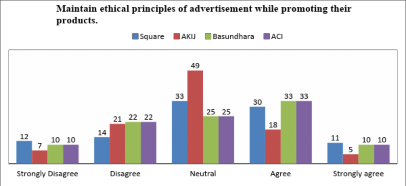
Figure 01: Maintain ethical principles of advertisement while promoting their products.
The figure above shows the response of the customers regarding the issue of maintaining the ethical principle of advertisement while promoting their products. It shows 11 percent of customers strongly agreed that Square group maintains the ethical principles while 12 percent strongly disagreed with the statement. On the other hand, 33 percent each agreed that Basundhara group and ACI group maintain ethical principles. 22 percent each disagree that the Basundhara group and ACI group maintain ethical principles. There was 49 percent customer who express their opinion as neutral about AKIJ group while 33 percent for Square and 25 percent each for ACI and Basundhara.
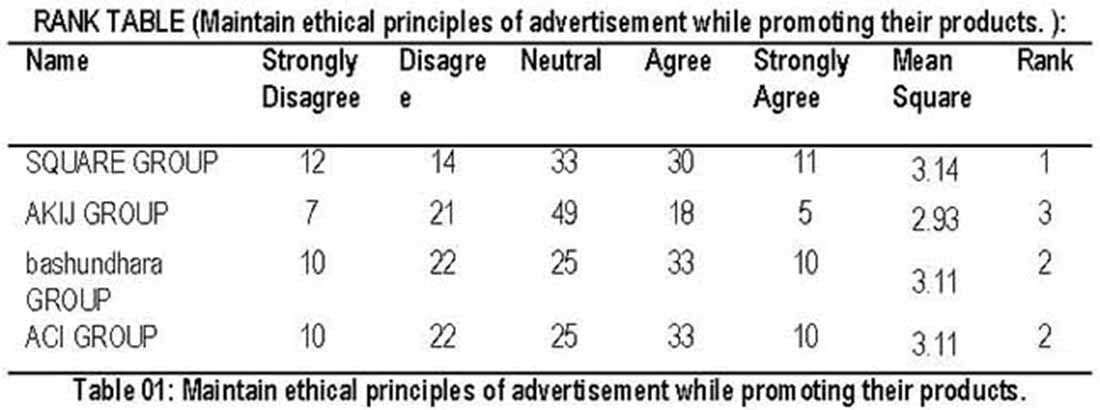
According to the rank table above, it is found that Square Group ranked first while Bashaundhara Group and ACI Group ranked second jointly in terms of maintaining the ethical principle of advertising.
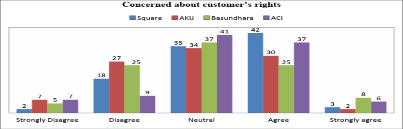
Figure 02: Concerned about customer’s rights
Most of the respondents agreed that the companies are concerned about customers’ rights as 42 percent agreed for Square, 30 percent for AKIJ, 25 percent for Basundhara and 37 percent for ACI. The figure shows another major portion of the respondents were opined neutral in that issue while 18 percent disagree for Square, 27 percent for AKIJ, 25 percent for Basundhara and 9 percent for ACI.
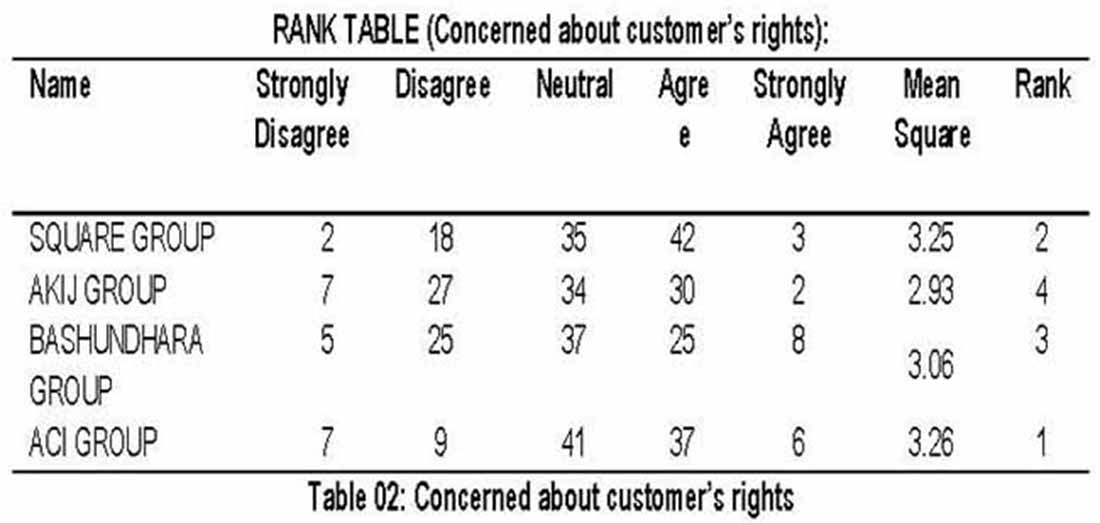
The table shows the ACI group ranked first about considering the rights of the consumer. Square Group ranked second on this point.
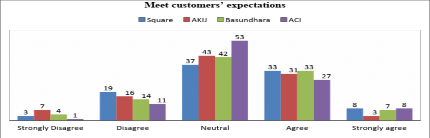
The figure (03) above shows the response about meeting the expectation of the customers. It shows 8 percent of customers each strongly agreed that Square group and ACI meet the customers’ expectations. On the other hand, 33 percent each agreed that Square and Basundhara group meet customers’ expectation while 31 percent agreed for AKIJ and 27 percent agreed for ACI. There was 19 percent of customers who disagreed about meeting expectations of customers of Square group while 16 percent for AKIJ and 11 percent each for ACI and 14 percent for Basundhara. It also shows a major portion of the respondents opined neutral in this issue.
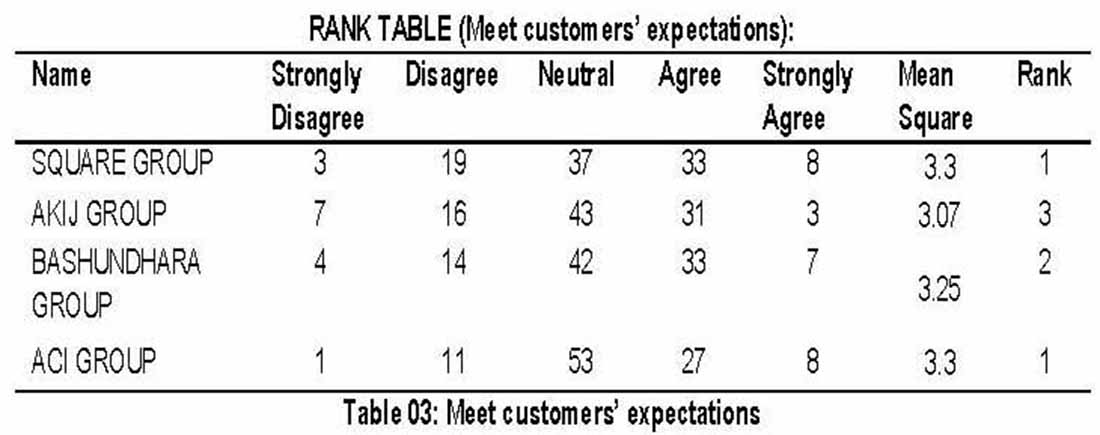
According to the table above, Square Group and ACI Group stood first on the point of meeting the expectation of the customers
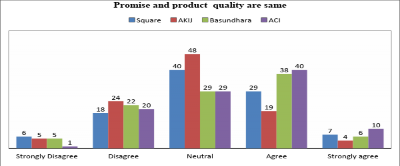
All the companies promise something better while promoting their products. The figure (04) above shows 40 percent of the respondents agreed while 10 percent strongly agreed the promise and products of ACI are the same while 38 percent agreed about Basundhara, 29 percent for Square and 19 percent for AKIJ. On the other hand, a big portion was neutral regarding the issue. It shows 24 percent customers disagreed that AKIJ group’s promise and product quality are same, 20 percent disagreed about Basundhara, and 20 percent disagreed about ACI and 18 percent about Square group.
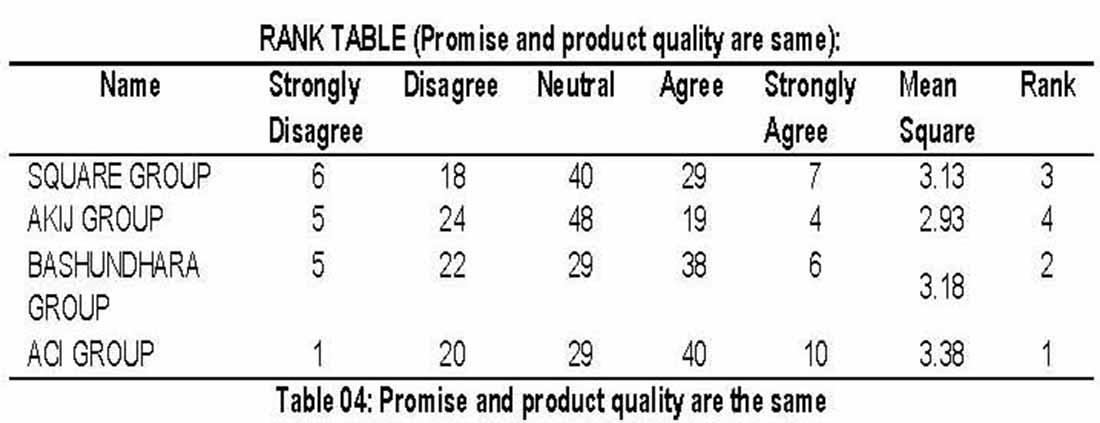
ACI Group ranked first in terms of keeping the quality of the product the same to their promised quality in the advertisement. Bashundhara Group is second while Square is ranked fourth.
The customers were provided four statements for each of four selected companies to know their opinionon the ethicality of the Television Commercials of those companies. It was found that none of the companiesmaintains the ethics properly according to the consumers. A large portion of the customers agreed that Basundhara and ACI Group maintain the ethical principles more than the other two companies while another large portion of the audience mentioned that Square Group is more concerned about their customers while ACI is in the second position in this point.
Most of the customers also opined that Square Group meets the expectation of the customers and ACIGroup keeps their promise that they use for their product in advertising more than the other products. The result of the survey shows AKIJ Group holds the last place in all aspects. But the interesting fact is, there is also a mentionable percent of consumers who disagreed with the statements for each company. And none of the companies got more than 45 percent positive opinion on the given statements.
Also a mentionable portion of the participants was neutral while giving their opinion on the statements for each companies advertising practice. So, it can easily be said that the companies of Bangladesh do not follow the advertising broadcasting policy properly and maintain the ethics of advertisement fully. As per the opinion of the customers, all the companies maintain the ethics partially. If one company tries to be concerned about the customers that the company somehow fails to keep its promises that it shows in the advertisement. At the same time, there are a lot of customers who also think about the opposite as well.
4. CONCLUSIONS
Advertisements provoke consumers to purchase any product or service. The companies spend a mentionable amount for marketing their products. But there is a major issue of ‘ethicality’, which should be maintained while promoting the products. As the companies use advertising agencies to promote their manufactured goods, they should take responsibility for violating customer’s rights. According to the study, all the companies in Bangladesh do not maintain the ethical aspect properly.
Companies should be more aware of the ethical ground during making an advertisement. The companies should follow the rules and regulations by the Bangladeshi Government, Customers Rights, Broadcast Code of Conduct, and Consumers Act. Unethical activities, false messages, over-promising, delivering poor quality products, or services than their commitment that they made through advertisement can hamper the images of any organization. That is why the company should recruit an expert marketing manager who can design the marketing policy and contact with advertising agencies for making the advertisement for them.
Based on the opinion survey and findings from the provided answer of the respondents, the followingrecommendations are made:
- 1. Companies should focus more on the ethical principles of advertising while they are promoting their product. In these circumstances, the AKIJ group should develop a policy to maintain the ethical principle of advertising and SQUARE group should keep their performance up.
- 2. Bangladesh has been becoming digitized rapidly for the last 10 years, which has helped thecustomers be more aware of their rights than before. So, companies should be more focused on customers’ rights while promoting their products or services. Like the first recommendation, AKIJ group should develop a strong policy in this ground as well while ACI should continue its policy.
- 3. Advertisement creates a desire to buy any products or services. So companies should be well concerned with providing the same products or services they promised which created desire/ expectations on customers' minds. AKIJ should keep this factor in mind while promoting its product and ACI and Square should continue their performance.
- 4. The promise through advertisement and the quality of the delivered product should be same. ACI should continue its performance while AKIJ should be more concerned about this issue.
- 5. Advertisement companies should follow the rules, regulations and broadcasting Code of Conduct of the Government of the People’s Republic of Bangladesh.
- 6. The Government of the People’s Republic of Bangladesh should be more focused on the Customers Rights act of Bangladesh.
- 7. The Government should be more strict on ad making agencies for maintaining the govt. Broadcast Code of Conduct in Bangladesh.
BIODATA
M. H PARVEZ: M Hasan Parvez, is Researcher and teacher at School of Management, Kalinga Institute of Industrial Technology (Deemed to be University), Bhubaneswar, Odisha, India (main employee), and is Sr. Officer, Daffodil International University, Bangladesh, His research areas are Public and Private Administration, Development Administration, Advertisements, Industrial Technology.
E. U. H EITEN: Ehatasham Ul Hoque Eiten is Researcher and teacher at School of Humanities, Kalinga Institute of Industrial Technology (Deemed to be University), Bhubaneswar, Odisha, India (main employee), and Holds Lecturer at Department of English, Daffodil International University, Bangladesh. Research areas are Public and Private Administration, Industrial Technology, social scientific, and Humanities.
BIBLIOGRAPHY
ALIYEVA, U (2017). Chanel ve ysl markalari üzerinden kadinlarin ötekileştirilmesine moda ile başkaldiriş (doctoral dissertation, istanbul aydin üniversitesi sosyal bilimler enstitüsü).
ANNÍA G, María Eugenia., VILLALOBOS ANTÚNEZ, José Vicente., ROMERO PABÓN, Julio Cesar., RAMÍREZ MOLINA, Reynier Israel., & RAMOS MARTÍNEZ, Yanelis. (2018). “Conciencia ética en organizaciones universitarias: un estudio fenomenológico de la praxis como continua formación”. In Revista Inclusiones, 5(4), pp. 179-195.
BAUMHART, R (1968). An honest profit: What businessmen say about ethics in business. Holt, Rinehart, and Winston.
BIN NOOH, MN, KHAIRI, KF, AB AZIZ, MR, ABDULLAH, M, & SHUKOR, SA (2014). “The Criteria andChallenges of Unethical Advertising”. American Journal of Business, Economics, and Management, 2 (4), p. 88.
BOULSTRIDGE, E, & CARRIGAN, M (2000). "Do consumers care about corporate responsibility? Highlighting the attitude-behavior gap”. Journal of communication management, 4(4), pp. 355-368.
CHONKO, LB, & HUNT, SD (1985). “Ethics and marketing management: An empirical examination”. journal of Business Research, 13(4), pp. 339-359.
CHRISTIANS, CG, RICHARDSON, KB, FACKLER, M, KRESHEL, P, & WOODS, RH (2015). Media Ethics:Cases and Moral Reasoning, CourseSmart eTextbook. Routledge.
DRUCKER, PF (1973). “Management: Tasks, Responsibilities”. Practice, p. 125.
HUQ, SM, NEKMAHMUD. M, AKTAR, MS (2016). “Unethical practices of Advertising in Bangladesh: A case study on some selective products”. International Economics of Sciences, Finance and Management Sciences, 4(1), pp. 10-19.
KALOGEROPOULOS, P, RUSSO, JA, SULLIVAN, P, KLOOGER, M, & GUNNINGHAM, S (2020). “Re-enfranchising Mathematically-alienated Students: Teacher and Tutor Perceptions of the Getting Ready in Numeracy (G.R.I.N.) Program”. International Electronic Journal of Mathematics Education, 15(1).
LAY RABY, N.D., RAMÍREZ MOLINA, Reynier Israel., & VILLALOBOS ANTÚNEZ, J.V. (2019). Sociología ydiscapacidad en el contexto laboral en Chile. First edition. Editorial Centro Internacional de Marketing Territorial para la Educación y el Desarrollo CIMTED. Medellín-Colombia.
LAU, GT, & LEE, SH (1999). “Consumers' trust in a brand and the link to brand loyalty”. Journal of Market- Focused Management, 4(4), pp. 341-370.
LAUREANO, RMS, FERNANDES, AL, HASSAMO, S, & ALTURAS, B (2018). “Facebook Satisfaction and Its Impacts on Fundraising”: A Case Study at a Portuguese Non-Profit Organization. Journal of Information Systems Engineering & Management, 3(1), pp. 4-7.
MALEKI, M., & PASHA, M. A (2012). “Ethical Challenges: Customers' Rights”. SCMS Journal of Indian Management, 9(4).
MARTÍNEZ, Suyis; RAMOS MARTÍNEZ, Yanelis y ANNÍA, María Eugenia. (2019). El coaching en educación. Utilidad para la transformación escolar mediante sistematización de experiencias. In Opción. Revista de Ciencias Humanas y Sociales. Año 35, No. 89-2: 1388-1439. Universidad del Zulia. Maracaibo (Venezuela).
MOHAMMADI, S, & YEKTA, P, (2018). “The Effect of Emotional Intelligence on Job Satisfaction among Stuff Nurses in Intensive Care Units”. UCT Journal of Social Sciences and Humanities Research, 6(2), pp. 1-7.
NANTEL, J, & WEEKS, WA (1996). “Marketing ethics: is there more to it than the utilitarian approach?”.European Journal of Marketing, 30(5), pp. 9-19.
NOORADI, M, BAGHERI NIA, H, & OULIAEY, A (2017). “Are the manager's bases of power related to job satisfaction?” UCT Journal of Management and Accounting Studies, 5(3), pp. 71-75.
RAMÍREZ MOLINA, Reynier Israel., CHACÓN ZÚÑIGA, H.C., & EL KADI JANBEIH, O. N. (2018). Gestiónestratégica del talento humano en las PYMES. First edition. Editorial Corporación CIMTED. Medellín- Colombia.
RINCÓN, Yanyn; SUKIER, Harold; CONTRERAS, Jairo & RAMÍREZ MOLINA, Reynier Israel. (2019). “Responsible Communication Strategies for Small and Medium-Sized Enterprises”. In Opción. Revista de Ciencias Humanas y Sociales. Vol. 35, No.89-2: 1208-1234. Universidad del Zulia. Maracaibo (Venezuela).
RAMOS MARTÍNEZ, Yanelis. (2007). Estrategias de la gestión directiva y construcción de la grandeza docente en las escuelas bolivarianas. In Revista electrónica de humanidades, educación y comunicación social, (REDHECS). Edición 2, año 2.
PAKDEL, M, & ASHRAFI, M (2019). “Relationship between Working Capital Management and the Performance of Firm in Different Business Cycles”. Dutch Journal of Finance and Management, 3(1)
SHAW, WH, & BARRY, VB (1995). “Moral Issues in Business”. Belmond. CA: Wadsworth.
SINGH, M (2014). “Ethical issues and principles related to advertising”. Abhinav National Monthly Refereed Journal of Research in Commerce and Management, 3(6), pp. 100-108.
TSALIKIS, J, & FRITZSCHE, DJ (2013). “Business ethics: A literature review with a focus on marketing ethics”. In Citation Classics from the Journal of Business Ethics, pp. 337-404. Springer, Dordrecht.
VITELL, SJ (1986). Marketing ethics: Conceptual and empirical foundations of a positive theory of decision making in marketing situations having ethical content (Doctoral dissertation, Texas Tech University).
WEINER, E (1992). “Business in the 21st Century”. The Futurist, 26(2), pp. 13-15.