Artículos
Received: 12 July 2020
Accepted: 14 August 2020
DOI: https://doi.org/10.5281/zenodo.3987599
Abstract: This study is a literature review that aims at describing appropriate entrepreneurial leadership models for vocational school students. There were three steps conducted in this study namely, designing the review, conducting the review, and analysis. The data of the study were taken from books and scientific articles from national and international journals. Specifically, this article describes leadership models, problems of the current leadership models, entrepreneurial leadership model, characteristics of entrepreneurial leaders, and the theoretical and practical implications of the entrepreneurial leadership model. It is expected that this article can give sufficient knowledge and information about the entrepreneurial leadership model.
Keywords: Entrepreneurial leadership model, Vocational school, Education, 21st century..
Resumen: Este estudio es una revisión de la literatura que tiene como objetivo describir los modelos de liderazgo empresarial adecuados para estudiantes de escuelas vocacionales. Se realizaron tres pasos en este estudio, a saber, diseño de la revisión, realización de la revisión y análisis. Los datos del estudio fueron tomados de libros y artículos científicos. Específicamente, este artículo describe modelos de liderazgo, problemas de los modelos de liderazgo actuales, modelo de liderazgo emprendedor, características de los líderes emprendedores y las implicaciones teóricas y prácticas del modelo de liderazgo emprendedor. Se espera que este artículo pueda brindar suficiente conocimiento e información sobre el modelo de liderazgo empresarial.
Palabras clave: Modelo de liderazgo emprendedor, Escuela vocacional, Educación, Siglo XXI..
INTRODUCTION
Ki Hajar Dewantara defined education as the effort to develop the growth of manners (spiritual power and character) and thought (intelligence and physical) of the child (Dewantara: 1967). In the National Education System Act in paragraph 1 states, education is defined as a conscious, planned effort to create an atmosphere of learning so that students actively develop their potential to have spiritual strength, control, self, personality, intelligence, noble character, and skills that are it needs itself, society, nation, and state. The National Education System Law discloses three aspects of education (Villalobos et al.: 2020, pp. 984-1018; Ahmad & Ahmad: 2019, pp. 746-778; Villalobos & Ramírez: 2018, pp. 1012-1587; Musfah: 2015).
Conscious and planned effort to create a learning atmosphere and learning process. First, education must be prepared carefully through the quality of teachers, classes, media, methods, evaluations to supporting infrastructure for educational success. Education that is not well planned affects the quality of the learning process that leads to not achieving educational goals. Second, students' potential in the form of attitudes, knowledge, and skills. The purpose of education is to produce skilled and pious humans. Faith and Taqwa as well as Science and Technology human beings are human beings who are skilled and good towards others and God. Third, a knowledge that is beneficial to individuals, society, and the nation. The ultimate goal of school and college is that people should be able to live happily and make others happy.
Education is the way to builds the quality of human resources towards the era of globalization in the 21st century which is called the digital age. This is a world in which education is moving from the industrial age to the connected age (Frankli: 2015, pp. 1089-1096).
In this century, the communication system has crossed national borders by using increasinglysophisticated technological devices. The internet is considered very helpful for humans to communicate (Ramadhan: 2019) as communication represents an essential and very important human need as well as a basic human right (Sen: 2015, pp. 2813-2817; Ahmad & Ahmad: 2018, pp. 44-49). Education is one of the fields that benefited by the internet since it brings opportunities for all of the scholars or academicians, especially the students, to have an education tool for accessing a source of academic and scientific information easily (Dogruer et al.: 2011, pp. 606-611).
Human capital is more important than any natural richness that a nation can have (Neamtu: 2015, pp. 413-420). In the present-day, context of the global economic development, human resources represent the essential elements of the competition, both on a national and international level (Iatagan et al.: 2010, pp. 5139- 5146). Human resources are commonly known as human capital included skills, knowledge, or value of people is the foundation of national growth. It was proven previously that human capital is crucial in ensuring economic growth expressed as gross domestic product per capita (Pelinescu: 2015, pp. 184-190). Besides that, an investment in the quality of human capital through education and health will improve the living standard of people and societal welfare (Olopade et al.: 2019, pp. 1-7; Ahmad & Sahar: 2019, pp. 1540-1543). Good human resources will certainly be of high benefit to a nation, but good human resources if not managed properly by human resources will become a burden.
The cause of the declining trend in the quality of Indonesian human resources is certainly due to various factors that influence it. One important factor causing the low HDI ranking of Indonesia is the Pure Participation Rate and the Gross Enrollment Rate of Education.
Some of the problems that cause the Gross Participation Rate and the Pure Participation Rate for SMA / SMK / SMLB have not reached the targets set, among others: 1. Economic factors; the inability of parents to pay for their children's education at the secondary school level; 2. a low level of parental education results in parents having doubts about continuing their children's education to secondary school; 3. geographical factors; the difficulty of access to school, lack of access to public transportation; the distance from home to high school is very far; 4. lack of high school / vocational education services provided by local governments and the community; 5. awareness of parents to send their children to high school / vocational school level is still low; 6. There are still many junior high school students aged 16-18 who repeat at junior high school anddrop out of high school students. There were 28,470 (0.28%) middle school students must study over again, and 31,123 (0.67%) high school students who dropped out of school in the academic year 2017/2018. There are still many parents who choose Pesantren as a place of education other than formal education after graduating from Junior High School. One of the main reasons was the desire of the parents to make their children having a good character (Supriatna: 2018, pp. 1-18).
Other problems faced by Vocational Schools in Indonesia are the achievement of the Vocational School expertise package until 2018. Of the 14,199 Vocational Schools that are accredited A (3,805), accreditation B (6,139), accreditation C (2,412), and not accredited (328). The low level of accreditation A in vocational schools has not been maximized to achieve national education standards and in the report also that the government is only trying to increase the number of SMK schools that are accredited to a minimum of B, in 2018. The average value of national examinations for vocational schools has decreased by 2018 targets to get a score of 7, but the realization of 4.52% (64.58% achievement).
Based on observations at some universities in Medan such as Medan State University and the Muhammadiyah University of North Sumatra, many vocational school graduates were found who continued their studies not suitable for the study programs they were undertaking while at school. Some students work not suitable for the occupied skills program. For example, students in the Computer Network Engineering expertise program switch to majoring in English Language Education. This is consistent with research Herawan, Kurniady, & Sururi (Herawan et al.: 2014) said that on vocational education that there are constraints in terms of adjustment of graduates with relevant stakeholders such as business and industry, where graduates after graduation were still required additional science or experience under the needs of business and industry. The rate of return and productivity of the Vocational High School graduates was lower than Senior High School graduates (Ngadi: 2014, pp. 59-70). Even, Vocational High School graduates contributed as the highest unemployed graduates compared to the other graduates at the same level of education (Khurniawan et al.: 2019). They could not compete and get a job (Tentama et al.: 2018, pp. 85-92).
The quality policy and implementation strategies in implementing new quality assurance are seen as aslogan or just fill accreditation requirements only, not entirely the school in question refers to the quality policy that is applied in the operational running of education that can improve the quality of education. Besides that, the policy of improving the number of Vocational High School graduates was irrelevant to the national economy growth (Slamet: 2016, pp. 301-311; Ramírez et al.: 2019, pp. 2477-9385). The incapability of the school to provide required facilities and skilled teacher/instructor to support students’ learning and practices, as well as competitiveness, is also another issue to be considered (Baharuddin & Dalle: 2017, pp. 1-13).
Vocational education is as part of the learning process to acquire and improve knowledge and skillsoutside the education system that applies in a relatively short time and with methods that prioritize practice rather than theory. The purpose can then be viewed on a spectrum with training for specific, narrowly defined jobs at one end and, at the other, a more general preparation designed to help young people lead productive and fulfilling adult lives as workers and citizens (Fuller: 2015, pp. 232-238).
Based on observations and interviews with the Head of the Vocational School 1 Beringin-Deli Serdang, and several deputy heads at the Vocational School 1 Percut Sei Tuan, there were still school principals who had not carried out their duties and functions to the full. Such as, educators and education staff who are not by their educational background. The educational staff aspect has very ideal criteria. However, both public and private vocational schools have weaknesses in librarians and laboratory assistants. Librarians and laboratory staff-owned are not under their educational background. Now and in the future, strong vocational school leadership is needed starting from the top line such as the Director-General of Vocational Education of the Ministry of Education and Culture to the lowest i.e. the principal, educators, and the education staff.
Leader as a change agent should think about the changes taking place and has led to demands for continuous education, educating students in schools is not a disconnected phase, but should be a dynamic contribution to its development, it is necessary to study human beings in the context of life-long education.
Current developments have led to the need for networking in people's lives, and this requires educational institutions or schools that are creative and innovative, to be able to make students intelligent comprehensive and have strong competitive capabilities that determine the success in facing and playing a role in the era of globalization and technological development fast. Education of teachers and other education personnel can no longer perform the usual response in the face of this reality. Efforts are needed to carry out educational reforms from the top to the lower levels (Suharsaputra: 2016). Efforts to change and develop the quality of vocational education need to be accompanied by a leadership capable of promoting the advantages of vocational education institutions (Harrison et al.: 2017, pp. 235-264; Ramírez et al.: 2018, pp. 826-854).
Vocational leadership is required to have the ability in the field of entrepreneurship. When a leader applies the principles of entrepreneurship in influencing his subordinates to do something by predetermined goals, both related to business organizations and non-profit organizations. Moreover, one of the keys of entrepreneurial attitudes and life is creative and innovative which will be needed in various fields of life, including in the fields of management and leadership and today the level of change is happening very quickly in various fields of life so entrepreneurial leadership is needed.
Like the results of the study conducted by Rohmah, Nurjanah, & Hayati (Rohmah et al.: 2017, pp. 522-535) claimed that entrepreneurial leadership owned by the school principal could increase entrepreneurial knowledge in school residents, especially teachers as professional educators with the main task of educating, teaching, guiding, directing, training, evaluating and evaluating students. Increased knowledge of teacher entrepreneurship as professional education in the era of the ASEAN Economic Community (AEC) through providing information to teachers to follow technological developments, socialization about entrepreneurship, and motivation to develop potential in teachers, the growth and development of entrepreneurial spirit for teachers include active, creative, empower, create, have initiative, and can improve the quality of education in the era of the ASEAN Economic Community (AEC). Teachers can produce an entrepreneurial spirit in the learning process so that students have superior competitiveness.
Based on the description above, it is necessary to examine in a way that can provide a clear picture of effective leadership models such as what is needed for Vocational Education in Indonesia in the 21st century.
METHODS
This study is a literature review that followed the four steps of the systematic literature review method as proposed by Snyder (Snyder: 2019, pp. 333-339). Those four steps are designing the review, conducting the review, analysis, and writing the review. Designing the review is the first step that was conducted to identify the background of the study, urgency, objective, and the review technique. Conducting the review is the second step that aimed at collecting the needed data from books and scientific journals that discuss leadership and entrepreneurial leadership. The third step of the study is analysis, during this step the researcher analyzed the collected data from the books and scientific journals. The analysis was conducted qualitatively. The last step is writing the review, it is the step when the researcher writes down the result of the analysis in the form of an article.
RESULTS
Leadership Model
Leadership is an important differentiating factor in an organization where it achieves success or failure, victory or defeat, glory or weakness, acceptance, or rejection. Leadership has also been discussed by smart scholars since ancient times. Leadership is included in the applied sciences group or applied sciences in the social sciences because the principles and formulations are beneficial in human welfare. So, to understandeverything related to aspects and problems, it is necessary to understand, the meaning or understanding of leadership from various perspectives from various experts.
Leadership is the process of affecting group activities to target and achieve goals (Allameh & Davoodi: 2011, pp. 3131-3137). It is often associated with the entrepreneur as being a part of the formula for success. Leadership is a translation of the word leadership which comes from the word "leader". The leader is the person who leads, while the leader in the position. In another sense, etymologically the term leadership comes from the basic word "Lead" which means guidance. From "lead" as the verb "lead" is born which means to guide. The word leader means giving guidance, guiding, directing, and walking ahead (precede) (Poerwadarminta: 1984).
Leadership is very important in organizational management (Poerwadarminta: 1984). Leadership needed by humans because there are certain limitations in human beings. From this arises the need to lead and be led. Leadership is defined in terms of individual characteristics, habits, ways of influencing others, interactions, position in the organization, and perceptions of legitimate interactions.
A similar opinion was expressed by Wirawan (Wirawan: 2013) that leadership as a process of leaders creating a vision and interacting with each other to realize the vision. As for a more detailed explanation namely;
a. Process. Leadership is a process, which can be likened to a production process in a productionmanagement system. The leadership production process consists of leadership input, process, and output. The process can also be interpreted that the leadership process requires time, not something that happens instantly. A process of interacting influences in leadership requires time, the length of time depends on the situation of the leadership altar, the quality of leaders, and the quality of followers.
Tabel 1. Leadership as a system process
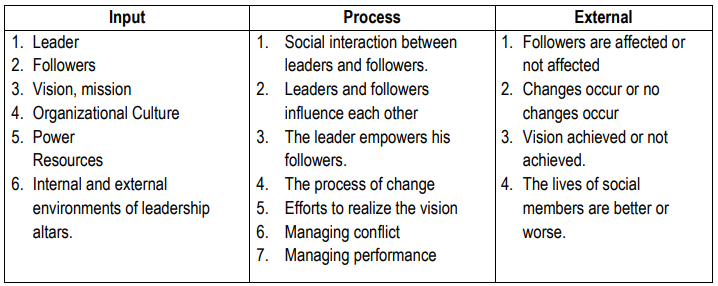
b. Leader. The essence of leadership is a leader in which every organization or social system has a different title or title. In political leadership, the leader is called the president, king, queen, prime minister, Speaker of the Parliament, Speaker of parliament, chairman of the party, and so on.Hidayat (Hidayat: 2018) expressed that Leadership (leadership) is the ability to move, influence, motivate, encourage, direct, advise foster, guide, train, order, order, ban, and even punish all organizational resources to achieve desired goals effectively and efficiently. This understanding shows that in leadership there are three elements, namely leader (leader), member (follower), and situation (situation).
Transformational Leadership Model
The term transformative leadership comes from two words, leadership and transformative, and transformational. The term transformative is based on the word to transform which means to transform or change something into another different form. Transformative leadership is a type of new leadership (new leadership paradigm) that is seen as effective in explaining the change, especially in transitional environmental situations.
Transformative leadership can be defined as the ability of a leader to work with, and/or through other people to optimally transform organizational resources to achieve the stated goals (Hidayat: 2018). Transformative leaders can motivate people to do more than they had previously expected to do-to transform themselves and their productivity (Winzenried et al.: 2010, pp. 221-232). Transformational leadership involves efforts to go beyond self-interest towards joint efforts for organizational progress. The real essence of transformational leadership that a leader makes followers do more than they are expected to do, and the follower knows and believes that the leader will not profit from them. Transformational leadership also enhances job satisfaction and team performance at individual and team levels of analysis, and directed attention to the relevance of trust among team members, also, to trust in supervisors (Braun et al.: 2013, pp. 270-283).
Transformational leadership will be able to be implemented if it is guided by the principles of transformational leadership. There are seven principles of transformational leadership, including (Apriansa: 2018);
- 1.
Implications
Leadership success begins with a vision that will be a mirror and a common goal. The ability and skill to express a clear, practical, and transformational vision that can answer the question. Where will we go?
- 2.
Motivation
The ability to get a commitment from everyone involved in the vision that has been explained is the second thing that needs to be done. When transformational leaders can create a sense of integrity within the organization, it should also be obtained to optimize, motivate, and energize each of his followers. Practically it can be in the form of tasks that are truly challenging and provide opportunities for them to be involved in a creative process, both in terms of giving proposals and making decisions in solving problems so that this will provide added value for themselves.
- 3.
Facilitating
It is the ability to effectively facilitate learning within organizations in an institutional, group, or individual manner. This will have an impact on increasing the intellectual capital of everyone involved in it.
- 4.
Innovation
The ability to boldly and responsibly make a change when needed and become a demand with the changes that occur. In an effective and efficient organization, everyone involved needs to anticipate changes and they should not be afraid of those changes. Transformational leaders must be swift in responding to change without sacrificing trust and the work team that has been built.
- 5.
Mobility of movement
Mapping out all available resources to complement and strengthen everyone involved in achieving the vision and goals. Transformational leaders will always seek followers who are full of responsibility.
- 6.
Preparedness
The ability to always be ready to learn about themselves and welcome change with a positive new paradigm.
- 7.
Commitments
Associated with a commitment to always solve problems properly and thoroughly. Therefore, it is necessary to develop discipline, spiritual, emotional, and physical as well as commitment.
Visionary Leadership Model
Visionary leadership is a model or pattern of leadership that is meant to give meaning to work and effort that is carried out jointly by all components of the organization by giving direction based on clearly made vision. The key concept of visionary leadership is vision. The vision of the organization created is not merely sentences that are arranged so that they are pleasant to read and hear. Vision is a statement about the picture of the situation and characteristics that the organization wants to achieve far in the future. Vision is a power or power to make changes, which encourages the process of creativity trade through integrity and the synergy of various experts from the people in the organization (Hidayat: 2018).
Visionary leadership is the ability to create and articulate a vision that is realistic, trustworthy, andinteresting about the future of the organization or organizational unit that continues to grow and improve compared to now. Visionary leadership focuses on creating and communicating an inspiring vision among subordinates to achieve and sustain superior performance (Dhammika: 2016, pp. 1-10).
Visionary leaders have a very important role in visionary leadership. The role is related to (Hidayat: 2018);
- 1.
Direction Setter
This role is a role where the leader presents a vision, assures an image or target for the organization, to be achieved in the future, and involves employees from "get to go". This is the view of experts and leading practitioners is the essence of leadership. As a direction maker, the organization's leader conveys a vision, communicates it, motivates employees, and assures employees that what they are doing is right and supports participation at all levels and all stages of the business towards the future.
- 2.
Agent of change
Change agents are the second important role of visionary leaders. In the context of change, the external environment is central. Economic, social, technological, and political changes occur continuously, some take place dramatically, and others take place slowly. Of course, customer needs, and choices change as changes in stakeholders' desires. Effective organizational leaders must constantly adjust to these changes and think ahead about potential and changeable changes.
- 3.
Spoke Person
Getting messages out and talking is arguably an important part of dreaming about the organization's future. An effective organizational leader is someone who knows and appreciates all forms of communication available, to explain and build support for the organization's future vision. The organization's leader as a spokesperson for other visions must announce a message that binds all employees to see themselves and touch the vision of the organization, both internally and externally. The vision conveyed must be useful, interesting, and raises about the future of the organization.
- 4.
Coach (Coach).
Visionary leaders are good trainers. Organizational leaders use group cooperation to achieve the vision. An organizational leader coordinates their activities or efforts, towards achieving victory or toward achieving a vision of the school. The organization's leader, as the trainer, maintains the work to focus on the realization of the vision by directing assignments and building trust among the organization's resources that are important to the organization and its vision for the future (Apriansa: 2018). The characteristics of visionary leaders that are unique in self-confidence, self-awareness, and empathy. The visionary leader will articulate a goal, which for him is a true goal, and in harmony with the shared values of the people in the organization (Apriansa: 2018).
Transactional Leadership Model
The transactional leadership model is the relationship between leaders and followers based on agreement and value or the exchange process (money transactions). The transaction is expected to benefit both parties (Usman: 2011). Transactional leadership emphasizes the task-related exchange of actions and rewards between followers and leaders (Aga: 2016, pp. 517-525). According to Bass in Djamaluddin Ancok (Anchok:2012), transitional leadership models are characterized by the nuances of transactions between those led and those who lead, namely;
-
Clarifies terms of the contract. The leader explains to the person being lied about the things that must be done and the consequences to the employee in terms of performance appraisal, compensation, and career if the work performed meets the demands of the work contract. In everyday language, this employment contract is a kind of job description.
-
Enforce compliance with rules and standards. This is related to the responsibility of the leader to always uphold the importance of compliance with work procedures and company regulations, as well as the standard of work that must be met by employees.
-
Arranges contractual agreements. The leader agrees with the employee if the work target and quality of work are achieved, then the employee will get a bonus.
-
Subordinate supervises to ensure work is carried out and effectively. Leaders supervise employees in working so that employees work effectively. There are two types of oversight carried out by transactional leaders. The first is active management by exception whose character is that the leader is always actively supervising employees working, whether under the rules and regulations that exist or not. The second is passive management by exception where the leader is passive in supervision. He must do if something has happened to the employee.
-
Isolates work from the changing environment. Transactional leaders only pay attention to what has been agreed by the company about what needs to be done and pay little attention to whether the things are done are indeed by the demands of the changing business environment.
-
Uses contingent rewards to influences motivation. In motivating employees to want to work, transactional leaders focus more on providing extrinsic motivation, which is something that comes from outside themselves, such as salary, bonus, promotion, and other recognition.
-
Ensuring the equity of the rewards. A transactional leader tries to be fair in distributingImportar listacompensation, to match the contribution of each employee.
The essence of this transactional leadership model is dependent on the presence of leaders who are fit to be able to meet the needs of performance and job satisfaction of their groups individually. Based on their abilities and characteristics of personality, behavior, and decision style. Then the leader must be able to influence the occurrence of valence, instrumentalities, expectancies, and role perceptions, and outcomes or rewards (Wijono: 2018).
Charismatic Leadership Model
Charismatic is a Greek word that means "divinely inspired gift" such as the ability to perform miracles or predict future events (Yulk: 1988). Charismatic leadership is not based on authority or tradition but by followers is said to have extraordinary abilities. Charismatic leaders prefer to set an example in their behavior to be followed by followers. Role modeling is more concerned with imitation of leader behavior. If adherents admire and identify themselves with a leader, they will likely try to emulate or believe these values and beliefs. Through this process, charismatic leaders can exert considerable influence on the satisfaction and motivation of their followers (Yulk: 1988).
Charismatic leadership is a leader who with the strength of his abilities can have an extraordinary effect on his subordinates. Charismatic leaders have a high desire for power and a sense of ability that is also high and a belief in the moral truth of their beliefs. Thus, charismatic leaders have extraordinary powers in influencing their subordinates (Suharsaputra: 2016). Charismatic leaders, who may become across with at any rank of organizations, have been identified as leaders who inspire, show trust, awaken respect, and motivate positive thinking for the future, help members realize things of the essence, transfer the feeling of mission and stimulate them to behave accordingly (Klein & House: 1995, pp. 183-198).
It has been believed that qualifications of charismatic leadership entailing the qualifications ofresponsiveness to the environment, undertaking risk, and discontinuing the status quo help provide thecreativity-supporting environment while motivate and strengthen members to act according to the manner (Findikli & Yozgat: 2012, pp. 227-236).
The types of charismatic leaders can be divided into two namely, visionary charismatic leaders and charismatic leaders in critical times. Visionary charismatic leaders are trying to realize a shared vision of the future. Visionary charismatic’s leaders through good communication can connect between the needs and targets desired by their followers to achieve the targets and/or tasks assigned by the organization. Visionary charismatic leaders can see a big picture and the opportunities that exist in the big picture. While the type of critical mass leader is the type of leader known charismatics but reached critical positions such as Sukarno and Hatta, Megawati, and Gusdur as well as other leaders such as Ki Hajar Dewantara and Raden Adjeng Kartini (Wijono: 2018).
Types of Leadership
Style means attitude, movement, behavior, beautiful attitude, good gestures, strength, and ability, to do well. The leadership style is a set of characteristics that are used to influence subordinates so that the organization's goals are achieved. In another sense, leadership style is a pattern of behavior and strategy that is often mastered and often applied by a leader. The leadership style is called the overall pattern of the actions of a leader, both visible and invisible by a subordinate. Leadership style describes a consistent combination of the philosophy of skills, traits, and attitudes that underlie a person's behavior. A leadership style that shows directly or indirectly about a leader's confidence in the abilities of his subordinates. That is, leadership style is the behavior or strategy resulting from a combination of philosophy, skills, traits, and attitudes. Style is often called the type of leadership (Hidayat: 2018).
Types of leadership (Hidayat: 2018) are;
-
Charismatic leadership type; in a charismatic leadership type, it has extraordinary energy, attraction, and carrier to influence others so that it has a very large number of followers and trusted bodyguards. Even now people do not know the true reasons why a person has such great charisma. He is considered to have supernatural power, and superhuman abilities, which he obtains as an almighty gift. He has a lot of inspiration, courage, and firm belief in his stance. The totality of the leader's personality exudes enormous influence and appeal. The totality of the leader's personality exudes enormous influence and appeal.
-
Paternalistic type, namely the type of fatherly leadership, with the qualities, among others.
-
Autocratic type. This leadership bases itself on absolute strengths and practices that must be fulfilled. The leader always wants to act as a single player or a one-man-show. Ambitious to rule the situation. Every order and policy is determined without consulting subordinates. Change children are never given in- depth information about plans and actions to be taken. All praise and criticism of all subordinates are given on the personal consideration of the leader himself.
-
The type of laissez-faire: In the type of leadership of laissez-faire in, the leader of the practice does not lead, he lets the group and everyone does as they wish. The leader does not participate in the least in his group activities. All work and responsibilities must be carried out by subordinates themselves. He is a symbolic leader, and usually does not have technical skills, because his position as director or chairman of the council, commander, or head is usually obtained through bribery, kickbacks or a system of nepotism.
-
Populist type; Populist leadership as leadership that can awaken people's solidarity. Pollution leadership holds fast to traditional community values. Do not trust the support of foreign powers and aid. This type of leadership reinforces the (re) living of nationalism.
-
Democratic type; Democratic leadership is oriented to people and provides efficient guidance to their followers. There is case coordination among all subordinates, with an emphasis on a sense of internal responsibility and good cooperation. The strength of this democratic leadership lies not in the person or individual leader, but the active participation of each group. Democratic leadership respects the potential andImportar listathe individual is willing to listen to the advice and suggestions of his subordinates. Willing to recognize the expertise of specialists with their respective fields, able to utilize the capacity of each member as effectively as possible at the right times. Democratic leadership is often referred to as group developer leadership.
Problems of the current leadership model
Emerging theories about leadership by experts and written in books and research results show that leadership plays an important role. Likewise, in the practices of leadership implementation is the most expected subject of many people, especially for subordinates or the community as followers. In the era of distortion where the world of education in Indonesia faces a big challenge. It takes a leader who can solve all problems and of course bring a more qualified Indonesian education. Many models of leadership and leadership types have been applied, some models survive and can bring success. But not a few models and types of leadership that are applied are not successful and cause setbacks.
From the discussion of the leadership models written above such as the transformative leadership model, visionary leadership, transactional leadership, and charismatic leadership. The author found a number of these models experienced problems. For example, charismatic leadership. From the results of an empirical study conducted by Smith in which he asked people to choose charismatic and non-charismatic leaders, then asked the subordinates of these leaders to give information about them on a questionnaire that measures the indicators and reactions of followers. The results show that followers of charismatic leaders have more self- confidence and feel work as heavier. However, contrary to the theory, they did not show blind obedience to the leader (Yulk: 1988). Charismatic leaders are also so rare that they cannot be applied in many organizations.
On the other hand, the problem of leaders today is that they are not visionary leaders. Leaders now still do not show competence as expected by the visionary leaders including, that a visionary leader must have the ability to communicate effectively with managers and other employees in the organization. This communication is rarely owned by leaders today. Moreover, the current leader is more transactional. Although there has been no research that shows that the brand was chosen because it was based on bribes, or because there were insiders as discussed above, but transactional leaders are more concerned with the existence of transactions in terms of financial transactions.
If we look at the results of research by Imran Asghar, the visionary and innovative leadership has an impact on organizational change for better and success (Asghar: 2010). Whereas the issue of transactional leadership, although transitional leadership helps organizations achieve their present goals more efficiently and more towards achieving routine goals. But there is a weakness that there must be a conditional reward. So, the transitional leadership is not very suitable for the era of change. This is under the opinion of transactional leadership. It is difficult to have a competitive ability in an era of change (Suharsaputra: 2016).
DISCUSSION
In the writings discussed above specifically, the Entrepreneurship Leadership proposed by the author certainly has implications if applied at the Ministry of Education and Culture in particular the Director-General of Vocational and Vocational High School Education.
Based on the results of the above understanding which is based on theoretical studies from books and journals, and understanding of entrepreneurial leadership becomes important for top levels such as the director-general to the head of vocational school. Understanding related to entrepreneurship leadership will certainly advance someone to act following the theory.
For example, in entrepreneurship leadership, a person must have the courage to take risks to open a business in various opportunities. Having the courage to take risks means to be mentally independent and dare to start a business, without being overwhelmed by fear or anxiety even in uncertain conditions.
If this is truly understood by leaders in the top manager to the low manager environment such as the Director-General of Vocational Schools to the principal, then of course in implementing the policy they always have the feeling as discussed in the theory above. The Director-General must be able to solve the problems of vocational education in Indonesia, which of course starts new ventures without fear and anxiety. New businesses that can be proposed are of course based on the theory of not doing ordinary activities.
From the theoretical study above, Entrepreneurial leadership is a leadership/leader who can anticipate various changes with a clear vision of the future and seeks to encourage cooperation in carrying out change through flexibility in carrying out their duties and roles. The condition is certainly very useful so that all changes that occur at this time can already be anticipated.
In vocational and technical school management issues always relate to leaders. A common weakness experienced by educational institutions today is that it is treated as a social institution. The leaders in the world of education in Indonesia considered themselves as volunteers with an emphasis on dedication not as professionalism. As a result, many opportunities owned by schools did not run optimally.
The emergence of entrepreneurship leadership can certainly have a good impact on education in Indonesia. Some research results that show that entrepreneurship leadership greatly affects the progress of the organization can be a basic capital. It was proven that entrepreneurial-minded school principals can improve and maintain a good relationship between school and both internal and external stakeholders (Suyitno et al.: 2014, pp. 44-64). The application of entrepreneurial leadership also significantly increased the commitment and loyalty of stakeholders to the vocational education organization, with the educational institutions noted for excellence (Dardiri et al.: 2017, pp. 361-367).
The Director-General of Vocational School Education must be able to apply entrepreneurial leadership among them by daring to take extraordinary policies because the explanation above shows how relevant entrepreneurship leadership is in advancing organizations like schools today. Entrepreneurial leadership requires creative and innovative responses. Moreover, the urgency of entrepreneurial leadership is based on the development of science and technology.
With entrepreneurship leadership, vocational school principals can take bold policies, including how to make and build creative efforts needed by external parties. Besides, because entrepreneurial leadership is a leader who implements thoughts, attitudes, and entrepreneurship behavior, it does not depend on the level and position in the organization so that this leadership is more dispersed and very strong with integrated leadership in the mind and spirit of entrepreneurship. There are some possible outcomes of entrepreneurial leadership such as wealth creation, firm performance, innovation performance, and strategic management of resources (Ranjan: 2018, pp. 104-114). Moreover, entrepreneurial leadership is needed to be able to control the uncertain conditions in the fast pace of competition. In this digital era, besides leadership skills, information and communication technology mastery and digital literacy are also very important skills to be mastered by the vocational school students (Baharuddin & Dalle: 2017, pp. 1-13).
CONCLUSION
The era of globalization is so fast, of course, a challenge for various organizations. Like in education. The problem that there is a general weakness experienced in education which is leadership problems. There is no effective leadership model that can solve the problems of vocational schools. Leaders who are supposed to be agents of change are required to think about changes that occur then in the current development it has led to the need for networking in people's lives, requires creative and innovative educational institutions/schools, to be able to make comprehensive intelligent students and have strong competitive capabilities that are crucial success in dealing with and playing a role in the era of globalization and rapid technological development.
Educational institutions through educational leadership, teacher education, and other education personnel are no longer able to make the usual response in dealing with this reality. Efforts are needed tocarry out educational reforms from the top to the lower levels. Vocational school leadership is required to have the ability in the field of entrepreneurship. If a leader applies the principles of entrepreneurship in influencing his subordinates to do something under predetermined goals, both related to business organizations and non- profit organizations. Moreover, one of the keys to entrepreneurial attitudes and life is creative and innovative which will be needed in various fields of life, including in the fields of management and leadership.
BIODATA
M. ARIFIN: Muhammad Arifin, currently studying in the Doctoral Education Management program at Medan State University (2018-now). His qualification is a lecturer of Management of Education and Curriculum and Learning of the Teaching and Education Faculty, Universitas Muhammadiyah Sumatera Utara (UMSU), North Sumatera, Indonesia. Since 2017 until now his position is Head of the Library of Universitas Muhammadiyah Sumatera Utara (UMSU), North Sumatera, and Indonesia.
G. GUNAWAN: Gunawan, currently studying in the Doctoral Islamic Education Education Program at Muhammadiyah University of Malang (UMM) (2015-now). His qualification is a lecturer of Islamic Education in Islamic Faculty Universitas Muhammadiyah Sumatera Utara (UMSU), North Sumatera, and Indonesia. Since 2015 until now his position is Secretary of University in Universitas Muhammadiyah Sumatera Utara (UMSU), North Sumatra, Indonesia.
BIBLIOGRAPHY
AGA, DA (2016). "Transactional leadership and project success: the moderating role of goal clarity".
AHMAD, I., & AHMAD, S. (2018). “Multiple Skills and Medium Enterprises’ Performance in Punjab Pakistan:A Pilot Study”. Journal of Social Sciences Research, 7(2010), 44-49.
AHMAD, I., & AHMAD, S. (2019). “The Mediation Effect of Strategic Planning on The Relationship Between Business Skills and Firm’s Performance: Evidence from Medium Enterprises in Punjab”, Pakistan. Opcion, 35(24), 746-778.
AHMAD, I., SAHAR. (2019). “Waste Management Analysis From Economic Environment Sustainability Perspective”. International Journal Of Scientific & Technology Research 8(12), 1540-1543.
ALLAMEH, SM, & REZA DAVOODI, SM (2011). "Considering transformational leadership model in branches of Tehran social security organization". Procedia Social and Behavioral Sciences, 15, pp. 3131-3137.
ANCHOK, D (2012). "Leadership psychology and innovation". Jakarta: Erlangga.
APRIANSA, ET (2018). "Leadership and organizational behavior". Bandung: Refika Aditama.
ASGHAR, WA (2010). "The role of leadership in organizational change, relatives the successful and innovativeleadership faculty of engineering and sustainable development". India: University of Gavle. Procedia Computer Science, pp. 517-525.
BAHARUDDIN, O, & DALLE, J (2017). "Interactive Courseware for Supporting Learners Competency in Practical Skills". TOJET: The Turkish Online Journal of Educational Technology, 16(3), pp. 1-13.
BRAUN, S, PEUS, C, WEISWEILER, S, & FREY, D (2013). "Transformational leadership, job satisfaction, and team performance: A multilevel mediation model of trust". The Leadership Quarterly, 24(1), pp. 270-283.
DARDIRI, A, ALFIANTO, I, KUNCORO, T, SUGANDI, RM, SUSWANTO, H, WIBAWA, AP, & SUDJANI, P(2017). "Implementing entrepreneurial leadership in technology and vocational education (TVE) organizations". World Transactions on Engineering and Technology Education, 15(4), pp. 361-367.
DEWANTARA, KH (1967). "Ki Hadjar Dewantara". Jogjakarta: Madjelis-Leluhur Taman-Siswa.
DHAMMIKA, KA (2016). "Visionary leadership and organizational commitment: the mediating effect of leader- member exchange (LMX)". Wayamba Journal of Management, 4(1), pp. 1-10.
DOGRUER, N, EYYAM, R, & MENEVIS, I (2011). "The use of the internet for educational purposes". Procedia Social and Behavioral Sciences, 28, pp. 606-611.
FINDIKLI, MA, & YOZGAT, U (2012). "A qualitative analysis of charismatic leadership in creative teams: the case of Turkish TV series directors". Procedia - Social and Behavioral Sciences, 41, pp. 227-236.
FRANKLIN, TJ (2015). "Embracing the future: empowering the 21st-century educator". Procedia Social and Behavioral Sciences, 176, pp. 1089-1096.
FULLER, A (2015). "Vocational education. En J. D. Wright (Ed.)". International encyclopedia of the social & behavioral sciences (second edition), pp. 232-238. Elsevier Ltd.
HARRISON, C, PAUL, S, & BURNARD, K (2017). "Entrepreneurial leadership: a systematic literature review". International Review of Entrepreneurship, 14(2), 235-264.
HERAWAN, E, KURNIADY, DA, & SURURI, B (2014). "Development of education quality management at SMK in Bandung". Jurnal Penelitian Pendidikan, 14(2).
HIDAYAT, IM (2018). "The handbook of education management". Jakarta: Prenadamedia Group.
IATAGAN, M, DINU, C, & STOICA, AM (2010). "Continuous training of human resources – a solution to the crisis going out". Procedia - Social and Behavioral Sciences, 2(2), pp. 5139-5146.
KLEIN, KJ, & HOUSE, RJ (1995). "On fire: Charismatic leadership and levels of analysis". The Leadership Quarterly, 6(2), pp. 183-198.
MUSFAH, J (2015). "Educational management". Jakarta: Prenadamedia Group.
NEAMTU, DM (2015). "Education, the economic development pillar". Procedia Social and Behavioral Sciences, 180, pp. 413-420.
NGADI, DM (2014). "The relevance of Vocational Education on labor market in Salatiga". Jurnal Kependudukan Indonesia, 9(1), pp. 59-70.
RAMÍREZ MOLINA, R., MARCANO, M., RAMÍREZ MOLINA, R., LAY RABY, N & HERRERA TAPIAS, B(2019). “Relationship Between social intelligence and resonant leadership in public health Institutions”. Opción. Revista de Ciencias Humanas y Sociales, 35(90), pp.2477-9385.
OLOPADE, BC, OKODUA, H, OLADOSUN, M, & ASALEYE, AJ (2019). "Human capital and poverty reduction in OPEC member-countries". Heliyon, 5, pp. 1-7.
PELINESCU, E (2015). "The impact of human capital on economic growth". Procedia Economics and Finance, 22, pp. 184-190.
POERWADARMINTA, W (1984). "General dictionary of Bahasa Indonesia". Jakarta: Balai Pustaka.
RAMADHAN, TI (2019). "Instructional planning for vocational education". Jakarta: Prenandamedia Group.
RAMÍREZ MOLINA, R; LAY, N; AVENDAÑO, I y HERRERA, B (2018). “Liderazgo resiliente comocompetencia potenciadora del talento humano”. Opción. Revista de Ciencias Humanas y Sociales, 34(86), pp. 826-854.
RANJAN, S (2018). "Entrepreneurial leadership: a review of measures, antecedents, outcomes, and moderators". Asian Social Science, 14(12), pp. 104-114.
ROHMAH, W, NURJANAH, AM, & HAYATI, DN (2017). "Principal entrepreneurship leadership in improving teach entrepreneurship in MEA era". National Seminar Proceeding and Call Papers Pendidikan, pp. 522-535. PGSD UMS and HDPGSDI Java Region.
SEN, FA (2015). "Communication and human rights". Procedia Social and Behavioral Sciences, 174, pp. 2813-2817.
SLAMET, PH (2016). "Contribution of an increasing number of Vocational High School graduates policy on the Indonesian economy growth". Cakrawala Pendidikan, XXXV(3), pp. 301-311.
SNYDER, H (2019). "Literature review as a research methodology: An overview and guidelines". Journal of Business Research, 104, pp. 333-339.
SUHARSAPUTRA, U (2016). "Educational innovation and leadership". Bandung: Refika Aditama.
SUPRIATNA, D (2018). "Parents motivation to choose Pondok Pesantren for their children". Intizar, 24(1), pp.1-18.
SUYITNO, S, SONHADJI, AK, ARIFIN, I, & ULFATIN, N (2014). "Entrepreneurial leadership of vocational schools". International Journal of Learning & Development, 4(1), pp. 44-64.
USMAN, H (2011). "Management; theory, practice, and research of education". Jakarta: Bumi Aksara.
VILLALOBOS ANTÚNEZ, J & RAMÍREZ MOLINA, R (2018). “El derecho a la autobiografía: dimensión ius-filosófica desde la perspectiva de H. Arendt y P. Ricoeur”. Opción. Revista de Ciencias Humanas y Sociales,34(18), pp. 1012-1587.
WIJONO, S (2018). "Leadership in organizational perspective". Jakarta: Prenadamedia Group.
WINZENRIED, A, LAW, D, HUGHES, P, JOHNSON, D, HEALEY, S, WARNER, D, . . . GIOVENCO, G (2010)."Conclusions. En A. Winzenried, D. Law, P. Hughes, D. Johnson, S. Healey, D. Warner, . . . G. Giovenco,Visionary Leaders for Information", págs. 221-232. Chandos Publishing.
WIRAWAN, R (2013). "Leadership; theory, psychology, organizational behavior, application, and research". Jakarta: Rajawali Pers.
YULK, G (1988). "Leadership in the organization". New Jersey.
