OIL PALM DEVELOPMENT AND FORCED DISPLACEMENT IN COLOMBIA: CAUSAL OR SPURIOUS?
El desarrollo de la palma aceitera y el desplazamiento forzado en Colombia: ¿causal o espurio?
Le développement du palmier à huile et le déplacement forcé en Colombie : relation causale ou infondée ?
O desenvolvimento da palmeira de óleo africana e o deslocamento forçado de população na Colômbia: causal ou espúrio?
 Catherine Pereira-Villa catherine.pereira@unisabana.edu.co
OIL PALM DEVELOPMENT AND FORCED DISPLACEMENT IN COLOMBIA: CAUSAL OR SPURIOUS?
Cuadernos de Economía, vol. 36, no. 71, pp. 441-468, 2017
Universidad Nacional de Colombia

This work is licensed under Creative Commons Attribution-NonCommercial-NoDerivs 3.0 International.
Received: 31 August 2013
Accepted: 26 May 2016
Abstract:
This article analyses whether forced displacement in the Magdalena Department (Colombia) between 2000-2010 was caused not only by the intensity of the armed conflict but also by the growth of the palm agribusiness. We find that a seven percentage point increase in the area used to produce palm per municipality caused an increase of a third of a standard deviation in the rate of forced displacement. These calculations were made on average and after controlling for armed conflict. We rationalize this finding by the fact that the development of the palm oil agribusiness caused displacement due to its land-intensive technology, increasing international prices combined with government subsidies, and the process was aided by paramilitary activities in the region. JEL: C23, N56, O13, Q13.
Keywords: Forced displacement, palm oil agribusiness, armed conflict, microeconometric panel data model.
Resumen:
Este artículo analiza si el desplazamiento forzado en el departamento del Magdalena (Colombia) entre los años 2000-2010 tuvo como causa no solo la intensidad del conflicto armado sino también el crecimiento del agronegocio de la palma. Encontramos que un aumento del 7% en la zona utilizada para la producción de palma por municipalidad causó un aumento de un tercio de una desviación estándar en el índice de desplazamiento forzado. Dichos cálculos se hicieron por término medio y tras el control del conflicto armado. Racionalizamos este hallazgo por el hecho de que el desarrollo del agronegocio del aceite de palma provocó desplazamiento debido a su tecnología intensiva en tierra, aumento de precios internacionales combinado con subsidios gubernamentales y que al proceso contribuyeron actividades paramilitares en la región. JEL: C23, N56, O13, Q
Palabras clave: desplazamiento forzado, agronegocio de aceite de palma, conflicto armado, modelo microeconométrico con datos de panel.
Résumé:
Cet article analyse si le déplacement forcé dans le département du Magdalena en Colombie entre les années 2000 et 2010 n’a pas eu pour seule cause l’intensité du conflit armé mais aussi la croissance de l’agro-négoce de la palme. Nous trouvons qu’une augmentation de 7 % dans la zone utilisée pour la production de palme par municipalité a produit une augmentation d’un tiers d’une variation du standard de l’indice de déplacement forcé. Ces calculs ont été faits à partir d’une moyenne et du contrôle du conflit armé. Nous avons rationalisé cette découverte en nous appuyant sur le fait que le développement de l’agro-négoce de l’huile de palme a provoqué un déplacement dû à sa technologie intensive sur les terres, à l’augmentation des prix internationaux combinés aux subventions de l’État et qu’à ce processus ont contribué des activités paramilitaires dans la région. JEL: C23, N56, O13, Q13.
Mots clés: déplacement forcé, agro-négoce de l’huile de palme, conflit armé, modèle micro-économétrique avec données de panel.
Resumo:
Este artigo analisa se o deslocamento forçado de população no Departamento do Magdalena, na Colômbia, entre os anos 2000 e 2010 teve como causa não só a intensidade do conflito armado senão que incluiu o crescimento do agronegócio com a cultura da palmeira de óleo africana. Encontramos que um aumento de 7 por cento na zona utilizada para a produção de palmeira de óleo africana pelo município causou um aumento de um terço no desvio padrão do índice de deslocamento forçado. Ditos cálculos foram feitos levando em conta a média e após ter ocorrido o controle do conflito armado. Racionalizamos esse achado pelo fato de o desenvolvimento do agronegócio do óleo de palmeira motivou o deslocamento devido a sua tecnologia intensiva em terra, aumento de preços internacionais combinado com subsídios do governo e que nesse processo contribuíram atividades paramilitares na região. JEL: C23, N56, O13, Q13.
Palavras-chave: Deslocamento forçado, agronegócio de óleo de palmeira africana, conflito armado, modelo micro econométrico com dados de painel.
INTRODUCTION
Between 2000 and 2010, the international price of palm oil increased by 229% per ton,1 which can be considered a significant price increase. In this context, a small open economy such as the one in Colombia developed a successful agribusiness industry and turned it into one of the largest producers of palm oil in the hemisphere and the fifth largest in the world (Fedepalma, 2008). In particular, the Department of Magdalena, located on the Caribbean coast, has been a very productive palm oil region. It has contributed to about 10% of all palm oil nationwide and, between 2000 and 2010, increased its land area of palm crops by 62%. It also opened the first biodiesel production plant in Colombia.2
However, during this decade, the palm oil agribusiness in the department developed in the midst of an ongoing armed conflict. In Colombia, various illegal armed groups (communist guerrillas, right wing paramilitary groups and drug traffickers) sought political and military control of the disputed territory as well as the illicit drug trade routes (OPPDD, 2008; Reyes, 2009). The growth of the palm agribusiness coincided with high rates of forced displacement in the area: between 1990 and 2013, there were 348,280 registered victims of forced displacement in Magdalena, and 87% of these displacements occurred between 2000 and 2010.3 In addition, four of the seven municipalities where 81% of the displacements took place during the decade were important palm cultivation municipalities in the Department (Fundación, Ciénaga, Zona Bananera, Aracataca).
To what extent was the forced displacement in the Department of Magdalena caused not only by the armed conflict but also by the development of the palm oil agribusiness? This question, amongst others, arises because of the stigma that has hovered over the Colombian palm oil agribusiness since the 1990s. The history of palm oil production in Colombia has coincided with a predominance of right wing paramilitary groups, dispossession of land, and forced displacement. This is the case of the so-called black legend of Urabá, where paramilitary leaders appropriated land for the development of palm oil cultivation, leaving around 3,000 displaced people who were members of ethnic minority groups (Mignorance, Flaminia & Helene, 2004). There is also an example of conflict over land between palm companies and small-scale farmers, as is the case with the Pavas plantation (Department of Bolívar), which led to the eviction of around 120 poor rural families (Commission The Body Shop & Christian Aid, 2010; Hurtado & Pereira, 2011); or the case of the town of Maria La Baja (Department of Bolívar) where the dispossession and massive purchase of land to plant palm oils took place (CNMH, 2010).
However, it would be inappropriate to stigmatize the entire Colombian palm agribusiness that has existed for more than six decades in the country and operates in 112 of the 1,101 municipalities in the Colombian territory.4 In fact, successful experiences in the implementation of horizontal production models exist, which allowed more farmers to have access to land and the financial system (Fedepalma-SISPA, 2010). This may give rise to an opposite white legend. Indupalma and the so-called “Peasant Palm” that supports the Program for Development and Peace in Magdalena Medio are examples of these successful experiences (Hurtado, 2009; Rettberg, 2009; Villegas, 2008). The case of ASOPALSAT in Sabana de Torres (Department of Santander), showed how, through palm production projects, a community is able to incorporate victims of forced displacement and demobilized members of illegal armed groups into the workforce (Rivas, 2008).
However, beyond the “black legend” or “white legend” of palm oil cultivation there are counterintuitive cases that lead to the association and possible causation between palm oil development and forced displacement being questioned. In the municipality of San Martín (Cesar) for example, 110 peasant families linked to palm production obtained a higher than average income compared to rural workers in the area (Villegas, 2008). However, this coincided with an increase in the number of displaced persons (Hurtado & Hernandez, 2010). Between 2000 and 2010, the Department of Magdalena showed a contrast between two locations of palm plantations. The traditional palm municipality of El Retén had 126% less displaced persons than the rest of the towns in the department, and the Zona Bananera municipality reported 56% more displaced persons than the Magdalena average.5
It is possible that the association between the palm oil agribusiness and forced displacement is spurious and is just a statistical coincidence. The purpose of this article is to establish whether, in the case of the Department of Magdalena during the 2000-2010 period, the development of the palm oil industry had a causal effect on forced displacement or not. For this purpose, we have built a municipality panel data set between 2000 and 2010 for the Department of Magdalena that allows us to estimate the relationship between palm development and forced displacement, controlling for the effects of armed conflict by using a micro-econometric fixed effect model. We use several estimation techniques for panel data and find strong evidence that palm cultivation in the Department of Magdalena caused a practically significant effect on forced displacement. Specifically, we found that a seven percentage point increase in the area used per municipality to produce palm oil caused an increase of a third of the standard deviation in the rate of forced displacement. This was the average calculated after controlling for the presence of armed conflict during the period of study. We also find that paramilitary groups seemed to have benefitted from the expansion of the palm agribusiness in the department.
The article consists of the following sections: first, a literature review; second, a description of the armed conflict context in Magdalena; third, a characterization of palm oil cultivation; fourth, a conceptual framework; fifth, the micro-econometric model and the estimation methods used; sixth, a description of the panel data that we assembled; seventh, the report and analysis of the results. Finally, we present our main conclusions.
LITERATURE REVIEW
In Colombia, one of the indicators of political violence that is most useful in revealing the intensity of the armed conflict is forced displacement. A person who has been forcibly displaced is understood to be:
Those who have been forced to migrate within the national territory, abandoning their place of residence or habitual economic activities because their lives, physical integrity, safety or personal freedom have been violated or are directly threatened, during any of the following situations: internal armed conflict, internal disturbances and tensions, generalized violence, massive violations of human rights, violations of international humanitarian law or other circumstances originating from prior situations that can dramatically alter or disrupt public order (Act 387 of 1997).
During the last two decades, Colombia has ranked as one of the countries with the largest number of people displaced by political violence in the world, alongside countries such as Sudan, Iraq, and recently Syria (IDMC, 2014). According to different authors, forced displacement in Colombia has been a strategy used by illegal armed groups to obtain political, economic, and military domination of a territory (CNMH, 2010; Goebertus, 2008; Ibáñez & Velásquez, 2008; Reyes, 2009). According to the concept expressed in Ibáñez and Velásquez (2008), forced displacement may be a strategy not only to appropriate land but also to weaken the support of both the civilian population and the alleged incumbent group involved in the confrontation. In this sense, it is necessary to review the contribution of political economic theory on conflict in order to understand the relationship between resources such as oil palm and forced displacement.
There might be a causal link between the development of oil palm agriculture and the onset and duration of an armed conflict. According to Collier and Hoeffler (1998), Collier (2000), and Collier, Hoeffler and Soderbom (2001) there is a greater likelihood that a conflict starts where there is high participation in the export of a natural resource as a percentage of the gross domestic product (GDP). However, palm production in Colombia only represents 4.41% of agricultural GDP when coffee is not considered (AGRONET cited in Ocampo, 2009). Fearon (2005), however, unlike Collier, argues that only resources such as petroleum and gems are associated with the risk of the onset of armed conflict. According to these authors’ arguments, it is not clear that oil palm cultivation in Colombia has contributed to the armed conflict.
In relation to the duration of an armed conflict, Ross (2003) has argued that it is not commodities but illicit resources, such as coca or opium, that can prolong armed confrontation. In principle, the resources mentioned contribute to prolonging conflict because they are to some extent lootable, i.e. resources that can be easily transported, are lucrative, and generate “means to engage in armed rebellion” (Snyder, 2006, p. 943-944). However, these conditions are not the same for the case of oil palm cultivation, which is not a lootable resource because it is not easy to carry, and it is a resource that is only profitable if produced in large quantities.
In the case of Colombia, Leiteritz, Nasi and Rettberg (2009) conclude that different resources, both illicit and licit, relate to different dynamics of armed conflict. In the specific case of palm, Goebertus (2008) argues that although it is not possible to establish a causal link between the cultivation of oil palm and forced displacement, there are trajectories and social developments associated with oil palm that have manifested as political violence in the Zona Bananera municipality (Magdalena). Among other factors, Goebertus mentions that the involvement of illegal armed groups when there is a weak government presence and incentives for planting palm oil provided by the government has contributed forced displacement.
In relation to other studies about resources and conflict, Ferguson, Romero and Vargas (2014) used satellite deforestation data and fixed effects municipal models and concluded that in the period 1990-2010 the paramilitary presence resulted in high levels of deforestation as well as the influx of a large number of people to secure territories to plant illicit crops, exploit mineral resources, and extend agriculture.
In Colombia, some quantitative studies have sought to explain the relationship between oil palm and armed confrontation. Regarding the development of agricultural activities and the conflict in Colombia, Rugeles and Delgado (2003) evaluate how the low transaction costs of cattle and high transaction costs of palm influence private organizations’ models and how they deal with armed actors that have a presence in the territory. While the literature mentioned contributes to understanding the dynamics of armed conflict and its relationship with natural resources, it does not explain the relationship between natural resources and forced displacement.
Using spatial econometric techniques, Rey (2013) argues that there is a direct geographical connection between palm agriculture and forced displacement across Colombian municipalities that are considered to be new palm producers from 2000 onwards. Rey identifies a spatial coincidence between these two variables but clarifies that it does not establish whether this relationship is actually causal. Palacios (2012), on the other hand, attempts to establish the relationship between the cultivation of oil palm and forced displacement in an illegal crop substitution and weak government presence context. The author’s conclusion is that, in this context, the cultivation of oil palm may generate greater displacement than illegal crops such as coca. However, this conclusion is limited in scope given that out of the 112 oil palm producing municipalities in the country only 18 contain illicit crops: this represents only 14% of the palm growing regions. These municipalities are not necessarily representative of the palm oil agribusiness and/or the spread of the coca leaf.6 Additionally, Sayago’s (2011) thesis analyses spatial panel data and concludes that coca, paramilitaries, guerrillas, and criminal gangs in Colombia are related to forced displacement. However, this study does not analyse the existence of other legal resources in these areas that may or may not explain forced displacement.
The literature does not reveal a causal link between the development of palm farming and forced displacement. However, given the particularities of oil palm cultivation and its development within the context of the armed conflict in the Department of Magdalena, a causal link might emerge.
CONTEXT OF THE ARMED CONFLICT
Colombia has suffered a prolonged armed conflict for more than five decades. It started in the 1960s when left-wing guerrilla organizations challenged military and political control of the State.7 As the decades went on, new illegal armed actors appeared that disputed guerrilla control of the territory. In the 1980s, for example, there was a rise of drug gangs and vigilante or self-defence groups, the latter created mostly by cattle ranchers and banana growers. The purpose of self-defence groups was to eliminate subversive organizations due to the fact that the State had not been able to do so. In the 1990s, self-defence groups had turned into paramilitary groups. Although their purpose was the same as the self-defence groups, they were different in two aspects: their main source of funding came from drug trafficking (Adams, 2012), and their military strategy was the use of terror. Undoubtedly, the paramilitary groups, in particular the Autodefensas Unidas de Colombia (AUC), were able to seriously combat the guerrilla organizations in different areas of the country; however, they also victimized thousands of civilians (see reports in the Centro Nacional de Memoria Histórica 2010, 2011, 2012).The Department of Magdalena, located in a strategic area rich in natural resources, has been the scene of armed conflict for several decades.8 In the 1980s, there was a strong influence of guerrilla groups, particularly the Fuerzas Armadas Revolucionarias de Colombia (FARC), which later retreated in the 1990s due to the actions of paramilitary groups. In the early 2000s, the so-called Northern Block of the AUC managed to counteract guerrilla presence in the region and take control not only of the territory but also the territoriality, understood as the space in which political, economic, and social relationships as well as power are formed and disputed (Sacks, 1986). This is confirmed by the fact that the AUC had heavily infiltrated local elections and public finances (Romero, Olaya & Pedraza, 2011).9
Whilst at the beginning of the decade of the new millennia the AUC were strongly consolidated, by 2003 the demobilization process promoted by Álvaro Uribe Velez’s government had begun. The demobilization of paramilitary structures left a power vacuum in the region that led to the emergence of different illegal groups that took control of drug trafficking and business extortion rackets demanding protection money fees from businesses. These are known as criminal gangs or “Bacrim” (see Reyes, 2009).
In short, the Department of Magdalena has been an area of contention due to the various illegal armed groups that have sought to dominate the country politically and militarily and also control the illicit drug trade routes (OPPDD, 2001; Reyes, 2009).
In the words of the CNMH (2011):
For the mafia and the paramilitary groups, the Sierra Nevada of Santa Marta10 represents a drug cultivation area with an exit route via the sea and for the FARC-EP, a hiding place for their kidnapped victims and a strategic rearguard in the Caribbean Block. It also connects different geographical corridors linking the mountains of Perijá Sierra and Ciénaga Grande (p. 233).
In a complex political scenario such as the one in the Department of Magdalena, the development of the palm oil agribusiness seemed to become a political and economic alternative, at least for some sectors of the current government and multilateral agencies.
CHARACTERIZATION OF THE OIL PALM CROP
Oil palm is a late high-yielding crop that requires about thirty months for the first harvest, and only during its sixth year is it able to produce higher income than expenses (Ocampo, 2009). It is not labour intensive; while banana requires 0.83 workers per hectare, oil palm requires only 0.16 workers per hectare (Viloria, 2008). However, once it starts to produce, it produces throughout the year and each commercially processed palm may last up to 25 years. This particular palm crop allows peasant families to build longer-term life projects and, in this way, form part of a population that can generate some roots. During the period under review in this study, the Uribe administration strongly supported palm cultivation through state subsidies (as in the case of the Rural Capitalization Incentive and Agro Ingreso Seguro). Plan Colombia also supported the development of this agribusiness in areas with illicit crops and the presence of guerrilla groups –as in the case of Tumaco and southern Bolívar (USAID/MIDAS, 2010).
Moreover, there are land intensive technologies for oil palm cultivation and, in order to lower costs and to be competitive, it requires economies of scale of at least a 5,000 hectares of crops (Ocampo, 2009). Besides the initial investment required, it is essential to install extraction plants that are not diversifiable. The plant transforms the palm fruit into oil that is subsequently sold in domestic and international markets. Moreover, once harvested, the fruit of the palm must be quickly processed; otherwise, it acidifies and can no longer be used for oil. It is for this reason that extraction plants are considered production centres and are key for the production. In Colombia there are 56 plants, eight of which operate in the Department of Magdalena (Fedepalma, 2008).
The reduced costs of this agribusiness attracted the presence of illegal armed actors. During the 1980s and 1990s, the guerrilla organizations became untraceable entrepreneurs of extortion and kidnappings. However, in 2000 the paramilitary groups (AUC) imposed their political and military power in flat areas where palm and banana plantations existed and cattle grazed. They also “taxed” local populations for their provision of security (protection money): a practice made possible by the weak presence of government institutions.
The favourable global market conditions (the international price of palm oil grew by 229% per ton) and the crop’s growing characteristics seemed to be a solution for the substitution of illicit crops. This generated employment for demobilized and displaced persons. However, in the light of a case such as the Department of Magdalena, these benefits could have converted into a black legend: a term used in Colombia, based on anecdotal evidence and victim testimony, to describe the dispossession of land, forced displacement, and political violence on a mass scale.
CONCEPTUAL FRAMEWORK
In this section, we propose two mechanisms that relate palm development and forced displacement. There exists the possibility of a causal mechanism in which palm production generates forced displacement due to an increase in the demand for land that was stimulated by the significant rise in the international prices of palm oil in world markets during the period 2000 and 2010 (in combination with government subsidies). This situation could have resulted in explicit alliances, where entrepreneurs, in association with illegal armed groups, sought to seize land at low cost.
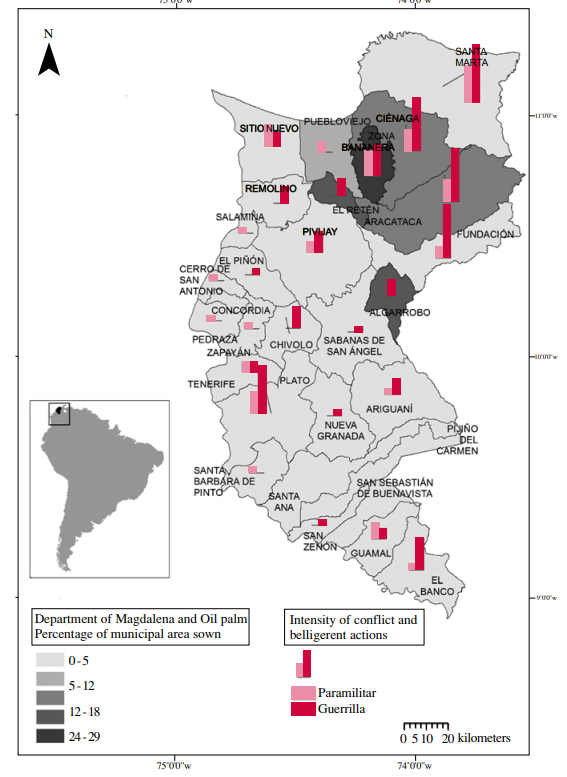
Map 1.
Map of the Department of Magdalena (Colombia): Palm Production Areas and Intensity of Armed Conflict
Source: Professor Jorge E. Rubiano, Universidad del Valle, taken from the database created by the authors.
There could have even been even implicit alliances, where although the palm cultivators did not seek to displace peasants or seize their land directly, they nonetheless benefitted by having access to cheap land that had been abandoned as a result of paramilitary violence.
There is also the possibility of a non-causal mechanism that relates forced displacement with palm oil development that is linked with the intensity of the armed conflict. That is, the dispute between paramilitary groups and guerrilla organizations for the control of territory coincides with land type that is appropriate for palm oil cultivation. In this situation, the civilian population (caught in the crossfire) are doomed to migrate and end up being victims of forced displacement. Although a positive relationship between increased palm activity and forced displacement was observed, it could be spurious. In reality, the correlation would follow a geographical overlap between territorial disputes by illegal armed groups and the development of palm oil agribusinesses.
This research’s hypothesis is that the development of palm oil in the Department of Magdalena is causally related to forced displacement, even after controlling for the effect of armed conflict. To test this hypothesis, we consider the following fixed effects model.
MODEL AND ESTIMATION METHODS
Consider the following linear fixed effect unobserved population model on a municipal level for the Department of Magdalena in the 2000-2010 study period:
 (1)
(1)for i = 1,.., 30; t = 2000,.., 2010 where Fit is the rate of forced displacement by expulsion for every 10,000 inhabitants in municipality i in year t; Pr_Producitis the percentage of area used in the production of palm oil in municipality i in year t; Paramilitaryit assumes a value of one if actions of political violence are attributably reported to paramilitary groups in municipality i in year t; Guerrillaittakes value one if actions of political violence are attributably reported to guerrilla groups in municipality i in year t; θt denotes time effects while αi denotes municipality fixed effects that capture time constant characteristics related to the type of land across municipalities; and finally, uit is the idiosyncratic errors of municipality i in year t.
According to the two mechanisms described in the conceptual framework, we have the following scenarios:
-
a) Causal mechanism (black legend) where Fit occurs by implicit or explicit strategic alliances between palm oil cultivators and paramilitary groups to strip peasant families of their land and/or combat guerrillas. This was spurred by an increase in government subsidies and palm oil prices. In this case, equation (1) would have the following signs for the parameters: γ1 > 0 and γ2 > 0, γ3 > 0.
b) Non-causal mechanism that generates a spurious statistical association between palm oil agriculture and forced displacement where armed conflict is not controlled for: γ1 > 0 when not controlling for αi and imposing restrictions γ2 = 0, γ3 = 0. When controlling for αi and armed conflict variables, then equation (1) would have the following signs: γ1 = 0, but γ2 > 0, γ3 > 0.
In equation (1) we assume that there is no reverse causality, in the sense that forced displacement does not cause expansion of palm oil production once armed conflict is controlled for. This assumption is consistent with anecdotal evidence, which suggests that there was explicit violence to displace peasant families for the purpose of land appropriation. However, the omission of the municipality fixed effect is the key issue in order to distinguish if it is the spurious non-causal mechanism that is at work or the causal one. This fixed effect captures all the determinants of forced displacement that are constant across time, such as land suitable for the cultivation of palm oil. This can also be related to land appropriated for territorial control by groups involved in the armed conflict. We can distinguish between the two mechanisms by assuming that the idiosyncratic error term is not correlated in a contemporaneous manner with any of the explanatory variables for all t = 2000,.., 2010; however, it still allows for serial correlation across time.
Moreover, under the causal mechanism proposed, we should find evidence that there was a practical and statistical increase in the area used to cultivate palm in the extensive margin. This is due to an increase in international prices as well as government subsidies, as argued above. Furthermore, we should also find evidence that paramilitary activities had a positive effect on the expansion of the palm cultivation area on the municipality level. To study this, we consider the following model:
 (2)
(2)for i = 1,.., 30; t = 2001,.., 2010 where φt represents time effects, and vitis the error term.
The variable Num_Extractit − 1× Pricet-1 represents the number of extracting plants by municipality in period t − 1, which can be thought of as a proxy variable for government subsidies.11 This is multiplied by the international price of palm oil in period t −1, while the variable Num_Extractit − 1× ∆ Pricet multiplies it by the price change in international markets between t and t −1. Since price only changes across time and not across municipalities, we needed to construct variables that have variability in the two dimensions. This is the reason why we multiplied the number of extracting plants by the price and the change in price across the time dimension. Furthermore, to control for a possible omission variable bias, we control for the lagged dependent variable Pr_Producit − 1.12
According to the causal mechanism, we should then observe that the combination of prices and number of extracting plants should have generated an increase in the extensive margin of palm oil cultivation across municipalities, which implies in equation (2) that ρ1 > 0, ρ2 > 0. Moreover, if there was an implicit or explicit alliance between oil palm cultivators and paramilitary groups, we should observe ρ3 > 0 while ρ4 = 0 since guerrilla activities would not have focused on expanding the palm oil agribusiness. If during the period of analysis, the expansion of the agribusiness was weakly persistent, then we should observe ρ5 > 0.
On the other hand, if the non-causal mechanism operates, we should observe ρ1 > 0, ρ2 > 0, and should have ρ3 = 0 (as well as ρ4 = 0). We would expect these results because paramilitary activities lagged one period (guerrilla activities also lagged one period). Therefore, given that we have lagged the dependent variable as a control variable in equation (2), they should not have a statistical relation with the development of the palm agribusiness on the municipal level in the following period.
If the municipal fixed effect is not correlated in any time period with the explanatory variables in the model, then (1) could be estimated by a Pooled Ordinary Least Squares Estimator (POLSE) or a Random Effects Estimator (REE), which is, in fact, a Minimum Generalized Least Squares (GLS) estimator. However, if the municipal fixed effect is correlated with the explanatory variables in the model, which may be the case as we have argued above in terms of the black legend, then the appropriate estimator is the Fixed Effects Estimator (FEE). In addition, equation (2) is estimated by POLSE since controlling explicitly for municipality fixed effects would be inappropriate given that land quality is an aspect that varies during palm cultivation. All estimations use fully robust standard errors that are valid under serial correlation and heteroskedasticity.
DATA
We assembled a panel data set to verify our research question that allows us to apply equations (1) and (2) to econometric estimation procedures, as described in the previous section. Before we present the data, we report some key aspects of forced displacement and oil palm production for the Department of Magdalena. First, note that the forced displacement dynamic in Magdalena shows similarities with the aggregate case for Colombia, as shown in Figure 1 for the same time period.
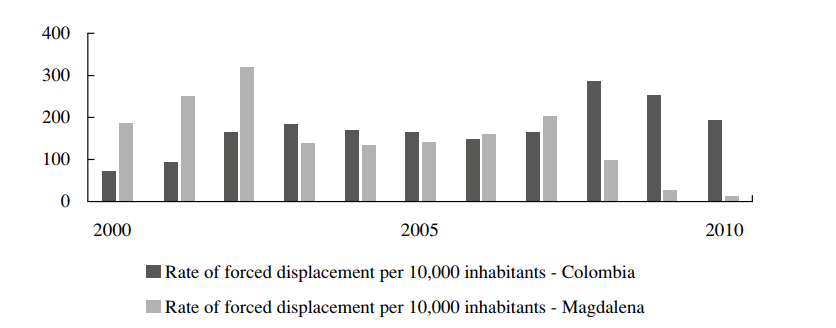
Figure 1.
Rate of forced displacement per 10,000 inhabitants
Source: Authors’ calculations based on data from OPPDD.
Secondly, during the period, the palm production area increased by 62%, as shown in Figure 2. Also, it coincided with a 229% increase in the price of palm oil in world markets, as is shown in Figure 3.
Third, the behaviour of palm oil production in the period under study coincides with the government support. This was manifested in policies promoting this type of crop under the presidency of Alvaro Uribe Vélez who was elected in 2002 and strongly supported this type of agricultural development in Colombia through the provision of grants, specifically in the Department of Magdalena, until the end of his administration in 2010.
Fourth, between 2003 and 2006, there was a demobilization process of paramilitary groups in Colombia, which coincided with a decrease in the rate of forced displacement, both on a national level and in the Department of Magdalena (shown in Figure 1). This becomes a motive in equation (1) to control for time effects, which represent changes in the rate of forced displacement by this exogenous temporal change.
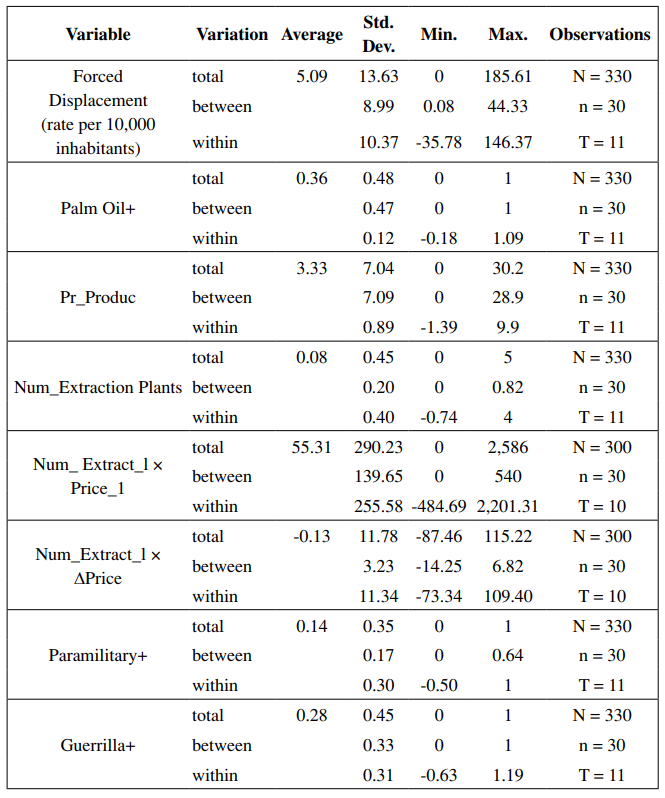
Table 1 reports the descriptive statistics for all variables used in the econometric estimation procedures. Notice the panel data is balanced because it has 11 periods on an annual basis between 2000 and 2010, which explains why T = 11. In addition, the total number of municipalities is n = 30, which includes Santa Marta, the capital of the Department, hence the total number of observations is N = n * T = 330.
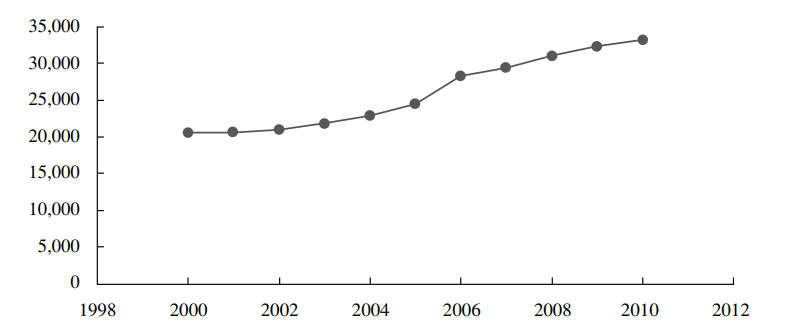
Figure 2.
Oil palm production - hectares
Source: Authors’ calculations based on data from FEDEPALMA.
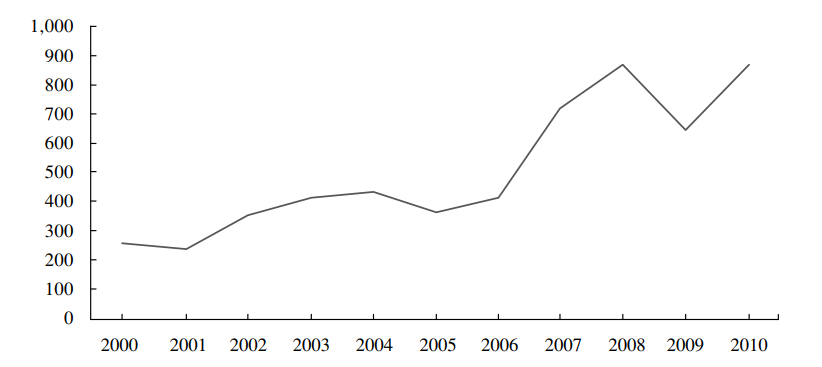
Figure 3.
Price of palm oil - $US per tonne
Source: Authors’ calculations based on data from UNCTADSTAT.
The dependent variable in equation (1) is the rate of forced displacement per ten thousand inhabitants, defined as the number of people who were forced, as a result of mechanisms of violence, to migrate from municipality i in period t, divided by the total population of the Department of Magdalena. This rate varies widely during the period (as shown in Table 1), where the average is 5.09, with a standard deviation of 13.63. The minimum value of this rate is zero and the maximum is 185.61, which shows a high variability across municipalities during the period under study.
Source: Authors’ calculations.+ Dummy variable.
The variable Palm Oil is binary and takes the value of one if municipality i in year t reported palm oil production and zero otherwise. Table 1 shows that in the study period, this variable varies over time and between municipalities. On average, 36% of municipalities in the department produced palm oil. The variable Pr_Produc is a continuous positive variable that represents the percentage of the area that produced palm oil relative to the total area used for production each year in the department. This number varies by year and municipality and is a measure of the extensive margin expansion of this agribusiness. There are places that did not produce palm in the period, and there is also a municipality in the period that used 30% of the area for palm oil production. The Num_Extraction_Plants variable varies by municipality and across time, as shown in Table 1. While one municipality had five extraction plants, there were towns that did not have any. This variable is lagged and then multiplied respectively by the international price of palm oil lagged for one period and the change in the price of oil per ton between t and t − 1. The variables Num_Extract_1×Price_1 and Num_Extract_1×∆Price are reported in Table 1.
The binary variables Paramilitary and Guerrilla were created to capture the geographical areas where disputes arose over territorial control. Such clashes occurred, not only between guerrilla and paramilitary groups, but also between paramilitaries and drug traffickers and even among the different factions of the paramilitary groups. The criteria to define these variables are related to political violence, including massacres (number of cases and number of victims); political assassinations (of mayors, former mayors, councillors, trade unionists, and journalists); and military confrontations, (the evidence for which is the number of civilian victims of landmines, improvised explosive devices and unexploded ordnance, attacks on police facilities, contact with armed groups, ambushes, harassment, kidnapping, and attacks on the population). The two variables take the value 0 if none of the above acts of violence occurred in municipality i and period t while variable Paramilitary takes the value one if there were violent confrontations where the modus operandi is typical of paramilitary groups, such as massacres and political assassinations. The Guerrilla variable takes a value of one if there were violent confrontations where the modus operandi is typical of guerrillas, such as landmines, improvised explosive devices, and unexploded ordnance, as well as attacks on police facilities, ambushes, kidnappings, and harassment.13 According to Table 1, there were a greater percentage of municipalities affected by the intensity of the armed conflict due to guerrilla actions (28%) than by paramilitary actions (14%).14
EMPIRICAL RESULTS
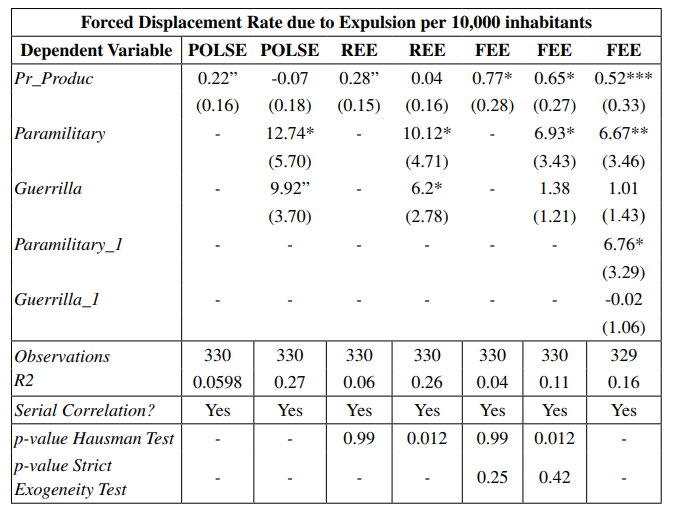
Table 2 reports estimates for equation (1) by POLSE in the first two columns, REE in columns three and four, and FEE in last three columns. All estimations include time dummies while cluster standard errors are reported given that serial correlation is detected across specifications. The first column shows that the development of the palm production area on the municipal level is associated in a positive and statistically significant manner at 1% with forced displacement. The value of 0.22 tells us that if municipal level production area is increased by seven percentage points forced displacement would be associated, on average, with an increase of 1.54 per 10,000 inhabitants. According to descriptive statistics, this would represent nearly a third of the average value of forced displacement in the period (5.09) per 10,000 inhabitants.
This result corroborates the stigma associated with palm cultivation in some areas in Magdalena to the extent that the production of this agribusiness would be positive, significant, and statistically related to forced displacement. However, this marginal effect should not be interpreted as causal because relevant variables, such as those related to the armed conflict, are ignored and not controlled for in the estimation.
Column 2 shows the POLSE estimate when controlling for armed conflict in equation (1) where the coefficient on Pr_Produc becomes negative, although it is not statistically significant, even at 10%. This implies that the positive value obtained in column 1 captured the effect of armed conflict, which would be highly correlated with the fact that the municipality is producing palm. Something similar happens when the estimation is made using the REE, as shown in columns 3 and 4. When no armed conflict variables are included, as in column 3, the coefficient associated with Pr_Produc is positive and statistically significant at 1%: a value similar to the POLSE estimate. However, if conflict variables are controlled, the estimate decreases in absolute value and becomes insignificant at 10%, also when using POLSE. These results are consistent with the non-causal mechanism because by controlling for variables related to the armed conflict we find that these control variables positively affect forced displacement. Palm development, however, does not. Interestingly, both paramilitary and guerrilla violent activities are associated in a positive and statistically significant way with forced displacement; this suggests that people would have been caught in crossfire. Despite this, we have to consider other estimation procedures before we can conclude that the evidence is in favour of the non-causal mechanism.
A Breusch-Pagan test was conducted to determine the existence of positive variance in the fixed effect αi under the random effects estimator, which yielded a p-value of 0,001 and allowed the rejection of the null hypothesis. This means that there is a fixed effect at the municipal level that we should consider.
Source: Authors’ calculations.* Dummy time variables included in all of the regressions.
POLSE: Pooled Ordinary Least Squares Estimator; FEE: Fixed Effect Estimator; REE: Random Effect Estimator.
Clustered standard errors at the municipality level in brackets.
Statistical significance at one tail ***10%, **5%, *1%.
POLSE and REE allow for the presence of the municipal fixed effect that is constant over time but assume that it is uncorrelated with the explanatory variables in equation (1). As argued above, since both the expansion in the extensive margin of palm oil agribusiness and armed conflict groups struggle to dominate territory then it seems more reasonable to control for land quality through a municipal fixed effects. This is because if we do not then there is an omitted variable bias in the estimation. Hence, it seems more reasonable to estimate equation (1) with a FEE that allows the municipal fixed effect to be correlated with the explanatory variables and which can be controlled for indirectly by the FE estimation procedure. Columns 5 and 6 report the estimation of equation (1) by the FEE.
The FEE consistently estimates population parameters when the error term satisfies the assumption of strict exogeneity.15 This means that the idiosyncratic error uit is not correlated with past, present, and future values of the explanatory variable of the model (1). The statistical test proposed by Wooldridge (2010, p. 325) tests the assumption of strict exogeneity for the FEE. Columns 5 and 6 in Table 2 report these statistical tests and their p-value. In this case we can see that even at 10% we cannot reject the null hypothesis of strict exogeneity. This supports the conclusion that the parameters estimated using FEE can be consistently estimated and can be interpreted in a causal manner.
Moreover, we also carried out a Hausman test to establish whether the estimates that we made using the FEE and the REE are statistically similar. This test allows us to see the effect of either controlling or not controlling for the municipal fixed effects. Columns 3 and 5 report the p-value for the Hausman test, which is 0.99. In this situation the null hypothesis means that the estimates are equal under the REE and FEE, which are not rejected (not even at 10%). The Hausman test for the estimates in columns 4 and 6, in which the p-value reported in Table 2 is 0.001, means that we can reject the null hypothesis that the REE and FEE estimates are equal at 1%. This implies that the municipality fixed effect makes a difference between these two types of estimators when the armed conflict variables are included. Since we want to control for the fixed effect on the municipal level, which could be correlated with the explanatory variables, the FEE is considered more credible than the REE. This is because the latter assumes, by construction, that αi is not correlated to the explanatory variables in equation (1) for any period. Hence, as a result of the statistical tests, we prefer the FEE results.
Note that column 4 in Table 2 shows that Pr_Produc is positively related with forced displacement in a statistically significant way at 1%. This is similar to the POLSE and REE results. Nonetheless, the point estimate of FEE continues to be positive and statistically significant when controlling for armed conflict variables, as shown in column 5 of Table 2. This result is in stark contrast with those obtained using POLSE and REE. The point estimate of the FEE in the sixth column of Table 2 that is associated with Pr_Produc is 0.65, and this is still statistically significant at 1%. Given the results of the strict exogeneity test carried out, this result can be interpreted causally. Hence, a seven percentage point increase (one standard deviation increase) in Pr_Produc seems to have caused, on average, a 4.55 per ten thousand inhabitants increase in forced displacement beyond the effect of armed conflict. This effect is practically significant, relative to the average forced displacement rate of 5.09 and its standard deviation (13.64). The causal effect is, on average, somewhat less than the mean and approximately a third of a standard deviation of the rate of forced displacement. The 95% confidence interval is between one eighteenth and two thirds of a standard deviation.
Column 6 in Table 2 shows that municipalities that experienced intense paramilitary violence had a forced displacement of 6.93 per 10,000 thousand inhabitants. This is around the same order of magnitude of a standard deviation for the rate of displacement during the time period studied. Hence, a standard deviation increase in the production of palm oil had a comparable order of magnitude effect on displacement as paramilitary activities. The results with the FEE suggest that there is a statistical and practically relevant causal relationship between palm oil cultivation and forced displacement after controlling for armed conflict variables and municipality fixed effects. This result allows us to reject the non-causal mechanism in favour of the causal one. Additionally, and consistent with the causal mechanism proposed, violent activities by paramilitary groups (rather than guerrilla groups) were positively related to the rate of forced displacement. This can be observed in column 6 of Table 2.
Finally, and in order to study the robustness of the result, the last column in Table 2 reports the FEE for equation (1) when controlling for lagged armed conflict variables. The theory is that current forced displacement may also be related to paramilitary and guerrilla violence in the previous period. Based on the results, our conclusion does not change with this robustness check although we do lose some statistical power. This seems to come from the loss of degrees of freedom, as it is the case that Pr_Prod has a positive and statistically significant coefficient at the 10% significance level for a one tail test. Again, only the lagged variable associated with paramilitary activities is positively related with forced displacement, and this is consistent with the proposed causal mechanism.
In this section of the paper, we closer investigate the workings of the causal mechanism given that we found strong evidence to reject the non-causal scenario. There may be several different causal mechanisms that could explain the relationship between forced displacement and palm development. In the conceptual framework, we suggest that forced displacement could have occurred by implicit or explicit alliances between palm growers and paramilitary groups in order to strip peasant families of their land in order to plant oil palm and combat guerrillas. They would have, simultaneously, took advantage of the large increase in international prices and government subsidies for this type of crop. This causal mechanism is consistent with some of the anecdotal evidence that we referred to above as the black legend of oil palm.
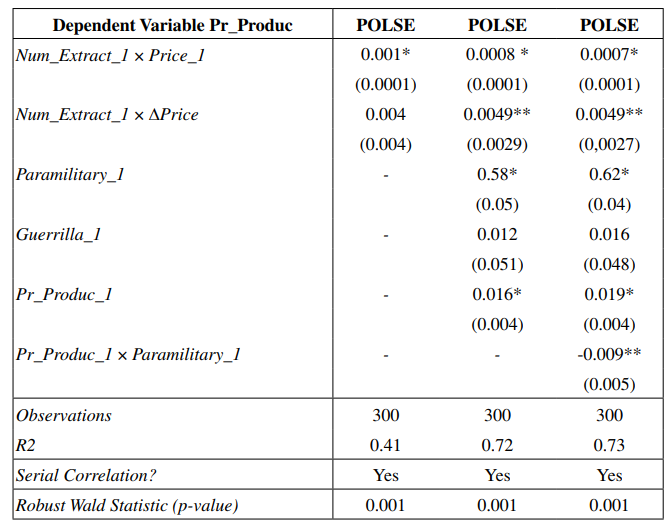
Equation (2) is estimated using POLSE. This is because controlling for a municipal fixed effect is not reasonable in this case as we need to allow for different land conditions for palm growers to expand their crops. We report equation (2)’s estimation results in Table 3. In both specifications we found serial correlation in the error term and, therefore, only considered statistical tests that are robust to this issue as well as to heteroskedasticity.
Source: Authors’ calculations.* Dummy time variables included in all of the regressions.
POLSE : Pooled Ordinary Least Squares Estimator.
Clustered standard errors at the municipal level in brackets.
Statistical significance at one tail ***10%, ** 5%, *1%.
Column 1 in Table 3 shows that the number of extracting plants interacted by the international price and its change positively explain the expansion of palm cultivation across municipalities. The variables are jointly significant at the 1% significance level according to the robust Wald statistic. As reported in column 2, this result is robust to the inclusion of the lagged armed conflict variables as well as to the lagged dependent variable. This is a way of controlling for an omitted variable bias. Interestingly, the lagged paramilitary variable has a positive effect on Pr_Produc, which is significant at the 1% while this is not true for the lagged guerrilla variable. This result underpins the causal mechanism proposed, since only paramilitary groups, in explicit or implicit alliances with oil palm cultivators seem to have benefitted from the expansion of oil palm cultivation.
The last column in Table 3 includes a specification that augments the model by including the variable that multiplies the lagged paramilitary dummy variable with the lagged dependent variable. This is undertaken in order to assess whether the paramilitary violence benefitted in a different way from the expansion of the palm agribusiness across municipalities with different proportions of land dedicated to palm oil cultivation. We found that that the positive marginal effect of paramilitary violence on the development and expansion of oil palm cultivation was attenuated in municipalities that had higher percentages of land dedicated to this activity. Hence, paramilitary violence seems to have expanded palm cultivation in municipalities that previously had a lower percentage of land dedicated to palm cultivation. This is perfectly consistent with the causal mechanism proposed since paramilitary activity would have been more prevalent precisely in municipalities with lower percentages of land dedicated to palm cultivation but that had the opportunity to expand.
This research finds evidence that supports a causal mechanism that is consistent with the anecdotal evidence of a black legend relating the development of the oil palm industry with forced displacement in the Department of Magdalena. We found that there is a causal mechanism even after controlling for the ongoing armed conflict. We also found strong evidence that paramilitary violence was a key factor in the expansion of palm agribusiness while guerrilla violence did not affect the expansion of this type of cultivation.
CONCLUSIONS
This article has found strong empirical evidence that between 2000 and 2010 in the Department of Magdalena —a representative case study in Colombia— the development of the palm oil agribusiness seemed to have caused a significant increase in forced displacement beyond that caused by the ongoing armed conflict. This finding does not mean that the development of oil palm was the only cause of forced displacement but that it did contribute in a causal manner to this phenomenon: beyond the obvious effect of paramilitary and guerrilla violent activities.
The results obtained allow us to reject the hypothesis that a spurious relationship between oil palm development and forced displacement was established between 2000 and 2010. Specifically, and with our preferred estimates, we found that an increase of a standard deviation in oil palm development on the municipal level caused, on average, an increase of about a third of a standard deviation in the rate of forced displacement. The 95% confidence interval is between one eighteenth and two thirds of a standard deviation.
We found that the expansion of palm cultivation in Magdalena benefitted from paramilitary rather than guerrilla involvement. Furthermore, we found that the positive effect of paramilitary activities on the expansion of the palm agribusiness was stronger in municipalities that initially had lower shares of land dedicated to oil palm.
Given that the palm agribusiness has existed in Colombia for more than six decades, and palm crop is present in over 110 municipalities that have not necessarily experienced forced displacement, it would be inappropriate to generalize this particular case study and apply it to other periods and for other regions. For this reason, it is important to conduct more research into displacement in different oil palm producing regions in Colombia and across the world. This research should be conducted in areas with and without territorial disputes with illegal armed actors, and it should take into account substantial increases in international prices and/or government subsidies.
Acknowledgements
We wish to thank the superb research assistance from Tatiana Vargas and Andrés Delgado.
References
Adams, D. (2012). Vínculos entre paramilitares y drogas: antes y después de la desmovilización. In M. Restrepo and B. Bagley (Eds.), La desmovilización de los paramilitares en Colombia: entre el escepticismo y la esperanza (pp. 69-87). Bogotá: Universidad de los Andes.
Centro Nacional de Memoria Histórica. (2010). Tierra en disputa. Bogotá: CNMH.
Centro Nacional de Memoria Histórica. (2011). Mujeres y guerra. Víctimas y resistentes en el Caribe. Bogotá: CNMH.
Centro Nacional de Memoria Histórica. (2012). Mujeres que hacen historia. Tierra, cuerpo y política en el Caribe colombiano. Bogotá: CNMH.
Collier, P. (2000). Rebellion as a quasi-criminal activity. Journal of Conflict Resolution, 44(6), 839-853.
Collier, P., & Hoeffler, A. (1998). On economic causes of civil war. Oxford Economic Papers, 50, 563-573.
Collier, P., Hoeffler, A., & Soderbom, M. (2001). On the duration of civil wars (Working Paper, 2681). World Bank Policy Research.
Comisión The Body Shop y Christian Aid. (2010). Primer informe, Comisión Independiente de Tierras. Las Pavas – Bolívar, Colombia. Bogotá: Body Shop y Christian Aid.
Departamento Administrativo Nacional de Estadística (DANE). (1993). Archivos del Censo. Bogotá: DANE.
Departamento Administrativo Nacional de Estadística (DANE). (2005). Censo Retrieved from http://www.dane.gov.co/censo/.
Departamento Nacional de Planeación (DNP). 2009. Retrieved from http://www.dnp.gov.co/PortalWeb/Programas/DesarrolloTerritorial/FinanzasP%C3%BAblicasTerritoriales/EjecucionesPresupuestales/tabid/369/Default.aspx.
Fearon, J. D. (2005). Primary commodity exports and civil war. The Journal of Conflict Resolution, 49(4), 483-507.
Fedepalma. (2008). Informe de gestión Fedepalma. Retrieved from https://issuu.com/fedepalma/docs/informe_fedepalma2008.
Fedepalma-SISPA. (2010). Panorama de la agroindustria de la palma de aceite en Colombia y en la zona norte del país: situación actual, retos y perspectivas. Retrieved from http://web.fedepalma.org/bigdata/zonaprivada/panoramadelaagroindustriadelapalmadeaceiteencolombiayenlazonanorte.pdf.
Fergusson, L., Romero, D., & Vargas, J. F. (2014). The environmental impact of civil conflict: The deforestation effect of paramilitary expansion in Colombia (Documentos CEDE 012225). Universidad de los Andes-CEDE.
Goebertus, J. (2008). Palma de aceite y desplazamiento forzado en zona bananera: “trayectorias” entre recursos naturales y conflicto. Colombia Internacional, 67, 152-175.
Hausman, J. A., Hall, B. H., & Griliches, Z. (1984). Econometric models for count data with an application to the patents–R&D relationship. Econometrica, 52, 909-938.
Hurtado, M. (2009). Palm oil production and armed conflict in Colombia: Exploring the cases of San Alberto and San Martín. Prague, Czech Republic: Global Business and Technology Association Reading Book.
Hurtado, M., & Hernández, G. (2010). Perfil local y agroindustria palmera explorando el caso de San Alberto y San Martín. Cuadernos de Desarrollo Rural, 7(65), 127-149.
Hurtado, M., & Pereira, C. (2011). Legitimidad empresarial, conflicto de tierras y producción palmera en Colombia. Revista de Relaciones Internacionales, Estrategia y Seguridad, 6(2), 91-110.
Ibáñez, A. M., & Velásquez, A. (2008). El impacto del desplazamiento forzoso en Colombia: condiciones socioeconómicas de la población desplazada, vinculación a los mercados laborales y políticas públicas. CEPAL: Santiago de Chile, División de Desarrollo Social. Retrieved from http://www.cepal.org/publicaciones/xml/2/35022/sps145-Desplazamiento-Colombia.pdf.
Instituto Geográfico Agustín Codazzi (IGAC). (2011). Atlas de la distribución de la propiedad rural en Colombia. Retrieved from http://igac.gov.co/wps/wcm/connect/8beae7804dc8d75abb1efb36b3 9898f6/1_notas_sobre_la_evolucion_historica_con_cubierta_1.pdf?MOD=AJPERES.
Internal Displacement Monitoring Centre (IDMC). (2014). The Global Overview 2014: People internally displaced by conflict and violence. Internal Displacement Monitoring Centre Norwegian Refugee Council: Geneva. Retrieved from http://www.internal-displacement.org/assets/publications/2014/201405-global-overview-2014-en.pdf.
Le Billion, P. (2001) The political ecology of war: Natural resources and armed conflicts. Political Geography, 20, 561-584.
Leiteritz, R., Nasi, C., & Rettberg, A. (2009). Desvinculando los recursos naturales del conflicto armado en Colombia: recomendaciones para formuladores de política y activistas. In Colombia Internacional (pp. 219-225). Bogotá: Tercer Mundo Editores.
Mignorance, F., Flaminia, M., & Helene, L. (2004). El cultivo de la palma africana en el Chocó. Legalidad ambiental, territorial y derechos humanos. Bogotá: Human Rights Watch Everywhere and Diócesis de Quibdó.
Observatorio del Programa Presidencial de Derechos Humanos y Derecho Internacional Humanitario (OPPDD). (2001). Panorama actual de la Sierra Nevada de Santa Marta (pp. 1-19). Bogota: OPPDD.
Observatorio del Programa Presidencial de DDHH y DIH (OPPDD). (2008). Diagnóstico Departamental del Magdalena. Retrieved from http://www.derechoshumanos.gov.co/Pna/documents/2010/magdalena/magdalena.pdf.
Ocampo, S. (2009). Agroindustria y conflicto armado. El caso de la palma de aceite. Colombia Internacional, julio-diciembre, 169-190.
Ospina, M., & Doris, O. (2001). La palma africana. Apuntes y memorias (2nd Ed.). Bogotá: Fedepalma.
Palacios, P. A. (2012). Forced displacement: Legal versus illegal crops. Defence and Peace Economics, 23, 133-160. Retrieved from http://www.mamacoca.org/docs_de_base/Cifras_cuadro_mamacoca/Forceddisplacement_PaolaPalacios_junio2010.pdf.
Programa de las Naciones Unidas para el Desarrollo (PNUD). (2011). Magdalena 2012. Estado de avance de los objetivos del milenio. Retrieved from http://www.pnud.org.co/2012/odm2012/odm_magdalena.pdf.
Rettberg, A. (2009). Business and peace in Colombia: Reponses, challenges and achievements. In Virginia, M. (Ed.), Building peace in a time of war. Washington, D. C.: Bouvier.
Rey, C. (2013). Análisis espacial de la correlación entre cultivo de palma de aceite y desplazamiento forzado en Colombia. Cuadernos de Economía, 32(61), 683-718.
Reyes, A. (2009). Guerreros y campesinos. El despojo de la tierra en Colombia. Bogotá: Norma.
Rivas, E. (February 19th 2008). Desplazados y productivos. Retrieved from http://www.elespectador.com/impreso/cuadernilloa/paz/articuloimpreso-desplazados-y-productivos?page=0,1.
Romero, M., Olaya, A., & Pedraza. H. (2011). Privatización, paramilitares y políticos: el robo de los recursos de salud en la costa Caribe. In V. M. Romero & M. A. F. Ávila (Eds.), La economía de los paramilitares. Redes de corrupción, negocios y política (pp. 15-74). Colombia: Debate.
Ross, M. (2003). Oil, drugs and diamonds: The varying role of natural resources in civil war. In Ballentine, K., & Sherman, J. (Eds.), The political economy of armed conflict: Beyond greed and grievance (pp. 47-70). Boulder, CO: Lynne Rienner.
Rugeles, L., & Delgado, L. (2003). La construcción de lo público desde el sector local productivo colombiano. La especificidad de los activos en palma de aceite y ganadería: un análisis regional comparado. Instituciones y Desarrollo, 14-15.
Sacks, R. (1986). Human territoriality its theory and history. Cambridge: Cambridge University Press.
Sayago, J. (2011). Desplazamiento forzoso en Colombia: expulsión y movilidad, dos dinámicas que interactúan (Unpublished Masters Thesis). Bogotá: Universidad Nacional de Colombia.
Snyder, R. (2006). Does lootable wealth breed disorder? A political economy of extraction framework? Comparative Political Studies, 39(8), 943-968.
Unctastat. Free market commodity price indices, 1960-2012. Retrieved in May 2015 from http://unctadstat.unctad.org/TableViewer/tableView.aspx?ReportId=30728.
United Nations Office on Drugs and Crime (UNODC). Proyecto Sistema Integrado de Monitoreo de Cultivos – SIMCI. Database retrieved from http://www.biesimci.org/.
USAID/Midas, Fedepalmay SNV & Cecodes. (2010). De las alianzas productivas a los negocios inclusivos. Bogotá: USAID/Midas, Fedepalma y SNV & Cecodes.
Viloria de la Hoz, J. (2008). Banano y revaluación en el departamento del Magdalena 1997-2007 (Documentos de Trabajo de Economía Regional 105). Retrieved from http://www.banrep.gov.co/sites/default/files/publicaciones/archivos/DTSER-105.pdf.
Villegas, M. (2008). Finca campesina con palma: ocupación productiva del territorio en el Magdalena Medio (Unpublished document).
Wooldridge, J. (2010) Econometric analysis of cross section and panel data (2nd Ed.). Massachusetts: MIT Press.
Notes
Additional information
Sugerencia de citación:: Hurtado, M., Pereira-Villa, C., & Villa, E. (2017). Oil palm development and forced displacement in Colombia: Causal or spurious? Cuadernos de Economía, 36(71), 441-468. doi: 10.15446/cuad.econ.v36n71.52554.
Alternative link
http://fce.unal.edu.co/media/files/cuadernos/71/finales/v36n71a07.pdf (pdf)