Artículos
VIRTUAL RESEARCH AND LEARNING COMMUNITIES IN LATIN AMERICA: THE CEVALE2VE CASE
COMUNIDADES VIRTUALES DE INVESTIGACIÓN Y APRENDIZAJE EN AMÉRICA LATINA: EL CASO CEVALE2VE
COMUNIDADES VIRTUALES DE INVESTIGAÇÃO E APRENDIZAGEM NA AMÉRICA LATINA: O CASO CEVALE2VE
VIRTUAL RESEARCH AND LEARNING COMMUNITIES IN LATIN AMERICA: THE CEVALE2VE CASE
Interciencia, vol. 42, no. 11, pp. 733-738, 2017
Asociación Interciencia
Received: 21/02/2016
Corrected: 10/02/2017
Accepted: 09/10/2017
Abstract: New strategies for the adaptation of higher scientific edu- cation to the requirements of the network society are briefly discussed, in particular the pivotal role played by virtual research and learning communities in the Latin American region. The Centro Virtual de Altos Estudios de Altas Energías (CEV- ALE2VE) is singled out in reference to the virtual graduate course on particle physics that was given at several Venezuelan and Colombian national universities and research institutions during the semesters September 2014 - February 2015 and March 2016 - July 2016. Different course implementation aspects are reviewed to encourage and facilitate similar regional initiatives in the near future.
Keywords: CEVALE2VE, e-Science, Latin America, Network Society, Particle Physics, Virtual Research and Learning Communities.
Resumen: Se discuten brevemente nuevas estrategias para la adaptación de la educación superior a los requerimientos de la sociedad en red, en particular el papel esencial que juegan las comunidades virtuales de investigación y aprendizaje en la región latinoamericana. Se selecciona al Centro Virtual de Altos Estudios de Al- tas Energías (CEVALE2VE) en referencia al curso de postgrado virtual sobre física de partículas que se impartió en varias universidades nacionales e institutos de investigación en Venezuela y Colombia durante los semestres septiembre 2014 - febrero 2015 y marzo 2016 - julio 2016. Se revisan diferentes aspectos relacionados con su implementación para así fomentar y facilitar iniciativas regionales similares en el futuro cercano.
Resumo: Discutem-se brevemente novas estratégias para adaptação da educação superior aos requerimentos da sociedade em rede, em particular o papel essencial que desempenham as comunidades virtuais de investigação e aprendizagem na região da américa latina. Seleciona-se o Centro Virtual de Altos Estudos de Altas Energias (CEVALE2VE) em referência ao curso de pós-graduação virtual sobre física de partículas que foi ensinado em várias uni- versidades nacionais e institutos de investigação na Venezuela e Colômbia durante os semestres setembro 2014 - fevereiro 2015 e março 2016 - julho 2016. Verificam-se diferentes aspectos relacio- nados com sua implementação para assim encorajar e facilitar iniciativas regionais similares no futuro próximo
Introduction
In the current information age, we would expect upgrades of the traditional educational models to cope with the growing demands of collaborative knowledge generation and the new profiles of the informational entrepreneurs driving the world economy. In this respect, higher education is rapidly becoming globally distributed, communal and inseparable from the actual research enterprise: knowledge generation, deployment, application and transfer are taking place in the same physical and social context. Distributed learning mainly relies on community interactions and cognitive tools (Swan and Shea, 2005) and, consequently, the ‘virtual research and learning community’ (VRLC) becomes a powerful scheme in the implementation of modern graduate courses, considering its possibilities for multiinstitutional participation, synchronous and asynchronous online engagement, decentralized student discussions, academic networking and cost effectiveness. This type of collective lecturing arrangements also exposes students to cut- ting-edge experimental infrastructures, and presents them with a variety of concepts and techniques not found in standard textbooks. Applications of these initiatives are particularly relevant in highly developed research fields such as particle physics.
Following this trend of thought and with the intention of stimulating and wideningthe physics education in Colombia and Venezuela, we implemented the virtual-com- munity course ‘Introduction to Particle Physics’, which took place during the semesters September 2014 - February 2015 and March 2016- July 2016. This was in part possible due to a group of young Venezuelan researchers, referred to as CEVALE2VE (2014), that is currently working in international collaborations in high-energy physics experiments at the Large Hadron Collider (LHC), European Organization for Nuclear Research (CERN), Geneva, Switzerland, and data science, all with particle physics background and geographically scattered in different academic institutions of Europe and North America. The course was officially included in the undergraduate and graduate course portfolios of four public institutions in Venezuela and Colombia. Since this initiative closely traces the aforementioned guidelines regarding higher education in a network society, and is perhaps new to some Latin American (LA) universities, we present herein a description and a critical assess- ment of the experience in order to help future regional efforts.
The Virtual Research and Learning Community
Collaborative data-intensive science, also referred to as ‘e-science’ (Hey and Trefethen, 2005; Bell et al., 2009; Hey et al., 2009), has given rise to new collaboration patterns such as interdisciplinary research projects, social networks and virtual research communities. As previously discussed by Borda et al. (2006) and Mendoza et al. (2014), a ‘virtual research community’ allows a network of researchers to effectively work together on an infrastructure rich in information and communications technologies (ICT) where data, software tools, research facilities and information resources are seamlessly shared. Since higher education capacity development is becoming well embedded in university research endeavors, as previously mentioned, we extend this concept to the ‘vir- tual research and learning com- munity’ (VRLC).
Palloff and Pratt (2007) argue that an effective community is key to a successful e-learning environment, where collabora- tive activities relieve isolation and promote interdependence by developing critical thinking skills, knowledge co-creation and transformative learning. Important indicators are: com- munity membership and the spirit of belonging, trust, student-student interaction, communication and resource sharing (Rovai, 2002). By means of video-conferencing tools, it is practical in a VRLC to develop face-to-face relationships to ensure teacher immediacy and student social presence to facilitate collaborative engagement. According to Sobrero (2008) a VRLC should be designed to grow naturally, support participation and diverse membership, use a functional and reliable ICT environment, consider different roles for members and extend online collaboration to offline activities. A detailed description of e-research in Latin America is given by Arcila-Calderón et al. (2014), and among the most active VRLC in the region, we find the CEVALE2VE virtual com- munity, the central topic of the present report.
Centro de Altos Estudios de Altas Energías (CEVALE2VE)
CEVALE2VE (2014) is a VRLC created to steer a new generation of Venezuelan and Colombian researchers in high-energy physics (HEP). It also attempts to contribute to the scientific dissemination of fundamental physics and the implementation of modern education technologies at the university level. It is strongly believed that the promotion of scientific communities in Latin America will lead to sustainable knowledge-based develop- ment. The project organization involves several academic institutions in Venezuela and Colombia in an attempt to reach a wide regional audience.
The main goals of the CEVALE2VE community are:
Education and interest in research: to inf luence and stimulate the interest of physics students in HEP research.
Opportunity awareness: to educate and motivate students with further opportunities in physics and innovative research career paths.
Networks and collaborations: to launch joint research projects between Latin-American institutions and those of Europe and North America.
Education and training modernization: to explore the use of web platforms and e-learning tools to support online courses and webinars.
Policy making: to work to- wards the formal involvement of regional institutions in HEP experiments.
The virtual graduate course ‘Introduction to Particle Physics’ has been the f irst CEVALE2VE academically formal project, since previous activities of our virtual community were mainly concerned with science popularization and virtual visits to the CERN facilities. For instance, we took for the first time to the region the International Particle Physics Outreach Group (IPPOG, 1997), Masterclasses (1996) and the ATLAS Experiment and Virtual Visits (ATLAS, 2008, 2010). Through our collaborators in Venezuela and Colombia, an outreach event was developed in five cities of Venezuela and Colombia, involving six participating institutions, over a period of two weeks in early October 2016 (PWF, 2016). During this event five HEP induction seminars, five IPPOG hands-on Masterclasses, four virtual visits to the CERN ATLAS experimental facilities and three sessions on HEP career and opportunities took place, reaching around 100 students in each country. This was made possible by the support of the ATLAS Collaboration and the Physics Without Frontiers (PWF, 2012) program of the International Centre for Theoretical Physics (ICTP), Trieste.
Graduate Course in Particle Physics
In its first edition (September 2014 - February 2015), the course was officially included in the undergraduate and grad- uate course programs of three Venezuelan national universities and research institutions: Universidad Central de Venezuela ( UCV), Universidad Simón Bolívar (USB) and the Instituto Venezolano de Investigaciones Científicas (IVIC).
In the second edition (March 2016 - July 2016), the Universidad Industrial de Santander (UIS) in Colombia also joined in. Additionally, several students followed the course informally at other Venezuelan universities: Universidad de Carabobo (UC), Universidad del Zulia (LUZ) and Universidad de Los Andes (ULA).
The support of an academic sponsor at each participating institution was key in course implementation, particularly due to their involvement in the painstaking details and procedures required to ensure the formal status of a credit course. The sponsor group also took part in local course manage- ment that involved a wide range of activities such as liaisons with the university administration and the network and vid- eo-conferencing service providers, lecture scheduling and student tutoring, and became a permanent feedback source for CEVALE2VE du-ring the whole duration of the course. An ideal audience for the course would be final-year undergraduate, master’s and Ph.D. students. Classes were in Spanish and the written material was available in both English and Spanish. In the following sections some important aspects of this initiative are indicated to give an all-round overview.
Rationale
In addition to the relevance of this type of course in streamlining graduate education to meet the requirements of the network society and the digital revolution (see the Introduction), from the physics standpoint several issues must be mentioned. Due to the seminal and far-reaching success of the standard model of particle physics, which was finally validated in 2012 with the discovery of the Higgs boson at CERN (ATLAS, 2012; CMS,2012), it is now vital for every physics faculty and graduate student to get well acquainted with its theoretical basis (quantum field theory), experimental methods and big-data processing techniques. These topics are rapidly becoming general rather than specialized knowledge. Therefore, this course was timely in giving an overview of a variety of formalisms and techniques that are not found in textbooks, and which cannot be comprehensively covered at present in many regional universities; for example, the course gave useful information that, although familiar to CERN insiders, would be difficult to digest by external graduate students.
From the point of view of the young CEVALE2VE postdocs, to begin a scientific lecturing career at the postgraduate level with an innovative course of this nature was certainly a challenge and an opportunity. It was not only demanding regarding the pedagogical preparation of the material, team interactions, student mentoring and virtual lecturing techniques, but also for the lengthy exposures to prospective employers and thesis students.
Induction
In order to promote the course, its content, scope and online methodology, three virtu- al induction lectures were given well in advance (beginning of June 2014) and were attended by both faculty and graduate students from IVIC, UCV, ULA, UIS and USB. This exercise led to extensive discussions on the course academic level, student interests and demands and general methodology (e.g. homework and evaluations), but also about the minimum requirements of the ICT infrastructure, which in Venezuela can be fragile and restrictive.
Syllabus
The course goal was to provide students with a comprehensive overview of the concepts and methods used in contemporary HEP research. It included an introduction of the theory of the standard model and its possible extensions, a description of the sophisticated experimental instrumentation (e.g. detectors, beams and magnetic devices) at CERN and the main techniques for big-data analyses. The course was di- vided into four topical modules involving specific instructors that delivered two-hour lectures, organized homework and supervised student progress. The organization of the topics was as follows:
Module 1. Review of theoret- ical concepts (5 lectures).
Module 2. Accelerator prin- ciples (3 lectures).
Module 3. Particle detector principles (8 lectures).
Module 4. Introduction to statistics, data analysis and computer tools (5 lectures).
ICT platform
The six-month course was held using the Internet band-widths currently available at Colombian and Venezuelan national universities, although a dedicated channel at IVIC was convenient to ensure transmission quality. Virtual classroom management was performed with Google Hangouts, which is a free and powerful platform that can host up to 15 active partici- pants, and enables class re- cording and downloading directly to a YouTube channel. The latter also made the class accessible to a larger audience in real t ime through video streaming. Lecture videos and course material were available to students for downloading immediately after each lecture from the UCV Moodle online platform (UCV, 2014) and the web page from CEVALE2VE (2014), as shown in Figures 1 and 2. The total budget for holding the course was ~100 US$ per year, which were destined to pay the domain for the CEVALE2VE website. The computers, video projectors and internet connections already available in the participating universities/institutions were employed. We should also acknowledge the time devoted by the instructors and academic sponsors to the organization of the course, carried out in parallel to their respective lecture/research activities.
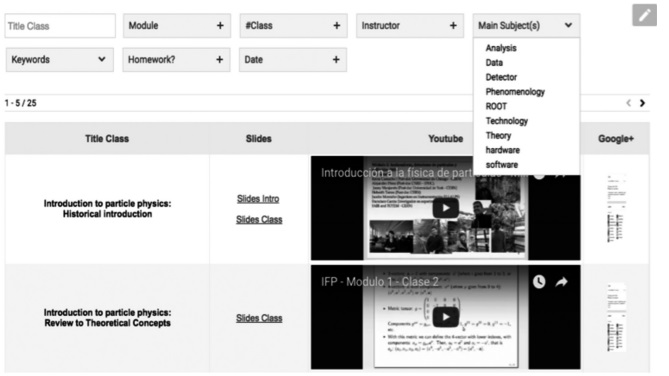
Figure 1
Webbased repository of the online particle physics courses and seminars The repository is hosted by the CEVALE2VE web platform and contains the class material and metadata links to the online events and videos
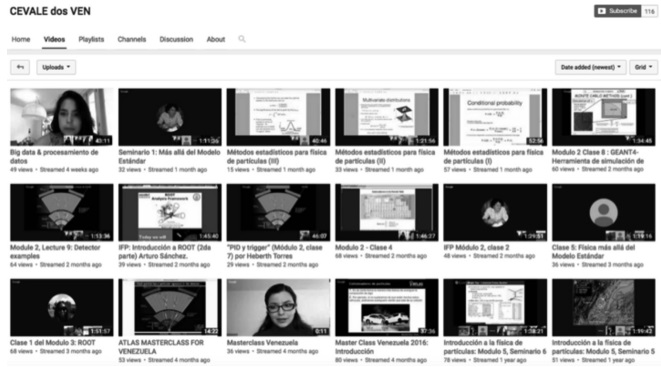
Figure 2
The CEVALE2VE YouTube channel containing more than 70 hours of online audio-visual content and 9000 views and dozens of comments in the tutorials.
Courseware
The course was designed to rely on student-instructor and student-student interactions as well as on independent study. The material included:
A complete set of video-lectures by the course instructors including the problem-solving sections.
Ancillary resources for each video-lecture such as slides (in Spanish and English) and code files.
Homework problems for each module.
Link collections to supple- ment online content for further enquiries.
Discussion forums on the UCV (2014) platform and the CEVALE2VE (2014) web page.
Seminars
In the final weeks of the course, lectures by the CEVALE2VE staff were complemented with a series of seminars by distinguished speakers. The intention was to give specialized views of different topics requiring more advanced knowledge than that covered during the lectures. The seminars given were:
Higgs Physics, 01/13/2015 and 06/21/2016, by José Oca- riz, ATLAS experiment (IN2 P3/LPNHE, Paris).
Big data processing, 01/14/2015 and 06/30/2016, by Bárbara Millán, Booking.com (previously at CERN-CMS).
B-quark physics, 01/20/2015, by Diego Milanés, LHCb ex- periment (Universidad Nacio- nal, Colombia).
Neutrinos, 01/21/2015 and 06/28/2016, by Maily Sánchez, MINOS experiment (Iowa State University, USA).
Accelerators, 01/27/2015, by Stefano Mattei, LINAC4 project, CERN (Lausanne Univer- sity, Switzerland).
Top-quark physics, 01/28/ 2015, by Bárbara González, ATLAS experiment (University of Michigan, USA).
Beyond the standard model physics, 06/14/2016, by Carlos Sandoval, ATLAS experiment (Universidad Antonio Nariño, Colombia).
Cosmology overview, 06/ 23/ 2016, by Anais Möller, CAASTRO Postdoctoral Fellow in Dark Energy (Australian National University).
Evaluations and final projects
A continuous evaluation strategy was implemented, con- sisting of four homework exercises covering the topics discussed in each course module and a final project. Homework papers were returned by the students via the Internet using the UCV Moodle online platform, and accounted for 70% of the total grade of the course.
The final evaluation consisted of a small project chosen by students from a predefined list proposed by the instructors. The projects were designed to cover many of the key points discussed during the course; for instance, a realistic and motivating contact with the research lines of current interest in HEP, data processing with the computer tools of common use at CERN, inter-institutional student-student partnerships and active student participation in presentations and discussions. Monte Carlo simulations and open-access scientific data from different LHC experiments were used through the Open Data Portal project of CERN (2014).
Student progress was over- seen by a tutor for a period of four weeks, at the end of which the results were present- ed by the students to the ple- nary virtual group. This evaluation counted for 30% of the total grade. The project portfo- lio included the following topics:
Project 1. Studying the Z boson decaying into an elec- tron−positron pair.
Project 2. Studying the top quark.
Project 3. A synchrotron de- sign for Venezuela.
Project 4. Hadronic cross section calculation at leading order (Drell-Yan process).
Project 5. Cross section mea- surement for WZ production (standard model).
Project 6. Time-dependent CP asymmetry measurements with B mesons.
Project 7. Background noise estimates in photon analysis.
Results
Table I summarizes the number of formal and informal students in each edition of the course. Participating students were given an online evaluation survey that showed that the overall result of the experience was highly positive. Such an outcome could also be extended to the in- structor group, and a more quantitative evaluation scheme should be developed for the next edition of the course. The survey results will be used to re-organize the course sylla- bus and reduce the number of hours dedicated to particle detector principles, and devote more t ime to the statistics module, following student suggestions.
Moreover, motivated by the introductor y scope of the course, several students ma- de definite steps to continue with advanced studies. Table II provides the number of students that took part in the course (both formally and informally) that have followed a career path in HEP. In par- ticular, CEVALE2VE mem- bers supervised a physics master’s and a physics under- graduate student working on theses related to dark matter searches. The former was part of the f i rst edition of the course at UCV and defended her thesis in August 2017, while the latter was part of the second edition also at UCV and defended her thesis in October 2017.
Discussion and Conclusions
An online particle physics course was developed by the CEVALE2VE community in collaboration with several uni- versities and research institutions in Venezuela and Colombia. The first edition of this course took place during the semester September 2014 - February 2015 and the second during March - July 2016. The use of the available ICT technologies to remotely share material and interact with students created a vibrant and engaging learning environment. This course has helped to strengthen scientific ties between the different participating individuals and institutions.
Among the several difficulties that affected the progress of the course, the poor Internet bandwidth and service quality stood out in Venezuela. In general, the Internet service quality at Venezuelan public univer- sities and research centers is insufficient for present day e-learning dynamics. To abate this situation a very close liaison with the network management at each receiving institution was mandatory, and in the case of IVIC, it was fortunate that it resulted in a dedicated channel for most of the virtual classes of the first edition.
It was found that, although good instructor-student relationships quickly developed, student-student interactions were not as active as desired, and within the scope of a VRLC, this certainly showed a weakness of the present approach. It was not possible to the course. This could be related to the current social, economic and political situation of the country, which has caused a large brain drain in academic institutions. It is essential to familiarize faculty members with the importance of particle physics in the higher education curricula and to involve them in our activities to ensure the continuation of the course.
The present course is but one of the several activities pursued by the CEVALE2VE VRLC. We believe that such initiatives will breed a new generation of physics research- ers in the region, contributing to the modernization of higher education and to collaborative networking with European and North American institutions. Furthermore, due to the current brain drain in Venezuelan academic institutions, this VRLC could be taken as a role model to involve expatriates in help- ing to resolve local shortcomings to reverse the diminishing higher education standards and research ventures.
An improved version of this virtual course was offered again in Venezuelan and Colombian universities during the semester March - July of 2017, and is expected to con- tinue yearly to extend our part- nership with other institutions and individual collaborators in order to attract more students.
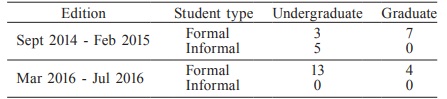
* Only informal students who participated in the evaluation and final projects have been included.

Acknowledgments
The authors thank Rita Gianvittorio and Iván Sánchez for their help in formally registering the course in the post-graduate course portfolio of the receiving institutions. We are also indebted to Mary Luz Tovar Castro, Head of the Informatics Unit at IVIC, and her personnel, for technical support during the whole duration of the first edition of the course. The work of FFC is supported by the Alexander von Humboldt Foundation in the framework of the Sofja However, we found little interest from this sector in most of the receiving Venezuelan institutions, in spite of the induction activities associated with Kovalevskaja Award 2014, endowed by the German Federal Ministry of Education and Research. The work of Reina Camacho is supported by the National Science Foundation (NSF) and the University of Chicago, USA.
REFERENCES
Arcila Calderón C, Calderín M, Núñez LA, Briceño, Y (2014) e-Research: the new paradigm of science in Latin America. In Arcila-Calderón C, Calderín M, Castro C. (Eds.) An Overview of Digital Media in Latin America. University of West London, UK. VISTAS Publications Ser. Nº .: 38-51.
ATLAS (2008) ATLAS Collabora- tion: The ATLAS Experiment at the CERN Large Hadron Colli- der. JINST 3: S08003. 407 pp.
ATLAS (2010) ATLAS Experiment Virtual Visits. http://atlasvirtual- visit.web.cern.ch/
ATLAS (2012) ATLAS Collaboration: Observation of a new particle in the search for the Standard Model Higgs boson with the ATLAS detector at the LHC. Phys. Lett. B 716: 1-29.
Bell G, Hey T, Szalay A (2009) Beyond the data deluge. Science 323: 1297-1298.
Borda A, Careless J, Dimitrova M, Fraser M, Frey J, Hubbard P, Goldstein S, Pung C, Shoe- bridge M, Wiseman N (2006) Report of the Working Group on Virtual Research Communities for the OST e-Infrastructure Steering Group, VRC Final Report, UK Office of Science and Technology: London, UK, 46 pp.
CERN (2014) CERN Open Data Portal project. http://opendata. cern.ch/ (Cons. 25/02/2017).
CEVALE2VE (2014) Centro de Altos Estudios de Altas Energías. www.cevale2ve.org/ (Cons. 25/02/2017).
CMS (2012) CMS Collaboration: Observation of a new boson at a mass of 125 GeV with the CMS experiment at the LHC. Phys. Lett 716: 30-61.
Hey T, Tansley S, Tolle KM (Eds.) (2009) The Fourth Paradigm: Data-Intensive Scientific Discovery. Microsoft Research. Redmont, WA, USA. 252 pp.
Hey T, Trefethen AE (2005) Cybe- rinfrastructure for e-Science. Science 308: 817-821.
IPPOG (1997) International Par- ticle Physics Outreach Group. http://ippog.web.cern.ch (Cons. 25/02/2017).
Masterclasses (1996) International Particle Physics Masterclasses. www.physicsmasterclasses.org/ (Cons. 25/02/2017).
Mendoza C, Boswell JS, Ajoku DC, Bautista MA (2014) AtomPy: An open atomic data curation environment for astrophysical applications. Atoms 2: 123-156.
Palloff RM, Pratt K (2007) Building Online Learning Communities: Effective Strategies for the Virtual Classroom. Jossey- Bass. San Francisco, CA, USA. 292 pp.
PWF (2016) Physics Without Fron- tiers (PWF) for Venezuela and Colombia. www.ictp.it/physicsw i t h o u t- f r o n t i e r s / c u r r e nt- country-projects/venezuela-and- colombia.aspx (Cons. 25/02/2017).
Physics Without Frontiers (2012) www.ictp.it/physics-without-fron- tiers.aspx (Cons. 25/02/2017).
Rovai AP (2002) A preliminary look at the structural differences of higher education classroom com- munities in traditional and ALN courses. J. Asynchnr. Learn. Netw. 6: 41-56.
Sobrero, PM (2008) Essential com- ponents for successful virtual learning communities. J. Exten- sion 46: 4.
Swan K, Shea P (2005) The development of virtual learning com- munities. In Hiltz SR, Goldman R (Eds.) Asynchronous Learning Networks: The Research Fron- tier. Hampton Press. New York, NY, USA. pp. 239-260.
UCV (2014) Moodle Online Platform. Campus Virtual de la UCV. Universidad Central de Venezuela. http://ead.ucv.ve/ (Cons. 17/12/2015).
Author notes
claudiom07@gmail.com