Dossier
Evaluation and Promotion of Argumentative Reasoning Among University Students: The Case of Academic Writing
Évaluation et promotion de raisonnement argumentatif entre étudiants universitaires : Le cas d’écriture académique
Evaluación y promoción del razonamiento argumentativo entre estudiantes universitarios: El caso de la escritura académica
Avaliação e promoção do raciocínio argumentativo entre estudantes universitários: O caso da escrita académica
 Chrysi Rapanta
Fabrizio Macagno
Chrysi Rapanta
Fabrizio Macagno
Evaluation and Promotion of Argumentative Reasoning Among University Students: The Case of Academic Writing
Revista Lusófona de Educação, vol. 45, pp. 125-142, 2019
Universidade Lusófona de Humanidades e Tecnologias
Abstract: Two fundamental critical thinking skills that students are expected to develop during their formal education are: the use of evidence for justifying their positions, and the consideration of objections or contrary opinions in their own reasoning. These skills, fully manifested in argumentative reasoning, have not been sufficiently addressed in higher education research. This exploratory case study sheds light on a specific type of argumentative reasoning particularly important for graduate students: the argument-based academic writing. A Ph.D. seminar course (22 lecture hours) was developed based on two main concepts of argumentation theory, namely argumentation schemes and the heuristic uses thereof, i.e. paraschemes. The course was delivered to seven first-year Ph.D. students at a public Portuguese University. The students’ reasoning skills were assessed through their written drafts before and after the three-month course. The assessment method used was mixed (qualitative and quantitative). A significant change was observed in the increase of sound argumentation strategies and the decrease of the ungrounded ones in students’ academic writing. The study concludes with recommendations for both the teaching of academic writing at a graduate level and the promotion of critical thinking skills.
Keywords: academic writing, argumentation, critical thinking, Phd students.
Resumo: : Esperam-se duas aptidões essenciais ao raciocínio crítico, adquiridas pelos estudantes como resultado da sua educação formal: o uso da evidência para justificar as suas posições e a consideração de objeções ou opiniões contrárias na construção das mesmas. Estas aptidões, inteiramente manifestadas no raciocínio argumentativo, não têm sido suficientemente investigadas nos estudos sobre a educação superior. O presente estudo de caso de âmbito exploratório aclara um tipo específico de raciocínio argumentativo, particularmente importante para alunos de pós-graduação: a escrita académica baseada na argumentação. Foi desenvolvido um seminário para doutorandos, de 22 horas letivas, com base em dois dos principais conceitos da Teoria da Argumentação, nomeadamente os esquemas argumentativos e as suas versões heurísticas, conhecidas como para-esquemas. O curso foi ministrado a sete estudantes do primeiro ano de doutoramento numa Universidade pública portuguesa. As aptidões de raciocínio dos estudantes foram avaliadas na base nos textos escritos antes e depois do curso, cuja duração foi de três meses. Utilizou-se um método de avaliação misto (qualitativo e quantitativo). Observou-se uma mudança significativa na escrita académica dos participantes, nomeadamente um aumento do uso de estratégias argumentativas válidas e uma redução de estratégias não fundamentadas. Conclui-se o estudo apresentando recomendações tanto para o ensino da escrita académica como para a promoção de aptidões de raciocínio crítico ao nível da pós-graduação.
Palavras-chave: escrita académica, argumentação, raciocínio crítico, estudantes de doutoramento.
Résumé: : Deux compétences essentielles de raisonnement critique sont attendues des étudiants à la suite de leur éducation formelle: l’usage de l’évidence pour justifier leurs positions et la prise en considération d’objections ou d’opinions contraires dans la construction de celles-ci. Ces compétences, entièrement manifestées dans le raisonnement argumentatif, ne sont suffisamment pas étudiées dans le cadre l’éducation universitaire. Cette étude de cas à visée exploratoire met en lumière un type spécifique de raisonnement argumentatif, particulièrement important pour les étudiants universitaires : l’écriture académique centrée sur l’argumentation. Ainsi, un séminaire de doctorat, de 22 heures, axé sur deux concepts principaux de la Théorie de l’Argumentation, les schémas argumentatifs et leurs versions heuristiques, les para-schémas, a été développé. Le séminaire a été donné à sept étudiants de première année de doctorat dans une Université publique portugaise. Les compétences de raisonnement des étudiants ont étés évaluées à partir de leurs textes écrits avant et après le séminaire de trois mois. La méthode d’évaluation a été mixte (qualitative et quantitative). Un changement significatif dans l’écriture académique des participants a été observé, notamment avec l’augmentation de stratégies argumentatives valides et la réduction de stratégies d’argumentation invalides. L’étude conclut avec des recommandations tant pour l’enseignement de l’écriture académique que pour l’éducation universitaire, aussi bien pour la promotion des compétences du raisonnement critique.
Mots clés: écriture académique, argumentation, raisonnement critique, étudiants du doctorat.
Resumo: : Entre las habilidades esenciales del razonamiento crítico que se esperan de los estudiantes como resultado da su educación formal se encuentran: el uso de evidencia para justificar sus posiciones y la consideración de objeciones o opiniones contrarias en la construcción de estas. Estas habilidades, que son manifestadas en su totalidad en el razonamiento argumentativo, no están suficientemente investigadas en la educación superior. El presente estudio de caso exploratorio ilumina un tipo específico de razonamiento argumentativo, especialmente importante para alumnos de posgrado: la escritura académica basada en la argumentación. Fue desarrollado un curso de seminario para estudiantes de doctorado, de 22 horas lectivas, basado en dos de los principales conceptos da la Teoría da la Argumentación, los esquemas argumentativos y sus versiones heurísticas, conocidas como para-esquemas. El curso fue impartido a siete estudiantes del primer año del doctorado en una Universidad pública portuguesa. Las habilidades de razonamiento de los estudiantes han sido evaluadas mediante los textos escritos antes y después del curso, cuya duración fue de tres meses. El método de evaluación fui mixto (cualitativo y cuantitativo). Se observó un cambio significativo en la escritura académica de los participantes: un aumento de la utilización de estrategias argumentativas válidas y una reducción de las no fundamentadas. El estudio concluye con recomendaciones tanto para la enseñanza de la escritura académica, como para la promoción de las habilidades de razonamiento crítico al nivel de posgrado.
Palavras-chave: escrita académica, argumentação, raciocínio crítico, estudantes de doutoramento.
Palabras clave: escritura académica, argumentación, razonamiento crítico, alumnos de doctorado
Introduction
Social media changed the way content is valued (Allcott & Gentzkow, 2016), the way authority is judged, and the way evidence is constructed and assessed, especially by the youth (Marchi, 2012). Living in the era of alternative facts, young people are faced with many risks of cognitive nature, such as: the “hybrid nature of news information” (Marchi, 2012; p. 254), the lack of “third party filtering, fact-checking, or editorial judgment” (Allcott & Gentzkow, 2016; p. 212), and the predominance of “folk theories” of knowledge and knowledgeability (Bereiter, 2005). In such a context, the role of higher education in teaching young people how to think critically, i.e. how to identify, assess, and organize evidence based on reliable sources, emerges as a need.
The purpose of this paper is to show how core CT skills can be taught through academic writing in higher education research (Badley, 2009; Aull, 2015), following an interdisciplinary approach for social sciences and humanities. In particular, we are interested in investigating how the consideration and application of an argumentative approach to academic writing may influence the structure of arguments and evidence within the writing of first-year Ph.D. students. The goal is to outline an approach to academic writing based on CT skills involved in explicit argumentative reasoning mechanisms that professional writers use implicitly (Elton, 2010). These mechanisms include: (a) the construction and evaluation of arguments based on patterns of reasoning; (b) the critical search, assessment, and use of sources; and (c) the integration of secondary data as evidence to support the writer’s arguments. This innovative approach to academic writing will be shown to provide guidance in constructing solid arguments grounded on critically assessed and relevant evidence, a fundamental ability for 21st century students living in the era of alternative facts and fake news.
Literature review
Development of argumentative reasoning skills at University
Critical thinking and argumentation are two terms often encountered together in educational research studies, many times being used alternately or one serving the other. In argumentation theory (see Walton, 1989), critical thinking is regarded as an unbiased analysis of arguments, involving some general skills such as questioning, empathy, and critical detachment, which are straightforwardly developed by engaging in argumentative dialogue. The critical stance consisting in looking at both sides of an argument is considered as the quality that renders an arguer more skilled than another (Kuhn & Udell, 2003). Similarly, argumentative writing becomes more “critical” when the following reasoning skills are evident: (a) the construction of valid arguments; (b) the construction and integration of valid counter-arguments; and (c) the accurate and relevant use of evidence.
From a cognitive development point of view, argument skills are commonly considered as capacities available from a very young age, but only mastered after being explicitly and consciously practiced, for example in educational settings (Kuhn & Udell, 2003). As reviewed by Felton (2004), three-year-old children understand and generate the most important components of an argument; during the early school years, when prompted, children are also able to produce counterarguments on both sides of an issue or more complex justifications; finally, adolescents can spontaneously implement oral argumentative strategies of persuading a peer, similar to the ones implemented by adults. However, research has shown that only through engagement with argumentative practice do argument skills get manifested during adolescence, either in oral or in written discourse (Felton, 2004).
Unfortunately, most educational programs around the world do not promote such an active engagement in argumentation (Zohar, 2008). As a result, adolescents’ argumentation skills are often described as weak (Goldstein, Crowell, & Kuhn, 2009). It may be implied that the same pattern can be detected at the university level, although there are very few studies conducted on this issue, and even less interventions focusing on the promotion of argumentation skills in higher education. For example, Rapanta and Walton (2016a) compared undergraduate students’ argument skills from two different countries, United Arab Emirates and Spain, on an argument mapping task concerning everyday issues. This study showed that University students in both countries often committed fallacies of circular reasoning and arguments based on “false” authorities (namely based an allegedly established rule or on what “others” say in general). Due to the little dialogue between the fields of argumentation (and critical thinking) and education, studies of this kind are both innovative and limited. Interventions aimed at promoting argumentation skills at undergraduate levels are isolated experiments, usually framed within critical thinking courses (Rowe, Macagno, Reed, & Walton, 2006). At a graduate level, studies explicitly focusing on the assessment and promotion of argumentative reasoning skills are completely absent. For this reason, the present study focuses on Ph.D. students and a particular type of argument writing skills, namely their academic writing skills.
An argumentative approach to academic writing
According to Graff and Birkenstein (2010), “academic writing is a means for entering a conversation” (p. xiii) and, therefore, its goal is to “make sophisticated rhetorical moves” (ibid, p. 3). This means that when we write an academic paper (or an essay, project, etc.), we write for “others”, and within a community of “others” (Hoey, 1983). That said, academic writing must be, above all, persuasive, not only for a professor or a supervisor, but also (and more importantly) for other scholars reading the work. Although many books and manuals are devoted to the mechanisms of writing for an academic audience, most of them focus on the linguistic dimension, namely on how to use academic language and conventions correctly. The gap that we identified was precisely the same that is found in the studies on critical thinking skills at the undergraduate and graduate level: the argumentative skills of students are neglected. In the “production” activity of writing a paper, the development of argumentation strategies is not even addressed, taking for granted that students or writers who want to improve their writing skills already have the fundamental ability to develop the argumentative structure of their paper. In sum, no studies or academic writing textbooks provide a theory for helping students render their discourse more academically persuasive, and thus more critical and more argumentative.
Applying an argumentative approach to academic writing would first imply to understand the very nature of argumentative reasoning, and therefore its main construction element, namely an argument. The most commonly used theoretical tool for representing an argument’s structure was proposed by Toulmin (1958) and it is applied in education under the name of Toulmin’s Argument Pattern (TAP). According to Toulmin, an argument can be represented as pattern of: a Claim, Data, a Warrant connecting claim and data, and Backings substantiating the warrants (or, as we will show, the data). The adapted structure of TAP (Toulmin, 1958, p. 97) is represented in Figure 1 below.
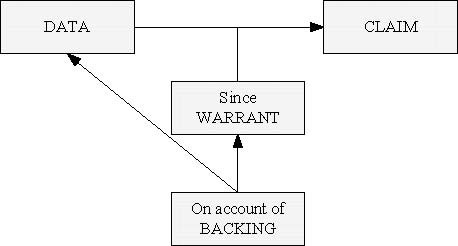
Figure 1. Toulmin’s main structure for argument analysis.
Generally defined, an argument is as “a set of claims in which one or more of them –the premises – are put forward so as to offer reasons for another claim, the conclusion” (Govier, 2014; p. 1). Using TAP terms, those premises include data, i.e. facts on which a conclusion is based, and warrants, i.e. rules of inference linking the data to the claim. In formal, deductive logic, as for example mathematical proofs, the validity of an argument is judged from the validity of the premises used to lead to the conclusion: if the premises (data and warrants) are true, then the conclusion is also true. This, however, is not the case for the great majority of arguments used in everyday and academic settings. A different type of logic, known as informal or defeasible logic applies, which calls for different, more complex criteria of validity, and also draws importance on the additional evidence used to support the premises of the argument, namely the backings. The distinction between data (premises) and backings is crucial at a strategic level, as the force of a thesis (a conclusion or claim) depends on the acceptability of the premises, and the acceptability of the premises can be increased or established using backings.
Moreover, given the difficulty in defining when a defeasible argument is acceptable, it is very usual to instead define when it is not acceptable (Govier, 2014). For this reason, various theories of fallacies or invalid arguments have emerged. Adopting one theory or another implies different criteria of defining the invalidity of an argument, and therefore its degree of acceptability or validity. This complexity of argumentative reasoning and its assessment may explain its limited use as a teaching tool in existing academic writing handbooks and courses. However, it also justifies the complexity of assessing argumentative writing itself, as the various existing forms of promoting it (see Ferretti & Graham, 2019).
Method
The paper presents an exploratory case study of a Ph.D. seminar on argumentative academic writing designed and delivered at a Portuguese University during the academic year of 2017-2018. As part of the case study, we analyzed both the course contents and the rationale of their design, as well as their impact of these contents on the students’ observed argumentative skills as assessed at the beginning and at the end of the course. The methodology used is mixed, as both a qualitative and a quantitative analysis of students’ paper drafts was applied, according to our research questions:
RQ1: Did students implement stronger argumentative writing strategies in their written drafts throughout the argument-oriented academic writing course?
RQ2: Did students apply more argumentative strategies in their written drafts throughout the argument-oriented academic writing course?
To address the above questions, we implemented an identification and analysis of the argumentation strategies that students applied in their academic paper drafts at the beginning and at the end of the course. These strategies were assessed on the basis of whether they correspond to valid “argumentation schemes” or to unsuccessful “paraschemes” (these terms will be defined below). After qualitatively identifying students’ valid and invalid argumentation strategies in their pre- and post-course drafts, a comparative statistical analysis using non-parametric tests was conducted. Our goal was to see whether an explicit focus on argumentative reasoning structure and skills, as part of an academic writing course, has a positive impact on the quality of students’ drafts.
Participants
The participants were seven first-year Phd students subscribed at different study programs of the Faculty of Social Sciences and Humanities of the authors’ affiliating institution, i.e. a public University in the urban area of Lisbon, Portugal. The students were one male and six females, with an average age of 26 years old. Their ethnicity varied with two students being Portuguese, one Italian, one Brazilian, one Spanish, one Korean, and one Turkish. The distribution of the study programs in which they were subscribed, was as follows: Artistic studies (4), Anthropology (1), Digital media (1), and Portuguese studies (1).
All students were volunteer participants in the Ph.D. seminar on “Academic writing” offered by our Institution as a free-option course. The course was delivered in eleven two-hour sessions with a total duration of 22 hours during one semester (September-December 2017).
Course contents and rationale
The course was designed drawing on two distinct fields of research, which despite their interrelations very rarely interact or overlap, namely argumentation theory and academic writing. For this reason, the course was based on an approach and materials innovative in many respects. At an institutional level, the course was one of the first University courses that explicitly addressed the skills of writing academically, in English, and in a transdisciplinary mode. From a content perspective, the materials and the approach used were new, as the focus was not on the linguistic dimension of writing, but on the argumentative and strategic aspect of developing the “logic” of a paper.
The eleven sessions of the course were divided in two groups based on their contents. The first six sessions were devoted to explaining the importance of argumentation for academic writing and the different argumentative strategies that can be used for designing the different parts of a paper, and different types of papers. The remaining five sessions focused on complementary strategies of writing a good paper, such as: rules for citing and quoting correctly, the structure of the narrative of a paper, the structure of a literature review section of paper or a literature review paper, the selection of the articles used as evidence, and the tips for drafting a research project. This last session was given by our Institute’s Research Officer to add value to students’ conception of the need for being persuasive, as the academic world is highly competitive.
The six sessions focused on the argumentative structure of a paper were structured as follows (for a complete account of the course contents, see Macagno & Rapanta, forthcoming):
Session 1. This session introduced the importance of detecting the audience, defining the logos and its role vis á vis pathos and ethos in academic writing, and identifying the most common fallacies that can be found in academic papers. This the most important objective was to prove that some of the most common fallacies are related to either the overuse of personal feelings and emotions (pathos-related fallacies) or the wrong presentation of oneself as the most adequate source of authority (ethos-related fallacies). Instead, the use of logos was presented as an evidence-based strategy (considering “evidence” in the broadest possible sense) for addressing an academic audience. The use of argument-based strategies was shown to be an instrument for avoiding common logical fallacies (e.g. ad verecundiam, ad populum, ad ignorantiam, false analogy, hasty generalization, etc.).
Session 2. The argumentative macro-structure of a paper (see Figure 2), and the argumentative structure of the Issue (see Figure 3) and the Problem (see Figure 4) were introduced. In this session, we explained that a paper is a macro-argument consisting of premises (Data and Warrants) and Backings (Evidence) that support these premises. Moreover, every paper was shown to have four main logical sub-structures namely the Issue, the Problem, the Solution, and the Defense, and for each one a specific argumentative structure must apply. The argumentative structures of the Issue and the Problem were explained.
Session 3. The Argumentation schemes used for defining a theoretical issue and problem were explained. In this session, the distinction between theoretical and empirical papers was made, introducing some main argumentation schemes or strategies to prove the importance of the Issue and the Problem in a theoretical study. The most important schemes used to support the importance of the issue were the argument from values, the argument from consequence to evaluation, and the argument from practical reasoning. The most frequent schemes used for pointing out the relevance of a theoretical research question were illustrated, such as the argument from ignorance, from example, and from best explanation. Students were trained to present the same issue and problem through different types of argument.
Session 4. The argumentation schemes used for defining an empirical issue and problem were explained. The most important argumentation schemes or strategies used for defining the Issue and the Problem in a study based on empirical data were presented. In particular, the general argumentative structure for supporting an empirical Issue and Problem was shown to be similar to the one used for a theoretical paper. However, the specific use of data collection for the arguments from ignorance and the methodological attacks used in the refutations of arguments from the “best” explanation provided by the existing theories were underlined. Also in this case, students were trained to present the same issue and problem through different types of argument.
Session 5. The argument structure of the Solution (see Figure 5) and the Defense (see Figure 6) was illustrated. In this session, we explained how a paper’s main contribution cam be persuasively defended through adding argumentative elements to the Solution and the Defense, such as the ones presented in Figures 5 and 6.
Session 6. The argumentative structure of a paragraph was explained. This last argument session focused on the micro-structure of a paragraph (any paragraph of any type of paper) and on the strategies that can be used for making it more argumentative, and therefore more persuasive. The focus of this session was on the pragmatic role of paragraphs. Students were first trained on recognizing the different pragmatic functions that paragraphs can have in a paper (including: defining, explaining, persuading, defending, summarizing, etc.). Then, they were requested to write paragraphs of different lengths on the same topic pursuing distinct goals.
Importar lista
The idea underlying this approach was that students would gradually understand the “logic” of writing argumentatively through applying handy TAP-based graphs (as the ones presented in Figures 2-6) in their own academic drafts. Each student would send their initial draft to the instructors at the beginning of the course, and they would work on them under the instructors’ guidance throughout the sessions, applying the different strategies learnt. Students would be assessed according to their improvement of writing skills as emerged from the comparison between the initial and the final drafts. As academic writing consists of different types of skills, we focused only on the argumentative dimension, both in our teaching and in the students’ assessment.
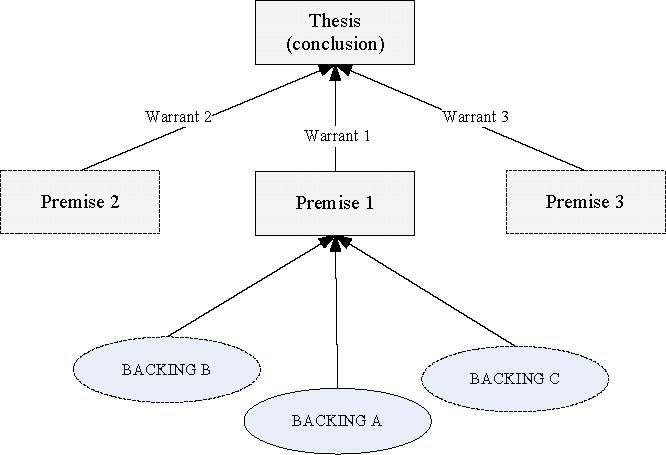
Figure 2. The argument macro-structure of a paper.
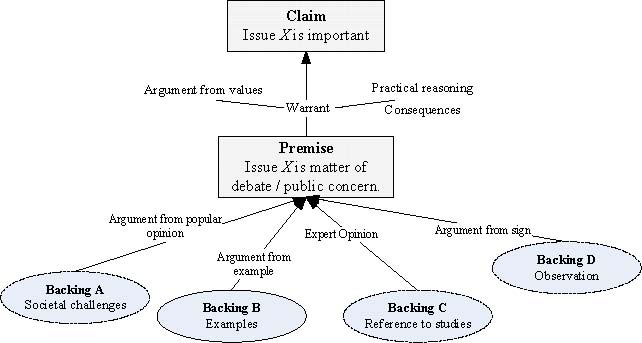
Figure 3. The argument structure of the Issue.
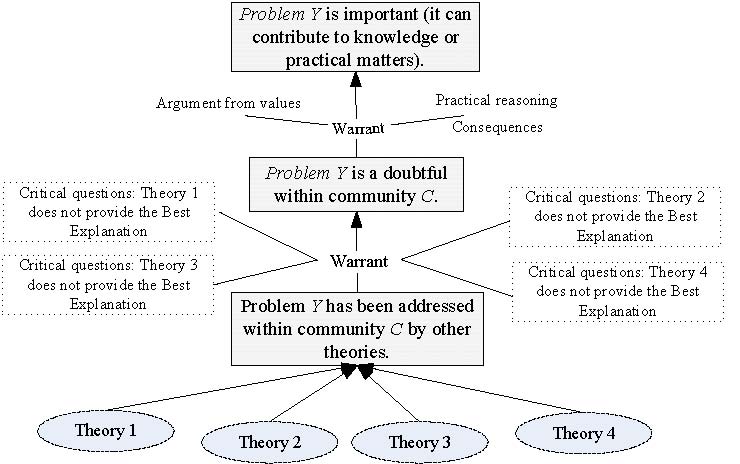
Figure 4. The argument structure of the Problem.

Figure 5. The argument structure of the Solution.
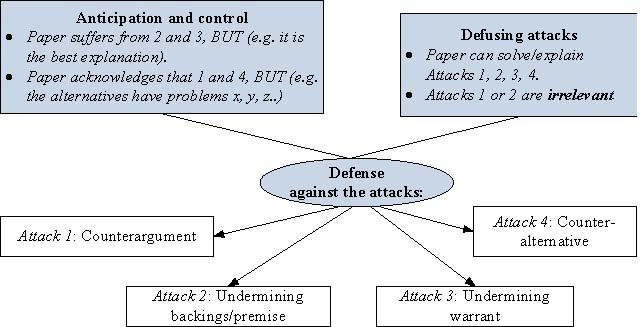
Figure 6. The argument structure of the Defense.
Assessment of argumentative reasoning
For the assessment of argumentative reasoning skills, we opted for the theory of paraschemes (Walton, 2010), previously used as an assessment tool at higher education (Rapanta & Walton, 2016a, b). The paraschemes are less valid or heuristic versions of the so-called argumentation schemes (Walton, Reed, & Macagno, 2008), which are structures of inference that represent common types of arguments in everyday conversation. A common argumentation scheme used both in everyday and in academic situations is the argument from expert opinion, represented in Table 1.
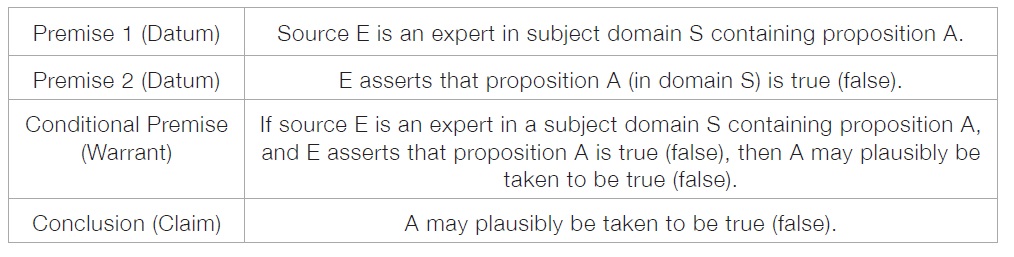
Table 1. Argument from expert opinion (Walton et al., 2008, p.19).
The important aspect of the use of this scheme is determining what counts as “expertise,” and more precisely what is to be a reference in a domain or field. Nonetheless, not always this, or other schemes, is expressed in a valid way. For example, the heuristic for argument from expert opinion can be expressed as follows: if p is an expert opinion, p should be accepted (is likely to be true). When the heuristic and not complete (critical) version of this type of argument is used, the risk is using a paraschemes and not an acceptable argumentation scheme. In this case, the use of the heuristic argument incurs the risk of committing the informal logic fallacy of ad verecundiam. The difference between schemes and paraschemes consist in the analysis and consideration of the critical questions accompanying each scheme (see Rapanta & Walton, 2016a, b). For example, the argument from expert opinion is matched with six questions:
(a) Expertise question: How credible is E as an expert source?
(b) Field question: Is E an expert in the field F that A is in?
(c) Opinion question: What did E assert that implies A?
(d) Trustworthiness question: Is E personally reliable as a source?
(e) Consistency question: Is A consistent with what other experts assert?
(f) Backup evidence question: Is E’s assertion based on evidence?
Findings
Fourteen texts (seven pre- and seven post-course) were submitted by the students as part of their assessment; nine were paper drafts, four were research project drafts, and one text was a Masters’ dissertation (submitted as a pre-course draft). The texts were analyzed both qualitatively and quantitatively, as explained above. The qualitative analysis consisted in characterizing the most important critical and non-critical strategies used by the students, both separately and as a group. The quantitative analysis consisted in comparing the performance of the participants before and after the course.
In the seven pre-course texts, the following argumentation schemes were detected: from sign or example, from popularity, from consequences, from cause to effect, and from expert opinion. In the post-course drafts’ assessment, some new argumentation schemes appeared together with the ones mentioned above, namely: analogy, from ignorance, from value, from classification, and practical argument. This change may indicate that students learned how to use new argumentation strategies. Regarding the use of paraschemes, the following types emerged among the pre-course drafts: ad verecundiam, ad populum, ad ignorantiam, hasty generalization, and false analogy (for an explanation of these terms see Rapanta & Walton, 2016a, b). In the post-course drafts, paraschemes occurred in only one students’ manuscript, where almost all the strategies used in the pre-draft were repeated. The rest of the students did not produce any paraschemes in support of the four main logical parts of their post-course drafts, namely the Issue, the Problem, the Solution, and the Defense. Table 2 presents the total number of types of schemes and paraschemes classified according to the logical parts of the papers drafted at the beginning and at the end of the course.
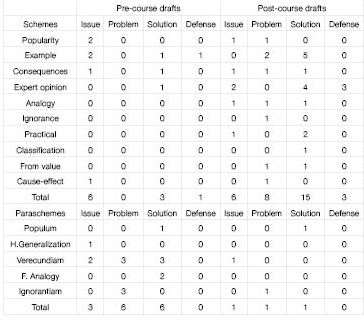
Table 2. Schemes and paraschemes emerged within the pre- and post-course drafts.
The qualitative changes that took place in students’ pre- and post-course drafts may be summarized as follows: (a) placing arguments based on critical patterns (argumentation schemes) in other logical parts of a paper, for example from Issue to Problem, from Solution to Defense, etc.; (b) modifying the structure of an argument, passing from the application of a parascheme to its corresponding valid argumentation scheme in the same logical section; and (c) avoiding the use of paraschemes and expressing the same arguments through critical patterns of argument.
To confirm whether a significant change in students’ use of argumentation strategies took place, we run a paired T test for the number of valid schemes used by each student before and after the course. The result (t = 4.260282; p = .00266) was significant at p < .05, confirming that there was a positive change in the manifestation of argumentation strategies in students’ writing. To complement this finding, we performed another paired T test for the number of paraschemes appearing in students’ texts before and after the course. The result (t = -2.661197; p = .01873) was again significant at p < .05, confirming that students’ use of invalid argumentation strategies also changed throughout the course (the negative value of t reveals a reduction in the use of paraschemes). Table 4 presents the scores, i.e. numbers of schemes and paraschemes, for each student before and after the course.
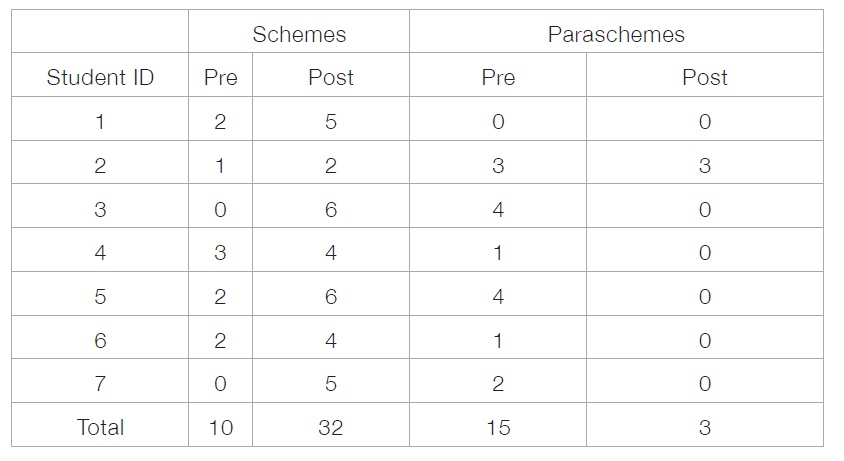
Table 4. Students’ scores for schemes and paraschemes in their pre- and post-course drafts.
Discussion
This study reported a case of an academic writing course delivered as a Ph.D. seminar at a public University in Lisbon. The course was innovative from the point of view of explicitly combining argumentation theory with the skill of writing academically. Our expectation was that students would manifest enhanced skill in implementing critical argumentation strategies, represented by arguments developed based on argumentation schemes, in various parts of their texts (research papers and project drafts).
The results were significantly positive, showing that students were able throughout the three months of the course to produce academic texts argumentatively more sophisticated. Moreover, the informal logic fallacies that they committed, captured as invalid argumentation schemes or paraschemes, were also significantly reduced, as the number of existing paraschemes used for presenting the Issue, the Problem, the Solution, and the Defense in their final drafts was zero for all participants except for one (Student 2). Although we did not have a control group, and the number of students was limited (seven), the increase of schemes and reduction of paraschemes for almost every student, was remarkable for the short time of the course, increasing the possibilities that the change was due to the course and not due to the time passed. In the case of the one student who did not have a remarkable change, this was possibly due to the fact that he chose to work on his Master dissertation and re-structure it as a research paper. Therefore, he paid attention to the structural aspects of the paper (sections, sub-sections, etc.) and not to the logical and persuasive aspects thereof. All the remaining students who worked on either research papers or project drafts since the beginning of the course showed a significant improvement in their final assessment.
The value of these findings is twofold. On one hand, they show that an argumentative approach to academic writing may function effectively and help students improve their writing in a short time. This contribution is even more remarkable considering the fact that the participants were not native English speakers (all drafts were written in English) and they were coming from different disciplinary fields within Social Sciences and Humanities. On the other hand, the findings show that through the explicit teaching of argumentation theory, showcased with examples from various fields of study, the context-dependent characteristics of critical thinking may be addressed and overcome. Our findings also suggest that during adulthood, the combination of teaching of argumentation strategies with a focused practice thereof (such as through writing exercises) may lead to an improvement of writing skills. This is in line both with studies that highlight the importance of the explicit teaching of critical thinking strategies (Saiz & Rivas, 2017; Cruz, Payan-Carreira, & Dominguez, 2017), as well as with studies that adopt an immersive approach (i.e. through practice) of argumentation (see Hemberger, Kuhn, Matos, & Shi, 2017, as a representative example of this latter approach).
To conclude, tools such as TAP (Toulmin, 1958) and argumentation schemes (Walton et al., 2008) may serve as generic mechanisms for learning how to apply argumentative reasoning, which can be used in different cases and settings. As this study showed, within a brief (11 two-hour sessions) course of academic writing explicitly focusing on the use of valid argumentation strategies, first-year doctorate students improved the logical structuring of their ideas. A limitation of the study is the small number of student participants, as it was a first-appearing course at our Faculty. However, the results of this exploratory case study are promising for a future implementation of the argumentative approach to academic writing proposed in the paper. Future (quasi-)experimental research could confirm the effectiveness of argumentation tools for the development of academic writing skills at different higher education levels and settings.
References
Allcott, H. & Gentzkow, M. (2017). Social media and fake news in the 2016 election. Journal of Economic Perspectives, 31(2), 211-236.
Aull, L. (2015). Connecting writing and language in assessment: Examining style, tone, and argument in the US Common Core standards and in exemplary student writing. Assessing Writing, 24, 59-73.
Badley, G. (2009). Academic writing as shaping and re-shaping. Teaching in Higher Education, 14(2), 209-219.
Bereiter, C. (2005). Education and mind in the knowledge age. London, UK: Routledge.
Cruz, G., Payan Carreira, R., & Dominguez, C. (2017). Critical thinking education in the portuguese higher education institutions: a systematic review of educational practices. Revista Lusófona de Educação, 38, 43–61.
Elton, L. (2010). Academic writing and tacit knowledge. Teaching in Higher Education, 15(2), 151-160.
Felton, M. (2004). The development of discourse strategies in adolescent argumentation. Cognitive Development, 19(1), 35–52.
Ferretti, R. P., & Graham, S. (2019). Argumentative writing: theory, assessment, and instruction. Reading & Writing, 32, 1345–1357.
Goldstein, M., Crowell, A., & Kuhn, D. (2009). What constitutes skilled argumentation and how does it develop? Informal Logic, 29(4), 379–395.
Govier, T. (2014). A practical study of argument (7th edition). Boston: Wadsworth & Cengage Learning.
Graff, G., & Birkenstein, C. (2010). They say, I say. The moves that matter in Academic Writing. New York: W. W. Norton and Company.
Hemberger, L., Kuhn, D., Matos, F., & Shi, Y. (2017). A dialogic path to evidence-based argumentive writing. Journal of the Learning Sciences, 26(4), 575–607.
Hoey, M. (1983). On the surface of discourse. London: George Allen & Unwin Ltd.
Kuhn, D., & Udell, W. (2003). The development of argument skills. Child Development, 74(5), 1245–1260.
Macagno, F., & Rapanta, C. (forthcoming). The logic of academic writing. Bronxville, NY: Wessex Press.
Marchi, R. (2012). With Facebook, blogs, and fake news, teens reject journalistic “objectivity”. Journal of Communication Inquiry, 36(3), 246–262.
Rapanta, C. & Walton, D. (2016a). Identifying paralogisms in two ethnically different contexts at University level. Revista Infancia y Aprendizaje, 39(1), 119-149.
Rapanta, C. & Walton, D. (2016b). The use of argument maps as an assessment tool in higher education. International Journal of Educational Research, 79, 211-220.
Rowe, G., Macagno, F., Reed, C., & Walton, D. (2006). Araucaria as a tool for diagramming arguments in teaching and studying philosophy. Teaching Philosophy, 29(2), 111-124.
Saiz, C. & Rivas, S. (2017). Desarollo del pensamiento crítico. In L. S. Almeida (Ed.), Criatividade e pensamento crítico: Conceito, avaliação e desenvolvimento (pp. 133-179). Braga: Centro de Estudos e Recursos em Psicologia.
Toulmin, S. (1958). The uses of argument. Cambridge: Cambridge University Press.
Walton, D. N. (1989). Dialogue theory for critical thinking. Argumentation, 3, 169-184.
Walton, D. N. (2010). Why fallacies appear to be better arguments than they are. Informal Logic, 30(2), 159–184.
Walton, D. N., Reed, C., & Macagno, F. (2008). Argumentation schemes. Cambridge: Cambridge University Press.
Zohar, A. (2008). Science teacher education and professional development in argumentation. In S. Erduran & M.-P. Jimenez-Aleixandre (Org.). Argumentation in Science Education: Perspectives from classroom-based research (pp. 245–268). Dordrecht: Springer.