2020
181
16052019
05122019
 Ruth Gómez de Travesedo Rojas ruthgtr@uma.es
(University of Málaga), España
Marta Gil Ramírez martagr@uma.es
(University of Málaga), España
Abstract: In recent years fashion and beauty magazines, although they have not abandoned their printed edition, have not been able to stay out of the current reality: a highly digitized society, which goes very often to the Internet and in which social networks win more prominence every day, especially among the younger female audience. For this reason, the magazines themselves, already in the 90s of the last century, launched their web portals and also have a presence on social networks with global reach. It is logical to think that these magazines pay more attention to social networks that give greater prominence to the image, such as Instagram, Pinterest or YouTube, because its theme focuses on content with a high visual component. In this way, the most used social networks will be analyzed through analysis of content, collecting information about the number and type of networks used, level of visibility and exposure, as well as the level of interaction and involvement of its followers. The results show that, although the interaction and involvement is greater in visual networks, the magazines are not yet aware of this and dedicate their greatest efforts to textual networks.
Keywords:Women’s magazinesWomen’s magazines,Social networksSocial networks.
Resumen: En los últimos años las revistas de moda y belleza, aunque no han abandonado su edición impresa, no han podido quedarse al margen de la realidad actual: una sociedad altamente digitalizada, que acude con mucha frecuencia a Internet y en la que las redes sociales ganan cada día mayor protagonismo, sobre todo entre el público femenino más joven. Por este motivo, las propias revistas, ya en los años 90 del siglo pasado, lanzaron sus portales web y cuentan también con presencia en redes sociales con alcance global. Resulta lógico pensar que estas cabeceras presten más atención a redes sociales que dan mayor protagonismo a la imagen, como Instagram, Pinterest o YouTube, ya que su temática se centra en contenidos con un alto componente visual. De este modo, se analizarán, mediante el análisis de contenido, las redes sociales más empleadas, recogiendo información referida al número y tipo de redes utilizadas, nivel de visibilidad y exposición, así como nivel de interacción e involucración de sus seguidores. Los resultados muestran que, aunque la interacción e involucración es mayor en redes visuales, las revistas aún no son conscientes de esta circunstancia y dedican sus mayores esfuerzos a redes textuales.
Palabras clave: Revistas femeninas, Redes sociales, Género.
Resumo: Nos últimos anos, revistas de moda e beleza, embora não tenham deixado a sua edição impressa, não conseguiram se manter fora da realidade atual: uma sociedade altamente digitalizada, que vai muito frequentemente à Internet e em que as redes sociais ganham mais destaque a cada dia, especialmente entre o público feminino mais jovem. Por esta razão, as própias revistas, já nos años 90 do século passado, lançaram suas páginas da web e também têm presença em redes sociais com alcance global. É lógico pensar que esses publicações prestem mais atenção às redes sociais que dão maior importância à imagem, como Instagram, Pinterest ou YouTube, já que seu tema se concentra no conteúdo com alto componente visual. Através da análise de conteúdo, serão analisadas as redes sociais mais utilizadas, número e tipo de redes utilizadas, nível de visibilidade e exposição, assim como nível de interação e envolvimento de seus seguidores. Os resultados mostram que, embora a interação e o envolvimento sejam maiores nas redes visuais, as revistas dedicam seus maiores esforços às redes textuais.
Palavras-chave: Revistas femininas, Redes sociais.
Artículos de investigación
From Twitter to Instagram: Which social network do fashion and beauty magazines choose?
De Twitter a Instagram: ¿Qué red social eligen las revistas de moda y belleza?
Do Twitter ao Instagram: Qual rede social as revistas de moda e beleza escolhem?
Ruth Gómez de Travesedo Rojas ruthgtr@uma.es
Marta Gil Ramírez martagr@uma.es

Recepción: 16 Mayo 2019
Revisado: 04 Octubre 2019
Aprobación: 05 Diciembre 2019
Publicación: 01 Enero 2020
Gómez de Travesedo Rojas, R. & Gil Ramírez, M. (2020). From Twitter to Instagram: Which social network do fashion and beauty magazines choose?, Icono 14, 18 (1), 179-202. doi: 10.7195/ri14.v18i1.1395
Fashion and beauty magazines emerged in the 1960s, but it was not until the 1980s, coinciding with our country opening to the outside world, that there was a boom in this type of press. At this time, large international titles – Elle, Vogue and Cosmopolitan – arrived in the Spanish market, dominating national magazines which would not win the battle against large international publishers1 (Ganzabal, 2006).
Since then, the market of fashion and beauty magazines has undergone various reorganisation processes, such as the adaptation to pocket size, reaching young women’s press with Ragazza in 1999, and subsequently with Cosmopolitan in February 2002; although the launch of Glamour in mini or pocket format in our country was the true wake-up call for most of these titles deciding to move to this format (Ganzabal, 2008).
Following the global economic crisis, which affected our country at the start of 2008, the appearance of low cost magazines was possible, with titles such as Cuore Stilo, ¡Hola! Fashion, Grazia and Divinity, imitating high end women’s magazines, although with more accessible fashion and beauty content.
We must also bear in mind what has been the great crisis of the media, particularly for the press: the digital crisis. The appearance of the internet entailed a change in the way media was consumed; but also in lifestyles. In fact, we cannot consider our current society without considering the internet. “The internet is the fabric of our lives now. It is not the future, it is the present. It is a medium for everything, which interacts with society as a whole” (Castells, 2001, p. 1).
The internet has been established as a form of media to which the traditional media has had to adapt its strategy (Canga, 2001). It offers us a different way of consuming, with constant renewal of information, with free, instantaneous and up to date content, something with which the paper format cannot compete (Font, 2015).
In this way, the digital crisis entailed a new restructuring of the media landscape and a redistribution of market share. Advertisers, although initially reluctant to invest in online formats, soon saw the advantages of this new media, especially due to its large, constantly growing audience, with global figures reaching 4.388 billion internet users according to the 2019 Digital Report. “The number of unique internet users is continuously growing, and at a global level, not only in Spain” (Ayestarán, 2011, p. 141).
In 1997 Albertos (1997) predicted the end of paper newspapers by 2020, which has not occurred. However, although for the moment the digital media exists alongside traditional media, we cannot ignore the boom of the former, due to which the majority of newspapers and magazines around the world also have an online presence.
Fashion and beauty magazines currently exist in a technological and communication context which has little in common with that of previous years. Almost nothing remains of the media market in which printed titles competed with each other; as the development and democratisation of the internet has diversified the media and eliminated borders, facilitating the creation of platforms and websites. Printed magazines now also compete with fashion and beauty blogs and with digital women’s magazines, two products which offer some of the same content as traditional titles aimed at women.
However, despite the digital crisis having affected the audience and advertising investment of all traditional media, high end women’s press in paper format continues to have large audience figures2, and we therefore cannot say that it is an obsolete product.
Despite this, publishers are aware of the importance of being on the internet for three reasons: fighting to maintain and not lose their share of a market as competitive as that of women’s press; accessing new, younger readers, used to a different type of consumption; and retaining advertisers, which requires an online presence (Ganzabal, 2007a).
In fact, studies show the preference of young people for finding information from online media compared with traditional media. This is confirmed by Ganzabal (2007a), for whom it is a fact that people under 30 years old are abandoning Reading printed media in favour of digital media and multimedia content, this situation being seen not only in newspapers, but also in a more specialised product such as magazines. “Young people live with screens in an unconstrained and natural way. They were born and have grown up in this environment, (...), they have learned to operate technological interfaces before reading and writing” (Gabelas & Marta, 2011, p. 11). This is something which Ayestarán (2001) agrees with:
People under 30 years old are abandoning printed media, amazed by the possibilities of multimedia and the online presence of their magazines. This audience segment is beginning to be essential for both opening to this new market and for maintaining their position in it. Another of the routes for this type of publication to not lose their market share and access new readers is the introduction and generalization of their online content. Thus, large publishing groups have included the websites of these magazines. Their use is so logical that it is currently unthinkable for these publications not to have their corresponding website. It is not necessary to pay the price for these RFAG3 titles on the internet; anyone who is connected can access them. (pp. 141-142)
According to Ganzabal (2007a, p. 69) “if there is a sector especially suitable for new trends, it is the female audience, precisely for their fondness for new fashions”. Fashion and beauty magazines have quickly understood this, not remaining outside of this circumstance, also having adapted to the digital revolution.
Although not having abandoned their traditional paper format, they have created digital editions of their titles, aware that their younger readers do not consume magazines purchased at kiosks, but instead on the internet. These are new generations born into a digital culture, a culture through which they can and must be reached. In fact, the constant reorganisation and adaptation of women’s press through its history is “a form of constant updating, thereby avoiding the successive loss of this market niche formed by a younger audience” (Ganzabal, 2007a, p. 69). Ayestarán (2011) also indicates that these publications have a long journey toward the future, positioning themselves and adapting to their new environment. In this way, the digital presence of this type of title is essential.
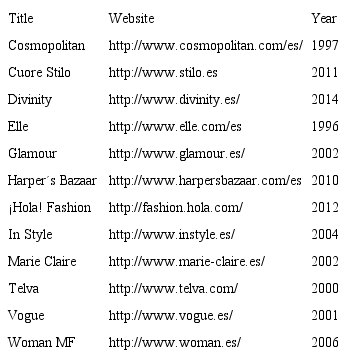
In this context, women’s press adapted to the internet with great speed, almost simultaneously with national newspapers. Elle and Cosmopolitan were the first to have an online version in the mid-90s, when the internet was still an emerging phenomenon. In 1996, when barely 1% of the population used the internet, Elle already had its web portal, Cosmopolitan having its own one year later.
However, the digital boom of fashion and beauty magazines occurred in the period between 2000 and 2003, when the market for digital consumption was more stabilised. It was then that the websites of Telva (2000), Vogue (2001), Glamour and Marie Claire (2002) emerged. Other magazines released on the market later in printed format were released simultaneously in their online version (Ganzabal, 2007a; and Armentia, Ganzabal & Marín, 2011).
Currently, all fashion and beauty magazines printed in paper format have their own website (Table 1), therefore this type of title is fully incorporated in the digital market.
The majority of the pages end in “.es”, as indicated by Ganzabal (2007a), in order to differentiate the Spanish edition of the publication from that of other countries, except for titles which are only published in our country.
With regard to the type of content offered by these digital versions, the differences are not significant. For Armentia et al. (2011), these digital versions of the magazines repeat the same discourse as their eponymous printed editions, acting as an element for their promotion.
From the above, we can see that the internet, in addition to being an endless source of information, has also become a very powerful tool for its dissemination: due to its immediacy, because it allows any content and topic, and due to the lack of censorship. In the same way, the spread of electronic and technological devices such as portable computers, smartphone and tablets has allowed quick and instantaneous access to these platforms (Sánchez, 2014). In addition to this are social networks such as Facebook, Myspace, Tuenti, etc., which have become one of the elements with greatest influence on the new media landscape (García, 2012).
In the new social scenario of the 21st century, social networks have taken on great importance, becoming major players in digital society (Caldevilla, 2010). This prominence increases each day, as reflected by figures on the existence of 3.484 billion social network users around the world, amounting to 43% of the global population (Hootsuite, 2019).
According to Flores (2009), the internet itself is the quintessential social network, which has allowed the development of the other networks which have become a mass phenomenon, offering a new form of communication. For Caldevilla (2010, pp. 45-47) “it has revolutionised our concept of classic social relationships and our investment in free time” and totally transformed the traditional concept of communication.
It is in this context where traditional mass media is starting to consider its survival, moving to the internet and necessarily adapting to the changes it has brought. Campos (2008) refers to social networks as a new media:
The new phenomenon of social networks amounts to audiences of millions, increases advertising, achieves the personalisation of users and breaks away from some of the barriers of old media organisations. This new media now appears on the screens of millions of internet users as one of the main sources of entertainment and information. (p. 277)
Caldevilla (2010, p. 46) agrees on this, referring to them not only as a new scenario, but as “a new agent and a new media to take into account on the mapping of communication, and which stands out with great power for generating opinion and trends”. Noguera (2010, p. 178) underscores the need to bring the media to social networks, although indicating that “entering naturally and exploiting the journalistic possibilities of social networks to the maximum is still a pending task”.
Among the reasons prompting the media to adapt to social networks, Lara (2008) indicates three aspects:
The new challenge of the media is to “capture new audiences and make their audiences into social networks” (Lara, 2008). Flores (2009, p. 75) agrees on this, indicating that “in social media, communities replace audiences”.
In terms of audience, what could be more appealing to a form of media than becoming a meeting point for friends or people with common interests? Thus, the media wishes to be a social network, although have not yet discovered the formula for doing so; therefore, for the moment, their first attempts are focused on having a presence on the networks with most followers or which are most important in terms of the audience profile or type of content (text, image, video, etc.). For Sánchez (2012), social networks are not an option in communication for companies, instead being essential.
Logically, as with the rest of the media, fashion and beauty magazines have not escaped this trend. “Thus, both the media, institutions, entities and associations, as well as businesses of all types, including those related with the fashion industry, have not been able to refuse the opportunity to be present on the network, being able to offer more options and improve the experience, in this case, of the reader of fashion magazines” (Font, 2015, p. 20).
In our current society, the importance of visual elements, of image, is evident. Even more “textual” social networks, such as Twitter, today offer the possibility of viewing photos. As González (2014) states, images are a major, central part of our lives, and with them we communicate better and more quickly. In fact, there is an increasing trend toward a more visual network.
For some time now we have seen how all social networks have placed greater importance on the visual elements of the web content, displaying images of increasing size and quality. We are talking about the Facebook cover photo, the possibility now offered by Twitter of viewing photos without leaving its page (…) and many other signs which clearly show the triumph of the visual over the textual. (González, 2014)
The qualities of the image when communicating have triumphed over text on Web 2.0, as it allows a concept to be explained more easily and quickly that with text (Mercedes & De la Morena, 2014).
Faced with this reality, we must bear in mind that in online editions of women’s magazines, images take precedence over text, so that, as Armentia et al. (2011) indicates, they are planned more for being looked at then read. This is not surprising if we consider that in the printed versions of these titles, images predominate over text, especially in advertising, which makes up 27% of the pages (Torres, 2007). Therefore, it is also not surprising that all of these are presence on one of the networks categorised as “visual” (Font, 2015) or “based on image” (Mercedes & De la Morena, 2014).
Among the characteristics that we can highlight in these visual social networks compared with other more textual types of networks, the fact that accessing them on mobile devices is very easy and that they attract a younger audience is notable.
In recent years and with the proliferation of the use of smartphones and other mobile devices with integrated cameras, a type of social network has been consolidated which, due to its functional characteristics and the ease of sharing the content generated on it, has become widespread among users of Web 2.0, users who are increasingly social and digitally active; these are social networks based on images. (Mercedes & De la Morena, 2014, p. 155)
Although fashion and beauty magazines are present on the most popular networks and which have more followers (Facebook and Twitter), they also have a significant presence on visual networks. All women’s fashion and beauty magazines, Cosmopolitan, Cuore Stilo, Divinity, Elle, Glamour, Harper´s Bazaar, ¡Hola! Fashion, In Style, Marie Claire, Telva, Vogue and Woman MF, are present on Facebook, Twitter, Instagram, Pinterest and YouTube (except for ¡Hola! Fashion and Divinity which are not present on the video network).
Instagram and Pinterest are the image based social networks which have become most popular in recent years (Mercedes & De la Morena, 2014), as found in the 2017 Annual Study on Social Networks, which placed them among the top ten networks with most followers (in fifth and ninth place, respectively) and additionally reflects an increase of 345 compared with the previous year for Instagram and 14% for Pinterest. Additionally, 56% and 39% of users of Instagram and Pinterest respectively have increased their frequency of visiting them in the last year. In 2018, Instagram was in fourth position and Pinterest eighth, both social networks therefore having increased their use in the last year (IAB Spain, 2018).
The same study additionally discovered that in both cases, the audience profile is mainly made up of women, there being a correspondence with the sex of the readers of women’s magazines. The importance of these networks is also demonstrated by studies such as that of Mercedes (2015) which refer to a migration of young people from Facebook to Instagram.
However, if we take into account the fact that Pinterest and Instagram are relatively young social networks, both created in 2010, it is no surprise that scientific literature on the use of image based social networks in women’s fashion and beauty press is scarce. In this way, although it is not the purpose of this research to summarise the history and course of each one of these social networks, on which there are works of essential reading by Font (2015), González (2014) and Mercedes & De la Morena (2014), among others, we will dedicate some lines to reflection on the relationship which these social networks may have with the fashion and beauty magazines, the subject of our research.
The importance of visual social networks for titles aimed at women revolve around their importance to brands. We cannot forget the commercial nature of magazines aimed at women, in which the content itself fuels brands, mainly fashion and beauty brands. In this regard, Mercedes & De la Morena (2014) highlight the importance of both Instagram and Pinterest from the commercial perspective and for advertisers and firms by allowing them, as De Salas (2009) indicates, to appear before their audience in a less institutional way, mixing with it, allowing companies to advertise in less intrusive ways, becoming an opportunity for advertising impact thanks to segmentation by interests, hobbies, etc.
For Rodríguez (2015) social networks humanise commercial brands and connect them with the emotional part of people. Through these networks, they are presented in day to day scenes and become something commonplace.
The importance of networks for brands is also demonstrated in the 2017 Annual Study on Social Networks, which ascertained that 83% of users state they are a fan of or follow a brand through its social networks. Additionally, over half state having been influenced in purchase decisions by them.
These figures are also reflected in the increased advertising investment in social networks, advertisers showing their interest in not losing this business opportunity (De Salas, 2009).
Additionally, and with regard to Instagram, authors such as Font (2015) consider this network to be configured as a strong competitor with women’s magazines, as various renowned Instagrammers have become spokespeople for fashion brands; to the point that it is questioned whether they could replace traditional women’s magazines, indicating that “brands (…) have made them an intermediary which allow them to access consumers more easily and through a more economical channel” (Font, 2015, p. 3). Thus, they contact Instagram influencers to send them their garments, aware that if they are photographed with the clothing or accessories of the brand and upload these images to the social network, thousands of followers will imitate their style.
In agreement on this aspect is Basoa (2014, p.18), for whom the relationship between fashion and the internet has generated new professions such as bloggers who “are great influences in purchase decisions and in the creation of trends”.
Social networks become great allies for the fashion industry because they allow fashion and trends to reach everyone sooner; in this way, “images, items and styles are created and disseminated around the world much more quickly” (Martínez, 2006, p. 188).
Corporate websites, digital magazines, blogs and bloggers are created to “renew the industry, communication and consumption habits of fashion” (Font, 2015, p. 5). Additionally, Font (2015) recognises the importance of the network for women’s magazines, indicating that apart from being used as an advertising format for brands, the digital format of publications is used to “share” their content; the social networks having become window displays “through which users express opinions, feelings, and in a certain way, their own personality” (Font, 2015, p. 31).
With regard to Pinterest, for González (2014) it is “the quintessential visual social network, which reached 10 million users faster than any other”. Mercedes & De la Morena (2014) highlight it as one of the most attractive networks for the female audience, and of great importance before making a purchase decision, indicating that many brands around the world have a profile on this network.
Finally, with regard to YouTube, Amaya & Rojas (2016) indicate that it has become a very important network for the dissemination of fashion, with the book of YouTubers uploading content to the platform with fashion tips which, on many occasions, affect the purchase decisions of their followers.
Based on the aforementioned aspects, the hypothesis is posed considering women’s magazines to have greater impact on social networks which give greater prominence to image, such as Instagram, Pinterest and YouTube, as the topic of these posts is essentially based on fashion and beauty content, aspects with a high visual component. In this way, we understand that it is on these social networks that these publications operate more comfortably and naturally, being titles whose print and digital versions revolve around distinctly commercial content, where brands are the prominent players and where photographs and images play an essential role, not only on advertising pages, but even in their content.
Through the technique of content analysis, the social networks most used by women’s fashion and beauty magazines will be studied. The research encompasses a twelve month period, from the 1st of July 2018 to the 30th of June 2019.
To proceed to the selection of the sample, it was considered which magazines were most representative, using the data provided by the Ari 360º report, which measures audiences on multiple platforms and formats, including paper, digital, website, video and social network editions. As the analysis period includes the last six months of 2018 and the first half of 2019 and the social networks analysed are Facebook, Twitter, Instagram, Pinterest and YouTube, only the figures referring to these networks and with aggregated data to June 2019 have been considered.
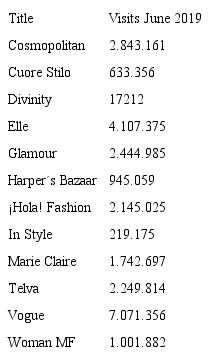
The magazines with most visits are Vogue, Elle, Cosmopolitan and Glamour, in this order; in all cases exceeding two million. These four titles have therefore been selected as the most representative in terms of audience on the five social networks we wish to analyse.
To undertake the analysis of each one of the networks, we will focus on formal and interaction aspects through a content analysis datasheet and with the support of the Fanpage Karma tool, which offers metrics on the different social networks.
The formal variables analysed are number of followers and posts; the interaction variables are made up of total interactions, reactions, shares, etc., and commitment. The criteria analysed on each one of the networks were level of visibility and exposure, as well as the level of interaction and involvement of followers, through likes, shared elements, saved elements, comments, etc. In this way we will be able to ascertain:
The size of the audience or community (fans, followers, contacts, subscribers, etc.) of each one of the networks and their growth.
Number of posts, tweets, pins, videos, etc. and interactions through comments, shared content, likes, etc.
Commitment or loyalty, which measures the level of involvement of the audience.
It is noted that this is not intended as a comparative analysis between the different titles, therefore we will study the overall use which women’s magazines make of the networks in order to test our initial hypothesis stating that these publications focus their efforts on visual networks; although in some cases it will be necessary to refer to the individual results of each one of them for better interpretation and understanding of the data.
The analysis was carried out in the period from July 2018 to June 2019, but due to the tool used not providing data on Elle Pinterest followers for this period, we have taken the data from the ARI 360º report, which reflects the number of followers on all social networks up to the end date of the analysis. It is aggregated data, which takes into account highs and lows, which allows us to check the end date of the analysis period for the situation of each magazine on the different networks in terms of number of followers.
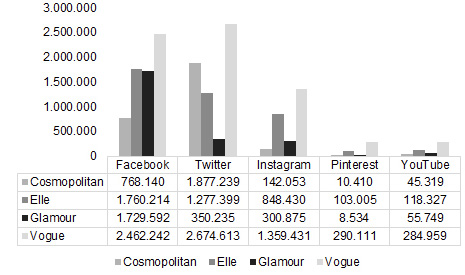
Facebook and Twitter are the networks with the largest number of followers, exceeding six million in total for the four titles (6,720,188 and 6,179,486 respectively); followed by Instagram, with over two and a half million followers (2,650,789) and at a greater distance by YouTube (504,354 subscribers) and Pinterest (412,060 followers). In this way, the textual networks have a larger number of followers compared with the visual networks which in general are followed less by the audience of these magazines.
Vogue and Cosmopolitan are those with the most followers on Twitter, while Elle and Glamour have more users on Facebook. The highest figure of Instagram followers corresponds to Vogue, with just over one million, three hundred thousand. It is also the fashion magazine with the greatest number of users on Pinterest (290,111) and YouTube (284,959), standing out on all networks analysed.
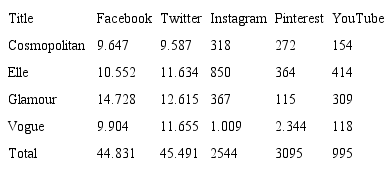
Facebook and Twitter are not only the networks with the most followers, but also those on which the magazines have posted most during the analysed period, with a total of 44,831 and 45,491 posts respectively, translating into an average of 11,208 and 11,373. The activity on Instagram is lower, with an average of 636 posts during the whole period, with YouTube in last place with only 249 posts.
Glamour is the most active on Facebook and Twitter, although less active on visual networks. However, the number of posts on Pinterest by Vogue (2,344 pins in twelve months) stands out in comparison with only 364 by Elle, 272 by Cosmopolitan and 115 by Glamour. Behind Vogue, Elle is the second most active magazine of the four analysed on Instagram, with 850 posts during the period.
Additionally, we must draw negative conclusions from the fact that although the Elle Pinterest page has over 103,005 followers, being the title with the second most users on this social network, it posted only 364 pins.
In summary, Vogue is the most active magazine, posting most in Pinterest and Instagram, and Glamour posting most on Facebook and Twitter, while Elle stands out on the YouTube video platform.
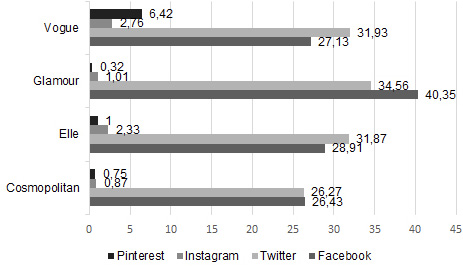
If we analyse the variable of number of posts per day4, we can again observe that the magazines are more active on textual networks, with figures varying between 40 and 26 posts/day on Facebook, and between 34 and 26 on Twitter. In general terms, the level of activity of the magazines is an average of 30 posts/day on textual networks. However, for Pinterest, it is barely 2.12 posts/day, with similar behaviour on Instagram, where activity is even lower (1.74 posts/day).
The magazine responsible for Pinterest being ahead of Instagram is Vogue, the most active magazine on this network (6.42 posts/day). It is also most active on Instagram (2.76 posts/day). However, it is curious that this magazine has more followers on the latter network, although dedicating greater effort to Pinterest.
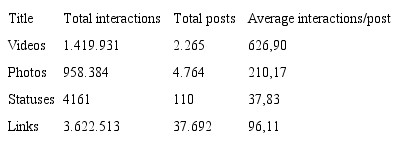
With regard to Facebook, the tool used for data collection offers us information on the number of videos, images, links and statuses posted, as well as the level of interaction with each one. Analysing the number of images and videos published individually, we can see that overall they make up 15.68% of the posts on this network, as well as noting that more images are uploaded than videos (10.63% photographs and 5.05% videos).
Glamour is the title which uses most images (2.258), while Vogue uploads the greatest number of videos (903). Although there is less of this type of content compared with other types, it is what users react to most; that is, they receive more likes, shares and comments.
If we calculate the relationship between the types of posts and the number of interactions received, we can see that the content with most reactions, comments and shares are mainly videos (629.90 interactions/posts) and photographs (202.17 interactions/posts).
After analysing followers and content, we are interesting in examining the interactions of users on each of the networks, there being most on Instagram and Facebook. The total interactions on Instagram was 8,103,883, with 6,505,484 on Facebook, 814,167 on Twitter, 292,622 on YouTube, and finally 35,507 on Pinterest (32,831 from Vogue). However, these are absolute values, it therefore being interesting to observe another aspect: the commitment5 of users to the page.
It is in this point where low percentages are notable, in no case reaching 2%, the highest being that of the magazine Elle on Instagram, with 1.21%; and with an average between all magazines of 0.24% for Facebook and 0.04% on Twitter. However, the commitment percentage is greater on the visual network of Instagram (0.83%), although still very low on Pinterest (0.06%). We can read this data as showing the most committed users to be those of Instagram, being even greater than that of those who follow the magazines on Facebook.
Finally, the variable of growth allows us to see that the network which has grown most in the analysed period is YouTube, followed by Instagram and Pinterest; all visual networks. However, Elle has shown a decrease of 100% on Pinterest, although it is the title with the second most followers and posts on this network. Despite this, the 134% growth of Vogue keeps the Pinterest figures ahead of the textual networks such as Facebook and Twitter, which have decreased for almost all magazines, in some cases by almost 3%, Vogue being the only title which has grown on Facebook.
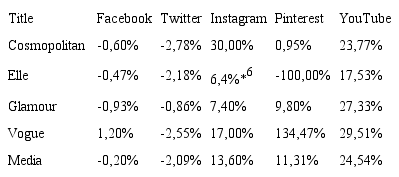
The networks with most followers and most posts are textual networks (Facebook and Twitter), however the level of commitment and growth is greater on visual networks; Instagram with regard to commitment and YouTube with regard to growth, which is not surprising, considering the great importance this network currently has. From this we can infer that the video network is configured as a format which, although it currently seems not to have sufficient attention from women’s magazines, should not be overlooked, among other aspects due to the growth it has experienced in recent years and which it seems it will undergo in the future.
With regard to the interaction of publications, in all cases it is very low, but it is curious that although women’s magazines dedicate their efforts to textual networks, Instagram is the network which has greatest commitment from users. Additionally, Vogue is quite active on the other visual network of Pinterest. This data reflects how these titles have realised the power of image and the possibilities of these younger social networks, and that they are better adapted to their themes and content.
We can conclude that although high end women’s magazines in paper format are fundamentally focused on fashion and beauty content and place great importance on image over text (something also reflected in their online editions), the social networks with greater scope are not, for now, visual networks, as we posited in our initial hypothesis, but the networks which have most users at both a national and global level: Facebook and Twitter. However, we do note that even on these more textual networks, the importance of image is essential for these titles, with content appearing accompanied by images and videos, and which also provokes more reactions from followers.
We must keep in mind the perspective of the different ages of the social networks when interpreting our analysis. While Facebook and Twitter are networks over ten years old, Pinterest and Instagram are younger. Future lines of research may be aimed at analysing whether the commitment and level of activity of women’s magazines on this type of visual network advances positively over time, causing a transfer from textual to visual networks, something which seems to already have started to happen, based on the data reflecting the percentage of decline of textual networks.
Perhaps it will not be necessary to wait much longer for a trend to be noted which prompts these titles to focus more on visual networks, above all if we consider the level of interaction of users or followers, which is greater on this type of network, even if the level of activity of titles is low, reflecting the preferences of a more active audience with a higher level of commitment toward networks such as YouTube, Instagram or Pinterest.
Facebook and Twitter are the leaders of social networks and also in the case of fashion and beauty magazines; however, the other networks are rising in rankings each day, above all those on which image, whether fixed or moving, is a principal element, especially in a society where, as we previously noted “a picture is worth a thousand words”.