Artículos
Parenting: Psychometric analysis of two studies in Spanish population
Estilos parentales: análisis psicométrico de dos estudios en población española
Parenting: Psychometric analysis of two studies in Spanish population
Anuario de Psicología, vol. 45, no. 3, 2015
Universitat de Barcelona
Abstract: Parenting styles set the pace and quality of parent-child relationships and parenting practices. This empirical research consisted of three studies based on the Child Reports of Parental Behavior Inventory (CRPBI; Schaefer, 1965) and was conducted in Spain. The analysis checks the typology and styles of parenting, bearing in mind both parents in a differentiated way. The first study involved 762 adolescents of 12-17 years (mean age=13.69 y SD= 1.40; 52.7% boys). A total of 824 children of 8-11 years participated in the second study (mean age=9.28 y SD= 1.34; 47.8% boys). The results of the exploratory and confirmatory factorial analyses show a four-factor model: Support and communications, Negative psychological control, Permissiveness, and Negligence, for both the mother and the father, which determine parenting from the children's perception. The fit indexes are within the established limits to consider this an appropriate questionnaire to assess parenting styles in childhood and adolescence in Spanish populations
Keywords: Parenting, factorial analyses, adolescence, middle childhood, young teens.
Resumen: Los estilos de crianza van marcando el ritmo y la calidad de las relaciones entre padres e hijos, así como las prácticas de crianza. Este trabajo analiza los resultados de los análisis factoriales exploratorio y confirmatorio del cuestionario Child Reports of Parental Behavior Inventory (CRPBI; Schaefer, 1965) realizado en dos estudios en población española. El estudio contempla la tipología y estilos de crianza, teniendo presente a ambos progenitores de forma diferenciada. En el primer estudio han participado 762 adolescentes de 12-17 años (M=13,69 y DT= 1,40; 52,7% varones). En el segundo estudio han participado 824 niños y niñas de 8-11 años (M=9,28 y DT= 1,34; 47,8% varones). Los resultados de los análisis factoriales exploratorio y confirmatorio muestran un modelo de cuatro factores referidos a Apoyo y comunicación, Control psicológico negativo, Permisividad y Negligencia, tanto para la madre como para el padre. Los índices de ajuste se sitúan dentro de los límites establecidos para considerar que se trata de un cuestionario adecuado para evaluar los estilos de crianza en la infancia y adolescencia en población española
Palabras clave: crianza, análisis factorial, adolescencia, infancia tardía, preadolescencia.
Parenting styles determine parent-child interaction and they are therefore linked to the emotional atmosphere between parents and children (Darling & Steinberg, 1993). This way, parenting styles set the pace and the quality of parentchild relation-ships, as well as parenting practices, which pursue the children's adequate behavior.
The initial tridimensional model of parenting styles (Baumrind, 1968, 1996) classifies them into authoritative, authoritarian, and permissive. This typological approach yields an orthogonal bidimensional perspective, defined by an affective-attitudinal axis and a demand-control one (Maccoby & Martin, 1983). Interaction between both dimensions, demand-control and affection-support and love, results in a quadripartite typology of parenting patterns. This multidimensional character sets a rather inductive or rather punitive parenting style (Hoffman, 1977, Wahl & Metzner, 2012). Currently, the classification into authoritative or competent, authoritarian, indulgent, and negligent is widely accepted (Barnhart, Raval, Jansari & Raval, 2013; Carlo, Mestre, Samper, Tur & Armenta, 2011; Sorkhabi, 2012).
Inductive parenting - Punitive parenting
Inductive parenting is based on affection and communication, and on setting limits, which are defined by behavior control, and promoting autonomy (Hoffman, 1977; Parra & Oliva, 2006). Parents act according to criteria, respecting their children's feelings. This inductive style has had positive effects on the development of children in practically every culture (Barnhart et al., 2013; Sorkhabi, 2012).
Conversely, more punitive, authoritarian parenting is based on unidirectional orders from the parents towards their children. With this style, the negative, psychological control involves a lack of confidence, disqualifications and humiliations towards the children, which has negative effects on the children's process of development (Wahl & Metzner, 2012).
Gender differences in parenting
Before the 1960s, research on parenting invisibilized the role of the father in parenting. Later on, papers start to appear taking both parents into account, checking for father-child and mother-child same-quality bonds (Silverstein & Auerbach, 1999). Still, research offers contradictory results.
On the one hand, it has been proved that a father's love can be the best predictor of the children's psychosocial development and functioning, both as young children and as adults (Rohner & Veneziano, 2001). On the other, it has been proved that mothers are more involved in parenting and that children perceive a stronger involvement of mothers (Laible & Carlo, 2004). Likewise, it has been proved that the mothers' expressivity has positive effects on the children's development (Eisenberg et al., 2003).
To sum up, although there are no conclusive results, it seems that mothers can have a significant influence on parenting, regardless of the children's sex. These responsibilities seem to spread both to the factors pertaining to inductive discipline (love, autonomy, and control), and to those pertaining to a punitive parenting style (hostility, negligence, and permissiveness) (Tur-Porcar, Mestre, Samper & Malonda, 2012).
Moreover, the parents' parenting style has proved to be quite stable and subject to few changes throughout adolescence (Rodríguez, Del Barrio & Carrasco, 2009), which seems to support the existence of the family interaction patterns characteristic of certain households. For example, controlling parents still want to control their children regardless of their age (Parra & Oliva, 2006). Even so, as the children grow up, parents tend to decrease their control and increase their autonomy. This might be due to the inherent needs of adolescent children. In adolescence, a process of extension of the social networks takes place which requires greater progressive autonomy (Parra & Oliva, 2006; Spera, 2005). Likewise, it has been proved that the children's perception of parenting styles is usually a reliable source of information and even more coherent than that provided by the parents (Silk, Morris, Kanaya & Steinberg, 2003), among other reasons, because it is less subject to social desirability (Roa & del Barrio, 2002).
The differences between the father and the mother justify the fact that this research is conducted separately for the mother and the father, which strengthens this paper.
Therefore, the goal of the current study is to analyze the dimensions and the structure of the Child Reports of Parental Behavior Inventory (CRPBI) (Schaefer, 1965), and to observe to what extent they fit into the theoretical model mentioned in the introduction.
The analyses were conducted bearing in mind the father's and the mother's parenting, from the children's perception, in two studies covering from late childhood to adolescence. A factor analysis of this same questionnaire has been conducted previously (Samper, Cortés, Náche & Tur, 2006). However, now we have more information. It is advisable to update these analyses for two reasons basically: one, to simplify the factorial structure into four factors, following the aforementioned model (Baumrind, 1968, 1996; Maccoby & Martin, 1983); and another, because of the reliability of some of the previous papers.
Method
Participants
Study 1
The participants were selected with simple randomness criteria, taking into account the geographical location so as to consider different zonal districts. The participants were 762 adolescents aged between 12-17 years (M=13.69 and SD=1.40), attending school at 4 different centers (2 public and 2 charter schools subsidized by the Valencian Government). A 52.7% were male and 47.3% women. Of the total sample, 541 lived with both parents (71%), while 221 belonged to single-parent families. With respect to the fathers' level of education: university studies (40.5%), high school diploma or vocational training (31.7%), primary school (4.2%), and uneducated (8.9%). Mothers: university (41%), high school or equivalent (35.5%), primary (3.5%), and uneducated (3.5%). Non-defined in fathers (3.4%) and mothers (0.9%).
Study 2
The population comprised 824 boys (47.8%) and girls (52.2%) aged between 8-11 years (M=9.28 and SD=1.34), attending school at 5 public centers. Of the total sample, 71.1% lived with both parents and 28.9 with one of them (single-parent families). The presence of the mother or the father stood at 98% in both cases. Fathers' level of education: university studies (19.4%), high school diploma or vocational training (17.7%), primary school (27.8%), and uneducated (8.9%). Mother: university (19.9%), high school or equivalent (16.1%), primary (24.7%) and uneducated (9.5%). Non-defined in fathers (26%) and mothers (29.7%).

Instruments
The Child's Report of Parent Behavior Inventory (CRPBI; Schaefer, 1965; Samper et al., 2006). It evaluates the rules of parent-child interaction perceived by the children, both with respect to the father and the mother. The initial questionnaire includes 52 items (distributed into 8 factors for the father and 8 for the mother), which present typical situations of everyday life and family education. A three-choice scale is presented (never, sometimes, always). These are the dimensions: a) Permissiveness: total freedom without rules or limits; b) Autonomy and Love: sociability and independent thought is stimulated; c) Love: positive evaluation, expressing affection, emotional support; d) Love and Control: intellectual stimulation of the children, discipline focused on the child; e) Control: intrusiveness, control through blame and paternal guidance; f) Control and Hostility: applying strict rules and punishments; g) Hostility: predominance of irritability, negative evaluation and rejection; h) Hostility and Negligence: hostility and, at the same time, extreme autonomy, where the children perceive a lack of attention to their needs. These are the average reliabilities of the four molar dimensions - obtained through the Kuder-Richarson-20 test: Love = .84; Hostility = .78; Autonomy = .69; Control = .66 (Schaefer, 1965).
Procedure
In both studies the process started with information for the teachers and the families, who gave their consent. Confidentiality and anonymity were preserved. The application of the instrument took place in the schools in a collective way. In both studies the instrument was part of a longer file, for which reason the sessions were 45- 50 minutes long. Statistic processing was conducted with SPSS 19.0 and AMOS 6.0.
Data analysis
First of all, we divided the participating population into two subsamples: one comprised the boys and girls who lived with their fathers on a daily basis (defined as "presence of the father") and the other comprised those who lived with their mothers (defined as "presence of the mother") As has been proved, the perception of the role of the father or the mother may depend on the time of cohabitation (Bravo & Del Valle, 2009).
Then, for each subsample, we conducted exploratory factor analyses by means of principal component analyses with Promax rotation (Nunnally & Bernstein, 1994; Rennie, 1997), along with the item-factor correlation, and the items with low correlations were discarded (below .40, although they can be accepted below .30) (Hair, Black, Rabin, Anderson & Tatham, 2006). The Kaiser-MeyerOlkin index (KMO) and Bartlett's sphericity test made the data fit for factorization. The acceptance of four factors was defined by the sedimentation graph (Cattell's scree test) and the total explained variance (Henson & Roberts, 2006; Bernabé-Valero, García-Alandete & Gallego-Pérez, 2014).
The items were discarded and the factors reduced according to the following criteria: a) items with a loading below .40 (Hair et al., 2006); b) items with a loading over .40, which saturated in two or more factors similarly - the item was preserved when it saturated in two factors but the differences were noticeable and one of them had a loading over .50; c) the item's internal consistency had to present an alpha α ≥ .60 (Lathan & Wexley, 1994).
To estimate the goodness of fit of the confirmatory factor analysis, according to Hu and Bentler (1999), the following were considered: goodness of fit index (GFI), non-normative fit index (NNFI), and Bentler's compared fit index (CFI). All these indexes had to be over .90.
Additionally, we considered the root mean square error of approximation (RMSEA), which evaluates the level of discrepancy between the model and the data in the population. In RMSEA a value below .08 is acceptable (sets the limit of acceptability), and being close to .05 is the model's value of fit (Hu & Bentler, 1999). Lastly, we conducted the factors' internal consistency analysis through Cronbach's alpha (Prieto & Delgado, 2010).
Results
Exploratory factor analysis (EFA)
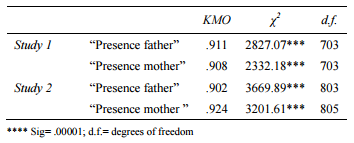
Cattell's scree test showed that the weight of the information is concentrated in 4 factors, represented by 38 items. KMO indexes, along with Bartlett's sphericity test -a contrast test- prove the fit of the factor analysis (table 2, see next page). The KMO coefficients close to 1 and those obtained from Bartlett's test show they are fit for factorization (χ 2 divided by the degrees of freedom below 6.0) (Hu and Bentler, 1999).
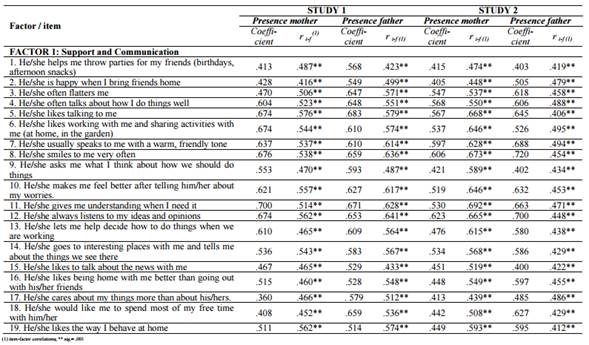
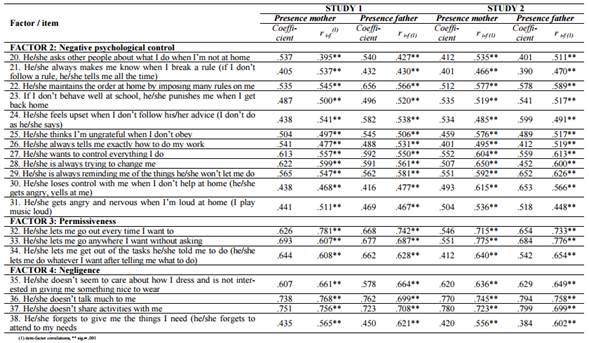
Regarding factor saturation and item-factor correlations, Table 3 (see page 354) reflects that the factorial weights (coefficients) are over .400, reaching values close to .800 in both studies. However, there is one factorial weight of .384 (item 38 of Study 2, because it improved the factor's alpha) (Hair et al., 2006).
With regard to item-factor correlations, table 3 also shows moderately high and high correlations (almost over .400), which confirms that the item belongs in the factor (Hair et al. 2006; Costello & Osborne, 2005; Nunnally & Bernstein, 1994).
Confirmatory factor analysis (CFA)
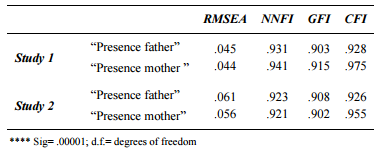
The results of the confirmatory factor analysis, displayed in table 4 (see page 356), show the model's goodness of fit indexes for both studies. As can be seen, the RMSEA obtained is between 0.044 and 0.061 in both studies. Additionally, the robust measurement indexes (GFI, NNFI and CFI) present levels over .90 in every case, which indicates good fits (Ferrando & Anguiano-Carrasco, 2010; Hu & Bentler, 1999).
Descriptive and reliability analyses
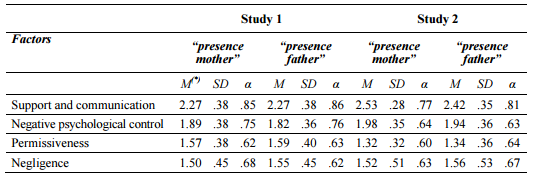
The reliability indexes, obtained through Cronbach's alpha (table 5, see page 356), are between .60 and .86 (study one, range between .62 and .86; study two, range between .60 and .81). Alpha indexes over .60 were considered adequate (Hair et al., 2006).
So as to complete this information, we calculated the mean scores and typical deviations of the questionnaire's four factors. Table 5 also shows higher mean scores in the younger population (8-12 years, Study 2). It seems that, towards late childhood, children perceive greater support and communication, greater negative psychological control, less permissiveness, and less negligence than in adolescence, both from the father and the mother. In the adolescent population, the mean scores for permissiveness increases for fathers and mothers (Study 1).
A general comparison of both studies shows higher mean scores in the Support and Communication factor when it is related to other factors. Moreover, the indexes are higher in the mothers than the fathers.
Discussion
The results of the factor analyses show a structure of four clearly differentiated factors grouped into: Support/Communication; Negative Psychological Control; Permissiveness; and Negligence. Study number 1 was conducted on an adolescent population (early and middle adolescence) and study number two, on a population from late childhood to young adolescence. They also show that the questionnaire may be quite appropriate to assess parenting styles in late childhood and adolescence.
The distribution into four factors is in accordance with the quadripartite model of parenting styles defended by Baumrind (1996), Maccoby and Martin's contribution (1983), and the contribution by Darling and Steinberg (1993), and even with Schaefer's polar dimensions of control/autonomy and affection/hostility (1965). The perception the children have regarding their fathers' and their mothers' parenting presents small variations. In late childhood, the children perceive greater support and communication, especially from the mother. Likewise, in childhood, they feel greater psychological control from both parents. In adolescence, it seems the parents tend to reduce the psychological control and increase permissiveness. Family communication and support also decrease. In this sense, the permissiveness observed may reflect the need to yield to the children's demands for greater autonomy and independence (Spera, 2005).
Lastly, negligence shows mean scores quite similar in both stages of development. These results may be related to the idea of granting certain stability to parenting styles (Rodríguez et al., 2009; Parra & Oliva, 2006). When parents exercise a negligent parenting style, they do so regardless of the children's age. In a way, these results support the notion of behavior patterns from the father and the mother which make a difference in the way they influence their children. As has been proved, the perception the children have of their father and their mother is different, as is the influence each one has on the development of adolescent children (Tur-Porcar et al., 2012) and in childhood (Solís-Cámara & Díaz Romero, 2007). This research is not without limitations. The main one is related to the collection and the source of information, based on self-reports from the children taken in one evaluation. Although this procedure presents fewer social desirability problems (Roa & Del Barrio, 2002), it could be complemented with information from the parents and with longitudinal information.
Another limitation may have to do with the level of education of the participants' parents. The adolescent population belongs to a greater percentage of families with further education (over 70% has a university degree, high school diploma or equivalent).
However, it must be concluded that this paper simplifies the questionnaire's structure - intended to evaluate parenting styles - and may offer valuable information as a working tool.
References
Barnhart, C.M., Raval, V.V., Jansari, A., & Raval, P.H. (2013). Perceptions of parenting style among college students in India and the United States. Journal of Child and Family Studies(5), 684-693. doi: 10.1007/s10826-012-9621-1.
Baumrind, D. (1968). Authoritarian vs. authoritative parental control. Adolescence(11), 255-272. Retrieved from http://search.proquest.com/docview/60077037?accountid=14777
Baumrind, D. (1996). The discipline controversy revisited. Journal of Applied Family & Child Studies(4), 405-414. http://dx.doi.org/10.2307/585170.
Bernabé-Valero, G., García-Alandete, J., & Gallego-Pérez, J.F. (2014). Construcción de un cuestionario para la evaluación de la gratitud: el Cuestionario de Gratitud-20 ítems (G-20). Anales de Psicología(1), 278-286.
Bravo, A. & Del Valle, J. (2009). Crisis y revisión del acogimiento residencial. Su papel en la protección infantil. Papeles del Psicólogo(1), 42-52. Retrieved from http://www.papelesdelpsicologo.es/pdf/1655.pdf
Carlo, G., Mestre, M. V., Samper, P., Tur, A., & Armenta, B.E. (2011). The longitudinal relations among dimensions of parenting styles, sympathy, prosocial moral reasoning, and prosocial behaviors. International Journal of Behavioral Development(2), 116-124. Doi: 10.1177/0165025410375921.
Costello, A.B. & Osborne, J.W. (2005). Best practices in exploratory factor analysis: four recommendations for getting the most from your analysis. Practical Assessment Research & Evaluation(7), 1-9. http://pareonline.net/getvn.asp?v=10&n=7
Darling, N. & Steinberg, L. (1993). Parenting style as context: An integrative model. Psychological Bulletin(3), 1-10. http://dx.doi.org/10.1037/0033-2909.113.3.487.
Eisenberg, N., Zhou, Q., Losoya, S.H., Fabes, R.A., Shepard, S.A., Murphy, B.C., Reiser, M. & Cumberland, A. (2003). The relations of parenting, effortful control, and ego control to children's emotional expressivity. Child Development(3), 875-895. DOI: 10.1111/1467-8624.00573
Ferrando, P.J. & Anguiano-Carrasco, C. (2010). El análisis factorial como técnica de investigación en psicología., Papeles del Psicólogo (1), 18-33. Retrieved from http://www.redalyc.org/articulo.oa?id=77812441003.
Hair, J., Black, B., Rabin, B., Anderson, R. & Tatham, R. (2006Multivariate data analysis (6th edition). Upper Saddle River, NJ: Prentice-Hall.
Henson, R.K. & Roberts, J.K. (2006). Use of exploratory factor analysis in published research: Common errors and some comment on improved practice. Educational and Psychological Measurement, 393-416. DOI: 10.1177/0013164405282485
Hoffman, L.W. (1977): Changes in family roles socialization, and sex differences. American Psychologist, 644-657. http://dx.doi.org/10.1037/0003-066X.32.8.644.
Hu, L. & Bentler, P.M. (1999). Cutoff criteria for fit indexes in covariance structure analysis: Conventional criteria versus new alternatives. Structural Equation Modeling: A Multidisciplinary Journal(1), 1-55. doi: 10.1080/10705519909540118.
Laible, D. J. & Carlo, G. (2004). The differential relations of maternal and paternal support and control to adolescent social competence, self-worth and sympathy. Journal of Adolescent Research759-782. http://dx.doi.org/10.1177/0743558403260094
Lathan, G.P. & Wexley, K.N. (1994). Improving productivity through performance appraisal. Reading, MA: Maddison-Wesley.
Maccoby, E.E. & Martin, J. (1983). Socialization in the context of the family: Parent-child interaction. En P. H. Mussen y E. M. Hetherington (Vol. Ed.), Handbook of child psychology: Vol. 4. Socialization, personality, and social development (4a ed., pp. 1-101). Nueva York: Wiley.
Nunnally, J.C. & Bernstein, IH. (1994). Psychometric Theory. New York, NY: McGraw-Hill.
Parra, A. & Oliva, A. (2006). Un análisis longitudinal sobre las dimensiones relevantes del estilo parental durante la adolescencia. Infancia y Aprendizaje(4), 453-470. Retrieved from http://www.tandfonline.com/loi/riya20
Prieto, G. & Delgado, A. R. (2010). Fiabilidad y validez. Papeles del Psicólogo(1), 67-74. Retrieved from http://www.papelesdelpsicologo.es/pdf/1797.pdf
Rennie, K. M. (1997). Exploratory and confirmatory rotation strategies in exploratory factor analysis, paper presented at the Annual Meeting of the Southwest Educational Research Association (January), Austin, TX. Disponible en http://eric.ed.gov/?id=ED406446
Roa, L. & del Barrio, V. (2002). Cuestionario de percepción de la crianza para niños y adolescentes. Psicología Educativa(1), 37-5.
Rodríguez, M.A., del Barrio, V. & Carrasco, M.A. (2009). ¿Cómo perciben los hijos la crianza materna y paterna? Diferencias por edad y sexo. Escritos de Psicología(2), 10-18. Retrieved from http://scielo.isciii.es/pdf/ep/v2n2/original2.pdf
Rohner, R.P. & Veneziano, R.A. (2001). The importance of Father Love: History and Contemporary Evidence. Review of General Psychology(4), 382-405. http://dx.doi.org/10.1037/1089-2680.5.4.382
Samper, P., Cortés, M., Mestre, V., Nácher, M.J., & Tur, A. (2006). Adaptación del Child´s Report of Parent Behavior Inventory a población española. Psicothema(2), 263-271. Retrieved from http://www.unioviedo.net/reunido/index.php/PST/article/view/8503/8367
Schaefer, E.S. (1965). Children´s reports of parental behavior: an inventory. Child Development(2), 413-424. doi::10.1111/j.1467-8624.1965.tb05305.x.
Silk, J.S., Morris, A.S., Kanaya, T., & Steinberg, L. (2003). Psychological control and autonomy granting: Opposite ends of a continuum or distinct constructs? Journal of Research on Adolescence113-128. DOI:10.1111/1532-7795.1301004
Silverstein, L.B. & Auerbach, C.F. (1999). Deconstructing the essential father. American Psychologist397-407. http://dx.doi.org/10.1037/0003-066X.54.6.397
Solís-Cámara, P. & Díaz Romero, M. (2007). Relaciones entre creencias y prácticas de crianza de padres con niños pequeños. Anales de Psicología(2), 177-84. Retrieved from http://hdl.handle.net/10201/8126
Sorkhabi, N. (2012). Parent socialization effects in difference cultures: Significance of directive parenting. Psychological Reports(3), 854-878. doi:http://dx.doi.org/10.2466/10.02.17.21.PRO.110.3.854-878.
Spera, C. (2005). A review of the relationship among parenting practices, parenting styles, and adolescent school achievement. Educational Psychology Review(2), 125-146. doi::10.1007/s10648-005-3950-1.
Tur-Porcar, A., Mestre, V., Samper, P. & Malonda, E. (2012). Crianza y agresividad de los menores: ¿Es diferente la influencia del padre y de la madre?. Psicothema(2), 284-288. Retrieved from http://www.psicothema.com/pdf/4012.pdf
Wahl, K. & Metzner, C. (2012). Parental influences on the prevalence and development of child aggressiveness. Journal of Child and Family Studies(2), 344-355. doi: 10.1007/s10826-011-9484-x.
Notes
1 Acknowledgements: R+D project for excelling research groups (Reference PROMETEO 2011/009) Valencian Government, Spain. R+D project of the Ministry of Science and Techonology (Reference PSI2011-27158) and the Excellence Network ISIC/2013/001 of the Valencian Community, Spain. Correspondence: Ana Tur-Porcar, Facultad de Psicología, Universitat de València. 46010 Valencia (Spain). E-mail: ana.tur@uv.es