Dossier
Together and also Mixed? Pre-Electoral Coalitions for Gubernatorial Elections in Colombia (2019-2023)
¿Juntos y también revueltos? Coaliciones préélectorales para la elección de gobernaciones en Colombia (2019-2023)
Together and also Mixed? Pre-Electoral Coalitions for Gubernatorial Elections in Colombia (2019-2023)
Reflexión Política, vol. 26, no. 53, pp. 22-32, 2024
Universidad Autónoma de Bucaramanga
Received: 20 May 2024
Accepted: 18 June 2024
Abstract: The results of the 2019 and 2023 subnational elections show that pre-election coalitions are an effective strategy for winning governorships. The aim of this paper is to characterize the types of coalitions and their competitiveness in subnational gubernatorial elections. It uses data from the National Civil Registry, party statements issued in accordance with the opposition statute filed before the National Electoral Council, and the classification criteria proposed by Uribe, et al. (2022). This study contributes to the emerging literature on coalitions, subnational elections and gubernatorial elections in Colombia. The results confirm the sharp differences between the national and subnational political logic, given the effectiveness of moderately incoherent coalitions and the predominant role of coalitions in governorship candidacies, both as a form of competition and as a winning strategy.
Keywords: Pre-electoral coalitions, Subnational politics, Governorships, Colombian political system.
Resumen: Los resultados de las elecciones subnacionales de 2019 y 2023 evidencian que las coaliciones preelectorales son una estrategia efectiva para alcanzar el cargo de gobernación. El presente estudio tiene por objetivo caracterizar los tipos de coaliciones y su competitividad para las elecciones subnacionales a gobernación. Para esto, se usan los datos de la Registraduría Nacional del Estado Civil, las declaraciones partidarias del Estatuto de Oposición ante el Consejo Nacional Electoral, y como criterio de clasificación, la tipología de tipos de coaliciones propuesta por Uribe, et al. (2022). El presente estudio es una contribución a la emergente literatura sobre coaliciones, elecciones subnacionales y elecciones a gobernación en Colombia. Los hallazgos reafirman la separación entre las lógicas políticas nacionales y subnacionales, dada la efectividad de las coaliciones incoherentes moderadas y el rol preponderante de las coaliciones en las candidaturas a gobernación, tanto como forma de competir como estrategia ganadora.
Palabras clave: Coaliciones preelectorales, política subnacional, gobernaciones, sistema político colombiano.
Resumo: Os resultados das eleições subnacionais de 2019 e 2023 evidenciam que as coalizões pré-eleitorais são uma estratégia eficaz para alcançar o cargo de governador. O presente estudo tem como objetivo caracterizar os tipos de coalizões e sua competitividade para as eleições subnacionais a governador. Para isso, são utilizados dados da Registraduría Nacional del Estado Civil, declarações partidárias do Estatuto de Oposição perante o Conselho Nacional Eleitoral e, como critério de classificação, a tipologia de tipos de coalizões proposta por Uribe, et al. (2022). Contribuição para a emergente literatura sobre coalizões, sobre eleições subnacionais e sobre eleições a governador na Colômbia. Os achados reafirmam a separação entre as lógicas políticas nacionais e subnacionais, dada a eficácia das coalizões incoerentes moderadas e o papel preponderante das coalizões nas candidaturas a governador, tanto como forma de competir quanto como estratégia vencedora.
Palavras-chave: Coalizões pré-eleitorais, política subnacional, governadores, sistema político colombiano.
1. Introduction
In the 2023 elections for subnational authorities, 78% of the governorships were won by representatives of electoral coalitions, demonstrating that this strategy is highly effective for winning elections to positions at the executive level (single-member positions) in Colombia. The purpose of this study is to contribute to the emerging literature on subnational political coalitions, contrasting the most and least effective electoral strategies between the 2019 and 2023 elections for the intermediate office of governors.
In Colombia, candidacies can be submitted in three ways: Significant Citizen Groups (GSC, for the Spanish original)1, party candidacies, and coalitions; the latter can result from alliances between GSCs, joint candidacies between different parties, or mixed coalitions of GSC leaders backed by parties. Coalitions have become the preferred mechanism to compete for executive positions at all levels of government (mayor-municipality, governorships-departments, presidency-national), to the extent that party candidacies face limitations in terms of mobilizing the votes they need to win, while GSC candidacies have fallen into disuse as an exclusive form of presentation, and find that they have better prospects when they are accompanied by an alliance with other groups that support them.
This shows the importance of studying and characterizing coalitions as a recurrent strategy with significant results, for which the 32 departmental governorships (intermediate level) in Colombia will be taken as a sample. This article is divided into three sections, beginning with a review of the existing theoretical-conceptual specialized knowledge, followed by the review of the context of the competition for representation in Colombia at the intermediate level and the emergence of coalitions, and ending with some preliminary reflections.
2. Theoretical Framework
Pre-election coalitions have become a crucial area of study for understanding electoral dynamics and the configuration of political power at the national and subnational levels. Political organizations use them strategically to increase their chances of obtaining elected positions and, in some cases, forming governments after elections (Golder 2005, 2006).
A pre-election coalition involves coordination between actors to achieve common goals, which involves costs, negotiations, and the sharing of roles and benefits. This notion highlights the importance of cooperation and agreements in the political process, where each party takes risks and seeks to maximize its gains within a given electoral context (Clerici et al. 2016).
When political organizations anticipate close races, they may choose to join coalitions to support a common candidate, thereby consolidating votes that would otherwise be dispersed among various options. This phenomenon is especially relevant in single-person elections decided by simple majority, in which voters tend to avoid "wasting" their vote, favoring competitive candidates, even if they are not their first choice. In this context, coalition formation represents a political strategy calculated to offer the electorate a more solid alternative and increase the chances of victory in the election (Cruz Olmeda and Devoto, 2019). In addition to defining the electoral strategy, negotiations between party leaders also encompasses the distribution of the benefits that will accompany electoral success, which is a key aspect in the formation of pre-electoral coalitions or alliances (Strom, 2014; Golder, 2006).
The academic literature provides three explanations for the formation of preelectoral coalitions: institutional explanations, the dynamics of electoral competition, and the internal characteristics of political organizations. Institutional explanations highlight that the electoral rules system creates incentives for cooperation between parties, especially in majoritarian representation systems, in which a coalition can be a crucial strategy for maximizing the chances of electoral success (Golder, 2005). In addition, the legal requirements for maintaining registration can put pressure on parties, especially minority ones, to opt for coalitions to ensure their survival in the political system (Méndez de Hoyos, 2012).
On the other hand, the dynamics of electoral competition indicate that contexts of high fragmentation, electoral volatility or opposition to a strong ruling party can favor the formation of pre-electoral coalitions (Reynoso, 2011; Méndez de Hoyos, 2012; Olmedo & Devoto, 2019). In such scenarios, political organizations strategically seek to form alliances to consolidate dispersed support and offer voters a more competitive option, with the aim of increasing their chances of victory in the election.
Finally, the internal characteristics of political organizations, such as their ideological positions, also influence the willingness to form coalitions. Although coalitions have historically been associated with parties of the same political spectrum (Méndez de Hoyos, 2012), empirical evidence suggests that the formation of coalitions between parties with divergent ideologies is increasingly common (Olmedo and Devoto, 2019). These strategic agreements between parties are essential to counter contemporary political challenges, such as party fragmentation and the de-nationalization of political systems, which have transformed the dynamics of political competition in Latin America. In this context, the territorialization of party politics at subnational levels has turned pre-electoral coalitions into a fundamental tool to ensure governability and effective political representation (Clerici et al. 2016; Cruz, 2019).
The formation of pre-electoral coalitions has significant repercussions on political dynamics and democracy in general. Even though these alliances may reflect the search for better electoral results for the parties involved, they also pose important challenges: on the one hand, they put the basic principle of accountability to the electorate in question, since the fragmentation of the electoral offer can make it difficult to clearly identify political leaders, diluting accountability (Duque Daza, 2020).
In addition, coalitions can have effects on the party system, either by strengthening electoral competitiveness, or by generating distortions in the citizens' assessment of candidacies (Méndez de Hoyos, 2012). Finally, the formation of preelectoral coalitions can pose a risk for the effective consolidation of opposition parties, by diluting their political identity and hindering their ability to offer a clear alternative to the electorate (Basset and Franco, 2020).
A distinction must be made between pre-electoral coalitions, whose main purpose is to win the election, and post-electoral coalitions whose objective in parliamentary systems is to form a government, and in presidential systems to establish a joint position vis-à-vis the government, whether of support or opposition.
It is important to note that pre-electoral coalitions or alliances do not always translate into government coalitions, which has strategic implications for political parties. They are two types of coalitions that arise in two different political moments, and there is evidence that they are not always made up of the same organizations; i.e., sometimes organizations that did not support a candidacy in the electoral stage later decide to support the elected candidate (Uribe, Cruz, Acuña, 2022).
In the case of pre-election alliances, the parties commit to join forces only during the electoral process, without agreeing on cooperation after the election day. On the other hand, government coalitions imply closer collaboration between parties, where they decide to be partners in the exercise of power. This collaboration can be seen in a variety of ways, such as the formation of a common bloc in the legislature, or the control of different offices in the administration's cabinet. In some cases, these coalitions can emerge even when partner parties competed separately in previous elections, highlighting the flexibility and complexity of "coalitional" dynamics in Latin American politics (Lisandro and Devoto, 2019).
In Colombia, the formation of electoral coalitions has been an increasingly frequent trend, especially in the electoral processes of 2019 and 2023. In these processes, multiple coalitions were registered to compete in regional elections for mayors and governorships. Despite its growing relevance, empirical research on the subject is still in an incipient stage, both at the general level and in the Colombian context specifically. This highlights the need to deepen the study of electoral coalitions and their impact on the country's political system and democracy.
3. Context: Subnational gubernatorial elections
In Colombia, the intermediate level of government is represented in the departmental governors, located between the municipal administrations and the national government. Although they were established in the Colombian territorial order since the Constitution of 1886, it was with the reform of 1991 that they acquired both political autonomy by allowing the popular election of governors, as well as fiscal and administrative powers. In addition, with the recognition of such status to nine national territories2, the current 32 departments became the highest intermediate entities in the country3.
The Colombian institutional design previously established that the nomination of executive positions at the subnational level was subject to the decision of the presidency and negotiations with the traditional parties: the Liberal Party (PLC, for the Spanish original) and Conservative Party (PCC, for the Spanish original). Although the elections were directed towards the collegiate bodies, their purpose was to measure the electoral forces between national factions in the local competition (Pino, 2020: 2-43).
As Estupiñán Achury (2006) points out, the departments have powers of complementarity to the tasks of the municipalities, of intermediaries between the national and municipal governments, and of territorial coordination of issues related to economic and social development (Estupiñán Achury, 2006: 101). However, during the first decade of existence they were overshadowed by the numerous powers granted to the municipal level, and the expectation of the creation of the regions as autonomous entities superior to the governorships (Estupiñán Achury, 2006: 100-101).
The governorships are elected in concurrent subnational electoral processes, in which the executive positions of the governor and mayor's offices, and the members of the collegiate bodies of the Departmental Assembly, the Municipal Council and the district representatives (Ediles) are elected. These elections are held more than one year apart from the national elections, so it can be expected that there will be no carry-over effect or interaction between the national results and the subnational ones. Initially, the mandate of these authorities was three years, but in 2002, through Legislative Act 02 of 2002, it was extended to four years, which gave greater execution capacity to local leaders.
As for the election mechanism, subnational executive positions, including governorships, are elected in single-member districts by the simple majority system4. The Colombian electoral system recognizes three types of organizations authorized to present candidates: i) political parties and movements, ii) significant citizen groups, and iii) coalitions. Coalition candidacies are characterized by uniting two or more political forces or leaderships, which may include alliances between independent candidacies, between parties, or between independent candidacies and parties or organizations (Uribe, et al., 2022).
For the 2023 elections, a total of 35 party organizations were authorized to present candidacies. This explosion in the number of parties was the result of a series of decisions by both the Constitutional Court and the electoral authorities, including the National Electoral Council and the Council of State.
As of 2021, these authorities had decided in various rulings to facilitate legal status to various organizations under the arguments of reparation to victims of political violence, compliance with the peace agreements signed in 2016 between the national government and the FARC (Revolutionary Armed Forces of Colombia) guerrillas, the autonomy of coalition actors who won seats in public corporations and in general the principle of pluralism of the Constitution of 1991.
These decisions, although consistent with the spirit of the 1991 Constitution, which emphasized multi-party and political plurality as the basis for democratization, are contrary to the intent of the political reforms undertaken since 2003, aimed at reducing the number of parties and strengthening them internally. So in practice, at least in terms of legal status, these decisions meant a kind of ad hoc political reform5.
4. Comparative data of the 2019-2023 gubernatorial coalitions
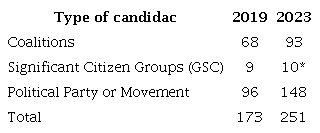
The data provided by the electoral authorities reveal a change in the number of gubernatorial candidacies between 2019 and 2023, indicating differences in the behaviors of the different types of candidacies. Table 1 presents a comparison of the candidacies registered for the gubernatorial elections in 2019 and 2023, classified according to the three types of qualified candidacies: Political Parties or Movements, Coalitions, and Significant Citizen Groups (GSC).
*lt is important to mention that the Civil Registry registered as a Social Movement the GSC Reverdecer de las Islas REDI, an organization that presented a candidate for the governorship of San Andrés Islas. According to the internal regulations of the National Electoral Council, it is classified as a GSC. Source: Prepared by the authors based on data from the National Civil Registry (2023) andUribe et al. (2022: 237).
When contrasting the data for 2019 and 2023, we find an overall increase in the number of registrations of gubernatorial candidacies by different types of political actors in Colombia, increasing from 173 candidacies in 2019 to 251 in 2023. The number of political parties or movements that registered candidacies increased from 96 in 2019 to 148 in 2023. In turn, the number of coalitions also increased, with 68 registered in 2019 and 93 in 2023. On the other hand, the participation of significant citizen groups also showed a slight increase, from 9 to 10, between these two years.
These data are consistent with the increase in the number of parties with legal status in force: while in 2019 seventeen parties were authorized to register candidacies, in 2023 the number increased to 35 organizations. This expansion of options led to an increase in candidacies, and also in coalition building, while the GCS option remains numerically stable.
Figure 1 shows the percentage comparison of the types of candidacies presented for the gubernatorial election between 2019 and 2023. The data reveal, firstly, a slight decrease in the percentage of registered coalitions, decreasing from 39.31% to 37.05%. This decrease is also present in the GSC registrations, which decreased from 5.20% in 2019 to 3.98%.
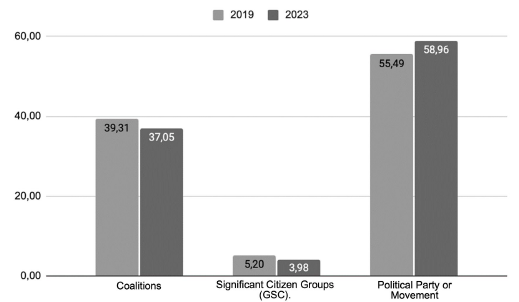
Figure 1
Percentage by type of candidacies competing for the departmental governorships 2019-2023.
Source: Prepared by the authors based on information from RNEC 2019 and 2023.
The percentage comparison provides a better picture of the trend, showing a consistent increase in the number of parties with legal status, the increase in the registration of party candidacies and a slight decrease in coalitions. However, in percentage terms, a greater decrease in the percentage of GSC candidacies is observed.
The above data must be contrasted with the electoral results to observe the competitiveness of each type of candidacy. Although the largest number of candidacies came from political parties, coalitions were the ones that won the highest proportion of governorships in both 2019 and 2023.
In 2023, coalitions won 25 out of 32 possible governorships (78%), and political parties won only 7 governorships out of a possible 32 (22%), while GSCs won no governorships at all. In 2019, coalitions won 26 of the 32 possible governorships (81%), while parties obtained 6 out of 32 possible (15.6%) and GSCs 1 out of 32 possible (3%).
These data show that coalition candidacies were, in both processes, the most effective electoral strategy, as well as an increase in the effectiveness of party candidacies, while GSCs fail to be an effective strategy. This data is observable in Figure 2.
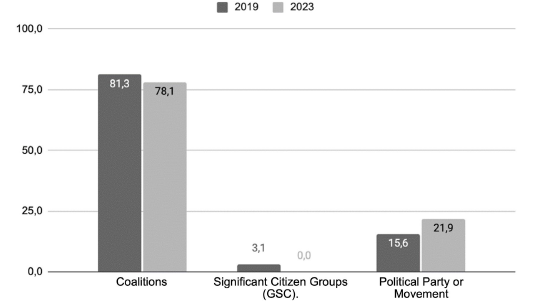
Figure 2
Percentage data of governorships elected according to type of candidacy 2019-2023.
Source: Prepared by the authors based on inforrnationfrom RNEC 2019 and 2023.
Given that coalitions are the most effective strategy, it is worth identifying what type of coalitions are the ones that presented candidacies, and of these which were most effective in winning more governorships. To this end, coalitions are characterized based on Uribe et al. (2022). The authors distinguish coalitions according to how close they are or are not to the national government, making use of the political statements that political parties and movements must make before the National Electoral Council (CNE, for the Spanish original). According to the opposition statute6, the parties are under the obligation of publicly declaring whether they will be part of the government coalition, will be independent, or will act in opposition at the executive level, according to the corresponding territorial order.
Although we are evaluating coalitions for the intermediate subnational level (departmental governorships), we have decided to make use of the political statements of parties and movements made in connection with their stance towards the national governments elected in 2018 and 2022. These national presidential periods have the particularity of having two different political orientations: in 2018 the elected government of Iván Duque belonged to the Democratic Center Party (right), and in 2022, Gustavo Petro became the first elected center-left government in Colombia's republican history. The purpose of the comparison is to identify whether coalitions behave differently taking into account their political stance towards the national government.
The opposition statute provides the possibility of clearly identifying the public statement of political organizations vis-à-vis the executive, depending on the level of government being evaluated, but in this paper the decision was made to use as reference the statement vis-à-vis the national government of two periods of government (2018 and 2022), based on two main reasons: first, because we are evaluating preelectoral coalitions, and the only information available at that time is the statement of parties towards the national government7, and second, because the Colombian party system is national in nature and is not differentiated at the subnational level, which does not necessarily mean that there is a total correspondence between the different levels of government.
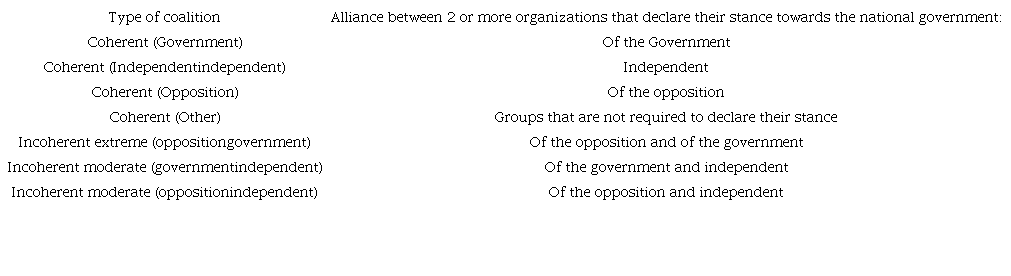
Based on the political statements of the parties or movements vis-à-vis the government, it is possible to identify the coherence or not of the coalitions that presented candidacies for governor in 2018 and 2023. Coalitions can be classified as coherent or incoherent, depending on the alignment, independence, or opposition to the national government of the political organizations that are part of the coalition (Uribe et al., 2022).
This evaluation of coherence allows distinguishing between coherent coalitions, in which the groups that compose it coincide in either their support for the current administration, or in their opposition to it, or in that all the organizations in the coalition hold that they are independent from the government.
In turn, those called incoherent coalitions are characterized by the fact that some of the organizations that make up the coalition support the government, while others oppose it or claim to be independent. But the level of incoherence can be classified as moderate when the coalition is formed between pro-government and independent groups, or as an extremely incoherent coalition, in the case of alliances between pro-government and opposition groups (Uribe, et al., 2022) (see table 2).
The dynamics of coherence and incoherence reflect the complexity of party politics in Latin America and the importance of coalitions as a mechanism to manage this ideological and programmatic diversity in the pursuit of common goals (Clerici, et al., 2016: 257).
Taking into account the proposal for the classification of coalitions, according to the coherence of the statements on their stance towards the national governments elected in 2018 and 2022 (which are of two different political orientations) made by the political organizations that form part of coalitions that presented candidates for the departmental governorships in the subnational elections of 2019 and 2023, it was found that in 2019 the most frequent type of coalition was of the moderate type, between organizations declared as pro-government and independent (54%).
Source: Prepared by the authors based onUribe, et al., 2022.
The dynamics of coherence and incoherence reflect the complexity of party politics in Latin America and the importance of coalitions as a mechanism to manage this ideological and programmatic diversity in the pursuit of common goals (Clerici, et al., 2016: 257).
Taking into account the proposal for the classification of coalitions, according to the coherence of the statements on their stance towards the national governments elected in 2018 and 2022 (which are of two different political orientations) made by the political organizations that form part of coalitions that presented candidates for the departmental governorships in the subnational elections of 2019 and 2023, it was found that in 2019 the most frequent type of coalition was of the moderate type, between organizations declared as pro-government and independent (54%).
Instead, in 2023 the largest proportion is held by coalitions between parties or organizations declared in favor of the Government. In turn, in 2019 there were more coalitions between opposition groups (14%) than in 2023 (7%), and in both election periods there is a similar proportion of coalitions of extreme incoherence, that is, that include organizations declared as both pro-government and opposition, and that presented candidacies for governor, as shown in Figure 3.
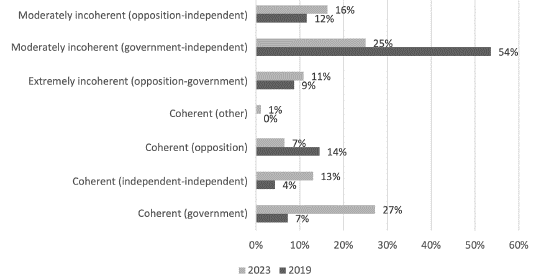
Figure 3
Candidacies in coalitions according to their level of coherence 2019-2023.
Source: Prepared by the authors based on information from RNEC 2019 and 2023.
These data reflect dynamic trends in political alliances at the subnational level and suggest changes in electoral strategies in response to national politics and local realities. Increased polarization and alignment with the government, coupled with declining opposition coalitions, could significantly influence policies and governance at the departmental level.
After describing the type of coalitions that presented the gubernatorial candidacies, the next step is to identify which were most successful in winning the governorships, i.e., the coalition candidacies that were actually elected. In the 2019 subnational elections, 16 governorships out of 32 (64%) were elected under a moderately incoherent coalition scheme, which included government and independent groupings, which is similar to what happened in the 2023 elections. However, that proportion was divided between government and independent coalitions (28%) and opposition and independent groupings (32%), whereas in 2023 the proportion of extremely incoherent coalitions (Government-opposition) that won governorship positions was higher (24%), as shown in Figure 4.
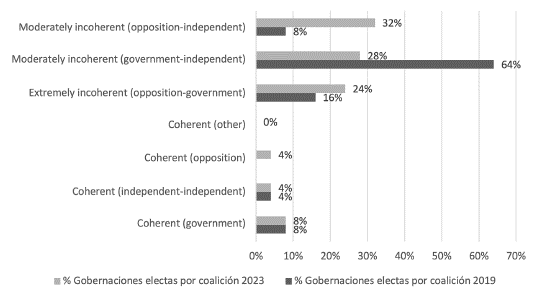
Figure 4
Governorships elected by coalitions according to their level of coherence 2019-2023.
Source: Prepared by the authors based on information from RNEC 2019 and 2023.
The data on the percentage of governorships elected by coalition type in 2019 and 2023 reveal several interesting trends in terms of the coherence and incoherence of the political alliances.
The percentage of governorships elected by coherent coalitions in favor of the government remained constant at 8% in both years; in turn, coherent coalitions between independents also maintained their percentage at 4% in both years. These figures suggest that coalitions strictly aligned with the government or made up of independents have not changed significantly in their ability to win governorships between 2019 and 2023.
Moderately incoherent coalitions between pro-government and independents were the most common in 2019 (64%), but their effectiveness decreased markedly, falling to 28% in 2023. This indicates a decline in the ability of these coalitions to win governorships, possibly due to an increase in the preference for alliances more clearly aligned with a specific political orientation.
Increased effectiveness of extremely incoherent coalitions (opposition-government). The percentage of governorships won by extremely incoherent coalitions (opposition-government) increased from 16% in 2019 to 24% in 2023. This increase suggests that pragmatic coalitions, which cross opposition and government lines, have become more effective in winning governorships, perhaps due to greater flexibility or adaptability in local politics.
Increase in moderately incoherent coalitions (opposition-independent): moderately incoherent coalitions between opposition and independents showed a significant increase, from 8% in 2019 to 32% in 2023. This growth reflects a shift toward alliances between opposition parties and independents, which have proven increasingly successful in winning governorships.
Coherent opposition coalitions, on which there is no data for 2019, account for 4% in 2023, indicating that these coalitions are beginning to gain some traction, which, if analyzed together with the increase in moderately incoherent coalitions, shows an increase in the competitiveness of the differentiated formulas of the national executive, and perhaps, a greater identification of programmatic lines by the electorate compared to 2019.
In summary, these data show an evolution in the strategy of political coalitions, with a reduction in the effectiveness of moderate coalitions between government and independents, and an increase in the effectiveness of extremely and moderately incoherent coalitions between opposition and independents. This trend may reflect changes in local policy dynamics, where more flexible or pragmatic alliances are gaining ground compared to more clearly aligned coalitions.
At this point, it is important to clarify that much of the existing literature insists, with good arguments, that the political dynamics of the national order do not directly correspond to politics at the subnational level (Dosek & Freidenberg, 2013; Botero & Alvira, 2012). Therefore, the levels of coherence or incoherence should be viewed with healthy skepticism. However, the observation window shows an increase in the competitiveness of coalitions with a specific alignment with the national executive.
5. Conclusions
The analysis of coalitions for the presentation of candidacies for the 32 departmental governorships in Colombia during the subnational elections of 2019 and 2023 reveals several significant trends that underscore the importance of pre-electoral coalitions as an effective electoral strategy. In both electoral cycles they have proven to be a dominant way to obtain governorships, compared to candidacies presented exclusively by parties or by gathering signatures.
Pre-election coalitions make it possible to combine resources, support bases, and campaign strategies of different political organizations, thus maximizing the chances of electoral success for coalition actors. They also reveal the interest of subnational organizations in adapting to their political contexts and negotiating with territorial criteria, not necessarily subordinated to the national level.
The relative stability in the strategic behavior of the coalitions is highlighted despite the changes in the national government. In 2018, Colombia elected Iván Duque of the Democratic Center, a right-wing figure, while in 2022, the presidency was won by Gustavo Petro, leader of the Historical Pact and representative of a coalition of centerleft parties. Despite these ideological differences at the national level, coalitions in subnational elections have not shown drastic changes in their strategy. This indicates that local dynamics and the search for subnational power maintain different logics, prioritizing pragmatic collaboration to win governorships.
Applying the classification of electoral coalitions proposed by Uribe et al. (2022) for the analysis of coalitions for governorships, it was found that moderately and extremely incoherent coalitions have been particularly effective. In 2019, moderately incoherent coalitions (government-independent) dominated, but their effectiveness declined in 2023, being partly replaced by extremely incoherent coalitions and moderately incoherent coalitions (opposition-independent), which saw a notable increase in their ability to win governorships.
Studying coalitions at the subnational level is crucial to understanding the competition for executive positions in Colombia, even more so, to understand the political dynamics in an intermediate position such as governorships, traditionally of less interest to the local literature than municipal mayors. Alliances reflect the flexibility and adaptability of political organizations in a context where local politics can differ significantly from national politics, although they are not entirely disconnected from the national discussion, a pendulum that is observed in the variation in the types of coalitions between 2019 and 2023.
With the progressive consolidation of opposition statements at the subnational level in the future, the analysis will be able to contrast the dynamics of coherence at the territorial level vis-à-vis the national executive, a multidimensional analysis that will allow us to better discern the local pragmatic dynamics. This also applies to the variations between the type of electoral strategy by district and the variation between coherence by type of district. These signal an emerging field of study for subnational political literature.
References
Botero, F., & Alvira, D. (2012). Fulano de tal va por su aval. Desconexion entre los niveles nacionales y locales de los partidos politicos en Colombia. En Wills, L., & Batlle, M. Política y territorio: Análisis de las elecciones subnacionales en Colombia, 2011. PNUD-IDEA-NIMD. https://www.undp.org/sites/g/files/zskgke326/files/migration/co/undp-co-politicayterritorio-2013.pdf
Clerici, P., et al. (2016). Coaliciones politicas en America Latina. Iberoamericana, XVI, 61, 237-266. https://journals.iai.spk-berlin.de/index.php/iberoamericana/article/view/2356/1939
Cruz, J., & Devoto, L. (2019). Unidos o separados? Dimensionando el exito de las coaliciones electorales a nivel subnacional en Mexico (2000-2016). Revista mexicana de ciencias políticas y sociales, 64(235), 289-326. https://doi.org/10.22201/fcpys.2448492xe.2019.235.61872
Cruz, F. (2019). Construccion de coaliciones electorales en escenarios desnacionalizados. Un aporte teorico. Revista de Estudios Políticos, 184, 161-194. https://doi.org/10.18042/cepc/rep.184.06
Devoto, L., & Olmeda, J. (2017) “Juntos pero no revueltos”. Estrategias electorales y coaliciones partidarias para la eleccion de diputados locales en los estados mexicanos (2000-2016). Colombia Internacional, 90: 157-187 https://doi.org/10.7440/colombiaint90.2017.06
Duque, J. (2020). Alianzas y coaliciones en las elecciones de gobernadores en Colombia: Nuevas reglas, fragmentacion y coordinacion estrategica”. Reflexión Política, 22(46), 8-32 https://doi.org/10.29375/01240781.3990
Estupinan, L. (2006). El modelo territorial colombiano: Crisis y perspectivas. Diálogos De Saberes, (25), 91-108. https://revistas.unilibre.edu.co/index.php/dialogos/article/view/1973
Došek, T., & Freidenberg, F. (2013). La congruencia de los partidos y los sistemas de partidos multinivel en America Latina: conceptualizacion y evaluacion de algunas herramientas de medicion. Politai, 4(7), 161-178. https://revistas.pucp.edu.pe/index.php/politai/article/view/13903
Golder, Sona N. (2005). Pre-electoral coalitions in comparative perspective: A test of existing hypotheses. Electoral Studies, 24(4):643-63. https://doi.org/10.1016/j.electstud.2005.01.007
Golder, S. (2006). Pre-electoral coalition formation in parliamentary democracies. British Journal of Political Science, 36(2):193-212. https://doi.org/10.1017/S0007123406000123
Mendez de Hoyos, I. (2012). Coaliciones preelectorales y competencia partidista en Mexico a nivel federal y local (1994-2011). Política y Gobierno XIX(2):147-98. http://www.politicaygobierno.cide.edu/index.php/pyg/article/view/139
Pino, J.F. (2020). Trayectorias de Desarrollo de la Competitividad Electoral Subnacional en las Alcaldias Colombianas: 1988-2015. Dados, 63(3), e20190073. https://doi.org/10.1590/dados.2020.63.3.217
Uribe, C., Cruz, C., & Acuna, F. (2022). La unión hace la fuerza? Coaliciones preelectorales y competencia partidista en las elecciones locales y nacionales en Colombia (2018-2019). En Botero, F., et al. En configuración Permanente. Partidos y elecciones nacionales y subnacionales, 2018-2019. Bogota: Universidad de los Andes, Universidad Javeriana.
Notes
Cómo citar este artículo: