Dossier
Measuring Gender Inequality in Politics at the Subnational Level: Proposal for a Subnational Women's Political Rights Index (SWPRI)
 Maria Victoria Eizaguirre vickyeizaguirre@gmail.com
Measuring Gender Inequality in Politics at the Subnational Level: Proposal for a Subnational Women's Political Rights Index (SWPRI)
Reflexión Política, vol. 26, no. 53, pp. 118-133, 2024
Universidad Autónoma de Bucaramanga
Received: 09 May 2024
Accepted: 25 June 2024
Abstract: The study of the exercise and guarantee of women's political rights at the subnational level in politically decentralized countries is a subject on which academic production is very incipient. Subnational studies in political science have historically been characterized by suffering from great "gender blindness," and studies on women's political rights tend to incur in methodological nationalism. Based on this scenario, and seeking to answer the question "How can we measure women's access to their political rights under decentralized institutional designs such as federal ones?" this article aims to make a contribution to the study of parity democracy from a subnational perspective based on the construction of a measurement tool: the Subnational Women's Political Rights Index (SWPRI).
Keywords: Democracy, index, political science, local administration, gender parity.
Introduction
In recent decades, the study of democracy from a parity perspective has gained momentum in political science, both in Europe and Latin America. This approach involves understanding and interpreting democracy from a feminist institutionalist approach (Acker, 1992; Mackay et al., 2010; Vickers, 2011a, 2011b; Lovenduski, 2015; Lombardo & Verge, 2017; Archenti & Tula, 2019), which is based on the postulate that institutions are "gendered" (Acker, 1992) and, therefore, it is necessary to include the gender dimension in the study of both formal and informal institutions. In other words, gender is yet another institution that is nested in other institutions, and politics is an environment in which inequalities of this type are produced and reproduced (Lovenduski, 2015).
As a result of this new perspective, in the last three decades there has been an increase in academic production on the study of women's political participation, with the aim of identifying persistent obstacles and inequalities in women's access to and participation in decision-making positions in State institutions. Much of the literature generated during this time has focused on the analysis and study of women's access to the powers of the State and the impacts that the implementation of affirmative action measures, such as quota and parity laws, has had on their achievement. At the same time, and to a lesser extent, various international organizations - UN Women, International IDEA, the United Nations Development Program (UNDP), the European Institute for Gender Equality (EIGE), the Organization for Economic Cooperation and Development (OECD), among others - have promoted the creation of tools that seek to assess gender equality in various areas, including the political arena, through various indicators quantified in synthetic indexes.
Despite these advances both in the academic arena and in the agenda of international organizations, the studies have focused on the study of the national level of government, leaving out of the analysis the identifiable subnational units in decentralized or federal government designs, incurring in a "methodological nationalism" (Jeffery & Wincott, 2010; Detterbeck, 2012, as cited in Caminotti et al., 2018, p. 18). Given this scenario, this paper proposes to make a contribution to the study of parity democracy from a subnational perspective guided by the following questions: How can we measure women's access to their political rights under decentralized institutional designs such as federal ones? What tools are in place today to achieve this goal? What components should a tool that seeks this objective have?
Based on these questions, and taking as a reference a series of current indexes, this paper presents a proposal for an instrument for measuring women's access to political rights under contexts of high political decentralization: the Subnational Women's Political Rights Index (SWPRI). In the first section of this paper, a bibliographic review of the study of parity democracy and women's political rights is presented from the perspective of subnational studies, and then, in the second section, based on synthetic indexes selected based on a series of criteria, the most relevant theoretical dimensions for their measurement are identified. Next, the SWPRI is introduced with its components, and we conclude with some recommended lines of action regarding the applicability of the tool and its possible uses.
1. Theoretical Framework
1.1 Parity democracy and subnational studies
Since the 1990s, and to a greater extent in the 2000s, the notion of parity democracy began to take hold in academic discussions of political science. At the international level, the Athens Declaration of 1992 and the Beijing Declaration and Platform of 1995 are two instruments that reinforce the obligation of States to ensure women's political rights, and point out their direct relationship with the strengthening and proper functioning of democracy.
The concept of "parity democracy" appeared for the first time in the European region in the Athens Declaration (1992), where it was defined as
... a concept of a society made up equally of women and men, in which the balanced representation of both in the decision-making functions of politics is a precondition for the full and equal enjoyment of citizenship, and in which similar or equivalent participation rates (between 40/60 and 50/50) of women and men in the democratic process as a whole is a principle of democracy. (Archenti & Tula, 2019, p. 32)
Based on this notion, then, similar participation rates between genders in the spheres of political representation has come to be considered, at the international level, as a democratic principle.
Specifically, the Beijing Platform for Action (1995) stresses that it is necessary for the composition of the powers of the State to reflect the distribution of society, where women are about 50% of the population. At the Latin American level, the Quito Consensus (2007), signed at the Tenth Regional Conference on Women in Latin America and the Caribbean1, was the key moment in which the adoption of positive or affirmative action measures, such as quota or parity laws, was agreed upon to ensure women's full participation in public office and elected positions of representation with the aim of achieving parity.
In the case of federal institutional arrangements, the study of parity democracy and women's access to political rights is more complex. Taking the model proposed by ElinorOstrom (2005, cited in Vickers et al., 2020), federalism could be interpreted as a polycentric model of government, in which "nodes" of decision and power can be distinguished between levels of government that interact with each other, and that do not necessarily do so in a hierarchical and static way.
Authors such as Snyder (2001) began to highlight, in the 2000s, the need to "scale down" the level of analysis, due to the analytical and methodological advantages that descending in the level of analysis can have in the field of comparative politics. In this sense, comparisons at the subnational level allow the visualization and identification of the disparate nature of most political processes. Scaling down the level of analysis avoids falling into the "national stretch" that occurs in some studies that take national states as units and do not take into account the internal heterogeneity that can exist, above all, in federal institutional arrangements. This shift in focus allows us to observe other actors and institutions that are units of analysis that have been left aside by most comparative studies focused on the national level (Dosek, 2020; Eaton, 2020; Gibson & Suarez-Cao, 2010; Giraudy et al., 2021; Giraudy & Niedzwiecki, 2022; Harbers & Steele, 2020)
1.2 Territorial heterogeneity in women's access to rights
Returning to this new approach, in the last two decades, a series of studies have been published that assess the territorial heterogeneity in women's access to their rights under federal and decentralized institutional arrangements, seeking to understand its causes and effects (Barnes et al., 2019; Berman, 2021; Caminotti, 2013, 2014; Caminotti et al., 2018; Caminotti & Del Cogliano, 2019; Caminotti & Freidenberg, 2016; Franceschet & Piscopo, 2013; Freidenberg & De Sierra, 2021; Freidenberg & Gilas, 2022; Haussman et al., 2010; Lopreite, 2014; Smulovitz, 2015; Sundström & Stockemer, 2015; Vickers, 2011a, 2011b, 2013, 2023; Vickers et al., 2020). Subnational units, according to these perspectives, can function either as "innovation laboratories" or as "conservative enclaves" for women's rights (Franceschet & Piscopo, 2013; Haussman et al., 2010).
As Gibson and Suarez Cao (2010) point out, in countries with high levels of political decentralization, the characteristics of political systems can be so diverse that it is even possible to identify different party systems by comparing party dynamics at the national level and what happens at the subnational level. This same phenomenon can also be transferred to the study of electoral systems. Caminotti and Freidenberg (2016) define it as "electoral federalism" (p. 123) and point out that it allows for the coexistence of a heterogeneity of electoral systems with very diverse rules, including, for example, those that directly affect women's political participation and election, such as gender quotas.
This type of approach, according to Vickers et al. (2020), allows gender researchers to ask questions about the impact that federalization can have on women's political participation, for example, given that, as Caminotti (2013, 2014) argues, electoral federalism can directly affect the quality of democracy by generating different structures of opportunity for groups, such as women, to access formal institutions.
These types of electoral reforms, such as the implementation of quota or parity laws for access to elected offices (usually legislative), seek to influence the descriptive representation of women (Pitkin, 2014). Under this notion, "representation depends on the characteristics of the representative, on what he/she is or what he/she seems to be, on being something rather than doing something" (p. 85). Therefore, these measures seek to incorporate a greater number of women into the powers of the State in order to represent women in society and, in this sense, various studies have shown the positive impact of these regulations in expanding the number of women who manage to be elected to public offices (Archenti & Tula, 2019; Bustelo & Lombardo, 2006; Caminotti et al., 2018; Lombardo & Verge, 2017; Novo & Diz, 2020; Trujillo & Oñate, 2020; Tula, 2015; Tula & Martin, 2021; Verge, 2008; Verge & Espírito-Santo, 2016).
Beyond the limitations of the notion of descriptive representation, since it does not study the type of measures or legislation that these representatives then promote, research on the study of political representation has focused on this conception to study territorial variations in access to political rights under federal institutional arrangements.
In short, "territorialized gender cultures" (Caminotti, 2008, p. 26) can shape norms that appear to be uniform, such as quota or parity laws, and this can impact on women's barriers to access politics at subnational levels (Dosek & Muñoz-Pogossian, 2018).
In addition to the analysis of women's levels of political participation, recent studies at the national level have focused on the study of the conditions of women's participation, pointing out that gender-based political violence is one of the main obstacles, and that it is still recurrent, (Albaine, 2015, 2018). As Albaine (2015) argues, women's participation in the public sphere implies a disruption of the roles and spheres traditionally assigned to each gender, which brings as a correlation the exercise of gender-based violence against them. Gender-based political violence is also referred to as "political violence against women" by international organizations such as the Committee of Experts of the Follow-up Mechanism of the Belém do Pará Convention of the OAS (MESECVI), which defines it as "any action, conduct or omission, carried out directly or through third parties that, based on their gender, causes harm or suffering to one or more women, and that has the purpose or result of impairing or nullifying the recognition, enjoyment or exercise of their political rights" (Committee of Experts of the Follow-up Mechanism to the Convention of Belém do Pará, 2017, p. 14). In this sense, the study of women's access to political rights requires, therefore, the incorporation of the terms of access and exercise of those rights.
In summary, recent research shows that the subnational level of government has analytical relevance for the study of women's political representation in "descriptive" terms, an aspect that is often left out of the analysis when the research focuses on the national levels of government. By taking subnational political and administrative units as units of analysis, then, it is possible to capture with greater precision the territorial heterogeneity in the access to elected offices and the conditions of their exercise for women. In other words, women's access to political rights can vary between branches of government, levels of government and between territorially delimited political units.
2. Methodology
At the international level, there are no measurement tools that synthetically collect information on the state of women's political rights at the subnational level, which would therefore make it possible to reflect the heterogeneity that exists in access to and guarantee of rights within the same national territory. Due to this shortcoming, and the analytical relevance identified at the subnational level of government, it is relevant to develop the SWPRI.
The construction of the index required, on the one hand, the analysis of the current indexes used to evaluate women's access to political rights at the national level and, on the other hand, the identification of the most relevant theoretical dimensions for its analysis. With respect to the first point, a selection of indexes was made taking into account a series of criteria (Table 1) from which four tools were identified: the Social Institutions and Gender Index (OECD, 2020), the Gender Equality Index (EIGE) (Barbieri et al., 2017), the Political Parity Index2 (UNDP, UN Women, International IDEA) (UNDP et al., 2020) and the Gender Sensitive Parliaments Tool (EIGE - European Institute for Gender Equality, 2019).
The analysis of the indexes allows for an evaluation and selection of the most relevant dimensions and indicators for the study of women's political rights (Eizaguirre, 2023)3.

Source: Authors.
Consequently, the theoretical conceptualization of women's political rights could be organized around three major rights or dimensions: 1) the right to vote and be eligible as representatives in elected public offices; 2) the right to participate in the formulation and execution of public policies and to hold public office; and 3) the right to participate in organizations concerned with the public and political life of the country. In addition to this and taking the Political Parity Index (PPI) as a model, a fourth dimension can be incorporated that deals with the regulatory guarantee of these rights.
2.1 Relevant theoretical dimensions
Based on this analysis, four relevant dimensions for the measurement of women's political rights are delimited, which can be summarized as: 1) regulatory guarantee of women's political rights; 2) exercise of the right to vote and to be elected as representatives; 3) exercise of the right to participate in the formulation and execution of public policies and to hold public office; and (4) exercise of the right to participate in nongovernmental organizations and associations concerned with public and political life. Each one of the dimensions is detailed below.
2.1.1 Regulatory guarantee of women's political rights
Within the theoretical dimension of "Regulatory guarantee of women's political rights"4 it is possible to identify different regulatory levels and hierarchies, as follows: the constitutional level, the legal level and the institutional/electoral level. Within the first level, it is relevant to identify the inclusion of principles of parity and equality in the constitutions, as indicated by the PPI.
At the second level of analysis, the legislation that establishes the minimum conditions that the State must ensure for the political participation of men and women under equal conditions is observed, such as equal opportunity laws or laws for protection against violence. Although countries may have regulations on protection against violence at the national level, federal designs can produce heterogeneity in the areas of protection of legislation (Smulovitz, 2015). This level can also include legislation on gender-based political violence. Even though none of the indexes analyzed contemplates it, organizations such as the MESECVI have proposed an "Inter-American Model Law on Political Violence against Women" (2017), recognizing that it is a problem that directly affects the exercise of their political rights and that, in many cases, it can even end their lives5.
In the same way and taking EIGE's Tool for Gender-Sensitive Parliaments as an example, the presence of laws that promote training courses with a gender perspective for State powers can be incorporated within this dimension. Gender training and education is a topic that has begun to be regulated in various countries such as Spain (Organic Law 3/2007), Argentina ("Micaela" Law 27.499/2019) and Peru (Supreme Decree 010- 2022-MIMP), because the actions of the State powers -that are the subject of the training- have a direct effect on the guarantee of women's rights.
With respect to the third level, it focuses on legislation directly linked to the access to elected and non-elected offices in the public administration and the powers of the State, that is, quota and parity laws for the composition of the legislative, executive and judicial branches.
This level also covers the presence of regulations linked to the establishment of quotas for trans people in the Public Administration. This last indicator has not been incorporated into any of the indexes studied, but due to the gendered nature of the institutions, its incorporation is necessary, understanding that women's conditions are not homogeneous, and that trans people face great obstacles for exercising their political rights. The Yogyakarta Principles (2007)6 set a precedent on this point in its principle number 25, "Right to participate in public life" of all persons without discrimination based on sexual orientation or gender identity.
2.1.2. Exercising the right to vote and to be elected as representatives
In this dimension it is possible to identify two rights or sub-dimensions: the "Right to vote" and the "Right to run for elected office". In the first case, taking into account the PPI, the index proposes to measure the level of electoral participation of women in the latest executive branch elections. In the second case, linked to the exercise of representation, it is possible to evaluate the participation of women in candidacies for the positions at stake, both in the executive and legislative branches, which are the powers appointed by popular election7.
In line with the "Right to be candidates", this dimension also enables the analysis of those at the top of the tickets for legislative positions. It has been shown that those in the top positions of a ticket have greater possibilities of being elected to the positions at stake, both in majority-based and proportional electoral systems where the lists are closed and blocked, which makes them the most disputed positions in the internal party elections (Trujillo & Oñate, 2020).
2.1.3. Exercise of the right to participate in the formulation and execution of public policies and to hold public office
As Tula (2021) points out, parity implies the inclusion of women not only in "collegiate bodies such as parliaments, assemblies, congresses, and legislatures, but also extends to the instances of the Executive Branch and the Judiciary as branches of government" (p. 278). Therefore, this dimension theoretically incorporates the three State powers: legislative, executive (and Public Administration) and judicial.
The analysis of the exercise of power within the executive branch and the Public Administration is a dimension that has gained greater prominence in political science studies in recent years, both at the national and subnational levels. Chudnovsky (2021) points out that there is evidence about the impact of bureaucratic representation in terms of gender and about the persistence of "glass ceilings"8 (p. 124), so it is relevant to study the positions women occupy within the Public Administration. Despite the difficulties pointed out for the collection of information at subnational levels of government (Chudnovsky, 2021), some studies such as those of Diz Otero and Lois González (2012), Barnes et al. (2019), Berman (2021), have introduced the study of provincial executives, ministerial cabinets and public administrations at the regional or subnational level, understanding these spaces as central places of decision-making and subnational politics in general.
On the other hand, the legislative branch is one of the dimensions of analysis that has been widely studied in political science, since the first regulations of positive discrimination were applied in this branch of government. Most research has studied women's access to parliaments and legislatures from a descriptive representation perspective, observing their access rates and their evolution since the application of quota or parity laws for the regulation of the formation of candidate ballots (Granara, 2014; Marx et al., 2006; Vengroff et al., 2003; Verge & Espírito-Santo, 2016). However, more recently, the focus of analysis has shifted to which positions women occupy within the legislative branches and under what conditions they exercise their posts. Along these lines, research studies have assessed the occupation of hierarchical positions within the legislative branch (Delgado Sotillos, 2016), the assignment of committee chairs and the topics led9 (Barnes, 2014; Caminotti, 2013), the study of political careers prior to reaching the legislative branch (Caminotti & Piscopo, 2019), or the phenomenon of political violence associated with women's access to legislative powers (Albaine, 2015, 2018), among others.
Regarding the judiciary, it is possible to analyze women's access to the highest subnational justice bodies, High Courts/Tribunals of Justice, and to the electoral justice bodies, i.e. the highest subnational electoral bodies, as proposed in the PPI. Women's access to justice and to high positions in this power is a pending need that has been identified by the United Nations General Assembly through various resolutions in recent years. Despite the progress made in the participation of women in the judiciary, there are still "glass ceilings". This same phenomenon that is present in positions in the Public Administration, means that the proportion of women in senior positions in the judicial system or prosecutors' offices is "disproportionately low" (United Nations General Assembly, 2021, p. 13). In the case of the electoral bodies, they are the ones that solve all the political-electoral conflicts that may arise under their jurisdiction, often in relation to the application of quota and parity laws (Tula, 2021), therefore they are a decisive space of power in electoral matters.
2.1.4. Exercise of the right to participate in nongovernmental organizations and associations concerned with public and political life
Within the right to participate in non-governmental organizations and associations that seek to influence public and political life, political parties can be identified as one of the main actors of democratic regimes. Political parties are essential actors for the functioning of democracy, since they are responsible for the mobilization of the electorate, the recruitment and presentation of candidates, and the formation and organization of the government, among other functions (Manin, 2017). In some countries10, moreover, political parties are the only actors allowed to present candidates for elected offices in the executive branch (in presidential or semi-presidential systems) and the legislative branch (in all systems of government)11.
In the case of women's political representation, political parties were the ones that inspired the implementation of electoral quotas based on their party quotas (Archenti & Tula, 2019; Catalano, 2019; Verge, 2006; Verge & Espírito-Santo, 2016). Specifically, left-wing parties (communists, social democrats, labor) were the first to apply quotas in internal party regulations (Archenti & Tula, 2019).
The rules of party nomination, therefore, become relevant for the study of women's political rights, since the organizational culture of political parties can determine the ways in which legal quotas are applied and thus directly affect women's possibilities of being placed in and accessing "safe positions" (Funk et al., 2017; Hinojosa & Piscopo, 2013; Oñate and Trujillo, 2020; Verge & Astudillo, 2019).
In turn, political parties are not unrelated to the phenomenon of gender-based political violence, which discourages women's political participation within them (Inter-Parliamentary Union, 2016). It should be noted that, as a result of this phenomenon, the Inter-American Commission of Women of the OAS, in 2019, published a Model Protocol for Political Parties that aims to prevent, address, punish and eradicate violence against women in political life (Inter-American Commission of Women, 2019).
3. Results: Proposal for a Subnational Women's Political Rights Index (SWPRI)
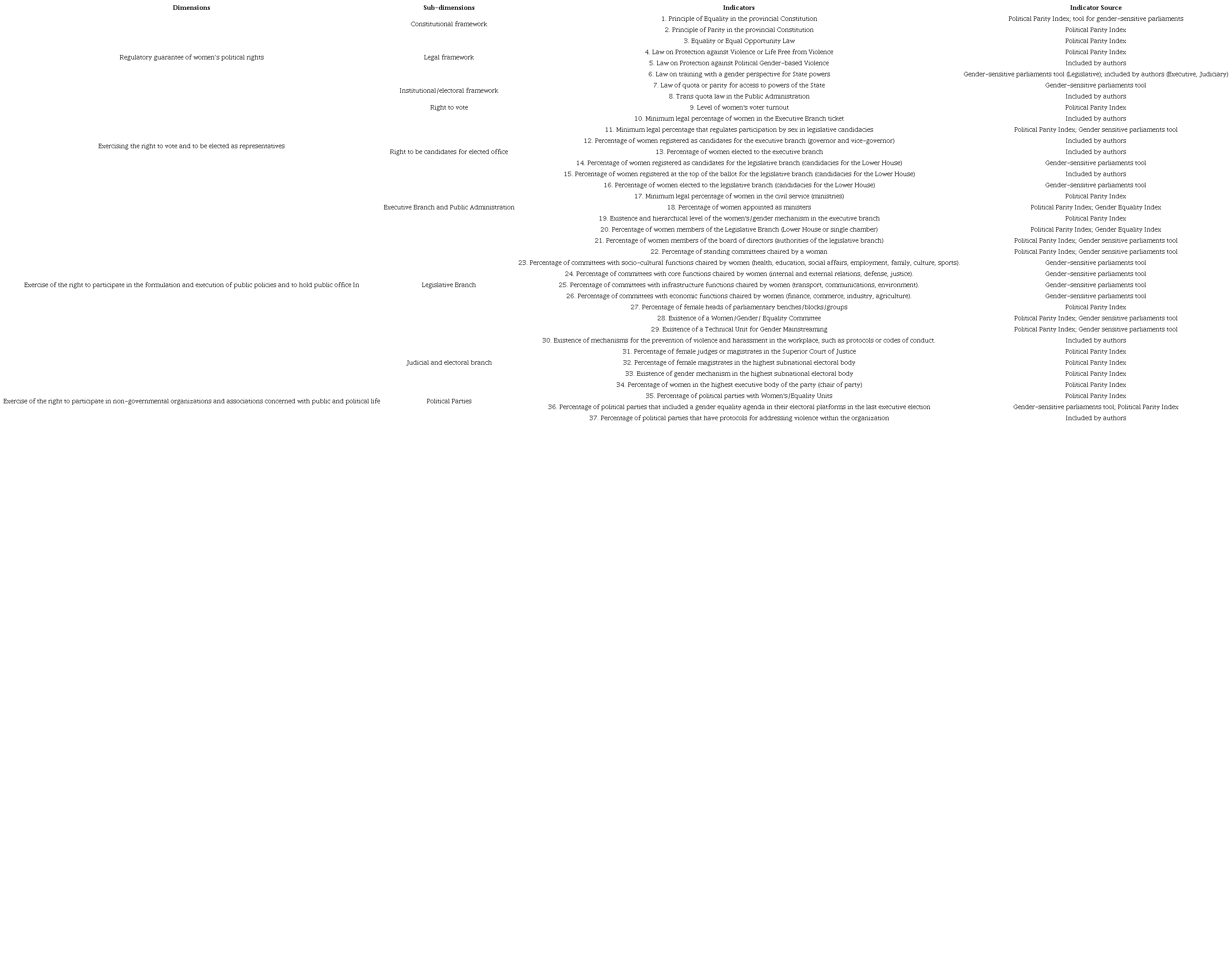
The SWPRI is an instrument composed of four dimensions, nine sub-dimensions and a total of 37 indicators (Table 2) that arise from the analysis of the selected indexes and the theoretical framework analyzed. The proposed tool aims not only to measure the presence of women in decision-making positions in the branches of government, from a perspective of descriptive representation, but also to evaluate the regulatory contexts and conditions under which women hold these positions.
Source: Authors.
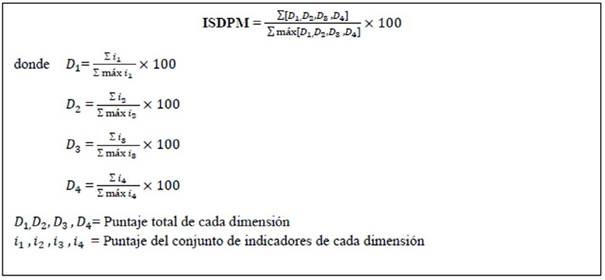
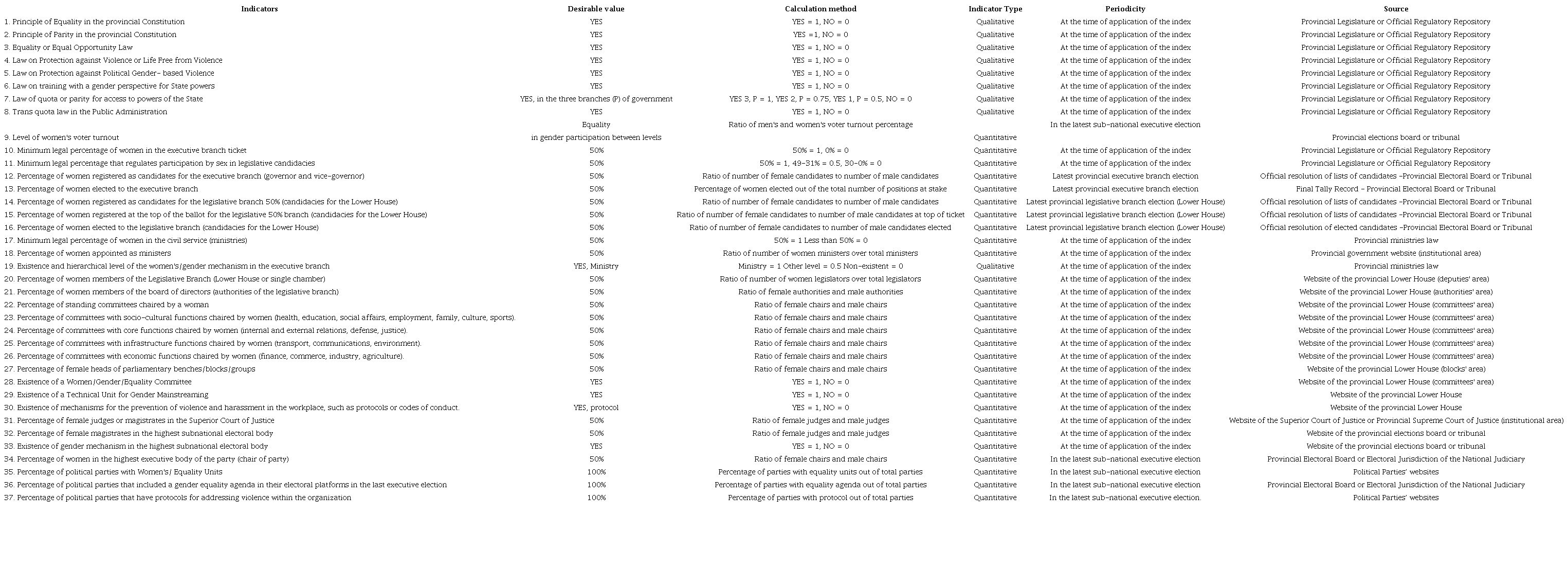
For the calculation of the index, the indicators are divided into categorical and result type indicators. In the case of the latter, it was decided to calculate participation ratios of women and men by truncating the maximum possible score at the parity point (Annex 1). Then, each of the four proposed dimensions obtains a score between 0 and 100, where 100 means that the subnational unit in that dimension guarantees women's access to their political rights on equal terms with men.
For the final calculation of the score obtained by each subnational unit, the sum of the scores obtained in each of the dimensions is divided by the sum of the maximum possible scores in each dimension (Table 3). In this way, the index makes it possible to identify those dimensions in which obstacles to women's access to political rights still persist and those in which there have been greater advances and, in turn, allowing comparisons to be made between subnational units.
Source: Authors.
Preliminary Conclusions
Studying democracy from a parity perspective and through subnational studies implies understanding that women's access to political rights can vary between state powers, levels of government, and territorially delimited political units, especially in those institutional designs where territorial units have broad political autonomy. This inequality in access to political rights based on gender has a direct impact on democracy understood in parity terms.
In order to answer the question: How can we measure women's access to their political rights under decentralized institutional designs such as federal ones?, this paper has proposed the composition of a measurement index in the absence of a tool for these purposes at the international level. The final objective of the SWPRI is to promote the consolidation of a parity democracy at the various levels of government that can be identified within a national territory, based on the production of relevant information for the generation of diagnoses.
The construction of the SWPRI has involved a process of analysis of the current indexes and a bibliographic review that has led to the final choice of its dimensions, sub-dimensions and indicators. It is worth clarifying that the SWPRI is not intended to be an instrument that reduces the analysis of parity democracy to a series of indicators and scores, but one that allows generating evidence to strengthen with quantitative and qualitative data the discussions around the pending challenges of this new democracy, identifying advances and persistent obstacles.
Based on the recognition of the difficulties in accessing public information that are identified at the subnational level of government (Chudnovsky, 2021), the SWPRI is proposed as a tool for data collection. As for its application, it can be carried out taking into account a set of subnational cases within the same national territory -single country small-N analysis-, or it can be applied in subnational units of different national territories to make comparisons between national states -cross-national small-N analysis- (Dosek, 2020; Snyder, 2001). Cases such as those of the provinces in Argentina, the Mexican or Brazilian states, or the Spanish autonomous communities could be some examples of application for the tool.
On the other hand, within the field of public policies, the application of the SWPRI could also contribute to the development of public policy diagnoses and evaluations that incorporate the gender perspective from a subnational viewpoint. Likewise, it could help to position issues on public agendas, for instance, the lack of existing regulation on the phenomenon of gender-based political violence.
In short, "going down" the scale of analysis for the study of women's political rights is necessary in order not to incur in a stretching of the analyses and diagnoses that are carried out at the national level, as well as to be able to think about policies that are situated in and sensitive to the heterogeneity of realities in each territorial unit.
References
Acker, J. (1992). From Sex Roles to Gendered Institutions. Contemporary Sociology, 21(5), 565-569. https://doi.org/10.2307/2075528
Albaine, L. (2015). Obstáculos y desafíos de la paridad de género. Violencia política, sistema electoral e interculturalidad. Revista de Ciencias Sociales, 52, 145-162. https://doi.org/10.1714/iconos.52.2015.1675
Albaine, L. (2018). Estrategias legales contra la violencia política de género. Las oportunidades de acción. La Ventana, 48, 264-293. https://doi.org/10.32870/lv.v6i48.6750
Archenti, N., & Tula, M. I. (2019). Teoría y política en clave de género. Colección, 30(1), 13-43.
Asamblea General de las Naciones Unidas (2021). Participación de la mujer en la administración de la justicia. Informe del Relator Especial sobre la independencia de los magistrados y abogados, Diego García-Sayán. ONU.
Barbieri, D., Karu, M., Riobóo Lestón, I., Mollard, B., Reingardé, J., & European Institute for Gender Equality (2017). Gender Equality Index 2017 methodological report. EIGE.
Barnes, T. D. (2014). Representación de las mujeres y designaciones a comisiones legislativas: El caso de las provincias argentinas. Revista Uruguaya de Ciencia Política, 23, 135-163.
Barnes, T. D., Ciocci, T., & Lopreite, D. (2019). Evaluación de la presencia de mujeres en gabinetes subnacionales de Argentina (1992-2016). Revista de Ciencia Política, 39(1), 1-23. https://doi.org/10.4067/s0718-090x2019000100023
Berman, L. (2021). Condiciones de acceso a la participación política de las mujeres en elecciones ejecutivas subnacionales. Evidencia de siete provincias argentinas (1983-2015). Revista Uruguaya de Ciencia Política, 30(2).
Bustelo, M., & Lombardo, E. (2006). Marcos interpretativos de las políticas de igualdad. Revista Española de Ciencia Política, 14, 117-140.
Caminotti, M. (2008). Derribar los muros indebidos. Reflexiones en torno de las leyes de cupo femenino en Argentina. Aportes para el Estado y la administración gubernamental, 13-33.
Caminotti, M. (2013). Cuotas de género, federalismo y calidad de la democracia en Argentina. Seminario de Investigación del Instituto de Iberoamérica, Universidad de Salamanca.
Caminotti, M. (2014). No todos los caminos van a Roma. Cuotas de género y federalismo electoral en Argentina. En M. Escolar & J. M. Abal Medina (Eds.), Modus vivendi. Política multinivel y Estado federal en Argentina. Prometeo Libros.
Caminotti, M., & Del Cogliano, N. (2019). El origen de la "primera generación" de reformas de paridad de género en América Latina. Evidencia de Argentina. Política y Gobierno, XXVI(II semestre), 205-218.
Caminotti, M., & Freidenberg, F. (2016). Federalismo electoral, fortaleza de las cuotas de género y representación política de las mujeres en los ámbitos subnacionales en Argentina y México. Nueva Época, LXI(228), 121-144. https://doi.org/10.1016/S0185-1918(16)30042-3
Caminotti, M., Freidenberg, F., & Larrañaga, S. (2019). El camino de la paridad. Diagnóstico subnacional basado en el Índice de Paridad Política de ATENEA para la Provincia de Córdoba. PNUD.
Caminotti, M., Muñoz-Pogossian, B., Dosek, T., & Freidenberg, F. (2018). Mujeres en la Política. Experiencias nacionales y subnacionales en América Latina. Universidad Autónoma de México, Instituto Electoral de la Ciudad de México.
Caminotti, M., & Piscopo, J. M. (2019). Neither penalised nor prized: Feminist legislators, women's representation, and career paths in Argentina. Journal of Politics in Latin America, 11(2), 181-203. https://doi.org/10.1177/1866802X19876460
Catalano Weeks, A. (2019). Quotas and party priorities: Direct and indirect effects of quota laws. Political Research Quarterly, 72(4), 849-862. https://doi.org/10.1177/1065912918809493
Chudnovsky, M. (2021). ¿Dónde están y qué hacen las mujeres dentro de la administración pública? El caso del sector público argentino. Revista de Gestión Pública, 9(1). https://doi.org/10.22370/rgp.2020.9.1.2682
Cingolani, M., Almaraz, G., De Vita, P., & Eizaguirre, M. V. (2022). Democracia paritaria en la Ciudad Autónoma de Buenos Aires. Avances y desafíos. ONU Mujeres, PNUD e IDEA Internacional.
Comité de Expertas Mecanismo de Seguimiento de la Convención de Belém do Pará (2017). Ley Modelo Interamericana sobre Violencia Política contra las Mujeres. OEA.
Delgado Sotillos, I. (2016). Cuotas e instituciones: un análisis comparado de sus efectos sobre la representación política de las mujeres. En M. La Barbera & M. Cruells Lopez (Eds.), Igualdad de género y no discriminación en España: evolución, problemas y perspectivas (pp. 131-156). Centro de Estudios Políticos y Constitucionales.
Diz Otero, I., & Lois González, M. I. (2012). ¿Han conquistado las mujeres el poderpolítico?: un análisis de su representación política en las instituciones autonómicas. Catarata.
Dosek, T. (2020). Multilevel Research Designs: Case selection, levels of analysis, and scope conditions. Studies in Comparative International Development, 55(4), 460-480. https://doi.org/10.1007/s12116-020-09313-6
Dosek, T., & Muñoz-Pogossian, B. (2018). Conclusiones. En M. Caminotti, T. Dosek, F. Freidenberg, & B. Muñoz-Pogossian (Eds.), Mujeres en la política Experiencias nacionales y subnacionales en América Latina (pp. 305-331). Universidad Nacional Autónoma de México, Instituto Electoral de la Ciudad de México.
Eaton, K. (2020). Latin American politics and the subnational comparative method: Vertical and horizontal challenges. Latin American Politics and Society, 62(3), 149-172. https://doi.org/10.1017/lap.2020.10
Eizaguirre, M. V. (2023). Repositorio de índices sobre derechos políticos de las mujeres - Trabajo de Fin de Máster - María Victoria Eizaguirre. Figshare. https://doi.org/10.6084/m9.figshare.23545206.v1
Franceschet, S., & Piscopo, J. M. (2013). Federalism, decentralization, and reproductive rights in Argentina and Chile. Publius: The Journal of Federalism, 43(1), 129-150. https://doi.org/10.1093/publius/pjs021
Freidenberg, F., & De Sierra, S. G. (2021). Electoral gender regime and subnational women's representation in Mexico. Revista de Ciencia Política , 41(1), 67101. https://doi.org/10.4067/S0718-090X2021005000103
Freidenberg, F. & Gilas, K. (2022). La construcción de democracias paritarias en América Latina. Régimen electoral de género, actores críticos y representación descriptiva de las mujeres (1990-2022). Universidad Nacional Autónoma de México.
Funk, K. D., Hinojosa, M., & Piscopo, J. M. (2017). Still left behind: Gender, political parties, and Latin America's pink tide. Social Politics, 24(4), 399-424. https://doi.org/10.1093/sp/jxx012
Gibson, E. L., & Suarez-Cao, J. (2010). Federalized party systems and subnational party competition: Theory and an empirical application to Argentina. Comparative Politics, 43(1). https://doi.org/10.5129/001041510X12911363510312
Giraudy, A., Moncada, E., & Snyder, R. (2021). Subnational analysis: Theoretical and methodological contributions to comparative politics. Revista de Ciencia Política , 41(1), 1-34. https://doi.org/10.4067/S0718-090X2021005000107
Giraudy, A., & Niedzwiecki, S. (2022). Multi-level governance and subnational research: Similarities, differences, and knowledge accumulation in the study of territorial politics. Regional and Federal Studies, 32(3), 393-411. https://doi.org/10.1080/13597566.2021.1941900
Granara, A. (2014). Women's legislative participation in the Argentine provinces, 1989-2011. America Latina Hoy, 66, 115-143. https://doi.org/10.14201/alh201466115143
Harbers, I., & Steele, A. (2020). Subnational variation across states: A typology and research agenda. In Latin American Politics and Society (vol. 62, Issue 3, pp. 1-18). Cambridge University Press. https://doi.org/10.1017/lap.2020.4
Haussman, M., Sawer, M., & Vickers, J. (2010). Federalism, Feminism and Multilevel Governance. Ashgate Publishing.
Hinojosa, M., & Piscopo, J. M. (2013). Promoting Women's Right to Be Elected: Twenty-Five Years of Quotas in Latin America. Women Suffrage. http://womensuffrage.org/?page id=109.
Instituto Europeo de la Igualdad de Género (2019). Herramienta para Parlamentos sensibles al género: Cuestionario para Parlamentos nacionales. IEIG.
Inter-American Commission of Women (2019). Model protocol for political parties preventing, addressing, punishing and eradicating violence against women in political life. ICW.
Inter-Parliamentary Union (2016). Sexismo, acoso y violencia contra las mujeres parlamentarias. Inter-Parliamentary Union.
Lombardo, E., & Verge, T. (2017). Cuotas de género en política y economía. Regulación y configuración institucional en España. Política y Gobierno, 2(II semestre).
Lopreite, D. (2014). Explaining policy outcomes in federal contexts: The politics of reproductive rights in Argentina and Mexico. Bulletin of Latin American Research, 33(4), 389-404. https://doi.org/10.1111/blar.12209
Lovenduski, J. (2015). Gendering politics, feminising political science. ECPR Press.
Mackay, F., Kenny, M., & Chappell, L. (2010). New institutionalism through a gender lens: Towards a feminist institutionalism? International Political Science Review, 31(5), 573-588. https://doi.org/10.1177/0192512110388788
Manin, B. (2017). La democracia de lo público reconsiderada. Cuadernos Del Ciesal, 16, 9-24.
Marx, J., Borner, J., & Caminotti, M. (2006). Cuotas de género y acceso femenino al Parlamento: los casos de Argentina y Brasil en perspectiva comparada. Política, 46, 61-81. https://doi.org/10.5354/0716-1077.2006.17262
Naciones Unidas (1979). Convención sobre la eliminación de todas las formas de discriminación contra la mujer. OACNUDH. https://www.ohchr.org/es/ instruments-mechanisms/instruments/convention-elimination-all-forms-discrimination-against-women.
Novo, A., & Diz, I. (2020). Eficacia de las cuotas de género y paridad en las elecciones autonómicas. En C. Ortega Villodres, J. Montabes Pereira, & P. Oñate Rubalcaba (Eds.), Sistemas electorales en España: caracterización, efectos, rendimientos y propuestas de reforma (pp. 283-298). Centro de Investigaciones Sociológicas. https://dialnet.unirioja.es/servlet/articulo?codigo=7681153
Organización para la Cooperación y el Desarrollo Económicos (OCDE) (2020). Annex B. Social Institutions and Gender Index methodology. OCDE. https://www.genderindex.org.
Pitkin, H. F. (2014). El concepto de representación. Centro de Estudios Políticos y Constitucionales.
PNUD, ONU Mujeres, & IDEA Internacional (2020). ATENEA-Mecanismo para acelerar la participación política de las mujeres en América. Documento explicativo. ONU Mujeres.
Principios de Yogyakarta (2007). Principios sobre la aplicación de la legislación internacional de derechos humanos en relación con la orientación sexual y la identidad de género. https://www.yogyakartaprinciples.org
Smulovitz, C. (2015). Legal inequality and federalism: Domestic violence laws in the argentine provinces. Latin American Politics and Society, 57(3), 1-26. https://doi.org/10.1111/j.1548-2456.2015.00277.x
Snyder, R. (2001). Scaling down: The subnational comparative method. Studies in Comparative International Development, 36(1), 93-110. https://doi.org/10.1007/BF02687586
Sundström, A., & Stockemer, D. (2015). "What determines women's political representation at the local level? A fine-grained analysis of the European regions. International Journal of Comparative Sociology, 56(3-4), 254-274. https://doi.org/10.1177/0020715215595691
Trujillo, J. M., & Oñate Rubalcaba, P. (2020). Eficacia de las cuotas de género y paridad en el Congreso de los Diputados y el Senado. En C. Ortega Villodres , J. Montabes Pereira , & P. Oñate Rubalcaba (Eds.), Sistemas electorales en España: caracterización, efectos, rendimientos y propuestas de reforma (pp. 95-119). Centro de Investigaciones Sociológicas (CIS). https://dialnetuniriqia.es/servlet/articulo?codigo=7681162
Tula, M. I. (2015). Mujeres y política. Un panorama sobre la adopción de las cuotas de género y sus efectos en América Latina y Colombia. OPERA, 16(1), 9-33. https://doi.org/10.18601/16578651.n16.03
Tula, M. I. (2021). Conflictos partidarios y paridad género. En M. I. Tula & M. E. Martin (Eds.), Hacia la paridad. Cambios y desafíos en la representación política. Universidad de Buenos Aires.
Tula, M. I., & Martin, M. E. (2021). Hacia la paridad. Cambios y desafíos en la representación política. Universidad de Buenos Aires.
Vengroff, R., Nyiri, Z., & Fugiero, M. (2003). Electoral system and gender representation in subnational legislatures: Is there a National-Sub-National Gender Gap? Political Research Quarterly, 56(2), 163-173. https://doi.org/10.1177/106591290305600205
Verge, T. (2006). Mujer y partidos políticos en España: las estrategias de los partidos y su impacto institucional, 1978-2004. Reis, 115, 165-196. https://doi.org/10.2307/40184770
Verge, T. (2008). Cuotas voluntarias y legales en España. La paridad a examen. Reis, 123.
Verge, T. & Astudillo, J. (2019). The gender politics of executive candidate selection and reselection. European Journal of Political Research, 58(2), 720-740. https://doi.org/10.1111/1475-6765.12312
Verge, T., & Espírito-Santo, A. (2016). Interactions between party and legislative quotas: candidate selection and quota compliance in Portugal and Spain. Government and Opposition, 51(3), 416-439. https://doi.org/10.1017/gov.2016.9
Vickers, J. (2011a). Gender and state architectures: The impact of governance structures on women's politics. Politics and Gender, 7(2), 254-262. https://doi.org/10.1017/S1743923X11000092
Vickers, J. (2011b). Gendering federalism: Institutions of decentralization and power-sharing. En M. Krook & F. Mackay (Eds.), Gender, Politics and Institutions. Gender and Politics Series. Palgrave Macmillan. https://doi.org/10.1057/97802303039118
Vickers, J. (2013). Is federalism gendered? Incorporating gender into studies of federalism. Publius: The Journal of Federalism, 43(1), 1-23. https://doi.org/10.1093/publius/pjs024
Vickers, J. (2023). Applying a gender lens to federal systems. In Teaching Federalism (pp. 198-209). Edward Elgar Publishing. https://doi.org/10.4337/9781800885325.00026
Vickers, J., Grace, J., & Collier, C. N. (2020). Handbook on Gender, Diversity and Federalism. Edward Elgar Publishing Ltd. https://doi.org/10.4337/9781788119306
Annex
Source: Authors
Notes
How to cite this article: