Artículos
Relationship between school refusal behavior and social functioning: a cluster analysis approach
Relación entre el comportamiento de rechazo a la escuela y el funcionamiento social: un enfoque de análisis de clúster.
Relationship between school refusal behavior and social functioning: a cluster analysis approach
European Journal of Education and Psychology, vol. 12, no. 1, pp. 17-29, 2019
Asociación Universitaria de Educación y Psicología

This work is licensed under Creative Commons Attribution-NonCommercial-NoDerivs 4.0 International.
Received: 02 December 2018
Accepted: 27 December 2018
Abstract: On the basis of the heterogeneous casuistry that characterizes the students who refuse going to school, it is useful to have a classification of this population in homogeneous groups. For this, the aim of this study was, first, to identify by cluster analysis the profiles of school refusal behavior based on the functional model evaluated through the School Refusal Assessment Scale-Revised (SRAS-S). Secondly, it is intended to analyze if there are differences in social functioning scores according to the school refusal profiles identified. This study involved 1212 Spanish children between 8 and 11 years old (M=9.12, SD=1.05) who completed the SRAS-R to evaluate the school refusal behavior and the Child and Adolescent Social Adaptive Functioning Scale (CASAFS) to assess social functioning. Four profiles were identified: Non-school refusers, School refusers by mixed reinforcements, School refusers by tangible reinforcements and School refusers by negative reinforcements. The profile of Non-school refusers achieved the highest average scores in social functioning, while School refusers by mixed reinforcements group obtained the lowest average scores in social functioning. In general, the profiles found support the clusters identified in previous studies. The implications of social functioning on school refusal behavior are discussed.
Keywords: School Refusal behavior, social functioning, cluster analysis.
Resumen: Partiendo de la heterogénea casuística que caracteriza a los estudiantes que rechazan la escuela, resulta útil disponer de una clasificación de esta población en conjuntos homogéneos. Para ello, el objetivo de este estudio fue, en primer lugar, identificar mediante análisis clúster los perfiles de estudiantes que rechazan la escuela en base al modelo funcional evaluado a través de la School Refusal Assessment Scale-Revised (SRAS-S). En segundo lugar, se pretende analizar si existen diferencias en las puntuaciones de funcionamiento social en función del perfil de estudiante que rechaza la escuela. En este estudio participaron 1212 niños españoles entre 8 y 11 años (M=9.12; DE=1.05) quienes cumplimentaron la SRAS-R para evaluar el rechazo escolar y la Child and Adolescent Social Adaptive Functioning Scale (CASAFS) para evaluar el funcionamiento social. Fueron cuatro los perfiles identificados: No rechazo escolar, Rechazo escolar por reforzamiento mixto, Rechazo escolar por refuerzos tangibles y Rechazo escolar por reforzamiento negativo. El perfil de No rechazo escolar alcanzó las puntuaciones medias más altas en funcionamiento social, mientras que el perfil de Rechazo escolar por reforzamiento mixto obtuvo las puntuaciones medias más bajas en funcionamiento social. En general, los perfiles hallados apoyan los clústeres identificados en estudios previos. Las implicaciones del funcionamiento social sobre el rechazo escolar se discuten.
Palabras clave: Comportamiento de rechazo a la escuela, funcionamiento social, clúster análisis.
School attendance problems (SAPs) are characterized by their multiple forms of manifestation, etiology and interpretation. Different terms such as school refusal, school avoidance behavior, truancy or absenteeism, among others, have been used in the history of the investigation of this field. In order to deal with the inaccurate and ambiguous use of these terms, Heyne, Gren-Landell, Melvin, and Gentle-Genitty (2019) carried out a revision of the evolution in the conceptualization of SAPs and analyzed two contemporary approaches for differentiating them. On the one hand, the functional analytic model measured by the School Refusal Assessment Scale (SRAS, Kearney and Silverman, 1993; Kearney, 2002) and on the other hand, an approach which distinguishes between four types of SAPs, named school refusal, truancy, school withdrawal and school exclusion measured by the School Non-Attendance ChecKlist (SNACK; Heyne et al., 2019).
In this study, the differentiation between school refusal behaviors is based on the functional analytic model introduced by Kearney and Silverman in the 90s (Kearney & Silverman, 1990). This model proposed four functional conditions measured via the SRAS: I. Avoidance of school related stimuli that provoke Negative Affectivity (ANA),
II. Escape from aversive Social and/or Evaluative situations at school (ESE), III. Pursuit of Attention from Significant others (PAS), and IV. Pursuit of Tangible Reinforcement outside of the school setting (PTR) (Kearney & Silverman, 1993).
Based on this model, the first two factors of the SRAS-R (ANA and ESE) are maintained by negative reinforcement, such as removing the child from stressful situations or avoiding school stimulus that provoke negative affectivity. In many cases, youths refuse school for a combination of the first and second functional conditions (Kearney, Lemos, & Silverman, 2004). Youths of these functional conditions have reported high scores in anxiety, depression and other emotional disorders (Higa, Daleiden, & Chorpita, 2002; Kearney, 2002; Kearney & Albano, 2004; Gómez-Núñez et al., 2017). The latter two factors of the SRAS-R (PAS and PTR) are maintained by positive reinforcement, such as providing attractive alternatives activities outside the school (e.g. being with friends orplaying, among others) and desired attention (e.g. parental attention). The third functional condition sometimes refers to children with symptoms of separation anxiety whereas the fourth condition is more related with externalizing behavior problems (Higa et al., 2002; Kearney, 2002; Kearney & Albano, 2004).
In the last years, the SRAS-R is becoming increasingly used in countries other than United States where it was originally designed, e.g. Germany (Overmeyer, Schmidt, & Blanz, 1994; Walter, von Bialy, von Wirth, & Doepfner, 2017), France (Brandibas, Jeunier, Gaspard, & Fourasté, 2001), Italy (Rigante & Patrizi, 2007), Korea (Geum-Woon, 2010), the Netherlands (Heyne et al., 2017), the United Kingdom (Richards & Hadwin, 2011), Turkey (Seçer, 2014), Spain (Gonzálvez et al., 2016), Chile (Gonzálvez et al., 2017) and Ecuador (Gonzálvez et al., 2018a).
School refusal behavior profiles
The etiology of school refusal behavior is heterogeneous in nature (Elliot & Place, 2019; Inglés, Gonzálvez, García-Fernández, Vicent, & Martínez-Monteagudo, 2015). Establishing different groups of children with SAPs (Berg et al., 1993; Bools, Foster, Brown, & Berg, 1990) or identifying different subtypes of truants (Maynard, Salas.Wright, Vaughh & Peters, 2012; Keppens and Spruyt, 2016) have been the purposes of several studies in order to offer an attention more in line with its characteristics. However, the study of Dube and Orpinas (2009) started the emergence of studies analyzing the profiles of students who reject school based on the functional model using the SRAS-R. In this study, three profiles were distinguished in a nonclinical sample of 99 American students with SAPs (M=12.5; SD=1.38; range=8–15 years). A mixed school refusal profile which combines explanatory factors characterized by positive and negative reinforcement, a profile of school refusal formed by positive reinforcement, which only includes factors related to obtaining care from loved ones or the attainment of tangible external reinforcements (outside school), and a non-school refusal profile.
More recently, based on a random sample of non-clinical Spanish children aged between 8 and 11 years (N=1113; M=9.53; SD=1.10), four different groups were grouped (Gonzálvez et al., 2018b, 2018c). The first group was the Non-school refusers, characterized by low scores in the four factors, the second group was the School refusers by positive reinforcement, characterized by high scores in the third and fourth factor, the third group was the School refusers by negative reinforcement, with high scores in the first two factors, and the School refusers by mixed reinforcement, characterized by high scores in the first three factors of the SRAS-R.
In Ecuador, with an adolescent sample aged between 12-18 years (N=1582; M=14.83; SD=1.86), three school refusal behavior profiles were identified (Gonzálvez et al., 2018d). Two of them, Non-school refusers and School refusers by mixed reinforcement, coincide with the characteristics of those identified in Spain. However, the authors also identified a different profile called School refusers by tangible reinforcements, characterized by high scores only in the fourth factor.
In both countries the results warn that the group with high scores in the first three factors of the SRAS-R, known as School refusers by mixed reinforcements, reached the highest average scores in maladaptive variables such as anxiety, depression and stress.
School refusal behavior and social functioning
Social functioning refers to the skills of a person to have social relationships and it is understood as an inclusive construct encompassing cognitive, emotional and linguistic skills (Crowe et al., 2011). Recent empirical research has revealed that social functioning is a variable that positively affects academic performance (Gutiérrez, Escartí, & Pascual, 2011, Talwar, Lavoie, Gómez-Garibello, & Crossman, 2017; Vicent et al., 2017) and favors adaptation to school (Fernández-Zabala, Goñi, Camino, & Zulaika, 2016; Furguerle & Graterol, 2010). However, the relationship between social functioning understood as a multidimensional construct that includes school performance, home duties/self-care and the relationship with family and friends has not been previously analyzed in comparison with school refusal behavior.
Previous studies have showed that social anxiety is highly prevalent in some groups of school refusers (Kearney & Albano, 2004). According to the functional model, students who based their school Refusal on escaping from aversive social and/or evaluative situations (Factor II) are those who obtain higher scores in social anxiety. Testing the relationship between school refusal behavior and social functioning from an early age is important in order to verify whether an adequate social functioning can be considered a protective element of school refusal behavior or not.
In order to overcome the shortcomings above-mentioned, the aim of this study is twofold: (1) to identify the resulting school refusal behavior profiles based on the functional model in a community sample of Spanish children aged between 8 and 11 years old, and (2) to determine the existence of possible statistically significant differences between the school refusal behavior profiles identified and the four dimensions of social functioning (School performance, Peer relationships, Family relationships and Home duties/Self-care). The scientific literature reviewed leads us to expect as hypotheses that (1) four school refusal behavior profiles would be identified (Non-school refusers, School refusers by positive reinforcement, School refusers by negative reinforcement and School refusers by mixed reinforcement) in line with the results of previous studies with similar sample (Gonzálvez et al., 2018b, 2018c); and (2) School refusers by mixed reinforcement would obtain the lowest scores on social functioning in accordance with previous studies that highlight this profile as the most maladaptive (Gonzálvez et al., 2018b, 2018c, 2018 d ).
METHOD
Participants
Recruitment of participants was carried out through random sampling by conglomerates in two Spanish provinces (North, South, East, West and center geographical areas of Alicante and Murcia) in 17 different schools.
At first, the total number of participants was 1384 Primary Education students from Spain recruited by multistage random cluster sampling. A 5.6 percent of the students were excluded due to omissions and mistakes in their answers and 8.6 percent because they did not deliver their parent’s consent to participate in the investigation. The final sample included 1212 students aged between 8 and 11 years (M=9.12; SD=1.05). Participants’ distribution by academic course in Primary Education was 546 students (45%) of third grade, 420 students (34.7%) of fourth grade, 132 students (10.9%) of fifth grade, and 114 students (9.4%) of sixth grade.
Non-significant differences between the eight groups were found across sex and age using the χ2 test of homogeneity of the frequency distribution (χ2=3.49, p=.32).
Instruments
School Refusal Assessment Scale-Revised (SRAS-R; Kearney, 2002). The SRAS-R is a self-report measure composed by 24 items distributed in four functional conditions (I. Avoidance of stimuli that provoke negative affectivity, II. Escape from aversive social and/or evaluative situations, III. Pursuit of attention from significant others and IV. Pursuit of tangible reinforcement outside of school). In this study the Spanish version of the SRAS-R formed by 18 items was used. Participants rated the frequency of each situation exposed in the items on a Likert scale of 7 points (0=never; 6=always). The instrument has shown adequate levels of internal consistency (.70-.79) and 2-weeks test-retest reliability of .70-.75 (Gonzálvez et al., 2016). Cronbach alphas for the scale in this study were .75 (Factor I), .86 (Factor II), .81 (Factor III) and .71 (Factor IV).
Child and Adolescent Social Adaptive Functioning Scale (CASAFS; Price, Spence, Sheffield, & Donovan, 2002). The CASAFS is a self-report measure that assesses social functioning in children and adolescents. This scale is composed by 24 items distributed in four subscales: School Performance (SP), Peer Relationships (PR), Family Relationships (FR) and Home Duties/Self-care (HD). It uses a 4-point Likert scale (1=never; 4=always) where high scores represent high social adaptive functioning. The CASAFS has shown adequate levels of internal consistency (.67-.81) and 12-months test-retest of .48- .63 (Price et al., 2002). Cronbach alphas for the scale in this study were.77 (SP), .73 (PR), .71 (FR) and .76 (HD).
In this study the back-translation method was used to adapt this instrument to Spanish. Firstly, two specialists whose mother tongue is English and are familiar with the culture of the original language of the scale translated the CASAFS into Spanish independently. After that, a native English speaker with high level of Spanish back-translated the Spanish version into English. Finally, the new English version of the scale was compared with the original version and was found that the translated version exactly corresponded to the original scale.
Procedure
Students anonymously and collectively completed the questionnaires during normal school hours in the classroom, for approximately 35 minutes. The investigators were present during the administration of the tests in order to clear up any doubts that could arise. Written parental informed consent was obtained from all parents or legal custodians of the minors that participated in the study. All procedures were performed according to the ethical standards of the 1964 Helsinki Declaration. The research study protocol was approved by the ethical committee of the University of Alicante with the reference number UA-2017-09-05.
Data Analysis
Data analysis procedures were divided into two stages. Firstly, a non-hierarchical quick cluster analysis was carried out to identify the school refusal behavior profiles based on the standardized scores of the four functional conditions from the SRAS-R.
Secondly, an analysis of variance was conducted to examine whether School performance, Peer relationships, Family relationships and Home duties/self-care (CASAFS dimensions) would differ across the subgroups of school refusers identified. In addition, post hoc tests (Scheffé’s method) were performed and effect sizes were calculated using the d index, which was analyzed according to Cohen's interpretation (Cohen, 1988), distinguishing between a small (0.20≤ d ≤0.49), moderate (0.50≤ d ≤0.79), and large magnitude (d≥0.80). Analyses were calculated using the SPSS 22 statistical package.
RESULTS
dentification of school refusal behavior profiles
The cluster analysis differentiated four groups of school refusal behaviors based on the different combinations of the four SRAS-R dimensions (see figure 1).
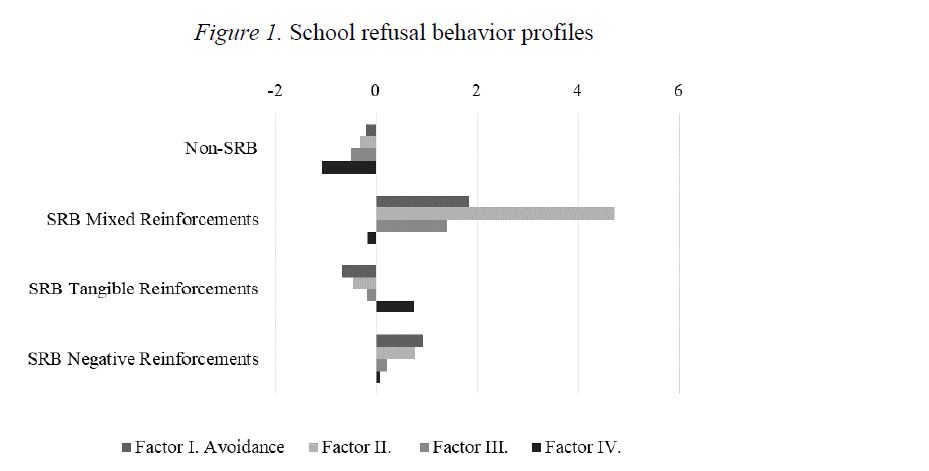
The largest group, Non-school refusers, was made up of 456 students (37.62% of the participants) characterized by low-moderate scores in the first two factors of the SRAS-R and low scores in the rest. The next group, School refusers by mixed reinforcement, included 162 students (13.37% of the participants) with high scores in the first three factors of the SRAS-R. The third group, School refusers by tangible reinforcements, was made up of 366 students (30.20% of the participants) with high scores in school refusal behavior by obtaining tangible reinforcements outside the school. Lastly, the fourth group, School refusers by negative reinforcement, has 228 students (18.81% of the participants) with high scores in the first two factors of the SRAS-R.
School refusal behavior profiles and social functioning
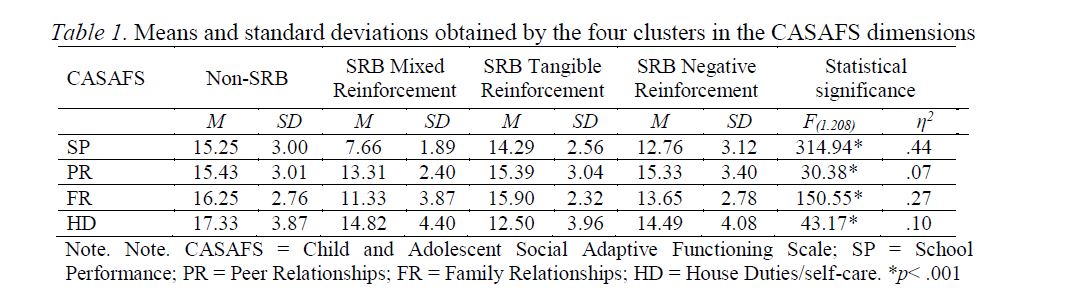
The second purpose of this study was to examine whether School Performance, Peer relationships, Family relationships and House duties/self-care would differ across the four-clusters identified or not. Results of the ANOVA, which compared the mean scores of each cluster on the four dimensions mentioned of social functioning, showed statistically significant differences in all cases (see Table 2). The Non-school refusers profile scored higher in School Performance, Peer relationships, Family relationships and House duties/self-care in comparison with the rest of groups. By contrast, School refusers by mixed reinforcement obtained the lowest scores in the first three dimensions of social functioning (School Performance, Peer relationships, Family relationships), whereas the profile of School refusers by tangible reinforcement obtained the lowest score in the Home duties/self-care dimension (see Table 1).
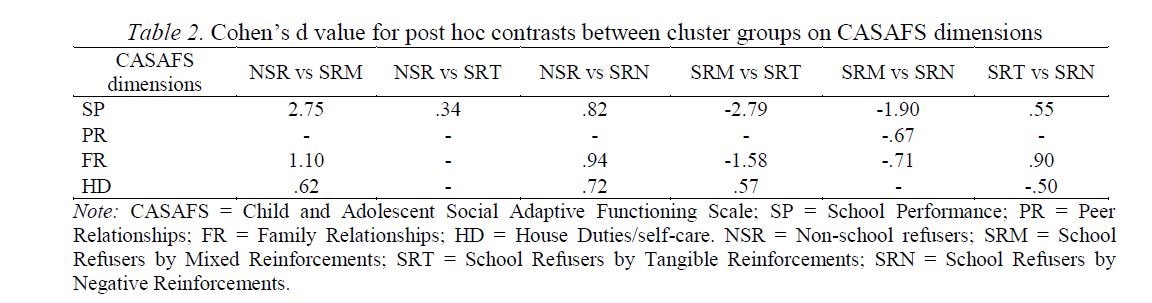
Post hoc comparisons revealed that the Non-school refusers group scored significantly higher in social functioning dimensions than the rest of groups with a large effect size in comparison with the School refusers by mixed reinforcement (SP=2.75; FR=1.10 and HD=.62) and School refusers by negative reinforcements groups (SP=.82; FR=.94; and HD=.72). In contrast, the magnitude of the differences was not significant between the group of Non-school refusers and School refusers by tangible reinforcements profile, only there were found significant differences with a small effect size (d=.34) for the dimension of School Performance.
Similarly, the School refusers by tangible reinforcements profile scored significantly higher in social functioning than School refusers by mixed reinforcement and School refusers by negative reinforcements groups with a large effect size in the following three dimensions respectively (SP=2.79 and .55; FR=-1.58 and .90; HD=.57 and -.49).
Finally, a comparison of the School refusers by mixed reinforcement and School refusers by negative reinforcements groups revealed that the last one obtained higher scores in the first three dimension of social functioning with large effect sizes (SP=-1.90; PR=-.67 and FR=-.71) (see Table 2).
DISCUSION AND CONCLUSIONS
Knowing the characteristics that define the different groups of students who reject school is an opportunity to more precisely attend their needs. In turn, the identification of these profiles from an early age and the knowledge about their relationship with other psychoeducational variables is essential in the proposal of action measures. Therefore, the aim of this study was twofold. On the one hand, we aimed to identify school refusal behavior profiles in a Spanish children's sample according to the classification proposed by the functional model. And on the other hand, it was intended to clarify the relationship between social functioning and the different groups of school refusers identified.
Four school Refusal behavior profiles were identified in this study: Non-school refusers, School refusers by mixed reinforcements, School refusers by tangible reinforcements and School refusers by negative reinforcements. In general, these groups coincide with the profiles found in previous investigations (Dube & Orpinas, 2009; Gonzálvez et al., 2018b, 2018c, 2018d). Specifically, three of the identified groups (Non-school refusers, School refusers by mixed reinforcements, School refusers by negative reinforcements) coincide with the findings reported by Gonzálvez et al. (2018b, 2018c) in Spanish child simple in line with the first hypothesis. With regard to the School refusers by tangible reinforcements profile, the findings coincide with a group identified in an Ecuadorian adolescent sample characterized by high scores in the fourth factor of the SRAS-R (Gonzálvez et al., 2018d). Despite the fact that the number of studies that apply typical statistical techniques regarding the identification of profiles (e.g. cluster analysis or latent class analysis) in this field is still small, we can find some similarity between the results. More research in this line is required in order to generalize these findings to populations of other cultures and ages.
Regarding the relationship between school refusal behavior and social functioning, the results found support the second hypothesis of this work being the group of School refusers by mixed reinforcements who achieved lower average scores in this variable. According to previous studies, this profile has been considered as the maladaptive and, therefore, requires more attention (Gonzálvez et al., 2018b, 2018c, 2018d). Students who belong to this profile base their refusal to attend school on feelings of negative affectivity, social aversion and anxious symptoms. The appearance of these negative emotions inevitably impacts on the establishment of social relationships, causing deficiencies in the development of an adaptive social functioning (Carroll, 2011; Egger, Costello, & Angold, 2003). In this line, several studies suggest that the establishment of good social relationships with friends and classmates can prevent the appearance of school refusal behavior (Havik, Bru, & Ertesvag, 2014; 2015; Shilvock, 2010). On the contrary, as expected, the group called Nos-school refusers, characterized by low scores in the four factors of the SRAS-R, achieved the highest scores in social functioning.
The effect size of the differences found between the profiles in social functioning were generally of large magnitude, except between Non-school refusers and School refusers by tangible reinforcements groups whose differences were not significant. Only for the School performance dimension, the group of Non-school refusers scored significantly higher with a small effect size.
These results show together with the average scores in social functioning that the profiles of Non-school refusers and School refusers by tangible reinforcements are those presenting a better social functioning in comparison with the rest of the groups. However, these findings should be considered with caution and future studies should analyze other academic and psychological variables (e.g. academic performance, aggressiveness or self-concept) that could negatively affect any of these groups. In fact, previous research has revealed that the fourth factor of SRAS-R (To pursuit tangible reinforcements outside the school) is more linked to behavioral problems, but not so much to emotional disorders (Kearney, 2002, Kearney, & Albano, 2004).
Despite the contributions of this work, a series of limitations should be considered as future lines of research. First, although the sample of this work exceeds a thousand Spanish students, it is not possible to generalize the results. Therefore, it is proposed as a future line of research to expand the identification of profiles in other age and cultural groups. Secondly, it would be interesting to extend to other psychoeducational variables, such as academic attributional style or self-concept, the relationship between them and school refusal behavior. Finally, it should be noted that this study is based on the functional model proposed by Kearney and Silverman which differentiates four functional conditions of school refusal behavior. Thus, other types of school attendance problems, such as school exclusion or school withdrawal have not been considered.
Despite these limitations, this research is a novel contribution for research in school refusal behavior profiles for several reasons. On the one hand, the profiles identified allow reinforcing the recent findings made by other researches that demanded more studies in this line. On the other hand, no previous studies have analyzed the relationship between school refusal behavior profiles and the four dimensions of social functioning (School performance, Peer relationships, Family relationships and Homeduties/self-care), which has revealed the existence of groups of students who reject school with greater difficulties than others in this area and who need special attention. In accordance with our results, it would be convenient, especially with students who reject the school for mixed and negative reinforcement, to encourage their participation in social and communication skills acquisition programs in order to improve their social functioning.
REFERENCES
Brandibas, G., Jeunier, B., Clanet, C., & Fouraste, R. (2004). Truancy, school refusal and anxiety. School Psychology International, 25(1), 117-126. doi: 10.1177/0143034304036299
Berg, I., Butler, A., Franklin, J., Hayes, H., Lucas, C., & Sims R (1993). DSM-III-R Disorders, social factors and management of school attendance problems in the normal population. Journal of Child Psychology Psychiatry, 34, 1187-1203. doi: 10.1111/j.1469-7610.1993.tb01782.x
Bools, C., Foster, J., Brown, I., & Berg, I. (1990). The identification of psychiatric disorders in children who fail to attend school: a cluster analysis of a non-clinical population. PsychologicalMedicine, 20, 171-181. doi: 10.1017/S0033291700013350
Carroll, H.C.M. (2011). The peer relationships of primary school pupils with poor attendance records. EducationalStudies, 37(2), 197-206. doi: 10.1080/03055698.2010.510240
Cohen, J. (1988). Statistical power analysis for the behavioral sciences (2nd ed.). Hillsdale, NJ: Erlbaum.
Crowe, L.M., Beauchamp, M.H., Catroppa, C., & Anderson, V. (2011). Social function assessment tools for children and adolescents: A systematic review from 1988 to 2010. Clinical Psychology Review, 5, 767-785. doi: 10.1016/j.cpr.2011.03.00
Egger, H.L., Costello, J., & Angold, A. (2003). School refusal and Psychiatric Disorders: a community study. Journal of the American Academy of Child & Adolescent Psychiatry, 42(7), 797-807. doi: 10.1097/01.CHI.0000046865.56865.79
Elliott, J., & Place, M. (2019). Practitioner review: school refusal developments in conceptualisation and treatment since 2000. Journal of Child Psychology and Psychiatry, 60(1), 4-15. doi: 10.1111/jcpp.12848
Fernández-Zabala, A., Goñi, E., Camino, I., & Zulaika, L.M. (2016). Family and school context in school engagement. European Journal of Education and Psychology, 9(2), 47-55. doi: 10.1016/j.ejeps.2015.09.001
Furguerle, J., & Graterol, C.T. (2010). Habilidades sociales para el fortalecimiento del trabajo en equipo en las organizaciones educativas [Social skills for strengthening teamwork in educational organizations]. Revista electrónica UVM, 4(2), 216-228.
Geum-Woon, K. (2010). A validation study of the School Refusal Assessment Scale for Korean adolescents. Korean Journal of Play Therapy, 13(3), 121-139.
Gómez-Núñez, M.I., García-Fernández, J.M., Vicent, M., Sanmartín, R., Gonzálvez, C., Aparisi-Sierra, D., & Inglés, C.J. (2017). Influencia del rechazo escolar sobre la alta ansiedad ante el castigo escolar en educación primaria. EuropeanJournal of Education and Psychology, 10(2), 68-74. doi: 10.1016/j.ejeps.2017.08.001
Gonzálvez, C., Inglés, C.J., Fernández-Sogorb, A., Sanmartín, R., Vicent, M., & García-Fernández, J. M. (2018c). Profiles derived from the School Refusal Assessment Scale-Revised and its relationship to anxiety. Educational Psychology, 1-14. doi: 10.1080/01443410.2018.1530734
Gonzálvez, C., Inglés, C.J., Kearney, C. A., Vicent, M., Sanmartín, R., & García-Fernández, J.M. (2016). School Refusal Assessment Scale-Revised: factorial invariance and latent means differences across gender and age in Spanish children. Frontiers in Psychology, 7, 1-10. doi: 10.3389/fpsyg.2016.02011
Gonzálvez, C., Inglés, C.J., Sanmartín, R., Vicent, M., Calderón, C.M., & García-Fernández, J.M. (2018a). Testing factorial invariance and latent means differences of the school refusal assessment scale-revised in Ecuadorian adolescents. Current Psychology. doi: 10.1007/s12144-018-9871-1
Gonzálvez, C., Inglés, C.J., Sanmartín, R., Vicent, M., Fernández-Sogorb, A., & García-Fernández, J. M. (2018b). A cluster analysis of school refusal behavior: identification of profiles and risk for school anxiety. International Journal of Educational Research, 90, 43-49. doi: 10.1016/j.ijer.2018.05.006
Gonzálvez, C., Kearney, C.A., Jiménez-Ayala, C.E., Sanmartín, R., Vicent, M., Inglés, C.J., & García-Fernández, J.M. (2018d). Functional profiles of school Refusal behavior and their relationship with depression, anxiety and stress. PsychiatryResearch, 269, 140-144. doi: 10.1016/j.psychres.2018.08.069
Gonzálvez, C., Kearney, C.A., Lagos-San Martín, N., Sanmartín, R., Vicent, M., Inglés, C.J., & García-Fernández, J.M. (2017). School Refusal Assessment Scale-Revised Chilean version: factorial invariance and latent means differences across gender and age. Journal of Psychoeducational Assessment, 36(8), 835-843. doi: 10.1177/0734282917712173
Gutiérrez, M., Escartí, A., & Pascual, C. (2011). Relaciones entre empatía, conducta prosocial, agresividad, autoeficacia y responsabilidad personal y social de los escolares [Relationships between empathy, prosocial behavior, aggressiveness, self-efficacy and personal and social responsibility of school children]. Psicothema, 23(1), 13-19.
Havik, T., Bru, E., & Ertesvag, S.K. (2014). Parental perspectives of the role of school factors in school refusal. Emotional and Behavioural Difficulties, 19(2) 131-153. doi: 10.1080/13632752.2013.816199
Havik, T., Bru, E., & Ertesvag, S. K. (2015). School factors associated with school refusal and truancy related reasons for school non-attendance. Social Psychology of Education, 18(2), 221-240. doi: 10.1007/s11218-015-9293-y
Heyne, D., Gren-Landell, M., Melvin, G., & Gentle-Genity, C. (2019). Differentiation between school attendance problems: why and how? Cognitive and Behavioral Practice, 26(1), 8-34. doi: 10.1016/j.cbpra.2018.03.006
Heyne, D., Vreeke, L.J., Maric, M., Boelens, D., & van Widenfelt, B.M. (2017). Functional assessment of school attendance problems: An adapted version of the School Refusal Assessment Scale-Revised. Journal of Emotional and Behavioral Disorders, 25(3), 178-192. doi: 10.1177/1063426616661701
Higa, C.K., Daleiden, E.L., & Chorpita, B.F. (2002). Psychometric properties and clinical utility of the School Refusal Assessment Scale in a multiethnic sample. Journal of Psychopathology and Behavioral Assessment, 24(4), 247-258. doi: 10.1023/A:1020727016113
Inglés, C.J., Gonzálvez, C., García-Fernández, J.M., Vicent, M., & Martínez-Monteagudo, M.C. (2015). Current status of research on school refusal. European Journal of Education and Psychology, 8(1), 37-52. doi: 10.1016/j.ejeps.2015.10.005
Kearney, C.A. (2002). Identifying the function of school refusal behavior: a revision of the School Refusal Assessment Scale. Journal of Psychopathology and Behavioral Assessment, 24(4), 235-245. doi: 10.1023/A:1020774932043
Kearney, C.A., & Albano, A. (2004). The functional profiles of school refusal behavior: Diagnostic aspects. Behavior Modification, 28(1), 147-161. doi: 10.1177/01454455033259263
Kearney, C.A., Lemos, A., & Silverman, J. (2004). The functional assessment of school refusal behavior. The Behavior Analyst Today, 5(3), 275-283.
Kearney, C.A., & Silverman, W.K. (1990). A preliminary analysis of a functional model of assessment and treatment for school refusal behavior. Behavior Modification, 14, 340-366.
Kearney, C.A., & Silverman, W.K. (1993). Measuring the function of school refusal behavior: the School Refusal Assessment Scale. Journal of Clinical Child Psychology, 22(1), 85-96. doi: 10.1207/s15374424jccp2201_9
Keppens, G., & Spruyt, B. (2016). Towards a typology of occasional truancy: an operationalisation study of occasional truancy in secondary education in Flanders. Research Papers in Education, 32(1), 121-135. doi: 10.1080/02671522.2015.1136833
Maynard, B.R., Salas-Wright, C.P., Vaughn, M.G., & Peters, K.E. (2012). Who are truant youth? Examining distinctive profiles of truant youth using latent profile analysis. Journal of Youth Adolescence, 41, 1671-1684. doi: 10.1007/s10964-012-9788-1
Overmeyer, S., Schmidt, M.H., & Blanz, B. (1994). Die Einschät-zungsskala der Schulverweigerung (ESV): Modifizierte deutsche Fassung der School Refusal Assessment Scale (SRAS) nach C.A. Kearney und W.K. Silverman (1993) [The School Refusal Assessment Scale (SRAS): Modified German version of the SRAS by C.A. Kearney and W.K. Silverman (1993)]. Kindheit und Entwicklung, 3, 238-243.
Price, C.S., Spence, S.H., Sheffield, J., & Donovan, C. (2002). The development and psychometric properties of a measure of social and adaptive functioning for children and adolescents. Journal of Clinical Child and Adolescent Psychology, 31(1), 111-122. doi: 10.1207/153744202753441729
Richards, H.J., & Hadwin, J.A. (2011). An exploration of the relationship between trait anxiety and school attendance in young people. School Mental Health, 3(4), 236-244. doi: 10.1007/s12310-011-9054-9
Rigante, L., & Patrizi, C. (2007). Il rifiuto scolare [The school refusal]. Cognitivismo Clínico, 4, 124–138.
Seçer, I. (2014). The adaptation of School Refusal Assessment Scale into Turkish: Reliability and Validity studies. Pakistan Journal of Statistics, 30(6), 1197-1202.
Shilvock, G.G. (2010). Investigating the factors associated with emotionally-based non-attendance at school from young people’s perspective. Birmingham: The University of Birmingham.
Talwar, V., Lavoie, J., Gomez-Garibello, C., & Crossman, A.M. (2017). Influence of social factors on the relation between lie-telling and children’s cognitive abilities. Journal of Experimental Child Psychology, 159, 185-198. doi: 10.1016/j.jecp.201.02.009
Vicent, M., Inglés, C.J., Sanmartín, R., Gonzálvez, C., Granados, & García-Fernández, J.M. (2017). Perfeccionismo socialmente prescrito y afectividad en población infantil española [Socially prescribed perfectionism and affect in Spanish children population]. European Journal of Investigation in Health, Psychology and Education, 7(1), 17-29. doi: 10.1989/ejihpe.v7i1.192
Walter, D., Bialy, J.V., Wirth, E.V., & Doepfner, M. (2017). Psychometric Properties of the German School Refusal Assessment Scale-Revised. Journal of Psychoeducational Assessment, 36(6), 644-648. doi: 10.1177/0734282916689641
Additional information
Correspondence:: Ricardo Sanmartín. University of Alicante. Carretera de San Vicente del Raspeig, s/n. San Vicente del Raspeig, C.P.: 03690. Alicante (Spain). E-mail: ricardo.sanmartin@ua.es