Artigos
PROCESSO DE INTERNACIONALIZAÇÃO DE EMPRESAS DO VALE DO SÃO FRANCISCO: UM ESTUDO DE MÚLTIPLOS CASOS
INTERNATIONALIZATION PROVESS OF VALE OF SÃO FRANCISCO COMPANIES: A MULTIPLE CASE STUDY
 Yákara Vasconcelos Pereira yakarav@gmail.com
Walter Fernando Araújo de Moraes wfam1950@gmail.com
Vinicius Farias Moreira viniciusfmoreira@yahoo.com.br
Viviane Santos Salazar viviane_salazar@yahoo.com.br
Yákara Vasconcelos Pereira yakarav@gmail.com
Walter Fernando Araújo de Moraes wfam1950@gmail.com
Vinicius Farias Moreira viniciusfmoreira@yahoo.com.br
Viviane Santos Salazar viviane_salazar@yahoo.com.br
PROCESSO DE INTERNACIONALIZAÇÃO DE EMPRESAS DO VALE DO SÃO FRANCISCO: UM ESTUDO DE MÚLTIPLOS CASOS
Gestão e Regionalidade, vol. 35, núm. 106, pp. 108-133, 2019
Universidade Municipal de São Caetano do Sul - USCS
Recepção: 17 Abril 2018
Aprovação: 28 Maio 2019
RESUMO: Esta pesquisa tem o objetivo geral de investigar o processo de internacionalização de exportadores localizados no Vale do São Francisco. A partir do estudo de casos múltiplos de natureza qualitativa e longitudinal desenvolvido em empresas Special Fruit-BA e Ara Agrícola-PE, quinze gestores e consultores participaram de entrevistas semiestruturadas, examinadas por meio de análise de conteúdo, além disso documentos também foram investigados. A Special Fruit revelou três fases e doze eventos, enquanto na Ara Agrícola, duas fases constituem o processo de internacionalização, com sete eventos principais. Observa-se que os empresários que entram na região do Vale do São Francisco tendem a buscar negociação com o mercado internacional. Existe uma cultura na região para produzir para o exterior, neste caso, as redes de relacionamentos são cruciais para obter informação e criar parcerias para atender às demandas da lógica internacional.
Palavras chave: Empreendedorismo internacional, Empreendedorismo, Internacionalização, Processo de internacionalização.
ABSTRACT: This research has the overall aim of investigating the process of internationalization of exporters located in the Vale of São Francisco. From the study of multiple cases of qualitative and longitudinal nature developed in enterprises Special Fruit-BA and Ara Agrícola-PE, fifteen managers and consultants participated in semi-structured interviews, examined through content analysis, moreover documents were also investigated. In Special Fruit, revealed three phases and twelve key events while in Ara Agrícola, two phases constitute the internationalization process with seven major events. Moreover, it is observed that entrepreneurs entering the São Francisco region tend to enter the international market. There is a culture in the region to produce abroad, in this case, the networks of relationships are shown as crucial for information and create partnerships to meet the demands of the international logic.
Keywords: International Entrepreneurship, Entrepreneurship, Internationalization, Internationalization process.
1 INTRODUCTION
The internationalization of companies is a complex phenomenon that demands attention from managers and researchers. Practitioners in the field seek to improve corporate strategic actions to overcome the challenges to remain competitive in the market. There are also efforts to develop research by domestic and foreign scholars.
In the field of knowledge, they can be identified two focuses on research internationalization, one is directed to small businesses, while the other studies the major corporations. The first group is formed by international entrepreneurship and born global literature to deal with new firms (AUTIO; GEORGE; ALEXY, 2011), while the other approaches such as the Product Cycle ( VERNON, 1966 ), the Internationalization Process Uppsala ( JOHANSON; VAHLNE, 1977 ), the Eclectic Paradigm ( DUNNING, 1988 ), the model Choose Adaptive ( LAM; WHITE, 1999 ), Porter's Diamond (1999), Perspective of Resource Based View ( SHARMA; ERRAMILLI, 2004) among others, mainly grounded investigations of companies with more time to market.
Among them, this study includes the procedural perspective that considers the context. The identification and exploitation of opportunities are dynamic and dependent on environmental conditions ( VENKATARAMAN et al., 2012 ), instead, is shown as an important component to start and continue the internationalization. In addition, there is a need to conduct studies to compare internationalization in different contexts and as expressed in different countries ( PERÉNYI; LOSONCZ, 2018 ), specifically in developing nations because, research on the subject tends to focus on developed countries. The field of study is still accused of conducting research with theoretical inconsistencies ( MARTIN; JAVALGI, 2018 ), so this study also aims to contribute to overcoming this gap by carrying out the internationalization process study, identifying the relevant events ( ATES; TARAKCI, 2017 ).
Because of the contextual approach, it is observed that unlike the European countries, the Brazilian market is extensive and has been developing. Especially with regard to the purchasing power of consumers is increasing and proven resisting international crises. Thus companies of Vale of San Francisco, located in the Brazilian semiarid region of Bahia and Pernambuco, are analyzed for their relevance and prominence in the export of fresh fruits. In view of the identified theoretical gaps and the challenges of the context, this article has the following research problem: how did the process of internationalization of companies located in the Valley of São Francisco?
By understanding the dynamics of globalization, researchers and managers have the opportunity to take on the nuances of the phenomenon and thus exercise their management and research activities closer to the organizational reality. Thus, the article has the general objective to investigate the export of internationalization process located in the Vale of São Francisco.
In view of this purpose, the results found advance in the knowledge of the subject when portraying that the idiosyncrasies of the region influence the internationalization. The fact of exporting fresh fruits, the way in which competitors negotiate with buyers and the soil and climate aspects favorable to the cultivation of certain fruits influence the internationalization process. These findings reveal the contribution of the study and indicate the overcoming of identified gaps.
2 INTERNATIONALIZATION PROCESS
Strategy is defined in this research as a standard in a stream of decisions and actions made by the strategies undertaken (patterns of decisions and actions observed in time), which both may have been deliberate (required, meaning) or emerging - standards achieved in the absence of explicit intentions ( MINTZBERG; MCHUGH, 1985 ). Organizations develop plans for their future, intended strategies, and also adopt standards of their past, made strategies (MINTZBERG; AHLSTRAND; LAMPEL, 2000). In this perspective, the authors explain that the strategies carried out may have its origin in the intended or deliberate strategies. Also emerging strategies, the result of a continued action, whose strategic patterns to be recognized cause the individual pass to use them. In this case, the strategies emerge and become held by strategists are stored so they can be used in a similar situation next. Validating this view, different authors support the existence of strategic patterns caused by emerging strategies.
In international markets, firms have the option of offering multiple products to different nations, thus, it is understood that "[...] an international strategy is the one through which the company sells its products or services outside the ball of your local market "(HITT; IRELAND; HOSKISSON, 2008, p. 211). There are the business level represented by generic strategies ( PORTER, 1986) and corporate international strategy, known as multi-national, global, international and transnational ( BARTLETT; GHOSHAL, 1989) .
In the multinational strategic and operational decisions are decentralized to the level of the strategic business unit of each country, having autonomy in creating products to meet the local market, with emphasis on responsiveness ( BARTLETT; GHOSHAL, 1987 ). The overall strategy occurs when the company offers standard products to different markets, and the strategy drawn up by the central office. The international brand adapts and leverages locally, the essential sources are centralized, but knowledge is diffused. Transnational, the company seeks to be both global efficiency and site responsiveness and are adopted by organizations that have the most advanced degree of internationalization ( BARTLETT; GHOSHAL, 1989 ).
Presented the definition of the strategy term and types, it is continued with the explanation of the process of internationalization. In organizational studies that follow the process of proposal, Van de Ven (1992) states that it is necessary to define it first. Thus, this research recognizes the internationalization strategy as a process that occurs in a sequence of stages ( MELIN, 1992 ) and events in a historical development of design company, caused by individual and organizational actions ( VAN DE VEN, 1992 ).
Companies follow a path that changes happen, it is necessary then to the research process, investigate strategic changes. The process, the context and content of change are closely interlinked ( PETTIGREW, 1987 ) and when the researcher follows this orientation tends to understand the phenomenon in its entirety. The extent of change is one of its characteristics determined by the scope (wide or narrow) and amplitude (high or low), and the evolutionary or revolutionary character that depends on the mode and time it happens ( DE WIT; MEYER, 2004 ).
The intention to market products or services to foreign countries may be caused by a strategic shift. The strategic change can also be triggered by entry modes in foreign markets. The causes and forms of entry into different nations are issues relevant to firms that intend to operate beyond national borders. Thus, it is appropriate to present the input modes abroad.
The entries are classified as export, contractual and investment ( ROOT, 1994 ). Exports give up indirectly, directly by agents or target country distributors or sales subsidiary. In the input mode for contracts, there is the possibility of using licensing, franchising, technical agreements, service contracts, management contracts, production contracts and co-production agreements. Direct investment happens through a new venture, acquisition or joint venture.
The literature suggests a range in the order of implementation and use of such input modes. By analyzing some of the theoretical internationalization approaches can be seen that both the Eclectic Paradigm ( DUNNING, 1988 ) and The Adaptive Choice Process of Internationalization ( LAM; WHITE, 1999 ), the achievement of entry modes in foreign countries differ from what is determined in the model Uppsala that has the right order to occur, namely: export through agents then trading becomes via sales subsidiaries to then produce in the destination country ( JOHANSON; VAHLNE, 1977 ).
Given this explanation of input modes depicted in various theoretical perspectives of internationalization is possible to identify some relevant factors. The sequence of use of each type ( ROOT, 1994 ) will depend on the strength of the external environment, as technology and the economy at the macro level, the five competitive forces ( PORTER, 1986 ), the internal conditions of the company, as well as , the entrepreneur's actions.
Moreover, in pursuit of competitive advantage, organizations adopt input modes that enable the implementation of strategies. Whatever the selected strategy, organizational structure needs to be aligned to it ( MELIN, 1992 ). Therefore, it is understood that implementing international strategies tends to be complicated and risky.
In the contemporary perspective, Andersson (2000) goes beyond recognizing the process of internationalization in the entrepreneurial perspective. In this case, the actions of the entrepreneurs are crucial in the internationalization when the strategies are implemented with focus on the technical development, creating an international pull strategy and structure entrepreneur. In this way, the process of strategy formation ( LARSEN, 2013 , MACK; SZULANSKI, 2017 ) is one of the aspects that can be analyzed in internationalization. In addition, it is observed that international entrepreneurship has become a fundamental approach for the understanding of internationalization (HAGEN; DENICOLAI, 2014; LAVARDA; CANET-GINER; PERIS-BONET, 2010, SUDDABY; BRUTON; SI, 2015).
3 METHODOLOGICAL PROCEDURES
The qualitative perspective led the research ( BOGDAN; BIKLEN, 1994 ; GUBA; LINCOLN, 2005 ), considering the context ( GODOY, 1995 ). A multiple case study approach was used ( EISENHARDT, 1989 ; MERRIAM, 1998 ), with the analysis in retrospect and longitudinal ( COVIELLO; JONES, 2004 ; KISS; DANIS; CAVUSGIL, 2012). Given such a complex phenomenon, we opted for the use of ATLAS.ti software.
Two companies located in the Vale of São Francisco - Special Fruit (BA) and Agricultural ARA (PE) - were selected and analyzed. After the study of each company, then considered the examination of cases, denominating cross-examination of cases. The two selected companies export fresh fruit and both are located in the northeastern semi-arid. Social subjects and cases were selected by criteria of convenience, due to access to information ( MERRIAM, 1998 ). Specifically, it was chosen to study the Brazilian semi-arid region, due to the following factors: (i) peculiar geographical area that can generate academic insights; (ii) eight of the nine states that constitute it are part of the Northeast, a place lacking the development of research and scientific and technological resources; (iii) this work is part of the line of research of internationalization of the Chamber of Studies in Strategies of Organizations that has been making efforts to investigate companies in the Northeast; and (iv) the researchers' commitment to the improvement of the semiarid.
In a second phase, the region highlights the importance of fruit growing in the Brazilian export agenda. There is relevant economic performance and natural vocation of the region for this type of crop. In the third stage, it was estimated the selection of companies that operate in the segment of fruit growing, two companies, representatives of the States of Bahia and Pernambuco, were selected.
Regarding the identification of the companies, the following parameters were considered: (a) to be located in the cities with the highest export volume of fruit; (b) to have the managerial decision center in some of the semi-arid municipalities; (c) have export value in the range between US $ 1 and US $ 100 million; (d) have at least eight years of activity in foreign trade due to longitudinal analysis; (e) originated (foundation) in the Brazilian semi-arid; (f) be considered by SEBRAE as a large company, in the classification defined according to the number of persons employed in the firm (SEBRAE, 2011); and, (g) have access to information.
Regarding the respondents, preference was given to those social subjects who had information on the competitive dynamics of the semi-arid region, about the segment in which they operate and on investment decisions and implementation of international strategies. The number of respondents was set when the categories reached the saturation point appropriate to answer the research objectives (PAIVA JR; LION; MELLO, 2011), totaling 15 social subjects. Table 1 presents detailed information about the respondent's code, the description (indicating the company), the time in the organization and interview time. The interviews were recorded and transcribed for analysis.
| Code of the interviewee | Description | Time in org. | Time |
|---|---|---|---|
| Interviewee PEeBA 16 | ARA Agrícola - Manager | 2010- current | 59m. |
| Interviewee PEeBA 17 | ARA Agrícola – Manager | 2009- current | 25m. |
| Interviewee PEeBA 18 | EMBRAPA Semiárido | --------- | 43m. |
| Interviewee PEeBA 19 | EMBRAPA Semiárido | --------- | |
| Interviewee PEeBA 20 | SEBRAE | 2006- current | 58m. |
| Interviewee PEeBA 21 | SEBRAE | ---------- | 23m. |
| Interviewee PEeBA 22 | VALEXPORT | 2003- current | 52m. |
| Interviewee PEeBA 23 | EMBRAPA Semiárido | ---------- | 50m. |
| Interviewee PEeBA 24 | Special Fruit - Manager | 2001- current | 71m. |
| Interviewee PEeBA 25 | Special Fruit - entrepreneur | 1982- current | 73m. |
| Interviewee PEeBA 26 | CODEVASF | 2005- current | 67m. |
| Interviewee PEeBA 27 | ARA Agrícola – director (son of the owner) | 2004- current | 68m. |
| Interviewee PEeBA 28 | ARA Agrícola – Manager | 2008- current | 26m. |
| Interviewee PEeBA 29 | Ad Diper (vice president) | 2007- current | 58m. |
| Interviewee PEeBA 30 | ARA Agrícola | 2004- current | 18m. |
To carry out the interviews, two scripts were elaborated, the first one with seven questions addressed to the organizations of the sector of fruticulture of the region. While the second was prepared for the two companies investigated, composed of seventeen questions, in which twelve were focused on the internationalization process and five in the context of internationalization.
So in addition to semi-structured interviews, data were collected for analysis of documents and literature ( PATTON, 2001 ; TAYLOR; BOGDAN, 1984 ). Commercial leaflets and data published on the websites of the companies investigated formed the group of documents collected. Prior to data collection, a pilot study was conducted in Brazil Melon, located in Mossoro-RN. It is stated that the notes on the pilot study and primary data collection (interviews) were journaled digital field in word file. The realization of the pilot study provided benefits, such as the correction and re-elaboration of some issues; identification of the main competitors of the sector and of subjects that had not been contemplated; and, information that collaborated in the construction of the interview script for the representatives of organizations related to the sector.
Adopted the content analysis ( BARDIN, 2011 ) to identify the connections, codes and existing categories in the transcripts of the interviews, considering the context. A phase of analysis occurred simultaneously with data collection, to be essential for qualitative studies ( TAYLOR; BOGDAN, 1984 ). It is a refined technique that requires a lot of dedication, patience and time for the researcher, who should use intuition, imagination, and creativity, especially in the definition of categories of analysis (MOZZATO; GRZYBOVSKY, 2011).
The internationalization process delineated the phases based on the periods formed by marked events due to the implemented strategies. Significant events were identified from radical or incremental changes in companies.
The data analysis was faithfully developed to Bardin's (2011) content analysis method, composed of three stages: (1) pre-analysis; (2) exploitation of the material; (3) treatment of results and interpretations. The following is presented individually, considering the operationalization in ATLAS.ti:
(I) Pre-analysis - at this stage, we performed: floating reading, formulation of objectives and propositions, definition of constructs, choice of documents, definition of method rules, constitution of the corpus, material preparation;
(II) Exploitation of material
(a) codification - "[...] corresponds to a transformation - carried out according to precise rules - of the raw data of the text ... allows to achieve a representation of content or expression [...]" ( BARDIN, 2011 , p.133) that precedes categorization. In this phase, we defined:
(a.1) Record and context unit.
- registration unit (textual element considered in this research): theme Theme is one: "[...] unity of signification that is naturally freed from a text. The text can be cut into constituent ideas into utterances and propositions that bear insensitive meanings "( BARDIN, 2011 , 135).
- context unit (this is the unit of understanding for encoding the unit of analysis): paragraph.
(a.2) Enumeration rules (four types were used in the coding: presence or absence, co-occurrence, frequency, and order).
- "presence or absence" in conjunction with "co-occurrence" (in this research we opted for the representation of the binary 1/0 code to express this analysis).
- Frequency (another rule used to identify: events, phases etc.
- Order (for chronological organization of events, context and classification of phases).
(a.3) Qualitative analysis - methodological perspective adopted in the interpretation of the data.
(b) Categorization - "[...] are headings or classes, which combine a group of elements (unit of record in the case of content analysis) under a generic title, grouped by common categories of these elements . "( BARDIN, 2011 , p. 34). Uses the codes as the unit of analysis.
- stages carried out: inventory (which isolates the elements) and classification (ordering)
(III) Treatment of results and interpretations: establishment of tables, tables, figures and models presented in the results section. Regarding the cases, following the recommendations of Merriam (1998) , an individual analysis occurred separately and then make a comparison between the data of the two companies.
During data analysis, the coding process was marked by comings and goings, an iterative process that would help adjust the categories of analysis and establish a more elaborate research design ( FLICK, 2009 ; GIOIA, CORLEY; HAMILTON, 2013; WILDEMUTH, 2016 ). There was concern in obtaining validation and reliability for the results achieved were as close as possible to reality and method capable of replication, emphasizing the objectivity of the study. Scientific rigor and analytical depth were present in data analysis, probably the most problematic phase in the development of a qualitative case study ( PATTON, 2001 ; FLICK, 2009 ). To reach them, they were adopted some criteria of reliability and validity for qualitative research indicated by Paiva Junior, Leo and Mello (2011).
4 ANALYSIS OF THE RESULTS
This section presents the results of analysis of data from Special Fruit and Agricultural ARA located in Polo Juazeiro-BA / Petrolina-PE. Then, the cross analysis is exposed.
4.1 SPECIAL FRUIT-BA
The Special Fruit has more than 1,700 employees and 600 ha dedicated to mango and grapes (SPECIAL FRUIT, 2012). Although the initial intention was not to internationalization, the company can be classified as a born global ( RENNIE, 1993 ), having quickly inserted in foreign trade. Three phases demarcate the biography of Special Fruit. The first has three events (SF-Event 1; SF-Event 2; SF-Event 3), the second four (SF-Event 4; SF-Event 5; SF-Event 6; SF-event 7) and five in the third (SF-8 Event, SF-9 Event, Event SF-10, SF-11 Event, Event SF-12). To understand the entrepreneurial present actions in the internationalization of the company investigated, it is necessary to explore their path, which deals 1982-2012.
4.1.1 PHASE 1 - PARTICIPATION IN CURAÇÁ PROJECT (1982-1992)
Initiation in Curaçá Project, the first export of melons and grapes, as well as the output of the Agricultural Cooperative of Cotia (CAC) happened in phase 1. Figure 1 allows the observation of relevant factors incursions and the external context of that period. Please note that for reasons of space limitations the other phases are not covered with pictures of illustrations.

Figure 1
Phase 1 of the internationalization process of Special Fruit (1982-1992)
Source: Prepared by the authors with ATLAS.ti (2018).
The owner of Special Fruit, born in Japan, came to Brazil accompanied the parents and siblings to 5 years old. Immigrants came attracted by the proposal of improvement of life, but when he arrived in the country, realized that the conditions were different. Work in agriculture was the way found to support the family, in the State of São Paulo.
In adulthood, the Japanese immigrant marries and raises a family, but the land of their fathers were not sufficient to meet the needs with this extension, leading him to search for new opportunities. Meanwhile, as part of the Agricultural Cooperative of Cotia (CAC) receives the invitation to join the Curaçá Project in Juazeiro-BA, directed to irrigation and infrastructure in the region (external environment). The purpose was to bring 29 families of Japanese descent and specialized in agriculture to colonize the new irrigated region, supported by Codevasf and funding agencies that have provided financing. The intent of the cooperative was to supply the domestic market with Italy grape thus the testimony shows that: "There was grape, every year on the market. Then, the cooperative had one, he wanted to produce grape in the region to keep grapes in the domestic market during the year "(Interviewee-PEeBA_25, 22: 116). The exploration of opportunity by the entrepreneur (HAGEN; DENICOLAI, 2014, LAVARDA; CANET-GINER; PERIS-BONET, 2010, SUDDABY; BRUTON; SI, 2015) is now in agreement with the literature on which refers to the use of opportunities.
It was a challenging step, out of São Paulo, a state already developed at that time, to venture in northeastern backlands with wife and three small children. The owner of the company details: "It was 30 hectares of land, but it was so much different feeling than I imagined right. We got there is a dry concrete channel, with no water and only scrub vegetation and more. It is a feeling. This is where I will make my life "(Interviewee-PEeBA_25, 22: 7).
Along with his wife, planted fruits and vegetables, while the grape began to produce, and with hard work and dedication they have adapted to new life (Interviewee-PEeBA_25, 22:28). The knowledge and experience of agriculture and legacy technologies of parents who have cultivated fruits, including grapes, were paramount in this process.
Always very careful in the second season of melons, Japanese immigrant received an award from one of the best producers in Brazil (Interviewed PEeBA_-24, 21: 9). The ability to give you the land and experience in irrigated agriculture have earned him this status and consequently saw the first export without him having knowledge. Similar to Rossi's findings (2008), internationalization started at random. The following year, the CAC explained what happened and asked melon for export. At that time, the families only produced and all marketing and distribution were the purview of the cooperative.
The grape orchard had fruit quality of export standards, allowing customers to send the importer of Belgium in 1986, and remaining as the only product marketed externally until 2000, after that, continued together with the sleeve (Interviewee-PEeBA_ 24, 21: 103).
The industry grew gradually with heating sales to international markets (external environment). But it was not being advantageous to remain in the model of the cooperative. Soon, she adds that: "[...] have left the Cotia cooperative. It was a move which at the time was considered very bold and unpopular to the other cooperative members "(Interviewee-PEeBA_24, 21: 119). In the same year 1992, he acquired a farm to leave the colony of small producers.
A break action is fundamental to international expansion and exploration opportunities. It is clear, above all, the courage and attitude to risk on the part of the entrepreneur who broke with the cooperative to act individually on the market, as is asserted by Dimitratos and Plakoyiannaki (2003) .
4.1.2 PHASE 2 - ESTABLISHMENT OF SPECIAL FRUIT, DEVELOPMENT AND OBSTACLE (1993-2007)
The establishment of the company, production of seedless grapes, expansion and occurrence of climate elements are events of phase 2. This step subsequently happens to the cooperative's output and purchase farm in Juazeiro-BA ( Figure 2 ).

Figure 2
Phase 2 of the internationalization process of Special Fruit (1993-2007)
Source: Author's elaboration with ATLAS.ti (2018).
Feeling hurt by the way that grape exports were being mediated by the Agricultural Cooperative of Cotia, the option was out of the CAC and act alone. The management of the company explains, "But he and then quality of the agronomist, export of COTIA cooperative, which was the commercial director of Special Fruit, set up the Special Fruit and had left the COTIA cooperative" (Interviewee-PEeBA_24 , 21:13).
The commercialization of Special Fruit without export agents, the market knowledge of agronomy partner and recognized brand as an icon in the supply of quality products were important at this stage, similar results were found in research by Ribeiro and Pimentel (2009) . The brand has always been printed in grapes boxes from the first batch exported when it was part of the CAC. Sending products abroad meant a considerable portion of income was therefore essential to maintain exports, the understanding of the company ruling: "Then I even had to mount the export company because already, the export was already a good deal of my income right from my right billing. My exported products already were, were very significant, the volume of sales "(Interviewee-PEeBA_25, 22:32).
To help raise the market share and firm Special Fruit, the partners hired a consultant with extensive international experience. In this decade, the CAC ran into difficulties with a financial crisis that ended at the close of the cooperative. Note the owner's vision of Special Fruit to anticipate with the output of the CAC before bankruptcy. Attitude that has brought many benefits, including increased demand, control of supply chain management and jump in the company's revenues (Interviewee-PEeBA_25, 22:38).
The Special Fruit accounted for 15% of exports of grapes Polo Petrolina / Juazeiro, in 1998. Prior to the initiative of exporting via VALEXPORT region, innovatively, the majority shareholder held significant investments in import varieties in several countries and studies to adapt species to the semiarid region. Many of them have not succeeded in the experiment field of this type of grape. The entrepreneur ventured to seize the opportunity (MELLO; ROCHA; MACULAN, 2009). Although expensive, the grape production seedless becomes a viable product due to the appreciation and price abroad, so the first export date of the year 2001 to England.
The growth came as a result of the focus on quality, international window of 60 days and cultivation of species demanded by foreign buyers. In this sense, they set up the packing house sleeve enabling exports to countries that required the hydrothermal processing. Thus, the technology greatly boosted the business expansion of Special Fruit ( OVIATT; MCDOUGALL, 2005 ), highlighted in the observation of MDIC data (2012), in which it exported between the range of $ 1 and $ 10 million in 2001 to 2004, reaching uS $ 10 and uS $ 50 million in 2005 and 2007.
Producers of the Vale of São Francisco drew two grape harvests from 2001 to 2006 quite risky attitude, because invariably, the harvest of the first half took rain, but the exchange favored it. “The producer could go wrong, however, when I hit a lot, covered the losses” (Interviewee-PEeBA_24, 21:36).
The harvest of the second half was guaranteed if directed-every resource available to have a satisfactory harvest. In 2004, unexpectedly, it rained too much, compromising the entire grape harvest. Join in the same year, the Polo infrastructure improvement with the expansion of Petrolina airport. Except the weather conditions, the variables of the external environment was favorable, therefore, sufficient to maintain the growing rate of export.
4.1.3 PHASE 3 - EVOLUTION AFTER THE CRISIS (2008-2012)
The international crisis of 2008 triggered other important moments in the period, namely: adjustments in supply to the domestic and foreign markets, out of the junior partner, professionalization and diversification with an agribusiness. The Polo producers experienced two major crises in 2004 and 2008, requiring them skills to stay competitive and to honor delivery commitments ( Figure 3 ).
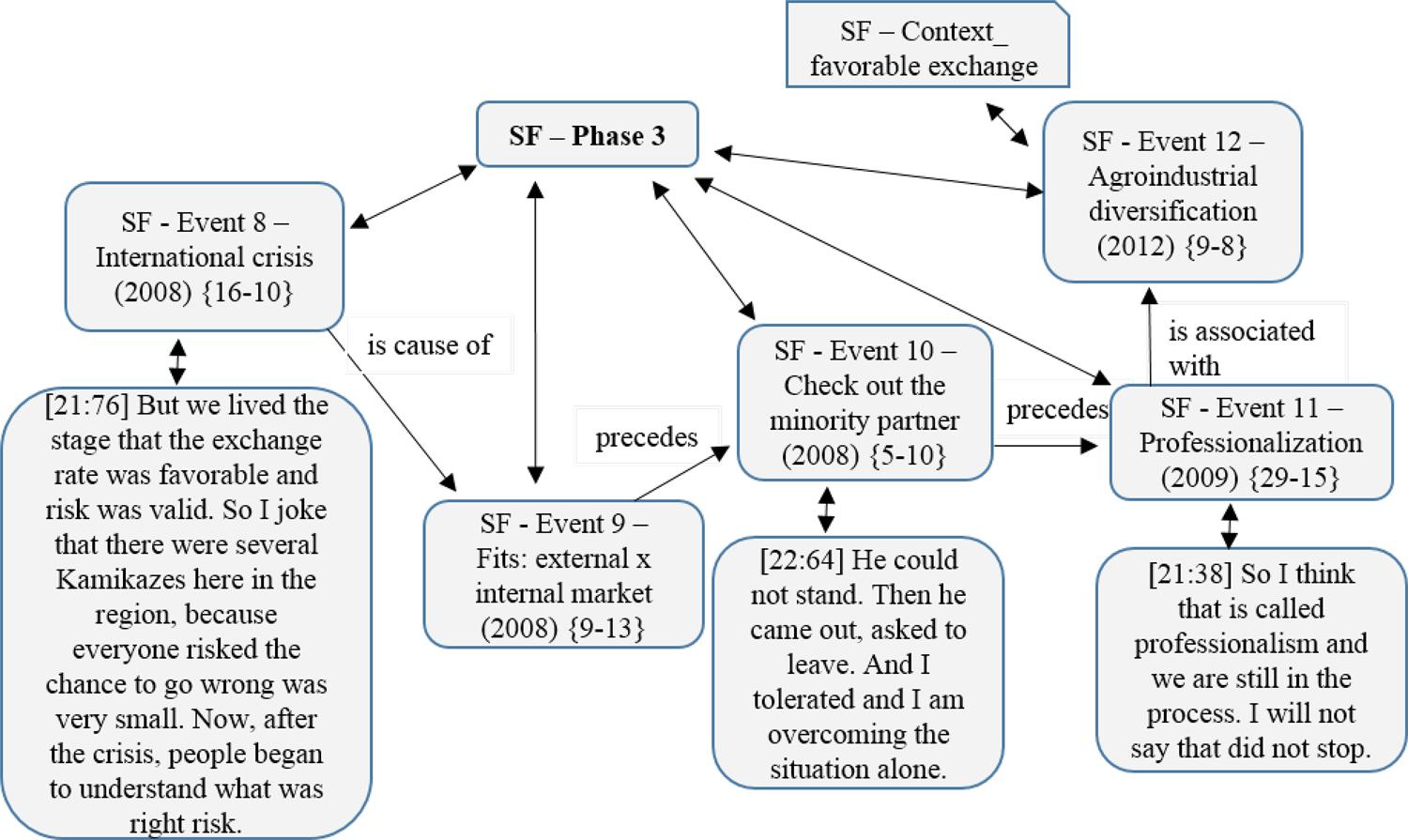
Figure 3
Phase 3 of the internationalization process of Special Fruit (2008-2012)
Source: Author's elaboration with ATLAS.ti (2018).
As for the other companies of the fruit growing region, sales manager explains that "[...] 2008 was the final blow. Why it had production, had all of a sudden dollar from$ 2.20 to $ 1.60 was. And the worst and right, the clientele was undercapitalised. So there was a lot of fruit stock, price problem and all [...]." (Interviewee-PEeBA_24, 21:33). The international crisis of 2008 demarcated the business dynamics of fruit producers highlighting the segment vulnerability.
In the external context, the exchange was not in favor of exports and the national economy was not as heated. Yet, contrary to organizational focus, part of the harvest was negotiated with Brazilian customers, according to the Respondent-PEeBA_23, (20:15).
The company had to readapt changing the payroll contracts to fixed price, in order to minimize risk, this result strengthens the vision of Sohn, Lenzi and Kiesel (2004), that recognize organizational adaptation as a mechanism to mitigate the risk. The supply of mangoes to Japan was ceased with the devaluation of the dollar, explains the manager: "It's because after this exchange fall was not feasible to work with Japan is because there everything is paid for in dollars right and dollar when he arrived in Brazil was so little unfeasible" (Interviewee-PEeBA_25, 22:84).
The changes were implemented in several instances, the marketing, production with the introduction of new varieties and adjustments in management ( RIBEIRO; PIMENTEL, 2009 ).
Despite the Special Fruit has positioned itself to respond to the economic crisis, in the year of the events, many entrepreneurs do not endured, and went bankrupt. The junior partner to observe such destabilization of the fruit system left the company. The oriental culture which until then was reflected in a closed company to external agents, take another strategic direction. The international crisis convinced the entrepreneur the urgency of restructuring the firm. Allied to this, two sons graduated and went to work in the professionalization of the company. It was necessary to remove obstacles to expanding the output was plan by controlling cost management, deliver the crop to the two sons, implement information system and make adjustments to the organizational structure. These changes are consistent with that set down Etemad (2004) and Rossi (2008) in entrepreneurial international literature.
The evolution and changes were essential to sell fruit for 50 weeks of the year. Managers have achieved new technologies, implementing innovative tools in the field and in the administration. The company resumed innovative guidance now interacting with rivals, and made investments in varieties. Europe, United States, Argentina and Canada are responsible for the largest portion of their portfolio of clients which are mostly distributors. Currently, grow direct negotiations with supermarkets, steadying best supply agreements for Special Fruit. At the same time, it intensified attention to the domestic market, with a presence in 15 Brazilian states. The Brazilian consumption rose and comparative are others, demanding to quality fruits throughout the year and higher volumes.
Transformations sustained export performance which remained balanced after the crisis of 2008. Data from the MDIC (2012) show that the company remained in the range between $ 10 and $ 50 million from 2008 to 2011, a result that defines it as one of the strongest developments of the region.
The pace of growth maintained enables the preparation of the project of an agro-industry functional juices (good for health) in order to consolidate the diversification strategy. Intends to carry out the business with the support of partners and bank financing. The idea of building a fruit processing industry is not unique to the head of Special Fruit, the factory Queiroz Galvão was one of the first in the region in this current phase.
The entrepreneurial activities were essential in the internationalization process of Special Fruit, find the following in line with the research Nassif, Ghobril and Silva (2010), Schweizer, Vahlne and Johanson (2010). The leader stood firm and the challenges and constraints of the external environment, enabling international expansion and business development.
4.2 AGRICULTURAL ARA-PE
Among the two companies analyzed, Agricultural Ara is distinguished by having less time there and be a strategic business unit of the family corporation ( BARNEY, 2002 ). The farm where it is located was acquired in 2004 with the aim of exporting seedless grapes (born global - RENNIE, 1993 ), only product grown from the foundation and the harvest, the enterprise employs approximately thousand employees (Interviewee-PEeBA_16, 14:27; 14:54).
The father was agricultural entrepreneur in cotton cultivation in Limoeiro-PE, the actual historical owner of ARA Resort dates back to civil engineering student days when he rode the first business to provide services in the construction of apartments (Interviewee-PEeBA_30, 27: 8). With the evolution of the company, Recife company is established on several fronts, namely: the development of real estate projects in the industrial manufacturing, agriculture and energy (ARA DEVELOPMENTS, 2012).
This research adheres to the research unit located in Petrolina, Agricultural Ara, recognized as one of the largest exporters and most solid in the region (Interviewee-PEeBA_17, 15:21). The process of internationalization of business has two phases and seven events. Three of them form the first phase (SF-Event 1; SF-2 Event, Event SF-3) and four, the second (SF-Event 4; SF-Event 5; SF-Event 6; SF-Event 7).
4.2.1 PHASE 1 - ENTRY IN THE EXPORTING AGRICULTURAL SECTOR (2004-2007)
In the first stage, the company's founding, formation and early SUNGROUP exports account for the most significant milestones for the internationalization of Agricultural Ara. The three events and forces of the external environment are shown in Figure 4 .
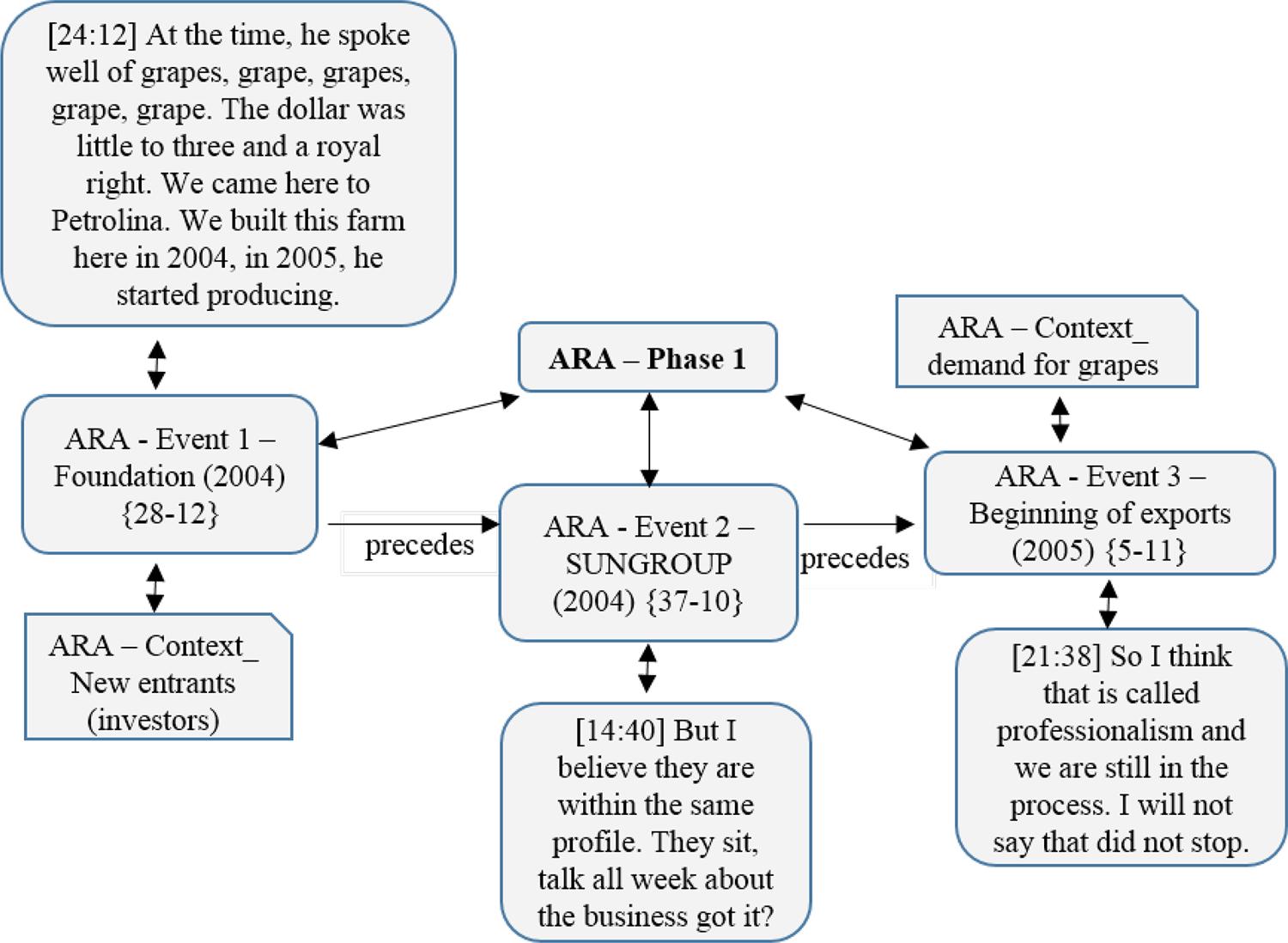
Figure 4
Phase 1 of the internationalization of Agricultural Ara process (2004-2007)
Source: Prepared by the authors with ATLAS.ti (2018).
Ownership of financial capital gained from the sale of a mall, the entrepreneur sought alternatives to invest. There were doubts that invest, shrimp, mango, grapes, there were several alternatives, none of which was related to knowledge of the technology already dominated the business segments. However, this was not an impediment, it is an attitude that is part of the official biography, go into business that does not dominate. This is a clear evidence of the willingness to take entrepreneurial risks (ZAHRA; GEORGE, 2002). The favorable exchange rate, content producers and the existence of the airport in Petrolina (the residence of the entrepreneur is located in the capital - Recife-PE) were decisive to choose the production of seedless grapes in the state (Interviewee-PEeBA_27 24:18).
Visits were carried out to California and Chile to learn the idiosyncrasies of seedless grape. In 2003, the farm was acquired to produce grapes in export standard thus set up the whole structure geared to meet international certifications. The company's owner and his son, both civil engineers, were present in the implementation of the farm made possible by financing from Banco do Nordeste for deployment. Furthermore, it is noted that the rains of 2004 did not affect the production of 120 ha, because at the time, although there were no fruits in the orchard (Interviewee-PEeBA_27, 24:14).
To minimize the lack of knowledge in the area, a partnership was held to compose the company's business, an action that is in line with that Child and Rodrigues (2007) set down when they recognize the role of relationships in the internationalization of firms. The minority shareholder with 10%, was invited to be experienced agronomist consultant in the production of seedless grapes in the Creative Commons License.
Having the best professionals with any information acquired in the farms of international producers, decided to innovate in the operation. An innovative and risky move that ensured the successful entry into the sector. Evidence supporting the understanding Mello, Rocha and Maculan (2009) in relation to the size of the firm, explain that when the new international project is to affect risk. At the same time, the external environment, professionals invested in fruit growing, raising the rivalry between competitors.
To enter and participate in the segment discussions, the company applied for entry into the Brazilian Grape Marketing Board (BGMB) which was rejected, the same happened with three investors. This event spurred the creation of the informal association SUNGROUP, with the participation of four businessmen to exchange experience and knowledge through weekly meeting that evolved into joint procurement of inputs and trading in the international market. The SUNGROUP has become an export brand adopted by the four enterprises. In the commercial arena, the participants sought to bring customers to present to the group and close business, establishing a strong bond in the network of relationships (FERREIRA; SANTOS, SERRA, 2010). In the first year, exports were the result of foreign travel and foreign visitors on the farm.
The owner's son is fluent in English favoring transactions with importers and leading to Ara Agricultural to be the spokesperson in SUNGROUP negotiations. The joint export initially treated the Netherlands, Germany, England and the United States, expanding annually. Thus, the company has remained between $ 1 and $ 10 million in the value of exports range from 2005 to 2007 (MDIC, 2012).
At this stage, the entrepreneur jumped step in searching a promising segment for effective internationalization within short time. Although he not had experience in irrigated fruit and negotiating with international buyers, had set focus and managerial competence.
4.2.2 PHASE 2 - INTERNATIONAL CRISIS MANAGEMENT AND SUCCESSOR (2008-2012)
The international financial crisis, active participation of the child, focus on the domestic market, consolidation and diversification of the corporation are part of the second stage of the internationalization of Agricultural Ara process ( Figure 5 ).
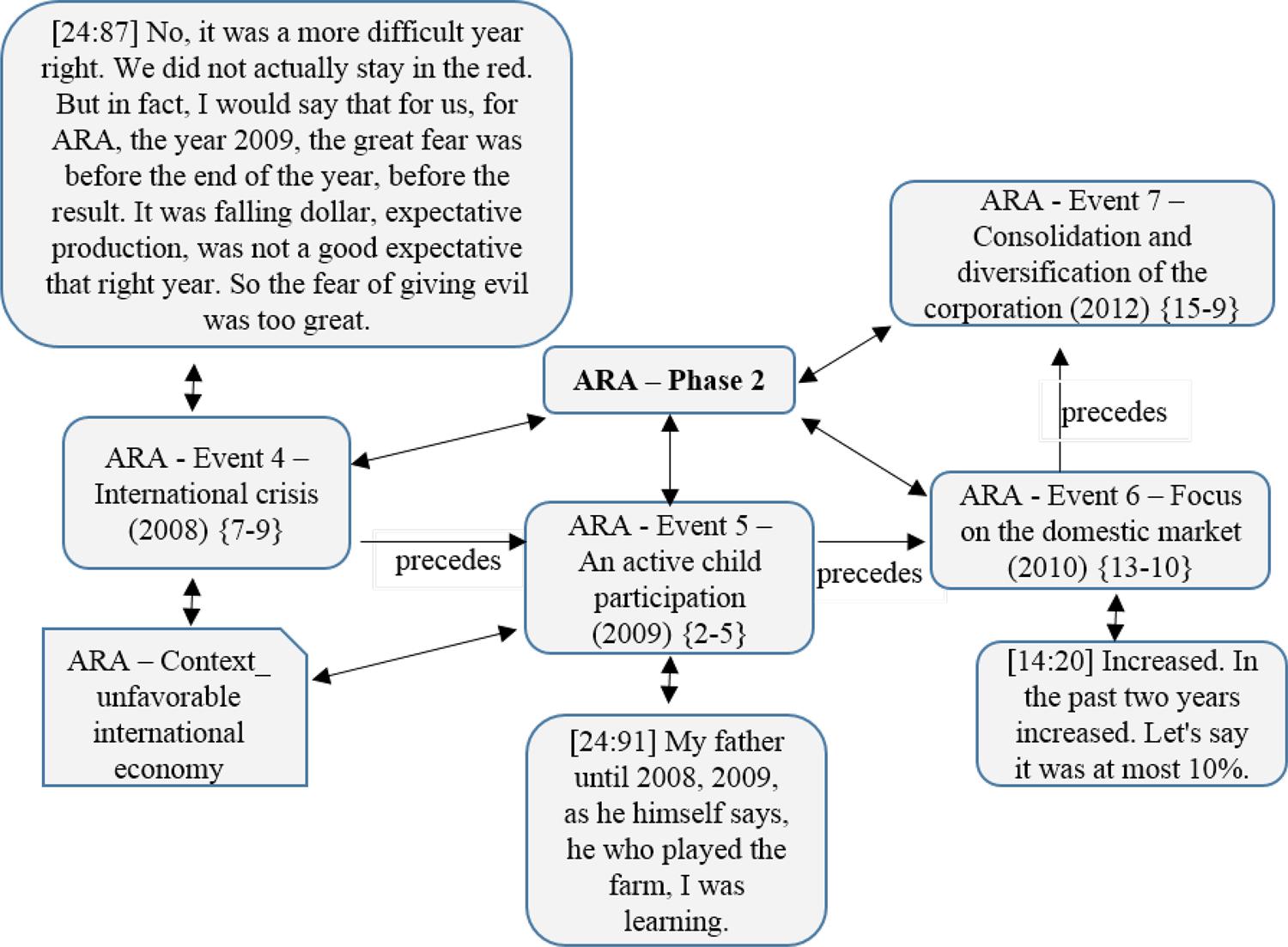
Figure 5
Phase 2 of the internationalization of Agricultural Ara process (2008-2012)
Source: Author's elaboration with ATLAS.ti (2018).
The 2008 crisis is also recognized by the managers of the Agricultural Ara as a landmark event. Managers awakened to expand the customer base by shifting part of the production to the domestic market by 2009 accounted for 3% of the volume (Interviewee-PEeBA_27, 00:43). Cost control has received more attention by eliminating unnecessary expenses and internal adjustments.
MDIC data (2012) show that the company was in the same export range by 2010, between US $ 1 and US $ 10 million, positive situation to face an international crisis. It is noteworthy that in 2011, the Agricultural Ara level up, reaching revenues of between US $ 10 and US $ 50 million.
Petrolina and Recife are separated by more than 700 km, attached to this fact, the owner of Agricultural Ara manages the entire corporation (Ara Empreendimentos), on this setting, in 2009, the owner allows the full entry of the son as director of the agricultural unit. This series was started from the design of the company and, gradually, the owner went over the responsibilities. Both continue residing in Recife, but from that definition, only the child has the obligation to travel weekly to Petrolina. By contrast, the owner by far be physically requires weekly statistical reports and active participation in decision making (Interviewee-PEeBA_28, 25:11).
The successor management, conducted in conjunction with the parent, sales to the domestic market were intensified. To meet this demand, the operation was adapted. The quality standard also increased with increasing income, domestic customers are more demanding. With the change in behavior, Agricultural Ara also had to adjust to the new reality, evidence that is in line with that set down Autio, George and Alexy (2010) to recognize the need to adapt to the requirements of demand.
In the sphere of the corporation, it is important to note, as it relates to the Ara Agricultural, entering the energy sector, specifically in hydroelectric plants in Bahia and wind energy. Projects such as the current manager of the agricultural unit is also involved. At that time, exports fall by 30% to USA and 50% for Europe and to accommodate internal and external demand, increased the area planted to about 180 hectares. But from that moment, with the rising costs and the crisis in Europe, the growth area is stopped to set the unit and raise the level of quality (Interviewee-PEeBA_27, 24: 105).
The internationalization of Agricultural Ara was completely planned, from the choice of product greater acceptance in foreign markets to the selection of staff. The company follows from that time in order to further improve grape quality to win more space in international trade.
4.3 THEORETICAL AND EMPIRICAL ANALYSIS OF THE INTERNATIONALIZATION PROCESS
In the semiarid region of the São Francisco Valley, Special Fruit's internationalization process is constituted by three phases and twelve outstanding events ( MELIN, 1992 ; VAN DE VEN, 1992) . Figure 6 summarizes the key aspects of its international biography.
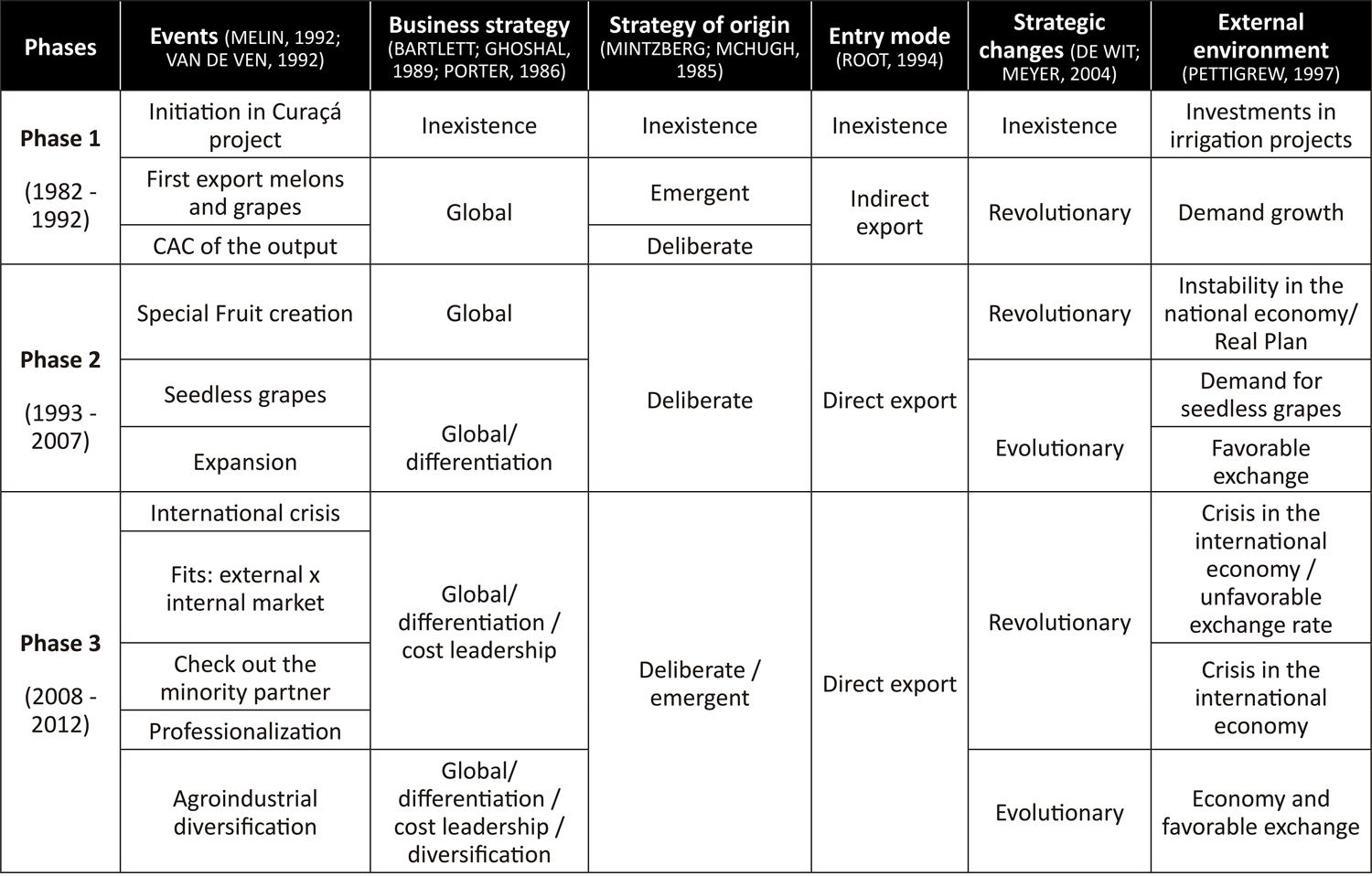
Figure 6
Analysis of the internationalization of Special Fruit process (1982-2012)
Source: Prepared by the authors (2018).
Internationalization happened by chance, via indirect exports intermediated by the Agricultural Cooperative of Cotia. Admittedly, this is the case that the internationalization happened so without being intentional. Entering Unplanned in foreign trade occurred spontaneously, as proposed by Rossi (2008) , establishing itself as a result of demand from importers, as Fernandes and Seifert Junior (2007) . Therefore, strategies, global, differentiation, cost leadership and diversification were implemented mostly deliberately ( MINTZBERG; MCHUGH, 1985 ).
There is a predominance of direct export as input mode, the first phase being the exception using the indirect export, in collaboration with the cooperative ( ROOT, 1994 ), a similar situation occurred in the Agro melon in the early years of internationalization. On the issue of change, the entrepreneur Special Fruit was more audacious transformations leading to the front arising from environmental impacts with evolutionary changes and mostly revolutionary ( DE WIT; MEYER, 2004 ).
The external context provided challenges that led the company to implement important changes since the departure of partner and professional to diversification. While some producers of fruit closed, the international recognition of Special Fruit has been achieved as a result not only of the successes, but the clarity of how to make appropriate decisions to the context.
Also located in the São Francisco Valley, the Ara Agricultural, has two phases in the internationalization process. It is the company analyzed with shorter international operations, which began in 2004. Among the strategies implemented, there is a predominance of global, cost leadership and differentiation that come together from the beginning to the strategic alliance and, more recently, diversification (HITT; IRELAND; HOSKISSON, 2008). Deliberate origin of these strategies is an interesting aspect to stand out, with only the exception of the strategic alliance (emerging) arising from the partnership, which evolved into the creation of SUNGROUP.
The direct export the input mode is adopted throughout internationalization period ( ROOT, 1994 ). Moreover, although it was in operation during the period of international crisis, considered the most sudden occurrence of the period, there were no revolutionary changes in the firm ( DE WIT; MEYER, 2004 ).
The owner of Ara Agricultural comes from a family of entrepreneurs, in addition, set up his first company even in the time it was as a university. The business ballast brings some advantages as well as the implementation of conservative actions. Bearing in mind that the Agricultural Ara is a strategic unit, one of the corporate portfolio business, maturity and objectivity of entrepreneur lead to the use of deliberate strategies and evolutionary changes ( Figure 7 ).
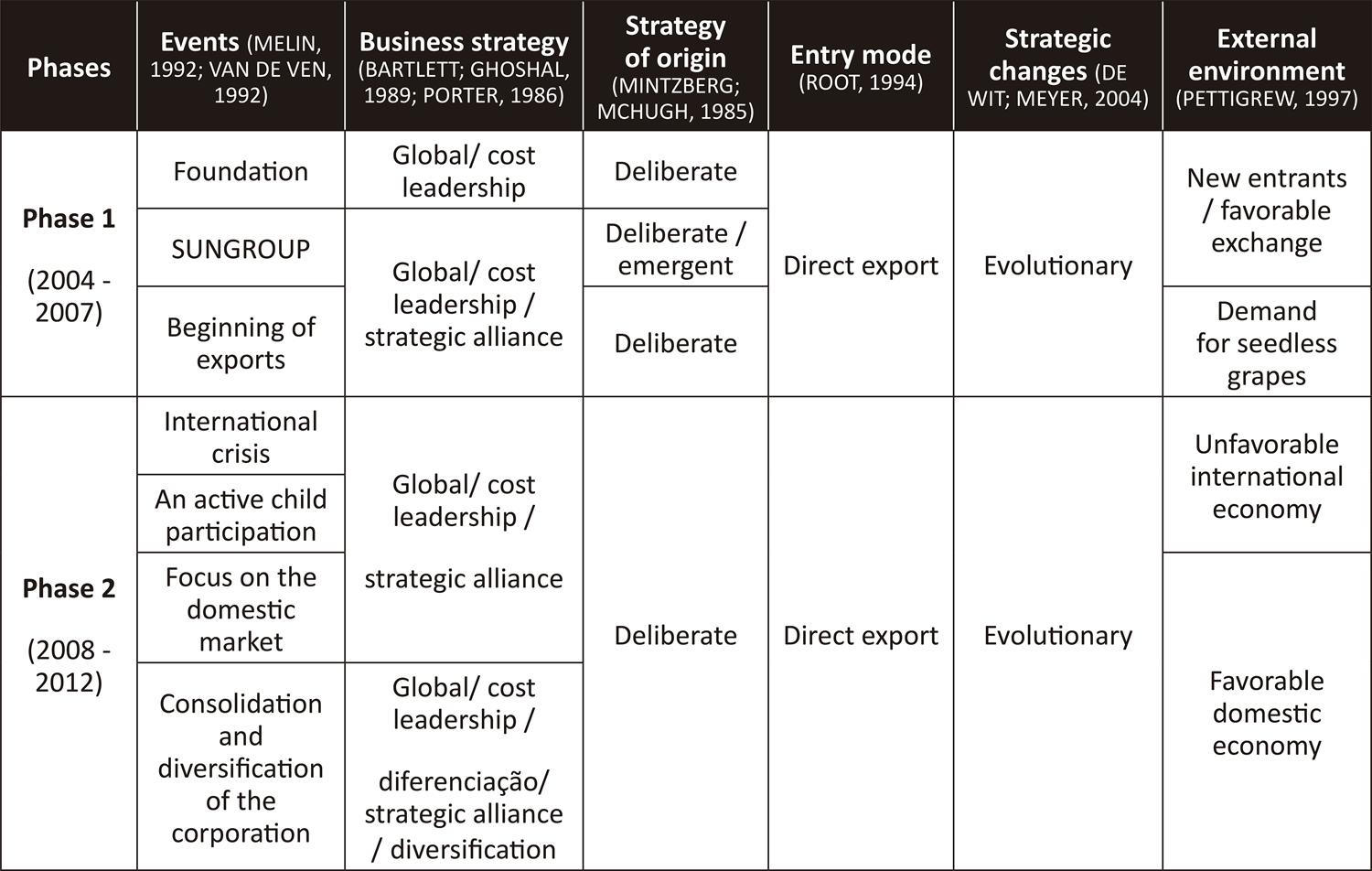
Figure 7
Analysis of the Ara Agricultural internationalization (2004-2012)
Source: Prepared by the author (2018).
Given the consideration of the two cases examined here, it identifies key points of the fruit companies internationalization process. Direct export is the predominant input mode, regardless of the time of operation and size of the firm, and is characterized by lower risk and commitment, as Honorius (2008).
You can go further, considering that the data collected allow to make the following inference: the exporter fruit need to focus and be present continuously in the business, so of course, requirements to some degree unfeasible transnational production. The redirection of production to the domestic market is another feature highlighted in the data collected. After the 2008 crisis, in addition to the unfavorable exchange rate, with the two largest consumer markets fruit, USA and Europe, withdrawn, fruit producers tried to transfer part of the production for the domestic market. But the culmination of this phenomenon date from 2010 to 2012, heating time of the national economy accompanied by rising purchasing power, passing the Brazilian to demand for healthy products, so increasing the consumption of fruit.
Regarding the strategies implemented, the results contradict the arguments Porter (1986) with regard to the incompatibility of the simultaneous presence of lead in costs and differential. In companies (Special Fruit and Agricultural Ara) the two strategies are adopted favoring internationalization, in line with the diversification strategy. Note the complexity of the business to remain competitive in the market.
It is possible to observe approximations of the findings of the two companies with the Eccentric Paradigm of Dunning (1988) , such as the location advantages of the OLI model. Already in the Adaptive Choice ( LAM; WHITE, 1999 ), internationalization is recognized as a process in which its managers have rational limitations, an aspect also identified in the results of this research in view that not everything can be predicted and planned, leading companies to adapt to the demands of the context such as the change in the dollar exchange rate.
Finally, one should mention the export values of mango and grapes in the São Francisco Valley. There was a reduction of the indicators in 2004 and 2009, respectively caused by the rain and the international crisis, as was discussed earlier. Thus, it is necessary to point out that the Special Fruit and Agricultural Ara (extracted data from MDIC, 2012) had no reduction in export values at the time of these events, a position that differs from producers in the region.
5 FINAL CONSIDERATIONS
This study analyzes the internationalization process of fruit exporting companies located in the São Francisco Valley. The results are showed through phases and significant events from which are analyzed: business strategy, strategy of origin, mode of entry, strategic changes and external environment.
The data obtained allow us to observe that there are some peculiarities in the process of internationalization of the analyzed export, the fruit growing industry. One of these is in the input mode is generally restricted to export. Although it is the least risky way is the most favorable way to stay competitive in the market without unduly compromising the resources.
Moreover, it is observed that entrepreneurs entering the São Francisco Valley region tend to enter the international market. There is a culture in the region to produce abroad, in this case, social networks show up as crucial to get information and form partnerships to meet the demands of the international logic.
The originally strategies are emerging as well as planned. Factors of the internal and external environment are crucial for managers to define and implement the most appropriate strategies to the company.
Thus, it is observed that there is no single way of the internationalization process. The entrepreneur's profile, the context, the provision of resources, among other factors should be considered in decisions that form the trajectory of companies seeking internationalization. However, management control and the propensity to take risks are present over time. One of the contributions of this research is the advance of the knowledge of the subject when portraying that the idiosyncrasies of the region influence the internationalization. The fact of exporting fresh fruits, the way competitors negotiate with buyers and the soil and climate aspects favorable to fruit cultivation influence the internationalization process. On the social side, the findings can help the agricultural community associations and the group of family farmers in the region understand the stages and challenges of the internationalization process to prepare for export.
Regarding the limitations, this study could include the participation of stakeholders such as buyers from abroad and Brazilian government representatives who work in the foreign ministry. These groups were not part of this research, but for future research it is strongly suggested to include these categories as sources of information. Another inspiration is to evaluate the influence to be in a cluster atmosphere and its relation with firms international performance, also the advantage obtained through the institutional support and the relationship between firms inside the cluster.
Thus, it is indicated for future studies to observe these elements and their influence on the process of internationalization. Finally, it indicates the realization of quantitative research covering the fruit industry companies, to analyze the common and divergent aspects of the realities of their international careers.
REFERENCES
ANDERSSON , S. The internationalization of the firm from an entrepreneurial perspective . International Studies of Management & Organization , v. 30 , n. 1 , p. 63 - 92 , Spring 2000 .
ARA EMPREENDIMENTOS . Quem somos empresa . Disponível em: < http://www.araempreendimentos.com.br/Empresa/index.html . Acesso em: 28 out. 2012 .
ATES , N. Y. ; TARAKCI , M. A Justice-Power Perspective on Middle Manager's Involvement in Strategy Process. Academy of Management Proceedings. Academy of Management Briarcliff Manor , New York , 2017 .
AUTIO , E. ; GEORGE , G. ; ALEXY , O. Intermational entrepreneurship and capability development: qualitative evidence and future research directions . Entrepreneurship Theory & Practice , v. 35 , n. 1 , p. 11 - 37 , 2011 .
BARDIN , L. Análise de Conteúdo . São Paulo : Edições 70 , 2011 .
BARNEY , J. B. Gaining and Sustaining Competitive Advantage . 3 . ed. New Jersey : Prentice-Hall , 2002
BARTLETT , C. A. ; GHOSHAL , S. Managing across Borders: New Strategic Requirements . Sloan Management Review , v. 28 , n. 4 , p. 7 - 17 , Summer , 1987 .
BARTLETT , C. A. ; GHOSHAL , S. Managing across Borders: the transnational solution . London : Harvard Business School Press , 1989 , p. 1 - 20 .
BOGDAN , R. C. ; BIKLEN , S. K. Investigação qualitativa em educação . Porto : Porto Editora , 1994 .
CHILD , J. ; RODRIGUES , S. B. The Role of Trust in International Entrepreneurship . In: Encontro da ANPAD, 31 ., Rio de Janeiro , 2007 . Anais […] . Rio de Janeiro : EnAnpad , 2007 .
COVIELLO , N. E. ; JONES , M. V. Methodological issues in international entrepreneurship research . Journal of Business Venturing , v. 19 , n. 1 , p. 485 - 508 , 2004 .
DE WIT , B. ; MEYER , R. Strategy: process, content, context . 3 . ed. London : Thomson , 2004 .
DIMITRATOS , P. ; PLAKOYIANNAKI , E. Theoretical foundations of international entrepreneurial culture . Journal of International entrepreneurship , v. 1 , n. 2 , p. 187 - 215 , 2003 .
DUNNING , J. H. The eclectic paradigm of international production: a restatement and some possible extensions . Journal of International Business Studies , v. 19 , n. 1 , p. 1 - 31 , 1988 .
EISENHARDT , K. M. Building theories from case studies research . Academy Management Review , v. 14 , n. 4 , p. 532 - 550 , 1989 .
ETEMAD , H. International entrepreneurship as a dynamic adaptive system: towards a grounded theory . Journal of International Entrepreneurship , v. 2 , n. 1 , p. 15 – 59 , 2004 .
FERNANDES , B. H. R. ; SEIFERT JÚNIOR , R. E. Tipologia de novos empreendimentos internacionais . In: Fleury , A. ; Fleury , M. T. L. ( Orgs .) . Internacionalização e os países emergentes . São Paulo : Atlas , 2007 , p. 51 - 73 .
FERREIRA , M. P. ; SANTOS , J. C. ; SERRA , F. A. R. The international entrepreneurial firms’ social networks . Cadernos EBAPE.BR , v. 8 , n. 1 , p. 133 - 145 , 2010 .
FLICK , U. Desenho da pesquisa qualitativa . Porto Alegre : Artmed , 2009 .
GIOIA , D. A. ; CORLEY , K. G. ; HAMILTON , A. L. Seeking qualitative rigor in inductive research: Notes on the Gioia methodology . Organizational research methods , 16 ( 1 ), 2013 , p 15 - 31 .
GODOY , A. S. Introdução à pesquisa qualitativa e suas possibilidades . Revista de Administração de Empresas , São Paulo , v. 35 , n. 2 , p. 57 - 63 , mar./abr . 1995 .
GUBA , E. G. ; LINCOLN , Y. S. Paradigmatic controversies, contradictions, and emerging confluences . In: Denzin , Norman K. ; Lincoln , Yvonna S. ( Eds .) . Handbook of Qualitative Research: Third Edition . London : Sage , 2005 , p. 191 - 215 .
HAGEN , B. ; DENICOLAI , S. ; ZUCCHELLA , A. International entrepreneurship at the crossroads between innovation and internationalization . Journal of International Entrepreneurship , [ s.l. ], v. 12 , n. 2 , p. 111 - 114 , jun . 2014 .
HITT , U. A. ; IRELAND , R. R. ; HOSKISSON , R. E. Administração Estratégica: competitividade e globalização . São Paulo : Cengege , 2008 .
HONÓRIO , L. C. A internacionalização de empresas brasileiras em uma perspectiva motivacional . Revista de Administração Mackenzie , v. 9 , n. 2 , p. 128 - 151 , 2008 .
JOHANSON , J. ; VAHLNE , J.-E. (). The internationalization process of the firm: a model of knowledge development and increasing foreign markets commitments . Journal of International Business Studies , v. 8 , n. 1 , p. 23 - 32 , Spring 1977 .
KISS , A. N. ; DANIS , W. M. ; CAVUSGIL , S. T. International entrepreneurship research in emerging economies: a critical review and research agenda . Journal of Business Venturing , v. 27 , n. 2 , p. 266 - 290 , March 2012 .
LAM , L. W. ; WHITE , L. P. An adaptative choice model of the internationalization process . International Journal of Organizational Analysis , v. 7 , n. 2 , April , p. 105 - 134 , 1999 .
LARSEN , P. Relational Strategic Leadership (RSL) - Model for Effective Strategy Formation Processes . Academy of Management Proceedings , v. 2013 , n. 1 , p. 11703 , 2013 .
LAVARDA , R. ; CANET-GINER , M. T. ; PERIS-BONET , F. Integrative Strategy Formation Process and the Management of Complex Work a Microorganizational Analisys . BBR-Brazilian Business Review , v. 7 , n. 3 , p. 108 - 129 , 2010 .
MACK , D. Z. ; SZULANSKI , G. Managing Participation And Inclusion In The Strategy Process. Academy of Management Proceedings . Academy of Management Briarcliff Manor , New York , 2017 .
MARTIN , S.L. ; JAVALGI , R. G. Epistemological foundations of international entrepreneurship . International Entrepreneurship and Management Journal , v. 14 , n. 1 , p. 671 - 680 , 2018 .
MDIC . Empresas brasileiras exportadoras: geral . Disponível em: http://www.desenvolvimento.gov.br/sitio/interna/interna.php?area=5&menu=2413&refr=603 . Acesso em: 20 out. 2012 .
MELIN , L. Internationalization as a strategy process . Strategic Management Journal , v. 13 , n. S2 , p. 99 - 118 , 1992 .
MELLO , R. C. de ; ROCHA , A. da ; MACULAN , A-M. A Trajetória Internacional das Pequenas Empresas: É Possível Conciliar as Teorias Comportamentais? In: IV Encontro de estudos em estratégia , Recife , 2009 . Anais… Recife : 3Es , 2009 .
MERRIAM , S. B. Qualitative research and case study applications in education . San Francisco : Jossey-Bass , 1998 .
MINZTBERG , H. , AHLSTRAND , B. ; LAMPEL , J. Safári de estratégia: um roteiro pela selva do planejamento estratégico . Porto Alegre : Bookman , 2000 .
MINTZBERG , H. ; MCHUGH , A. Strategy formation in an adhocracy . Administrative Science Quarterly , v. 30 , v. 2 , p. 160 - 197 , Jun . 1985 .
MOZZATO , A. R. ; GRZYBOVSKI , D. Análise de conteúdo como técnica de análise de dados qualitativos no campo da administração: potencial e desafios . Revista de Administração Contemporânea , 15 ( 4 ), 2011 , p. 731 - 747 .
OVIATT , B. M. ; MCDOUGALL , P. P. Defining international entrepreneurship and modeling the speed of internationalization . Entrepreneurship Theory & Practice , v. 29 , n. 5 , p. 537 - 553 , 2005 .
PAIVA JÚNIOR , F. G. de ; LEÃO , A. L. M. de S. ; MELLO , S. C. B. de. Validade e Confiabilidade na Pesquisa Qualitativa em Administração . Revista de Ciências da Administração , v. 13 , n. 31 , p. 190 - 209 , set/dez . 2011 .
PATTON , M. Q. Qualitative research and evaluation methods . California : Sage Publication , 2001 .
PERÉNYI , Á. ; Losoncz , M. A systematic review of international entrepreneurship special issue articles . Sustainability , v. 10 , n. 3476 , p. 1 - 26 , 2018 .
PETTIGREW , A. M. Context and action in transformation of the firm . Journal of Management Studies , v. 24 , n. 6 , p. 649 - 670 , Nov . 1987 .
PORTER , M. E. Estratégia competitiva: técnicas para análise de indústrias e da concorrência . Rio de Janeiro : Campus , 1986 .
PORTER , M. E. Competição: Estratégias Competitivas Essenciais . 6 . ed. Rio de Janeiro : Campus , 1999 .
RENNIE , M. W. Born Global . The McKinsey Quarterly , v. 4 , p. 45 - 52 , 1993 .
RIBEIRO , F. C. F. ; PIMENTEL , J. E. A. Empresas Born Globals Brasileiras: a Influência do Perfil do Empreendedor e da Localização Geográfica . In: ENCONTRO DA ANPAD, 33 ., 2009 , São Paulo . Anais […] . São Paulo : EnAnpad , 2009 .
ROOT , F. R. Entry strategies for international markets . New York : Lexington Books , 1994 .
ROSSI , D. L. Dimensões do empreendedorismo internacional na internacionalização de uma empresa mineira do setor alimentício . 114 f. Dissertação (Mestrado Acadêmico em Administração) . Programa de Pós-Graduação em Administração. Faculdade Novos Horizontes , Belo Horizonte, MG . 2008 .
SCHWEIZER , R. ; VAHLNE , J. E. ; JOHANSON , J. Internationalization as an entrepreneurial process . Journal of International Entrepreneurship , v. 8 , n. 4 , p. 343 - 370 , 2010 .
SEBRAE . Anuário do trabalho: na micro e pequena empresa 2010/1011 . 2011 . Disponível em: < http://www.dieese.org.br/anu/anuSebraeMicroPeqEmp/anuarioSebrae10-11.pdf . Acesso em: 9 nov. 2012 .
SHARMA , V. M. ; ERRAMILLI , M. K. Resource-based explanation of entry mode choice . Journal of Marketing Theory and Practice , v. 12 , n. 1 , p. 1 - 18 , Winter 2004 .
SOHN , A. P. L. ; LENZI , F. C. ; KIEZEL , M. D. A Presença do Espírito Empreendedor no Processo de Formulação de Estratégias de Internacionalização da Datasul . In: XXVIII Encontro da ANPAD , Curitiba , 2004 . Anais… Curitiba : EnAnpad , 2004 .
SUDDABY , R. ; BRUTON , G. D. ; SI , S. X. Entrepreneurship through a qualitative lens: insights on the construction and/or discovery of entrepreneurial opportunity . Journal of Business Venturing , [ s.l. ], v. 30 , n. 1 , p. 1 - 10 , jan . 2015 .
TAYLOR , S. J. ; BOGDAN , R. Introduction to qualitative research methods: the search for meanings . John Wiley & Sons . 2 . ed., 1984 , p. 123 - 145 .
VAN DE VEN , A. H. Suggestions for studing stratey process: a research note . Strategic Management Journal , v. 13 , Special Issue Summer , p. 169 - 188 , 1992 .
VENKATARAMAN , S. ; SARASVATHY , S. D. ; DEW , N. ; FORSTER , W. R. Reflections on the 2010 AMR decade award: whither the promise? Moving forward with entrepreneurship as a science of the artificial . Academy of Management Review , v. 37 , n. 1 , p. 21 - 33 , 2012 .
VERNON , R. International investment and international trade in the product cycle . Quarterly Journal of Economics , v. 80 , n. 2 , p. 191 - 207 , 1966 .
WILDEMUTH , Barbara M. ( Ed .) . Applications of social research methods to questions in information and library science . ABC-CLIO , 2016 .
ZAHRA , S. A. ; GEORGE , G. International entrepreneurship: the current status of field and future research agenda . In: HITT , M. A. ; IRELAND , R. D. ; SEXTON , D. L. ; AMP,S. M. ( Eds .) Strategic entrepreneurship, creating a new mindset . Oxford, UK : Blackwell , p. 255 - 288 .
Autor notes
Doutorado em Administração pela Universidade Federal de Pernambuco, Recife-PE, Brasil. Professora na UFPE – Universidade Federal de Pernambuco. Recife – PR – Brasil. E-mail: yakarav@gmail.com
Walter Fernando Araújo de Moraes 2
Doutorado em Management Sciences pela University of Manchester Institute of Science and Technology, Grã-Bretanha (1988). Mestrado em Engenharia de Produção pela Universidade Federal de Santa Catarina- SC – Brasil. E-mail: wfam1950@gmail.com
Vinicius Farias Moreira 3
Doutorado em Administração pela Universidade Federal de Pernambuco, Brasil (2015). Pesquisa e Desenvolvimento da Universidade Federal de Campina Grande, Brasil. Professor adjunto e coordenador do curso de graduação em Administração, professor de MBA e mestrado em Administração da Universidade Federal de Campina Grande-UFCG, Paraíba – Brasil. E-mail: viniciusfmoreira@yahoo.com.br
Viviane Santos Salazar 4
Doutora em Administração pela Universidade Federal de Pernambuco, Recife,PE, Brasil. Professora do Departamento de Hotelaria e Turismo da Universidade Federal de Pernambuco – Recife – PE – Brasil. E-mail: viviane_salazar@yahoo.com.br