Articles
Inter and intraocupations wages differences: evidences for Paraná and Bahia

Inter and intraocupations wages differences: evidences for Paraná and Bahia
Gestão & Regionalidade, vol. 37, núm. 110, pp. 117-136, 2021
Universidade Municipal de São Caetano do Sul

Esta obra está bajo una Licencia Creative Commons Atribución 4.0 Internacional.
Recepción: 11 Julio 2019
Aprobación: 01 Octubre 2020
Abstract: This article aims to analyze the occupational segmentation effects on workers' incomes, as well as intra-occupational gender discrimination in the states of Paraná and Bahia. Through the National Household Sample Survey microdata of 2015, the mincerian equations were estimated with the correction of the sample selection bias and the wage decomposition of Oaxaca-Blinder was performed for the occupational groups and for gender. The data identified lower wage returns in Bahia for all the variables studied, especially for the white employed and schooling (except Leaders and PCAs). They confirmed the segmentation among occupations, that is, the relevance of the jobs characteristics as source of wage differences, more pronounced in the state of Paraná. There is intra-occupational gender discrimination, being superior for more complex occupations, and the greatest effect of wages discrimination is in the state of Bahia.
Keywords: Wage gap, Occupational segmentation, Gender discrimination.
Resumo: Este artigo tem por objetivo analisar os efeitos da segmentação ocupacional sobre os rendimentos dos trabalhadores, assim como a discriminação salarial intraocupacional de gênero, nos estados do Paraná e da Bahia. Por meio dos microdados da Pesquisa Nacional por Amostra de Domicílios de 2015, estimou-se as equações mincerianas com a correção do viés de seleção amostral e efetuou-se a decomposição salarial de Oaxaca-Blinder para os grupos ocupacionais e para o gênero. Os dados identificaram retornos salariais inferiores na Bahia para todas as variáveis estudadas, especialmente para os ocupados brancos e para a escolaridade (exceto para Dirigentes e PCA). Confirmaram a segmentação entre ocupações, ou seja, a relevância das características dos postos de trabalho como fonte das diferenças salariais, mais pronunciada no estado do Paraná. Há discriminação de gênero intraocupacional, superior para ocupações mais complexas, sendo que o maior efeito da discriminação de salários encontra-se no estado da Bahia.
Palavras-chave: Diferenças salariais, Segmentação ocupacional, Discriminação de gênero.
1 INTRODUCTION
Empirical research on wage disparities has been produced in Brazil and in its regions, provoked by arguments about their amplitude and sources. The scientific literature highlights the wage differences resulting from the workers’ productive attributes and other profiles, associated with ethnicity, gender and the profession exercised. From this perspective, research is relevant to the formulation and implementation of public policies to reduce inequalities in the country.
Despite this, Brazil’s vast territorial extension and the diversity of regional labor markets require localized studies, relatively scarce for the states of the Brazilian Federation. Thus, immediate questions emerge about the labor market of two distinct states in their social and economic formations, Paraná and Bahia, the latter being materialized by unfavorable socioeconomic indicators in relation to the former.
The state of Paraná is characterized by the high human development index (HDI) of 0.749, per capita monthly household income of R$ 1.621, in 2019, by the occupation of 92.71% of the labor force, and one of the lowest unemployment rates in the country (8.43% in 2019). In 2010, the poor and extremely poor individuals accounted for 1.96% and 6.46% of the population. On the other hand, Bahia has an average HDI (0.660), per capita monthly household income of R$ 913.00, in 2019, with 83,58% of the labor force employed, and the highest unemployment rate in Brazil (17.20% in 2019). In 2010, about 28.72% were poor and 13.79% were extremely poor individuals (IBGE, 2020; IPEADATA, 2020; ATLAS DO DESENVOLVIMENTO HUMANO, 2020).
Paraná therefore qualifies as a more developed state and better labor market indicators compared to the state of Bahia. Due to that, this research aims to show the labor market specificities of the two federative units, and to strengthen the formulation or enhancement bases of local public policies for the individuals’ development or inclusion in the labor market.
In theory, the wage inequalities are explained by distinct theoretical frameworks. The theory of compensating differential (SMITH, 1983; BORJAS, 2012) shows the wage inequalities caused by undesirable working conditions. The theory of human capital, from the perspective of labor supply, has as precursors Mincer (1958), Becker (1962), Becker and Chiswick (1966) and Schultz (1961), and declares the existence of a positive correlation between education and income. The theory of discrimination shows that wage discrimination occurs when workers with identical productive attributes are treated differently due to the groups to which they belong (BECKER, 1962; BECKER; CHISWICK, 1966), encouraged by the employer, employee, customer or statistical discrimination. In the theory of labor market segmentation, wages differences originate from the work place characteristics, either by the allocative adjustment (DOERINGER; PIORE, 1970), by technological dualism (VIETORISZ; HARISSON, 1973), or by the differences of the social classes (REICH; GORDON; EDWARDS, 1973).
Empirically, in the international context, research reveals wage differences caused by productive characteristics, but also by gender and occupation aspects. Melly (2002) investigated the wage differences in public and private occupations in Germany, Cobb-Clark and Tan (2010) confirmed a significant effect of non-cognitive skills on the probability of employment in Australia in certain occupations, Ma (2017) studied the intersectoral and intra-sectoral segmentation with emphasis on gender for urban China, and Ma (2018) explored the influence of industrial sector segmentation on wages among rural-urban migrants and urban residents in China.
Considering the Brazilian bibliography, studies analyzed the wage gaps in occupations, such as Flori (2007), Araújo et al. (2011), Madalozzo and Artes (2017), Alves et al. (2019) and Mantovani, Souza and Gomes (2020) supported by the market dualistic perspective. Within the States, Silva (2014) did so for Pernambuco, Souza (2004) for Paraná, and Gomes and Souza (2020) for Bahia. However, the substantial contribution of this research is in the occupations regrouping and in the measurement of gender discrimination within these occupations, as well as in the state specificities of Paraná and Bahia, in order to fill an existing research gap.
In view of this, the objective of this work is to analyze the wage differences sources, especially due to occupational segmentation and intra-occupational gender discrimination in the states of Paraná and Bahia. In addition to this introduction, this Article is structured into four more sections. The second presents the review of theoretical literature and empirical studies in relation to the theme. The third section explains the methodological procedure and the database selected. The fourth section describes the results and data interpretation. In the end, the final considerations are presented.
2. THEORIES AND EVIDENCES ON WAGE DIFFERENCES
The wage gaps are dealt with in different theoretical constructions. For the theory of the compensating differential, the workers' wages are influenced by working conditions (SMITH, 1983; BORJAS, 2012). The Human Capital theory, exposed by Mincer (1958), Schultz (1961), Becker (1962) and Becker and Chiswick (1966) and focuses on the variable’s qualification and experience, revealing an association between the worker’s education and income. The worker must define whether to remain in the job market without qualification or to spend time specializing to increase his or her productivity in the future.
According to the economic theory of discrimination, workers are treated differently based on irrelevant criteria for productivity (LOUREIRO, 2003). Discrimination is made when a group of individuals have equal qualifications, productivity and experiences, but have different incomes and treatments to the detriment of skin color, gender, region where they reside, sexual orientation, without such attributes influencing the employee’s productivity.
According to Becker (1957, 1962) and Becker and Chiswick (1966) there are four types of discrimination: provoked by the employer, employee, customer and statistical discrimination (BECKER, 1971; EHRENBERG; SMITH; 2000, BORJAS, 2012). Discrimination fostered by the employer occurs when employers have prejudice against minorities (such as women), but their employees and customers are not discriminators. Discrimination originated by the employee occurs when male workers prefer not to work with women. Customers can also present preference for discrimination. This is the case where consumers plan to be served by specific workers, for example, to be attended by men. The company can position female workers in functions that need little interaction with consumers (BORJAS, 2012; EHRENBERG AND SMITH, 2000).
From the perspective of the theory of labor market segmentation, there is a multiplicity of arguments about the phenomenon, which complement each other (LIMA, 1980). Initially, Doeringer and Piore (1970) argue that an allocation adjustment will define the worker’s destination according to his or her personal characteristics and behaviors in the labor market. Vietorisz and Harisson (1973) claim that the capitalism concentration process produced technological dualism and aided segmentation. Finally, Reich, Gordon and Edwards (1973) emphasize the different social classes and consider them to be the segmentation process motivation. The wage difference due to occupational segmentation occurs, when workers have the same characteristics, qualifications and productivity, however, they are treated in a dissimilar way by the job position they are inserted in.
The empirical literature proves the existence of income inequalities related to occupations and gender in the international, national and state labor market. Internationally, Cobb-Clark and Tan (2010) analyzed whether the women’s and men’s non-cognitive characteristics influenced their occupational abilities in Australia. Through the decomposition of Oaxaca-Blind, a significant effect was found of non-cognitive abilities on the probability of employment in the 18 occupations based on the Australian Standard Classification of Occupations of 1997.
In a study for Urban China, Ma (2017) estimated how sector segmentation influences men's and women's wages, with data from China Household Income Project (CHIP) 2014. The wage difference between men and women was confirmed, the greatest influence of the intra-sectoral disparity (93.3%) and the superiority of the party explained by the workers' attributes in the inter-sectoral analysis (111%), while gender discrimination (85.7%) is responsible for most of the intra-sectoral differences. In another research in China, and with the same database, MA (2018) examined the action of labor market segmentation by industrial sectors on rural-urban migrants and those residing in the urban sites of China in 2002 and 2013, and it was found that the influence of intra-industrial disparities is greater than inter-sectoral differences in both years. Moreover, the component explained by the individual's personal and productive characteristics is the main generator of wage inequalities, but it is noteworthy that the share of discrimination against immigrants in the industrial sector increased from 2002 to 2013.
Nationally, Flori (2007) confirmed with data from PNAD from 1984 to 2001 that the occupation of services workers is the one with the lowest wages, the highest percentage of workers with low educational levels, but it is the one that employs the most. The most attractive job position is that of managers, for adding the highest level of remuneration.
From the point of view of the professions, Machado and Scorzafave (2016) compared the wage gap between teachers and non-teachers, and concluded that the occupation related to the teacher presents a positive remuneration differential in the mean and in the lowest quantiles, 10 and 50, in relation to non-teachers. The wage difference is mostly explained by the return of characteristics and less by differences in the levels of these attributes. Madalozzo and Artes (2016) employed PNAD data from 2013 to prove the existence of differences in the attributes of individuals who choose traditional professions (law, engineering or medicine) and their respective remuneration. They also noted the presence of differences in intra-occupational gender, but this differential is lower for more traditional professions, which indicates that those who opt for careers in non-imperial posts have significant disparities.
Alves et al. (2019) investigated the wage inequalities from the perspective of occupations of Brazilian qualified women. Most women are in science and arts-related posts, while lower incomes are paid for those employed in high school-level technical professions. They have proven gender discrimination, in which qualified women with higher education earn less income than men, and the wage gap and discrimination against them are higher the higher their qualification levels.
In an analysis of wage heterogeneity between the public and private spheres, Costa et al. (2020) found that in 2018 most of the workers employed in the private sector were placed in job positions regarding services, trade and markets (24.40%) and machine plant operations (18.25%), while in the public sector most of the individuals were science and intellectual professionals (38.04%). They confirmed that part of the wage gap is favorable to the public sector, mainly due to differences in the workers' characteristics, and the highest wage premium is among the administrative support workers (43.3%).
Mantovani, Souza and Gomes (2020) identified occupational segmentation in the Brazilian labor market, with a greater effect for the occupations of Managers and Sciences and Arts Professionals. In addition to the segmentation among the professions, they found the presence of intra-occupational gender discrimination, and the woman is more discriminated in the positions that aggregate higher incomes and qualification and lower for workers with low wages and educational level.
Concerning the state cut-off, Souza (2004) studied the occupations and incomes of agricultural activities in Paraná, PNAD data from 1992 to 1999. In addition to the labor force employed in this sector, it noted the contrast between agricultural employers and rural workers, the first group being the one that aggregates the highest income and the last one that has the lowest wages. Silva (2014) investigated the wages inequality among professions – Science and Arts Professionals and other occupations – in Pernambuco. The author stated that there is a significant portion of the wage difference that comes from occupational segmentation, that is, from the part not explained by the workers’ attributes vector.
Through the formal jobs (RAIS) of 2013, Gomes and Souza (2020) measured the wages heterogeneities and gender discrimination for those who achieved the first job in Bahia. Using the Oaxaca-Blind decomposition method, they observed that there is discrimination against women, being lower in the first job (12.5%) and higher for the remaining female employees of the companies (25%). In addition, they note that occupational discrimination has a negative effect on women's wages, indicating that women are in positions with lower pay than men.
In view of the above, this work focuses on the individual’s occupation in Paraná and Bahia labor market, as a determinant of the wages gaps, and the quantification of the portions of the income differences that result from gender discrimination in each group of occupations.
3 EMPIRICAL STRATEGY
3.1 Database
The database used in this research was the National Household Sample Survey (PNAD) of 2015 for Paraná and Bahia. PNAD is a survey carried out by Instituto Brasileiro de Geografia e Estatística through a sample of households throughout the country. PNAD with annual periodicity was discontinued as of 2016, with methodological changes, reason why the database of the previous year was chosen[4].
For better visualization, occupations classified by PNAD (CBO 2002 – Brazilian Classification of Occupations, from the Ministry of Labor and Employment) were regrouped into three occupational groups correlated to their educational levels and competencies (Table 1). Occupational group 1 contains the sciences and arts professionals and managers (PCAs), which covers the workers they lead, establish rules for companies and the public interest; occupational group 2 refers to the high school-level technicians and comprises the high school-level technical professions; and finally, occupational group 3, which brings together workers from administrative services, goods and services, sales people from trade and agriculture, designated in this study as services and production workers.
| Occupational groups | CBO 2002 | Large occupational group | Level of competence | Educational Level(mean) |
| 1 | GG1 GG2 | Organization mangers of public interest and business and managers; Science and arts professionals (PCAS); | 4 | 13, 27 |
| 2 | GG3 | High School Technicians; | 3 | 11.73 |
| 3 | GG4 GG5 GG6 GG7 | Workers in administrative services; Workers in services sales people of trade in stores and markets; Agricultural, forestry and fisheries workers; Workers in the production of industrial goods and services. | 2 | 8.08 |
Source: Elaborated by the authors based on CBO of 2002 (BRAZIL, 2017) and PNAD 2015.
Note: GG corresponds to the large occupational group.
The choice of variables was based on the economic theories of the labor market, that is, the Human Capital Theory (Mincer, 1958; Schultz, 1964; Becker and Chiswick, 1966), Segmentation Theory (Doeringer; Piore, 1970; Vietorisz; Harrinson, 1973, Reich; Gordon; Edwards, 1973), Theory of Discrimination (Becker, 1957; Borjas, 2012), and also by investigations in the empirical studies of Flori (2007); Gomes (2016); Alves et al. (2019) and Mantovani, Souza and Gomes (2020).
| Representation | Variable | Description |
| Dependent variable | ||
| Importar imagen | Time wage log | Natural logarithm of the adjusted income by working hours. |
| Independent Variables | ||
| Importar imagen | Years of study | Worker’s schooling level; |
| Importar imagen | Experience | Quantity of working years (individual’s age – age at which he or she began working). |
| Importar imagen | Squared experience | Variable experience squared. |
| Importar imagen | Formal sector | 1 if the individual works in the formal market, 0 otherwise. |
| Importar imagen | Gender | 1 if it is a woman, 0 otherwise. |
| Importar imagen | Color | 1 if it is white, 0 otherwise. |
| Importar imagen | Economic sector | Agricultural - 1 if working in agriculture, 0 otherwise; Trade - 1 if working in trade, 0 otherwise; Services - 1 if working in the service sector, 0 otherwise; Industry - 1 if working in industry, 0 otherwise; |
| Importar imagen | State | Dummies for each Federal Unit corresponding to its region. |
| Importar imagen | Occupational group | Group 1 (Managers and PCAs) - 1 belonging to group 1, 0 otherwise; |
| Group 2 (High school technicians) - 1 belonging to group 2, 0 otherwise; | ||
| Group 3 (Workers in services and production) | ||
| =1 if it belongs to group 3, 0 otherwise; | ||
| Importar imagen* | Another income | Another income that the worker presents in addition to the wage. |
| Importar imagen* | Spouse | 1 if the individual is considered a spouse, 0 otherwise. |
| Importar imagen* | Head | 1 if the individual is considered a head of the family, 0 otherwise. |
| Importar imagen* | Children from 0 to 5 years | Number of children the individual has from 0 to 5 years. |
| Importar imagen* | Children from 0 to 13 years | Number of children the individual has from 0 to 13 years. |
| URB | Urban area | 1 if the individual lives in the urban area, 0 otherwise. |
Source: Elaborated by the authors from PNAD 2015.
Notes: (1) Wage and income will be treated as synonyms; (2) * variables used exclusively for the sampling selection bias correction procedure.
3.2 Mincerian equations
The incomes were estimated using the semi-logarithmic equation formulated by Mincer (1974). The model incorporates productive variables as determinants of wage and is employed in works that aim to measure wages returns due to the workers’ productive and non-productive attributes, such as jobs positions, skin color or gender.
This research used the Mincer equation to measure the incomes of occupational groups: occupational group 1 (managers and science and arts professionals (PCAs)), occupational group 2 (high school technicians), and occupational group 3 (services and production workers). Then, the wages determination equations were estimated for men and women for each occupational group in Paraná and Bahia in 2015:
Where
is the natural logarithm of the adjusted income per working hours
, is the schooling,
the experience,
the variable squared experience, which displays the long-term returns
, refers to the vector worker’s personal characteristics and of the labor market segments and, finally,
is the vector of the coefficients of each attribute. The variables chosen were: qualification, experience, squared experience, formal sector, woman, white, economic sector, the country’s macro-regions, urban housing area and occupational group to which the worker belongs (Table 2).
3.3 Correction of Sampling Selection Bias
The literature regarding the wage’s determination equations amplifies the Mincer equations, proposing the correction of a possible sampling selection bias. Sample selection bias may occur because some people do not offer workforce because the reserve wage is higher than the wage in practice in the labor market, and the sample randomness is not ensured (HECKMAN, 1979).
The strategy of bias correction through the sampling selection may be useful for analyzing heterogeneous effects when endogeneity is expected in the self-selection process. Failure to apply this type of procedure will result in a biased estimate (HECKMAN, 1979). The method consists of two stages. Initially, the Probit multinomial model (Equation 2) that deals with the individuals’ decision to enter the workforce or not is estimated. In this model, the dependent variable presents a multinomial distribution, that is, more than two categories. Examples of this method can be observed in Imai and Van Dyk (2005), Kropko (2008), Gama and Machado (2014) and Gomes et al. (2015). The description of the variables used in this procedure is in Table 2.
In the second stage, the reverse ratio of Mills (IMR) is calculated. When the IMR is statistically significant in the probability model, it should be entered as a return variable in the wage’s equation. The inverse Mills ratio (IMR) is represented by
, consisting of a decreasing monotone function of a probability, where it represents a density function of a standard normal variable and Φ corresponds to a distribution function of a standard normal variable.
3.4 Wage decomposition of Oaxaca-Blind
The Wage decomposition of Oaxaca (1973) and Blinder (1973) fragments the individual's wage determination equations in a portion that is explained by personal characteristics and in an unexplained part, proxy of discrimination, when gender or ethnic differences are focused, or proxy of labor market segmentation, in the professions differences investigation. This methodology is used in several studies, such as Cobb-Clark and Tan (2010), Silva (2014), Gomes (2016), Alves et al. (2019), Costa et al. (2020) and Mantovani, Souza and Gomes (2020), and others.
Based on the Mincerian equations for the groups analyzed, we have the equations for the groups in advantage and disadvantage:
Where the superscript H denotes High-Wage of the advantage group, and the subscript L symbolizes Low-Wage of the disadvantage group. Applying Minimum Ordinary Squares and subtracting the equation (6) from (5), we obtain:
The term
represents the incomes differential due to differences in characteristics. The other term of the equation
refers to the existence of unequal wages valuations for groups that have the same attributes, that is, the wages differential fragment attributed to the differences of coefficients. Thus, the part of the differential is considered by the segmentation effect to the sum of the shares
resulting from the coefficients differentials and the unexplained share.
For this research, the decomposition of the equation (7) was used, dividing the individual's income into two shares: the first contains the explained part concerning the differences between the characteristics (productive aspects, gender), and the second relates to the unexplained part, given by the segmentation of the job position (or gender discrimination).
Decomposition makes it possible to expose the differences that are clarified or not by the individual attributes, however, this method has an identification problem, that is, invariance of the decomposition results due to the selection of variables to be omitted in the sets of categorical variables manipulated in wages regressions. To correct the problem, the normalization process displayed by Yun (2005) is used.
3.5 Sample description
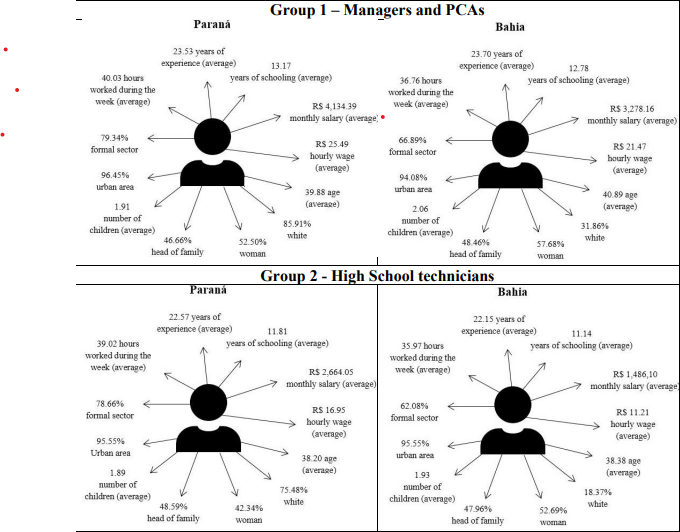
In this section, we have the workers' profiles employed according to their productive and non-productive attributes for the states of Paraná and Bahia (Figure 1). The states profiles are similar from the point of view of occupational groups, age, experience and urban housing area. The main differences are found in the high inequality among hours worked during the week, in schooling, in the percentage of ethnicity and in income, especially among those who lead the activities (group 1) and those who operate them (group 3).
Source: Elaborated by the authors
4 RESULTS AND DISCUSSIONS
4.1 Wage determinants of occupational groups in Paraná and Bahia
The results of the equations of estimated wage determinations for occupational groups in the states of Paraná and Bahia are presented in Table 2. These equations show the elements that influence the workers’ wages employed according to the occupational groups in which they are allocated, for Paraná and Bahia. The coefficients values symbolize the percentage gain on the hourly wage that an individual receives by adding a unit of the productive aspect to be analyzed (in the case of continuous variables — such as education), or by belonging to a class (for categorical variables — such as color or gender). Econometric tests were performed[5] to certify the model robustness.
Data for both states reveal that schooling and experience show positive returns, corroborating the Human Capital Theory exposed by Mincer (1974), Becker (1962) and Becker and Chiswick (1966). The coefficients are similar for all groups, although the wage return is more expressive for the managers and PCAs (group 1) and the high school technicians (group 2). Occupations linked to the activities that are essentially operational obtain a lower wage premium, and a more disadvantageous one for Bahia.
| Variables | General | Group 1 | Group 2 | Group 3 | ||||
| Paraná | Bahia | Paraná | Bahia | Paraná | Bahia | Paraná | Bahia | |
| Schooling | 0.0533* | 0.0542* | 0.1597* | 0.1800* | 0.1843* | 0.1517* | 0.0723* | 0.0366* |
| Experience | 0.0343* | 0.0267* | 0.0303* | 0.0308* | 0.0412* | 0.0417* | 0.0312* | 0.0206* |
| Experience2 | -0.0005* | -0.0003* | -0.0003** | -0.0002 | -0.0004* | -0.0004** | -0.0004* | -0.0002* |
| Woman | -0.2732* | -0.2557* | -0.3148* | -0.3298* | -0.3089* | -0.2198* | -0.2119* | -0.2011* |
| White | 0.1099* | 0.0538* | 0.3105* | 0.2414* | 0.2358** | 0.1053** | 0.1521* | 0.0207* |
| Trade | -0.1077* | -0.1465* | -0.1142** | -0.1646* | -0.0512 | -0.2765* | -0.0824* | -0.0977* |
| Agricultural | -0.1970* | -0.2650* | -0.0511 | -0.0934 | -0.5655* | - | -0.1910* | -0.2622* |
| Industry | -0.0724* | 0.0199 | -0.1334** | -0.1862* | -0.1388** | 0.0178 | -0.0331** | 0.0754* |
| Formal | 0.1451* | 0.3539* | 0.3741* | 0.2776* | 0.0213*** | 0.1511** | 0.1267* | 0.3703* |
| Urban | 0.0892* | 0.1328* | 0.3529** | 0.2178 | 0.0531 | 0.2075* | 0.1055* | 0.0852* |
| Grupo2 | -0.2246* | -0.3541* | ||||||
| Grupo3 | -0.4218* | -0.5032* | ||||||
| Mills | 1.3376* | 0.8445* | 0.5509* | 0.2451*** | 0.5628* | 0.4630** | 0.1681* | 0.0504* |
| Constant | 4.7984* | 2.6813* | 0.7646 | 0.7012 | 0.7253 | 0.5473 | 2.0241* | 2.3645 |
Source: Elaborated by the authors based on the Log-lin model results.
Notes: (1) Significant (*) p<0.01, (**) p<0.05, (***) p<0.10. (2) The values are the antilogarithms of the coefficients [(ec-1) x100], according to Van Garderen and Shah (2002). (3) When significant, the reverse ratio of Mills was inserted as a return variable. (4) Agricultural sector did not show values for group 2 in Bahia.
Gender inequalities in wage gains are reaffirmed in both states, and less pronounced in group 3, that is, in less educated professions there is less wage disparity. Differences in wage returns between white and non-white are clearly reported in both states, with a large advantage for non-white people in Bahia.
In the job position approach, the economic sectors had negative signs, indicating that the service sector is the one that has the best pay in the states, and gains in Bahia state agricultural sector are more affected. The wage return of the formal market is higher for workers in the state of Bahia and in group 3 of this state. The same favorable behavior toward Bahia is in the wage premium for workers living in the urban area. Although the existing literature on the theme of wages inequalities shows the direction of some of these data (Silva, 2014; Machado; Scorzafave, 2016; Madalozzo; Artes, 2017; Alves et al, 2019; Mantovani; Souza; Gomes, 2020), it does not contemplate the two states studied in this research.
4.2 Effect of occupational segmentation
This section decomposes the wages of the occupational groups in Paraná and Bahia. The wage inequalities have been specified by the workers’ characteristics, either productive or non-productive and at work; and a share that refers to the proxy of labor market segmentation.
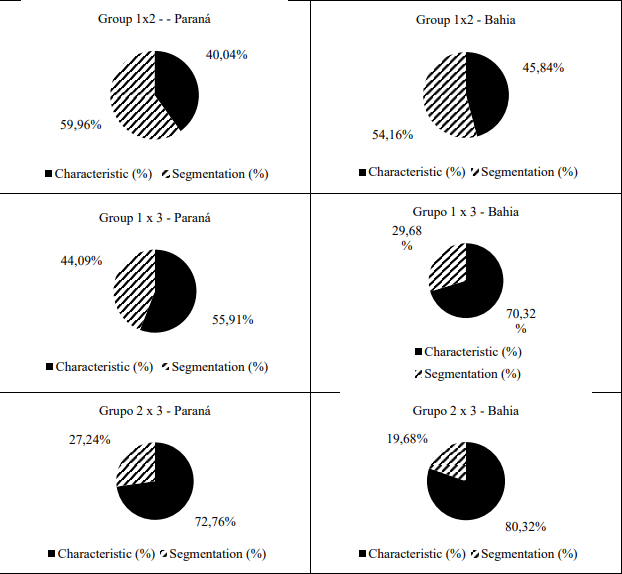
Figure 1 shows the inequalities among occupational groups, managers and PCAs (group 1), high school technicians (group 2) and workers in services and production (group 3). The data show that in the state of Paraná, the wage differences among the managers and PCAs and the high school technicians (group 1x2), 40% come from the characteristics and about 60% occur due to occupational segmentation. In relation to Bahia, 46% of the wage difference is derived from the productive characteristics and 54% refer to the occupational segmentation effect.
The analysis for the managers against workers in services and production, that is, the extreme groups, shows that in Paraná, 56% of the wage differences arise from the characteristics of the workers and the market, and 44% comes from occupational segmentation. In Bahia, about 70% of wage inequalities derive from the individuals’ characteristics and 30% result from the occupational segmentation effect.
In the wage comparison between high school technicians (group 2) and workers in services and production (group 3) in Paraná, 73% of these differences result from the characteristics and the segmentation corresponds to 27%. For Bahia, 80% of these disparities derive from the productive characteristics and 20% from occupational segmentation. In this case, segmentation has less power to explain the wage gap in the states, and the workers’ profile clarify substantially the wage differences between the groups.
Source: Elaborated by the authors from PNAD 2015.
Source: Elaborated by the authors from PNAD 2015.
Note: Advantage group: Mangers and PCAs (group 1) for analyzes between Group 1x2 and Group 1x3. High school technicians (group 2) for the analysis between Group 2x3.
In the wage’s counterfactual analysis, the effect of occupations on wages – for the occupational groups 1 and 2 - surpasses what originates from the workers’ characteristics in both States (Table 3). The segmentation impact is greater for the state of Bahia (33.85%), when compared to Paraná (20.89%), as well as the effect of the workers’ characteristics in Bahia (27.99%). Both contribute to an important total wage difference between these occupation groups in Bahia (71.31%) and Paraná (37.23%), however, as wage differences are lower in Paraná, compared to the segmentation among the occupations becomes more significant in this state.
In comparison of groups 1 and 3, the large wage differences found among the occupations so disparate in competences, leadership (managers and PCAs) versus carrying out activities (workers in services and production) - groups 1x3 -, they are made clearer by the worker’s characteristics and less by the jobs characteristics in both regions. In Bahia this finding is more intense than in Paraná.
| Group 1x2 | Group 1x3 | Group 2x3 | ||||
| Paraná | Bahia | Paraná | Bahia | Paraná | Bahia | |
| Explained | 13.51* | 27.99* | 56.99* | 115.84* | 42.85* | 45.89* |
| Schooling | 9.19* | 27.39* | 35.82* | 97.31* | 22.58* | 38.76* |
| Segmentation | 20.89* | 33.85* | 42.70* | 38.37* | 14.29* | 9.70 |
| Total difference | 37.23* | 71.31* | 124.03* | 198.65* | 63.26* | 60.04* |
Source: Elaborated by the authors from PNAD 2015.
Notes: (1) Significant (*) p<0.01, (**) p<0.05, (***) p<0.10. (2) Advantage group: Mangers and PCAs (group 1) for analyzes between Group 1x2 and Group 1x3. High school technicians (group 2) for the analysis between Group 2x3.
The interpretation is that, in Paraná, if the workers in services and production (group 3) had the same characteristics as group 1 (managers and PCAs), the group 3 wage would increase by 56.99%. The relevance of education corresponds to 36% in the wage difference. In Bahia, if the workers in the services and production had the same productive attributes as group 1, the wage of the workers employed in group 3 would have to rise by 115.84%. Education has a 97.31% impact on the wages of group 3 workers. The segmentation impact is secondary in the comparison of these occupational groups. Finally, so that the wage of the occupational group 3 is equal to that of the managers and PCAs, it would need to increase by 198.65%.
When considering high school technicians (group 2) and workers in services and production (group 3) in Paraná, so that the workers’ wages in occupational group 3 would be equal to that of occupational group 2, the group 3 wage should increase by 63.26%. If the workers belonging to group 3 presented the same productive and market factors as the workers in group 2, the group 3 wage would increase by 42.85%. Without labor market segmentation, the workers' wages from services and production would rise by 14.29%. For Bahia, if the workers’ wage in occupational group 3 was equal to that of occupational group 2, the income should increase by 60.04%. If the individuals belonging to group 3 had the same productive characteristics as the members of group 2, the wage of the disadvantaged group should grow by 45.89%. In this comparison between high school technicians (group 2) and workers in services and production (group 3), the schooling impact on wage differences is evidenced, approximately 23% and 39% for the state of Paraná and Bahia.
4.3 Wage determinants of occupational groups by gender
Table 4 shows information on the wage determinants of occupational groups by gender for the states of Paraná and Bahia in 2015. The coefficients indicate the percentage gain on the hourly wage that a worker receives when increasing a unit of the analyzed aspect for continuous variables (experience) or for belonging to a class (gender).
Schooling and experience have a positive relationship with the incomes, in a way that a higher level of qualification and experience lead to higher returns on wages, and agree with the theory of human capital (BECKER, 1962; BECKER; CHISWICK 1966; MINCER, 1958, 1974; SHULTZ, 1961). It is verified that women are more educated than men in all analyzes, but men are better paid regardless of the sector in which they are employed, region where they reside or occupation.
The white worker presented returns (compared to non-white ones), regardless of the occupational group to which he belongs, gender or state where he resides. Regarding the sectors of economic activity, the services sector (base sector) is the one that leads the greatest wage gains for both Paraná and Bahia.
The fact that the individual works in the formal sector guarantees a wage advantage. The greatest wage differences found are in occupational group 1 for men in the state of Paraná (39.25%) and in occupational group 3 for women in Bahia (39.86%). If the worker lives in the urban area, he receives a higher income than the employee living in the rural area and the highlight was for the woman living in the urban area of Bahia, with a gain of 29.29%, compared to 6.24% of the man.
In summary, the data found point out that the productive and non-productive attributes of men, regardless of the state in which they reside, are contracted with wages higher than the women’s characteristics (productive and non-productive). It is also noted that wage returns in Bahia are lower for the selected variables when compared to Paraná, especially for the white skin color.
| Variables | Paraná | Bahia | Paraná | Bahia | |||
| General | ♀ | ♂ | ♀ | ♂ | |||
| Schooling | 0.0533* | 0.0542* | 0.0550* | 0.0423* | 0.0641* | 0.0483* | |
| Experience | 0.0343* | 0.0267* | 0.0304* | 0.0234* | 0.0229* | 0.0286* | |
| Experience2 | -0.0005* | -0.0003* | -0.0004* | -0.0003* | -0.0002* | -0.0003* | |
| Woman | -0.2732* | -0.2557* | - | - | - | - | |
| White | 0.1099* | 0.0538* | 0.1253* | 0.0806* | 0.0805* | 0.0331 | |
| Trade | -0.1077* | -0.1465* | -0.1099* | -0.1047* | -0.1489* | -0.1441* | |
| Agricultural | -0.1970* | -0.2650* | -0.1082 | -0.2126* | -0.2057* | -0.2916* | |
| Industry | -0.0724* | 0.0199 | -0.0956* | -0.0634* | -0.1228* | 0.0558** | |
| Formal | 0.1451* | 0.3539* | 0.1325* | 0.1472* | 0.3853* | 0.3259* | |
| Urban | 0.0892* | 0.1328* | 0.0859** | 0.1155* | 0.2919* | 0.0632*** | |
| Grupo2 | -0.2246* | -0.3541* | -0.2376* | -0.2207* | -0.3064* | -0.4030* | |
| Grupo3 | -0.4218* | -0.5032* | -0.3997* | -0.4463* | -0.4840* | -0.5168* | |
| Mills | 1.3376* | 0.8445* | 1.0008* | -0.6476** | 0.9433* | 0.5119*** | |
| Constant | 4.7984* | 3.6813* | 3.5833* | 6.6652* | 2.2194* | 4.1507* | |
Source: Elaborated by the authors based on the Log-lin model results.
Notes: (1) Significant (*) p<0.01, (**) p<0.05, (***) p<0.10. (2) The values are the antilogarithms of the coefficients [(ec-1) x100], see Van Garderen and Shah (2002). (3) when significant, the inverse ratio of Mills was inserted as a return variable (Probit multinomial) (4) Agricultural sector did not show values for women from Bahia in group 1 and 2; women from Paraná state in group 2 and men from Bahia state in group 2.
| Variables | Group 1 | Group 2 | Group 3 | |||||||||
| Paraná | Bahia | Paraná | Bahia | Paraná | Bahia | |||||||
| ♀ | ♂ | ♀ | ♂ | ♀ | ♂ | ♀ | ♂ | ♀ | ♂ | ♀ | ♂ | |
| Schooling | 0.0971* | 0.0870* | 0.1890* | 0.1128* | 0.1268* | 0.0909* | 0.1609* | 0.0821* | 0.0421* | 0.0336* | 0.0430* | 0.0394* |
| Experience | 0.0244* | 0.0218 | 0.0281* | 0.0342* | 0.0358* | 0.0161 | 0.0248** | 0.0632* | 0.0271* | 0.0225* | 0.0193* | 0.0268* |
| Experience2 | -0.0003** | -0.0001 | -0.0001 | -0.0003 | -0.0005** | -0.0001 | -0.0003 | -0.0008** | -0.0004* | -0.0003* | -0.0002* | -0.0003* |
| Woman | - | - | - | - | - | - | - | - | - | - | - | - |
| White | 0.1948* | 0.1741** | 0.1633* | 0.2481* | 0.1491 | 0.1054 | 0.1121 | 0.0411 | 0.1074* | 0.0743* | 0.0417 | 0.0023 |
| Trade | -0.1126 | -0.1399** | -0.0455 | -0.2711* | 0.0963 | -0.1599 | -0.2974* | -0.2974* | -0.0706** | -0.0770* | -0.1147* | -0.0830* |
| Agricultural | -0.3814*** | 0.0716 | - | -0.2047 | - | -0.5964* | - | - | -0.1050 | -0.1983* | -0.2182* | -0.2740* |
| Industry | -0.2224* | -0.0840 | -0.1137 | -0.2433* | 0.0359 | -0.2361* | -0.1751 | 0.1699 | -0.0335 | -0.0332 | -0.0346 | 0.1045* |
| Formal | 0.2988* | 0.3925* | 0.2973* | 0.2649* | 0.2419*** | -0.1080 | 0.2801* | 0.0541 | 0.0752** | 0.1467* | 0.3986* | 0.3524* |
| Urban | 0.1997 | 0.3632 | 0.6422* | 0.1402 | 0.0241 | -0.0470 | 0.3271 | 0.2892 | 0.0536 | 0.1148* | 0.2229* | 0.0624*** |
| Grupo2 | - | - | - | - | - | - | - | - | - | - | - | - |
| Grupo3 | - | - | - | - | - | - | - | - | - | - | - | - |
| Mills | 0.3736 | -0.7621 | 16.9809* | -0.8258* | 1.2596 | -0.8944** | 3.8086 | 7.9163 | 0.8152** | -0.6626** | 0.2868 | 0.5826*** |
| Constant | 1.7902*** | 2.4512* | 0.2869* | 1.9746*** | 1.0792 | 4.9027* | 0.5252 | 1.0126 | 2.6639* | 4.0188* | 1.5957* | 2.1178* |
Source: Elaborated by the authors based on the Log-lin model results.
Notes: (1) Significant (*) p<0.01, (**) p<0.05, (***) p<0.10. (2) The values are the antilogarithms of the coefficients [(ec-1) x100], see Van Garderen and Shah (2002). (3) When significant, the reverse ratio of Mills was inserted as a regression variable (Probit Multinomial). (4) The agricultural sector did not show values for women from Bahia state in group 1 and 2; women from Paraná state in group 2 and men from Bahia state in group 2.
4.4 Effect of gender discrimination on occupational groups
This section presents the breakdown of wages for each occupational group by gender. The wage differences were explained by two parts, one by the workers’ attributes and the other by gender discrimination, that is, when men and women have the same productive attributes, although they are treated differently by the labor market. The interpretations were based on the works of Blinder (1973), Jann (2008), Pereira and Oliveira (2013) and Gomes (2016).
It is evident that the market values male characteristics more than female characteristics for all the groups. Women are more qualified than men, and gender discrimination is evident. Similar data for gender in the Brazilian labor market are found in Silva (2014), Maia et al. (2017), Madalozzo and Artes (2017); Alves et al. (2019); Mantovani, Souza and Gomes (2020); Gomes and Souza (2020). However, the indicators are more expressive for Bahia.
The data interpretation is that, in case group 1 workers had the same characteristics as men, their wages should fall by -8.27% and -18.28%, in Paraná and Bahia, in this order (Table 5). It is also observed that, if the woman had the same schooling as the man, her wage should be reduced by -16.51% in Bahia, which reveals the importance of this factor for this occupational group in the state. In the absence of discrimination, women would receive 42.46% and 46.08% more in Paraná and Bahia, respectively. Therefore, the wage difference of the high-qualification group (managers and PCAs) is higher for Paraná, although discrimination against women is higher in the state of Bahia.
Regarding the high school technicians (group 2), in Paraná, the total difference in the wages of men and women is 37.92%. If there was no gender discrimination, the worker in this group would receive 38.51% more. In relation to Bahia, if the woman had the same schooling as the man, her wage would reduce by 7.30%. In the absence of gender discrimination in Bahia, the woman included in this group should receive 39.05% more. Again, the highest wage gap is in Paraná (37.92%), while Bahia is the largest discriminator (39.05%).
Analyzing the occupational group 3 (workers in services and production), in Paraná, the wage difference between genders is approximately 20%. In the absence of discrimination, the women’s wages would increase by 30.53%. In the case of Bahia, the wage difference between men and women is 10.38%. As in previous analyzes, women in both states are more educated than men and have other attributes that are also better, which helps to cushion the wage differences. However, there is wage discrimination and it is higher in the state of Bahia (36.03%).
| Group 1 | Group 2 | Group 3 | ||||
| Paraná | Bahia | Paraná | Bahia | Paraná | Bahia | |
| Explained | -8.27* | -18.28* | -0.42 | -22.09 | -8.16 | -18.86* |
| Schooling | -8.02 | -16.51* | -4.04 | -7.30* | -2.88* | -8.54* |
| Discrimination | 42.46* | 46.08* | 38.51* | 39.05** | 30.53* | 36.03* |
| Total difference | 30.68* | 19.37* | 37.92* | 8.33 | 19.88* | 10.38* |
Source: Elaborated by the authors from PNAD 2015.
Notes: (1) Significant (*) p<0.01, (**) p<0.05, (***) p<0.10. (2) Advantage group: Men.
In short, it is possible to state that the greatest inter-occupational wage differences are centered between the managers and PCAs groups (occupational group 1) and workers of services and production (group 3), and the smallest gaps are between groups 1 and 2 (between managers and PCAs, and high school workers). When the wage differences are very large, the characteristics effect is greater than that of segmentation; and the lowest wage gaps are between groups 1 and 2, with the least segmentation effect. The wage differences promoted between the technical groups (group 2) and the production group (group 3) are also large, but the duality present in the labor market is the lowest. Personal characteristics, especially schooling, are significant as a cause of wage inequality in these occupations. Segmentation is greater when the managers and PCAs and workers of services and production are analyzed (larger in Paraná).
Regarding the intra-occupational gender discrimination, the wage inequality is higher in Paraná, however, the Bahia state’s woman, manager and PCA, is the most discriminated. In occupations with lower levels of income and schooling (group 3), the wage differences and gender discrimination are lower compared to other occupations in both states. At the opposite extreme, the most qualified professions, with the highest wages (group 1), are the ones that discriminate the women the most in both states.
5 FINAL CONSIDERATIONS
The objective of this research was to analyze the occupational segmentation effect on workers' wages and gender discrimination within occupations in the states of Paraná and Bahia.
The workers’ profile can be summarized: the similarities in the states are found in the variables corresponding to age, worker experience and housing in the urban area. The disparities are strongly concentrated in hours worked per week, in the proportion of white and non-white workers, and also in wages, being higher for Paraná.
For both states, qualification and experience contribute to higher pays in different occupational groups and women have lower wages than men. The economic sectors have a positive gain in relation to the base sector (services) and being employed in the formal sector, being white, and living in urban areas lead to greater wage gains.
In wage decomposition, for both states, the segmentation effect is greater between the groups of managers and PCAs (group 1) compared to the workers of production services (group 3). The wage gap between these occupations disparate in their competencies, leadership versus activity execution, is mostly explained by the worker’s characteristics and less by the job’s characteristics.
The main determinations of intra-occupational wages, according to gender, are: experience and qualification presented wage gains; schooling shows higher returns for women; the white individual has a higher wage return for the state of Paraná than in Bahia; the best remuneration activity sectors are services. In addition, acting in the formal market sector and living in the urban region lead to positive wage returns. The individual man displays higher wage gains when compared to women, regardless of the occupational group or state.
There is gender discrimination, being greater for the group with high income and qualification, managers and PCAs (group 1) and lower for the workers involved in the execution of activities, the workers of services and production (group 3). Gender discrimination is higher in Bahia between the managers and PCAs, showing that the occupational group with higher income and education is also the most discriminating group. The group that brings together workers from services and production is the one that presents the least discrimination against women.
The results of the wage, inter-occupational (occupational) and intra-occupational (occupational) breakdown (within occupational groups) show the presence of segmentation and gender discrimination in the labor market, confirming the Theory of discrimination and the Theory of Segmentation. The wage differences and the segmentation effect are greater in the most developed state, Paraná. In contrast, gender discrimination is higher in the state of unfavorable economic and social indicators, Bahia.
In view of this, this research strengthens the basis for the formulation or improvement of local public policies for development, promotion of equal opportunities, as well as the inclusion of individuals in the labor market. Public policies and programs present in Brazil have limitations to induce equivalent pays among workers inserted in positions that lead and establish rules (Group 1) and those employed in professions involving services and production (Group 3), with the same personal and productive attributes, as well as between men and women who perform the same functions and have identical characteristics.
It is emphasized the need to reduce occupational and gender inequalities through public actions and programs carried out in conjunction with organized civil society, in addition to mitigating obstacles to the workers’ integration into certain professions and women into the labor market. The evidences presented in this study shows that the measures adopted so far have not been sufficient to eradicate gender wages disparities and occupations.
There is, therefore, an empirical recognition of gender and occupation differences, as well as the peculiarities of two Brazilian states (Paraná and Bahia), which can contribute as a beacon tool toward wage equalization among the studied groups, adapting to the state reality.
REFERENCES
ALVES, P. R.; SOUZA, S. C. I. ; PAIVA, V. F.; GOMES, M. R. Ocupações e salários de mulheres qualificadas no Brasil. Revista de Economia Mackenzie, v. 16, n. 2, p. 120-144, 2019.
ARAÚJO, E.; EVARINI, A.; GARCIA, M. F.; ARAÚJO, E. L. Nota sobre os diferenciais de salários no Brasil: uma investigação empírica sob a perspectiva da teoria da segmentação. Revista Economia & Tecnologia (RET), v. 26, n. 7, p. 1-12, 2011.
ATLAS DO DESENVOLVIMENTO HUMANO NO BRASIL. Perfil, 2020. Disponível em: http://atlasbrasil.org.br/2013/. Acesso em: 16 jul. 2020.
BECKER, G. S. Investment in human capital: a theoretical analysis. Journal of Political Economy, v. 70, n. 5, p. 9-49, 1962.
BECKER, G. S. The economics of discrimination. 2. ed. The University of Chicago Press. Chicago, 1971.
BECKER, G. S.; CHISWICK, B. R. Education and the distribution of earnings. American Economic Review, v. 56, n. 2, p. 358-369, 1966.
BLINDER, A. S. Wage discrimination: reduced form and structural estimates. The Journal of Human Resources, v. 8, n. 4, 1973.
BORJAS, J. Economia do trabalho. 6 ed. Porto Alegre: Mcgraw Hill, 2012.
BRASIL. Ministério do trabalho e emprego. Classificação Brasileira de Ocupações. Brasília: Ministério do Trabalho e Emprego, 2017. Disponível em:
http://www.mtecbo.gov.br/cbosite/pages/informacoesGerais.jsf. Acesso em: 16 jul. 2020.
COBB-CLARK, D.; TAN, M. Noncognitive Skills, Occupational Attainment, and Relative Wages. Forthcoming, Labour Economics, v. 18, n. 1, p. 1- 13, 2010.
COSTA, J. S.; SILVEIRA, F. G.; AZEVEDO, B. S.; CARVALHO, S. S.; BARBOSA, A. L. N. H. Heterogeneidade do diferencial salarial público e privado. Mercado de trabalho: conjuntura e análise, IPEA, ano 26, 2020.
DOERINGER, P. B.; PIORE, M. J. Internal labor markets and manpower analysis. Harvard University, MIT, 1970.
EHRENBERG, R.; SMITH, R. A Moderna Economia do trabalho - Teoria e política. São Paulo: Makron Books, 2000.
FLORI, P.; Polarização ocupacional? entendendo o papel da ocupação no mercado de trabalho brasileiro. 2007. 120 f. Tese (Doutorado em Economia) – Universidade de São Paulo, São Paulo, 2007.
GAMA, L. C. D.; MACHADO, A. F. Migração e rendimentos no Brasil: análise dos fatores associados no período intercensitário 2000-2010. Estudos Avançados, São Paulo, v. 28, n. 81, p. 155-174, 2014.
GOMES, M. R. Diferenças de rendimentos e alocação setorial por gênero no primeiro emprego; reemprego e remanescentes dos trabalhadores: análise nas regiões sul e nordeste. 2016. 131 f. Dissertação (Mestrado em Economia Regional) – Centro de Estudos
Sociais Aplicados, Universidade Estadual de Londrina, Londrina, 2016.
GOMES, M. R.; SOUZA, S. C. I. Diferenças salariais de gênero no primeiro emprego dos trabalhadores no estado da Bahia. Cadernos de Ciências Sociais Aplicadas, v. 17, n. 29, p. 106-127, 2020.
HECKMAN, J. J. Sample selection bias as a specification error (with an application to the estimation of labour supply functions). Econometrica, n. 47, mar. 1979.
IMAI K.; VAN DYK DA. Mnp: R package for fitting the multinomial probit model. Journal of Statistical Software, n. 14, p. 1-32, 2005.
INSTITUTO BRASILEIRO DE GEOGRAFIA E ESTATÍSTICA (IBGE). Pesquisa
Nacional por Amostra de Domicílio (PNAD), 2015. Rio de Janeiro: IBGE. Disponível em:
http://www. ibge.gov.br. Acesso em: 03 jul. 2016.
INSTITUTO BRASILEIRO DE GEOGRAFIA E ESTATÍSTICA (IBGE), 2020. Pesquisa Nacional por Amostra de Domicílios – Contínua (PNAD-C). Séries históricas. Rio de Janeiro: IBGE. Disponível em: https://www.ibge.gov.br/estatisticas/sociais/trabalho/17270-pnad-continua.html?edicao=26413&t=series-historicas. Acesso em: 16/07/20.
IPEADATA. Base de Dados do Instituto de Pesquisa Econômica Aplicada, 2020. Disponível em: http://www.ipeadata.gov.br. Acesso: 16/07/20.
KROPKO J. Choosing between Multinomial Logit and Multi-nomial Probit models for analysis of unordered choice data, Midwest Political Science Association, Chicago, 2008.
LIMA, R. Mercado de trabalho: o Capital Humano e a teoria da segmentação. Pesquisa e Planejamento Econômico, Rio de Janeiro, v. 10, n. 1, 1980.
LOUREIRO, P. R. A. Uma resenha teórica e empírica sobre economia da discriminação. Revista Brasileira de Economia, Rio de Janeiro, v. 57, n. 1, p. 125-157, 2003.
MA, X. Labour market segmentation by ownership type and gender wage gap in urban China: evidence from CHIP2013. Economic and Political Studies, v. 5, n. 3, p. 305-325, 2017.
MA, X. Labor market segmentation by industry sectors and wage gaps between migrants and local urban residents in urban China. China Economic Review, v. 47, p. 96-115, 2018.
MACHADO, L. M.; SCORZAFAVE, L. G. D. S. Distribuição de salários de professores e outras ocupações: uma análise para graduados em carreiras tipicamente ligadas à docência. Revista Brasileira de Economia, v. 70, n. 2. p. 203-220, 2016.
MADALOZZO, R.; ARTES, R. Escolhas profissionais e impactos no diferencial salarial entre homens e mulheres. Cadernos de pesquisa, v. 47, n. 163, p. 202-221, 2017.
MANTOVANI, G. G.; SOUZA, S. C. I.; GOMES, M. R. Ocupação e género: uma análise dos efeitos da segmentação ocupacional e da discriminação de género para o Brasil. Estudios Económicos, v. 37, n.74, p. 71-104, 2020.
MAIA, K.; SOUZA, S. C. I.; GOMES, M. R. G.; FIUZA-MOURA, F. K.; SILVA, R. J. Discriminação salarial por gênero e cor no Brasil: uma herança secular. Revista Espacios, v. 38, n. 31, p. 16-37, 2017.
MELLY, B. Public-private sector wage differentials in Germany: Evidence from quantile regression. Empirical Economics, v. 30, n. 2, p. 505-520, 2005.
MINCER, J. Investment in human capital and personal income distribution. Journal of Political Economy, v. 66, n. 4, p. 281-302,1958.
MINCER, J. Schooling, experience and earnings, New York: National Bureau of Economic Research, 1974.
OAXACA, R., Male-female wage differentials in urban labor market. International Economic Review, Osaka, v.14, n.23,0. 693-709,1973.
ORGANIZAÇÃO INTERNACIONAL DO TRABALHO. Mulheres no trabalho: tendências de 2016. Brasília, 2016. Disponível em: http://www.oit.org.br. Acesso em: 15 out. 2017.
REICH, M.; GORDON, D. M.; EDWARDS, R. C. Dual labor markets: a theory of labor market segmentation. American Economic Review, v. 63, n. 2, p. 359-365, maio 1973.
SCHULTZ, T. W. Investment in human capital. American Economic Review. v. 51, n. 1, p. 1-17, 1961.
SCHULTZ, T. W. O valor econômico da educação. Rio de Janeiro: Zahar Editores, 1964.
SILVA, E. S. Diferenciais salariais entre os profissionais das ciências e das artes e demais ocupações: qual a importância das características não observáveis? 2014. 100 f. Dissertação
(Mestrado em Economia) - Universidade Federal de Pernambuco, Curuaru, 2014.
SMITH, A. A Riqueza das Nações. São Paulo: Abril Cultural, 1983.
SOUZA, M. Agricultura, ocupações e rendas das pessoas nas áreas rurais do Estado do Paraná: 1992-99. Ensaios, v. 25, n.2, p. 523-543, 2004.
VAN GARDEREN, K. J; SHAH C. Exact Interpretation of Dummy Variables in Semilogarithmic Equations, Econometrics Journal, v. 5. p. 149-159, 2002.
VIETORISZ T.; HARRISON, B. Labor Market Segmentation: Positive feedback and divergent development. American Economic Review, v. 63, n. 2, p. 366-376, maio 1973.
YUN, M. A simple solution to the identification problem in detailed wage decompositions. Economic inquiry, v. 43, n. 4, p. 766-772, 2005.
Notas de autor
gmmantovani@gmail.com