Articles
Public governance of brazilian municipalities

Public governance of brazilian municipalities
Gestão & Regionalidade, vol. 37, núm. 110, pp. 221-237, 2021
Universidade Municipal de São Caetano do Sul

Esta obra está bajo una Licencia Creative Commons Atribución 4.0 Internacional.
Recepción: 21 Diciembre 2019
Aprobación: 22 Octubre 2020
Abstract: This study analyzed the public governance of Brazilian municipalities, investigating large and small municipalities. For that, the public governance measurement model developed by Oliveira and Pisa (2015) was used. Descriptive analysis techniques and statistical tests for comparing means were used. The results showed that most of the municipalities analyzed have a high degree of public governance. Furthermore, it was found that, in general, large municipalities presented public governance superior to small municipalities. In addition, it was evident that the municipalities in the South Region stood out in terms of the degree of governance, when compared with the municipalities in the other regions. Finally, this study contributes to the field of public management, as it raises the discussion of public governance at the municipal level, leading public managers to reflect on this mechanism for good progress in the public sector.
Keywords: Public Governance, Brazilian Municipalities, IGovP.
Resumo: Este estudo analisou a governança pública dos municípios brasileiros, investigando os municípios de grande e pequeno porte. Para tanto, utilizou-se o modelo de aferição de governança pública elaborado por Oliveira e Pisa (2015). Foram utilizadas técnicas de análise descritiva e testes estatísticos de comparação de médias. Os resultados evidenciaram que a maior parte dos municípios analisados apresentam elevado grau de governança pública. Ainda, verificou-se que, de forma geral, os municípios de grande porte apresentaram governança pública superior aos municípios de pequeno porte. Além disso, evidenciou-se que os municípios da Região Sul se destacaram quanto ao grau de governança, quando comparados com os municípios das demais regiões. Por fim, este estudo contribui para o campo da gestão pública, à medida em que suscita a discussão da governança pública no âmbito municipal, levando os gestores públicos à reflexão sobre esse mecanismo para o bom andamento na máquina pública.
Palavras-chave: Governança Pública, Municípios Brasileiros, IGovP.
1 INTRODUCTION
Since the promulgation of the Federal Constitution of 1988, known as the Citizen Constitution, which sought to bring greater participation of society in public acts, it is that there has been a greater commitment by public bodies to assist in the inspection, by citizens, regarding management of public finance (ERICEIRA, 2011; OLIVEIRA; PISA, 2015; ZORZAL; RODRIGUES; 2015; MONTEIRO; PEREIRA; THOMAZ, 2016; PERES, 2017). As a result, several laws were subsequently created to ensure the implementation of mechanisms that facilitate this social control, such as the Fiscal Responsibility Law (LRF), 2000, and the Transparency Law, 2009.
In this sense, legal guidelines oblige public bodies to disclose information so that there is transparency and accountability of public policies, both for regulatory bodies and for Civil Society, after all, it is the main public of any government action. Information, together with access and transparency, must be democratized and socialized, in addition to being timely, understandable and accurate, so that it can be captured by society, in order to facilitate accountability. (ZORZAL; RODRIGUES, 2015).
It should be mentioned that there were changes in civil behavior and society started to be present in the decision-making process of public policies (CARLOS, 2009; BROUCHOUD, 2010; ERICEIRA, 2011), conduct that reinforces the concept of accountability. This process of citizen participation is made possible by the action of fundamental control bodies, such as: Legislative Power, Judiciary Power, Public Prosecution Service, Courts of Auditors and internal control bodies (BRASIL, 1988; COELHO; CRUZ; NETO, 2011).
Therefore, information about the public sector must be disseminated so that citizens can assess the management of their representatives, thus effecting social control (PERES, 2017). In this, public governance is favorable to social control and to the participation of society in public policies, since, according to Dias and Cairo (2014), public governance would be a developmental strategy used by the State to bring it closer to society, seeking to meet the interests.
From this perspective, governance can be understood as the arrangements that are made to ensure that the results intended by the interested parties are achieved. In the public sector, which aims to improve or maintain the well-being of the population, these stakeholders are citizens (IFAC, 2014). In this way, good governance implies promoting responsibility, participation and effectiveness at all levels, and must develop institutions and processes that are more receptive to ordinary citizens, including the poor (UDDIN; JOYA, 2007). Besides, good governance in the public sector encourages the efficient use of resources, strengthening management's responsibility to execute them (IFAC, 2014).
In Brazil, in order to measure the level of governance, some metrics were created. Mello and Slomski (2010) proposed an index for measuring and monitoring the electronic governance of Brazilian states. Oliveira and Pisa (2015) developed a metric to measure the public governance of States, based on the principles of governance, intending to be a planning and self-assessment instrument for the State, in addition to being useful as social control for citizens. However, only metrics created for the Brazilian States were observed.
Some adaptations of the models mentioned above were also observed. Freitas and Luft (2014) adapted the model by Mello and Slomski (2010) for the municipalities of Sergipe. Souza et al. (2014) also analyzed e-governance practices, but only in the 100 most populous municipalities. However, no studies were found that analyzed the governance of Brazilian municipalities, comprehensively, involving both small and large municipalities.
In this sense, the following problem arises: What is the degree of public governance in Brazilian municipalities? To elucidate this questioning, the objective of this research was to analyze the public governance of Brazilian municipalities, investigating large and small municipalities.
It should be noted that public administration is based on transparency, integrity and accountability (FRAGA et al., 2019), that public sector efficiency is associated with the quality of governance (HWANG; AKDEDE, 2011) and that countries in development, which have a history of poor corruption results, have weaknesses in governance structures (GANI, 2011). Therefore, studying the governance of Brazilian municipalities becomes important and current.
In addition, Uddin and Joya (2007) highlight that good governance for the international community is a growing priority. However, Fabriz, Gomes and Mello (2018), when carrying out a bibliometric study on electronic governance, found that, in Brazil, the number of publications is low. Therefore, this study can contribute to the increase in the debate on the theme, since the sample is being expanded and the results are being compared with previous studies.
2 THEORETICAL FRAMEWORK
2.1 Governance
Governance, initially focused on corporate conflicts, gained notoriety after major financial scandals in several North American corporations. The basis of this practice is in the search for mechanisms that solve the agency's problem, which results from the asymmetry of information between shareholders, shareholders, and other related parties, stakeholders (BORGES; SERRÃO, 2005).
Governance is more pluralistic than the government, as it is less focused on state institutions and is more attentive to the process and interactions that characterize the state of civil society. There is also a bifurcation in the development of this governance, while one side focuses only on the result, the second strand seeks to bring new actors to this scenario, a closer relationship between the State and civil society, paying attention to the democratization of processes (BEVIR, 2010).
In the view of Brouchoud (2010), governance goes against hierarchical control, with the proposal of a new model of governing. Seeking a horizontal relationship between the State and civil society, bringing more pluralistic public decisions, where everyone can participate. For Dias and Cario (2014), governance has become an umbrella term with several perspectives and approaches, being deployed in corporate governance and public governance. Corporate governance deals with the relationship between shareholders and related parties (BORGES; SERRÃO, 2005) and public governance is understood as a type of State management, articulating its various dimensions, establishing partnerships with civil society and the market (RONCONI , 2011).
With regard to research on corporate governance, most derive from the Theory of Agencies, according to Yusoff and Alhaji (2012). Goranova et al. (2017) clarify that, although the aforementioned literature is the predominant one, there are other Theories, which demonstrates a diversity of approach on governance, denoting different meanings.
For Bekele and Kjosavik (2016), corporate governance can be treated as a mechanism to create an orderly rule or collective action, implying a new pattern of decision making and participation, resulting in new government practice, to solve social problems. Abid et al. (2014) simplify the understanding of corporate governance, to the point of characterizing it as a way of achieving with a view to a purpose or activity. Therefore, corporate governance can then be considered as the practice and the relationship between stakeholders, both internal and external. Its purpose is to value assets, involving principles such as transparency, rights and equity among shareholders and accountability (RAMOS; MARTINEZ, 2006).
Governance in the public sector includes the use of mechanisms of leadership, control and strategy to serve as an assessment, direction and monitoring of management, aiming to conduct public policies and provide services of interest to the community (TCU, 2014). For Sales et al. (2020), public governance is based on the principles of private governance, bringing to the public administration precepts of private management, to give a greater return to the citizen in the execution of its public policies.
Secchi (2009) believes that the promotion of public governance gained strength through the implementation of the managerial public administration model, which gave greater focus on performance and the treatment of problems. In Brazil, the implementation of the management model took place through the National Program for Public Management and Bureaucratization (GesPública). In this model, we seek public management oriented to the citizen, which develops within the constitutional principles, which are: legality, impersonality, morality, publicity and efficiency (MPOG, 2009).
Even with the advent of the management model, applied in Brazil through GesPública, it was found that municipal public administrations were unable to reach a satisfactory organizational level, present at the federal and state level, encountering financial, technical, personnel and service provision barriers Thus, it is necessary to carry out a systematic, continuous and effective evaluation, which finds impasses regarding the lack of clarity in performance indicators in the municipal public sector (RAMOS; VIEIRA, 2015).
2.2 Public Sector Governance Studies
For this study, it was necessary to search for works related to governance, from its broadest form to its specificities, such as corporate governance, its principles until funneling and reaching the main point of this research, which is public sector governance and ways of assessing this governance.
Moura et al. (2011) analyze the electronic governance practices of the municipalities of Santa Catarina and checking if there was a correlation with the variables GDP (Gross Domestic Product), HDI (Human Development Index) and size. Descriptive research was carried out with a quantitative approach to the data of 57 municipalities with a population above twenty thousand inhabitants. It was found as a result that among the five dimensions of the metrics on electronic governance, the provision of services stood out, followed by the practices of usability and accessibility, content, citizen participation and privacy and security, respectively. As for the e-governance index, the results indicated that the minimum of adhered practices was 13%, the maximum of 76%, while the average of the municipalities under study was 50%. Based on this, the authors concluded that the largest municipalities with the best socioeconomic conditions represented by the HDI, GDP adhered to a greater number of e-governance practices.
Cruz et al. (2012) sought to verify the level of transparency of information on public management disclosed in the electronic portals of the municipalities. This level of transparency was verified on the websites of 96 of the 100 populous Brazilian municipalities, using a verification model called the Municipal Management Public Transparency Index (Índice de Transparência Pública da Gestão Municipal - ITPG-M), which was based on codes of good transparency and governance practices, applicable Brazilian legislation and previous research related to the subject. It was concluded, based on the score achieved, that the evaluated municipalities did not make full disclosure of information about public management, the general average of the index was 66.10, with 143 being the maximum score, with the lowest municipality being observed The score was Carapicuíba-SP with 15 points and the municipality with the highest score, Londrina-PR, reached 122 points. It was also understood that the municipalities showed a level of transparency incompatible with their socio-economic development.
Freitas and Luft (2014) analyzed the electronic governance index of the municipalities (IGEM) of the state of Sergipe, correlating the results with the size of the municipalities, carrying out descriptive research, with a quantitative approach, based on the model developed by Mello and Slomski (2010). The research population was composed of 75 municipalities, using as sample the 40 municipalities with up to 100 thousand inhabitants that had active websites during the research period. The results obtained showed that the indexes of the analyzed municipalities were very low, the municipality of Lagarto was the one that obtained the highest score in the index with 42.146 points, the sample municipality with the largest population and the lowest was Nossa Senhora de Lourdes, considered a micromunicipality, obtaining 4,415 points. The authors observed that the municipalities with the best indexes were the medium-sized ones and the lowest indexes are in the micro municipalities, showing that there is an influence of the size of the population in the application of electronic governance practices, although there are some cases that were considered an exception.
Souza et al. (2014) analyzed the electronic governance practices of the 100 most populous municipalities in Brazil, based on a model proposed by Mello (2009). Data collection consisted of analyzing the websites of these municipalities and tabulating this data in a Microsoft Excel spreadsheet in order to obtain and Electronic Governance Index of Brazilian Municipalities (Índice de Governança Eletrônica dos Municípios Brasileiros - IGMB), based on the variables and analyzes by Mello (2009) , which were divided into five groups: content (PCon), services (PSer), citizen participation (PPC), privacy and security (PPS) and usability and accessibility (PUA). As noted, the municipality that obtained the highest score in the index was Campo Grande-MS, with 64.30% of the practices applied, even though the municipality that scored the most, still obtained a score below the desired, while the municipality that obtained the lowest score, with 18.76% of the practices, it was Boa Vista-RR. Based on this, the authors understood that e-governance practices were not well applied and that this makes social control effective.
Oliveira and Pisa (2015) developed a public governance assessment index, in which they could measure the degree of application of governance principles. For the formation of the index, the following principles were taken into account: effectiveness; transparency and accountability; participation; equity; legality, ethics and integrity. Also being aggregated, within each principle, some indicators. Taking into account data from 2010, the Public Governance Index (Índice de Governança Pública - IGovP) of the Union was 0.6986, while the North region had a value of 0.5979, the Northeast region received 0.5859, the Southeast region with 0.6769, the South region quantified 0.6976 and the Midwest region with 0.6642. Elaborating a ranking of the states, the Federal District ranked 1st with 0.7336, 2nd São Paulo with 0.7174 and 3rd place, Rio Grande do Sul with 0.7071.
Ramos and Vieira (2015) created a matrix based on the constitutional principles of Legality, Impersonality, Morality, Publicity and Efficiency (LIMPE), where they presented a transversal checklist that addresses topics based on both corporate governance and the perspective of the Balanced Score Card (BSC). With the creation of this matrix, we sought to create a managerial and targeted tool for the assessment of corporate governance in Direct Administration organizations. From the citizen's point of view, it sought to bring an instrument that is easy to understand and that clarifies the indicators, establishing objective standards for the performance of the municipal public administration.
It should be noted that this study was based on the measurement method developed by Oliveira and Pisa (2015).
3 METHODOLOGY
As for the objectives, this research is descriptive, as for the procedures, it is documentary, and, as for the approach, it is quantitative.
To calculate the public governance index of Brazilian municipalities (IGovP) a model adapted from Oliveira and Pisa (2015) was used. This index is composed of five dimensions: (i) effectiveness; (ii) transparency and accountability; (iii) participation; (iv) equity; and (v) legality, ethics and integrity. Then, each dimension is divided into variables and indicators. Table 1 shows the weights for each dimension, variable and indicator.
| Dimensions of Public Governance | Weigh of Dim. | Variables | Weigh Var. | Indicators | Weigh Ind. |
| 1. Effectiveness | 20% | 1.1 Access to income | 50% | 1.1.1 Average household income per capita | 100% |
| 1.2 Human development | 50% | 1.1.2 HDI-M | 100% | ||
| 2. Transparency and Accountability | 20% | 2.1 Access to information and accountability | 100% | 2.1.1 Federal Public Ministry Transparency Index | 100% |
| 3. Participation | 20% | 3.1 Electorate | 100% | 3.1.1 Effective Votes Valid on the Total of the Electorate 1st Round of Elections | 100% |
| 3.2 Social participation in councils | - | - | |||
| 4. Equity | 20% | 4.1 Income inequality | 40% | 4.1.1 Gini index of the distribution of the monthly nominal income of all jobs of persons | 100% |
| 4.2 Population without access to a decent life | 60% | 10 years of age and over, employed in the reference week, with working income | 25% | ||
| 4.2.1 Population aged 16 and over, economically active, unemployed | 25% | ||||
| 4.2.2 Illiteracy rate | 50% | ||||
| 5. Legality, Ethics and Integrity | 20% | 5.1 Compliance with LRF/Approval of annual accounts by the Courts of Auditors | 50% | 5.1.1 Personnel Expense Limit Below 54% à1.00 Between 54.01% and 57.00% à0.677 Between 57.01% and 60.00% à0.333 Above 60% à0 | 100% |
| 5.2 Human Rights | 50% | 5.2.1 Child labor rate | 100% |
Source: Adapted from Oliveira and Pisa (2015).
From Table 1, it can be seen that the five dimensions have equal weights. Therefore, each dimension represents 20% of the IGovP. Among the variables, it is highlighted that only the variables of the “equity” dimension have different weights. The variable “income inequality” makes up 40% of the dimension, while the “population without access to a decent life” represents 60%. Among the indicators, only the indicators related to the variable “population without dignified life” have different weights. The indicators “Population aged 16 or over, economically active, unemployed” and “Illiteracy rate” each make up 25% of the variable. On the other hand, the indicator “Rate of the population living with a family income below 1/4 of the minimum wage (extreme poverty)” represents 50% of the variable.
Considering that the authors' model was developed for the Union and the States, adaptations were necessary for this study. In Chart 1, it is possible to verify the adaptations made based on the model proposed by Oliveira and Pisa (2015).
| Modified Oliveira and Pisa (2015) Indicators | Model Indicators |
| 2.1.1 Open Accounts Transparency Index | 2.1.1 Federal Public Ministry Transparency Index |
| 3.2.1 Number of instruments related to National and State councils | - |
| 5.1.1 Approval of accounts by the Courts of Auditors | 5.1.1 Personnel Expense Limit |
| If regular - grade 1.00 | Below 54% to 1.00 |
| If regular with reservations, recommendations or determinations - | Between 54.01% and 57.00% at 0.677 |
| grade 0.50 | Between 57.01% and 60.00% at 0.333 |
| If irregular - grade 0 | Above 60% to 0 |
Source: Prepared by the authors (2019).
The changes made to the composition of the variables were due to the unavailability of those data for the municipalities, being replaced by similar ones. The Federal Public Ministry's Transparency Index replaced the Open Accounts Association's Transparency Index. Likewise, the approval of the accounts by the Audit Courts has been replaced by the Personnel Expenses Limit established by the LRF. The indicator on the number of instruments related to National and State councils was excluded, given their unavailability of collection in the municipalities.
Data were collected between February and March 2019, from the portals of the National Treasury Secretariat (STN, 2019), the United Nations Development Program (UNDP, 2013), the Superior Electoral Court (TSE, 2016) and the Ministry Público Federal (MPF, 2016), in addition to municipal portals of transparency of the municipalities. It is noteworthy that the questions regarding the data of these sites, when not found, were reset. There was also research in bodies specialized in statistical data, such as the Brazilian Institute of Geography and Statistics (IBGE, 2010) and the Informatics Department of the Unified Health System (DATASUS, 2010).
The population is made up of 5,570 municipalities existing at the time of the research. The final sample, at a 95% confidence level and a 5% margin of error, was 360 municipalities. The choice of municipalities was based on the population estimated by the IBGE in 2018. Therefore, the 180 most populous municipalities and the 180 least populous ones were selected. It is worth mentioning that Brasília-DF was excluded from the sample due to the unavailability of research data, being replaced by another municipality in the most populous list, Nilópolis-RJ. It should be noted that, for this study, the most populous municipalities were considered to be large and the least populous to be small.
After data collection, the IGovP for each municipality was calculated, which ranged from 0 to 1. It should be mentioned that the IGovP result range scales proposed by Oliveira and Silva (2015) were also used, as shown in Figure 1.
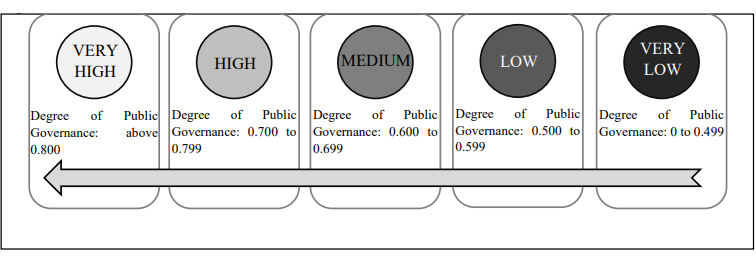
Therefore, the IGovP was considered very high, when it was above 0.800. If it was between 0.700 and 0.799 it was considered high. It was medium, if it was between 0.600 and 0.699; low if a value between 0.500 to 0.599 was found. Finally, if the IGovP result was between 0 and 0.499, it was classified as very low.
Descriptive analysis techniques were applied. In addition, the T Test was used to verify the existence of a difference between the averages of governance indicators between the municipalities in the groups of small and large municipalities. Likewise, the Tukey Test was used to compare the averages of the governance indicators of the municipalities based on the Brazilian regions. The first test makes it possible to statistically compare the means of two groups, while the second makes it possible to compare the means of multiple groups. The Statistical Package for the Social Sciences (SPSS) was used to perform the statistical analyzes.
4 DESCRIPTION AND ANALYSIS OF RESULTS
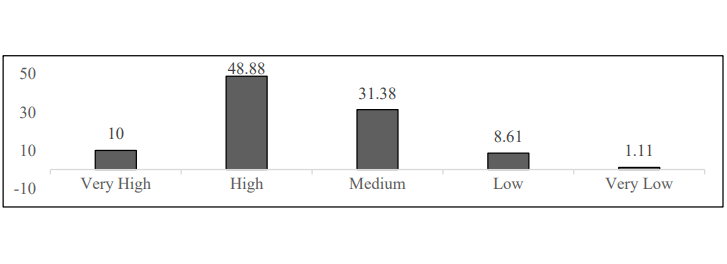
Based on the data collection carried out in the selected municipalities and based on the methodology proposed by Oliveira and Pisa (2015), the IGovP of the municipalities that were part of the sample of this study was arrived at. Thus, Graph 1 presents, globally, the percentage of municipalities by index result range.
Graph 1
Municipalities by IGovP result range
Research data (2019).
It is noticed that 58.88% of the municipalities are concentrated in the high or very high levels in terms of public governance, which is a positive sign, as it shows that many of them are applying governance practices. This result was different from that found by Oliveira and Pisa (2015), in which none of the entities reached a very high or very low degree of public governance. Therefore, these findings indicate that there has been an improvement in public governance over time, since the states have more structure and resources than the municipalities, and, therefore, must have a higher degree of governance than the municipalities.
Besides, only 10% of the municipalities are observed with a result below 0.600. This result denotes that even though there are municipalities with low levels of governance, they represent a small portion concerning the global sample.
Based on the degree of public governance in the municipalities, it was decided to segregate the sample according to the size of the municipality. Thus, to obtain more consistent results in relation to the differences between large and small municipalities about the degree of governance, it was decided to carry out a detailed descriptive analysis, followed by the comparison of the means of the two groups.
Therefore, Table 1 shows the values for the mean, minimum, maximum and standard deviation of the IGovP and its respective dimensions. Likewise, the values for the two groups of municipalities are presented: (i) large municipalities; and, (ii) small municipalities.
Then, based on the values of the means of the two groups, comparisons were made using the T Test, in order to verify any statistical differences between the two groups. The result of this test of means is also shown in Table 2.
| Indicator/Dimension | Municipality | N | Average | Minimum | Maximum | Standard deviation | T | Sig. | |
| IGovP | Brazil | 360 | 0.708 | 0.460 | 0.867 | 0.078 | 4.941 | 0.000*** | |
| Large | 180 | 0.728 | 0.543 | 0.867 | 0.069 | ||||
| Small | 180 | 0.688 | 0.460 | 0.844 | 0.083 | ||||
| Effectiveness | Brazil | 360 | 0.547 | 0.343 | 0.919 | 0.097 | 9.148 | 0.000*** | |
| Large | 180 | 0.589 | 0.394 | 0.919 | 0.096 | ||||
| Small | 180 | 0.505 | 0.343 | 0.739 | 0.077 | ||||
| Transparency and Accountability | Brazil | 360 | 0.654 | 0.000 | 1.000 | 0.255 | 4.746 | 0.000*** | |
| Large | 180 | 0.716 | 0.020 | 1.000 | 0.239 | ||||
| Small | 180 | 0.592 | 0.000 | 1.000 | 0.255 | ||||
| Participation | Brazil | 360 | 0.882 | 0.738 | 0.985 | 0.067 | -22.993 | 0.000*** | |
| Large | 180 | 0.830 | 0.738 | 0.952 | 0.048 | ||||
| Small | 180 | 0.933 | 0.787 | 0.985 | 0.036 | ||||
| Equity | Brazil | 360 | 0.670 | 0.490 | 0.823 | 0.055 | -8.748 | 0.000*** | |
| Large | 180 | 0.647 | 0.537 | 0.744 | 0.042 | ||||
| Small | 180 | 0.693 | 0.490 | 0.823 | 0.057 | ||||
| Legality. Ethics and Integrity | Brazil | 360 | 0.788 | 0.174 | 0.990 | 0.201 | 6.991 | 0.000*** | |
| Large | 180 | 0.857 | 0.418 | 0.982 | 0.174 | ||||
| Small | 180 | 0.718 | 0.174 | 0.990 | 0.203 | ||||
Source: Research data (2019).
Based on Table 2, it can be seen that the average IGovP is, in fact, higher in large municipalities (p-value <1%), which indicates that larger municipalities tend to have better levels of public governance, when compared to small municipalities. This fact corroborates the findings of Freitas and Luft (2014), who found, in general, that the municipalities with the largest populations have better rates of electronic governance. Likewise, Fraga et al. (2019), when analyzing the transparency of small municipalities, identified a low level of transparency in these municipalities. Therefore, this work reinforces the results of these other researchers.
This fact may be related to the better administrative conditions and more robust management systems that these municipalities have. In addition, in more populous municipalities, society tends to exercise greater enforcement with respect to the actions of managers, thus generating greater social control that can be reflected in a greater degree of public governance.
Analyzing the dimensions of public governance, it is observed that large cities also had a higher degree of governance with regard to effectiveness, transparency and accountability, as well as legality, ethics and integrity (p-value <1%) . This result reinforces the idea that, in large municipalities, there is a greater degree of effectiveness, since there is greater access to income and better conditions for human development, given that, in large municipalities, large urban and commercial centers are concentrated, as well as educational and health units with more physical and human resources, realities opposite to small municipalities. Regarding the dimensions related to transparency and accountability and legality, ethics and integrity, it is noteworthy that large municipalities tend to be more sensitive to legal enforcement, since provisions such as the LRF tend to be more stringent with municipalities more populous, which can lead to higher levels of transparency due to proper compliance with the law.
Furthermore, it is noteworthy that the dimension with the greatest discrepancy between the municipalities was that of transparency and accountability, followed by the dimension of legality, ethics and integrity, which are related, considering that they reflect issues related to social control. This result suggests that there is a high dispersion among the municipalities regarding these factors, reinforcing the findings in the research by Cruz et al. (2012) and Souza et al. (2014).
Regarding the dimensions of participation and equity, a different behavior was observed from the other dimensions, that is, small municipalities had averages higher than large municipalities in relation to these two dimensions (both with p-value <1%) . Thus, these findings suggest that, in small municipalities, popular participation is higher and inequality is lower. Such results seem consistent, since, in small municipalities, there seems to be greater political engagement by voters, since there is greater proximity between society and its representatives. As for equity, it is observed that, in large municipalities, there is a higher level of social inequality.
After analyzing public governance based on the size of the municipalities, it was decided to conduct analyzes based on the geographic distribution of the municipalities. Thus, the municipalities were aggregated based on the five regions that make up the national territory. Table 3 presents a descriptive analysis of the IGovP of the municipalities by region.
| Territory | N | Average | Minimum | Maximum | Standard deviation |
| Brazil | 360 | 0.708 | 0.460 | 0.867 | 0.078365 |
| Midwest region | 29 | 0.666 | 0.506 | 0.797 | 0.074291 |
| Northeast Region | 45 | 0.671 | 0.472 | 0.813 | 0.075825 |
| North region | 26 | 0.661 | 0.460 | 0.782 | 0.076550 |
| Southeast region | 142 | 0.709 | 0.486 | 0.867 | 0.076460 |
| South region | 118 | 0.745 | 0.527 | 0.848 | 0.067687 |
Source: Research data (2019).
Based on the results evidenced in Table 3, it can be seen that the average IGovP was 0.708 and the highest IGovP reached 0.867, being higher than the values found in the research by Oliveira and Pisa (2015), reinforcing once again that governance public health has improved over time. Comparing the averages by region, it is observed that the South region had the highest average (0.745), followed by the Southeast (0.709), Northeast (0.671), Midwest (0.666) and North (0.661), respectively. A difference of 8.4% is then perceived between the region with the highest and lowest average, suggesting that there was a reduction in inequality between the regions, compared to the findings of Oliveira and Pisa (2015).
As for the minimum, maximum and standard deviation values, it was found that the region that holds the municipality with the lowest index was the North region (0.460), also showing greater dispersion. In contrast, the Southeast region had the municipality with the highest index (0.867), contrasting with the results of Oliveira and Pisa (2015).
Then, in order to verify statistical differences between the public governance of the municipalities by region, the Tukey Test was used to compare means of multiple groups. The results of the Tukey Test are shown in Table 4.
| Region | IGovP | Effectiveness | Transparency and Accountab. | Participation | Equity | Leg.. Ethics and Integrity | ||||||||
| (A) | (B) | (A-B) | Sig. | (A-B) | Sig. | (A-B) | Sig. | (A-B) | Sig. | (A-B) | Sig. | (A-B) | Sig. | |
| SO | SE | 0.033 | 0.003 | 0.008 | 0.944 | 0.106 | 0.005 | 0.083 | 0.000 | 0.014 | 0.100 | -0.020 | 0.929 | |
| SO | NO | 0.067 | 0.000 | 0.105 | 0.000 | 0.181 | 0.007 | 0.034 | 0.049 | 0.081 | 0.000 | 0.000 | 1.000 | |
| SO | NE | 0.070 | 0.000 | 0.089 | 0.000 | 0.155 | 0.003 | 0.052 | 0.000 | 0.095 | 0.000 | -0.025 | 0.954 | |
| SO | MW | 0.076 | 0.000 | 0.044 | 0.130 | 0.224 | 0.000 | 0.038 | 0.013 | 0.020 | 0.200 | 0.063 | 0.549 | |
| SE | NO | 0.034 | 0.203 | 0.097 | 0.000 | 0.074 | 0.615 | -0.049 | 0.001 | 0.068 | 0.000 | 0.020 | 0.990 | |
| SE | NE | 0.037 | 0.032 | 0.081 | 0.000 | 0.048 | 0.779 | -0.031 | 0.014 | 0.082 | 0.000 | -0.005 | 1.000 | |
| SE | MW | 0.043 | 0.035 | 0.036 | 0.300 | 0.118 | 0.131 | -0.045 | 0.001 | 0.006 | 0.961 | 0.084 | 0.249 | |
| NO | NE | 0.003 | 1.000 | -0.016 | 0.949 | -0.026 | 0.993 | 0.018 | 0.712 | 0.014 | 0.700 | -0.025 | 0.987 | |
| NO | MW | 0.009 | 0.990 | -0.061 | 0.087 | 0.043 | 0.966 | 0.004 | 0.999 | -0.062 | 0.000 | 0.064 | 0.768 | |
| NE | MW | 0.007 | 0.996 | -0.045 | 0.217 | 0.069 | 0.758 | -0.014 | 0.840 | -0.076 | 0.000 | 0.088 | 0.349 | |
Note: SO = South Region; SE = Southeast Region; NO = North Region; NE = Northeast Region; and MW = Midwest Region.
Source: Research data (2019).
Based on the results in Table 4, regarding IGovP, it was found that there is a statistical difference between some averages. Among the observed differences, it is noteworthy that the municipalities in the South Region had averages higher than the averages of the municipalities in the other regions (p-value <1%). In addition, it was observed that the average of the IGovP of the municipalities in the Southeast Region is higher than the average of the municipalities in the Northeast (p-value <5%) and Central-West (p-value <5%). Thus, the South and Southeast regions showed prominence with regard to the degree of public governance in the municipalities, reinforcing the results in Table 2.
Regarding the effectiveness dimension, the municipalities in the South and Southeast regions had higher averages than the municipalities in the North and Northeast regions, with statistical significance at the level of 1%. This finding suggests that the municipalities in the South and Southeast tend to have a greater possibility of access to income and greater development than the municipalities in the North and Northeast. Regarding the transparency and accountability dimension, it was found that the municipalities that belong to the South Region had higher averages than the other municipalities (p-value <1%), with this region being the most advanced with regard to access to information and accountability with society.
Regarding the participation dimension, it was found that the municipalities in the South Region had averages higher than the averages of the municipalities in the other regions. On the other hand, the municipalities in the Southeast Region register averages below the averages of the municipalities in all other regions. Thus, it is understood that, in the municipalities of the South Region, there is greater engagement of the population with regard to the choice of their governors, whereas, in the Southeast Region, there is greater distancing in the population with regard to participation in electoral elections. Concerning the equity dimension, it was found that the municipalities that belong to the North and Northeast regions had lower averages than the municipalities in the South, Southeast and Center-West regions, denoting that these regions are the ones that suffer most from poverty and inequalities. . Regarding the legality, ethics and integrity dimension, there were no statistical differences between the averages of the municipalities in the different regions.
For a more detailed analysis to be achieved, it was decided to analyze the ten municipalities with the lowest and highest scores, as shown in Table 5.
| Municipalities with higher IGovP | Municipalities with smaller IGovP | |||||
| UF | Municipality | IGovP 2018 | UF | Municipality | IGovP 2018 | |
| RJ | Niterói | 0.867 | MG | Doresópolis | 0.538 | |
| ES | Vitória | 0.850 | MG | Senador José Bento | 0.530 | |
| PR | Curitiba | 0.848 | TO | Juarina | 0.529 | |
| SC | Joinville | 0.848 | RS | Dois Irmãos das Missões | 0.527 | |
| RS | Poço das Antas | 0.844 | MG | Oliveira Fortes | 0.527 | |
| RS | São Vendelino | 0.842 | MT | Luciara | 0.506 | |
| SC | Marema | 0.841 | PI | Miguel Leão | 0.489 | |
| RS | Porto Alegre | 0.840 | MG | Santo Antônio do Rio Abaixo | 0.486 | |
| SC | Jaraguá do Sul | 0.839 | RN | Monte das Gameleiras | 0.472 | |
| SC | São José | 0.836 | TO | Rio da Conceição | 0.460 | |
Source: Research data (2019).
Looking at Table 5, it can be seen that, in the section of the municipalities with the highest scores in the IGovP, Niterói-RJ was the one with the highest score (0.867), followed by Vitória-ES (0.850) and Curitiba-PR and Joinville-SC that scored 0.848. It is also noticed that even the last of the ten municipalities, São José-SC, achieved a score of 0.836, indicating that the 10 municipalities with the highest scores have a very high degree of public governance. In addition, it appears that all are from the South and Southeast, regions that had the highest rates.
It should also be mentioned that among the 10 municipalities with the highest scores, three are small: Poço das Antas-RS, São Vendelino-RS and Marema-SC. However, even though there are some small municipalities listed among the best, they are exceptions to the general, as noted by Freitas and Luft (2014).
Still based on Table 5, it is clear that the municipality that obtained the lowest score in the IGovP was Rio da Conceição-TO (0.460), followed by Monte das Gameleiras-RN (0.472), Santo Antônio do Rio Below-MG (0.486) and Miguel Leão-PI (0.489), all with a very low degree of public governance. It is also noteworthy that among the four municipalities with very low IGovP, two are from the Northeast, one from the Midwest and one from the Southeast. Also, it was found that all municipalities that obtained the lowest scores are small.
It is also worth noting that, at the time of the research, some municipalities had zero marks for not having the necessary disclosure of information necessary for the calculation of the index, consequently, decreasing the score obtained by the municipality.
Continuing the analysis, Table 6 presents the large municipalities that obtained the lowest scores, as well as the small municipalities that had the highest scores.
| Large municipalities with the lowest IGovP scores | Small municipalities with higher scores in the IGovP | |||||
| UF | Municipality | IGovP 2018 | UF | Municipality | IGovP 2018 | |
| RJ | Mesquita | 0.607 | RS | Poço das Antas | 0.844 | |
| SP | Osasco | 0.606 | RS | São Vendelino | 0.842 | |
| BA | Juazeiro | 0.600 | SC | Marema | 0.841 | |
| SP | São Vicente | 0.597 | TO | Crixás do Tocantins | 0.833 | |
| AL | Arapiraca | 0.569 | SP | Borá | 0.815 | |
| SP | Ferraz de Vasconcelos | 0.569 | SC | Santiago do Sul | 0.815 | |
| GO | Águas Lindas de Goiás | 0.566 | RS | Relvado | 0.812 | |
| PE | Jaboatão dos Guararapes | 0.560 | RS | Ivorá | 0.804 | |
| SE | Nossa Senhora do Socorro | 0.557 | SC | Irati | 0.802 | |
| MG | Montes Claros | 0.543 | RS | Ipiranga do Sul | 0.797 | |
Fonte: Dados da pesquisa (2019).
From Table 6, it appears that no large municipality obtained IGovP within the “very low” classification range. It is noteworthy that the large municipalities that had the lowest rates were Montes Claros-MG (0.543), followed by Nossa Senhora do Socorro-SE (0.557) and Joaboatão dos Guararapes (PE). There are also municipalities with “medium” IGovP, such as Juazeiro-BA (0.600), Osasco-SP (0.606) and Mesquita-RJ (0.607).
Among the small towns, Poço das Antas-RS is at the top of the list, with an index of 0.844, followed by São Vendelino-RS (0.842) and Marema-SC (0.841), with very small differences. Among the ten best evaluated, only Ipiranga do Sul-RS does not fall within the range of high degree of governance. It should also be mentioned that only the municipality of Crixás do Tocantins-TO belongs to the Midwest region, with the remaining municipalities belonging to the South and Southeast regions, reinforcing that these are the regions that have the greatest public governance practices.
5 FINAL CONSIDERATIONS
In this study, the public governance of Brazilian municipalities was analyzed. To this end, 360 municipalities were investigated, 180 of which are large and 180 small. To measure the degree of governance of the municipalities, the index based on the model of Oliveira and Pisa (2015) was used, which is divided into five indicators: (i) effectiveness; (ii) transparency and accountability; (iii) participation; (iv) equity; and (v) legality, ethics and integrity.
The research results indicate that 58.78% of the municipalities analyzed have a high degree of public governance, while 9.75% of the municipalities have low levels of governance. Thus, the study suggests that most of the municipalities analyzed have adequate public governance practices. Moreover, it was evidenced that the large municipalities presented public governance superior to the small municipalities, suggesting the size of the municipality as a relevant factor for the governance practices to be effective, reinforcing the findings of other studies, which related the governance population and income. The municipalities that achieved the lowest scores were, in general, smaller municipalities, and the large ones that fell within the latter, generally had their scores decreased due to factors of transparency, accountability and legality, reinforcing how governance is inherently linked to these factors and therefore are practices that must be improved for public governance to be effective.
In addition, despite the high degree of public governance observed in many municipalities, there is still evidence of inequality between the regions, being perceived more sharply when comparing the minimum and maximum values of the South and North regions, regions that had the highest and lowest index mean, respectively. This result was reinforced by comparing the averages by region, in which the municipalities in the South Region tend to have a higher degree of public governance than the municipalities in other regions. However, it is worth mentioning that these differences were smaller than those observed in other studies, showing that perhaps, over time, this disparity can be ended.
It is concluded, therefore, that the researched municipalities are applying, even if partially, governance practices that are in the literature, but still need to adopt different practices and insert them in public actions. It is important to emphasize that, as governance seeks transparency, mainly, and this factor is essential for social control to occur, there must be a greater search to encourage this governance in municipalities, especially in large ones, where control social is mainly through electronic means.
This study then contributes to the literature through the search for new data, which can be used as guidelines for future research in the area, in addition to being a form of analysis of public management, regarding governance at the municipal level. There were limitations in the research due to the lack of disclosure of information in some municipalities, but that did not significantly impair the conduct of the research. For future studies, it is suggested to search for new variables that can calculate the governance of the municipalities, as well as the replication of this study in municipalities in specific regions. It is also suggested that relationships be made with other factors and how governance may interfere with this. Finally, it is hoped that this study can serve as a stimulus to social control, to greater participation of society in public decision-making and in raising the awareness of managers regarding the importance of governance at the municipal level.
REFERENCES
Abid, G.; KHAN, B.; RAFID, Z.; AHMED, A. Theoretical perspective of corporate governance. Bulletin of Business and Economics, v. 3, n. 4, p. 166–175, 2014.
BEKELE, Y. W.; KJOSAVIK, D. J. Decentralised local governance and poverty reduction in post-1991 Ethiopia: a political economy study. Politics and Governance, v. 4, n. 4, p. 1-15, 2016.
BEVIR, M. Democratic Governance. New Jersey: Princeton, 2010.
BORGES, L. F. X.; SERRÃO, C. F. B. Aspectos de governança corporativa moderna no Brasil. Revista do BNDES, v. 12, n. 24, p. 111-148, 2005.
BRASIL. Constituição da República Federativa do Brasil. 1988. Disponível em: http://www.planalto.gov.br/ccivil_03/constituicao/constituicao.htm. Acesso em: 15 jan. 2019.
BRASIL. MINISTÉRIO DO PLANEJAMENTO, ORÇAMENTO E GESTÃO - MPOG. Secretaria de Gestão. Programa Nacional de Gestão Pública e Desburocratização – GesPública; Prêmio Nacional da Gestão Pública – PQGF; Documento de Referência; Fórum Nacional 2008/2009 / Ministério do Planejamento, Orçamento e Gestão, Subsecretaria de Planejamento, Orçamento e Gestão. - Brasília: MP, SEGES, 2009.
BRASIL. TRIBUNAL DE CONTAS DA UNIÃO - TCU. Governança Pública: referencial básico de governança aplicável a órgãos e entidades da administração pública. Brasília: TCU, Secretaria de Planejamento, Governança e Gestão. Brasília, DF, 2014.
BRASIL. TRIBUNAL SUPERIOR ELEITORAL – TSE. 2016. Estatísticas eleitorais. Disponível em: http://www.tse.jus.br/eleicoes/estatisticas/estatisticas-eleitorais?busca=2016. Acesso em: 06 mar. 2019.
BROUCHOUD, M. F.R. Gobernanza y legitimidad democrática. Reflexión Política, v. 12, n. 23, p. 96-96, 2010.
CARLOS, F. Controle social no âmbito municipal: um estudo sobre a utilidade dos relatórios da Controladoria Geral da União (CGU) na percepção dos conselheiros de políticas sociais no Estado de Pernambuco. 2009. 173 f. Dissertação (Mestrado em Ciências Contábeis) – Universidade Federal de Pernambuco, Recife, 2009.
COELHO, M. C.; CRUZ, F.; NETO, O. A. P. A informação contábil como ferramenta de auxílio no exercício do controle social. Contabilidade Vista & Revista, v. 22, n. 3, p. 163-184, 2011.
CRUZ, C. F.; FERREIRA, A. C. S.; SILVA, L. M.; MACEDO, M.A. S. Transparência da gestão pública municipal: um estudo a partir dos portais eletrônicos dos maiores municípios brasileiros. Revista de Administração Pública, v. 46, n. 1, p. 153-176, 2012.
DATASUS. Departamento de Informática do SUS, 2010. Informações de saúde. Disponível em: http://www.datasus. gov.br. Acesso em: 15 mar. 2019.
DIAS, T.; CARIO, S. A. F. Governança Pública: ensaiando uma concepção. Revista Contabilidade, Gestão e Governança, v. 17, n. 3, p. 89-108, 2014.
ERICEIRA, A. C.C. Participação e controle social na administração pública: um exercício de cidadania. In: JORNADA INTERNACIONAL DE POLÍTICAS PÚBLICAS, 5, 2011. São Luís. Anais [...]. São Luís, 2011.
FABRIZ, S. M.; GOMES, A. R. V.; MELLO, G. R. Governança Eletrônica: uma análise bibliométrica dos periódicos nacionais e internacionais. Contabilidade, Gestão e Governança, v. 21, n. 3, p. 320-338, 2018.
FRAGA, L. D. S.; MEDEIROS, A. P.; VIEIRA, K. M.; BENDER FILHO, R. Transparência da gestão pública: análise em pequenos municípios do Rio Grande do Sul. Revista Gestão & Planejamento, v. 20, n. 1, p. 255-272, 2019.
FREITAS, R. K. V.; LUFT, M. C. M. S. Índice de governança eletrônica nos municípios: uma análise do estado de Sergipe. Revista de Ciência Administrativa, v. 13, n. 1, p. 56-73, 2014.
GANI, A. Governance and growth in developing countries. Journal of Economic Issues, v. 45, n. 1, p. 19-40, 2011.
GORANOVA, M.; ABOUK, R.; NYSTROM, P. C.; SOOFI, E. S. Corporate governance antecedents to shareholder activism: a zero-inflated process. Strategic Management Journal, v. 38, n. 2, p. 415-435, 2017.
HWANG, J.; AKDEDE, S. H. The influence of governance on public sector efficiency: a cross-country analysis. The Social Science Journal, v. 48, n. 4, p. 735-738, 2011.
INSTITUTO BRASILEIRO DE GEOGRAFIA E ESTATÍSTICA – IBGE. 2010. Estimativas da população. Disponível em: http://www.ibge.gov.br. Acesso em: 15 fev. 2019.
INTERNATIONAL FEDERATION OF ACCOUNTANTS – IFAC; CHARTERED INSTITUTE OF PUBLIC FINANCE AND ACCOUNTANCY – CIPA. International Framework: good governance in the public sector. IFAC, 2014.
MELLO, G. R. Estudo das práticas de governança eletrônica: instrumento de controladoria para a tomada de decisões na gestão dos estados brasileiros. 2009. 179 f. Tese (Doutorado em Ciências Contábeis) – Universidade de São Paulo, São Paulo, 2009.
MELLO, G. R.; SLOMSKI, V. Índice de governança eletrônica dos estados brasileiros (2009): no âmbito do poder executivo. Journal of Information Systems and Technology Management, v. 7, n. 2, p. 375-408, 2010.
MINISTÉRIO PÚBLICO FEDERAL - MPF. Mapa da transparência - Portal de Combate à Corrupção. Disponível em: http://combateacorrupcao.mpf.mp.br/ranking/mapa-da-transparencia/arquivos-pdf/ranking-da-transparencia-2a-avaliacao-nacional.pdf. Acesso em: 02 mar. 2019.
MONTEIRO, R. P.; PEREIRA, C. A.; THOMAZ, J. L. P. Accountability e controle social: uma reflexão sobre sua importância e relação para a democracia. Revista UNEMAT de Contabilidade, v. 5, n. 9, p. 62-87, 2016.
MOURA, G. D.; DALLABONA, L. F.; FANK, O. L.; ALMEIDA-SANTOS, P. S.; VARELA, P. S. Análise das práticas de governança eletrônica de municípios do Estado de Santa Catarina. In: ENCONTRO DE ADMINISTRAÇÃO DA INFORMAÇÃO, 3., Porto Alegre, 2011. Anais [...]. Rio de Janeiro: Anpad, 2011.
OLIVEIRA, A. G.; PISA, B. J. IGovP: índice de avaliação da governança pública – instrumento de planejamento do Estado e de controle social pelo cidadão. Revista de Administração Pública, v. 49, n. 5, p. 1263-1290, 2015.
PERES, L. N. Novo olhar sobre a qualidade da informação contábil: a ótica dos observatórios sociais. 2017. 125 f. Dissertação (Mestrado em Controladoria e Contabilidade) – Universidade de São Paulo, São Paulo, 2017.
PROGRAMA DAS NAÇÕES UNIDAS PARA O DESENVOLVIMENTO - PNUD. Atlas do desenvolvimento humano do Brasil 2013: O índice de desenvolvimento humano municipal. Disponível em: www.pnud.org.br /atlas/ranking/Ranking-IDHM-UF-2010.aspx. Acesso em: 03 mar. 2019.
RAMOS, G. M.; MARTINEZ, A. L. Governança corporativa. Revista Contemporânea de Contabilidade, v. 3, n. 6, p. 143-164, 2006.
RAMOS, S. S.; VIEIRA, K. M. Matriz LIMPE: Proposta de ferramenta gerencial para mensuração da governança pública municipal. Tecnologias de Administração e Contabilidade, v. 5, n. 1, p. 30-53, 2015.
RONCONI, L. Governança pública: um desafio à democracia. Emancipação, v. 11, n. 1, p. 21-34, 2011.
SALES, E. C. A. S.; PETER, M. G. A.; MACHADO, M. V. V.; NASCIMENTO, C. P. S. Governança no setor público segundo a IFAC – estudo nas universidades federais brasileiras. Brazilian Journal of Business, v. 2, n. 2, p. 1477-1495, 2020.
SECCHI, L. Modelos organizacionais e reformas da administração pública. Revista de Administração Pública, v. 43, n. 2, p. 347-69, 2009.
SECRETARIA DO TESOURO NACIONAL - STN. SICONFI - Secretaria do Tesouro Nacional (STN) - Versão 2.0 RGF. Disponível em: https://siconfi.tesouro.gov.br/siconfi/pages/public/consulta_finbra_rgf/finbra_rgf_list.jsf. Acesso em: 07 mar. 2019.
SOUZA, F. J. V.; ARAUJO, A. O.; ARAÚJO, F. R.; SILVA, M. C. Análise das práticas de governança eletrônica dos municípios mais populosos do brasil: um estudo baseado no modelo de Mello (2009). Reunir: Revista de Administração, Contabilidade e Sustentabilidade, v. 4, n. 3, p. 62-77, 2014.
UDDIN, M. J.; JOYA, L. A. Development through good governance: lessons for developing countries. Asian Affairs, v. 29, n. 3, p. 1-28, 2007.
YUSOFF, W. F. W.; ALHAJI, I. A. Insight of corporate governance theories. Journal of Business & Management. v. 1, n. 1, p. 52–63, 2012.
ZORZAL, L.; RODRIGUES, G. M. Disclosure e transparência no setor público: uma análise da convergência dos princípios de governança. Informação & Informação, v. 20, n. 3, p. 113-146, 2015.
Notas de autor