Artigos
Scientific production of the organizational studies event under the social network analysis perspective
Produção científica do encontro de estudos organizacionais sob a óptica da análise de redes sociais
Scientific production of the organizational studies event under the social network analysis perspective
Gestão & Regionalidade, vol. 38, núm. 113, pp. 261-281, 2022
Universidade Municipal de São Caetano do Sul

Esta obra está bajo una Licencia Creative Commons Atribución-NoComercial-SinDerivar 4.0 Internacional.
Recepción: 06 Mayo 2020
Aprobación: 08 Octubre 2021
Abstract: The aim of this study is to investigate the profile and characteristics of the scientific production of articles published in the 10 editions of EnEO under the perspective of social network analysis. Methodologically, it is a research with quantitative approach, using documentary research and social network analysis. We investigate the following indicators of social network: (a) co-authorship network by accumulated EnEO edition; (b) co-authorship network of the 10 EnEO editions; (c) social network of the Higher-educational institutions (HEIs); (d) social network of international states and cities; (e) social network of the regions of Brazil; and (f) countries' social network. The main results point to a low density in all investigated social networks. However, it is noticeable that the studied co-authorship networks are in evolution phase, inherently influencing the other collaboration networks, and that way contributing to the improvement, development and growth of the investigated scientific production.
Keywords: Scientific production, EnEO, Social network analysis.
Resumo: O objetivo deste estudo foi investigar o perfil e as características da produção científica dos artigos divulgados nas 10 edições do EnEO sob a óptica da análise de redes sociais. Metodologicamente, foi uma pesquisa com abordagem quantitativa, utilizando-se de pesquisa documental e análises de redes sociais. Foram investigados os seguintes indicadores de redes sociais: (a) redes de coautoria por edição do EnEO acumulada; (b) redes de coautoria das 10 edições do EnEO; (c) rede social das HEIs; (d) rede social dos estados e cidades internacionais; (e) rede social das regiões do Brasil; e (f) rede social dos países. Os principais resultados apontam uma baixa densidade em todas as redes sociais investigadas, contudo, com é perceptível que as redes de coautoria estudadas estão em fase de evolução, influenciando de maneira inerente as outras redes de colaboração, contribuindo com isso para o aperfeiçoamento, desenvolvimento e crescimento da produção científica investigada.
Palavras-chave: Produção científica, EnEO, Análise de redes sociais.
1 INTRODUCTION
Scientific production is an important instrument to analyze the activity of the academic knowledge (AMARAL et al., 2017) and of the scientific collaboration among authors and their respective institutions (MUÑOZ; DELGADO, 2016).
This is accomplished by publishing the results in academic texts (KROKOSCZ, 2015) that are disseminate at congresses (RIBEIRO; RIBEIRO, 2019) and / or in scientific journals (SMOLSKI et al., 2017). Here, we add a remark regarding the diffusion and dissemination of the scientific knowledge by means of two classes: gray Received: 06/05/2020 | Accepted: 08/10/2021 literature and white literature (SILVA et al., 2019). That said, we highlight that such expressions are still little manifested and even unknown in the scientific community, making them rare (BOTELHO; OLIVEIRA, 2015). In general, gray literature refers to events, congresses, colloquiums, dissertations, theses, etc.,while white literature comprises scientific journals, books and chapters (BOTELHO; OLIVEIRA, 2015).
Yet, in regard to the gray literature, we observe that it is characterized as being a literature of difficult access, therefore, restricted to a small group within an academic community, non-commercial and with a minimum volume of reproduction. In short, this type of literature has limited access and propagation (LEITE; ASSIS; MELO, 2015). However, it is important to emphasize that gray literature is essential for the beginning, construction, dissemination, socialization and maturation of the scientific knowledge ( POBLACIÓN; NORONHA, 2002); it providesthe exchange of information among researchers, contributing to the advancement of the scientific knowledge in the area of Administration and related areas (PONTES et al., 2017). Based on that, wereinforce the importance of scientific congresses, which are special sources of data that generate specific information for the understanding and comprehension of various themes; among those congresses, we place emphasis on the EnANPAD – Meeting of the National Association of Graduate Studies and Research in Administration (RIBEIRO, 2017).
Searching on the national scientific literature, we found studies about the academic production of various topics that are published in scientific journals, and presented in events of the specific areas of the ANPAD (WALTER; BACH; BARBOSA, 2012; BACH; DOMINGUES; WALTER, 2013; BALSAN et al., 2016; ROCHA et al., 2017; GUIMARÃES et al., 2018). In 1998, the EnANPAD already had two areas linked to the organizational studies: organizations and organizations/strategy (strategic administration, from 1999 onwards). In 2000, the 1st EnEO is held in Curitiba. In 2002 the second EnEO takes place in Recife, and in 2004, the third meetinghappened (CRUBELLATE, 2005), thus becoming an event with biennial periodicity until 2016 (GUIMARÃES et al., 2018). In 2019, the tenth Edition of EnEO took place in Fortaleza (ANPAD, 2019). In Brazil, the area of organizational studies has been marked by evolution (CASSUNDÉ; BARBOSA; MENDONÇA, 2016).
The EnEO has been used as the main focus and/or with participation in research of some scientific works published in scientific journals that deliberated investigation on scientific production in organizational studies and/or related themes; for that, they use the techniques of bibliometrics and/or sociometry (CASSUNDÉ; BARBOSA; MENDONÇA, 2016), being the latter also known as Social Network Analysis – SNA (RIBEIRO, 2014; CARDOSO; BERNARDINO; PESSOA ARAÚJO, 2018; FERREIRA; SILVA, 2019). Nevertheless, we did not find works about the EnEO, which emphasize specifically its full scientific production, which means, from the first edition (held in 2000) until its last edition this year. The same way, we did not find in the national literary field, studies focusing on the 10 editions of the EnEO that use the social network analysis approach, and highlight the characteristics of the actors (researchers, institutions, states, regions and countries).
In this context, in order to understand an area of knowledge in all its nuances, we need to understand it in terms of its connections among the actors involved in the process of publication, dissemination and socialization of the scientific knowledge, by the means of collaboration among authors, their respective institutions, and other factors.Therefore, we address the research question that will underpin this study: What is the profile and characteristics of the scientific production of the articles published in the 10 Editions of the EnEO under the perspective of the social network analysis?The aim of this study is to investigate the profile and characteristics of the scientific production of the articles published in the 10 editions of the EnEO under the perspective of the social network analysis. Our choice to investigate the scientific production in the annals of the EnEO scientific event is based on the fact that publications in the “grey literature” flow and are socialized more quickly in the scientific panorama than the other conventional means of communication, such as books and scientific journals(VISENTINI; CHAGAS; BOBSIN, 2018).
Our justificative for this study is that it brings out a complete mapping of the 10 Editions of the EnEO, by contributing to the understanding of the productivity and collaboration patterns of the actors (researchers, HEIs, states, regions, countries), which are involved in the process of diffusion and dissemination of knowledge in the Organizational Studies disclosed in the aforementioned scientific event. Therefore, our study contributes to understanding how the social interaction of those actors occurs through the social network analysis (RIBEIRO; RIBEIRO, 2019). An important remark is that, methodologically, our study emphasizes the social network analysis for the fact that it is fundamentally based on graph theory, which allows to analyze the structure and relationships of the network as a whole, as well as the subgroups of actors and the individual actors within the network(BORDIN; GONÇALVES; TODESCO, 2014).
For example, in a co-authorship network, the findings of this investigation are essential for the understanding and comprehension of several questions that are relevant to collaboration (SAMPAIO et al., 2015; MUÑOZ; DELGADO, 2016), such as: What is the level of collaboration of the entire research community? Which are the study groups that work in isolation? Who are the researchers who collaborates the most? The answers to these questions can provide input for decision making in a scientific context(BORDIN; GONÇALVES; TODESCO, 2014). Therefore, this study is ready to try to mitigate gaps in the national academic literature on the subject under investigation, by means of a holistic view and using a contemporary approach over social network indicators, and that way collaborating to broaden the understanding and comprehension of the organizational studies in Brazil.
2 THEORETICAL FOUNDATION
This section approaches the themes: organizational studies and social network analysis.
2.1 ORGANIZATIONAL STUDIES
The organizational studies are the specification of a macro theme / discipline, aimed at the organization (MACHADO; FERNANDES; SILVA, 2017). It belongs to the administration area, whose terms / disciplines used to name this thematic are: sociology of organizations, general management theory, organizational or organizational theories, and organizational studies, as designated in this research (FADUL; SILVA, 2009); this shows the relevance of the organizational studies in the context of management education (RODRIGUES; CARRIERI, 2001).
In the research of Guimarães et al. (2018), the authors identified the strong influence of organizational studies on theinstitutional theory, since the aforementioned theme strengthens the understanding of the organizational practices (RIBEIRO; SANTOS, 2016). The authors Machado-da-Silva and Vizeu (2007) define organizational practices as being all the managerial tools and formally instituted concepts of organizational practice belonging to the process of elaboration and the business strategy feasibility. For that reason, the relationship between the strategic field and the institutional perspective has been investigated (MACHADO-DA-SILVA; VIZEU, 2007), concomitantly with the organizational studies (GUIMARÃES et al., 2018).
It is important to understand that organizational studies are characterized by their multi- and interdisciplinarity, as well as transversality in the area of Administration (FISCHER; WAIANDT; SILVA, 2008), being permeated by research objects from other fields of knowledge, such as: Economic Sciences, Sociology, Anthropology and Philosophy (LACRUZ; AMÉRICO; CARNIEL, 2017), which contributes to the formation of the Administration education in Brazil (COSTA; SILVA, 2019). In this scenario, we can observe and verify the intrinsic condition between the Organizational Studies and the Administrative Sciences(FERRAZ; CHAVES; FERRAZ, 2018). The authors Couto, Honorato and Silva (2019) corroborate and complement the statement of the previous paragraph by saying that the area of Administration / Organizational Studies has been the object of epistemic colonization in the last 160 years.Being the knowledge in Administration / Organizational studies firstly designed by the knowledge of engineering, followed by the knowledge of psychology and, finally, by the management knowledge.
That academic information has been approached with an indispensable usefulness for the corporate profits, which heavily impacted the functional improvement of the scientific knowledge that guides the Theories of Administration (RIBEIRO; SANTOS, 2016; LACRUZ; AMÉRICO; CARNIEL, 2017). To summarize, the academic knowledge, in the totality of the organizational studies, is the most diverse, but all share a common feature, which is the attempt to establish a distinction between data, information and scientific knowledge (BEHR;NASCIMENTO, 2008). Such initiative will take place through an expansion and robustness of the scientific production of the organizational studies, either in white literature as well as in gray literature (POBLACIÓN; NORONHA, 2002) within the national scenario, since the majority of its scientific production still comes from abroad (PAULA et al., 2010). Asconsequence, the organizational studies in Brazil are no longer recent (ANDRADE; MACEDO; OLIVEIRA, 2014), to become mature and legitimized a posteriori with the contribution of the scientific knowledge(MACHADO JUNIOR et al., 2016a).
2.2 Social network analysis (SNA)
As a principle, the networks theory adopts the fact that the connections between people are important because they transmit behavior, habits, information and knowledge, delimiting the knowledge frontiers (PESSOA ARAÚJO et al., 2017). However, it needs to emphasize that bibliometrics is preponderant to assist in the sociometric process, i.e., the social network analysis (RIBEIRO, 2014), therefore helping in understanding the interaction that occurs among the actors in the networks(NASCIMENTO; BEUREN, 2011). Based on that, we state that while Bibliometrics is responsible for investigating and measuring the activities of the scientific production and communication, helping the Sociometry, this last one studies the existing collaboration networks among researchers of a specific subject. That way, the social network analysis is becoming increasingly necessary for the better understanding by researchers regarding the diffusion and dissemination of the scientific knowledge.
In this regard, our study focus predominantly on sociometry (also called social network analysis), which is supported by the bibliometric techniques, for the fact that it involves quantitative aspects of the scientific production (RIBEIRO; CIRANI; FREITAS, 2013; RIBEIRO; SANTOS, 2015; MACHADO JUNIOR et al., 2016b). The social network analysis tries to put mathematical concepts that focus on graph theory, together with the relational mechanisms suggested by the Economic Sociology. It also receives contributions from several disciplines, such as: Physics, Statistics, Economics, Psychology, among others. In the researches related to the area of Administration, the social network analysis can be considered mainstream, because it contributes to the generation of an increasing number of articles under this approach (KIRSCHBAUM, 2018).
That way, it is reasonable to say that social network analysis is essential to clarify and understand the structure of themes or scientific fields (RIBEIRO, 2017). For example, in the Administration (LEONARDO et al., 2019), more specifically in the stricto sensu (MELLO; CRUBELLATE; ROSSONI, 2010; CARDOSO; BERNARDINO; PESSOA ARAÚJO, 2018), and overall to understand the collaboration of the actors involved in the process of scientific production of articles published in scientific congresses (RIBEIRO; RIBEIRO, 2019), mainly in the ANPAD events (RIBEIRO; CORRÊA; RIBEIRO, 2019).
The following elements - actor, nodes, ties, group, centrality and density are necessary for the formation of the social networks (LEONARDO et al., 2019). Beside those elements, we add the structural gaps (holes), which are indicators of weak ties (CRUZ et al., 2011), that permeate the collaboration networks(CONNER; PROVEDEL; MACIEL, 2017). It should be noted that the approach of structural holes is similar to the concept of small worlds (ROSSONI, 2014). And this occurs when actors from a specific sparse social network are highly grouped in different and defined clusters (BRAGA; GOMES; RUEDIGER, 2008). That way, the properties of small worlds provide elements for the solidity of the relationship structures as well as of the institutions, which is a fundamental fact to understand the mutual relation between local and global structures (ROSSONI; GUARIDO FILHO, 2007).
The actors are considered social entities that have connections in the network. Those actors also represent the nodes included in the collaboration network, in where each actor collaborates with at least one of the actors of a given social network(NASCIMENTO; BEUREN, 2011; ALLEGRETTI et al., 2018). Among the types of centralities, the simplest, most direct and that stands out in the SNA studies is the degree centrality (degree), which is derived from the number of direct connections that an actor has. Consequently, it will be emphasized in this work(CUNHA; PICCOLI, 2017). Therefore, it is said that an actor is central if it has many ties that connect with other points (actors) and, it is globally central, if it presents an expressive strategic position in the social network (CRUZ et al., 2011).
3 METHODOLOGICAL PROCEDURES
Our study aims to investigate the profile and characteristics of the scientific production of articles that were published in the 10 editions of the EnEO, under the perspective of the social network analysis. Methodologically, it is an empirical work, withquantitative approach that uses bibliometric and sociometric techniques (having predominance in social network analysis) by means of longitudinal temporal cut, with non-probabilistic statistical sampling. It also involves descriptive research regarding the aims, and documentary research regarding the means(PINHEIRO et al., 2018). There are other studies with preponderance in social network analysis either in the field of Administration and related fields, which emphasize the collaboration networks of the actors that have articles published in the national scientific congresses, such as: EnANPAD (BRAGA; GOMES; RUEDIGER, 2008); USP Congress on Controllership and Accounting (CRUZ et al., 211); EnANPAD and 3Es (ROSSONI; GUARIDO FILHO, 2007; WALTER; BACH, 2013); Congress promoted by the National Association of Postgraduate Programs in Accounting Sciences- Anpcont (RIBEIRO; RIBEIRO, 2019); EnEPQ (RIBEIRO; CORRÊA; RIBEIRO, 2019).
In the first phase we used bibliometric techniques, and collected data from highlighted articles in the period of 2000 to 2019, following a 20-year longitudinal survey. However, within this temporality, there are 10 editions of the scientific event investigated, which are 2000, 2002, 2004, 2006, 2008, 2010, 2012, 2014, 2016 and 2019. Therefore, it is clear that the data were collected from the ANPAD, more specifically from the EnEO scientific meetings. In this procedure we identified 1,319 evidenced studies from the 2000-2019 Editions.
In the second phase, by using the sociometric techniques, we created the one-modematrices (BUFREM; MASCARENHAS; SOBRAL, 2017) of the actors' networks, which are contemplated in the following section of this study. The data collection processes, download of articles, tabulation, organization, measurement and creation of social media figures had started
on 06-07-2019 and ended on 08-15-2019. The data analysis was carried out using the following indicators: (I) co-authorship networks by accumulated EnEO Edition; (II) co-authorship networks of the 10 EnEO Editions; (III) social network of the HEIs; (IV) social network of the international states and cities; (V) social network of the Brazilian regions; and (VI) the countries' social network. These indicators were measured by using the UCINET software and visualized with the NetDraw software.
4 RESULTS ANALYSIS AND DISCUSSION
Figure 1 shows the co-authorship networks of the first nine editions of EnEO. Being the first co-authorship network (the first from left to right - with fewer ties) the one that corresponds to the 2000 Edition; the second co-authorship network includes the networks of the year 2000 together with the Edition of the year 2002; the third one corresponds to the sum of the co-authorship networks of the periods 2000, 2002 and 2004; that goes successively until reaching the ninth co-authorship network, which corresponds to the grouping of the networks of the editions 2000, 2002, 2004, 2006, 2008, 2010, 2012, 2014 e 2016.
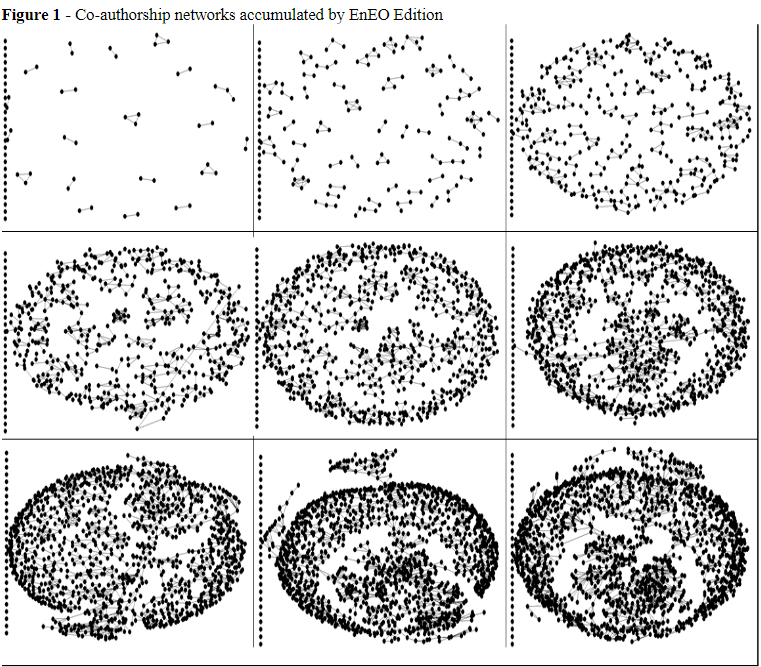
Figure 1 - Co-authorship networks accumulated by EnEO Edition
Note: The first co-authorship network (from left to right) is from the 2000 edition, the second co-authorship network is from the 2000 and 2002 editions, the third one is from the 2000, 2002 and 2004 editions, and that goes successively, until reaching the last co-authorship network, which is the ninth figure representing the editions of 2000, 2002, 2004, 2006, 2008, 2010, 2012, 2014 and 2016.
We understand that with an accumulated view of the co-authorships (connections among researchers), it is possible to visualize and investigate more robustly how is the behavior of the various scholars involved in the scientific production of a given topic and / or area of knowledge (MARTINS, 2014). Therefore, by analyzing the Figure 1, we observe a growth in the relationships among authors, cumulatively year by year, which depicts the following: (i) the growth of the publications in EnEO, by edition; (ii) the researchers availability and will to disseminate and share their information and scientific knowledge in EnEO; (iii) the maturation of the referred scientific event either in the national and international scope (see Figures 6, 7 and 8); (iv) the consequent evolution of the organizational studies theme in the administration area; (v) the increase of partnerships in publications, contributing to the expansion and strength of the scientific production in the area; e (vi) the emergence, growth, maturation and / or legitimacy of the study groups, and, concomitantly, of the authors (Figure 3) who, by standing out in the area, together with their respective HEIs (Figure 5), contribute to and impact the improvement of the scientific research for the under investigated topic in the scientific literature in Brazil.
This finding is corroborated in the affirmation that - the community detection (in the case of authors) refers to the problem of identifying groups or partitions of nodes that share common properties in a particular social network. In that scenario, we understand that co-authorship networks are considered complex networks, where the nodes of the network are the authors, and the connections between the nodes establish the co-authorship relationship in one or more publications (MUÑOZ; DELGADO, 2016). We are aware that the social networks dynamics consider that actors evolve over time. As consequence, their respective characteristics and predicates are transformed, as well as the way they will relate to each other, leading to a reconfiguration of the structure of the current investigated social network (MARTINS, 2014). That said, Figure 2 shows the accumulated co-authorship network of the 10 editions of EnEO. In other words, the aforementioned social network has 1,924 authors identified in the 1,319 articles published in EnEO, in all 10 editions published so far.
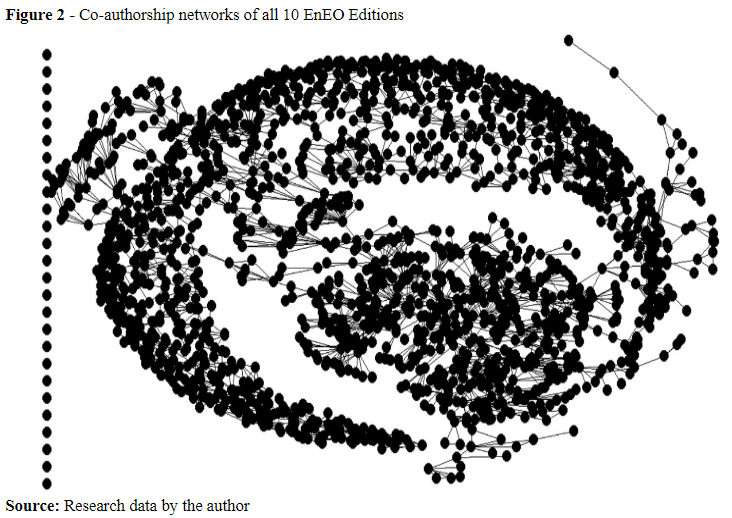
Figure 2 - Co-authorship networks of all 10 EnEO Editions
Source: Research data by the author
Figure 2 shows the co-authorship network of this study, which is composed of 1,924 nodes and 5,419 ties. However, the global density of the network is only 0.044, that is, only 4.40% of the interactions are effectively performed in that co-authorship network. Other similar studies, such as Ribeiro, Cirani and Freitas (2013), Ribeiro and Santos (2015) corroborate this fact. The shortness of that interaction, depicted by the low density in the aforementioned co-authorship network, in some way makes unviable to encourage the dissemination and socialization of the topic under investigation. This fact highlights the importance that the interaction among authors has in that scientific production process, as priority to create academic value and foster / materialize the scientific construction at any area of knowledge(LIMA, 2011; ALVES; PAVANELLI; OLIVEIRA, 2014; BORDIN; GONÇALVES; TODESCO, 2014).
Such understanding is confirmed by stating that the co-authorship networks are a powerful tool for research on collaboration networks and its scientific partnerships, which contributes to a vision of standards and/or harmonization of that cooperation among authors and their respective institutions. In addition, we emphasize that the co-authorship of a scientific text simulates an official relationship of the involvement between two or more researchers and / or HEIs, which in a way shows the maturity and legitimacy that the co-authorship analysis has in the scientific spectrum and scope.
In other words, co-authorship networks have been widely used to understand and to evaluate the scientific collaboration patterns in a global scope(SAMPAIO et al., 2015). Figure 3 shows, in its structure, the co-authorship networks that stood out in Figure 2, giving emphasis to the degree centrality. In consequence, it brings out the three authors with the greatest span and weight in regard to the scientific production of articles published along the 10 EnEO editions performed until now.
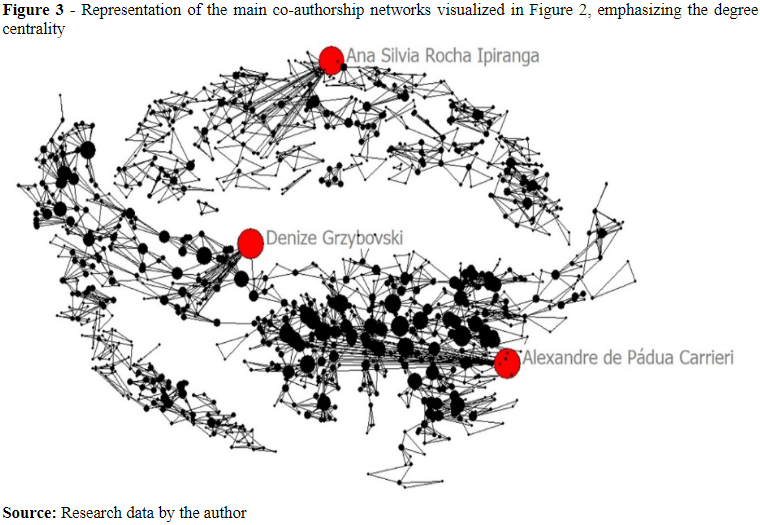
Figure 3 - Representation of the main co-authorship networks visualized in Figure 2, emphasizing the degree centrality
Source: Research data by the author
The research by Cassundé, Barbosa and Mendonça (2016) corroborates the findings of this section in regard to the usefulness, influence and relevance of the professors Clóvis L. Machado-da-Silva, Alexandre de Padua Carrieri and Francis Kanashiro Meneghetti in the scientific production; being the last two the authors who also stand out in the scientific collaboration network, appearing as central researchers in the area (RIBEIRO; CIRANI; FREITAS, 2013). The findings in this section help to understand and contribute to perceive the importance of the collaboration among researchers in a social network. Through their tiesand connections, those scholars - with their respective thoughts, insights, information and scientific knowledge - provide a range of opportunities in the knowledge construction, as well as in the expansion and robustness of science (CRUZ et al., 2011).
The authors who achieve greater focus and, therefore, are considered more influential in the network, lead to and impact the dissemination and socialization of the scientific knowledge. Directly or indirectly, they influence the emergence of new centers and research groups, being a positive reinforcement to the appearance of researchers who yearn and wish to diversify and / or foster their knowledge, to finally enter the academic field of publications and socialization of their studies in scientific events. That is the case of the currently studied EnEO, which contributes to the enhancement and maturation of themes such as the Organizational Studies and its themathics that branch out in the national academic literature. The dialogue that happens via scientific collaboration among the institutional co-authorship networks leads to a consolidation of hypotheses and central objectives of the scientific research(ALVES; PAVANELLI; OLIVEIRA, 2014). That said, Figure 4 shows the social network of the 210 institutions identified in this study.
By analyzing Figure 4, we immediately notice a network divided into eight distinct groups, as well as 22 institutions that publish without partnership. Among the eight clusters inthat network, one is in evidence, since it comprises about 82% of the 210 HEIsidentified in this study. In this cluster, the biggest interaction influenced the density of the referred network, measuring 0.201, which represents an interaction of 20% of the institutions involved in the scientific production of the topic under study in this research. We verify that, even not having a very high density, there is a cluster that stands out by means of a robust grouping. By that, it is noticeable that several institutions are directly or indirectly connected, which generates important contributions to the formation of social capital (ROSSONI; GUARIDO FILHO, 2007), and consequently, to the construction of the scientific knowledge of the investigated theme / area, in the national academic literature.
In fact, the scientific event under investigation is still recent in regard to the number of editions carried out. From that position, it is viable to expect that the density of the aforementioned network will increase, because, in the course of future editions, more and more authors and, concomitantly, institutions will be linked among the actors involved in the academic production process of the organizational studies. This fact will influence and contribute to fostering relationships and, consequently, reducing the dispersion of the HEIs social network approached in this work. Figure 5 includes in its spectrum, the largest social network visualized and highlighted in Figure 4 (on the right), focusing on the degree centrality, as well as on the most relevant and important HEIs, in regard to the academic production of the articles highlighted in the 10 Editions of EnEO to date.
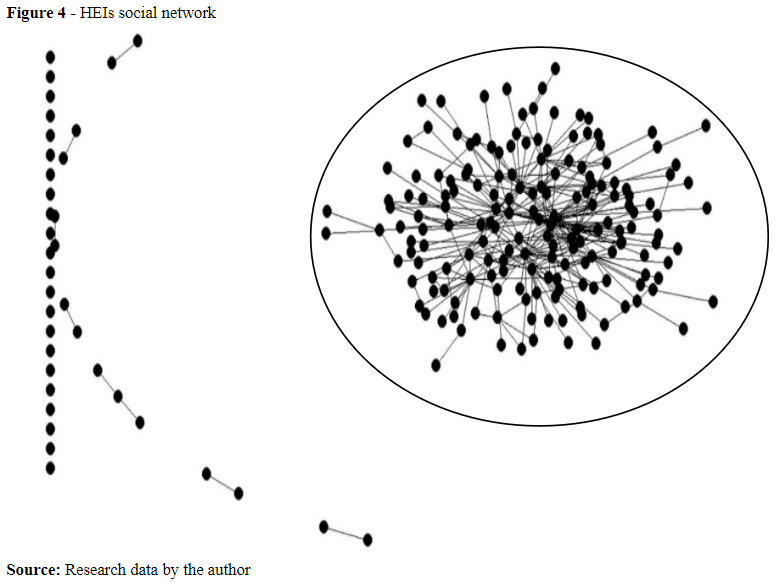
Figure 4 - HEIs social network
Source: Research data by the author
Figure 5 highlights 27 HEIs as those with the largest degree centrality in the collaboration network of institutions. However, in regard to the applicability of the scientific production, 11 institutions are placed as the most prolific and with the greatest influence and relevance to the scientific production of the theme under investigation. They are: UFMG, UFRGS, FGV (SP), UFPR, UFLA, UFPE, FGV (RJ), UFBA ̧ UFES, UFSC e USP.
It is interesting to remark that the institutions highlighted in this section are responsible for 50% or more of the academic production in their respective States of the Brazilian Federation, on the subject of Organizational Studies under the perspective of the EnEO. It is interesting to remark that the institutions highlighted in this section are responsible for 50% or more of the academic production of their respective Brazilian Federation States, on the subject of Organizational Studies under the perspective of EnEO.
In regard to the applied study techniques, the findings of the scientific papers by the researchers Mello, Crubellate and Rossoni (2010) and Smolski et al. (2017), which are similar to our study, corroborate the results shown in this section. Those results highlight the aforementioned institutions in terms of their respective relevance both in the scientific production and in the HEIs collaboration networks of their published scientific studies.
Even not being in evidence in Figure 5, it is worth to mention that not only Brazilian HEIs are among the 210, but also international institutions are identified. We list here the international HEIs with more relevance in our study: University of Quebec (Canada) with four published articles; and the University of Coimbra (Portugal) and the University TÉLUQ (Canada) appear with two publications. This fact shows that the EnEO event is interested in disclosing and disseminating the academic production of the Organizational Studies in the international panorama as well. This initiative influences and contributes to the optimization and expansion of the aforementioned theme in the scientific literary context in Brazil. Thisresult demonstrates the importance of those institutions in the construction of the scientific knowledge and to the science promotion and expansion in the national and, perhaps, international context, for the subject under investigation. Furthermore, it influences and contributes to the growth and maturation of the organizational studies with disciplines and themes that ramify it inthe national scientific sphere. It is worth to mention that the scientific production on the referred subject is larger in the states of the Southeast and South regions of Brazil, although the Northeast region is also in evidence, even with less propagation.
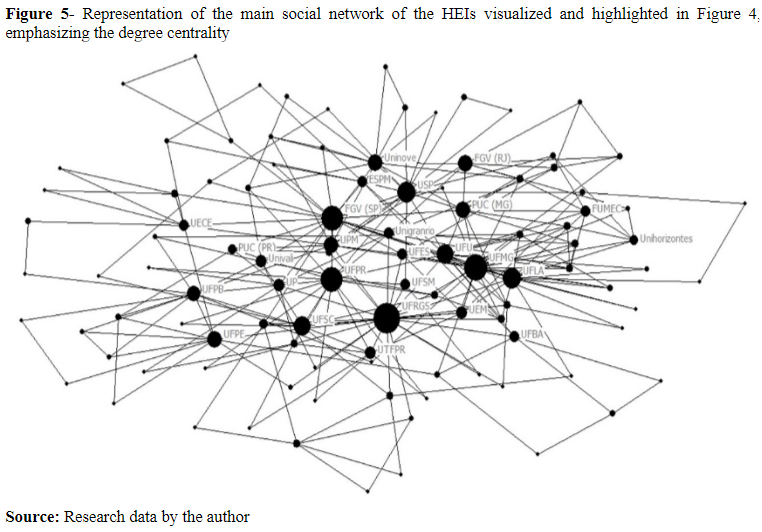
Figure 5- Representation of the main social network of the HEIs visualized and highlighted in Figure 4, emphasizing the degree centrality
Source: Research data by the author
Figure 6 identifies the social network of the Brazilian States together with some cities in the world (totaling 45 actors) that were identified in our study, emphasizing first the degree centrality and, later, the States of Brazil with greater distinction in the production of articles published along the EnEO 10 Editions. By analyzing Figure 6, we can say that its correlation with Figures 3, 5 and 7 is visible. The collaboration network of the States and of some international cities brings a special focus to the States of MG, SP, RS and PR, being aligned with the HEIs that have the highest productivity in this study, which are UFMG, UFRGS, FGV (SP) and UFPR. This fact corroborates the information presented in Figure 5 and thus showing the influence that these States have on the expansion and dissemination of the Organizational Studies thematic in the Brazilian academic literature. The studies by Mello, Crubellate and Rossoni (2010), Nascimento and Beuren (2011), Pontes et al. (2017) and Smolski et al. (2017), which are analogous to this one, corroborate our results explained here
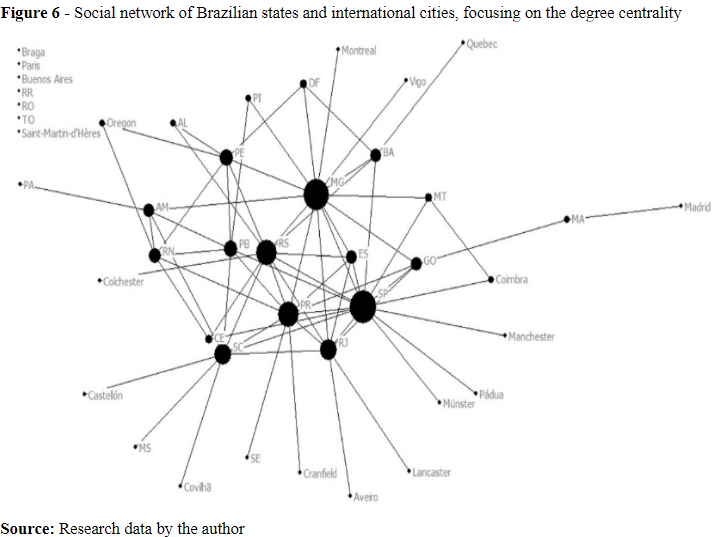
Figure 6 - Social network of Brazilian states and international cities, focusing on the degree centrality
Source: Research data by the author
In regard to the international cities visualized in Figure 6, they are the following: Quebec (Canada) with six published articles; Coimbra (Portugal) with two published studies; and the cities of Aveiro (Portugal), Braga (Portugal), Buenos Aires (Argentina), Castellón (Spain), Colchester (United Kingdom), Covilhã (Portugal), Cranfield (United Kingdom), Lancaster (United Kingdom), Lisbon ( Portugal), Madrid (Spain), Manchester (United Kingdom), Montreal (Canada), Münster (Germany), Oregon (United States), Padua (Italy), Paris (France) and Saint-Martin-d'Hères (France), all of them with one study each published. Another interesting data shown in Figure 6 is the visualization of a single cluster with 38 actors (states and some international cities), which are equivalent to 84% of the amount.
In general, these 38 actors are directly or indirectly connected, by forming a single integrated social network; this helps to understand and to comprehend how information, knowledge and scientific knowledge about the subject under investigation is disseminated and socialized in some states (part of Brazil) and in some international cities, by means of their respective HEIs of origin and of the researchers who are part of it. This brings optimization and better performance toregions of Brazil that stand out not only in the academic sphere, but also in business, such as the Southeast and South regions (RIBEIRO, 2014). The social network analysis is used to identify, map and investigate the regional and national collaboration (ALVES; PAVANELLI; OLIVEIRA, 2014). In this context, Figure 7 shows the social network of the five regions of Brazil, focusing on the degree centrality as well.
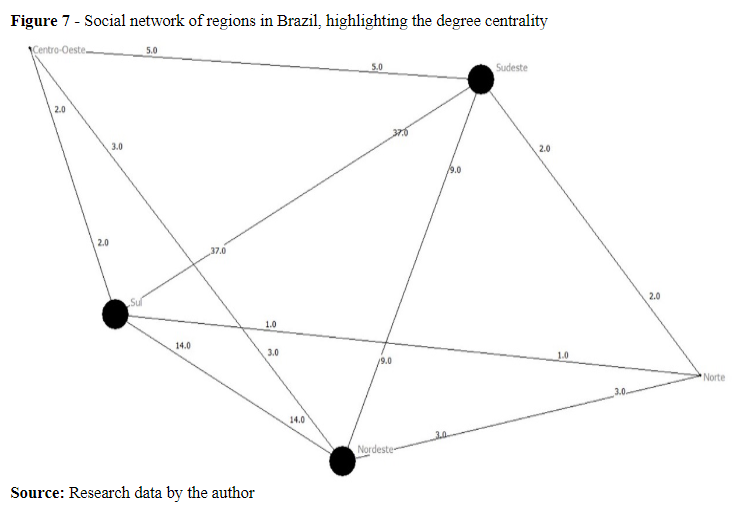
Figure 7 - Social network of regions in Brazil, highlighting the degree centrality
Source: Research data by the author
Analyzing the social network of the Brazil regions, we see the predominance of the Southeast and South regions, by publishing in partnership for 37 times. We emphasize that, when publishing in partnership, it is important to show that the partnership is originated from the HEIs, or better saying, it comes from the States highlighted in Figure 6, and simultaneously from the regions highlighted in Figure 7, making it a prominent interaction. The fact that those regions, by the means of the actors that consolidate them, have a strong relation, impacts and contributes to the relevance and influence of those regions in the construction, composition and promotion of the scientific production of Organizational Studies in Brazil.
Following, the interaction between the South and Northeast regions comes in 14 opportunities (reiterating that the connections are made by the HEIs and those, by the authors that compose them; see Figures 1, 2, 3, 4 and 5). Such interaction also placed the Northeast region in highlight on the network visualized in this section. In third, comes the link between the Southeast and Northeast regions manifested nine times. Being those the main connections that occurred in the social network of Figure 7. The further interactions between the other two regions of this research did not exceed five times.
Another fact that contributes to the prominence of the Southeast and South regions in the scientific production of various themes in Brazil, especially the Organizational Studies, which are the focus of our study, is the number of Graduate Programs in Administration and related fields that those regions contain (MELLO; CRUBELLATE; ROSSONI, 2009; MELLO; CRUBELLATE; ROSSONI, 2010; CARDOSO; BERNARDINO; PESSOA ARAÚJO, 2018; GUIMARÃES et al., 2018; SILVA et al., 2019). That directly impacts the creation and promotion of the active research groups in those areas, guides the various nuances of topics related to the area of Administration, and contributes to the evolution of science. The social network analysis is also applied to measure and investigate the collaboration among countries (ALVES; PAVANELLI; OLIVEIRA, 2014). Based on that, Figure 8 shows the social network of the countries identified in this study, with emphasis on the degree centrality.
The social network of the countries highlights Brazil as the most central country, what means, the most influential, important and relevant in the scientific production of the Organizational Studies. This fact is explained because, in despite of being an international event promoted by ANPAD, EnEO is a scientific event that has a predominance of Brazilian students, masters, doctoral students, professors, researchers and scholars; even though, as said before, the EnEO is open for the dissemination of the scientific works of international authors, as evidenced by the collaboration networks included in this study, especially those that make the presence of the international actors more transparent (see Figures 6 and 8).
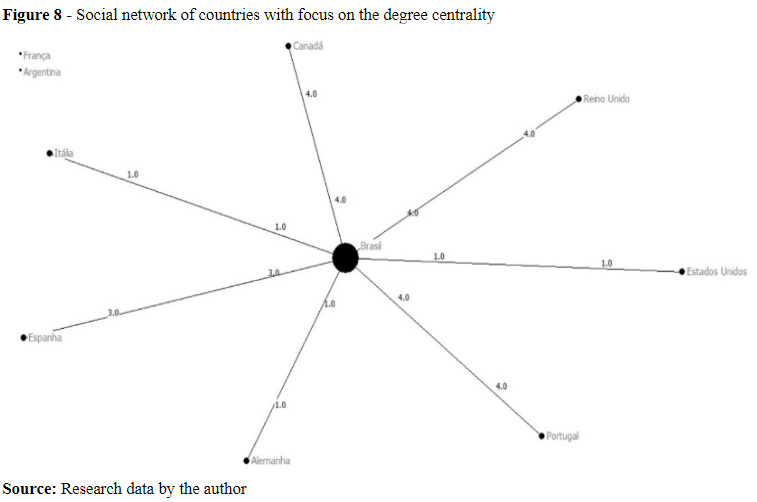
Figure 8 - Social network of countries with focus on the degree centrality
Source: Research data by the author
Yet on Figure 8, we see that only the countries Argentina and France do not partner with the collaboration network of nations. In contrast, the countries Canada, Portugal, United Kingdom, Spain, Germany, Italy and the United States partner with Brazil, or better saying, the institutions from international countries collaborate with national HEIs, through their respective researchers.
5 FINAL CONSIDERATIONS
Our study aim is to investigate the profile and characteristics of the scientific production of articles published in the 10 editions of the EnEO, under the perspective of social network analysis. For that, we used a quantitative approach, documentary research, bibliometric and sociometric techniques, with dominance of the social network analysis in 1,319 studies identified in the editions of the years 2000, 2002, 2004, 2006, 2008, 2010, 2012, 2014, 2016 and 2019. The main findings point to the existence of low density in all of the social networks investigated in our work, being them disperse and with low interaction; however, since the EnEO is still a new event, having only 10 editions, it is possible and plausible that the density of the investigated networks will expand, to influence and contribute to a greater connection among the actors involved in the process of publication, dissemination and socialization of the Organizational Studies academic production.
Yet in regard to the collaboration networks investigated in this work, we verified and evidenced that they all have a common characteristic, which is the creation of small worlds (ROSSONI, 2014); that means, clusters that stood out, thus enabling the emergence and structuring of research groups that made it possible to perform and strengthen the scientific production standards of the now investigated topic. That is, expanding the publications of studies on the analyzed subject. Another inherent characteristic in sparse networks is the high degree centrality, highlighting few authors who, in general, have a high number of publicationsand are well referenced (RIBEIRO; CIRANI; FREITAS, 2013). They appear as the most important, relevant, influential and with potential to lead or enable the emergence of new ideas, thoughts on new themes, and / or improve new knowledge; therefore, creating scientific value and strengthening the scientific production currently explored (CRUZ et al., 2011).
Therefore, we confirm that the Organizational Studies theme has evolved over the course of the EnEO editions, according to the co-authorship networks of the aforementioned event (Figure 1). Over the years, the referred scientific event has been growing and adding academic value, by means of harmonic and heterogeneous networks of collaborations, which aremeasured, visualized and contemplated throughout this study.
Even with low density in those social networks, we cannot deny that the EnEO scientific event is focused on achieving success in regard to enabling a continuous alignment with various actors who directly contribute to optimizing and expanding information, knowledge and academic knowledge about the Organizational Studies under the EnEO perspective; this fact directly contributes to empower the Administration area and / or its related fields in the scientific literature in Brazil.
That way, we conclude a profile and characteristics of the scientific production of the articles published in the 10 Editions of EnEO, under the perspective of the social network analysis. With a differentiated view, through the SNA, we help the understanding and comprehension on how the scientific production and collaboration behave among the actors involved in the publication procedure of the Organizational Studies and / or correlated themes. Given the above, it is tangible to say that our study contribution brings to light the nuances of the co-authorship networks collaborations, being them: researchers, HEIs, States, Regions and Countries in a contemporary way; that makes possible the creation of a research agenda on the aforementioned theme and in other similar scientific congresses in the area. And, lastly, this study contributes to a robust research agenda on the social network analysis, regarding the thematics, starting from the holistic view that was developed in this research.
Our study is limited to investigate the scientific production of the Organizational Studies theme, based solely on the EnEO. However, we remark that the findings expressed here are aligned with what we wanted to answer and achieve by the question and the objective of the study, respectively. With that, we make the following suggestions for future research: (i) to carry out an analogous research, using for that other scientific congresses in the area of administration; (ii) to replicate this research using a foreign approach, that means, international events; (iii) to develop social network analysis; (iv) to complement the centrality, by using the intermediation and proximity centralities; (v) to complement the collaboration networks analysis with bibliometric indicators; (vi) to perform co-citation analysis; and to carry out a systematic review, specially, focusing on latent thematics in regard to the organizational studies that are approached in this research.
References
ALLEGRETTI, A. C. V.; MOYSÉS, S. T.; WERNECK, R. I.; QUANDT, C. O.; MOYSÉS, S. J. Redes sociais na produção científica em administração pública da saúde no Brasil. Revista de Administração Pública, v. 52, n. 4, p. 571-592, 2018. DOI: http://dx.doi.org/10.1590/0034-7612162930.
ALVES, B. H.; PAVANELLI, M. A.; OLIVEIRA, E. F. T. Rede de coautoria institucional em Ciência da Informação: uma comparação entre indicadores de rede e os conceitos CAPES. Em Questão, v. 20, n. 3, p. 73-87, 2014.
AMARAL, R. M. do; QUONIAM, L.; FARIA, L. I. L. de; LEIVA, D. R.; MILANEZ, D. H.; FIORONI, J. Ultrapassando as barreiras de conversão e tratamento de dados: indicadores de produção científica dos programas de pós-graduação em engenharia de materiais e metalúrgica. Em Questão, v. 23, n. 1, p. 228-253, 2017. DOI: 10.19132/1808-5245231.228-253.
ANDRADE, L. F. S.; MACEDO, A. dos S.; OLIVEIRA, M. de L. S. A produção científica em gênero no Brasil: um panorama dos grupos de pesquisa de administração. Revista de Administração Mackenzie, v. 15, n. 6, p. 48-75, 2014. DOI: 10.1590/1678-69712014/administracao.v15n6p48-75.
ASSOCIAÇÃO NACIONAL DE PÓS-GRADUAÇÃO E PESQUISA EM ADMINISTRAÇÃO. EnEO 2019. Disponível em: http://www.anpad.org.br.
BACH, T. M.; DOMINGUES, M. J. C. de S.; WALTER, S. A. Tecnologias da informação e comunicação no ensino: um estudo bibliométrico e sociométrico de 1997-2011. Avaliação: Revista de Avaliação da Educação Superior, v. 18, n. 2, p. 393-416, 2013. DOI: 10.1590/S1414-40772013000200009.
BALSAN, L. A. G.; KNEIPP, J. M.; TONIN, S.; COSTA, V. M. F. Os vínculos que o indivíduo estabelece com a organização: uma análise da produção científica brasileira. Revista de Ciências da Administração, v. 18, n. 45, p. 25-37, 2016. DOI: 10.5007/2175-8077.2016v18n45p25.
BEHR, R. R.; NASCIMENTO, S. P. A gestão do conhecimento como técnica de controle: uma abordagem crítica da conversão do conhecimento tácito em explícito. Cadernos EBAPE.BR, v. 6, n. 1, p. 1-11, 2008. DOI: 10.1590/S1679-39512008000100003.
BORDIN, A. S.; GONÇALVES, A. L.; TODESCO, J. L. Análise da colaboração científica departamental através de redes de coautoria. Perspectivas em Ciência da Informação, v. 19, n. 2, p. 37-52, 2014. DOI: 10.1590/1981-5344/1796.
BOTELHO, R. G.; OLIVEIRA, C. da C. de. Literaturas branca e cinzenta: uma revisão conceitual. Ciência da Informação, v. 44, n. 3, p. 501-513, 2015.
BRAGA, M. J. da C.; GOMES, L. F. A. M.; RUEDIGER, M. A. Mundos pequenos, produção acadêmica e grafos de colaboração: um estudo de caso dos Enanpads. Revista de Administração Pública, v. 42, n. 1, p. 133-154, 2008. DOI: 10.1590/S0034-76122008000100007.
BUFREM, L. S.; MASCARENHAS, F.; SOBRAL, N. V. Análise das influências intelectuais na produção científica da área de Ciência da Informação: um estudo sobre os bolsistas de produtividade em pesquisa (PQ-CNPq). Em Questão, v. 23, p. 115-141, 2017. DOI: 10.19132/1808-5245230.115-141.
CARDOSO, T. R. N.; BERNARDINO, C. F.; PESSOA ARAÚJO, U. Isomorfismo normativo e redes na pesquisa científica brasileira. Revista Hispana para el Análisis de Redes Sociales, v. 29, p. 248-270, 2018. DOI: 10.5565/rev/redes.788.
CASSUNDÉ, F. R.; BARBOSA, M. A. C.; MENDONÇA, J. R. C. de. A influência da tradição anglo-saxônica nos estudos organizacionais brasileiros: o que mudou (ou+ não) nos últimos 15 anos? Perspectivas em Gestão & Conhecimento, v. 6, n. 1, p. 238-254, 2016.
CONNER, N.; PROVEDEL, A.; MACIEL, E. L. N. Ciência & Saúde Coletiva: análise da produção científica e redes colaborativas de pesquisa. Ciência & Saúde Coletiva, v. 22, n. 3, p. 987-996, 2017. DOI: 10.1590/1413-81232017223.18992016.
COSTA, A. de S. M. da.; SILVA, M. A. de C. A pesquisa histórica em administração: uma proposta para práticas de pesquisa. Administração: Ensino e Pesquisa, v. 20, n. 1, p. 90-121, 2019. DOI: 10.13058/raep.2019.v20n1.1104.
CRUBELLATE, J. M. Estudos organizacionais no Brasil: do futuro que queremos e do futuro que teremos. Cadernos EBAPE.BR, v. 3, n. 4, p. 1-4, 2005. DOI: 10.1590/S1679-39512005000400014.
CRUZ, A. P. C.; ESPEJO, M. M. dos S. B.; COSTA, F.; ALMEIDA, L. B. de. Perfil das redes de cooperação científica: Congresso USP de Controladoria e Contabilidade - 2001 a 2009. Revista Contabilidade &Finanças, v. 22, n. 55, p. 64-87, 2011.
CUNHA, P. R. da; PICCOLI, M. R. Influência do board interlocking no gerenciamento de resultados. Revista Contabilidade & Finanças, v. 28, n. 74, p. 179-196, 2017. DOI: 10.1590/1808-057x201701980.
FADUL, É. M. C.; SILVA, M. de A. M. A. da. Limites e possibilidades disciplinares da administração da administração pública e ação pública e dos estudos organizacionais. Revista de Administração Contemporânea, v. 13, n. 3, p. 351-365, 2009. DOI: 10.1590/S1415-65552009000300002.
FERRAZ, D. L. da S.; CHAVES, R. H. S.; FERRAZ, J. de M. Para além da epistemologia: reflexões necessárias para o desenvolvimento do conhecimento. Revista Eletrônica de Administração, v. 24, n. 2, p. 1-30, 2018. DOI: 10.1590/1413-2311.204.80474.
FERREIRA, J. B.; SILVA, L. de A. M. O uso da bibliometria e sociometria como diferencial em pesquisas de revisão. Revista Brasileira de Biblioteconomia e Documentação, v. 15, n. 2, p. 448-464, 2019.
FISCHER, T.; WAIANDT, C.; SILVA, M. R. da. Estudos organizacionais e estudos curriculares: uma agenda de convergência entre o passado e o futuro de campos paralelos. Organizações & Sociedade, v. 15, n. 47, p. 175-193, 2008. DOI: 10.1590/S1984-92302008000400010.
GUIMARÃES, T. A.; MOTTA, G. da S.; FARIAS, S. A. de; KIMURA, H.; QUINTELLA, R. H.; CARNEIRO, J. M. T. A ANPAD e o processo de institucionalização da comunidade científica brasileira de Administração. Cadernos EBAPE.BR, v. 16, Edição Especial, p. 523-537, 2018. DOI: 10.1590/1679-395173273.
KIRSCHBAUM, C. Análise de redes sociais: a bibliografia inicial. Revista de Administração de Empresas, v. 58, n. 1, 2018.
KROKOSCZ, M. Autoría en la redacción científica. Informação & Informação, v. 20, n. 1, p. 319-333, 2015.
LACRUZ, A. J.; AMÉRICO, B. L.; CARNIEL, F. Teoria ator-rede em estudos organizacionais: análise da produção científica no Brasil. Cadernos EBAPE.BR, v. 15, n. 3, p. 574-598, 2017. DOI: 10.1590/1679-395157007.
LEITE, F. C. L.; ASSIS, T. B. de; MELO, B. A. de. Gestão de teses e dissertações eletrônicas no brasil: sobre bibliotecas digitais de teses e dissertações e repositórios institucionais. Informação & Informação, v. 20, n. 3, p. 529-543, 2015. DOI: 10.5433/1981-8920.2015v20n3p529.
LEONARDO, S. B.; FARINA, M. C.; ANDREOLI, T. P.; LIMA, A. P. M. B. de. Relacionamentos interpessoais formal e informal: interação das redes no ambiente acadêmico. Revista de Administração Contemporânea, v. 23, n. 3, p. 395-415, 2019. DOI: 10.1590/1982-7849rac2019180045.
LIMA, M. Y. de. Coautoria na produção científica do PPGGeo/UFRGS: uma análise de redes sociais. Ciência da Informação, v. 40 n. 1, p.38-51, 2011. DOI: 10.1590/S0100-19652011000100003.
MACHADO-DA-SILVA, C. L.; VIZEU, F. Análise institucional de práticas formais de estratégia. Revista de Administração de Empresas, v. 47, n. 4, p. 89-100, 2007. DOI: 10.1590/S0034-75902007000400008.
MACHADO, F. C. L.; FERNANDES, T. A.; SILVA, A. R. L. da. Michel de Certeau e estudos organizacionais: uma leitura do cenário brasileiro. Caderno de Administração, v. 25, n. 2, p. 25-43, 2017.
MACHADO JUNIOR, C.; SOUZA, M. T. S. de; PARISOTTO, I. R. dos S.; PALMISANO, A. A contribuição da sociologia do conhecimento para os estudos de institucionalização e legitimação do conhecimento do campo científico. Organizações & Sociedade, v. 23, n. 77, p. 231-246, 2016a. DOI: 10.1590/1984-9230773
MACHADO JUNIOR, C.; SOUZA, M. T. S. de; PARISOTTO, I. R. dos S.; PALMISANO, A. As leis da bibliometria em diferentes bases de dados científicos. Revista de Ciências da Administração, v. 18, n. 44, p. 111-123, 2016b. DOI: 10.5007/2175-8077.2016v18n44p111.
MARTINS, D. L. Análise dinâmica de redes sociais de coparticipação em bancas de defesa de teses e dissertações: um estudo de caso a partir de múltiplos indicadores na área da Ciências da Comunicação. Encontros Bibli: Revista Eletrônica de Biblioteconomia e Ciência da Informação, v. 19, n. 40, p. 99-116, 2014. DOI: 10.5007/1518-2924.2014v19n40p99.
MELLO, C. M. de; CRUBELLATE, J. M.; ROSSONI, L. Dinâmica de relacionamento e prováveis respostas estratégicas de programas brasileiros de pós-graduação em administração à avaliação da Capes: proposições institucionais a partir da análise de redes de co-autorias. Revista de Administração Contemporânea, v. 14, n. 3, p. 434-457, 2010. DOI: 10.1590/S1415-65552010000300004.
MELLO, C. M. de; CRUBELLATE, J. M.; ROSSONI, L. Redes de coautorias entre docentes de programas brasileiros de pós-graduação (Stricto Sensu) em Administração: aspectos estruturais e dinâmica de relacionamento. Revista de Administração da Mackenzie, v. 10, n. 5, p. 130-153, 2009. DOI: 10.1590/S1678-69712009000500007.
MUÑOZ, E. O.; DELGADO, Y. H. Detección de comunidades a partir de redes de coautoría en grafos RDF. Revista Cubana de Información en Ciencias de la Salud, v. 27, n. 1, 2016.
NASCIMENTO, S. do; BEUREN, I. M. Redes sociais na produção científica dos programas de pós-graduação de ciências contábeis do Brasil. Revista de Administração Contemporânea, v. 15, n. 1, p. 47-66, 2011. DOI: 10.1590/S1415-65552011000100004.
PAULA, A. P. P.; MARANHÃO, C. M. S. de A.; BARRETO, R. de O.; KLECHEN, C. F. A tradição e a autonomia dos estudos organizacionais críticos no Brasil. Revista de Administração de Empresas, v. 50, n. 1, p. 10-23, 2010. DOI: 10.1590/S0034-75902010000100002.
PESSOA ARAÚJO, U.; MENDES, M. de L.; GOMES, P. A.; COELHO, S. de C. P.; VINÍCIUS, W.; BRITO, M. J. de. Trajetória e estado corrente da sociometria brasileira. Revista Hispana para el Análisis de Redes Sociales, v. 28, n. 2, p. 97-128, 2017. DOI: 10.5565/rev/redes.706.
PINHEIRO, J. L.; TOMAZ, C. M.; BUENO, N. X.; SILVA, W. A. C. Meio século de produção científica em mercado de capitais no Brasil em periódicos de alto impacto. Brazilian Business Review, v. 15, n. 3, p. 209-225, 2018. DOI: 10.15728/bbr.2018.15.3.1.
POBLACIÓN, D. A.; NORONHA, D. P. Produção das literaturas “branca” e “cinzenta” pelos docentes/doutores dos programas de pós-graduação em ciência da informação no Brasil. Ciência da Informação, v. 31, n. 2, p. 98-106, 2002. DOI: 10.1590/S0100-19652002000200011.
RIBEIRO, H. C. M. Bibliometria: quinze anos de análise da produção acadêmica em periódicos brasileiros. Biblios, n. 69, p. 1-20, 2017. DOI: 10.5195/biblios.2017.393.
RIBEIRO, H. C. M.; RIBEIRO, G. K. M. Análise de dez anos da produção acadêmica divulgada nos estudos científicos publicados no congresso ANPCONT. Revista Ciências Administrativas, v. 25, n. 1, p. 1-18, 2019. DOI: 10.5020/2318-0722.2019.7945.
RIBEIRO, H. C. M.; CIRANI, C. B. S.; FREITAS, E. J. da S. M. de. Análise da produção científica da revista de administração e inovação. Revista de Administração e Inovação, v. 10, n.4, p. 208-228, 2013. DOI: 10.5773/rai.v10i4.1139.
RIBEIRO, H. C. M.; CORRÊA, R.; RIBEIRO, G. K. M. Redes sociais de um e dois modos: trajetória da produção científica do Encontro de Ensino e Pesquisa em Administração e Contabilidade. Revista Gestão Universitária na América Latina, v. 12, n. 2, p. 253-270, 2019. DOI: 10.5007/1983-4535.2019v12n2p253.
RIBEIRO, H. C. M. Redes sociais: uma metanálise nos periódicos da área de administração no Brasil. Gestão & Regionalidade, v. 30, n. 88, p. 62-80, 2014.
RIBEIRO, H. C. M.; SANTOS, M. C. dos. Perfil e evolução da produção científica do tema governança corporativa nos periódicos Qualis/Capes nacionais: uma análise bibliométrica e de redes sociais. Revista Contabilidade, Gestão e Governança, v. 18, n. 3, p. 04-27, 2015.
RIBEIRO, H. C. M.; SANTOS, M. C. dos. Produção acadêmica das teorias enfatizadas nos estudos divulgados nos periódicos nacionais. Revista de Administração, Contabilidade e Economia, v. 15, n. 2, p. 649-684, 2016. DOI: 10.18593/race.v15i2.7235.
ROCHA, J. C.; TORRES, L. B.; CORTE, V. F. D.; VIACAVA, K. Panorama nacional de publicações em marketing social na administração. Revista de Administração IMED, v. 7, n. 2, p. 227-253, 2017. DOI: 10.18256/2237-7956.2017.v7i2.2076.
RODRIGUES, S. B.; CARRIERI, A. de P. A Tradição anglo-saxônica nos estudos organizacionais a tradição anglo-saxônica nos estudos organizacionais brasileiros. Revista de Administração Contemporânea, v. 5, n. Edição Especial, p. 81-102, 2001.
ROSSONI, L. Agência e redes mundos pequenos: uma análise multinível da produtividade acadêmica. Revista de Administração Mackenzie, v. 15, n. 1, p. 200-235, 2014.
ROSSONI, L.; GUARIDO FILHO, E. R. Cooperação interinstitucional no campo da pesquisa em estratégia. Revista de Administração de Empresas, v. 47, n. 4, p. 74-88, 2007. DOI: 10.1590/S0034-75902007000400007.
SAMPAIO, R. B.; SACERDOTE, H. C. de S.; FONSECA, B. de P. F.; FERNANDES, J. H. C. A colaboração científica na pesquisa sobre coautoria: um método baseado na análise de redes. Perspectivas em Ciência da Informação, v. 20, n. 4, p. 79-92, 2015. DOI: 10.1590/1981-5344/2447.
SILVA, L. C. da; GASPAR, M. A.; MAGALHÃES, F. L. F. de; GARCIA, R. D. R.; AIHARA, C. H.; MAURO, M. H.Perfil dos programas de pós-graduação stricto sensu em gestão do conhecimento no Brasil e seu panorama da produção científica. Revista da Avaliação da Educação Superior, v. 24, n. 1, p. 328-351, 2019. DOI: 10.1590/S1414-407720190001000017.
SMOLSKI, F. M. da S.; DALCIN, D.; VISENTINI, M. S.; BAMBERG, J.; KERN, J. S. Análise do perfil da produção científica da Revista de Administração Pública (RAP) no período 2003-16. Revista de Administração Pública, v. 51, n. 6, p. 1.139-1.163, 2017. DOI: 10.1590/0034-761220170046.
VISENTINI, M. S.; CHAGAS, F. B.; BOBSIN, D. A produção acadêmica sobre redes sociais virtuais no Brasil: análise dos artigos publicados em eventos entre 2006 e 2015. Revista Gestão & Conexões, v. 7, n. 1, p. 37-73, 2018. DOI: 10.13071/regec.2317-5087.2018.7.1.14789.37-73.
WALTER, S. A.; BACH, T. M.; BARBOSA, F. Estratégia como prática: análise longitudinal por meio de bibliometria e sociometria. Revista Brasileira de Estratégia, v. 5, n. 3, p. 307-323, 2012.
WALTER, S. A.; BACH, T. M. Inserção de pesquisadores entrantes na área de estratégia: análise das relações de autoria e temas estudados no período de 1997-2010. Revista Eletrônica de Administração, v. 19, n. 1, p. 165-191, 2013. DOI: 10.1590/S1413-23112013000100007.