Artigos
Management of family farming associations and cooperatives in the implementation of the Brazilian School Feeding Program in rural territories
Management of family farming associations and cooperatives in the implementation of the Brazilian School Feeding Program in rural territories
Gestão & Regionalidade, vol. 38, núm. 114, pp. 287-304, 2022
Universidade Municipal de São Caetano do Sul
Recepción: 30 Julio 2020
Aprobación: 27 Junio 2021
Abstract: The article analyzes, through a comparative perspective, the implications of normative, cognitive, and ideological elements of the implementation of the Brazilian School Feeding Program (PNAE) in rural territories at the local level, based on the administrative structure and work of leaders of family farming organizations. The qualitative research adopted multiple-case studies examining ten organizations in two Brazilian rural territories (Mato Grande, in the state of Rio Grande do Norte, and Serra do Brigadeiro, in the state of Minas Gerais). The organizations’ leaders operate under the influence of the local context of implementation, such as the provisions of Brazilian Law 11947/2009. Their work also depends on the administrative structure available, which has been changed in terms of access to technology, technical assistance, and material, human, and financial resources. The roles leaders play in the organizations do not change significantly, and all of them contributed to the implementation of the PNAE. Future studies on this issue could expand the analysis, contemplating other actors such as street-level bureaucrats.
Keywords: Brazilian School Feeding Program (PNAE), public policy implementation, associations and cooperatives, family farming, rural territories.
Resumo: O artigo objetiva analisar, no plano local, no aparato administrativo e na atuação de dirigentes de organizações da agricultura familiar, implicações de elementos normativos, cognitivos e ideológicos atinentes à implementação do Programa Nacional de Alimentação Escolar (PNAE) em territórios rurais, de forma comparativa. De natureza qualitativa, a pesquisa consiste em estudo de casos múltiplos em dez organizações nos Territórios do Mato Grande/RN e da Serra do Brigadeiro/MG. Os diretores dessas organizações têm atuação moldada pelo contexto local da implementação, como influências da Lei nº 11.947/2009. A atuação também sofre interferências do aparato administrativo das organizações, que foi alterado em termos de recursos materiais, humanos e financeiros e no acesso a tecnologias e assistência técnica. Não há diferenças significativas nos papéis desempenhados pelos dirigentes das organizações, de modo que todos contribuíram na implementação do PNAE. Sugere-se a ampliação do campo de estudo, contemplando atores como burocratas de nível de rua.
Palavras-chave: Programa Nacional de Alimentação Escolar (PNAE), implementação de políticas públicas, associações e cooperativas, agricultura familiar, territórios rurais.
INTRODUCTION
This article establishes connections between school feeding and family farming, presenting empirical evidence observed in two rural territories in different Brazilian states. School feeding and family farming are two segments of public policies in the global agenda to fight hunger. According to the 2019 report “El estado de la seguridad alimentaria y la nutrición en el mundo” (The state of food security and nutrition in the world) prepared by the Food and Agriculture Organization of the United Nations (FAO), the International Fund for Agricultural Development (IFAD), the World Health Organization (WHO), the World Food Program (WFP), and the United Nations Children’s Fund (UNICEF), about 820 million people worldwide did not have sufficient access to food in 2018, compared to 811 million in 2017 – this indicator has increased since 2015. The report highlights Brazilian initiatives to combat inequality via the Zero Hunger Program, the conditional cash transfer program Bolsa Família, the Rural Pension Plan, and the National School Feeding Program (PNAE).
The starting point of this analysis is the implementation of Law 11947 of June16, 2009. Article 14 of this law establishes that at least 30% of the total financial resources transferred by the National Education Development Fund (FNDE) to finance the PNAE must be used in the acquisition of foodstuffs directly from family farming and rural family entrepreneurs or their organizations (Lei n. 11.947/2009). The obligation to purchase foodstuffs from family farming brings innovation to public administration – in terms of public procurement designed for this public – and the need to open dialogues with this specific segment of production .
The enforcement of Law 11947/2009 led to reaction and resistance – in the normative domain – within the public administration. The law carries a cognitive bias, a particular understanding of the government procurement process combined with an ideological dimension, i.e., the affirmation of political identities and commitments to reduce poverty and food insecurity in the countryside and strengthen family farming. Against this backdrop, this research seeks to answer the following question: how does the management of family farming organizations in rural territories occur in the implementation of the National School Feeding Program (PNAE)? The article adopts a comparative perspective to analyze the implications of normative, cognitive, and ideological elements of the implementation of PNAE in rural territories at the local level, observing the administrative structure and the leaders of family farming organizations.
When discussing directions for a research agenda on policy implementation in Brazil, Lotta et al. (2018) propose themes such as the challenges of federalism, the impact of publicizing services, participatory processes, contexts of heterogeneity, inequalities, and intersectoriality. Following this proposal, this article contributes by addressing the challenges of federalism in Brazil. Although the legal framework has a national scope, the instruments for implementing the PNAE are adopted locally with high discretion, both regarding the form of execution and the policy content.
Winter (2010) conducted a critical examination of the development and status of the field of policy implementation research. For the author, comparative research is one of the elements that contribute to the improvement of the theme, helping to increase knowledge and classify the influence of different implementation variables. Therefore, this article innovates by adopting a comparative perspective to analyze policy implementation – which is often conducted observing single cases – in two rural territories in different Brazilian states and regions (in Rio Grande do Norte (RN), Northeast; and in Minas Gerais (MG), Southeast).
The article addresses the implementation of PNAE. It is a phase of the program that requires commitment from the actors involved, both public managers and leaders of family farming organizations. The organizations’ leaders are considered in this research as intermediary agents between family farming and the public procurement market. Therefore, their work is influenced by regulations, the administrative structure available, and the local context of family farming, together with the influence of the stakeholders’ ideas, values, and worldviews.
PUBLIC POLICY IMPLEMENTATION: NOTES ON THE ANALYTICAL MODEL
Public policy is defined as “the sum total of government action, from signals of intent to the final outcomes” (CAIRNEY, 2020, p.2); or as “the actions, objectives, and pronouncements of governments on particular matters, the steps they take (or fail to take) to implement them, and the explanations they give for what happens (or does not happen)” (WILSON, 2006, p.154). For Cairney (2020), public policy is essential for influencing all aspects of life; thus, it is essential to define it correctly or, at least, it is crucial to explain the problems in the public sphere and point out directions on how to address them.
According to Mazetto (2015), public policies are the product and expression of the state structure of a given social formation. Therefore, they are not just administrative decisions or technicalentities resulting from management planning – considering that policies are rooted in the state structure and therefore manifest the state logic; they represent an index that helps to understand the perspective of the state legal and political structure.
According to Sebatier and Mazmanian (1980), policy implementation refers to executing a basic political decision that identifies a problem, stipulates the objective, and establishes an implementation process. According to Hill and Hupe (2002), contextualization is essential in the scope of the implementation theory and research. Implementation is always connected to specific policies as particular responses to specific problems in society.
Bonelli et al. (2019) stress that traditional models (top-down approach) still prevail in the literature. However, there has been an evolution of studies on public policy implementation, revealing different generations of models such as the generation of top-down approaches, bottom-up approaches, and the generation of these perspectives considering implementation as a process that develops gradually through the interaction of the many actors involved. Lima and D’Ascenzi (2013) work in the perspective of implementation asan execution and adaptation process mediated by the government and its agents. The authors report that the analytical models of implementing public policies find their limits in the overestimation of the importance of norms (top-down approach) or the discretion of the executors (bottom-up approach).
For Lima and D’Ascenzi (2013), on the one hand, the focus on the normative framework disregards the influence of implementers. On the other, the discretion attributed to implementers underestimates the influence of normative variables in policy implementation. Therefore, the authors propose an analytical model for studies on policy implementation where implementation analysis must contain elements such as the plan’s characteristics, the organization of the administrative structure responsible for implementation, and the ideas, values, and worldviews of individuals participating. Table 1 synthesizes the authors’ model based on the main characteristics of each element.
| Plan | The content of norms structuring public policies will be included in established processes and adapted to the conceptions and capabilities of government instances and implementing bureaucracies. In this scenario, the analysis of the plan’s characteristics helps to understand the reaction of the implementation instances. |
| Organization of the administrative structure | The plan will be absorbed, translated, and adapted to the possibilities and constraints of the agencies and individuals who will carry it out. Thus, factors such as availability and quality of human and material resources, structure and dynamics of organizational rules (formal and informal), information flow and availability, influence how the appropriation and implementation of the plan will occur in local areas. |
| Ideas, values, and worldviews | Cognitive variables act as a link between the plan and its appropriation. This element concerns the influence of ideas on the actors’ actions since they shape the decision-makers’ perception of issues. Also, the analysis of cognitive variables considers the role of social groups, their relations with state actors, and how these relations affect policy implementation. |
Based on Lima and D’Ascenzi’s(2013) model, this research analyzes the implementation of PNAE in rural territories, considering: i) the characteristics of the plan, from the characteristics of associations and cooperatives; ii) the administrative structure, observing human, material, and financial resources; iii) ideas, values, and worldviews, examining the leaders of family farming cooperatives and associations. The analysis of the implementation of the PNAE through family farming organizations allows systematizing the limitations and possibilities inherent to the elements ‘plan’ and ‘administrative structure’ from the work of the organizations’ leaders since they lead the implementation of the program and influence the policy outcomes after the phase of formulating the public procurement announcement. Another element that stands out in the analysis is the quality of interactions, symmetries, and asymmetries of ideas, values, and worldviews among individuals from different places (countryside, city) and 5These territories were chosen based on opportunity. The data collection was conducted as part of a doctoral consortium project (in which this article originated) with funding from the Coordination for the Improvement of Higher Education Personnel (Capes), involving the Federal University of Rio Grande do Norte (UFRN), Federal University of Viçosa (UFV), and the Federal University of Cariri (UFCA).6 The DAP Jurídica (DAP as a legal entity) is used to identify and qualify the forms of organization family farmers adopt when operating as legal entities (Ordinance 523, of August 24, 2018). Also, having a valid DAP as a legal entity is one of the conditions to participate in PNAE’s public procurement announcements.different economic segments (public administration, family farming).
METHODOLOGY
This descriptive and qualitative research adopted the method of multiple-case study. According to Yin (2001), each case in a multiple-case study has a specific purpose within the global scope of the research. This study uses a comparative perspective to analyze two blocks of cases, represented by organizations located in rural territories of two Brazilian states (Rio Grande do Norte – RN and Minas Gerais –MG). Figure 1 shows the organizations’ selection criteria in the two territories, Mato Grande (RN) and Serra do Brigadeiro (MG).5 It is worth noting that the base criterion was the organization’s status in the Brazilian National Program to Strengthen Family Farming (PRONAF). The organization had to have a valid declaration of aptitude to operate within Pronaf (DAP) as a legal entity,6 which was verified by searching the website of the Special Secretariat for Family Farming and Agrarian Development (SEAD, 2019).
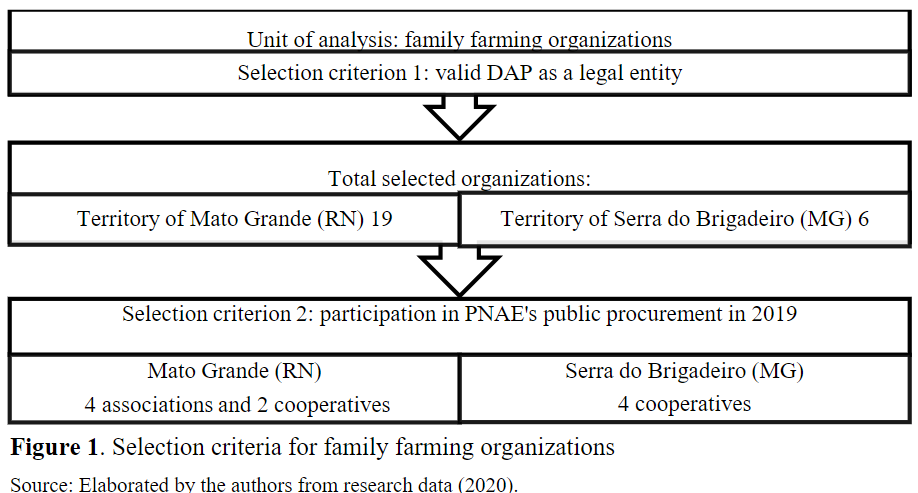
The case study subjects are leaders of the researched family farming organizations listed in Table 2. One of the organizations selected (Cooperativa de Agricultores Familiares e Pescadores Artesanais da Ecosol da Região do Mato Grande – COOAFES) did not meet the criteria of having participated in PNAE’s public procurement in 2019. This exception was made because COOAFES is the only organization operating at the territorial level, which allows understanding the territorial attributes of the phenomenon investigated.
| Ceará-Mirim | Associação para o Desenvolvimento da Mulher de São José de Pedregulho (Associação de Pedregulho) |
| Associação do Projeto de Assentamento e Reforma Agraria Riachão (Associação de Riachão) | |
| Associação dos Trabalhadores Rurais da Agrovila Nova Esperança Projeto de Assentamento Rosário (Associação de Rosário) | |
| João Câmara | Cooperativa de Agricultores Familiares e Pescadores Artesanais da Ecosol da Região do Mato Grande (COOAFES) |
| Pureza | Cooperativa Mista da Agricultura Familiar e Economia Solidária de Bebida Velha (COOPABEV) |
| Touros | Associação de Mulheres Lutadoras de Lilás de Boqueirão (Associação de Boqueirão). |
| Araponga | Cooperativa dos Agricultores (as) Familiares e Economia Solidária de Araponga/MG (COOAFA) |
| Divino | Cooperativa da Agricultura Familiar de Divino e Orizânia –MG (COOPERDOM) |
| Fervedouro | Cooperativa dos Agricultores Familiares e Economia Solidária de Fervedouro (COOPAF Fervedouro) |
| Muriaé | Cooperativa dos Produtores da Agricultura Familiar Solidária (COOPAF Muriaé) |
Data was collected through semi-structured interviews, prepared based on the research objectives and theoretical framework. The interviews were conducted in April 2019. The research has a certification of its submission to ethical evaluation (CAAE) and was approved by the Research Ethics Committee (CEP) of the Federal University of Rio Grande do Norte (UFRN)
Following Flick’s (2008) protocol, the process of coding the interviews’ content was conducted in different phases: a) open coding (in vivo), to express data and phenomena in the form of concepts; b) axial coding, to improve and differentiate the categories resulting from open codification; c) selective coding, to continue axial coding by improving the development and integration of the codification compared to other groups. Before coding, the interviews were transcribed and read. In this process, initial codes from in vivo processes were generated (first coding phase).
After in vivo coding, we searched for themes via axial coding, which allowed grouping codes into “families” corresponding to categories previously defined based on the theoretical framework, processed afterward using the software Atlas.ti. In the selective coding phase, the grouping of codes was improved by comparing the codes present in the three categories to verify whether the code agglutination process was consistent with the literature. The collected and transcribed material was analyzed using the Atlas.ti data analysis software, chosen due to accessibility and usability.
ANALYSIS OF RESULTS
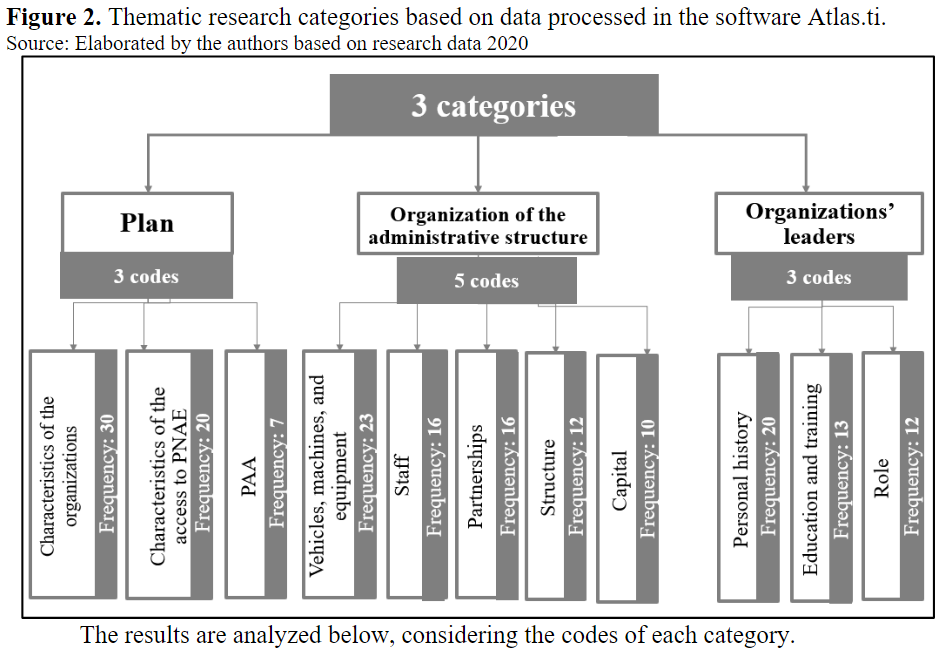
The relationship between Lima and D’Ascenzi’s (2013) policy implementation model and the implementation of PNAE through family farming associations and cooperatives in the rural territories analyzed is illustrated in Figure 2. The figure shows the alignment among the three thematic categories established by the authors and the codes and respective frequencies generated from the processing of the content using Atlas.ti.
Category 1: Plan
This category presents the characteristics of the local plan. Table 3 shows the frequency of codes in the category. The code “characteristics of the organizations” refers to aspects related to the number of members, the year of creation, and the form of creation (top-down or bottom-up). The code “characteristics of the access to PNAE” included elements such as the number of schools and types of products the organizations supply to schools. The code “Food Purchasing Program – PAA” refers to associations and cooperatives that started selling to the government through procurement processes within the scope of the PAA. Before Law 11947/2009 – which established the mandatory government purchase to PNAE from family farming – a similar process was institutionalized via PAA. Therefore, when elaborating the plan category, the PAA appears as a condition prior to the phenomenon researched.
| Mato Grande/RN | Associação de Pedregulho | 1 | 1 | 1 | 3 |
| Associação de Riachão | 1 | 1 | 1 | 3 | |
| Associação de Rosário | 1 | 1 | 1 | 3 | |
| Associação de Boqueirão | 1 | 1 | 1 | 3 | |
| COOPABEV | 1 | 1 | 1 | 3 | |
| COOAFES | 1 | 1 | - | 2 | |
| Serra do Brigadeiro | COOAFA | 1 | 1 | 1 | 3 |
| COOPERDOM | 1 | 1 | - | 2 | |
| COOPAF Fervedouro | 1 | 1 | - | 2 | |
| COOPAF Muriaé | 1 | 1 | 1 | 3 | |
| TOTAL | 10 | 10 | 7 | 27 |
Associação de Pedregulho is a membership organization created by female farmers in 2003 on the territory of Mato Grande/RN. In 2012, they started selling their production via PAA, and have supplied PNAE since 2018. Associação de Riachão was created in 2004 at a meeting of the farmers union Sindicato dos Trabalhadores Rurais (STR). In 2007, the organization started to sell via PAA, and it has supplied PNAE since 2009. Associação de Rosário was created in 1999, selling to intermediaries or via PAA. In 2009 the organization started to sell to PNAE. Associação de Boqueirão was created in 2006, established around a grant received to start a factory to produce fruit pulp. In 2009 the organization started to supply fruit pulp to the school feeding program PNAE. Before that, the production was sold to intermediaries and via PAA. COOPABEV was created in 2011 and started to sell to PNAE in 2013. COOAFES did not sell to PNAE in 2019. As mentioned before, it was included in the research because it is the only organization in the two territories analyzed that operates at the territorial level. Table 4 summarizes the information for each organization.
| Associação de Pedregulho | 2003 | 2018 | 25 | 73 |
| Associação de Riachão | 2004 | 2009 | 73 | 55 |
| Associação de Rosário | 1999 | 2009 | 55 | 55 |
| Associação de Boqueirão | 2006 | 2009 | 81 | 33 |
| COOPABEV | 2011 | 2013 | 26 | 7 |
| COOAFES | 2009 | 2015-2016 | 50 | - |
As for cooperatives in the Territory of Serra do Brigadeiro/MG, COOAFA was created in 2015, but farmers have accessed the PNAE through an informal group since 2010 and through the local association of farmers since 2012. COOPERDOM was also created in 2015. The opportunity of selling to PNAE was a critical element in the farmers’ decision to create the cooperative (before creating the organization, farmers used to supply to school feeding programs via a local farmers’ association. COOPAF Fervedouro was created in 2013 and, since then, the entire production has been destined to PNAE. COOPAF Muriaé was created in 2012, but the cooperative only made its first sale to PNAE in 2015. Before starting the cooperative, farmers sold their production via PAA directly (from 2007 to 2010) and through a local association (from 2010 to 2015). In 2015, the farmers suspended sales through the local association and started to sell through COOPAF Muriaé. Table 5 summarizes the characteristics of the organizations.
| COOAFA | 2015 | 2010 | 34 | 9 |
| COOPERDOM | 2015 | 2009 | 36 | 29 |
| COOPAF Fervedouro | 2013 | 2009 | 45 | 5 |
| COOPAF Muriaé | 2012 | 2010 | 120 | 160 |
Rios and Carvalho (2007) also stress that associations have the advantage of organizing stakeholders more organically from the social point of view, without the administrative and economic weight of a business structure. For the authors, although the associations are functional as structures that allow tests and building practical experience, this administrative advantage has its limitations in terms of accessing the market. The role of associations was verified in the analysis of cooperatives in the territory of Serra do Brigadeiro, where farmers could start operating collectively before forming cooperatives to access the opportunities offered by the public policy.
Most organizations in both territories started a bottom-up process after a decision from farmers. The same happened with the decision to participate in PNAE. The bottom-up model emphasizes elements of the context in which the policy is implemented, and its variables are related to the conditions of local spaces (LIMA; D’ASCENZI, 2013). Another relevant aspect is associated with the interrelationship between public policies. As observed in the frequency analysis of the PAA code, for all associations and cooperatives in the territory of Mato Grande, and for COOAFA and COOPAF Muriaé in Serra do Brigadeiro, the organizations first accessed the PAA – a program that also purchased food from family farming – then they started to sell to PNAE. Therefore, prior experience of a public policy may facilitate opening opportunities to access new markets.
Escobal et al. (2015) highlight the importance of recognizing that public policies and programs implemented in a territory find a series of structures and processes already in place that can strengthen or weaken their effects. This research showed that the existence of family farmer organizations in the territories and their previous experience with the PAA facilitated the implementation of PNAE, which, in turn, contributed to strengthening the structure of these associations and cooperatives. The analysis of the categoryplan, represented by the code characteristics of the organizations in the territories, contributes to identifying particularities regarding the administrative structure and the organizations’ leaders.
Category 2: Organization of the administrative structure
Table 6 presents the frequency analysis of codes in this category. The codes associated with access to resources show their relationship with the day-to-day implementation and the established partnerships. Other elements that influence how the plan’s appropriation and implementation occur in local spaces refer to formal and informal rules through the institutional devices of the PNAE and their interfaces with particularities of family farming and suppliers, mediated by specific norms of associations and cooperatives.
| Mato Grande/RN | Associação de Pedregulho | 2 | 1 | 1 | 1 | 1 | 6 | |||
| Associação de Riachão | 3 | 2 | 1 | 1 | 1 | 8 | ||||
| Associação de Rosário | 0 | 1 | 1 | 1 | 1 | 4 | ||||
| Associação de Boqueirão | 3 | 1 | 1 | 1 | 1 | 7 | ||||
| COOPABEV | 1 | 1 | 1 | 1 | 1 | 5 | ||||
| COOAFES | 2 | 1 | 1 | 1 | 0 | 5 | ||||
| Serra do Brigadeiro/MG | COOAFA | 0 | 1 | 1 | 1 | 0 | 3 | |||
| COOPERDOM | 2 | 1 | 1 | 1 | 0 | 5 | ||||
| COOPAF Fervedouro | 2 | 3 | 1 | 1 | 0 | 7 | ||||
| COOPAF Muriaé | 5 | 4 | 2 | 1 | 0 | 12 | ||||
| 20 | 16 | 11 | 10 | 5 | 62 | |||||
In this category, most organizations in the territory of Mato Grande/RN, except for the Associação de Boqueirão and COOAFES, do not have their own vehicles to deliver their products to the schools. Associação de Boqueirão has a semi-refrigerated van and a truck. COOAFES has two pickup trucks acquired in 2011/2012, in a contract with the Brazilian Development Bank (BNDES) in partnership with the National Supply Company (CONAB) designed to support logistics related to PNAE in the state of Rio Grande do Norte. The other associations and cooperatives in the territory of Mato Grande/RN lease trucks to deliver their products to schools.
Funds for projects were also essential to help cooperatives in Serra do Brigadeiro to acquire vehicles. COOPAF Muriaé obtained a truck through a project related to the Serra do Brigadeiro Territorial Development Plan in 2009. A van was granted through a free lease agreement in the scope of a project led by a federal deputy,7 and the pickup truck was obtained with the Center of Alternative Technologies of Zona da Mata (CTA). The cooperative bought a motorcycle with its own resources. In the case of COOPERDOM, the CTA donated a pickup truck as part of a project in partnership with the local farmers association. As for COOPAF Fervedouro, the vehicle used is shared with the local association. Finally, farmers of COOAFA use their personal vehicles to deliver the products to the schools.
Other types of resources are machines and other equipment. In the territory of Mato Grande, only COOPABEV has a computer with Internet 7The role of political agents in Muriaé is connected with the relationship they have with implementers of PNAE. The political agents help to obtain vehicles to transport the farmers’ production to the 160 schools served by COOPAF. For example, the van mentioned above was granted in a free lease access. Other examples of resources are cooling chambers and fruit processing machines of the Associação de Boqueirão; the cake production equipment (tools, stainless steel tables, stove, industrial oven) of the Associação de Pedregulho, and the three mini-tractors of the Associação de Riachão. In the territory of Serra do Brigadeiro, all cooperatives have a computer, although COOAFA uses its director’s personal computer.
As for staff resources, in the territory of Serra do Brigadeiro, only COOPAF Muriaé and COOPAF Fervedouro have employees. The first has an agricultural technician, an employee in the administration, and paid directors (who are also farmers and members of the cooperative). As for COOPAF Fervedouro, the organization has an agricultural technician and an intern from an undergraduate program in administration. In Mato Grande, the female farmers of Associação de Boqueirão and Associação de Pedregulho take on the organizations operations. In the first association, the members are in charge of producing fruit pulp, and in the second, to make cakes and manage the vegetable garden. In Associação de Riachão, the farmers’ entire family produces and delivers food to schools. Family members, however, are not members of the organization or employees, and they are paid daily for services rendered. In Mato Grande, none of the organizations studied had an exclusive agricultural technician. In Associação de Rosário, the director’s son is an agricultural technician and offers assistance voluntarily to members.
Santos, Ferreira, and Campos (2019) show how the lack of technical assistance is a barrier to accessing the PNAE in a family farming cooperative. However, the authors clarify that only technical assistance is not enough for family farming to thrive. These endeavors need constant and permanent support to develop fully. Although most organizations do not have technical assistance, such gap is filled in partnership with organizations such as the SEAP (Secretariat of Agriculture, Supply, Aquaculture, and Fisheries) of the municipality of Ceará-Mirim (RN), the National Service for Rural Learning (SENAR), the Brazilian Micro and Small Business Support Service (SEBRAE), the Technical Assistance and Rural Extension Company (EMATER) and the CTA. This shows the analysis of policy implementation within a generation that sees implementation as a process that develops gradually through the interaction of the various actors involved (BONELLI et al., 2019).
Other relevant organizations that were mentioned by the leaders of the organizations in the territory of Mato Grande are the Landless Rural Workers Movement (MST) and the National Institute for Colonization and Agrarian Reform (INCRA), which reinforces ideological elements in the analysis of the implementation of PNAE in the territory of Mato Grande. These two organizations are connected with the cause of agrarian reform and have contributed in different ways in this field. Pereira and Reis (2018) show that the MST refects a historical construction that originated in 1984 with the peasant movement for agrarian reform, in an international link between Latin American countries and 21 countries in Europe, Africa, Asia, and North America. The authors emphasize that the MST brings in its history a struggle beyond the land issue and involves the emancipation of organized peasants.
In Mato Grande, all the researched organizations based on rural settlements adopted the legal form of “associação” (membership organizations). The two organizations not based on rural settlements – COOPABEV and COOAFES – adopted the legal form of cooperative. This phenomenon suggests that, for the sample of organizations studied, the family farming movement based on rural settlements has difficulties organizing cooperatives. In addition, the cooperatives in the territory of Serra do Brigadeiro did not emerge from rural settlements.
Financial resources refer to capital raised through projects and contributions from members, paid when the farmer enters the organization. Sales revenues (particularly sales to schools in the scope of PNAE) are a substantial part of the organizations’ financial resources. PNAE is the main consumer of all organizations studied except for COOAFES, which is undergoing a restructuring process to participate in PNAE’s public procurement announcements.
The administrative structure presented in the organizations was assessed by analyzing whether they have an established office. In the territory of Mato Grande, only COOAFES did not have a single office used as the headquarters since the cooperative has offices in cities around the state of Rio Grande do Norte, considering its characteristic of operating at the territorial level. The other associations and cooperatives in this territory have headquarters and are located in rural areas. In Serra do Brigadeiro, the offices of COOPERDOM and COOPAF Muriaé belong to the STR and are used based on a free lease agreement. COOAFA uses the space provided by the association of family farmers of the municipality of Araponga/MG, and COOPAF Fervedouro rents an office. These offices are located in urban areas nearby the STR. As for the organizations in Mato Grande, all of them are located in rural areas.
The analysis of this category shows that the administrative structure influences policy implementation as resources are available and PNAE represents a substantial part of the organizations’ revenues. Resource availability contributes to increasing the differences between the two territories analyzed, reflected in the availability of vehicles, computers withaccess to the Internet, and access to technical assistance found in the territory of Serra do Brigadeiro in Minas Gerais. In contrast, the organizations in the territory of Mato Grande in Rio Grande do Norte lack most of these facilities. Such conditions decisively influence the policy outcomes, considering that transportation may reduce costs of goods, access to the Internet facilitates communication processes and information flow, and technical assistance ensures a regular flow of production.
Category 3: Organizations’ leaders
This category reveals the wrk of the organizations’ leaders regarding the implementation of PNAE. Table 7 shows the frequency of the codes in the category. The code “education and training” showed that in Mato Grande, a director of one of the organizations did not complete primary education, one completed primary education, two directors completed secondary education, and two obtained a degree (in administration and management of Cooperatives). In the territory of Serra do Brigadeiro, one director did not complete primary education, two directors completed secondary education, and one director obtained a degree in accounting.
| Mato Grande/RN | Associação de Pedregulho | 1 | 1 | 1 | 3 |
| Associação de Riachão | 1 | 1 | 1 | 3 | |
| Associação de Rosário | 1 | 1 | 1 | 3 | |
| Associação de Boqueirão | 1 | 1 | 1 | 3 | |
| COOPABEV | 2 | 2 | 1 | 5 | |
| COOAFES | 2 | 2 | 1 | 5 | |
| Serra do Brigadeiro/MG | COOAFA | 2 | 1 | 1 | 4 |
| COOPERDOM | 1 | 1 | 1 | 3 | |
| COOPAF Fervedouro | 1 | 1 | 1 | 3 | |
| COOPAF Muriaé | 1 | 1 | 1 | 3 | |
| 13 | 12 | 10 | 35 |
The directors with higher education obtained degrees in programs related to management, which is a positive element for their role as leaders of the organizations. Furthermore, most of the interviewees (except the directors of Associação de Rosário and Associação de Boqueirão) had already participated in some type of training/course related to the cooperative management, promoted by specialized entities of technical assistance and rural extension. The director of the Associação de Boqueirão, who never participated in any training/course, reported having learned everything in her daily work at the organization. Despite not having specific formal knowledge of cooperative management, the director demonstrated interest in participating in meetings held in the territory of Mato Grande. In addition, it is possible to observe the importance of tacit knowledge developed throughout the implementation of PNAE. The leader of COOPABEV declared that a degree in administration was essential in the process of creating and during the development of the cooperative, facilitating the use of managerial tools.
Thus, it is possible to see the importance of formal and informal training – since the interviewee who did not attend courses/training declared to learn in daily practical activities the aspects related to the organization’s management and implementation of PNAE. Prior knowledge, the need for the evolution of rural activity through the improvement of practices and processes, and the aggregation of resources are factors identified in the research by Furlan, Sachser, and Morozini (2018) as antecedents that influence the absorptive capacity of farmers in a cooperative (recognition and understanding, assimilation, and knowledge application). In this research, tacit knowledge about agriculture and being organized in membership entities (associação) are antecedents of access to PNAE.
This category presents the code “role,” which shows the roles and responsibilities of organizations’ leaders toward their institutions and the implementation of PNAE. In addition to managing the organizations (except for Associação de Boqueirão that counts on an external manager, and COOPAF Muriaé that has employees), the leaders’ activities are: control the delivery of the members’ production; prospecting new projects; participate in food production; conduct the activities related to delivering the products to schools; sell products; represent the cooperative in events and meetings; issuance and control of invoices, responsibilities regarding the farmers’ payment.
When asked about their responsibilities, in some cases, directors proved to be overburdened. A similar result was found in Santos, Ferreira, and Campos (2019), who found that the excessive dependency of the vice president in one of the studied cooperatives constitutes a barrier that hinders the organization’s performance and its access to public policies. The authors reported that the cooperative did not manage to sell to PNAE and participate in this institutional market because of this dependency and otherbarriers.
The code “personal history” refers to the engagement of the leaders interviewed with the organizations. In the territory of Mato Grande, it was possible to notice this engagement in the interviewees’ discourses. Their motivation to create the associations and cooperatives comes not only from the desire to unite and strengthen family farming but also from believing in the potential of this segment for local development, production of food, and generating work and income.
The interviewee from Associação de Boqueirão participated in the collective activities that culminated in a grant designated to build the fruit pulp factory, which originated the organization. The director of Associação de Pedregulho participated in the meeting on March 8, 2003 (International Women’s Day), in which 72 women from the rural settlement established the organization. In the rural settlements of Rosário and Riachão, in addition to participating in the creation of the associations, the interviewed farmers were in the process of expropriating the land where these settlements were formed. The president of COOAFES participated in the process of creating the cooperative within the scope of territorial forums.
In addition to being present in the process of creating organizations, most of the interviewees perform their duties as directors and also work to produce food to sell through the organizations, whether in individual work on their properties or working with other farmers, such as the production of cakes at Associação de Pedregulho and fruit pulps at Associação de Boqueirão.
Among the interviewees from the territory of Serra do Brigadeiro, the directors of COOPAF Muriaé, COOPAF Fervedouro, and COOAFA stated that they were presidents of the STR before being directors of the cooperatives, which reinforces the results of this research regarding the relationship of proximity that cooperatives in this territory have with the STR. All directors of cooperatives in this territory also participated in mobilizations that originated the organizations, first as associations and later in the transition to cooperatives.
The PNAE was a crucial element for the creation of all cooperatives in Serra do Brigadeiro, which shows how public policy may influence the genesis of these institutions. This fact corroborates Franzoni and Silva (2016), who point out that several cooperatives in the city of Porto Alegre (Brazilian state of Rio Grande do Sul) would not exist if school feeding programs were not in place. Considering the role of the institutionalization of PNAE as an inducing mechanism for creating and strengthening formal organizations of family farming, the aspects reported by the COOAFA farmer are worth mentioning. The interviewee said that her daughter was born in 2010, and she was looking for alternative ways to supplement the family income, which was experiencing financial difficulties. She learned from a teacher in a public school that family farmers could produce to supply school meals. In this case, the farmer’s ability to interpret the public policy was minimal, but the search for knowledge of how the policy works made it possible for the farmer to access it.
In the interviewees’ personal history, it was clear that they were leaders in the municipalities in which the organizations are located and at the territorial level – as in the case of the COOAFES interviewee in the territory of Mato Grande. These leaders are people committed to including their organizations in the institutional market because they are family farmers themselves (in most cases), beneficiaries of public policy, leaders of organizations, and ideologically aligned with the causes and ready to advocate for their segment’s interests.
Table 8 summarizes the frequency of codes generated in each of the three categories elaborated. The cases presenting higher frequency are marked with an X. The first category (plan) does not show a significant difference among the cases, and access to the PAA was a differential factor. In the second category (organization of the administrative structure), the cooperatives in the territory of Serra do Brigadeiro (MG) stood out, especially for owning vehicles. In terms of structure, most organizations in the territory of Mato Grande have offices, while in the territory of Serra do Brigadeiro, the offices are rented or use a space provided by the STR. The emphasis on partnerships in both territories confirms the importance of the work developed in collaboration. As for the third category (organizations’ leaders), the personal history does not offer an element of differentiation, as it was possible to observe a common pattern of engagement of all interviewees with family farming and the organizations they represent.
| Mato Grande/RN | Associação de Pedregulho | X | X | X | X | X | X | |||||
| Associação de Riachão | X | X | X | X | X | X | ||||||
| Associação de Rosário | X | X | X | X | X | X | ||||||
| Associação de Boqueirão | X | X | X | X | X | X | ||||||
| COOPABEV | X | X | X | X | X | X | X | X | ||||
| COOAFES | X | X | X | X | X | X | ||||||
| Serra do Brigadeiro/MG | COOAFA | X | X | X | X | X | X | |||||
| COOPERDOM | X | X | X | X | ||||||||
| COOPAF Fervedouro | X | X | X | X | X | |||||||
| COOPAF Muriaé | X | X | X | X | X | X | X | X |
The intra-case matrix allowed comparing the three thematic categories, favoring a general understanding of how the categories influence policy implementation. The results presented in the three thematic categories reveal that, in general, 11 codes emerged, computing a total frequency of 124 appearances, distributed among the categories as summarized in Tables 3, 6, and 7 with a total frequency of 27, 62, and 35, respectively. Such frequencies reveal that the second category shows the most differences, followed by the third and the first, which is the most homogeneous.
FINAL CONSIDERATIONSM
The empirical evidence outlined here is important for the stock of knowledge in the field of administrative science, considering that the implementation of PNAE by family farming includes integrative readings among interests from different areas of knowledge such as economics, sociology, agronomy, rural extension, and nutrition/public health. In addition to addressing a topic with a multidisciplinary and interdisciplinary appeal, it is also a subject with an intersectoral bias regarding management and public policies. The findings of this article reveal that the PNAE is an inductive public policy in terms of political-institutional capacities, with emphasis on the influence of the DAP Jurídica (DAP as a legal entity) in the formalization of organizations to access the program.
At the local level, the PNAE reveals that the organizational capacity of family farmers to access public policies was a process led by the beneficiaries themselves, despite the program’s inductive power. The administrative structure was changed more intensely in the territory of Serra do Brigadeiro (MG) than in the territory of Mato Grande (RN) in terms of transport infrastructure, material, human and financial resources, access to technology, and technical assistance. The role of organizations’ leaders in the implementation evidence participation in the creation and transformation of the institutions, including by engaging in new attributions related to access and flow of information and public policy execution.
Some obstacles require administrative measures from the municipalities. For example, in the territory of Mato Grande, the local governments need to provide space to centralize the product delivery and distribute the food to schools. This measure would improve the program’s performance since farmers report difficulties in leasing vehicles, and costs increase when deliveries are fragmented. For public managers in both territories, this research indicates the need for courses and training for farmers in management and agricultural production, health care, and product certification. Furthermore, complementary public policies to the PNAE are needed, especially about credit, infrastructure financing, and Technical Assistance and Rural Extension (ATER) services.
The PNAE has a national reach, and the obligation to purchase food from family farming is determined by federal law. However, the contexts in which the policy is implemented have important particularities. It was possible to observe elements in which the territories showed profound differences affecting policy implementation, especially in the organization of the administrative structure. The similarities observed are mainly related to the roles of local actors in the territory and the characteristics of local governance, which opens space for future research expanding the field of study. Research involving the role of street-level bureaucrats in implementing PNAE in municipalities and states, considering different scopes and degrees of complexity, would be helpful to the field. Also, future studies could expand the object and the profile of interviewees, bringing new elements to enrich the dialogue around PNAE and family farming in different Brazilian states and territories, including adopting a quantitative approach.
It is relevant to highlight the need for particular approaches in analysis involving municipalities and territories and state governments. Although submitted to federal law and FNDE regulations, the implementation of PNAE gains specific dynamics in municipalities and states, such as the definition of menus, the diversity of products to be purchased, the volume of purchases (at least 30%, possibly reaching 100%) and the format of elaboration, execution, evaluation, and control of public procurement. In addition, research within the School Feeding Councils (CAE) is timely, notably to qualify their composition and improve the debate around family farming purchases in these social accountability instances.
REFERENCES
ANDERSON, J. Public Policymaking: An Introduction. 2nd ed. Geneva, IL: Houghton Mifflin. 1994.
BONELLI, F. et al. A atuação dos burocratas de nível de rua na implementação de políticas públicas no Brasil: uma proposta de análise expandida. Cadernos EBAPE.BR, v. 17, Edição Especial, p. 800-816, 2019.
BRASIL. Lei nº 11.947, de 16 de junho de 2009. Dispõe sobre o atendimento da alimentação escolar e do Programa Dinheiro Direto na Escola aos alunos da educação básica; altera as Leis nos 10.880, de 9 de junho de 2004, 11.273, de 6 de fevereiro de 2006, 11.507, de 20 de julho de 2007; revoga dispositivos da Medida Provisória no 2.178-36, de 24 de agosto de 2001, e a Lei no 8.913, de 12 de julho de 1994; e dá outras providências. Diário Oficial da União. 16 jun. 2009.
CAIRNEY, P.Understanding Public Policy. Theories and Issues. 2. ed. Red Globe Press, London, 2020.
ESCOBAL, J.; FAVARETO, A.; AGUIRRE, F.; PONCE, C. Linkage to dynamic markets and rural territorial development in Latin America. World Development, v. 73, p. 44-55, 2015.
FRANZONI, G. B.; SILVA, T. N. Inovação Social e Tecnologia Social. O Caso da Cadeia Curta de Agricultores Familiares e a Alimentação Escolar em Porto Alegre/RS. Desenvolvimento em Questão, v. 14, n. 37, p. 353-386, 2016.
FLICK, U. Qualidade na pesquisa qualitativa. 3.ed. Porto Alegre: Artmed Editora, 2008.
FURLAN, M.; SACHSER, A.; MOROZINI, J. F. Capacidade absortiva em propriedades rurais de agricultores associados a uma cooperativa agroindustrial. Cadernos EBAPE.BR, v. 16, n. 2, p. 302-317, 2018.
HILL, M.; HUPE, P. Implementation Public Policy. London: Sage Publications, 2002. 226p.
LIMA, L.; D’ASCENZI, L. Implementação de Políticas Públicas: Perspectivas Analíticas. Revista de Sociologia e Política, v. 21, n. 48, p. 101-110, 2013.
LOTTA, G. et al. Por uma agenda brasileira de estudos sobre implementação de políticas públicas. Revista do Serviço Público, v. 69, n. 4, p. 779-816, 2018.
MAZETTO, F. E. Estado, Políticas Públicas e Neoliberalismo: um Estudo Teórico sobre as Parcerias-Público-Privadas. Caderno de Estudos Interdisciplinares – Edição Especial Gestão Pública e Sociedade, v. 1, n. 21, p. 1-21, 2015.
ORGANIZAÇÃO DAS NAÇÕES UNIDAS PARA A ALIMENTAÇÃO E AGRICULTURA (FAO); Fundo Internacional De Desenvolvimento Agrícola (FIDA); Organização Mundial Da Saúde (OMS); Programa Mundial De Alimentos (PMA); Fundo Das Nações Unidas Para A Infância (UNICEF). El estado de la seguridad alimentaria y la nutrición en el mundo 2019. Protegerse frente a la desaceleración y el debilitamiento de la economía. Roma: FAO, 2019.
PEREIRA, S. S.; REIS, A. T. O movimento dos trabalhadores rurais Sem Terra (mst): emancipação dos sujeitos e transformação social. Revista de Políticas Públicas, v. 22, p. 1249-1267, 2018.
RIOS, G. S. L.; CARVALHO, D. M. Associações de agricultores familiares como estruturas de ensaio pré-cooperativas. ESAC. Economia Solidária e Ação Cooperativa (UNISINOS), v. 2, p. 139/05-146, 2007.
SANTOS, L. F.; FERREIRA, M. A. M.; CAMPOS, A. P. T. Barreiras de desempenho e políticas públicas: análise em cooperativas de agricultura familiar. Cadernos de Gestão Pública e Cidadania, v. 24, n. 77, p. 1-21, 2019.
SEBATIER, P.; MAZMANIAN, D. D. The implementation of public policy: a framework of analysis. Policy Studies Journal, v. 8, p. 538-560, 1980.
SECRETARIA ESPECIAL DA AGRICULTURA FAMILIAR E DO DESENVOLVIMENTO AGRÁRIO (SEAD). Extrato DAP. Disponível em: http://smap14.mda.gov.br/extratodap/ Acesso em: 05 fev. 2019.
WILSON, R. Policy Analysis as Policy Advice. In: MORAN, Michael; REIN, Martin; GOODIN, Robert E. (ed.). The Oxford Handbook of Public Policy.. New York: Oxford University Press. 2006. p. 152-168.
WINTER, S. C. Perspectivas de implementação: status e reconsideração. In: PETERS, B. Guy; PIERRE, Jon (org.); Administração pública: coletânea. tradução Sonia Midori Yamamoto, Mirian Oliveira. São Paulo: Editora UNESP; Brasília, DF: ENAP, 2010.
YIN, R. K. Estudo de caso. Planejamento e métodos. 2. ed. Porto Alegre: Bookman, 2001.