Artigos
Organic food distribution channels in the city of Porto Alegre/RS
Organic food distribution channels in the city of Porto Alegre/RS
Gestão & Regionalidade, vol. 38, núm. 114, pp. 249-265, 2022
Universidade Municipal de São Caetano do Sul
Recepción: 17 Junio 2020
Aprobación: 12 Abril 2021
Abstract: Organic and agroecological agriculture demonstrates a strong connection with the theme of sustainability, and taking this as an assumption, the study seeks to identify how this influences the decision of producers and traders when choosing the distribution channel for their products. In addition to the difficulties inherent in agroecological and organic production, making these foods reach the consumer in adequate conditions is one of the main challenges faced by the producer. The research was exploratory and qualitative, and the collection of information through semi-structured interviews with organic food producers, website owners, organic fair coordinators and public servants - analyzing the perception of existing distribution channels and how they decide for determined channel when the topic is sustainability. There was a great preference, and dependence, on traditional channels, especially producer fairs. This is mainly due to a strong sense of community formed around organic production, which includes producers, consumers and other actors involved in the process.
Keywords: sustainability, short agri-food chains, organic food.
Resumo: A agricultura orgânica e agroecológica demonstra uma forte ligação com o tema sustentabilidade, e tendo isso como pressuposto, o estudo busca identificar de que forma isso influencia a decisão de produtores e comercializadores na escolha do canal de distribuição de seus produtos. Além das dificuldades inerentes à produção agroecológica e orgânica, fazer esses alimentos chegarem ao consumidor em condições adequadas é um dos principais desafios encontrados pelo produtor. A pesquisa, do tipo exploratória e qualitativa, teve a coleta de dados feita através de entrevistas semiestruturadas com produtores de alimentos orgânicos, proprietários de sites, coordenadores de feiras orgânicas e servidores públicos – analisando como decidem por determinado canal quando o tema é sustentabilidade. Verificou-se uma grande preferência, e dependência, de canais tradicionais, especialmente as feiras de produtores. Isso se dá principalmente pelo senso de comunidade formado em torno da produção orgânica, que engloba produtores, consumidores e demais atores envolvidos no processo.
Palavras-chave: alimentos orgânicos, cadeias curtas, sustentabilidade.
INTRODUCTION
One of the reflexes of the growing concern with health, environmental awareness, and sustainability of the planet is the increase in the search and consumption of foods that bring more benefits to the consumers’ health, produced with the least aggression to the environment, normally represented by organic foods. Many producershavedevoted themselves to this type of production, and supermarkets, stores and other sales points have included these products in their portfolio. This research seeks, then, to understand how the concept of sustainability influences the choice of distribution channels made by producers.
According to the IFOAMAnnualReport(2019), which tabulatesdata from186 countries, the world has 71.5 million hectares of land dedicated to organic farming, and another 35.7 million hectares where food is only collected directly from nature, without management. In absolute numbers of hectares and of their share in the total world production of organic products, the biggest continent is Oceania, at 36.0 million (51.0 %), followed by Europe at 15.6 million (23.4%),Latin America at 8.0 million (12.3%), Asiaat 6.5 million(8.5%), North America at 3.34 million (5.4%) and Africa at 2.0 million (3.1%) (WILLER and JULIA,2019). Amongcountries, Braziloccupies the tenth position in productionarea (1.1 million). In terms of number of producers worldwide, there were approximately 2.9 million in 2019, a 7 % growth over 2016 (2.7 million), with India being the country that concentrates the largest number of producers (835,000).
The number of organic food producers certified in Brazil by the Ministry of Agriculture, Livestock and Supply (Ministério da Agricultura, Pecuária e Abastecimento –MAPA) was 20,995 in January 2020, representing an increase of 253% over 2012, when the survey began, this contingent being led by the State of Paraná (3,871), then Rio Grande do Sul (3,199), São Paulo (2,372) and Santa Catarina (1,646), which together represent 52.81% of nationalproducers (BRASIL, 2020).
Delimitation of the problem and definition of the theme
In Porto Alegre, organic products can be found in 22 weekly fairs dedicated to these products, in addition to their presence in traditional channels such as supermarkets, markets and mini- markets, specialized stores and internet-based platforms that sell baskets of products, either as one-time purchases or through subscription systems in which these baskets are delivered at intervals determined between buyers and sellers. This diversity of channels, which reflects a greater consumptionof organic foods, is what motivates thefollowing concern in the study: how do those involved in the production and commercialization of organic products define the distribution channels?
STUDY OBJECTIVES
The present research had thefollowing objectives:Main goal:To analyze the choice by producers and traders of the different distributionchannels for organic products present in the Porto Alegre metropolitan area.
Specific objectives:•To identify the distribution channels for organic products available and used in Porto Alegre. •To investigate the influence of concerns with sustainability in thechoice of distribution channels for organic food. •To identify the reasons for preferring a certain distribution channel over another, among those used by organic food producers and traders, in Porto Alegre.
LITERATURE REVISIONSustainability
Economic development has always been the foundation of social development, but it is often accompanied by an environmental cost and has not always sought a balance between them. The term “sustainability” is logically related to something’s ability to sustain itself, and when we talk about the use of natural resources, either from an environmental and an economic point of view, the term applies to a way of exploiting this resource without it running out.
Before addressing sustainability, it is important to characterize consumption. According to Canclini (1995, p.53), “it is the set of socio-cultural processes in which the appropriation and uses of products are carried out”. Ways of consuming alter structural possibilities and ways of exercising citizenship. In addition, “the act of consuming changes not only the material aspects of life in society, but the essence of being itself”.
In this sense, consumption has long guided the organization of society and the way we act and interact with others. Bauman (2008) mentions the conceptof a “consumeristrevolution”, the moment we move from consumption to consumerism, when we want, desire, and acquire things in an intense andcontinuous way. We then have an incentiveto consume and exploit natural resources on increasingly larger scales and at levels that will be unsustainable in a few years (FAO, 2014).
The definition of sustainability, a concept associated with the act of consuming, is complex, and this difficulty in conceptualizing contributes to the difficulty in operationalizing any resulting concept. Scott (2002), for example, counts more than three hundred different definitions for the term, which justifies, in part, the existing tendency not to believe in the feasibility of applying it.
According to Sachs (1993), the term “sustainability” denotes a dynamic concept, which considers the growing needs of populations in an international context that is constantly expanding. The author defines eight dimensions as a basis for sustainability: social, economic, ecological, territorial, cultural, environmental, national-political, and international-political.
As for the concept of sustainable development, one of the most widely accepted is that produced by the World Commission on Environment and Development in 1987 – theBrundtland Commission (ELKINGTON, 2001) – in the Brundtland Report. It states for the first time that development is sustainable when it meets the needs of the current generation, without compromising the ability of future generations to meet their own needs. The Commission has established two important ideas in changing the understanding of sustainability. The first is that basic needs, especially those related to poverty, must be a priority; the second, that natural resources can – and, if nothing is done, will – run out. This represented a change in the perspective fromwhichnatural and environmental resourceswere treated, themhaving previously been seen as resources to be priced, used and replaced, practically infinite. It gives them a character of finitude and establishes the necessity for them to be optimized for the social well-being, or social equity, of the current generation, while maintaining the perspective of continuity for the next generations, that is, ensuring that they are not exhausted.
Elkington (2001), one of the mainauthors on the subject and who participatedin the Brundtland Commission, says that the environmental revolution permeated two important moments: in the 1960s, when a group of environmental researchers, such as Paul Ehrlich, Teddy Goldsmith and Barry Commoner began to warn us that the combination of population growth, industrial pollution and ecosystem destruction compromised future generations and the planet; and at the end of the 1980s, when a second environmental wave surfaced, catalyzed by the media, during which industrial aggressivenessbecame moreevident due to emerging economies entering a new phase of expansion of their industries. Soon after, in 1997, John Elkingtonestablishedtheconceptof sustainabilitylinked to three pillars, coining the term Triple Bottom Line (TBL), also referred to as 3Ps:people, related to social problems; planet, referring to environmental issues; and profit, related to economic aspects. This concept is still widely used today.
In this sense, sustainability encompasses: (a) the economic dimension, which concerns the financial results of a company; (b) the social dimension, focused on the well-being of people, whether internal or external resources, contributing to the reduction of social inequalities, involving and respecting the interests of the communities participating in the business; and (c) the environmental dimension, where the focus is eco-efficiency, through the supplying, at competitive prices, of goods and services which satisfy human needs and improve quality of life, but also reduce the ecological impacts and the use of natural resources to a level that can be withstood by the planet. Sustainability is defined, therefore, as the balance of economic prosperity, environmental quality, and social justice (ELIKINGTON, 2001).
In the late 1990s, the discussion around economic growth and environmental preservation gained more strength, and three different currents of thought emerged. The first emerged in the last century and argues that the most appropriate path to sustainability is the improvement of economic performance (GROSSMAN and KRUEGER, 1995). The second, the Stationary Condition Thesis (DALY, 2008), states that continuous economic growth would not be achieved without catastrophic environmental consequences in the near future, a thesis which conflicts directly with the growth model of the so-called developing countries, preciselybecause they are in an industrial period that demands great exploitation of their natural resources. Daly (2008) was one of the first authors who argued that environmental costs should be reflected in product costs, even in 1968. And, as explained by Veiga (2010), a third trend also arose, which states that it is possible to achieve economic growth without the depletion of natural resources through the reconfiguration of the production process, using energy and resources on a smaller scaleand more efficiently. According to Hickeland Kallis (2019), this theory of green growth emerged as a dominant political response to climate change andecologicalcollapse,proposing that technological changes andsubstitutions would allow the decoupling of GDP growth from the use of resources and carbon emissions. Even though it is assumed in national and international politics, including in the Sustainable Development Goals, the empirical evidence on the use of resources and carbon emissions does not, according to the authors, support the theory. This current of thought is the one that best fits the political concept of contemporary sustainable development, and that is why it has also become the most propagated in society,precisely because it supposes that it can grow economically for as long as certain limits are respected, or, from another perspective, that it is possible to restrict the consequences of human action upon the environment in a controlled manner.
This concept was disseminated through the publication of the book Limits to Growth in 1972, the year of the first United Nations Conference on the Human Environment, inStockholm. In this work, a group of scientists from the Club of Rome, using a computational model, evaluated the consequences of the rates of economic and population development and their impacts on pollution and use of natural resources. At the time, despite being accused of alarmism for not considering advances in technology, production, and society, it provoked an international debate on the issue of sustainability. The main criticisms of the model came especially from the countries of the Southern Hemisphere, fundamentally because this study neither differentiated the smaller contribution of these countries in the depletion of natural resources, nor recognized their right to grow economically, since, at the time, they were the most vulnerable countries. According to Nobre and Amazonas (2002), the project for the institutionalization of the sustainable development model was developed between 1982 until 1992, a decade marked by the realization of three international events related to the issue. The first, in 1982, was the Special Session of the UnitedNationsEnvironment Program (UNEP); the second, the institution of the World Commission on Environment and Development (WCED), in 1983; and the third, in 1992, the World Conference on Environment and Development in Rio de Janeiro, Rio 92. Subsequently, in 2002, in Johannesburg, South Africa, a world conference on the theme of Environmental Management and Sustainable Development, called Rio +10, took place. There, the document known as the Kyoto Protocol was drawn up, with the countries with the highest level of industrial development signing a commitment with an emphasis on reducing gases that aggravate the greenhouse effect. In the same conference, it was reinforced that the path to sustainable development must be based on the three pillars – economic, social, andenvironmental – of the Triple Bottom Line. Finally,in 2011, the United NationsConference on Sustainable Development (Rio +20) took place in Bonn, Germany. Thus, the concept was introduced and allowed the transition from the question of economic growth being contradictory to environmental issues to that of building a sustainable development model, which demonstrates the achievement of a minimum level of consensus.
For Morin (2013), sustainable development has multiple dimensions, which always contain the possibility of depleting natural resources, or even social and economic instabilities, which in turn are also related to the prospect of scarcity. According to the author, the belief in economic growth sustained by the positivist viewpoint faces opposition from planetary limits, from chains of complex interfaces and from the challenges presented by the reduction of social and global inequalities.
Currently, the term “sustainability” is much more related to the search for sustainable development, and that finds balance betweeneconomic,social,andenvironmental objectives. The contemporary concept of sustainable development ends up, then, being the result of a series of discussions that gained strength in the 1960sand were centered around ecology and environmental preservation, but which naturally evolved to encompass other aspects.
Mooz and Silva (2014) affirm that the consumption of organic food grows in direct relation to the movements in favor of a more sustainable development, and it is interesting to note that, according to the authors, there are no differences in the profiles of food consumers from poor and rich countries. And, finally, according to Guzzatti et al. (2014, p.365), “In this perspective, the consumer must be stimulated so that his act of consumption is also an act of citizenship”.
Short agri-food chains
The supply chain, as well as sustainability, is a concept that permeates the organizational environment, going beyond thesimple purchase of production inputs and thesale of products or services, especially with regard to its possible economic, environmental or social impacts. As stated by Seuring and Müller (2008), the supply chain is commonly defined as a linear path, which integrates the activities associated with the flow and transformation of goods, from the extraction of their raw materials to their delivery to the end user. Some chains also include a post-consumption stage, so that the waste generated by consumption has an appropriate destination. When defining short agri-food chains, Schneider and Gazolla (2017) propose the following concept:
Short agri-food supply chains can be understood as an expression of the willingness of the actors involved in a value chain to build new forms of interaction between production andconsumption, by rescuing the origin and identity of the products, based not only on price, but also on social values, principles, and symbolic, cultural, ethical, and environmental meanings. In this sense, the definition of short chains rescues a central dimension of the economies of proximity and scope, one that refers to the role of geography and the interaction between space and economic activity(SCHNEIDER and GAZOLLA; 2017; p.12).
According to Del Grossi and Thomé (2018), short food supply chains fulfill the role of conventional supply chains, but with the advantage, in the specific case of organic food, that their food reflects characteristics of being “local”, “natural”, “healthy” and “reliable”. The authors also state that, for the family farmer, short networks are an excellent way to diversify their production, gaining greater added value and, thus, guaranteeing a more stable income.
Renting, Marsden and Banks (2003) divide short agri-food chains in three categories: those of organic agriculture; those that serve the high-quality market; and those aimed at direct sales. They all share a lessernumber of levels, stages or links whencompared to traditional retail chains, since a chain, to be considered short, must have at most one intermediary between the producer and the final consumer, even if there are several processes involved – in which case the producer fulfills additional functions, such as processing. According to Schneider and Ferrari(2015), thisis a characteristicof the distribution models carried out by family farming, which sought new ways of inserting farmers in local product markets, where they commercialize products that until recently were used only for self-consumption by families and were part of the gastronomic andculinary repertoire of the food culture of these farmers.
As Renting, Marsden and Banks (2003) affirm, the agri-food markets are undergoing transformations and thus present new dynamics. This situation is due to a change in the pattern of agri-food consumption, with society giving more weight to environmental, social, ecological and aesthetic issues in detriment mass production, these chains originating from the pursuit of establishing more direct relationships between producers and consumers. In addition, there is a growing distrust on the part of consumers and society in general about the quality of processed foods. It is emphasized that “the food markets are increasingly differentiated, based on a series of – socially constructed – criteria of food quality” (MARSDEN, 1998, p.107).
Renting, Marsden and Banks (2003) divide chains into three types, in order to extend the chains in time and space: face-to-face, spatially narrow and spatially extended. These chains manage to create economic spaces that transpose the force of globalization, complex labor relations and the growing power of corporations, whereas, according to Schneider and Gazolla (2017), long agri-food chains tend to break the direct links between production and consumption, between theagent that produces and the individual thatconsumes. Face-to- face chains are usually the first contact of the consumer public with organic products, as producers sell directly to the consumer through various direct sellingmechanisms, such as at fairs, at the roadsidenear the rural property, directly in the property, or by other means by which the product is delivered directly to the consumer, such as on tourist routes, combined with the saleof services suchas accommodation or participation in theharvesting by the consumer. Because it allows for direct interaction between producer and consumer, the face-to- face chain creates a feeling of authenticity and trust in the relationship.
The second type, that of spatially narrow chains, creates a strong link between the products offered and their place of origin.Usually linked to family agribusiness, the sale takes place in the region of production or very close to it. Its distribution occurs through food establishments, local retailers, regional fairs, and institutional sales (school meals, for example), and is always limited to a specific region. It is common for cooperatives, both producer and consumer cooperatives, to be active in the form of short chains.
And finally, in the third type, the spatially extended chain, the sale to consumers takes place outside the region of production, and with virtually no interaction between producer and consumer. Despite the difficulty in establishing itself, this type of chain has been growing in presence, with a long history in Europe, and is linked to the certification of the product's origin or reputation.
METHOD
In the present study, we carried out a bibliographic research based on the analysis of secondary data, which, according to Gil (2010, p.64) “is developed from material already prepared, consisting mainly of books and scientific articles”.
In a second step, we did a survey of organic food producers and other participants in the chain, located in the Porto Alegre metropolitan area, to collect primary data through semi- structured interviews. According to Klein et al. (2015), an interview is a technique in which the researcher is put in front of the person investigated and asks him or her questions, aiming to obtain data that are interesting to the investigation.
There were thirteen interviews, totaling 7h20min, averaging 40 minutes each. The interviews were conducted in four stages, in the period between June 27 and August 4, 2017: a) in the first, the exploratory stage held in Porto Alegre, with three coordinators of the producers' fairs, one being also a producer, who indicated which of the producers were appropriate for the sample; b) in the second,with five producers participating in fairs for organic and ecological producers, who also use other distribution channels such assupermarkets or internet-based platforms; c) in the third, with owners of platforms that sell products in Porto Alegre and the surroundingregion; and finally, d) with three employeesof the Municipal Secretary of Industry andCommerce(SecretariaMunicipalde Indústria e Comércio – SMIC), who are responsible for supervising, creating, orclosing the ecological fairs held in Porto Alegre.
In the year of 2017, Porto Alegre had eight regular organic fairs recognized by theSMIC, and another fourteen points of sale, which do not operate on public roads and are not controlled by the agency, totaling twenty-two places with regular offerings. As an indication of the recent increase in supply and demand, eight of these fairs started their activities less than five years before 2017, and fourteen less than two years before that same date.
We analyzed the collected information without using statistical measures or inferences and, based on the literature review, sought the answers to the initial question and objectives for which this research is proposed.
Afterwards, we sought to understand and capture the perspective of the respondents versus the literature review. To assist in the final considerations, we organized the data in the form of narrative texts, identifying patterns and possible explanations for causes and effects.
RESULTS
In order to organize expectations and expected results, we present in Table 1 a summary of the methodology that displays their relationship to the objectives of the work.
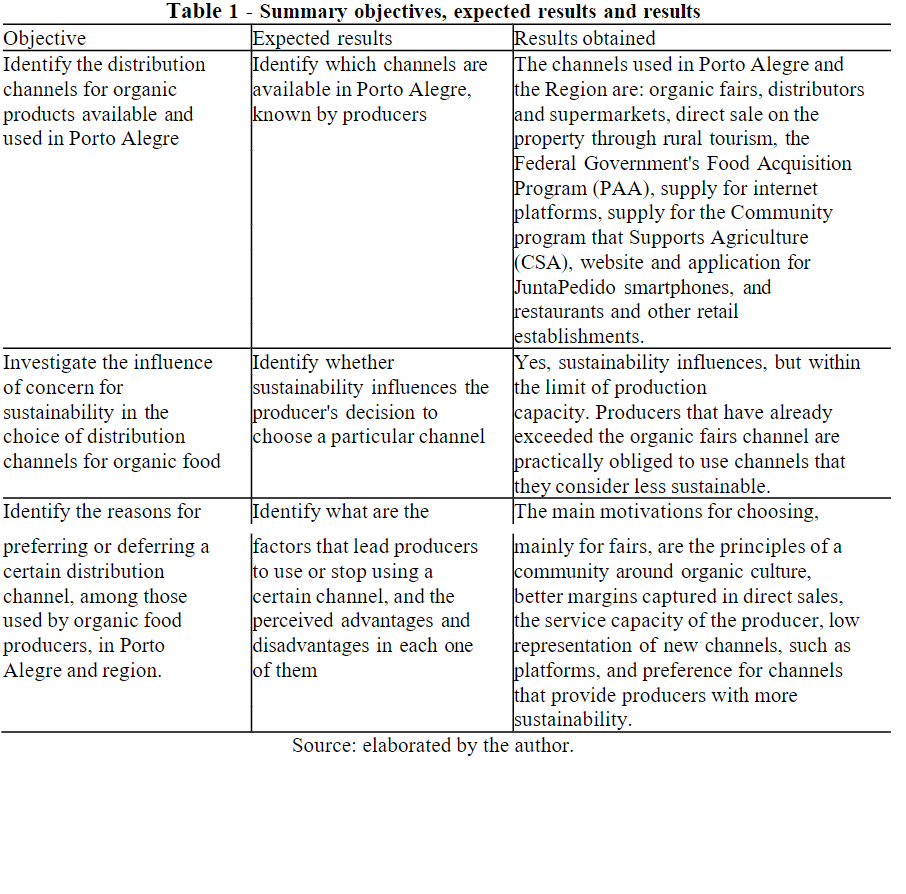
Firstly, we questioned the interviewees' understanding of what sustainability means, to verify whether the literature corresponds to common sense among them.
Sustainability: understanding and influence
There is a variation of understandingbetweentheparticipants,butthe mostcommon centers on the environmental issue. For most, sustainability is linked to a process that does not degrade the environment, and when possible makes it even better.
The second point raised most frequently is the social issue. For many, sustainability implies enabling the family’ssubsistence in the countryside and keeping the transaction cycle as tight as possible, either within their community, or with those producers or people and entities closest to them, whether geographically or by affinity. According to some interviewees, the understanding of this social implication is as follows:
We can be self-sufficient. Right here we have an example, I have a partnership for trading the nuts,and that closes a circuit. We work with a problem,which is the long distances to which we sell, we always try to develop local partnerships, it’s a construction. (Interviewee 7).
The social component of sustainability defended by Elkington (2001) confirms these perspectives, as it is focused on the well-being of people, both internal and external resources, and that in some way contributes to the reduction of social inequalities, involving andrespecting the interests of communities participating in the business. Furthermore, Guzzatti et al. (2014) argue that there are also social objectives to the relationships established between local producers.
Economic sustainability also appeared in the responses, but as an indirect link with questions related to cost. The responses relating economic and financial sustainability to the process of production and marketing of organic products came, for the most part, from the owners of the SMIC's websites and civil servants. Despite this, authors on the subject, such as Elkington (2001) and Guzzatti et al. (2014), do not dissociate the economic issue from the environmental and the social issues.
Then, weaskedwhethersustainability affects the decision in favor of a given channel. Most said yes, especially when the environmental aspect is taken into account. In this respect the economic issue appeared more frequently, but with a bias due to the financial result of companies. The social issue was mentioned by some, but in relation to the alignment of principles, not necessarily of social inclusion. Only Interviewee 11 mentioned as an advantage the fair’s enabling new generations of farmers, children of the current ones, to remain in the field, as well as allowing them to sell at better prices
The economic issue also arose, first when the interviewees cited the difficulty to obtain financing for their activities, or, when they do obtain it, to pay them off. As for the price, it appeared in the perspective they have about the difficulty the consumer generally demonstrates in understanding that organic products, given their low scale of production and the difficulty in pest control, may have a higher price than that of industrialized agricultural products. Despite this, they did not see it as acceptable that a distributor should place an excessive price to the consumer, because they understand that it is the distributor’s responsibility to make his or her product reach the consumer at a fair price,comparable to the prices practiced at the fair,even if it goes through a middleman.
Two interviewees claimed that the fairs have sometimes been putting the sustainability issue aside. Two examples were cited, the first questioning how “organic” it is to bring aproduct from Bahia to Rio Grande do Sul, given the amount of fuel and emission of pollutants for transportation, and the second with regard to the logistics of a fair, which affects local economic sustainability. In the example, the producer mentioned that Porto Alegre has eight ecological street fairs and Caxias do Sul, in Rio Grande do Sul, has onlyone, a number which is disproportionate to their respective populations. The producers claimed to perceive an ongoing dilution of the clientele between the fairs, rather than an increase in demand
Channels
Regarding the channels used, for many producers the distribution chain is restricted to organic products fairs. According to three interviewees, the fair represents between 95% and 100% of their sales. One interviewee said that many establishments, including owners of websites, restaurants, bistros and small stores, buy at fairs instead of directly from the producer, which ends up distorting the perception of producers about the chain in which they participate, since what the producer understands to be a sale at the fair will, in practice, be commercialized through another channel, even without him or her being involved in this process.
Interviewee4 mentionedanotherchannel that, unlike the others, participates in the Caminhos Rurais (Rural Paths) project, implemented by the Porto Alegre City Hall in 1995. This channel represents a significant part of this interviewee’s revenue, partly by selling products directly on the property, and partly due to the possibility of them offering tours and other related services.
Interviewee 5 is in a different situation from the others, as his production is mostly processed, since he participates in a very well-consolidated cooperative with established agribusiness. He is responsible for a much smaller portion of the sales made at the fairs, being theonlyonewhosells to supermarkets and one of the onlytwo who serve distributors among the interviewees, and has these channels as his main outlets. The other producer who serves distributors, Interviewee 1, allocates around10% of their sales to this channel.
The representativeness of e-commerce sites as a channel for these producers is verylow, remaining under 5% for all of them. We asked whether the producers also commercialized directly through their own websites, but none of them utilize this channel.
Only Interviewee 4 participates in the Food Acquisition Program (Programa de Aquisição de Alimentos – PAA), in themunicipality of Canoas – RS, and this channelrepresents, in addition to one or two restaurants, about 10% of their revenue.
Interviewee 3 also mentioned his participation in two other channels recently made available in Porto Alegre, and which are not used by the other four. The first is the CSA (Community that Supports Agriculture), which despite not being representative in theirsales, in seen by the interviewee as an initiative that deserves attention due to its differentiation from the others, this being therefore the subject that took the most time in the interview. It was evident in their reply that the CSA initiative has their approval, as it presents a partnershipmodel that goes beyond the traditional relationship between producer and consumer. And, logically keepingin mindthedifferences in operation between a fair and delivery via CSA, it is the model that most closely matches the relationship established between the producer and the consumer at the fairs.
In addition to the CSA, this same producer also makes sales through an application called Junta Ordem, being among the interviewees the only one who knew and used it during the period of the interviews.Although it is still not expressive in their sales,theapplicationwasmentioned by the interviewee when questioned about new channels available in Porto Alegre, its launch having taken place in June 2017. Its advertisement and the encouragement for MST settlements to make use of it were done by the National Institute of Colonization and Agrarian Reform (Instituto Nacional da Colonização e Reforma Agrária – INCRA), which ended up inducing the interviewee to error in understanding as to the origin of the application’s developer.
Restaurants, bistros oreven specialized stores have virtually no representation among the interviewed producers. Even though at one point these channels have been served by one of the interviewees, today they either no longer are, or represent a maximum of two of the regular customers of each of them, without significant sales.
Table 2 shows the participation by channel in the sales volume of each of theinterviewed producers.
| P1 | Fairs Direct Selling Distributors Restaurants Websites | 75% 10% 10% 3% 5% |
| P2 | Fairs Restaurants and sites | 97% 3% |
| P3 | Feiras Sites, CSA, Junta Pedido | 95% 5% |
| P4 | Fairs Rural Paths PAA and restaurants | 45% 45% 10% |
| P5 | Fairs Distributors and Supermarkets Websites and restaurants | 35% 60% 5% |
DISCUSSION
The information gathered in the interviews, confirming what Kotler and Keller (2012) claim, is that the choice of a channel is one of the critical decisions that producers need to make.
As Niederle and Wesz (2018) explain, even if their primary purpose still seems to be subsistence, it is natural that family and agroecological farming should also involve commercial relations. For most producers, thefair is still the main channel. Even with theliterature showing, according to research by Dalmoro and Ladeira (2016), Willer and Julia (2017), and other researchers, that markets, supermarkets, and hypermarkets account for 60% or more of overall sales of organic products, this is not the reality of the interviewees.
Sustainability has great relevance in the choice of channels. This relevance corroborates the work of Bazzani and Canavari (2013), who claim that two of the factors that most influence the definition of the type of alternative chain are rooting and location. Inthe case of rooting it is meant within a broader context, which encompasses the social, ecological, and cultural character that food carries, and as for location, as highlighted by FAO (2019), family farming can contribute to strengthening regional sustainable development.
According to Guzzatti et al. (2014), there is a tendency for rapprochement between producers and consumers as a response from society to the process of globalization. According to the authors, this is explained by another factor that makes sustainability more important, and which was clear in the interviewee’s responses, which is the feeling of belonging to a community that shares the same values.
In the understanding of the interviewees, and mainly of the producers, thesocial pillar of sustainability is manifestedwhen their activity, be it production or commercialization, enables their way of life, which is the economic sustenance of the family, and allows them to remain on the land. The social aspect is also manifested in the responses of the interviewees, including website owners, who mention belonging to a community formed by those who share the same values and principles linked to a concern for the environment and for a healthier lifestyle.
Regarding which channels are used, the fair is the most common channel used by most producers. Among the reasons that stood out the most for this to be the preferred channel, one of the first reasons to be mentioned, and the one which the producers emphasized as being the main one, was direct contact with the consumer. At this point, two aspects stand out: the first relating to issues of sociability andcoexistence, and the second relating to thefinancial matters. In addition to these two points, the third reason mentioned was that the fair is a channel that provides greater sustainability.
Sampaio et al. (2013) explain this relationship in their research, where they point to the establishment of a shared cultureamong producers and consumers of organicfood, whostart to establish bonds of friendship. Portilho (2009, p.65) also explains this relationship when he states that organic fairs show themselves as “a stage for theconstruction, sharing, reinforcement and materialization of values, dissatisfactions and anxieties. Therefore, a space of sociability, exchanges and reciprocities”.
From the perspective of producers,participating in fairs makes it possible to sell atbetter prices when compared to other channels, due to the elimination of middlemen and thepossibility of capturing the price difference that would exist when the consumer purchases from a distributor or retailer, instead of directly from him or her.
What was evidenced is that, even if a scale of values is not applied in the research, the producers put the fair and the supermarkets in opposite extremes. This distance of perspective could be reduced if retailers, especially supermarkets, adopted practices of approximation with these producers, effectively participating in the communities in which they find themselves, for example through initiatives such as courses that provide specific training to operate within these channels, enabling producers from the step of production planning onward, and not only interacting at the time of commercial negotiation; or else through developing specific spaces within stores so as to offer producers an environment more similar to what they are used to, namely, the fair. E-commerce platforms, even though they are characterized as retail, are perceived in a different way, as the interviewees perceive advantages in this channel in relation to sustainability, either due to a lesser use of packaging or by ensuring that there will be no leftovers, to convenience and safety, and to the advertising of their products, which is felt tobe more comprehensive even when a sale does not take place.
The social component proved to be always present, being a factor that contributes to the logic of the current functioning of each channel. Very often, interviewees mentioned the pleasure of participating in the fair as a community, reinforcing theproducer'sidentity in relation to consumers, as well as the exchange of experiences with other producers. Accordingto the interviewees, when participating in a fair the producer already gains credibility due to the environment he is in, and also provides the consumer with diversity, as they can offer the consumer a greater diversity of products, by bringing all the producers together in one space. This feeling is reinforced, for example, by theresponse of one of the website owners who also sells at physical locations, who said that if he had to choose to remain in only one of the channels, he would keep the fair.
Still regarding the platforms, there was no resistance or preference on the part of the producers, but rather a lack of this channel’s capacity for absorption. Of the three organizations that participated in the interviews, all were practically one-person companies, essentially the owner. The threehave around sixty active customers each,work mostly with the same suppliers, and offer similar services from the consumer's point of view. For these companies, there is the risk of an industrialization of the service, if multinational networks or large national networks start to compete directly in this segment. The major platform operators on the internet already sell organic products, but after processing them. However,thereis nothing to prevent these operators fromoffering fresh produce, whicharetheproducts most commercialized by these three companies in Porto Alegre, or even offering this service directly through fairs or supermarkets. In addition, they compete directly with more recent initiatives such as CSA or JuntaPedido. Some alternatives for these landowners would be to work in niche products with greater proximity to producers, or to offer other services such as rural tourism or rural experiences on their properties, courses, or even to associate with each other, making, for example, a territorial division.
FINAL CONSIDERATIONS
Historically, the definition of distribution channels has always presented itself as a challenge to producers, in addition to the effort in production, which in this case constitutes a greater challenge because they are focused on organic production. In deciding for a channel, the producer becomes even more of an entrepreneur, and a series of economicdecisions needs to be made. In this scenario, there is an additionalconcern with sustainability, in addition to an increasingly competitive environment, and the presence of tools that did not exist a few years ago, such as the internet.
It is important to highlight several particularities arising, above all, from this activity being based on family nuclei, where the family and the business are practically the same. Expanding this circle from the perspective of the producers, many of their consumers also become their friends and enter their relationship network, providing acollectivization of the market as a community.
Concerning the first specific objective: To identify the distribution channels for organic products available and used in Porto Alegre, an observation regarding the fairs suggests a limit for this model: someproducers claim that the number of fairs is excessive, especially due to logistical restrictions. However, one of the observationsmade by employees of the SMIC is that the main difficulty is to bring organic food to the impoverished peripheries, and that the most usual way would be through ecological fairs. However, what happens is that when they offer a selection of producers to non-central or lower-class neighborhoods, competition decreases . Although the sales via e-commerce
As to the second specific objective, To investigate the influence of concerns with sustainability in the choice of distribution channels for organic food, the research pointed out that sustainability is an important factor in the selection of channels, and that it is always taken into consideration. This explains, in part, a certain lack of interest by these producers in developing into broader channels, such as supermarket chains. There are regularization issues involved, but there is room for networks to approach these producers. In the environmental aspect, the concern is more closely related to the business they conduct and their relationship with producers, which is expressed in the requirement for certification of organic producers to maintain a partnership. However, this concern also has a commercial appeal, provided by linking their company to a product and officially recognized producers, and, at the same time, resolving any doubts about the origin of the food, since its relationship of trust with consumers is not in person, as it would be at a fair.
Finally, for the third specific objective, To identify the reasons for preferring acertain distribution channel overanother, among those used by organic food producers and traders, in Porto Alegre, we have determined the fair to be the preferred channel. The main reasons indicated by the producers were sustainability, the possibility of selling at better prices andreceiving their payment in cash, and a culturerooted in sociability. What we perceived, however, is that in most cases the fair consumes practically all production, so there is no surplus that would justify diversification. In addition, the entire production process, from planning to the final sale, is based on the model of the fair. In the same way, the fair reaches a determined audience, those who like to go to the fair, transit among the producers, have conversations and live a culture of direct access to the farmers. But this limits the universe of potential buyers by defining that certain groups, such as the younger generationand those more concerned with convenience,do not frequent this commercial space.
It is worth noting that for all channels there will always be the challenge of transposing the feeling of belonging to a community that the fair provides.
LIMITATIONS
The fact that the producers go deeply intoallthedimensionsof sustainability established in the triple bottom line, this work being directed more specifically to the environmental axis, tangential to the economic and social dimensions.
During interviews with producers, there was also an intense repetition of comments on components of sociability and a sense of community as factors that influence the decision to choose a certain channel, but the theme of sociability was not explored in the research due to that not being one of its objectives. Another factor that deserves attention refers to the channels thatwerelistedin theinterviews,as they arelimitedto theinterviewee's own knowledge. Therefore, other options that are presented in the market of Porto Alegre and its surrounding region, but that are not used or cited by the interviewees, such as supplying to the pharmaceutical or cosmetics industries, or for animal feed, among others,were disregarded.
Finally, the research technique that was carried out, being of a qualitative nature, does not allow for the generalization of results which could be explored in later projects.
CONTRIBUTIONS AND SUGGESTIONSFOR THE DEVELOPMENT OFFUTURE RESEARCH
This study contributes to deepening the understanding of the distribution channels used by producers of organic products in the Porto Alegre metropolitan area, as well as of the reasons that lead producers to prefer a particular channel over the others. In addition, it brings the area of applied social sciences, and especially of management, closer to an area of relevant commercial activity in the Porto Alegre region – the supply of organicproducts, a subject that is normally studied by other disciplines such as agronomy, nutrition and sociology, but that still lacks studies in the domain of administration, since it can collaborate not only in productive techniques, but also in management, commercialization and distribution, as well as in understanding and directing adequate public policies.
Based on the themes that were raised by the interviewees, we highlight issues that can be explored in future research, with an emphasis on sociability as a motivational factor for the participation of producers in fair environments as a choice of or preference for a given channel. The value ofthis relationship with the consumer can be expanded on in future debates, expanding on the sense of community as one of the factors that influence the decision for a particular channel.
And finally, the development of new channels. In this regard, several options can be considered, both by consumer initiatives, such as consumer associations and cooperatives, supermarkets created and maintained by these cooperatives, and on the part of producers, initiatives already present in other states or countries, such as networks of retail outlets, whether supermarkets or stores, maintained in a cooperative manner.
REFERENCES
BAZZANI, C.; CANAVARI, M. Alternative Agri-Food Networks and Short Food Supply Chains: a review of the literature.Economia agro-alimentare, 2013.
BAUMAN, Zygmunt. Vida para o consumo: a transformação das pessoas em mercadoria. Rio de Janeiro: Zahar, 2008.
BRASIL, Ministério da Agricultura Pecuária e Abastecimento (MAPA), disponível em www.agricultura.gov.br, 2020
CANCLINI, Néstor García. Consumidores e cidadãos:conflitos multiculturais da globalização. Rio de Janeiro: Editora UFRJ, 1995.
CASTELLS, Manuel. A sociedade em rede: a era da informação. Economia, Sociedade e Cultura. v.1. 8. ed. São Paulo: Paz e Terra, 1999.
DALY, H. A Big Ideia. A State-Steady Economy. Economics. Towards a Steady-State Economy, IN: UK Sustainable Development Commision, abril de 2008.
DALMORO, Marlon; LADEIRA, Wagner J. (organizadores). Barômetro dos Orgânicos, 2016. https://www.univates.br/noticias/20241-gauchos-procuram-cada-vez-mais-por-alimentos-organicos - acesso em 16/01/2020
ELKINGTON, John. Beyond Greening: Strategies for a Sustainable World. Harvard Business Review, v. 75, n.1, p. 66-76, 1997
ELKINGTON, John. Cannibals with Forks: The Triple Bottom Line of 21st Century Businnes. New Society Publishers, 2001.
FAO, The Water–Energy–Food Nexus: A New Approach in Support of Food Security and Sustainable Agriculture. Food and Agriculture Organization of the United Nations, Rome, 2014. FAO, Putting family farmers at the centreto achieve the SDG. UN Decade of Family Farming. 2019. Disponível em: http://www.fao.org/3/ca4532en/ca4532en.pdf - Acesso em: 10 nov. 2020.
GROSSMAN, Gene. M.; KRUEGER, Alan B. Economic Growth and the Environment. In: The Quarterly Journal of Economics, v..110, n.2, Cambridge, maio de 1995.
GUZZATTI, T. C., et al. Novas Relações entre Agricultores Familiares e Consumidores: Perspectivas Recentes no Brasil e Na França.Organizações Rurais & Agroindustriais. v.16, n. 3, 2014.
HICKELS, Jason; KALLIS, Giorgios. Is green growth possible?. New Political Economy, 2019.
HOPWOOD, B.; MELLOR, M. and O’BRIEN, G. Sustainable Development: mapping different approaches. Sustainable Development, v. 13, p. 38-52, 2005.
KLEIN, Amarolinda Z.; DA SILVA, Lisiane V.; MACHADO, Lisiane; AZEVEDO, Débora. Metodologia de pesquisa em administração: Uma abordagem prática. São Paulo: Atlas, 2015.
KOTLER, Philip; KELLER, Kevin L. Administração de Marketing, 12 ed. São Paulo: Pearson Prentice Hall, 2012.
MARSDEN, T. New rural territories: regulating the differentiated rural spaces. Journal of Rural Studies, v.14, n.1, p.107-117, 1998
MOOZ, E. D. e SILVA, M. V. d. Cenário mundial e nacional da produção de alimentos orgânicos. Nutrire Rev. Soc. Bras. Aliment. Nutr.39(1), 2014.
MORIN, Edgar. A Via para o futuro da humanidade. Rio de Janeiro: Bertrand Brasil, 2013.
NIERDERLE. Paulo A.; WESZ, Valdemar J. As novas ordens alimentares. Porto Alegre, Editora da UFRGS. 2018.
NOBRE, Marcos; AMAZONAS, Maurício (orgs.). Desenvolvimento sustentável: a institucionalização de um conceito. Brasília: IBAMA, 2002.
PORTILHO, F. Sociabilidade, confiança e consumo na feira de produtos orgânicos. In: BARBOSA, Lívia; PORTILHO, Fátima; VELOSO, Letícia. Consumo: cosmologias e sociabilidades. Rio de Janeiro: Mauad X; Seropédica: EDUR, 2009.
RENTING, H.; MARSDEN, T.; BANKS, J. Understanding alternative food networks: exploring the role of short food supply chains in rural development. Environment and Planning, v.35, 2003, p.393-411.
SACHS, I.Caminhos para o Desenvolvimento Sustentável. Rio de Janeiro: Garamond, 2002.
SAMPAIO, D. O.; GOSLING, M.; FAGUNDES, A. F. A.; SOUZA, C. V. Consumo de alimentos orgânicos: um estudo exploratório, RAD (Revista Administração em Diálogo), v.15, n.1, São Paulo, Jan/Fev/Mar/Abr 2013, p.01-22
SCOTT, W. Education and sustainable development: challenges, responsibilities, and frames of mind. The Trumpeter, v. 18, n. 1, p. 22-34, 2002.
SCHNEIDER, Sérgio; FERRARI, Dilvan Luiz. Cadeias curtas, cooperação e produtos de qualidade na agricultura familiar – o processo de relocalização da produção agroalimentar em Santa Catarina. Organizações Rurais & Agroindustriais, vol. 17, núm. 1, jan-mar, 2015, pp. 56-71. 2015.
SCHNEIDER, Sérgio; GAZOLLA, Márcio. Cadeias curtas e redes agroalimentares alternativas: negócios e mercados da agricultura familiar. Porto Alegre: Editora da UFRGS, 2017.
SEURING, S.; MÜLLER, M. From a literature review to a conceptual framework for sustainable supply chain management. Journal of Cleaner Production, v.16, 2008, p.1699-1710.
VEIGA, José Eli da. Economia socioambiental. São Paulo: SENAC, 2010.
WILLER, Helga e JULIA, Lernoud (Eds.): The World of Organic Agriculture. Statistics and Emergind Trends 2019. ResearchInstitute of Organic Agriculture (FiBL), Frick, and IFOAM – Organics International, Bonn (Alemanha), 2019.