Artigos
The expansion of scientific knowledge in the Amazon: ramifications of the Unifesspa federal higher education interiorization project
The expansion of scientific knowledge in the Amazon: ramifications of the Unifesspa federal higher education interiorization project
Gestão & Regionalidade, vol. 39, e20237999, 2023
Universidade Municipal de São Caetano do Sul
Recepción: 30 Julio 2021
Aprobación: 09 Agosto 2022
Abstract: The internalization of higher education in the Amazon by Reuni took place recently, with the creation of UFOPA in 2008 and Unifesspa in 2013. The objective of the research was to take stock of the scientific production carried out by Unifesspa about Marabá, including the topics of inequality and urbanization within the major areas of humanities, social and applied sciences, between 1955 and 2019. The methodology applied involved the collection of data from the Higher Education Census, from INEP, and a systematic review on digital platforms, Portal de Periódicos Capes, Google Scholar, and digital libraries of universities about the aforementioned municipality. It is concluded that after the implementation of Unifesspa there was an expansion of scientific production, which indicates that the creation of this federal university generated research on local problems, such as urbanization and socioeconomic inequalities in Marabá, evidencing one processes of university´s influence on the region.
Keywords: expansion of higher education, Unifesspa, Marabá, urbanization, socioeconomic inequalities.
Resumo: A interiorização do ensino superior na Amazônia pelo Reuni ocorreu de forma tardia, com a criação da UFOPA em 2008, e da Unifesspa, em 2013. O objetivo deste artigo é fazer um balanço sobre a produção de conhecimento científico que foi realizada pela Unifesspa em Marabá, considerando as publicações das temáticas das grandes áreas das ciências humanas, ciências sociais e aplicadas, especificamente as nomenclaturas conceituais de desigualdades e urbanização, com o recorte temporal de 1955 até 2019. A metodologia aplicada perpassou pela coleta de dados do Censo do Ensino Superior, do INEP, e a consulta em plataformas digitais, Periódicos da Capes, Google Scholar, periódicos científicos, e de bibliotecas digitais de universidades sobre o referido município. Conclui-se que após a implementação da Unifesspa houve uma ampliação da produção científica, o qual indica que a inserção dessa universidade federal gerou pesquisas acerca das problemáticas locais, tais como a urbanização e as desigualdades socioeconômicas em Marabá, evidenciando um dos processos da influência da universidade na região.
Palavras-chave: interiorização da educação superior, Unifesspa, Marabá, urbanização, desigualdades socioeconômicas.
Introduction
The trajectory of federal higher education in Brazil can be described at different times: a) in 1808, with the arrival of the royal family to colonial Brazil, which contributed to the emergence of isolated higher education institutions (HEIs); b) in 1931 the State University of São Paulo (USP) was created, and in 1935 the University of Distrito Federal (in Rio de Janeiro) and the Catholic Universities were created; b) from 1945 to 1964, 22 new federal universities were created, installed in the capitals of each federative unit; c) in 1968, Law no. 5,540/68, related to University Reform was approved, which increased the number of HEIs to 109 in the 1980s; d) in 1995, the conversion of the Federal Council of Education to the National Council of Education and Student Financing (FIES); e) from 2007 onwards, Federal Universities expanded through the Program to Support Restructuring and Expansion Plans of Federal Universities (REUNI) and actions for the private sector such as the University for All Program (PROUNI) (Zambello, 2013).
In the different phases of implementation described for federal higher education in Brazil, the new universities faced the problem of their regional insertion. The implementation of the university in the region implies establishing a balance between the formulation of scientific knowledge mediated by proposals for overcoming the problems of the local community. The production of scientific knowledge must result from dialogue with the population, through the demands of the local community and the university, in the design of a republican project for development (Serra & Rolim, 2013).
The focus on higher education as a formulator of knowledge is of importance. According to Santos (1996), research and innovation centers are drivers of new technologies, and vectors for reducing existing differences between institutions located in large metropolises or small cities. So that cities can be positioned as relevant in this institutional rational calculation for housing teaching and research institutions. The emergence of new institutions in the process of internalization of higher education is a strategic key for the propagation of economic competitiveness and the development of regions.
According to the aforementioned author, the public university is an institution that can collaborate with the development project. It must be positioned as a mediator of the demands of the social movements of the territory, in which its implementation can reconcile redistribution effects with those of recognition, through affirmative actions (blacks, indigenous peoples, low-income population, political refugees) (Santos, 1996).
Among these moments in the trajectory of higher education in Brazil, in this paper, we will address the actions of REUNI, specifically for the interior of the Amazon, focusing on the implementation of the Federal University of the South and Southeast of Pará (Unifesspa) in Marabá, Pará. The expansion of federal higher education occurred at a rapid rate in the Amazon, when compared to other regions of Brazil. Encompassed by the experiences of implementation and internalization of new federal universities in this region, there were only the cases of Unifesspa and the Federal University of Western Pará (UFOPA), both in Pará.
TThe justification for choosing the Unifesspa, in Marabá, is its importance, once it is the youngest federal university in the Amazon, opened in 2013. A second justification is due to the indicators of the Human Development Index (HDI), with averages lower than the state and national averages. According to data from Atlas Brasil, the IDHM classification, in the years 1991 and 2000, classified the municipality of Marabá respectively at 0.401 and 0.536, in the range of extremely low or low development and only in 2010 it reached the average category, 0.668. Despite the increase in the IDHM of Pará over the years, when analyzing the HDI ranking by states, Pará fell in the ranking, in 1991 it occupied the 17th position, in 2000 the 19th and in 2010 the 24th, tied with the Piauí. In summary, the IDHM in Marabá surpassed the state average in 2010, however, it remained lower when compared to the national average ranking, namely, 0.493, in 1991, 0.612, in 2000, and 0.727, in 2010 1.
According to the late insertion of the federal institution of higher education (UFES) in the interior of Pará, we seek to understand how the institutional arrangement formed by undergraduate and postgraduate courses are positioning topics dear to the debate for development, and which can be considered as strategic research agendas around the themes of inequalities and urbanization, subsidizing and pointing out clues in relation to the formulation of diagnoses of public policies to overcome territorial asymmetries.
Marabá is a municipality positioned as strategic for its formation, for the processes of economic modernization and territorial integration with Brazil, assuming the nomenclature of medium city considered by the IBGE as a regional capital C, with a direct influence on 23 municipalities around it (IBGE, 2020).
The formation of the municipal network in Pará occurred in parallel with the generation of royalties generated by the installation of large infrastructure projects, such as the Grande Carajás Program (PGC) and the Tucuruí Hydroelectric Power Plant, in the 1980s, which stimulated the creation of new municipalities and the (re)organization of the interests of fractions of social classes, influencing the spatial formation of Marabá, which reduced its territorial extension over that time. The Polamazônia Carajás Program played an important role in the socio-spatial restructuring of the Carajás region, as it not only mobilized resources for the implementation of infrastructure and polarized resources for mining enterprises, but also boosted a mass of migrants with the objective of expanding the supply of labor in the new work fronts. The succession and coexistence of the oligarchies of the chestnut groves due to the entry into the scene of new agents such as entrepreneurs, farmers, migrants and settlers changed the tonic of the frictions between the dispute for territorial power, now nested in large mining projects, such as the Companhia Vale do Rio Doce (CVRD) and social movements (Souza, 2015).
The centrality of the city comes from the urbanization modernization project in Marabá, created by the federal government in the 1970s and it may be the result of two aspects acting as vectors in urbanization and their regional importance. The implementation of a new urban center, Nova Marabá, together with the development of the multimodal hub, consisting of the port area, headquarters of a regional airport, the junction of the PA-150 and BR-230 highways, and the logistic point of the Carajás Railway, tacked to new projects related to natural resources in Marabá, as suggested by the ALPA (Vale) and ALINE (Sinobrás) projects (Melo, 2015).
The objective of this paper is to take stock of the production of scientific knowledge that was carried out in Marabá, considering the publications of the themes of the great areas of human sciences, social and applied sciences, specifically the conceptual nomenclatures of inequalities and urbanization, with the time frame from 1955 to 2019. This balance seeks to understand how the formation of the scientific production research agenda of Unifesspa impacted diagnoses about problems for territorial development .
The route applied in this paper for the proposed investigation, went through the analysis of institutional documents related to the expansion of REUNI and Unifesspa: REUNI 2008 – First Year Report, 2009, and Universidade, Expandir até ficar do tamanho do Brasil, 2009, both from the Ministry of Education, and the Institutional Development Plan (PDI) 2014-2019 formulated by the Secretary of Planning and Institutional Development of Unifesspa. Data from the Higher Education Census at the National Institute of Higher Education (INEP) and by the Dean of Undergraduate Education (PROEG) at Unifesspa were consulted. These movements of analysis presented the implantation of Unifesspa in Marabá and the expansion of the human capital directed to the formulation of scientific research.
The data collected were carried out on digital platforms, such as the Capes Journals and Google Scholar. Subsequently, data were collected regarding the scientific production produced by dissertations and theses in the information base of university libraries, which contributed to the studies on Marabá, including the University of São Paulo (USP), the Federal University of Rio de Janeiro (UFRJ), the Federal University of Pará (UFPA), Unifesspa and the Brazilian Agricultural Research Corporation (EMBRAPA), the Postgraduate Program of the Center for Advanced Studies in the Amazon (NAEA), UFPA, and the Postgraduate Program in Territorial Dynamics and Society (PDTSA), from Unifesspa.
The terms inequalities and urbanization were prioritized for the selection of scientific publications, as they are themes that dialogue with the possible impacts on the generation of scientific production of the insertion of the federal university as an explanatory key to formulate diagnoses on the problems of territorial asymmetries and implement proposals for the regional development. The filter of concepts used for the selection of scientific publications considered the main issues related to inequalities and urbanization in Marabá, as topics of scientific research, as a guideline. The following keywords indexed to Marabá were used: industry; migration; economy; urbanization; urban; development; conflicts, social conflicts; agrarian conflicts; mining; production chains; and agriculture.
The second step was the cataloging of publications for quantitative analysis, classified into layers of analysis: a) historical and chronological cut; b) publications by area of knowledge; c) typology of publications, defined by the balance sheet as books, book chapters, scientific papers, thesis, dissertations and monographs. In addition to the topics addressed in each publication, the description referring to the identification in the consulted productions of the researchers' home institution and the origin of academic journals and academic publishers by federative unit was considered.
The paper is divided, in addition to the introduction and final considerations, into three sections. In the first, the process of internalization of the federal university was presented as an important institutional arrangement for territorial development, enhancing the improvement of social indicators, expanding the cultural heritage of the population and instigating paths for the generation of technological innovation. The second section presented the guidelines that guided actions of REUNI for the internalization of Unifesspa, as a synthesis of the expansion of federal higher education in the Amazon. In the third section, the balance of scientific productions was carried out, focusing on inequalities and urbanization in Marabá.
THE INTERIORIZATION OF FEDERAL HIGHER EDUCATION AS A POLICY FOR TERRITORIAL DEVELOPMENT
REUNI systematized an advance in the formulation of a public policy for development, considering social vulnerability indicators as important variables for development accountability. According to Marques and Cepêda (2012), the public university is the locus for the institutionalization of this perspective as a social policy to overcome social asymmetries in sub-regions of the interior and border regions of Brazil. The aforementioned authors defend the implementation of the university as an alternative for the democratization of the population to higher education, combined with Sen's thesis that enables the empowerment and training of the population.
In this analytical key presented, education was positioned as a form of freedom and empowerment through the public policy of REUNI. According to Sen's (2000) thesis, education is an alternative aimed at the individual to overcome deprivations of economic, political and social freedoms. Complementing this reasoning, Bourdieu (2012) points out that empowerment can be understood as the granting of subsidies for the formation of cultural capital of individuals, which allows their social mobilization, opening opportunities and achieving the ethos necessary to overcome the social inequalities imposed. during the trajectory of the individual who lacks cultural capital.
Education in Sen's (2000) thesis has a strong capacity to generate empowerment and grant freedom to individuals, when discussed under two analytical keys. The first key is the diagnosis of poverty that derives from the low capacity for freedom determined by the deprivation of rights to individuals, such as the absence of income, related to the quadrants of gender inequalities, when equated, strengthen inequalities. The second key to understanding Sen's thesis is the fundamental role played by the State in the formulation of public policies, which can remove the deprivations of liberty to the individual. Sen's prognosis for overcoming deprivations of liberties is through education, and it can be the potentiator of the expansion of other modalities of individual liberties, such as economic, political and social opportunities.
The public university is positioned as an institutional arrangement capable of reverberating propagated chain effects to reduce territorial inequalities. In this conception, the university enables the diffusion and consolidation of the “new work”2 of cities (Jacobs, 1969).
For Rolim and Serra (2009), the modern conception of the National System of Innovation, Economy, and Knowledge is articulated with several subsystems, such as finance, learning, and productive culture, which centralize universities as the locus of externalities that impact the territory. The learning subsystem is essential to spread the accumulated knowledge and generate innovation, to increase competitiveness in the region. The productive culture relates to the degree of involvement of local social actors in productive segments, narrowed by the technical culture of the inhabitants of the region through the transmission of knowledge and generational knowledge.
Higher education institutions (HEIs) can generate cumulative effects in two dimensions. The first corresponds to financial and monetary flows, called backward linkages, which influence the effective demand for consumption and spending on local services for the functioning of the institution, students, and university employees. The second dimension represents the production and dissemination of scientific and technological knowledge, guided by teaching and research, with forward linkages and a strong capacity for structural transformation of the productive economy of the region, given the supply of qualified human capital, research and development (R&D) infrastructure, scientific and technological knowledge (Vieira, 2017).
According to Vieira (2017), the so-called forward effects are the most relevant, as they relate to the fields of teaching and research, specifically the dimension of culture, which encompasses initiatives such as libraries, museums, art galleries, multipurpose cultural centers, and extension actions in the territory.
The interaction between territorial scales is relevant in the perception of Vieira (2017), since the guidelines established at the national level decisively influence the articulations with other scales (global and regional), with a strong impact on the locality, through teaching, research, and extension of HEIs, mobilized by resources for science, technology, and innovation (S,T & I) for regional development and work.
Camagni adds that in the relationship established between the territorial scales, attention must be paid to the city, in which competitiveness is “strongly linked to the quality of university education or of technology and management consulting companies” (Camagni, 2005, p. 156).
Clementino and Dantas (2014) point out that the changes caused by the insertion of higher education in medium-sized cities and in the interior can reverberate in direct effects on tertiary activities, such as commerce, transport, housing, expansion of the health network. The offer of employment for the population of the territory is included in the combination of direct effects and can be an important aspect in the offer of jobs for skilled labor. Finally, the training of professionals expands opportunities in the region, for retaining young professionals in qualified jobs.
The impact of the public university in the territorial and regional dimension is related to the generation of commuting movements of the student population. Ojima and Marandola (2012) point out that the process of metropolitan deconcentration carried out through the expansion of means of mobility and communication redefined the meaning of the city and the region, considering medium and small cities, which began to create links through the daily horizontal displacement flows of the population.
The increase in the number of vacancies in HEIs in municipalities in the interior is an important factor that contributed to the new trend of commuting made explicit, in small and medium-sized cities outside the metropolitan perimeter. This process had an impact on small and medium-sized cities, by offering vacancies at HEI, meeting the local demand for university education. More than that, it presented an opportunity for the population of these places to have access to public higher education, previously polarized only in the large metropolises and capitals of Brazil (Ojima & Marandola, 2012).
Thus, in the analysis of Fusco and Ojima (2017), the internalization of higher education promoted social inclusion underlying the expansion of access to higher education. In this process, the new vacancies for access to higher education on the countryside campuses also contributed to a change in the profile of university students, for example, from being predominantly white. The creation of vacancies in HEIs, including federal and state universities, provided a reduction in educational inequalities in relation to the criteria of race/color, income and geographic location (interior and capital), thus allowing the regional integration of municipalities through population exchanges in these municipalities.
According to Vieira (2017), the expansion of HEIs carried out as a public policy aimed at border and interior geographic areas of Brazil can be considered a catalyst to unlock two obstacles to development, the concentration of education in large metropolises and regional inequalities.
THE REUNI IN AMAZON PROGRAM AND THE CASE OF UNIFESSPA
REUNI was formulated by Decree no. 6096, April 24th, 2007, as a result of the Education Development Plan (PDE). In 2007, 53 of the 54 federal educational institutions (HEIs) joined REUNI. The expansion process implemented by the aforementioned program proposed to the federal public universities the increase in the offer of teacher training courses, vacancies in existing courses and the promotion of new formats of interdisciplinary undergraduate courses (BRASIL, 2009a).
The internalization and expansion of federal institutions of higher education were guided by student assistance actions. Normative Ordinance no. 39, December 12th, 2007, institutionalized the National Student Assistance Program (PNAES) for student assistance referent to new students, provided food, transportation, housing and pedagogical support, digital inclusion, health care, culture, sports and day care services. Ordinance no. 582, May 14th, 2008, regulated the REUNI scholarships for teaching assistance, for master’s and doctoral postgraduate courses. The amounts referring to student assistance, master’s scholarships were initially BRL940.00 and were readjusted in June of the same year to BRL 1,200.00, doctoral scholarships were initially BRL 1,394.00 and passed to BRL 1,800.00. 656 master’s scholarships, 352 doctoral scholarships and 52 postdoctoral scholarships were awarded (BRASIL, 2009a).
Accompanying the assistance actions, REUNI promoted the internalization of public federal education by creating new universities according to regional economic needs and vocations. Nine federal universities were created, combining different modalities: a) new universities, such as the Federal University of ABC (UFABC); b) dismemberment of two institutions, the Federal University of Grande Dourados (UFGD) was born from a spin-off of the Federal University of Mato Grosso do Sul (UFMS), and the implantation of the Federal University of Recôncavo da Bahia (UFRB), from the dismemberment from the School of Agronomy of the Federal University of Bahia (UFBA); c) transformation of isolated colleges into universities (Brasil, 2009b).
The expansion of the internalization of federal higher education in the North region 4 occurred late, as there were only two cases. UFOPA was created by Law no. 12,085, November 5th, 2009, and Unifesspa, created by Federal Law no. 12,824, in 2013, to meet the demands for federal higher education in the interior of Pará.
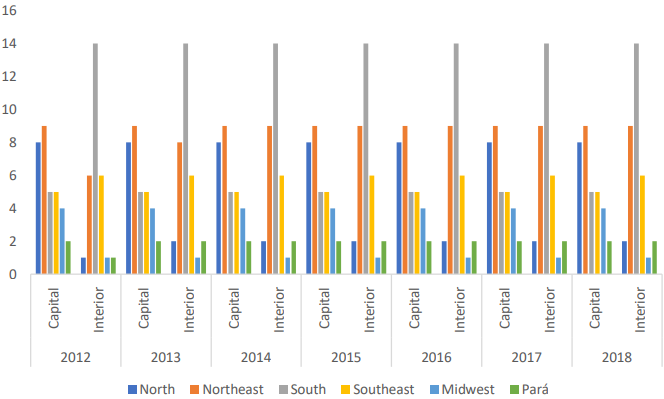
From 2013, a change in the scenario can be observed through the creation and internalization of UFES. As is evident in Graph 1, UFES are concentrated in the capitals of the federative units of the regions and the interiorization occurred more strongly only in the Southeast region, with an uneven distribution in the country.
Graph 1 – Brazil location of UFES in the capital and in the countryside
Source: INEP Synopsis.
Unifesspa was the second federal university in the interior of the Amazon, under a framework of concentration of federal universities in the capitals of the North, Northeast and Midwest macro-regions. In Marabá, Unifesspa was implemented from the spin off from the Federal University of Pará (UFPA), and divided into three units of Campus Marabá, and four new campuses in the municipalities of Rondon do Pará, Santana do Araguaia, São Félix do Xingu and Xinguara.
The problem in Marabá is linked to its position in relation to the centrality it occupies in relation to the municipalities of Southeast Pará, in which it is conditioned by the economic dynamism paved by the installed logistics infrastructure that allows connecting with the branches of export of commoditiesto the global circuits. of production. The highways, railways, waterways and the airport are articulated in a wide circulation system featuring a hub, which connects the Amazon to the Northeast and Midwest. This logistical system aligned with the productive dynamics of commodities enhances income concentration and amplifies territorial inequalities (Michelotti, 2019).
With the inauguration of UFOPA and Unifesspa, the number of federal universities in Pará increased their presence in the territory, bringing local and regional interests closer to higher education. In 2014, 6 universities were identified in Pará, 5 public and 1 private. Of the 5 public universities (UFPA, UFOPA, Unifesspa, UFRA and UEPA), 4 are federal universities and 1 are state universities, with only 2 HEIs located within the state, Unifesspa and UFOPA. So far, the number of public universities remains the same since 2014. Despite the implementation of these HEIs in the interior of Pará, there is still a large mismatch in the relationship between vacancies offered and demand, the indicators point to a lower ratio of vacancies offered to demand in the state. The data can be even more pronounced if compared with the other regions.
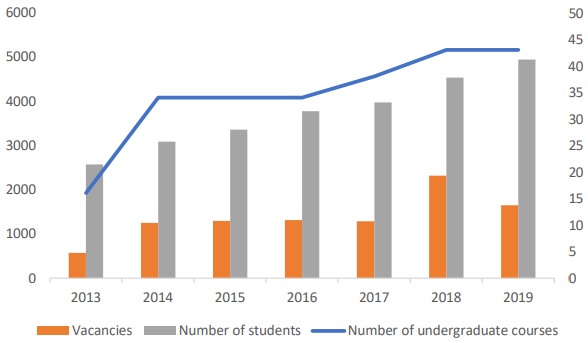
In graph 2, it is possible to observe that there was an increase in the number of undergraduate courses from 16 to 43, between 2013 and 2019. This growth is accompanied by the increase in the number of students enrolled in undergraduate courses. There are strong findings that the expansion in the offer of undergraduate courses and vacancies, for students to attend undergraduate courses in federal higher education, may be an indication that there is a pent-up demand from students who have completed high school in the interior of Pará and low supply of vacancies in free higher education courses.
Graph 2 – Unifesspa. Number of students, courses and undergraduate vacancies
Source: SEPLAN, 2018.
As can be seen in Figure 1, the distribution of the municipalities of origin of the students enrolled in Unifesspa corresponds to the municipalities where there are campuses, which demonstrates the adherence of local demand to the vacancies offered in undergraduate courses. While the number of students from other municipalities in Pará is smaller or located in other municipalities in other states and regions of Brazil. According to Andifes (2019), the origin of students enrolled in Unifesspa, counted from 2014 to 2018, is distributed in 81.2% of the North, 13.2% of the Northeast, 2.4% of the Southeast, 1.8% of the Center- West and 0.8% from the South.
Figure 1 - Unifesspa. Students’ city
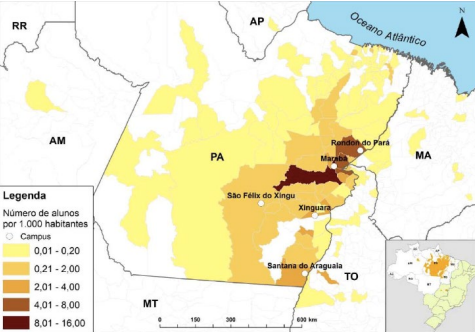
Figure 1
Unifesspa Students’ city
Source: SEPLAN, 2018.
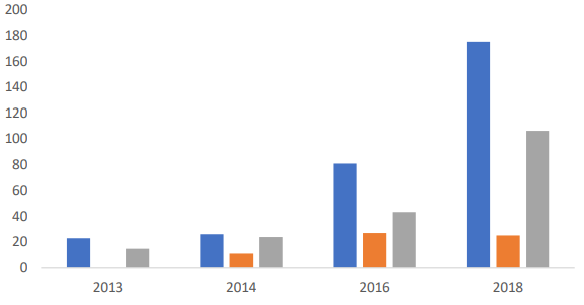
Another relevant aspect of the implementation of a new federal institution of higher education is the generation of scientific knowledge through the insertion of new professors, linked to research, and in undergraduate and graduate programs. In the following graph, it was found that from 2013 to 2018 there was an expansion in the number of PhD professors working in Unifesspa graduate programs, from 15 to 106. This trend was followed by the number of students enrolled in graduate programs, went from 23, in 2013, to 175, in 2018, and the number of students titled as master’s, increased from 11, in 2014, to 27, in 2018.
Graph 3 - Unifesspa. Number of students and PhDs in PPGs
Source: Geocapes . Accessed at:
https://geocapes.capes.gov.br/geocapes/
A significant element to support scientific production are research grants, which allow the maintenance of students without the need to supplement their income. In this sense, the distribution of research grants was expanded from 2014 to 2019, in terms of thematic grants in full doctoral studies, from 11 grants to 43 grants. Research grants for master’s students increased from 8 (2015) to 26 (2019). Taken together of the number of research grants, there was an increase from 11 research grants (2015) to 76 research grants (2019) (GEOCAPES).
BALANCE OF SCIENTIFIC PRODUCTION IN MARABÁ AFTER THE INSERTION OF UNIFESSPA
Scientific production related to the municipality of Marabá is largely conditioned to the implementation of Unifesspa. However, in a pioneering way, Marabá was positioned as a topic for scientific research by other educational institutions. We can point out that there was a first research agenda that focused on themes related to the interiorization of the population and Brazilian economic integration.
The first publication identified was registered in 1958, produced by Catarina Vergolino Dias, entitled “Marabá, centro comercial de castanhas”. This publication was a monograph presented in the Geographers contest at the National Council of Geography (IBGE) in June 1955 and published in the Revista de Geografia Brasileira at the Brazilian Institute of Statistics and Geography (IBGE). This publication inaugurated the trajectory of publications on the aforementioned themes about Marabá, in which the period from 1955 to 2019, recorded 146 publications. However, 13 publications, represented by 8.90%, are not academic, as they are not linked to the production of books and scientific documents. For the purposes of this paper, only the 133 academic publications published by teaching and research institutions or other institutions with a scientific character were analyzed.
The temporal distribution of scientific productions presents two important analytical movements appreciated in this paper. The first comprised the period from 1958 to 2010, comprising 25% of the total production of academic publications. The second period covered from 2010 to 2019 and accounted for three quarters of the total number of scientific publications, with the largest share of publications concentrated in the last 5 years of this historical series.
Graph 4 - Publications about Marabá from 1958 to 2019
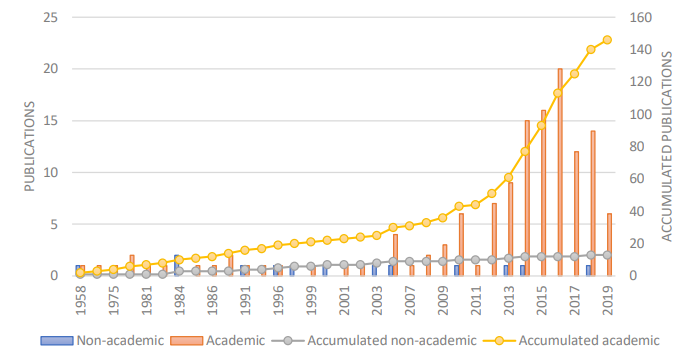
Source: Elaborated by the authors.
In the 1980s, federal government planning through land colonization and agricultural modernization programs and the first mining projects in Serra dos Carajás were the dominant themes on the research agenda that corresponded to 6 publications. In the 1990s, the research agenda remained on the insertion of the economy of Marabá by mining in the division of the national economy, added to the theme of the environment, registering 4 publications.
In the 2000s, there was an increase in the number of publications and themes related to the treatment of Marabá, 10 academic productions were published on: a) the urban genesis of the city, b) well-being and quality of life; c) cultural identities related to migration, rural and traditional populations; d) the water supply; e) the municipal school system; f) and, political changes.
From 2010 to 2019, there was an increase in publications about the new transformations that took place in Marabá, derived from the intensification of economic and social processes through the implementation of social and economic growth programs, such as the Growth Acceleration Program (PAC) and the “Minha Casa, Minha Vida” (PMCMV). The strong relationship between the increase in the number of publications from 2013 onwards, as a result of the creation of Unifesspa, is remarkable, as will be shown below.
The balance of scientific productions can be listed according to the areas of scientific knowledge of the Coordination for the Improvement of Higher Education Personnel (Capes), with Geography having the highest percentage of publications, with 37.59%, followed by Sociology with 21.80%, Urban and Regional Planning and Demography (URPD) with 9.77%, Agronomy5 with 6.77%, and Economic Sciences with 5.26%, and the other areas with an accumulated total of 18.80% (History; Law; Architecture and Urbanism; Environmental Management; and Pedagogy). Geography and Sociology were the areas that stood out the most, as they focused the research effort on themes such as urban formation, territorial conflicts, urban aspects and social conflicts, but also because a considerable part of the research has these themes as its objects of study.
Graph 5 - Academic publications by area of knowledge
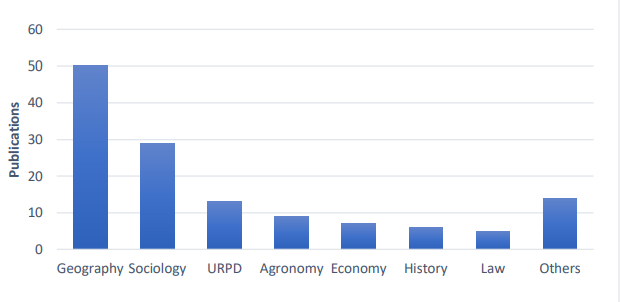
Source: Elaborated by the authors.
The area of knowledge of Geography was first published in 1958 and occupied the largest amount of publications due to IBGE studies, focusing on the expansion of productive activities and demography in the 1960s and 1970s, and for the pioneering insertion of geography courses in Marabá, which since 1987 it has positioned its research agenda on urban geography. The publications were complemented by contributions from Architecture and Urbanism in 1975, Economic Sciences in 1985, and Urban and Regional Planning in 1991.
In the aggregate of registered publications, the largest contributions by area of knowledge were in 2016 it produced 12 publications, all belonging to the area of Geography, standing out with the largest number of publications about the city; in 2018, 5 publications were in the field of Sociology; in 2013 the area of Agronomy was responsible for 3 publications; and, in 2015, the area of Economic Sciences published 2 productions. It is important to note that these scientific areas had more publications from 2013 onwards, indicating a trend towards an increase in the annual total published.
An important data in the analysis is the typology of academic publications. The categories raised were papers, final paper (TCC) or monographs, master’s dissertations, doctoral theses, books, and book chapters. The modality of scientific papers approached half of the total number of publications, with 44.36%, represented by 59 publications. Master’s dissertations reached 31.58%, contributing with 42 publications. Final papers were responsible for 12.03%, with 16 products, while doctoral theses were 6, representing 4.51%. Eight books were published, representing 6.02% of the total. It is worth emphasizing that the publications carried out from 2013 onwards were mostly composed of the increase in papers, close to 30% during the historical series. The increase in dissertation defenses was due to the implementation of the Postgraduate Program in Territorial Dynamics and Society in the Amazon (PDTSA) in Marabá, which began its activities in 2012, and had its first dissertation conclusions in 2014. Although dissertations play a relevant role throughout the series studied.
Chart 6 - Publications by typology
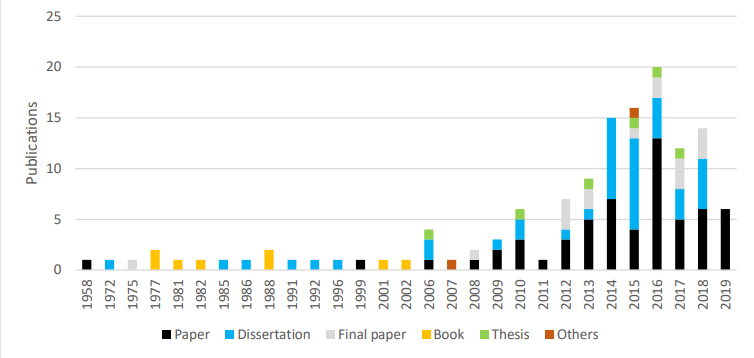
Source: Elaborated by the authors.
The doctoral theses dealt with the theme of medium or small cities and were defended in the 2000s and 2010s. Although, the absence of postgraduate programs at the doctoral level at Unifesspa limits innovation in the themes, they have relevance in the production of knowledge about Marabá, as it broke with the trend of producing scientific knowledge about the metropolises of the Amazon, carried out in universities located in the capitals.
The doctoral theses produced on Marabá were: the first was defended at the Federal University of Pará (UFPA), in 2006; later, another thesis defended at the University of São Paulo (USP) in 2010; followed by a thesis defended at the Federal University of Pernambuco (UFPE) in 2013, under the theme including the land conflict in the region; a thesis defended at the Federal University of Uberlândia (UFU) in 2015; another at UFPA in 2016; and, one more thesis at the University of Minho, in Portugal in 2017. Most of the authors are currently professors at Unifesspa who left their teaching activities to carry out their theses in universities outside Pará.
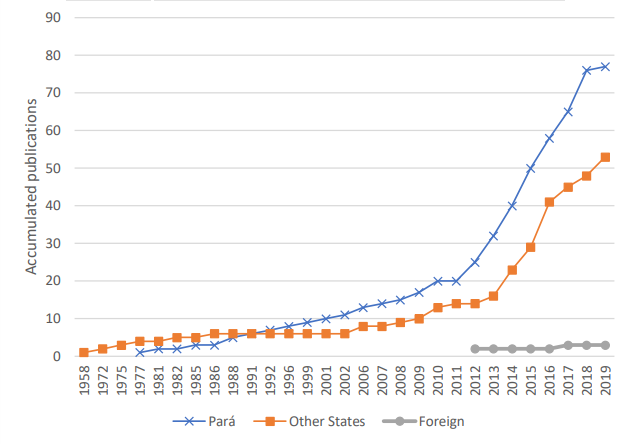
The origin of the researchers interested in the city of Marabá was another of the analyzed categories. The federative units of origin of the authors' institutions were Pará, São Paulo, Goiás, Rio de Janeiro, Minas Gerais, Pernambuco, Maranhão, and Mato Grosso do Sul. Of the total number of publications analyzed, the state of Pará published 81.95% of 109 publications, São Paulo 9.02%, Goiás and Minas Gerais 2.25%, and the other states were represented by 18.05% of the total publications. The connection of researchers to postgraduate programs outside Pará was recurrent, which reinforces the importance of the interiorization and deconcentration of UFES from the state capitals to the interior for the retention of researchers and professors.
Graph 7 - Publications accumulated by state of the main researcher's institution
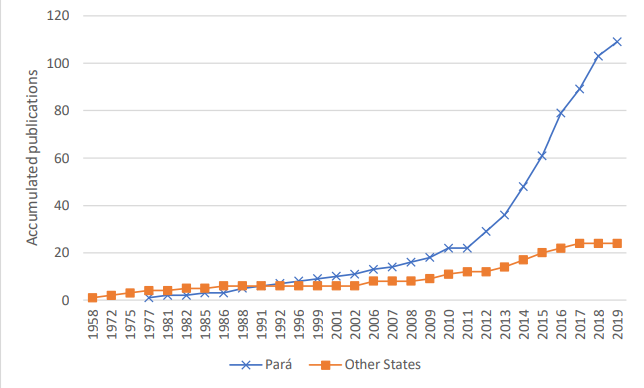
Source: Elaborated by the authors.
In graph 8, the analysis filter of the origin of the publishers responsible for the publications placed the state of Pará in first place. However, there was an inflection in the trend that occurred until the 1990s, as publications were concentrated outside Pará. In the total of the series studied, Pará concentrated 57.89% of the publications, with 77 productions, followed by São Paulo with 15.78%, represented by 21, the other states with 24.06%, with 32, and 3 productions of foreign publishers.
Graph 8 - Accumulated publications by state of publishers
Source: Elaborated by the authors
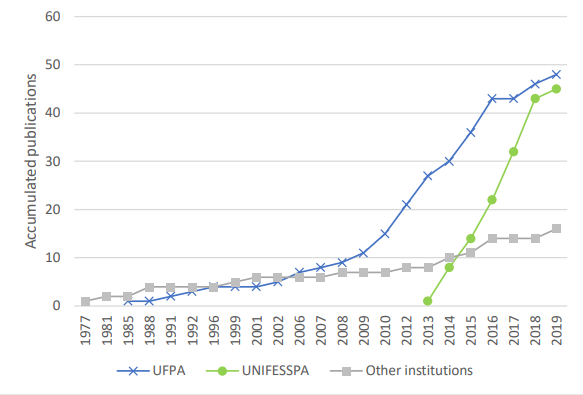
In total, the HEIs in Pará contributed with a total of 80.36% of publications during the analyzed period, and Unifesspa contributed with 41.28%, represented by 45 publications, UFPA contributed with 44.04%, being 48 publications, and other institutions contributed with 14.68%, totaling 109 publications.
In Graph 9, the main difference is in the distribution of research along the historical periodization, with great importance of the graduate programs of UFPA in scientific production throughout the series. The surprise is the scientific production of Unifesspa, accounting for almost half of the total, but they took place in a period of 6 years, that is, in a shorter period of time than the production of UFPA. Regionalized production, as described by Becker (2007), would indicate that Unifesspa gained importance for local knowledge.
Graph 9 - Publications accumulated by research institutions in Pará
Source: Elaborated by the authors.
FINAL CONSIDERATIONS
The internalization of federal higher education advanced, even in a contingent way, in the Amazon. The case addressed in this paper refers to the identification of research topics after the implementation of Unifesspa. According to the approach in the literature, two important aspects that result from this process can be resumed: a) Sen (2000) positions education as a provider of empowerment and empowerment of individuals through the formulation and management of public policy by the State; b) Santos (1996) emphasizes the impact of the technical-scientific-informational space in the alteration of the production of knowledge, with the insertion of universities in municipalities outside the circuit of the metropolises. Both of these authors' contributions can be applied to the case of Unifesspa in relation to the production of scientific knowledge referenced by the characteristics of the territory in which it is inserted, making it possible to identify beacons for development.
Unifesspa has advanced quantitatively in recent years, with emphasis on the formation of qualified human capital in the region, increasing the number of undergraduate courses to 43, absorbing 81.2% of students from the North region. However, the formation of a research agenda goes beyond graduations, it requires as a presupposition the republican pact of the institutions, in this case Unifesspa with the social actors, expanding the population's access to social rights and reverberating this action in the form of systematization of the scientific production and its application in the territories of the communities.
It is possible to relate, going back to Vieira (2017), that the effects generated by federal universities in their internalization process resulted in two processes, backward chainings (backward linkages) and forward threads (forward linkages). In the case of forward linkages, we can infer, even at an early stage, that Unifesspa mobilizes important potential for the production and dissemination of scientific knowledge, which can be converted into technology for application in society.
The data presented in the paper show the importance of the internalization of the university for Brazil, in the peripheral regions. This process mobilized important potentialities, based on the training and qualification of human resources and the production of knowledge on the characterization of territorial asymmetries. In a similar way to the benefits in infrastructure, resources, specialized professional qualification, student training, the university has repercussions on the creation of knowledge that circulates in the scientific area of the human sciences and applied social sciences. Knowledge that has many mechanisms to be disseminated outside the university in the city or region, especially after the graduates leave.
Within this scope, this paper presents the process of scientific production at first with the absence of Unifesspa in Marabá, and later the results achieved after the inauguration of Unifesspa. Although this process represents a specific case, it can be reverberated in new research for other cases in Brazil, so that it can constitute a research agenda, seeking to relate the impacts generated from the production of scientific knowledge on the territory, the mesoregion and the region in which the higher education institution was implemented. Publications carried out by research that resulted in monographs, dissertations and scientific papers at Unifesspa allowed for a substantial increase in intellectual production. This condition was generated by the expansion of infrastructure and the opening of new undergraduate and graduate courses, but there still remains a gap in the institutional development of Unifesspa, the creation of new graduate courses in relation to master’s and mainly doctoral degrees.
The formation of future research topics is based, in the scientific production of theses, dissertations, monographs, papers, book chapters and books, on the knowledge consolidated by the two most predominant areas of knowledge, which are Geography and Social Sciences. This fact allows us to recommend as important research agendas the urbanization that is related to the advancement of agribusiness and mining extraction, under deforestation and territorial conflicts in traditional and indigenous communities, in Marabá and neighboring municipalities, complemented by the valorization of lands from subdivisions to new condominiums. Research on socioeconomic inequalities permeates different areas of scientific knowledge, however, it was consolidated with the efforts of researchers in the Social Sciences.
The training of new professionals by Unifesspa opens a qualitative research agenda that would continue the research that resulted in this paper. It would consist of finding out to what extent the students from Unifesspa have remained in the region, entering the job market. Understanding that the permanence of qualified professionals is an essential part of the development of the municipality.
Finally, this research published in this paper is part of a larger agenda to which researchers are linked, on the impacts of Unifesspa in the municipalities of Southeast Pará. Evidently, this paper has limitations regarding the updating of data related to social indicators, such as IDHM, and those related to the Educational Census carried out by Unifesspa. Another flank that has limitations, however, without limiting the results of this paper, refers to the scope of academic production, since it was necessary to delimit the focus to seek the results, without losing the objectivity. In the next stages of research, the filters for analyzing scientific production will be improved, allowing the expansion of the analytical scope, endorsing possible studies on the relationship with the formulation of public policies in the municipalities, as a basis for overcoming territorial and regional inequalities.
REFERENCES
Becker, B. (2007). Síntese da Produção Científica em Ciências Humanas na Amazônia: 1990- 2002. In W. M. da Costa, B. K. Becker, & D. S. Alves (Eds.). Dimensões humanas da biosfera-atmosfera na Amazônia (pp. 13-38). EdUSP.
Bourdieu, P. (2012). Escritos de educação. São Paulo: Vozes.
Brasil. Ministério da Educação. (2009a). Reuni 2008 – Relatório de Primeiro Ano. Retrieved from http://portal.mec.gov.br/index.php?option=com_docman&view=download&alias=2069- reuni-relatorio-pdf&Itemid=30192
Brasil. Ministério da Educação. (2009b). Universidade, Expandir até ficar do tamanho do Brasil. Brasília, DF.
Clementino, M. L., & Dantas, J. (2014). A expansão do ensino superior e as cidades médias: um estudo sobre a atuação da UERN/Campus de Pau dos Ferros (RN). Revista Política e Planejamento Regional, 1(2), 227-236.
GeoCAPES. (n.d.). Retrieved from http://geocapes.capes.gov.br/geocapes2/
IBGE - Instituto Brasileiro de Geografia e Estatística. (2020). Regiões de Influência das Cidades: 2018. Rio de Janeiro: IBGE.
Instituto Nacional de Estudos e Pesquisas Educacionais Anísio Teixeira. (2018). Sinopse estatística da Educação Superior. Retrieved from http://portal.inep.gov.br/web/guest/sinopses-estatisticas-da-educacao-superior
Jacobs, J. (1969). The economy of cities. New York: Vintage Books.
Marques, A. C., & Cepêda, V. A. (2012). Um perfil sobre a expansão do ensino superior recente no Brasil: aspectos democráticos e inclusivos. Revista Perspectiva, 42, 161-192.
Melo, A. C. C. de. (2014). Modernização e transformações recentes nos processos intraurbanos no sudeste do Pará (Master's thesis). Universidade Federal do Pará.
Ojima, R., & Marandola, E. (2012). Mobilidade populacional e um novo significado para as cidades: Dispersão Urbana e reflexiva na Dinâmica regional não metropolitana. Revista Brasileira de Estudos Urbanos e Regionais, 14(2).
Rolim, C., & Serra, M. (2009). Ensino superior e desenvolvimento regional: avaliação do impacto econômico de longo-prazo. Revista Brasileira de Estudos Regionais e Urbanos, 3(1).
Santos, M. (1996). A Natureza do Espaço: técnica e tempo. Razão e Emoção. São Paulo: Hucitec.
Sen, A. (2000). Desenvolvimento como liberdade. São Paulo: Companhia das Letras.
SEPLAN, Secretária de Planejamento e Desenvolvimento Institucional UNIFESSPA. (2018). Plano de Desenvolvimento Institucional (PDI) 2014-2019. Universidade Federal do Sul e Sudeste do Pará. Retrieved from
https://www.unifesspa.edu.br/images/documentos/PDI2014-2019-Unifesspa.pdf
Serra, M. A., & Rolim, C. F. C. (2013). Desenvolvimento e Engajamento Regional: O Papel das Universidades. In R. L. L. da Silveira (Ed.), Observando o Desenvolvimento Regional Brasileiro: Processo, Políticas e Planejamento. Santa Cruz do Sul: UNISC.
Souza, M. V. M. (2015). O projeto Alpa e a produção do espaço urbano em Marabá (PA): a cidade mercadoria e as desigualdades socioespaciais (Doctoral dissertation). Universidade Federal de Uberlândia.
Vieira, D. (2017). Evolução do ensino superior brasileiro em período recente: novas perspectivas para o desenvolvimento regional? In A. Monteiro, C. N. Castro, & C. A. Brandão (Eds.), Desenvolvimento regional no Brasil: políticas, estratégias e perspectivas. Brasília: Ipea.
Zambello, A. (2013). Universidades Federais Brasileiras e o Impacto Regional do Reuni. Revista Gestão & Políticas Públicas, 3, 246-267.