Artigos
A Systematic for Classifying Business Models and Strategies
A Systematic for Classifying Business Models and Strategies
Gestão & Regionalidade, vol. 39, e20238072, 2023
Universidade Municipal de São Caetano do Sul
Recepción: 01 Septiembre 2021
Aprobación: 16 Julio 2022
Abstract: Over the years, many business assumptions and practices that were once taken for granted began to unravel, giving way to new concepts. The business strategy is a consequence of the business model, as the model represents the assumption of the strategy, and is an initial factor for it. The objective of this research is to develop indicators to classify the relationship between business models and business strategies in different production systems and apply them to companies in Brazil and Poland to understand if the indicators remain the same. For the methodology, a qualitative, exploratory-descriptive approach was used, and for the construction of the indicators, a multiple case study was applied to identify the similarities and dissimilarities in the business models and strategies. Among the results, it can be highlighted that the unifications of the individual strategies of each pillar of the business model, when grouped, represent the relationships between business models and strategies of different production systems.
Keywords: value, Canvas, business strategies, productive systems.
Resumo: Ao longo dos anos muitos pressupostos e práticas de negócios antes tidos como certoscomeçaram a se desfazer dando lugar a novos conceitos. A estratégia de negócios é uma consequência do modelo de negócio, pois o modelo representa o pressuposto da estratégia, sendo um fator inicial para ela. O objetivo desta pesquisa é elaborar indicadores para classificar a relação entre modelos de negócios e estratégias de negócios em diferentes sistemas produtivos e aplicá-los em empresas no Brasil e na Polônia para compreender se os indicadores permanecem os mesmos. Para a metodologia foi utilizada abordagem qualitativa, do tipo exploratória descritiva, para a construção dos indicadores foi aplicado estudo de múltiplos casos para identificar as semelhanças e dissemelhanças nos modelos de negócios e estratégias. Dentre os resultados pode-se destacar que as unificações das estratégias individuais de cada pilar do modelo de negócio, quando agrupadas, representam as relações entre modelos de negócios e estratégias de diversos sistemas produtivos.
Palavras-chave: valor, Canvas, estratégias de negócios, sistemas produtivos.
1 Introduction
The complexity and dynamism of modern business environments has made companies need tools that provide data from the entire business in the shortest possible time (Doleski, 2015).
Rapidly changing markets impose constant evolution on companies. These transformations require changes and adjustments in business models, as well as adjustments in strategies for the development of new scenarios (Kotler, 1999).
Camponovo and Pigneur (2003) define a business model as a detailed conceptualization of a company's strategy at an abstract level, which serves as the basis for implementing business processes. On the other hand, Osterwalder et al. (2005) complement that the business model is an interface or an intermediate theoretical layer between business strategies and business processes. For Rusnjak (2012), the relationship between business models and business strategies is not completely clarified, both in the scientific literature and in practice.
According to Falenciokowski (2013), the business strategy is a consequence of the business model, as the model represents the assumption of the strategy, being an initial factor for it.
According to Vukanovic ́ (2016), the topic “business models” has been debated over the years, with the period between 1998 and 2002 having the highest increase in peer-reviewed articles, followed by a sharp rise in published theses and dissertations (2000–2005).
Through these debates, the research question to be answered is: How do companies from different production systems relate their business models and their business strategies?
The main objective of this research is to develop indicators to classify the relationship between business models and business strategies in different production systems and apply them in companies in Brazil and Poland to understand if the indicators remain the same, regardless of cultural, and commercial variations. and business of these production systems.
The justification of this research allowed the authors to exchange internationally with a Polish university and to carry out a joint study of two themes that are widely used in both countries, but which have not received any academic attention so far. In one year, there were three trips to Poland to develop the work, and the cities of Katowice, Krakow, and Warsaw were visited.
In addition to the conceptual and technical development, the internationalization of this research project allowed the knowledge of the organizational and social culture of the Polish people, contributing to the professional and personal development of the authors.
2 Literature revision
2.1 Business models
In the context of a business model, "model" is the abstract representation of how a company's business activities work; “business” can be understood as the structured transformation of input factors into products and services. A business model provides a simplified representation of value creation processes, functions, and interactions to create value for customers, ensuring competitive advantage and generating revenue, using a comprehensive and aggregated picture of reality, which can integrate the political, legal, economic, sociocultural, technological, and sustainability (Doleski, 2015).
According to Oliveira and Crispim (2020), the term business models has been used with increasing frequency in business and academia, and some authors claim that this trend has been driven by the increase in technology in the business environment.
The topic has been debated over the years. The period between 1998 and 2002 saw the most significant increase in peer-reviewed articles, followed by the sharp rise in published theses and dissertations (2000–2005). Vukanovic' (2016) demonstrates the detailed and longitudinal evolution of the most cited academic works, books, master's dissertations, and doctoral theses (Chart 1).
| Timmers (1998) | The business model primary constructs include an architecture for the products, service, and information flows, including various business actors as well as their roles and benefits in addition to sources of revenue | 2642 |
| Eriksson and Penker (2000) | The business model is the focal point around which business is conducted or around which business operations are improved. | 1359 |
| Tapscott et al. (2000) | Business webs are inventing new value propositions, transforming the rules of competition, and mobilizing people and resources to unprecedented levels of performance a b-web is a distinct system of suppliers, distributors, commerce service providers, and customers that use the Internet for their primary business communications and transactions | 1161 |
| Amit and Zott (2001) | A business model is the architectural configuration of the components of transactions designed to exploit business opportunities an e-business models include content (exchanged goods and information), structure (the links between transaction stakeholders), and governance of transactions (the control of the flows of goods, information, and resources). | 3785 |
| Magretta (2002) | The main components of BMs include telling a logical story explaining who the customers are, what they value, and how to deliver values to them at an appropriate cost. | 2196 |
| Osterwalder et al. (2005) | The business model is an interface or an intermediate theoretical layer between the business strategy and the business processes. | 1598 |
| Shafer et al. (2005) | A business model is a representation of a firm’s underlying core logic and strategic choices for creating and capturing value within a value network | 1046 |
| Johnson et al. (2008) | A business model consists of four interlocking elements (value proposition; profit formula; key resources and key processes). | 1272 |
| Teece (2010) | A business model reflects “management’s hypothesis about what customers want, how they want it, and how an enterprise can best meet those needs, and get paid for doing so.” A business model articulates how the firm will convert resources and capabilities into economic value. It is nothing less than the organizational and financial “architecture” of a business and includes implicit assumptions about customers, their needs, and the behavior of revenues, costs, and competitors. | 1834 |
| Osterwalder & Pigneur (2010) | A business model is a series of elements: the value proposition (product/service offering), customer segments, customer relationships, activities, resources, partners, distribution channels (value creation and delivery) and cost structure, and revenue model (value capture). | 2573 |
The various definitions of the business models concept highlight the fragmented nature of existing conceptualizations. A wide variety of different, multidisciplinary approaches, viewpoints, and issues add up to undefined and fragmented views. This suggests that the domain is confused and vague and is still in the conceptualization stage, being confused with a set of undefined discrepant methodological characteristics (VUKANOVIC ́, 2016).
A better understanding of business models helps entrepreneurs make the right decisions, increasing the likelihood of success (ALEGRE and BERBEGAL-MIRABENT, 2016). Business models must also be aligned with the organization's strategy, culture, and resources. These relationships cannot just be optimized through data analysis. A good business model depends on art, intuition, science, and business analysis (TEECE e LINDEN, 2017).
2.2 Conceptual model
The conceptual approach to business models is presented in the literature in different ways. However, three main value-based elements can be distinguished: value proposition, value creation and delivery, and value capture (Figure 1). These three dominant elements in business models play a significant role in the value composition process (OTOLA et al., 2020).
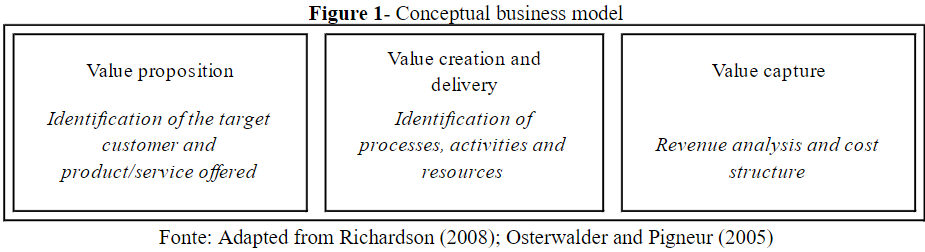
The conceptual model contains a set of elements and their respective relationships that allow expressing the logic of the researched business. It describes the value that a company provides to customers and its network of partners to create, sell, and deliver that value to generate profitable revenue streams (OSTERWALDER and PIGNEUR, 2005; OSTERWALDER and PIGNEUR, 2011). The construction of the business model blocks is presented (Chart 2).
| Product | Value proposition | It offers an overview of a company's package of products and services. |
| Customer interface | Customer segment | It describes the customer segments to which a company wants to provide value |
| Relationship with customers | It explains the types of connections a company establishes between itself and its different customer segments. | |
| Channels | It describes the company's various means of contacting its customers. | |
| Infrastructure management | Key resources | It describes the arrangement of activities and resources. |
| Key activities | It describes the competencies needed to run the company's business model. | |
| Key partners | It portrays the network of cooperation agreements with other companies to efficiently deliver and market value. | |
| Financial aspects | Cost structure | It summarizes the monetary consequences of the means employed in the business model. |
| Revenue stream | It describes how a company makes money, through various revenue streams. |
According to Alegre and Berbegal-Mirabent (2016), business models provide a consistent and integrated image of a company, describing the rationale of how an organization creates, delivers, and evaluates value captures, in addition to identifying the elements and relationships that describe how the business operates.
2.3 Canvas business model
Osterwalder (2004) evaluated and compared the most common construction models in the literature. The result of this comparison allowed the identification of the most cited components. The result allowed a synthesis with nine building blocks, covering all the components of the mentioned business models.
For Osterwalder and Pigneur (2011), the business model represents parts of the strategy planned to be implemented within its organizational structures, processes, and interdependent systems.
Through the authors' work, it was possible to have access, through clear language, for any interested party to create or modify a business model, allowing the exchange of ideas between those involved in the business modeling process (OROFINO, 2011).
The illustration of the interaction between the blocks of the business model screen can be observed (Figure 2).
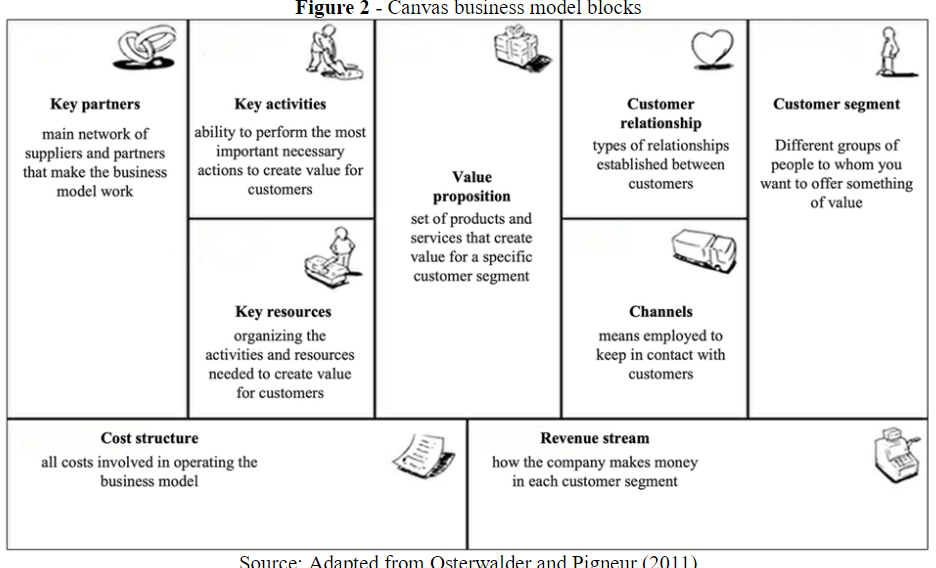
According to Figure 2, five blocks of the business model refer to external aspects, namely: value offering, relationship, customer segments, channels, and revenue sources; while the others refer to internal aspects: key activities, key partners, key resources, and cost structure.
The questions that guide the analysis of each of the nine blocks of the Canvas business model are presented in Chart 3, according to Osterwalder and Pigneur (2011).
| Value offer | What is the value offered to the customer? What problem can it be solved? What needs to be satisfied? What set of products and services are offered to each customer segment? |
| Customer segment | For whom is value created? Who are the most important consumers? |
| Channels | Through which channels do customer segments want to be contacted? How can they be reached now? How do channels integrate? Which works best? Which are the most profitable? |
| Relationship with customers | What kind of relationship can be offered to each of the customer segments? What is the cost of each? How do they integrate with the rest of the business model? |
| Key resources | What are the main resources that the value proposition requires: The distribution channels? Relationship with the consumer? Revenue sources? |
| Key activities | What key activities does the value proposition require: The distribution channels? Relationship with the consumer? Revenue sources? |
| Key partiners | Who are the main partners? Who are the main suppliers? What are the main resources obtained from partners? What main activities do partners carry out? |
| Cost structure | What are the most important costs in the business model? What are the most expensive key features? Which core activities are more expensive? |
| Revenue stream | What amounts are customers willing to pay? Why and how do they currently pay? How much does each revenue source contribute to total revenue? |
The process of building a business model is the starting point for a company. However, each organization can customize the method, adapting it to its reality (OSTERWALDER and PIGNEUR, 2011).
2.4 Value
According to Bradenburger and Stuart (1996), there are two important items in value creation: buyers' willingness to pay and opportunity cost. Meeting buyers' needs seems to be enough to create value, with suppliers playing only a secondary role. As companies try to control their costs to profit from the needs of buyers, an unsatisfactory asymmetry in the chain is created, as suppliers are constituents of the chain. For a company to have positive added value, there must be a favorable asymmetry between it and its competitors. The four value-based strategies (Figure 3) that lead to the creation of buyers' willingness to pay and suppliers' opportunity costs can be identified (BRADENBURGER and STUART, 1996).
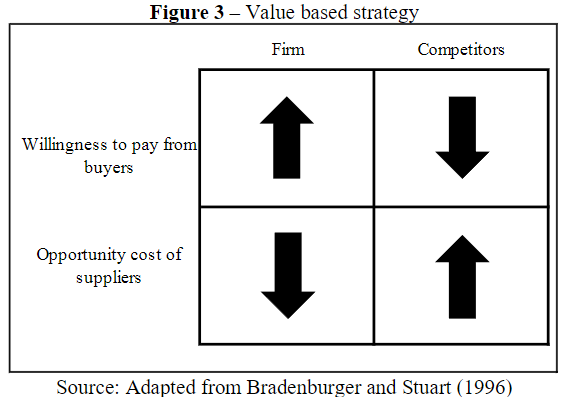
Analyzing Figure 3, it is possible to understand each of the strategies contained in the quadrants:
Top left corner: strategy of increasing buyers' willingness to pay for the company's product, through the classic differentiation strategy, which involves the company finding ways to better meet buyers' needs than its competitors.
Bottom left: Strategy of reducing the opportunity cost for suppliers by reducing a supplier's costs of doing business with the company. This type of strategy is based on values that companies should establish “value-managed partnerships” with their suppliers.
Top right: a strategy to reduce buyers' willingness to pay for products from other companies. This strategy can include negative publicity of the competition and convincing buyers that the competition's products are less interesting, using, for example, sustainability issues.
Bottom right: strategy of increasing the opportunity cost for suppliers of offering resources to other companies, influencing not only buyers (such as the willingness-to-pay reduction strategy) but also suppliers.
Value-based strategies take a basic approach that remains unchanged: value is created as a whole, willingness to pay and opportunity cost remain the main ingredients of the definition (BRADENBURGER and STUART, 1996).
2.5 Business models and business strategies
Although the terms “business models” and “strategies” are widely used, there is still no unanimous definition of them. A systematic literature review of the two terms carried out by Vukanovic' (2016) reveals that there is considerable and substantial overlap between them. Two more relevant points are asked: “what are the subtle and distinct differences between business models and strategies?” and “which comes first: business model or strategy?” (VUKANOVIC', 2016).
MacLennan et al. (2020) consider that theories of strategy seek to establish relationships between collaboration between companies and their competitiveness, and De Aro et al. (2019) add that the strategic management literature has consistently explored organizational and dynamic capacity, seeking to identify in the company's abilities ways to differentiate its products, processes, and services.
According to Grabowska; Krzywda; Krzywda (2015), business models and business strategies are strategic planning tools, representing a set of decisions that are essential aspects for the functioning of the business. Business models are geared towards creating value for customers, while strategies are driven by competition and the profitability generated by sales, focusing on value for all parties involved in the business. Thus, concepts are completed as they implement the strategic objectives.
Subsequently, the most pertinent issues that characterize business strategies and business models are demonstrated (Figure 4).
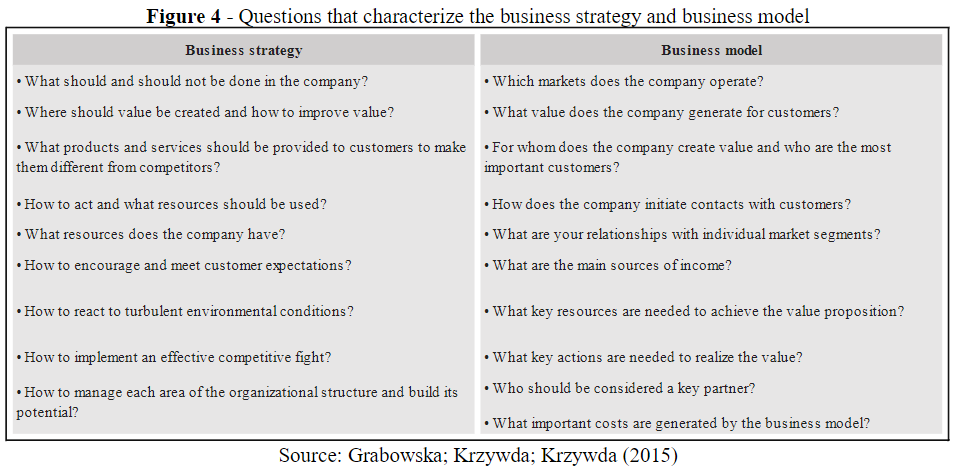
There is no unanimity in the scientific literature or in practice on how business models and business strategies are ordered. However, scholars of the terms agree that business models describe the company's logic and strategies act on success and the competitive situation (RUSNJAK, 2012).
Seddon and Lewis (2003), through a literature review, identified the following propositions in the use of terms (Figure 5).
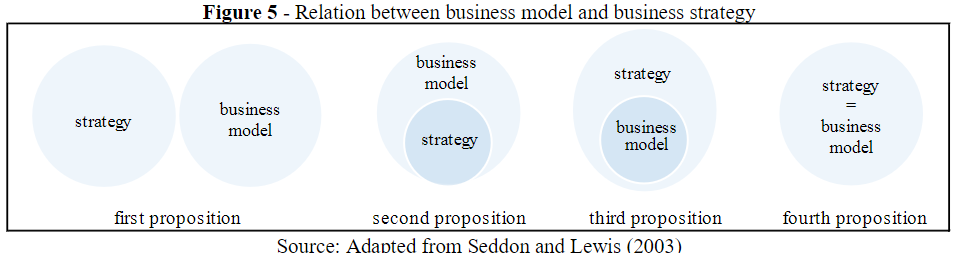
The first proposition adopts the strategy and the business model as totally different constructs. The second proposition adopts the strategy as a construct fully contained in the business model construct. The third proposition adopts the business model as a construct fully contained in the strategy construct. The fourth proposition adopts the strategy and the business model as completely identical constructs.
According to Shafer et al. (2005), a business strategy is the result of a change in the prevailing business logic, that is, changes in business models. A business model is always changing. A company's business model is never complete, just as the process of making strategic choices and testing business models must be continuous and iterative.
According to Stefanovic and Molosevic (2012), in a company there can be only one strategy and several business models. Following this definition, the strategy represents the sum of all business models and their changes within a specific period, becoming a pattern in which each business model is a subpart of the strategy set. In this way, each model is a bisection of the business strategy or a bisection of a set of functional strategies at a specific time.
Ending the discussion, according to Demil et al. (2015), business models emphasize how the value proposition is brought to market, connecting strategy formulation and implementation. These two propositions happen simultaneously in a convergent way.
3 Methodology
The type of research chosen was exploratory and descriptive, as exploratory research aims to provide greater familiarity with the problem, to make it more explicit, and descriptive research aims to describe the characteristics of a given population or phenomenon (GIL, 2017). The methodological procedure followed the steps of the flowchart (Figure 6).
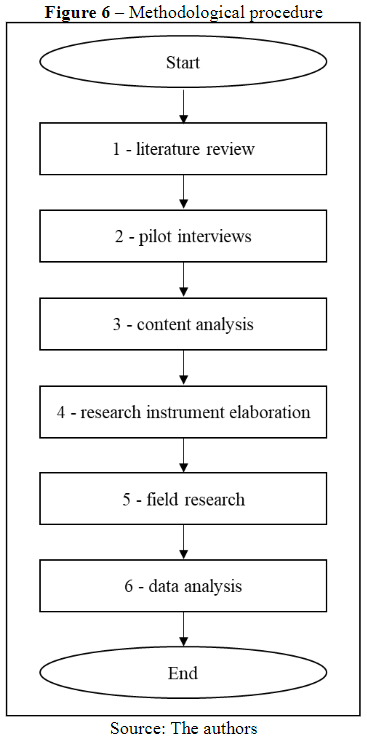
Analyzing Figure 6, it is possible to understand each item of the methodological procedure:
1- Bibliographic review As the literature review clarifies the theoretical assumptions that underpin the research and the contributions offered by previous research (GIL, 2017), the literature review on “business models”, “business strategies” and “value” was used to legitimize the pertinent questions. on the themes, allowing the choice of the theoretical lenses of Osterwalder and Pigneur (2005), Osterwalder and Pigneur (2011) on business models, and of Seddon and Lewis (2003) for propositions between business models and business strategies.
2- Pilot interviews The next step consisted of conducting pilot interviews with three companies, to assess whether the theoretical concepts reflected the interviewees' entrepreneurial experiences. A script of open questions was prepared based on the literature review and experts from the business and strategy areas of three companies were interviewed. For reasons of confidentiality, the companies were named: Alpha, Beta, and Gamma.
Alfa: a small company that provides multidisciplinary consulting services specialized in economic analysis; competition defense and advocacy; financial and regulatory structuring. The strategy director and a senior consultant were interviewed.
Beta: medium-sized company, specialized in outsourcing and vehicle fleet management. The company owner and the financial director were interviewed.
Gama: a large company that sells corporate medical care nationwide. The strategy superintendent was interviewed.
3- Content analysis After transcribing the interviews, a content analysis was performed, whose results from the domains, subcategories, and categories are observed (Chart 4).
Content analysis is a set of methodological instruments in constant improvement, which apply to diversified discourses (contents and continents), having as main characteristics: focus on the message (communications); categorical-thematic (only one of the possibilities of analysis); objective (manipulation of messages to confirm the indicators that allow inferring about reality other than that of the message) (BARDIN, 2011).
| value, services, products, proposal, purpose, business, canvas, template | Value Proposition | Product/Service |
| clients, services, business, company, meet, rendering, care, better, focus, attention | Customer segment | Customer interface |
| Customer Relationship | ||
| network, support, deliver, market, tracking, best, responsive | Channels | |
| After sales, call center, call | Key resources | Infrastructure management |
| health, rental, activities | Key activities | |
| quality, processes, offer, areas | Key partners | |
| suppliers, automakers, hospitals, stakeholders, partnerships | Cost structure | Financial aspects |
| cost, price, margin, budget, pay | Revenue stream | |
| Fine Selling Revenue | Strategic management | Strategy |
| strategic, indicators, drivers, information, following, formulation, effectively monitor market, competitor | Strategic planning |
According to the data presented in Chart 4, it was possible to compare the practical knowledge of the interviewees with the scientific literature of Osterwalder and Pigneur (2005), Osterwalder and Pigneur (2011) on business models, and of Seddon and Lewis (2003) for the overlaps between business models and business strategies. A word cloud was created (Figure 7) according to the content analysis
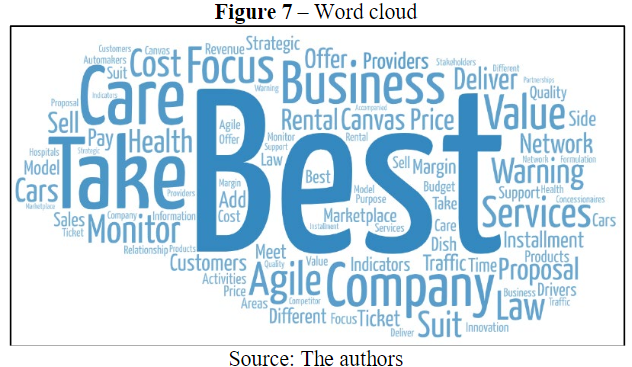
As shown in Figure 7, the words most mentioned by the interviewees are in the center of the figure and the others on the edges. The most cited words were better, attention, services, care, focus, and monitoring.
. Development of the research instrument From the data obtained, the final script of the interview was prepared, initiating the field research. A semi-structured script was developed containing twenty-four questions, aiming at the freedom of answers for the interviewees. In addition to the content of the interviews, direct observations were documented during the field study, helping to triangulate the data, which, for Yin (2005), is the justification for the use of various sources of evidence, allowing the development of convergent lines of investigation., providing more accurate conclusions about the same phenomenon.
5. Field ResearchThe interviews were carried out in twelve companies in Brazil and Poland. For reasons of confidentiality, the companies were named A, B, C, D, E, F, G, H, I, J, K, and L (Table 5), eight in Brazil and four in Poland.
Despite all the efforts of the researchers to gain access to a greater number of companies, it was only possible to contact eight companies in Brazil and four in Poland, and in this country, to obtain the interviews, it was necessary to visit three distant cities at an interval of eight days, due to the availability of the interviewees. In this way, the sampling is non-probabilistic and for convenience. According to Guimarães (2008), a non-probabilistic sampling is obtained when access to information is not simple or resources are limited, impelling the researcher to use data that are within their reach, called convenience sampling.
Due to the language difference between the two countries, the English language was adopted to carry out the interviews carried out in Poland. In Brazil, the Portuguese language was used.
| A | 12/6/19 | 30m09s | IT Director | Health | Medium | Brazilian | São Paulo, Brasil |
| B | 22/4/19 | 25m13s | Sales Consultant | IT | Large | German | São Paulo, Brasil |
| C | 18/6/19 | 28m30s | Commercial Director | Food | Medium | French | São Paulo, Brasil |
| D | 17/6/19 | 30m18s | CEO | Residence | Small | Brazilian | Fortaleza, Brasil |
| E | 25/6/19 | 25m31s | Regional manager | Logistics | Large | Swiss | São Paulo, Brasil |
| F | 8/5/19 | 57m00s | CEO | Vehicles | Medium | Brazilian | São Paulo, Brasil |
| G | 9/7/19 | 33m04s | Business director | IT | Large | Brazilian | São Paulo, Brasil |
| H | 13/5/19 | 28m27s | Strategy Superintendent | Health | Large | Brazilian | São Paulo, Brasil |
| I | 31/5/19 | 41m18s | Business director | Publicity | Medium | Polish | Varsóvia, Polônia |
| J | 24/5/19 | 33m32s | President | IT | Large | Polish | Katowice, Polônia |
| K | 29/5/19 | 51m22s | President | IT | Medium | Polish | Cracóvia, Polônia |
| L | 31/5/19 | 37m23s | President | IT | Small | Polish | Varsóvia, Polônia |
The interviews were recorded and transcribed. After completion, all transcripts were carried out and passed through the reliability check, so that the recordings were heard and the manually transcribed texts were checked sentence by sentence. The interviews conducted in English, after transcription, were translated into Portuguese.
6. Data analysis The analysis of the data obtained was performed using intra-case and inter-case models established by Miles and Huberman (1994). Intra-case analysis grants familiarity and data generation, through a preliminary theory; in contrast, the inter-case analysis allows the researcher to observe more than one case of evidence and obtain different perspectives on the analyzed fact (EISENHARDT, 1989).
The convergence of intra-case and inter-case analyses led to the study of multiple cases used to identify similarities and dissimilarities in how companies relate their business models and business strategies, enabling the elaboration of classification indicators and the development of the artifact table classification.
Descriptive statistics were used to analyze the variables, containing a list of variables with mean, median, standard deviation, maximum, and minimum (Table 2).
| Product | Value proposition | 10000,00 | 10000,00 | 0,00 | 10000,00 | 10000,00 |
| Customer Interface | Customer segments | 500,00 | 500,00 | 522,23 | 1000,00 | 0,00 |
| Customer relationship | 833,33 | 1000,00 | 389,25 | 1000,00 | 0,00 | |
| Channels | 166,67 | 0,00 | 389,25 | 1000,00 | 0,00 | |
| Infrastructure Management | Key resources | 83,33 | 100,00 | 38,92 | 100,00 | 0,00 |
| Key activities | 83,33 | 100,00 | 38,92 | 100,00 | 0,00 | |
| Key partners | 75,00 | 100,00 | 45,23 | 100,00 | 0,00 | |
| Financial Aspects | Cost structure | 5,83 | 10,00 | 5,15 | 10,00 | 0,00 |
| Revenue stream | 5,00 | 5,00 | 5,22 | 10,00 | 0,00 | |
| Strategy –macroeconomic analysis | Strategies | 0,50 | 0,50 | 0,52 | 1,00 | 0,00 |
Observing the data in Table 2, it is possible to analyze some characteristics of the companies, as in the first line related to the “Product” pillar, in which all companies present a value proposition. This means that companies know the importance of having a differential that serves the customer.
Regarding the “Customer interface” pillar in lines 2 to 4, in customer segments, only 50% of companies know their segments or main customers. In terms of relationships, 83% of companies know how to relate to customers and only 16.66% of respondents consider channels to be strategic.
Between lines 4 and 6 in the “Infrastructure Management” pillar, respondents considered key resources and key activities equally important in the order of 83.33% for infrastructure management, followed by the Key partners pillar with importance of 75%.
In the “Financial Aspects” pillar in lines 9 and 10, the cost structure is understood by 58.3% of the companies, on the other hand, 50% of the companies surveyed understand the revenue stream of the business model.
Finally, for the strategy variable, 50% of companies consider owning and planning their business strategies.
4 Results presentation
For intra-case analysis, the business model of each company was mapped using the Canvas business model. Each of the nine blocks of each company was analyzed individually: value proposition, customer segment, customer relationships, channels, key resources, key activities, key partners, cost structures, and revenue streams.
The inter-case analysis was used to refer to which parts of the business models’ companies focus their business strategies on. Through a synthesis of the information provided by the interviewees, regularities were found among the twelve companies, even though they were from different production systems.
For the elaboration of the indicators, the four pillars with their respective building blocks presented in Chart 2 were considered and a fifth pillar called strategy was added.
To differentiate, total, and classify the indicators, a multiplied factor was assigned to each pillar, being an exponential in the base 10, that is, from 100 = 1 to 104 = 10,000, attributing greater significance to each pillar studied.
In this way, it was possible to punctuate the existence of business strategies in each of the blocks of the business model as follows:
a) Product (value proposition): for the value proposition, the weight indicator was given 10,000 or 104, considering that without the value proposition there is no business model. b) Customer interface (customer, relationship, and channels segment): for the customer interface, the weight indicator was given 1,000 or 103, individually to the three blocks, considering that the delivery of value to customers refers to the delivery of a value offer. The maximum possible score reached by the companies was 3,000 points. c) Infrastructure management (key resources, key activities, and key partners): for infrastructure management, the weight indicator 100 or 102 was considered, individually for the three blocks, considering that the creation and delivery of value follow the interface with the client. The maximum possible score reached by the companies was 300 points. d) Financial aspects (cost structure and revenue stream): for the financial aspects, the weighting indicator 10 or 101 was considered, individually for the two blocks, considering that the financial aspects exist to capture the value that is offered to customers. The maximum possible score reached by the companies was 20 points. e) Strategy (macroeconomic analysis): for strategic analysis, the weighting indicator 1 or 100 was considered since macroeconomic analysis extends the value to the entire business model. The maximum possible score reached by the companies was 1 point.
The score given the existence of business strategies in each of the pillars of the building blocks of the business models is presented (Table 3).
| Product | Value proposition | 10.000 / 104 | 10.000 |
| Customer interface | Customer segments | 1.000 / 103 | 1.000 |
| Customer relationship | 1.000 / 103 | 1.000 | |
| Channels | 1.000 / 103 | 1.000 | |
| Infrastructure management | Key resources | 100 / 102 | 100 |
| Key activities | 100 / 102 | 100 | |
| Key partners | 100 / 102 | 100 | |
| Financial aspects | Cost structure | 10 / 101 | 10 |
| Revenue stream | 10 / 101 | 10 | |
| Strategy –macroeconomicanalysis | 1 / 100 | 1 | |
| Total | 13.321 |
The total points obtained by the companies were scaled, representing the overlaps between business models and business strategies by Seddon and Lewis (2003). The overlay schedules were called constructs (Figure 8).
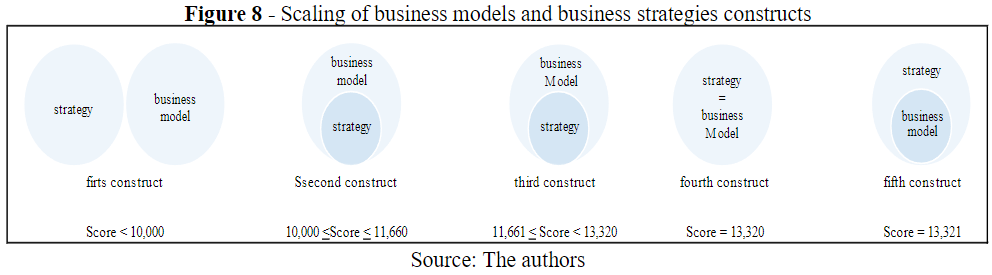
For the definitions of each logical proposition between the constructs, the following definitions by the authors were considered.
1. First construct adopts the strategy and the business model as totally different constructs.
Chesbrough and Rosenbloom (2002) state that business models are focused on creating value for the customer and delivering that value. The strategy, on the other hand, emphasizes the sustainability of this value, considering the possible threats, for example, from new entrants and/or substitute products.
2. Second construct adopts the strategy as a small part of the business model construct.
According to Falenciokowski (2013), the business strategy is a consequence of the business model, as the model represents the assumption of the strategy, being an initial factor for it.
3. Third construct adopts strategy as a major part of the business model construct.As the business model concepts are easy to apply, they make it possible for more than one strategic approach to be used simultaneously. The business model is a dynamic and systemic instrument of strategy (JOIA and FERREIRA, 2005).
4. Fourth construct adopts the strategy and the business model as totally identical constructs.
The mapping of the concept of strategy and the concept of business models are very close, inferring that business models and strategy are just two sides of the same coin (SEDDON and LEWIS, 2003).
5. Fifth construct adopts the business model as a construct fully contained in the strategy construct.
According to Thompson and Strickland (2004), strategy is a broader concept than a business model. The strategy relates to a competitive initiative of the company, regardless of the results, while the business model focuses on the problems of sufficient and necessary income for the continuity of the company's operation.
According to Thompson and Strickland (2004), strategy is a broader concept than a business model. The strategy relates to a competitive initiative of the company, regardless of the results, while the business model focuses on the problems of sufficient and necessary income for the continuity of the company's operation.
The consolidated scores of the companies are shown (Table 4). The interviews in Brazil correspond to companies A, B, C, D, E, F, G, and H; the interviews in Poland correspond to Polish companies I, J, K, and L.T
| A | 10.000 | 1.000 | 1.000 | 0 | 100 | 100 | 100 | 10 | 10 | 1 | 12.321 | |
| B | 10.000 | 1.000 | 1.000 | 0 | 100 | 100 | 100 | 10 | 10 | 1 | 12.321 | |
| C | 10.000 | 1.000 | 0 | 0 | 100 | 100 | 100 | 10 | 10 | 1 | 11.220 | |
| D | 10.000 | 1.000 | 0 | 0 | 0 | 0 | 0 | 0 | 10 | 0 | 11.000 | |
| E | 10.000 | 1.000 | 1.000 | 1.000 | 100 | 100 | 100 | 10 | 10 | 1 | 13.321 | |
| F | 10.000 | 1.000 | 1.000 | 0 | 100 | 100 | 100 | 10 | 10 | 1 | 12.321 | |
| G | 10.000 | 1.000 | 1.000 | 0 | 100 | 100 | 0 | 10 | 10 | 0 | 12.301 | |
| H | 10.000 | 1.000 | 0 | 1.000 | 100 | 100 | 0 | 10 | 10 | 0 | 11.300 | |
| I | 10.000 | 1.000 | 0 | 1.000 | 100 | 100 | 100 | 10 | 10 | 1 | 11.311 | |
| J | 10.000 | 1.000 | 0 | 1.000 | 100 | 0 | 0 | 10 | 10 | 0 | 11.200 | |
| K | 10.000 | 1.000 | 0 | 1.000 | 100 | 0 | 0 | 10 | 10 | 0 | 11.200 | |
| L | 10.000 | 1.000 | 0 | 0 | 100 | 100 | 100 | 0 | 10 | 1 | 11.220 | |
| Indicadores estratégicos | 12 | 6 | 10 | 2 | 10 | 10 | 9 | 7 | 6 | 6 | ||
| Total de empresas | 12 | 12 | 12 | 12 | 12 | 12 | 12 | 12 | 12 | 12 |
As shown in Table 4, no company is in the first or fourth construct, as they have strategies for their value propositions and their strategies are different from their business models.
Seven companies fit the second construct with only a part of the strategy included in the business model, and their strategies are contained in only some of the blocks of the business model. For companies that fit the second construct, the most punctuated blocks were relationship with customers, key resources, and key activities.
Four companies fit into the third construct, in which most of their strategies are contained in the business model, permeating most of the blocks of the model. The combination of the strategies of these blocks represents the strategic management of the company. For companies that fit the third construct, the blocks that received the most scores were relationship with customers, key resources, key activities, key partners, and macroeconomic strategy.
Only one company fits the fifth construct, in which the strategy extends the business model and is contained in all blocks of the model. In this case, the company makes external analyzes to understand its organizational performance.
5 Discussion of results
According to Table 4, it is possible to observe in which blocks of the business models’ companies focus their business strategies. The descending order of score for the blocks was: value proposition (12/12), relationship with customers (10/12), key resources (10/12), key activities (10/12), key partners (9/12), cost structure (7/12), customer segment (6/12), revenue stream (6/12), macroeconomic strategy (6/12), and channels (2/12).
Four Brazilian companies are in the third construct, in which the strategy is contained in most of the business model construct, whose score is in the range 11,661-score-13,320. The four Polish companies are in the second construct, in which the strategy is contained in a small part of the business model construct, whose score is in the range 10,000-score-11,660.
In the individual score, which measures the existence of a business strategy in each of the blocks of the business model, it is possible to identify the following similarities and dissimilarities between the companies in Brazil and Poland (Table 5).
| Value proposition | 8 | 4 | 12 |
| 8 | 4 | 12 | |
| Customer segment | 5 | 1 | 6 |
| 8 | 4 | 12 | |
| Customer relationship | 7 | 3 | 10 |
| 8 | 4 | 12 | |
| Channels | 2 | 0 | 2 |
| 8 | 4 | 12 | |
| Key resources | 7 | 3 | 10 |
| 8 | 4 | 12 | |
| Key activities | 6 | 4 | 10 |
| 8 | 4 | 12 | |
| Key partners | 7 | 2 | 9 |
| 8 | 4 | 12 | |
| Cost structure | 5 | 2 | 7 |
| 8 | 4 | 12 | |
| Revenue stream | 5 | 1 | 6 |
| 8 | 4 | 12 | |
| Macroeconomic strategy | 5 | 1 | 6 |
| 8 | 4 | 12 |
The main similarities between companies in Brazil and Poland are Value proposition: all companies in Brazil and Poland have strategies for their value propositions.
Relationship with customers: more than 50% of companies in Brazil and Poland have strategies for relationship with customers.
Channels: less than 50% of companies in Brazil and no company in Poland have strategies for their channels.
Key resources: more than 50% of companies in Brazil and Poland have strategies for their main resources; and
Key activities: more than 50% of companies in Brazil and all companies in Poland have strategies for their main activities.
The main dissimilarities between companies in Brazil and Poland are:
Customer segment: more than 50% of companies in Brazil have strategies for segmenting customers, while only a quarter of companies in Poland have strategies for this block of the model.
Key partners: more than 50% of Brazilian companies have a strategy for their main partnerships, while only 50% of companies in Poland have strategies for this block of the model.
Cost structure: more than 50% of companies in Brazil have a strategy for their cost structures, while only 50% of companies in Poland have strategies for this block of the model.
Revenue stream: more than 50% of companies in Brazil have a strategy for their revenue streams, while only a quarter of companies in Poland have strategies for this block of the model; and
Macroeconomic strategy: more than 50% of companies in Brazil have macroeconomic strategies, while only a quarter of companies in Poland have strategies for this block of the model.
Comparing the data from the two countries, the blocks of customer segmentation, revenue stream, and macroeconomic strategy show the greatest deviations, as more than 50% of companies in Brazil have a strategy, against less than 50% of companies in Poland. It is possible to see that companies from both countries focus their strategies or not on the same blocks of their business models.
An assessment of the importance of the terms was prepared, considering the interviewees' assessment (Chart 5).
| Brazil | A | - | - | x | - | |
| B | - | - | - | x | ||
| C | x | - | - | - | ||
| D | - | x | - | - | ||
| E | - | - | x | - | ||
| F | - | - | - | x | ||
| G | - | - | x | - | ||
| H | - | - | - | x | ||
| Poland | I | - | - | x | - | |
| J | - | - | - | x | ||
| K | - | - | x | - | ||
| L | - | - | - | x | ||
| Total | 12 | 1% | 1 | 5 | 5 | |
| Percentage | 100% | 8% | 8% | 42% | 42% |
The data presented reveal that 42% of respondents believe that both terms have equal importance. The same percentage of respondents have uncertainties regarding the prevalence of importance of terms.
The same percentage is equal in terms of importance between business models and business strategies, as 8% of respondents believe that the business model is more important, while 8% believe that the business strategy is more important.
The research result reveals that the discussion between the terms business models and business strategies is not clear in practice, relating in a complementary way with the purpose of guiding strategic management in a real way in companies.
6 Final considerations
The main objective of this research was the development of indicators to classify the relationship between business models and business strategies in productive systems, as well as the development of an artifact classification table. Through the table, it is possible to analyze the companies' business models and point out the business strategies in each block of the model, indicating in which parts of the business models the companies apply strategies.
The pillars of construction of the Canvas business model allowed the intra-case analysis of the companies and, through the questions that characterize the strategy, it was possible to elaborate the indicators.
For the companies interviewed, the relationship with clients, key resources, and key activities blocks are strategically most important, followed by the key partners blocks, cost structure, customer segment, cost structure, and macroeconomic analysis to maintain business competitiveness.
Through descriptive exploratory research with a qualitative approach and field research, it was possible to conclude that the business model is never complete, as internal, and external analyzes are needed to assess strengths, weaknesses, opportunities, and threats. The result of the analysis leads to strategic changes that are tested and implemented, resulting in logical changes to the model. This cycle will repeat itself until there is no longer any reason for the value proposition to exist and a new business model is created.
The research also reveals that the discussion between business models and business strategies is not clear in practice, and the terms are related in a complementary way to guide strategic management in a real way in companies.
The relationship between business model and business strategies by Seddon and Lewis (2003) made it possible to compare the two terms in a practical way, since the constructs received scores derived from the occurrence of business strategies.
There is no unanimity in the scientific literature or in practice on how models and strategies are organized. However, academic scholars agree that business models mainly describe the logic of the company and strategies predominantly act on the company's success and competitive situation (RUSNJAK, 2012). Therefore, indicators make it possible to examine business models and business strategies simultaneously, analyzing their overlaps substantially.
It is important to highlight that, during this research, no other research that resembled the creation of indicators and the artifact table for comparison between companies in Brazil and Poland was found, either nationally or internationally.
For future work, it is proposed that more companies from different production systems be analyzed, expanding the validation of the indicators and the applicability of the artifact table as a stress test between theory and practice. Another proposal is that the table be tested in several companies of the same consumer market, making it possible to restrictively analyze the indicators, as well as to elaborate specific tables for different production systems. The names and addresses informed in this magazine will be used exclusively for the services provided by this publication, not being made available for other purposes or to third parties.