Artigos
Urban solid waste management in a public consortium: the case of Curitiba and the metropolitan region
Urban solid waste management in a public consortium: the case of Curitiba and the metropolitan region
Gestão & Regionalidade, vol. 39, e20238157, 2023
Universidade Municipal de São Caetano do Sul
Recepción: 22 Octubre 2021
Aprobación: 28 Abril 2022
Abstract: Most Brazilian municipalities have still not properly implemented the management of urban solid waste (USW) according to Law No. 12,305/201. Intermunicipal consortia can collaborate in this management, minimizing financial or technical costs and reducing negative environmental impacts. This study investigates the constitution of the Intermunicipal Public Consortium of Curitiba and Metropolitan Region and the challenges of urban solid waste management. The methodology is qualitative and descriptive with bibliographic and documental procedures. Nine municipal managers participating in the Consortium were interviewed to understand its interinstitutional arrangement. The results indicate that the Consortium constitution may use governance practices to optimize financial resources, establish a communication channel to support management decisions, evaluate public policies and align them with the collection service and final disposal of waste, directing actions through management, control, and information mechanisms.
Keywords: Braziliannational policy on solid waste, consortium management, public governance.
Resumo: A maioria dos municípios brasileiros ainda não implementou de forma adequada a gestão dos resíduos sólidos urbanos (RSU) da forma como preconiza a Lei nº 12.305/201. Os consórcios intermunicipais podem colaborar na gestão, minimizando custos financeiros ou mesmo técnicos e reduzindo os impactos ambientais negativos. Este artigo investiga a constituição do Consórcio Público Intermunicipal de Curitiba e Região Metropolitana e os desafios da gestão dos RSUs. A metodologia é de natureza qualitativa, descritiva com procedimento bibliográfico e documental. Entrevistou-se nove gestores municipais que integram o consórcio buscando compreender seu arranjo interinstitucional. Os resultados indicam que a constituição do consórcio pode se valer de práticas de governança para otimizar recursos financeiros, estabelecer um canal de comunicação para subsidiar as decisões na gestão consorciada, avaliar as políticas públicas e alinhá-las ao serviço de coleta e destinação final dos RSUs, direcionando as ações através de mecanismos de gestão, controle e informação.
Palavras-chave: política nacional de resíduos sólidos, gestão consorciada, governança pública.
1 Introduction
The environmental issue is a keynote of the public administration efforts and stems from the importance of nature and biodiversity for human survival. It fosters reflection on municipal solid waste (MSW), especially on the legal arrangements and management of waste collection, disposal, and environmentally sound final disposal.
According to Jacobi and Besen (2011), the Brazilian National Policy on Solid Waste (NPSW), established by Law No. 12,305 of August 2, 2010 (Brasil, 2010), provided for the urban solid waste (USW) management principles, goals, and tools that aim at creating public consortia for integrated management, as well as conditions to expand management capacity and contribute to reducing solid waste collection, treatment, and disposal costs. This management is under the responsibility of the State, specifically the three spheres of Government — Federation, States and Federal District, and Municipalities — but also of society and the productive sector.
According to Law No 11.445/20072, activities comprising drinking water supply, sanitary sewage, public cleansing and solid waste management, and urban rainwater drainage and treatment are considered basic sanitation public services. The seventh article of this law defines public cleansing and solid waste management as the activities related to waste collection, transport and transshipment, sorting for recycling, treatment and composting, and proper final disposal, as well as sweeping, weeding, and tree pruning in public areas, among others (Câmara dos Deputados, 2007).
In fact, according to art. 30, item V, of the Brazilian Federal Constitution of 1988, public cleansing services, especially proper waste management, are a municipal duty as it concerns the organization and provision of public services of local interest (Ferrari, 2014). However, most Brazilian municipalities have still not properly implemented it as recommended by Law No 12.305/20101. This issue implies the challenge of eliminating dumps and providing environmentally sound disposal for the collected materials, which, in turn, is affected by economic and legal difficulties and the complex particularities of each city.
According to Law No 11.445/20072, activities comprising drinking water supply, sanitary sewage, public cleansing and solid waste management, and urban rainwater drainage and treatment are considered basic sanitation public services. The seventh article of this law defines public cleansing and solid waste management as the activities related to waste collection, transport and transshipment, sorting for recycling, treatment and composting, and proper final disposal, as well as sweeping, weeding, and tree pruning in public areas, among others (Câmara dos Deputados, 2007).
In light of this, Law No. 12.305/2010 — approved after 20 years of debate in the National Congress — established the NPSW and the National Policy on Solid Waste Management to standardize the subject approach throughout Brazilian territory by means of principles, goals, and instruments.
According to the Brazilian Association of Public Cleansing and Special Waste Companies (ABRELPE, 2020), sanitary landfills are the most used method for proper waste disposal in Brazil. However, building and maintaining a sanitary landfill that meets the NPSW principles is quite complex, especially in small towns, and obtaining financial and technical resources to implement and afford proper waste disposal is also challenging. In response to this, alternatives have arisen for municipalities to choose the most appropriate way to comply with the waste environmental regulation, among which is the creation of shared sanitary landfills (SILVA et al., 2021) managed by intermunicipal public consortia.
In the state of Paraná, southern Brazil, Law/PR No. 19,261 of December 7, 2017, created the Paraná Waste Program (Programa Paraná Resíduos, in Portuguese), which aims for the state to play a guiding role in shared management, contributing to its structuring. In addition, it intends to support the financial stability of solid waste management and the recovery of areas degraded by improper disposal, as well as provide transparency, among others (Paraná, 2017). This law states, among other principles, a systemic approach to waste management in an integrated, shared, and participatory way. In the case of Curitiba, the state's capital city, management is shared with several municipalities that constitute its metropolitan region, which resulted in the formation of an intermunicipal public consortium named CONRESOL.
Created in August 2001 as a legal entity of public law operating as a non-profit civil society organization, CONRESOL was composed of 10 municipalities. Headquartered in Curitiba, it currently includes the following 23 municipalities: Adrianópolis, Agudos do Sul, Almirante Tamandaré, Araucária, Balsa Nova, Bocaiuva do Sul, Campina Grande do Sul, Campo Largo, Campo Magro, Colombo, Contenda, Curitiba, Fazenda Rio Grande, Itaperuçu, Mandirituba, Piên, Pinhais, Piraquara, Quatro Barras, Quitandinha, São José dos Pinhais, Tijucas do Sul, and Tunas do Paraná.
Public consortia allow, therefore, the rational use of resources and strengthen the ties between municipalities of the same territorial region, consolidating the regional identity (RIBEIRO et al., 2006) as a means to achieve the effectiveness of public policies in common. However, when studying the difficulties and potentialities of USW management in the Intermunicipal Consortium for Solid Waste Management (CIGRES, in the Portuguese acronym), located in the Upper-Middle Uruguay River region (state of Rio Grande do Sul, southern Brazil), Knopf et al. (2022) highlight aspects that need to be reviewed, such as the calculation formula for provided services charges, the need for composting, and online information dissemination. Regarding the consortium municipalities, the authors (p. 23) address points to be improved, mentioning that "although they [the municipalities] have norms and legislation and environmental education advertising campaigns, there are communication difficulties and lack of information, selective collection transportation and composting".
In light of this, this study is methodologically supported by qualitative, descriptive research with bibliographic, documental, and field procedures. It aims at investigating the constitution of the Intermunicipal Public Consortium of Curitiba and Metropolitan Region, as well as the challenges of USW management.
2. Theoretical framework
2.1 Municipal solid waste generation in Brazil
In dealing with waste management, it is necessary to address the impacts resulting from its final disposal. This approach includes environmentally sound management, reuse, and final disposal alternatives. In Brazil, according to the Brazilian Association of Public Cleansing and Special Waste Companies (ABRELPE, 2020), the amount of collected waste has increased in all regions of the country and, from 2010 to 2020, went from approximately 59 million tonnes to 72.7 million tonnes. In the same period, the collection coverage went from 88% to 92% (ABRELPE, 2020).
As for the final disposal, most of the waste collected is disposed of in sanitary landfills (Chart 1). In a decade, the annual waste collection increased by 10 million tonnes, i.e., from 33 million to 43 million tonnes per year. On the other hand, the amount of waste disposed of in inadequate units (dumps and controlled landfills) has also increased, rising from 25 million tonnes to slightly more than 29 million tonnes per year (ABRELPE, 2020).

To implement a sanitary landfill, several interventions and activities related to civil and sanitary engineering and environmental control are required. Furthermore, after the landfill's closure, the potential land use of its location reduces. This issue can be challenging for municipalities, especially small towns, which, according to Ventura and Suquisaqui (2020), do not have sufficient financial resources and technical staff to manage the landfill. In addition, according to the authors, other challenges include the implementation, maintenance, control, and management costs that occur from USW collection to its transshipment and final disposal.
In this sense, it is noteworthy that the resources invested by Brazilian municipalities in waste collection and other public cleansing services — which include USW final disposal, sweeping, weeding, cleaning, and maintenance of parks and public gardens, cleaning of brooks, among others — went from R$ 17.65 billion (an average of R$ 8 per inhabitant/month) in 2010 to R$ 25 billion (R$ 10 per inhabitant/month) in 2019 (ABRELPE, 2020). The costs and expenses regarding waste collection and final disposal are a municipal responsibility since they have to provide this service, which requires adequate planning and efficient collection.
A sustainable USW management must also consider the environmental impact caused by the daily-produced amount of waste resulting from human activities, as well as its environmentally sound final disposal. The challenge of effectively understanding USW management and its environmental impacts, which "require observing the interactions between the human-environmental system and its organizational, spatial, and temporal complexities" (Feil & Schreiber, 2017, p. 672), stands out since future generations will certainly be different and have different demands from the current one regarding, for instance, economic, cultural, behavioral, and consumption aspects.
However, for the effective implementation of management tools, it is necessary to adopt good practices and governance processes that, according to Nardes et al. (2014), must emerge from the delegation of relevant tasks and recognition of the need to establish control mechanisms and activities risk reduction, as well as guidelines related to the coordination of actions, results, and resource management.
2.2 Public governance for the management of public service provision in consortia
Public governance is understood as the "capacity that governments have to evaluate, direct, and monitor the management of their policies or services to meet the demands of the population, using a set of appropriate instruments and tools" (Nardes et al., 2014, p. 183).
In order to organize governance in the public sector as a set of principles and mechanisms of leadership, strategy, and control, the Brazilian Federal Court of Accounts (TCU, in the Portuguese abbreviation) developed a document named Basic Governance Reference Guide for Public Organizations and Actions for Improvement (TCU, 2014). Its purpose is to evaluate, direct, and monitor management, ensuring policy implementation and the adequate provision of public services for the benefit of collective interests.
Thus, a public governance proposal must encompass an increase in the number of participants (including managers, public agents, and the civil society) in the decision-making process to establish a model of hierarchy overcoming that copes with the complexity of public organizations in our modern configuration. This is the USW case, which can be managed through the establishment of intermunicipal public consortia, contributing to the economic, environmental, and social sustainability of the participating municipalities.
The Brazilian Sanitation Information System Survey (SNIS, 2021) identified 235 intermunicipal consortia managing solid waste in Brazil in 2020, representing a 23.7% increase from the 190 registered in 2019. The 1,404 municipalities participating in consortia for the management of urban solid waste cover 25.2% of the 5,570 Brazilian municipalities and 14.0% of the country’s urban population (25.1 million inhabitants).
The shared management of waste between municipalities via consortia is "one of the alternatives that have been adopted to meet the NPSW" (Silva et al., 2021, p. 8), as well as to promote integrated and efficient decentralization since it encourages municipalities to plan, coordinate, control, and inspect, ensuring the reasonability and effectiveness of the public service provision (Pereira & Moreira, 2016; Silva, Imbrosi, & Nogueira, 2017; Ferreira & Jucá, 2017). Consortia "allows neighboring municipalities to adopt shared solutions with lower costs and greater potential for sustainability" (Silva et al., 2021, p. 8), fostering the use of tools able to support them in facing environmental, social, and economic problems caused by inadequate solid waste management.
In this sense, the intermunicipal public consortium may be an attractive interinstitutional arrangement for public governance practice, providing articulation and cooperation between municipal public entities and of these with the civil society, as well as reducing social disparities and the environmental consequences of waste generation.
It can also contribute to the political strengthening and increased interaction among participating entities since "they support the integrated planning and collective purpose." Another advantage is that "the public consortium may be managed by an outsourced team or company to ensure that, even after changing the municipal public administration, the consortium management has administrative self-sufficiency" (Ventura & Suquisaqui, 2020, p. 339).
Consortia have the potential to attract interested municipalities due to their ability to reduce public service costs, i.e., to conduct the provided service efficiently and, regarding the adopted policies, effectively. According to Silva, Imbrosi, and Nogueira (2017, p. 198), depending on the municipalities' needs and interests, the consortium can "achieve several goals and reach different sectors in a single contract, which can reduce administrative costs and increase regional cooperation."
Thus, in order to implement the NPSW nationwide and guarantee the correct and environmentally sound waste and tailing disposal, all Brazilian states were assigned with pertinent attributions. The NPSW provides some tools to enable the public provision of USW management, among which the establishment of intermunicipal public consortia stands out. They aim at prioritizing public resources applied to urban cleansing and adequate waste management in the associated municipalities under shared management.
The formation and maintenance of intermunicipal public consortia presupposesagreements and contracts between public entities, through which they will cooperate on particular situations affecting the members — in this case, the USW management. This arrangement allows articulations and deliberations within a given territory, which are regulated by a pact — Protocol of Intent, Public Consortium Statute, and the applicable legislation. Therefore, consortia are conditioned by the rules that guide rights and obligations and by the political, economic, and social contexts of their participants.
Public consortia allow the rational use of resources and strengthen the ties between municipalities of the same territorial region, consolidating the regional identity (Ribeiroet al., 2006) as a means to achieve the effectiveness of public policies in common. It is also worth noting that Article 18 of Law No 12.305/10 establishes that the municipalities that choose intermunicipal consortium solutions for USW management will be prioritized for financial support from the Federal Government. To this end, they must foster selective collection through the participation of cooperatives or other forms of association of collectors of reusable and recyclable materials, which must be composed of low-income participants.
Therefore, public governance must be present in the consortium constitution as it allows better use of the arrangement regarding financial statements, monitoring of the waste management execution, internal and external information dissemination channels, and effectiveness in the allocation of available resources, leading, ultimately, to the efficient implementation of the public policies.
The exercise of the interinstitutional arrangement as consortia requires, therefore, the members' commitment to complying with the rules, under risk of affecting the longevity of the pact, especially regarding its financial sustainability. The violation of any rule by the member municipality leads to a breach of trust and cooperation, especially when it occurs through nonpayment of the apportionment of cost (Brito, 2018) since it undermines the consortium's goal of achieving better results at lower costs (Farias, 2017).
In addition, aligning economic growth, quality of life, and environmental conservation implies the effectiveness of sustainable development, in which the environmentally sound urban waste disposal issue must be vigorously addressed through participative management and governance. In this regard, we can "suggest changes in the way of perceiving and building development" (Kronemberger & Costa, 2016, p. 387) since the environmentally sound USW disposal cannot be understood as a duty only of the government, also involving the participation and responsibility of both civil society and the private sector.
Complicating USW management, in 2020, the Covid-19 pandemic outbreak raised other socio-environmental issues. According to Ganguly and Chakraboty (2021), it created a global socio-economic and environmental crisis that changed waste generation and disposalboth qualitatively and quantitatively, posing challenges for policymakers to make decisions that ensure environmentally sustainable management. According to the authors, the pandemic has increased the use of sanitary and other healthcare products and personal protective equipment (PPE), consequently generating more hazardous and contagious waste whose disposal must follow strict guidelines. This issue has forced government institutions to recommend the treatment of hazardous and non-hazardous waste as an essential public service (Kasa, 2020; Ganguly & Chakraboty, 2021). Based on this, Ganguly and Chakraboty (2021) note that, in order to achieve a highly resilient socioeconomic management system that copes with any future crisis, it is necessary to rebuild the management structure, which must include, among others, training informal workers and increasing the number of automated or mobile incinerators.
Kulkarni and Anatharama (2020) investigated USW management practices with an emphasis on waste treatment and disposal facilities in high and middle-income countries and pointed out the scarce literature addressing this subject in the pandemic context, as well as the need for immediate attention from authorities during and after this period. The authors report that inadequate management during the pandemic poses potential risks to workers handling USW and increases virus transmission among the population, emphasizing the need for decentralized waste management and its integration into the existing system.
Nzeadibe and Ejike-Aliejib (2020) analyzed solid waste management in Nigeria during the Covid-19 pandemic, where formal and informal agents coexist in a weakened relationship. The authors identified a lack of strategies for inclusive management during and after the pandemic, fostering further exclusion of the informal sector. In addition, they observed policy gaps in the country's waste governance and political processes. They concluded that recognizing the informal economy is the first step to formulating a sustainable solid waste management policy in which the main stakeholders are involved.
Therefore, regarding public administration, it is necessary to institutionalize sustainability through public governance since "goodwill" does not arise nor is consolidated by itself. Institutionalization needs to occur through role reversal, norms, and new operational logic aiming at implementing sustainable rationality based on environmental governance, as well as a guideline for waste management in potential pandemic scenarios.
In light of this, we can conclude that public consortia must provide a democratic and participative space that encourages their members to overcome traditional interorganizational and interinstitutional ways and relations. It cannot be understood as a mere public body but as an autonomous institution whose organization presupposes integration and cooperation among the member municipalities. Likewise, Nzeadibe and Ejike-Aliejib (2020) emphasize that the socioeconomic and spatial inclusion of the waste sector is crucial to the Global Waste Management Goals (United Nations Environment Programme, 2015). The authors argue that accomplishing it will facilitate the development of several sustainable initiatives that might contribute to achieve, in turn, the Sustainable Development Goals (SDGs).
3. Methods
3.1 Nature of the research and procedures
This research has a qualitative and descriptive approach and uses the case study methodology. Aiming to investigate the constitution of the Intermunicipal Public Consortium of Curitiba and Metropolitan Region, as well as the challenges of Urban Solid Waste management, the research planning was organized as follows:
) Identification and analysis of the research scope, i.e., CONRESOL. ii) Selection of bibliographic material on the themes of urban solid waste, public governance, and public consortia. In this step, the Brazilian Coordination for the Improvement of Higher Education Personnel (CAPES, in the Portuguese abbreviation) database and Google Scholar were used with the following keywords: urban solid waste, public policies, and management. iii) Selection and document analysis, in which Law No 12.305/2010, the Technical and Economic Feasibility Study, the Protocol of Intent, and the Management Plan for the Treatment and Disposal of Urban Solid Waste of Curitiba and Metropolitan Region were regarded. The Minutes of 18 CONRESOL meetings conducted between the 26th and the 43rd General Assembly, which occurred from March 31, 2014, to January 30, 2019, were consulted. iv) Field research, in which data collection occurred twice on-site with a semi-structured questionnaire containing a few closed-ended questions. First, an interview with the CONRESOL representative was carried out in May, 2019, in order to gather preliminary information on the Consortium's constitution and help establish contact with the municipal representatives. Then, a semi-structured questionnaire was applied to nine managers of the municipalities participating in the Consortium, which occurred from June 2019 to February 2020. It is noteworthy that, although CONRESOL is composed of 23 municipalities, not all of them have a professional responsible for waste management. Moreover, there was little response from municipal representatives to the requests for collaboration in the research.
Regarding data analysis, the content analysis technique (Bardin 2016) was used, which encompasses the pre-analysis, material exploration, and data treatment (inference and interpretation) phases. The interpretation was done by using the triangulation technique, which consists in merging theory, official documents, and interviews. Results were obtained based on the proposed objective and are presented below.
4. Results and discussion
This section presents the analysis and interpretation of the data obtained from the bibliographic and documental research and the interviews with the nine representatives of the participating municipalities. It also presents the study area's background, the organization and functioning of the Intermunicipal Public Consortium of Curitiba and Metropolitan Region, and the institutional arrangement and public governance in the intermunicipal public consortium: CONRESOL.
4.1 Study Area
Curitiba's Metropolitan Region (RMC, in the Portuguese abbreviation) (Figure 1) is currently composed of 29 municipalities, as last changed by the State of Paraná Complementary Law No 139/2011.

CONRESOL has an integrated and decentralized system of waste processing and utilization, which consists of sorting, transshipment, secondary transportation, processing, and urban solid waste treatment services, as well as environmentally sound final disposal.
The Consortium was founded in August 2001 by 10 municipalities as a legal entity of public law operating as a non-profit civil society organization. Headquartered in Curitiba, it is located alongside the Municipal Environment Secretariat. Currently, 23 municipalities participate in it: Adrianópolis, Agudos do Sul, Almirante Tamandaré, Araucária, Balsa Nova, Bocaiúva do Sul, Campina Grande do Sul, Campo Largo, Campo Magro, Colombo, Contenda, Curitiba, Fazenda Rio Grande, Itaperuçu, Mandirituba, Piên, Pinhais, Piraquara, Quatro Barras, Quitandinha, São José dos Pinhais, Tijucas do Sul, and Tunas do Paraná.
Regarding the collected waste disposal, they are directed to two licensed sanitary landfills: Estre Ambiental S/A, located in the city of Fazenda Rio Grande, and EssencisSoluções Ambientais S/A, located in Curitiba. This occurs due to contracts signed with the consortium. According to a Technical and Economic Feasibility Study conducted by CONRESOL (Curitiba, 2018), in 2017, these two landfills received 817,215.71 tonnes of waste from the consortium municipalities, with the Estre Ambiental S/A sanitary landfill receiving the largest volume. Between 2010 and 2017 (Table 1), the sent volume of USW reached 5,978,837.98 tonnes.
| 2010 | 3.412,87 | 132.239,56 | 135.652,43 |
| 2011 | 135.240,10 | 779.334,11 | 814.574,21 |
| 2012 | 25.116,91 | 803.599,50 | 828.716,40 |
| 2013 | 20.174,46 | 21.700,85 | 41.875,31 |
| 2014 | 21.947,53 | 36.012,83 | 57.960,36 |
| 2015 | 13.972,38 | 41.717,93 | 55.690,31 |
| 2016 | -827.153,25 | 827.153,25 | |
| 2017 | 4.435,68 | 12.780,03 | 17.215,71 |
| TOTAL | 124.299,93 | 5.854.538,05 | 5.978.837,98 |
It is worth clarifying that there is no data for 2016 on the amount of waste sent to the Essencis Soluções Ambientais S/A sanitary landfill, located in Curitiba. In the analyzed CONRESOL documents, there is no mention of this lack of data either.
4.2 Organization and functioning of the Intermunicipal Public Consortium of Curitiba and Metropolitan Region
Regarding its administrative organization, CONRESOL is composed of a General Assembly, President and Vice-President, Fiscal Council and Technical Council, Technical Chambers and Executive Secretariat. Its patrimony consists of assets acquired by any means, donated by public or private entities or transferred by a participating municipality through a program contract, transfer tool, or alienation.
The consortium's staff consists of civil servants or holders of commissioned positions assigned by the participating municipalities. Its organizational structure (Table 2) has 10 assigned servants and 5 commissioned ones, which are distributed as follows:
| Administrador | 01 | Comissionado |
| Assessor Jurídico | 01 | Comissionado |
| Assistente Administrativo | 02 | Designado |
| Contador | 01 | Comissionado |
| Controlador Interno | 01 | Designado |
| Coordenador de Fiscais | 01 | Designado |
| Fiscal de Aterro | 06 | Designado |
| Secretário Executivo | 01 | Comissionado |
| Técnico | 01 | Comissionado |
CONRESOL’s foundation aimed to organize and carry out the actions and activities relevant to the treatment system and final disposal management of the USW generated by the consortium municipalities, as stated in the Management Plan for the Treatment and Disposal of Urban Solid Waste approved in the Resolution No. 003/2018 (Curitiba, 2018). This document emphasizes that the municipality can withdraw from the consortium at any time, being necessary to formalize this intention within 180 days before the General Assembly.
The resources or revenues for the consortia maintenance may “come from transfers from the Federal, state, and participating municipal governments; from agreements, contracts or partnerships with other entities; from technical services provided; from transfers by private entities and donations, as well as from financial investments” (Ventura et al., 2018, p.25). In the case of CONRESOL, it is subsidized by a contract revenue included in the remuneration pact defined by the Protocol of Intent, in which each municipality commits to monthly transfer an amount proportional to the volume of USW disposed of in the sanitary landfills, whose calculation is annually performed. Other resources from financial aid, contributions, and subsidies are granted by public or private entities, as well as due to income from their assets, asset alienation, donations, among other sources.
However, default can directly compromise the financial sustainability of a consortium as the interinstitutional arrangement demands compliance with the members' rights and duties and the cooperation pact that permeates the consortium management, which searches for better results at lower costs with economy and efficiency (Farias, 2017; Brito, 2018).
As for CONRESOL, the managers of the Araucária, Colombo, Curitiba, and Itaperuçu municipalities highlighted that they face difficulties in paying the apportioned quotas. In Curitiba and Itaperuçu, the population is charged annual fees for expenses with waste collection, but they do not cover the full costs of this public service. Consequently, it is necessary to use other municipality resources available for this purpose. As for Araucária and Colombo, the difficulties reported led to measurements aiming at solving this issue, in which the municipalities, in partnership with the Paraná State Sanitation Company (Companhia de Saneamento do Paraná — SANEPAR), started to monthly charge the waste collection fee together with the water and sewage fee, reducing the default rate. As a result, collection efficiency increased, which contributed to compliance with the apportionment of cost contract.
The analysis of both the Minutes of the Consortium meetings and reports of the interviews with the managers demonstrated that the main -– if not the only — mechanism CONRESOL has to regulate the non-compliance with the apportionment of cost contract is to exert control based on the monthly payment and approve in the General Assembly the defaulting municipalities' request for installment of debt. Minute No 34, 2015, presents the concerns of municipality’s managers with the financial stability of the consortium members regarding the fulfillment of contractual and legal obligations:
[...] the moment is of absolute insecurity and unpredictability in relation to the economic and financial aspect of city halls (...) it is necessary to maintain at least the same values for next year, thus avoiding any further investment that may weigh for the municipalities. Everyone's greatest challenge is to ensure that the services are maintained. (...) the price charged today was possible due to the work of the Consortium to ensure that there was no impact on the Municipalities...” (Minute nº 34, 2015).
By considering the economic scenario and each member’s demands and resource availability, CONRESOL can provide directions to deal with the apportionment of cost contracts issue, identifying the points to be corrected and the risks to be avoided or minimized. Regarding the payment of the apportionment of cost, the 2016 Minutes showed that the municipalities were concerned about their debts and the financial difficulty of paying them off, the change in municipal management, and the need for renegotiation to comply with the Fiscal Responsibility Law:
[...] are carried out according to the income of resources from the municipalities and which divided the bank accounts of the Consortium into three: one just for taxes, other just for payment of Estre Ambiental S/A and another for the other expenses of theConsortium. (...) it also clarifies that the overdue debt for 2012 will be settled now (Minute nº 36, 2016). [...] municipalities requesting renegotiations of values that need to be approved in the first half of this year, in view of the Fiscal Responsibility Law. (Minute nº. 37, 2016) [...] the new managements that will take charge of the municipalities and the financial difficulties of some of them propose that the apportionment of cost contract for the year 2017, and the following, must include the installment of the capital value and costing in 06 (six) consecutive installments (Minute nº. 38, 2016)
The 23 CONRESOL participant municipalities are represented by their mayors, who are invited to participate in the periodical General Assemblies, which deal with the main deliberations. Decision-making occurs by simple majority vote on matters such as contracting third-party services; agreements and partnerships with federal, state, municipal, or private entities; endorsing the Executive Secretary appointment; inducting members of the Fiscal and Technical Councils; deciding on the inclusion or exclusion of members; deciding on fee and costs adjustments; approving apportionment of cost contracts; approving budget proposal, balance sheets, and account reports in general, among others.
For the effective performance of the consortium, all technical or fiscal issues are first discussed by the Councils, then submitted to deliberation and approval of the General Assembly. The dynamics are described as follows:
In this environment of Technical and Fiscal Council is where doubts arise, and text corrections and clarifications are made. So, when it is at the Assembly, the municipal technicians have already taken it to the Secretaries of Finance, Secretaries of the Environment and to the Mayor himself. So, when you arrive at the Assembly, you already have all the technical guidance, so there is hardly any disagreement in the assembly due to the process carried out before, in the Councils (Interview, CONRESOL, 2019).
In the Consortium, each municipality is guaranteed equal participation but those with greater technical and financial capacity may guide some deliberations, affecting the participation dynamics. This implies a negative factor since the consortia core is exactly the objective shared by all participants: the fulfillment of social demands, efficiency in a public service provision, greater access to technology, reduction of USW collection costs, and environmental preservation through proper disposal.
Therefore, the interinstitutional arrangement of the consortium must search for solutions to a collective problem that is common to the municipalities. In the case of CONRESOL, the reasons that led the municipalities to join the Consortium (Chart 2) were the search for beneficial solutions promoted by the participation in public consortia that help to minimize the difficulties regarding technical, financial, and political issues of USW management. In addition, it was necessary to implement the aforementioned management as recommended by Law No 12.305/201 and according to environmental norms.
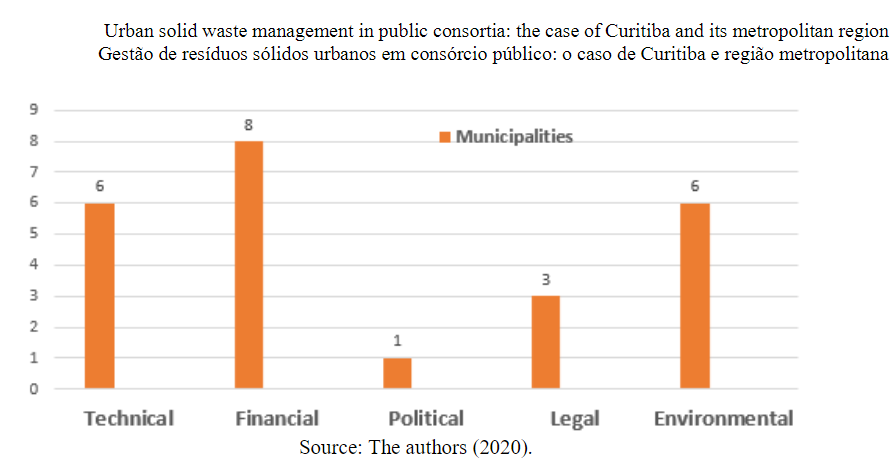
The financial criterion was the main objective for pursuing consortium management, that is, the need to optimize the few public resources available to be applied in waste collection and final disposal in Curitiba and its Metropolitan Region. It is worth highlighting the analyses conducted by Rodrigues et al. (26016) and Silva et al. (2021), who identified the factors directly influencing USW per capita costs in the Brazilian capital cities. According to the authors, solid waste costs depend not only on how the municipality chose to manage it (existence of selective collection) but fundamentally on the adopted management – in the sense of administration – method. They also report that the highest costs were found in private monopolies; public monopolies and the hybrid models presented lower costs. In other words, if there is more than one company providing the service, the costs tend to be lower in comparison to a private monopoly.
Technical and environmental criteria also stand out since the consortium management allows access to methods of USW final disposal that isolated municipalities would not be able to implement, as well as fosters the concern to provide an environmentally sound waste destination.
When analyzing the factors influencing municipalities in their decision-making on the provision of public waste services through consortia, Fernandes et al. (2020) highlight that the NPSW poses major financial and technical challenges to local governments, which begun to cooperate, consequently reducing the costs to meet the demands of the new policy. The authors emphasize that this strategy is effective and might be verified since this approach has been used even by municipalities in more favorable fiscal conditions. With a more political connotation of USW management, Fernandes et al. (2020, p. 518) highlight that:
[...] unlike the international literature, intermunicipal cooperation in Brazil does not have a political nature but meets the need to achieve the objectives outlined for public policies. It can be argued, therefore, that the political, economic, and social dynamics in the country greatly affect the results, which are different from those found in previous research in high-income Western countries.
In view of this, the consortium management modality — as a strategy to provide access to technologies, solutions, and measures that isolated municipalities could not achieve due to lack of financial resources, structure, and technical personnel — enables the collaboration and sharing of actions for better USW management.
4.3 Institutional arrangement and public governance in the intermunicipal public consortium: CONRESOL
To better understand the USW shared management within the intermunicipal public consortium, it is necessary to first understand the role played by a set of public entities in a given territory. For this, the formation and maintenance of the intermunicipal public consortium presupposes agreements and contracts between public entities, through which they will cooperate on particular situations affecting the members — in this case, the USW management.
This institutional arrangement allows articulations and deliberations within a territory, as well as to regulate them by a pact — Protocol of Intent, Public Consortium Statute and applicable legislation. Therefore, it is conditioned by the rules that guide rights and obligations and by the political, economic, and social contexts of the consortium members.
In the CONRESOL scenario, as aforementioned, its administrative organization consists of an organizational structure (Figure 2).
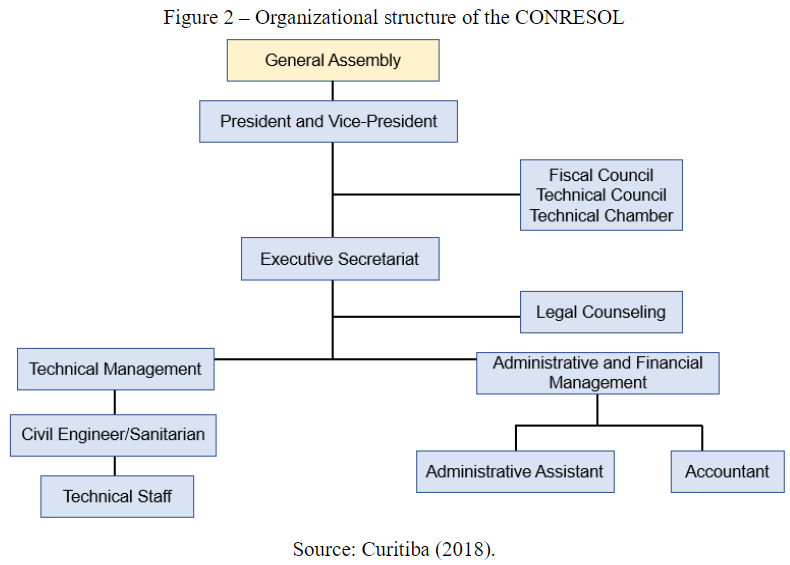
The General Assembly is composed of the mayors of the municipalities participating in the public consortium; each one has the right to one vote, and the President has the right to a casting vote breaks the tie in the deliberations voting. The minimum quorum is the presence of two-thirds of the consortium members, which, supported by the Technical Council, decides on the inclusion or exclusion of any member municipality, readjustment of fees and costs, budget proposal, accountability, outsourcing, partnerships, agreements or covenants, change of statute, among other issues. The consortium presidency and vice presidency are exercised by heads of the Executive Power of one of the participating municipalities, elected for a two-year term by secret ballot and an absolute majority, with reelection being allowed. The Fiscal Council has the power to monitor and supervise any economic or financial operation, in addition to controlling the management and purpose of the consortium and other activities. It is comprised of one representative and one alternate from each consortium member that are appointed by the heads of the municipalities’ Executive Power and also elected for a two-year term by an absolute majority and secret ballot. The Technical Council is a body created for planning, monitoring, and controlling the operation of the consortium's activities, issuing a technical opinion on outsourcing, partnership, agreements with public bodies and private entities, readjustment of fees, tariffs and costs, among other duties. It consists of a representative and an alternate from each member municipality that are appointed by the respective Executive Power heads and presided over by one of its members elected for a two-year term by secret ballot. The Technical Chamber may be constituted whenever necessary and will be composed of technical representatives of the member municipalities that are appointed by the heads of the Executive Power, as well as other professionals with notable knowledge. The Technical Chamber’s purpose, attributions, and duration will be deliberated after its constitution. The Executive Secretariat is the executive body of CONRESOL, consisting of an executive secretary and the technical and administrative staff, which is appointed by the President and endorsed by the Assembly (Curitiba, 2019).
To this extent, in the consortium management, each public entity has the same participation space, with equal voting power, regardless of its population and geographic or economic size. In other words, regarding the public consortium deliberations, the participation of smaller municipalities is equal to that of larger ones.
This equality is also related to the responsibilities and obligations of each member. In order to join the consortium, the interested municipality must obtain a prior authorization of the respective City Council and the application approval in the General Assembly. In addition, it has to adhere to the Protocol of Intent, recognizing it as an essential document that regulates the rights and obligations of members, as well as the participation and organizational structure of the consortium.
Here, governance may be present in the intermunicipal public consortium for USW management by allowing better use of the arrangement regarding financial statements, monitoring of the waste management execution, internal and external information dissemination channels, and effectiveness in the allocation of available resources, leading, ultimately, to the efficient implementation of the public policies.
However, Priti (2019, p. 1263) highlights that “other factors such as government policy, legal framework and financial allocation, and social and cultural contexts play an equally vital role for an efficient waste management system, which is often ignored.” Accordingly, in research on the executive secretaries or superintendents of public consortia in the state of Ceará that investigated consortia characterization, consortium members, actions and projects in progress, and their institutional relationships, Martins et al. (2022) observed the young age of these institutions, as well as a lack of technical operational structure and infrastructure to meet the requirements of the NPSW and limited agreements with partner institutions. The authors highlight “the role of the State Public Ministry and financial stimuli, as well as the state technical support for planning public consortia as inducers, exposing the incipient municipalist culture in the State” (p. 127).
The municipalities’ participation also requires the establishment of an information channel as a significant tool for the consortium management since it enables participation and data exchange between members and society. Nevertheless, this communication path must be twofold: at the same time that CONRESOL makes information available to its members and society, the municipality must also present the necessary data on waste collection to subsidize the consortium management.
Another relevant aspect to be investigated is to understand whether goals, indicators, and risk assessment are established to support planning and analyze the obtained results. According to the analyzed documentary data and from a public governance perspective, evaluation, direction, and monitoring are still insufficient as a dynamic feedback structure (governance functions) within the dynamics of CONRESOL. As suggested by Nardes et al. (2014), the consortium can implement good governance practices in a cyclical and dynamic way as a mechanism to provide public policy effectiveness, as well as proper public resources application and service efficiency.
However, concerns on both the environment and the negative impacts of waste disposal led CONRESOL to study the feasibility of a new USW treatment and disposal system that will include other techniques in addition to the sanitary landfill. It is named Integrated and Decentralized System of Waste Treatment and Tailing Final Disposal3 and it is currently in the bidding phase for contracting the public service company. By means of a concession, the activity will consist of carrying out the reception, mechanized sorting, transshipment, secondary transport, USW treatment, and environmentally sound final disposal of waste and tailings from the 23 member municipalities.
Governance is another aspect that unites many activities and stakeholders involved in USW management. Hettiarachchi et al. (2018) investigated USW management in Latin American and Caribbean countries, emphasizing that both problems and potential solutions are better analyzed from a governance perspective, whether it is bureaucratic, of market, or networking, helping by explaining which stakeholders are involved and who should be responsible for what. USW is still not seen by the private sector as a place for investment, perhaps due to the negative social attitude associated with waste. Market governance aspects such as the Clean Development Mechanism (CDM) may help increase the efficiency and profitability of the USW market (Hettiarachchi et al.,2018).
Moreover, still from the governance perspective, a Term of Commitment was signed aiming at commitment to reverse logistics in the post-consumption light bulb sectors in the state of Paraná; unusable lead-acid batteries, their waste and packaging; and the industrial sector of paper, cellulose and wood pulp for paper and cardboard, as well as paper and cardboard artifacts. A partnership was signed by the Secretariat for Sustainable Development and Tourism (Sedest), Water and Land Institute (IAT) and the companies and unions that represent manufacturers, importers, distributors, traders or entities representing the products that are required for reverse logistics. This state government action requires companies based in Paraná to have their Reverse Logistics Plan (RLP) approved by Sedest to obtain or renew the environmental operating license. On the other hand, CONRESOL currently does not use reverse logistics as a mechanism for the reuse of materials with potential for recycling or reuse aimint at minimizing environmental liabilities. However, it was identified that the new Integrated and Decentralized System for Waste Treatment and Tailings Final Disposal will include this procedure since it emcompasses valuing reusable materials through separation and recycling, aiming at socio-environmental and economic gains.
Regarding the Management Plan for the Treatment and Disposal of Urban Solid Waste, the consortium approved, by means of the Resolution No 003/2018, the plan prepared in accordance with the Sanitation Law No 11,445/2007 and the NPSW (No 12,305/2010). All municipalities participating in the consortium use this device.
Therefore, public governance is an important tool for the development of shared management. However, in order to improve the effectiveness of public policies and service provision to satisfy the collective interest, it is necessary to advance the application of good governance practices within the public administration scope.
Final Considerations
This article investigated the creation of the Intermunicipal Public Consortium of Curitiba and Metropolitan Region, as well as the challenges of solid waste management. In this regard, shared management is considered a relevant instrument as it allows municipal representatives to make decisions with greater control and information, directing actions towards a proper waste disposal. It also enables solving the problem arising from the financial, social, environmental, and geographical limitations that each member municipality faces when meeting the determinants of the NPSW. To implement it nationwide, this policy designates attributions, aiming at guaranteeing a correct and environmentally sound destination of the waste and tailings daily produced in the cities.
Although USW management is a challenge for Brazilian municipalities — and in view of the need for technical and financial resources for implementing and maintaining a sanitary landfill — it is evident in the case of CONRESOL the existence of advantages promoted by its creation, such as: (i) reduction of operating costs; (ii) sharing of technologies, resources, equipment, and services provision; (iii) articulation through the intermunicipal arrangement; (iv) strengthening of the implementation of joint actions aimed at environmental issues and urban infrastructure demands; and (v) strengthening of the decentralization process through shared management. However, it is noteworthy that, for the proper functioning of the consortium, it is necessary to define its functions and processes, as well as provide a financial statement, especially when addressing the responsibility of each member municipality with the apportionment of cost since it guarantees the public consortium’s financial sustainability.
The efficiency of USW management through a public consortium is connected to internal, control, and performance decisions by the member municipalities. Promoting consortium USW management strengthens the coordinated action of the metropolitan region since it is based on cooperation between municipalities in the search for a solution to a common problem. This is why public governance can contribute to the instrumentalization of public consortia management and, therefore, to the efficiency of waste collection and proper disposal, complying with the NPSW and the Paraná State Plan for Solid Waste, Law 19,261/ 0217 PR – as well as satisfying the public interest.
Finally, public governance can contribute to the efficiency of USW management in an intermunicipal public consortium through practices such as:a) establishing an evaluation, guidance, and monitoring system that includes indicators of goals, results, and risks on the entire process involving USW collection and final disposal to better support the decisions of the public consortium; b) adopting a quality information channel, continuously fed by both the consortium and the member municipalities with concrete data on USW collection, transport, and final disposal, as well as local recycling programs, thus making the planning of actions more effective; c) internal control of apportionment of cost contracts, with measures to resolve default demands by members, not only limiting the collection or installment of municipal debts but also suggesting and assisting in measures to implement public policies to reduce the volume of USW destined for landfills and, consequently, reducing costs with apportionment of cost; d) the concrete and frequent participation of member municipalities, collaborating with proposals for solutions, techniques, and alternatives for the proper waste disposal.
To those municipalities that participate in a public consortium or aim at establishing one, it is recommended that they must understand the importance of the interinstitutional arrangement and the effective and systematic participation in the consortium management dynamics, which are based on cooperation and not on the mere transfer of public service provision or responsibility regarding USW management. In this sense, it will be possible to advance in the search for an environmentally responsible, socially fair, and economically sustainable system.
References
Associação Brasileira de Empresas de Limpeza Pública e Resíduos Especiais (ABRELPE). (2020). Panorama dos Resíduos Sólidos no Brasil. http://abrelpe.org.br/panorama/
Bardin, L. (2011). Análise de conteúdo. Lisboa: Edições 70.
Brasil. (2017). Lei n. 12.305, de 2 de agosto de 2010. Política Nacional de Resíduos Sólidos. (3rd ed.). Brasília: Câmara dos Deputados, Edições Câmara.
Brasil. (2022). Lei nº 14.026 de 15 de julho de 2020. https://www.in.gov.br/web/dou/-/lei-n-14.026-de-15-de-julho-de-2020-267035421
Brito, A. S. (2018). Uma proposta metodológica para análise política e institucional de consórcios públicos como espaço de gestão compartilhada de políticas. Revista de Serviço Público, 69, 631-654.
Câmara do Deputados. (2020). Legislação Informatizada. Lei nº 11.445, de 5 de janeiro de 2007. https://www2.camara.leg.br/legin/fed/lei/2007/lei-11445-5-janeiro-2007-549031-publicacaooriginal-64311-pl.html
Coordenação da Região Metropolitana de Curitiba. (2019). http://www.comec.pr.gov.br/Pagina/MapasCuritiba.
Secretaria Municipal de Meio Ambiente. (2018). Consórcio Intermunicipal para Gestão de Resíduos Sólidos Urbanos. https://www.curitiba.pr.gov.br/conteudo/consorcio-intermunicipal-para-gestao-dos-residuos-solidos-urbanos/132
Faria, T. (2017). Consórcios públicos, federalismo cooperativo e intermunicipalidade. A&C – Revista de Direito Administrativo & Constitucional, 17(70), 237-255.
Feil, A. A., & Schreiber, D. (2017). Sustentabilidade e desenvolvimento sustentável: desvendando as sobreposições e alcances de seus significados. Cadernos EBAPE.BR, 14(3), Artigo 7. DOI: http://dx.doi.org/10.1590/0034-761220190237
Fernandes, A. S. A., Pinheiro, L. S., Nascimento, A. B. F. M., & Grin, E. J. (2020). Uma análise dos consórcios intermunicipais para serviços de tratamento de resíduos sólidos a partir da ação coletiva institucional. Revista de Administração Pública, 54(3), 501-523. DOI: http://dx.doi.org/10.1590/0034-761220190237
Ferrari, R. M. M. N. (2014). Direito Municipal. (4th ed.). São Paulo: Revista dos Tribunais.
Ferreira, C. F. A., & Juca, J. F. T. (2017). Metodologia para avaliação dos consórcios de resíduos sólidos urbanos em Minas Gerais. Engenharia Sanitária e Ambiental, 22(3).
Ganguly, R. K., & Chakraborty, S. K. (2021). Integrated approach in municipal solid waste management in COVID-19 pandemic: Perspectives of a developing country like India in a global scenario. Case Studies in Chemical and Environmental Engineering, 3. DOI: https://doi.org/10.1016/j.cscee.2021
Hettiarachchi, H., Ryu, S., Caucci, S., & Silva, R. (2018). Municipal Solid Waste Management in Latin America and the Caribbean: Issues and Potential Solutions from the Governance Perspective. Recycling, 3(19). DOI: https://doi.org/10.3390/recycling3020019
Jacobi, P. R., & Besen, G. R. (2011). Solid waste management in São Paulo: the challenges of sustainability. Estudos Avançados, 25(71), 135-158.
Knopf, D. S., Lorenzi Junior, D., Pontelli, G. E., & Kneipp, J. M. (2022). Gestão de resíduos sólidos: dificuldades e potencialidades em um consórcio intermunicipal. Exacta. DOI: https://doi.org/10.5585/exactaep.2022.20776
Kronemberger, D., & Costa, V. G. (2016). Desenvolvimento local sustentável e governança ambiental. In: A. H. Figueiredo (Ed.), Brasil: uma visão geográfica e ambiental do início do século XXI (pp. 359-392). Rio de Janeiro: IBGE, Coordenação de Geografia.
Kasa, S. (2020). Waste workers are protecting our communities during COVID-19. Retrieved from https://blogs.worldbank.org/sustainablecities/waste-workers-are-protecting-our-communities-during-covid-19
Kulkarmi, B., & Anatharama, V. (2020). Repercussions of COVID-19 pandemic on municipal solid waste management: Challenges and opportunities. Science of the Total Environment. DOI: https://doi.org/10.1016/j.scitotenv.2020.140693
Martins, I. M., Galvão Júnior, A. C., Maia, C. V. A., & Correia, V. M. S. (2022). Análise sobre o consorciamento para gestão de resíduos sólidos no Ceará – Brasil. Desenvolvimento Regional em debate, 12, 127-142. http://54.205.230.206/index.php/drd/article/view/3755
Nardes, J. A. R., Altounian, C. S., & Vieira, L. A. G. (2014). Governança Pública: o desafio do Brasil. Belo Horizonte: Fórum.
Nzeadibe, T. C., & Ejike-Alieji, A. (2020). Solid waste management during Covid-19 pandemic: policy gaps and prospects for inclusive waste governance in Nigeria. Local Environment, 25(7), 527-535. DOI: https://doi.org/10.1080/13549839.2020.1782357
Paraná. (2017). Lei/PR nº 19.261 de 07 de dezembro de 2017. Dispõe sobre o Plano Estadual de Resíduos Sólidos do Estado do Paraná. Assembleia Legislativa: Curitiba.
Pereira, G. A., & Moreira, T. B. S. (2016). Consórcio público intermunicipal: características dos municípios participantes. Revista de Políticas Públicas, 20(1), 307-326.
Priti, K. M. (2019). Review on evolution of municipal solid waste management in India: practices, challenges and policy implications. Journal of Material Cycles and Waste Management, 21, 1263–1279. DOI: https://doi.org/10.1007/s10163-019-00880-y.
Ribeiro, H. M. D., Bastos, S., & Bugarin, M. S. (2006). Consórcios Públicos Municipais: uma análise institucional. Anais do Encontro Nacional ANPEC.
Rodrigues, W., Magalhães Filho, L. N. L., & Pereira, R. S. (2016). Análise dos Determinantes dos custos de resíduos sólidos urbanos nas capitais estaduais brasileiras. Revista Brasileira de Gestão Urbana (Brazilian Journal of Urban Management), 8(1), 130-14.
Silva, W. de M., Imbrosi, D., & Nogueira, J. M. (2017). Municipal solid waste management: public consortia as an alternative scale-efficient? lessons from the Brazilian experience. Current Urban Studies, 5, 185-201.
Silva, T. R., et al. (2021). Proposta de um consórcio intermunicipal na microrregião de saúde de Teófilo Otoni/Malacacheta para gestão de resíduos sólidos urbanos. Research, Society and Development, 10(10), 1-12.
Sistema Nacional de Informações sobre Saneamento (SNIS). (2021). Diagnóstico Temático Manejo de Resíduos Sólidos Urbanos Visão Geral. Brasília. Disponível em: http://www.snis.gov.br/downloads/diagnosticos/rs/2020/DIAGNOSTICO_TEMATICO_VISAO_GERAL_RS_SNIS_2021.pdf.
Tribunal de Contas da União. (2014). Referencial Básico de Governança Aplicável a Órgãos e Entidades da Administração Pública. Disponível em: https://portal.tcu.gov.br/governanca/governancapublica/.
Ventura, K. S., et al. (2020). Consórcios Intermunicipais de Saneamento e de Resíduos Sólidos: elementos para estruturação e consolidação no contexto nacional. Revista Nacional de Gerenciamento de Cidades, 8(59), 53-68.
Ventura, K. S., & Suquisaqui, A. B. V. (2020). Aplicação de ferramentas SWOT e 5W2H para análise de consórcios intermunicipais de resíduos sólidos urbanos. Ambiente Construído, 20(1), 333-349.