Artigos
UBERIZATION OF WORK: the perception of transport drivers by apps in the city of Goiânia
UBERIZATION OF WORK: the perception of transport drivers by apps in the city of Goiânia
Gestão & Regionalidade, vol. 39, e20238117, 2023
Universidade Municipal de São Caetano do Sul
Recepción: 21 Septiembre 2021
Aprobación: 27 Marzo 2022
Abstract: The uberization of work highlights a new way of organizing, managing and controlling work through digital platforms. The ideas of autonomy, independence and entrepreneurship, and precariousness seem to underlie this form of management. The objective was to analyze the perception of transport drivers by application regarding the work they perform for platform-companies or application-companies in the city of Goiânia, through a descriptive research using the Survey method, involving 99 drivers. The analysis used descriptive statistics and factor analysis. Excessive amounts of days and hours worked were identified, in addition to the finding that 78.7% of drivers either own financed vehicles or rent a car in order to work. There were also six main components, labeled as follows: Formalization of employment; Income; Autonomy; Perceived losses; Job opportunity; and Job evaluation. Drivers perceive benefits in the autonomy of flexible work, in addition to the need to contain their precariousness.
Keywords: uberization, precariousness, entrepreneurship.
Resumo: A uberização do trabalho evidencia uma nova forma de organizar, gerenciar e controlar o trabalho por meio das plataformas digitais. As ideias de autonomia, independência, empreendedorismo e precarização parecem subjazer a essa forma de gestão. Objetivou-seanalisar a percepção dos motoristas de transporte por aplicativo quanto ao trabalho que realizam para as empresas-plataformas ou empresas-aplicativo na cidade de Goiânia, por meio de uma pesquisa descritiva com utilização do método Survey, envolvendo 99 motoristas. A análise utilizou a estatística descritiva e análise fatorial. Identificaram-se quantidades excessivas de dias e horas trabalhadas, além da constatação de que 78,7% dos motoristas ou possuem veículos financiados ou alugam um carro para poder trabalhar. Constituíram-se, ainda, seis componentes principais, assim rotulados: Formalização do emprego; Rendimentos; Autonomia; Perdas percebidas; Oportunidade de emprego; e Avaliação do trabalho. Os motoristas percebem benefícios na autonomia do trabalho flexível, além da necessidade de conter sua precarização.
Palavras-chave: uberização, precarização, empreendedorismo.
1 Introduction
Working whenever you want, when you can, indefinitely, without explicit control from a boss and needing few technical or conceptual skills to perform activities seem to be very attractive requirements. On the other hand, working without labor rights, bearing the costs of one's own means of production, being paid when the work has actually been carried out, instead of receiving a fixed monthly salary may seem disadvantageous counterparts from the point of view of working relationships. In addition to being a dilemma, this description refers to whatseveral authors call uberization or platformization of work (Nerinckx, 2016; Abílio, 2017; Fleming, 2017; Pochmann, 2017; Antunes, 2018; Consiglio, 2018; Felix, 2018; Franco & Ferraz, 2019; Hughes & Southern, 2019; Moraes, Oliveira, & Accorsi, 2019; Antunes et al., 2020; Moreschi, Perreira, & Cozman, 2020).
For these and other scholars, the uberization of work shows a new way of organizing, managing and controlling work. Work organization satisfies the capitalist production process by meeting economic and political needs: in the first case, by intensifying the extraction of surplus value from work; and in the second, by maintaining domination and subordination relations used to guarantee the first (Fischer, 1987). It follows that the people management model is characterized as “the way in which a company organizes itself to manage and guide human behavior at work.” (Fischer, 2003, p. 12).
In the case of uberization, new organizational management models transform the worker into a just-in-time worker (Abílio, 2017), thus, without formalizing labor relations, but with sophisticated technological instruments to meet these economic and political needs. The term uberization is due to the success of the company Uber, which emerged as a digital work platform as a “remedial solution for unemployment, given the potential for absorbing labor not included in the formal job market, and the possibility of greater satisfaction of the consumer market". (Franco & Ferraz, 2018, p. 854).
Several authors attempted to classify digital platforms in terms of production, or not, of value from the work. The possibility of exchanging or selling through Internet-connected applications may or may not establish production relationships, and therefore, labor exploitation. (Huws, 2014; Kenney & Zysman, 2016; Srnicek, 2017; Bo & Petrini, 2019; Lima& Bridi, 2019; Moraes, Oliveira, & Accorsi, 2019).
The ideas of autonomy, independence and entrepreneurship seem to underlie the new form of exploitation of the workforce through these platforms, intensifying and updating the past notion of precariousness of work (Kalleberg, 2009; Kalleberg & Vallas, 2018). Thus, the perspective of precariousness of work proposed by these authors, based on the critical institutionalism of American sociology, as well as the conceptual formulations about work, developed in Brazil by Antunes (2020, 2018), Abílio (2019, 2017), Pochmann ( 2017), among others, and the organizational, subjective and/or technological analyzes, proposed by Fleming (2017), Huws (2014), Gaulejac (2007), among others, serve as a framework for the problematization of this research and to analyze their results. The different perspectives reflect the complexity of the object analyzed here.
Given this context, the question is: what is the perception of workers regarding the work organized and managed by platform companies?
Considering the uberization or platformization of work, as well as its potential for precariousness, the objective was to analyze the perception of transport app drivers regarding the work they perform for platform companies or app companies in the city of Goiânia. Therefore, descriptive research was carried out using the Survey method for data collection. The responses were analyzed adopting descriptive statistics and factor analysis (Principal Component extraction method), using the software SPSS®.
In addition to this Introduction, this article has four more sections (Theoretical Framework, Methodology, Presentation and Analysis of Results, and Final Considerations), complemented by the References.
This research aims to help understand a part of Brazilian labor relations, given the relevance of the work category to digital platforms as new business models, thus aligning with other studies that establish relationships between the field of Administration, in general, and human resource management, particularly, with the world of work.
2 Theoretical reference
In this section, the main concepts of the research are presented and characterized, used to analyze the results of the questionnaires, which are: uberization or platformization of work; and precariousness of work.
2.1 Uberization or platformization of work
Contextually, the uberization or platformization of work is part of the logic of the gig economy, which has long been addressed by both academic literature and government statistics in central countries, due to the growing number of informal jobs and an increase in structural unemployment (Gandini, 2018; Fleming, 2017). The “gig economy” can be defined as workers who, deprived of formal and regulated employment, perform sporadic, poorly paid work, without labor rights and without social security contribution, and therefore “without a future.” (Fleming, 2017).
This scenario is intensified by work organizations adopting technological forms arising from the so-called Industry 4.0, characterized, in general terms, by digitization of the entire production process from raw materials to factories, transport, commerce and consumer services, with interconnection of people, objects and systems, from an intense exchange of data (Sacomano et al., 2018).As a result of this advance, digital work platforms are new and emblematic of the future of work, consisting “of web-based digital work platforms (commonly called group work) and local work platforms, where work is allocated through software apps (applications)” (ILO, 2018, p. 1).
According to Moraes, Oliveira and Accorsi (2019), digital platforms can take the following forms: digital work platforms (remotely carrying out tasks or micro-tasks); face-to-face work organization platforms (carrying out transport and delivery services); unpaid digital work platforms (inserting information by the consumer on social networks or service evaluation platforms); and digital classified platforms (renting or selling services or products).
It is inaccurate to say that new jobs emerged from the advent of platform companies (Ilo, 2018). Taxi transport services had already existed, for example, to houses and apartments or motorcycle couriers for mail or food delivery. However, it is worth mentioning that the novelty lies in the way these companies organize and control the work.Through information technology, worker registration, geolocation systems, evaluation and remuneration of services provided, forms of punishment and reward for work are digitally conceived and operationalized, through informational algorithms, often incomprehensible to those who use the platform, and who exercise enormous control over their work. In fact, this mechanism is based on the strategy of disciplinary power over individuals. The discipline-mechanism, typical of the panopticon, is a “functional device that should improve the exercise of power, making it faster, lighter, more effective, a design of subtle constraints for a society to come.” (Foucault, 1997, p. 173).
Another characteristic of this work is that it is carried out, as we have said, with resources of those who carry it out. Cars, houses or motorcycles, smartphones, Internet data package, maintenance, subsistence food, etc. are the property, risk and responsibility of the person applying for the activity, seen as “self-entrepreneurs” (Antunes, 2018) or “self-managers” (Gualejac, 2007).
According to Schumpeter (2006), just to present a concept of entrepreneurship that is very legitimized in the economic and administrative field, the role of the entrepreneur
is to reform or revolutionize the pattern of production, exploiting an invention or, more generally, an untried technological possibility to produce a new commodity or produce an old one in a new way, opening up a new source of material supply or a new outlet. of products, reorganizing an industry, and so on (Schumpeter, 2006, p. 132).
Although platform-companies propagate the idea of flexibility to determine the working time and benefits of work “without a boss” as constitutive elements of the entrepreneurship of workers, the strength of the content of this Schumpeterian formulation is unavoidable to determine the role of the real entrepreneur in a society under the capitalist sign.
Thus, the status of entrepreneurship seems to change in a world of precarious work, “where everyone should possess an entrepreneurial attitude and when people become entrepreneurs, as a result of outsourcing, and being encouraged to become freelancers.” (Ikonen, 2013, p. 470).
As drivers do not have a formal employment relationship, they must assume the risks of work, as the process of carrying out the activity does not directly hold the platform company responsible for any misfortune that may affect the worker. Nor are accidents compensated by medical insurance or health insurance for the recovery period. Vacations and breaks are unpaid. This is because such a business model, as a matter of principle, does not require the formalization of labor relations and the provision of adequate conditions to carry it out. After all, the platforms are self-declared technology companies and not transportation, accommodation or deliveries. In the uberization or platformization of work, “the worker is an entrepreneur of himself, linked and subordinated to an app that connects service providers to consumers, intermediated by a company that keeps a percentage of the calculated” (Lima & Bridi, 2019, p. 335), producing new precarious forms of work.
2.2 Precariousness of work
Faced with the decrease in formal employment relationships and the increase in the level of unemployment, the work carried out through these companies-platforms, more than being a gig, has become the main source of income for many workers, either because they are unemployed or because these companies, with more competitive prices, replace part of the competition.
The issue of precariousness is initially developed in central countries. The oil and currency crises of the mid and late 1970s put an end to an era considered, concretely or ideally, of enormous prosperity, social well-being, practically full employment with adequate conditions, which had emerged in post-World War II. The motivation for the debate is precisely the emergence of partial, temporary, low-paid jobs, exercised in inadequate conditions regarding the risks to the worker, that is, jobs considered atypical or precarious (Rodgers, 1989; Harvey, 1994; Vallas, 2012).
Added to this context is the injunction of flexible accumulation: of production, products and services of organizations, made possible by technology and determined by global competition; financial markets, made possible by the deregulation of international financial transactions; of labor legislation and social policies, in terms of the State, made possible by the neoliberal perspective of decreasing state action in society and privatization of public companies; and the union and associative relations of workers, made possible by the atomization of the worker and the diffusion of the ideology of entrepreneurship (Harvey, 1994; Kalleberg, 2009; Vallas & Prener, 2012).
Vallas and Prener (2012), analyzing the work of Kalleberg (2011), state that there are numerous structural roots or causes of the trend of polarization between formal and precarious jobs, among them
an increasingly anemic labor movement that left workers more vulnerable to toughening employer tactics; neoliberal economic policies that weakened economic and labor regulations and social insurance provisions; fiercer global competition, which shifted the balance of power for employers; and technologies that make unskilled labor superfluous (Vallas & Prener, 2012, p. 334-335).
Some social researchers believed that the scenario of atypical jobs would be temporary because they were not very representative, and that overcoming the economic crisis would be sufficient for resuming decent jobs, to avail us, anachronistically, of a recent concept proposed by the International Labor Organization (ILO), meaning productive work in conditions of freedom, equity, security and human dignity (ILO, 2018). Other researchers understood the incipient informal employment as an index of the new era of employment, an omen of what would be known as precarious work.
Kalleberg (2018) sought to characterize precarious work, so that, to a greater or lesser extent, it could be understood not only as a negative adjective (precarious), but as a category. He proposes, therefore, the following dimensions (Kalleberg, 2018):
1) Unsafe and uncertain work: risk of job loss and uncertainty as to what the work will be, in view of the lack of control over its conditions and content; 2) Work with economic limitations and social benefits: low pay and lack of medical and/or social security assistance; 3) Work without labor rights: absence of labor laws, regulatory protections and rights; 4) Hazardous and risky work: exposure to hazardous situations and risky conditions; 5) Work without collective power: low association of workers in unions or little collective power of workers to claim the maintenance or expansion of rights and guarantees with companies and the State.
Specifically, “technological changes were a major source of precarious work. Advances in technology have shortened product cycles and increased rewards for achieving flexibility in manufacturing processes.” (Kalleberg, 2018, p. 21).
As a consequence of economic, political and technological transformations, the uberization or platformization of work, representative of the new production relations, names the “flexible, unprotected working conditions that cloud the employment relationship”, since the companies themselves do not recognize this relationship (Lima & Bridi, 2019, p. 335).
In research conducted with Uber drivers in the city of Rio de Janeiro, André, Silva and Nascimento (2019) show that the work carried out points to precarious or degrading work, as it is associated with unsafe work, largely exploited, with uncertainties, subjection to the organization's determinations, competition between workers and time and subjectivity are under the command of companies. According to them, “the excessive work of drivers is a point that deserves attention and attention, since it makes the work even more degrading, which can lead to physical or psychological illnesses [...]”. (André, Silva, & Nascimento, 2019, p. 29).
3 Methodological procedures
This is a descriptive research using the Survey method for data collection. In the first half of 2019, the questionnaire, adapted from Moraes, Oliveira and Accorsi (2018), was used to obtain the answers from 99 transport drivers by application in the city of Goiânia. According to the Association of Application Drivers of the State of Goiás (Amago), an estimated 40,000 people are registered in one of the transport applications in the Metropolitan Region of Goiânia, with between 8,000 and 12,000 driving daily (Hirose, 2019). Specifically, the questionnaires, which included questions to identify the profile of the respondents and to survey their perceptions regarding the work for the application-companies (a stage elaborated in the Likert scale of 5 points – totally disagree to totally agree). According to Table 1 below, the following questions were presented to drivers:
| How old are you? What's your sex? What is your marital status? What is your level of education? How long have you been working with Uber? When you work with the app, how many hours a day do you work? How many days a week do you work with Uber? Currently, the vehicle you use for work is..? On average, how much do you earn per working week (excluding discounts)? How much do you expect to spend per WEEK on the vehicle (fuel and washing)? Working with Uber (or another app) is: | Ordinal Nominal Nominal Ordinal Ordinal Ordinal Ordinal Nominal Ordinal Ordinal Nominal | Survey of the research subjects' profile | Descriptive |
| I've been working with Uber (or another app) because I didn't have a job. I'm looking for another job opportunity while working with Uber (or another app). I would like to have an employment record book with Uber (or another app). I feel like an entrepreneur who uses the Uber app (or another app) to provide a transportation service. I think the discount on my rides should be less than 25% (or some other amount). I enjoy working with Uber (or another app) due to customer relations. One of the advantages of Uber (or another app) is that I have complete freedom to work whenever I want, without being controlled by the company. The lack of a working relationship with Uber (or another app) is positive, as I don't get "stuck" with only one company. If I had a steady job, I wouldn't work or work less with Uber (or another app). My car ́s maintenance costs should be paid by Uber (or another app). I consider that the company's rating system, evaluated by customers is fair, as it separates good drivers from bad ones. My earnings are higher working with Uber (or another app) than when I was a company employee. I would be happier if Uber (or another app) gave me a bonus, health care and other labor rights. When you do all the calculations, it's worth working with Uber (or another app), as the earnings are greater than the expenses. If I am the victim of an accident or robbery while working, Uber (or another app) should pay for the vehicle and the time I spent on leave. The best thing would be for the drivers themselves to have an app in the form of a cooperative so they don't have to pay so many taxes. The lack of a working relationship with Uber (or another app) is positive, as I don't get "stuck" with only one company. If I had a steady job, I wouldn't work or work less with Uber (or another app). My car ́s maintenance costs should be paid by Uber (or another app). I consider that the company's rating system, evaluated by customers is fair, as it separates good drivers from bad ones. My earnings are higher working with Uber (or another app) than when I was a company employee. I would be happier if Uber (or another app) gave me a bonus, health care and other labor rights. When you do all the calculations, it's worth working with Uber (or another app), as the earnings are greater than the expenses. If I am the victim of an accident or robbery while working, Uber (or another app) should pay for the vehicle and the time I spent on leave. The best thing would be for the drivers themselves to have an app in the form of a cooperative so they don't have to pay so many taxes | Interval | Survey of drivers' perception of work in applications | Factorial with extraction of Principal Components |
The questionnaires were distributed in a place near Santa Genoveva airport, where drivers were waiting for passengers arriving from flights.
The answers were analyzed using descriptive statistics and factor analysis (Principal Component extraction method), using SPSS® software. According to Brown (2006, p. 12-13), factor analysis has the fundamental intention of “determining the number and nature of latent variables or factors responsible for variation and covariation among a set of observed measures, commonly called indicators”. According to the author, the factors would be unobserved variables, which maintain relations (influence and correlation) with the observed measures. Thus, the factors express the intercorrelation between the observed measures as such measures share a common cause (Brown, 2006).
In Principal Components, we consider “the total variance and derive factors that contain small portions of unique variance and, in some cases, error variance. Component analysis is preferred when the primary goal is data reduction” (Hair et al., 2009, p. 143).The rotation method used was orthogonal (Varimax), and the factors are generated not to be correlated, although it is believed that there is a high correlation between the variables. Furthermore, factor loadings represent correlations between indicators or variables and latent factors (Brown, 2006).
To measure the internal consistency or the confidence level of the questionnaire, we used Cronbach's Alpha measure. George and Mallery (2003) suggest the following values to measure the reliability of the questionnaire, considering the number of questions proposed and the number of responses: > 0.90 – excellent reliability; > 0.80 – good reliability; > 0.70 –acceptable reliability; > 0.60 – questionable reliability; > 0.50 – poor reliability; and - 0.50 – unacceptable.
The Kaiser-Meyer-Olkin Measure of Sampling Adequacy (KMO-MSA) test is used to quantify the degree of intercorrelations between the variables and the adequacy of the factor analysis. Thus, KMO-MSA greater than or equal to 0.8 is considered admirable. Between this value is greater than or equal to 0.70, the index is considered median. Greater than or equal to 0.60 and less than 0.70 is considered mediocre. Greater than or equal to 0.50 and less than 0.60, the index is considered bad. Below 0.50, it is considered unacceptable. According to Hair et al. (2009, p. 110): “[...] the MSA increases when (1) the sample size increases, (2) the average correlations increase, (3) the number of variables increases, or (4) the number of variables of factors decreases.
Bartlett's sphericity test presents the correlations among the variables, showing that the correlation matrix has significant correlations among at least some of the variables (HAIR et al., 2009). To be statistically significant, the significance level must be less than 0.05, indicating a correlation between the variables.
Finally, the communality index was used to measure the explanatory power of the variable for the factor or component in which it was grouped. Hair et al. (2009, p. 101) state that commonality is the: “[...] total amount of variance that an original variable shares with all other variables included in the analysis”. (Hair et al., 2009, p. 101). Its value is expected to be greater than or equal to 0.500
4 Presentation and analysis of results
Initially, we will present the profile of the respondents and some characteristics of their work for the application, presented in Table 2 below. Next, we present and analyze the data regarding drivers' perceptions of their work.
| Age | 18 to 25 years old 26 to 35 years old 36 to 45 years old 46 to 55 years old 56 to 65 years old above 65 years old | 14,1 37,4 27,3 15,2 5,1 1,0 |
| Sex | Female Male | 4,0 96,0 |
| Marital status | Married Divorced Single | 56,6 10,1 33,3 |
| Scholarity | Incomplete fundamental incomplete high school complete medium Incomplete higher Graduated | 8,1 7,1 39,4 24,2 21,2 |
| Time working with application | 0 to 1 year 1 to 2 years 2 to 3 years 3 to 4 years | 43,4 33,3 19,2 4,0 |
| Hours worked per day | 4h to 6h per day 6h to 8h per day more than 8h per day | 8,1 18,2 73,7 |
| How many times do you work per week | 3 to 4 times per week 5 to 6 times per week Every day | 6,1 47,5 46,5 |
| Vehicle status | Rented Owned and financed Owned and paid off | 25,3 43,4 31,3 |
| Billing per week | until R$ 1.000,00 from R$ 1.000 to R$ 2.000 from R$ 2.000 to R$ 3.000 from R$ 3.000 to R$ 4.000 above R$ 4.000 | 37,4 45,5 11,1 5,1 1,0 |
| Expenses per week | Between R$ 100,00 and R$ 300,00 Between R$ 300,01 and R$ 500,00 Between R$ 500,01 and R$ 700,00 Between R$ 700,01 and R$ 900,00 Above R$ 1.000,00 | 17,2 49,5 25,3 5,1 3,0 |
| Sources of income | My only source of income One of the sources of income, as well as other non-fixed activities that I carry out One of the sources of income, as well as a fixed activity that I carry out | 80,8 9,1 10,1 |
In general terms, the profile of the drivers in the sample is formed by young adults mostly (78.8%), male (96.0%), married or divorced (66.7%), who have a level of education equal to or higher than high school (84.9%), they have recently started working as app drivers (76.7% with up to 2 years of activity). Moreover, 91.9% work more than 6 hours a day and 94% work five or more days a week. 68.7% of respondents have run up a debt with the vehicle, whether renting it or paying for it in installments. 82.9% earn up to R$ 2,000.00 per week and 92% have expenses of up to R$ 700.00 per week. Finally, 80.8% of the app drivers said it was their only source of income, a percentage that increases to 89.9% if other temporary jobs to supplement their income are added.
4.1 Factor analysis or principal components
Chart 1 below presents the KMO-MSA indices and Bartlett's sphericity test.
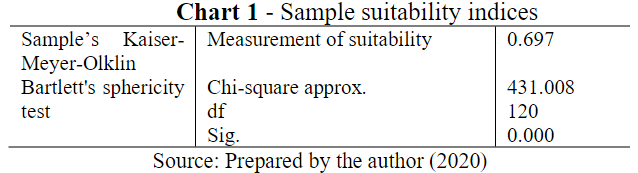
The KMO index is very close to the median as it is close to 0.70. On the other hand, the Sphericity test shows statistical significance as the result is 0.000.
Concerning the internal consistency or the confidence level of the questionnaire, it can be said that it is very close to the acceptable value (0.70). Chart 2 shows the value of 0.695 of Cronbach's Alpha standardized for the 16 variables tested.
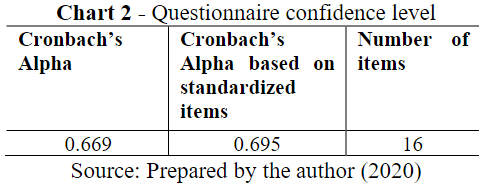
Chart 3 shows that, after the formation of the Components, considering a cut-off Eigenvalue equal to 1.000, 6 Principal Components were formed with a total accumulated explained variance of 68.583%.
| Component | Initial eigenvalues | Sum of rotations of square charges | ||||
| Total | % variance | Cumulative % | Total | % variance | Cumulative % | |
| 1 2 3 4 5 6 | 3,355 3,036 1,281 1,219 1,071 1,011 | 20,967 18,973 8,009 7,619 6,697 6,318 | 20,967 39,940 47,949 55,568 62,264 68,583 | 2,472 2,139 2,003 1,658 1,491 1,209 | 15,453 13,368 12,522 10,364 9,321 7,555 | 15,453 28,821 41,343 51,706 61,028 68,583 |
This means that the 6 (six) Main Components explain more than 68.5% of the total of variables used in the research.
Table 3 presents the components from 1 to 6 formed with the 16 variables used from the questionnaire. It can be seen that the commonalities are relatively high (above 0.50), which shows that the variables are consistent in the responses obtained.
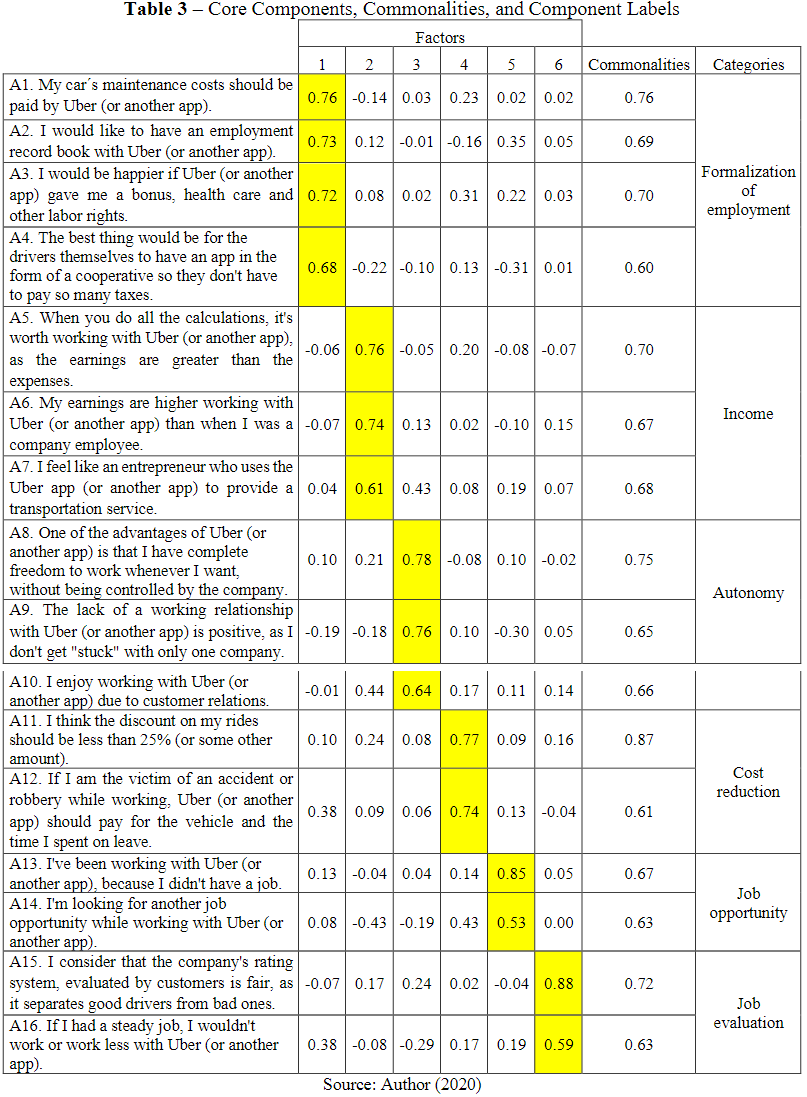
From the Labels created for the Main Components presented (Job formalization, Income, Autonomy, Perceived Losses, Employment Opportunity and Work Evaluation), a theoretical analysis of each one of them can be made, so that the literature can be collected about uberization and precariousness of work and the perceptions of transport drivers by the app in Goiânia. Figure 1 presents the loads referring to the correlations of the component variables of each factor formed.
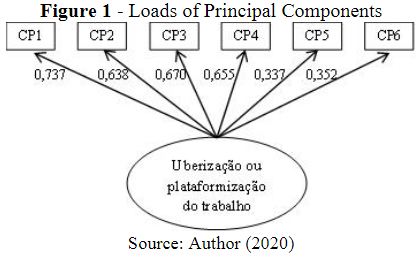
It can be observed that the first four components have high correlations among their variables. This is not observed for the last two. However, the uberization or platformization of work using these components can be explained, according to the analysis below.
PC1, labeled as Formalization of employment, aggregates the variables that deal with the employment relationship between the platform-companies and the workers, in view of their perception of the work performed. For most respondents, the benefits and guarantees of formal working relationships should be extended to them. Thus, 71.72% of respondents agree (agree or totally agree) that maintenance costs should be paid by the company, 59.6% agree with the possibility of having a formal contract with the companies, 77.78% agree with the statement that they receive the benefits of labor legislation and 53.54% agree with the statement that the formation of a workers' cooperative would be beneficial to them.
Such results indicate the desire that workers have to reduce the economic limitations implied in this activity. In addition, they would like to see expanded benefits and rights in the exercise of work, whose legislative guarantees could bring additional advantages. The formation of workers' cooperatives, although with a lower level of agreement than the other variables, could mean greater protection over work.
According to Antunes (2020), Abílio (2017) and Pochmann (2017) (Brazilian references), app workers do not have formal employment relations. Owing to this, they realize the importance of formalizing these relations due to social benefits.
Thus, “gig economy”, characterized by Fleming (2017), seems to be part of workers’ concerns as the idea of a job “without a future”, as the author points out, brings insecurities and lack of perspective.
Resisting this, Araraquara, an inland city in São Paulo State, was the first to have a passenger transport app created by the workers themselves. It is called Bibi Mob and offers a service similar to that of other platforms. It is offered by the Araraquara Transport Cooperative (Coomappa). Approximately 95% of each ride goes to the driver, and the cooperative even has partnerships for tire repairs, an autocenter, car wash and discount tow truck (Araraquara, 2022)
It is understood that CP1 indicates that the perception of drivers is oriented towards reducing the precariousness of work, by guaranteeing rights and conditions for carrying out the activity, as seen in Kalleberg (2018), previously.
CP2, labeled as Income, aggregates the variables that deal with the financial advantages or disadvantages arising from the activity performed, in view of the workers' perception.
Thus, 49.49% of respondents agree or totally agree with the statement of financial advantage to work with platform companies. Another 25.5% disagree (disagree or totally disagree). In addition, 44.44% show agreement with the improvement of personal income when working for platform companies (Uber or other apps). Equal number disagree or strongly disagree. Finally, 59.60% agree or fully agree with the statement that points to the feeling of being an entrepreneur.
It can be inferred that the maintenance costs of the equipment used to carry out the work erode the gains from the activity. In addition, for most of the interviewees, the activities carried out previously brought pay equal to or better than work for the applications. Both cases show the insecurity or instability of workers for future continuity in this work, due exclusively to the remuneration received. According to Antunes (2018), the work for the platform companies is poorly paid and, adding the costs incurred to carry it out, it almost makes it impossible to carry it out or leads them to have to carry it out for long hours throughout practically the entire period. the week
This seems to be in agreement with Oliveira (2003), for whom the modern tendency of capital is to suppress the advance of capital (salary): that is, the payment of workers will depend on the results of the sales of merchandise products, therefore, of your productivity. Thus, the more they work, the more they earn and the more they spend on maintaining their resources.
The issue of entrepreneurship may seem out of place in this Main Component, but perhaps it is justified by the idea that the income received derives from the work performed, rather than the lack of a formal employment relationship with the company. That is, workers seem to identify the issue of entrepreneurship with remuneration and not with the ability to create, innovate, self-fulfill and change paradigms, according to Schumpeter (2006).
For Gualejac (2007), today's society spreads the idea of the manager as an ideal type of man who must undertake, with a high capacity for risk-taking, decision-making, and complex problem solving, and must be prepared to withstand the stress of work. daily life, with the development of different types of intelligence (cognitive and emotional), so that it can mobilize all its qualities in the service of profitability.
However, the perceived feeling of being an entrepreneur does not seem to be objectified. This is because these workers do not have any interference from their work; they only follow the protocols created by the algorithms and, if they try to make them more flexible, they could be penalized by the company.
PC3, labeled as Autonomy, aggregates the variables that deal with the feeling of self-organization of work, perceived by workers. In this case, 80.81% of respondents perceive that they have full autonomy to carry out their activities, without control of the company and another 52.53% agree or totally agree with the positive aspect of the lack of bond, as they do not feel tied to one company. Finally, for 69.70% of respondents, there is pleasure in working with the applications, due to the relationship they establish with customers.
It is interesting to see how this idea of atomization of the worker and its virtual consequences were already established in Marx and Engels (1988) when dealing with the management of production and piecework. For the authors,
[...] given piecework wages, it is naturally in the worker's personal interest to apply his labor power as intensively as possible, which makes it easier for the capitalist to raise the normal degree of intensity. Likewise, it is the worker's personal interest to prolong the working day. [...] even if the piece-wage remains constant, it implies in itself and for itself a fall in the price of labor. [...] But the greater freedom that the piece wage offers to individuality tends to develop, on the one hand, individuality and, with it, the feeling of freedom, independence and self-control of workers, on the other hand, competition between them and against each other. (Marx & Engels, 1988, p. 141-142).
If the analogy is adequate, we can extract three consequences for platform work: 1) workers will tend to extend their working hours to earn more, as identified in the analysis of the drivers' profile and earnings (CP2); 2) the reinforcement of the feeling of independence intensifies the entrepreneurial concept of this type of work; and 3) occurrence of greater fragmentation of platform workers due to the logic of self-control and competition to which they may adhere.
However, in the first case, unlike the factory worker, the more the platform worker works, the greater the maintenance and self-reproduction costs (vehicle, internet data package, food, etc.). In the second case, as we analyzed earlier, it does not seem plausible to admit that workers are entrepreneurs subject to as many injunctions as, objectively, they are.
In the third case, the control over the work carried out by the platform companies, although not felt by the drivers as a control, occurs in a subtle way - as Foucault (1997) would say about the disciplinary power seen above -, but quite effective. The algorithms developed by the platform companies calculate not only the route taken in answering a call, but also the time since the driver ́s last ride. In this case, the driver receives casual messages asking why they are inactive. In addition, there are evaluations made by customers, which even serve to “rank” drivers. Such information is used to reward (provide better-ranked customers or provide services in more valued regions) or punish drivers (with interruption of services for the driver or total blocking), in a true surveillance by algorithms (ERWIN, 2015).Unlike the panopticon treated by Foucault (2007), “software-driven surveillance systems are not panoptic in character but distributive, sorting individual bodies into flows through events of in- and exclusion.” (Erwin, 2015, p. 32). The author continues: “[...] contemporary surveillance does not aim to repress. It sorts.” (Erwin, 2015, p. 41).
The work of drivers can be seen as heterodetermined, with an impediment to decision-making, with standardization of activities to be carried out, with a complete absence of the possibility of exercising creativity, with impossibility of professional growth and development of work skills, digitally monitored
CP4, labeled as Perceived Losses, aggregates the variables that deal with expenses incurred or that may occur by the driver in his daily activities. For 93.94% of the interviewees, the discounts for their rides, paid to the platform companies, should be lower, while 87.88% believe that the expenses resulting from incidents, which occurred in the exercise of the activity, should be paid by the companies.
The logic followed by the business model of platform companies is the transfer of risks to the workers who carry out the activities (Abilio, 2017; Pochman, 2017). This is because they understand that there is no work and employment relationship with such workers, who are service providers (CONSIGLIO, 2018), who, after all, rent the application to carry out a remunerative activity.
Once again, we can associate this perception with the idea of precariousness of work, in the sense of increased insecurity and exposure of the worker to dangerous situations and risk conditions, according to Kalleberg (2018)
CP5, labeled as Employment Opportunity, aggregates the variables that deal with the beginning of work for the platform companies, as well as the future perspective of this work. Thus, 56.57% agree with the statement that they started working for the platform companies after losing their job, while 65.66% agree or totally agree with the statement that they are looking for another job while working with applications.
The idea of contingent, unstable, temporary or atypical work, as seen above, seems to be taking place at this moment, showing that necessity made them look for this type of work and the working conditions they receive impel them to look for other jobs.
As shown by Kalleberg (2011) and Vallas and Prener (2012), atypical or precarious work leads to a decrease in the worker's income, greater exposure to work risks and a lack of perspective to develop in the profession. Thus, the worker invariably experiences feelings of insecurity and discontinuity or drift, experiences that are different from those found at work that enable the development of a professional career, as Sennett (2009) already showed us. Apparently, application-companies deepen the instability of work relationships so well analyzed by this author.
This insecurity can explain the manifestation made by workers who also use apps, but as delivery people and not drivers, which occurred in 2020, due to dissatisfaction with long working hours, low pay, the constant danger of accidents and, still, the threat of the Coronavirus. (Pskowski & Vilela, 2020)
CP6, labeled Work Assessment, aggregates variables that deal with consumer assessment of drivers' work, as well as self-assessment regarding the prospect of permanence in this activity. There is agreement (agree or totally agree) for 48.48% of the interviewees with the legitimacy of the clients' evaluation, compared to 42.48% of disagreement (disagree or totally disagree). Another 60.61% believe that with a steady job they would work less with applications.
This is about assessment and self-assessment that challenge the idea that they are not controlled by the company and, at the same time, that work is sporadic, a gig, only serving as a supplement to income.
It is understood, here, that uberization as control, management and organization of work of a new business model, makes the transition from the “‘self-entrepreneur’ to that of the worker ‘subordinated self-manager’. It is not a question of a dispute of terms, but of connecting more strongly the modes of subjectivation to the forms of subordination and management of work.” (Abílio, 2019, p. 5).
In addition, from Lima and Bridi (2019), Erwin (2015) and Foucault (2007), the evaluation system serves as an instrument of control over work, classifying (ranking) drivers according to the service provided and taking to a labor discipline under the discourse of autonomy, the new “modern” business model and work flexibility, which, in practice, means digital surveillance. (Zuboff, 2019).
In the competitive perspective, present in the entrepreneurial discourse and on Uber's own website (2019), the more worker-drivers in the market, the better for the consumer, but worse for the drivers themselves. Therefore, customer evaluation can help to reduce the supply of services, which imposes the need for greater dedication on the part of workers in the provision of services in order to be well evaluated.
The search for a steady job seems to point to the attempt to “devalue” work relations experienced by drivers who work with platform companies. Even though they work many hours a day and many days throughout the week, it cannot be said that they are doing a part-time job. However, such activity is perceived as contingent in the interregnum for replacement in a professional activity.
In general terms, the work of drivers using apps in the sample is close to precariousness, either because of the lack of labor rights offered by the companies, which are perceived as important by the interviewees (bonus, vacation pay, medical care, among others), either from the perspective of the transience of work, as they seek other more stable job opportunities, or from the earnings perceived by drivers. On the other hand, they feel comfortable with the idea of autonomy to work whenever they want, without the hierarchical figure of the boss or manager, valuing the propagated entrepreneurial perspective.
5 Final considerations
The uberization or platformization of work is a very recent phenomenon, although the work relationships engendered by the platform companies and the work performed are not new. The novelty lies in the intense use of digital technology to organize and control work, which is now managed by algorithms and no longer by people, directly.
In this descriptive research, carried out with 99 app transport drivers who work in the city of Goiânia, we analyzed the perception of app transport drivers regarding the work they perform for platform companies or application companies.
The first part of the questionnaire made it possible to identify excessive amounts of days and hours worked, compared to formal regulated work, in addition to verifying that most drivers (78.7%) either have financed vehicles or rent a car to be able to work, something that marks the logic of this business model, as the “service providers” must employ their own resources, increasing the expenses incurred to work.
The analysis of the responses to the statements made it possible to establish six main components (PCs), labeled as follows: Formalization of employment; income; Autonomy; perceived losses; Job opportunity; and Job Evaluation. Faced with the answers, drivers perceive the need to obtain the guarantees and benefits of formal work, although the relationships established are informal. They also understand that incomes are low and that they believe in the idea of being entrepreneurs. Most likely, this belief stems from the feeling of autonomy to carry out the work with flexible hours and absence of clear and present supervision, even though the algorithms exercise an effective surveillance in a digital way. It was also observed that, for the interviewees, the losses resulting from accidents or theft should be paid by the platform companies, because without them, they would not be exposed to imminent risks. In addition, it was observed that the workers started working for the platform companies because they were unemployed, but they looked for other job opportunities that are fixed, which reinforces the instability of this type of work. Finally, although it legitimizes the assessment made by clients, the self-assessment shows that it would be preferable to work in another fixed activity, if given the opportunity.
The vicissitudes that industrial society has gone through in the last thirty years have created a form of work with high risks of job loss, with insecurity about the future of work itself, with low remuneration and loss of social benefits, without labor rights and with great difficulty in associating workers to fight for better working conditions. This reality, as previously discussed, was called precariousness of work.
Although platform companies, due to the way they organize and control work, do not recognize employment relationships with those they consider “service providers”, it seems to us that such workers do not perform their work sporadically, as a “beak”. Differently, this research shows a work carried out with habituality, onerousness, personality and subordination, which, for the law, constitutes a labor relationship. The analysis of drivers' perception also points to this.
Thus, the new business models, based on digital platforms, pose several challenges to the relationship between application-companies and workers, even though they are considered service providers by them. As initially presented, the people management model establishes a way to manage and guide human behavior at work. This reflection is important in the field of Administration and human resources management, in terms of the way in which such a model impacts working conditions of those who, in fact, generate profits for these corporations.
As a limitation of the research, due to the size and nature of the sample, it is not possible to generalize the results to the totality of application drivers, nor extrapolate to workers from platforms in other areas. Thus, it is suggested to carry out research with workers from other types of platform-companies to collect the results and verify approximations and divergences. It would be of great importance, in the current moment of a pandemic, to understand, through qualitative research, what the meaning of work for these drivers is, in view of the additional risks they run in their work. Finally, still as a recent phenomenon, and due to delivery people’s protests on digital platforms throughout the pandemic, it would be important to understand their forms of organization and resistance, even more so due to the conditions of fragmentation, atomization and competition that structure them.
References
ABILIO, Ludmila Costhek. Uberização: Do empreendedorismo para o autogerenciamento subordinado. Psicoperspectivas, Valparaíso, v. 18, n. 3, p. 41-51, nov. 2019.
ABÍLIO, Ludmila Costhek. Uberização do trabalho: subsunção real da viração. Passa Palavra, 19 fev. 2017.
AMORIM, Wilson Aparecido Costa de. Gestão de recursos humanos e relações de trabalho no Brasil: uma análise sob a ótica da teoria dos custos de transação em um conjunto de empresas privadas. 2017. Tese (Livre Docência em Gestão de Recursos Humanos) - Faculdade de Economia, Administração e Contabilidade, Universidade de São Paulo, São Paulo, 2017.
ANDRÉ, Robson Gomes; SILVA, Rosana Oliveira da; NASCIMENTO, Rejane Prevot. 'Precário não é, mas Eu Acho que é Escravo': Análise do Trabalho dos Motoristas da Uber sob o Enfoque da Precarização. Revista Eletrônica de Ciência Administrativa, v. 18, n. 1, p. 7-34, 2019.
ANTUNES, Ricardo. O privilégio da servidão: o novo proletariado de serviços na era digital. São Paulo: Boitempo, 2018.
ANTUNES, Ricardo (org.). Uberização, trabalho digital e indústria 4.0. São Paulo: Boitempo, 2020.
ARARAQUARA. Araraquara lança seu próprio aplicativo de transporte urbano. Prefeitura Municipal de Araraquara, 03 jan. 2022. Disponível em: http://www.araraquara.sp.gov.br/noticias/2022/janeiro/03/araraquara-lanca-seu-proprio-aplicativo-de-transporte-urbano. Acesso em: 18 fev. 2022.
BO, Gicelda Julia Dal; PETRINI, Maira. Empowering and resisting in a sharing economy: two sides of the same coin. BAR, Maringá, v. 16, n. 3, 2019.
BROWN, Timothy A. Confirmatory factor analysis for applied research. New York-London: The Guilford Press, 2006.
CONSIGLIO, Alessia. Work in the digital economy: perspectives on an unprecedented subordination? Labour & Law Issues, v. 4, n.1, p. 78-116, 2018.
DAMÁSIO, Bruno Figueiredo. Uso da análise fatorial exploratória em psicologia. Avaliação Psicológica, v. 11, n. 2, p. 213-228, 2012.
ERWIN, Sean. Living by algorithm: smart surveillance and the society of control. Humanities and Technology Review, v. 34, p. 28-69, 2015.
FELIX, Gil. Circulación y superexplotación del trabajo. Sociología del Trabajo, n. 92, p. 87-105, 19 mar. 2018.
FISCHER, André Luiz. Um resgate conceitual e histórico dos modelos de gestão de pessoas. In: FLEURY, Maria Tereza Leme. As pessoas na organização. São Paulo: Gente, 2002.
FISCHER, Rosa Maria. Pondo os pingos nos is, sobre relações do trabalho e políticas de administração de recursos humanos. In: FLEURY, Maria Tereza; FISCHER, Rosa Maria. Processos relações do trabalho no Brasil. São Paulo: Atlas, 1987.
FLEMING, Peter. The human capital hoax: work, debt and insecurity in the era of uberization. Organization Studies, New Castle, v. 38, n. 5, jan. 2017.
FOUCAULT, Michel. Vigiar e punir: nascimento da prisão. 34. ed. Petrópolis: Vozes, 1997.
FRANCO, David Silva; FERRAZ, Deise Luiza da Silva. Uberização do trabalho e acumulação capitalista. Cad. EBAPE.BR, v.17, Ed.Especial, Rio de Janeiro, nov. 2019.
GANDINI, Alessandro. Labour process theory and the gig economy. Human Relations, p. 1-18, 2018.
GAULEJAC, Vincent de. Gestão como doença social: ideologia, poder gerencialista e fragmentação social. Aparecida, SP: Ideias & Letras, 2007.
HAIR, Joseph F. et al. Análise multivariada de dados. 6. ed. Porto Alegre: Bookman, 2009.
HARVEY, David. Condição pós-moderna: uma pesquisa sobre as origens da mudança cultural. Tradução Adail Ubirajara Sobral e Maria Stela Gonçalves. 4. ed. São Paulo: Loyola, 1994.
HIROSE, Rodrigo. Insegurança assusta motorista e clientes de aplicativos. Jornal Opção, Caderno Vida Urbana, 10 nov. 2019. Disponível em: https://www.jornalopcao.com.br/reportagens/inseguranca-assusta-motorista-e-clientes-de-aplicativos-219584/. Acesso em: 18 fev. 2022.
HUGHES, Carl; SOUTHERN, Alan. The world of work and the crisis of capitalism: Marx and the Fourth Industrial Revolution. Journal of Classical Sociology, v. 19, n. 1, p. 59-71, jan. 2019.
HUWS, Ursula. Labor in the global digital economy: the cybertariat comes of age. Londres: Monthly Review Press, 2014.
IKONEN, Hanna-Mari. Precarious work, entrepreneurial mindset and sense of place: female strategies in insecure labour markets. Global Discourse: An Interdisciplinary Journal of Current Affairs and Applied Contemporary Thought, v. 3, p. 467-481, 2013.
ILO. Digital labour platforms and the future of work: towards decent work in the online world. Geneva: International Labour Office, 2018.
KALLEBERG, Arne L. Precarious lives: job insecurity and well-being in rich democracies. Cambridge, UK: Polity Press, 2018.
KALLEBERG, Arne L.; VALLAS, Steven P. (Ed.). Precarious work. Research in the sociology of work. v. 31. Bingley: Emerald Publishing, 2018.
KALLEBERG, Ane L. Good jobs, bad jobs: the rise of polarized and precarious employment systems in the United States, 1970s-2000s. New York, NY: Russell Sage Foundation, 2011.
KALLEBERG, Arne L. Precarious work, insecure workers: employment relations in transition. American Sociological Review, v. 74, p. 1-22, 2009.
KENNEY, Martin, ZYSMAN, John. The rise of the platform economy. Issues Sci. Technol, v. 32, n. 3, p. 61–69, 2016.
LIMA, Jacob Carlos; BRIDI, Maria Aparecida. Trabalho digital e emprego: a reforma trabalhista e o aprofundamento da precariedade. Cad. CRH, Salvador, v. 32, n. 86, p. 325-342, ago 2019.
MARX, Karl; ENGELS, Friedrich. O capital: crítica da economia política. v. 1. Trad. Régis Barbosa e Flávio R. Kothe. 3. ed. São Paulo: Nova Cultural, 1988.
MORAES, Rodrigo Bombonati de Souza; OLIVEIRA, Marco Antonio Gonsales de; ACCORSI, André. Uberização do trabalho: a percepção dos motoristas de transporte particular por aplicativo. Revista Brasileira de Estudos Organizacionais, v. 6, n. 3, p. 647- 681, dez./2019.
MORAES, Rodrigo Bombonati de Souza; OLIVEIRA, Marco Antonio Gonsales de; ACCORSI, André. Uberization: advanced stage of flexibilization of work relations. Proceedings 36th International Labour Process Conference, Buenos Aires, 2018.
MORESCHI, Bruno; PEREIRA, Gabriel; COZMAN, Fabio G. The brazilian workers in Amazon Mechanical Turk: dreams and realities of ghost workers. Contracampo – Brazilian Journal of Communication, v. 39, n. 1, 2020.
NERINCKX, Stefan. The ‘Uberization’ of the labour market: some thoughts from an employment law perspective on the collaborative economy. ERA Forum, v. 17, n. 2, p. 245-265, jun. 2016.
OLIVEIRA, Francisco de. Crítica à razão dualista: o ornitorrinco. São Paulo: Boitempo Editorial, 2003.
POCHMANN, Márcio. A nova classe do setor de serviços e a uberização da força de trabalho. Revista do Brasil. São Paulo. 9 jul. 2017.
PSKOWSKI, M., VILELA, R. 'They aren’t anything without us': gig workers are striking throughout Latin America. Motherboard, 2020. Disponível em: https://www.vice.com/en_us/article/jgxazk/they-arent-anything-without-us-gig-workers-are-striking-throughout-latin-america. Acesso em: 15 ago. 2020.
RODGERS, Gerry. Precarious work in Western Europe: the estate of the debate. In: RODGERS, Gerry; RODGERS, Janine (ed.). Precarious work in labour market regulation: the growth of atypical employment in Western Europe. Geneva: ILO, 1989.
SACOMANO, José Benedito et al. (Orgs.). Indústria 4.0: conceitos e fundamentos. São Paulo: Blucher, 2018.
SCHUMPETER, Joseph A. Capitalism, socialism and democracy. London: Routledge, 2006.
SENNETT, Richard. Corrosão do caráter: as consequências pessoais do trabalho no novo capitalismo. 14. ed. Rio de Janeiro: Record, 2009.
SLEE, Tom. Uberização: a nova onda do trabalho precarizado. Tradução João Peres. São Paulo: Editora Elefante, 2017.
SRNICEK, Nick. Platform capitalism. London: Polity, 2017.
UBER. Uber. Disponível em: https://www.uber.com/pt-BR. Acesso em: 12 dez. 2019.
VALLAS, Steven. Work. Combridge: Polity Press, 2012.
VALLAS, Steven; PRENER, Christopher. Dualism, job polarization, and the social construction of precarious. Work and Occupations, v. 39, n. 4, p. 331-353, 2012.
ZUBOFF, Shoshana. The age of surveillance capitalism: the fight for a human future at the new frontier of power. Nova York: Public Affairs, 2019.