Artigos
The Presence of Individual Microentrepreneur Women in the Labor Market at RMVPLN, SP – An Exploratory Stud
The Presence of Individual Microentrepreneur Women in the Labor Market at RMVPLN, SP – An Exploratory Stud
Gestão & Regionalidade, vol. 39, e20237967, 2023
Universidade Municipal de São Caetano do Sul
Recepción: 07 Julio 2021
Aprobación: 12 Junio 2022
Abstract: This paper presents an analysis of the participation of women, as individual microentrepreneur (MEI) in the Metropolitan Region of Vale do Paraíba and North Coast (RMVPLN), detailing the analyzes in the municipality of São José dos Campos, São Paulo. Data from Brazilian Micro and Small Business Support Service (Sebrae) were used, according to the Profile of Microentrepreneurs (2019), data from the Federal Revenue (2021), Brazilian Institute of Geography and Statistics (IBGE) indexes, as the Monthly Company Survey - Workers and the Continuous National Household Sample Survey (PNAD), from 2019. It was found that, between 2010 and 2020, there was a growing formalization of MEIs in Brazil and, in the same period, women had an exponential participation in activities of industry, commerce and provision of services, as MEIs in the formal labor market. In the RMVPLN, between 2010 and 2020, there was an increase of 1,874.75% in the number of MEIs, pointing to an increase in informality in the last decade. The importance of the figure of the MEI woman in the formal market is highlighted and for the family income.
Keywords: Individual Microentrepreneur, Woman, Labor market.
1 Introduction
One of the most obvious existing inequalities in our society is gender relations related to the economic issue. At the end of the 20th century a relevant fact was observed in Brazilian society, which was the insertion of women in the labor market, combined with economic, cultural and social factors (Bruschini, 2000, p.18).
In the last decades of the 20th century, Brazil experienced important demographic, cultural and social transformations that had a great impact on the increase in female work (Bruschini, 2007, p. 539). The author comments that the transformation of some traditional family patterns explains the increase in the number of women in the paid job market. In this process of insertion of women in the labor market, it is noticed that their participation in the workforce reveals new attitudes and cultural values, thus women feel encouraged to seek new dynamics for insertion in the labor market.
Thus, the participation of women in the workforce is understood in a historical trend that, according to Miranda (2013, p. 23), is justified by a series of changes in the social and economic organization in Brazilian society that contributed to increase female employment.
The importance of the insertion of women in the labor market in Brazilian society is highlighted, and it has been present with great intensity in the last two decades in Brazil. Brazilian women saw themselves transition from the role of housewife, in which housework was their obligation, in addition to caring for their children and husband, to occupy an important slice of the labor market.
In this sense, according to Oliveira et al. (2016), in Brazil, women began to have a greater insertion in the labor market as Individual Microentrepreneurs (MEIs), especially in the last 10 years. This process structures a new reality in the incorporation of women's participation, through the Microentrepreneur Law.
For Hisrich; Peters; Sheperd (2014, p. 65), entrepreneurship is the process of creating something new with value dedicating the essential time and effort, with the awareness of the existence of financial, psychological and social risks). For the authors, entrepreneurial opportunities are situations in which new goods, services, raw materials and organizational methods can be introduced and sold for a value greater than their cost of production (Hisrich, Peters, & Sheperd, 2014, p. 06). GEM (2019, p. 20) explains that entrepreneurship is any attempt to create a new business, be it an autonomous and individual activity, a new company, or the expansion of an existing enterprise.
Zen and Fracasso (2008) state that entrepreneurship is strong in Brazil. The authors cite the Global Entrepreneurship Monitor report (GEM, 2007, apud Zen & Fracasso, 2008, p. 137), which shows that Brazil was among the ten most entrepreneurial countries in the world, with an entrepreneurial activity rate of 12.7 %. According to GEM (2019), data from 2019 indicated that 38.7% of the adult population was, in some way, involved in entrepreneurial activity.
In this regard, Oliveira et al. (2016, p. 128) draw attention to the increased participation of women in the labor market, as entrepreneurs, which can be explained by the years of study (higher education), the drop in the fertility rate, the growth of the number of childless couples and greater urbanization. The insertion of women in the labor market thus becomes an important factor for economic development, due to the increase in the supply of labor. Consequently, there is an increase in their income, and it may have an impact on cultural factors, since there is a greater socialization of women in relation to work performed outside the home, bringing a new dynamic in their lives, a new role in society.
Considering these aspects, the main objective of this paper is to present an analysis of the participation of women as Individual Microentrepreneurs and their reflections in the formal labor market, in the Metropolitan Region of Vale do Paraíba and North Coast (RMVPLN) and in the municipality of São José dos Campos, located in the state of São Paulo. The study starts from a contextualization of the situation of MEIs in the RMVPLN.
Studies of this nature are still scarce, so this research is important from the perspective of contributing to the discussion on women entrepreneurs. There is a shortage of works that make an effort to know the profile of microentrepreneurship and the characteristics of the activities performed by women in such a program.
In this way, it is expected to cooperate with the discussion on female participation in the context of formalized Individual Microentrepreneurs, according to Complementary Law No.128/2008 (BRASIL, 2008), and inserted in the labor market, highlighting the importance of the figure of women in the market as a cause of great importance for its economic autonomy.
In this way, it is expected to cooperate with the discussion on female participation in the context of formalized Individual Microentrepreneurs, according to Complementary Law No.128/2008 (BRASIL, 2008), and inserted in the labor market, highlighting the importance of the figure of women in the market as a cause of great importance for its economic autonomy.
This topic presents some conceptual discussions that analyze the relationship between MEIs and the female labor market.
2.1 A Brief Conceptual Discussion about the Labor Market and MEIs
According to Milton Santos (Santos, 2002, p. 17), globalization has characteristics and variables that, directly or indirectly, build a new system of transformation and new arrangements. With the globalization of the economy, there are transformations in the labor market and in the structure of production of goods and services.
This situation is an effect of globalization, and it has transformed labor relations and presents a contradiction, as working conditions, between men and women, have become closer, however unequal wages have not decreased. Hirata (2002, p. 143) points out that globalization represents new opportunities, but also new risks for working women.
It appears that the phenomenon of globalization, within the scope of cities, according to their demographic, economic, cultural, social, educational realities, among others, demonstrates disparity regarding the scope and effects of globalization in a homogeneous way, as well as its influence within of a metropolitan region. According to Milton Santos (2002)
the multiplicity of regional and municipal situations, brought about by globalization, installs a huge variety of life situations, whose reality presides over people's daily lives and must be the basis for a civilized life in common (Santos, 2002, p. 55).
It is a fact that technology, in this new era, has brought impacts on the market, with a transformation occurring, with a decrease in stable jobs, both for men and women. Work relations changed and work became precarious. Bruschini (1998) states that globalization generated a “restructuring of the economy, which causes loss of jobs in formalized sectors and flexibilization of labor relations” (Bruschini, 1998, p. 02).
In this sense, there is Complementary Law No. 128/2008 (Brasil, 2008), which amended the General Law of Micro and Small Enterprises, Complementary Law No. 123/2006 (Brasil, 2006) and created the figure of the Individual Microentrepreneur, establishing in its article 4, paragraph 1 that
The Individual Microentrepreneur registration process referred to in art. 18-A of this Complementary Law must have a special procedure, optional for the entrepreneur in the form to be disciplined by the Committee for Management of the National Network for the Simplification of the Registration and Legalization of Companies and Businesses (Brasil, 2008).
The National Network for Simplifying the Registration and Legalization of Companies and Businesses ( REDESIM) was created by Law No. 11,598/2007 (Brasil, 2007). It is an integrated network of services, bringing together efforts to facilitate registration, contractual changes during the life of the microentrepreneur and his/her eventual termination of activities carried out by him/her. The law establishes that the three spheres of government (Union, States and Municipalities) must share data and facilitate the formalization of the MEI. The Individual Microentrepreneur is distinguished by its electronic administrative procedure to formalize its constitution, plain by simplification, since in a single procedure there is also the registration with the Federal Revenue, informing the annual income of the MEI.
Complementary Law No. 147, August 7, 2014 (Brasil, 2014), amended Law No. 123 December 14, 2006 (BRASIL, 2006), in its article 4, paragraph 3, further encouraging the formalization of the MEI to the establish the total cost reduction for registration in the system.
Summarizing, according to the Law, MEI is required to: carry out the activities established in the list on the Brazilian Support Service for Micro and Small Companies (Sebrae) website (Sebrae, 2021), not own more than one establishment, not participate in another company and has up to 01 (one) employee who receives, exclusively, 01 (one) minimum wage or the minimum salary of the professional category. Souza and Schaurich (2011, apud Tartaset al., 2016, p. 424) state that the law that instituted the Individual Microentrepreneur was created as an alternative for the “formalization of professionals who carried out their activities without coverage of the benefits of basic rights of workers, and to solve the problem of tax evasion”.
Lenza (2016) points out that, with the creation of the figure of MEI, the power of microentrepreneurship was create, strengthening local economies, formalizing jobs for MEI employees, generating growth in economic activity directed to smaller size giving rise to the much sought after income distribution and inevitable contribution to the reduction of regional, social and economic inequalities (Lenza, 2016, p. 90). However, “the occupation situation in the country also interfered with the increase in initiatives for new businesses. The small reduction in unemployment rates still maintained many uncertainties about the options for occupation and income generation for the population” (GEM, 2019, p. 28).
Mantovani (2020, p. 36) explains that, in Brazil, the MEI figure was proposed from acollective construction, which involved organizations from the “business sectors, social movements, unions, universities and government”, considering them the based on concerns related to “the development of an entrepreneurial culture, better working conditions, insertion of workers in the market, guarantees of social security protection”, including the understanding that it is not possible to reach all workers with a formal contract. That is, it was expected that the law could consider a strategy of economic and social integration for workers who were outside the market or in a precarious situation.
Therefore, the creation of this public policy aimed to integrate workers in situations of informality or unemployment. Mantovani (2020) comments that there were more than 7.5 million formalized workers in Brazil, via MEI, with 3.5 million women (46.35% of the total).
However, it is important to note that the professional activity is experienced in different ways by men and women: while the man has his main activity at work, the woman tries to organize her career contemplating the balance between family and professional life, since in contemporary society, in many homes, the woman is still responsible for household chores (Mantovani, 2020, p. 37).
Neves (2013, p. 415) points out that studies mention that women's participation in the labor market, considering the processes of globalization and structural adjustment, is quite heterogeneous, with growth in the services and trade sectors. The author explains that, in the industrial sector, the insertion of women in an excluded way is also observed, since they occupy less qualified functions, most of the time, which causes a smaller opportunity for promotion within the industry (Neves, 2013, p. 416). This situation is also verified in the formalization of female microentrepreneurs, in this same sector.
The MEI woman is a new figure in entrepreneurship. She can have an annual income of up to R$ 81,000.00 (eighty-one thousand Reais), an amount that divided by 12 (twelve) months reaches an average of R$ 6,750.00 (six thousand, seven hundred and fifty Reais), having to pay
a variable monthly fee with its framework of R$ 56.00 (commerce or industry), R$ 60.00 (service provision) and R$ 61.00 (commerce and services together) (Sebrae, 2021). This represents that the value of the fee to be MEI does not reach 1% of the monthly income earned, so this is a fact that demonstrates the new aspect of women's economic autonomy in participating in the labor market.
In this point of view, it is necessary to examine the figure of MEIs women, because when they become MEI, as Economically Active Population (PEA), they are considered inserted in the formal labor market but is not always true. Thus, analyzes of this nature are a way of evaluating their participation in the labor market.
Oliveira et al. (2016, p. 128) draw attention to the increased participation of women in the labor market, as entrepreneurs, which can be explained by the years of study (higher education), the drop in the fertility rate, the growth of the number of childless couples and greater urbanization. The insertion of women in the labor market thus becomes an important factor for economic development, due to the increase in the supply of labor. Consequently, there is an increase in their income, which may have an impact on cultural factors, since there is a greater socialization of women in relation to work outside the home, bringing a new dynamic in their lives, a new role in society.
Mantovani (2020, p. 38) explains that,
although the presence of women in the labor market has increased and almost half of the registrations as MEI are women, the idea that women are still primarily responsible for care (at home, family, children), the formalization how MEI can become an instrument of precariousness of women's work, as these women enter the market without a protected job, without rights such as vacations and Severance Pay Fund ( FGTS, occupying temporary positions and shorter hours
Conceiçãoet al. (2021, p. 196) affirm that the main reason that lead women to become MEIs while they are still young is necessity, that is, they seek this sector because they realize that they can obtain better income, make their time more flexible and “pay the bills”. Regarding the sector of economic activity, in which women predominate, studies show that there is a concentration in the retail trade and accessories, in the field of hairdressing, beauty treatment, trade fairs (Dapperet al., 2019; Pereira, 2020; Spagnollo & Junckes, 2019; Da Silva & Machado, 2022).
3 Materials and Methods
This research, in terms of objectives, is descriptive in nature and, according to Gil (2007), aims to describe the facts and phenomena of a given reality. As for the procedures, it is a survey research, which is used in exploratory and descriptive studies (Fonseca, 2002). Gil (2007) explains that descriptive studies are the ones that best fit survey studies. It is a study supported by a bibliographical and documentary survey. The theoretical framework is based on papers published on the subject in question, such as the labor market and women, MEI women, women and work.
In order to support the analyses, a survey was carried out on women and the labor market, MEIs and PEA, available in different institutions, such as: Sebrae, Profile of MEIs - 2019; data from the Federal Revenue of Brazil (RFB), from 2021; indexes from the Brazilian Institute of Geography and Statistics (IBGE), Monthly Survey of Companies – Self-employed workers and Continuous National Household Sample Survey (PNAD), from 2019 and, with a time frame between 2010 and 2020. Sebrae indexes, based on data from the RFB, is an important instrument for analyzing women's participation in the labor market as Individual Microentrepreneurs . From these databases, data were collected on the total number of Individual Microentrepreneurs in the RMVPLN, the relationship between MEIs and PEA and the total number of male and female MEIs, in São José dos Campos, with the objective of presenting an analysis of the participation of women as MEIs and its reflections in the formal labor market, in the RMVPLN and São José dos Campos.
Some procedures were used to collect and analyze data and information about the figure of the female MEI, including documental research in public bodies (State and Municipalities), with the objective of compiling Complementary Law No. 128/2008 (BRASIL, 2008), which instituted the figure of MEIs in the country and correlate it with statistical data from Sebrae and IBGE for 2010, 2015 and 2020. Sebrae statistical data, based on data from the RFB (2021), were essential to identify the existing differential between male and female MEIs, in the 39 municipalities of the RMVPLN and, in particular, the presence of female MEIs in the São José dos Campos.
The graphs, charts and tables generated in this paper, presenting the information obtained, were created using the Excel tool, to facilitate the visualization, understanding and analysis of the results.
4 The Study Area – The RMVPLN and the Municipality of São José dos Campos
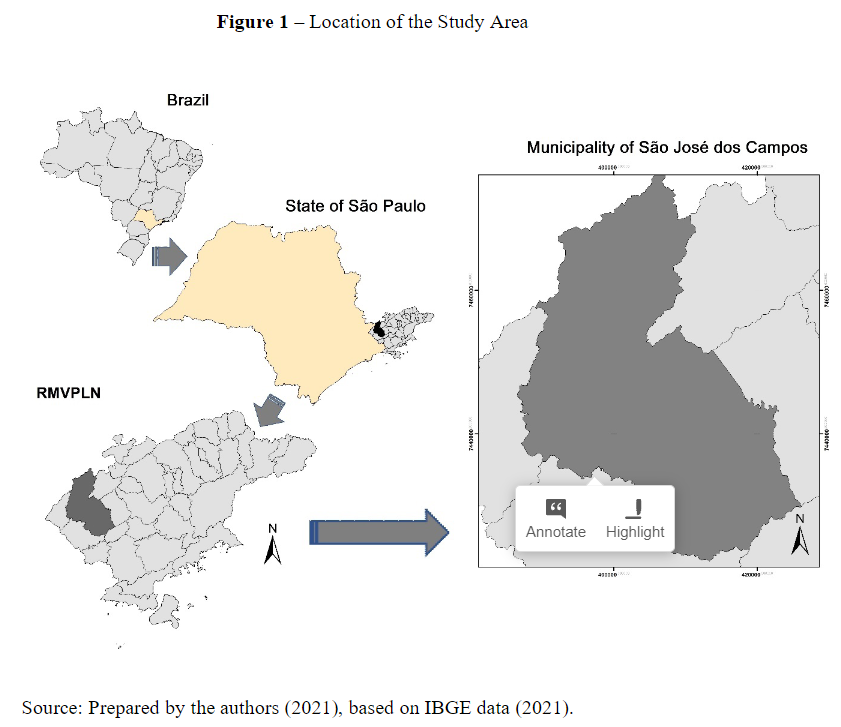
São José dos Campos is located in the Metropolitan Region of Vale do Paraíba and North Coast, in the east of the state of São Paulo (Figure 1). The municipality experienced different economic moments, from the agricultural and slave economy, through the “healing industry” thus, the long-standing citizen of the senatorial period, industrial period, after the 1950s, and, more recently, its insertion in the technical-scientific-informational period (Lessa,2001).
Souza and Costa (2009, p.145) explain that “The proximity to the metropolitan region of São Paulo contributed to São José dos Campos becoming a highly industrialized municipality and, also, [...] 'Technological Pole', based on the aerospace, war and electronics sectors”. São José dos Campos is the 19th richest municipality in the federation (GDP/IBGE) and the most industrialized in the RMVPLN. These data explain the municipal policy to encourage entrepreneurship, explained on the City Hall web page, through the Entrepreneur Portal (PMJSC, 2021).
The municipality has 729,737 inhabitants, distributed in 98% in the urban area and 2% in the rural area and a per capita income of R$ 55,603.18 (IBGE, 2021). There is a female predominance among residents, in a ratio of 49% men and 51% women.
5 The MEI Woman in the RMVPLN and in the Municipality of São José dos Campos
This section presents the situation of the MEI in the country and the MEI woman i n the RMVPLN, to contextualize this situation in the municipality of São José dos Campos, SP.
5.1 The MEIs in Brazil: General Characteristics
In consonance with the Individual Microentrepreneur Profile – 2019 of Sebrae, the MEI profile was drawn from the registration base of RFB (2021) and the profile of the Individual Microentrepreneur was analyzed regarding the date of its formalization, location, gender, age and economic sector (Sebrae, 2019, p.20).
According to the Continuous National Household Sample Survey (IBGE, Continuous PNAD, 2019), in Methodological Notes, a self-employed person is considered to be a person who works in the exploration of his own enterprise, whether alone or with a partner, without, however, having employed, with or without the help of an auxiliary family worker (IBGE, Continuous PNAD, 2019, p. 33).
Consistent with the data from Sebrae (2019, p. 20), the formalization of microentrepreneurs began in July 2009, after the amendment of the General Law of Micro and Small Enterprises, since then the creation of MEI in the country has been increasing. From July 2009 to December 31, 2018, according to data published by Sebrae (2019, p. 21), “7,739,452 Individual Microentrepreneurs were registered in Brazil”
The Individual Microentrepreneur Profile - 2019 (Sebrae, 2019, p. 21) shows that from 2010, considering the first full year of formalization of microentrepreneurs, to 2018, there was, in Brazil, an increase “by an average of 943,673 per year. The year 2018 was the one with the highest balance registered, 1,267,803 new businesses”, while in 2014, it presented a balance of MEI formalization of 993,299, indicating a growth of 3.4%, from 2014 to 2015.
The same Profile informs that “Until December 2018, the month with the highest balance of new MEI was January 2014, with 153,106 new businesses. In 2018, the month with the highest balance of registrations of Individual Microentrepreneurs was August, with 138,549 new companies opened” (Sebrae, 2019, p. 16).
It is noteworthy that according to the Individual Microentrepreneur Profile - 2019 (Sebrae, 2019), most MEIs have varied origins and motivations, it can be mentioned that they were informal entrepreneurs - self-employed - before becoming MEI. The Profile also points out that the Continuous National Household Sample Survey (Continuous PNAD), released monthly, shows the number of self-employed workers in Brazil (Sebrae, 2019, p. 22).
The figure of women as a workforce has been the subject of several studies, as it is a part of the labor market with extremely specific specificities and which has been transformed over the years. According to the Monthly Employment Survey - Self-Employed Workers Profile and Highlights of March 2008 (IBGE, 2008, p. 11),
[...] an analysis of the profile of the self-employed worker according to gender was carried out, in order to observe the behavior of the female presence in this form of insertion. Of the 4.1 million self-employed workers in March 2008, 60.8% were men and 39.2% were women, indicating a lower participation of women than the employed population (44.1%). In the period from March 2002 to March 2008, for the Metropolitan Regions as a whole, there was an increase of 4.9 percentage points in female participation in self-employed workers and 1.7 percentage points in the employed population. Among men, in March 2008, in the aggregate of surveyed metropolitan areas, 20.9% were self-employed. Among women, this percentage was 17.1%.
According to the Individual Microentrepreneur Profile - 2019 (Sebrae, 2019, p. 23), most MEIs do not have employees, so they would be classified as self-employed before formalizing MEI. Likewise, it notes that self-employed workers, who currently do not have the National Register of Legal Entities (CNPJ) and do not have partners are considered candidates to become MEI, due to the facilities and simplification of transforming from the so-called old ' autonomous' for MEI regulation by Law. According to these data, of the total MEI, formalized in December 2018, in Brazil, 52.5% are male and 47.5% female, and between 2010 and 2014, the percentage of individual female microentrepreneurs presented a slight increase, but remained stable at 47% between 2016 and 2018 (Sebrae, 2019, p. 34)
The Individual Microentrepreneur Profile - 2019 (Sebrae, 2019, p. 34) also states that, in December 2018, women participate in several sectors and activities, as they are the majority among Individual Microentrepreneurs in industry (56%), services (51%) and trade (51%), while men are the majority in civil construction (93%) and constitute a considerable majority of microentrepreneurs in agriculture (73%), according to data from Sebrae (2019, p. 34).
The greater participation of women in the labor market as MEI is variable, however, when observing the 20 activities with greater female participation, their presence is verified in the services and commerce sectors in general (Sebrae, 2019, p. 36). Oliveira et al. (2016, p.135) explains that the preferred activities, by MEIS, in Brazil, are: trade in clothing items, hairdressing services and aesthetic activities. The authors mention that
Women with a business have a higher proportionate presence in the services and commerce sectors, as the activities that predominate are beauty services such as: hairdressers, pedicures and manicures, sales through catalogues, pharmacies and perfumeries and haberdashery, manufacture of tailored clothing, textiles and fabrics in industry and forestry and forestry and poultry farming (Oliveiraet al., 2016, p. 135).
According to IBGE (2008, p. 11), there was an increase in female participation for self-employed workers in all Metropolitan Regions, during 2002 and 2008. It was also found that, although self-employed workers self-employed have a lower level of participation, this has changed more intensely.
5.2 The participation of MEI women in the labor market in the RMVPLN and in the municipality of São José dos Campos
As mentioned before, the main objective of this paper is to present an analysis of the participation of women as Individual Microentrepreneurs and their effects in the formal labor market, in the RMVPLN and in São José dos Campos, located in the state of São Paulo. This analysis used those data available at the RFB, MEIs in the years 2010, 2015 and 2020, in the 39 municipalities that make up the RMVPLN, detailing the analysis for São José dos Campos.
According to these data, it is observed, as shown in graph 1, a growing evolution of the formalization of MEIs, in the period from 2010 to 2020 (RFB, 2021). There is a growth of workers who were classified as 'self-employed' seeking to participate in the workforce in the areas of commerce, services, industry and service provision in the cities of the RMVPLN.
Graph 1 shows that, in 2010, a total of 8,535 MEIs were registered in the RMVPLN. Among the 39 municipalities, the five municipalities with the highest incidence of MEIs are recorded: in 1st place, São José dos Campos, with 2,333 (27.33%); in 2nd place, Taubaté, with 865 (10.33%); in 3rd place, Caraguatatuba, with 599 (7.02%); in 4th place, Jacareí, with 573 (6.71%); in 5th place, Pindamonhangaba, with 517 (6.06%). The other municipalities had 4% or less of the total records of MEIs .
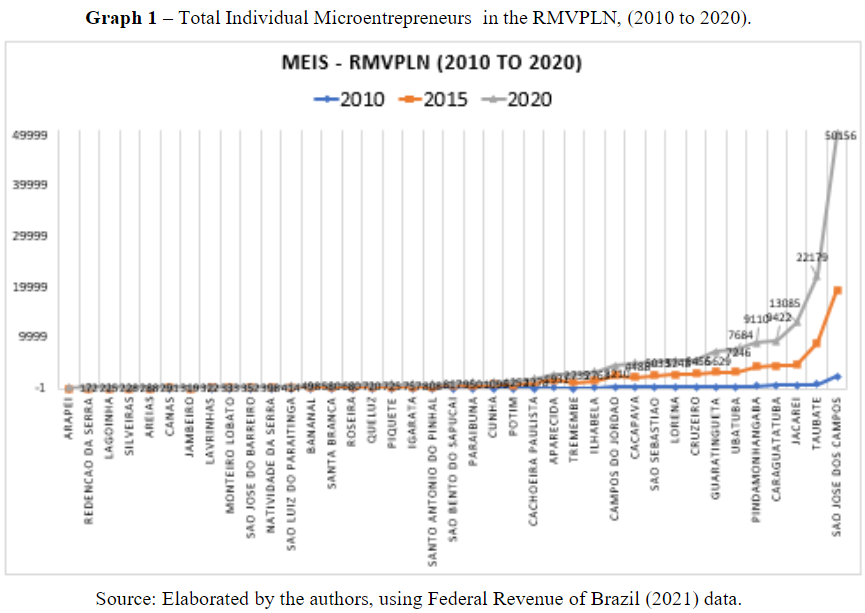
In 2015, there was a significant growth compared to 2010. According to the data in Graph 1, there was a growth in the formalization of MEIs in the RMVPLN of more than 760%, since a total of 73,965 were registered Individual Microentrepreneurs , for the 39 municipalities. One explanation for this increase lies in the economic crisis of this period, which made many unemployed people choose to undertake in order to generate income. According to Oliveira (2013, p. 36), for these, “the policy was responsible for reinserting them into the formal world, now as MEIs”. The author mentions that, analyzing Sebrae data from 2012, half of the MEIs came from the formal market, as unemployed. However, the author points out that the policy “may also be being used by some companies to replace labor contracts with service provision relationships, thus constituting a side effect of the program” (Oliveira, 2013, p. 38).
According to the IBGE (2022), the unemployment rate in the country, in December 2014, was 6.6%, rising to 9.1% in December 2015 and reaching 12% in December 2017. In the RMVPLN, the values are similar to those found for the national territory: 6.8%, 10.2%, 13.3%, for the mentioned periods, respectively (IBGE, 2022).
The five municipalities with the highest incidence of MEIs in 2015 were: in 1st place, São José dos Campos remained with 19,600 (26.50%); in 2nd place, Taubaté, with 9,053 (12.24%); in 3rd place, Jacareí, with 4,737 (6.40%); in 4th place, Caraguatatuba, with 4,474 (6.05%); and in 5th place, Pindamonhangaba, with 4,318 (5.84%). The other municipalities had 4% or less of the total records of MEIs . It should be noticed that Caraguatatuba, in 2010, was in 3rd place, in 2015, it moved to 4th place, being surpassed by Jacareí, in numbers of MEIs.
In 2020, there is continuity in growth, however, compared to the previous period (2010-2015), it grew by more than 127%. According to the data in Graph 1, there was a growing formalization of MEIs in the RMVPLN, since a total of 168,545 MEIs were registered.
Among the 39 municipalities, the five with the highest incidence of MEIs are recorded: in 1st place, São José dos Campos, with 50,156 (29.76%); in 2nd place, Taubaté, with 22,179 (13.16%); in 3rd place, Jacareí, with 13,085 (7.76%); in 4th place, Caraguatatuba, with 9,422 (5.59%); and, in 5th place, Pindamonhangaba, with 9,110 (5.41%) MEIs. Caraguatatuba, in 2010, was in 3rd place, in 2015, it moved to 4th place, having maintained this position, in 2020. According to Guimarães et al. (2022, p. 101), the year 2020 was exceptional due to the Covid-19 Pandemic and that, “in addition to unemployment and the precariousness of formal work, some factors may have contributed to the increase in the formalization of Individual Microentrepreneurs during the novel Corona Virus Pandemic. The authors point out that this formalization favored the performance.
in sectors that are high during this period, such as the food sector, with the supply of packed lunches or food to establishments authorized to operate, such as bakeries, and in the segment of transport and delivery services (Guimarãeset al., 2022, p. 101).
According to data available at the RFB (2021), it appears that, between 2010 and 2020, there was an increase of 1,874.75% in the number of MEIs registered, a scenario that points to an increase in informality in the last decade, demonstrating the consequent shrinkage of formal jobs, registered in the Employment Card. Oliveira reinforces this perceptionet al. (2016, p. 135), when stating that the growth of the service sector, through “professions such as seamstress, painter, [...] has placed many workers in formality. However, [...], more than 55% of MEIs are in default in Brazil”, which means informal.
It is observed that the values, year by year, for all municipalities, vary differently from that observed for the absolute value when comparing these data with the economically active population1. Graph 2 was elaborated from data from the PEA (IBGE, 2021) for 2010, which was projected for 2015 and 2020. We are aware that the ideal would be to make a population projection, following the demographic methods for this. However, for the purpose of calculating the ratio between the number of MEIs, per municipality, in the RMVPLN, in order to understand whether there was a growth in the participation of MEIs, in relation to the PEA, we considered the value used by the IBGE, for projection for the total population of each municipality (IBGE, 2019).
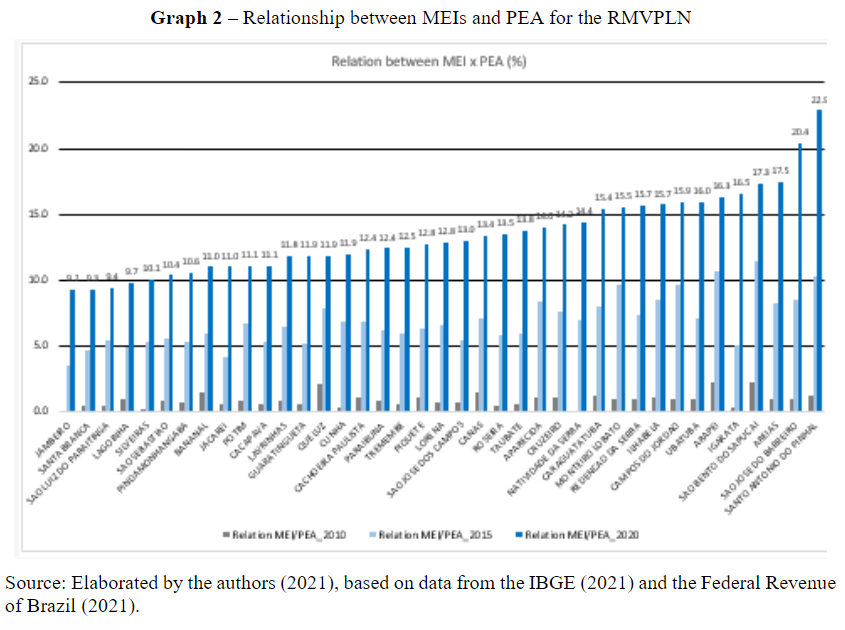
From the calculation of the rate of change of the total population, projected by the IBGE, for 2015 and 2020, for each municipality, this value was used to project the value of the PEA, for the RMVPN. With the collected data, it was possible to identify, among the sample, the percentage of existing entrepreneurs and estimate this amount for the PEA, as a whole.
One first observation concerns the position of the first five municipalities, the use of absolute data. The municipalities of São José dos Campos, Taubaté. Jacareí, Caraguatatuba and Pindamonhangaba are among the 10 most important, under the economic perspective and presented the highest absolute values of MEI, in the analyzed period. However, when using relativized values, they cease to occupy the first 10 positions among the municipalities of the RMVPLN. In 2010, the five municipalities with the highest percentage of MEIs in relation to the PEA were Arapeí, Bananal, Canas, Queluz and São Bento do Sapucaí, varying between 1.2 and 2.2%. In 2015, they included Arapeí, Monteiro Lobato, Santo Antônio do Pinhal and São Bento do Sapucaí, with values varying between 9.6 and 11.5%. For 2020, the values will vary from 16.5 to 22.9%, keeping São Bento and Santo Antônio, with Areias, São José do Barreiro and Igaratá included. What do all these municipalities have in common? Economies linked to Tourism, located outside the axis of Dutra Road, total population of less than 20 thousand inhabitants, that is, they are small municipalities, from an economic and population perspective. They are municipalities with low capacity to produce jobs and where informality is extremely high. Thus, these values are also a reflection of economic and social constraints, which deserve to be better understood.
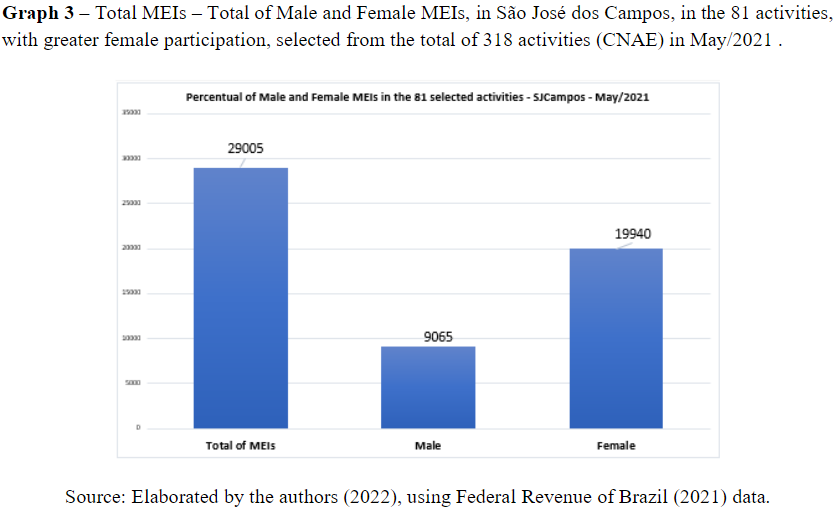
According to data available from the RFB (2021), it was verified that, in May 2021, among the 81 activities, extracted from the general framework of 318 activities, carried out and formalized by women as MEIs in the municipality of São José dos Campos, there are a total of 29,005 male and female MEIs. In this total, there is the participation of 9,065 men (31.25%) and, in contrast, there is the participation of 19,940 women (68.75%). The greater female participation, such as MEIs, in the municipality is evident, according to Graph 3.
The RFB (2021) provides data on the results of the Total Companies Opting in the MEI System (SIMEI), for the municipality of São José dos Campos, by CNAE Code - National Classification of Economic Activities and Sex. These data show us the branches of activity, among the 318 activities available, for microentrepreneurs to choose from, when they formalize their activity at the RFB (2021). In São José dos Campos, it was found that the formalization of female MEIs, among the 20 main activities, are concentrated in: 3 in the industry sector; 7 in the trade sector and 10 in the service sector in general. This formalization of female MEIs is inserted in the segments of commerce, industry and services, highlighting the segments: hairdressers (18%), retail trade (14.5%), beauty sector (8.6%), service of frozen products (8.4%) and administrative services (6%), a situation also observed by Oliveira et al. (2016). In this way, it appears that the highest female participation as MEIs, in São José dos Campos, in May 2021, is found in the service provision sector in general. Table 1 shows this distribution.
The process of inserting women into the labor market, through the Microentrepreneur Law, provided economic, social and behavioral transformations of the female role in the workforce in the country. Based on these transformations, this section sought to analyze female participation and the new dynamics of women's insertion in the formal labor market in the RMVPLN.
It appears that, with the Microentrepreneur Law, there is a new figure of activity that can be exercised formally by women. Through its formalization there is a possibility of improving its participation in the labor market, as an incentive to entrepreneurship, as well as its economic autonomy.
| 1412601 | Manufacture of garments, except underwear and made-to-measure clothing | 283 | 28 | 255 |
| 1412602 | Tailor-made manufacturing of garments, except underwear | 268 | 20 | 248 |
| 3299099 | Manufacture of miscellaneous products not previously specified | 387 | 40 | 347 |
| 4729699 | Retail trade of food products in general or specialized in unspecified food products | 407 | 173 | 234 |
| 4772500 | Retail trade of cosmetics, perfumery and personal care products | 516 | 144 | 372 |
| 4789099 | Retail trade of other products not otherwise specified | 354 | 115 | 239 |
| 4781400 | Retail trade of clothing and accessories | 3137 | 617 | 2520 |
| 4781400 | Restaurants and similar | 851 | 419 | 432 |
| 5611201 | Snack bars, tea houses, juice bars and similar | 1264 | 630 | 634 |
| 5611203 | Provision of food prepared for home consumption | 2044 | 597 | 1447 |
| 7319002 | Sales promotion | 2770 | 1344 | 1426 |
| 8219999 | Document preparation and specialized administrative support services not otherwise specified | 1806 | 753 | 1053 |
| 8230001 | Organization services for fairs, congresses, exhibitions and parties | 800 | 299 | 501 |
| 8592999 | Teaching of arts and culture not otherwise specified | 430 | 168 | 262 |
| 8599604 | Training in professional and managerial development | 1034 | 492 | 542 |
| 8599699 | Other teaching activities not previously specified | 951 | 417 | 534 |
| 8712300 | Activities to provide support infrastructure and assistance to patients at home | 845 | 105 | 740 |
| 9602501 | Hairdressers | 4259 | 1149 | 3110 |
| 9602502 | Other beauty treatment activities | 1548 | 56 | 1492 |
| 9700500 | Domestic services | 937 | 49 | 888 |
| TOTAL | 24891 | 7615 | 17276 | |
| % | 100% | 100% | 69.41 |
According to table 1, in addition to, in 2021, women represent more than 60% of MEIs, in São José dos Campos, representing more than 50%, at least, in all categories. It is noteworthy the fact that they stand out in activities that, historically, they have dominated: beauty treatment, with 96% of the total MEIs; domestic services, with 94%; confection, with 90%; retail trade, with 80%; Hairdressers, with 73%; and food supply, with 70%. According to Pereira (2020, p. 7), many of these activities, considered a feminine characteristic, “developed within the scope of small and micro family businesses”, function as “the main pillar of support, so they used this 'female skill' as an economic alternative to survive and, at the same time, transfer their ability to manage the home to the management of small domestic factories”. The author explains that working at home is strongly linked to a gender variable (Perreira, 2020, p. 8). Pereira (2020, p. 12) also emphasizes that
When we talk about women's work, it means to “formalize” the accumulation of productive and reproductive work; exhausting workloads; to the use of non-formalized labor in the same productive process, sending women to the domestic sphere, thus making it difficult for them to be recognized as precarious workers.
The significant increase in the participation of women in the MEI program, according to Pereira (2020, p. 11), can be explained by the perception of these women that, by joining the Program, a possibility of social protection is created for them and their family. At the same time, the flexibility of the workplace facilitates the association with domestic tasks, which always burden women. This situation becomes more complex for female heads of household, who are more economically and socially vulnerable, as, in addition to these issues, they assume the main role within their households.
According to Abramo (2007, p. 7), the stereotypes around the female gender, or the social representations of men and women in the labor market are constitutive elements of these gender orders, as well as the reproduction process of the inequalities that continue to be observed and experienced by women in the labor market. These stereotypes, according to the author, devalue women as workers and continue to be discussed in countless work environments.
6 Final Considerations
The process of inserting women into the labor market, through the Microentrepreneur Law, provided economic, social and behavioral transformations of the female role in the workforce in the country. It was from these transformations that this paper sought to analyze female participation and the new dynamics of women's insertion in the formal labor market in the municipality of São José dos Campos.
The Individual Microentrepreneurs indexes were analyzed to identify the total number of MEIs in the country, in the Metropolitan Region of Vale do Paraíba and North Coast (RMVPLN) and in the municipality of São José dos Campos, as well as male and female participation in the labor market and the sectors with the largest share of each one.
The Individual Microentrepreneur Profile - 2019 (Sebrae, 2019) emphasizes that the creation of MEI changed the scenario of entrepreneurship in the country, since a very rapid number of microentrepreneurs formalized, based on the new figure in the legislation. From the comparison of the presented data, it was verified a growth in the general percentage of Individual Microentrepreneurs in the country, reflecting an evolution of the formalization of the MEIs. Between 2010 (first year of formalization of micro-entrepreneurs in the country) and 2018, there was an average growth of 943,673 MEIs per year, indicating a growth of 3.4% from 2014 to 2015.
It is evident that, in December 2018, the total number of MEIs in the country was 52.5% male and 47.5% female and, in the period between 2010 and 2014, the percentage of female Individual Microentrepreneurs showed a slight increase but remained stable at 47% between 2016 and 2018. From the total of male Individual Microentrepreneurs , in December 2018, there were 41% male and 47% female (service sector), 31% male and 36% female (trade), 17% male and 1% female (construction), 11% male and 16% female (industry) and 0.2% male and 0.1% female (agriculture). It is noteworthy that, in the total value of the number of MEIs, the presence of men is greater than that of women, however, when observed by sectors, it is verified that the MEI woman only does not have a greater participation, compared to men, in the sectors of construction and agriculture.
It is important to emphasize that, in the time frame from 2010 to 2020, there is a growing evolution in the formalization of Individual Microentrepreneurs , according to data available from the RFB (2021), in the RMVPLN. There is a growth of workers who were classified as 'self-employed', seeking to participate in the workforce in the areas of commerce, services, industry and services in the region. In view of the percentages presented, an increase in informality can be seen in the last decade, which led to the formalization in MEIs of self-employed men and women, demonstrating the consequent shrinkage of formal jobs registered in the Employment Card.
It should be noticed that when the MEIs were formalized, it was found that most of them had varied origins and motivations, it can be mentioned that they were informal entrepreneurs - self-employed - before becoming MEIs. There was an increase in female participation for self-employed workers in May 2021, in São José dos Campos, among the 20 main activities carried out and formalized by women, there are a total of 24,891 male and female MEIs , with 7,615 men (30.59%) and 17,276 women (69.41%), distributed in 3 sectors of industry, 7 sectors of commerce and 10 sectors of services in general. In this way, it appears that the largest female participation as MEIs, in São José dos Campos, in May 2021, is found in the service sector in general, mainly in the field of beauty.
It appears that, with the Microentrepreneur Law, there is a new figure of activity that can be exercised formally by women. Through its formalization there is a possibility of improving its participation in the labor market, as an incentive to entrepreneurship, as well as its economic autonomy. However, despite the Program promoting this formalization, women continue to perform activities associated with the female workforce. So,
as long as public policies do not seek to overcome this distinction between productive and reproductive work, where only the former should be recognized and remunerated, women who engage in productive work have their total workday increased, crystallizing the perspective of precariousness and exploitation of labor, to their detriment (Perreiraet al., 2020, p. 15).
References
Brasil. (2006). Lei Complementar nº 123 de 14 de dezembro de 2006. Institui o Estatuto Nacional da Microempresa e da Empresa de Pequeno Porte.
Brasil. (2008). Lei Complementar nº 128 de 19 de dezembro de 2008. Altera a Lei Complementar nº 123, de 14 de dezembro de 2006.
Brasil. (2014). Lei Complementar nº 147, de 7 de agosto de 2014. Altera a Lei Complementar nº 123, de 14 de dezembro de 2006.
Brasil. (2007). Lei nº 11.598, de 3 de dezembro de 2007. Estabelece diretrizes e procedimentos para a simplificação e integração do processo de registro e legalização de empresários e de pessoas jurídicas, cria a Rede Nacional para a Simplificação do Registro e da Legalização de Empresas e Negócios – REDESIM.
Bruschini, M. C. A. (2000). Gênero e trabalho no Brasil: novas conquistas ou persistência da discriminação? (Brasil 1985/95). In: Rocha, M. I. B. (Org.). Trabalho e gênero: mudanças, permanências e desafios. São Paulo: Editora 34, p. 13-57.
Bruschini, M. C. A. (2007). Trabalho e gênero no Brasil nos últimos dez anos. Cadernos de Pesquisa, 37(132), 537-572.
Bruschini, M. C. A. (1998). Trabalho feminino no Brasil. Novas conquistas ou persistência da discriminação? Fundação Getúlio Vargas, São Paulo, p. 1- 32.
Conceição, A. J. S., Gois, E. S. B., Ribeiro, R. S., Corrêa, S. R. S., & Estival, K. G. S. (2021). Os desafios da mulher brasileira no mercado de trabalho: em busca do papel da liderança no empreendedorismo. Revista Caribeña de Ciencias Sociales, 10(7), 188-207. Online
Da Silva, N. V., Machado, A. C. L., & Pucca, M. B. (2022). Perfil da Mulher Microempreendedora de Roraima–Confrontando a Desigualdade de Gênero. Cadernos de Prospecção, 15(2), 411-429.
Dapper, S. N., Rosa, M. K., Lopes, L. F. D., Obregon, S. L., & Teixeira, E. G. (2019). Empreendedorismo Feminino: Uma Análise das Práticas Empreendedoras (MEI) do Sul do País. In: V ENPI-Encontro Nacional de Propriedade Intelectual. Florianópolis, SC; p. 809-819.
Fonseca, J. J. S. (2002). Metodologia da pesquisa científica. Fortaleza: UEC, Apostila.
Gil, A. C. (2007). Como elaborar projetos de pesquisa(4th ed.). São Paulo: Atlas.
Global Entrepreneurship Monitor (GEM). (2020). Empreendedorismo no Brasil: 2019. Curitiba: IBQP. Retrieved from https://ibqp.org.br/wp-content/uploads/2021/02/Empreendedorismo-no-Brasil-GEM-2019.pdf
Guimarães, C. P., et al. (2022). O empreendedorismo no contexto da covid-19: necessidade, oportunidade e solidariedade. Pensar Acadêmico, 20(1), 93-105.
Hirata, H. (2002). Globalização e divisão sexual do trabalho. Cadernos Pagu, n. 17-18, 139-156.
Hisrich, R. D., Peters, M. P., & Shepherd, D. A. (2014). Empreendedorismo (9th ed.). Boston: Irwin/McGraw Hill.
IBGE. (2012). Censo Demográfico 2010: Resultados gerais da amostra. Rio de Janeiro: IBGE.
IBGE. (2019). Pesquisa Nacional por Amostra de Domicílios Contínua – PNAD: Notas Técnicas (4th ed.). Rio de Janeiro. https://biblioteca.ibge.gov.br/visualizacao/livros/liv101651_notas_tecnicas.pdf
IBGE. (2008). Trabalhadores por Conta Própria Perfil e Destaques. Março 2008. https://ftp.ibge.gov.br/Trabalho_e_Rendimento/Pesquisa_Mensal_de_Emprego/Estudos/Trabalhadores_por_Conta_Propria_parte1.pdf
Instituto Brasileiro de Geografia e Estatística (IBGE). (n.d.). Estatísticas de Gênero. https://www.ibge.gov.br/apps/snig/v1/?loc=0&cat=128,-1,1,2,-2,-3&ind=4726
Instituto Brasileiro de Geografia e Estatística (IBGE). (2019). Forma de cálculo das projeções mensais da população com data de referência nos dias 1o e 15 de cada mês e por segundo. Rio de Janeiro. https://ftp.ibge.gov.br/Projecao_da_Populacao/Projecao_da_Populacao_2018/Nota_Metodologica_Populacao_mensal_dias_1_e_15.pdf
Instituto Brasileiro de Geografia e Estatística (IBGE). (n.d.). Cidades. https://cidades.ibge.gov.br/brasil/sp/sao-jose-dos-campos
Lenza, P. (2016). Direito Empresarial Esquematizado. São Paulo: Ed. Saraiva (3rd ed.).
Lessa, S. N. (2001). São José dos Campos: O planejamento e a construção do pólo regional do Vale do Paraíba. Tese de Doutorado. Campinas: UNICAMP.
Mantovani, E. (2020). A política pública do Microempreendedor Individual como instrumento de precarização do trabalho feminino. Cadernos de Gênero e Diversidade, 6(3), 35-56.
Miranda, G. V. de. (2013). A educação da mulher brasileira e sua participação nas atividades econômicas, em 1970. Cadernos de Pesquisa, n. 15, 21-36.
Neves, M. de A. (2013). Anotações sobre trabalho e gênero. Cadernos de Pesquisa, 43(149), 404-421.
Oliveira, E. M., Nakazone, N., & Coelho, T. J. N. G. (2016). A participação feminina no microempreendedorismo individual no estado de São Paulo. Revista Lumen, n. 1, 120-146.
Oliveira, J. M. (2013). Empreendedor individual: ampliação da base formal ou substituição do emprego? Texto do Instituto de Pesquisa Econômica Aplicada (Ipea). http://repositorio.ipea.gov.br/handle/11058/5638
Pereira, J. N. (2020). Mulheres e empreendedorismo: MEI como política de combate à informalidade. In: Encontro Internacional e Nacional de Política Social, 8., Vitória, ES. Anais, 1- 17 p.
Pereira, J. N. (2020). Mulheres e empreendedorismo: MEI como política de combate à informalidade. Anais do Encontro Internacional e Nacional de Política Social, 1(1).
Prefeitura Municipal de São José dos Campos (PMSJC). (n.d.). Apoio ao empreendedor. https://www.sjc.sp.gov.br/servicos/urbanismo-e-sustentabilidade/apoio-ao-empreendedor/
RFB. Receita Federal do Brasil. (2021). Total de Microempreendedores Individuais. http://www22.receita.fazenda.gov.br/inscricaomei/private/pages/relatorios/opcoesRelatorio.jsf
Santos, M. (2002). Por uma outra globalização: do pensamento único à consciência universal. Rio de Janeiro, RJ: Record.
Sebrae. (2020). Perfil do Microempreendedor Individual, 2019. https://www.sebrae.com.br/sites/PortalSebrae/estudos_pesquisas/estudos-apresentam-perfil-do-microempreendedor-individualdetalhe6,6a1713074c0a3410VgnVCM1000003b74010aRCRD#:~:text=O%20Microempreendedor%20Individual%20%C3%A9%20uma,R%24%2081%20mil%20ao%20ano
Sebrae. (2021). Faturamento Anual do Microempreendedor, 2021. https://www.sebrae.com.br/sites/PortalSebrae/faq/qual-o-faturamento-anual-do-mei,58dea97917504510VgnVCM1000004c00210aRCRD#:~:text=O%20Microempreendedor%20Individual%20que%20se,%2C%20neste%20ano
Souza, A. A. M., & Costa, W. M. (2009). As Atividades Industriais no Interior do Estado de São Paulo: Uma Análise da Formação do Complexo Tecnológico-Industrial - Aeroespacial de São José dos Campos. INTERFACE – Natal/RN, 6(2), 142-159.
Spagnollo, M. C. I., & Junckes, I. J. (2019). Microempreendedor Individual (MEI): Uma Análise do Perfil no Município de Paranaguá/PR (2010-2017). Gestus-Caderno de Administração e Gestão Pública, 2, 5-20.
Tartas, R., Guareschi, A., & Bogoni, N. (2016). O perfil socioeconômico dos MEIs passo-fundenses: uma análise no ano de 2013. Revista Teoria e Evidência Econômica, 21(45), 15 ago.
Zen, A. C., & Fracasso, E. M. (n.d.). Quem é o empreendedor? As implicações de três revoluções tecnológicas na construção do termo empreendedor. Revista de Administração Mackenzie.