Artigos
Specialization and Sectorial Competitiveness of the Planning Territories of Sergipe in the collection of ICMS
Specialization and Sectorial Competitiveness of the Planning Territories of Sergipe in the collection of ICMS
Gestão & Regionalidade, vol. 39, e20238109, 2023
Universidade Municipal de São Caetano do Sul
Recepción: 14 Septiembre 2021
Aprobación: 21 Marzo 2023
Abstract: This paper analyzes the change that has taken place in the participation of different sectors in the planning territories of Sergipe through the ICMS collection in the 2016-2020 period. For that, the differential-structural method was used with the change proposed by EstebanMarquillas (1972). The main results indicate that, despite the region of Grande Aracaju still being the main productive engine of the state, there was an expressive interiorization of some sectors, such as agriculture and trade, which became specialized and competitive in several planning territories of the state. Industry and services, in turn, despite still having a competitive advantage in most territories, have been losing their degree of specialization over the period.
Keywords: ICMS, Sergipe, shift-share.
Resumo: Este trabalho analisa se houve mudança na participação de diferentes setores dos territórios de planejamento de Sergipe por meio da arrecadação do ICMS no período 2016-2020. Para tanto, foi utilizado o método diferencial-estrutural com a mudança proposta por Esteban-Marquillas (1972). Os principais resultados indicam que, apesar de a região da Grande Aracaju ainda ser o principal motor produtivo do estado, houve expressiva interiorização de alguns setores, como agricultura e comércio, que se tornaram especializados e competitivos em diversos territórios de planejamento do estado. A indústria e os serviços, por sua vez, apesar de ainda apresentarem vantagem competitiva na maioria dos territórios, vêm perdendo seu grau de especialização ao longo do período.
Palavras-chave: ICMS, Sergipe, diferencial-estrutural.
1 Introduction
Economic growth and development have long been the scope of scientific discussion. If before studies focused on the difference between these two concepts, in the last decades it has been accepted that without growth there is no development; Understanding this, the debate has changed focus and what has drawn attention today is the uneven and irregular character of growth. Although there is no consensus to explain the economic protagonism of certain areas, it is known, since Hirschman (1958), that economic growth is focused in the places where the process began, being leveraged by the agglomeration of industrial activities (Souza, Ribeiro, & Lopes, 2019). From this viewpoint, Kaldor (1957) already pointed out the need for a sectoral approach to understand the growth differentials, which can be a consequence of both regional and national factors.
National factors would be importante, in so far as there are, in the local economy, economic activities that, nationally, are dynamic. Regional factors, on the other hand, depend on eminently internal characteristics, which provide location benefits for certain sectors (Souza, Ribeiro, & Lopes, 2019). Thus, it is natural that some regions grow more than others, since they have different sectoral dynamisms (Gonçalves, Junior, & Galete, 2011). In this sense, from Myrdal and Sitohang (1957), the industrial sector has been pointed out as an important source of economic activity, because it would be one of the most responsible for promoting increasing returns to scale.
In Brazil, a country of late and unequal industrialization, the evolution of this sector was prematurely interrupted, resulting in the stagnation of several regions in the 1980s - including Brazilian Northeast. In 1990, in the face of the trade opening and productive restructuring, the exhaustion of development policies related to that specific region became evident, forcing state governments to elaborate instruments capable of impacting the local economy (Feitosa, 2014). To meet this, Sergipe State developed the PSDI - Sergipan Program for Industrial Development, which, through the State Secretary for Planning (Seplan), divided the state into eight Planning Territories.
Grande Aracaju, a planning territory which includes the municipalities of Aracaju, Barra dos Coqueiros, Itaporanga d'Ajuda, Laranjeiras, Maruim, Nossa Senhora do Socorro, Riachuelo, Santo Amaro das Brotas and São Cristóvão, has always concentrated most of the ICMS tax collection (tax on operations relating to the circulation of goods and on interstate, intermunicipal and communication transport services, or Tax on the Circulation of Goods and tout court Services). This fact testifies to the concentration of economic growth , since, due to its high tax burden, the ICMS is understood to be an essential component of the national added value (PAULUS, 2020). In this sense, the intent of PSDI was to seek better economic planning and to deconcentrate industry in order to favor economic expansion beyond metropolitan region (Teixeira, De Melo, & França, 2011).
This being said, the main objective of this study is to verify whether there was a change in the participation of the economic sectors of Sergipe's planning territories in the period 2016-2020 and to identify those that are more dynamic. For this, the differential-structural method modified by Esteban-Marquillas (1972) will be used. Due to the statistical availability of data, traditionally in the literature, studies in this direction make use of the added value or the number of jobs as an economic variable for analysis. It is also worth mentioning that this research differs and advances in relation to the others by using the ICMS tax collection. Besides being more up-to-date, this variable is more appropriate for measuring the real growth of a sector, due to its productivity gains and the fact that all economic activities developed in the planning territories are subject to taxation.
Thus, it is expected that by working with ICMS collection data in Sergipe planning territories by sector, it will be possible to verify the pattern of structural changes in the economic composition, seeing especially the possibility of deconcentration. This way, the most specialized and competitive sectors in the collection of this tax will be verified.
The paper is structured in five sections, including this introduction. Section 2 outlines a brief empirical review of papers that used the structural-differential method. Section 3 describes the methodology used and the treatment of the data. Section 4 discusses the empirical results of the research, and finally, the last section summarizes the main conclusions.
2 Literature Review
Economy is conventionally divided into three major sectors: primary, secondary, and tertiary. The primary sector covers agriculture, cattle raising, and extractive activities; the secondary sector encompasses extractive, transformation, and civil construction industries; and the tertiary sector includes commerce and public and private services. Even if some regions perform below the national average, they may still have sectors with greater economic dynamism. Identifying these sectors is important mainly for targeting public policies that aim to improve dynamic activities, potentially resulting in increased performance of the regional economy as a whole.There are several methods through which regional economic analysis can be conducted. One approach to identifying promising sectors is through the Structural-Differential (Shift-Share) method, which aims to capture regional dynamics. This method describes the economic growth of a region considering its productive structure (Junior & Galete, 2011). Many studies have employed shift-share analysis to verify economic phenomena. Internationally, some notable recent studies include those by Shi et al. (2008), Abidin (2015), Lewandowska-Gwarda and Antczak (2015), Molnar and Chalaux (2015), Telechi (2017), and Cieślak, Pawlewicz, and Pawlewicz (2019).
Shi et al. (2008) reviewed the shift-share method and its extensions, aiming to demonstrate its applicability in the tourism sector to contribute to future research and practical applications in this field. Abidin (2015) identified sectoral changes in the gross regional product of a province in Indonesia between 2003 and 2013. The research showed that the method can provide an overview of the transformation of agriculture in this province, revealing sector growth, increased competitiveness, specialization, and allocation effects, as well as strong linkages of the agriculture sector with others. The allocation effect helps identify whether the region is specialized in sectors with competitive advantages.
Lewandowska-Gwarda and Antczak (2015) examined internal population movement in Poland and its associated problems. They analyzed internal migration according to migrant gender and migration direction (urban or rural) from 2000 to 2012 using shift-share analysis. The authors noted an increase in migration volume in Poland during the period. Meanwhile, Molnar and Chalaux (2015) investigated recent productivity changes in China, breaking down labor productivity growth from 2000 to 2011 and comparing China with other countries during this period.
Telechi (2017) analyzed the relationship between labor productivity and worker compensation in Portugal and Brazil. The author identified significant differences in the composition of the variation in productivity and remuneration in both countries. Cieślak, Pawlewicz, and Pawlewicz (2019), meanwhile, used shift-share to study sustainable development in the regions of Poland. The authors created a synthetic indicator to measure changes in the sixteen regions of Poland in the period from 2003 to 2013 with regard to the level of sustainability based on three components: social, economic, and environmental order. The results showed that the indicators of sustainable development did not have a significant change in the period.
Among the national studies that employ the shift-share in order to analyze regional economic aspects, the researches of Morrone (2015), De Oliveira (2016) and De Oliveira, Ribeiro and Vieira (2020) stand out. The first analyzed the sectoral performance in the states of the Southern region between 2007 and 2012. To do so, he decomposed the sectoral labor growth rate between its structural and differential components. It was obtained as results findings that the state of Paraná presented the best economic performance, exhibiting a greater number of sectors with specialized comparative advantages. The states of Rio Grande do Sul and Santa Catarina, however, lagged behind in relation to performance and sectors with comparative advantages. De Oliveira (2016) studied the performance of the Human Development Indicators in the municipalities of the western region of Paraná in the period from 2000 to 2010. The author intended to identify which municipalities in the region obtained the highest and lowest variations of each basic indicator of the HDI-M. As a result, all municipalities presented positive variation in the HDI-M and it was possible to classify them into four distinct types of cities.
In a more recent study, De Oliveira, Ribeiro, and Vieira (2020) used the methodology using employment information. Besides considering the results of the Allocation Effect, they highlighted the results of the Total Net Change to evaluate the dynamics of formal employment in Brazil by gender criteria. Moreover, they divided the data collected by Brazil's Federative Units (states) and by the economic sectors: agriculture, industry, civil construction, commerce, services, and public administration. The results indicated that the net creation of jobs in the main sectors of the economy occurred differently for men, "demonstrating, for both sexes, that some sectors require more specialization to take advantage of the benefits they have achieved" (De Oliveira, Ribeiro, & Vieira, 2020, p. 74).
For the Northeastern states, the research by Cuenca, Dompieri, and Sá (2015); Ribeiro, Jorge, and Da Cruz (2015); Santos and Das Almas (2017); Cunha (2019); and Lopes and De Santana Ribeiro (2020) made use of shift-share to analyze economic aspects. Cuenca, Dompieri, and Sá (2015) carried out an analysis of the effects obtained from the variation factors of the VBP (gross value of production) of corn in the state of Sergipe, studying the impact of the variables "harvested area", "productivity" and "price on VBP percentage rate of change of corn production" in four six-year periods (1990 to 1996, 1996 to 2002, 2002 to 2008 and 2008 to 2013) and also in the total period (1990 to 2013). According to the study, "the results of the analysis showed a negative annual geometric growth rate of the price variable in all municipalities and in the state" (Cuenca, Dompieri, & Sá, 2015, p. 4). The authors added that between 1990 and 2013, there was a 14% annual increase in VBP because of changes in the area, productivity, and price variables, which caused effects of 2.9%, 23.7%, and 12.6%, respectively, on the annual percentage change rate of VBP.
Ribeiro, Jorge, and Da Cruz (2015) conducted research on the deconcentration of industry in Sergipe in the period between 2000 and 2010. The authors concluded that, although more than half of Sergipe municipalities increased their industrial employment in the period, there is still a concentration of formal industrial employment in the eastern region of the state and a high-high type cluster around Grande Aracaju. That is, this region has a strong concentration of industrial employment, in line with the high concentration of neighboring regions. Santos and Das Almas (2018), on the other hand, analyzed the competitiveness of exports from Northeastern states in the period from 2005 to 2015 and came to the conclusion that the region presents an export agenda concentrated both in products and in relation to the share of each state in total exports.
Another relevant study was Cunha´s (2019), which analyzed the employment dynamics of the Northeast region and its states in the period 2006-2017, considering 18 sectors and identifying those that presented specialized competitive advantage in the region and in the states. The results pointed out that there was specialized competitive advantage for the construction, water and sewage sectors and unspecialized competitive advantage in other sectors directly and indirectly linked to the aforementioned sectors. Lopes and De Santana Ribeiro (2021, p; 113), finally, studied the recession of the municipalities of the state of Bahia in the period between 2014 and 2017. The researchers showed that: "the largest municipalities in Bahia, especially those belonging to the Metropolitan Region of Salvador, had poor local and sectoral performance in the period of analysis." Still, the authors noticed that the Western and Southern regions of Bahia, in the opposite direction, "contributed to mitigate the recession of the economy of Bahia, as a result of both the growth inherent to the municipalities themselves and the lower decline of the main sectors of these regions".
3 Method and data treatment
Shift-share is often used to compare the dynamic sectors of one region compared to another. This method is composed of a set of identities that seek to identify and disaggregate regional growth components in a descriptive analysis of the production structure. Considering as a dynamic sector the one that grows at rates higher than the average, the method starts from the observation that there are sectorial and regional differences in the speed of growth between two periods. This difference may occur due to two factors: i) the predominance of more or less dynamic sectors in the region's productive composition; and ii) greater or lesser participation in the regional distribution of the basic variable, even if there are no more or less dynamic sectors. The original method subdivides regional employment growth into two substantial variations, namely:
i) structural variation: represents the additional amount (positive or negative) that a given region may obtain as a result of its structural composition, i.e., the relative participation of dynamic sectors or not in its productive structure. Regions specialized in dynamic sectors will have a positive structural variation and vice-versa (SIMÕES, 2005, p. 10); and
ii) differential variation: indicates the positive (or negative) amount that the region j will achieve because the growth rate in certain sector(s) is higher (or lower) in this region than in the national average. The differential effect thus indicates the (dis)locational advantages of the region in global terms, qualifying the multiple region-specific factors, highlighting the regional growth rate in the global economic space (Lodder, 1972).
Briefly, the difference between the actual growth in each region j and its hypothetical growth (estimated using the global growth rate) is due to two factors that give the method its name. A structural one, which shows the effects of variations in productivity, consumption patterns, technological progress, changes in the inter-regional division of labor, etc. Regions specialized in more dynamic sectors tend to grow more than the average and present a positive structural variation.
Haddad et. al. (1989) makes clear that the method does not necessarily explain regional growth, but seeks to understand the components of this growth. According to the author, these components are accounting relationships that do not describe any hypothesis of behavior among the variables. Thus, it can be seen that there are sectorial and regional differences in growth between two periods. This difference may be caused by the existence of more dynamic or less dynamic sectors in the composition of the region's production structure, or may occur due to a greater or lesser participation in the regional distribution of an economic variable. Furthermore, the differentiation of more or less dynamic sectors may or may not occur.
The shift-share, throughout its existence, underwent modifications with the aim of overcoming some limitations of previous versions. This article adopts the update proposed by Esteban-Marquillas (1972), which sought to remove the structural influence resulting from the sectoral distribution of the reference variable (employment) in the initial year in order to calculate the differential effect. For this purpose, he added the homothetic employment method and added two new components to the identity: the allocation effect (A) and the competitive effect from homothetic employment (D').
In the present analysis, the core variable used is ICMS collection and not employment as traditionally seen in the literature. Therefore, the homothetic ICMS (E'ij) shows the ICMS in sector i in region j if the productive structure is equal between the region and the total of regions. From this point, the regional ICMS growth in relation to sectors is divided into: regional variation (R), structural variation (E), differential variation (D), competitive effect (C), and allocation effect (A). The regional variation identifies how much the ICMS of a particular region would increase if it grew the growth rate of the reference region.
The structural variation refers to the ICMS increase obtained because of its productive composition, being positive or negative when, respectively, the region is specialized in dynamic sectors. The differential variation measures the amount of ICMS, positive or negative, obtained by the region under study as a result of the differential of its sectorial growth rates when compared to the average of the reference region (Haddad et al., 1989).
The Esteban-Marquillas (1972) method can be summarized in the following expression:
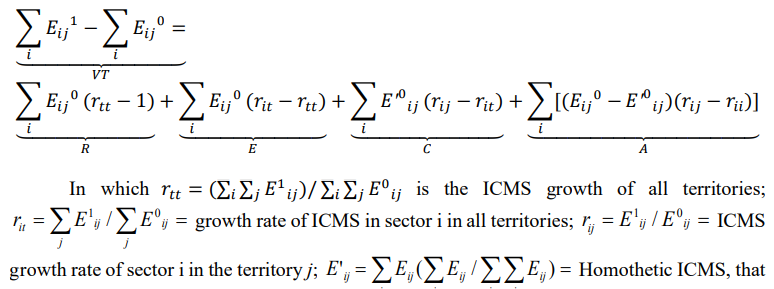
is, the ICMS in sector i if territory j presented the same ICMS structure as the total of the territories. In general, the contribution of Esteban-Maquilas (1972) was to insert in the identity of the original method two more components, which are, the competitive effect (C) and the allocation effect (A). The Total Net Change (TLV) is given by
VLT = VT - R = E + C + A
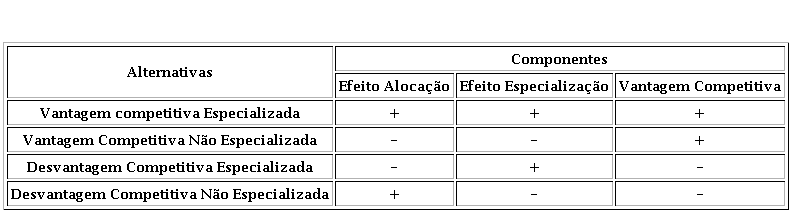
In which R = ICMS addition if territory j had the ICMS growth rate of all territories. If VLT is negative, it means that the sector would stop growing within the period, because its effective growth would be lower than the homothetic growth. Thus, there would be an ICMS net loss in the sector. For a positive VLT, the effective ICMS would grow above its homothetic growth. The possible results of the analyses proposed by the differential-structural method improved by Esteban-Marquillas (1972) are summarized in Table 1:
Table 1 –Possible alternatives to the effects
Source: Adapted from Haddad et al.(1989).
Interpreting the possibilities of results for this type of work, according to De Oliveira, Ribeiro and Vieira (2020, p. 81), we have the following possibilities:
i) the region is specialized in sectors with greater competitive advantages over others;
ii) the region has competitive advantage in sectors in which it is not specialized, resulting in a negative allocation effect
iii) the region is specialized in sectors that have no competitive advantage, resulting in a negative allocation effect; and
iv) the region is neither specialized nor does it have competitive advantages, the combination of which generates a positive allocation effect.
From the analysis of these effects it becomes possible to make inferences about the regional performance of the sectors of the state economy based on ICMS collection, which, in a way, can be characterized as a proxy1 for economic dynamism.
3.1 Data Treatment
The nominal ICMS data were collected by Sergipe municipalities from the Treasury Office of Sergipe State (Sefaz/SE) for the years 2016 and 2020. Nevertheless, the data were deflated by the Broad Consumer Price Index - IPCA for the year 2016, in order to obtain the real growth of the variable under analysis. The spatial focus of this study is due to the fact that Sergipe has the already mentioned Sergipe Program for Industrial Development (PSDI) whose division into planning territories provides a sectoral dynamic that is differentiated in relation to its northeastern neighbors. scarcity of studies for the aforementioned State. The temporal range is due to the accessibility of Sefaz's Business Intelligence data, since data from previous periods was not available for sectors.
Due to the peculiarities of the ICMS collection sectors state division in Sergipe, a differentiated sector classification will be made. Thus, the following four sectors are considered: agriculture and cattle-raising and others, industry, services, and finally trade sector. In Farming and others sector, the subcategories Animal Husbandry, Rural Producer, and Not informed were included; in Industry, only the subcategory Industry was included; for the Commerce sector, the subcategories Wholesale Trade, Consignment Trade, Retail Trade, and Supermarkets were added; and, for Services, the subcategories Communication, Restaurant and Similar, Services and Transportation were allocated.
The basic economic variable preferable for the analysis performed in shift-share is the value of production, as it best shows the contribution of each factors in the production process. However, employment data has often been used because it is more accessible and up-to-date at the regionally. However, in the present study the ICMS tax collection is used as an economic variable for the development of the shift-share. According to Article 155 of 1988 Federal Constitution, taxes are levied on consumption, more specifically on the circulation of goods and services, and the state government is in charge of establishing and collecting them. Thus, tax collection can also be used to reflect the level of activity of a certain sector, since data such as the Gross Domestic Product (GDP) have a time lag in their publication by the statistical agencies, while tax collection data are made available as soon as the respective month is closed by the State Treasury Departments.
The municipal data were aggregated into eight planning territories, namely: Agreste Central, Alto Sertão, Baixo São Francisco, Centro Sul, Grande Aracaju, Leste, Médio Sertão, and Sul. Such division was based on the inherent particularities that contemplate five dimensions, namely: i) economic-productive; ii) geo-environmental; iii) social; iv) politicalinstitutional; and v) socio-cultural (Teixeira, De Melo, & França, 2011). This territorial division was chosen because it is used by the state for planning purposes.
4 Outcomes and Discussions
The objective of using the shift-share method in this article is to identify the competitive and specialization advantages (allocation effect) of Sergipe planning territories by economic sector, using ICMS collection data, as well as to classify such data as dynamic or stagnant in the period 2016-2020. However, before going into the main results, a preliminary analysis is necessary in order to understand the territorial division studied and the economic dynamics that make up each of the eight planning territories (Figure 1):
Figure 1 -Sergipe's Planning Territory
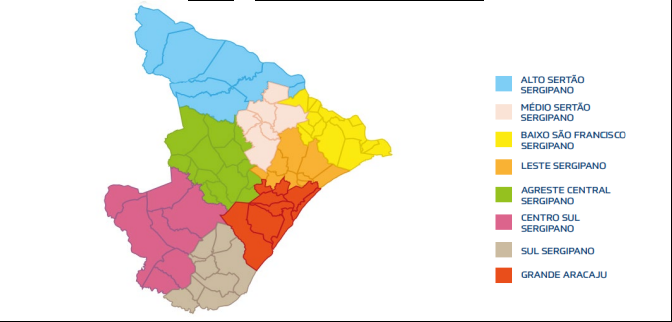
Figure 1
Sergipe's Planning Territory
Source: Seplan (2008).
The territories Leste Sergipano and Alto Sertão have large mining and energy production companies, which contributes to the high share of wealth generated by these two territories. Agreste Central and Grande Aracaju, which are the most urbanized territories, are characterized by the presence of activities in the areas of services, commerce and industry, especially in the Metropolitan Region of Aracaju (Teixeira, De Melo, & França, 2011). Lower Sergipan São Francisco has a high concentration of land, a poorly developed industrial sector and small oil and gas extraction activities. Sul Sergipano Territory has a relevant participation in agriculture, as well as some industries and the clothing sector. Médio Sertão Sergipano has a significant rural population, with agriculture and public administration playing the main roles in generating the territory's GDP. Centro-sul Sergipano, finally, stands out for its agriculture, cattle raising, and confections (LIMA, 2008). To explore the evolution of ICMS collection on a territorial and sectorial level, we have Graph 1.
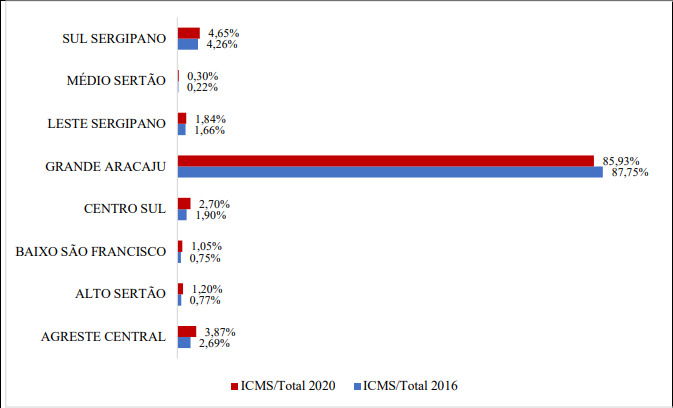
Graph 1 -Share of ICMS Collection by Planning Territory over the State's Total Collection in the periods 2016 and 2020.
Source: Own elaboration.
According to Graph 1, it can be observed that in the years 2016 and 2020, respectively, the participation of Grande Aracaju in the total collection of ICMS in the state was 85.93% and 87.75%, with the Sul Sergipano territory taking second place, with a participation slightly higher than 4% in both years, mainly due to the industrial production in the region, such as the textile and beverage industries. Graph 2 outlines the revenue collection by sector.
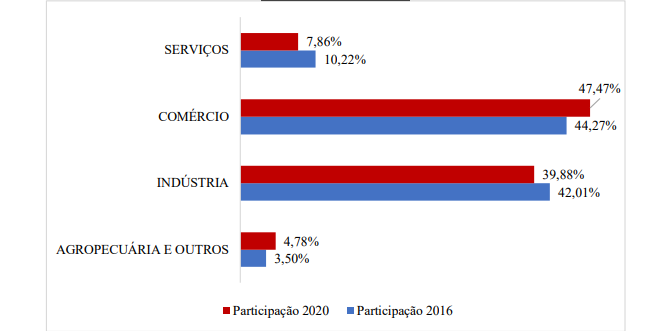
Graph 2 -Share of ICMS collection by sector in the State's total collection between 2016 and 2020
Source:Own elaboration.
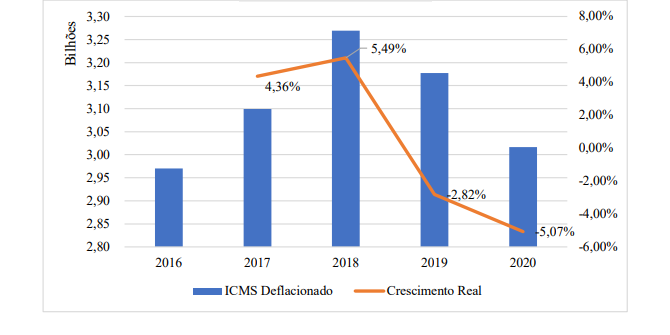
When analyzing the participation of ICMS collection by sector in 2016 and 2020, one notices a drop in the participation of industry and services in the state economy. Such drops can be attributed to the effects of the pandemic, which, although it started in 2019 in China, its major effects arrived in Brazil in 2020, affecting several economic sectors. On the contrary, commerce sector gained importance in ICMS collection, increasing its share from 42.27% to 47.47%. Agriculture and Husbandry and Others sector also showed an increased participation in the period from 2016 to 2020. Even though, within the entire period between 2016 and 2020, the ICMS had nominal growth year by year for Sergipe state, when deflating the data using the IPCA, it can be seen that in the years 2019 and 2020, there was no real growth in revenue. Graph 3 outlines the real growth as well as the levels of ICMS collections.
Graph 3 - Real (deflated) ICMS and growth in the state of Sergipe, encompassing all planning territories and all
Source:: Own elaboration
From Graph 3, we can see that the cumulative real growth of ICMS from 2016 to 2020 was 1.55%. In parts, one can imagine two problems that caused this accumulated real growth to be low. The first one is deindustrialization. The ICMS is a tax that goes pari passu with industrial activity, with the loss of the participation of the state's industrial GDP, as it is observed in Brazil, there are losses in the collection of this tax as deindustrialization is accentuated (Afonso, Lukic, & Castro, 2018). The second problem to be considered is the coronavirus crisis, which was responsible for a steep drop in world productions, consequently lowering the tax collection of governments. In light of these problems, Graph 4 makes it possible to analyze the real growth of ICMS by Planning Territory.
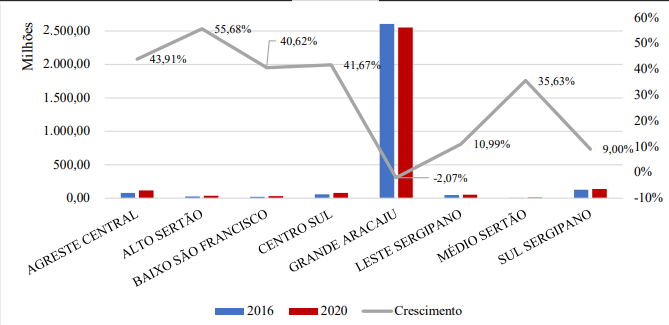
Graph 4 -Accumulated real growth from 2016 to 2020 of Sergipe state ICMS by Planning Territory.
Source:Own elaboration.
When considering the real growth of Sergipe's ICMS divided by planning territory, we have some interesting points to address. One notices that, in all the inland regions, there was a very high growth in collected revenue, especially in Alto Sertão, Agreste Central and Baixo do São Francisco, which grew 55.68%, 43.91% and 40.62%, respectively.
ju. Such results can be interpreted as the state's capacity to interiorize its production, even if only in short steps, taking its production chain from the metropolitan region to the interior of the state. Graph 5, shows the accumulated growth of ICMS collection by sector.
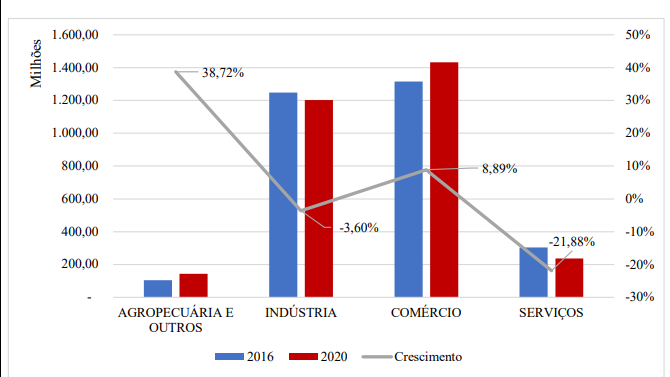
Graph 5 -- Accumulated real growth from 2016 to 2020 of Sergipe state ICMS by Sector.
Source: Own elaboration
Evaluating the accumulated growth of sectorial ICMS collection in the period of 2016- 2020, as shown in Graph 5, we also have something that corroborates the deindustrialization thesis. Not only did the industry's share in total revenue drop, but also the real value of its collection (-3.6%). However, the Trade and the Agriculture and Livestock and Other sectors had growth of 8.89% and 38.72%, respectively, in the period. For Cunha (2019), considering the entire Northeast region, the biggest change in employment is due to the increase of labor in low productivity activities.
Thus, the Northeastern economy presented, in the period, a specialized competitive advantage in the sectors of construction and water and sewage, both linked to housing stimuli. The author also shows that other sectors presented a non-specialized competitive advantage in the Northeast region, such as financial and real estate activities, commerce, education, transportation, and manufacturing. Such results are associated with investments in highway infrastructure, tax incentives for industries, and the interiorization of universities. Table 2 presents the results of the allocation effect.
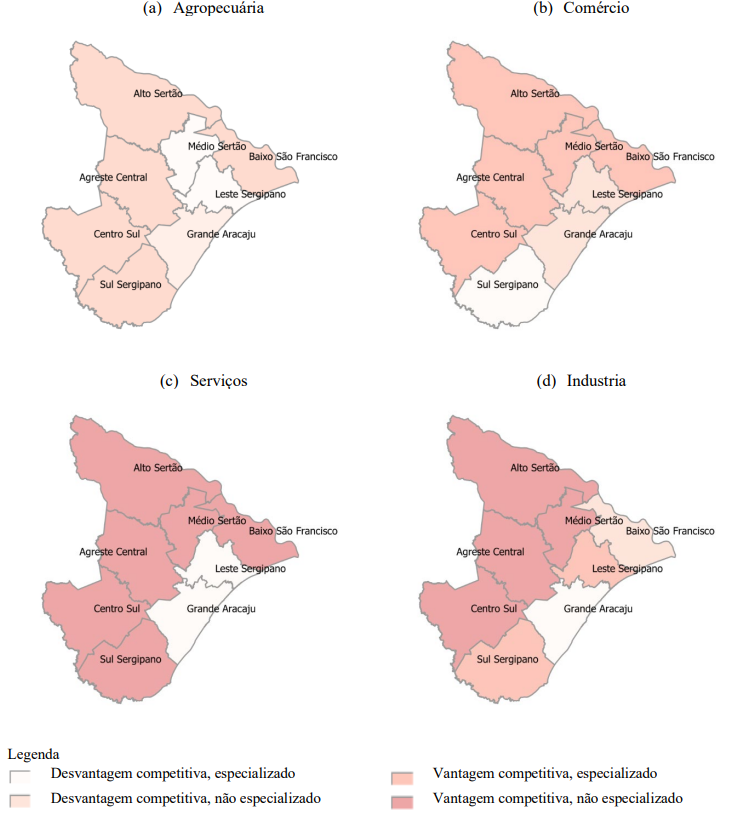
Table 2 - Results of the allocation effect by territory and sector
Source: Own preparation based on the results
In view of the presented results in Table 2, it can be seen that the planning territories Agreste Central, Alto Sertão, Baixo do São Francisco, Centro Sul and Sul Sergipano have competitive advantage and are specialized in the Agriculture and Others sector. This type of composition is generally the preferable type for the regions, because it shows that the sector, having competitive advantage, has also been well utilized in the sense that the region specialized in it, which allows productivity gains. Historically, the territories of Sul Sergipano, Médio Sertão and Centro Sul had the relatively more developed agricultural sector of the state (Teixeira, De Melo, & França, 2011). It is possible to realize that, of these regions, Sul Sergipano and Centro Sul continue increasing their agricultural competitiveness and being specialized regions. Médio Sertão, however, despite still being a specialized region, has no competitive advantage.
Agreste Central, Alto Sertão, and Baixo São Francisco have also been known to lack a strong agricultural sector, although the latter has large concentrations of land (Teixeira, De Melo, & França, 2011). However, more recently these regions have shown an improvement in their growth in the sector, gaining productive competitiveness and becoming specialized. Such results corroborate the idea that in recent years there has been a decentralization of the agricultural production center in the state of Sergipe, evidencing a migration of rural activities to other regions.
For Santos and Das Almas (2017), in the period from 2005 to 2015, the state of Sergipe showed higher growth than the Northeast states in some sectors, such as the production of fruit, sugar, fuels and mineral oils, organic chemicals, plastics, footwear, iron, steel, vehicles, and automotive parts. These are areas that, according to the authors, made the state of Sergipe have specialized comparative advantages and export specialization. However, in both 2005 and 2015, Sergipe was the state that had the least share in the total exports of the Northeast states (Da Silva et al., 2016). In this period, the segment that gained competitiveness in the region and distinction in Northeast export agenda has been the commodities, that is, mostly agricultural and livestock goods and extractive industry products (Santos, & Das Almas, 2017).
Table 2 also reveals that Leste Sergipano and Sul Sergipano planning territories have a competitive advantage and are specialized in Industry. Ribeiro, Jorge and Da Cruz (2015) had as a result that in 41.3% of Sergipan municipalities, despite presenting competitive advantages in the industrial sector, this sector was not considered as specialized. That is, the growth rate of industry in these municipalities was lower than the regional average (state). The authors show, in addition, that in 25.3% of the municipalities in Sergipe, although the industry is characterized as specialized, the sector did not present competitive advantages over other economic activities. Moreover, in 24% of the cities, the industry was not considered specialized nor did it present competitive advantages. The results suggest that, despite the fact that 40 cities increased their industrial employment in the period (2000-2010), there is still a concentration of formal industrial employment in the eastern region of the state, especially in Grande Aracaju.
Grande Aracaju and Agreste Central, historically, were regions that had a robust industrial sector (Teixeira, De Melo, & França, 2011), given the proximity of the regions and the concentration of industries in the metropolitan region of the state capital. However, Agreste Central, despite still having a competitive industry, is not specialized and Grande Aracaju, even though it has a specialized industry, has a competitive disadvantage.
Leste Sergipano and Alto Sertão were territories that had a strong industry of mining and energy production (Teixeira, De Melo, & França, 2011). However, it can be seen that Alto Sertão territory has been losing space in this sector. Although it presents a competitive advantage for industry, it is not specialized. One conjectures that, in part, this is a reflection of the effects of deindustrialization occurring throughout the national territory. Thus, the Leste Sergipano and the Sul Sergipano stand out as regions favorable to industrial activity. This fact also characterizes a decentralization of these activities from the capital's metropolitan region to the interior.
The planning territories Agreste Central, Alto Sertão, Baixo do São Francisco, Centro Sul and Médio Sertão have a competitive advantage and are specialized in the Trade sector. According to Teixeira, De Melo and França (2011), the trade sector is stronger in the regions of Agreste Central and Grande Aracaju, at least when it comes to absolute levels. However, the results also show a possible decentralization of the commercial activity to the other regions, so that Grande Aracaju area reveals a competitive disadvantage rather than specialization.
In the services sector, no planning territory has a competitive advantage and it is specialized simultaneously. In fact, the planning territories Agreste Central, Alto Sertão, Baixo São Francisco, Centro Sul, Médio Sertão and Sul Sergipano have competitive advantages, although they are not specialized in the services sector. Grande Aracaju, despite being specialized in the sector, does not have a competitive advantage. This goes against the possibility of productive decentralization of the sector to the other territories of the state. Figure 2 presents the spatial synthesis of the results of the allocation effect:
Figure 2 - Spatial summary of the result of the Allocation effect by sector
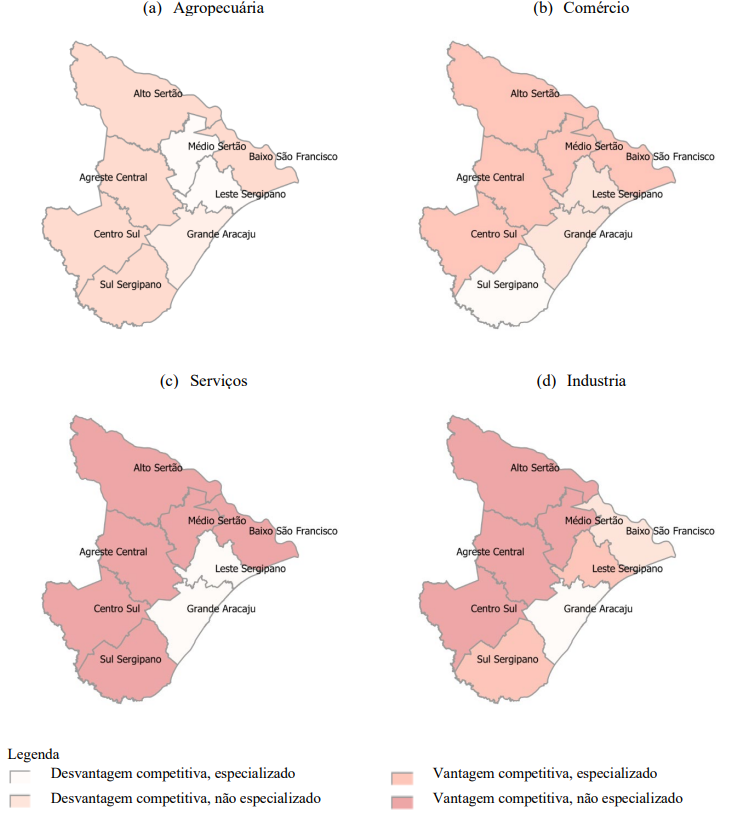
Figure 2
Spatial summary of the result of the Allocation effect by sector
As shown in Figure 2, Grande Aracaju has competitive disadvantages in all sectors. The services sector is the one that presents the most competitive advantages in the territories, but perhaps this is due to the migration of the sector from the capital to the interior. In most regions, the sectors of Agriculture and Livestock and Others and Commerce present competitive advantages and are specialized sectors. This is because the growth of the sectors in Grande Aracaju was small in the period, when considered the relative growth of the state as a whole. Industry has a competitive advantage in most territories, although it is a non-specialized advantage in half of them. In Grande Aracaju, on the other hand, the sector is at a disadvantage, despite being specialized.
Comparing with other works, it can be seen that Cunha (2019) had results that Sergipe state presented, in the period 2006-2017, specialized competitive advantage, when compared to the other Northeastern states, in the Human Health and Social Services sector. It presented nonspecialized competitive advantage in Agriculture, Manufacturing Industries, Water and Sewage, Transportation, Real Estate Activities, Administrative Activities, and Education. Also, according to Cunha (2019), Sergipe presented specialized competitive disadvantage in the sectors of Extractive Industries, Electricity and Gas, Construction, Information and Communication, Financial Activities, Public Administration and Domestic Services. It is also worth noting that the state had unspecialized competitive disadvantage in Trade, Accommodation and Food, and Professional and Scientific Activities. As a rule, in this work, the results seem to show the internalization that occurred in the investments made in Sergipe state within the period 2016-2020 in all sectors.
Concluding Remarks
This study aimed at verifying whether there has been a change in the participation of different sectors in Sergipe's planning territories through ICMS collection in the period 2016- 2020, as well as at identifying the most dynamic sectors. It was observed that the sectors Agriculture and Others and Commerce have been gaining strength in specialization and competitiveness in most of the territories. This may mean a change in the central axis of development in the state, which for many years was industry. Based on the results presented, one can say that there was a relative interiorization of production in Sergipe state, that is, investments migrated from the metropolitan region of the capital to the interior, considering that the territory of Grande Aracaju was the one that presented competitive disadvantage in all sectors, while the regions of Agreste Central, Alto Sertão, Baixo São Francisco, Centro Sul, Médio Sertão and Sul Sergipano presented competitive advantage in at least three of the four sectors
Industry, despite having competitive advantage in almost all the territories, has specialization in less than half of them, highlighting the metropolitan region of the capital. These results corroborate the idea of the deconcentration of industry in the state, since the competitive advantage demonstrates that the sector grew in the region more than the state average. Only in the territories of Baixo São Francisco and Grande Aracaju does the industry have a competitive disadvantage. Thus, most of the results found are relatively unexpected due to the great importance of Grande Aracaju territory both in the state's total production and in ICMS collection. Since the tax collection figures and their growth in Grande Aracaju area influence the growth rates for the state as a whole, as well as the expected growth rates , i.e. homothetic ICMS, for the other territories, substantial impacts on the allocation effects are expected.
The present study has advanced in that it has used ICMS collection data as they are daily updated. However, it is worth mentioning that such data required a reorganization because the internal division of the collection sectors, carried out by Sefaz/SE, is different from the official division of IBGE and other government agencies. Thus, it is believed that future work can advance in the refinement of the analysis at both sectoral and territorial levels. Still in relation to the limitations of the study, we point out that exported products are exempt from taxation by this tax. Thus, eminently exporting sectors in the state would tend not to have their effects computed in the methodology proposed here. However, according to the Secretariat of Foreign Trade (SECEX, 2017), Sergipe state exports relatively little. In 2017 Sergipe's exports were less than US$ 100 million in a scenario of a state GDP of R$ 40.7 billion. Thus, the exporting sectors tend to have low impact on the results of this work. As a suggestion for future studies, it is desirable to follow up this research in order to observe annually the evolution of the sectors of Sergipe's economy in its planning territories and, above all, in the municipalities, so that it is possible to evaluate public policies for reorienting the state productive structure in a more detailed way. The results found here can be used as guideposts for the formulation of public policies for economic development in the planning territories of Sergipe, delimiting the sectors most in need of expansion in the various regions so that the government can act in a coordinated way in granting the necessary incentives for territorial growth and employment generation.
References
Abidin, Z. (2015). Aplikasi Analisis Shift Share pada Transformasi Sektor Pertanian dalam Perekonomian Wilayah di Sulawesi Tenggara. Jurnal Informatika Pertanian, 24(2), 165-178.
Afonso, J. R. R., Lukic, M. R., & Castro, K. P. de. (2018). ICMS: crise federativa e obsolescência. Revista Direito GV, 14, 986-1018.
Brasil. (1988). Constituição Federal. Senado Federal.
Cardoso, P. G. S. (2015). Estimando o "gap" tributário dos Estados brasileiros no período 1997-2012 (Dissertação de Mestrado). Universidade Federal de Pernambuco.
Chein, F. (2019). Introdução aos modelos de regressão linear: um passo inicial para compreensão da econometria como uma ferramenta de avaliação de políticas públicas.
Shi, C. Y., et al. (2008). A review of shift-share analysis and its application in tourism. International Journal of Management Perspectives, 1(1), 21-30.
Cieślak, I., Pawlewicz, K., & Pawlewicz, A. (2019). Sustainable Development in Polish Regions: A Shift-Share Analysis. Polish Journal of Environmental Studies, 28(2).
Cuenca, M. A. G., Dompieri, M. H. G., & Sá, H. A. (2015). Análise dos Efeitos dos Fatores de Variação do Valor Bruto da Produção de Milho por meio do Modelo Shift-Share, no Estado de Sergipe. Aracaju: Embrapa Tabuleiros Costeiros.
Cunha, A. A. P. da. (2019). Vantagens competitivas nos estados do Nordeste: uma análise da dinâmica do emprego no período de 2006 a 2017 (Dissertação de Mestrado). Universidade Federal de Pernambuco.
Estado de Sergipe. (2008). Sergipe em dados. Aracaju: SEPLAN/SUPES.
Esteban-Marquillas, J. M. I. (1972). A reinterpretation of shift-share analysis. Regional and urban economics, 2(3), 249-255.
Feitosa, C. O. (2014). A distribuição espacial das atividades econômicas de Sergipe. Cadernos de Ciências Sociais Aplicadas, Vitória da Conquista, 17, 187-206.
Gonçalves Junior, C. A., & Galete, R. A. (2011). O método estrutural-diferencial: aplicação da adaptação de Herzog e Olsen para a microrregião de Maringá frente à economia paranaense 1994/2008. Informe Gepec, 14(2), 149-165.
Haddad, P. R., et al. (1989). Economia regional: teorias e métodos de análise. Fortaleza: BNB/ETENE.
Hirschman, A. O. (1958). The strategy of economic development. New Haven: Yale University Press.
Kaldor, N. (1957). A model of economic growth. The economic journal, 67(268), 591-624.
Lewandowska-Gwarda, K., & Antczak, E. (2015). Analysis of internal emigration in Poland using the spatial dynamic shift-share method. Argumenta Oeconomica, 35(2), 123-143.
Lima, R. R. P. (2008). Território e arranjos produtivos locais em Sergipe: em busca da endogeneização do desenvolvimento (Tese de Doutorado). Universidade Federal de Sergipe.
Lodder, C. A. (1972). Crescimento da ocupação regional e seus componentes.
Lopes, T. H. C. R., & de Santana Ribeiro, L. C. (2021). O Estado da Bahia na Recessão: Uma Análise Shift-Share Multifatorial dos Municípios Entre 2014 e 2017. Revista portuguesa de estudos regionais, 58, 101-115.
Myrdal, G., & Sitohang, P. (1957). Economic theory and under-developed regions.
Molnar, M., & Chalaux, T. (2015). Recent trends in productivity in China: shift-share analysis of labour productivity growth and the evolution of the productivity gap.
Morrone, H. (2015). Analisando a performance setorial nos estados da Região Sul entre 2007 e 2012: uma análise Shift-Share. Perspectiva Econômica, 11(1), 36-46.
Oliveira, G. B. de. (2016). O desempenho dos Indicadores de Desenvolvimento Humano nos municípios da região oeste paranaense com aplicação da metodologia Shift-Share para o período 2000–2010. Revista Tecnologia e Sociedade, 12(24), 59-77.
Oliveira, B. R. de, Ribeiro, L. C. de S., & Vieira, O. H. P. (2020). A questão de gênero no mercado de trabalho: uma análise para os anos de 2010 a 2017. Reflexões Econômicas, 5(1), 74-92.
Paulus, C. I. (2020). Incentivos fiscais de ICMS: qual o impacto na arrecadação fiscal e no crescimento regional? - In: Congresso da associação nacional de programas de pós-graduação em contabilidade.
Ribeiro, L. C. S., Jorge, M. A., & da Cruz, I. S. (2015). Desconcentração da indústria em Sergipe? Uma análise descritiva do período 2000-2010. Revista Brasileira de Estudos Regionais e Urbanos, 9(1), 50-70.
Santos, T. A., & das Almas, R. S. (2018). Análise das exportações da região Nordeste nos anos de 2005 e 2015: uma aplicação do método Shift-Share. Cadernos de Ciências Sociais Aplicadas, 16, 16-16.
Secretaria de Comércio Exterior-SECEX. (Várias datas). Balança Comercial Brasileira-Mensal. Disponível em: http://www.desenvolvimento.gov.br/.
Silva, R. A. da, et al. (2016). Padrão de especialização do comércio internacional do Sergipe (1999-2015). FACEF Pesquisa-Desenvolvimento e Gestão, 19(2).
Simões, R. F., et al. (2005). Métodos de análise regional e urbana: diagnóstico aplicado ao planejamento. Belo Horizonte: Cedeplar/UFMG.
Souza, L. R. de S., Ribeiro, L. C. de S., & Lopes, T. H. C. R. (2019). A dinâmica da indústria nos municípios de Sergipe no período 2000-2015. RDE-Revista de Desenvolvimento Econômico, 3(41).
Teixeira, O. A., de Melo, R. L., & França, V. L. A. (2011). A experiencia de territorialização para o planejamento regional em Sergipe. [Teste] Revista Economia Política Do Desenvolvimento, 4(12), 91-128.
Telechi, A. V. (2017). Produtividade e remuneração do trabalho: aplicação de uma análise Shift-share ao Brasil e Portugal (Tese de Doutorado).