Artigos
Environmental impact assessment of environmental sanitation in Brazil: reflections for the future of environmental licensing in the context of sanitation privatization
Environmental impact assessment of environmental sanitation in Brazil: reflections for the future of environmental licensing in the context of sanitation privatization
Gestão & Regionalidade, vol. 39, e20237562, 2023
Universidade Municipal de São Caetano do Sul
Recepción: 14 Diciembre 2020
Aprobación: 20 Julio 2022
Abstract: A bill, recently approved by the Federal Chamber and sent to the Senate, could modify the environmental sanitation licensing. The objective of this work is to explore the evolution of environmental impact assessment legislation for environmental sanitation systems to provide technical support for the new environmental licensing framework in the context of sanitation privatization. This bibliographical and documentary study analyzes norms and resolutions representative of the legal framework applicable to environmental and water issues. The results indicate that Brazil has a broad legal scope in environmental and water resources matters, fundamental to guaranteeing guidelines for licensing potentially degrading projects, such as sanitary sewage and water supply systems. Although a scenario of an increase in these projects is foreseen due to the new legal framework for basic sanitation, the proposed law for licensing is a negative surprise when it excludes them from the list of initiatives submitted to environmental impact assessment.
Keywords: environmental licensing, water, basic sanitation, water supply, environmental impact assessment.
Resumo: Um projeto de lei, recentemente aprovado na Câmara Federal e encaminhado ao Senado, pode modificar o licenciamento do saneamento ambiental. O objetivo deste trabalho é explorar a evolução das legislações de avaliação de impacto ambiental para sistemas de saneamento, de modo a fornecer subsídios técnicos ao novo marco do licenciamento ambiental no contexto de privatização do saneamento. Este estudo bibliográfico e documental analisa normas e resoluções representativas do quadro legal aplicável às questões ambientais e hídricas. Os resultados indicam que o Brasil possui amplo escopo legal em matéria ambiental e de recursos hídricos, fundamental para garantir diretrizes para licenciar projetos potencialmente degradadores, como são os sistemas de esgoto sanitário e abastecimento de água. Ainda que se vislumbre um cenário de aumento desses projetos pelo novo marco legal de saneamento básico, o projeto de lei do licenciamento surpreende negativamente ao exclui-los do rol de iniciativas submetidas à avaliação de impacto ambiental.
Palavras-chave: licenciamento ambiental, água, saneamento básico, abastecimento de água, avaliação de impacto ambiental.
1 Introduction
The history of environmental sanitation, especially of water supply and sewage systems, is closely linked to the relationship that human beings have with water protection. Even the most archaic societies were aware of the fundamental role of water in life and the relationship between diseases and “dirty water”. However, the regulatory aspects and the understanding of water as a public good is recent. The incorporation of licensing as an element of protection and management of natural resources in Brazil began only in the 1970s, while the grant for water use, which works in addition to licensing, is less than 30 years old (PORTO; PORTO, 2008).
Since the legal creation of these two instruments – granting and licensing – essential for water conservation in Brazil, a long path has been covered for their regulation aimed at promoting the effectiveness of the preponderant objectives of conservation of the environment. Even so, several deficiencies in the legislation and in the application of these instruments are alleged and have been a constant target of criticism by the various licensing actors (FONSECA; RODRIGUES, 2017; NASCIMENTO; FONSECA, 2017; BRAGAGNOLO, 2017). There is an understanding among those involved that there is a need for regulatory changes in order to speed up the processes, improve licensing and Environmental Impact Assessment (EIA) procedures (WORLD BANK, 2008) and include other instruments to support decision making, such as the Strategic Environmental Assessment (SÁNCHEZ, 2017; TURCO; GALLARDO, 2018).
According to Oliveira et al. (2019), in the 21st century, the challenges of environmental sanitation in Brazil are still giant, with 83.5% of the population with access to the water supply network and only 46% with sewage collection and treatment. More than 30 million Brazilian citizens still do not have access to water and more than 100 million are releasing their raw sewage into the environment, causing harm to national health.
The recent approval of Law 14.026 of 2020, which established the new Legal Framework for Basic Sanitation, aims to expand the coverage of basic sanitation in Brazil. However, there are controversies due to the risks and shortcomings of privatization already investigated in the literature (ROSSONI et al., 2020; MELLO, 2005).
It is also necessary to consider the new Legal Framework for Licensing, Proposed Law (PL) 3.729 of 2004, recently approved in the Chamber of Deputies and pending in the Federal Senate (RUARO et al., 2021). Thus, with the changes in environmental licensing and sanitation regulations in Brazil (RUARO et al., 2021), it is essential to analyze how the new regulations dialogue with the consolidated legal framework for environmental licensing of water resources, with a focus on water systems. sanitation and water supply.
To understand the functioning of the environmental licensing of these systems, it is necessary to go beyond the laws that specifically deal with impact assessment and explore the regulations that permeate the scope of environmental matters (TAMBELLINI, 2012; NASCIMENTO et al., 2020). It is not enough to write in laws that water is public and needs to be protected, it is important to establish how to make these provisions work in practice. These regulations are extensive and many of them have roots previous to the licensing system itself and the National Environmental Policy (NEP) of 1981.
In this work, we chose to analyze the legislation at the federal level and the normative resolutions of the National Environmental Council (NEC) and National Water Resources Council (NWRC). Specific aspects of municipal and state legislation will not be addressed, only an overview that supports these regulations will be presented.
Thus, the objective of the work is to explore the evolution of the EIA legislation of two of the environmental sanitation systems - water supply and sanitary sewage - to provide technical subsidies to the new environmental licensing framework in the context of privatization of sanitation. The specific objectives are: to analyze the EIA environmental licensing legislation of these environmental sanitation systems; and to analyze the legislation of the National Water Resources Policy (NWRP), NEP and the Federal Basic Sanitation Policy (FBSP), which guide the use and protection of water resources regarded to the environmental sanitation systems.
It is intended to encourage discussion about some of the possible legal and practical consequences of prominent changes that may occur in the near future.
2 Methodology
This bibliographic and documentary study was based on the identification and analysis of specific legal documents and the context in which they were formulated. We sought to analyze laws and regulations that determine the objectives, tools and guidelines of the main licensing policies related to water supply and sanitary sewage in Brazil. In this way, the interaction of new laws with the existing legal framework and the practice of EIA in Brazil was evaluated. The study was developed in four parts.
In the first part, the main laws that led to the establishment of the current licensing policy and its temporal relationship with the spheres of governance of water resources and sanitation were explored. It focused, especially, on the federal constitutions that were in force in Brazil and ordinary and complementary laws of greater scope on the subject indicated by the literature.
In the second part, the creation and development of the NWRP, the NEP and the FBSP, the main guiding policies for the use and protection of water resources for supply and sanitation, were addressed. The research was based on a literature review and analysis of the text of the laws.
In the third part, the normative details of the resolutions issued by NWRC and NEC were discussed, which help to govern and provide guidelines for EIA systems in all governmental spheres. In this section, quantitative surveys were made of the NWRC and NEC resolutions issued since their creation, in 1997 and 1981, respectively, until July 2020, available on the official websites of the Ministry of the Environment3 and NWRC4 . NEC resolutions were screened in two stages. In the first screening, we sought to quantify and analyze all NEC Resolutions that concern water supply and sanitary sewage systems. In the second step, all licensing-related resolutions were identified and divided into general or specific. The relationship between the quantity and theme of NEC and NWRC resolutions, with the actions of the councils and the institutional context in which they were issued, were also discussed.
In the last part, based on literature reviews, an analysis was made of the six texts of the main law proposal to create a legal framework for licensing. The possible consequences of the proposals were also discussed, associated with the necessary expansion of water supply and sanitary sewage systems, for the preponderant objectives of sanitation and environmental protection policies. The proposals analyzed date from June 2019 to May 2021 but are based on an initial proposal from 2004 and the addition of 23 other bills. The proposals are available on the official website of the Chamber of Deputies5 , as well as technical notes and expert opinions sent to the Chamber.
3 Results and Discussions
In this section, the results of the bibliographic surveys and the consequent discussions will be presented. In the first part, a historical approach was made to the path of legislation and contexts of regulation of water conservation in Brazil. In the second part, the national policies that guide the water resources, sanitation and licensing sector are presented. Subsequently, the survey and discussions of the specific normative resolutions of the environment and water resources councils are dealt with and, finally, the changes foreseen with the approval of the new environmental licensing law and their consequences for water supply and water supply projects are discussed. sanitary sewage.
3.1 Water conservation and environmental licensing in laws
The conservation and regulation of water in Brazil began in legal ways in the 20th century. The first constitutions did not or barely mention the environment and only a few sparse laws, dating from the arrival of the Portuguese royal family to Brazil, dealt with water regulation, usually relating regulatory measures to health and hygiene (DE SOUZA ABESSA; AMBROZEVICIUS, 2020).
The Imperial Constitution of 1824, the first in Brazil, completely omitted any type of reference to natural resources, in a period in which Brazil was fundamentally an exporter of primary products dependent on these resources. The posture of omission is explained by the understanding that the State should not interfere in economic activities (ANTUNES, 2020).
This understanding is repeated in legislation throughout the 19th and early 20th centuries. The Civil Code of 1916 took care to mention water in its article, but the concern expressed was that the use of one owner would not harm the neighbour’s water, strengthening the understanding that it is more important to protect the property than the quality of the natural asset (BITTENCOUR; PEREIRA, 2014).
The legislative design that we have today of water regulation systems began to be formed with the Water Code of 1934, which followed strategies characteristic of the statist model of the Estado Novo. The origin and purpose of the current legislation are very different from those that culminated in the Code, but it is the result of the forms of organization in force at the time of its elaboration (RAVENA, 2008). In the Vargas period, water was conceptualized as a public good with economic value, an understanding maintained to this day, and which gained constitutional level with the Magna Carta of 1934 (ANTUNES, 2020).
Another important perception about the Decree that established the Water Code is the strong influence exerted by the models in force in other countries, in which the systems were mainly focused on the public character and predominant domain of the Union, promoting the centralization of decision-making power over water resources. (MURTHA et al., 2015). The drafter of the Decree that established the Code used as a reference the models applied in Europe and the USA (RAVENA, 2008). In 1968, in the context of the military dictatorship and the process of nationalization of public services, the National Basic Sanitation Plan (NBSP) was created. This plan promoted the concession and expansion of public sanitation services for state public companies (KAYSER, 2015). It also caused a process of centralization of legislative issues for the provision and regulation of sanitation services by the states, which were previously dealt with mainly by the municipalities (SOUSA; COSTA, 2016).
Also, during this period, the NEP was created in 1981. This policy instituted at federal level, in Brazil, environmental licensing and the environmental impact statement (EIS), among its instruments. Previously, licensing practices took place in some states and EIS were required for hydroelectric plants as a condition of financing by the World Bank. However, licensing only became recurrent in 1986, when NEC approved the first Resolution with guidelines for licensing (FONSECA et al., 2017).
A few years later, the environment was taken to a new level of importance in Brazil, with the promulgation of the Federal Constitution (FC) of 1988. This FC is one of the formal primary sources of environmental law and water protection and is considered innovative regarding the environment, compared to previous constitutions that did not address the subject (ANTUNES, 2020).
In Art. 225 of the CF (1988), one of the pillars of the impact assessment system, of which licensing is a part, is mentioned: a preliminary impact assessment study. The origin of the article dealing with the environment was strongly influenced by the international context (TAMBELLINI, 2012), especially after the Stockholm Declaration in 19726.
Another important point to be highlighted about the FC is the way in which legislative competence was attributed, dividing responsibilities for the environment between the Union, states and municipalities. In practice, this division took a long time to be regulated and the Union, followed by the states, acting in supplementation to the lower spheres, shouldered most of the responsibilities for years (NASCIMENTO; FONSECA, 2017).
Antunes (2020) argues that the 1988 FC has centralizing characteristics in terms of environmental competence. The main argument that supports this statement focuses on the fact that Art. 22 determines the exclusive competence of the Union to legislate on: waters, energy, deposits, mines and other natural resources and nuclear activities of any nature, in order to encompass the majority of projects potentially causing an environmental impact. In this way, limited resources would remain for state and municipal entities to legally legislate on the environment.
The late 1990s and early 2000s were marked by several relevant events for the environment and water conservation, with emphasis on the law that created the NWRP, Law No. 9,433/1997. Also from this period, Law No. 9,605/1998, which criminalizes actions harmful to the environment, Law No. 9,984/2000, which creates the National Water Agency (NWA) (BITTENCOURT; PEREIRA, 2014) and Law No. 11,445/2007 which established the FBSP and provided for the National Basic Sanitation Plan (PLANSAB). Still in the early years of the century, the creation of the Brazilian Water Decade took place in a government demonstration of interest in managing and advancing environmental issues of water regulation. At that time, a movement to privatize public services, including water supply and sanitation, was also underway (KAYSER, 2015).
The laws of that period brought aggregating facts to the protection of water resources associated with sanitary sewage and water supply, both in terms of environmental planning and management, as well as the effective protection of water. The entities created to help in this process, especially regulatory agencies, and river basin committees, play an essential role in promoting the objectives of the NEP, NWRP and FBSP.
During this period, a trend towards decentralization of management and licensing of water resources can be seen. Starting in the early 2000s, municipalities gained more autonomy from the states and the federation to conduct licensing, while watersheds gained autonomy to manage water resources, including criteria for charging and providing services. In 2011, the powers of federal entities for environmental licensing were finally specified in law, with a growing increase in the participation of municipalities in licensing (NASCIMENTO et al., 2020). Complementary Law No. 140, of December 8, 2011, was important to settle conflicts between governmental spheres and better define their competences in licensing (NASCIMENTO; FONSECA, 2017).
In 2020, the regulation of service provision underwent a new change that tends to centralize some decision-making powers in relation to the provision of services. The Law on the Legal Framework for Sanitation gave NWA powers to create general guidelines for the provision of services, while the supervision and adoption of measures at the regional and municipal level was left to the municipalities and the state. This Law directly or indirectly changes the main laws for the conservation of water resources in Brazil, which are summarized in Figure 1.
Figure 1 Timeline of the main laws regulating and conserving water and sanitation resources
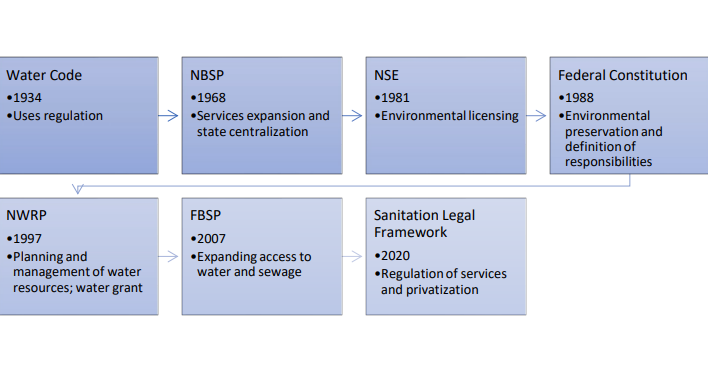
Figure 1
Timeline of the main laws regulating and conserving water and sanitation resources
Prepared by the authors.
3.2 Guiding policies
Environmental impact assessment systems as a tool for water conservation permeate three main environmental policies: NEP, NWRP, and FBSP. These three policies are not directly linked, but they have an intrinsic relationship regarding water. For example, the management of water resources and the provision of sanitation services are not part of the same policy, but they are dependent on each other (GRANGEIRO, 2020). Furthermore, the three policies converge towards the objectives of water resources management, universal access to treated water and sanitation, and sustainable development.
The first of these policies to be created was the NEP, which instituted environmental licensing in Brazil and introduced NEC as a consultative and deliberative body, with competence to establish norms and criteria for the licensing of effectively or potentially polluting activities. This body must also: “establish norms, criteria and standards related to the control and maintenance of the quality of the environment with a view to the rational use of environmental resources, especially water” (BRASIL, 1981, p. Art. 8).
One of the roles that NEC tried to assume in its history was to discipline licensing competences. To this end, NEC Resolution nº 237/1997 was published, which has great importance as a guideline for licensing, but is still questioned in legal terms because it deals with a matter that should have been brought by a Law, a situation that was formally resolved with Complementary Law No. 140, of 2011 (ANTUNES, 2020).
The second environmental policy of great importance for water is the NWRP, from 1997. Complementary to the NEP (ANTUNES, 2020; BRITES, 2010) and as the latter has NEC as its manager and environmental licensing as its execution tool, the NWRP has the one of the managers is the NWRC and as a legal administrative management instrument, the grant. The grant is a classic instrument of command and control that allows the use of water resources (DE SOUZA ABESSA; AMBROZEVICIUS, 2020). In general, the grant is required in a manner linked to the licensing process for activities that use water resources in the form of prior grant and granting of right.
The Law that instituted the NWRP established a water resources management model. It determines that the management of these resources be done in an integrated manner and with broad public participation, following the basic principles proposed by the International Conference on Water and the Environment in 1992 (DE SOUZA ABESSA; AMBROZEVICIUS, 2020). Until the 1980s, the various uses of water resources were made in isolation, without joint planning by the active sectors (TUCCI, 2005).
This law also created the National Water Resources Management System (NWRMS), which includes the NWRC; the Water Resources and Environmental Quality Secretariat; the NWA; the State’s Water Resources Councils; the State Water Resources Management Bodies (State Entities); the River Basin Committees; and Water Agencies. This system was based on the French model that defines the watershed as an administrative unit (KAYSER, 2015).
NWRMS values public participation, providing for the involvement of users and civil society in all the plenary sessions constituted by them, as a way of giving legitimacy to decisions and guaranteeing the implementation of decisions taken (PORTO; PORTO, 2008).
However, in the last two years, Decree 10,000, of September 3, 2019, reduced this participation, causing an emptying of the technical chambers of NEC and NWRC. The decree reduced the participation from 10 to 9 representatives of state councils, the user sector from 12 to 6 and reduced the number of civil society organizations from 6 to 3. It also linked the representation of non-governmental organizations (NGOs) to those that are members of river basin committees under the control of the Union. NEC underwent a similar change with the reduction of 96 directors to 23, through Presidential Decree No. 9,806/2019.
In theory, public participation in management councils broadens the scope of the debate to the interests of Brazilian society, giving legitimacy to public policies and inserting groups traditionally excluded from the debate. However, the debate is not equal, due to the difference in the number of representatives and knowledge gap between some sectors. There is, therefore, a need to balance public participation with theoretical knowledge, providing technical preparation for counsellors (FONSECA et al., 2012).
The emptying of councils is an attempt to reduce public participation and the bureaucracy involved in collegiate decisions, reducing the level of demand on environmental issues that depend on the approval of members, such as granting and licensing issues. It also aims to speed up the processes. But, on the other hand, this reduction can increase the legal uncertainty of decision-making for environmental analysts (NASCIMENTO; FONSECA, 2017; SÁNCHEZ, 2013), especially due to the high collection and judicialization of cases by the Public Ministry, also identified in the literature (WORLD BANK, 2008).
The third guiding policy is the FBSP, 2007, which incorporated guidelines for basic sanitation into the Brazilian legal system, after almost two decades of political-institutional gaps. This policy, unlike the NWRP, did not add a management or planning system for sanitation at different levels (GRANGEIRO, 2020), despite stipulating the adoption of basic sanitation plans at the three federative levels. On the other hand, the law adopted important objectives of universal access to sanitation and treated water.
The issue of lack of planning and management could be improved with new laws. One of the options could have been the New Legal Framework for Sanitation, but this point remains incipient in the new regulation.
The regulation of the FBSP made by Decree nº 7.217/2010 brought an interesting relationship between this policy, the NEP and the NWRP. The Art. 22, which deals with the licensing of sanitation services, determines that NEC and NWRC establish rules for compliance with the Law, respecting their respective powers. This decree also includes, among the objectives of the FBSP, the minimization of environmental impacts.
The policies, to a lesser or greater degree, created an integrated political ordering among their participating bodies. However, there is still little relationship in the administrative scope between them. Even within the Ministry of the Environment, which is responsible for the NEP and NWRP, coordination between policies is not articulated, relying on independent sectoral actions (GRANGEIRO, 2020). Figure 2 shows the relationship between these policies.
Figure 2 – Relationship between policies and their objectives and tools.
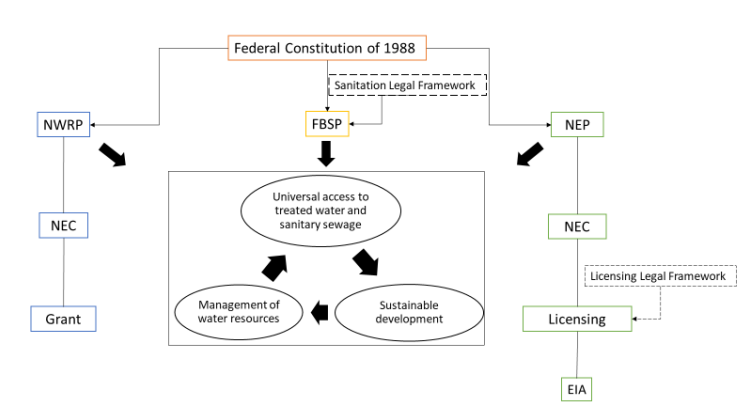
Figure 2
– Relationship between policies and their objectives and tools
Prepared by the authors.
The New Basic Sanitation Framework made some direct changes to the FBSP Law and caused adaptations in the various laws and decrees that regulate this policy and others. As an example, one can cite Decree 7,217/2010 with guidelines for basic sanitation, which establishes rules for the execution of the FBSP Law, and Law 9,984/2010, which created the NWA.
3.3 Specific regulation through resolutions
The specific regulations issued by the NEP and NWRP Councils seek to create formal criteria for the application of policies. It also has the important role of disciplining the adoption of legal instruments for its application, such as: licensing, environmental impact studies and water use grants. In this section these resolutions will be analyzed.
According to Antunes (2020), the range of activities that provide for the granting regime, including public supply and final disposal of liquid waste, will lead to an increase in the control of activities that imply the use of water bodies. The NWRP legislation is still new.
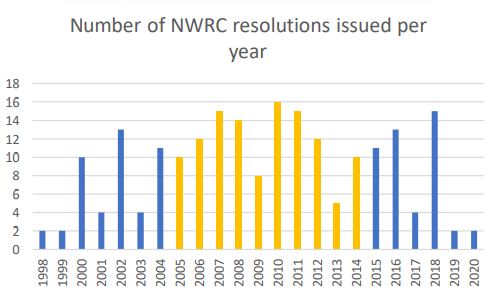
However, some advances in the regulation of the various uses of water resources can be seen, from 1998 to July 2020, the NWRC issued 210 normative resolutions.
The Brazilian Water Decade, established by the unnumbered Decree of March 22, 2005, with the objective of promoting and intensifying the formulation and implementation of policies, programs and projects related to the management and sustainable use of water, played a role in promoting laws and resolutions. One of the arguments that solidifies this statement is found in the data on the issuance of resolutions from the NWRP, which almost doubled the average issuance of resolutions per year between 2005 and 2014 in relation to the previous period (1998 to 2004), jumping from an average of 6.6 to 11.7 as illustrated in Figure 3.
Figur3 3 Number of NWRC resolutions issued per year
Prepared by the authors
The resolutions issued in the first two years of the Council's existence provide for the formation of technical chambers to deal with matters stipulated in the creation law. Specific resolutions for water regulation began to be issued in July 2000, with Resolution No. 12/2000.
The survey carried out among the NEC Resolutions focusing on those concerning the water supply and sanitary sewage systems showed similar data to the NWRC survey regarding the increase in resolutions after 2005, as shown in Figure 4.
Figure 4 Number of NEC Resolutions related to water supply and sanitary sewage
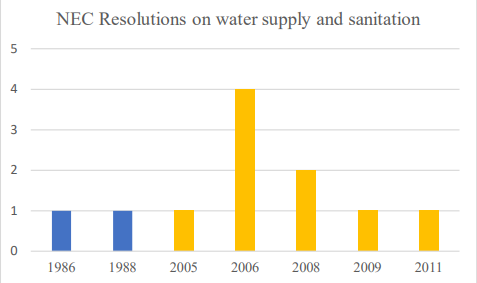
Figure 4
Number of NEC Resolutions related to water supply and sanitary sewage
Prepared by the authors
Eleven resolutions related to the topic of water supply and sanitary sewage were identified in the survey on the Ministry of Environment's website. Table 1 presents a brief description of the menu of these NEC resolutions.
Table 1 - NEC Resolutions that provide for water supply and sanitary sewage systems
| 20/1986 | Revoked | Provides for the classification of fresh, brackish and saline waters in the National Territory. |
| 5/1988 | No express revocation | Provides for the environmental licensing of sanitation works. |
| 357/2005 | No express revocation | Provides for the classification of bodies of water and environmental guidelines for their classification, as well as establishing the conditions and standards for the release of effluents, and other measures. |
| 370/2006 | Purpose fulfilled | Extends the deadline for completing the conditions and standards for the release of effluents, provided for in art. 44 of Resolution No. 357, of March 17, 2005. |
| 375/2006 | No express revocation | Defines criteria and procedures for the agricultural use of sewage sludge generated in sanitary sewage treatment plants and their derived products, and makes other provisions. |
| 377/2006 | No express revocation | Provides for simplified environmental licensing of Sanitary Sewage Systems. |
| 380/2006 | No express revocation | Rectifies NEC Resolution No. 375/06 - Defines criteria and procedures for the agricultural use of sewage sludge generated in sanitary sewage treatment stations and its derived products and makes other provisions. |
| 396/2008 | No express revocation | Provides for the classification and environmental guidelines for the classification of groundwater and other provisions. |
| 397/2008 | No express revocation | Amends item II of § 4 and Table X of § 5, both of art. 34 of NEC Resolution 357, of 2005, which provides for the classification of bodies of water and environmental guidelines for their classification, as well as establishing the conditions and standards for effluent discharge. |
| 410/2009 | No express revocation | Extends the deadline for completing the conditions and standards for the release of effluents, provided for in art. 44 of Resolution NEC No. 357, of March 17, 2005, and in art. 3 of Resolution No. 397, of April 3, 2008. |
| 430/2011 | No express revocation | Provides for the conditions and standards for the release of effluents, complements and amends Resolution No. 357, of March 17, 2005, of the NEC. |
* Information available at
http://www2.mma.gov.br/port/conama/. Accessed on July 2, 2020 Prepared by the authors.
NEC Resolution nº 357/2005 is one of the most important for water conservation, as it organizes the system that serves as a parameter to exercise inspection of water quality control (ANTUNES, 2020) and the standards to be observed in licensing (BRITES, 2010). This resolution establishes the classification of rivers in classes according to their predominant use, aiming to ensure quality compatible with the most demanding uses to which the water is destined (TUCCI, 2005). It also implements a water management tool, since it generates objectives of desired quality of water bodies, not just maintenance of the current situation (DE SOUZA ABESSA; AMBROZEVICIUS, 2020).
In 2006, the NWRC issued Resolution 91/2006, which essentially established criteria for the application of NEC Resolution nº 357/2005 on a decentralized basis in the hydrographic basins, in order to generate articulation between the federative levels. This measure increases the power of practical effectiveness of the Resolution with integrated management as highlighted by Porto and Porto (2008).
NEC Resolution nº 357/2005 was not a pioneer in dealing with the classification of bodies of water. The first classification of water was made by Ordinance No. 13/1976 of the Ministry of the Interior, an agency linked to the former Sema (Special Secretariat for the Environment), today an integral part of the Brazilian Institute for the Environment (Ibama). Subsequently, NEC itself established a new classification with resolution No. 20/1986. NEC Resolutions No. 430/2011 and No. 396/2008 complement Resolution No. 357/2005, with special emphasis on the chapter on effluent discharge standards conditions. Although they deal with the same topic and most of the criteria do not change, there is a successive update and complementation of some criteria.
Resolution No. 396/2008 is similar to Resolution No. 357/2005 in terms of water classification, but specifically deals with groundwater. In relation to effluents, the standard only mentions that the application of effluents and residues in the soil must not confer characteristics that do not comply with the current framework.
Resolutions No. 375/2006 and No. 380/2006 maintain a more punctual relationship with sewage and water supply systems by establishing criteria for monitoring sewage sludge in treatment plants. They constitute an innovation from an environmental point of view in terms of regulation as they offer an alternative destination for waste from sewage treatment plants. However, these resolutions are not directly related to the regulation of water supply and sewage systems like the others mentioned in Table 1.
Resolution No. 377/2006 deals with simplified licensing of sanitary sewage systems. The standard does not mention mandatory environmental impact assessment for simplified licensing, requiring only preliminary information on the basic characteristics of the project and the affected environment. The licensing agency may require more information, but there is no obligation to present the impact assessment and related information to support decision-making and environmental management. Public participation in the decision-making process is also not mentioned.
Gaspar et al. (2020) analyzed simplified impact assessment procedures in the state of São Paulo, based on a case study of a dam. The results show that the studies presented in this licensing were highly deficient, the licensing process was not speeded up, which lasted more than ten years, and the decision support functions were not fulfilled. Only the description of environmental management was better than the other items analyzed, although unsatisfactory.
This diagnosis was also observed in other places in Brazil and for other project typologies (KIRCHHOFF et al., 2007; OLIVEIRA, 2016). Internationally, this diagnosis was verified in locations where simplified procedures are performed for different projects, in attempts to privilege the rapid execution of the licensing practice (GASPAR et al., 2020).
There is no NEC resolution specifically dealing with simplified environmental licensing of water supply systems. However, Resolution No. 005/1988 deals in general terms with the licensing of supply systems, as well as with non-simplified procedures for sewage systems. This resolution does not specify procedural issues, it only delegates the decision-making function of the process to the licensing body. It is provided that the licensing procedures will be determined by licensing bodies and that the license will only be required after these procedures and criteria have been determined.
Law 11,445/2007, which provided guidelines for the FBSP, determined that licensing authorities should establish simplified procedures for sanitation activities referred to in the same law. Previously, there was already a provision for licensing for works to explore water resources and sanitary sewage in NEC Resolution No. 001/1986 and this provision was ratified in Resolution No. 237/1997.
To complement the data on environmental licensing, a general survey of resolutions dealing with licensing and EIS was carried out, identifying 84 resolutions. Of these, 71 deal with specific licensing and only 13 with general licensing rules, as shown in Figure 5.
Figure 5 NEC resolutions on environmental licensing issued by year.
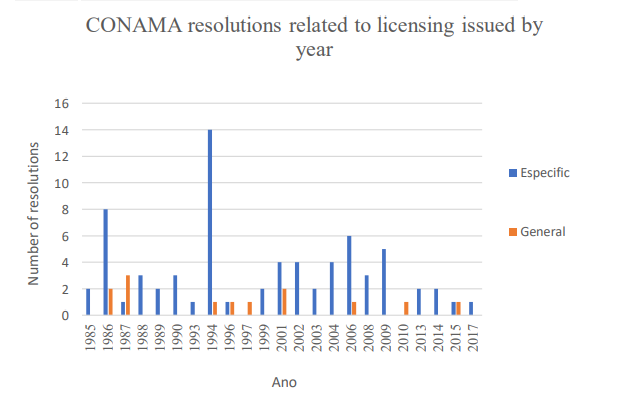
Figure 5
NEC resolutions on environmental licensing issued by year
Prepared by the authors.
The analysis of NEC resolutions shows that there is an evolution in terms of specifications and clarity in the provisions. The first ones, for the most part, had to be revoked or amended by subsequent resolutions due to the need to improve environmental control and provide better guidelines on the subject or, in a few cases, due to changes in current laws.
The most recent resolutions have required document content specifications, including proposed terms of reference. The types of licenses that can be granted are also varied, expanding the scope beyond the traditional prior licenses (LP), installation licenses (LI) and operating licenses (LO). There is also an increase in the frequency of publication of concepts in resolutions, not always identical to those published in laws and decrees, but in general they are close.
In addition to general resolutions that sought to divide powers, resolutions on specific subjects open up opportunities for legislative freedom attributed to states and municipalities. In this way, the licensing bodies of these spheres are responsible, in several cases, of determining when a licensing object can or cannot go through a simplified procedure.
Since the end of 2018, there has been a drop in the number of new resolutions issued by the NWRC, only two in 2019 and two in 2020, while NEC issued only one in 2019 and none until July 2020. The likely reason for this lack of new resolutions is the emptying of technical chambers by means of a decree in 2019, which profoundly changed the way in which councils work and reduced public participation in decisions, contrary to international recommendations for popular involvement in decision-making (ILO, 1989).
3.4 General bill for environmental licensing
Several authors have highlighted the political and business pressure to review and simplify environmental legislation and the licensing process (BRAGAGNOLO, 2017; FONSECA; RODRIGUES, 2017). In addition to these pressures, the operators of impact assessment systems themselves agree on the need to review existing legislation. One of the ways discussed to review this legislation and centralize the main federal laws and decrees is the creation of a legal framework for licensing.
A bill of this magnitude could unify part of the main laws that exist and regularize several points of divergence. But, at the same time, it could increase legislative centralization on the issue, in order to counteract the decentralization movement that has taken place in recent years, especially with NEC Resolution No. 237/97 and Complementary Law No. 140/2011.
In 2019, under a political context and pressure to change the current licensing laws, PL nº 3.729/2004 was once again discussed in the Chamber of Deputies, which seeks to reduce the problem of lack of legal and administrative discipline in environmental licensing and to speed up to the processes, resolving the problems caused by the amplitude of the system's order. However, this bill has been harshly criticized by the technical and academic areas, especially for relaxing the technical requirements in order to speed up and simplify the process and for reducing the participation of government entities, such as the National Indian Foundation, in the decision-making process (BRAGAGNOLO, 2017). This last criticism is of particular concern, as the need to include more the population, especially indigenous and tribal communities, in decision-making processes is internationally recognized (ILO, 1989; HANNA et al., 2014).
PL nº 3.729/2004 has a broad scope, as it received the addition of another 23 bills formulated between 2004 and 2017 and won five substitutes between June 2019 and May 2021, when it was sent to the Senate. The proposal has as a menu: “Provides for environmental licensing, regulates item IV of § 1 of art. 225 of the Federal Constitution, and other provisions.” (BRASIL, 2004)
The current PL is different from the first proposed in 2004. In 2019, when it was discussed again in the Chamber of Deputies, the project's rapporteur delivered a substitute that was the subject of controversy. There was then a high rejection of society that motivated the writing of a Technical Note, in which a part of the specialist academic community evaluated the new proposition of the law (FONSECA et al., 2019).
The negative reception of the proposal led to five more substitutes. The main basic and controversial aspects (ARAÚJO; FELDMANN, 2021) of these six propositions have the potential to influence the impact assessment and regulation of water supply and sewage projects.
The first substitute proposed by the rapporteur, of June 11, 2019, brought a controversial point in relation to water supply and sanitary sewage projects, inserting the following provision in article 7.
Art. 7 The following activities or undertakings are not subject to environmental licensing: VI - facilities necessary for the public supply of drinking water, from the capture to the building connections and respective measuring instruments and the operational installations for the collection, transport and treatment of sanitary sewage, without prejudice to the licensing of the final destination of waste from the processes of water and sewage treatment.
This article was not based on any scientific evidence (FONSECA; SANCHEZ et al., 2019) and was one of the first to be widely criticized. In addition, it separates the treatment of wastewater into two parts, the construction of the appliances and the disposal of waste, as if the service and the tailings were not closely linked, mainly in the environmental management of the processes.
The PL also confuses concepts of environmental studies and EIA, in addition to invading legal competences already disciplined and determined by LC 140/2010. One of these competences concerns “installations necessary for the public supply of drinking water, from the capture to the building connections” and “operational installations for the collection, transport and treatment of sewage”. No Art. 8, it is established that for these activities, in cases of municipal or district licensing, the issuance of urban and environmental licenses must be integrated, ignoring that municipalities and the Federal District are free to define their own procedures.
In section 2, which deals with procedures, the possible types of licensing are inserted, divided into three-phase, which include the LP, LI and LO phases, and simplified. The section is unclear and does not address a large number of possibilities for procedures currently adopted in Brazil. A point that may be of concern in this section is the lack of clarity regarding the link between environmental licensing and impact assessment (FONSECA; SANCHEZ et al., 2019), especially for simplified licensing regarding water supply and sewage systems.
Among its internationally recognized objectives, EIA has that of promoting sustainable development and optimizing the use and management opportunities of resources (SÁNCHEZ, 2013; IAIA, 1999). Some studies on the subject show that this instrument applied in licensing still presents difficulties in its adoption for decision-making at the planning level in Brazil (MONTAÑO; DE SOUZA, 2015). When especially considering water resources, which require extensive environmental management, this lack of linkage and lack of clarity can undermine a great opportunity to expand this instrument as a planning tool.
In the second version of the substitute, dated July 2, 2019, the item that established that water supply and sewage systems should not be subject to environmental licensing was removed. In this way, the substitute would not change the model in which the licensing of water supply and sewage projects is currently carried out.
In the July 18 and August 8 versions, the text gained a specific article on basic sanitation activities or undertakings. This article mentions the provisions of the Federal Basic Sanitation Policy Directives Law. It is stated that the licensing authority must ensure a simplified licensing procedure and priority in the analysis of these activities and undertakings. It also adds that the EIS requirement should only occur in exceptional and duly justified situations, but without specifying what exceptional situations.
In addition to bringing together the main federal legislation on the subject, creating a legal framework, few collaborations are being adopted in the Law in order to generate improvements or solve problems already identified in the licensing systems (FONSECA et al., 2019). Several general problems are still identified in the text. The technical note issued by the EIA specialists mentions the persistence of the following problems in the proposed Law (SÁNCHEZ et al., 2019, p. 23):
(1) restriction of the application of the environmental impact study; (2) inconsistency in guidelines for preparing terms of reference; (3) weaknesses in the presentation of forms of public participation; (4) mention of strategic environmental assessment without basic elements to guide its application; (5) lack of clarity and empirical basis for consideration of locational criteria in the participation of involved authorities; (6) excessive mechanisms in prioritizing projects for environmental licensing; and (7) disregard of the capacity of licensing authorities to implement the law. Serious conceptual contradictions also persist.
The fourth substitute of the Law, of August 13, 2019, was drafted by other deputies in an attempt to apply the suggestions of the technical note. It is difficult to say that the attempt could be effective in the case of approval of the law with this text, given that part of the problems identified is more of an administrative nature than a legislative issue. Several studies on the subject of EIA and licensing could be used to suggest improvements in the Chamber's base text and expand the planning aspect that EIA should have in licensing (MONTAÑO; DE SOUZA, 2015).
Little change regarding the water supply and sanitary sewage systems can also be seen in this substitutive room. But there is an innovative point in this proposition in relation to the previous ones: the manifestation of the authorities involved starts to link the final decision regarding the environmental license, which gives a more active power to the bodies that represent communities affected by the projects.
The fifth and last substitute, which was approved in May 2020 in the Chamber of Deputies, goes back to the points related to water supply and sewage systems that were overcome in the second substitute of 2019. In this fifth substitute, the mandatory licensing of systems and water and sewage treatment plants. In this way, the proposed law goes against the findings regarding the path of strengthening the legal structure of water conservation (GRANGEIRO, 2020) and licensing procedures over time (SÁNCHEZ, 2013) and dispenses with a range of resolutions and documents legal provisions that support the execution of licensing and granting of water resources for the release of effluents.
The considerations regarding public participation made in the previous substitute that linked the decision of the authorities involved to the decision of the licensing body were also removed. The bill also defined in which cases these authorities would have to speak up and ended up excluding communities at risk of vulnerability, such as groups in indigenous lands in the process of demarcation.
In general terms, the analysis of the proposed law confirms the findings of Fonseca et al. (2017). The proposed laws continue to focus on the perceived problems of low effectiveness and delay in issuing licenses and adopting as solution proposals not based on the literature regarding the practice of EIA. In particular, the proposals seek to simplify licensing processes, which can further affect the quality of decision-making (GASPAR et al. 2020). The proposal approved in the Chamber of Deputies, which went on for approval by the Senate, may still cause environmental damage by determining the non-enforceability of licensing for water and sewage treatment systems and plants, removing two important tools for the protection of water bodies. . In general terms, the long-term outcome of these proposals remains uncertain, given that the bills do not present solutions to some of the main problems identified in the literature, such as the low technical and financial capacity of municipal licensing agencies.
There is a need for a government interest in strengthening the institutions that participate in the licensing, especially the municipal ones (NASCIMENTO; FONSECA, 2017), which in the case of water supply and sewage systems are the most active. This interest should be demonstrated more in the executive than in the legislative sphere, through the reinforcement of administrative issues and investment in institutions that have undergone a significant increase in work with the decentralization of responsibilities in recent years, as demonstrated in several studies (NASCIMENTO et al., 2020).
Finally, it is worth mentioning here one of the conclusions of the World Bank report on the licensing of hydroelectric plants in 2008: “A possible reform of the Brazilian environmental licensing system cannot be approached based on a single and simple solution, given that this is a complex and multifaceted system, with a long legal and institutional history” (WORLD BANK, 2008, p. 12).
4. Final considerations
Brazil has a broad legal scope in environmental matters and regulation of water resources applicable to decision-making in environmental sanitation projects. However, some deficiencies are highlighted in the literature in the application of legislation, such as: limitations on public participation in decisions that affect the environment and more vulnerable populations, lack of clarity regarding the competences of entities and licensing bodies, delay in issuing licenses, low quality and effectiveness of impact assessments and informed decisionmaking, among others. The proposed environmental licensing law could be a vehicle to overcome these limitations. But, if approved without adequately addressing the solutions to these problems, it could cause more harm than possible benefits.
The temporal analysis of the laws that are related to the EIA process of these sanitation systems revealed a recent increase in the complexity of regulatory apparatus, evaluation criteria and environmental control tools. Since its creation, 210 resolutions issued by the NWRC were identified, while NEC issued 11 specific resolutions on sanitary sewage and water supply systems and 84 resolutions on licensing.
These NEC and NWRC resolutions have shown an increase in maturity to deal with issues such as: deliberation on projects that generate impacts, regulation of the categories of classification of water bodies, establishment of guidelines for granting and charging for the use of water resources, establishment of procedures for licensing and requirement of specific documents for different types of projects. Such questions are fundamental to organize environmental systems and provide guidelines for licensing potentially degrading projects. In this way, the new draft law could dialogue with these resolutions, strengthening the regulatory framework that already exists. But this is not what is observed in the fifth and most recent proposition of a substitute for the general licensing law.
If we also consider the context of the approval of the new Law of the Legal Framework for Sanitation, two of the environmental sanitation systems – water supply and sanitary sewage – may experience an increase in the number of projects in the coming years, as well as the environmental impacts resulting from these initiatives. Removing these typologies from the list of environmental licensing without technical basis, as provided for in the most recent substitute, represents a serious risk to the environment.
The evaluation of proposals and substitutes for the licensing law reinforces the perception indicated in the literature that there is a tendency to seek changes that speed up licensing processes, making procedures and requirements more flexible. In some parts, the licensing law proposals focus on simplifying the procedures of sanitation activities, which also occurs in the FBSP Law. These activities are of interest to the whole of society and there is always a cry from various stakeholders for their licensing to be expedited. However, attention should be paid to the establishment of minimum criteria so as not to generalize simplification, leading to the relaxation of requirements for studies and presentation of documents for decision making. In the case of the proposal sent to the Federal Senate, the threat of loosening requirements goes beyond simplification, with the possibility of exclusion from the licensing of sanitation projects, representing a risk of damage to the environment.
The new licensing framework is an opportunity to discuss the articulations of environmental policies, as in the case studied of sanitation systems, but any proposed change to the existing framework must be based on a review of the literature, application experiences and good practices. It is recommended that future research discuss mechanisms foreseen in the EIA process itself, which allow accelerating the environmental licensing processes for water supply and sanitary sewage systems, without culminating in performance losses of the impact assessment systems.
It is also recommended, for new research, that the performance of the control bodies and those implementing sanitation policies be explored and that interviews be carried out with specialists, analysts, entrepreneurs, non-governmental organizations and civil society. In this way, expectations, and the most relevant aspects of eventual changes in legislation dealing with environmental sanitation can be raised.
Bibliography
BRASIL. Lei nº 11.445, de 5 de janeiro de 2007. Dispõe sobre as diretrizes nacionais para o saneamento básico; cria o Comitê Interministerial de Saneamento Básico, Brasília, 2007. Disponível em: http://www.planalto.gov.br/ccivil_03/_ato2007-2010/2007/lei/l11445.htm. Acesso em: 20 jun. 2020.
BRASIL. Constituição (1988). Constituição da República Federativa do Brasil, de 5 de outubro de 1988, Brasília, 2020. Disponível em: http://www.planalto.gov.br/ccivil_03/constituicao/constituicao.htm. Acesso em: 2 jul. 2020.
BRITES, A. P. Z. Enquadramento dos Corpos de Água Através de Metas Progressivas: Probabilidade de Ocorrência e Custos de Despoluição Hídrica. Tese (Doutorado em Engenharia) - USP, São Paulo, 2010. Disponível em: https://doi.org/10.11606/T.3.2011.tde19012011-100828.
DE SOUZA ABESSA, D. M.; AMBROZEVICIUS, A. P. Government initiative and policies on water conservation and wastewater treatment in Brazil, p. 215-231, 2020. DOI: https://doi.org/10.1016/B978-0-12-818339-7.00010-2.
FONSECA, A. et al. Nota Técnica - Projeto de Lei Geral do Licenciamento Ambiental: análise crítica e propositiva do projeto de lei à luz das boas práticas internacionais e da literatura científica, 2019. Disponível em: https://www2.camara.leg.br/atividadelegislativa/comissoes/grupos-de-trabalho/56a-legislatura/licenciamentoambiental/documentos/manifestacoes-recebidas/2019.08.02%20-%20ABAI%20-%20Nota%20Tecnica%20II.pdf. Acesso em: 8 jul. 2020.
FONSECA, A.; RODRIGUES, S. E. The attractive concept of simplicity in environmental impact assessment: Perceptions of outcomes in southeastern Brazil. Environmental Impact Assessment Review, v. 67, p. 101-107, 2017. DOI: https://doi.org/10.1016/j.eiar.2017.09.001.
FONSECA, A.; SÁNCHEZ, L. E.; RIBEIRO, J. C. J. Reforming EIA systems: A critical review of proposals in Brazil. Environmental Impact Assessment Review, v. 62, p. 90-97, 2017. DOI: https://doi.org/10.1016/j.eiar.2016.10.002.
FONSECA, I. F. D.; BURSZTYN, M.; MOURA, A. M. M. D. Conhecimentos técnicos, políticas públicas e participação: o caso do Conselho Nacional do Meio Ambiente (Conama). Revista de Sociologia e Política, v. 20, n. 42, p. 183-198, 2012. DOI: https://doi.org/10.1590/S0104-44782012000200013.
GASPAR, C.; SANTOS, S. M. D.; SOUZA, M. M. P. D. Boas práticas em estudos ambientais para processos simplificados de avaliação de impacto ambiental. Desenvolvimento e Meio Ambiente, v. 53, p. 227-249, 2020. DOI: http://dx.doi.org/10.5380/dma.v53i0.62244.
GRANGEIRO, E. L. D. A. Integração de políticas públicas no Brasil: o caso dos setores de recursos hídricos, urbano e saneamento. Cadernos Metrópole, São Paulo, v. 22, n. 48, p. 417-434, 2020. DOI: https://doi.org/10.1590/2236-9996.2020-4804.
HANNA, P. et al. Improving the effectiveness of impact assessment pertaining to Indigenous peoples in the Brazilian environmental licensing procedure. Environmental Impact Assessment Review, v. 46, p. 58-67, 2014.
IAIA, I. A. F. I. A. Principles of Environmental Impact Assessment Best Practices, Fargo, 1999. Disponível em: https://www.iaia.org/best-practice.php. Acesso em: 12 jul. 2020.
KIRCHHOFF, D. et al. Limitations and drawbacks of using Preliminary Environmental Reports (PERs) as an input to Environmental Licensing in São Paulo State: a case study on natural gas pipeline routing. Environmental Impact Assessement Review, v. 27, n. 4, p. 301-318, 2007. DOI https://doi.org/10.1016/j.eiar.2006.11.003
MELLO, M. F. D. Privatização do setor de saneamento no Brasil: quatro experiências e muitas lições. Economia Aplicada, v. 9, n. 3, p. 495-517, 2005. DOI: https://doi.org/10.1590/S1413-80502005000300009
MONTAÑO, M.; DE SOUZA, M. P. Impact assessment research in Brazil: achievements, gaps and future directions. Journal of Environmental Assessment Policy and Management, v. 17, p. 1550009-1, 2015. DOI: https://doi.org/10.1142/S146433321550009X
MURTHA, N. A.; CASTRO, J. E.; HELLER, L. Uma perspectiva histórica das primeiras políticas públicas de saneamento e de recursos hídricos no Brasil. Ambiente & Sociedade, v. 18, n. 3, p. 193-210, 2015. DOI: https://doi.org/10.1590/1809-4422ASOC1047V1832015
NASCIMENTO, T.; ABREU, E. L.; FONSECA, A. Descentralização do Licenciamento e da Avaliação de Impacto Ambiental no Brasil: Regulação e Estudos Empíricos. Ambiente & Sociedade, São Paulo, v. 23, 2020. ISSN 1809-4422. DOI https://doi.org/10.1590/1809- 4422asoc20180266r2vu2020l1ao
NASCIMENTO, T.; FONSECA, A. A descentralização do licenciamento ambiental na percepção de partes interessadas de 84 municípios brasileiros. Desenvolvimento e Meio Ambiente, v. 43, 2017. DOI http://dx.doi.org/10.5380/dma.v43i0.54177
OIT, O. I. D. T. Convenção 169 da OIT sobre povos indígenas e tribais, Genebra, 7 junho 1989. Disponivel em: https://www.ilo.org/brasilia/convencoes/WCMS_236247/lang-- pt/index.htm. Acesso em: 28 jun. 2020.
OLIVEIRA, F. S. D. . P. F. J. F. . R. C. F. F. Licenciamento ambiental simplificado na região sudestes brasileira: conceitos, procedimentos e implicações. Desenvolvimento e Meio Ambiente, v. 38, p. 461-479, 2016. DOI http://dx.doi.org/10.5380/dma.v38i0.42297
OLIVEIRA, J. L. D. M.; et al.. Os desafios do saneamento como promoção da saúde da população brasileira. Saúde em Debate, Rio de Janeiro, V. 43, n. spe 3, p. 4-7, 2019. DOI https://doi.org/10.1590/0103-11042019S300.
PORTO, M. F. A.; PORTO, R. L. L. Gestão de bacias hidrográficas. Estudos avançados, v. 22, n. 63, p. 43-60, 2008. DOI https://doi.org/10.1590/S0103-40142008000200004
RAVENA, N. Trajetórias Virtuosas na Regulação da Água no Brasil: os Pressupostos Inovadores do Código da Águas. Papers do NAEA, Belém v. 17, n. 1, p. 1-16 , 2008. DOI: http://dx.doi.org/10.18542/papersnaea.v17i1.11431
ROSSONI, H. A. V. et al. Aspectos socioeconômicos e de desenvolvimento humano municipal determinantes na ausência de prestadores de serviços de esgotamento sanitário no Brasil. Engenharia Sanitaria e Ambiental, v. 25, n. 2, p. 393-402, 2020. DOI https://doi.org/10.1590/s1413-41522020183887
RUARO, R.; FERRANTE, L.; FEARNSIDE, P. M. Brazil's doomed environmental licensing. Science, 372, n. 6546,p. 1049-1050, 2021.
SÁNCHEZ, L. E. Development os Environmental Impact Assessment inBrazil. UVP Report, v. 27, p. 193-200, 2013.
SÁNCHEZ, L. E. Por que não avança a avaliação ambiental estratégica no Brasil? Estudos Avançados, 31, n. 89,p.167-183, 2017.
SÁNCHEZ, L. E.; FONSECA, A.; MONTAÑO, M. Nota Técnica - Proposta de Lei Geral do Licenciamento Ambiental: análise crítica e propositiva da terceira versão do projeto à luz das boas práticas internacionais e da literatura científica. School of Environment, Resources and Sustainability/University of Waterloo, Waaterloo (Canadá), 2019. Disponivel em: https://www2.camara.leg.br/atividade-legislativa/comissoes/grupos-de-trabalho/56alegislatura/licenciamento-ambiental/documentos/manifestacoes-recebidas/2019-08-02-abainota-tecnica-3a-versao. Acesso em: 02 dez. 2020.
SOUSA, A. C. A. D. O que esperar do novo marco do saneamento. Cadernos de Saúde Pública, 36, n. 12,, e00224020, 2020.
SOUSA, A. C. A. D.; COSTA, N. D. R. Política de saneamento básico no Brasil: discussão de uma trajetória. História, Ciências, Saúde- Manguinhos, Rio de Janeiro, v. 23, n. 3, p. 615- 634, 2016. DOI http://dx.doi.org/10.1590/S0104-59702016000300002
TAMBELLINI, A. T. Environmental Licensing in Brazil-an emerging country and power. Ciencia & saude coletiva, v. 17, n. 6, p. 1399-1403, 2012. DOI 10.1590/S1413- 81232012000600003
TUCCI, C. E. M. Desenvolvimento institucional dos recursos hídricos no Brasil. Revista de Gestão de Água da América Latina (REGA), v. 2, n. 2, p. 81-93, 2005.
TURCO, L. E. G.; GALLARDO, A. L. C. F. Avaliação de Impacto Ambiental e Avaliação Ambiental Estratégica: há evidências de tiering no planejamento de transportes paulista? Gestão & Regionalidade, 34, n. 101, 2018.
WORLD BANK. Environmental Licensing for Hydroelectric Projects in Brazil : A Contribution to the Debate. Relatório Síntese, Washington, DC, 2008. Disponivel em: https://openknowledge.worldbank.org/handle/10986/7854. Acesso em: 12 jun. 2020.