Abstract: This article analyzes the public policies to promote the Local Productive and Innovative Arrangement and System - ASPIL of colored cotton artifacts and confections from Paraíba, from the scalar perspective of development. Therefore, a survey was designed using a field, with application of semi-structured interviews and questionnaires in data collection, in addition to a literature review. In line with the specialized literature, we sought to identify how the Aspil subsystems in question are constituted, mapping the actors and functioning of the system and the Aspil arrangement under analysis; in order to define the macro scale (Brazil, Spain and Paris), meso (Northeast) and micro (Paraíba). It was found that the ASPIL analyzed here developed from the strategies of local public bodies. However, after 2010, the lack of public policies to support the arrangement culminated in the expansion of barriers. Even so, the companies in the arrangement have stood out in the international fashion scene, due to their partnerships with macro scale actors. On the other hand, since 2016, a public policy has been structured with a multi-scale vision of fostering arrangements, as it is understood that the analysis based on scales provides guidance for development policies
Keywords: ASPIL, public policy, scales.
Resumo: Este artigo analisa as políticas públicas de fomento do Arranjo e Sistema Produtivo e Inovativo Local - ASPIL de artefatos e confecções de algodão colorido da Paraíba, a partir da perspectiva escalar do desenvolvimento. Para tanto, foi traçada uma pesquisa usando um campo, com aplicação de entrevistas semiestruturas e questionários na coleta de dados, além de revisão da literatura. Em congruência com a literatura especializada, buscou-se identificar como se constitui os subsistemas do Aspil em questão, mapeando os atores e funcionamento do sistema e do arranjo do Aspil em análise; de modo a definir a escala macro (Brasil, Espanha e Paris), meso (Nordeste) e micro (Paraíba). Verificou-se que o ASPIL aqui analisado se desenvolveu a partir de estratégias de órgãos públicos locais. Contudo, depois de 2010, a falta de políticas públicas de apoio ao arranjo culminou no alargamento de entraves. Mesmo assim, as empresas do arranjo têm se destacado no cenário da moda internacional, devido às parcerias com os atores da escala macro. Por outro lado, desde 2016, tem sido estruturada uma política pública com visão multi-escalar de fomento aos arranjos, por se entender que a análise a partir das escalas proporcionam a orientação das políticas de desenvolvimento.
Palavras-chave: ASPIL, políticas públicas, escalas.
Artigos
Scalar analysis of the development of public policies for the Arrangement and Productive and Innovative Local System - Aspil
Universidade Municipal de São Caetano do Sul
Recepción: 27 Enero 2021
Aprobación: 27 Junio 2022
The state of Paraiba began to stand out in the early 2000s, in the national scope of the sustainable textile segment, as a producer of naturally colored cotton. This fact was the result of two scenarios: I– the research developed by the Brazilian Agricultural Research Corporation (Embrapa) – Cotton to strengthen the resistance of naturally colored fiber; and, II– use of colored cotton as a raw material in clothing in the state of Paraiba, encouraged by the Union of the Clothing Industry of Paraiba (SINDIVEST).
Due to a boll weevil (Anthonomus grandis) cotton pest in the 1980s, and therefore with the dismantling of white cotton production in the state of Paraiba, which was of fundamental importance for the state's economy3 , Embrapa was driven by Japanese textile entrepreneurs, to start research with colored cotton, in the search for strengthening the fiber for its use in the machinery of the textile industry. Businessmen visited Embrapa in the city of Campina Grande, state of Paraiba, in 1989, and stimulated the search for new colored cotton varieties. They showed interest in acquiring naturally colored cotton for making clothes for newborns and people with allergies. The local clothing sector was also shaken by the growing competition from textiles from the state of Pernambuco and with the country's trade opening, and therefore, with the strong competition from Chinese products.
According to this reality, following the interviews and the literature analyzed for the study in question, between the 1990s and the year 2000, Embrapa researchers developed research to strengthen the fiber, in order to make it suitable for use in the textile, since it is known that naturally colored cotton was already present in nature, but was passed over to white, due to the characteristics of its fiber; that is, since the Industrial Revolution, white cotton has been used because it is more suitable for machines in the Textile Industry4 . Thereby, in 2000, the first naturally colored cotton cultivar was launched: BRS 200. Therefore, SINDIVEST found in the use of naturally colored cotton in the clothing of its associates, a competitive differential to present at the National Textile Industry Fair (FENIT) in the year 2000.
Currently, the discussion about the production chain of colored cotton in Paraiba, also includes the Arrangement and Local Productive and Innovative System (ASPIL). That is, we seek to understand the entire context in which production and innovation occur. Therefore, as conceptualized by Cavalcanti Filho et al. (2008), ASPIL's refer to sets of economic, social and political actors that, in a given common territory, interact, formally or informally, around a central productive activity or a set of activities, in order to obtain economic gains. As Cavalcanti Filho (2012) explains, a local productive and innovative system can present several APLs articulated to the system, in a relationship of systemic dependence between the 'center' (the system) and its 'periphery' (the arrangement).
ASPILs have been presented as an instrument to promote local/regional development, as they promote the generation of employment and local income; and, with the articulations and partnerships between the actors, it can culminate in the competitive insertion of the locality in the global scenario. To this end, authors such as: Cavalcanti Filho et al. (2008), Barroso and Soares (2009), Cavalcanti Filho (2012), Gondin (2011), Guimarães (2013), Abrantes (2014); discuss the elaboration of Public Policies to support ASPILs.
Locally, since 2016, the government of the state of Paraíba, together with the Federal University of Paraiba, has been developing a strategic planning project for the economic development of local productive and innovative arrangements in Paraiba: the Economic, Social and Sustainable Development Plan for the Local Productive Arrangements of Paraiba (PLADES). An attempt to build a State project, under the perspective of multi-scale development, to reduce obstacles in the arrangements of Paraiba, and thus, promote local development through them.
Presuposing that the scales generate data both for the actors to evaluate their practices, as well as for the orientation of development policies; the objective of the study in question is to investigate the existence/conduction of public policies aimed at promoting ASPIL of artifacts and colored cotton confections from Paraiba, with a view to overcoming obstacles to the process, from the perspective of scalar analysis of development.
Adjusting the multiscale view of development to the analytical category ASPIL, it was defined in this study that the macro scale refers to the spaces where the actors of the productive and innovative local system of artifacts and clothing made of naturally colored cotton are found, namely: Brazil, Spain and Paris. On the other hand, the micro-regional scale refers to the state of Paraiba, where the core of actors in the production arrangement of artifacts and production of naturally colored cotton in Paraiba is found. Finally, the mesoregional scale is understood here as the space (gap) between what was classified as micro and macro. Therefore, in geographic terms, the Northeast region was considered as part of the ASPIL meso scale under analysis.
Previously, we explain that some studies may bring other classifications about the macro, meso and micro scales, refering their objects of study. For instance, Alcantara and Kneib (2018), working with the multiscale view of Urbanism, consider the macro scale, at the city level; the meso scale would be the neighborhood; and the micro scale consisted of the urban landscape. On the other hand, in the legal aspect, the National Policy for Regional Development (PNDR), instituted by Decree law n. 6047 of 02/22/2007 (Revoked by Decree No. 9810 of May 30, 2019) considers the following scales: macro-regional, which consists of the geographic space of large Brazilian regions, with priority for the North, Northeast and Midwest; and the sub-regional scale, which refers to the territorial cut in priority areas of the PNDR5 .
The expression Local Productive Arrangement appears in the 1990s, within the scope of the study group Network of Studies in Local Innovative Productive Systems – REDESIST, at the Federal University of Rio de Janeiro (UFRJ). Although, the literature also recognizes that Alfred Marshall, at the end of the 19th century, already mentions the productive activities clustered by small and medium-sized economic actors. Nevertheless, such clusters did not receive much attention from specialists, at least while the Fordist Accumulation Regime was predominant, when the reference production model, synonymous of competitiveness, was formed by large vertically integrated industrial complexes (COSTA, 2010).
In spite of that, with the change in the production paradigm and the emergence of the flexible accumulation model, interest in small productive spaces emerges and, in the academic sphere, theorists emerge with an emphasis on territories and agglomerations between companies. The ASPIL concept derives from the analytical category: National Innovation System (SNI), as explained by Albuquerque (1996). According to this theoretical perspective, technical progress is the result of the interaction of the agents involved, which can be: firms, a set of partner companies, universities, government agencies and research institutes. For that reason, the SNI is based on the systemic view of the innovative process, since the interaction of agents is essential for technical progress to occur, considering that, individually, they do not have all the knowledge for innovative development (ALBUQUERQUE, 1996; SAMPAIO, 2011).
The notion of Local Innovative Productive Arrangements and Systems brings with it the systemic view, since the focus of the analysis resides in the identification and analysis of the existing links of interaction, cooperation/conflicts and learning directed to the introduction of new products and processes (CAVALCANTI FILHO, 2012). When studying about an ASPIL, most of the time, it is necessary to carry out a field research to not only understand the existing links, but, firstly, to identify the agents that make up the structure and identify the space of action (location).
Szapiro et al. (2017, p.77-78) state that, according to the Redesist methodology, it is necessary to design the arrangement and/or productive and innovative local system, which must present the productive, service and marketing activities of the arrangement and the actors, local or external, that play the role of coordinating activities. They also say that the “[...] Special focus is placed on activities and agents that generate and diffuse knowledge and innovations” (SZAPIRO et al., 2017, p.78).
Amaral Filho (2011, p.178) elucidates that: “When studying a productive system, the main concern is to seek to identify the types of agents involved, their behavioral patterns, and to understand the laws and properties that constitute this system”.
ASPILs actors are divided into the following classes: I) Producer, commercial, technical, technological and scientific service providers; II) companies in the Financial System; III) workers; IV) end users; V) support, promotion and financing organizations, cooperatives, associations and unions; and, V) governments (Local/Municipal, State/Regional and National/Multilateral/Global).
Cavalcanti Filho (2012, p.14) underlines that: “Being formed by actors that are diverse in their nature, functions and hierarchical position [...] but that present systemic regularity and coherence, ASPILs must be constituted by subsystems, at different scales.” According to Amaral Filho (2011, p. 174): “Once articulated, the set elements, actors, links and location form the image of a hologram, understood here as a localized system of production, in which the 'productive arrangement' becomes its operating regime”.
Though it is essencial to differenciate the productive arrangement from the local productive and innovative system. In accordance to Cavalcanti Filho (2012), the system is formed by 12 dimensions, divided into three subsystems: cultural, political and economic. Hence, the cultural subsystem has three dimensions, namely: population, history and territory. In the political subsystem the dimensions are analyzed: work, property and power. Ultimatelly, in the economic subsystem, there are six dimensions, grouped into three mechanisms: the wealth generation mechanism, which circumscribes the production and innovation dimensions; the appropriability mechanism, which involves the consumption and investment dimensions; and the mechanism of circulation and acceleration of wealth, which includes the financing and commercialization dimensions (CAVALCANTI FILHO, 2012).
Consequently, it is required to shape the structures of the three subsystems. Hereafter, it is possible to observe which actors are present in the productive system, but who are not part of the arrangement, and how these connection relationships with the arrangement occur. The absence of one of the dimensions, in the territory, results in an arrangement that will be linked to the system through this dimension. To iluminate, if in the territory of the APL there is no innovation dimension, but rather, they depend on actors from outside that territory to fill the gap, such actors are the members of the productive system, while the arrangement is linked to the system through the innovation dimension.
A major impasse is the definition of the territory of the arrangement and that of the system, particularly to identify the external/internal borders of the domain of the political, economic and cultural structure. According to Amaral Filho (2011, p.183) explanation, the location of the system “is one of the most difficult tasks faced by researchers who deal with localized production systems”. This difficulty is linked to the assumptions of the National Innovation System, specially given to the systemic character, when talking about ASPIL, much more than the dynamics of a firm or an industry is being discussed and analyzed, a "tangled complex of activities driven by workers, companies, organizations, governments, in addition to intangible factors. Acknowledgeable, these agents are not concentrated in one place, which can be clearly delimited” (AMARAL FILHO, 2011, p.183).
When investigating the Italian industrial districts, Becattini (1989 apud AMARAL FILHO, 2011) overlooked the challenge of identifying the area of local production systems, because, due to the unstable nature of its elements, he considers that it is necessary, depending on which one is the objective of the study, that the researcher adapts his/her criteria of delimitation of the location for each structure. Despite the fact that the core of understanding an ASPIL lies in the relationships that develop within it to generate some economic value, it is preferable to consider that the mobilization between the economic and social actors of an arrangement is limited, given the global scenario. Thus, the need for a closer look at the role of the State in the process of supporting/fostering development strategies arises.
According to Albuquerque and Zapata (2008), it is the State that brings with it a broader long-term notion than that existing in business sectors subordinated to economic rationality and, hence, focused on the search for immediate profits, which, by Strategies for sustainable development can sometimes be contradictory. Nonetheless, when discussing regional development, in recent years, emphasis has been given to the role of local actors who, mobilized, would work on local potential. As a consequence, they would be responsible for an endogenous development, from the bottom up. In opposition to what was in force in the past, especially in the period of the Brazilian Military Regime, when public policies were topdown, sometimes without considering the specificities of regions/localities.
Regarding local protagonism to generate regional/local development, Brandão (2007, p. 35-37 apud VIEIRA, 2017, p.6) criticizes:
An exaggerated endogeny of localities [...] In this context, 'the place can do everything' and, given the growing 'sensitivity of capital to local variations', it would be enough to show itself as different and 'special', advertising its comparative advantages of competitiveness, efficiency, amenities, etc. to ensure its insertion into modernity. This struggle of places to achieve the best 'sale in the region or city' has [...] blunted the debate on the real structural issues of development.
Anyhow, we should consider that the micro (local) scale is not a sufficient space for political intervention in favor of overcoming economic delays, as their causes may be at the mesoregional or macroregional scales. As Brandão (2008a, p.152) states: “a problem manifests itself on one scale - for instance, municipal unemployment-, its determinations may be in another sphere (macroeconomic policy at the national scale)”. In such manner that they “contribute to invalidate microeconomic strategies and development policies” (MATOS; CASSIOLATO; PEIXOTO, 2017).
Thus, formulating a national public policy for development, without taking into account the regional disparities and specificities of a territory, can culminate in the lack of effectiveness of the policy, precisely as a result of barriers to the implemented policies. That is demonstrated by the different trajectories taken by capitalism. Brandão (2008b, p. 6) understands that: “It is thus demonstrated that the capitalist system is by nature polymorphic [...] Hence, the need to study its particularities and its different mode of organization in each historical context, institutional, geographic, etc”.
Accordingly, it is arbitrary to consider the historicity of the place (and its culture) and space as a neutral substrate on which economic activities are located. And especially when looking at the Brazilian contexto. On the report of Szapiro et al. (2017, p.46), Brazil is “characterized by high heterogeneity related to the specificities of a vast and diversified territory with varied patterns of historical-institutional evolution”. Hence, it is clear that public policies implemented in a given country/region should not be exactly the same as those adopted in other locations. So, it is necessary to think about public policies in a multi-scalar perspective.
It is necessary to identify the space of action of the actors of the different economic activities. It is necessary to identify the locus where the dialogue and the involvement of the actors best take place, that is what Abrantes (2014) highlights; but also to structure a public action that is not only centered on the micro scale, but that is articulated with the meso and macro-regional scales.
Brandão (2008a, p.154-155) asserts:
Reality has denied “uniscalar” abstract theoretical elaborations. All over the world, development policies, with greater and better results, are precisely those that do not discriminate against any scale per se (considering that one scale is better than another, and should be privileged in action), but rather reinforce the multi-scalar actions.
Considering that, and converging on Brandão (2012) statement, we need to put aside the local-global polarization to pay attention to a multi-scale approach to development. It would be the search for an integrated development, through the horizontal articulation of the economic, social and political actors; and the vertical integration of the different politicaladministrative scales (micro-regional, meso-regional and macro-regional). Thus, we will be searching to establish structured public policies at the macro (national) level with actions at other scales, taking into account the specificities and asymmetries of each location.
Regarding public actions to promote and support local productive arrangements, since 1999, there have been actions in Brazil, even though they are disjointed, in favor of supporting local productive arrangements; actions such as: concession of land and exemption from state and municipal taxes, with the objective of attracting business. However, the APL theme only stood out within the federal government's policy, with the Interministerial Ordinance nº 200, of August 2, 2004 and, therefore, from its inclusion in the Industrial, Technological and Foreign Trade Policy (PITCE) (BARROSO; SOARES, 2009).
Based on this ordinance, the permanent working group (GTP) for APLs was created, integrated by the Ministry of Development, Industry and Foreign Trade (MDIC); Ministry of Planning, Budget and Management (MPOG); the Ministry of Science and Technology (MCT); the Ministry of National Integration (MI); and another 23 institutions, governmental and non-governmental. The group built a term of reference for carrying out integrated public policy actions for APL's, in favor of the development of the territory; where the APL was inserted (BARROSO; SOARES, 2009; TATSCH, 2011).
On that account, the main initial actions taken by the GTP focused on the discussion and establishment of a consensus on the parameters to characterize the local productive arrangements and the elaboration of a database of all the existing actions of the involved organizations. Subsequently, around 400 clusters were identified and registered in Brazil. From the database, 11 APL's in Brazil were chosen to test and improve the methodology of operation of the Policy for Supporting Local Productive Arrangements of the GTP6 .
Consecutively, from 2005 onwards, the GTP expanded its activities and began to select a maximum of five arrangements per state, reaching a list of 141 priority APL's for public policies, which were confirmed by the State Nuclei (NEs), who are responsible for promoting the demands of local APL's.
The State centers are the local partners of the Permanent Working Group for APL's; they emerged to improve the dialogue between the Group and the members of the productive arrangements in different locations of the country. As a consequence, they are responsible for articulating with the institutions of the APL's in their state, focusing on the establishment of plans to remedy obstacles and foster structures. As shown on the Ministry of Economy website (2018), there are 27 state centers, composed of at least one representative of the State Government; Business sector; System S; Financial Institution; C&T System and workers in local productive arrangements.
Normally, the specialized literature highlights several criticisms of first-generation APL public policies. But the main one, as Vieira (2017, p. 6) points out, refers to Administrative Vision. Specifically, it reduces public policy to a matter of “APL management or governance, having as a reference success cases, generally in more developed regions and, therefore, often decontextualized from the local reality”.
Since 2011, the second generation of public policies for APLs emerged, when the debate around public policies to support the development of productive arrangements in Brazil in a territorialized way intensified. The objectives of second-generation public policies, in addition to generating income and reducing local poverty, include the introduction of the notion of sustainability and the restructuring of policy gaps, for instance, the incorporation of previously forgotten regions; all this, through systemic articulation as an element of coordination. Build a “systemic policy capable of mobilizing and welcoming demands from different territories in all their diversity” in favor of an “integration of national, regional, state and local development priorities within a long-term perspective” (VIEIRA, 2017, p. .10).
This new perception is important since it was verified that the first generation public policies directed to ASPILs were, basically, “compensatory actions, often punctual, monoscalar, sectorial, and, generally, decontextualized. Traditional policies, guided by instruments to support isolated companies in APLs” (VIEIRA, 2017, p.10). Then, given the specificities of Brazilian regions, many challenges can be overcome through mechanisms of interaction between ASPIL actors, in facing difficulties from endogenous development models with a multi-scale public policy bias.
Regarding the methodological procedures, the principles of this study is the result of a literature review on ASPIL analytical variables, public policies and development scales. Based on a literature review, the theoretical foundation was established for results understanding. A field research was also carried out and, for data collection, the nonparticipant direct observation method was used, as well as the use of semi-structured interviews and questionnaires applied to ASPIL actors. The semi-structured interviews were made with actors who currently participate or have participated in the ASPIL in question, between 2017 and 2018.
The original purpose was to interview the actors that the literature pointed out as being responsible for developing the arrangement in Paraiba and, subsequently, to interview the actors currently participating in Aspil. Thence, it was essential to identify the actors, since the literature had gaps on this. Some researches mentioned some actors, but before this research, in no academic work, the mapping of all the participants of the Aspil in question was found.
Therefore, the following were interviewed:
I) the president of Coopnatural and former president of SIDVEST; II) the Director of the Municipal Economic Development Agency (AMDE); III) one of the researchers of the Embrapa-Algodão colored cotton fiber strengthening project; IV- the economic analyst and Embrapa's representative on the APL Management Committee for artifacts and clothing in Paraiba, and; V- Association of Rural Settlers “Margarida Maria Alves”.
Along the first interviews, it was observed the need to include some actors that the literature analyzed so far had not pointed out, such as the rural settlers, Unitêxtil Ltda, the Rendeiras Association of Cariri Paraibano and the Association of the Clothing Industry of Paraiba – AIVEST.
Throughout the interviews, it was established that the field research would be with all the actors participating in the Management Committee of the Apl in question, since it was identified in the literature that they were the ones who understood the formal structure of the arrangement.
Concerning data-gathering from ASPIL members who could not be interviewed, due to difficulties in access or availability of time for actors or even to acquire more data from actors who had already been interviewed; It was also decided to apply two questionnaires to the following actors: Santa Luzia – Redes e Decoração Ltda, Unitêxtil Ltda, Empresa Casulo, Association of Rendeiras do Cariri Paraibano, Association of Rural Settlers “Margarida Maria Alves”, Association of the Clothing Industry da Paraiba – AIVEST, State Center for Supporting Local Productive Arrangements in Paraiba (NEAPLs-PB), SENAI-PB, Embrapa Algodão and Coopnatural.
It is notewhorthy that the target actors of the interviews and questionnaires were all the members of the Managing Committee of the Local Productive Arrangement - APL - of Confections and Colored Cotton Artifacts of Paraiba7 , and some other actors that do not compose the Committee, but that were important for the beginning of production and use of colored cotton in clothing in the state of Paraiba, namely: AMDE and Coopnatural.
Besides, it is worth mentioning that no answers/access were obtained from all members of the Management Committee, and the analysis of the results was based according to the information provided by the above-mentioned actors.
Additionally, we indicate that the research results presented here are part of a larger study that has been developed since 2016, within the scope of graduate studies. Wherefore, for the present paper, only the data obtained in questionnaire I was considered, which sought to identify the articulations/cooperations between ASPIL actors, for the characterization of the territory and the productive and institutional infrastructure.
As a whole, the interviews and questionnaires presented questions to identify the same variables:
I- Role of the actor within Aspil; II- Establish with whom Aspil actors were related and what was the meaning of the interfaces; III- Point out the obstacles they found when performing their function within the structure; IV- What would be the factors and/or elements to overcome such obstacles and the actor's perspectives for the future within Aspil.
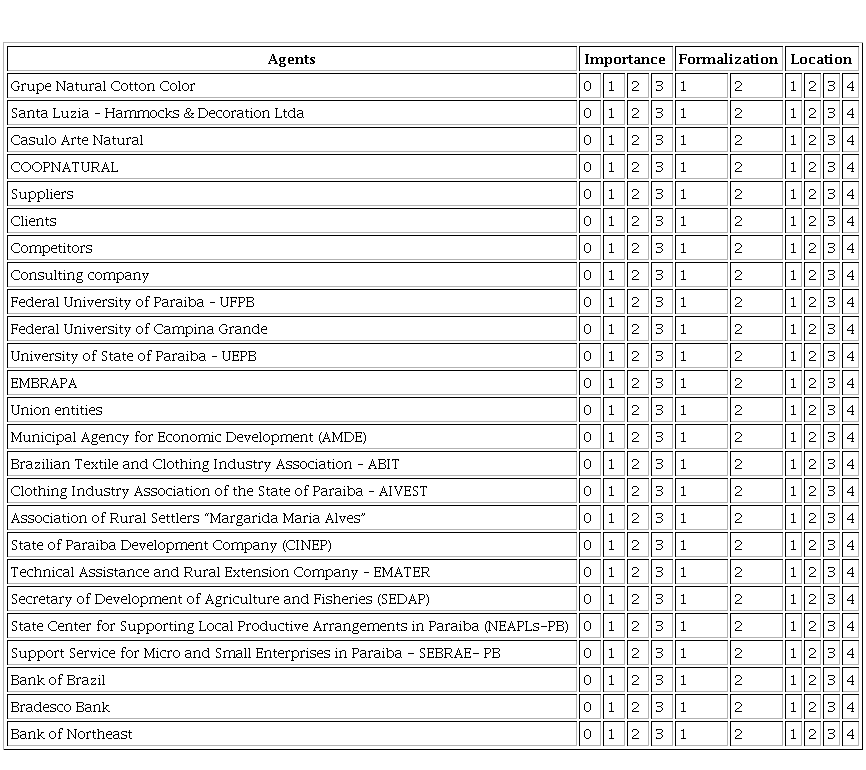
Concerning questionnaire I, Table 1 was presented, which aimed to verify the degree of importance that each actor delegates to the other actors of ASPIL, in the period between 2012 and 2017, as well as the degree of formalization and the scale that each ASPIL member is.
Therefore, the actors chose between the following scale of degree of importance: 1 is low importance, 2 is medium importance and 3 is high importance and 0 not relevant to your company and/or institution.
Regarding formalization, if a contract was signed with an actor, the choices were: 1 (formal), otherwise, it would choose 2 (informal). Regarding the degree of location: 1 when located in the arrangement (Paraiba), 2 in the Northeast, 3 in Brazil, 4 abroad.
Table 1 – Categorization for the characterization of the territory, production and institutional infrastructure.
– Categorization for the characterization of the territory production and institutional infrastructure
Source: Do Bu (2018, p.86).
Additionally to Table 1, questionnaire 1 presented some questions, in order to obtain data on issues considered important for the characterization of the actors' articulation scenario (institutional and productive characterization), but mainly, it sought to investigate what would be the difficulties that each actor found within the range of his acting role within the structure. From the perception of the methodological aspects, the section that follows will bring the results of the research. Thus, it will be presented: the formation and public policies performed, current characterization and the relationships between the actors of the APL under analysis.
Research for the improvement of colored cotton, developed by Embrapa Algodão, located in the city of Campina Grande – PB, began in 1989. In 2000, the production of naturally colored cotton began in the state of Paraiba, featuring the species BRS 200. Still, the research pursue and, in the following years, the institution announced the following outcome: BRS Verde (2003), BRS Rubi and BRS Safira (2005) and BRS Topázio (in 2010).
Currently, Embrapa's research revolves around generating higher production in the naturally colored cotton lint of existing specters (tones of brown and green), as well as there is research in favor of the emergence of new tones for colored cotton fiber through biotechnology.
Normally, Embrapa has played a leading role in the arrangement, by helping in the interactions between different actors (economic and political) with the farmers. The field research showed that Embrapa offers support to farmers, inviting them to participate in lectures and training courses at its headquarters or in other locations/cities; it participates when actors from the arrangement or from outside, visit the farmers, for possible negotiations or exchange of experiences; and also, it offers technical support in planting, instructing them to apply techniques to inhibit pests without the use of pesticides.
Embrapa also contributed to the valorization of colored cotton from the Margarida Maria Alves Settlement, through the Algodão e Cidadania project, in partnership with the Committee of Entities in the Fight against Hunger and for Life (COEP), which offered equipment that would help rural communities of the Brazilian semiarid region. Properly, the Settlement received equipment for processing its cotton and, therefore, will be able to add more value to its product, since it started to sell it after processing. Under the circumstances, by acting as an intermediate of
Under the circumstances, by acting as an intermediate of interests in the system, Embrapa has played a role in what the literature calls “institutional coordination”, which, as Crawford and Ostrom (1995 apud AMARAL FILHO, 2011, p.182) argue: “it is placed as a central piece in the structure [...] acting as an element of unity and stability of the system”. Although, it is recognized that this “position” is shared with another body, which is the APL Management Committee, as will be discussed further on.
Nevertheless, besides the role played by Embrapa, we need to highlight some actors who were of fundamental importance for the structuring of the APL of artifacts and colored cotton clothing in Paraiba. Hence, as stated by Pinheiro (2003); Picciotto and Shewchenko (2006), Lirbório (2017), they are:
1- Campina Grande Clothing Union - SINDIVEST: which identified in naturally colored cotton a strategy of competitive differentiation for its members in the national and international clothing market, and therefore was responsible for stimulating the technical feasibility tests (carried out by the Industrial Apprenticeship - SENAI/CERTEX, in PaulistaPE and by EMBRATEX, in Campina Grande-PB), and later, encouraged the emergence of the first colored cotton clothing in the state of Paraiba.
2- Municipal Agency for Economic Development (AMDE): Agency of the city of Campina Grande – PB; created in 1999, to minimize the current socioeconomic situation at the time, in the state, generated by the crisis in cotton farming in Paraiba8 . AMDE, with the objective of generating a differentiated product for the clothing manufacturers in the city, worked with the LABVEST laboratory of SENAI-PB, to develop the design of the clothing collections and artifacts produced with colored cotton. So, in an attempt to work the productive sector in a more organized and integrated way, AMDE created the Program for Strengthening the Productive Chain of the Textile Sector of Campina Grande.
Subsequently, in 2003, the Cooperativa de Produtores de Têxteis e Afins da Paraiba (COOPNATURAL) was created, and the Natural Cotton Collor Group emerged. These actors aimed to add value to their products, using handcrafted finishing with regional elements (such as handicrafts and embroidery) as a strategy for competitive differentiation.
Simultaneously, with the company Santa Luzia – hammocks and decorations, they are the main economic actors in the state of Paraiba, working with naturally colored cotton as a raw material in clothing and artifacts. Still, they are not the only ones. There are several artisans spread across the state, but they do not focus their activities only on colored cotton items or have a very small production, for this reason, in order to acquire colored cotton threads and fabrics, they need to get togheter to purchase them, because the amount they need is lower than the minimum sold by Unitêxtil, for instance, 50 kilos, according to Lirbório (2017).
Consequently, for this research, only the economic actors who are members of the Managing Committee of the Local Productive Arrangement - APL - of Colored Cotton Clothing and Artifacts of Paraiba were considered; and Coopnatural9 , since they produce according to the patterns accepted by the foreign market, that is, they use naturally colored cotton threads, produced in an organic and certified way10, thus offering guarantees of the origin of the raw material.
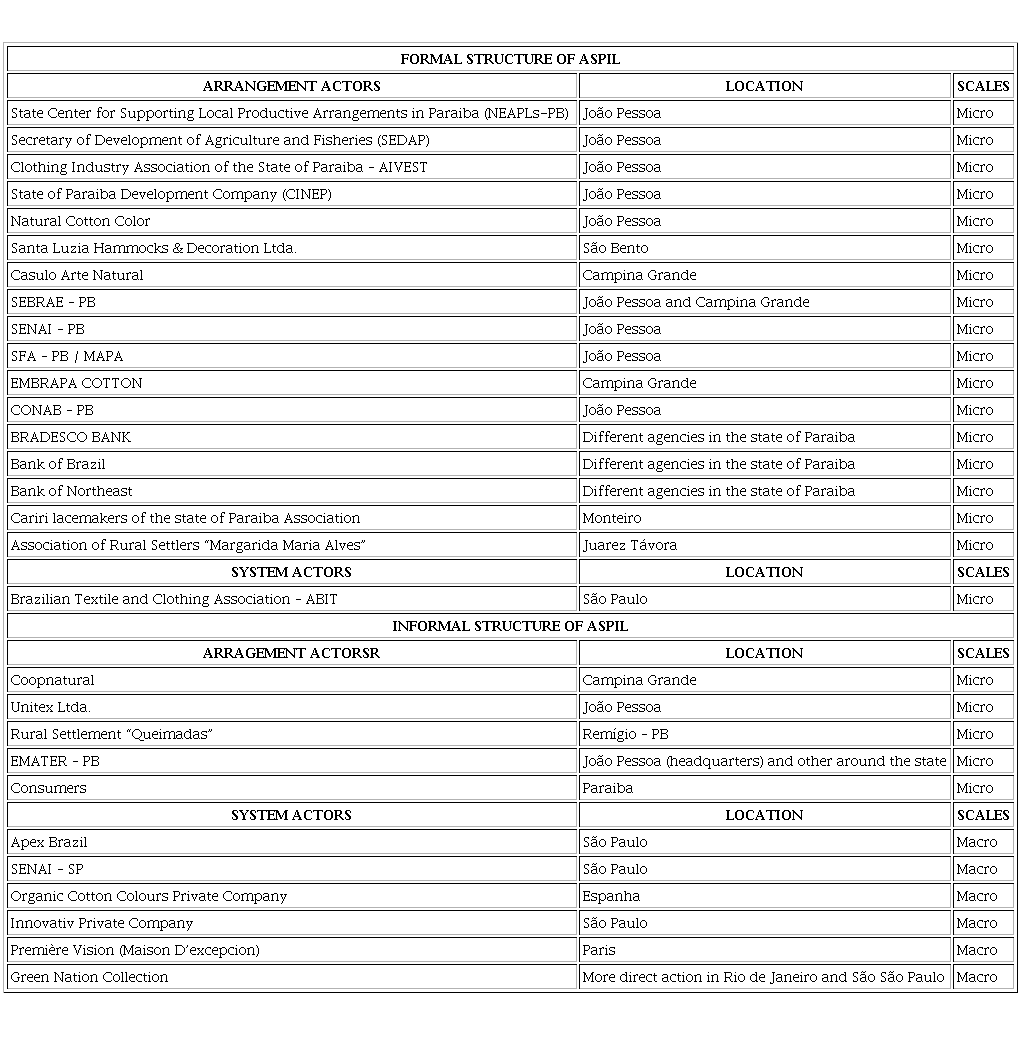
Even though there are different types of actors within the structure of an ASPIL, it is important to pay attention to the behavior of companies, folowing Amaral Filho (2011) explanation, they are characterized as the interfacial agent of the composition of the local productive and innovative system. Currently, the actors that compose ASPIL are described in Table 2.
Regarding Table 2, it shows that the actors are divided between those who are part of the formal structure (they are part of the Management Committee of the APL of artifacts and clothing from Paraiba) and those who compose the informal structure (which are not part of the Committee). The latter were observed in the interviewees' speeches and applied questionnaires.
The Management Committee has also represented an institutional coordination for the system. Still, it was created to inhibit the commercialization of counterfeit colored cotton (with artificial dyeing), the biannual meetings between its members are spaces for dialogue in favor of promoting the structure. Briefly, according to article 8 of its Internal Regulations, the Committee is responsible for, among other functions: developing actions that promote good business management and environmental preservation initiatives and providing ways of cooperation between other national and international development institutions.
In this respect, as well as Embrapa, the Management Committee is an institutional mechanism to promote the security of its members, protecting from possible opportunistic actions.
Summarizing, the actors described in Table 2 are divided into categories:
I- public agencies (such as: Embrapa, Companhia de Desenvolvimento da Paraíba – CINEP, the State Center for Supporting Local Productive Arrangements in Paraiba – NEAPL's-PB); II- private funding agencies (such as: SENAI-PB and Innovativ); III- unions, associations and federations [APL Management Committee, Brazilian Export and Investment Promotion Agency (APEX) and Brazilian Textile and Apparel Industry Association (ABIT)]; IV- Technological Research Centers (such as: Embrapa, SENAI – PB and SENAI – SP); V- Universities in the state of Paraiba; VI- Suppliers of raw materials (Margarida Maria Alves Settlement); VII- Artifact and clothing production companies (Coopnatural, Santa Luzia –Redes e Decorações and Grupo Natural Cotton Color); VIII- Financial agents (banks); and, IX- Customers11.
Table 2 – Actors that compose the arrangement and local production system of artifacts and clothing in Paraiba
– Actors that compose the arrangement and local production system of artifacts and clothing in Paraiba
Source: Do Bu (2018, p.114-115).
Concerning the locus of the APL, the actors located in Paraiba were classified as members of the arrangement and belonging to the micro scale. The actors that are in other regions, such as the Southeast (São Paulo and Rio de Janeiro) and abroad (Paris and Spain), were classified as members of the local productive and innovative system and of the macro scale. On the meso scale (for instance: the Northeast region, with the exception of Paraiba), there is only the category of consumers of artifacts and garments produced by the APL. Even if, in the past, APL companies already had a relationship with Sergipe, where flat weaving was carried out in the first years of colored cotton production in the state, “since Paraiba does not have [...] there” (FARIAS, 2010, p. 292). 12
Briefly, as observed in the field research, the consumers of the arrangement are predominantly in the micro and macro scales.
Regarding macro-scale actors, they are responsible for supporting local economic actors, both in terms of design innovation, modeling, production, and commercialization, especially abroad. As a matter of fact, despite the survival of ASPIL studied here is linked to the use of innovations developed within Paraiba, more specifically, promoted by Embrapa, the dependency factors that link the arrangement to its local productive system (formed by actors from Spain and São Paulo) are precisely: innovation (of products) and commercialization.
Moreover, regarding Table 2, the absence of an actor in the current ASPIL structure can also be seen, namely: Municipal Economic Development Agency (AMDE). Hence, the field research observed that since 2010, the municipal agency that, in the past, had an important role of mediator and supporter of activities around colored cotton; Currently, it focuses on providing credit and supporting: family farming, recycling cooperatives and the artisans of Vilã do Artesão13.
This reality can be explained by the change in the actors of the arrangement, which, at the beginning, were concentrated in the municipality of Campina Grande - PB, with the exception of farmers, who were present in various parts of the state. Although, over the years, it seems that the decision-making power of the arrangement (and thus, its main actions) is/are more concentrated in João Pessoa, as can be seen in Table 2.
According to the research, comparing to the early 2000s, when Coopnatural was the main mediator of the structure, bringing important contributions, such as the tests and implementation of the production of naturally colored cotton in an organic way, in 2007; Currently, the Natural Cotton Color Group has played a strategic role, as Lirbório (2017) also asserts it.
Accordinly, the Group has been establishing partnerships in favor of constant investments in product and process innovations, with various actors, such as: SENAI – SP, Innovativ, Première Vision (Maison d’Excepción)14 .
The partnerships established by the Natural Cotton Color Group with the actors of their local productive and innovative system (the macro scale of the structure) support product innovation and commercialization. This fact built up changes in the hierarchies of the local productive arrangement.
The Natural Cotton Color Group has partnered with SENAI-SP and the private company Innovativ (a textile technology company) to contribute with product and process innovations, intending to broaden the varieties of pieces to be made by the Group. For instance, in November 2019, the group Natural Cotton Color, the first Brazilian jeans made from colored cotton, featured the fashion event 'Brasil Eco Fashion Week'. This product was the result of research developed since 2016, by the Group together with the SENAI Institute of Textile Technology, located in São Paulo15.
Those partnerships established with actors outside the state of Paraiba are due to the fact that the spinning and weaving stages represent problems for ASPIL of artifacts and colored cotton clothing from Paraiba. The main reason is that production is small and the colored cotton spinning process requires expensive cleaning processes before and after spinning, so that there is no contamination between white and colored cotton (FARIAS, 2010).
Field research shows that, unlike traditional clothing companies, which purchase fabrics from suppliers and thus carry out their production; the clothing companies in the arrangement: Grupo Natural Cotton Color and Rede Santa Luzia – Redes e Decorações, are responsible for purchasing the naturally colored cotton lint from the Margarida Maria Alves settlement. And only after that, they send it to a company to do the spinning and weaving. Afterwards, they distribute the raw material among themselves and carry out their respective productions separated.
The same dynamic is carried out by Coopnatural, which obtains it at the Queimadas Settlement and Ingá farmers. Even though, as Lirbório (2017) and Do Bu (2018) explain, in recent years the cooperative has focused its activities more on marketing naturally colored cotton fabrics of past harvests stocks.
Consequently, the dependence that economic actors show on macro-scale actors, such is, the actors of their production system in terms of marketing and the development of product innovations, as well as the fragility that clothing is found, having to " fight” for the production of naturally colored cotton yarns and fabrics, reveal the need for the state of Paraiba to act in public policies focused on promoting more autonomy for the arrangement and that eliminates the precarious forms of production. This reality requires a public policy that is the result of an effective reflection of the dynamics experienced among the members of the arrangement and their real needs. A public policy that is more than those elaborated in the first generation of public APL policies, as discussed in topic 2. Thus, a public policy that is capable of meeting the demands of the different actors in the arrangement within a long-term focus, for the sake of integration between local development (in the state of Paraiba), but in accordance with the macro scale and the National Policy for Regional Development.
After all, regarding state action on the APL analyzed here, we verified, with the exception of AMDE's actions, until 2010, in subsequent years, it was not observed in the literature, nor in the field research: the realization of a structured public policy focused on ASPIL of naturally colored cotton artifacts and clothing from Paraiba, aimed at solve obstacles and encourage its potential.
The approach for ASPIL actors to express themselves in a more structured way was the devlopment of the APL Management Committee, but as several interviewees observed, over the years, actions of the Committee members who are the representatives of the public power have not been verified. With the exception of Embrapa, which represents an important actor/mediator in the arrangement.
Indeed, we cannot deny that the role played and explained here by Embrapa has been extremely important for the arrangement, yet, the need to think about and solve the obstacles that are facing the preparations of the arrangement, which consist of the difficulties in obtaining the raw material and developing innovations in processes and products; as well as difficulties in accessing credit, due to the lack of specific lines of financing.
Attempting to support APLs in the state of Paraiba, since 2016, the state government of Paraiba signed a Cooperation Agreement with the Federal University of Paraiba. It refers to the Economic, Social and Sustainable Development Plan for Local Productive Arrangements in Paraiba – PLADES. An endeavor to formulate a State Plan and not a Government Plan and with a multi-scale vision, as it is showed by the PLADES' tactical planning quoted below:
[...] A new Multiscale Territorialization Model, by which problems and solutions are identified and integrated among the local, immediate (productive networks), intermediate (territorial networks), state, regional, national and global scales: The technical strategy of the PLADES identifies, guides and mobilizes the territorial networks of local productive arrangements, designing operational tools, action instruments and institutional mechanisms to promote the process of economic, social and political transformations that characterize development (SITE PLADES, s/d).
Even though PLADES targets all 22 existing arrangements in the State of Paraiba, regarding the APL under analysis, at a meeting of the Management Committee in 2018, it was decided that a strategic planning of the APL of clothing and colored cotton from Paraiba, with the objective of preparing a Cooperation Agreement between the Government of the State of Paraiba, ABIT and SENAI-PB, to enable an assembly of spinning mills that serve all companies that work with colored cotton in the territory Paraiba.
Currently, the focus of PLADES is to build a digital platform “Paraíba de Oportunidades”, to be ready by May 2020. According to Dementshuk (2019), the tool is a space that will gather data about APLs certified by the state government. Being coordinated by the State Center of Support to APLs of Paraiba, it is the outcome of the collaboration of more than 70 specialists from public authorities, universities and the private sector.
Wherefore, the data available on the platform, will facilitate the state, municipal and transversal public policies plannig; potential investors will have access to a set of data related to the sector of interest; as well as, the academic community will be able to have access to the research that is being developed, since the platform will cross-reference data from the information banks between the threefold: public, private and universities. Even so, during the Pandemic, after seeking information from the actors of the State Administrative Center, it was found that the Platform is not available yet and they were discussing the renewal of the Cooperation Agreement for the completion of the Project.
This study seeks to investigate the existence/conduction of public policies aimed at promoting ASPIL of artifacts and colored cotton clothing in Paraiba, from the perspective of scalar analysis of development. The purpose was to investigate the structure of ASPIL and the role played by its actors.
The configuration of the ASPIL of colored cotton artifacts and clothing in Paraiba took place with the support of public agencies, such as: the Municipal Development Agency (AMDE) and Embrapa. Thus, the arrangement is formed by economic, social and political actors that are spread across the state of Paraiba, but most of them are located in João Pessoa – Campina Grande axis. Therefore, the local productive system is compose by actors that are on the macro scale (they are from Spain, Paris and São Paulo).
Concerning the delimitation of the scales, the state of Paraiba represents the locus of the micro scale, as it is the space where the largest number of repetitive interactions and proximity in terms of trust (belonging) among: clothing and artifacts companies, farmers and technological development centers for the fiber (Embrapa) and the product (such as: SenaiPB). United by the elements of Paraiba's handicraft culture and the perception that colored cotton is a new chance for Paraiba, which has already been international prominence with its production of white cotton, is now reinserting itself in the international textile context.
Northeast region is considered the intermediate scale (meso), which needs to be further analyzed, because, although actors from Sergipe left the scene of the arrangement, there may be opportunities for cooperation that, perhaps, are being wasted due to lack of knowledge of the actors of the arrangement. Thus, a public policy among the state governments of the Northeast could promote transversal actions from local potentialities that benefit the arrangement, in the context of promoting the commercialization and innovation of the product.
Ultimately, the macro scale was considered as being Brazil and abroad, as it is observed that these spaces are where the dimensions that the arrangement lacks on the micro scale reside, such as: commercialization and innovation. Hence, it was observed that the actions of São Paulo agents (for the promotion of product and process innovation and commercialization) were linked to the support of production in Paraiba with a focus on foreign agents (such as Première Vision), that is, such actors exert an influence on the actions of the actors of the arrangement, while these spaces are also for the exchange of knowledge.
Despite some limitations, Paraiba's colored cotton clothing and artifacts companies have highlighted the state of Paraiba and Brazil in the context of international sustainable fashion for bringing innovations in products and processes, such as: constant research in favor of new varieties of colored cotton fiber and studies in favor of new fabrics with colored cotton.
Regardless of this, attention is drawn to the need for the State to act in overcoming precarious processes in the arrangement, since for effective local development, that is, in an integrated and sustainable way: the State needs to act as a mediator among the scales.
Though, it was found that public actions, after 2010, were more restricted to the support and mediation that Embrapa has promoted between clothing and artifacts companies, farmers and private development agencies (SENAI and SEBRAE). The institution has acted as an institutional coordinator for the arrangement, acting on several fronts: from publicizing the actors to technical support for farmers.
Since 2016, a development program for all existing APLs in the state of Paraiba has been debated and built. When observing the PLADES project, it is clear that it deviates from the traditional view of APL public policy, and goes towards the recognition that they not only need to find the obstacles of the arrangements, but rather, frame them in a multi-scale vision. This means that some problems will be solved through actions that will go beyond the political and administrative frontier of Paraiba to solve them.
Acknowledgedly the analysis from the scales helps to understand the interrelationships between the actors of this complex structure that is an ASPIL, as well as the strengths and weaknesses in the development trajectories, generating subsidies for the actors to evaluate their practices, and for the orientation of development policies. For that reason, it is expected that the study will serve to bring theoretical contributions from the reflections on the results and limitations pointed out here.
Ultimately, due to the dynamics of interfaces between the Aspil actors changed over time, it is necessary to take into account that, in the most recent context, there may have been changes in the formatting of the Aspil under analysis that were not captured at the time of the field research, as they did not yet exist.
– Categorization for the characterization of the territory production and institutional infrastructure
– Actors that compose the arrangement and local production system of artifacts and clothing in Paraiba
