Artigos
Relationship between public consortia and municipal development: an analysis based on the size and diversity of intermunicipal networks in Minas Gerais
Relationship between public consortia and municipal development: an analysis based on the size and diversity of intermunicipal networks in Minas Gerais
Gestão & Regionalidade, vol. 39, e20237779, 2023
Universidade Municipal de São Caetano do Sul
Recepción: 27 Marzo 2021
Aprobación: 12 Julio 2022
Abstract: The study aimed to analyze the relationship between the size and diversity of the networks of cities by consortia with the levels of the socioeconomic development indicator in the municipalities of Minas Gerais. The inter-municipal network structure was represented by the participation of cities in public consortia, an instrument that connect different local managers for the cooperative provision of social services and policies. Regional inequality and the relative national importance of Minas Gerais’ municipalities (especially small and medium) in the formation of cooperative networks, in addition to an observed convergence of income in recent decades, justify the choice of the state for the study. The application of Ordered Logistic Regression Analysis led to results that indicate that the size of the network of municipalities positively impacts the probability of cities in Minas Gerais reaching higher levels of socioeconomic development, measured by the Índice FIRJAN de Desenvolvimento Municipal(IFDM).
Keywords: networks, development, municipalities.
Resumo: O estudo objetivou analisar a relação entre o tamanho e a diversidade das redes intermunicipais com os níveis do indicador de desenvolvimento socioeconômico dos municípios de Minas Gerais. A estrutura de rede intermunicipal foi representada pela participação das cidades em consórcios públicos, instrumento que conecta diferentes gestores locais para a provisão cooperada de serviços e políticas sociais. A desigualdade regional e o relativo protagonismo nacional dos municípios mineiros (sobretudo os pequenos e médios) na formação de redes cooperadas, além de uma observada convergência de renda nas últimas décadas, justificam a escolha do Estado para a avaliação. A aplicação da Análise de Regressão Logística Ordenada levou a resultados que indicam que o tamanho da rede de municípios impacta positivamente a probabilidade de as cidades mineiras atingirem níveis mais elevados de desenvolvimento socioeconômico, medido pelo Índice FIRJAN de Desenvolvimento Municipal (IFDM).
Palavras-chave: Redes, Desenvolvimento, Municípios.
1 Introduction
In the federalist configuration determined by the Federal Constitution of 1988, Brazilian municipalities started to have greater autonomy, and at the same time, they faced new attributions and demands that some municipalities, especially those in small and medium-sized cities, could not manage by themselves (ABRUCIO, 2005). Education, urban infrastructure, health, housing, sanitation, and garbage collection services began to be the responsibility of the city halls in a country with evident regional and local disparities in fiscal, economic, institutional, and population terms (ARRETCHE, 2010).
In addition to the constitutional attributions in the scenario marked by inequality, in recent decades, municipalities have faced the continuous expansion of demand and diversification of social preferences in the context of technological transformations. This has led federal entities to adopt innovative models of intergovernmental associations and network governance, either to provide public services or to promote regional development (ROCHA; FARIA, 2004; LINHARES et al., 2012).
The networks reflect the structure that relates two or more jurisdictions, or organizational units, which are not necessarily inserted in the same hierarchical matrix, which share similar interests in relation to a specific action and exchange resources and act cooperatively to achieve this common goal (O’TOOLE; MEIER, 2004). At the local level, inter-municipal network associativism is a phenomenon of articulation of a set of interconnected and interdependent municipal governments that aim to implement one or more public policies under a principle of horizontal coordination (CADAVAL, 2004; SILVESTRE, 2018).
There are a number of forms of inter-municipal associations in Brazil, such as: secretariat councils; councils of mayors; river basin committees; local productive arrangements; integrated development regions, and public consortia. The latter stands out as the most implemented municipal network instrument in the country (GRIN et al., 2016). According to the Brazilian Institute of Geography and Statistics (IBGE), in 2019, about 66% of Brazilian municipalities declared to participate in at least one inter-municipal public consortium.
Inter-municipal consortia are legal entities that bring together several municipalities in favor of conducting a joint action, aiming at solving common problems in a region, in addition to achieving efficiency gains in the use of public resources and economies of scale. They can work in several areas of social interest, such as health, education, basic sanitation, environment, urban infrastructure, development, among others (GUIMARÃES, 2010).
The structure (formation and maintenance) of consortium involves meetings, dialog, agreements, supervision, and public consultations. In this sense, this instrument of inter-municipal cooperation creates a network capable of encompassing a multidimensional sphere of collaboration and inter-organizational trust, as it reflects the interpersonal relationships of mayors, executive boards, municipal secretariats and other regional and municipal leaders (BRITO, 2019).
Thus, in addition to the gains in scale and efficiency in the provision and implementation of social services and policies, the municipal network created by the consortia relates to what Denhardt (2012) defines as “new public service” and Osborn (2006) calls “new public governance”, related to a network governance that is plural and involves efforts of different social and economic actors, in different hierarchies, which cooperate for the provision of social services.
As the networks allow us to share reflections, the search for solving problems of the community and the rational and efficient use of available resources, they can be understood as promoters of socioeconomic development (VACHON, 2001). Furthermore, the nature of what unites the actors involved in the network is responsible for determining its productive effectiveness and the recognition of the local character of development (PECQUEUR, 2000).
Therefore, economic development is related to the density of networks that are formed locally (ANDION, 2003).
Andion (2003) lists the dimensions of the network’s contribution to the promotion of sustainable local development: economic and technological promotion; social promotion, with improvements in health, education, housing, leisure, and culture conditions of the network members; environmental and ecological promotion, and political promotion.
In the last two decades of the twentieth century, several diversified experiences of intercity consortium have spread throughout Brazil, either autonomously or induced by state and federal governments, with the most relevant experiences in the health area, especially for the states of Minas Gerais and Paraná respectively (ROCHA; FARIA, 2004). The period after the creation of the Law 11.107/2005 (Law of Consortium) also marks the creation of new consortia and gradual municipal adhesion, since such an instrument provided legal certainty to adopt consortium in the country, institutionalizing the relations between the entities involved (LINHARES et al., 2012).
In a technical study carried out by the National Confederation of Municipalities (CNM), regarding data for 2020, the macro-region with the largest number of consortia and proportion of participating municipalities is the Southeast, with Minas Gerais having the largest number of consortium headquarters in the most diverse thematic areas. In addition, of the 853 municipalities within the state, 846 declared to participate in at least one inter-municipal consortium, with about 92% of them participating in more than one consortium. The state of Minas Gerais is also the one with the most multi-thematic public consortia (which simultaneously operate in more than one social area), in addition to the municipalities of Minas Gerais being part of 3 of the 6 largest consortia (in participants) in the country (CNM, 2021)
Minas Gerais is the state with the largest number of municipalities, mostly geographically small and with high contiguity. According to IBGE’s data, in 2019, about 29% of the municipalities of Minas Gerais had a small population (below 10,000 inhabitants), which is generally related to low fiscal autonomy. Such factors, combined with the historical regional and inter-municipal inequality existing in the state, especially in relation to economic activities and health, as well as employment conditions (COSTA et al., 2012), may be related to the observed creation and maintenance of municipal consortium networks in recent decades, due to the physical proximity of the entities involved (BRITO, 2019) and the potential redistribution power and access to social services created by the consortium, by giving scale to smaller municipalities (LACKZYNSKI; ABRUCIO, 2013).
Empirical studies indicate that, despite regional inequalities, there has been a convergent movement between the municipalities of Minas Gerais in recent decades, reducing income inequality (e.g., SILVA et al., 2006; PEROBELLI et al., 2007). The comparison between FIRJAN’s Municipal Development Index (IFDM) of the cities of Minas Gerais shows that the coefficient of variation of the series, which is a measure of data dispersion in relation to the average, ranged from 0.178 in 2005 to 0.100 in 2016. That is, the comparison indicates a reduction in the variation of the data, pointing to a possible convergence in the IFDMs.
In this context, it is assumed that the convergence of income and development indicators(IFDM) observed in the cities of Minas Gerais is partially explained by the structure of cooperation, interpersonal relationships, and efficient use of resources created with the inclusion of cities, especially the smaller ones, in dense municipal networks. Thus, the greater and more diverse the interconnection of the municipality with other regional agents through consortium, the more available would be the benefits of efficiency, access, exchange of ideas, and economies of scale, which would lead to better socioeconomic indicators.
Thus, we seek to test this hypothesis by conducting an applied study unprecedented in the national literature. We used the statistical technique of Ordered Logistic Regression Analysis, considering the different dimensions of the IFDM (Geral, Saúde e Emprego e Renda, General, Health, and Employment and Income respectively) as a dependent variable for the year of 2016 (most recent year with data available for the indicator). As explanatory variables of interest, we used proxies of size and diversity of the inter-municipal network, expressed in consortia, based on data from CNM’s public consortia, collected in 2020. The focus is to answer the following question: Are the cities of Minas Gerais inserted in larger and more diverse inter-municipal networks, through consortium, more likely to obtain better levels of development reflected by their IFDMs?
he Brazilian literature that evaluates the relationship between local cooperation networks and regional development is still little explored, and some works are focused on theory (e.g., Andion, 2003; Silvestre, 2019). This article contributes to the applied part of this literature, since no study evaluated the relationship of the city network, created by the consortium, with the municipal development indicators. Although Pereira and Moreira (2016) have analyzed the impact of the participation or not of municipalities in consortia on their levels of development, they do not deal with the structure and density of the networks to which municipalities decide to integrate, thus ignoring the fact that the same municipality can connect with others (many or few) through several different consortia, at the same time, in addition to not exploiting the potential benefits of city networks.
In addition to this introduction, the article is divided into four other topics. The second presents the socioeconomic, population, and consortium characteristics of the municipalities of Minas Gerais. The third topic shows the data and methods used in the study. The fourth discusses the results obtained and the last section shows the final remarks.
2 Inter-municipal Consortia in Minas Gerais
Inter-municipal public consortia are organizations capable of articulating sectoral and territorial public policies (CALDAS, 2007). They bring together the cities into a joint action that certainly would not be possible if it were performed individually. Thus, they reflect a voluntary cooperation agreement to solve common problems aimed at gains in scale (SPINK, 2006). They mainly cover small and medium-sized municipalities, which are geographically close (CRUZ, 2002).
Minas Gerais is the state with the largest number of cities, mostly geographically small, and with high contiguity, in addition to presenting historical regional inequalities (COSTA et al. , 2012). These factors favor the formation of cooperative network nodes through consortium (BRITO, 2019). Table 1 shows that the municipalities of Minas Gerais participate in inter-municipal public consortia in several areas, with about 88.4% participating in health consortia, followed by 24.5% in solid waste management, and 16.8% in the area of urban development.
Most municipalities that declared to share consortia in different social areas had small populations (below 20 thousand inhabitants). On the other hand, the municipalities with the largest population participated less in consortia.
In 2020, Minas Gerais was the fifth among the states with the highest proportions of consortia, regarding the number of municipalities, with 115 nodes, of which 42 were multi-thematic. Among the 115, the smallest one consisted of 3 participating municipalities and the largest one had 153. The most common areas were health (74), environment (31), solid waste (29), and street lighting (27) (CNM, 2021).
Figure 1 shows the connection flows of the five largest consortia of the state, in terms of the participants, based on their host cities. According to the Intermediate Geographical Regions (RGI),4 it is possible to observe that the consortium coverage in the state is a regional phenomenon, although it varies according to the breadth of the networks. It is noteworthy that the CISSUL consortium (green color) is composed primarily of cities of the RGIs of Varginha and Pouso Alegre.
| Health | 754 | 88,39 | 199 | 213 | 178 | 103 | 34 | 24 | 3 |
| Solid waste management | 209 | 24,56 | 1 | 62 | 46 | 25 | 9 | 6 | |
| Urban development | 143 | 16,76 | 30 | 41 | 39 | 21 | 10 | 2 | |
| Environment | 131 | 15,36 | 31 | 44 | 28 | 21 | 4 | 2 | 1 |
| Sanitation | 117 | 13,72 | 24 | 38 | 27 | 20 | 8 | ||
| Social assistance | 66 | 7,74 | 15 | 20 | 16 | 7 | 3 | 3 | 2 |
| Tourism | 51 | 5,98 | 9 | 15 | 12 | 11 | 3 | 1 | |
| Waters management | 46 | 5,39 | 9 | 17 | 8 | 7 | 4 | 1 | |
| Culture | 39 | 4,57 | 9 | 12 | 8 | 7 | 3 | ||
| Education | 39 | 4,57 | 9 | 13 | 7 | 7 | 3 | ||
| Habitation | 31 | 3,63 | 7 | 11 | 7 | 4 | 2 | ||
| Transport | 24 | 2,81 | 3 | 9 | 7 | 3 | 2 |
The two consortia from Minas Gerais with the largest networks of cities are located in the southern region of the state, where there are smaller and more contiguous municipalities geographically speaking. From the map, it is noteworthy that, apart from the aspect of geographical proximity, the municipality of Inhaúma (red-colored), located in the RGI of Belo Horizonte, is linked both to the Cias consortium (yellow-colored), basically composed of cities from the same region, and to the CISSUL consortium (green-colored), composed of municipalities of the RGIs of Varginha and Pouso Alegre. Thus, the municipality is inserted in two of the four largest networks of cities formed by consortia in the state of Minas Gerais, connecting to different and non-contiguous RGIs. In addition to these two consortia, the city also participates in the CISMISEL consortium, composed of 14 municipalities and headquartered in Sete Lagoas. Therefore, Inhaúma participates in 3 nuclei of different consortium networks, with dimensions (in cities) equivalent to 153, 81, and 14.
These three consortia work in the area of health, with the CIAS also operating in the areas of social assistance, development and fundraising of projects and assistance to the elderly, children, and adolescents. CISSUL and CIAS were established in 2011 and CISMISEL was established in 1996. In 2011, the IFDM Inhaúma Health was 0.731, rising to 0.755 in 2012, 0.758 in 2013, 0.763 in 2014, 0.773 in 2015 and 0.779 in 2016. From the insertion of the city of Inhaúma into the two health consortia, there has been a gradual increase in the IFDM Saúde of the city.
Table 2 reports the average level of development, measured by the IFDM Geral of 2016, of the cities in Minas Gerais participating in the four largest and four smallest consortia in the state. In addition, the quantitative of consortium members by classes of population is demonstrated, and for both large and small consortia, participation involves a greater proportion of municipalities with populations less than 20,000 inhabitants.
| Largests: | ||||||||
| CISSUL | 0,72 | 36 | 40 | 41 | 25 | 6 | 5 | |
| CISDESTE | 0,67 | 41 | 23 | 19 | 6 | 2 | 2 | 1 |
| CISRUN | 0,64 | 16 | 33 | 17 | 15 | 4 | 1 | - |
| CIAS | 0,69 | 19 | 16 | 15 | 13 | 8 | 8 | 2 |
| Smallest: | ||||||||
| CISCOM | 0,69 | 3 | ||||||
| CONCASS | 0,67 | 2 | 1 | |||||
| CPGRS | 0,69 | 3 | 1 | |||||
| CINSC | 0,76 | 1 | 1 | 1 | 1 |
Regarding the IFDM, there is no relationship between the average development of the municipalities and the size of the consortia (Table 2). However, it should be considered that cities can participate in more than one type of consortium and operating in more than one area. In this sense, Table 3 shows the relationship between the average development of the cities of Minas Gerais and the number of consortia in which they participate.
| 0 | 0,66 | 6 | 4 | 5 | 1 | 1 | 2 | |
| 1 | 0,67 | 26 | 36 | 18 | 18 | 4 | 7 | |
| 2 | 0,66 | 69 | 80 | 78 | 33 | 15 | 10 | 2 |
| 3 | 0,6982 | 82 | 83 | 61 | 42 | 14 | 6 | 2 |
| 4 | 0,70 | 45 | 31 | 20 | 10 | 5 | 3 | - |
| 5 | 0,69 | 4 | 8 | 8 | 8 | - | - | - |
| 6 | 0,71 | 1 | 1 | 2 | 1 | - | - | - |
| 7 | 0,75 | - | - | 1 | - | - | - | - |
In the state of Minas Gerais, there were municipalities that participated in up to 7 inter-municipality consortia at the same time. Most cities with a population of less than 10,000 inhabitants participated in 3 public consortia. This same pattern was observed in municipalities with a population between 20 and 50 thousand inhabitants. Generally, cities with a population between 10,000 and 20,000 inhabitants participated in 2 different consortia. The average IFDMGeral of the municipalities increases in proportion to the number of participation. Thus, in addition to the effect of consortium participation on the socioeconomic levels of municipalities, the characteristics of the municipal networks formed permit such improvements.
3 Data and Methods
To evaluate the relationship between the size and diversity of inter-municipality networks by consortia and the levels of the indicator of socioeconomic development, a probabilistic regression model with an ordered response is used, in which the dependent variable is categorical and follows an ordering.
The variable explained is the IFDM, which has been used in the empirical literature because of its ability to capture the quality of life of the population, especially with regard to the distribution of income and its periodicity of disclosure (POSTALI; NISHIJIMA, 2011). The IFDM was evaluated in its different versions: Geral, Saúde, Educação e Renda (General, Health, Education and Employment and Income), with data from 2016, obtained by the FIRJAN System (Federation of Industries of the State of Rio de Janeiro). The General version consolidates in a single number the level of local socioeconomic development, through the simple average of the values obtained for the areas of Employment and Income, Education, and Health.5 The indices range from 0 to 1, and the closer to 1, the higher the level of development of the municipality in the analyzed area (FIRJAN, 2018).
The FIRJAN System adopts a convention for the division of the indicator into four categories and based on this division and the strategy adopted by Pereira and Moreira (2016), a categorical variable was created as follows: i) IFDM between 0.0 and 0.4: low development; ii) IFDM between 0.4 and 0.6: regular development; iii) IFDM between 0.6 and 0.8: moderate development; and iv) IFDM between 0.8 and 1.0: high development.
To measure the size of the inter-municipal network, the information provided by the CNM’s Municipalist Observatory of Public Consortia is used, with data collected in 2020. Although the period of collection of consortium data is different from the reference period for IFDMs, there were no new consortia or new memberships of municipalities in the state in the period after 2014 (CNM, 2021). Thus, the causal analysis of the networks and the IFDMs remains valid.
All the nodes of consortia existing in Minas Gerais from 1993 to 2014 were extracted, as well as the participating municipalities, and the size of each one was measured in terms of the cities that are part of them. Thus, each consortium has a specific size (the number of participants). Then, these values were attributed to the municipalities, so that the localities that participate in more than one consortium had the sizes of their municipal networks defined by the sum of the size of each of the consortia in which they participate.
It is noteworthy that the focus of the proxy (𝑅𝑅𝑅𝑅𝑅𝑅𝑅𝑅_𝑇𝑇𝑇𝑇𝑇𝑇) is not the connection itself, but the size of the network in which the municipality is inserted. This occurs because it is assumed that greater networks imply greater economies of scale and inter-organizational and interpersonal relationships. Thus, if municipalities are inserted in many networks, they are expected to enjoy greater socioeconomic benefits.
The variable that measures the diversity of the network in which the municipality is inserted (𝑅𝑅𝑅𝑅𝑅𝑅𝑅𝑅_𝑇𝑇𝑅𝑅𝑅𝑅𝑇𝑇𝐴𝐴) was created from the CNM data, considering the number of areas of activities in which each municipality is included. Thus, if the municipality participates in 3 different consortia, which together represent 4 different areas of activity, then the networkdiversity meter for this municipality is equal to 4.
As control regressors, the expenditure variables of governments (by social area) were considered, in addition to demographic, geographical, and tax aspects. Avelino et al. (2013), when analyzing the accounting factors that influence IFDMs in Brazilian capitals, consider the following as explanatory variables of personnel expenses (except labor indemnities), interest, and debt charges, capital expenditure, investments, education and health expenses, tax revenue, among others. When considering the influence of inter-municipal health consortia in the IFDM Saúde of Brazilian municipalities, Pereira and Moreira (2016) also consider the variable of health expenditure as a control. When Scarpin and Slomski (2007) analyzed the conditioning factors of the human development index of the municipalities of the State of Paraná, they used financial and non-financial as control variables, among them: distance to the capital, altitude and expenditure on agriculture. Regarding the influences on municipal indicators of Employment and Income, there is the relative importance of public spending on tourism (FAGUNDES; ASHTON, 2010), infrastructure (CRUZ et al., 2010) and economic development. Such surveys justify the selection of the variables.
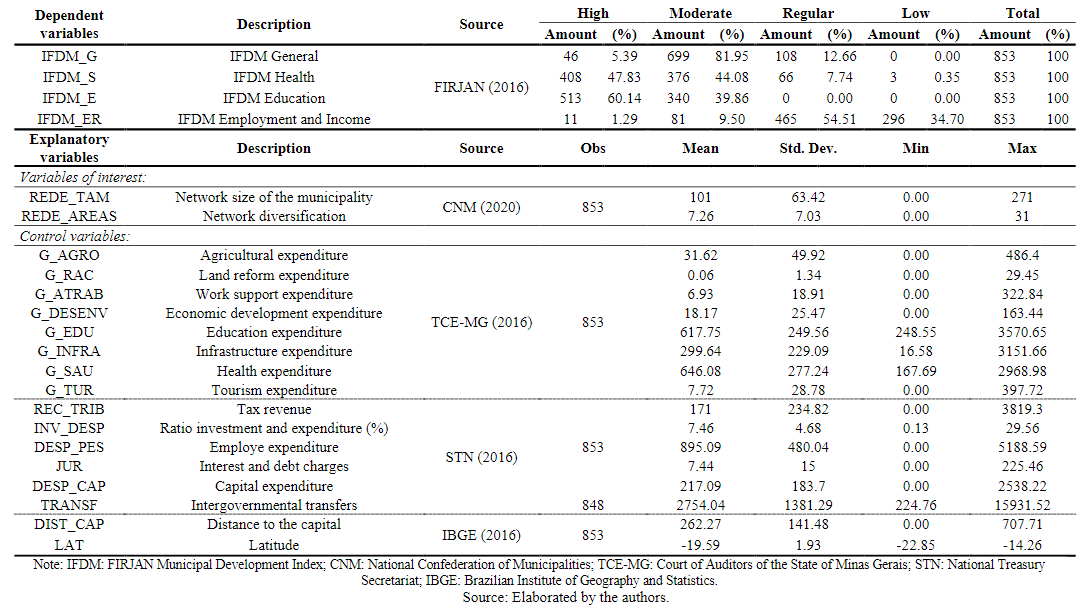
Table 4 reports the dependent and explanatory variables used, as well as their descriptions, collection sources, and descriptive statistics. It should be noted that the metric variables were considered in terms of per capita, to equalize the potential problems arising from the disparity between the populations of the cities in Minas Gerais. The analysis of the coefficients of variation of the explanatory statements showed a discrepant value for per capita spending on agrarian reform and colonization (𝐺𝐺_𝑅𝑅𝑇𝑇𝑅𝑅)6and, given that only two municipalities contained non-zero information for the variable, we decided to exclude it.
The existence of multicollinearity between the variables was tested. This arises when two or more variables are highly correlated with each other. It could be identified with the analysis of the Variance Inflation Factor (VIF). As a rule of thumb, it is assumed that if the VIF of a variable is greater than ten, then it is taken as highly collinear (KLEINBAUM; KUPPER; MULLER, 1988). The calculated VIF for intergovernmental transfers (𝑇𝑇𝑅𝑅𝑇𝑇𝑇𝑇𝐴𝐴𝑇𝑇) was 10.16, which led to its exclusion.
Univariate and multivariate tests were performed to verify the existence of discrepant data. Congonhas presented itself as an outlier for the two categories of tests, which led to its exclusion from the database. Univariate and multivariate normality tests were also performed. No variable showed adherence to the normal distribution. Therefore, the multivariate statistical technique of ordered logistic regression proved to be more appropriate for this study. This is because logistic regression does not assume linearity of relationships and that errors are normally distributed, in addition to relaxing the hypothesis of homoscedasticity (PREARO, 2008).
Being y an ordered response component that assumes the values {0, 1, 2, . . . , J} for some known integer J, the ordered model for y, conditional on explanatory variables x, can be derived from a latent, or unobserved, variable model, as follows (WOOLDRIDGE, 2010):

where y* is not observed, β is a vectorKx1, x does not have a constant, and the error terms 𝑒𝑒𝑖𝑖follow logistic distribution. Considering 𝛼𝛼1-𝛼𝛼2-⋯-𝛼𝛼𝐽𝐽as unknown cut-off points, given the J ordering categories, the following are defined:

One can derive the conditional distribution of y given x as a probability response:

The α and β parameters can be estimated by maximum likelihood. For each i, the log-likelihood maximum function is given by:𝑙

Usually, there is no interest in evaluating𝑅𝑅(𝑦𝑦∗|𝑥𝑥)=𝑥𝑥𝑥𝑥, since 𝑦𝑦∗ is not observed. Interest then arises in the response probabilities𝑃𝑃(𝑦𝑦=𝑗𝑗|𝑥𝑥), in case of an ordering response.
To evaluate the consistency of the results for the variables of interest, four ordered logitmodels were estimated, where all other control variables were considered, as shown in Table 4.

4 Results and Discussion
Knowing the estimated values for the parameters of the variables in the ordered logit, it is possible to know the directions of the effects of the explanatory variables on the dependent. Thus, Table 5 shows that the size variable of the public consortium’s inter-municipal network (𝑅𝑅𝑅𝑅𝑅𝑅𝑅𝑅_𝑇𝑇𝑇𝑇𝑇𝑇) is positive and significant in all models, corroborating the hypothesis raised. This indicates that municipalities participating in broader networks are more likely to have better IFDMs.7
In addition to the categorization of dependent variables (IFDMs) in the four models, following the FIRJAN division, an alternative categorization was tested, based on the deviations from the mean. In the results of the regressions of the alternative models, reported in Table A1 of the Appendix, the estimates for the explanatory statements of interest presented the same signs and statistical significance in Table 5, which reinforces the consistency of the results obtained.
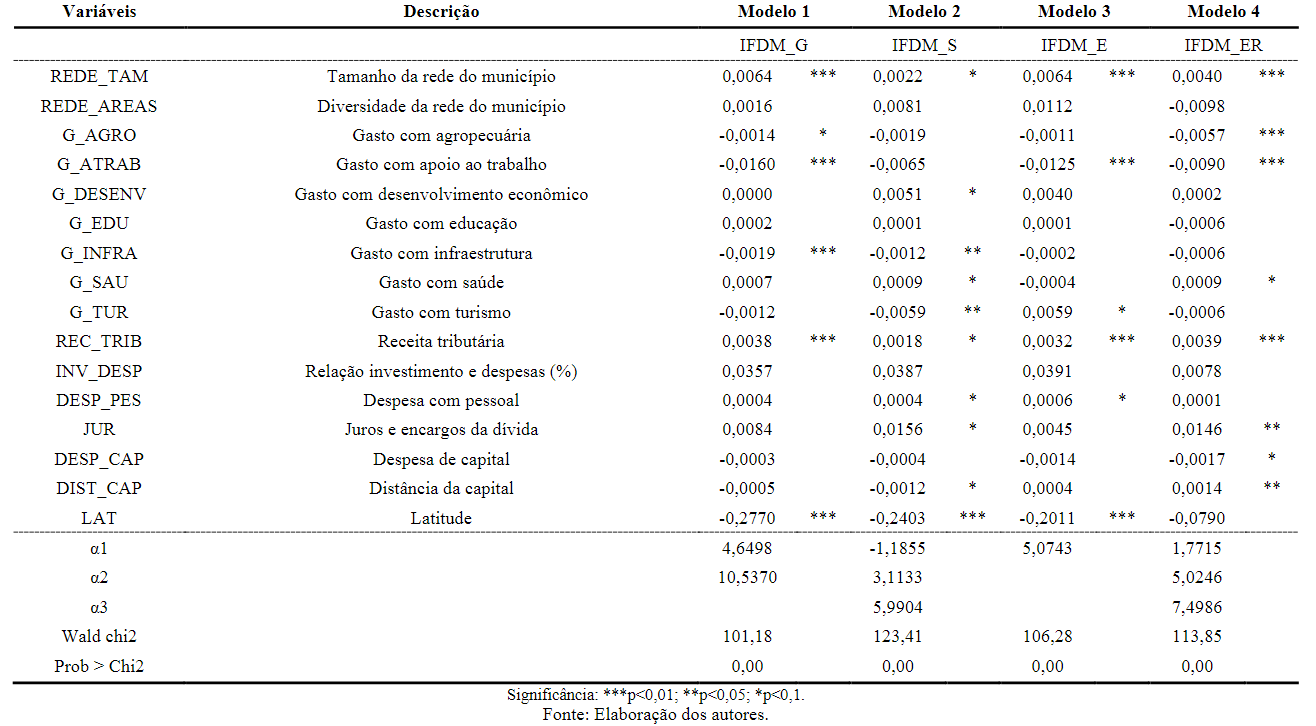
Given that the IFDM and the dimension of participation in consortia are being used as proxies, respectively, for socioeconomic development and breadth of municipal networks, the result is in line with the authors who point out that development is related to the density of networks that are formed at the local level (e.g., Andion, 2003).
For the diversification of the areas of operation of the networks, no significant results were found in any of the models. This result may reflect the existence of some level of specialization involving the services implemented by the consortia so that the diversification of the areas of activity would not directly allow the achievement of gains on an intersectoral scale. Still, the proxy used may not be useful to reflect the inter-organizational complexity inherent in network governance for the provision of the “new public service” (DENHARDT, 2012).
The IFDM Emprego e Renda (Employment and Income index) is built from the aspects of formal employment in the municipalities, such as the generation of new positions, formalization rate, and wage bill. For 2020, there are 23, 26, 14, and 17 inter-municipal public consortia active in the areas of agriculture, infrastructure, tourism, and economic development (CNM, 2021). Such areas relate to the indicators of Employment and Income (e.g., Fagundes and Ashton, 2010; Cruz et al., 2010).
The Consórcio Inter-municipal Multifinalitário do Médio Espinhaço (CIMME), based in Conceição do Mato Dentro, is an example of action in several areas, since it supports the development of municipalities with its motor-mechanized patrol, in addition to assisting in the training of servers and qualification of services (AMME, n.d).
Given these services, it is believed that, for consortia with this type of attributions, the greater the number of participating municipalities, the greater the collection of funding through the apportionment contract, enabling the purchase of more sophisticated utilities (shared use), and that can be beneficial to the productive processes of some of the sectors of the consortium municipalities, making them more competitive regionally.
In addition, the greater the number of municipalities participating in a consortium with this type of activity, the easier it becomes to promote conferences, technical courses, meetings and training of workers from the consortium cities, as the greater are the demand and the fundraising to hire training companies, in addition to the increase in the possibility of economies of scale. Such gains justify the improvement in the development indicator in the area of Employment and Income, since the qualification and specialization of the local labor force is related to improvements in the formal employment market. Therefore, municipalities that are part of more dense consortium networks are more susceptible to such benefits, compared to cities linked to only two other cities through consortium, for example.
The IFDM Saúde (Health) deals with the proportion of adequate prenatal care, infant deaths due to preventable causes and number of hospitalizations sensitive to primary care. Consortium in the health area is the most prevalent in Minas Gerais. The CISSUL, the largest health consortium in Minas Gerais in number of participants, is aimed at delegating, expanding, and qualifying professionals in management, regulation in health, and urgency and emergency, through training, improvement, qualification, prevention of chronic diseases, health surveillance, and permanent and continuing education. The consortium operates with a regional network of Emergency Medical Service ambulances (SAMU) and the costs for its maintenance is distributed among the participating municipalities, the state, and federal government (CISSUL, n.d).
For the health area, in general, it appears that the consortia that have more participating cities enjoy greater fundraising, which provides more sophisticated and specialized equipment and training in basic care to the populations of the cities with consortia, increasing the probability of better levels for the IFDM Saúde (Health).
It is noteworthy that, according to the principle of universality of the Unified Health System (SUS), hospitals that serve consortium municipalities cannot fail to provide care to citizens of non-participating municipalities (TEIXEIRA; MENEGUIN, 2012). However, due to the purchase of consortium quotas by the participants, in some types of specialized services, the populations of the participants enjoy preferential care, similarly to what occurs with health plans. Such aspects could justify the improvement in the IFDM Municipal health, given the size of the participation network.
Education consortia act to strengthen the consortium municipalities in their demands with the state and federal education agencies, in addition to being able to sign agreements, receive aid, and sign service contracts, making education receive more investment in a regional way, in addition to strengthening municipal education. In this sense, the larger the network that municipalities participate in the area of education, the greater the benefits for the area, reflected in a greater probability of improvement in the level of IFDM Education.
While the direction of the effect of 𝑥𝑥𝑘𝑘 on the probabilities 𝑃𝑃(𝑦𝑦=0|𝑥𝑥) and 𝑃𝑃(𝑦𝑦=𝐽𝐽|𝑥𝑥)is determined by the sign of𝑥𝑥𝑘𝑘, its signal does not always determine the direction of the effect for the intermediate orderings, 1, 2, . . . , J−1 (PEREIRA; MOREIRA, 2016). Thus, in order to have a dimension of the impact of explanations on the probability of each of the orders of the dependents, and not only on their extremes, one must calculate the marginal effect for each of the order levels.
The marginal effect generally measures the conditional effect of the mean of a 𝑦𝑦 given change in one of the regressors (CAMERON; TRIVEDI, 2010). Thus, the marginal effects on the mean of each explanatory on the predicted probabilities of each ordered response are estimated. Table 6 reports the marginal effects of the network dimension, which is, among the variables of interest, the one that was significant for the models with ordered logistic regression.8
| IFDM Geral | Alto | 0.2517 |
| Moderado | 0.4003** | |
| Regular | -0.9963*** | |
| Low | - | |
| IFDM Saúde | Alto | 0.0348 |
| Moderado | 0.1895 | |
| Regular | -0.9286*** | |
| Low | - | |
| IFDM Educação | Alto | 0.6356*** |
| Moderate | -0.6356*** | |
| Regular | - | |
| Low | - | |
| IFDM Emprego e Renda | Alto | 0.5880 |
| Moderado | 0.2723 | |
| Regular | 0.2959** | |
| Low | -0.4574*** |
It is noted that the expansion of the municipal consortium network in a city increases the probability of evolution from a level of IFDM Geral considered “regular” to “moderate” by 0.4 percentage points. When analyzing indicators of the sub-areas, it is clear that the (significant) major impacts on the transitions between the categories are for the areas of Education and Health, in relation to the area of Employment and Income. This may be an indication that in these areas it is possible to better reuse and obtain gains in scale in the provision of social goods and services, as the number of partners from the sharing of inputs and knowledge, for example, increases. In addition, it can be assumed that the areas of Education and Health are more related to the municipal network (of social services) created through consortium. That is, the network created deals, in essence, more with public services directly linked to citizens (basic health care and primary education) than with the improvement of other aspects, such as formal employment, salary remuneration, among others.
5 Conclusion
When analyzing the relationship between the size (number of participants) and the diversity of the inter-municipal networks by consortia with the levels of the socioeconomic development indicator of the municipalities of Minas Gerais, the results were significant only for the network dimension variable, indicating that larger networks of cities are positively related to the probability of better values of the dimensions of the IFDM.
The insertion in denser municipal networks in terms of the number of participants is related to obtaining the benefits of cooperation and economies of scale, reflected in the probability of obtaining better levels for the IFDM. Such insertion may even be one of the elements that justify the convergence observed in the IFDMs of the municipalities of Minas Gerais in recent decades, since smaller cities (with less fiscal autonomy) seek more often to insert themselves into larger municipal networks through consortium.
Thus, in order to enjoy the advantages of cooperative inter-municipal action, municipal managers must not only seek to participate in a consortium with other municipalities, but also aim at entering networks with more participants, seeking to connect to locations that are not limited to the micro-regional geographical space they are inserted in, depending on the area of activity (some areas of activity allow greater geographical expansion of the network of the cities, such as technology, for example).
Although its application advances in the regional empirical literature evaluating the relationship between cooperation networks and regional development, since it is an unprecedented study that prioritizes the density of municipal networks, the main limitation is the consortium data used, which do not provide information on the profile of the networks of cities to the society, companies and others, through the consortia. That is, it fails to capture the complexity of networks, since different inter-municipal networks may involve different government-business-society interrelationships. In addition, it is a specific application for a Brazilian state. For future studies, the analysis can be extended to the national level.
References
ABRUCIO, F.L. A coordenação federativa no Brasil: a experiência do período FHC e os desafios do governo Lula. Revista de Sociologia e Política, n. 24, p. 41-67, 2005.
AMME. Associação Dos Municípios Da Microrregião Do Médio Espinhaço: História, s.d. Disponível em: http://www.ammecimme.org.br/historia/. Acesso em: 15 fev. 2022.
ANDION, C. Análise de redes e desenvolvimento local sustentável. Revista de Administração Pública, v. 37, n. 5, p. 1033-1054, 2003.
ARRETCHE, M. Federalismo e igualdade territorial: uma contradição em termos? Dados, v. 53, p. 587-620, 2010.
AVELINO, B.C.; BRESSAN, V.G.F.; DA CUNHA, J.V. A. Estudo sobre os fatores contábeis que influenciam o Índice Firjan de Desenvolvimento Municipal (IFDM) nas capitais brasileiras. Revista de Educação e Pesquisa em Contabilidade (REPeC), v. 7, n. 3, 2013.
BRITO, E.S. Consórcios intermunicipais no federalismo brasileiro: coordenação, colaboração e a nova governança pública. In: CARNEIRO, J.M.B.; BRITO, E.S. (Org.) Consórcios intermunicipais e políticas públicas regionais, 2019. p. 11.
CADAVAL, M. Las aglomeraciones urbanas desde la perspectiva de la hacienda pública. WP19/04, Madrid: Instituto de Estudios Fiscales, 2004.
CALDAS, E.L. Formação de agendas governamentais locais: o caso dos consórcios intermunicipais. Tese (Doutorado em Ciência Política). USP, São Paulo, 2007.
CAMERON, A.C.; TRIVEDI, P. K. Microeconometrics using stata. College Station, TX: Stata press, 2010.
CISSUL. Consórcio Intermunicipal da Macrorregião do Sul de Minas: Página inicial, s.d. Disponível em: http://cissul.saude.mg.gov.br/. Acesso em: 15 fev. 2022.
CNM. Mapeamento dos consórcios públicos brasileiros 2021. Estudo técnico. Brasília, 2021.
COSTA, C.C.M.; FERREIRA, M.A.M.; BRAGA, M.J.; ABRANTES, L.A. Disparidades inter-regionais e características dos municípios do estado de Minas Gerais. Desenvolvimento em Questão, v. 10, n. 20, p. 52-88, 2012.
CRUZ, M.C.M.T. Consórcios intermunicipais: uma alternativa de integração regional ascendente. In: APINK, P.; CACCIA BAVA, S.; PAULICS, V. (Orgs.). Novos contornos da gestão local: conceitos em construção. São Paulo, Polis: Programa Gestão e Cidadania/ FGV – EAESP, 2002.
CRUZ, A.C.; TEIXEIRA, E.C.; BRAGA, M. J. Os efeitos dos gastos públicos em infraestrutura e em capital humano no crescimento econômico e na redução da pobreza no Brasil. Revista Economia, v. 11, n. 4, p. 163-185, 2010.
DENHARDT, R.B. Teorias da Administração Pública; tradução técnica e glossário Francisco G. Heidemann. 6 ed. norte-americana. Título original: Theories of public administration. São Paulo, 2012.
FAGUNDES, C.; ASHTON, M.S.G. Desenvolvimento regional através do turismo: geração de emprego e renda. Revista Conhecimento Online, v. 2, p. 68-78, 2010.
FIRJAN. Metodologia do Índice FIRJAN de Desenvolvimento Municipal – IFDM. Disponível em: https://www.firjan.com.br/. Acesso em:17 fev. 2021.
GARCIA, C.H. Tabelas para classificação do coeficiente de variação. Circular técnica. IPEF, 1989.
GRIN, E.J.; SEGATTO, C.I.; ABRUCIO, F.L. El asociativismo intermunicipal en Brasil. In: CRAVACUORE, D.; CHACÓN, A. (Org.). El asociativismo intermunicipal en America Latina. Chile. v.1, p. 66-104, 2016.
GUIMARÃES, T.C. O consórcio público como instrumento de fortalecimento do federalismo brasileiro: vantagens e condições de formação. Dissertação (Mestrado em Administração Pública). Escola de Governo Paulo Neves de Carvalho, Belo Horizonte, 2010.
IBGE. Divisão regional do Brasil em regiões geográficas imediatas e regiões geográficas intermediárias. Rio de Janeiro, 2017.
KLEINBAUM, D.G.; KUPPER, L.L.; MULLER, K.E. Applied regression analysis and other multivariable methods. Boston. Change Learning, 1998.
LACZYZSNKI, P.; ABRUCIO, F.L. Desigualdade e Cooperação Federativa: um novo olhar para a discussão dos consórcios. In: CHERUNINE, M.; TREVAS, V. Consórcios públicos e as agendas do Estado brasileiro. São Paulo, 2013.
LINHARES, P.T.F.; MENDES, C.C.; LASSANCE, A. Federalismo à brasileira: questões para discussão. Brasília, 2012.
O'TOOLE, L.J.; MEIER, K.J. Public management in intergovernmental networks: Matching structural networks and managerial networking. Journal of Public Administration Research and Theory, p.469-494, 2004.
OSBORNE, S.P. The new public governance? Public Management Review, p.377-387, 2006.
PECQUEUR, B. Le développement local. Paris: Syros, 2000.
PEREIRA, G.A.; MOREIRA, T.B.S. A influência dos consórcios intermunicipais de saúde no índice Firjan de desenvolvimento municipal (IFDM). Planejamento e Políticas Públicas, n. 46, jan.-jun., 2016.
PEROBELLI, F.S.; FERREIRA, P.G.C.; FARIA, W.R. Análise de convergência espacial no Estado de Minas Gerais: 1975-2003. Revista Brasileira de Estudos Regionais e Urbanos, v. 1, n. 1, 2007.
POSTALI, F.A.S.; NISHIJIMA, M. Distribuição das rendas do petróleo e indicadores de desenvolvimento municipal no Brasil nos anos 2000. Estudos Econômicos, São Paulo, p. 463-485, abr.-jun., 2011.
PREARO, L.C.O uso de técnicas estatísticas multivariadas em dissertações e teses sobre o comportamento do consumidor: um estudo exploratório. Dissertação (Mestrado em Economia). Universidade de São Paulo, São Paulo, 2008.
ROCHA, C.V.; DE FARIA, C.A.P. Cooperação intermunicipal, reterritorialização da gestão pública e provisão de bens e serviços sociais no Brasil contemporâneo: a experiência dos Consórcios de Saúde de Minas Gerais. Cadernos Metrópole, n. 11, 2004.
SCARPIN, J.E.; SLOMSKI, V. Estudo dos fatores condicionantes do índice de desenvolvimento humano nos municípios do estado do Paraná: instrumento de controlaria para a tomada de decisões na gestão governamental. Revista de administração pública, v. 41, n. 5, p. 909-933, 2007.
SILVA, E.; FONTES, R.; ALVES, L.F. Crescimento e desigualdade de renda em Minas Gerais. Revista Econômica do Nordeste, v. 37, n. 1, p. 54-78, 2006.
SILVESTRE, H.C.; MARQUES, R.C.; GOMES, R.C. Joined-up Government of utilities: a meta-review on a public–public partnership and inter-municipal cooperation in the water and wastewater industries. Public Management Review, v. 20, n.4, p. 607-631, 2018.
SILVESTRE, H.C. A (Nova) Governança Pública. Brasília: Enap, 2019.
SPINK, P. Metropolitan Governance in Brazil: institutional push or organizational pull. Austin: Mimeo, 2006.
TEIXEIRA, L.S.; MENEGUIN, F.B. Os consórcios intermunicipais aumentam a eficiência do setor público. São Paulo: Instituto Braudel, 2012.
VACHON, B. Le développement local. Théorie et pratique. Montréal: Gaetan-Morin, 2001.
WOOLDRIDGE, J.M. Econometric analysis of cross section and panel data. Massachusetts, U.S.: MIT Press, 2010.