Artigos
Typologies of coproduction of the public good: state of the art and research agenda
Typologies of coproduction of the public good: state of the art and research agenda
Gestão & Regionalidade, vol. 39, e20237667, 2023
Universidade Municipal de São Caetano do Sul
Recepción: 11 Febrero 2021
Aprobación: 25 Agosto 2021
Abstract: The purpose of this article is to present the state of the art on the types of coproduction of the public good and how they can be used in the public policy cycle. The research used the Systematic Literature Review (RSL) method and the selected studies were analyzed in their entirety via categorical content analysis, aiming to identify different types of co-production. The analysis of the studies focused on the following categories: objective of the study, types of co-production and main results. The results show the variety and complexity of the co-production models, as well as not having a single model or typology for co-production. Studying the types of co-production is relevant in understanding the co-production process and its consequences. Knowing the typologies can be useful to managers, since it allows them to select those aligned with the objectives proposed by the Public Administration, working as a management strategy and contributing to improvements in the public policy cycle.
Keywords: coproduction of the public good, typologies, systematic review, public policies, management.
Resumo: O objetivo deste artigo é apresentar o estado da arte sobre as tipologias de coprodução do bem público e como essas podem ser utilizadas no ciclo de políticas públicas. A pesquisa utilizou como método a Revisão Sistemática da Literatura (RSL) e os estudos selecionados foram analisados na íntegra via análise de conteúdo categorial, visando identificar diferentes tipos de coprodução. A análise dos estudos teve foco nas seguintes categorias: objetivo do estudo, tipologias de coprodução e principais resultados. Os resultados mostram a variedade e complexidade dos modelos de coprodução, bem como não haver um modelo ou tipologia única para coprodução. Estudar os tipos de coprodução é relevante na compreensão do processo coprodutivo e suas consequências. Conhecer as tipologias pode ser útil aos gestores, uma vez que permite selecionar aquelas alinhadas aos objetivos propostos pela Administração Pública, funcionando como uma estratégia de gestão e contribuindo para melhorias no ciclo das políticas públicas.
Palavras-chave: coprodução do bem público, tipologias, revisão sistemática, políticas públicas, gestão.
1 INTRODUCTION
The objective of this paper is to present the state of the art of the typologies of co-production of the public good, and show how they can be used in the public policy cycle. Our intention is to pave the way for new knowledge relying on the results found in previous studies, as well as to introduce guiding questions that can serve as a stimulus for producing further studies.
The co-production of the public good entails a conceptual breadth. The several types of co-production, resulting from empirical and theoretical studies, show the practice and the levels of participation. To Aiyar (2010), as the population is closer to the government, its demands are expected to be heard and met, and access to information on management is essential. Therefore, the participation process promotes learning to those involved. Neshkova (2014) states that new solutions tend to emerge through public participation, with potentially better results than those proposed by traditional Public Administration models, which are full of bureaucratic dysfunctions.
With citizens more actively present, Ostrom and Davis (1991) indicated that co-production would have an impact on the efficiency and effectiveness of public policies. Salm and Menegasso (2010) understand that citizen participation is an indispensable condition for the co-production of public goods. Brandsen and Honingh (2016) highlighted that the production of the public good can be shared, and showed the responsibility of both sides in such a process. Then, it is convenient and timely to understand how this occurs and the classifications found in the literature on this topic. So, the intention of this paper is to advance research and lay the foundation for defining models in co-production of the public good (SOUZA, 2015).
In addition, studying the types of co-production and adopting different research methodologies contribute to better understanding the co-production process and its consequences (BRANDSEN; HONINGH, 2016). Recognizing the variety of concepts and typologies is key to greater coherence and consistency on the topic. Then, by adopting a typology model, according to Nabatchi, Sancino and Sicilia (2017), it is possible to compare different cases and experiences of co-production; moreover, it contributes to improvements in assessment, transparency and communication.
It is also important to mention that the typologies can be useful management strategy to managers, since they allow them to identify the different forms of co-production and select the one that best aligns with the objectives proposed by the Public Administration. According to Lotta (2017), the existing classifications of co-production found in the literature stem from the breadth of its concept in the search for a better empirical and theoretical understanding. Similarly, Schommer and Tavares (2017) found that several authors propose models and types of co-production.
Given the above, this study seeks to investigate, identify, select, evaluate and synthesize the relevant evidence on the subject (GALVÃO and PEREIRA, 2014). This SRL will attempt to answer the following question: What are the different types of co-production reported in the literature? Recognizing the various concepts and typologies of co-production is essential for scholars studying the subject to be able to compare different cases of co-production.
2 CO-PRODUCTION OF THE PUBLIC GOOD
Today, studies in co-production focus greatly on citizen participation in public management, and its active and direct action in all phases of the public policy cycle for the common good. According to Ryan (2012), participants learn from practice through a collaborative process, in which public agents act as facilitators.
This way, relying on the paradigm of New Public Governance (NPG), co-production proposes a new modality for providing public services (OSBORNE, 2010). According to Pestoff and Brandsen (2013), under its apparatus, the relationships between the state and society are reviewed, and the citizen is then empowered; in addition, Public Administration resources are saved.
In turn, Salm and Menegasso (2010) see the complexity of society and believe that the Public Administration should adopt different strategies to solve social problems and to meet the demands of citizens. The strategy chosen to this end is co-production, which fits into the new social arrangements and forms, by involving the production of isolated or networked services, with the participation of several actors (public and private organizations, civil society, and citizens).
Due to the dilemma of cutting expenses and providing solutions to social problems, co-production presented itself as a viable alternative, gaining new momentum during the global recession of 2008. According to Brandsen and Honingh (2016), the formulation of public policies was reinterpreted. According to Bovaird and Loeffler (2012), governments renewed their interest in co-production as they recognized the limits of State action and the role of citizens in the joint provision of public services.
The State recognizes the complexity of contemporary public problems and admits that their solution involves multiple expertise (SCHOMMER et al., 2011). Along with this, the orthodox models of Public Administration, marked by bureaucracy and inflexibility in the relations with society, disfavored co-production practices. According to Cooper and Kathi (2005), co-production can overcome such barriers and make citizens less and less dependent on the State through civic and ethical engagement.
Co-production innovated public management (DOS-REIS; SILVA FILHO, 2019) and addressed issues related to society in general, by promoting participation and, therefore, citizenship. In addition, co-production proposes improving democracy, increasing trust between the parties involved, and engaging citizens in the public policy cycle. Co-production interacts with community and political development within society, and can be of great value in social mediations and in attempts to raise participation and citizenship in Brazil (NEBOT et al., 2020).
The value generated in the co-production process should be driven to the collectivity and to the notion of citizenship (ALFORD, 2014). By involving individuals in the provision of public services, co-production requires that they view citizenship in a more complex manner, due to their effective action in the process. Rantamaki (2017) highlights a new understanding of the relationship between public agents and citizens, resulting from the more active and participatory role in co-production.
Following this reasoning, citizenship is strengthened and the citizen is part of a collective unit under construction (FLEURY, 2004). According to Schommer and Tavares (2017), co-production can contribute to the expansion of citizenship, whereby governments, citizens, and public and private organizations share responsibilities. Then, co-production highlights the exercise of citizenship by making society one element in the search for solutions to collective problems. For Pestoff (2006), existing experiences show a highly relevant democratic aspect. According to Schommer and Tavares (2017), co-production practices can represent an expansion of citizenship, depending on the model and the way they occur.
In addition, Salm and Menegasso (2010) pointed out the contribution that co-production offers to the Public Administration by creating a link between citizen participation and the production of public services. For Anheier and List (2007), such a link has a doubly transformative function, both for citizens and the quality of the services they provide, and for Civil Society Organizations. Brandsen and Pestoff (2006) observed that the system components involved in the production process rub off on one another.
Thus, Ostrom (2000) stated that co-production derives from the synergy of joint actions by the state and society. According to Schommer and Tavares (2017), this process strengthens the decentralization of power, while it generates more citizen involvement in issues of collective interest. Consequently, Brandsen and Honingh (2016) pointed out the promising character of co-production as it operationalizes greater public participation in the implementation of public services.
In this sense, the discussion on co-production includes thinking about the role of individuals in society, considering the citizens’ action to solve social problems. According to Schommer et al. (2011), a joint effective solution needs the following from the actors involved in the process: communication, articulation, mutual adjustment, and formation of networks.
In turn, Salm (2014) identified that networks and partnerships that co-produce public goods and services consist of public, private, and social organizations, plus individuals. Through such networks and partnerships, according to Souza (2015), co-production stems from responsibilities shared by participants. It should be noted that creating public policies is the result of negotiation among the participants of the political systems, so that the State is not the absolute protagonist, and can adopt a democratic governance of the network (RAMOS, 1981).
So, according to Schon (1971), co-production overcomes the conservatism of the State centralizing the provision of Public Services. In fact, McMullin (2020) stated that citizens can take a leading position in the process while public agents act as facilitators, exercising a supporting or complementary role in the process. This does not contradict the concept of co-production, which, in short, represents the joint action of public agents and citizens in the provision of services.
Therefore, services are no longer simply delivered by professionals or public agents; rather, they are co-produced with users, citizens and organizations. Consequently, the literature shows that public services can be provided in different ways. In the following sections we will delve into this subject.
3 RESEARCH METHODOLOGY
In this research, the integrative literature review was used to identify studies that addressed co-production typologies. This method can be classified as a systematic literature review, based on knowledge generated in previous studies, with the aim of grouping and summarizing research results on an area of study or a specific theme, in a systematic and organized way (BOTELHO; CUNHA; MACEDO, 2011).
An integrative review adopts strict methods of analysis in order to minimize risks and increase research reliability (WHITTEMORE; KNAFL, 2005). Then, in this study, we decided to follow the steps described by Botelho, Cunha and Macedo (2011), which are similar to those of other studies (GANONG, 1987; TORRACO, 2005; WHITTEMORE; KNAFL, 2005), as follows: identifying the subject and selecting the research question; setting up the criteria for inclusion and exclusion; identifying the pre-screened and selected studies; categorizing the selected studies; analyzing and interpreting the results; and presenting the knowledge review/synthesis.
The initial work stage consisted in choosing the theme and defining the research question, according to Chart 1. After this phase, descriptors and search strategies were defined.
| What are the different types of co-production reported in the literature? |
| October to November/2019 |
| 105 |
| Studies published as a scientific paper; works available in full; innovative typology proposals; studies considered classic in the area. |
| Work repeats in different databases; papers not available in full; studies on co-production in other areas, such as marketing and cinema, since the study is based on the co-production of the public good; papers with few contributions for discussion; results similar to those of other works; papers by the same author with small incremental contributions from the first published paper. |
| 15 |
| 9 |
The following databases were used: Web of Science, Scopus, Scientific Electronic Library Online – SciELO, Scientific Periodicals Electronic Library – Spell, Portal de Periódicos da Capes (Capes Publications Portal), and Biblioteca Digital Brasileira de Teses e Dissertações(Brazilian Digital Library of Theses and Dissertations) – BDTD. Searches were run by “title” and “abstract”, without applying the “language” or “publication period” filters. Then, for the typologies of co-production, we used the expressions: “co-production” OR “co-producing” OR “co-produce” OR “coproduction” OR “coprodução”, AND “typology” OR “tipologia”. The same search words were used in both Portuguese and English languages.
As the second stage of the review, we relied on the research question; that was the moment when the inclusion and exclusion criteria, also presented in Chart 1, were laid out. As recommended by Saetren (2014), in this analysis, we included the works called “false negatives”, which help in the discussion of the themes, even if they do not deal directly with co-production. Conversely, we excluded works considered as “false positives”, i.e., those with little or no contribution to the debate, even if they deal with co-production.
Yet, many of the findings could not be used in this SRL because they belong to other areas of knowledge, such as chemistry, cinema, marketing, and health. In addition, other works were not available in full or required payment for access to their content. Some studies were found in more than one database and inflated the results.
Next, the third stage of the review consisted in identifying the pre-selected studies in order to obtain an overview of the publications that composed the set to be analyzed. As an initial part of this stage, we read the studies’ titles, abstracts, and the introduction of the works that remained from the previous stage. These parts were read for selecting the studies to be fully analyzed in this review.
After reading, some studies were excluded, mainly due to the incompatibility of existing elements in the studies with the objective of the review, as, for example, few advances on the themes addressed in this research, or types addressed in other works. Due to the existence of many works in the researched area, we had to be strict as to the inclusion criteria.
The remaining works were analyzed in full, via categorical content analysis, in order to answer the guiding question to this study and generate a future research agenda. The detailed analysis of each selected study focused on the following categories: objective of the study, typologies of co-production, and main results obtained by the authors.
The fourth stage of the integrative review consisted in categorizing the selected studies, in order to summarize and document the information extracted from the scientific papers found in the previous phases. We pre-screened the papers found by reading their titles. Then, we analyzed the abstract, keywords and introduction of the pre-selected works. After reading the studies, we created a synthesis matrix on the topic (Chart 2) with the works to be commented upon individually in the next section.
4 DISCUSSION OF RESULTS AND RESEARCH AGENDA
After taking the steps described above, a total of nine publications were read in full. They were selected mainly because they proposed innovative typologies, or they are considered classic in the area, while the other studies used these typologies in their respective studies. Chart 2 presents the selected papers – the fifth stage of this review –, in chronological order, which will be analyzed individually next.
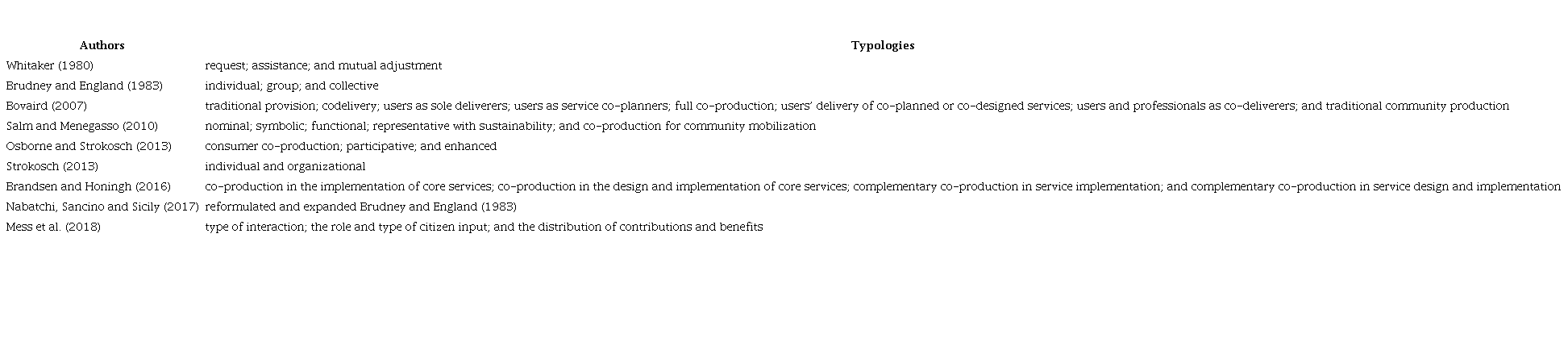
Whitaker’s study (1980) can be considered a classic on typology for co-production of the public good. It was one of the first studies on the subject, bringing three different forms of citizen action in co-production, classified as follows: by request; assistance in the provision of services; and mutual adjustment between the citizen beneficiary of the services and the public provider.
The author sees the state as the protagonist of the actions, associated with the ideas of efficiency, effectiveness, cost reduction and quality improvement in public service delivery. Citizen participation occurs when a citizen requests the provision of a service or when he/she provides assistance to public agents, cooperating voluntarily, or when citizens and public agents interact and adjust, in order to define the actions of each part, according to the expectations for the service.
Although public agents can suggest options, illustrate techniques, supply encouragement and provide guidance on the provision of services, public agents alone are unable to bring about change. Indeed, rather than the agent presenting a “finished product” to the citizen, both agent and citizen together can produce the desired transformation in the provision of a particular service, thus developing co-production. Such citizen participation is often critical to the success of the project.
The first type of co-production arises when citizens request assistance from public agents. It should be noted that service delivery generally depends on this initiative. The requests define the operational capacity of the agency, whose workload is largely directed to customer service. In this type of co-production, citizens can overload a particular service provider, such as the police or firefighters, with unnecessary requests.
Another type of co-production occurs when citizens provide assistance to public agents, which is a behavior that influences the execution of public policies. Some examples in this sense are parents acting in the education of their children, and residents acting to collaborate towards the public security of their neighborhood. This typology is also addressed by Bovaird (2007) when he points out individuals delivering a service designed by professionals. Such a cooperation has a continuous effect on the content of public policies, since citizens and public agents interact to adjust each other’s expectations and service actions.
The third type of co-production arises from said interaction, characterized by the mutual adjustment between the parties, aiming to jointly analyze a given problem, understand the collective needs, and define each part’s actions. In this case, the citizen and the agent share the responsibility of deciding the action to be taken, although almost always the agent holds more resources. Though mutual adjustment does not apply to each and every type of public service, it is preferable for it to happen in the development of public policies.
Then, we suggest that the effects of this citizen/public agents partnership be addressed in future studies, starting from the following question: What are the effects of the co-production of the public good? We believe that studies that can analyze the (d)effects of co-production are quite relevant for the literature, and for public managers and Civil Society Organizations, as well.
Another classic study on typology for co-production of the public good is that of Brudney and England (1983). Their publication served as a starting point for other researchers, who adopted the typology presented therein for proposing new models or even reformulation and expansion (NABATCHI; SANCINO; SICILIA, 2017). Brudney and England classified the types of co-production into individual, group and collective.
In individual co-production, citizens engage in co-production activities which, in most cases, require little effort and confer on them the status of the greatest beneficiary. When in a group, individuals join public officials to achieve coordinated activities, favoring communities or a group of people. Finally, collective co-production provides great advantages to everyone, regardless of their participation in the provision of the service; however, this requires the involvement of many individuals.
We believe that this typology can be addressed in future studies and can point out the level of sociability of the citizens who co-produce in order to understand their level of participation, as well as the motivations that took them to that level.
In turn, the model of Bovaird (2007) sees the co-production of regular service providers and users in a more lasting and consistent way. Bovaird presented a model for understanding the emerging role of users and the community in co-production. Bovaird also pointed out that the formulation of public policies is a negotiation involving many integrated political systems rather than just a process imposed from the top down.
The typologies addressed by Bovaird expand the possibilities of relationships between professionals, service users, and their communities. Such typologies present the main arenas of interaction in service design and provision, showing, in practice, the need to unite professionals and users. With this, Bovaird proposed a model based on case studies in the United Kingdom and pointed out eight possibilities of service production and delivery resulting from the relationship between regular providers and users. The levels are classified from traditional provision (level 1) to traditional community production (level 8), according to Table 1.
| Professionals as sole service deliverer | 1. Traditional professional service provision | 2. Citizens and professionals co-plan/co-design; service delivered by professionals | Not applicable |
| Professionals and users/communities as service co-deliverers | 3. Services designed by professionals only and co-delivered with users | 4. Full co-production; services co-designed and co-delivered by users and professionals | 5. Services delivered by users and professionals; little formal planning |
| Users/communities as sole service deliverers | 6. Services planned by professionals only and delivered by users | 7. Citizens and professionals co-plan; services delivered by users deliver services | 8. Traditional self-organized community provision |
Co-production essentially occurs at levels 4, 5, and 6, when professionals and users co-produce and co-deliver services. At levels 1 to 3, users participate symbolically or passively, only delivering services planned or designed by regular providers. Finally, at levels 7 and 8, the services are basically produced by users, with minimal participation of professionals in service delivery, or even no co-production or co-delivery.
Within a system in which services are largely provided by traditional and professionalized methods, it is worth highlighting the potential that citizens have to be involved in planning and designing a given task. The ideal is for users and professionals to fully share the phases of planning, designing, and delivering the service. One example of full co-production is neighborhood watch, where users work with the police and local authorities to increase local security.
Based on the work of Bovaird (2007), we suggest that studies be developed to analyze the participation of citizens in the public policy phases of co-production of the public good as a form of service provision or goods delivery. In addition, Salm and Menegasso (2010) proposed models of co-production of public services based on typologies of participation. To this end, they relied on the works on citizen participation by Arnstein (1969), Pretty (1995) and White (1996), as well as studies on public service co-production. Then, they related the two things and created the conceptual model of co-production of public services presented in Table 2.
| Nominal | It is a strategy for producing public services in which people in the community, preferably volunteers, and the public administrative apparatus of the state share responsibilities with the sole purpose of making these services efficient. | There is no effective participation and power of the citizen over the state. |
| Symbolic | It is a strategy to involve citizens in the production of public services to demonstrate the presence of the State. | Co-production almost always has a manipulative character and serves to demonstrate the effectiveness of the State. |
| Functional | It is a strategy used by the public apparatus of the state to produce public services more efficiently and effectively with the participation of individuals, a group, or a community. | It occurs through requesting services, assistance, or by mutual adjustment with the State. |
| Representative with sustainability | It is the result of the synergy that takes place in public service delivery in which citizens, community organizations, and the administrative apparatus of the state participate, which, as a whole, interact for the common good. | This model requires the civic engagement of citizens and the community. Co-production results from the delegation of power by the state and its interaction with the citizens. |
| Co-production for community mobilization | It is a strategy for delivering public services in which the whole community participates, guided by ethical principles and normative democracy, with the purpose of keeping the society permanently mobilized. | Permanent mobilization of the community, and overcoming the bureaucratic organization. |
Nominal co-production or non-participation is understood as the strategy of public service production in which citizens and the State share responsibilities with the sole purpose of making services more efficient. Symbolic co-production, in turn, can have a manipulative character and be used strategically to involve citizens in service delivery so as to demonstrate the presence of the State. The authors warned that, in these two types of co-production, there is a risk of manipulation and use of co-production to “calm the spirits” of citizens, without effectively sharing the power.
Functional co-production is based on results; it is another strategy to be used by the State to offer more efficient and effective services with the participation of the citizens, whether individually, collectively, or in groups. Another type is representative co-production with sustainability, which relies on the delegation of State power, and the civic engagement of citizens and the community to ensure synergy with the State to provide public services. Finally, co-production for community mobilization proposes a transformation in society in general towards public service delivery. In this latter type of co-production, citizens and the State become permanently mobilized and guided by ethical principles and normative democracy.
Similarly, Osborne and Strokosch (2013) were influenced by areas of Public Administration and service management to propose the modes of co-production of public services classified into: consumer, participative, and enhanced. Based on the theory of service, consumer co-production sees the user as a client or consumer, who has production and consumption as inseparable processes in service delivery. In this type, users are not involved with designing the services.
Participative co-production promotes user interaction through participatory mechanisms at the strategic level of the organization. The citizen can engage in several stages of the process such as public service planning, production, and delivery. The other type, called enhanced co-production, seeks to carry out a transformative change in the existing paradigm of service delivery. It combines the other two types of co-production and enables the effective contribution of users in innovative service delivery.
We believe that combining the typologies proposed by Salm and Menegasso (2010) and Osborne and Strokosch (2013) can generate a theoretical model for studying the co-production of the public good, and they can be used to analyze the degrees of citizen participation in co-production processes.
Meanwhile, Strokosch (2013) proposed a typology of co-production at the individual and organizational levels. In the individual level, Strokosch uses the work classification cited above, which provides for consumer, participative, and enhanced co-production (OSBORNE; STROKOSCH, 2013). In the organizational level, she adopts the typology of Brandsen and Pestoff (2006), which classifies co-production into co-management and co-governance. This typology shows strong action of Civil Society Organizations, both in public service planning and delivery.
Strokosch created a matrix combining the individual and organizational co-production types. She also stressed that, even with all the existing differentiation across co-production types, whether by the degree of involvement or participation, it is necessary that they coexist, especially for forming alliances and collaboration agreements. The typological diversity also allows the public agency to have access to the knowledge, resources, and capacities of those involved in the service.
Nevertheless, Brandsen and Honingh (2016) set out to distinguish different types of co-production, based on a conceptual analysis of the classical definitions on the subject. According to those authors, identifying the several typologies is essential to make the research in co-production more comparable. Their classification takes into account the nature of the service (core or complementary) and the degree of citizen participation (implementation or design and implementation), as presented in Table 3.
| Complementary | Complementary co-production in implementation | Complementary co-production in service design and implementation |
| Noncomplementary | Co-production in the implementation of core services | Co-production in the design and implementation of core services |
Then, we have four types of co-production: in the implementation of complementary services; in the implementation of core services; in the design and implementation of complementary services; and in the design and implementation of core services. The last type is the one that allows the greatest involvement of citizens, both in service planning and delivery, allowing greater engagement and quality improvement.
First, co-production in the design and implementation of a complementary service consists in the participation of citizens in activities that are complementary to an organization’s core service delivery, such as, for example, planning and holding a school prom party. Another type is co-production in the implementation of a complementary service that is not the core activity of the public agency; one such example is the collaboration of citizens to clean a hospital.
The third type is co-production in the design and implementation of a non-complementary service. In this case, citizens participate in the core activities of the organization and are considered essential in service planning and delivery. Finally, co-production in the implementation of a non-complementary service involves citizens in the core activity of a public agency; however, they do not participate in the design phase.
In turn, when Nabatchi, Sancino and Sicilia (2017) present and define the types of co-production, their intended contribution is for professionals and public managers to be able to select the type of co-production that best aligns with the goals and purposes of the public policy. The authors used the typology of co-production of Brudney and England (1983) and added four phases (commissioning, design, delivery, and assessment) to that model. Combining the types and phases generates a 3x4 co-production typology, which varies according to the characteristics of what is co-produced, who co-produces, and when the co-production occurs.
The four added phases refer to the public policy cycle. They help define when the activity was performed, what was produced, and more accurately capture existing applications in the literature. The commissioning phase is equivalent to the stages of problem identification, service priority, and creating an agenda. Design refers to activities used to create, plan for, or arrange services. Delivery concerns the activities used to provide or improve the provision of public services, while assessment is intended to assess the quality of the services provided. In any of such phases, all the three levels (individual, group, and collective) are possible to occur.
The types of co-production tend to vary in three aspects: quantitative (number of participants), representative (who they represent) and temporal (when they occur). So, the typology developed by Nabatchi, Sancino and Sicilia is able to describe and define several forms, since the number of actors, the location, and the size of the co-production activity can change according to the phases. However, the authors do not discuss the risks of the model; the risks of both the model proposed by Nabatchi, Sancino and Sicilia (2017) and the other models addressed in this study may lead to future research. Scholars or critics of co-production of the public good can focus on improving or criticizing the various models presented.
The risks inherent in the creation of models should be observed when classifying or proposing a classification, according to Mees et al. (2018), who gathered three typologies to understand the forms of co-production related to flood risk governance, relying on the other types identified in different areas of public policy. They understood that a comprehensive approach to the concept of co-production would be required to sufficiently capture its occurrence in reality.
The three complementary typologies proposed are the following: (I) the type of interaction between government and citizens (hierarchical, incentivized, deliberative); (II) the role and type of citizen input (complementary co-funding, complementary co-delivery, complementary co-production of knowledge, substitutive co-funding, substitutive co-delivery, and substitutive co-production of knowledge); and (III) the distribution of contributions and benefits (private individual co-production, philanthropic individual co-production, private collective co-production, and philanthropic collective co-production).
The categories of the first typology (interaction between governments and citizens) are not entirely exclusive. Hierarchical and incentivized co-production is directed by the government, while deliberative co-production allows the formation of more government-citizen relations based on partnerships. In this case, there may exist a certain overlap between these categories. The second type (the role and type of citizen input) refers to the model of Brandsen and Honingh (2016) mentioned earlier.
Meanwhile, the third (the distribution of contributions and benefits), differentiates the individual and collective forms of co-production, depending on who contributes and who benefits from the co-produced services. This classification was created by Bovaird et al. (2015), based on a co-production study in the areas of health, safety, and the environment. “Private individual co-production” is provided individually for the exclusive benefit of the person directly involved in the activity. “Philanthropic individual co-production” is provided individually for the benefit of a larger group of people.
“Private collective co-production” is provided by a group of citizens for the exclusive benefit of those directly involved in the activity. Finally, “philanthropic collective co-production” is provided by a group of citizens for the benefit of a larger group of people. Given the complexity of the model proposed by Mees et al. (2018), we suggest that future studies may break down typologies and compare them in specific sectors. In the concluding section of this paper, next, we present the synthesis of knowledge, with the objective of enabling the replication of this study.
5 CONCLUSIONS
This paper aimed to present the state of the art of the typologies of co-production of the public good. The SRL went through all the proposed stages, namely: outlining the theme and defining the research question; explaining the way the studies were retrieved, resulting in 105 papers; applying inclusion and exclusion criteria, which generated the pre-selection of 15 papers; categorizing the selected studies; analyzing and interpreting the data; creating a synthesis matrix with the 9 papers analyzed; and presenting the following conclusions.
Thus, the integrative review of the literature on co-production typologies concluded that each author herein presented contributed theoretically and/or empirically to the advance of studies on the topic of co-production of public goods. In addition to showing the state of the art on the subject, this review aimed to allow the production of new knowledge based on its results. A significant contribution consists in the possibility of developing future studies suggested throughout the text, and in creating conceptual models and, subsequently, building typology scales.
Considering the types addressed, the variety and complexity of the co-production models are noteworthy. This study found that there is no single model or typology for co-production. The authors herein presented recognized the specific applicability of their studies to the sector on which they focused and recommended that the models be tested or adapted to other areas. After relating different typologies of co-production, we acknowledge the complexity of the theme and the difficulty to propose a universal model. Recognizing the variety of concepts and typologies is essential so scholars studying this subject can compare different co-production cases and experiences, and assess the level of citizen involvement.
This SRL contributes to advancing the theme of co-production of the public good, since it can be used by public managers and Civil Society Organizations to create public policies that include the citizens in service delivery. Identifying the typologies and the various forms of citizen participation in co-production processes will enable these agents to more easily implement the co-production of the public good as a management tool.
The studies herein analyzed are concentrated in the last decade, except for the classics Whitaker (1980), and Brudney and England (1983), which served as the basis for the others. For the most part, the studies advanced by using existing theoretical arguments. Qualitative studies mainly conducted in developed countries were predominant; therefore, the results found may not reflect the typologies for co-production in Brazil.
In this sense, it is worth highlighting the work of the Brazilian authors Salm and Menegasso (2010), who considered the participation and involvement of citizens to different degrees to propose a conceptual model of co-production. However, they recognize the limitations of their study and leave it up to those interested in the topic to improve the model. So, this is a knowledge gap that can be explored to deepen the studies on the types of co-production in Brazil.
It is noteworthy that this research faced sampling limitations, since it occurred within a specific time frame. Another limitation was the lack of depth of the studies analyzed, which sometimes replicated existing theoretical arguments.
REFERENCES
ALFORD, J. The multiple facets of co-production: Building on the work of Elinor Ostrom. Public Management Review, v. 16, n. 3, p. 299-316, 2014.
ANHEIER, H.K; LIST, R. A. A Dictionary of Civil Society, Philanthropy and the Nonprofit Sector. Londres; Routledge, 2007.
ARNSTEIN, S. R. A Ladder Of Citizen Participation. Journal of the American Institute of Planners. Routledge, v. 35, n. 4, 1969.
AIYAR, Y. Invited spaces invited participation: effects of greater participation on accountability in service delivery. India Review, v. 9, n. 2, p. 204-229, 2010.
BOTELHO, L. L. R.; CUNHA, C. C. A.; MACEDO, M. O método da revisão integrativa nos estudos organizacionais. Gestão e Sociedade, v. 5, n. 11, p. 121-136, 2011.
BOVAIRD, T. Beyond Engagement and Participation: User and Community Coproduction of Public Services. Public Administration Review, v. 67, n. 5, p. 846–60, 2007.
BOVAIRD, T. et al. Activating citizens to participate in collective co-production of public services. Journal of Social Policy, v. 44, n. 1, p. 1-23, 2015.
BOVAIRD, T.; LOEFFLER, E. From engagement to co-production: the contribution of users and communities to outcomes and public value. VOLUNTAS: International Journal of Voluntary and Nonprofit Organizations, v. 23, n. 4, 2012.
BRANDSEN, T.; HONINGH, M. Distinguishing different types of coproduction: a conceptual analysis based on the classical definitions. Public Administration Review, v. 76, n. 3, p. 427-435, 2016.
BRANDSEN, T.; PESTOFF, V. Co-production, the third sector and the delivery of public services: an introduction. Public Management Review, v. 8, n. 4, p. 493-501, 2006.
BRUDNEY, J. L.; ENGLAND, R. E. Toward a definition of coproduction concept. Public Administration Review, v. 43, n. 1, p. 59-65, 1983.
COOPER, T. L.; KATHI, P. C. Neighborhood councils and city agencies: a model of collaborative coproduction. National Civic Review, v. 94, n. 1, 2005.
DOS-REIS, M. C. A.; ISIDRO-FILHO, A. Inovação em Serviços e a Coprodução no Setor Público Federal Brasileiro. Administração Pública e Gestão Social, v.12, n.1, 2019.
FLEURY, S. Democracia com exclusão e desigualdade: a difícil equação. Programa das Nações Unidas para o Desenvolvimento–PNUD. 2004.
GALVAO, T. F.; PEREIRA, M. G. Revisões sistemáticas da literatura: passos para sua elaboração. Epidemiol. Serv. Saúde, Brasília, v. 23, n. 1, p. 183-184, mar. 2014.
GANONG, L. H. Integrative reviews of nursing research. Research in Nursing & Health, Hoboken, v. 10, n. 1, p. 1-11, Mar. 1987.
LOTTA, G. S. Redes e parcerias em políticas sociais: novos arranjos institucionais de coprodução de serviços nos municípios brasileiros. Brasília, DF: Enap, 2017.
MCMULLIN, C. The Role of Public Servants in Supporting Local Community Projects: Citizen-Led Co-production in Quebec. In: Sullivan H., Dickinson H., Henderson H. (eds.) The Palgrave Handbook of the Public Servant. Palgrave Macmillan, Cham. 2020.
MEES, H. et al. Typologies of citizen co-production in flood risk governance. Environmental Science & Policy. V. 89, p. 330–339. 2018.
NABATCHI, T.; SANCINO, A.; SICILIA, M. Varieties of participation in public services: The who, when, and what of coproduction. Public Administration Review, v. 77, n. 05, p. 766–776. 2017.
NEBOT, C. P.; et al. Coproducción E Incidencia De La Sociedad Civil En La Política De Residuos Sólidos En Belém, Amazonia. Administração Pública e Gestão Social, Vol. 12, nº 2, 2020.
NESHKOVA, M.I. Does agency autonomy foster public participation? Public Administration Review, 74. 2014.
OSBORNE, S. P. Delivering Public Services: Time for a new theory? Public Management Review 12(1):1-10. 2010.
OSBORNE, S.P.; STROKOSCH, K. It takes two to tango? Understanding the Co production of public services by integrating the services management and public administration perspectives. British Journal of Management, v. 24, 2013.
OSTROM, E.; DAVIS, G. Public Economy Approach to Education Choice & Co-Production. International Political Science Review, v. 12, p. 313-335, 1991.
OSTROM, E. Collective action and the evolution of social norms. Journal of Economic Perspectives, v. 14, n. 3, p. 137–158, 2000.
PESTOFF, V. Citizens and co-production of welfare services. Public Management Review, v. 8, n. 6, p. 503-519, 2006.
PESTOFF, V.; BRANDSEN, T.; VERSCHUERE, B. New public governance, the third sector and co-production. London: Routledge, 2013.
PRETTY, J. N. Participatory learning for sustainable agriculture. World Development, Elsevier, v. 23, n. 8, p. 1247-1263. 1995.
RAMOS, A. G. A nova ciência das organizações: uma reconceituação da riqueza das nações. Rio de Janeiro: Fundação Getúlio Vargas, 1981.
RANTAMÄKI, N. J. Co-production in the Context of Finnish Social Services and Health Care: A challenge and possibility for a new kind of democracy. International Journal of Voluntary and Nonprofit Organizations Impact Factor, v. 28, n. 1, p. 248-264, 2017.
RYAN, B. Co-production: option or obligation? Australian Journal of Public Administration, v. 71, n. 3, p. 314-324, 2012.
SAETREN, H. Implementing the third generation research paradigm in policy implementation research: an empirical assessment. Public Policy and Administration, v. 29, n. 2, p. 84-105, 2014.
SALM, J. F. Coprodução de bens e serviços públicos. In: BOULLOSA, Rosana de Freitas (org.). Dicionário para a formação em gestão social. Salvador: CIAGS/UFBA, p. 42-44, 2014.
SALM, J. F.; MENEGASSO, M.E. Proposta de modelos para a coprodução do bem público a partir das tipologias de participação. In: ENCONTRO CIENTÍFICO DE ADMINISTRAÇÃO DA ASSOCIAÇÃO NACIONAL DE PÓS-GRADUAÇÃO E PESQUISA EM ADMINISTRAÇÃO - ANPAD. 34., 2010. Anais [...]. Rio de Janeiro: Anais, CD-ROM, 2010.
SCHOMMER, P.C. et al. Coprodução e inovação social na esfera pública em debate no campo da gestão social. In: SCHOMMER, P.C.; BOULLOSA, R.F. Gestão social como caminho para a redefinição da esfera pública. Florianópolis: Udesc Editora, Coleção Enapegs, v. 5, p. 31-70, 2011.
SCHOMMER, P. C.; TAVARES, A. O. Gestão Social e Coprodução de Serviços Públicos. In: Curso de Gestão Social. Fundação Demócrito Rocha, UANE. Fortaleza, 2017.
SCHON, D. A. Beyond the stable state. New York: Randon House, 1971.
SOUZA, V. B. A coprodução do bem público aplicada aos projetos de Administração Pública premiados pelas nações unidas. Dissertação (mestrado) – Universidade Federal de Santa Catarina, Centro Sócio-Econômico, Programa de Pós-Graduação em Administração, Florianópolis, 2015.
STROKOSCH, K. Co-production and innovation in public services: can co-production drive innovation? In: OSBORNE, S. P.; BROWN, L. (eds.). The Handbook of Innovation in Public Services. Edward Elgar Publishing Limited, Massachusetts, USA, p. 375-389. 2013.
TORRACO, R. J. Writing integrative literature reviews: guidelines and examples. Human Resource Development Review, v. 4, n. 3, p. 356-367, 2005.
WHITAKER, G. P. Coproduction: citizen participation in service delivery. Public Administration Review, v. 40, p. 240-246, 1980.
WHITE, S. C. Depoliticising Development: The Uses and Abuses of Participation. Development in Practice, v. 6, n. 1, p. 6–15. 1996.
WHITTEMORE, R.; KNAFL, K. The integrative review: updated methodology. Journal of Advanced Nursing, Oxford, v. 52, n. 5, p. 546-553, Dec. 2005.