Artigos
Port-logistics service level: comparative study of the ports of Rio Grande and Itapoá for exports of auto parts produced in the State of Rio Grande do Sul
Port-logistics service level: comparative study of the ports of Rio Grande and Itapoá for exports of auto parts produced in the State of Rio Grande do Sul
Gestão & Regionalidade, vol. 39, e20236815, 2023
Universidade Municipal de São Caetano do Sul
Recepción: 19 Abril 2020
Aprobación: 30 Octubre 2022
Abstract: Ports are of outstanding importance to economy and international trade, representing links that can contribute to the companies’ competitiveness. Given this context, this study aimed to comparatively analyze the ports of Rio Grande and Itapoá from the point of view of exporters, in relation to the shipment of auto parts manufactured in the State of Rio Grande do Sul. Considering this objective and taking into account the main port-logistics service level criteria from the literature, a survey with managers of companies in this sector was carried out. The collected data were analyzed using descriptive statistical procedures and multiple regression analysis. The results indicated port costs and port efficiency as statistically significant criteria. Together, these criteria were able to explain 55.9% of the general assessment of the Port of Rio Grande compared to Itapoá, constituting critical factors for the competitiveness of these two ports from the respondents’ perspective.
Keywords: exports, auto parts industry, port-logistics service level, Southern Brazil.
Resumo: Os portos têm destacada importância para a economia e o comércio internacional, representando elos que podem contribuir para a competitividade das empresas. Dado esse contexto, este trabalho teve como objetivo analisar comparativamente os portos de Rio Grande e Itapoá, pela ótica de exportadores, em relação ao embarque de autopeças fabricadas no Estado do Rio Grande do Sul. Considerando-se esse objetivo e levando em conta os principais critérios associados ao nível de serviço logístico-portuário identificados na literatura, foi realizada uma survey orientada aos gestores das empresas desse setor e região. Os dados coletados foram analisados mediante procedimentos de estatística descritiva e análise de regressão múltipla. Os resultados indicaram como critérios estatisticamente significantes os custos portuários e a eficiência portuária. Juntos, esses critérios foram capazes de explicar 55,9% da avaliação geral do Porto de Rio Grande comparativamente ao de Itapoá, constituindo fatores críticos para a competitividade desses dois portos pela ótica dos respondentes.
Palavras-chave: exportação, indústria de autopeças, nível de serviço logístico-portuário Sul do Brasil.
1 Introduction
The growing internationalization of world economies and the composition of a more globalized market is an irreversible process to which companies that wish to expand their business will have to adapt (VIEIRA, 2003). These accelerated changes of globalization clearly impact the daily life of companies, demanding greater capacity for understanding, adaptability and planning in organizations (BALLOU, 1993; KOBAYASHI, 2000).
According to Keedi (2011), the expansion of globalization and internationalization requires nations to perform better in the flow of their production. And, for this flow, the transport sector plays a fundamental role in international trade. The different modes of transportation, linked to several other factors such as storage, movement, time, quality and price, can mean the success, or not, of international trade.
The logistics system is essential both for companies and for the development of the economy. This makes companies working in this sector increasingly concerned with the available infrastructure (COLATIVE; KONISHI, 2015). In this sense, Ballou (1993) argues that an improved transport system helps to increase competition in the market, guarantee an economy of scale in production and, therefore, reduce the prices of goods.
The maritime modal has stood out throughout history as an important means of displacement and movement of goods between nations. And in Brazil, which has a vast coastline, this modal also plays an important strategic role for the integration of the different regions of the country (BRASIL, 2017).
According to Monié and Vidal (2006), ports are fundamental for the advancement of foreign trade and for the maritime transport system. In addition, port services are essential for a country’s economy. This is due to the fact that the efficiency and dynamics of a port are not limited to the port business and maritime transport, also impacting the development of its regions of influence. As a result, a port should not be analyzed only from a technical and operational point of view. It is not just a corridor, but a service tool for trade and economic development (MONIÉ; VIDAL, 2006).
The southern region of Brazil, for example, has shown an important evolution of investments in the port sector. Just considering the State of Santa Catarina, there are five different port facilities in operation: Itapoá, São Francisco do Sul, Navegantes, Itajaí and Imbituba. There is still Paranaguá, located in the State of Paraná, and the port of Rio Grande, in the State of Rio Grande do Sul. The present study focuses on the ports of Rio Grande and Itapoá, as they are among the main port alternatives considered by industries located in the State of Rio Grande do Sul, both for loading export cargo and for unloading import cargo.
In Brazil, according to Art. 2 of Law nr. 12.815/2013 (BRASIL, 2013), there are different types of port facilities. The two most relevant for the movement and storage of export and import goods are the organized ports and the private use terminals.
An organized port is understood as a public property built and equipped to meet the needs of navigation, passenger movement or the movement and storage of goods, whose operation is under the jurisdiction of a Port Authority (BRASIL, 2013). These public ports can be operated directly by the Federal Government, delegated to States and Municipalities, or granted to the private sector. Thus, the Port Authorities responsible for the management of these ports may be federal, state, municipal or private entities.
Although organized ports have been public assets since the old Ports Law, operations in these ports are usually private, carried out by duly accredited port operators. These port operators may or may not be tenants of port areas.
The predominant port model in Brazilian organized ports is the landlord (WORLD BANK, 2007). In this model, the Port Authority is a public entity, but the operations are carried out by private operators, who have leased areas of the organized port. In this type of model, the infrastructure (common to all operators) is public, while the superstructure is private (belongs to tenants).
On the other hand, private use terminals (TUPs) are port facilities operated with authorization and located outside the areas of organized ports (BRASIL, 2013). Unlike organized ports, which are public in nature, these facilities are completely private, being usually constituted through greenfield projects (in which the authorized company invests its resources in the construction of the necessary structure for the port operation).
In addition to organized ports and TUPs, Law No. 12,815/2013 also defines three other types of port facilities. They are: (i) the cargo transhipment station, which is a port facility operated with authorization, located outside the organized port area and used exclusively for transhipment of goods on inland navigation or cabotage vessels; (ii) the small public port facility, which is also operated with authorization and located outside the organized port, but its use is oriented to the movement of passengers or property in inland navigation; and (iii) the tourism port facility, which can be located inside or outside the organized port (and can therefore be operated through authorization or leasing contracts) and is used for boarding, disembarking and transit of passengers, crew and luggage, as well as structures for the provision and supply of tourist vessels (BRASIL, 2013).
Located in the southern half of Rio Grande do Sul, the Port of Rio Grande is an organized port that has a leased terminal specializing in container throughput (Tecon Rio Grande). The port of Rio Grande (RIG) moves cargo mainly from the states of Rio Grande do Sul and Santa Catarina, in addition to some regions of neighboring countries such as Uruguay, southern Paraguay and northern Argentina, according to the Brazilian Research Company Agriculture (BRASIL, 2019).
Porto Itapoá (IOA), located in the north of Santa Catarina, is a Private Use Terminal (TUP) that began operating in June 2011 (PORTO ITAPOÁ, 2020). The port operates with cargo that has as origins and destinations the States of Santa Catarina, Rio Grande do Sul, Paraná, São Paulo, Rio de Janeiro, Espírito Santo, Mato Grosso, Mato Grosso do Sul and Paraguay (PORTO ITAPOÁ, 2020).
It is observed that these two port facilities have similar container throughput. Table 1 shows the movement in Twenty Feet Equivalent Unit (TEU) in the ports of Rio Grande and Itapoá in the period from 2016 to 2020.
Table 1 -Handling of containers in the studied ports from 2016 to 2020, total and by direction (in TEU)
| 2016 | 354.907 | 350.247 | 705.154 | 281.873 | 265.806 | 547.679 |
| 2017 | 373.100 | 370.617 | 743.717 | 299.582 | 292.722 | 592.304 |
| 2018 | 370.471 | 366.496 | 736.967 | 322.194 | 312.003 | 634.197 |
| 2019 | 340.128 | 339.782 | 679.910 | 372.025 | 363.114 | 735.139 |
| 2020 | 330.859 | 325.774 | 656.633 | 358.744 | 353.902 | 712.646 |
Source: Prepared by the authors based on the Antaq’s Yearbook (2021)
Analyzing the total container throughput in the considered period, a drop can be observed in the port of Rio Grande in the last three years. On the other hand, in the case of Itapoá, there was a growth in the first four analyzed years. The only contraction occurred in 2020, when the movement was 3% lower than in 2019.
As a result, the port of Itapoá began to handle more containers than the port of Rio Grande as of 2019 (Figure 1), which justifies analyzes of port choice involving these ports. It should be noted that, in 2019 and 2020, the difference in container throughput of the two ports remained relatively constant.
Figure 1 -Evolution of container handling in the ports studied from 2016 to 2020 (in TEU)
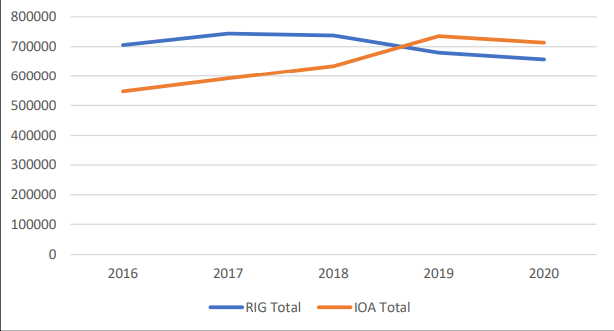
Figure 1
Evolution of container handling in the ports studied from 2016 to 2020 in TEU
Source: Prepared by the authors based on the Antaq Yearbook (2021)
The distances between Caxias do Sul (the most economically representative city in the Serra Gaúcha region) and the ports of Rio Grande and Itapoá are, respectively, 434 km and 588 km, considering the shortest routes. The distances from Porto Alegre to those ports, also using the shortest routes, are 320 km for Rio Grande and 699 km for Itapoá. Therefore, due to their geographical location (Figure 2), the two port facilities analyzed (Tecon Rio Grande and Porto Itapoá) compete for cargo from Serra Gaúcha and the Metropolitan Region of Porto Alegre. This justifies the comparative analysis of these facilities as alternatives for the export of products manufactured in that State, considering, in the case of the present study, the auto parts.
Figure 2 -Location of regions and studied ports
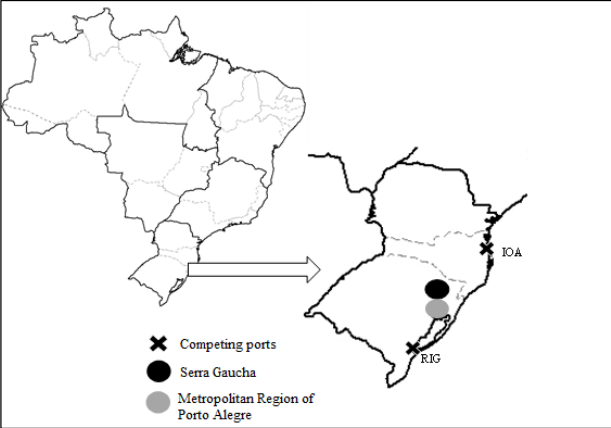
Figure 2
Location of regions and studied ports
Source: prepared by the authors
The automotive sector plays a significant role in the global industry. And the auto parts constitute a fundamental element for the automotive chain. The Brazilian auto parts sector is made up of companies located in 19 states in the country, the main ones being São Paulo, Minas Gerais, Rio Grande do Sul, Paraná and Santa Catarina.
Information from the Ministry of Economy, Industry, Foreign Trade and Services (BRASIL, 2016) indicates that auto parts manufacturers in Brazil associated with the National Union of the Component Industry for Motor Vehicles (SINDIPEÇAS) are located in ten states. In all, there are 590 companies, with revenues of US$ 18.1 billion, generating 162.2 thousand jobs.
According to a survey carried out by the National Union of the Component Industry for Motor Vehicles (SINDIPEÇAS, 2018), the 2017-2018 result brought an optimistic balance in relation to the 2014-2016 period. The results were relevant throughout the chain, especially for exports, which had an increase of 26.5%. According to data from Sebrae (2015), Rio Grande do Sul is an active state in the auto parts export segment, representing 5.4% of the total exported by the country.
On the other hand, transport, taking into account everything it involves, represents a significant part of the cost of exports, influencing the competitiveness of products sold. Inevitably, all economic sectors are more or less directly dependent on the functionality and efficiency of the transport sector (FERREIRA, 2013). Within this sector, maritime transport accounts for most of the volume of world trade, since it allows transporting different types of cargo in large quantities (FERREIRA, 2013).
For Ballou (1993), when defining the transport strategy, one must take into account, in addition to cost, the logistics service level, which is the quality with which the flow of goods and services is managed. The service level also includes the performance delivered by suppliers to their customers in meeting their demands and is directly associated with the costs of providing the service and planning the movement of goods (BALLOU, 1993). Controlling the logistics service level is essential, as it has an influence on revenue and costs (BALLOU, 1993). Therefore, it is a key element in the design and implementation of logistics strategies. Therefore, companies must be attentive to the product offered and also to the way it is offered, because when there is not an adequate logistics service level between buyer and supplier, little or no sales are generated (BALLOU, 1993).
In this context, it is important for companies, customs brokers, freight forwarders and international trade advisors to analyze and evaluate different logistics alternatives in exports and part of this analysis concerns the choice of the port of shipment. Since exports from the automotive sector in southern Brazil have been growing (SINDIPEÇAS, 2018), and considering that ports are important elements for the competitiveness of companies in the foreign market (PASQUALI et al., 2022), this study addresses port choices made by companies in this sector in the context of their export operations.
More specifically, the research question that supported the study was: What is the best port alternative for the export of auto parts from Rio Grande do Sul (Port of Rio Grande or Port of Itapoá)? To answer this question, the objective that led the study was to comparatively analyze the ports of Rio Grande and Itapoá, from the perspective of exporters, in relation to the shipment of auto parts manufactured in the State of Rio Grande do Sul.
2 Theoretical Background
This section presents the theoretical background that supported the development of this study. First, the main port concepts and their dimensions are addressed. Next, the concepts and main attributes related to the assessment of service level and port choice are presented.
2.1 Ports
According to Vieira (2003), a port is an enclosure of land and water that has facilities and machinery that allow the reception of ships, their loading and unloading; the storage of goods; the change of modal (sea-land and vice versa) and the development of commercial activities linked to transportation. Lacerda (2005) defines a port as a set of terminals established close to each other, which operate with a common structure (road access, rail and maritime channel). According to Porto and Silva (2000), ports are physically composed of facilities dedicated mainly to cargo and other activities permitted by Law No. 12,815/2013 (BRASIL, 2013).
According to Porto and Teixeira (2002), the port is an appropriate place for cargo movement that enables interaction and integration between modes of transport and their users. Monié and Vidal (2006) point out that the activities of a port are not limited to its physical facilities or capacity to receive and dispatch cargo. According to the authors, the activities around the ports must also be taken into account. In this sense, it is clear that ports should not be considered just as a tool for the development of technical or operational activities, but rather as trade facilitators and development inductors.
Ports are made up of different kinds of activities and should be able to help reduce logistics costs (MAZZA; ROBLES, 2004). Over the years, ports have gone from simple modal exchange points to service centers prepared to add value to goods (RODRIGUES, 2014). In this way, ports cannot be seen in isolation, but rather as a complex set of functions that are integrated with the life of the local community and with the actors related to it (AKABANE; GONÇALVES; SILVA, 2008).
As for their dimensions, Bussinger (1998) indicates that ports can be analyzed under three different aspects: (i) as nodes in logistics chains, linking different origins and destinations, and connecting maritime and land transportation; (ii) as economic agents, which influence the development of the places where they are inserted; and (iii) as physical entities, which have their own infrastructure and facilities from which activities are carried out, and which share space with other environments, whether natural or urban.
Currently, it is also possible to identify two other relevant dimensions of ports: environmental and social. Kitzmann and Asmus (2006) state that, gradually, the conservation of the environment has been used as a factor of sustainable competitive advantage, no longer being considered just an additional cost. With regard to the social dimension, Chaud and Rodrigues (2006) define it as a set of goals associated with improving the population’s quality of life, based on established indicators. The authors also observe that the port-city integration and the incorporation of social responsibility policies and practices, which include social development and job creation, generate advantageous effects in the region where the port is located (CHAUD; RODRIGUES, 2006). On the other hand, according to Almeida (2011), the lack of proper management of port-city relations can result in social problems such as sexually transmitted diseases, prostitution, poverty and the growth of drug trafficking around the port.
To analyze the port as a system, first the main actors in the port-logistics chain must be identified. According to Vieira (2013) and Vieira, Kliemann Neto and Ribeiro (2015), the port-logistics chain is composed of a set of actors whose functions are linked to the port and its management must focus on the alignment and coordination of these actors and the actions carried out by them, with the aim of increasing the efficiency and effectiveness of logistics flows, and the port competitiveness The port-logistics chain can be analyzed using two approaches: (i) through the territorial perspective, in which their impact on the development of the environment in which they are inserted is evaluated, considering aspects such as the organization of economic activities and the density of territorial concentration; and (ii) through the functional perspective, in which the activities carried out and the insertion of the port in global maritime transport networks are evaluated.
Sutrisnowati, Bae and Song (2015) point out that port-logistics operations involve many decisions for each process. For example, the positioning of a container on a ship is defined according to its size, type of cargo, destination, among other factors that, as a whole, bring more complexity. Vieira (2003) also points out that, in addition to traditional port services, related to the modal transfer of goods, ports can also provide other additional services, such as industrial services (related to cargo, ships or land vehicles); environmental services; administrative and commercial services; and logistics and distribution services (like storage and information services). Finally, Novaes and Vieira (1996) point out that organized ports are equipped with facilities, people and equipment that are available to users, who need to be served efficiently and uniformly.
2.2 Port-logistics service level
For Christopher (1997), due to changes in consumer perceptions in relation to technical differences between competing products, the search for differentials through added services has been expanding more and more, including those of logistics nature. In this context of seeking to add value through logistics services, transport is no longer seen only as a ‘derived demand’, becoming an important element of business decisions. And, when it comes to import and export operations, given the representativeness of the maritime transportation in international trade, the relevance of port choice becomes clear (THOMAZ E SERRA; MARTINS; BRONZO, 2009).
It is possible to verify in the literature the main port selection criteria from the point of view of shipowners and users (importers, exporters and freight forwarders). From the point of view of shipowners, factors such as location of the port and distance from the main shipping routes; port hinterland; capacity to receive large ships; efficiency in loading and unloading operations; wait times; and port tariffs stand out. On the other hand, from the perspective of users, factors such as frequency of ships; sea transit time; ocean freight; port costs; and land freight to the port or from the port to the place of destination are the main factors (VIEIRA et al., 2013; VIEIRA; GONÇALVES; DORION, 2015; GRISON et al., 2021; PASQUALI et al., 2022).
Mazza and Robles (2004) point out that the port choice in countries that have a large territory and a significant number of ports distributed along their coastline, as is the case of Brazil, involves an analysis of the scenario in which the port operation is involved, considering aspects such as the services offered by the port terminals, the installations and equipment for handling and storing cargo, the costs inherent to the services provided and, mainly, the efficiency of operations. Table 2 illustrates how Chou (2007) exposes the main port choice criteria and then divides them into sub-criteria.
Table 2 -Port choice criteria and sub-criteria
| Criteria | Sub-criteria |
| Port location | Proximity to the import and export area Proximity to feeder ports Proximity to main shipping routes |
| Port hinterland | Quantity of imports and exports Number of transhipment containers Frequency of ships |
| Port infrastructure | Infrastructure availability Port installations and equipment Intermodal connections |
| Port efficiency | Competence in handling containers Length of mooring time Terminal efficiency Efficiency in customs services |
| Costs | Port tariffs Intermodal freight costs |
| Other criteria | Information system Free trade zones Port development plans |
Source: adapted from Chou (2007).
The criteria presented in Table 2 largely converge with recent research on the subject. As examples, can be mentioned the studies carried out by Boontaveeyuwat (2018) and Rezaei et al. (2018), and the literature review on port choice conducted by Martínez-Moya and FeoValero (2017).
According to Porto and Silva (2000), for a company to be competent in international trade, in addition to quality, it is necessary to have competitive prices. These prices are influenced by logistics costs, part of which are related to port activities. Porto and Silva (2000) also point out that port costs can be divided into two types: (i) those of a public nature; and (ii) those of a private nature. Public costs are included in the port tariffs and refer mainly to services related to maritime infrastructure, the berthing of vessels and land infrastructure. Private costs, in turn, are related to cargo handling and storage performed by port operators, in addition to other types of services such as pilotage and ship towing. According to Ferreira and Campos Neto (2011), among the main costs incurred by users of national public ports are mooring, loading, unloading, transhipment and movement of products from the pier to the warehouses.
Port selection and port competitiveness have been topics widely discussed in the literature. Min and Partk (2019) highlighted the importance of analyzing port competitiveness and its relationship with the production chains in which ports are inserted. This issue is also emphasized by Talley and Ng (2017), Notteboom et al. (2017) and Rezaei et al. (2018). Notteboom et al. (2017) also stated that port users may have different needs, so that competitive strategies must be customized, which justifies the need to analyze the perception of shippers from specific sectors, as is the case of the auto parts sector in Rio Grande do Sul state, object of the present study. This statement converges with Martínez-Moya and Feo-Valero (2017), who also mentioned port choice in specific industries as a potential line of research. Therefore, this research is in line with the findings in the theoretical framework and addresses a relevant line of research.
3 Method
In this section, the method used in the present study is described. First, the characterization of the research is presented, and then the data collection and analysis procedures are reported.
As for the characterization of the research, it is possible to frame it as quantitative with a descriptive approach. It is quantitative because it aims to quantify and analyze the number of responses through predetermined techniques. And it is descriptive because the data obtained from the respondents through the application of questionnaires are described and analyzed.
As for the technical procedures used, data collection was carried out through a survey, which consists of searching for information through questionnaires (SAMARA; BARROS, 2002; MALHOTRA et al., 2005). The questionnaire proposed for this study was based on the port choice criteria described by Chou (2007) and presented in Table 1.
However, it was necessary to adapt two of these criteria. One of these criteria, the port hinterland, is subdivided into three sub-criteria: (i) volume of imports and exports; (ii) number of transhipment containers; and (iii) vessel frequency. The first two sub-criteria are related to port choice by shipowners and, for this reason, were not considered in the present study. Therefore, only the frequency of ships was considered, which is a key element in port choice by exporters.
The other criterion that underwent adaptations was the last one mentioned by Chou (2007), called ‘extra conditions’. This factor is subdivided into three sub-criteria: (i) information system; (ii) free trade zones; and (iii) port development plans. The second subcriterion does not apply because there are no zones of this type close to Rio Grande and Itapoá. And the third was not considered because, normally, exporters do not have access to information regarding the future development of ports, even more so in the case of private terminals, as is the case of Tecon Rio Grande and the Port of Itapoá. Therefore, in the questionnaire used to collect data for this research, only the ports’ information system was considered.
In view of this, the questionnaire considered the following port selection criteria: (i) port costs (which considers the amount spent by exporters to ship their goods from the ports under analysis); (ii) geographic location (which indirectly includes land transport costs to ports); (iii) frequency of ships (which considers the shipping lines that operate in ports and the frequency of shipping calls); (iv) physical infrastructure of the port (which involves the capacity to receive, move and store containers); (v) port efficiency (which is related to the average export dwell time, that is, the time spent from the entry of containers at the terminal to their loading on the ship); (vi) information system (which refers to timely and reliable information on the status of cargoes under the custody of the terminals); and general performance (with regard to the global assessment of the port, considering the previous variables and others that have not been contemplated. For purposes of validating the questionnaire’s content, it was shared with export managers of three companies, who carried out a pre-test in order to evaluate and point out possible adjustments to the instrument.
To collect the research data, a convenience sampling was carried out with companies that operate in the auto parts export segment, in addition to international trade advisory services, customs brokers and freight forwarders, who provide services to the exporting companies. According to information from the Ministry of Economy, Industry, Foreign Trade and Services (BRASIL, 2018), there are 74 auto parts manufacturing companies in the State of Rio Grande do Sul. This was the universe of the study with regard to manufacturing companies. As for customs brokers, international trade advisors and freight forwarders, indications made by the auto parts exporters were considered.
The questionnaire developed for the research consisted of 17 questions. The objective of questions 1 to 3 was to characterize the respondents. The four subsequent questions (questions 4 to 7) aimed to identify the profile of the companies to which the respondents were linked. The next three questions (questions 8 to 10) aimed to verify the main port of shipment used by companies in exports and the degree of knowledge of the respondents in relation to the Port of Rio Grande and the Port of Itapoá. And questions 11 to 17 were developed with the aim of analyzing the perception of respondents in relation to the performance of the Port of Rio Grande compared to the Port of Itapoá, both in terms of port choice criteria identified in the literature, and in general terms. For this, the following scale was used: 1. Much worse than Itapoá; 2. Worse than Itapoá; 3. Same as Itapoá; 4. Better than Itapoá; 5. Much better than Itapoá.
The questionnaires were sent by email, using the Google Forms online platform. A total of 78 completed questionnaires were obtained. Of these 78 questionnaires, 48 were considered invalid: two from respondents who declared having ‘low’ or ‘very low’ knowledge of the Port of Rio Grande; and 46 of respondents with ‘low’ or ‘very low’ knowledge of the port of Itapoá. After excluding invalid questionnaires, a total of 30 questionnaires were considered in the analyzes.
After collection, data were tabulated and analyzed using descriptive statistics procedures (mean and standard deviation) and multiple linear regression analysis. In the multiple regression analysis, the dependent variable was the evaluation of the overall performance of the Port of Rio Grande, compared to the Port of Itapoá, while the independent variables were the evaluations of the Port of Rio Grande, compared to the Port of Itapoá, in each of the port choice criteria considered.
4 Results
The results of the present study are organized into three sections. The first section presents the characterization of the respondents. In the second, the descriptive statistics of the respondents’ perceptions are analyzed in relation to the performance of the Port of Rio Grande, compared to the Port of Itapoá. And the third analyzes the impact of the different port selection criteria on the overall assessment of the respondents.
4.1 Characterization of respondents
Question 1 was designed to identify the respondents’ level of education. It was observed that 80% of the sample had completed higher education or had a postgraduate degree.
Question 2 sought to obtain data on the hierarchical level of respondents in companies. What was found was that 57% (17 respondents) hold support and analysis positions and 43% (13 respondents) hold commercial and management positions.
Question 3 was designed to identify the respondents’ department of activity to verify their level of interaction with the research topic. It was observed that 57% (17 respondents) work in the area of international trade; 27% (eight respondents) work in the commercial/logistics area; and 3% (one respondent) works as a customs broker. Therefore, 87% of respondents have direct interaction with the subject studied. The remaining 13% (four respondents), although classified in other sectors of the companies, also showed involvement with the researched topic.
Question 4 aimed to identify the location of the companies. Most are located in the city of Caxias do Sul (RS), representing 57% (17 respondents), followed by Porto Alegre (RS) with 33% (10 respondents). The other locations, with a less expressive number, represent 10% of the sample (three respondents).
Question 5 sought to verify the experience of companies with exports. It was noticed that 24 companies (80% of the sample) have been carrying out export processes for over 10 years; four companies (13%) have 5 to 10 years of experience; and two companies (7%) have been carrying out export processes for 3 to 5 years.
Question 6 aimed to identify the types of cargo exported by companies (Full Container Load - FLC or Less than Container Load - LCL). According to Vieira (2003), FCL is understood to be a container with cargo sent from a single exporter to a single importer. In this case, there is no sharing of container space by more than one company. On the other hand, LCL is understood to be a container with loads from several exporters, destined for several importers, with the shared use of the container by the companies (VIEIRA, 2003). As shown in Figure 3, companies use both modes, with a predominance of FCL shipments.
Figure 3 - Type of cargo exported
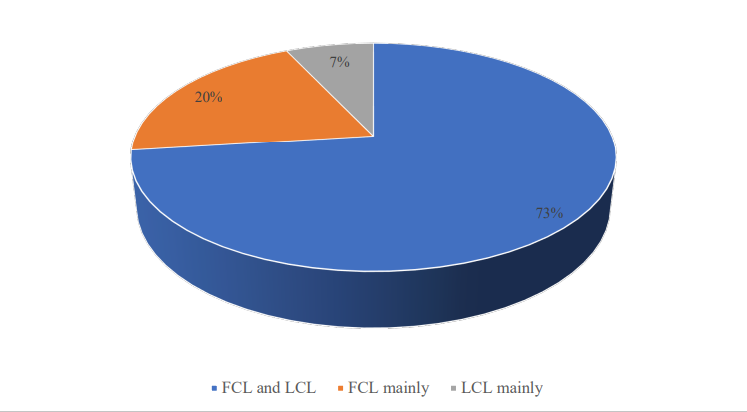
Figure 3
Type of cargo exported
Source: Prepared by the authors based on the research results
Question 7 aimed to obtain data on the annual number of exports carried out by companies. It is observed that 84% of the companies carry out at least 50 export processes per year, which shows a significant involvement with this type of activity (Figure 4).
Figure 4 - Annual number of export processes
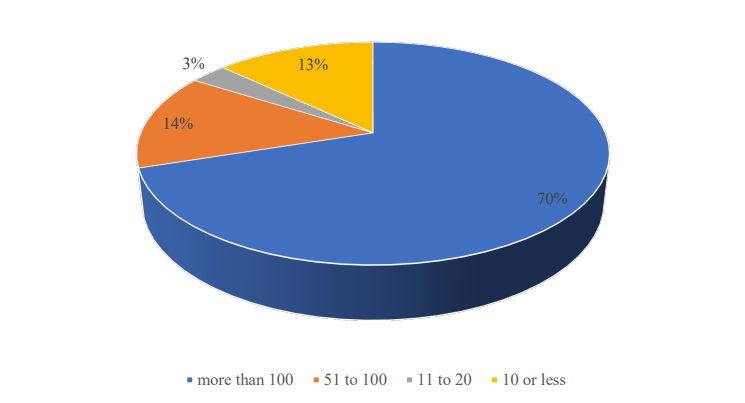
Figure 4
Annual number of export processes
Source: Prepared by the authors based on the research results
Question 8 sought to identify the main ports of loading used by companies. As the choice of more than one port was allowed for this question, the total number of responses (38) was greater than the sample size (30 companies). It was found that the Port of Rio Grande is the most used by the sampled companies, with 66% (25 responses), followed by Santos with 32% (12 responses) and Itapoá with 3% (one response).
Question 9 was designed to collect data on the respondents’ level of knowledge regarding the Port of Rio Grande. In this question, the following scale was used: Very Low, Low, Intermediate, High and Very High. The results showed that 87% of respondents have high or very high knowledge about this port, while 13% have intermediate knowledge.
Finally, question 10 had the objective of obtaining data on the level of knowledge of the respondents in relation to the Port of Itapoá. The same scale applied in the previous question was used. It was observed that 87% claimed to have an intermediate knowledge of this port and only 13% (four respondents) indicated a high knowledge. It should be noted, however, that none of the respondents in the sample considered had low or very low knowledge of this port.
4.2 Respondents’ perception of port performance
The next seven questions were developed with the aim of analyzing the respondents’ perception of the performance of the Port of Rio Grande compared to the Port of Itapoá. The six port selection criteria identified in the literature review were considered, as well as the overall performance perceived by the respondents. The criteria were coded as follows: (i) port costs (CPO); (ii) geographic location (LOC); (iii) vessel frequency (FRQ); (iv) port physical infrastructure (IFF); (v) port efficiency (EFI); (vi) information system (INF); and (vii) overall performance (GER). The results are presented in Table 3 and consider the scale from 1 to 5 described in Section 3.
Table 3 - Performance of the Port of Rio Grande compared to the Port of Itapoá
| CPO | 2.566 | 0.9352 |
| LOC | 3.233 | 0.8976 |
| FRQ | 3.133 | 1.008 |
| IFF | 3.000 | 0.8304 |
| EFI | 2.633 | 0.8087 |
| INF | 3.400 | 0.855 |
Source: Prepared by the authors based on the research results
LOC, FRQ and INF showed higher averages than the overall assessment (GER). On the other hand, the CPO and EFI variables presented averages below the general evaluation (GER), indicating opportunities for improvement to be considered by the port management. The IFF variable, in turn, presented an average very close to the general evaluation (GER).
In general terms, considering the scale used (from 1 to 5), there is not much difference between the studied ports. This can be evidenced in the averages obtained in the different criteria, which ranged from 2.6 (CPO) to 3.4 (INF). It should also be noted that the general assessment (GER) was very close to the central point of the scale, showing equality between the ports.
4.3 Impact of each variable on port choice
As the last stage of the comparative study, we analyzed the relevance of each criterion in the general evaluation of the Port of Rio Grande when compared to the Port of Itapoá, according to the perception of the respondents. The method used was the multiple regression analysis. For this purpose, the general assessment of the port (GER) was considered as the dependent variable and the six port selection criteria (CPO, LOC, FRQ, IFF, EFI and INF) were the independent variables. The results obtained through multiple linear regression are presented in Table 4.
Table 4 - Multiple regression analysis results
| 0.747904318 | 0.559360868 | 0.526720933 | 0.638322173 | 30 |
Source: Prepared by the authors based on the research results
Through multiple linear regression, a model capable of explaining 55.9% of the variation in the evaluations of the port of Rio Grande in relation to the Port of Itapoá was obtained (Table 5). Two criteria showed statistical significance at a 99% level: (i) port costs (CPO); and (ii) port efficiency (EFI).
Table 5 - Significance of variables
| Intersection | 0.503225806 | 0.270905 |
| CPO | 0.376129032 | 0.010485 |
| EFI | 0.594193548 | 0.000837 |
Source: Prepared by the authors based on the research results
Regarding the influence of each of these two variables on the overall assessment, it is noted that the variable with the greatest impact is port efficiency, according to the regression coefficients (Table 4). Anyway, both variables have a significant relationship with the general assessment (GER), the dependent variable of this study.
These findings are supported by the international literature and corroborate previous studies on port choice carried out in the studied region. The second most impactful variable (port costs) identified in this research had already shown statistical significance in studies conducted by Vieira et al. (2013), Vieira, Gonçalves and Dorion (2015) and Grison et al. (2021). It is, therefore, a relevant variable to be considered by the ports under analysis. On the other hand, Pasquali et al. (2022) noted in their study on port choice for imports that land transport costs are more important than port costs for importers from Serra Gaúcha, suggesting the need to assess the logistics connections of ports.
With regard to port efficiency, the variable with the greatest impact on the general assessment, the results corroborate the findings of Pasquali et al. (2022), in which this was the most significant variable. Furthermore, although port efficiency has not been directly contemplated by Vieira et al. (2013) and Vieira, Golçalves and Dorion (2015), it has certain relationship with the ‘port service’, which was the most important variable.
5 Conclusions
This study aimed to comparatively analyze the Port of Rio Grande in relation to the Port of Itapoá according to the perception of auto parts exporters and freight forwarders, customs brokers and international trade advisory services that provide services to these companies. Six different port choice criteria were considered, according to the literature.
The multiple regression analysis indicated port costs and port efficiency as the main criteria for choosing the port of shipment by auto parts exporters. Through multiple linear regression, it was possible to explain 55.9% (according to the R² value) of the general evaluation of the port of Rio Grande compared to Itapoá. The two significant variables (port costs and port efficiency) are critical for the Port of Rio Grande, as the port has presented an average lower than the central point of scale in these criteria. On the other hand, in the other criteria, the Port of Rio Grande was considered equivalent or superior to the Port of Itapoá.
In the two criteria that were statistically significant (port costs and port efficiency), the Port of Itapoá proved to be competitive, and can be considered an option for the shipment of auto parts exporters produced in the State of Rio Grande do Sul. Based on these results, both ports can identify opportunities to improve their services and increase their competitiveness. And, with regard to export companies, they can use this study to analyze the best alternative for the shipment of their export cargo.
5.1 Study limitations and future research suggestions
During the study, some limitations were found that should be taken into account. The first concerns the fact that only one respondent actually uses the Port of Itapoá. Although respondents claimed to know the port, not using it can generate a distorted perception of its characteristics and services provided. The second limitation concerns the hierarchical level of the respondents, since 57% of them have analysis and support positions, and may not be the last responsible for port choice. And a third limitation is associated with the effect of the export destination on port choice, which was not verified. This is an important aspect, as the port choice can change depending on the coverage and frequency of shipping services available at each port.
In view of this, it is recommended that, in future studies, questions be included to verify which sectors and professionals are responsible for port choice in companies; what are their main export destinations; which ports cover these destinations; and what are the frequencies of liner services for each of the covered destinations. In addition, it is suggested that in-depth interviews be carried out in relation to the costs of each port and that port efficiency be assessed, using, for example, data envelopment analysis techniques. In this way, it will be possible to identify more clearly the strengths and weaknesses of each port. Another suggestion is that the present study be applied in different states and considering other industrial sectors, thus making it possible to analyze the variation in port choice criteria among different regions and sectors.
References
AKABANE, G. K.; GONÇALVES M. A.; SILVA T. R. A importância do modelo de autoridade portuárias como opção no planejamento logístico: uma pesquisa exploratória. In: VIEIRA, Guilherme Bergmann Borges; SANTOS, Carlos Honorato Schuch (Org.). Logística e gestão portuária: uma visão ibero-americana. Caxias do Sul: Educs, 2008.
ALMEIDA, B. Z. S. Principais características e problemas dos portos do Brasil. Trabalho de Conclusão de Curso. Curso de Tecnologia em Construção Naval da Universidade Estadual da Zona Oeste. Rio de Janeiro, 2011. Disponível em: http://www.uezo.rj.gov.br/tccs/capi/BrunoAlmeida.pdf. Acesso em: 13 abr. 2019.
BALLOU, R. Logística empresarial: transportes, administração de materiais e distribuição física. São Paulo: Atlas, 1993.
BOONTAVEEYUWAT, S. Optimising the location of a hub port in Thailand for arrival of Dawei and Pakbara ports. International Journal of Logistics Systems and Management, v. 29, n. 3, p.271-295, 2018.
BRASIL. Ministério da Economia, Indústria, Comércio Exterior e Serviços - MDIC. Empresas Brasileiras Exportadoras e Importadoras. 2018. Disponível em: http://www.mdic.gov.br/comercio-exterior/estatisticas-de-comercio-exterior/empresasbrasileiras-exportadoras-e-importadoras. Acesso em: 15 ago. 2019.
BRASIL. Agência Nacional de Transportes Aquaviários – ANTAQ. Anuário Estatístico Aquaviário. Disponível em: http://web.antaq.gov.br/Anuario/. Acesso em: 14.abr.2020.
BRASIL. Confederação Nacional do Transporte - CNT. Anuário 2017. Disponível em: https://www.cnt.org.br/home. Acesso em: 30 mar. 2019.
BRASIL. Empresa Brasileira de Pesquisa Agropecuária - EMBRAPA. Macrologística, Porto Rio Grande. Disponível em: https://www.embrapa.br/macrologistica/exportacao/porto_riogrande. Acesso em: 18 abr. 2019.
BRASIL. Lei nº 12.815, de 5 de junho de 2013. Dispõe sobre a exploração direta e indireta, pela União, de portos e instalações portuárias e sobre as atividades desempenhadas pelos operadores portuários, e dá outras providências. Brasília, DF: Diário Oficial [da República Federativa do Brasil], 2013. Disponível em: http://www.planalto.gov.br/ccivil_03/_Ato2011-2014/2013/Lei/L12815.htm. Acesso em: 14.abr.2020.
BRASIL. Ministério da Economia, Indústria, Comércio Exterior e Serviços - MDIC, 2016. Competitividade industrial setor automotivo. 2016. Disponível em: http://www.mdic.gov.br/index.php/competitividade-industrial/setor-automotivo. Acesso em: 19 abr. 2019.
BRASIL. Serviço Brasileiro de Apoio às Micro e Pequenas Empresas - SEBRAE. Sistema de Inteligência de Mercado. Metal Mecânico. Boletim de Inteligência. Dezembro, 2015. Disponível em: http://www.bibliotecas.sebrae.com.br/chronus/ARQUIVOS_CHRONUS/bds/bds.nsf/960e4477c82d8031c7f345a349cc1b7c/$File/5847.pdf. Acesso em 19 abr. 2020.
BUSSINGER, F. Reformas e regulamentação portuária. Brasília: Instituto de Pesquisa Econômica Aplicada (IPEA), 1998.
CHAUD, C. A; RODRIGUES, R. G. Aplicação do conceito de responsabilidade social através da sustentabilidade portuária: um estudo de caso no porto de Santos. In: ENCONTRO NACIONAL DE ENGENHARIA DE PRODUÇÃO - ENEGEP, 16., 2006. Anais [...]. Fortaleza: ABEPRO, 2006.
CHOU, C. C. A fuzzy MCDM method for solving marine transshipment container port selection problems. Applied Mathematics And Computation, v. 186, n. 1, p.435-444, 2007.
CHRISTOPHER, M. Logística e Gerenciamento da Cadeia de Suprimentos. Pioneira: São Paulo, 1997.
COLAVITE, A. S.; KONISHI, F. A matriz do transporte no Brasil: uma análise comparativa para a competitividade. In: SEGET SIMPÓSIO DE EXCELÊNCIA EM GESTÃO E TECNOLOGIA. 12., 2015. Anais [...]. Resende, Rio de Janeiro, 2015.
FERREIRA, I. M.; CAMPOS NETO, C. Estrutura tarifaria dos portos nacionais. Revista Desafios do Desenvolvimento. Brasília: Instituto de Pesquisa Econômica Aplicada – IPEA, Ano 8. Edição 64, 2011. Disponível em: http://www.ipea.gov.br/desafios/index.php?option=com_content&view=article&id=2354:catid=28&Itemid=23. Acesso em: 14 jun. 2019.
FERREIRA, V. H. M. O Setor dos Transportes de Mercadorias em Portugal: A intermodalidade enquanto fator dinamizador das empresas exportadoras. Dissertação de Mestrado. Curso de Faculdade de Economia, Universidade do Porto, Porto, 2013.
GRISON, N. R.; VIEIRA, G. B. B.; ROOS, E. C.; CONSTANTE, J. M. Port value analysis from the importers' point of view: a comparative study between two container ports located in south Brazil. International Journal of Logistics Systems and Management, 2021. DOI: 10.1504/IJLSM.2021.10050529
KEEDI, S. Logística de transporte internacional: veículo prático de competitividade. 4. ed. São Paulo: Aduaneiras, 2011.
KITZMANN, D.; ASMUS, M. Gestão ambiental portuária: desafios e possibilidades. Revista de Administração Pública, v. 40, n. 6, p. 1041-1060, 2006.
KOBAYASHI, S. Renovação da logística: como definir as estratégias de distribuição física global. Tradução de Valéria Custódio dos Santos. São Paulo: Atlas, 2000.
LACERDA, S. M. Investimentos nos portos brasileiros: oportunidades da concessão da infraestrutura portuária. Rio de Janeiro: BNDES, 2005.
MALCHOW, M. B; KANAFANI, A. A disaggregate analysis of port selection. Transportation Research Part e: Logistics and Transportation Review, v. 40, n. 4, p. 317-337, 2004.
MALHOTRA, N. K.; ROCHA, I.; LAUDISIO, M. C.; ALTHEMAN, E.; BORGES, F. M. Introdução à Pesquisa de Marketing. São Paulo: Pearson, 2005.
MARTÍNEZ-MOYA, J.; FEO-VALERO, M. Port choice in container market: a literature review. Transport Reviews, v. 37, n. 3, p.300-321, 2017.
MAZZA, M.; ROBLES, L.T. Análise dos fatores de decisão na escolha de portos brasileiros na logística de exportação de carga conteinerizada na perspectiva do embarcador: uma proposta metodológica. In: XI Simpósio de Excelência em Gestão e Tecnologia – SIMPEP. Anais... Bauru, 2004.
MIN, H.; PARK, B. I. A two-dimensional approach to assessing the impact of port selection factors on port competitiveness using the Kano model. Maritime Economics & Logistics, v. 22, p.353-382, 2019.
MONIÉ, F.; VIDAL, S. M. S. C. Cidades, portos e cidades portuárias na era da integração produtiva. Revista de Administração Pública, v. 40, n. 6, p. 975-995, 2006.
NOTTEBOOM, T.; PAROLA, F.; SATTA, G.; PALLIS, A. A. The relationship between port choice and terminal involvement of alliance members in container shipping. Journal of Transport Geography, v. 64, p.158-173, 2017.
NOVAES, A. G.; VIEIRA, H. F. O nível de serviço logístico portuário sob a ótica dos exportadores. Revista Gestão & Produção, v. 3, n. 3, p. 290-306, 1996.
PASQUALI, V. K.; VIEIRA, G. B. B.; ROOS, E. C.; CONSTANTE, J. M. Analysis of container port selection criteria from the importers’ perspective: a study in southern Brazil. International Journal of Logistics Systems and Management, v. 41, n. 3, p. 295-310, 2022.
PORTO ITAPOÁ. Institucional. Disponível em: http://www.portoitapoa.com.br/institucional/73. Acesso em: 19 abr. 2020.
PORTO, M. M.; SILVA, C. F. Transportes, seguros e a distribuição física internacional de mercadorias. São Paulo: Aduaneiras, 2000.
PORTO, M. M.; TEIXEIRA, S. G. Portos e meio ambiente. São Paulo: Aduaneiras, 2002.
REZAEI, J.; van WULFFTEN PALTHE, L.; TAVASSZY, L.; WIEGMANS, B.; van der LAAN, F. Port performance measurement in the context of port choice: an MCDA approach. Management Decision, v. 57, n. 2, p.396-417, 2019.
RODRIGUES, P. R. A. Introdução aos sistemas de transporte no Brasil e a logística internacional. 5. ed. São Paulo: Aduaneiras, 2014.
SAMARA, B. S.; BARROS, J. C. Pesquisa de marketing. 3. ed. São Paulo: Prentice Hall, 2002.
SINDIPEÇAS - SINDICATO NACIONAL DA INDÚSTRIA DE COMPONENTES PARA VEÍCULOS AUTOMOTORES –. Desempenho do Setor de Autopeças 2018. Disponível em: http://www.virapagina.com.br/sindipecas2018. Acesso em: 19 mai. 2019
SUTRISNOWATI, R. A.; BAE, H.; SONG, M. Bayesian network construction from event log for lateness analysis in port logistics. Computers & Industrial Engineering, v. 89, n. 1, p.53-66, 2015.
TALLEY, W. K.; NG, M. Hinterland transport chains: determinants effects on chain choice. International Journal of Production Economics, v. 185, p.175-179, 2017.
THOMAZ E SERRA, L. T.; MARTINS, R. S.; BRONZO, M. Public-private environment in the port operation decision-making process in Brazil: a case study. Review of Business Management, v. 11, n. 31, p. 183-199, 2009.
VIEIRA, G. B. B. Modelo de governança aplicado a cadeias logístico-portuárias. Tese de Doutorado. Universidade Federal do Rio Grande do Sul (UFRGS), Escola de Engenharia, Programa de Pós-Graduação em Engenharia de Produção, Rio Grande do Sul, 2013.
VIEIRA, G. B. B. Transporte internacional de cargas. 2. ed. São Paulo: Aduaneiras, 2003.
VIEIRA, G. B. B.; GONÇALVES, R. B.; DORION, E. C. H. O Nível de Serviço do Tecon Rio Grande pela ótica de empresas da Serra Gaúcha: Um Estudo Longitudinal 2006-2013. Revista Gestão Industrial, v. 11, n. 3, p.202-217, 2015.
VIEIRA, G. B. B; GONÇALVES, R. B.; PASA, G. S.; NETO, F. J. K. O nível de serviço do Tecon Rio Grande pela ótica dos exportadores e importadores. Revista Gestão Industrial, v. 9, n. 2, p 490-491, 2013.
VIEIRA, G. B. B.; KLIEMANN NETO, F. J.; RIBEIRO, J. L. D. The Rationalization of Port Logistics Activities: A Study at Port of Santos (Brazil). International Journal of eNavigation and Maritime Economy, v. 2, p. 73 –86, 2015.
WORLD BANK. Alternative port management structures and ownership models. World Bank Port Reform Tool Kit, Module 3. 2.ed. World Bank, 2007. Disponível em: https://ppiaf.org/sites/ppiaf.org/files/documents/toolkits/Portoolkit/Toolkit/index.html. Acesso em: 11 ago.2021.