Artigos
Coffee Productive System: a bibliometric and sociometric review
Coffee Productive System: a bibliometric and sociometric review
Gestão & Regionalidade, vol. 39, e20237089, 2023
Universidade Municipal de São Caetano do Sul
Recepción: 29 Junio 2020
Aprobación: 11 Abril 2022
Abstract: Rural producers, regardless of the size of properties and financial conditions, are the main foundations of the coffee production chain. To keep producing, it is necessary that they have profitability in their enterprise. This article aims to analyze the structure and dynamics of the coffee production chain, its agents, and the interrelationships throughout the system, through the techniques of bibliometry and sociometry. Through the results of the research, it is clear that rural coffee producers are seeking to act more efficiently in production processes, whether in conventional or organic production. But the great concern of coffee growers is related to factors external to production, which are difficult to control, mainly involving the commercialization of their products. The studies point to the need for bodies supporting the coffee production system to assist producers in the mechanisms of adding value to the product, such as the production of specialty coffees, and certifications, among others. Acting mainly in the commercialization processes in order to maximize revenues overcoming additional costs for the most produced quality.
Keywords: productive chain, commercialization, producers.
Resumo: Os produtores rurais, independentes do tamanho das propriedades e das condições financeiras, são os principais alicerces da cadeia produtiva cafeeira. Para manter-se produzindo é necessário que tenham rentabilidade em seu empreendimento. Este artigo tem como objetivo analisar a estrutura e a dinâmica da cadeia produtiva do café, seus agentes e os inter-relacionamentos ao longo do sistema, através das técnicas de bibliometria e sociometria. Através dos resultados da pesquisa percebe-se que os produtores rurais de café estão buscando atuar de maneira mais eficiente nos processos de produção, sejam na produção convencional ou orgânica. Mas, a grande preocupação dos cafeicultores está relacionada com os fatores externos à produção e que é de difícil controle, envolvendo principalmente a comercialização de seus produtos. Os estudos apontam a necessidade de os órgãos de apoio ao sistema produtivo de café auxiliarem os produtores nos mecanismos de agregação de valor ao produto, como a produção de cafés especiais, certificações, dentre outros. Atuando, principalmente, nos processos de comercialização a fim de maximizar as receitas superando os custos adicionais pela qualidade a mais produzida.
Palavras-chave: cadeia produtiva, comercialização, produtores.
1 Introduction
Rural producers, regardless of the size of the properties and financial conditions, are the main pillars of the coffee production chain. To keep producing it is necessary that they have profitability in their enterprise. However, there are numerous difficulties faced, as agricultural production is exposed to weather conditions, the seasonality of production, whose implications range from price variations, need for a storage structure, rapid perishability of products, etc. (BATALHA, 2009).
In addition, they need to know the best alternative for raising funds (financing), negotiate with suppliers for the purchase of necessary inputs, machinery and equipment, as well as understand the main marketing mechanisms.
Despite being efficient in all processes, they are still exposed to risks. And the lack of information and knowledge in these aspects can make the business unfeasible, interfering with the entire production chain.
Knowledge of the coffee production system becomes vital for the survival of the business, mainly to find ways to seek support from coordinating bodies, better methodology for financing production, and adopting mechanisms for acquiring inputs and marketing products in a viable and accurate way, in order to minimize risks, especially price risks.
In this context, the following question arises: how is the coffee production system structured and what are its peculiarities around the world?
To answer this question, this article aims to analyze the structure and dynamics of the coffee production system. Specifically, to identify the dynamics of the coffee production chain, its agents, and the interrelationships throughout the system, through bibliometrics and sociometry techniques.
This work is subdivided into five sections, the introduction, theoretical framework addressing the coffee production system; methodological procedures, results and discussion; and final considerations.
2 Coffee production system
The productive system presents successions of activities linked vertically, necessary for the production of one or more correlated products. They refer to the set of consecutive steps through which they pass, transfer, and transform the various inputs that enter the system, in the production, distribution, and commercialization cycle (MALINSK, 2018).
Currently, the terminology production chain has become part of a broader process of production systems. Systems are interconnected structures to coordinate or perform a particular function or operation.
Malinsk (2018) also infers that understanding agribusiness, in all its components and its interrelationships, is an indispensable tool for all decision-makers, whether public authorities, private economic agents or rural producers.
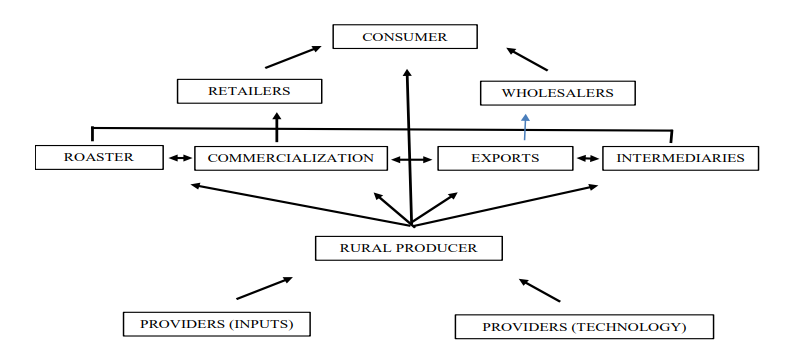
The systemic view of the coffee value chain helps to understand the operation of the activity and the adoption of strategic practices related to the acquisition of inputs, technology, the ideal way of raising funds, as well as the commercialization of products. In this sense, the coffee production system, its components, and their interrelationships will be demonstrated below.
Figure 01 : Coffee Production System
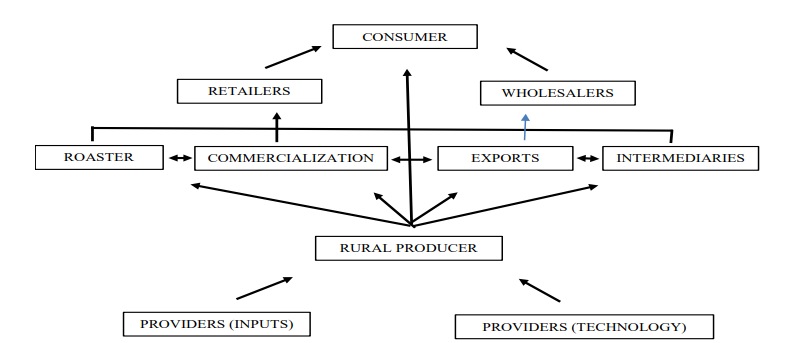
Figure 01
Coffee Production System
COORDINATION STRUCTURE • Markets (physical, futures, options, swaps). • Government (public policies, government programs, agribusiness support agencies, etc.). • Cooperatives. • Unions, NGOs, etc.
INFRASTRUCTURE AND SERVICES • Job • Credit • transport • Energy • Technology • Advertising • Storag
Source: Adapted from ZYLBERSZTAJN, NEVES (2000).
The coffee agroindustrial system, figure 1, shows us the options for local production arrangements, however, it is not a single structure, and may vary according to the needs and preferences of each member of the chain.
It is essential to understand the system, the production chain, the structure, the local arrangements, and the clusters for decision-making, especially for the rural producer in the purchase of inputs, in the commercialization of products, in the mitigation of risks, and in the search for credits. For the government in order to draw up public policies for the sector, and for the coordinating agents that make up the system in order to plan, organize and make assertive decisions.
3. Methodology
The bibliometrics techniques were used, which enable the mapping of research, exploring the collection of relevant journals on the subject, and sociometry that demonstrates the relationships between the actors involved.
Bibliometrics and sociometry procedures are used in quantitative research and are essential to improve the context, with a deeper discussion and content analysis; it also favors the visibility of revision works (FERREIRA, SILVA, 2019).
Ferreira and Sadoyama (2015) explain that bibliometrics is the quantitative technique to analyze scientific productions related to the proposed topic. The content is analyzed, involving titles, keywords, abstracts, texts, authors, institutions, methods, involving authorship, and bibliographic references.
Oliveira and Zambalde (2013) comment that sociometry researches the evolution and organization of individuals and their position in the group, focusing on the social relations between them. Based on the analysis of social networks, composed of three basic elements: nodes (or actors) represent the individuals that make up a group; ties (or social relations) consist of ties involving two or more nodes; and the flow that demonstrates the direction of the bond (SOUZA et al., 2016).
As for the approach, this research can be classified as quantitative research, as we will use statistical methods in the collection and analysis of data. Gerhard and Silveira (2009) report that quantitative research uses mathematics and statistics to describe the causes of a phenomenon or the relationships between variables, among others.
As for the objectives, it is classified as descriptive research, as we will seek to investigate a series of information related to the research subject. And related to the procedures is bibliographic research, and bibliometrics and sociometry have as objectives the survey of theoretical references already used.
Data collection covered relevant samples related to the study topic, selected and presented in the Web of Science (WOS) database. Using as search criteria the keywords “coffee production chain", "coffee production system” and “coffee marketing”.
At WOS, the search was initially limited to the period from 2010 to 2019, and by titles, adopting the keyword “coffee”. production system” found 27 articles. Already with the keyword “coffee production chain” found 4 publications; and with the keyword “coffee marketing” 103 publications were found, totaling 134 publications in total. All publications are exported to EndNote-online in order to analyze and select the most relevant publications on the proposed topic. Thus, 113 publications were selected that served as a basis for the discussion and theoretical foundation of the research.
For data analysis, a database was set up in Microsoft Office Excel 2016, containing the following characteristics of all publications: title, authors' names, authors' education, number of authors per publication, year of publication, topics of interest, institutions linked by the authors, research objectives, final considerations and conclusions, as well as methodological aspects of the publications. In sequence, the collected data were treated through statistical formulas, in order to detect the necessary percentage of each analyzed item, serving as a support to identify the expected results and assist in the final conclusions.
4. RESULTS AND DISCUSSIONS
In this topic, the collected data will be treated, analyzing the 113 publications that will serve as a basis for the discussion on the main themes listed over the period from 2010 to 2019, on the coffee production system.
Table 1. Distribution of articles by year
Source: survey data, 2020.
The data, in table 1, demonstrate that the concern of studies in the coffee production system is focused on transformation, especially on issues that permeate the commercialization of the product, specifically the understanding of the market and its interactions and consumer preference.
It is evident that there are still almost no issues involving relations with input suppliers, however, we cannot infer that this issue is not being researched, as it may be due to the search restrictions.
Figure 1. Network of studies in the coffee production system
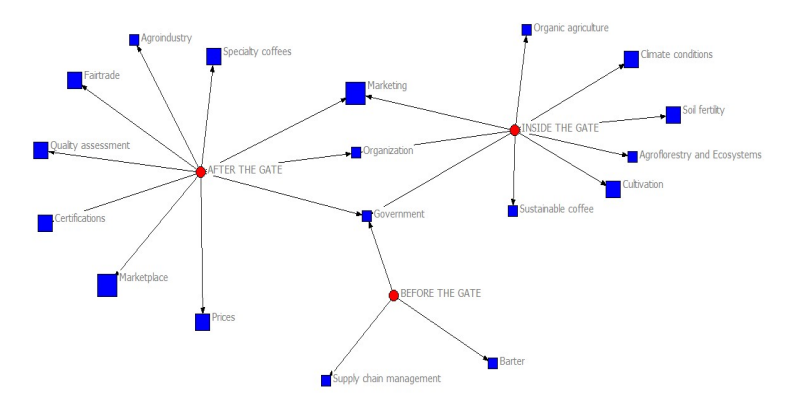
Figure 1
Network of studies in the coffee production system
Source: Prepared by the authors with the help of UCINET software (2020).
Ucinet is a software package with the function of creating and manipulating matrices that mathematically represent networks, where their elements are relations (FERREIRA, SILVA, 2019). The size of the square represents the weight of the item, and the number of publications on the subject.
In the question before the gate, only two subjects were addressed during the analyzed period, being supply chain management and exchange or barter.
Exchange operations (barter) are negotiation instruments that make it possible to finance the production of rural producers in credit difficulties or not. It facilitates access to productive inputs, such as seeds, fertilizers, and pesticides in the absence of credit in the market. Exchange operations can be specified as the commercialization of agricultural inputs made by the receipt of commodities or financial amountsrelated to an agricultural price indicator (GARCIA, 2011).
Within the scope of the gate, several issues were discussed, with the concern with climatic conditions, cultural practices, and soil fertility being more widespread, followed by sustainability, agroforestry, and organic agriculture.
The concern with weather conditions is recurrent. Thus, Tucker (2010) analyzed the perceptions of risk and adaptation of Central American coffee producers, in relation to market shocks and climatic conditions, noting that adaptive responses were more clearly associated with access to land than with perception. of risk. On the other hand, Bastianin, Lanza and Manera (2018) evaluated the economic impacts of El Nino, and their evidence from the Colombian coffee market, demonstrating the impacts on prices.
Wild coffee from the forest brings many relevant discussions. According to Lilieholm, and Weatherly (2010), in Africa an experience with wild, organic and certified coffee did not have the expected result, despite being successful until the processing, it did not obtain good results in the international market, due to prices based on commodities.
In Mexico, on the other hand, the concern about the cultural treatment in the coffees consortium with the forest (ARIAS, et al., 2012). In Costa Rica, concern about farmers' knowledge of how trees affect coffee productivity and ecosystem services (CERDAN, et al., 2012). And in the Western Ghats, Cordillera in India, the study by Nesper et al. (2017), refers to the diversity of shade trees improves coffee production and quality in agroforestry systems, revealing important co-benefits of agroforestry systems for biodiversity conservation and coffee production.
But an experience of producing coffee, according to the consumer's desires, with a concern for sustainability deserves to be highlighted. This is coffee production in the Los Tuxtlas Biosphere Reserve, Mexico, production of shaded coffee with low environmental impact, however it is not valued and is strongly affected by the collapse of international prices (DE LA VEGA-LEINERT, BRENNER, STOLL- KLEEMAN, 2016).
While consumers demand coffees produced with environmental responsibility, in a sustainable way, rural producers seek to meet them. However, due to asymmetry of information and prices, rural producers are not remunerated for the work towards the sustainability of the planet, and on the other hand, this work generates extra costs, being a sustainable production for some but for rural producers.
In this context, certifications can also be included, with high costs for rural producers. And at the time of marketing, prices are based on the New York Stock Exchange price, not being remunerated for adding value to the product.
Not to mention, the way rural producers are organized through cooperatives and associations that should help them, and sometimes, are exploited in favor of capitalism, that is, the economic profitability of these organizations.
The most difficult and risky part for rural businesses, including coffee production, is the post-gate segment. It includes commercialization, which consequently depends on the market, and there is neither logic nor precision in the results, it all depends, as they involve relationships and interactions between agents.
The focus of the discussions after the concierge is related to the market. Several studies analyze the potential of the coffee market in the world, among them, Bantiwalu and Demisse (2010) analyzed the potential of the Chinese market for Ethiopian coffee; and Hill (2010) assessed the Ugandan coffee market and price risks.
In Colombia, studies focus on analyzing the adaptations of family farmers to new market conditions (Álvarez, 2010), local conflicts after the breach of the International Coffee Agreement (Rettberg, 2010), and organic market tensions (GOMES-CARDONA, 2012). It is also evidenced, by the main mechanism of commercialization of coffee in Latin America, the export of basic raw materials, through the research of Sandoval (2016) who inquire about the competitiveness of coffee exports from Colombia, Guatemala, and Mexico towards the market. American.
Adding value to coffee, mainly through local industrialization, should be the focus of agents in the coffee production system: government, cooperatives, producers, and other stakeholders. In order to improve the country's domestic economy and at the same time, guarantee fair prices to rural producers.
Price insecurity is a constant, for example, in the Ugandan coffee market, concern about price risks (Hill, 2010), asymmetric price transmission, in Ethiopia (Alemu, 2011), Zambia, and in Tanzania ( Mofya-Mukuka, Awadu, 2013), and also in France (Bonnet, Vilas-Boas, 2016), the volatility in commodity prices in East Africa (Lukanima, Swaray 2014). There is also an emphasis on market power for the formation of coffee prices (Igami, 2015), and the role of emerging countries in price formation (Bohl, Gross, and Souza, 2019), as well as the importance of the futures market and options (Barabach, Lobo and Silva, 2015).
Even, coffee is privileged in relation to other cultures, as there are financial tools that allow the producer to receive better prices, such as options, for example.
The concern with the formation of coffee prices is notorious and relevant. But price formation is dependent on the market structure, and in the case of the coffee commodity, it is an oligopsony, and those who dictate the price are the large roasters with enormous market power and are privileged due to the asymmetric information of the coffee market. coffee.
The dependence of rural producers on the commercialization of coffee substantially harms the profitability of the property. The output for price improvement is related to the processes of adding value to the product, with the production of specialty coffees, certification, and industrialization of the product, even knowing the injustices of the market, mentioned above.
From 2010 to 2015, researchers focused on fair trade, emphasizing existing social injustices (Topik, 2010), others advocated opposing positions emphasizing the effectiveness of market-based social governance (Schuler, 2011 and Hejkrlic, Mazancova, and Forejtova, 2013), and the relationship with sustainability in the view of the Dutch (Ingenbleek, 2013).
The concern with health on the part of the consumer has changed the dynamics of the sector, currently, specialty coffees have become the focus of studies and production, to meet the demand of a more demanding and informed consumer. Investments and focus on the production of specialty coffees can be seen in some regions, such as Papua, New Guinea (West, 2010), Nicaraguá (Donovan and Poole, 2014), Vietnam (Anh and Bokelmann, 2019), Brazil (Guimarães et al. al., 2019), Colombia, Mexico, Mayan farmers (Fritsch, 2014), among others.
There is also an increase in research to evaluate the quality of the product and the presence of chemicals harmful to health, especially those related to the indiscriminate use of pesticides in consuming countries. Such as the occurrence of furan in coffee in the Spanish market (Altaki, Santos, and Galceran, 2011), with a replica by Stadler (2011) on the subject; the occurrence of furan and methyl furan in coffee in the Canadian market ( Becalsk et al., 2016) and occurrence of ochratoxin (Galarce- Bustos et al, 2014), and acrylamide in coffee associated with cancer, in the Saudi Arabian market ( Kahn et al, 2017) and Turco ( Akgun and Araci, 2019).
On the other hand, they evaluated the antioxidant capacity, phenolic acids, and caffeine content of some commercial coffees available in the Romanian market (Trandafir, Nour and Ionica, 2013), in Algeria ( Belguidoum et al, 2014), and in Saudi Arabia (Al Doghaither et al., 2017), as well as the types of roasting and its effects (Rubach et al, 2014) and Algarni et al., (2018), demonstrated that the research findings indicated that increased roasting decreases the content of caffeine and antioxidant activity.
Finally, the role of marketing in the coffee production system, widely used by agribusinesses, with a focus on relationships ( Wollni and Fischer, 2015), satisfaction surveys and consumer behavior ( Kongthong et al., 2015) and adoption of technologies for cutting-edge, such as text mining (Lima, Castro and Zambaldi, 2016) and data mining (Chiang, 2018).
With the help of the VOSviewer software, it was possible to build the networks of countries, authors, and institutions that published the most on the subject, from 2010 to 2019, based on the delimitation of the research.
Initially, the following figure shows the networks of the countries that are publishing on the subject under study.
Figure 2. Country Networks
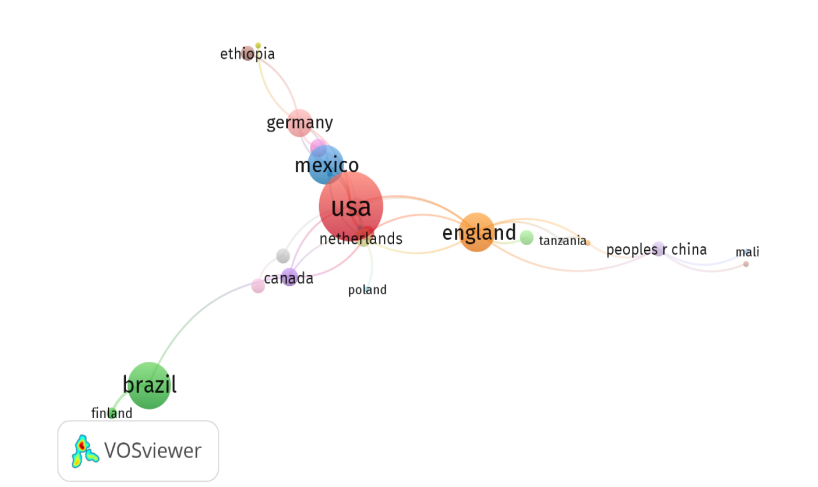
Figure 2
Country Networks
Source: Prepared by the authors with the help of the VOSviewer software (2019)
When observing the network, it is verified that the cluster (1) of red color is formed by the link between the United States, which has 24 documents and 358 citations, and Australia; and in the green cluster (2), are Brazil, with 14 documents and 16 citations, and Finland. The blue cluster (3) is composed of Mexico, with 11 documents, and 11 citations, and Guatemala; the other clusters are composed of only one country, the orange cluster is composed of England, with 11 documents and 163 citations; the pink one for Germany, with 7 documents and 29 citations; Violet for Canada, with 4 documents and 17 citations; the light brown for Holland, with 4 documents and 40 citations; dark brown for Ethiopia, with 3 documents and 10 citations; light green Tanzania, with 1 document and 3 citations; the light violet China, with 3 documents and 1 citation; and the light blue composed by Mali, with 1 document and 2 citations, in addition to other countries with less relevance.
Van Eck and Waltman (2018) explain that when viewing the network, items are represented by circles or labels. The size of the circle is determined by the weight of the item (number of documents and citations made), that is, the more documents and citations, the larger the circle. An item's color is determined by the cluster the item belongs to. And the closer two clusters are located to each other, the stronger their relationships are.
Figure 3: Keywords used in publications
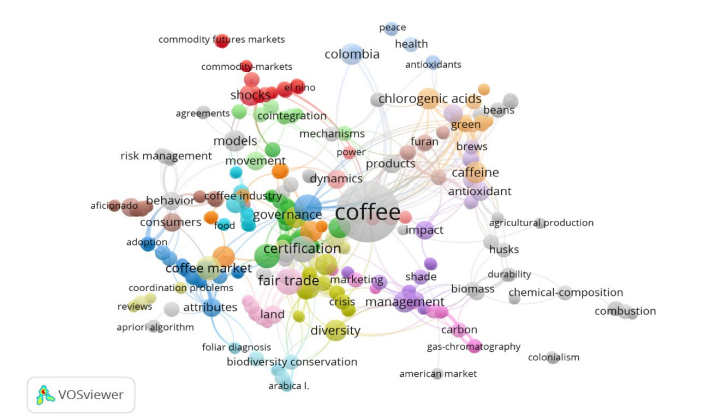
Figure 3
Keywords used in publications
Source: Prepared by the authors with the help of the VOSviewer software (2019).
It is noted through the keywords contained in the works, that the studies focus on the conservation of biodiversity; in certification, mainly Fairtrade; issues related to product quality and health impacts; market study, emphasizing the derivatives market (futures and options market), risk management; focused on the perception of consumer interests, with market research; and aspects inherent to the production itself, among others.
According to the research data, Table 2 was constructed, which shows the main producing and purchasing countries mentioned by the authors.
Table 2: List of coffee-producing and buying countries
| 2010 | 09 | 00 | 02 | 07 |
| 2011 | 06 | 00 | 01 | 05 |
| 2012 | 10 | 00 | 03 | 07 |
| 2013 | 10 | 00 | 02 | 08 |
| 2014 | 12 | 00 | 02 | 10 |
| 2015 | 14 | 01 | 03 | 10 |
| 2016 | 12 | 00 | 03 | 09 |
| 2017 | 14 | 01 | 04 | 09 |
| 2018 | 12 | 00 | 03 | 09 |
| 2019 | 14 | 00 | 07 | 07 |
Source: survey data, 2020
It is worth mentioning that the mentioned producing and consuming countries are based on data from the surveyed sample. Consumption extends practically throughout the world, while coffee is produced in other countries, such as Honduras, Ivory Coast, Congo, Angola, Kenya, Cameroon, Zimbabwe, Ecuador, Peru, Paraguay, Antilles, El Salvador, New Caledonia, etc. (CCMG, 2019).
In addition to observing in which country’s knowledge is being disseminated in relation to the coffee production system, it is relevant to visualize the most cited researchers and their partners.
Figure 3. Networks of Most Cited Authors
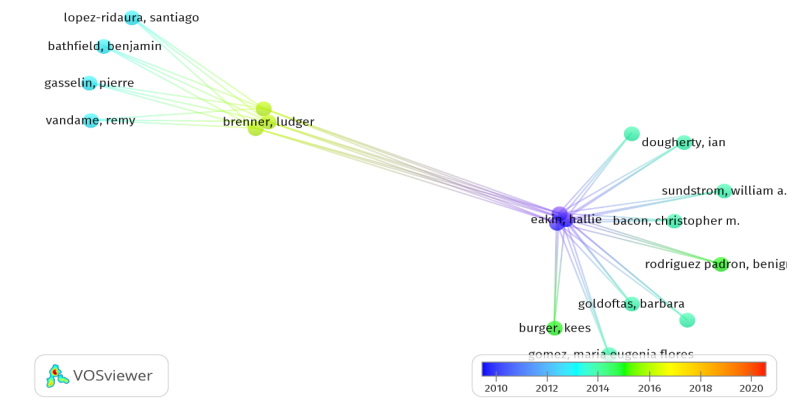
Figure 3
Networks of Most Cited Authors
Source: Prepared by the authors with the help of the VOSviewer software (2019).
Figure 3 shows the list of the most cited authors, in which the colors represent the years of publication. The highlight for the following authors: Hallie Eakin with 111 citations; Christopher Bacon, Barbara Goldoftas, Ian Dougherty, William A. Sundstrom, and Maria Eugenia Flores Gomes with 40 citations; Kees Burger with 5 quotes; Benjamin Bathfield, Pierre Gasselin, Santiago Lopes - Ridaura and Remy Vandame with 4 quotes, among others.
Figure 4. Institutions that published the most about the coffee production chain
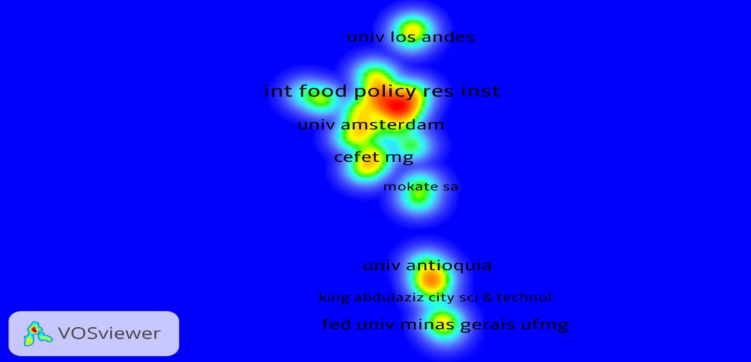
Figure 4
Institutions that published the most about the coffee production chain
Source: Prepared by the authors with the help of the VOSviewer software (2020).
Figure 4 highlights the International food policy Research Institute, based in Washington, with 3 papers and 17 citations and the University of Amsterdam, with 2 papers and 18 citations, both in the US; Universidad de Antioquia, based in Medellin and Antioquia in Colombia, with 2 documents and 10 citations; Los Andes University, in Chile, with 2 documents and 12 citations; and the Brazilian institutions, CEFET/MG and UFLA/MG, with 2 documents and 3 citations, UFMG, with 2 documents and 1 citation, among others. Conclusions
Conclusions
Resuming the objective of analyzing the structure and dynamics of the coffee production system. Specifically, to identify the dynamics of the coffee production chain, its agentes, and the interrelationships throughout the system. Throughout this study, it was possible to perceive that the major bottleneck faced by coffee producers is still related to the process of marketing their products, with business management and risk management, and with the purchase of inputs.
The focus of studies on the coffee production system focuses on transformation, mainly on issues that permeate the commercialization of the product, specifically the understanding of the market and its interactions and consumer preference.
It was clear that consumers are increasingly demanding, seeking quality of products, free of pesticides, and concerned with the sustainability of the planet. However, to produce organic, special, or certified coffee, there are extra costs for the rural producer, and the value added to the product is not always remunerated as it should, or this remuneration is dispersed throughout the chain and does not reach the producer.
Specifically, before the gate, issues involving the relationships and management of the supply chain and barter operations, which are widely used today, were addressed. Already within the gate, the climate concern was highlighted, the concern with the sustainability of the planet, organic production, social concern, and certifications are routine matters.
It is noted that consumers are increasingly demanding, the factors that impact production must be minimized, and commercialization processes become a competitive differential for producers.
Through the results of the research, it is clear that rural coffee producers are acting effectively in the production sector, whether in conventional or organic production. Within each typology, different dynamics were found, adaptations to climate change, concerns with soil correction, aspects related to pests and diseases, composting, as well as the use of technology in the field. However, the great concern of rural producers is related to factors external to production, which are difficult to control, mainly involving the commercialization of their products.
It is concluded, through the analysis of the coffee production system, that the greater the interrelationships throughout the system, the lower the remuneration received by rural producers. The way out is to avoid intermediaries, and middlemen, and try to establish a direct relationship with the final consumer.
In addition, using all trading mechanisms becomes paramount to avoid market risks, due to the seasonality of production, futures, options, and exchange markets. Make insurance, protecting from weather conditions and other risks inherent to production.
It is recommended for future research to deepen the study with a focus on derivatives and operations to mitigate price risks, mainly involving futures, options and barter operations.
In addition to focusing on relationships before the gate, analyzing relationships with suppliers of inputs, technology, and production support services
References
AKGÜN, B.; ARICI, M. Evaluation of acrylamide and selected parameters in some Turkish coffee brands from the Turkish market. Food Additives & Contaminants: Part A, v. 36, n. 4, p. 548-560, 2019.
AL-DOGHAITHER, H. A.; ALMOWALAD, A. M., SHORBAJI, A. M., Al-GHAFARI, A. B., OMAR, U. M. Assessment of the antioxidant properties of the most common Coffee Brews available in the local markets of the western region of Saudi Arabia. Journal of Experimental Biology and Agricultural Sciences, v. 5, n. 1, p. 70-76, 2017.
ALEMU, Z. G.; WORAKO, T. K. Price transmission and adjustment in the Ethiopian coffee market. Agrekon, v. 50, n. 2, p. 27-43, 2011.
ALQARNI, M. H.; ALAM, P.; SALKINI, M. A. Roasting effect on the Caffeine contents and antioxidant potential of different coffee grades available in the Saudi Market. Indo American Journal of Pharmaceutical Sciences, v. 5, n.12, p.16738-16745, dez. 2018.
ALTAKI, M. S.; SANTOS, F. J.; GALCERAN, M. T. Occurrence of furan in coffee from Spanish market: contribution of brewing and roasting. Food chemistry, v. 126, n. 4, p. 1527- 1532, 2011.
ÁLVAREZ, J. F. Colombian family farmers’ adaptations to new conditions in the world coffee market. Latin American Perspectives, v. 37, n. 2, p. 93-110, 2010.
AMORIM, W. C. P. Logística de transporte no agronegócio do Tocantins. TCC (graduação em logística) Universidade Federal de Tocantins, 2019.
ANH, N. H; BOKELMANN, W. Determinants of Smallholders’ Market Preferences: The Case of Sustainable Certified Coffee Farmers in Vietnam. Sustainability, v. 11, n. 10, p. 2897, 2019.
ARAÚJO, M. J. Fundamentos do Agronegócio. 2. Ed. São Paulo: Atlas S.A. 2007.
ARIAS, R. M.; HEREDIA-ABARCA, G.; SOSA, V. J.; FUENTES-RAMIREZ, L. E. Diversity and abundance of arbuscular mycorrhizal fungi spores under different coffee production systems and in a tropical montane cloud forest patch in Veracruz, Mexico. Agroforestry Systems, v. 85, n. 1, p. 179-193, 2012.
BANTIWALU, E. A.; DEMISSE, A. Y. Analyzing of Potential Market of China for Ethiopian Coffee. 2010.
BARABACH, G.; SILVA, L. E.; EDUARDO, C. The importance of future market and stock market for coffee trading: an analysis utilizing the markowitz model methodology. Revista Gestão Organizacional, v. 8, n. 2, p. 4-25, 2015.
BARROS, Marco AN de. Cadeia produtiva da educação superior no Brasil: elementos para desenho de um modelo analítico. Simpósio de Excelência em Gestão e Tecnologia, v. 16, 2018.
BASTIANIN, A.; LANZA, A.; MANERA, M. Economic impacts of El Niño southern oscillation: evidence from the Colombian coffee market. Agricultural economics, v. 49, n. 5, p. 623-633, 2018.
BECALSK, A., HALLDORSON, T., HAYWARD, S., ROSCOE, V. Furan, 2-methylfuran and 3-methylfuran in coffee on the Canadian market. Journal of Food Composition and Analysis, 47, 113-119, 2016.
BELGUIDOUM, K., AMIRA- GUEBAILIA, H., BOULMOKH, Y., HOUACHE, O. HPLC coupled to UV–vis detection for quantitative determination of phenolic compounds and caffeine in different brands of coffee in the Algerian market. Journal of the Taiwan Institute of Chemical Engineers, v.45, n.4, p.1314-1320, 2014.
BOHL, M. T.; GROSS, C.; SOUZA, W. The role of emerging economies in the global price formation process of commodities: Evidence from Brazilian and US coffee markets. International Review of Economics & Finance, v. 60, p. 203-215, 2019.
BONNET, C.; VILLAS-BOAS, S. B. An analysis of asymmetric consumer price responses and asymmetric cost pass-through in the French coffee market. European Review of Agricultural Economics, v. 43, n. 5, p. 781-804, 2016.
CERDAN, C. R.; REBOLLEDO, M. C.; SOTO, G.; RAPIDEL, B.; SIMCLAIR, F. L. Local knowledge of impacts of tree cover on ecosystem services in smallholder coffee production systems. Agricultural Systems, v.110, p.119-130, 2012.
CENTRO DE COMÉRCIO DE CAFÉ DE MINAS GERAIS - CCMG. Principais Países Produtores da Café. Disponível em: http://cccmg.com.br/principais-paises-produtores-decafe/. Acesso em: set. 2019.
CHIANG, Wen-Yu. Applying data mining for online CRM marketing strategy: An empirical case of coffee shop industry in Taiwan. British Food Journal, v. 120, n. 3, p. 665-675, 2018.
DE LA VEGA-LEINERT, Anne Cristina; BRENNER, Ludger; STOLL-KLEEMANN, Susanne. Peasant coffee in the Los Tuxtlas Biosphere Reserve, Mexico: A critical evaluation of sustainable intensification and market integration potential. Elementa Science of the Anthropocene, v. 4, 2016.
DONOVAN, J.; POOLE, N. Changing asset endowments and smallholder participation in higher value markets: Evidence from certified coffee producers in Nicaragua. Food Policy, v. 44, p. 1-13, 2014.
FERREIRA, J. B.; SILVA, L. de A. M. O uso da bibliometria e sociometria como diferencial em pesquisa de revisão. Revista Brasileira de Biblioteconomia e Documentação, v. 15, n. 2, p. 448-463, mai./ago. 2019.
FRITSCH, S. Coffee and Community: Maya Farmers and Fair-Trade Markets. International Studies Review, v.16, n.2, p. 307-310, jun 2014
GALARCE-BUSTOS, O.; ALVORADO, M.; VEGA, M.; ARANDA, M. Occurrence of ochratoxin A in roasted and instant coffees in Chilean market. Food Control, v.46, n.1, p.102- 107, 2014.
GARCIA, C.H. Barter. II Simpósio de Milho e Soja, 2011.
GERHARDT, T. E.; SILVEIRA, D. T. (orgs). Métodos de Pesquisa. 1. ed. Porto Alegre: UFRGS, 2009.
GÓMEZ-CARDONA, Santiago. Tensions of Organic Markets for Colombian Coffee Growers: The Case of Valle del Cauca. Cuadernos de Desarrollo Rural, v. 9, n. 68, p. 65-85, 2012.
GUIMARÃES, E.; LEME, P. H. M. V., DE REZENDE, D. C., PEREIRA, S. P., Santos, A. C. The brand new Brazilian specialty coffee market. Journal of food products marketing, v. 25, n. 1, p. 49-71, 2019.
HEJKRLIK, Jiri; MAZANCOVA, Jana; FOREJTOVA, Karolina. How effective is Fair Trade as a tool for the stabilization of agricultural commodity markets? Case of coffee in the Czech Republic. Agricultural Economics, v. 59, n. 1, p. 8-18, 2013.
HILL, Ruth Vargas. Liberalisation and producer price risk: examining subjective expectations in the Ugandan coffee market. Journal of African Economies, v. 19, n. 4, p. 433-458, 2010.
IGAMI, Mitsuru. Market Power in I nternational Commodity Trade: The Case of C offee. The Journal of Industrial Economics, v. 63, n. 2, p. 225-248, 2015.
INGENBLEEK, Paul TM; REINDERS, Machiel J. The development of a market for sustainable coffee in the Netherlands: Rethinking the contribution of fair trade. Journal of Business Ethics, v. 113, n. 3, p. 461-474, 2013.
KHAN, M. R.; ALOTHMAN, Z. A.; NAUSHAD, M.; ALOMARY, A. K.; ALFADUL, S. M., ALSOHAIMI, I. H.; ALGANDI, M. S. Occurrence of acrylamide carcinogen in Arabic coffee Qahwa, coffee and tea from Saudi Arabian market. Scientific reports, v. 7, p. 41995, 2017.
KONGTHONG, L.; SUDHARATNA, Y.; APIBUNYOPAS, P. Marketing Factors Affecting Fresh Coffee Buying Decision. In: INTERNATIONAL CONFERENCE ON APPLIED BUSINESS RESEARCH, 9., 2015. Proceedings [...], 205.
LILIEHOLM, Robert J.; WEATHERLY, W. Paul. Kibale forest wild coffee: challenges to market‐based conservation in Africa. Conservation Biology, v. 24, n. 4, p. 924-930, 2010.
LIMA JUNIOR, P. O. L.; CASTRO JUNIOR, L. G.; ZAMBALDE, A. L. Applying textmining to classify news about supply and demand in the coffee market. IEEE Latin America Transactions, v. 14, n. 12, p. 4768-4774, 2016.
LUKANIMA, B.; SWARAY, R. Market reforms and commodity price volatility: The case of East African coffee market. The World Economy, v. 37, n. 8, p. 1152-1185, 2014.
MALINSK, A. Cadeia produtiva do Agronegócio. Porto Alegre: Sagah, 2018.
MOFYA-MUKUKA, R.; ABDULAI, A. Policy reforms and asymmetric price transmission in the Zambian and Tanzanian coffee markets. Economic Modelling, v. 35, p. 786-795, 2013.
NESPER, M., KUEFFER, C.; KRISHNAN, S.; KUSHALAPPA, C. G.; GHAZOUL, J. Shade tree diversity enhances coffee production and quality in agroforestry systems in the Western Ghats. Agriculture, Ecosystems & Environment, v. 247, p. 172-181, 2017.
OLIVEIRA, N.; ZAMBALDE, A. L. Relações sociométricas dos pesquisadores que patentearam inventos. Encontros Bibli: revista eletrônica de biblioteconomia e ciência da informação, v. 19, n. 39, p. 227-242, 2014.
RETTBERG, Angelika. Global markets, local conflict: violence in the Colombian coffee region after the breakdown of the International Coffee Agreement. Latin American Perspectives, v. 37, n. 2, p. 111-132, 2010.
RUBACH, M.; LANG, R.; BYTOF, G.; STIEBITZ, H., LANTZ, I.; HOFMANN, T.; SOMOZA, V. A dark brown roast coffee blend is less effective at stimulating gastric acid secretion in healthy volunteers compared to a medium roast market blend. Molecular nutrition & food research, v. 58, n. 6, p. 1370-1373, 2014.
SANDOVAL, K. V. Competitividad de las exportaciones de café de Colombia, Guatemala y México hacia el mercado estadounidense (2001-2014). CIENCIA ergo-sum: revista científica multidisciplinaria de la Universidad Autónoma del Estado de México, v. 23, n. 3, p. 239-246, 2016.
SCHULER, D. A.; CHRISTMANN, P. The effectiveness of market-based social governance schemes: The case of fair trade coffee. Business Ethics Quarterly, v. 21, n. 1, p. 133-156, 2011.
SOUZA, J. A. e; MENDONÇA D. J.; SOUZA, J. A. e; SANTOS, A. C. dos. Produção cientifica sobre coopetição: uma análise bibliométrica e sociométrica em periódicos internacionais. Observatorio de la Economia Latino Americana, out. 2016.
STADLER, R. H. Response to the article''Occurrence of furan in coffee from Spanish market: Contribution of brewing and roasting''. Food chemistry, v. 129, n. 3, p. 1325, 2011.
TAVARES, M. F. de F. Introdução à gestão do agronegócio. Porto Alegre: Sagah, 2018.
TOPIK, S. Fair Trade Coffee: The Prospects and Pitfalls of Market-Driven Social Justice. Latin American Perspectives, v. 37, n. 2, p. 145-148, 2010.
TRANDAFIR, I.; NOUR, V.; IONICA, M. E. Antioxidant capacity, phenolic acids and caffeine contents of some commercial coffees available on the Romanian market. Archivos latinoamericanos de nutricion, v. 63, n. 1, p. 87, 2013.
TUCKER, C. M.; EAKIN, H.; CASTELLANOS, E. J. Perceptions of risk and adaptation: coffee producers, market shocks, and extreme weather in Central America and Mexico. Global Environmental Change, v. 20, n. 1, p. 23-32, 2010.
VAN ECK, N. J.; WALTMAN, L. VOSviewer Manual. CWTS Meaningful metrics, Universiteit Leiden, ago. 2018.
WEST, P. Making the market: specialty coffee, generational pitches, and Papua New Guinea. Antipode, v. 42, n. 3, p. 690-718, 2010.
WOLLNI, M.; FISCHER, E. Member deliveries in collective marketing relationships: evidence from coffee cooperatives in Costa Rica. European Review of Agricultural Economics, v. 42, n. 2, p. 287-314, 2014.
ZYLBERSZTAJN, D.; NEVES, M. F. Economia & Gestão dos Negócios Agroalimentares. São Paulo: Pioneira, 2000.