Artigos
Population aging and social vulnerability: the case of the state of Minas Gerais
Population aging and social vulnerability: the case of the state of Minas Gerais
Gestão & Regionalidade, vol. 39, e20237769, 2023
Universidade Municipal de São Caetano do Sul
Recepción: 15 Junio 2021
Aprobación: 16 Diciembre 2021
Keywords: social vulnerability, population aging, Minas Gerais
Palavras chave: vulnerabilidade social, envelhecimento populacional, Minas Gerais
1 Introduction
Several countries worldwide have gone through or are currently going through the process of demographic transition, a change in the demographic structure of a given location. It is divided into three phases, the first of which is characterized by a reduction in infant mortality, thereby increasing the proportion of young people and, consequently, the dependency ratio. The second is marked by a reduction in fertility, which leads to a decrease in the number of young people and, consequently, a lower level of dependence. Finally, in the last stage, both mortality and fertility rates fall, which lead to slower demographic growth and older populations, which, in turn, generates a high degree of dependence and gives rise to the process of population aging.
In developed countries, demographic transition which began at the beginning of the last century has already been completed, and has proved to be slower than in developing countries, which, according to Alves (2008), are still experiencing the process. In developing regions, mortality rates have already reduced; however, birth rates are still declining. In the poorest regions of developing countries, such as in part of the African continent, the reduction in mortality has advanced, but the birth transition is still in its early stages.
Thus, in developing countries, population aging is an extremely important topic, particularly because it happened more quickly than in developed countries. According to Alves (2008), this new demographic scenario is one of humanity’s achievements as it denotes progress in tackling the various challenges involving health and education, the basis for improving quality of life and the consequent process of economic development. With this new situation, however, innovative measures must be taken to enable healthier aging and maintain the well-being of the elderly.
In Brazil, demographic transition occurred relatively quickly, considering that the reduction in the average number of children per woman only started in the 1970s. According to data from the Brazilian Institute of Geography and Statistics (IBGE, 2004), Total Fertility Rate (TFR) went from 6.3 children per woman in 1960 to 2.1 in 2004. Life expectancy at birth increased from 52.5 to 71.7 years over the same period. Such changes were mainly brought about by macroeconomic, cultural and social aspects and led to an increase in population aging. In 1980, for every 100 children, there were 16 elderly people and, by 2000, this ratio increased to almost 30 per 100 children. According to the United Nations (UN), in 2025, Brazil will be the sixth country in the world with the most elderly people.
The characteristics of acceleration and generalization of demographic transition in Brazil do not exclude the fact that it occurs unequally, in spatial and social terms. According to a survey carried out by the Getúlio Vargas Foundation (FGV), the federal unit with the highest rate of elderly people is Rio de Janeiro (13.06%), followed by Rio Grande do Sul (12.95%), São Paulo (11.27%) and Minas Gerais (11.19%). According to the study, the Southeast has the largest proportion of elderly people. In contrast, the North has the lowest %, where Roraima (5.26%), Amapá (5.75%), Amazonas (6.7%), Acre (6.9%) and Pará (7.0%) have the lowest rates of elderly people in the country.
In addition, as a result of the great income and social inequality between regions, elderly Brazilians experience different conditions of well-being. According to data from the 2004 National Household Sample Survey, PNAD (2004), 8.9% of the population in the North, aged 65 or over, were living in a situation of severe food insecurity, while in the Southeast the proportion was 2.4%. Data from PNAD (2008) show that in that year, 18.6% of the population in the Northeast, aged 65 or over, rated their health status as poor or very poor, while in the Southeast the proportion was 12.7%.
As population aging is a phenomenon which occurs at an accelerated rate in developing countries and affects different dimensions of society, it has become the object of study in several fields, including Economics. In the theoretical and empirical literature, it has already been related to aspects of public health, the labor market, social security policies, and others.
Some of those studies suggest that older people are more socially vulnerable. According to Carmo and Guizardi (2018), social vulnerability refers not only to the absence or precariousness of access to income, but also to inequality of access to public goods and services and the fragility of affective and social bonds. According to Kaztman (2000), it is the inability of families, individuals or social groups to take advantage of the opportunities available in different socioeconomic contexts in order to improve their well-being or prevent its deterioration. Complementarily, Vignoli (2004) states that the concept can be understood as the objective fragility of the poor in surviving everyday life or economic crises. Similarly, the Secretariat for Evaluation and Information Management (2015) states that such vulnerability is associated with being deprived of access to rights, goods and services.
According to Rodrigues and Neri (2012), senescence generates a consequent increase in the risk of developing biological, socioeconomic and psychosocial vulnerabilities. For them, this is due to the typical biological decline of old age, which when added to the cumulative effects of adverse conditions of education, income and health throughout life, and to individual, collective, contextual and historical aspects, generates a greater possibility of becoming ill and more difficulty in accessing economic and social resources.
The relationship between aging and social vulnerability is also treated in the international literature, as in the study by Abeliansky et al. (2021). According to the results found by these authors, social vulnerability increased according to age in the American population between 1913 and 1966. In terms of the national literature, there is a large gap, particularly of studies to empirically analyze the causality relationship between the increasing age of the population and their level of socioeconomic fragility. The studies which exist are restricted to considering the effect of aging on attributes of vulnerability, such as health, and work and income. Social vulnerability, however, encompasses all these factors, as well as others.
In view of the aforementioned gap in the national literature, the present study sets out to analyze the association between population aging and social vulnerability in the state of Minas Gerais in 2016. It aims to verify whether municipalities with more long-living individuals are more socially vulnerable, given the importance and the frequent debates of these themes nowadays. In view of the biological, socioeconomic and psychosocial conditions presented, it is expected that longer-established locations would present a greater degree of social vulnerability.
As Minas Gerais is one of the country’s most dynamic states, it plays a prominent role in the national economy. Its vast territory is characterized by great heterogeneity and spatial inequalities, to the extent that there are some more modernized regions with high socioeconomic indicators, similar to Brazil’s Southern region, and others which are underdeveloped and backward, which resemble the North and Northeast of the country (CIRINO, GONZÁLEZ, 2011).
It should also be noted that the study considers data aggregated by municipalities in Minas Gerais and differentiated effects of population aging on different distributions in quantiles of social vulnerability between municipalities, which differentiates it from most of the literature, which generally emphasizes individual information. In addition, this research uses a relatively recent database, referring to 2016, unlike most studies, which use less updated information.
Thus, with the objective of determining whether aging increases social vulnerability in the municipalities of the state of Minas Gerais, which serves as a proxy for the national reality, the aim is to understand how growth in the proportion of elderly people resulting from demographic transition affects the Brazilian population in social and economic terms, so as to help formulate public policies which would contribute to improving well-being. The research is relevant, therefore, both in terms of the literature and the possibility of implementing public policies. In addition to this introduction, the study includes four more sections, namely: the theoretical and empirical aspects underlying the study, the methodology used, presentation and discussion of results and then the final comments.
2 Theoretical and empirical aspects
While the concepts of poverty and social vulnerability are interlinked, they are defined differently. Previously, poverty was analyzed in a unidimensional manner, in which only measures based on lack of income were considered. Recently, it has been classified in a multidimensional manner, as it considers the lack of what is necessary for material well-being (food, housing and clothing, for example) and varies according to age, gender, culture, health and housing conditions, inclusion in the labor market and other social and economic issues. In view of the concept of multidimensional poverty, one can discuss privation of an active voice in society, the power and independence of the poor and, in addition, the greater susceptibility of the elderly population to socioeconomic and demographic risks (CRESPO, GUROVITZ, 2002; AGOSTINHO, MÁXIMO, 2006).
However, social risks are not restricted to situations of poverty, as they are associated with various factors, such as social inequality, unemployment, health problems, housing conditions, etc. Thus, the concept of poverty is inadequate for explaining certain impasses of a structural nature, which are not resolved by economic solutions only (CANÇADO, SOUZA, CARDOSO, 2014). In this respect, the definitions of social vulnerability presented above are more appropriate for dealing with individuals, groups or municipalities at risk and unable to avail of opportunities which could increase well-being.
In terms of the national literature, empirically, studies on the effect of aging on social vulnerability focus, to a large extent, on specific attributes of this vulnerability. With regard to health conditions, for example, Camarano, Kanso and Mello (2004), who deal with the conditions in which elderly Brazilians live, state that a considerable part of this group experiences difficulties in hearing, seeing, climbing stairs and coping with basic day-to-day activities. Concomitantly, Freitas (2010) mentions the frequency with which the elderly suffer from chronic and degenerative complications, such as rheumatic, Alzheimer’s and Parkinson’s diseases, osteoporosis and reduced functional capacity, all factors which can make it difficult for them to perform everyday tasks, such as personal hygiene, for example.
As regards income level, according to the study by Agostinho and Máximo (2006), elderly people are more likely to enter and/or remain in poverty. In turn, Mendonça and Santos (1999) present opposing results. Their study found that, although a large section of this age group in Brazil lives in a situation of fragility, the prevalence of poverty conditions among the elderly is lower than among the non-elderly. According to data from the National Household Sample Survey (PNAD, 1997), presented in that survey, the degree of poverty among the oldest was 23%, while among the non-elderly it was 39%. Furthermore, the authors emphasized that the presence of an elderly person in a household tends to reduce the degree of poverty, as that household has an average income higher than the per capita income of households in general.
Other aspects of social vulnerability were also analyzed, such as the discrimination suffered by the elderly. In a study on the subject, Vieira (2013) highlighted the incidence of stereotyping and prejudice. He also emphasized the infantilization of the elderly, who can be delegitimized as adults and not taken seriously in many circumstances. In the same perspective, Carolino, Cavalcanti and Soares (2010) highlighted the undervaluing of this group for producing less or not producing at all, as many consider them inept and incompetent human beings.
Thus, from existing studies it can be perceived that aging affects a series of factors which contribute to the social vulnerability of individuals, or in other words, it reduces their ability to maintain adequate levels of quality of life. However, social vulnerability is not limited to just one factor, such as income level or health conditions. Rather, it is defined by the set of conditions that impede individual well-being. The international study by Abeliansky et al. (2021), for example, measures social vulnerability through a multidimensionally constructed index, which covers the complexity of an individual’s socioeconomic situation and determines the effect of aging on this index.
In the national literature, however, studies are restricted to specific aspects of social vulnerability. So, the present study sets out to determine the effect of population aging on social vulnerability in Minas Gerais, measured by means of an index. As the State presents inequalities of development throughout its territory similar to those of the national reality, understanding how aging affects the fragility of the population in Minas Gerais could help understand the national reality and facilitate the drafting of strategies to increase and maintain people’s well-being.
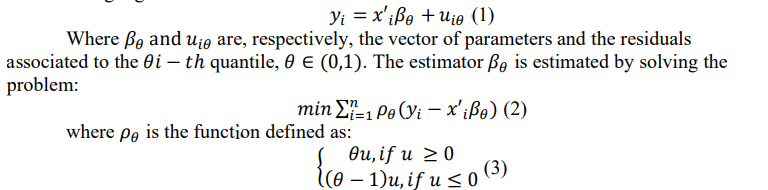
,b>3 Methodology
4 Results
4.1 Descriptive analysis
Table 3, below, presents a description of the variables used in the model (with the exception of the meso-regional dummies6), making it possible to perform a more accurate analysis of its results. With regard to descriptive statistics, the interpretation of social vulnerability and aging is similar, so that in both cases there is a significant disparity between municipalities. That is justified by the heterogeneity of the state of Minas Gerais, which has some wealthy, modernized dynamic regions and others characterized by extreme poverty and low productivity. Such great inequality explains the fact that both variables present discrepant maximum and minimum indices, with some observations well below state averages.
Table 3: Descriptive statistics of variables used
| Social Vulnerability | 853 | 0.70 | 0.70 | 0.05 | 0.86 | 0.49 |
| Aging | 853 | 41.24 | 40.88 | 4.19 | 53.59 | 27.52 |
| Population Density | 853 | 69.99 | 23.18 | 333.00 | 7532.48 | 1.36 |
| GDP per capita | 853 | 17988.93 | 13661.46 | 15970.02 | 183218.0 | 5446.6 |
| Per capita spending on Sanitation | 853 | 34.01 | 14.53 | 46.59 | 333.70 | 0 |
| Per capita spending on Health | 853 | 410 | 369.02 | 181.5 | 1582.64 | 16.6 |
| Administrative costs | 853 | 44.5 | 43.96 | 7.87 | 76.54 | 20.01 |
Source: Drawn up by the authors.
In terms of social vulnerability, the values were, respectively, 0.86 (referring to the municipality of Belo Horizonte - the least vulnerable) and 0.49 (referring to the municipality of Manga - the most vulnerable), with a significant difference of 0.37 between the two. The maximum aging index was 53.95 (referring to the municipality of Senador José Bento - the longest established) and the minimum was 27.52 (relative to the municipality of Nova Serrana - the most recently established), while the mean in Minas Gerais corresponded to 41.24, which shows the high state diversity.
Figures 1 and 2, below, show the distribution of aging and social vulnerability rates among municipalities in Minas Gerais in 2016. In Figure 1, municipalities are classified into different aging categories, the first of which includes those with an aging rate of between 27.52 and 38.26; the second includes the municipalities with aging rates of between 38.26 and 43.53 and the third those municipalities with aging rates of between 43.53 and 53.59. The municipalities in lighter colors are those with lower aging rates.
Figure 1: Distribution of aging rates in Minas Gerais municipalities in 2016.
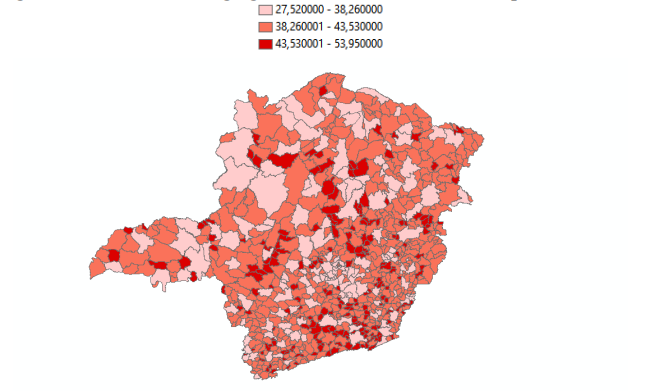
Figure 1
Distribution of aging rates in Minas Gerais municipalities in 2016
Source: Drawn up by the authors
Figure 2: Distribution of social vulnerability rates in Minas Gerais municipalities in 2016.
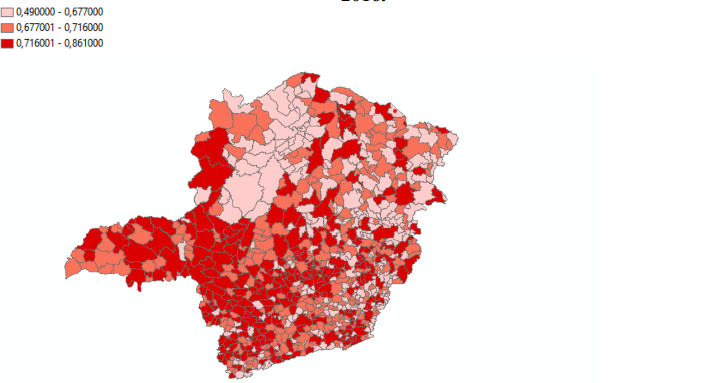
Figure 2
Distribution of social vulnerability rates in Minas Gerais municipalities in 2016
Source: Drawn up by the authors.
In Figure 2, the municipalities are classified into different categories of social vulnerability. The first category includes municipalities with vulnerability between 0.49 and 0.677, or in other words, the most vulnerable municipalities. The second category includes those with vulnerability between 0.677 and 0.716, while the last category includes those with vulnerability between 0.716 and 0.861. The municipalities in lighter colors are the most socially vulnerable.
It can be seen that in terms of aging, most municipalities in Minas Gerais are close to the state mean. In addition, there is no clear spatial relationship between the different levels of aging in the State. Vulnerability, on the other hand, presents a clear distinction between the different regions of the State. While the municipalities with greatest social vulnerability are, for the most part, located in the North and Northwest of Minas Gerais, those with less social vulnerability are, for the most part, found in the South and Center-South regions
Table 4, below, shows the percentage of total number of municipalities in the Minas Gerais meso-regions in each category of social vulnerability determined in Figure 2. As can be seen, in the meso-regions located in the north of the State (North Minas, Northwest Minas, Jequitinhonha, Vale do Mucuri, Vale do Rio Doce), the majority of municipalities are more socially vulnerable. In the meso-regions located in the central, south and south-central regions of the State, most municipalities are less socially vulnerable.
Table 4: Percentage of municipalities in Minas Gerais meso-regions in each social
Source: Drawn up by the authors.
It was not possible to verify an established relationship between the levels of aging and social vulnerability in the municipalities of Minas Gerais in 2016, either through descriptive analysis or observation of the figures. A more in-depth analysis was therefore carried out by means of the estimation of the quantile regressions. The results of those estimations are presented and discussed in the next subsection
In relation to the other variables analyzed, a great variation can be seen between maximum and minimum levels in terms of per capita expenditure on sanitation, per capita expenditure on health, GDP per capita, population density and administrative costs, which can be explained by the great inequality that exists in the State, as already mentioned.
4.2 Econometric results
To assess the effect of aging on the social vulnerability of the municipalities, quantile regressions (QRs) were estimated, considering three quantiles (0.2, 0.5 and 0.8), whose results are shown below in Table 5.
The first group (first quantile) is made up of the municipalities presenting lower values in the social vulnerability index, or in other words, the most vulnerable, while the third quantile is made up of the least socially vulnerable municipalities. It can be seen that in all three quantiles estimated, the coefficient which denotes population aging is negative and statistically significant at 1%.
Table 5: Econometric result
| North Minas | 56.18% | 29.21% | 14.6% |
| Northwest Minas | 52.63% | 26.31% | 21.05% |
| Jequitinhonha | 49.01% | 39.21% | 11.8% |
| Vale do Mucuri | 56.52% | 21.74% | 21.74% |
| Vale do Rio Doce | 48.04% | 27.45% | 24.51% |
| Greater Belo Horizonte | 21.9% | 35.24% | 42.85% |
| Central Mineira | 33.33% | 36.67% | 30% |
| Triângulo Mineiro/Alto Paranaíba | 3.03% | 42.42% | 54.54% |
| Zona da Mata | 45.07% | 33.1% | 23.24% |
| Campo das Vertentes | 25% | 52.78% | 22.22% |
| West Minas | 9.09% | 31.81% | 59.09% |
| South/Southwest Minas | 20.55% | 30.13% | 49.31% |
| Minas Gerais | 33.99% | 33.17% | 32.94% |
Source: Drawn up by the authors
Note: ***significant at 1%, **significant at 5%, *significant at 10%. Robust standard deviations in brackets.
5 Discussion
In view of the result that municipalities with longer-established populations are actually more vulnerable, the multidimensional dimensions of social vulnerability drawn up by Kaztman (2000) and Cunha et al. (2004) help to clarify the reason for this relationship. According to them, aging makes people or households less able to avail of opportunities which can provide increased well-being and avoid/combat situations of risk and/or embarrassment. Thus, the elderly are more predisposed to be affected by health, social, economic, physical, cultural and political problems in unforeseen circumstances and turmoil, whether external or internal (CAMARANO, KANSO, MELLO, 2004; RODRIGUES, NERI, 2012; RINCO, LOPES, DOMINGUES, 2012).
It is essential to analyze the factors related to this predisposition. Progressive increases in physical and cognitive limitations, and a propensity for chronic and degenerative diseases can be obstacles for the elderly in maintaining their routines, making it difficult for them to face their poverty status and carry out their everyday tasks (FREITAS, 2010). Furthermore, family abandonment becomes a challenge at this stage of life, when frailty can prevent the carrying out of certain activities necessary to maintain well-being, and people need assistance from family (MIRANDA, MENDES, SILVA, 2016; MAIA, 2011).
The financial difficulties present other challenges for the elderly, as in many circumstances, their pensions are inadequate to meet basic needs, which further contributes to family dependence, as noted by Inouye et al. (2010). It should also be stressed that the prejudice they experience also makes it difficult for them to join or remain in the labor market, given the distrust of their level of productivity and qualification for certain jobs (CAROLINO, CAVALCANTI, SOARES, 2010; NÉRI, 2007).
Hence, all the aspects highlighted make the elderly more vulnerable, and cause them to suffer more intensely from problems which affect people of other age groups in a simpler way. In the economic literature, while other studies present similar results, the present study is important for four reasons. The first is the use of the specific regional approach for the state of Minas Gerais, which has high heterogeneity. Second, this research considers a municipal aggregation level, unlike most studies which emphasize individuals. In addition, the data refer to 2016, which is very recent when compared to the data used in most studies. Finally, it considers results for different distributions in terms of quantiles of the dependent variable – social vulnerability.
In addition to the fact that the results show that aging increases social vulnerability in all three quantiles estimated, it can be seen that the coefficient was lower in the first quantile; it increases in the second and decreases again in the third quantile. As already discussed, the study by Barros, Mendonça and Santos (1999) points out that the presence of one elderly person in the household tends to reduce the level of poverty, as most elderly people receive social welfare benefits, which add to the family income. Thus, in municipalities where vulnerability is greater, the effect of the additional income somewhat counterbalances the impact of aging on social vulnerability, thereby making the coefficient estimated in such locations smaller. Therefore, it can be seen that the coefficient increases in medium quantiles of the distribution of vulnerability and falls again in municipalities with a lower level of vulnerability, as aging has less impact on the latter due to better living conditions.
As well as the question of aging, the positive coefficient of population density in the first quantile indicates that in more vulnerable municipalities, this variable reduces social vulnerability. Although many municipalities find themselves in precarious conditions, proximity to large urban centers and agglomerations of people means that there are more job opportunities and greater access to education, which reduces the condition of vulnerability. A similar result was found by Cidade (2013).
GDP per capita in the three quantiles observed presented a positive estimated coefficient, which was significant at 1% in the first two quantiles and at 5% in the third. In this respect, the absence or insufficiency of income prevents individuals from consuming goods and services, which are necessary for their survival and for maintaining their level of wellbeing.
In addition to income, access to public goods and services is a key dimension in determining social vulnerability. In this regard, per capita spending on sanitation and health variables were included, as was the percentage of administrative costs in relation to Net Current Revenue.
Per capita spending on sanitation and health indicates government investment in two essential areas for the population. The percentage of administrative costs in relation to Net Current Revenue indicates the percentage of government expenditure allocated to administrative functions and which are, therefore, not applied in areas related to economic development, such as health and education. Thus, it is expected that the spending on sanitation and health reduces the social vulnerability of municipalities, showing a positive coefficient; and the percentage of administrative costs in relation to Net Current Revenue increases municipal vulnerability, showing a negative coefficient.
Spending per capita on sanitation showed a significant and positive coefficient in all three quantiles, and was highest in municipalities with greater vulnerability. Thus, the greater the government investment in basic sanitation, the lower the social vulnerability of that location. According to Neri (2007), access to public services such as electricity, water supply, garbage collection and sewage considerably improves the quality of life of communities and reduces risks to health, thereby making them less vulnerable. Such access is a differential, especially in more vulnerable regions, as the result shows.
The non-significance of investment in health in all three estimations possibly shows the inefficiency of these expenditures in improving health conditions and, consequently, the well-being of the population. According to Dias (2016), the factors which impact the inefficiency of resource applications in municipal public health include corruption and unsatisfactory management.
Administrative cost was significant and showed a negative sign only in the first quantile estimated, or in other words, in the most vulnerable municipalities. As these locations have a higher level of vulnerability, there is a greater need for government assistance in several areas. Thus, the higher the percentage of government expenditure on administrative functions, the lower the possibility of undertaking social expenditure, which could reduce the social vulnerability presented by the local population.
Finally, with regard to the Minas Gerais meso-regions, in estimating the first quantile and using North Minas as a reference, all the other meso-regions presented a positive and significant coefficient, or in other words, the municipalities in these mesoregions are less socially vulnerable in relation to the reference meso-region. Those located in the northern and northeastern regions of the State presented lower coefficients, while those located in the southern and southwestern regions presented higher coefficients. In terms of the other two quantiles, only the Northwest Minas mesoregion was not significant, while the others presented a significant and positive coefficient.
As Araújo (2007) points out, historically, the mesoregions located in northern and northeastern Minas Gerais have a concentration of pockets of poverty, which include the mesoregions of North Minas, Northwest Minas, Jequitinhonha and Vale do Mucuri. In addition, the State has the greatest income inequality of all the states in the South and Southeast regions of Brazil, which results in a great disparity between the different meso-regions in terms of development and well-being, which is reflected in the result of the present study. The mesoregion dummies proved to be major determinants of municipal social vulnerability, as the municipalities located in the poorest regions of the State are, according to the estimates, the most vulnerable.
6 Final Comments
The rapid process of population aging which has occurred in developing countries is one of today’s most debated topics, along with its impact on conditions of social vulnerability. Existing national empirical studies, however, are limited to determining the effect of aging on specific factors of vulnerability, such as health conditions and education. In view of that, this study set out to analyze the relationship between population aging and social vulnerability, measured by means of an index which encompasses the dimensions of population fragility, in Minas Gerais in 2016. In that regard, the state of Minas Gerais helps understand the national reality and the analysis of this relationship is also crucial in practical terms as it can help in the formulation of public policies aimed at the older population.
The previously raised hypothesis suggests that the aging of the Minas Gerais population would lead to a higher level of social vulnerability. To attest to the veracity of this assumption, the João Pinheiro Foundation (FJP) database for 2016, containing information on the 853 municipalities in Minas Gerais, was used. The data collected were used to estimate quantile regressions, in order to evaluate the effect of aging in three quantiles of the distribution of social vulnerability; in the most vulnerable municipalities, in those with medium vulnerability, and in the least vulnerable municipalities.
The results found corroborate the research hypothesis in the three quantiles tested, or in other words, longer-established municipalities are actually more vulnerable. That relationship is due to the predisposition of the elderly to be affected by economic, social, physical, cultural and political situations and to their difficulty in protecting themselves or reacting to the said adversities. Issues related to physical and cognitive limitations, family abandonment, financial difficulties experienced and social prejudice explain the greater susceptibility to risk of this section of the population. In addition, it was seen that the effect of population aging is smaller in the most vulnerable municipalities, increases in medium quantiles of the distribution of vulnerability and falls again in municipalities with a lower level of vulnerability.
Finally, it is important to emphasize that the rapid process of population aging gains notoriety as it demands public policies on the part of the State. Programs which would assist the elderly by providing quality accessible rest homes and the training of professionals to care for the elderly should be implemented. In addition, the elderly should be encouraged to be independent and opportunities must be provided so that they feel included in society. Such measures are of vital importance, especially in the longer-established Minas Gerais municipalities, as they present higher levels of social vulnerability and a greater lack of assistance.
References
ABELIANSKY, A. L.; EREL, D.; STRULIK, H. Social vulnerability and aging of elderly people in the United States. SSM – Population Health, v. 16, 2021.
AGOSTINHO, C. S.; MÁXIMO, G. C. Idosos num Brasil que envelhece: uma análise multidimensional da pobreza. In: XV Encontro Nacional de Estudos Populacionais, 2006, Caxambú. Anais [...] Caxambú: ABEP, 2006.
ALVES, J. E. D. A transição demográfica e a janela de oportunidade. Instituto Fernand Braudel de Economia Mundial, São Paulo, 2008.
ARAÚJO, T. F. As inter-relações entre pobreza, desigualdade e crescimento nas mesorregiões mineiras, 1970-2000. 2007. 205 f. Dissertação (Mestrado em Economia) – Centro de Desenvolvimento e Planejamento Regional da Faculdade de Ciências Econômicas da Universidade Federal de Minas Gerais, Universidade Federal de Minas Gerais, Belo Horizonte, 2007.
BARROS, M. B. A.; GOLDBAUM, M. Desafios do envelhecimento em contexto de desigualdade social. Revista Saúde Pública, v. 52, 2018.
BARROS, R. P.; MENDONÇA, R.; SANTOS. D. Incidência e natureza da pobreza entre idosos no Brasil. Rio de Janeiro: IPEA, 999. 32 p. (Texto para discussão, n. 686).
CAMARANO, A. A.; KANSO, S.; MELLO, J. L. Como vive o idoso brasileiro? In: CAMARANO, Ana Amélia (Org.). Os novos idosos brasileiros: muito além dos 60? Rio de Janeiro: IPEA, p. 25-74, 2004.
CAMARANO, A. A.; PASINATO, M. T. Envelhecimento, pobreza e proteção social na América Latina. Papeles de población, v. 13, n. 52, p. 9-45, 2007.
CANÇADO, T. C. L.; SOUZA, R. S.; CARDOSO, C. B. S. Trabalhando o conceito de Vulnerabilidade Social. In: XIX Encontro Nacional de Estudos Populacionais, 2014, São Pedro. Anais [...] São Pedro: ABEP, 2014.
CARMO, M. E.; GUIZARDI, F. L. O conceito de vulnerabilidade e seus sentidos para as políticas públicas de saúde e assistência social. Cadernos de Saúde Pública, v. 34, n. 3, p. 1-14, 2018.
CAROLINO, J. A.; CAVALCANTI, P. B.; SOARES, M. L. Vulnerabilidade Social da População Idosa e a Necessidade de Políticas de Proteção como Mecanismo de Inclusão Social. Qualitas Revista Eletrônica, v. 9, n. 1, 2010.
CIDADE, L. C. F. Urbanização, ambiente, risco e vulnerabilidade: em busca de uma construção interdisciplinar. Cadernos Metrópole, São Paulo, vol. 15, n. 29, p. 171-191.
CIRINO, J. F.; GONZÁLEZ, A. M. G. O. A heterogeneidade do desenvolvimento econômico do estado de Minas Gerais. Revista de Ciências Humanas, v. 11, n. 1, p. 9-23, 2011.
COLET, C. F.; BORGES, P. E. M.; AMADOR, T. A. Perfil de gastos com medicamentos entre idosos em diferentes grupos socioeconômicos. Revista Brasileira de Geriatria e Gerontologia., Rio de Janeiro, v. 19, n. 4, p. 591-601, 2016.
CRESPO, A. P. A.; GUROVITZ, E. A pobreza como um fenômeno multidimensional. RAEeletrônica, São Paulo, vol. 1, n. 2, p. 1-12, 2002.
CUNHA, J. M. P.; JAKOB, A. E.; HOGAN, D. J.; CARMO, R. L. A vulnerabilidade social no contexto metropolitano: o caso de Campinas. In: XIV Encontro Nacional de Estudos Populacionais, 2004, Caxambú. Anais [...] Caxambú: ABEP, 2006 p. 20-24.
DIAS, L. N. S. Fatores que impactam na corrupção e na ineficiência relacionadas à aplicação de recursos da saúde pública municipal. 2016. 156 f. Tese (Doutorado em Ciências Contábeis) - Programa Multi-institucional e Inter-Regional de Pós-Graduação em Ciências Contábeis, Universidade de Brasília, Universidade Federal da Paraíba, Universidade Federal do Rio Grande do Norte, Brasília, 2016.
FREITAS, D. C. C. V. Vulnerabilidade e resiliência em idosos institucionalizados. Revista Kairós, v. 13, p. 63-74, 2010.
GIATTI, L.; BARRETO, S. M. Saúde, trabalho e envelhecimento no Brasil. Cadernos de Saúde Pública, v. 19, n. 3, p. 759-771, 2003.
INOUYE, K.; BARHAM, E. J.; PEDRAZZANI, E. S.; PAVARINI, S. C. L. Percepções de Suporte Familiar e Qualidade de Vida entre Idosos Segundo a Vulnerabilidade Social. Psicologia: Reflexão e Crítica, v. 23, n. 3, p. 582-592, 2010.
INSTITUTO BRASILEIRO DE GEOGRAFIA E ESTATÍSTICA. Tendências Demográficas: uma análise dos resultados do censo demográfico 2000. Rio de Janeiro, 2004.
KAZTMAN, R. Notas sobre la medición de la vulnerabilidad social. Borrador para discusión. 5 Taller regional, la medición de la pobreza, métodos e aplicaciones. México: BIDBIRF-CEPAL, 2000.
KRELING, N. H. Envelhecimento, trabalho e renda: uma análise na Região Metropolitana de Porto Alegre. FEE – Indicadores Econômicos, v. 36, n. 1, p. 67-76, 2008.
LIMA-COSTA, M. F.; VERAS, R. Saúde púbica e envelhecimento. Cadernos de Saúde Pública, v, 19, n. 3, p. 700-701, 2003.
MAIA, F. O. M. Vulnerabilidade e envelhecimento: panorama dos idosos residentes no município de São Paulo – Estudo SABE. 2011. Tese (Doutorado na Saúde do Adulto) - Escola de Enfermagem, Universidade de São Paulo, São Paulo, SP, 2011.
MIRANDA, G. M. D.; MENDES, A. C. G.; SILVA, A. L. A. O envelhecimento populacional brasileiro: desafios e consequências sociais atuais e futuras. Revista Brasileira de Geriatria e Gerontologia, v. 19, n. 3, p. 507-519, 2016.
NÉRI, A. L. Idosos no Brasil: vivências, desafios e expectativas na terceira idade. São Paulo: Fundação Perseu Abramo, 2007.
NERI, M. (Cord.). Onde estão os idosos? Conhecimento contra o COVID-19. Fundação Getúlio Vergas – Centro de Políticas Sociais, 2020.
NERI, M. C. Trata Brasil: Saneamento e Saúde. Rio de Janeiro: FGV/ IBRE, CPS, nov. 2007.
PAIVA, P. T. A.; WAJNMAN, S. Das causas às consequências econômicas da transição demográfica no Brasil. Revista Brasileira de Estudos de População, São Paulo, v. 22, n. 2, p. 303-322, 2005.
Pesquisa Nacional por Amostra de Domicílios (PNAD) 1997. Disponível em: http://www.ibge.gov.br. Acesso em: janeiro de 2020.
Pesquisa Nacional por Amostra de Domicílios (PNAD) 2004. Disponível em: http://www.ibge.gov.br. Acesso em: janeiro de 2020.
Pesquisa Nacional por Amostra de Domicílios (PNAD) 2008. Disponível em: http://www.ibge.gov.br. Acesso em: janeiro de 2020.
RINCO, M.; LOPES, A.; DOMINGUES, M. A. Envelhecimento e Vulnerabilidade Social: discussão conceitual à luz das políticas públicas e suporte social. Revista Temática Kairós Gerontologia, v. 15, n. 6, p. 79-95, 2012.
RODRIGUES, N. O.; NERI, A. L. Vulnerabilidade social, individual e programática em idosos da comunidade: dados do estudo FIBRA, Campinas, SP, Brasil. Ciência & Saúde Coletiva, v. 17, n. 8, p. 2129-2139, 2012.
SECRETARIA DE AVALIAÇÃO E GESTÃO DA INFORMAÇÃO (SAGI). Pobreza multidimensional: questões conceituais e metodológicas para seu dimensionamento. Ministério do Desenvolvimento Social e Combate à Fome, Brasília, 2015.
VIEIRA, R. S. S. Estereótipos e Preconceitos Contra os Idosos. 2013. Dissertação (Programa de Pós-Graduação em Psicologia Social) - Centro de Ciências de Educação e Ciências Humanas, Universidade Federal de Sergipe, São Cristóvão, SE, 2013.
VIGNOLI, J. R. Vulnerabilidad y grupos vulnerables: un marco de referencia conceptual mirando a los jóvenes, en: Población y Desarrollo. Comisión Económica para América Latina y El Caribe, Naciones Unidas. Santiago de Chile, n. 17, 2001.