Artículos
Perceptions of the influence of anxiety on students’ performance on English oral examinations
Percepción de la influencia de la ansiedad en el rendimiento de los estudiantes en los exámenes orales de inglés
 José Vicente Abad jose.abadol@amigo.edu.co
Santiago Otálvaro Arango lic.sotalvaro@gmail.com
Mateo Vergara Restrepo mateo.vergarare@amigo.edu.co
José Vicente Abad jose.abadol@amigo.edu.co
Santiago Otálvaro Arango lic.sotalvaro@gmail.com
Mateo Vergara Restrepo mateo.vergarare@amigo.edu.co
Perceptions of the influence of anxiety on students’ performance on English oral examinations
Revista Latinoamericana de Estudios Educativos (Colombia), vol. 17, núm. 2, pp. 143-167, 2021
Universidad de Caldas

Esta obra está bajo una Licencia Creative Commons Atribución 4.0 Internacional.
Recepción: 27 Julio 2020
Aprobación: 15 Junio 2021
Resumen: Este estudio de caso buscó determinar la forma en que diferentes actores perciben el impacto de los marcadores de ansiedad en el desempeño de los estudiantes de inglés en exámenes orales. La muestra incluyó 17 estudiantes, dos maestros y siete observadores externos de un programa de Licenciatura en inglés en Colombia. La recolección de datos incluyó observaciones estructuradas durante las presentaciones y entrevistas semiestructuradas a profesores y estudiantes. Los resultados mostraron que los presentadores se enfocaron en evitar los marcadores notorios de ansiedad, pero, para los observadores, estos no perjudicaron la calidad del discurso tanto como los marcadores intermitentes y sostenidos. Además, aunque la ansiedad afectó el rendimiento oral de los estudiantes, los maestros la excluyeron al evaluar su habilidad lingüística. Se invita a maestros y estudiantes a reflexionar sobre el impacto real de la ansiedad al hablar en público bajo circunstancias evaluativas, particularmente en contextos distintos al aula.
Palabras clave: marcadores de ansiedad, ansiedad en lenguas extranjeras, desempeño oral, exámenes orales, percepciones de ansiedad, hablar en público.
Abstract: This case study sought to determine the way in which different actors perceive the impact of anxiety markers on the quality of EFL students’ performance on oral examinations. The group of participants was made up of 17 students, two teachers, and seven external observers from an undergraduate English teaching program in Colombia. The data collection process involved structured observations during students’ presentations and semi-structured interviews to both teachers and students. The results showed that presenters focused on avoiding notorious anxiety markers, but, from the observers’ point of view, these did not affect speech quality as much as intermittent and sustained markers did. Moreover, although anxiety affected students’ oral performance, teachers filtered it out when grading students’ language ability. Teachers and students are therefore invited to reflect upon anxiety’s actual impact on public speaking in test situations, particularly in contexts other than the classroom.
Keywords: anxiety markers, foreign language anxiety, oral performance, oral exams, perceptions of anxiety, public speaking.
Introduction
With the undisputed place of English as the most preeminent lingua franca in the world (Melitz, 2018), it is no surprise that its learning has become a top priority in the educational agenda of most countries across Latin America (Escobar, 2013). In this respect, Colombia is not an exception. For over two decades, the Colombian government has issued a series of language policies[1] that seek to improve the English language proficiency of its citizens. Although such policies have received severe criticism from the national academic community (Coral-Piedrahita, 2018; Correa & González, 2016; Usma, 2015; Peláez & Usma, 2017), both advocates and detractors acknowledge the need that new professionals graduating in all areas of knowledge become competent English users.
One of the major goals of having undergraduate students learn English is turning them into fluent speakers of the language, mainly because in their professional and academic lives they will be invariably faced with situations that will require them to speak English in evaluative situations. Whether they have to take a job interview, attend international lectures, or engage in academic activities at the graduate level, the ability of new professionals to speak English is no longer a competitive advantage, but a baseline requirement. However, the development of oral skills at the undergraduate level of education, particularly of those pertaining to speaking in public, has proven to be quite challenging for both students and teachers.
The difficulties in having students develop public speaking skills are evident at the English teaching program where this study was conducted. As stated by the National Ministry of Education, Res. 02041 (2016), students from the program are expected to achieve a C1 English level[2] before graduation. To assess students’ communicative competence (Bachman & Palmer, 1996; Canale & Swain, 1980), teachers use multiple types and forms of assessment (Brown & Abeywickrama, 2010; Maturana-Patarroyo, 2015), including oral exams.
Before conducting this study, we had noticed that many college students, including pre-service English teachers, perform poorly on English oral examinations. Many of them argue that their low performance in this type of tests is due to their fear of speaking in public. In fact, these students usually appear to be quite nervous in the face of oral tests. This situation can lead students to feel frustrated about their learning process and to develop resistance towards both oral exams and foreign language learning as a whole. In some extreme cases, anxiety can lead students to drop out of their English courses.
To make matters worse, when designing and administering oral exams, teachers often fail to effectively address internal and external factors[3] that raise the students’ affective filter (Krashen, 2013; Ranjbar & Narafshan, 2016) and thereby encroach upon their ability to speak effectively. Paradoxically, most students continue to pass their English courses only to crash against a wall raised by situations that require them to speak English in public. This problem suggests an unaddressed discrepancy regarding the way teachers, students, and external observers perceive the influence of anxiety on English oral performance in evaluative situations.
Literature Review
Most people experience uneasiness towards speaking in public. According to The National Institute of Mental Health in the U.S., fear of speaking in public affects about 73% of the population (National Social Anxiety Center, 2016). When public speaking serves an assessment purpose, particularly in a foreign language, that feeling could easily worsen. Some researchers argue that anxiety can seriously hamper foreign language students’ oral performance and curtail their language learning (Horwitz, 2010; Subaşı, 2010); yet oftentimes neither teachers nor students know how to tackle this emotion. In the following section, we provide working definitions for different types of anxiety, which derive from areas such as psychology and applied linguistics; summarize some factors associated to language anxiety; and explore its relation to students’ performance in oral examinations.
Conceptual Framework
Anxiety is tied to negative feelings such as restlessness, frustration, insecurity, fear, and tension that can have a powerful impact on human behavior. At least three types have been identified. The first type, trait anxiety (Spielberger,1989) refers to the innate predisposition of some individuals to be anxious, which may be partly attributed to their lack of emotional stability (Goldberg, 1993). The second type, state anxiety (Spielberger, 1989) emerges temporarily without becoming a generalized condition. For MacIntyre (1999), it refers to “the moment-to-moment experience of anxiety” that any person could feel at any given time (p.15). Caver and Scheier (1986) found that the latter, albeit normal, may compromise behavior and cognition as it triggers a distinct response from the automatic nervous system. Last, Endler (1980) proposed a third type, situation-specific anxiety, which some people experience every time they are under a specific set of circumstances, such as travelling by air, taking a test, or speaking in public.
Although it could be claimed that anxiety is the affective factor that most hinders learning, its effects are not always negative. Horikawa (2013) classifies anxiety into debilitative or facilitative depending on whether it aids or hampers a specific learning task. Other forms of this condition in relation to learning include achievement anxiety, which is associated with the fear of failure in educational environments (Horwitz, 2010); and test anxiety (Fernández-Castillo & Caurcel, 2015), a situation-specific variant experienced when students have to take exams.
The influence of anxiety on language learning has been extensively investigated (See, for example, Gardner & MacIntyre, 1993; Horwitz et al., 1986; MacIntyre, 1995, 1999; Young, 1986). Horwitz and Young (1991) developed two possible approaches to explain the concept. The first approach suggests it is the result of students transferring anxieties from other domains; the second approach proposes it is a unique emotional experience of its own. These approaches laid the foundations for other research studies on the topic of foreign language anxiety (Young, 1986, 1999), which involves a negative emotional response of worry and nervousness provoked by having to learn or use a second language. Horwitz et al. (1986) and Horwitz (2010) characterized it as a multimodal construct that involves linguistic, cultural, learning, and instructional factors.
Research Antecedents
Factors associated to language learning anxiety. Students’ speaking is arguably the language skill most affected by language learning anxiety (Elkhafaifi, 2005; Horwitz et al., 1986; Price, 1991; Young, 1986, 1999). McKintyre (1999) argues that language anxiety is different from other anxiety types that affect learning because it is related to a complex interplay of internal and external factors that various researchers have tried to pinpoint. Given the complex interrelation between human beings and their environment, the line that researchers use to distinguish internal from external factors is often blurry. However, for the sake of analysis, anxiety-related factors can be placed within a continuum that measures students’ degree of influence over them. Hence, at the time of facing an oral presentation, subjective factors depend more directly on the learners’ volition —as they lie within their scope of influence— whereas objective factors cannot be directly controlled by them.
Based upon the previous premise, we found that the objective factors most commonly associated to students’ foreign language anxiety include (1) speaking in public (Aida, 1994; Horwitz et al., 1986; Liu, 2006; Mak, 2011; Woodrow, 2006); (2) complying with task-specific requirements regarding form or content (Chen, 2015); (3) experiencing pressure to pass (and fear of failing) the course (Mak, 2011); and (4) being evaluated by an audience (Aida, 1994; Chen, 2015; Mak, 2011, Subaşı, 2010) particularly by native speakers (Mak, 2011; Woodrow, 2006) or by peers (MacIntyre, 1999; Woodrow, 2006). With regard to peer evaluation, some research studies (MacIntyre, 1999; Price, 1991) concluded that students’ resistance to public oral examinations often derives from feelings of both inadequacy and fear, as they often believe they are not at the same proficiency level as their peers, and that, as a consequence, they can easily make a speaking mistake that could prompt their peers’ criticism and mockery. Other factors linked to language-anxiety in relation to oral examinations include students’ language proficiency (Chen, 2015) as well as their age and overall academic achievement (Onwuegbuzie et al., 1999).
Major subjective factors tied to language learning anxiety are students’ personality, including trait anxiety; and psychological conditions, including state and situation-specific forms of anxiety (MacIntyre, 1995, 1999; Mark, 2011). MacIntyre (1995) found, for example, that, when learning a language, extrovert students usually experience less nervousness than introvert students, who tend to do better in areas that require less social interaction such as math or science. Other subjective factors include students’ attitude towards language (Mak, 2011; Yan and Horwitz, 2008) and prior experience with language-learning (Chen, 2015; Onwuegbuzie et al., 1999) along with the quality and amount of preparation for the oral assignment (Chen, 2015), which is usually connected to students’ ability to use learning strategies (Abad & Alzate, 2016; Yan & Horwitz, 2008).
Relation between language anxiety and oral performance. Language anxiety as a psychological phenomenon has been largely studied through quantitative methods (see, for example, Horwitz et al., 1986; Young, 1986; Pappamihiel, 2002; Saito, 1999; MacIntyre & Gardner, 1991; MacIntyre, 1999). The most common instruments to measure it include tests, surveys, and scales, of which arguably the most popular one has been Horwitz et al. (1986)Foreign Language Class Anxiety Scale (FLCAS). Despite multiple studies on the topic, no conclusive findings have been established as to the relationship between language anxiety and students’ academic performance in oral examinations.
On the one hand, some studies have found a negative correlation between these variables. Through their own scale, Gardner et al. (1979) found a negative correlation between language anxiety and the learning of French. Horwitz et al. (1986) determined that students’ language learning performance was indeed affected by significant levels of foreign language anxiety. MacIntyre (1995) stated that “language anxiety can play a significant causal role in creating individual differences in both language learning and communication” (p. 90). Further studies (Horwitz, 2010; Subaşı, 2010) also concluded that this variable can seriously hamper EFL students’ oral performance and hinder their language learning.
Other studies, however, have found no direct correlation between language anxiety and students’ academic performance. Beatty and Andriate (1985) found that students’ language anxiety cannot directly determine second language learning performance, because other factors, such as students’ personality and learning environment, affect their second language acquisition. Findings ferreted out by Woodrow (2006) show that, even though ESL students feel anxious about presentations, this emotional state does not have a significant relationship with their oral performance.
After revising the literature, we conclude that foreign language anxiety is arguably the factor that most affects EFL students’ oral performance. However, discrepancies between researchers as to the relation between these two variables suggest that the incidence of anxiety on oral examinations probably varies depending on culture and school factors. Further, the fact that many students pass their oral examinations although their performance is affected by language anxiety evinces a mismatch in the way that different observers perceive — and assess — its impact on EFL students’ oral performance. This point, however, has not been deeply explored in EFL teaching and learning. Hence, more than measuring the impact of anxiety on students’ oral performance through quantitative methods, we aimed at exploring the way in which different actors, in the classroom and outside, perceive this emotional state and construe its impact on the quality of EFL students’ oral performance, particularly when it becomes a component of language assessment. Such findings could help EFL teachers and learners better understand the place of anxiety in students’ public speaking and develop strategies to more effectively address it when public speaking in English is required, especially for assessment purposes.
Method
Research Design
In adherence to the principles of the interpretive paradigm (Cifuentes-Gil, 2011; Vieytes, 2004), we conducted a case study (Moore et al., 2012). According to Taylor and Medina (2013), researchers within the interpretive paradigm use ethnographic methods such as informal interviews and participant observations “to construct trustworthy and authentic accounts of the cultural other” (p.5). On the other hand, investigators who engage in case study research (Creswell, 2014; Stake, 1995; Yin, 2013) seek to better understand a problem by studying in detail a representative case within a real context. Through this study we purported to broaden our understanding of the effects of anxiety on English learners’ oral performance by studying the said phenomenon in a group of pre-service English teachers and their instructors. More specifically, we aimed at exploring the perception that different actors (students, teachers, and external observers) hold as regards the way in which anxiety signs affect the quality of students’ speaking exams.
Context
The study was conducted at a private Catholic university in Colombia. At the time, the university had six schools that offered 28 graduate and 24 undergraduate programs to nearly 17,000 students in six sites spread out across the national territory. To this day, the university takes pride in its humanistic approach to education, through which it seeks to educate professionals with ethical principles that will positively impact their social context. To that effect, the university follows an integral assessment model that includes not only students’ skills and knowledge but also their attitudes, values, and emotions[4].
When the study started, the English teaching program at the university had 825 students. The curriculum comprised 144 credits distributed across 55 courses, out of which 19 belonged to the pedagogical core, i.e., to the language teaching component. Most of the latter regularly included oral exams and presentations as part of assessment; therefore, in order to more easily appraise the perceptions of anxiety’s impact on students’ oral performance, only students and teachers taking part in those courses were included in the study.
Sampling
As suggested above, we employed a criterion-based sampling (Marshall, 1996; Patton, 2015) for the selection of participants. To participate in the study, students had to be legal adults —18 years or older—effectively registered in the English teaching program, from the second semester onwards. In addition, participants had to be taking a course that belonged to the English teaching component of the program and that included oral presentations as part of the evaluation.
Considering the above conditions, researchers selected 17 students from four different English-teaching courses. Students’ average age was 21 years old. There were 9 males and 8 females. They belonged to socio-economic strata 3 and 4, which corresponds to households with a middle-class income. At the time of the study, their average English proficiency level was B1, according to the Common European Framework of Reference (Council of Europe, 2001).
Besides the 17 students, the four teachers in charge of the selected courses also participated in the study. These four instructors had masters’ degrees in language education and had been part of the program’s faculty for seven years on average. Their overall teaching experience ranged between five to 15 years. Two of them were former priests who had decided to become language teachers, and all four conformed to the institution’s Catholic and humanistic philosophy.
Data Collection
Prior to data collection, the four teachers and the 17 students formally agreed to the terms of the study by signing an informed consent. For data collection, we resorted to non-participant observations, students’ grades on observed examinations, and semi-structured interviews. After the non-participant observations, we collected students’ grades on the oral exams. Thereon, we conducted a preliminary analysis, which informed the design of the subsequent interviews. Below we describe the procedures for both the observations and the interviews.
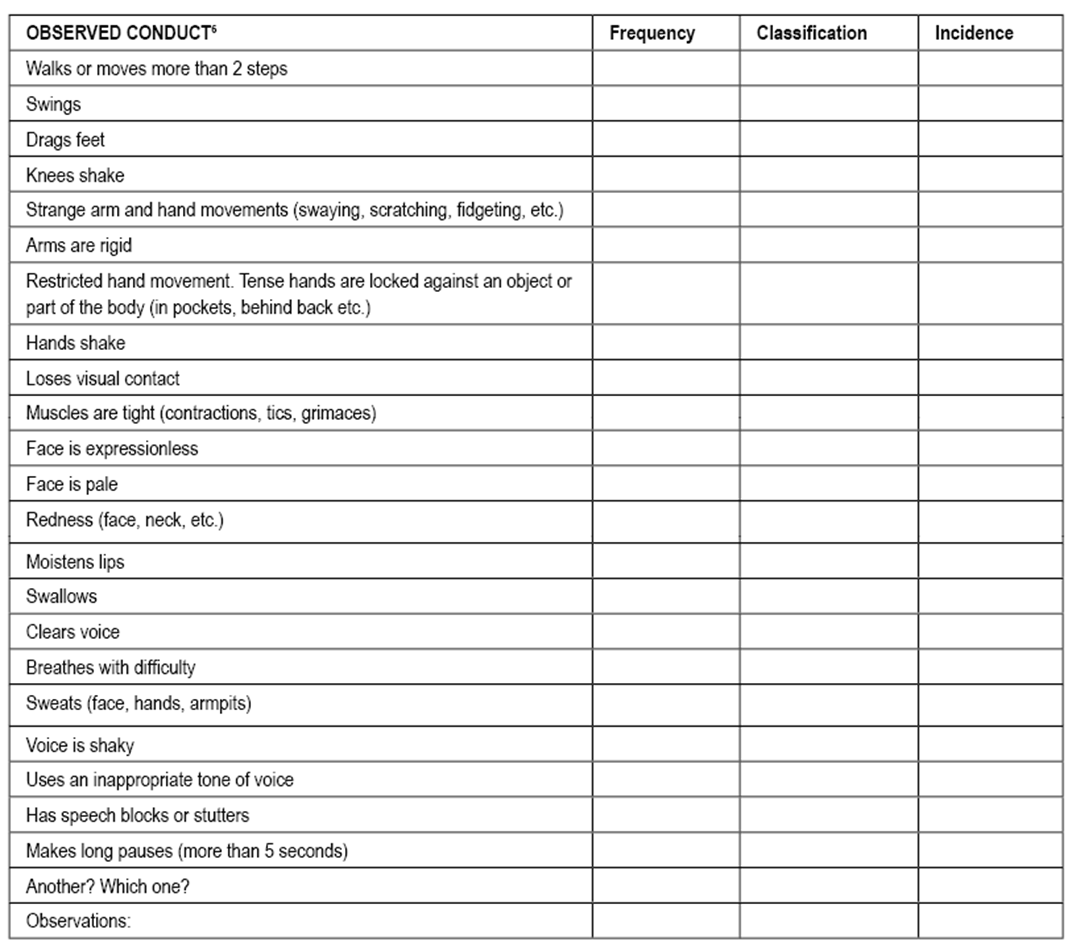
Observations. To verify the frequency of anxiety markers during students’ oral assessments, seven researchers carried out structured non-participant observations (Bell, 2010) using an observation checklist (Appendix A). The descriptors in the checklist were taken from Aiken’s (2003). In addition, three categories of anxiety markers were proposed: Notorious markers involved behaviors that were decidedly evident during the presentation, but that occurred fewer than 5 times; for example, when a student makes a 10-second pause because they forgot a word. Intermittent markers referred to on-and-off behaviors that happened more than five times but that, as a whole, did not take up more than 50% of the overall length of the presentation; for example, a student balancing their arms every now and again for a total of two minutes in a 10-minute presentation. Finally, sustained markers were defined as behaviors that occurred for 50% or more of the presentation’s total time span; for example, a student who walks around the room during the entire presentation.
The seven observers were trained to carry out the observations. As part of their training, they actively participated in adjusting, piloting, and field-testing the checklist. To pilot the instrument, the research team engaged in two trial sessions in which they used the instrument while observing 5- to 7-minute presentations online. After each observation run-through, team discussions were held to adjust the checklist according to practical and contextual needs perceived during the exercise and to unify the assessment criteria of observers. In the end, the seven researchers observed the 17 participants to determine the frequency of anxiety markers during their oral evaluations. Afterwards, observers also had to classify those markers into one of the three aforementioned categories and grade them from 1 to 10 depending on the incidence they perceived such markers had on the overall quality of the students’ oral performance.
Interviews. By means of semi-structured interviews (Longhurst, 2003), we sought to identify students’ and teachers’ perceptions about anxiety and its influence on oral performance. Based on the results derived from the analysis of the initial data, that is, the observation checklists and the students’ grades, the research team designed the protocols for the interviews, which helped us to validate our initial interpretations. Moreover, we adapted the protocol used with the teachers in light of the results obtained with the students’ interviews. In fact, one question was added concerning the teachers’ perception of anxiety during oral exams and the value ascribed to it at the time of grading students’ performance. In other words, the planning and implementation of the interviews was informed by the preceding results obtained through the preliminary analysis of previously collected data. Thus, the iterative and recursive nature of qualitative research (Burns, 1999, 2010; Curry, 2015) was preserved and came to bear. Table 1 describes the action plan we followed.
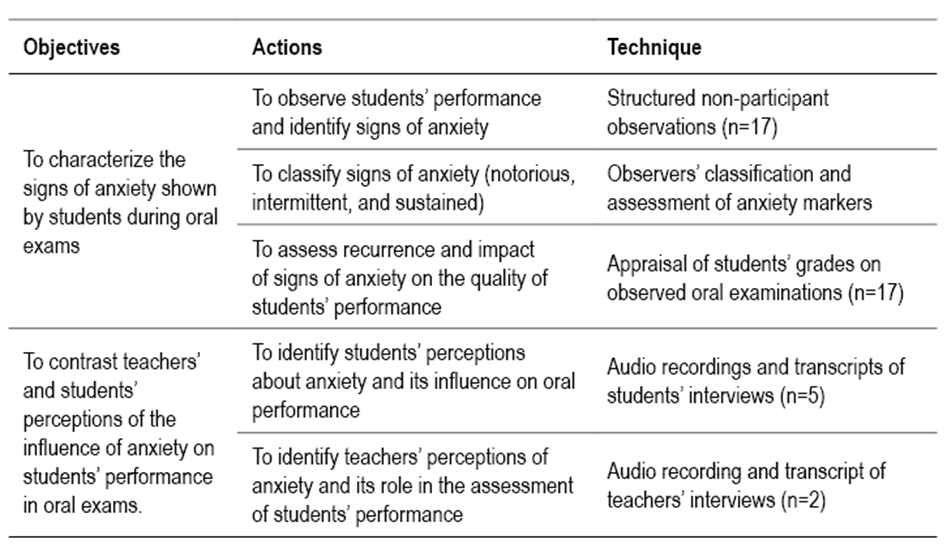
Table 1.
Action Plan
Note: Own Source.
Data Analysis
For the analysis of qualitative data, we followed an integrated approach (Curry, 2015) that involved assembling, coding, and comparing the data to identify patterns and relationships, as suggested by Burns (1999). Once the initial coding and categorization process was completed, we used a category matrix that allowed us to describe and compare sets of data around specific themes to arrive at plausible interpretations that were later verified with participants of the study and pitted against existing research in the area of foreign language anxiety.
In addition, we took a number of measures to maximize the study’s validity and trustworthiness (Burns, 1999; Denzin & Lincoln, 2005; Guba & Lincoln, 1989). Initially, we used different forms of triangulation, particularly as regards methods and investigators (Burns, 2010; Denzin & Lincoln, 2005; Golafshani, 2003). In this respect, Patton (2015) states that the combination of methods can strengthen a study, particularly when it involves the use of both quantitative and qualitative data. Moreover, as indicated earlier, interviews served as a strategy to perform members checking (Burns, 2010). Finally, we used peer examinations (Burns, 2010) as two external evaluators not directly involved in the study validated the results and interpretations.
Results
To analyze the incidence of anxiety on the quality of students’ performance on oral exams, we organized the findings according to the perceptions held by external observers, students, and teachers, as evinced through the different instruments used.
Observers’ Assessment of Anxiety in Oral Performance
As indicated in the method section, observers’ first task was to identify markers of anxiety and determine their frequency of occurrence during students’ presentations. Then, based on that frequency, observers had to classify those markers into notorious, intermittent, and sustained behaviors. Finally, they had to assess the degree to which those behaviors affected the quality of students’ oral performance. Figure 1 shows the frequency of occurrence of the different anxiety markers observed.
To determine the incidence of each type of anxiety markers on a student’s performance, the added value given to a group of behaviors under the same category (notorious, intermittent, or sustained) was divided into the frequency in which they occurred over the course of the presentation. Table 2 shows these data in detail.
After calculating the effect of anxiety markers on each student’s performance, the average incidence of each marker type was calculated for the whole group. The notorious markers showed the lowest incidence (2.7) whereas the intermittent (5.2) and sustained (6.8) ranked higher. Figure 2 shows the degree in which each type of marker influenced the quality of students’ oral performance as assessed by the external observers.
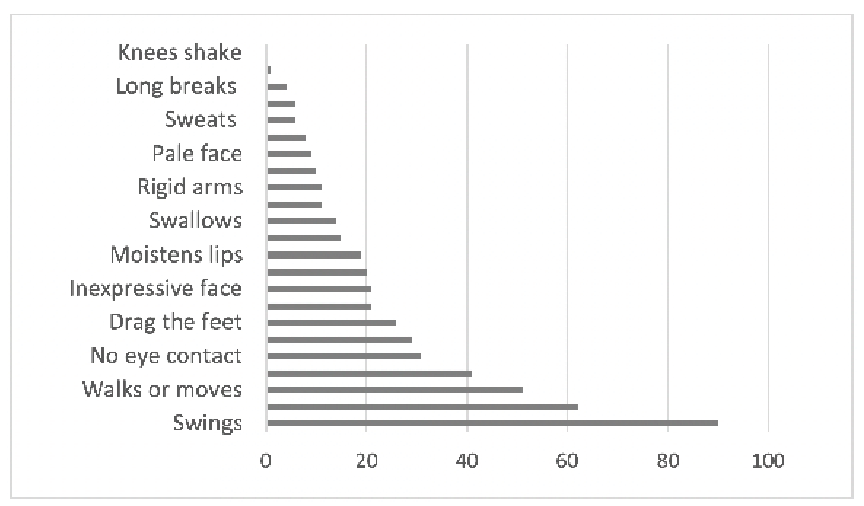
Figure 1
Frequency of Anxiety Markers
Note: The table shows the number of times each marker took place over the observation period.
Own source.
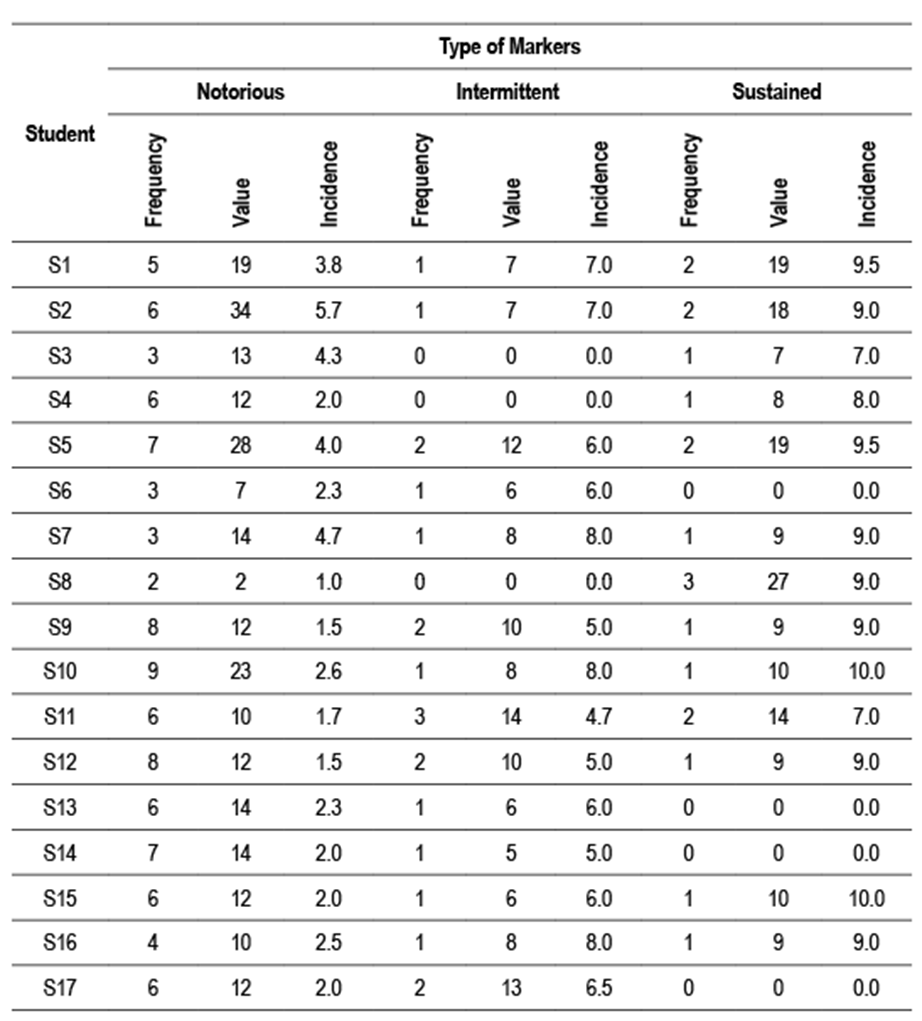
Table 2.
Incidence of Anxiety Markers per Student
Note: Notorious markers were noticeable yet they occurred fewer than five times. Intermittent markers occurred five or more times, but never for more than half the time of the presentation. Sustained markers were held or repeated for 50% or more of the total length of the presentation.
Own source.The results showed that intermittent and sustained behaviors had the greatest influence on students’ performance. Hence, conducts such as swinging (90), restricting hands against hard surfaces or objects (62), and walking or moving (51), which occurred repeatedly during students’ oral presentations, had the most negative impact on the quality of students’ public speaking. Conversely, in the eyes of external evaluators, notorious conducts that happened fewer than 5 times on each performance, such as taking long breaks (4), breathing heavily (6), getting pale (9), or flushing (11), did not have a strong overall effect on the quality of the presentations.
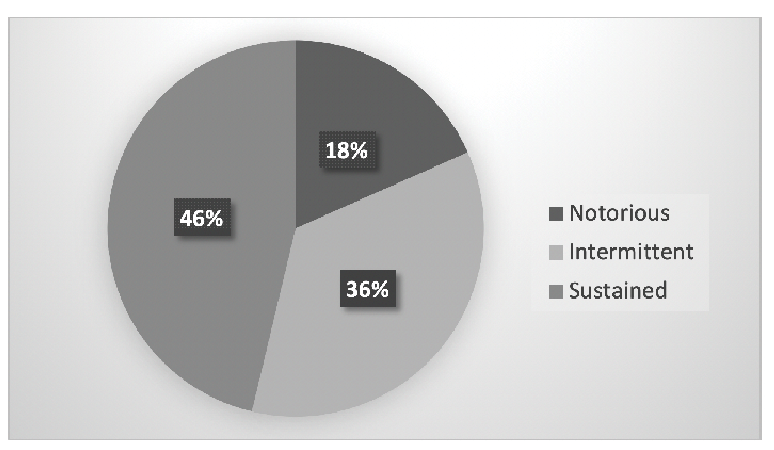
Figure 2
Observers’ Assessment of Anxiety Markers’ Incidence on Oral Performance
Note: The graph shows the perceived impact of the different types of anxiety markers on the quality of students’ presentations, as assessed by external observers.
Own source.Some students had more notorious behaviors than they had intermittent or sustained behaviors. However, the latter, whether they happened repeatedly (intermittent) or only a few times (sustained), occurred over a longer period of time than the former. Therefore, sustained behaviors generated more distractions for the observer and were valued as having a more negative impact on the students’ performance than the notorious ones. In conclusion, the more reoccurring an anxiety marker was and the longer it lasted, the more it disturbed the observer’s attention and, therefore, the more it negatively affected their evaluation of the students’ oral performance.
Students’ Perception of Anxiety in Oral Performance
When considering the impact of anxiety on themselves as presenters, the 17 participants were inclined to worry about notorious behaviors. Excerpts[5] from the interviews show how, on the assessment of their own oral production, participants gave greater importance to notorious behaviors such as forgetting parts of the speech or blushing while speaking. Several students, for example, were concerned about forgetting the words they had to say. Student 4 said a worrying situation was “blocking and for words not to come out of my mouth”. In addition, student 1 said, “When I get to the room, I forget everything”. Student 2 said: “The impact of anxiety is very big because, for example, if we are anxious, sometimes we forget what we are going to answer or we give a wrong answer.” Other students worried about blushing. Student 4 emphasized: “I blush, yes, I get red in the face”. Student 1 also said “I blush”.
Notwithstanding, when reflecting upon the impact of anxiety on their classmates’ presentations —that is, when they saw themselves as members of the audience—, interviewees focused primarily on sustained and intermittent conducts (just as external observers had done), indicating that these incidents negatively affected their peers’ performance. References to sustained behaviors were usually linked to their classmates through terms such as “they” and “them”. And students pointed out that, as they were listening to their classmates, these conducts were more disturbing for them than the notorious ones.
Student 1, for instance, in referring to the observation of how anxiety affected his classmates’ performance said: “They move a lot, hmm, they have a kind of tic, which is, for example, moving the foot against the floor or fidgeting with their hands or with the object they are holding and that type of thing.” Student 5 also commented: “They take many steps or play with the markers and with their hands.” Student 4 stated: “(When they are nervous,) their hands shake a lot and it shows.”
These results indicate that students’ perception of how much anxiety affects oral performance depends on the role they play during a presentation. As presenters, students tend to worry about notorious conducts because they are afraid of making “a big mistake”, and they believe that these behaviors have a strong negative impact on their oral performance that may cause them to lose face before their peers. However, as members of the audience, students tend to perceive sustained and intermittent conducts as being more taxing on the quality of their peers’ oral performance than the notorious ones.
Teachers’ Perception of Anxiety in Oral Performance
The first indication of teachers’ perception of anxiety is their assessment of students’ oral performance. As indicated in the revision of the literature, some studies have found no direct correlation between students’ anxiety levels and their results in oral examinations. But if students’ anxiety levels affect their oral performance, as has been noted herein and suggested by other studies, why was it not reflected on their exam grades? The analysis of the interviews indicates that, at the time of evaluating students’ oral performance (and in line with the university’s humanistic approach to assessment), teachers focused more on students’ overall linguistic skills rather than on the way they presented and on the signs of uneasiness they showed. Hence, when assigning grades, teachers were more attentive to students’ degree of preparation for the oral examination (as reflected in elements such as the accompanying visual aids) than to aspects such as signs of distress reflected in their body language.
In this regard, teacher 1 said:
I feel it’s important to help [students] lower anxiety levels so that the person can give the best of themselves, so I invite them to be better prepared, to make rehearsals or essays of their presentations … If those signs of anxiety still remain, I really do not give too much importance to them. I mean, I try to help the student understand that I am not really taking into account their anxiety if they have done some exercises to reduce it.
In turn, teacher 2 said,
Students may feel anxious when they have to speak in public regardless of how good they are in terms of language ability or how well prepared they are for an oral exam, so it would be unfair to penalize students simply because they are feeling anxious. As teachers, we need to focus on their actual linguistic skills and give them the opportunity to show how well prepared they are for the task, irrespective of how nervous they may be feeling at the time of presenting.
Finally, it is worth noting that these teachers do notice students’ anxiety, but their comments suggest that they feel they should help students reduce it, and that it ultimately should not be considered when grading students’ performance. What appears to be problematic is that both observers and classmates agreed that some signs of anxiety do affect the quality of students’ performance and their ability to communicate effectively when speaking in public, but teachers, in an attempt to play it down, may not be addressing its actual effects on oral communication.
Discussion
The analysis of the data around the perception that different actors held of anxiety markers’ impact on students’ performance led to some overall interpretations. First, although anxiety does not appear to have an impact on grades for oral exams, it does affect students’ oral performance. This result stands in agreement with Young’s (1986), who found that despite existing negative correlations between anxiety and oral performance, they were no longer significant once the effects of the ability were considered. In other words, “once the effect of an individual’s language proficiency was accounted for, oral performance no longer decreased as anxiety increased” (p. 439).
On the one hand, anxiety markers do not appear to have an impact on students’ results in oral exams. The independence between both variables most likely occurs because teachers filter out signs of nervousness and fear of speaking when they grade oral performance. Although teachers recognize those signs, they do not compute them in the grade they assign to students. This happens because teachers are aware that students’ levels of “stage fright” might not be indicative of their overall language ability or of the quality of the preparation they might have had for an oral exam.
However, in line with other studies (Horwitz et al., 1986, Horwitz, 2010; Subaşı, 2010), we conclude that anxiety does impact students’ academic performance. Nevertheless, the perception of how much it specifically affects performance on oral examinations varies depending on the standpoint from which observers value the presentation. Students’ perception of how serious a sign of anxiety is depends on the role they play, i.e. on whether they are presenting to others or listening to their presentation.
Although students in their role as presenters tend to focus on avoiding notorious behaviors, members of the audience usually consider intermittent and sustained behaviors as more pernicious to the quality of a public speech. Unfortunately, as students center their attention on notorious conducts, they often overlook sustained behaviors that creep into their body language and insidiously detract from the quality of their oral communication.
Results also indicate that in university contexts, where humanistic training and integral language development are favored, anxiety in oral evaluations is construed in different ways. As suggested above, student anxiety levels are not an indicator of success or failure in oral exams in this type of context. This happens because teachers are often aware that the students’ levels of nervousness are not indicative of either their overall language ability or the quality of the preparation they had for the oral exam.
Nevertheless, teachers who filter out anxiety signs when assessing students’ performance may be wielding a double-edged sword. Even though these teachers seek to promote a safe and relaxing classroom environment to diminish students’ levels of apprehension towards public speaking, they may be inadvertently doing a disservice to students by letting them pass their oral examinations without at least inviting them to consider the effects that anxiety has on oral performance when evaluated by external observers. This is particularly worrying as language users, particularly future language teachers, often have to engage in public speaking outside of the classroom, as we described at the beginning of this article.
Conclusion
In sum, the perception that different actors have of how much anxiety affects the quality of an oral examination depends on the role they play. For observers, sustained behaviors appear to have a greater incidence over the quality of a presentation than notorious ones do. Nevertheless, presenters tend to focus on avoiding notorious behaviors, bypassing sustained behaviors that negatively affect their body language. In some academic contexts, teachers tend to filter out signs of anxiety when grading oral presentations. Although they do that to generate a non-threatening environment and help reduce students’ uneasiness, they still need to address the impact that anxiety signs may have on students’ actual oral performance.
Therefore, teachers are encouraged to reflect upon the importance they attach to anxiety and to communicate it to students. Teachers can reassure students by letting them know in advance that errors caused by their nerves will not be severely penalized; this way students can strengthen their preparation for oral tests by focusing on mastering content and demonstrating their linguistic ability. However, both teachers and students should keep in mind that certain signs of distress take a toll on the overall quality of public speaking, which may have serious consequences in contexts other than the classroom. Hence, the study also calls for teachers to discuss with students the effect that body language has on the quality of a public presentation, particularly when signs of anxiety creep into it. In this regard, teachers could guide students so that they do not excessively worry about making “big mistakes” that may seem serious, but that external observers do not ordinarily penalize harshly. In contrast, they could lead students to practice their oral presentations by paying attention to intermittent and sustained behaviors, as these appear to have a greater influence on the evaluation of external observers.
References
Abad, J. V., & Alzate, P.A. (2016). Strategies instruction to improve the preparation for English oral exams. PROFILE Issues in Teachers’ Professional Development, 18(1), 129-147. http://dx.doi.org/10.15446/profile.v18n1.49592
Aida, Y. (1994). Examination of Horwitz and Cope’s construct of foreign language anxiety: The case of students of Japanese, Modern Language Journal, 782, 155-67.
Aiken, L.R. (2003). Tests psicológicos y evaluación,11ª. Ed. Pearson.
Bachman, L. F. & Palmer, A. S. (1996). Language testing in practice: Designing and developing useful language tests. Oxford University Press.
Beatty, M. J., & Andriate, G. A. (1985). Communication apprehension and general trait anxiety in prediction of public speaking anxiety. Communication Quarterly, 33: 174-184.
Bell, J. (2010). Doing your research project: A guide for first-time researchers in education, health and social science, 5th ed. McGraw Hill.
Brown, D.H., & Abeywickrama, P. (2010). Language assessment: Principles and classroom practices, 2nd ed. Pearson.
Burns, A. (1999). Collaborative action research for English language teachers. Cambridge University Press.
Burns, A. (2010). Doing action research in language teaching. A guide for practitioners. Routledge.
Canale, M., & Swain, M. (1980). Theoretical bases of communicative approaches to second language teaching and testing. Applied Linguistics, 11, 1-47.
Caver, C.S., & Scheier, M. F. (1986). Functional and dysfunctional responses to anxiety: The interaction between expectancies and self-focused attention. In R. Schwarzer (Ed.) Self-related cognition in anxiety and motivation, (pp. 111-142). Erlbaum.
Cifuentes-Gil, R.M. (2011). Diseño de proyectos de investigación cualitativa Noveduc.
Coral-Piedrahita, D.C. (2018). Una aproximación a la concepción del lenguaje en el discurso que comunica al Ministerio de Educación Nacional a las instituciones de educación superior. Revista Latinoamericana de Estudios Educativos, 14 (2), 12-37. https://revistasojs.ucaldas.edu.co/index.php/latinoamericana/article/view/3974
Correa, D., & González, A. (2016). English in public primary schools in Colombia: Achievements and challenges brought about by national language education policies. Education Policy Analysis Archives, 24(83), 1-30. http://dx.doi.org/10.14507/epaa.24.2459
Council of Europe. (2001). Common European Framework of Reference for Languages: Learning, teaching, assessment CEFR. https://www.coe.int/en/web/common-european-framework-reference-languages
Creswell, J.W. (2014). Research design: Qualitative, quantitative, and mixed methods approaches, 4th ed. SAGE.
Curry, L.A. (2015, June 23). Fundamentals of Qualitative Research Methods: Data Analysis Module 5. [Video]. YouTube https://youtu.be/opp5tH4uD-w
Chen, Y. (2015). ESL students’ language anxiety in in-class oral presentations (publication No. 962) [Theses, Dissertations and Capstones]. Marshal Digital Scholar. https://mds.marshall.edu/etd/962
Denzin, N. K., & Lincoln, Y. S. (2005). Handbook of qualitative research, 3rd ed. SAGE.
Elkhafaifi, H. (2005). Listening comprehension anxiety in the Arabic language classroom. The Modem Language Journal, 89(2), 206-220. https://doi.org/10.1111/j.1540-4781.2005.00275.x
Endler, N.S. (1980). Person-situation interaction and anxiety. In I.L. Kutash (Ed.), Handbook on stress and anxiety (pp.249-266). Jossey-Bass.
Escobar, A.M. (2013). Bilingualism in Latin America revised version. In T.K. Bhatia & W.C. Ritchie (Eds).The Handbook of Bilingualism and Multilingualism (2nd ed). (pp. 725-744). Blackwell. https://doi.org/10.1002/9781118332382.ch29
Fernández -Castillo, A. & Caurcel, M.J. (2015). State test-anxiety, selective attention and concentration in university students. International Journal of Psychology, 50/4: 265–271. https://doi.org/10.1002/ijop.12092
Gardner, R. C. & Macintyre, P. D. (1993). A student’s contribution to second language learning. Part II: Affective variables. Language Teaching, 26(1),1-11.
Gardner, R., Clement, C., Smythe, P.C., & Smythe. C. C. (1979). Attitudes and motivation test battery: revised manual, Research Bulletin No.15. University of Western Ontario.
Golafshani, N. (2003). Understanding reliability and validity in qualitative research. The Qualitative Report, 8(4),597-606. https://doi.org/10.46743/2160-3715/2003.1870
Goldberg, L.R. (1993). The structure of phenotypic personality traits. American Psychologist, 48, 26-34.
Guba, E. G., & Lincoln, Y. S. (1989). Fourth generation evaluation. SAGE.
Horikawa, M. (2013). Debilitative and facilitative perception of trait and state anxiety and their relationships to self‐confidence among undergraduate students on a serial addition task. International Journal of Advances in Psychology, 2(3),157-165.
Horwitz, E. (2010). Foreign and second language anxiety. Language Teaching, 43(2),154-167.
Horwitz, E. K., & Young, D. J. (1991). Language anxiety: from theory and research to classroom implications. Prentice Hall.
Horwitz, E.K., Horwitz, M.B. & Cope, J. (1986). Foreign language classroom anxiety. The Modern Language Journal, 70(2),125–132. https://doi.org/10.1111/j.1540-4781.1986.tb05256.x
Krashen, S. (2013). Second language acquisition: theory, applications, and some conjectures. Cambridge University Press.
Liu, M.H. (2006). Anxiety in Chinese EFL students at different proficiency levels. System, 34, 301-316.
Longhurst, R. (2003). Semi-structured interviews and focus groups. In N. Clifford, & G. Valentine (Eds.). Key Methods in Geography. (pp. 117-132). SAGE
Macintyre, P.D. (1995). How does anxiety affect second language learning? A reply to Sparks and Ganschow. The Modern Language Journal, 79(1),90-99. https://doi.org/10.1111/j.1540-4781.1995.tb05418.x
MacIntyre, P. D. (1999). Language anxiety: a review of the research for language teachers. In” D. J. Young (ed.), Affect in foreign language and second language learning: a practical guide to creating a low-anxiety classroom atmosphere, (pp. 24- 45). McGraw-Hill.
Macintyre, P. D., & Gardner, R. C. (1991). Methods and results in the study of anxiety and language learning: A review of the literature. Language Learning, 41(1), 85-117.
Mak, B. (2011). An exploration of speaking-in-class anxiety with Chinese ESL learners. System, 39, 202-204.
Marshall, M. N. (1996). Sampling for qualitative research. Family Practice,136, 522-526.
Maturana-Patarroyo, L.M. (2015). Evaluación de aprendizajes en el contexto de otras lenguas. Funlam. http://www.funlam.edu.co/uploads/fondoeditorial/89_Evaluacion_de_aprendizajes_en_el_contexto_de_otras_lenguas.pdf
Melitz, J. (2018). English as a lingua franca: Facts, benefits and costs. The World Economy. Special Issue: The Economics of Common Language and Culture, 41(7), 1750-1774. https://doi.org/10.1111/twec.12643
Ministerio de Educación Nacional de Colombia. (2016, feb. 03). Resolución 02041. Por la cual se establecen las características específicas de calidad de los programas de Licenciatura para la obtención, renovación o modificación del registro calificado. https://www.mineducacion.gov.co/1759/articles-356144_recurso_1.pdf
Moore, T.S., Lapan, S.D., & Quartaroli, M.T. (2012). Case Study Research. In S. D. Lapan, M.T. Quartaroli, & F.J. Riemer. (Eds). Qualitative research. An introduction to methods and designs. (pp. 243-270). Jossey-Bass.
National Social Anxiety Center. (2016). Public speaking anxiety. https://nationalsocialanxietycenter.com/social-anxiety/public-speaking-anxiety/
Onwuegbuzie, A. J., Bailey, P., & Daley, C. E. (1999). Factors associated with foreign language anxiety. Applied Psycho-Linguistics, 20, 217-239. https://doi.org/10.1017/s0142716499002039
Pappamihiel, N. E. (2002). English as a second language students and English language anxiety: Issues in the mainstream classroom. Research in the Teaching of English, 36, 327-355. https://www.jstor.org/stable/40171530
Patton, M.Q. (2015). Qualitative research and evaluation methods: Integrating theory and practice, 4th ed. SAGE.
Peláez, O., & Usma, J. (2017). The crucial role of educational stakeholders in the appropriation of foreign language education policies: A case study. Profile, Issues in Teachers’ Professional Development, 19(2), 121-134. https://doi.org/10.15446/profile.v19n2.57215
Price, M. L. (1991). The Subjective Experience of Foreign Language Anxiety: Interview with Highly Anxious Students. In E. K. Horwitz, & D. J. Young (Eds.), Language anxiety: from theory and research to classroom implications (pp. 101-108). Prentice Hall.
Ranjbar, N. A., & Narafshan, M. H. (2016). Affective domain: The relationship between teachers’ affective factors and EFL students’ motivation. Journal for the Study of English Linguistics, 4(2),13-28. https://doi.org/10.5296/jsel.v4i2.9920
Saito, Y., Horwitz, E. K., & Garza, T. J. (1999). Foreign language reading anxiety. The Modern Language Journal, 83, 202- 218.
Spielberger, C. D. (1989). State-Trait Anxiety Inventory: Bibliography, 2nd ed. Consulting Psychologists Press.
Stake, R.E. (1995). The art of case study research. SAGE.
Subaşi, G. (2010). What are the main sources of Turkish EFL students’ anxiety in oral practice? Turkish Online Journal of Qualitative Inquiry, 1/2 , 29-49. http://www.acarindex.com/dosyalar/makale/acarindex-1423932623.pdf
Taylor, P.C., & Medina, M.N.D. (2013). Educational research paradigms: from positivism to multiparadigmatic. Journal for Meaning Centered Education,1- https://doi.org/16.10.13140/2.1.3542.0805
Universidad Católica Luis Amigó. (2019). Proyecto Educativo Institucional
Universidad Católica Luis Amigó (2018). Proyecto Educativo del Programa Licenciatura en Lenguas Extranjeras con Énfasis en inglés.https://www.funlam.edu.co/uploads/facultadeducacion/402_LICENCIATURA_EN_LENGUS_EXTRANJERAS_PEP_2018.pdf
Usma, J. (2015). From transnational language policy transfer to local appropriation the case of the national bilingual program in Medellín, Colombia. Deep University Press.
Universidad Nacional de Colombia. (2012). Guía para consolidar el proyecto educativo del programa-PEP, autoevaluación y seguimiento de la calidad de los programas de pregrado. http://www.pregrado.unal.edu.co/docs/acreditacion/general/Guia_PEP_2012.pdf
Vieytes, R. (2004). Metodología de la investigación en organizaciones, mercado y sociedad. Epistemología y técnicas [Research methodology in organizations, market, and society. Epistemology and techniques]. Editorial de las Ciencias.
Woodrow, L. (2006). Anxiety and speaking english as a second language, RELC Journal, 37(3), 308-328.
Yan, J.X., & Horwitz, E. K. (2008). Learners’ perceptions of how anxiety interacts with personal and instructional factors to influence their achievement in English: qualitative analysis of EFL learners in China. Language Learning, 58(1),151-183.
Yin, R. K. (2013). Case study research: Design and methods, 5th ed. SAGE.
Young, D.J. (1986). The relationship between anxiety and foreign language oral proficiency ratings. Foreign Language Annals, 195, 439-445. https://doi.org/10.1111/j.1944-9720.1986.tb01032.x
Young, D.J. (1999). Affect in foreign language and second language learning: A practical guide to creating a low-anxiety classroom atmosphere. McGraw- Hill College.
Appendix A:
Observation Checklist of Anxiety Markers
Purpose: This checklist is a structured observation tool to characterize the anxiety experienced by students during oral evaluations and to establish the signs that identify it.

Instruction: Indicate frequency by drawing a tally mark each time the behavior is observed. Use a basic tabulation model by making four tallies crossed by a diagonal line for each five occurrences. Classify each behavior using the following abbreviations: NC (notorious conduct. Is noticeable yet it occurs fewer than five times). IC (intermittent conduct. It occurs five or more times). SC (sustained conduct. Is sustained or repeated for 50% or more of the total length of the presentation). Finally, rate the incidence of each behavior on the quality of the presentation from 1 to 10, being 1 the lowest degree of incidence and 10 the highest.
Notes
Información adicional
Cómo citar: Abad, JV., Otálvaro Arango, S. & Vergara Restrepo, M. (2021). Perceptions of the influence of anxiety on students’ performance on English oral examinations. Revista Latinoamericana de Estudios Educativos, 17(2), 143-167. https://doi.org/10.17151/rlee.2021.17.2.8