Artículos
A skills framework in the context of a digital ecosystem: an engine for social inclusion in developing countries*
Un marco de competencias en el contexto de un ecosistema digital: un motor para la inclusión social en los países en desarrollo
 Mauricio Arbeláez Rendón mar@ucaldas.edu.co
Laura Lotero Vélez llotero0@unal.edu.co
Yasaldez Eder Loaiza yasaldez@ucaldas.edu.co
Mauricio Arbeláez Rendón mar@ucaldas.edu.co
Laura Lotero Vélez llotero0@unal.edu.co
Yasaldez Eder Loaiza yasaldez@ucaldas.edu.co
A skills framework in the context of a digital ecosystem: an engine for social inclusion in developing countries*
Revista Latinoamericana de Estudios Educativos (Colombia), vol. 18, núm. 2, pp. 175-196, 2022
Universidad de Caldas
Recepción: 04 Marzo 2022
Aprobación: 15 Mayo 2022
Abstract:
Colombia has experienced a remarkable economic expansion in recent times, but it is still a country with a high level of inequality. The Gini index evidenced that fact with 51.3% in 2019, which shows that Colombia has one of the highest levels of inequality in Latin America, particularly in certain regions. Furthermore, in 2020, 42.5% of the population lived in poverty, around 21.02 million individuals, and this figure increased by 3.6 million due to the COVID-19 pandemic. These levels are similar to those recorded 20 years ago (Balakrishnan et al., 2021). Besides, Colombia experienced a peak unemployment rate of 43% during the peak of the pandemic in 2020. By the end of that year, the rate had decreased to 15.9%, but this still represents an increase of 1.3 million people who were unemployed compared to 2019. Colombia has pursued the transformation of its commodity-based economic system to knowledge-based assets; therefore, information and communication technologies (ICTs) are essential to foster the economic growth of the country and also play an essential role in meeting the sustainable development objectives proposed by the United Nations (Bogdan-Martin, 2017; United Nations, 2018; United Nations, 2015; United Nations Conference on Trade and Development, 2018). Several ICT applications have been implemented to reduce the gaps among individuals, including the use of Big Data to analyze marginalized communities, improve government services, provide farmers with relevant information, promote education and telemedicine, facilitate the purchase and sale of goods and services, offer financial services, and foster collaborative networks (Bauer, 2018, p. 6; Bogdan-Martin, 2017; Nielsen et al., 2018). Governments invest significant budgets in infrastructure such as Internet and computers to achieve this aim. Nonetheless, some Latin American do not achieve the same outcomes as developed nations. According to the ICTs Development Index, the highest-ranked Latin American country is Uruguay at the 42nd place, followed by Argentina (51st) and Chile (56th) (International Telecommunication Union (ITU), 2017b). In the IMD World Digital Competitiveness Ranking of 2019, out of 63 economies, Chile ranked 42nd, Mexico ranked 49th, Brazil ranked 57th, Colombia ranked 58th and Argentina ranked 59th (Brits and Cabolis, 2019) Internet is crucial in aspects such as the acquisition of new and improved skills, better employment opportunities, and the expansion of productive activities (ITU, 2017a; Organization for Economic Cooperation and Development (OECD), 2016b, p. 8; ITU, 2018a). The Internet also plays a crucial role in supporting innovation and entrepreneurship because it promotes information sharing, stimulates the creation of new businesses, facilitates the commercialization of new ideas, and explores new sources of income (OECD, 2016b, p. 9).
Keywords: Digital skills, digital ecosystem, inclusion, sustainable development.
Resumen:
Colombia ha experimentado una notable expansión económica en los últimos tiempos, pero sigue siendo un país con un alto nivel de desigualdad. Así lo demuestra el índice de Gini, que fue del 51,3% en 2019 y se encuentra entre los más altos de América Latina, particularmente en ciertas regiones. Además, en 2020, el 42,5% de la población vivía en la pobreza, lo que equivale a alrededor de 21,02 millones de personas, y esta cifra aumentó en 3,6 millones debido a la pandemia. Estos niveles son similares a los registrados hace 20 años (Balakrishnan et al., 2021). En términos de empleo, Colombia experimentó una tasa de desempleo máxima del 43 % durante el punto álgido de la pandemia en 2020. Al finalizar el año, la tasa había disminuido al 15,9 %, pero esto aún representa un aumento de 1,3 millones de personas que estaban desempleados en comparación con 2019. Colombia ha buscado la transformación de su sistema económico basado en productos básicos en activos basados en el conocimiento, para lo cual las tecnologías de la información y la comunicación (TIC) son esenciales para impulsar el crecimiento económico del país, y también juegan un papel fundamental en el cumplimiento de los objetivos de desarrollo sostenible propuestos por Naciones Unidas (Bogdan-Martin, 2017; United Nations, 2018; ONU, 2015; Consejo United Nations Conference on Trade and Development, 2018). Se han implementado varias aplicaciones TIC para reducir las brechas entre individuos, incluido el uso de Big Data para analizar comunidades marginadas, mejorar los servicios gubernamentales, brindar información relevante a los agricultores, promover la educación, la telemedicina, facilitar la compra y venta de bienes y servicios, ofrecer servicios financieros y fomento de redes colaborativas (Bauer, 2018, p. 6; Bogdan-Martin, 2017; Nielsen et al., 2018). Como el caso colombiano, los gobiernos invierten importantes presupuestos en infraestructura como Internet y computadoras para lograr este objetivo. No obstante, algunos latinoamericanos no logran los mismos resultados que las naciones desarrolladas. Según el Índice de Desarrollo de las TIC, el país latinoamericano mejor clasificado es Uruguay en el puesto 42, seguido de Argentina (51) y Chile (56) (ITU, 2017b). En el Ranking de Competitividad Digital Mundial de IMD de 2019, de 63 economías, Chile ocupó el puesto 42, México ocupó el puesto 49, Brasil ocupó el puesto 57, Colombia ocupó el puesto 58 y Argentina ocupó el puesto 59 (Brits and Cabolis, 2019) Internet es crucial en aspectos como la adquisición de nuevas y mejores habilidades, mejores oportunidades de empleo y la expansión de actividades productivas (ITU, 2017a; OECD, 2016b, p.8; ITU, 2018a). Internet también juega un papel crucial en el apoyo a la innovación y el espíritu empresarial, al promover el intercambio de información, estimular la creación de nuevos negocios, facilitar la comercialización de nuevas ideas y explorar nuevas fuentes de ingresos (OECD, 2016b, p. 9).
Palabras clave: Habilidades digitales, ecosistema digital, inclusión, desarrollo sostenible.
Introduction
Countries need individuals with the access to computers and the skills that allow them to take advantage of ICTs to overcome aspects such as poverty reduction, decent employment and access to better education, among others. However, not everyone has access to a computer or the necessary skills levels to achieve that purpose. To understand this problem, the digital divide theory is used to analyze the discrepancy between individuals, households, businesses, and regions of varying socioeconomic levels in their access and use of ICTs for a wide range of purposes. Many scholars and organizations have analyzed the DD, including Castells (2001), DiMaggio, et al. (2001), Norris (2001) and others. This theory considers various factors such as age, gender, rural-urban divide, and education level (Hargittai, 2014; Ragnedda and Muschert, 2013).
DD research has advanced through three stages. The first stage is concerned with technology access, specifically the availability of a device with Internet connectivity and basic digital literacy (Büchi et al., 2016; Hargittai, 2014; Scheerder et al., 2017).
The second stage refers to how people use ICT; aspects of Internet, such as information search (Hargittai, 2014), entertainment (Van Deursen and Van Dijk, 2014), social interactions, gaming, economic activities, among others (Chen, 2015) are considered. Factors such as age (Friemel, 2016; Hargittai and Hinnant, 2008), education level (Nishijima, et al., 2017), social context (Van Deursen and Van Dijk, 2014), geographical location (Breene, 2016; ;; Pick & Sarkar , 2015; Stern, Adams, & Elsasser, 2009), cultural or demographic background (Moritz Büchi et al., 2016), and wellbeing (Nie, Sousa-Poza, & Nimrod, 2017) have been explored in relation to Internet use. The third stage refers to the productive uses or results expected from the use of ICTs, a factor that is more complex to measure than the previous ones. Examples of this type of use include getting a university degree from a virtual program and increasing social relations. (Van Deursen and Helsper, 2015)
Digital skills and digital frameworks
In this research, we adopt the definition Digital skills proposed by the European Commission (2018): “cognitive skills that require the use of digital tools in purposeful activities and can be observed and assessed in the workplace when contextualized in particular job roles or practical tasks.” With a focus on the social and economic wellbeing of individuals.
Digital skills are a crucial component in the success of Digital Ecosystems due to their focus on talent (Bagaeva and Voronova, 2019; OECD, 2016a, 2019). Experts have examined digital skills through various interdisciplinary approaches since the advent and progression of the Internet, where technical concerns are just as important as individuals’ awareness of the benefits of ICTs in their daily lives (Chetty, et al., 2018; Helsper, et al., 2015). In Latin America, the lack of skilled individuals is one of the primary barriers to growing digital entrepreneurship because of difficulties in importing specialized knowledge, underdeveloped financial sectors, and a limited presence of digital entrepreneurs (United Nations Conference on Trade and Development , 2019).
Despite efforts to improve digital skills in Latin American countries, there is still unequal progress. For instance, Colombia was ranked 56th out of 63 countries in talent and 47th in digital skills according to the 2019 World Digital Competitiveness Ranking (Brits and Cabolis, 2019). The 2017 national ICT survey in Colombia also revealed that only 40% of the respondents believed they had the necessary skills to use the Internet, 13% said that they had the skills for programming, 12% stated that they could perform basic numeracy calculations in Excel, and 14% affirmed that they could connect and install a device (DANE, 2017).
The digital skills frameworks are systematic ways of defining the abilities needed in a digital ecosystem or territory, often proposed by scholars or governments that include a classification and method for organizing them (ITU, 2019; Pawlowski, et al., 2018; European Union, 2017, p. 7). These frameworks make an easier development of shared agendas among government, business, universities and citizens, aimed at determining the digital skills required to fill job vacancies, create new job opportunities, address youth inactivity, and provide educational offerings to facilitate citizens’ development.
Some governments propose digital skill frameworks in their countries, whose purpose is to increase collaboration networks among stakeholders, to share common purposes in regions, to promote the attraction of talent, and to bring a closer relationship between employment supply and demand. One of the most important impacts of Digital Skills Frameworks is to promote social and economic rights for citizens (Martínez-Cantos, 2017; Wilkin, et al., 2017).
European countries have established digital skills frameworks for individuals, but this is not the case in Latin American countries where only a few examples exist, such as Mexico (Ministry of Communications and Transportation (MCT), 2019), Chile (Alarcón, et al., 2013) and Colombia.
Some authors suggest ways to measure the set of skills necessary for individuals to participate in society: achievement of ICT literacy (Ferro et al., 2011), to understand more advanced skills (Van Deursen and Van Dijk, 2011), to depict Internet usage (Van Deursen, et al., 2011; Van Deursen, et al., 2016), and to analyze more complex skills (Mendonça, et al., 2015; Ragnedda, et al., 2019; Van Laar, et al., 2018).
The aim of this study is to analyze digital skills frameworks and structures, to identify the most relevant skills considered and to determine the skills included as advanced skills, as well as to create a digital economy skills framework that focuses on improving the quality of life for individuals and communities in developing countries, while also reducing social and economic vulnerabilities.
Method
Digital skills scales and frameworks, developed by scholars and cities or regions, are analyzed and linked to digital economy. For the development of this research, the steps shown in the figure were developed.

Figure 1
Methodology proposed
Source: Own elaboration
A literature review of digital skills frameworks and policy documents formulated by countries or regions around the world was developed. Subsequently, the skills proposed in each document were disaggregated and compared to determine commonalities.
Based on the skills analyzed, a skills framework is proposed, with a specific focus on product uses (or digital economy). The proposed framework includes the structure, the definition of competencies and skills, and the scale of measurement of the framework at the individual level.
The proposed framework was then subjected to content validation through expert judgment with statistical support, in which the relevance, clarity and coherence of the proposed framework were evaluated.
Review of digital skills frameworks
Digital skills frameworks are structured according to the specific needs of the regions for which they are developed. One approach focuses on addressing inequalities caused by the lack of access to ICT resources and skills and aiming to overcome digital illiteracy in certain populations. Another approach emphasizes how ICTs can facilitate digital citizenship by increasing participation and knowledge of city services, such as education, health, and public transport. Other frameworks prioritize 21st century digital skills that allow citizens to leverage ICTs through skills like critical thinking, problem-solving, communication, collaboration, and safety (Economou, 2016; Ferrari, 2012; Iordache, et al., 2017; Law, et al., 2018; Wedlake et al., 2019).
One of the most referenced skills frameworks is Digcomp 2.1, (Figure 2) whose structure is based on five competency areas in information and data literacy, communication and collaboration, content creation, safety and problem solving (Carretero et al., 2017; Ferrari, 2012). Each area of competence involves eight proficiency levels and is the reference of organizations such as the ITU (2018b, 2019), the United Nations Economic and Social Council (2018), the OECD (2015, 2019) and the European Commission (2019, 2018).
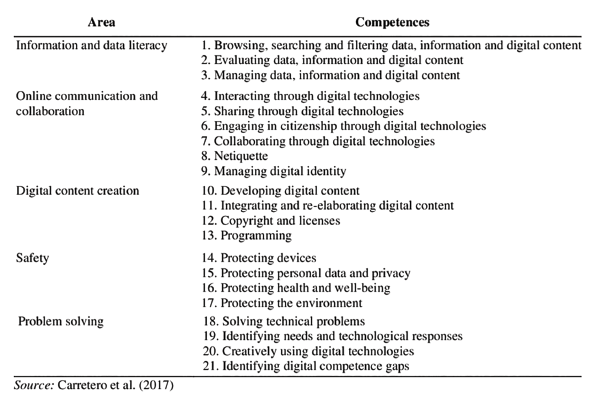
Figure 2
Areas and competencies proposed in Digcomp 21
Source: Carretero et al, (2017)
Analysis of skills
The first stage of this research was the development of digital skills frameworks worldwide to identify the specific skills used. A total of ten documents were found including city policy reports and scientific papers that were analyzed considering the criteria shown in Table 1.
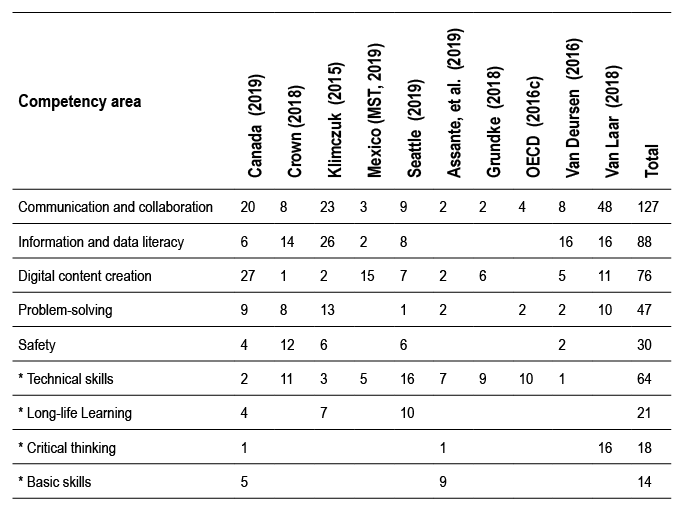
Table 1.
Frameworks analyzed and competencies found
Source: Own elaboration
In the digital economy context, the ability to create digital content is a crucial skill area. The most important skills in this area are programming, integration, and the ability to modify digital content, as shown in Table 2. The Canadian framework from 2019 provides a comprehensive level of detail on the skills and abilities needed to achieve specific outcomes, while the Mexican skills framework combines levels of technology adoption with technological trends as described in the MCT 2019 report.
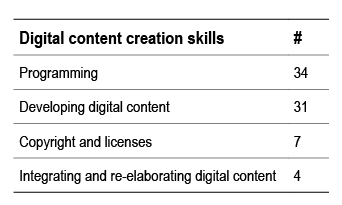
Table 2.
Skills in digital content creation
Source: Own elaboration
Framework proposed
There is no standard approach for designing skills or competency frameworks, as they vary in their structures and criteria. Most frameworks consist of a general classification and a method for organizing and defining skills (Pawlowski, et al., 2018). The framework presented here is divided into two layers: one layer consists of competency areas, and the other layer consists of individual skills. Each skill is defined with specific scope and levels of proficiency, as shown in Figure 3. This framework is unique in that it integrates digital skills with entrepreneurial intention as a means to achieve concrete outcomes in the use of ICTs (Helsper, et al., 2015).
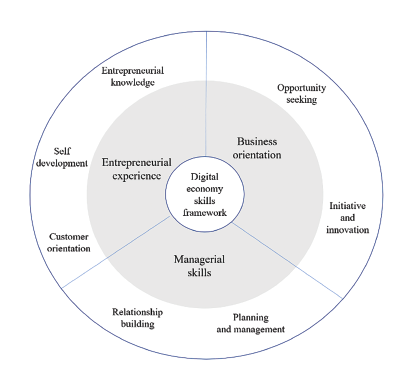
Figure 3
Digital skills framework in a digital economy focus
Source: Own elaboration
The proposed framework includes three competency areas with their respective skills (Table 3) and the set of validation questions for each of the skills (Table 4).
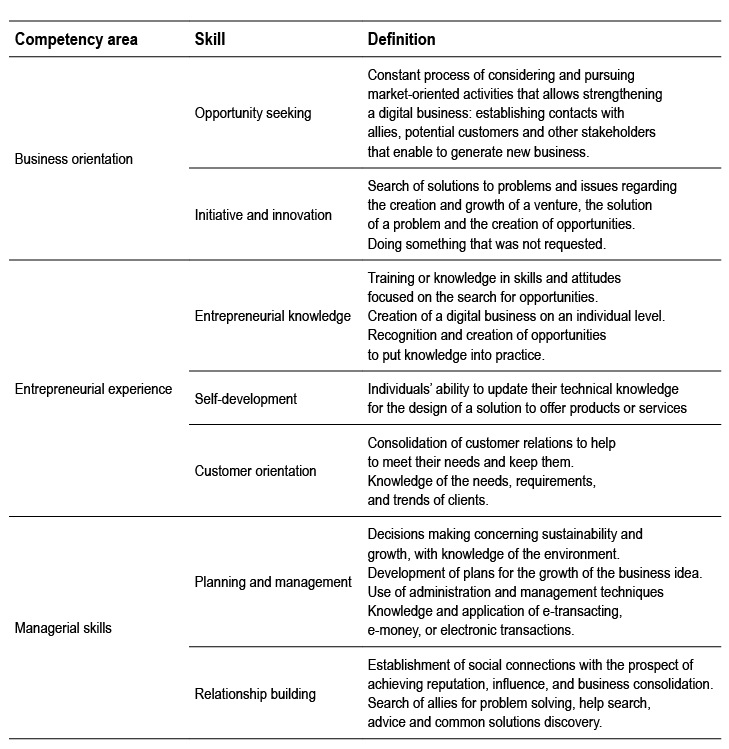
Table 3.
Definitions of competencies and skills
Source: Own elaboration
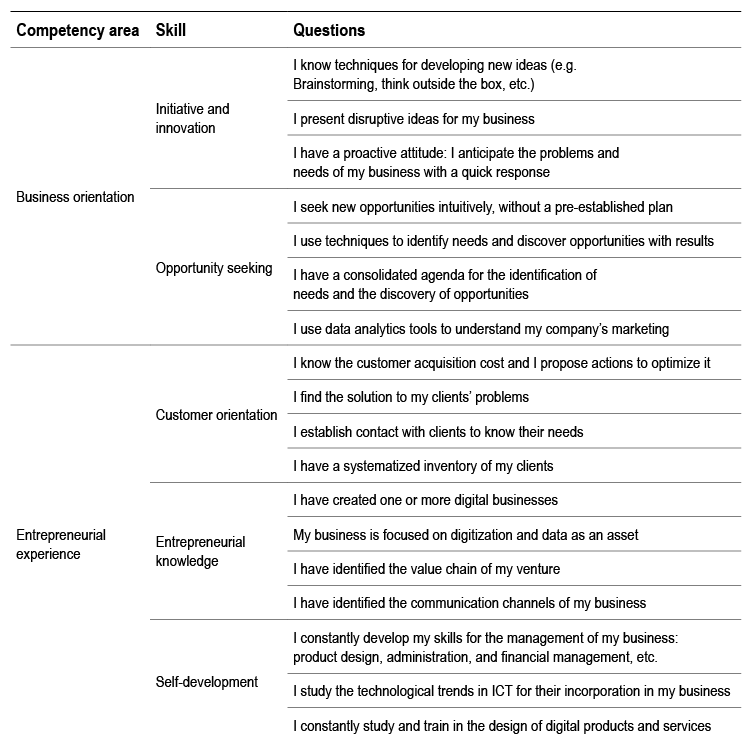
Table 4.
Questions proposed to assess the framework
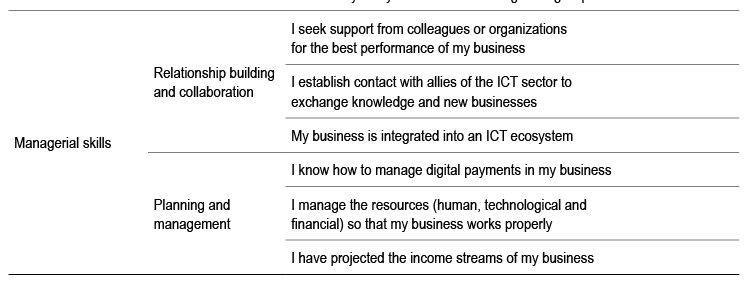
Source: Own elaboration
Validation
To ensure that the proposed framework can effectively assess skills required in a digital economy context, it must be comprehensive, appropriate, easy to understand, and logically consistent (Escobar-Pérez and Cuervo-Martínez, 2008). Content validity can be established by seeking expert opinions, as recommended by studies conducted by Escobar-Pérez and Cuervo-Martínez (2008).
The proposed framework possesses certain features that make Aiken’s V coefficient a suitable method for its evaluation. This coefficient is commonly used to assess the validity of instruments in social sciences and psychometric tests. One of its advantages is the statistical validity of the test, and it is capable of identifying negative asymmetric distributions as reported by experts. Aiken’s V coefficient has a range between 0 and 1, where a value of 1 represents a perfect agreement among judges (Merino-Soto, 2018).
To evaluate the clarity, coherence, and relevance of the proposed framework, a Likert scale ranging from 1 to 4 was used in a 26-item questionnaire that was distributed to five experts chosen from the fields of ICT and entrepreneurship. The questionnaire was sent to the experts in an Excel file, along with a description of the purpose of the instrument. Each of the experts provided recommendations for the evaluated items.
The Aiken’s V coefficient is used to evaluate the content validity of the framework and the criterion for acceptance is based on Escurra (1988), where V>=0.8 determines the item validity. The average V coefficients obtained for clarity, coherence, and relevance of skills were 0.88, 0.82, and 0.86, respectively (Table 4).
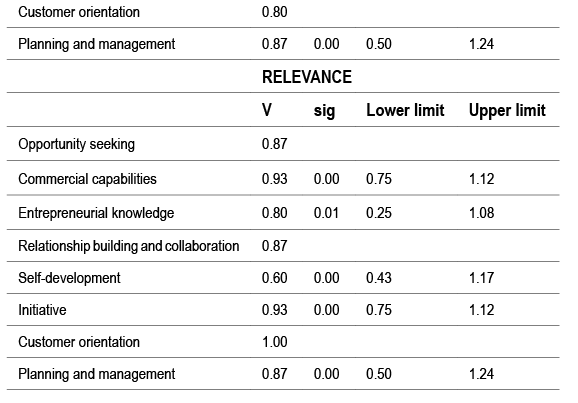
The questions in were initially evaluated and resulted in 55 valid questions and 23 invalid questions. The feedback from experts on each question was reviewed and some of them were adjusted or eliminated. Specifically, 8 questions were adjusted, 12 were reviewed for relevance, and 11 were reviewed for coherence. Four questions were removed because they did not meet the minimum evaluation criteria. The questions that were removed had the lowest average scores in all three categories. After the adjustments, the questions were evaluated again, and new coefficients were obtained, which are listed in Table 5.
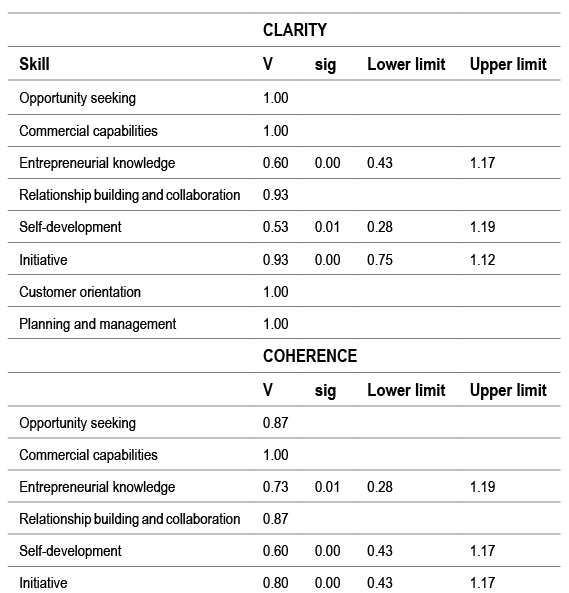
Table 5.
Aiken´s Value for skills analyzed
Source: Own elaboration
Discussion
Ten digital skills frameworks and their structures were analyzed to comprehend what the regions expected of their citizens in ICT field. Some skills were better documented than others, according to Iordache, et al. (2017). Communication and collaboration were highly documented, as was digital literacy, which referred to basic device knowledge, email management, and Internet browsing.
Are we advancing in digital skills of advanced uses? The level of preparedness of individuals to face or create a digital venture implies a set of skills aspects beyond basic skills. There is not much information about the skills analyzed and classified required in the economic field. The work of research by Grundke, et al. (2018) analyzes the possibility of producing income through the interaction with customers derived from the sale of products and services online using The Organization for Economic Cooperation and Development Survey of Adult Skills (PIAAC). Klimczuk, et al. (2015) whose work on digital skills includes skills related to financial management and making a profit using ICT.
The possibility of analyzing digital skills from the perspective of capabilities under the paradigm proposed by Amartya Sen is in future work, where capabilities determine greater opportunities for individuals. (Klimczuk, et al., 2015) An example of this is the possibility of getting digital jobs based on the skills gained (Berger and Frey, 2016; Civilcharran and Maharaj, 2019; OECD, 2016c; Organista-Sandoval et al., 2017).
Interdisciplinarity. One of the relevant findings of this work is that advanced digital skills require interdisciplinary research: technical competence, analysis of management skills and social skills are also required (Civilcharran and Maharaj, 2019). It is also important to study the socioeconomic conditions in the use of ICT to undertake digitally (Hanna, 2020) and the acceptance of technology as a facilitator for obtaining employment (Leahy and Wilson, 2014)
The need for alignment. This study serves as the basis for promoting alignment between actors in digital ecosystems: colleges, universities and other educational institutions must assess curricula relevance , the duration of study plans and training costs (ITU, 2018). Similarly, the analysis in the acquisition of skills through informal structures, for instance, social networks, self-learning and peer to peer learning (Leahy and Wilson, 2014)
Conclusions
Digital skills are a powerful tool to increase options of inclusion of individuals, determine the possibilities of being part of a workforce or to create a venture (Eynon and Geniets, 2016; Ratcheva, et al., 2019).
ICTs are determinant in the provision of capacities to individuals to achieve economic, social and cultural results. To achieve these results, individuals require skills that allow them to take advantage of the opportunities of a knowledge-based economy and the expansion of new markets.
There is a significant difference among frameworks between developed and developing countries. Some European countries have developed frameworks that align with Digcomp 2.1, while Latin American countries like Mexico, Chile, and Colombia lack details of skills and proficiency levels. A new framework called DQ, proposed by Park (2019), considers skills related to Data and Artificial Intelligence literacy. This approach is an interesting way to introduce new knowledge to students in schools.
A new framework is proposed, specifically for the context of a developing country and with a focus on the tangible outcomes that individuals can achieve with advanced skills. The proposed framework emphasizes the importance of identifying business opportunities through an entrepreneurial mindset, and by possessing managerial skills. To assess an individual’s preparedness for starting a digital venture, a series of questions were developed.
Novelty of this framework is its focus on individuals who have already acquired basic and intermediate ICT knowledge, and how a digital venture perspective can contribute to achieving tangible outcomes with ICT use.
A content validity was applied to the framework through expert judgment to determine its clarity, relevance, and consistency. Following the validation process, the framework was narrowed down to 20 questions, 7 skills, and three competency areas. Adjustments were made to the items and an average V Aiken’s coefficient of 0.96 for clarity, 0.93 for relevance, and 0.93 for coherence was obtained. in conclusion, the proposed skills model is reliable and can identify the essential skills for a digital entrepreneur.
Future research is recommended in specific fields such as design, creative industries, programming and software development, among others. Besides, the validation of digital skills in developing countries in specific conditions of age, social context and the role of universities in the process can also be explored more deeply.
References
Alarcón, P., Álvarez, X., Hernández, D., & Maldonado, D. (2013). Matriz_Habilidades_TIC_para_el_Aprendizaje. Ministerio de Educación de Chile.
Assante, D., Caforio, A., Flamini, M., & Romano, E. (2019). Smart education in the context of industry 4.0. IEEE Global Engineering Education Conference, EDUCON, April-2019, 1140–1145. https://doi.org/10.1109/EDUCON.2019.8725057
Bagaeva, I., & Voronova, O. (2019). Formation of Requirements to the Competency Model for a University Graduate in the Digital Economy. Proceedings of the International Conference on Digital Technologies in Logistics and Infrastructure (ICDTLI 2019), 1, 333–338. https://doi.org/https://doi.org/10.2991/icdtli-19.2019.58
Balakrishnan, R., Lizarazo, S., & Santoro, M. (2021). 2021 Commodity Cycles, Inequality and Poverty in Latin America (Issue 21).
Bauer, J. M. (2018). The Internet and income inequality: Socio-economic challenges in a hyperconnected society. Telecommunications Policy, 42(4), 333–343. https://doi.org/10.1016/j.telpol.2017.05.009
Berger, T., & Frey, C. B. (2016). Digitalization, Jobs, and Convergence in Europe: Strategies for Closing the Skills Gap. In Oxford - Prepared for the European Commission DG Internal Market, Industry, Entrepreneurship and SMEs (Issue January). https://www.oxfordmartin.ox.ac.uk/downloads/reports/SCALE_Digitalisation_Final.pdf
Bogdan-Martin, D. (2017). The role of ICTS in accelerating the achievement of the SDGS. New innovation approaches to support the implementation of the Sustainable Development Goals. https://unctad.org/system/files/non-official-document/cstd2016_p06_DoreenBogdan_ITU_en.pdf
Brits, A., & Cabolis, C. (2019). IMD World Digital Competitiveness Ranking 2019. IMD World Competitiveness Center. https://www.imd.org/research-knowledge/reports/imd-world-digital-competitiveness-ranking-2019/
Büchi, M., Just, N., & Latzer, M. (2016). Modeling the second-level digital divide: A five-country study of social differences in Internet use. New Media and Society, 18(11), 2703–2722. https://doi.org/10.1177/1461444815604154
Canada. (2019). The ICTC Digital Skills Roadmap Navigator. https://roadmap.digitalyouth.ca/
Carretero, S., Vuorikari, R., & Punie, Y. (2017). DigComp 2.1: the digital competence framework for citizens with eight proficiency levels and examples of use. Publications Office of the European Union. https://op.europa.eu/s/yCQU
Castells, M. (2001). The Internet Galaxy (Issue 1). Oxford University Press.
Chen, C. C. (2015). Assessing the Activeness of Online Economic Activity of Taiwan’s Internet Users: An Application of the Super-Efficiency Data Envelopment Analysis Model. Social Indicators Research, 122(2), 433–451. https://doi.org/10.1007/s11205-014-0690-y
Chetty, K., Aneja, U., Mishra, V., Gcora, N., & Josie, J. (2018). Bridging the digital divide in the G20: Skills for the new age. Economics, 12(1), 20180024. https://doi.org/10.5018/economics-ejournal.ja.2018-24
Civilcharran, S., & Maharaj, M. S. (2019). A framework to determine the digital skills preparedness of graduates for industry. 2018 International Conference on Intelligent and Innovative Computing Applications, ICONIC 2018, 1–6. https://doi.org/10.1109/ICONIC.2018.8601250
National Administrative Department of Statistics (DANE). (2017). Primera gran encuesta TIC 2017.
DiMaggio, P.; Hargittai, E.; Neuman, R.; Robinson, J. P. (2001). Social implications of the Internet. Annual Review of Sociology, 27, 307–336. http://webuse.org/p/a07/
Economou, A. (2016). Research report on transversal skills frameworks. European Union. http://www.ats2020.eu/images/deliverables/D1.1_TransversalSkillsFrameworks_CP.pdf
Escobar-Pérez, J., & Cuervo-Martínez, A. (2008). Validez de contenido y juicio de expertos: Una aproximación a su utilización. Avances En Medición, 6, 27–36.
Escurra, L.M. (1988). Cuantificación de la validez de contenido por criterio de jueces. Revista de Psicología, 6(1–2), 103–111. https://doi.org/10.18800/psico.198801-02.008
European Comission. (2019). High-Tech skills industry: increasing EU’s talent pool and promoting the highest quality standards in support of digital transformation. Publications Office of the European Union https://doi.org/10.2826/879267
European Commission. (2018). Digital skills accelerator. 1–59. https://www.digitalskillsaccelerator.eu/
European Union. (2017). Digital skills for life and work (UNESCO 2017).
Eynon, R., & Geniets, A. (2016). The digital skills paradox: how do digitally excluded youth develop skills to use the Internet? Learning, Media and Technology, 41(3), 463–479. https://doi.org/10.1080/17439884.2014.1002845
Ferrari, A. (2012). Digital Competence in Practice: An Analysis of Frameworks. Technical Report by the Joint Research Centre of the European Commission. Publications Office of the European Union. https://doi.org/10.2791/82116
Ferro, E., Helbig, N. C., & Gil-Garcia, J. R. (2011). The role of IT literacy in defining digital divide policy needs. Government Information Quarterly, 28(1), 3–10. https://doi.org/10.1016/j.giq.2010.05.007
Grundke, R., Marcolin, L., Nguyen, T. L. B., & Squicciarini, M. (2018). Which skills for the digital era? OECD Science, Technology and Industry Working Papers, (9). https://doi.org/10.1787/9A9479B5-EN
Hanna, N. K. (2020). Assessing the digital economy: aims, frameworks, pilots, results, and lessons. Journal of Innovation and Entrepreneurship, 9(1), 1–16. https://doi.org/10.1186/s13731-020-00129-1
Hargittai, E. (2014). Second-Level Digital Divide: Differences in People’ s Online Skills. First Monday, 7(4),1–17. https://doi.org/10.5210/fm.v7i4.942
Helsper, E. J., Van Deursen, A. J. A. M., & Eynon, R. (2015). Tangible Outcomes of Internet Use. From Digital Skills to Tangible Outcomes project report. London School of Economics and Political Science. https://doi.org/10.13140/RG.2.1.1117.6722
International Telecommunication Union. ITU. (2017a). ICT-centric economic growth, innovation and job creation. https://www.itu.int/en/ITU-D/Pages/IMPACT-STUDY.aspx
International Telecommunication Union. ITU. (2017b). Measuring the Information Society Report 2017. https://www.itu.int/en/ITU-D/Statistics/Pages/publications/mis2017.aspx
International Telecommunication Union. ITU. (2019). Digital Skills Insights 2019. https://academy.itu.int/itu-d/projects-activities/research-publications/digital-skills-insights/digital-skills-insights-2019
International Telecommunication Union. ITU. (2018a). Report on the WSIS Stocktaking 2018. http://handle.itu.int/11.1002/pub/8111ea61-en
International Telecommunication Union. ITU. (2018b). Digital Skills Toolkit. https://www.itu.int/en/ITU-D/Digital-Inclusion/Youth-and-Children/Pages/Digital-Skills-Toolkit.aspx
Iordache, C., Mariën, I., & Baelden, D. (2017). Developing digital skills and competences: A quick-scan analysis of 13 digital literacy models. Italian Journal of Sociology of Education, 9(1), 6–30.https://doi.org/10.14658/pupj-ijse-2017-1-2
Klimczuk, A., Jasiewicz, J., Filiciak, M., Mierzecka, A., Liwowski, K. K., Kisilowska, M., Tarkowski, A., & Zadrożny, J. (2015). Framework directory of digital skills [SSRN Scholarly Paper]. https://papers.ssrn.com/abstract=2696339
Law, N., Woo, D., Tore, J. de la, & Gary, W. (2018). A Global Framework of Reference on Digital Literacy skills for indicator 4.4.2. UNESCO. https://docs.edtechhub.org/lib/QB69UIDS
Leahy, D., & Wilson, D. (2014). Digital skills for employment. En D. Passey & A. Tatnall (Eds.), Key Competencies in ICT and Informatics. Implications and Issues for Educational Professionals and Management (pp. 178-189). Springer. https://doi.org/10.1007/978-3-662-45770-2_16
Martínez-Cantos, J. L. (2017). Digital skills gaps: A pending subject for gender digital inclusion in the European Union. European Journal of Communication, 32(5), 419–438. https://doi.org/10.1177/0267323117718464
Mendonça, S., Crespo, N., & Simões, N. (2015). Inequality in the network society: An integrated approach to ICT access, basic skills, and complex capabilities. Telecommunications Policy, 39(3–4), 192–207. https://doi.org/10.1016/j.telpol.2014.12.010
Merino-Soto, C. (2018). Confidence interval for difference between coefficients of content validity (Aiken’s V): A SPSS syntax. Anales de Psicologia, 34(3), 587–590. https://doi.org/10.6018/analesps.34.3.283481
MINTIC. (2015). Panorama TIC: Comportamiento del Sector TIC en Colombia (p. 37). Ministerio de las Tecnologías de la Información y las Comunicaciones. http://colombiatic.mintic.gov.co/602/articles-8917_panoranatic.pdf
Nie, P., Sousa-Poza, A., & Nimrod, G. (2017). Internet Use and Subjective Well-Being in China. Social Indicators Research, 132(1), 489–516. https://doi.org/10.1007/s11205-015-1227-8
Nielsen, M. M., Rohman, I. K., & Lopes, N. V. (2018). Empirical analysis of the current digital divides since 2010. Proceedings of the 11th International Conference on Theory and Practice of Electronic Governance – ICEGOV,18, 616-625. https://doi.org/10.1145/3209415.3209493
Norris, P. (2001). Digital Divide: Civic engagement, information poverty, and the Internet worldwide. Cambridge University Press.
Organization for Economic Cooperation and Development. OECD. (2019). OECD Skills Outlook 2019. OECD Skills Outlook. https://doi.org/10.1787/df80bc12-en
Organization for Economic Cooperation and Development (OECD). (2016a). Broadband policies for Latin America and the Caribbean: A digital economy toolkit. https://doi.org/10.1787/9789264251823-en
Organization for Economic Cooperation and Development (OECD). (2016b). Economic and Social Benefits of Internet Openness. OECD Digital Economy Papers, (257). https://doi.org/10.1787/5jlwqf2r97g5-en
Organization for Economic Cooperation and Development (OECD). (2016c). New Skills for the Digital Economy: Measuring the demand and supply of ICT skills at work. OECD Digital Economy Papers, (258). https://doi.org/10.1787/20716826
Organization for Economic Cooperation and Development (OECD). (2015). Skills for a Digital World. Working Party on Measurement and Analysis of the Digital Economy. https://www.oecd.org/els/emp/Skills-for-a-Digital-World.pdf
Organista-Sandoval, J., Lavigne, G., Serrano-Santoyo, A., & Sandoval-Silva, M. (2017). Development of a questionnaire to estimate undergraduate digital skills. Revista Complutense de Educacion, 28(1), 325-343. https://doi.org/10.5209/rev_RCED.2017.v28.n1.49802
Park, Y. (Ed.). (2019). DQ Global Standards Report 2019: Common Framework for Digital Literacy, Skills and Readiness. Digital Intelligence Institute. https://www.dqinstitute.org/wp-content/uploads/2019/03/DQGlobalStandardsReport2019.pdf
Pick, J. B., & Sarkar, A. (2015). The Global Digital Divides. Springer-Verlag. https://doi.org/10.1007/978-3-662-46602-5
Pawlowski, J. M., De Fries, T., & Smyrnaiou, Z. (2018). An adaptable innovation competence framework - the play4guidance framework and its application. MKWI 2018 - Multikonferenz Wirtschaftsinformatik, 2018-March (April), 1899–1910.
Ragnedda, M., Ruiu, M. L., & Addeo, F. (2019). Measuring Digital Capital: An empirical investigation. New Media & Society. https://doi.org/10.1177/1461444819869604
Ragnedda, M., & Muschert, G. W. (Eds.). (2013). The digital divide: The Internet and social inequality in international perspective. Routledge. https://doi.org/10.4324/9780203069769
Ratcheva, V., Zahidi, S., Chan, Q., & Jesuthasan, R. (2019). Strategies for the New Economy Skills as the Currency of the Labour Market. World Economic Forum. https://www.ravinjesuthasan.com/strategies-for-the-new-economy-skills-as-the-currency-of-the-labour-market/
Scheerder, A., Van Deursen, A., & Van Dijk, J. (2017). Determinants of Internet skills, uses and outcomes. A systematic review of the second- and third-level digital divide. Telematics and Informatics, 34(8), 1607-1624. https://doi.org/10.1016/j.tele.2017.07.007
Stern, M. J., Adams, A. E., & Elsasser, S. (2009). Digital inequality and place: The effects of technological diffusion on internet proficiency and usage across rural, Suburban, and Urban Counties. Sociological Inquiry, 79(4), 391–417. https://doi.org/10.1111/j.1475-682X.2009.00302.x
Ministry of Communications and Transportation Mexico (MCT). (2019 Mar.). Proyecto Marco de Habilidades Digitales. https://www.gob.mx/cms/uploads/attachment/file/444450/Marco_de_habilidades_digitales_vf.pdf
United Nations. (2018 Jul.). Mainstreaming Inclusive Technology and Innovation Policies That Leave No One Behind. 00816(June), 1-20.
United Nations (2018). Agenda 2030 y los Objetivos de Desarrollo Sostenible: una oportunidad para América Latina y el Caribe. CEPAL. https://repositorio.cepal.org/bitstream/handle/11362/40155/24/S1801141_es.pdf
United Nations. (2015). Transforming our World: The 2030 Agenda for Sustainable Development. https://sdgs.un.org/2030agenda
United Nations Conference on Trade and Development UNCTAD. (2019). Digital Economy Report 2019. Value creation and capture: Implications for developing countries. https://unctad.org/publication/digital-economy-report-2019
United Nations Conference on Trade and Development UNCTAD (2018). Creación de competencias digitales para aprovechar las tecnologías existentes y emergentes, prestando especial atención a las dimensiones de género y juventud.
Van Deursen, A.J.A.M. & Helsper, E.J. (2015), «The Third-Level Digital Divide: Who Benefits Most from Being Online?», Communication and Information Technologies Annual (Studies in Media and Communications, 10. Emerald Group Publishing. https://doi.org/https://doi.org/10.1108/S2050-206020150000010002
Van Deursen, A. J. A. M., Helsper, E. J., & Eynon, R. (2016). Development and validation of the Internet Skills Scale (ISS). Information Communication and Society, 19(6), 804-823. https://doi.org/10.1080/1369118X.2015.1078834
Van Deursen, A. J. A. M., & Van Dijk, J. A. G. M. (2014). The digital divide shifts to differences in usage. New Media and Society, 16(3), 507–526. https://doi.org/10.1177/1461444813487959
Van Deursen, A. J. A. M., Van Dijk, J. A. G. M., & Peters, O. (2011). Rethinking Internet skills: The contribution of gender, age, education, Internet experience, and hours online to medium- and content-related Internet skills. Poetics, 39(2), 125–144. https://doi.org/10.1016/j.poetic.2011.02.001
Van Deursen, A., & Van Dijk, J. (2011). Internet skills and the digital divide. New Media and Society, 13(6), 893–911. https://doi.org/10.1177/1461444810386774
Van Laar, E., van Deursen, A. J. A. M., Van Dijk, J. A. G. M., & de Haan, J. (2018). 21st-century digital skills instrument aimed at working professionals: Conceptual development and empirical validation. Telematics and Informatics, 35(8), 2184–2200. https://doi.org/10.1016/j.tele.2018.08.006
Vicente, M. R., & López, A. J. (2010). A multidimensional analysis of the disability digital divide: Some evidence for internet use. Information Society, 26(1), 48–64. https://doi.org/10.1080/01615440903423245
Wedlake, S., Keyes, D., & Lothian, K. (2019). Digital skill sets for diverse users: A comparison framework for curriculum and competencies [SSRN Scholarly Paper]. https://doi.org/10.2139/ssrn.3427252
Wilkin, S., Davies, H., & Eynon, R. (2017). Addressing digital inequalities amongst young people: conflicting discourses and complex outcomes. Oxford Review of Education, 43(3), 332–347. https://doi.org/10.1080/03054985.2017.1305058
Notes
Información adicional
Cómo citar: Arbeláez Rendón, M., Lotero Vélez, L., Loaiza, Y.E. (2023). A skills framework in the context of a digital ecosystem: an engine for social inclusion in developing countries. Revista Latinoamericana de Estudios Educativos, 18(2), 175-196. https://doi.org/10.17151/rlee.2023.18.2.8