BOOK REVIEWS
MISMATCH BETWEEN ACCOUNTING REPORTS AND INVESTORS' DEMAND FOR INFORMATION
DIVERGÊNCIA ENTRE DEMONSTRAÇÕES FINANCEIRAS E DEMANDA DE INFORMAÇÃO POR INVESTIDORES
MISMATCH BETWEEN ACCOUNTING REPORTS AND INVESTORS' DEMAND FOR INFORMATION
Revista de Administração de Empresas, vol. 58, no. 4, pp. 445-446, 2018
Fundação Getulio Vargas, Escola de Administração de Empresas de S.Paulo
| Lev Baruch, Gu Feng. THE END OF ACCOUNTING and the path forward for investors and managers. 2016. Hoboken. John Wiley & Sons. 288p.pp. |
|---|
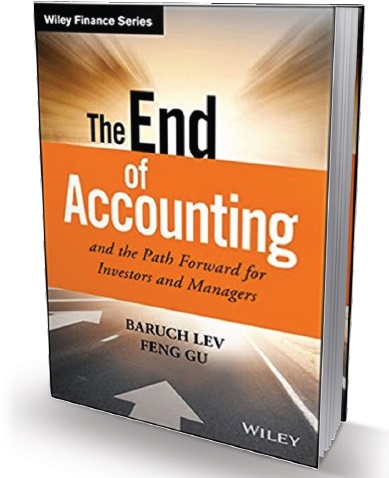
In most valuation courses, accounting and business students have been taught that financial statements, provided in compliance with a myriad of accounting principles and rules, are the best overview of companies' performance over a period of time. According to Baruch Lev and Feng Gu (BL&FG, hereafter), authors of “The end of accounting and the path forward for investors and managers,” this was true during in the 1950s and 1960s, when tangible assets were the most important of firms' assets and the valuation models for the economy, which was not as dynamic then as it is today, were suitable; further, the accounting rules earlier were not as complicated.
However, this may no longer be the case given that we have been living for three decades in the Information Era, wherein intangible assets became the most important of firms' assets. In their book's abstract, BL&FG argue that tangible assets are seen as commodities, whereas intangible assets are strategic assets that enhance sustainable value creation for companies by means of patents, know-how, brands, trademarks, licenses, copyrights, and other research and development investments. They claim that such assets matter to investors, and further, that managers should disclose more comprehensive information about them, even though current accounting rules usually do not require them to do so fully in financial statements.
The purpose of this book is to: i) convince readers that accounting is not providing the comprehensive information that investors need to perform investment valuation of strategic assets and ii) advocate for a change in reporting patterns by proposing a new report called Strategic Resources & Consequences Report (SR&CR, hereafter) to address the lack of information.
By targeting investors, managers, and market regulators, this well-written book is organized into four parts that combine a business approach with academic methodologies. The first part describes and empirically verifies (using US market data) the declining relevance of accounting information over the last 50 years. The second part summarizes the three most important reasons why this has happened. The third part proposes a framework to implement the SR&CR, an information disclosure that emphasizes what investors want to know. The fourth part presents the incentives for SR&CR implementation.
The chapters 1-2 constitute the book's prologue. In chapter 1, BL&FG build their argument by comparing two different financial statements of US Steel over a 110-year period and conclude that there were no substantial changes in the reports between 1902 and 2012. In chapter 2, the Wall Street's standard assumption about earnings efficiency is contested by an empirical analysis demonstrating that the cash flow strategy yielded better investment returns at the turn of the twenty-first century. The empirical evidence discussed in these chapters present two main accounting flaws: i) not capturing a company's entire value; and ii) not providing sufficient information to investors.
As the provocative title suggests, this book provides insights about the gradual end of the usefulness of old accounting information and introduces a new report: SR&CR. BL&FG, both of whom have had distinguished academic and professional careers, provide an alternative perspective concerning the decreasing relevance of accounting information and how investors can overcome this.
Part one comprises chapters 3-7. Chapter 3 shows an inverse causal relationship between important accounting indicators and stock prices. In chapter 4, accounting information is shown to have no impact when released in the market. Chapter 5 analyzes the decreasing ability of reported earnings to predict future earnings. Chapter 6 discusses the growing disagreements among financial analysts in their forecasts in using key accounting indicators. In chapter 7, BL&FG indicate why the accounting limitations earlier described should be a matter of concern for investors, because a better source of information about companies' performance is unavailable.
Part two, comprising chapters 8-10, discusses the three main reasons for the issues mentioned above. First, accounting rules restrict the disclosure of value-driving intangible assets in financial statements: accounting regulators worldwide consider a major part of the investments in them as expenses; further, internally generated intangibles are rarely reported as assets. Second, the high number of subjective estimates and projections in accounting reports lead to disclosure of incomplete and biased pieces of information. Third, the absence of timely recording of important business transactions, or even a lack of such records.
In part three, the proposed solution in the form of the SR&CR is presented. By combining the Resource-Based View (RBV) with what investors want to know about companies' value creation, SR&CR discloses strategic assets as the most important of firms' resources. By definition, BL&FG argue that strategic assets' attractive value, along with characteristics that are unique and hard to replicate, can provide a sustainable competitive advantage and economic benefits in the long term.
Chapter 11 describes five characteristics of SR&CR disclosure concerning strategic assets: (1) identification; (2) verification of companies' investments to create and/or develop such assets; (3) description of the significant risks related to strategic assets management, such as disruption risks; (4) description of how firms can manage their use; and (5) presentation of the value creation.
Chapters 12-15 present four different real world business cases. The data was collected from non-accounting reports and footnotes from financial statements to demonstrate the SR&CR implementation. In doing so, BL&FG show that SR&CR consists of the disclosure about companies useful information that can be applied to different industries.
Part four lists the incentives associated with the SR&CR. In chapter 16, the authors argue that three main forces must be in place to increase the quality of information disclosure: (i) investors' mobilization to demand better information; (ii) endorsement from regulation associations; and (iii) managers' willingness to disclose the requested information. Chapter 17 presents the imperative advances for intangible assets disclosure to investors.
The concluding chapter 18 reminds readers of the importance of accounting information while highlighting the current disclosure limitations. Following BL&FG's argument, the SR&CR could complement accounting information in an accurate, timely, and practical way for investors.
In short, BL&FG's work fosters debate on possible alternatives to fill the current gap concerning intangible assets disclosure. Their main contribution is to put forward potential solutions to improve financial reporting. In the international context, the role of intangible assets in firms' value and the accounting limitations preventing their full disclosure in financial statements are taken for granted, which contributes to the existing research by practitioners and researchers for better disclosure practices. Enhacing this debate in the Brazilian context is likely to highlight local intangible assets reporting, and could also produce new mechanisms to narrow information asymmetries.
ACKNOWLEDGMENTS
We would like to thank FAPEMIG for its financial support.
Author notes
joyce-mariella@cefetmg.brhudson.amaral@unihorizontes.brlaise@dcsa.cefetmg.br