FORUM
THE THIEF OF TIME AND SOCIAL SUSTAINABILITY: ANALYSIS OF A PROCRASTINATION AT WORK MODEL
O LADRÃO DO TEMPO E A SUSTENTABILIDADE SOCIAL: ANÁLISE DE UM MODELO DE PROCRASTINAÇÃO NO TRABALHO
EL LADRÓN DEL TIEMPO Y LA SOSTENIBILIDAD SOCIAL: ANÁLISIS DE UN MODELO DE PROCRASTINACIÓN EN EL TRABAJO
 Pilar Mosquera pilarconde@iseg.ulisboa.pt
Maria Eduarda Soares mes@iseg.ulisboa.pt
Paula Dordio pauladordio@aln.iseg.ulisboa.pt
Leonor Atayde e Melo l49380@aln.iseg.ulisboa.pt
Pilar Mosquera pilarconde@iseg.ulisboa.pt
Maria Eduarda Soares mes@iseg.ulisboa.pt
Paula Dordio pauladordio@aln.iseg.ulisboa.pt
Leonor Atayde e Melo l49380@aln.iseg.ulisboa.pt
THE THIEF OF TIME AND SOCIAL SUSTAINABILITY: ANALYSIS OF A PROCRASTINATION AT WORK MODEL
Revista de Administração de Empresas, vol. 62, no. 5, e2021-0313, 2022
Fundação Getulio Vargas, Escola de Administração de Empresas de S.Paulo
Received: 04 May 2021
Accepted: 29 November 2021
ABSTRACT: Although research on procrastination at work is scarce, existing studies indicate its negative effects in multiple spheres of personal and professional life, with repercussions on individuals’ well-being and social sustainability. This study proposes a model that aims to clarify the relationships between the antecedents and consequences of procrastination at work. We follow a bi-dimensional conceptualization of procrastination at work, using the dimensions of soldiering and cyberslacking. The model includes boredom at work as a predictor and work stress and job satisfaction as outcomes. Data from a sample of 287 participants were analyzed with Partial Least Squares. Results show that boredom at work is positively associated with both soldiering and cyberslacking. Results also show that soldiering increases work stress and decreases job satisfaction. Cyberslacking has no significant effects on work stress or job satisfaction. The theoretical and practical implications of this study are further discussed.
Keywords: social sustainability, procrastination at work, boredom at work, work stress, job satisfaction.
RESUMO: Embora as pesquisas sobre procrastinação no trabalho ainda sejam escassas, os estudos existentes apontam para os seus efeitos negativos em múltiplas esferas da vida pessoal e profissional com repercussões no bem-estar e na sustentabilidade social dos indivíduos. Este estudo propõe um modelo que visa esclarecer as relações entre os antecedentes e os consequentes da procrastinação no trabalho. Assim, adotou-se uma conceitualização bidimensional da procrastinação no trabalho, utilizando as dimensões de soldiering e cyberslacking. O modelo inclui o tédio no trabalho como um antecedente da procrastinação, e o estresse no trabalho e a satisfação no trabalho como seus consequentes. Os dados recolhidos a partir de uma amostra de 287 participantes foram analisados por meio do método dos mínimos quadrados. Os resultados mostram que o tédio no trabalho está positivamente associado tanto ao soldiering quanto ao cyberslacking. Os resultados também mostram que o soldiering aumenta o estresse e diminui a satisfação no trabalho. O cyberslacking não teve efeitos significativos quer sobre o estresse no trabalho, quer sobre a satisfação no trabalho. São ainda discutidas as implicações teóricas e práticas deste estudo.
Palavras-chave: sustentabilidade social, procrastinação no trabalho, tédio no trabalho, estresse no trabalho, satisfação no trabalho.
RESUMEN: Aunque la investigación sobre la procrastinación en el trabajo sea escasa, los estudios existentes ya indican sus efectos negativos en múltiples esferas de la vida personal y profesional con repercusiones en el bienestar de las personas y la sostenibilidad social. Este estudio propone un modelo que tiene como objetivo esclarecer las relaciones entre los antecedentes y los consecuentes de la procrastinación en el trabajo. Para ello, seguimos una conceptualización bidimensional de la procrastinación en el trabajo, utilizando las dimensiones soldiering y cyberslacking. El modelo incluye el aburrimiento en el trabajo como predictor y el estrés laboral y la satisfacción laboral, como consecuentes. Los resultados muestran que el aburrimiento en el trabajo se asocia positivamente tanto con el soldiering como con el cyberslacking. Los resultados también muestran que el soldiering aumenta el estrés laboral y disminuye la satisfacción laboral. También se discuten más a fondo las implicaciones teóricas y prácticas de este estudio.
Palabras clave: sostenibilidad social, procrastinación en el trabajo, aburrimiento en el trabajo, estrés laboral, satisfacción laboral.
INTRODUCTION
Employee well-being is a key element of social sustainability (Sadick & Kamardeen, 2020) and, consequently, of the utmost relevance for the sustainable development of organizations (Fabio, 2017). Healthy organizations must promote working environments conducive to employee well-being (Fabio, 2017). By doing so, they are also enhancing organizational effectiveness since employee well-being is positively associated with employee productivity and performance (Abid, Ahmed, Elahi, & Ilyas, 2020). Consequently, managers aiming to develop organizational sustainability should consider factors affecting employee well-being.
This study focuses on procrastination at work, a topic of research that is still in an early stage of development. In the 18th century, the English poet Edward Young (1742-5) referred to procrastination as “the thief of time”, an expression that is also used in recent essays on the topic (e.g., Andreou, 2012). Procrastination at work involves postponing work-related actions during working hours in favor of non-work-related actions (Metin, Taris, & Peeters, 2016). A procrastinator voluntarily delays the performance of necessary activities even when aware of the potential negative consequences of the delay (Klingsieck, 2013; Steel, 2007). Previous studies indicate a relevant relationship between procrastination and well-being (Çelik & Odaci, 2020; Eerde, 2016; Meier, Reinecke, & Meltzer, 2016; Metin, Peeters, & Taris, 2018). Therefore, it stands to reason to argue that identifying the predictors of procrastination may enhance well-being and consequently promote social sustainability.
Available research conducted in organizations recognize the relevance of procrastination at work for both employees and organizations (Metin et al., 2018). Employees spending more than one hour engaged in non-work related or personal activities, represents a considerable productivity loss (D’Abate & Eddy, 2007). Procrastination at work has also been negatively related with work engagement, organizational citizenship behaviors and job performance (Göncü Köse & Metin, 2018; Metin et al., 2018). Research also underlines the negative outcomes of procrastination for employees, such as lower self-efficacy, fatigue, psychological detachment, job stress, job boredom, lower wages, and unemployment (Metin et al., 2018).
Although the literature on procrastination is rapidly growing, several gaps need to be addressed. Firstly, most studies on procrastination have been conducted in academic settings (Khalid et al., 2019; Steel & Klingsieck, 2016), while studies in work settings are still scarce (Metin et al., 2016; Van Eeerde, 2015). Furthermore, most studies in work context have used general life or academic measures of procrastination and not a domain specific measure (Metin et al., 2016).
Secondly, most of the existing studies on procrastination at work have mainly focused on its predictors, while studies on its outcomes are still scarce (Gupta et al., 2012). Moreover, the majority of previous research aiming to identify predictors of procrastination has focused on individual level variables (Klingsieck, 2013; Steel, 2007; Van Eerde, 2003). Not many studies have focused on workplace characteristics or task-related variables, which are fundamental for the development of interventions aimed at reducing procrastination at work. Finally, we were not able to find any comprehensive model involving both predictors and outcomes of procrastination.
This study intends to fill these gaps by empirically testing a conceptual model that includes antecedents and consequences of procrastination. In order to identify relevant predictors and outcomes of procrastination, we followed two conceptual frameworks that have previously been associated with healthy organizations and, consequently, with social sustainability: Self-Determination Theory and Conservation of Resources Theory.
Self-Determination Theory (Deci & Ryan, 2000; Ryan & Deci, 2017) is pertinent for social sustainability since it emphasizes the fulfilment of basic psychological needs (autonomy, competence and relatedness) associated with employees’ well-being. According to this theory, tasks and conditions that fulfil an individual’s basic psychological needs lead to higher levels of motivation, performance and job satisfaction. By contrast, when basic psychological needs are not meet, tasks become more aversive, thus enhancing procrastination (Steel, 2007). Given that boredom is a task condition with low levers of stimulation and high levels of routine, basic psychological needs are unlikely to be met under these circumstances. Boredom is thus associated with procrastination (Metin et al., 2016) and we will consider it as a predictor in the model. On the other hand, procrastination may induce a vicious circle (Steel, 2007), leading to a lower fulfilment of the basic psychological needs and lower job satisfaction (Farivar & Richardson, 2018; Mohsin & Ayub, 2014). Given that Self-Determination Theory indicates that job satisfaction is affected by procrastination, we will consider job satisfaction as an outcome in the model.
Conservation of Resources Theory (Hobfoll, 1989; Hobfoll et al., 2018) is also important for healthy and sustainable organizations because of its emphasis on personal resources. According to this theory, human behavior is based on the need to acquire and conserve resources. It is a fundamental principle of the theory that actual or potential loss of resources leads to stress. Given that time is a relevant resource (Hobfoll et al., 2018) and that procrastination entails a loss of this resource, it is arguable that stress will be a likely outcome of procrastination.
In sum, the model includes a task-related predictor of procrastination at work - boredom at work - and two consequences of procrastination at work - work stress and job satisfaction. Given that work stress and job satisfaction are components of work-related well-being (Rothmann, 2008), we aim to contribute to the knowledge of this important aspect of social sustainability.
LITERATURE REVIEW
Procrastination at work has been conceptualized as “putting off work-related action by engaging in nonwork-related actions during work hours” (Metin et al., 2016:254). Procrastination has been seen as a conscious and voluntary action of delaying something that needs to be done despite the individual being aware of the negative consequences of that delay (Klingsieck, 2013; Steel, 2007).
Procrastination has been considered as a pervasive and counterproductive behavior, with negative consequences in multiple spheres of the personal and professional life (Dewitte & Lens, 2000; Steel, 2007). Although some authors have underlined the existence of a functional side of procrastination (e.g., Chun Chu & Choi, 2005; Schraw et al., 2007; Shin & Grant, 2020), research evidence has stressed its negative effects on individuals’ mental and physical health, economic status and well-being levels (Çelik & Odaci, 2020; Codina et al., 2020; Metin et al., 2016; Skowronski & Mirowska, 2013; Van Eeerde, 2016). At the organizational level, studies have often reported the negative impact of procrastination on employee productivity and performance (Thatcher et al., 2008), which is particularly serious given the huge market pressures that organizations are currently undergoing (Barabanshchikova et al., 2018).
Recent studies have pointed out that procrastination at work has two dimensions: soldiering and cyberslacking (Metin et al., 2016). Soldiering refers to work or task avoidance behavior for more than one hour a day, without the intention of harming others, or overloading them with more work (Paulsen, 2013). Soldiering occurs when an employee has a weak ethical relationship with work, does not identify with it, or professional demands fall short of individual potential (Paulsen, 2013). Soldiering involves behaviors that are associated with negative performance outcomes, which in turns reduces self-efficacy, leading to a vicious cycle of poor performance (Steel, 2007). Daydreaming, engaging in pleasurable activities to the detriment of professional tasks, or taking long coffee breaks are examples of soldiering behaviors (Metin et al., 2016).
Cyberslacking stems from the widespread use of mobile technology at work and involves employees that may appear to be working, but are actually shopping online, surfing social networks, playing games or sending instant messages (Vitak et al., 2011). Similar to soldiering, cyberslacking has also been linked to extremely high costs for organizations, notably lower productivity (Garrett & Danziger, 2008).
In the following sections we discuss in more detail the variables included in our conceptual model of procrastination.
Predictors of procrastination at work
As far as the antecedents of procrastination at work are concerned, existing studies have focused mostly on personality factors (e.g., Milgram & Tenne, 2000; Steel, 2007) or on situational factors (e.g., Metin et al., 2016; Reijseger et al., 2012). According to Barabanshchikova et al. (2018), procrastination may result from work-related factors, such as a low stimulating or challenging environment, particularly relevant for those seeking more creative, less administrative or less routine tasks.
There is widespread agreement that an under-stimulating work environment is associated with a cognitive-motivational state of low arousal and dissatisfaction known as boredom at work (Fisher, 1993; Game, 2007; Loukidou et al., 2009; Schaufeli & Salanova, 2014; Reijseger et al., 2012; Vodanovich & Watt, 2016).
Diverse scholars (e.g., Elpidorou, 2018; Martin et al., 2006; Reijseger et al., 2012; Vodanovich & Watt, 2016) have pointed out the negative impact of boredom on life satisfaction and well-being. Reijseger et al. (2012) considered boredom at work as a state of employee unwell-being. Authors that conceive boredom as a personal trait, consider that boredom-prone people tend to engage themselves in risk-taking behavior (e.g., reckless driving, binge eating, drug and alcohol abuse, and problem gambling) in order to find something that may excite them (Elpidoru, 2018). Employees who do not experience high levels of stimulation tend to have less cognitive energy, less commitment to their work, lower job satisfaction, lower job involvement, increased job stress and actively seek more pleasurable distractions (Elpidorou, 2018; Metin et al., 2016; Reijseger et al., 2012).
Previous research also indicates that, when boredom at work increases, employees are more prone to use communication technology for nonwork-related activities during work (cyberslacking) or taking longer coffee breaks (soldiering) (Eddy et al., 2010; Metin et al., 2016; Wan et al., 2014). The results of these studies are in accordance with reasonings derived from Self-Determination Theory. As mentioned earlier, given that boredom is associated with low stimulating contexts, where basic psychological needs are unlikely to be met, boredom may enhance task aversion and, consequently, procrastination. Hence, we propose:
-
H1: Boredom at work increases cyberslacking
-
H2: Boredom at work increases soldiering
Outcomes of procrastination at work
Although studies on the outcomes of procrastination at work are still scant, existing studies have pointed out some relevant detrimental effects of procrastination for both individuals and organizations: losses of productivity (Lim & Teo, 2005); counterproductive behaviors such as withdrawal and abuse (Metin et al., 2016); lower salaries, shorter durations of employment and a greater likelihood of being unemployed or under employed (Nguyen et al., 2013); increased rates of work stress (Sirois, 2014); and reduced job satisfaction (Mohsin & Ayub, 2014). In the present study we focus on two relevant outcomes of procrastination at work that are related to the pleasure-displeasure dimension and the anxiety-comfort dimension of work-related well-being, respectively, job satisfaction and work stress (Rothmann, 2008).
Work Stress
Work stress may be defined as an individual’s feelings of personal dysfunction as a result of perceived conditions in the work setting (Parker & DeCotiis, 1983). It thus refers to individual reactions to work conditions perceived as emotionally or physically threatening (Jamal, 2005). Several studies have provided evidence that work stress is negatively associated with well-being (e.g., Hart et al., 1995; Krause & Stryker, 1984; Li et al., 2021; O’Neill & Davis, 2011). Work stress is also put forward as a relevant challenge for human resources sustainability in organizations (Rajamohan et al., 2019; Wykes et al., 1997).
Previous studies on the relationship between procrastination at work and work stress have reported results that are apparently contradictory. On the one hand, procrastination can be considered as a way to cope with the pressure, allowing for temporary relief from stress by postponing the task (Tice, Bratslavsky, & Baumeister, 2001). On the other hand, procrastination can be viewed as a disabling behavior that leads to a waste of time, poor performance, and consequently increased stress (Chu & Choi, 2005; Metin et al., 2016; Steffy, Jones, & Noe, 1990). Eerde (2003) found that when employees were given time management training to reduce procrastination, they presented lower stress levels, reinforcing the positive relationship between procrastination at work and stress.
A possible explanation for these contradictory results may be that previous studies have not analyzed the effects of the two dimensions of procrastination at work - soldiering and cyberslacking - on work stress, separately. In this study, we contribute by clarifying the relationship between the two dimensions of procrastination at work and work stress.
Since soldiering is associated with the postponement of a task, it entails a loss of the time available to complete that task. According to conservation of resources theory, the loss of a relevant resource, such as time, is likely to lead to higher levels of stress (Hobfoll et al., 2018). Therefore, we propose:
-
H3: Soldiering increases work stress
There is still a lack of consensus on the relationship between cyberslacking and work stress. Several studies have pointed out that using the Internet for non-professional purposes during working hours can be a way of distancing oneself from stressors and relaxing from work tasks, therefore reducing stress (e.g., Andel, Kessler, Pindek, Kleinman, & Spector, 2019; Askew et al., 2014; Coker, 2013; Eddy et al., 2010; Lavoie & Pychyl, 2001; Lim & Chen, 2012; Meier et al., 2016; O’Neill, Hambley, & Bercovich, 2014; Reinecke, 2009; Tu & Chang, 2010). However, other authors (e.g., Lim & Teo, 2005) suggest that cyberslacking, diverting attention from tasks and preventing their completion, leads to work accumulation, therefore increasing work stress. Garrett and Danziger (2008), in turn, report that there is no relationship between time spent on non-work Internet activities and work stress.
These mixed results may be due to the fact that individuals may either associate cyberslacking with coping with work stressors, or with the accumulation of tasks and the loss of time available to complete those tasks. In this study, issues of postponing/accumulating tasks are covered in the soldiering dimension of procrastination. Therefore, it stands to reason to consider that the cyberslacking dimension of procrastination will be more associated with coping and/or relaxing mechanisms that allow individuals to reduce stress. We thus propose the following hypothesis:
-
H4: Cyberslacking decreases work stress
Job satisfaction
In the literature on job satisfaction, Locke (1976) is one of the most cited references. Locke defines job satisfaction as a positive emotional state resulting from the employees’ job experiences. More recently, job satisfaction is generally defined as an employee’s attitude (positive or negative) toward their job and job context, involving both cognitive and affective dimensions (e.g., Schlett & Ziegler, 2014; Weiss, 2002).
In his seminal work, Locke (1976) associates job satisfaction with aspects of well-being, such as health and life happiness. The meta-analytical work of Bowling, Eschleman, and Wang (2010) confirms the positive link between job satisfaction and well-being. Recent studies also show that job satisfaction is a component of sustainable human resource practices and contributes to long-term sustainable organizations (e.g., Davidescu, Apostu, Paul, & Casuneanu, 2020; Heimerl, Haid, Perkmann, & Rabensteiner, 2020; Strenitzerová & Achimský, 2019).
According to self-determination theory, the fulfilment of basic psychological needs is associated with higher levels of job satisfaction (Gagné & Deci, 2005; Slemp, Kern, Patrick, & Ryan, 2018). As mentioned earlier, procrastination tends to occur in conditions of low simulation, where these needs are unlikely to be fulfilled, and task aversion is heightened. By procrastinating, the individual does not solve the conditions that lead to task aversion but may induce a vicious circle where these conditions are worsened (Steel, 2007). Therefore, reasonings derived from self-determination theory seem to indicate a negative association between procrastination and job satisfaction.
While we did not find studies simultaneously researching both dimensions of procrastination, some studies indicate a negative association between the soldiering dimension and job satisfaction (Macan, 1996; Mohsin & Ayub, 2014). Mohsin and Ayrub (2014) analyzed a sample of high school teachers and concluded that employees who postpone tasks have lower job satisfaction. In an earlier study, Macan (1996) found that employees who optimize time management show higher levels of job satisfaction. Based on self-determination theory and this evidence, we propose:
-
H5: Soldiering decreases job satisfaction
The impact of cyberslacking on job satisfaction is not consensual in the literature. The results of Farivar and Richardson (2018) are in line with the expectation, derived from self-determination theory, that cyberslacking has a negative effect on job satisfaction. By contrast, Andel et al. (2019) suggest that Internet use in the workplace for personal purposes can have a positive effect on job satisfaction because it can diminish the negative effect of stressful work events (e.g., being the victim of workplace aggression) on job satisfaction. Additionally, Garrett and Danziger (2008) conclude that there is no relationship between job satisfaction and the amount of time spent using the Internet for nonwork-related activities during working hours. It appears that cyberslacking might be positively associated with job satisfaction in specific cases, such as workplace aggression exposure, while in general, the association is negative. We follow the reasoning derived from self-determination theory and propose:
-
H6: Cyberslacking decreases job satisfaction
RESEARCH MODEL
The research model in Figure 1 depicts the relationships under study.
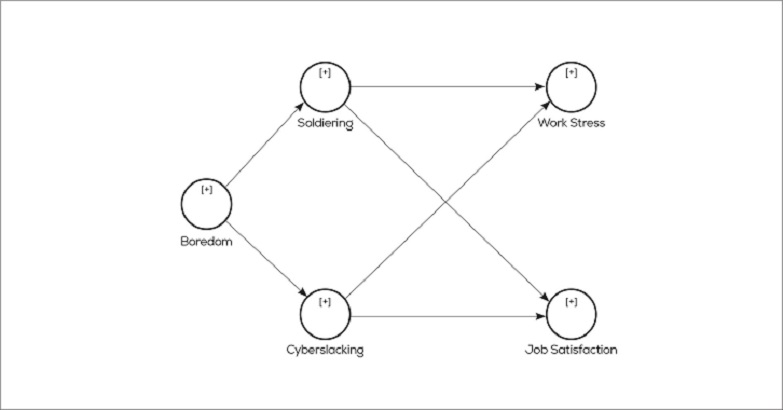
Figure 1
Research model
METHOD
Participants
A convenience sample of 287 participants completed an online questionnaire developed in Qualtrics XM. The link to the questionnaire was publicized in social networks and sent by e-mail to the researchers’ personal contacts. We collected 300 responses, but 13 were incomplete and were, therefore, excluded. In the total sample, 94 of the participants were male and 193 female. The average age was 34,5 (SD = 11,97), and the majority of participants (78.3%) had a Bachelor degree or above.
Measures
Boredom at work was measured using the one-dimensional boredom at work scale developed by Reijseger et al. (2012). It consists of six items (e.g., “I feel bored at my job”) on a 5-point scale ranging from never (1) to always (5).
Procrastination at work was measured with the Procrastination at Work Scale (PAWS) developed by Metin et al. (2016). It consists of twelve items that assess two dimensions of procrastination at work: soldiering (e.g., “I delay some of my tasks just because I do not enjoy doing them”) and cyberslacking (e.g.,” I do online shopping during working hours”), on a 5-point scale ranging from totally disagree (1) to totally agree (5).
Work Stress was measured with the General Work Stress Scale (GWS) developed by de Bruin and Taylor (2005). Items from the original scale were formulated as questions, but we formulated them as affirmations using the first person in order to be consistent with the other scales included in the questionnaire. The scale contains 9 items (e.g., “My work makes me so stressed I wish I had a different job”) on a 5-point scale ranging from never (1) to always (5).
Job satisfaction was measured with the Job Diagnostic Survey developed by Hackman and Oldham (1975). It consists of 5 items (e.g., “Generally speaking, I am very satisfied with this job”) on a 5-point scale ranging from disagree strongly (1) to agree strongly (5).
RESULTS
Structural equations modeling (SEM) was used to test the model, and partial least squares (PLS) was preferred over CB (Covariance Based) data analysis because PLS is more appropriate for exploratory research (Henseler et al., 2014). Another reason to use PLS was that it allows for estimating models without imposing distributional assumptions on the data (Hair, Risher, Sarstedt, & Ringle, 2019). This was particularly relevant since some of the original variables in the model did not follow a normal distribution. Data was analyzed with the software SmartPLS version 3 (Ringle, Wende, & Becker, 2015).
Descriptive Analysis
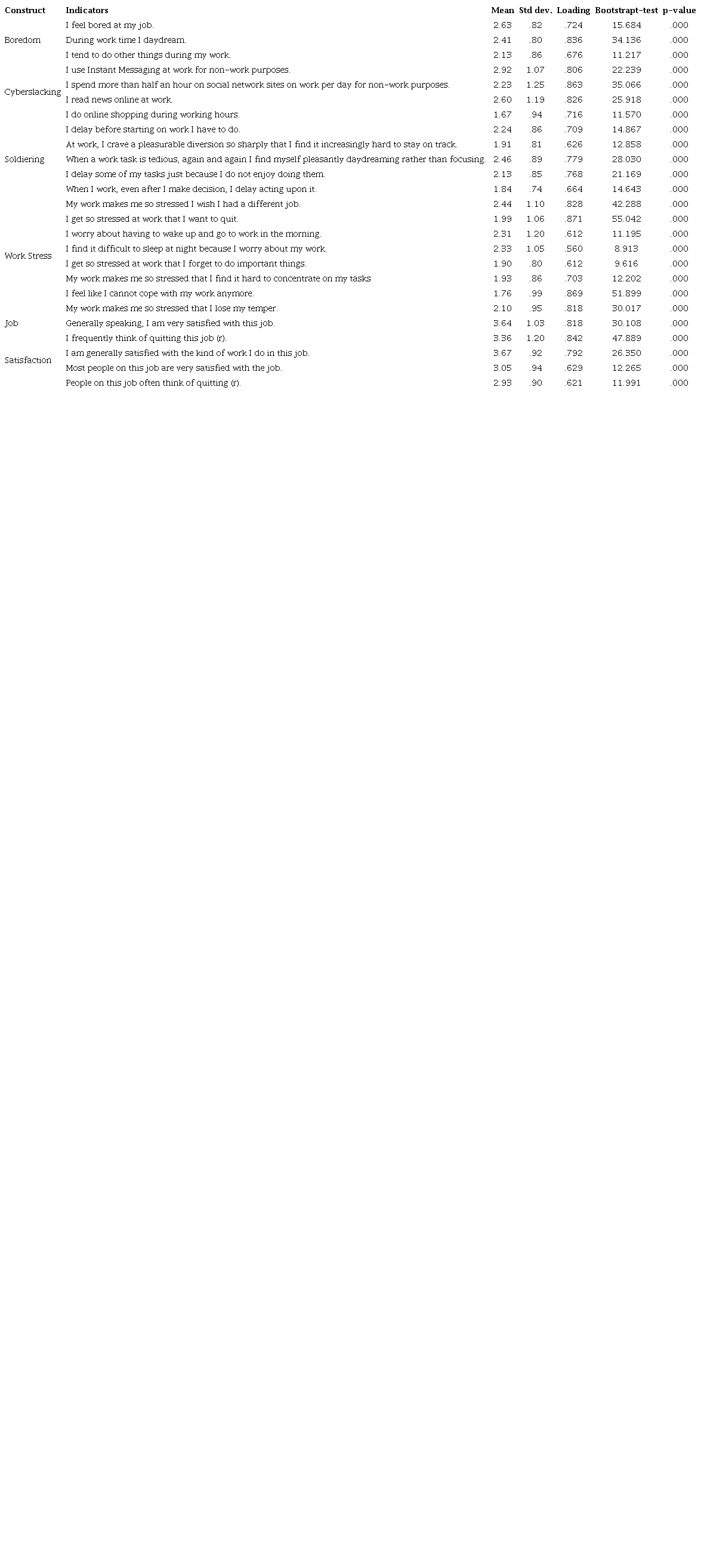
Table 1 shows the items and their respective loadings for each construct. It is noteworthy that items with loadings under .5 were considered to have poor reliability and, consequently, were deleted from the original scales (Hair, Hult, Ringle, & Sarstedt, 2017). Table 1 also provides information on the means and standard deviations of the items.
Since self-report measures were used for all variables, we tested for common method bias through a full collinearity assessment approach (Kock, 2015). All the variance inflation factor values (VIF) were lower than the threshold (3.3), indicating that the model is free from common method bias.
Measurement, reliability and validity
Table 2 presents the results for the assessment of reliability. We used composite reliability, for which the acceptable threshold is .7 (Hair, Ringle, & Sarstedt, 2011). All constructs in the model exceeded this threshold. In fact, except for the Boredom at Work, all composite reliabilities were above .8, while Work Stress was above .9. Therefore, these results indicate construct reliability (Fornell & Larcker, 1981).
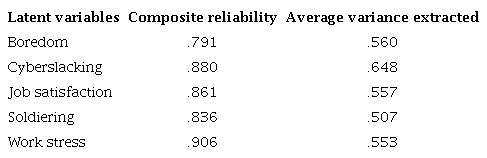
Results for validity can be found in Table 2 (convergent validity) and Table 3 (discriminant validity). Table 2 presents the average variance extracted (AVE), for which the acceptable threshold is .5. All constructs exceed this threshold, providing evidence of convergent validity (Fornell & Larcker, 1981). A complement to this convergent validity analysis can be found in Table 1, where the bootstrap t-statistics of the indicators’ standardized loadings are presented. Given that, for all indicators, these statistics are significant at the 1% significance level, there is further evidence on the convergent validity of the measurement models (Anderson & Gerbing, 1988).
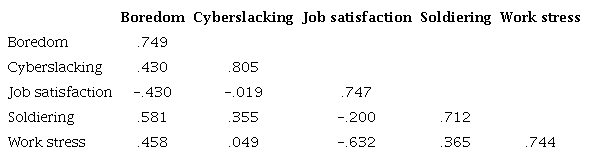
Table 3 compares the square root of AVE of a construct with the correlation of that construct with each of the other constructs in the model. In all cases, the square roots of the AVE are higher than the correlations, providing evidence of discriminant validity (Fornell & Larcker, 1981).
Analysis of the structural model
After ensuring the reliability and validity of the measurement models, we analyzed the structural model to test the hypotheses (Henseler, Ringle, & Sinkovics, 2009).
After carrying out bootstrapping and pseudo t-tests, we concluded that all except two-path coefficients presented a t-value above 1.96 (p < .05). The two exceptions were the path coefficient between cyberslacking and job satisfaction (t=.883, p=.377) and between cyberslacking and work stress (t=1.495, p=.135). Therefore, hypotheses H1 to H4 were validated, but hypotheses H5 and H6 were not validated.
After deleting the non-significant relationships from the model (Figure 2), it is possible to verify a significant relationship between boredom at work and the variables of soldiering (β=.602, p<.01) and cyberslacking (β=.481, p<.01); and between soldiering and the variables job satisfaction (β=-.234, p<.01) and work stress (β=.411, p<.01). Additionally, there are two significant indirect effects: soldiering mediates between boredom and job satisfaction (β=-.141, p<.01), as well as between boredom and job stress (β=.247, p<.01).
After analyzing the effect sizes (f2, Table 4), we conclude that there is one strong effect in the relationship between boredom at work and soldiering (effect size > .35). We also find two moderate effects (>.15), between boredom at work and cyberslacking and between soldiering and work stress. The remaining effect, between soldiering and job satisfaction, is weak (Cohen, 1988).
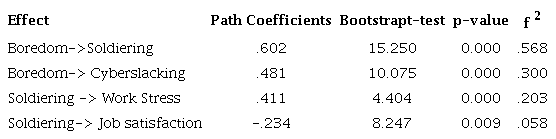
Figure 2 depicts the final structural model.
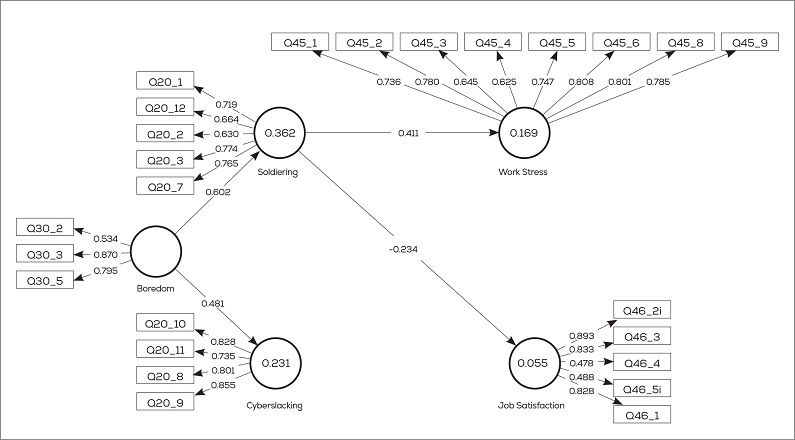
Figure 2
Final structural model
To evaluate the explanatory power of the model (Sarstedt, Ringle, Smith, Reams, & Hair, 2014) we analyzed the coefficient of determination (R2) of the endogenous constructs. The model explains 5.5% of variance for job satisfaction and 16.9% for work stress.
Finally, to assess the predictive relevance of the model, we used blindfolding to calculate Stone-Geiser’s Q2. As the values of Q2 are above zero for the endogenous constructs in our study (Q2=.020 for job satisfaction; Q2=.076 for work stress), the model is considered to have predictive relevance (Hair et al., 2011).
DISCUSSION AND CONCLUSION
This study tested a conceptual model that involves one predictor and two outcomes of procrastination at work. Results show that boredom at work is a predictor of both dimensions of procrastination at work. It has a strong effect on soldiering, which means that bored employees tend to delay tasks that they do not like and daydream rather than focus on work. Boredom at work also has a moderate effect on cyberslacking, evidencing that bored employees are more prone to behaviors such as using instant messaging for personal use, spending time on social network platforms, and reading news online at work. These results corroborate those from previous studies (Eddy et al., 2010; Metin et al., 2016; Reijseger et al., 2012; Wan et al., 2014), who reported that bored employees tend to take long coffee breaks (soldiering) and engage more in non-work-related use of communication technology (cyberslacking). Managers who wish to reduce job procrastination and its negative outcomes should promote working arrangements (e.g., job crafting) that fit employees’ preferences and competences promoting a more stimulating and challenging working environment, reducing boredom at work (Metin et al., 2016; Reijseger et al., 2012).
Results also show that soldiering has a moderate effect on work stress, increasing it, as previous studies have already suggested (e.g., Anderson & Pulich, 2001). Soldiering also reduces job satisfaction, but this effect is weak, suggesting that there are other aspects besides soldiering that concur to explain job satisfaction. Nevertheless, this is a contribution of the study because it is, to the best of our knowledge, the first study to relate the soldiering dimension of procrastination at work to job satisfaction.
Results on the effects of soldiering indicate that this is an important issue for organizations. Managers should thus provide time management training, which has proved to have a positive impact on reducing procrastination at work and, subsequently, work stress (Eerde, 2015) and increasing job satisfaction (Chang & Nguyen, 2011; Claessens, Eerde, Rutte, & Roe, 2007). Setting goals and priorities increase employees’ time structure and, subsequently, their job satisfaction and wellbeing (Chang & Nguyen, 2011).
It is noteworthy that cyberslacking has no significant effect on work stress or job satisfaction. Previous research provided contradictory results for the effects of cyberslacking, with some studies indicating that it increases work stress (Lim & Teo, 2005) and job satisfaction (Andel et al., 2019), while other studies indicate that it reduces work stress (Andel et al., 2019) and job satisfaction (Farivar & Richardson, 2018). It is thus possible that for some participants, cyberslacking increases these variables, while for other participants, there is a reducing effect. Consequently, the fact that the overall effect was non-significant should be interpreted with caution. More research is needed on variables affecting the relationship between cyberslacking and variables such as job satisfaction and work stress.
We believe that this study contributes to the procrastination literature in several ways. Firstly, by analyzing the two dimensions of procrastination at work separately, we were able to see the differentiated effects of the two dimensions on work stress and job satisfaction and therefore attempt to explain the controversial results of previous studies that focused on procrastination as a unidimensional concept. Thus, we suggest that future research should include both dimensions in other organizational settings to validate the results from this study.
Secondly, most previous research aiming to identify predictors of procrastination focused on individual level variables (Eerde, 2003; Klingsieck, 2013; Steel, 2007). Not many studies have focused on workplace characteristics or task-related variables, which are fundamental for the development of interventions aimed at reducing procrastination at work.
Thirdly, we tested a comprehensive model involving both predictors and outcomes of procrastination, which is, to our knowledge, the first accomplished attempt to do so, considering that existing studies on procrastination at work have either focused on its predictors or its outcomes.
The main limitation of this study is that a convenience sample was used. Therefore, the results must be interpreted with caution. Besides, although results for the structural model appear to be in line with previous studies, they are still tentative, as some effect sizes are weak. Another limitation is that all measurements were collected at the same point in time. To testify the causality of relationships, we suggest that future research on the topic follows a longitudinal approach. We also suggest that future research includes other predictors of procrastination (e.g., personality factors) and outcomes (e.g., performance, productivity, creativity) to reach an even more comprehensive model of procrastination at work. Identifying the predictors of procrastination at work is an essential step for reducing this counterproductive behavior and, consequently, enhancing well-being and social sustainability.
REFERENCES
Abid, G., Ahmed, S., Elahi, N. S., & Ilyas, S. (2020). Antecedents and mechanism of employee well-being for social sustainability: A sequential mediation. Sustainable Production and Consumption, 24, 79-89. doi: 10.1016/j.spc.2020.06.011
Andel, S. A., Kessler, S. R., Pindek, S., Kleinman, G., & Spector, P. E. (2019). Is cyberloafing more complex than we originally thought? Cyberloafing as a coping response to workplace aggression exposure. Computers in Human Behavior, 101, 124-130. doi: 10.1016/j.chb.2019.07.013
Anderson, J. C., & Gerbing, D. H. (1988). Structural equation modeling in practice: A review and recommended two-step approach. Psychological Bulletin, 103(3), 411-423. doi: 10.1037/0033-2909.103.3.411
Anderson, P., & Pulich, M. (2001). Managing workplace stress in a dynamic environment. The Health Care Manager, 19(3), 1-10. doi: 10.1097/00126450-200119030-00002
Andreou, C., & White, M. (2010) The Thief of Time: Philosophical Essays on Procrastination. New York: Oxford University Press.
Askew, K., Buckner, J. E., Taing, M. U., Ilie, A., Bauer, J. A., & Coovert, M. D. (2014). Explaining cyberloafing: The role of the theory of planned behavior. Computers in Human Behavior, 36, 510-519. doi: 10.1016/j.chb.2014.04.006
Barabanshchikova, V. V., Ivanova, S. A., & Klimova, O. A. (2018). The impact of organizational and personal factors on procrastination in employees of a modern Russian industrial enterprise. Psychology in Russia: State of the Art, 11(3), 69-85. doi: 10.11621/pir.2018.0305
Bowling, N. A., Eschleman, K. J., & Wang, Q. (2010). A meta-analytic examination of the relationship between job satisfaction and subjective well-being. Journal of Occupational and Organizational Psychology, 83(4), 915-934. doi: 10.1348/096317909X478557
Bruin, G. P. de, & Taylor, N. (2005). Development of the sources of work stress inventory. South African Journal of Psychology, 35(4), 748-765. doi: 10.1177/008124630503500408
Çelik, Ç. B., & Odaci, H. (2020). Subjective well-being in university students: What are the impacts of procrastination and attachment styles? British Journal of Guidance & Counselling, Ahead-of-print, 1-14. doi: 10.1080/03069885.2020.1803211
Chang, A., & Nguyen, L. T. (2011). The mediating effects of time structure on the relationships between time management behaviour, job satisfaction, and psychological well-being. Australian Journal of Psychology, 63(4), 187-197. doi: 10.1111/j.1742-9536.2011.00008.x
Chu, A. H. C., & Choi, J. N. (2005). Rethinking procrastination: Positive effects of “active” procrastination behavior on attitudes and performance. The Journal of Social Psychology, 145(3), 245-264. doi: 10.3200/SOCP.145.3.245-264
Claessens, B. J. C., Eerde, W. van, Rutte, C. G., & Roe, R. A. (2007). A review of the time management literature. Personnel Review, 36(2), 255-276. doi: 10.1108/00483480710726136
Codina, N., Castillo, I., Pestana, J. V., & Balaguer, I. (2020). Preventing procrastination behaviours: Teaching styles and competence in university students. Sustainability, 12(6), 2448. doi: 10.3390/su12062448
Cohen, J. (1988). Statistical power analysis for the behavioral sciences (2nd ed.). Hillsdale, NJ: L. Erlbaum Associates.
Coker, B. L. S. (2013). Workplace internet leisure browsing. Human Performance, 26(2), 114-125. doi: 10.1080/08959285.2013.765878
D’Abate, C. P., & Eddy, E. R. (2007). Engaging in personal business on the job: Extending the presenteeism construct. Human Resource Development Quarterly, 18(3), 361-383. doi: 10.1002/hrdq.1209
Davidescu, A. A., Apostu, S.-A., Paul, A., & Casuneanu, I. (2020). Work flexibility, job satisfaction, and job performance among Romanian employees: Implications for sustainable human resource management. Sustainability, 12(15), 6086. doi: 10.3390/su12156086
Deci, E. L., & Ryan, R. M. (2000). The “what” and “why” of goal pursuits: Human needs and the self-determination of behavior. Psychological Inquiry, 11(4), 227-268. doi: 10.1207/S15327965PLI1104_01
Dewitte, S., & Lens, W. (2000). Procrastinators lack a broad action perspective. European Journal of Personality, 14, 121-140. doi: 10.1002/%28SICI%291099-0984%28200003/04%2914%3A2<121%3A%3AAID-PER368>3.0.CO%3B2-%23
Eddy, E. R., D’Abate, C. P., & Thurston, P. W. (2010). Explaining engagement in personal activities on company time. Personnel Review, 39(5), 639-654. doi: 10.1108/00483481011064181
Eerde, W. Van. (2003). Procrastination at work and time management training. The Journal of Psychology, 137(5), 421-434. doi: 10.1080/00223980309600625
Eerde, W. Van. (2015). Time management and procrastination. In M. Frese & M. D. Mumford (Eds.), The psychology of planning in organizations: Research and applications (pp. 312-333). New York: Routledge.
Eerde, W. Van. (2016). Procrastination and well-being at work. In F. M. Sirois & T. A. Pychyl (Eds.), Procrastination, health, and well-being (pp. 233-253). Amsterdam: Elsevier Science.
Elpidorou, A. (2018). The bored mind is a guiding mind: Toward a regulatory theory of boredom. Phenomenology and the Cognitive Sciences, 17(3), 455-484. doi: 10.1007/s11097-017-9515-1
Fabio, A. Di. (2017). Positive healthy organizations: Promoting well-being, meaningfulness, and sustainability in organizations. Frontiers in Psychology, 8, 1938. doi: 10.3389/fpsyg.2017.01938
Farivar, F., & Richardson, J. (2018). Cross-domain online social networking and job/life satisfaction. Academy of Management Global Proceedings. Retrieved from https://journals.aom.org/doi/abs/10.5465/amgblproc.surrey.2018.0160.abs
Fisherl, C. D. (1993). Boredom at work: A neglected concept. Human Relations, 46(3), 395-417. doi: 10.1177/001872679304600305
Fornell, C., & Larcker, D. F. (1981). Evaluating structural equation models with unobservable variables and measurement error. Journal of Marketing Research, 18(1), 39-50. doi: 10.2307/3151312
Gagné, M., & Deci, E. L. (2005). Self-determination theory and work motivation. Journal of Organizational Behavior, 26(4), 331-362. doi: 10.1002/job.322
Game, A. M. (2007). Workplace boredom coping: Health, safety, and HR implications. Personnel Review, 36(5), 701-721. doi: 10.1108/00483480710774007
Garrett, R. K., & Danziger, J. N. (2008). On cyberslacking: Workplace status and personal internet use at work. CyberPsychology & Behavior, 11(3), 287-292. doi: 10.1089/cpb.2007.0146
Gupta, R., Hershey, D. A., & Gaur, J. (2012). Time perspective and procrastination in the workplace: An empirical investigation. Current Psychology, 31(2), 195-211. doi: 10.1007/s12144-012-9136-3
Hackman, J. R., & Oldham, G. R. (1975). Development of the job diagnostic survey. Journal of Applied Psychology, 60(2), 159-170. doi: 10.1037/h0076546
Hair, J. F., Hult, G. T. M., Ringle, C. M., & Sarstedt, M. (2017). A primer on partial least squares structural equation modeling (PLS-SEM) (2nd ed.). Thousand Oaks: Sage.
Hair, J. F., Ringle, C. M., & Sarstedt, M. (2011). PLS-SEM: Indeed a silver bullet. Journal of Marketing Theory and Practice, 19(2), 139-152. doi: 10.2753/MTP1069-6679190202
Hair, J. F., Risher, J. J., Sarstedt, M., & Ringle, C. M. (2019). When to use and how to report the results of PLS-SEM. European Business Review, 31(1), 2-24. doi: 10.1108/EBR-11-2018-0203
Hart, P. M., Wearing, A. J., & Headey, B. (1995). Police stress and well-being: Integrating personality, coping and daily work experiences. Journal of Occupational and Organizational Psychology, 68(2), 133-156. doi: 10.1111/j.2044-8325.1995.tb00578.x
Heimerl, P., Haid, M., Perkmann, U., & Rabensteiner, M. (2020). Job satisfaction as a driver for sustainable development in the hospitality industry? Evidence from the Alpine region. Sustainability, 12(17), 6754. doi: 10.3390/su12176754
Henseler, J., Dijkstra, T. K., Sarstedt, M., Ringle, C. M., Diamantopoulos, A., Straub, D. W., ... Calantone, R. J. (2014). Common beliefs and reality about PLS: Comments on Rönkkö and Evermann (2013). Organizational Research Methods, 17(2), 182-209. doi: 10.1177/1094428114526928
Henseler, J., Ringle, C. M., & Sinkovics, R. R. (2009). The use of partial least squares path modeling in international marketing. Advances in International Marketing, 20, 277-319. doi: 10.1108/S1474-7979(2009)0000020014
Hobfoll, S. E. (1989). Conservation of resources: A new attempt at conceptualizing stress. American Psychologist, 44(3), 513-524. Retrieved from https://psycnet.apa.org/buy/1989-29399-001
Hobfoll, S. E., Halbesleben, J., Neveu, J.-P., & Westman, M. (2018). Conservation of resources in the organizational context: The reality of resources and their consequences. Annual Review of Organizational Psychology and Organizational Behavior, 5(1), 103-128. doi: 10.1146/annurev-orgpsych-032117-104640
Jamal, M. (2005). Burnout among Canadian and Chinese employees: A cross-cultural study. European Management Review, 2(3), 224-230. doi: 10.1057/palgrave.emr.1500038
Khalid, A., Zhang, Q., Wang, W., Ghaffari, A. S., & Pan, F. (2019). The relationship between procrastination, perceived stress, saliva alpha-amylase level and parenting styles in Chinese first year medical students. Psychology Research and Behavior Management, 12, 489-498. doi: 10.2147/PRBM.S207430
Klingsieck, K. B. (2013). Procrastination. European Psychologist. 18(1), 24-34. doi: 10.1027/1016-9040/a000138
Kock, N. (2015). Common Method Bias in PLS-SEM: A full collinearity assessment approach. International Journal of E-Collaboration, 11(4), 1-10. https://doi.org/10.4018/ijec.2015100101
Köse, A. G., & Metin, U. B. (2018). Linking leadership style and workplace procrastination: The role of organizational citizenship behavior and turnover intention. Journal of Prevention & Intervention in the Community, 46(3), 245-262. doi: 10.1080/10852352.2018.1470369
Krause, N., & Stryker, S. (1984). Stress and well-being: The buffering role of locus of control beliefs. Social Science & Medicine, 18(9), 783-790. doi: 10.1016/0277-9536(84)90105-9
Lavoie, J. A. A., & Pychyl, T. A. (2001). Cyberslacking and the procrastination superhighway: A web-based survey of online procrastination, attitudes, and emotion. Social Science Computer Review, 19(4), 431-444. doi: 10.1177/089443930101900403
Li, Q., Du, H., & Chi, P. (2021). Job stress and well-being among internal migrant workers in China: A review and meta-analysis. Applied Psychology: Health and Well-Being, 13(3), 537-558. doi: 10.1111/aphw.12266
Lim, V. K. G., & Chen, D. J. Q. (2012). Cyberloafing at the workplace: Gain or drain on work? Behaviour & Information Technology, 31(4), 343-353. doi: 10.1080/01449290903353054
Lim, V. K. G., & Teo, T. S. H. (2005). Prevalence, perceived seriousness, justification and regulation of cyberloafing in Singapore. Information & Management, 42(8), 1081-1093. doi: 10.1016/j.im.2004.12.002
Locke, E. A. (1976). The nature and causes of job satisfaction. In M. D. Dunnette (Ed.), Handbook of industrial and organizational psychology (pp. 1297-1349). Chicago, IL: Rand McNally College Pub. Co.
Loukidou, L., Loan-Clarke, J., & Daniels, K. (2009). Boredom in the workplace: More than monotonous tasks. International Journal of Management Reviews, 11(4), 381-405. doi: 10.1111/j.1468-2370.2009.00267.x
Macan, T. H. (1996). Time-management training: Effects on time behaviors, attitudes, and job performance. The Journal of Psychology, 130(3), 229-236. Retrieved from https://www.tandfonline.com/doi/abs/10.1080/00223980.1996.9915004
Martin, M., Sadlo, G., & Stew, G. (2006). The phenomenon of boredom. Qualitative Research in Psychology, 3(3), 193-211. doi: 10.1191/1478088706qrp066oa
Meier, A., Reinecke, L., & Meltzer, C. E. (2016). “Facebocrastination”? Predictors of using Facebook for procrastination and its effects on students’ well-being. Computers in Human Behavior, 64, 65-76. doi: 10.1016/j.chb.2016.06.011
Metin, U. B., Peeters, M. C. W., & Taris, T. W. (2018). Correlates of procrastination and performance at work: The role of having “good fit.” Journal of Prevention & Intervention in the Community, 46(3), 228-244. doi: 10.1080/10852352.2018.1470187
Metin, U. B., Taris, T. W., & Peeters, M. C. W. (2016). Measuring procrastination at work and its associated workplace aspects. Personality and Individual Differences, 101, 254-263. doi: 10.1016/j.paid.2016.06.006
Milgram, N., & Tenne, R. (2000). Personality correlates of decisional and task avoidant procrastination. European Journal of Personality, 14(2), 141-156. doi: 10.1002/(SICI)1099-0984(200003/04)14:2<141::AID-PER369>3.0.CO;2-V
Mohsin, F. Z., & Ayub, N. (2014). The relationship between procrastination, delay of gratification, and job satisfaction among high school teachers: Procrastination, delay of gratification, and job satisfaction. Japanese Psychological Research, 56(3), 224-234. doi: 10.1111/jpr.12046
Nguyen, B., Steel, P., & Ferrari, J. R. (2013). Procrastination’s impact in the workplace and the workplace’s impact on procrastination: Procrastination’s impact. International Journal of Selection and Assessment, 21(4), 388-399. doi: 10.1111/ijsa.12048
O’Neill, J. W., & Davis, K. (2011). Work stress and well-being in the hotel industry. International Journal of Hospitality Management, 30(2), 385-390. doi: 10.1016/j.ijhm.2010.07.007
O’Neill, T. A., Hambley, L. A., & Bercovich, A. (2014). Prediction of cyberslacking when employees are working away from the office. Computers in Human Behavior, 34, 291-298. doi: 10.1016/j.chb.2014.02.015
Parker, D. F., & DeCotiis, T. A. (1983). Organizational determinants of job stress. Organizational Behavior and Human Performance, 32(2), 160-177. doi: 10.1016/0030-5073(83)90145-9
Paulsen, R. (2013). Non-work at work: Resistance or what? Organization, 22(3), 351-367. doi: 10.1177/1350508413515541
Rajamohan, S., Porock, D., & Chang, Y.-P. (2019). Understanding the relationship between staff and job satisfaction, stress, turnover, and staff outcomes in the person-centered care nursing home arena. Journal of Nursing Scholarship, 51(5), 560-568. doi: 10.1111/jnu.12488
Reijseger, G., Schaufeli, W. B., Peeters, M. C. W., Taris, T. W., Beek, I. van, & Ouweneel, E. (2012). Watching the paint dry at work: Psychometric examination of the Dutch Boredom Scale. Anxiety, Stress & Coping, 26(5), 508-525. Retrieved from https://www.tandfonline.com/doi/abs/10.1080/10615806.2012.720676
Reinecke, L. (2009). Games and recovery: The use of video and computer games to recuperate from stress and strain. Journal of Media Psychology, 21(3), 126-142. https://doi.org/10.1027/1864-1105.21.3.126
Ringle, C. M., Wende, S., & Becker, J.-M. (2015). SmartPLS 3. SmartPLS GmbH. Retrieved from http://www.smartpls.com
Rothmann, S. (2008). Job satisfaction, occupational stress, burnout and work engagement as components of work-related wellbeing. SA Journal of Industrial Psychology, 34(3), 11-16. Retrieved from http://www.scielo.org.za/scielo.php?script=sci_abstract&pid=S2071-07632008000300002&lng=en&nrm=iso&tlng=es
Ryan, R. M., & Deci, E. L. (2017). Self-determination theory: Basic psychological needs in motivation, development, and wellness. New York: Guilford Publications
Sadick, A.-M., & Kamardeen, I. (2020). Enhancing employees’ performance and well-being with nature exposure embedded office workplace design. Journal of Building Engineering, 32, (article 101789), 1-11. doi: 10.1016/j.jobe.2020.101789
Sarstedt, M., Ringle, C. M., Smith, D., Reams, R., & Hair, J. F. (2014). Partial least squares structural equation modeling (PLS-SEM): A useful tool for family business researchers. Journal of Family Business Strategy, 5(1), 105-115. doi: 10.1016/j.jfbs.2014.01.002
Schaufeli, W. B., & Salanova, M. (2014). Burnout, boredom and engagement in the workplace. In M. Peeters, J. De Jonge, & T. Taris (Eds.), An introduction to contemporary work psychology (pp. 293-320). Hoboken:Wiley Blackwell.
Schlett, C., & Ziegler, R. (2014). Job emotions and job cognitions as determinants of job satisfaction: The moderating role of individual differences in need for affect. Journal of Vocational Behavior, 84(1), 74-89. https://doi.org/10.1016/j.jvb.2013.11.005
Schraw, G., Wadkins, T., & Olafson, L. (2007). Doing the things we do: A grounded theory of academic procrastination. Journal of Educational Psychology, 99(1), 12-25. doi: 10.1037/0022-0663.99.1.12
Shin, J., & Grant, A. M. (2020). When putting work off pays off: The curvilinear relationship between procrastination and creativity. Academy of Management Journal (Advanced online publication). doi: 10.5465/amj.2018.1471
Sirois, F. M. (2014). Procrastination and stress: Exploring the role of self-compassion. Self and Identity, 13(2), 128-145. doi: 10.1080/15298868.2013.763404
Skowronski, M., & Mirowska, A. (2013). A manager’s guide to workplace procrastination. S.A.M. Advanced Management Journal, 78(3), 4-9. Retrieved from https://search.proquest.com/docview/1465064146?pq-origsite=gscholar&fromopenview=true
Slemp, G. R., Kern, M. L., Patrick, K. J., & Ryan, R. M. (2018). Leader autonomy support in the workplace: A meta-analytic review. Motivation and Emotion, 42(5), 706-724. doi: 10.1007/s11031-018-9698-y
Steel, P. (2007). The nature of procrastination: A meta-analytic and theoretical review of quintessential self-regulatory failure. Psychological Bulletin, 133(1), 65-94. doi: 10.1037/0033-2909.133.1.65
Steel, P., & Klingsieck, K. B. (2016). Academic procrastination: Psychological antecedents revisited. Australian Psychologist, 51(1), 36-46. doi: 10.1111/ap.12173
Steffy, B. D., Jones, J. W., & Noe, A. W. (1990). The impact of health habits and life-style on the stressor-strain relationship: An evaluation of three industries. Journal of Occupational Psychology, 63(3), 217-229. doi: 10.1111/j.2044-8325.1990.tb00523.x
Strenitzerová, M., & Achimský, K. (2019). Employee satisfaction and loyalty as a part of sustainable human resource management in postal sector. Sustainability, 11(17), 4591. doi: 10.3390/su11174591
Thatcher, A., Wretschko, G., & Fridjhon, P. (2008). Online flow experiences, problematic Internet use and Internet procrastination. Computers in Human Behavior, 24(5), 2236-2254. doi: 10.1016/j.chb.2007.10.008
Tice, D. M., Bratslavsky, E., & Baumeister, R. F. (2001). Emotional distress regulation takes precedence over impulse control: If you feel bad, do it! Journal of Personality and Social Psychology, 80(1), 53-67. doi: 10.1037/0022-3514.80.1.53
Tu, X., & Chang, Y. (2010). An empirical study on the determinants of cyberloafing: Data analysis based on individual factors. 2010 International Conference on E-Product E-Service and E-Entertainment, 1-4. doi: 10.1109/ICEEE.2010.5660800
Vitak, J., Crouse, J., & LaRose, R. (2011). Personal Internet use at work: Understanding cyberslacking. Computers in Human Behavior, 27(5), 1751-1759. doi: 10.1016/j.chb.2011.03.002
Vodanovich, S. J., & Watt, J. D. (2016). Self-report measures of boredom: An updated review of the literature. The Journal of Psychology, 150(2), 196-228. doi: 10.1080/00223980.2015.1074531
Wan, H. C., Downey, L. A., & Stough, C. (2014). Understanding non-work presenteeism: Relationships between emotional intelligence, boredom, procrastination and job stress. Personality and Individual Differences, 65, 86-90. doi: 10.1016/j.paid.2014.01.018
Weiss, H. M. (2002). Deconstructing job satisfaction. Human Resource Management Review, 12(2), 173-194. doi: 10.1016/S1053-4822(02)00045-1
Wykes, T., Stevens, W., & Everitt, B. (1997). Stress in community care teams: Will it affect the sustainability of community care? Social Psychiatry and Psychiatric Epidemiology, 32(7), 398-407. doi.: 10.1007/BF00788180
Young, E. (2010). Night thoughts (1742, May). In G. Gilfillan (Ed.), Young's night thoughts: With life, critical dissertation and explanatory notes. Ebook#33156, The Project Gutenberg. Retrieved from https://www.gutenberg.org/files/33156/33156-h/33156-h.htm
Author notes
Pilar Mosquera coordinated the conceptualization and theoretical-methodological approach. Maria Eduarda Soares coordinated the theoretical review. Data collection was conducted by Paula Dordio and Leonor Atayde e Melo. Data analysis included Pilar Mosquera and Maria Eduarda Soares. Pilar Mosquera, Maria Eduarda Soares, Paula Dordio, and Leonor Atayde e Melo worked in the writing and final revision of the manuscript.