2022
626
27102021
28032022
 Quang-Huy Ngo huynq121@fe.edu.vn
FPT University, Vietnam
ABSTRACT: This study analyzes how small businesses in an emerging country improve performance through strategic fit according to the intensity of market competition. It explores small businesses’ prospector or defender strategies in an environment of intense market competition. Data were collected from 107 small businesses in Vietnam, and PLS-SEM was used to assess the research model. The results showed that only prospector businesses improve performance in intense market competition. This study contributes to the literature fourfold. First, it extends the current knowledge of strategic fit by addressing the mediating effects of strategic behavior. Second, it contributes to the growing literature on contingency theory in small businesses’ strategic management. Third, this research offers a deeper understanding of the unique characteristics of emerging countries that jeopardize the effectiveness of using a defender strategy. Fourth, this study overcomes limitations observed in the literature regarding using single-item constructs to operationalize strategy variables.
Keywords: Defender strategy, market competition, prospector strategy, small business, Vietnam.
RESUMO: O objetivo deste estudo é saber como as pequenas empresas em um país emergente melhoram a eficácia dos ajustes estratégicos em relação a intensidade da concorrência no mercado. A pesquisa propõe que, quando a concorrência no mercado é intensa, essas pequenas empresas recorrem as estratégias dos tipos prospectora ou defensiva para melhorar o seu desempenho. Os dados foram coletados de 107 pequenas empresas localizadas no Vietnã. PLS-SEM foi utilizado para avaliar o modelo de pesquisa proposto. Os resultados sugerem que, quando a concorrência no mercado é intensa, apenas ajustes estratégicos com orientação prospectora levam as pequenas empresas a alcançar um desempenho superior. O estudo contribui para a literatura de quatro formas. Em primeiro lugar, amplia a compreensão atual sobre o tema dos ajustes estratégicos ao abordar os efeitos mediadores do tipo de estratégia. Em segundo, contribui para a crescente literatura sobre a teoria da contingência na gestão estratégica de pequenas empresas. Terceiro, a pesquisa oferece uma compreensão mais profunda das características únicas dos países emergentes, características essas que são responsáveis pela ineficiência da estratégia defensiva. Em quarto lugar, o presente estudo supera as limitações de estudos anteriores relacionados ao uso de construtos de item único para operacionalizar as variáveis da estratégia.
Palavras Chave: Estratégia defensiva, concorrência de mercado, estratégia prospectora, pequenas empresas, Vietnã.
RESUMEN: El propósito de este estudio es conocer cómo las pequeñas empresas en un país emergente mejoran la efectividad de los ajustes estratégicos bajo la intensidad de la competencia del mercado. En particular, propone que cuando la competencia en el mercado es intensa, estas pequeñas empresas se orientan hacia la estrategia de prospector/defensor para mejorar su desempeño. Se recopilaron datos de 107 pequeñas empresas ubicadas en Vietnam. Se utilizó PLS-SEM para evaluar el modelo de investigación propuesto. Los resultados sugieren que cuando la competencia en el mercado es intensa, solo los ajustes estratégicos de orientación tipo prospector inducen el desempeño de las pequeñas empresas. A la luz de los hallazgos, este estudio contribuye cuatro veces a la literatura. Primero, este estudio amplía nuestro conocimiento actual de los ajustes estratégicos al abordar los efectos mediadores de la estrategia. En segundo lugar, este artículo contribuye al creciente uso de la teoría de la contingencia en la gestión estratégica de las pequeñas empresas. En tercer lugar, este documento ofrece una comprensión más profunda de las características únicas de los países emergentes que causan la ineficacia de la estrategia de defensa. En cuarto lugar, este estudio supera las limitaciones de estudios anteriores relacionados con el uso de constructos de un solo ítem para operacionalizar las variables de la estrategia.
Palabras Clave: Estrategia de defensa, competencia de mercado, estrategia de prospector, pequeña empresa, Vietnam.
ARTICLES
THE STRATEGIC FIT’S EFFECTIVENESS IN THE COMPETITIVE MARKET: FOCUS ON SMALL BUSINESSES IN AN EMERGING COUNTRY
Eficácia dos ajustes estratégicos em um mercado competitivo: foco em pequenas empresas em um país emergente
La eficacia de los ajustes estratégicos en un mercado competitivo: Un enfoque en las pequeñas empresas en un país emergente
Quang-Huy Ngo huynq121@fe.edu.vn
Received: 27 October 2021
Accepted: 28 March 2022
Nowadays, market competition is increasingly intense, leading businesses to continuously adapt to the new market conditions to survive. Small businesses seem to be the most vulnerable to competition due to a lack of financial, technological, and other resources. However, these businesses have advantages over large corporations, such as flexibility and close customer relationships (Nooteboom, 1994). As a result, small businesses can achieve superior performance by quickly adapting to the market and changing to satisfy customers’ needs (Ebben & Johnson, 2005).
Notwithstanding, a superior performance based on these advantages is conditioned to the small businesses’ strategic fit. Authors such as Deshpandé, Grinstein, and Ofek (2012) and Pehrsson (2016) suggest that the external environment - which includes market competition - influences business strategy. The competition drives small businesses to adopt a specific strategy to find superior performance (Chaganti, Chaganti, & Mahajan, 1989), which is in line with the contingency theory. According to this theory, businesses’ strategies must fit with contingent factors to foster performance (Donaldson, 2006). Besides, the environment-strategy-performance paradigm suggests that businesses must examine the external environment and then choose a strategy fit to achieve superior performance (Child, 1972; Miller & Friesen, 1983). Thus, small businesses should consider external environmental factors such as market competition when choosing their strategy.
This study addresses several pieces of knowledge not yet well explored in the literature. First, in strategic management literature, the effectiveness of strategic fit can be assessed using the moderating and mediating role of strategy on the link between market competition and performance (Venkatraman, 1989). According to Boyd, Takacs Haynes, Hitt, Bergh, and Ketchen Jr (2012), prior empirical evidence from the mediating analysis is scarce. Thus, there is limited empirical evidence on the mediating role of strategy. Second, the contingency theory of organizations is mainly used in the context of large businesses. A lack of attention has been paid to small businesses with less hierarchical levels and a short chain of command (Gupta & Batra, 2016). These differences may challenge the relevance of the strategic management literature in the context of small businesses. Third, although many strategy-based studies focus on emerging economies, the knowledge of strategic management in emerging countries can be challenged since they present unique characteristics that make them different from developed countries (Crittenden & Crittenden, 2010; Venkateswaran & Ojha, 2017; Wright, Filatotchev, Hoskisson, & Peng, 2005).
This study focuses on small businesses because SMEs are dominant in the Vietnamese market (Koushan, 2017). Since becoming part of the World Trade Organization in 2007, Vietnam has actively engaged in many free trade agreements - such as the Comprehensive and Progressive Agreement for Trans-Pacific Partnership and the European Union-Vietnam Free Trade Agreement (Kikuchi, Yanagida, & Vo, 2018; Kokko & Thang, 2014) - leading to dramatic changes in the country’s economy. One notable consequence is the increasing participation of joint-venture and foreign enterprises with more resources, intensifying market competition. Against this backdrop, small businesses in Vietnam must improve performance by aligning their strategies to the intensity of market competition.
The research draws upon the strategic typology of Miles and Snow (1978) and the analytic framework of contingency theory of organizations (Venkatraman & Camillus, 1984) to propose a research framework that examines the mediating effects of prospector/defender strategic type of organizations (in this case, small businesses) on the link between market competition and performance. Data from 107 small businesses in Vietnam were collected to test the proposed model, using partial least squared structural equation modeling. The results show that the relationship between market competition and small businesses’ performance is mediated by a prospector strategy, while a defender strategy has a positive relationship with market competition but does not improve performance.
This study contributes to the literature fourfold. First, it expands the knowledge of strategic fit by examining the strategy’s mediating role. Second, it contributes to the growing literature on contingency theory in small businesses’ strategic management. Third, the findings suggest that a defender strategy does not improve small businesses’ performance in emerging countries due to these economies’ unique characteristics. Fourth, it overcomes prior studies’ limitations regarding the use of single-item constructs to operationalize strategy variables.
This article is organized into five sections, including this introduction. The next section presents the theoretical backgrounds and hypothesis development, followed by the methodology in the third section. The fourth section presents the results and discussions, and the fifth and final section offers the conclusions.
Strategic orientation refers to the degree to which businesses exert a pattern of behavior to adapt to external environments (e.g., market competition) (Miles & Snow, 1978; Mintzberg, 1973). This study uses Miles and Snow's (1978) strategic typology to explain small businesses’ strategic orientation. Compared to other frameworks, this typology offers a closer relationship with environmental conditions (such as the intensity of market competition) (Koçak & Edwards, 2005, p. 189). Miles and Snow (1978) propose four strategic types of organizations based on the strategies they adopt: prospector, defender, analyzer, and reactor. Prospector organizations are aggressive and continuously redefine markets by adopting new systems and technologies. Defender organizations focus on improving operational efficiency to protect market shares, while analyzer organizations maintain and expand the current market share through innovations (a hybrid strategy between the prospector and defender strategic types). Finally, reactor organizations avoid adopting a specific strategy. In this case, businesses show inconsistent patterns in adapting to the external environment. Therefore, the first three strategic types of organizations seek superior performance, while adopting a reactor strategy leads to low performance (Moore, 2005; Parnell, 2010).
This study examines the small businesses’ strategic fit considering the prospector and defender strategies. These two types are well known as drivers of superior performance, which helps us observe the positive effects of the strategic fit on the performance of small businesses (Moore, 2005). It is noteworthy that most studies investigate organizational strategy along the continuum between these two strategic types - the “analyzer” type shares characteristics with them (Kald, Nilsson, & Rapp, 2000). Furthermore, the distinction between the analyzer and defender strategies is not entirely recognizable (O'cass & Ngo, 2007, p. 13). According to Moore (2005), in factor analysis, “the defender and analyzer items loaded on a common factor.” Therefore, the study excludes the analyzer and reactor strategic types of organizations.
A research model is proposed based on the contingency theory, the environment-strategy-performance paradigm, and Miles and Snow's (1978) strategic typology. In particular, this study argued that intense market competition puts pressure on small businesses, which respond with a prospector or defender strategy to gain competitive advantages and achieve superior performance. In addition, according to contingency theory, the strategic fit between the intensity of market competition and prospector/defender strategies necessarily leads to better performance. According to Venkatraman (1989), the strategic fit can be assessed by examining the mediating effects of prospector and defender strategies on the relationship between market competition and performance. Figure 1 illustrates the research model.
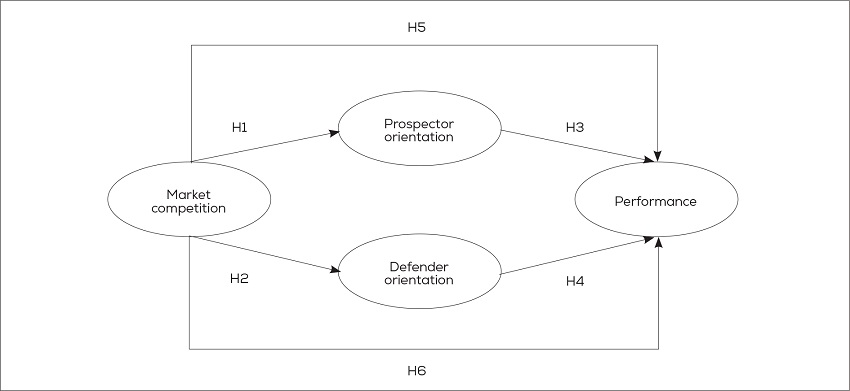
The intensity of market competition refers to the pressure businesses face when competing in the market (Grewal & Tansuhaj, 2001). In Vietnam, market competition is intense because of the significant increase in foreign direct investment and the country’s participation in various free trade agreements (Kikuchi et al., 2018; Kokko & Thang, 2014;Le, Pieri, & Zaninotto, 2019). When market competition is intense, the business can adopt aggressive behavior to gain an advantage in domains such as price, promotion, vertical integration, research and development, and technological innovation (Khandwalla, 1981).
For Porter (1996), intense competition continuously drives down businesses’ profit to the floor rate and consequently reduces businesses’ performance. However, businesses can enhance performance in the intense market competition by adopting adequate strategies. Competitive advantage in such a scenario can be obtained through innovation (Vincent, Bharadwaj, & Challagalla, 2004), considering that this competition drives businesses to develop new tools and techniques to meet customers’ demands and gain market share (Knot, Van den Ende, & Vergragt, 2001; Santos-Vijande & Álvarez-González, 2007). This perspective is corroborated by (Donaldson, 2001; Gopalakrishnan & Damanpour, 1997), who argue that competition intensity enhances the opportunities to innovate and obtain competitive advantages. First, innovation allows organizations to be ahead of new market entrants and technological laggards (Damanpour & Gopalakrishnan, 2001). Second, innovation increases the likelihood of a company to pursue more innovation and, therefore, outperform rivals (Cohen & Levin, 1989). For Kickul and Gundry (2002), the likelihood of a firm adopting innovative approaches due to intense market competition is a characteristic of the prospector strategy. Based on these arguments and considering the intense market competition in Vietnam, this research expects small businesses in the country to adopt prospector strategies. Thus, the first hypothesis is proposed as follows.
H1: There is a positive association between the intensity of market competition and using a prospector strategy.
There are several types of competition. One is price-based competition (Krishnan, 2005), where businesses face intense market competition reducing the prices of products and services, aiming to protect and expand market share (Khandwalla, 1972). This approach requires optimization and efficiency in the company’s operations, reducing costs (Rust, Moorman, & Dickson, 2002). In this scenario, small businesses can present a defender strategy to enhance operational efficiency through cost reduction (Chen & Tsou, 2012; Prajogo, McDermott, & McDermott, 2013). Therefore, small businesses will likely present a defender strategy when facing intense market competition.
There is a concern that small businesses are less likely to present a defender strategy because they do not have enough resources to compete by price. However, this study considers this issue irrelevant in the context of Vietnam. One reason is that most companies in Vietnam are small and medium enterprises (approximately 98%) (Koushan, 2017), and, according to Chaganti et al. (1989), size is not an issue when the market is predominantly formed of small businesses. Thus, following (Rugman & Verbeke, 1998), it is possible to suggest that small businesses can adopt a defender strategy to improve performance. Against this backdrop, this research expects that small business, in an environment of intense market competition, will likely compete by price, seeking operational efficiency by adopting a defender strategy. Therefore, the second hypothesis of this study is as follows.
H2: There is a positive association between the intensity of market competition and using a defender strategy.
Most researchers in management areas commonly refer to effectiveness as performance (Hoque, 2004). For Walker (2013), the strategy’s effectiveness lies in its ability to improve business performance. This study adopts the same direction, assuming that the strategy’s effectiveness refers to the positive relationship between the prospector or defender strategy adopted and the small businesses’ performance.
Miles and Snow (1978) explained how and why prospector organizations show superior performance. The unique characteristics of prospectors lead them to emphasize exploring new markets by continuously investing in innovation (Dev & Brown, 1990). Thus, these businesses are the “first-movers” in the industry (Slater & Narver, 1993), gaining competitive advantages. They have little competition and are more likely to present a superior performance (Lieberman & Montgomery, 1988). Empirical evidence from previous studies suggests a positive link between prospector strategies and performance (Moore, 2005; Naranjo-Gil, 2004). This article goes in the same direction, expecting similar effects. Therefore, the third hypothesis is
H3: There is a positive association between small businesses’ performance and using a prospector strategy.
Unlike prospector companies, defender organizations are more conservative and prefer not to enter a new market. These businesses focus on improving operational efficiency to gain competitive advantages (Miles & Snow, 1978). Because operational efficiency is suggested to positively impact the businesses’ performance (Baik, Chae, Choi, & Farber, 2013), those adopting a defender strategy would be more likely to achieve superior performance since this behavior leads to a high degree of operational efficiency. Empirical findings from Moore (2005) reveal the positive association between defender strategies and performance. In the same vein, this study expects similar effects on small businesses in Vietnam, leading to the fourth hypothesis as follows.
H4: There is a positive association between small businesses’ performance and using a defender strategy.
The crucial role of strategic orientation is to lead businesses to superior performance. In this sense, contingency theorists argue that an organization’s effective strategy must consider environmental characteristics (Donaldson, 2001). Contingency-based studies in strategic management argue that the effectiveness of strategic fit refers to how the alignment between contingent factors and strategies affects the businesses’ performance (Lindow, 2013, p. 52). Contingent factors can be external or internal (Miller, 1992), but this study examines only external factors, such as market competition.
One crucial notion of contingency-based research in strategic management is how to formulate an adequate research model to assess the strategic fit. There are many forms of obtaining strategic fit, which require the development of a specific analytical framework to propose hypotheses and carry out statistical analysis to evaluate such hypotheses (Venkatraman, 1989). The lack of an appropriate framework to assess the strategic fit may lead to inconsistent results (Hitt, Boyd, & Li, 2004), which has been one of the criticisms raised by contingency-based theorists in strategic management when analyzing the previous literature. For these scholars, the studies have been ambiguous when formulating the contingency hypotheses (Boyd et al., 2012), jeopardizing the application of contingency theory in strategic management research (Galbraith & Nathanson, 1978).
This study follows the Cartesian approach to assess contingency forms of fit (Donaldson, 2001, p. 185). In this approach, contingency-based research focuses on how combining single contingent factors and strategic orientation improves performance (Drazin & Van de Ven, 1985). This approach requires examining the mediating effects of strategy on the relationship between the external environment and performance (Venkatraman, 1989). Thus, this study expects that the fit between market competition and prospector or defender strategies will affect Vietnamese small businesses’ performance. Thus, the fit is represented by the mediating effects of prospector/defender strategies on the relationship between market competition and small businesses’ performance, which leads us to the last two hypotheses:
H5: The prospector strategy has mediating effects on the relationship between the intensity of market competition and the small businesses’ performance.
H6: The defender strategy has mediating effects on the relationship between the intensity of market competition and the small businesses’ performance.
This study explores how and why the strategic fit between market competition and the prospector and defender strategies influences the performance of small businesses in Vietnam. Data collection was conducted through a survey since public data was unavailable. Four research instruments based on the literature were adopted to measure the four main latent variables in the research model. After data collection, the study assessed common method bias and employed a partial least square structural equation model to test the hypotheses.
This study collects data from small businesses located in Can Tho city. This city is located at the heart of the Mekong Delta, Southern Vietnam. It is one of the country's five biggest and most developed cities. This selection may affect the study’s ability to generalize the findings to a larger population of small businesses in Vietnam. However, the research does not intend to offer such a generalization but to test theoretical assumptions, which can be carried out using convenience sampling (Speklé & Widener, 2018). Therefore, the sample gathered is appropriate for the scope of this research.
According to Can Tho’s 2019 statistical yearbook (Can Tho Statistical Office, 2020, pp. 232-244), about 4800 small businesses operate in service and trade areas. Due to the limited time and financial resources, this study took advantage of personal networking to collect data. More specifically, the business association of Can Tho, a non-profit organization that assists the development of local firms, was approached. The organization was asked to contribute by sending the research questionnaire to its members (most of the city’s small businesses are members of the association) to ensure a high response rate. The organization sent an email explaining the study and containing a link to access the online survey. A total of 800 electronic addresses were randomly selected from the organization’s database and received the email. The survey was completed by 107 small businesses that received the email (13.38%).
The business forming the sample had to fulfill three criteria. First, the target business’ representatives who responded to the questionnaire had to be the owners since the understanding behind the questionnaire was that only owners could respond about the small company’s strategy (Tymon Jr, Stout, & Shaw, 1998). In Vietnam, the owner is always in charge of managerial positions. Second, the businesses had to operate in the services and trade industry and employ less than 50 employees since these characteristics define small businesses in the country’s law (Vietnam National Assembly, 2018). Third, the study only approached small businesses operating for more than three years to ensure they would present an established strategy. Therefore, the questionnaire was built with screening questions to identify the characteristics of the businesses, ensuring the criteria were fulfilled.
Because there are four main variables in the research framework, this study adopted and relied on four instruments from prior studies. The original instruments were first translated into Vietnamese, and minor revisions were made after the translation (details below). In addition, the revision process was assisted by two small business owners to improve the quality of the questionnaire in terms of readability and understandability. After two rounds of revision, the final version was uploaded to an online system.
This study adopts an instrument from Mia and Clarke (1999) to measure the intensity of market competition. This instrument asked the businesses’ representatives to express their agreement regarding the intensity of market competition considering their perception of (1) the number of competitors, (2) technological changes, (3) access to marketing channels, (4) package deals, (5) competitive price, (6) new product introduction, (7) government regulations. A 5-point Likert scale ranging from “highly disagree” (1) to “highly agree” (5) was used to measure this instrument.
This study relies on two instruments from Moore (2005) to measure the degree to which small businesses use prospector/defender strategies. There are six items/sentences designed to assess these strategies in each instrument. Since Moore (2005) used the original measures in retailing contexts, some minor modifications were made in the sentences to ensure the appropriateness in the contexts of small businesses. For example, in the first statement of PROS, “retail industry” was replaced by “industry.” In the third item of PROS, “... developing new ways to retail” was changed to “developing new ways to perform.” Relating to the second statement of DEFD, “... current store type” was changed to “... current businesses.” After the revision, two owners of small businesses operating in trades and services carefully examined these two instruments to ensure their appropriateness. Thus, the instruments measuring PROS and DEFD strategies presented statements with ways a business may behave/operate, asking the representative of the businesses to indicate, using a 5-point Likert scale (from “highly disagree” to “highly agree”), whether they agree that the statements represent the behavior/operation of their businesses. The statements for PROS were: (1) Is an innovation leader in the industry; (2) Frequently moves into new markets; (3) Is known for being “first in” the industry for developing new ways to perform; (4) Does not mind risking profits for developing new products/services; (5) Is a leader in developing new ways to perform; (6) Continuously adopts new technology. The statements for DEFD were: (1) Maintains a safe niche using a traditional business; (2) Sticks with using current businesses; (3) Concentrates on improving current ways of conducting businesses rather than developing new methods; (4) Researches only trends that impact our business directly; (5) Adopts industry innovations only after lengthy consideration; (6) Focuses first on serving current customers and second on capturing new customers.
Acquaah (2007) argued that collecting data to assess subjective performance (e.g., ROA and ROS) may be difficult in emerging countries since owners may understate the profit to avoid income taxes (Sapienza, Smith, & Gannon, 1988). On the other hand, Jarvis, Curran, Kitching, and Lightfoot (2000) argued that objective performance might not sufficiently reflect the performance of small businesses because they focus not only on profit indicators but also on business goals. In line with the argument by Acquaah (2007), this study, examining small companies in Vietnam, adopted the instrument elaborated by Pelham and Wilson (1995) to capture objective performance, which is considered equally reliable and can be used when subjective performance cannot be assessed (Dess & Robinson Jr, 1984; Sapienza et al., 1988). This instrument has ten items. The first two focus on new product success: (1) new product/service development and (2) market development. The next three items focus on growth/share: (3) sales growth rates, (4) employment growth rate, and (5) market share. The last five items focus on profitability: (1) operating profits, (2) profit to sales ratio, (3) cash flow from operations, (4) return on investment, and (5) return on assets.
The research used the approach by Roxas, Ashill, and Chadee (2017) and Pelham and Wilson (1995) to measure the performance of small businesses. The instrument asked to indicate the businesses’ performance based on expectations considering the past three years. A 5-point Likert scale ranging from “much below expectations” (1) to “much above expectations” (5) was used to measure the performance through this instrument.
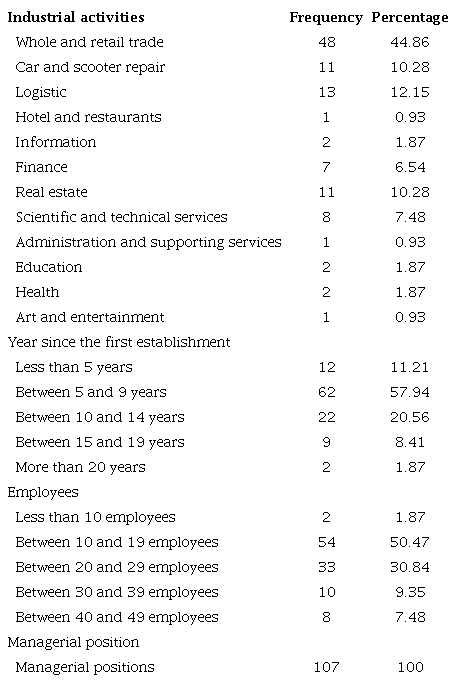
The heterogeneity of the small businesses’ activities may create a bias in the result. Table 1 shows that most small businesses operate in the trade industry, with a smaller part operating in the service industry. Therefore, this study includes a dummy variable (Trade_Service) to control the industry (0 for trade and 1 for services).
Data collection using a single source may be subject to common method bias. Podsakoff, MacKenzie, Lee, and Podsakoff (2003) recommend two approaches to assess this bias, which were adopted in this study. First, the results from Harman’s single-factor test showed that a single factor explains 23.180% of the total variance (Podsakoff & Organ, 1986). Second, the matrix correlation between marker variables and other main variables showed that these variables were unrelated (Lindell & Whitney, 2001). Therefore, common method bias was not a concern for this research.
First, this study assessed information about the characteristics of the businesses and the correlation matrix. After that, partial least square structural equation modeling (PLS-SEM) was used to assess the research model because data are subject to the issues such as non-normality and small sample size (Ali, Rasoolimanesh, Sarstedt, Ringle, & Ryu, 2018; Cassel, Hackl, & Westlund, 1999; Hair, Hult, Ringle, Sarstedt, & Thiele, 2017). The complex relationship between variables was estimated by maximizing the explanation of independent variables’ variances (Hair, Ringle, & Sarstedt, 2011), a technique that analyzes the measurement and structural models (Sarstedt, Ringle, Smith, Reams, & Hair Jr, 2014). The evaluation of measurement models examined first the unidimensionality of the constructs, followed by convergent validity, discriminant validity, composite reliability, and collinearity among the items. As for the evaluation of the structural model, collinearity between latent variables, predictive accuracy, and explanatory power of the model was assessed before examining the strength and magnitude of the hypothesized paths. In addition, this study relies on the approach of Zhao, Lynch Jr, and Chen (2010) to conduct a mediating assessment.
Table 1 presents the characteristics of the 107 small businesses in the sample, according to the responses offered by their owners. Almost half of them (44.86%) operated in the whole and retail trade. The industries with only one respondent (0.93%) were hotel and restaurant and art and entertainment. In the sample, 62 small businesses (57.94%) were operating in the market for 5 to 10 years, while only two small businesses (1.87%) had operated for more than 20 years. Most small businesses (50.47%) employed between 10 and 20 employees, while only two (1.87%) had less than 10 employees.
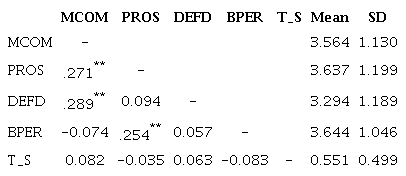
Table 2 summarizes the variables correlation matrix and descriptive statistics. The Pearson correlation was used, showing that marketing competition (MCOM) was positively correlated with defender (DEFD) (r=0.298, p=0.003) and prospector (PROS) (r=0.271, p=0.005) strategies. Business performance (BPER) was also positively correlated with PROS (r=0.254, p=0.008). However, correlation was not significant between DEFD and PROS (r=0.094, p=0.334), DEFD and BPER (r=0.057, p=0.558), and MCOM and BPER (r=-0.074, p=0.451). In addition, the dummy variable trade_service (T_S) did not present significant correlation with MCOM (r=0.082, p=0.402), PROS (r=-0.035, p=0.717), DEFD (r=-0.063, p=0.520), and BPER (r=-0.083, p=0.395).
First, this study assessed the unidimensionality of the constructs by conducting principal axis factoring with oblimin rotation (Fabrigar, Wegener, MacCallum, & Strahan, 1999). The results showed four extracted factors to which the load the intended items. It was necessary to remove three items, MCOM_7, BPER_3, and BPER_8, due to factor loadings under the threshold of 0.5 (Hair, Black, & Babin, 2006).
Second, the research evaluated the convergent validity, discriminant validity, and composite reliability of the item constructs and the collinearity among these items. The results show the establishment of the convergent validity based on two criteria. First, the average variance extracted (AVE) of all of the constructs was higher than the 0.50 threshold (Table 4), and all items loaded to the intended constructs respectively higher than others (Table 3) (Fornell & Larcker, 1981). It is noted that these loadings were all above the rule of thumb of 0.5.
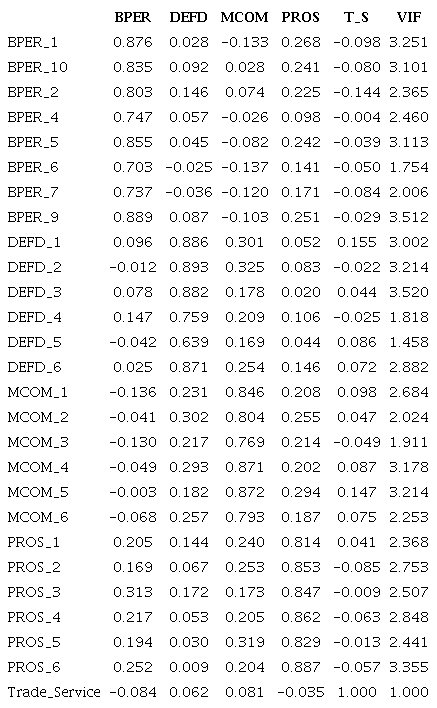
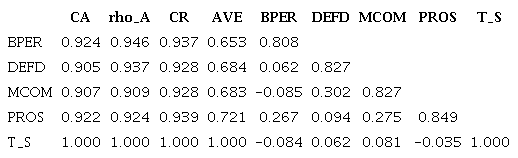
The assessment of discriminant validity was also established. Table 4 shows that the AVE’s square root was higher than any correlation between this variable and other latent variables (Chin, 1998; Fornell & Larcker, 1981). In addition, composite reliability (CR) was established since CR, Cronbach’s Alpha (CA), and Dillon-Goldstein’s rho (rho_A) were higher than the 0.70 threshold value (Table 4) (Hair et al., 2011; Henseler, Ringle, & Sinkovics, 2009). Finally, Table 3 shows that the items’ VIF values were below the threshold value of 5, which shows the absence of collinearity among items (Hair et al., 2011).
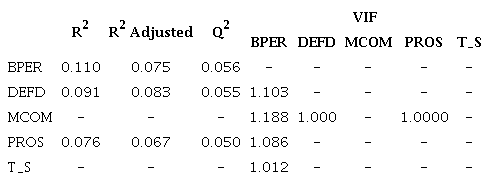
Bootstrapping with 5,000 replacements was used to assess the structural model (Hair et al., 2011). Table 5 reveals the absence of collinearity between latent variables since the VIF was lower than 5 (Hair et al., 2011). The table also indicates that the model’s predictive accuracy was sufficient because the Stone-Geisser Q2 value (Geisser, 1974; Stone, 1974) was higher than zero (Chin, 1998; Hair et al., 2011). Lastly, Table 5 shows that R-squared values were sufficient, so it is safe to conclude that the explanatory power is valid.
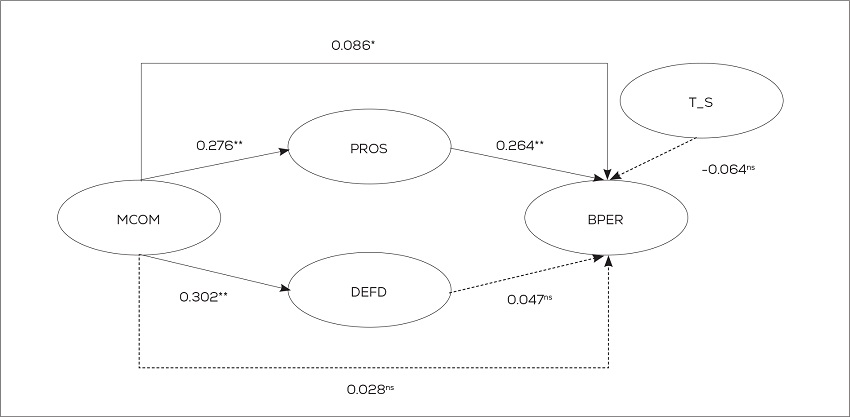
Establishing the structural model allows the examination of the magnitude and strength of the paths (Figure 2). The results reveal that market competition was positively related to prospector (β= 0.276, p=0.006) and defender strategies (β=0.302, p=0.002). The prospector strategy presented a positive relationship with the performance of small businesses (β=0.264, p=0.010). However, the defender strategy was not significantly related to the performance of small businesses (β=0.047, p=0.716). In addition, there was a non-significant relationship between the control variable and the performance of small businesses (β=-0.064, p=0.512). Therefore, the results only supported hypotheses H1, H2, and H3, implying that small businesses in Vietnam adopt prospector or defender strategies when market competition is intense. However, only the prospector strategy leads these businesses to improve performance.
A step-by-step analysis described by Zhao et al. (2010) was used to evaluate the mediating effects, adding a direct path between market competition and the performance of small businesses.
First, the path between market competition and a prospector strategy was positively significant (β=0.275, p=0.007). Second, the path between prospector strategies and the performance of small businesses was also significant (β=0.313, p=0.001). Third, the indirect path (MCOM->PROS->BPER) was significant (β=0.086, p=0.039), and its confidence intervals were from 0.018 to 0.184, excluding zero. Such criteria suggest the mediating effects of prospector strategies on the link between market competition and the performance of small businesses (Preacher & Hayes, 2008). Finally, it is crucial to specify the type of mediation (Boyd et al., 2012). Since there was no significance in the direct path between market competition and the performance of small businesses (β=-0.201, p=0.053), it is safe to conclude the full mediating effects of the prospector strategy (Zhao et al., 2010). Therefore, hypothesis H5 was supported. It implies that the strategic fit between market competition and the prospector strategy helps small businesses in Vietnam improve their performance.
It is also noted that because there was no significance in the path between the defender strategy and the performance of small businesses, its mediating effects were not supported. Thus, hypothesis H6 was rejected.
The research offered insights into the use of strategic fit on small businesses in Vietnam. The results showed a positive link between the intensity of market competition and prospector and defender strategies. Thus, small businesses in Vietnam adopt prospector or defender strategies when the market competition is intense, corroborating Porter (1989) argument that competitive pressure drives businesses’ strategies.
The results also revealed a positive association between a prospector strategy and the performance of small businesses in Vietnam. According to this finding, when small businesses in Vietnam adopt prospector strategies, they improve their performance. This result is similar to previous studies. For example, Moore (2005) found that retail organizations in the United States improve performance when adopting a prospector strategy. Also, Naranjo-Gil (2004) observed that public hospitals in Spain increase organizational performance when choosing prospector strategies.
This study also indicated the insignificant relationship between defender strategies and small businesses’ performance. As a result, there are no mediating effects of the defender strategy on the relationship between market competition and small businesses’ performance, while there are mediating effects when they adopt prospector strategies. Thus, the effective strategic fit for small businesses in Vietnam when market competition is intense is the adoption of a prospector rather than a defender strategy. These findings are somewhat similar to Baack and Boggs (2008), who borrows the generic framework to explain the effectiveness of differentiation and cost-leadership strategy in emerging markets. The strategic typology (Miles & Snow, 1978) and the generic framework (Porter, 1985) share similarities (Laugen, Boer, & Acur, 2006, p. 86). The prospector strategy is similar to the differentiation strategy, while the defender strategy is similar to the cost-leadership strategy. These two authors suggested that multinational companies should not follow the cost-leadership strategy in emerging countries because it does not work well in such a context. Instead, they recommended the differentiation strategy to improve performance. One possible explanation is that emerging countries’ conditions differ from those observed in developed ones. Developing countries lack essential resources, infrastructure, demand, governmental controls, and require stabilities. Thus, businesses cannot significantly obtain a better performance solely through cost reduction (Arnold & Quelch, 1998), which is the leveraging measure in the defender and cost-leadership strategy. This explanation may be sufficient to explain the insignificant relationship between defender strategy and performance.
In light of the findings, this study contributes to the literature fourfold. First, contingency theorists strongly suggested that the external environment significantly impacts strategic behavior. Recently, Tsai and Yang (2013) and Prajogo (2016) found support from the contingency theory to propose a framework to assess strategic fit by examining strategy as a moderating element. However, Boyd et al. (2012) reviewed strategic management studies and criticized that most contingency-based studies in this literature focus much on moderating rather than mediating effects. This study shows that the prospector strategy mediates market competition and performance. In this regard, it expands our current knowledge of strategic fit by addressing the strategy’s mediating role.
Second, the application of contingency theory in strategic management can mostly be found in studies on large businesses (Chung, Wang, & Huang, 2012; Pertusa-Ortega, Molina-Azorín, & Claver-Cortés, 2010; Prajogo, 2016; Wu, Wu, Chen, & Goh, 2014). A lack of attention has been paid to applying this theory in examining strategic fit in small businesses. This hampers the generalizations of contingency theory in small businesses’ strategic management. This study borrows contingency theory to explain the effectiveness of strategic fit, contributing to the growing body of knowledge using contingency theory in the strategic management of small businesses (Gupta & Batra, 2016; Pratono, Al-Mashari, & Del Giudice, 2016; Raymond & St-Pierre, 2013).
Third, emerging economies are characterized by a rapid pace of economic development and government policies emphasizing the economic liberalization and adoption of a free-market system (Arnold & Quelch, 1998). Therefore, several unique characteristics, which cannot be found in developed economies, may challenge strategic management literature used to explain the strategic behavior of organizations in emerging countries (Crittenden & Crittenden, 2010; Venkateswaran & Ojha, 2017; Wright et al., 2005). One reason is that strategic management literature is built mostly from data collected in developed countries. This study shows that the strategic fit of the defender strategy does not help small businesses to improve performance. Thus, the research expands our understanding of how and why the emerging countries’ unique characteristics cancel the effectiveness of the defender strategy.
Fourth, this study overcomes the limitations of prior research regarding the use of single-item constructs. Recent studies (Ishaq & Hussain, 2016; Park, 2016) used single-item constructs to measure strategic behavior, even though this practice has been criticized in the literature (Bergkvist & Rossiter, 2007; Kline, 2015; Nunnally, 1978). In SEM analysis, the use of single-item constructs leads to identification and convergence issues, which decreases the constructs’ validity. In this sense, Sarstedt, Diamantopoulos, and Salzberger (2016) strongly opposed this use in business research. This study seems to overcome this limitation by adapting the instruments from Moore (2005) to operationalize variables such as prospector and defender strategies.
This study aimed to gain insight into the effectiveness of strategic fit of small businesses in Vietnam in a context of intense market competition. The research was grounded on the contingency theory, the environment-strategy-performance paradigm, and the strategic typology of Miles and Snow (1978). The proposal put forward is that the fit between market competition and the prospector or defender strategies improves small businesses’ performance in Vietnam. The results suggest that only the fit between market competition and the prospector strategy improves performance.
The results are interpreted with the following caveats. First, due to the use of convenience sampling, this study collects data only from small businesses in Can Tho city. Thus, the generalization of the findings to other areas of Vietnam should be cautious. Second, the absence of a pilot test may pose a bias to the findings. However, the degree of bias is small because two small business owners carefully examined the questionnaire before sending it to respondents. Third, the use of cross-sectional data may be limited regarding causality since it can represent a snapshot of the variables used in the research model at the moment of data collection.
Despite these limitations, the findings open an avenue for future research. First, the strategic typology of Miles and Snow (1978) used in this study is one of the strategic frameworks. The generic framework from Porter (1985) is another structure, and it presents similarities with the one developed by Miles and Snow (1978) (Laugen et al., 2006, p. 86). Particularly, defender strategy is similar to cost-leadership strategy while prospector strategy is similar to differentiation strategy. In this regard, future studies should examine whether the alignment between market competition, cost-leadership, and differentiation strategy improves performance. Second, previous studies suggest several types of competition (Chaganti et al., 1989; Khandwalla, 1981; Krishnan, 2005). Thus, future studies should evaluate the impact of strategic fit between each type of competition and strategic behavior on performance. Third, because this study only focuses on the alignment between external environment and strategy, future studies should include variables approaching the organizations’ internal characteristics. For example, a fruitful avenue is to focus on innovative variables such as innovation capability and innovative culture while examining the effectiveness of the strategic fit by adopting the prospector strategy since this strategic behavior strongly relies on innovation (Dev & Brown, 1990). Finally, future studies should use longitudinal data to overcome the limitation of using cross-sectional data.
