ARTICLES
ANTECEDENTS, OUTCOMES, AND BOUNDARIES OF GREEN HUMAN RESOURCE MANAGEMENT: A LITERATURE REVIEW
ANTECEDENTES, RESULTADOS E LIMITES DA GESTÃO DE RECURSOS HUMANOS VERDE: UMA REVISÃO BIBLIOGRÁFICA
ANTECEDENTES, RESULTADOS Y LIMITES DE LA GESTIÓN VERDE DE LOS RECURSOS HUMANOS: UNA REVISIÓN BIBLIOGRÁFICA
 Irene Huertas-Valdivia irene.huertas@urjc.es
Fernando E García-Muiña fernando.muina@urjc.es
Irene Huertas-Valdivia irene.huertas@urjc.es
Fernando E García-Muiña fernando.muina@urjc.es
ANTECEDENTS, OUTCOMES, AND BOUNDARIES OF GREEN HUMAN RESOURCE MANAGEMENT: A LITERATURE REVIEW
Revista de Administração de Empresas, vol. 63, no. 4, pp. 1-21, 2023
Fundação Getulio Vargas, Escola de Administração de Empresas de S.Paulo
Received: 20 July 2022
Accepted: 20 January 2023
Funding
Funding source: Ministerio de Ciencia e Innovación (Madrid, Spain)
Contract number: FPU19/00945
Funding statement: The authors thank the Strategor Group (URJC) and V Plan de Fomento de la Investigatión (URJC) for partially funding the translation of this article. This research was financed by Ministerio de Ciencia e Innovación (Madrid, Spain), project grant number FPU19/00945. It was also supported by REVTUR research Project (URJC).
ABSTRACT: Green human resource management (GHRM) is a crucial element of the globally trending topic of green management. Although GHRM has received considerable research attention in recent years, confusion remains regarding its antecedents, the social, and psychological processes through which GHRM influences employee behavior, and the potential outcomes to be derived from its use. This paper aims to disentangle and summarize the components that have been explored in the GHRM-performance relationship. To achieve these goals, we conduct a systematic review based on the preferred reporting items method and then present a series of theoretical approaches to stimulate new debates on theory building and its subsequent use in GHRM research. We also carefully explain information on organizational and employee-level factors that motivate and hinder GHRM and display this information in a visual framework. The implications for practice provide focused recommendations to help managers understand how to create favorable conditions for enhancing sustainability performance. The gaps identified should open the way to new lines of research that still need attention.
Keywords: Green human resource management, triple bottom line, green behaviors, sustainability, human resource management.
RESUMO: A gestão de recursos humanos verde (GRHV) é um elemento crucial do tópico de tendências globais da gestão verde. Embora a GRHV tenha recebido bastante atenção da academia nos últimos anos, há ainda alguma confusão em relação a seus antecedentes, aos processos sociais e psicológicos por meio dos quais a GRHV influencia o comportamento dos empregados e aos potenciais resultados observados a partir sua utilização. O presente artigo tem como objetivo esclarecer e oferecer um resumo dos componentes que têm sido explorados na relação entre a GRHV e o desempenho das organizações. Para atingir estes objetivos, realizamos uma revisão sistemática com base no método dos principais itens para relatar (PRISMA). Ainda, foi apresentada uma série de abordagens teóricas para estimular novos debates sobre a construção de teorias e a sua consequente utilização na investigação da GRHV. O estudo explica os fatores que motivam e dificultam a GRHV em nível organizacional e dos empregados, apresentando-os num quadro visual. As implicações da pesquisa para a prática levam a recomendações focalizadas para ajudar os gestores a compreender como criar condições que possibilitam melhorar o desempenho do ponto de vista da sustentabilidade. Por fim, foram identificadas lacunas que precisam de atenção e devem abrir caminho a novas linhas de investigação.
Keywords: Gestão de recursos humanos verde, tripé da sustentabilidade, comportamentos verdes, sustentabilidade, gestão de recursos humanos.
RESUMEN: La gestión verde de recursos humanos (GHRM) es un factor crucial dentro del campo de la gestión ecológica, un tema que está en auge en todo el mundo. Aunque la GHRM ha recibido una atención considerable por parte de la investigación en los últimos años, persiste la confusión en cuanto a sus antecedentes, los procesos sociales y psicológicos a través de los cuales esta influye en el comportamiento de los empleados, y los resultados potenciales que se derivan de su aplicación. El presente artículo pretende desentranary resumir los componentes que se han explorado en la relación GHRM-desempeño. Para ello, se realiza una revisión sistemática basada en el método PRISMA (elementos de informe preferidos para revisiones sistemáticas y metanálisis) y luego se presenta una serie de enfoques teóricos para estimular nuevos debates sobre la construcción de teorías y su consecuente uso en la investigación de la GHRM. Asimismo, se explican cuidadosamente los factores organizacionales y a nivel de los empleados que motivan y dificultan la GHRM y se muestran en un marco visual. Las implicaciones para la práctica incluyen recomendaciones específicas para ayudar a los directivos a entender cómo crear condiciones favorables para mejorar el rendimiento sostenible. Las lagunas identificadas deberían abrir el camino a nuevas líneas de investigación que todavía necesitan atención.
Palabras clave: Gestión verde de recursos humanos, trípode de sostenibilidad, comportamientos verdes, sostenibilidad, gestión de recursos humanos.
INTRODUCTION
In the business environment, sustainability has become a global movement driving organizations to adopt a broader perspective. Sustainability urges organizations to look beyond the traditional objective of maximizing profit for shareholders and work for social welfare and environmental protection (Amrutha & Geetha, 2020). In support of this idea, Kazancoglu et al. (2021) recognize that lean management is important if corporations wish to achieve sustainable development and thus meet the economic, social, and environmental needs of their multiple stakeholder groups.
In the transition to sustainable development, the organizational mechanism of corporate social responsibility (CSR) adopts a multi-stakeholder perspective and involves discretionary actions oriented towards improving social, economic, and environmental welfare (Al Kerdawy, 2019). According to Amrutha and Geetha (2020) and Mascarenhas and Barbosa (2019), emerging interest in compliance with CSR principles has encouraged the introduction of GHRM initiatives in businesses to facilitate the establishment of green policies in all departments or organizational functions. Since the mid-1990s, research has recognized the utility of human resource management (HRM) function in the process of improving environmental performance (Longoni et al., 2018).
According to Zoogah (2011), growing stakeholder concern for environmental sustainability and regulatory pressures for companies to become greener have brought the concept of GHRM into the spotlight. By assisting the effective implementation of green policies and environmental management practices, GHRM can be used as a tool to address environmental challenges proactively. GHRM systems can also increase employee participation in eco-innovation processes and place employees on the path to upgrading products, improving process efficiency, and cutting costs (Bombiak & Marciniuk-Kluska, 2018). However, Ren et al. (2018) claim that researchers can benefit from broadening the scope of GHRM to consider its strategic significance as an HRM practice in running a corporate sustainability strategy and by acknowledging its potential implications across a wider range of outcomes in addition to employees’ green behaviors and environmental performance.
This notion is also supported by Benevene and Buonomo (2020), who argue that “GHRM might have green-specific and more general desirable outcomes and potential benefits at organizational and employees level, such as employees’ well-being” (p. 3). GHRM can generate such positive consequences. Firstly, it encourages employee creativity and increases job satisfaction and organizational productivity while improving the company's brand image, thereby attracting and retaining the best green talents (Amrutha & Geetha, 2020). Secondly, use of GHRM promotes reduction of environmental waste, product improvements, and increased levels of profitability (Bombiak & Marciniuk-Kluska, 2018). Finally, GHRM practices enable employees to identify more with their jobs, reducing staff turnover (Chams & García-Blandón, 2019).
In short, adopting GHRM processes can redirect the HR function toward sustainability, where organizations consider employees as a lasting investment and shift their focus away from profit maximization and shareholder supremacy (Jerónimo et al., 2020). Indeed, “GHRM covers all the practices that contribute to an organization's economic, environmental, and social (this last one being in terms of employee safety, health, equity, and wellness) sustainability dimensions from the perspective of employees, in the light of the corporate sustainability requirements” (Benevene & Buonomo, 2020, p. 2). Recently, the call for papers “HRM Contribution to Sustainability” released by the journal RAE-Revista de Administração de Empresas (RAE, 2021), recognized the value of continuing to explore the role that different GHRM practices play in sustainability and to analyze further the HRM practices that promote employee well-being and inclusion, foster employees' creativity and innovation, and support development of sustainable careers for the workforce.
Ren et al. (2018) highlight the need to establish the difference between GHRM and other related HRM specializations (such as sustainable HRM). These authors note the need for further development to clarify the conceptual link between these two sustainable HRM approaches to reduce the risk of confusing the different antecedents, consequences, and contingencies of GHRM at an individual and collective levels. The Sustainable HRM perspective involves simultaneous analysis of economic, environmental, and social principles when designing and implementing the HRM system. The narrow scope of GHRM, in contrast, explicitly targets ecological concerns when defining the content of HRM. The different concepts and dimensions of GHRM that researchers have chosen for analysis are creating divergent research approaches to study GHRM practices within organizations (Benevene & Buonomo, 2020).
Since the conceptualization of GHRM remains controversial, scholars have noted the need to build a comprehensive model that includes the precedents, outcomes, and potential contingencies of GHRM (Ari et al., 2020; Ren et al., 2018). More specifically, Hameed et al. (2020) argued the need for further analysis of the antecedents and outcomes of GHRM. Chaudhary (2019), in turn, called for an in-depth exploration of the mediating and moderating mechanisms underlying the link between GHRM and employee's pro-environmental behavior. Recent scholarly studies such as those by Amrutha and Geetha (2020), Benevene and Buonomo (2020), and Ari et al. (2020) provide insight into this issue. In this context, our study aims to disentangle and summarize the components explored in the GHRM-performance relationship. The originality of this review of recent literature lies in: (1) its novel method for analyzing elements that can both ensure the success of GHRM practices and jeopardize it through a dual approach at organizational and individual levels whose integrative vision does not restrict the scope of analysis to green-specific outcomes; (2) its proposal of various alternative theoretical foundations, due to the emerging stage of GHRM and the limited number of theoretical lenses applied and (3) its decision not to limit the studies examined by either economic sector or type of article (i.e., empirical studies).
We thus achieve the study goals by answering the following research questions:
-
RQ1: What are the main theories grounding this literature?
-
RQ2: What factors motivate or hinder application of GHRM practices?
To address the issues raised, we conducted a systematic literature review to identify the magnitude of interest in prior studies. With the information derived from this analysis, we systematize, explain, and summarize crucial variables studied previously in the GHRM literature, constructing a schema of the mechanisms at organizational and individual level through which this sustainable HRM approach functions.
This paper is organized as follows: Section 2 discusses the theoretical background and the literature on GHRM and sustainability. Section 3 explains the details of the research methodology, followed by the results and discussion in Section 4. Finally, Section 5 presents the main conclusions, theoretical and practical implications, limitations, and potential future research directions.
THEORETICAL BACKGROUND
Origins of GHRM
The institutional framework for action designed jointly by the United Nations Global Compact (UNGC) and the Global Reporting Initiative (GRI) establishes the cross-national objective of helping to create a more sustainable world for future generations (Sathasivam et al., 2020). Applied to business, in this context, Guerci et al. (2016) affirmed that GHRM is an emergent research line embedded in the broader field of green knowledge management. More specifically, this literature recognizes the organizational changes that a firm's transition to corporate sustainability produces and argues that the best way to tackle these changes is the application of HRM processes that motivate the creation of sustainable psychological capital (Mazur & Walczyna, 2020). This management approach is considered a fundamental instrument to ensure the successful implementation of a firm's sustainability-oriented strategies (Arasli et al., 2020). The GHRM mechanism aims to respond to the demands that arise from the firm's adoption of an orientation to green corporate strategy by developing a favorable environment that promotes workforce engagement in the development of green initiatives (Zhao et al., 2020).
Definition of the construct GHRM: scope and objectives
GHRM has been established as a long-term corporate human resource (HR) strategy and is analyzed within the broader framework of CSR (Bombiak & Marciniuk-Kluska, 2018). This relatively new HRM approach forms part of the holistic sustainable HRM framework, an emerging people management method that moves beyond strategic HRM by redefining the HR function to enhance compliance with sustainability principles (Jerónimo et al., 2020). Unlike the broader definition of sustainable HRM, this approach does not include a sociological perspective that would see HRM activities as a social practice that considers social justice issues like employee diversity (Mazur & Walczyna, 2020). GHRM can thus be used to promote the conservation and protection of the natural environment through the implementation of a cohesive set of green-oriented HR policies and practices designed to implement eco-friendly behaviors in the working environment (Bombiak & Marciniuk-Kluska, 2018; Yusliza et al., 2019; Zaid et al., 2018).
The core objective of GHRM strategy adoption is to develop an involved, engaged, committed workforce willing to undertake initiatives to mitigate the company's environmental impact (Saeed et al., 2019; Siyambalapitiya et al., 2018; Tulsi & Ji, 2020). According to Tulsi and Ji (2020), Saeed et al. (2019), and Jerónimo et al. (2020), installing GHRM systems not only guarantees better environmental performance but also supports the triple-bottom-line paradigm by concurrently incorporating aspects of economic growth, social inclusion, and environmental protection. GHRM tools, processes, and practices play an important role in the operational implementation of sustainable development principles and in building a sustainable development culture. Acting as a primary instrument in eco-oriented management or green management, GHRM supports the strategic greening of the organization and, in turn, of the economy and society in general (Benevene & Buonomo, 2020). A win-win management approach emerges at the intersection of strategic HRM and environmental sustainability (Paillé et al., 2020) that adopts a long-term, multi-stakeholder orientation to performance.
The bundle of HR practices that compose GHRM includes policies oriented to improving employees' green consciousness and capabilities oriented to successfully fulfilling their green duties through the implementation of effective training programs, reinforcement of green behaviors through rewards and compensation practices based on positive performance appraisals, and increased employee involvement through the development of a supportive green corporate culture (Chaudhary, 2020).
METHODOLOGY
A systematic literature review (SLR) was used to map and examine the studies. This method includes some widely accepted steps to enable validation and replication by other researchers (Denyer & Tranfield, 2009). The review procedure employed the five steps advocated by Denyer and Tranfield (2009): (1) question formulation, (2) locating studies, (3) study selection and evaluation, (4) analysis and synthesis, and (5) reporting and using the results. Figure 1 presents the research design, in a PRISMA (preferred reporting items for systematic reviews and meta-analyses) flow diagram (Page et al., 2021).
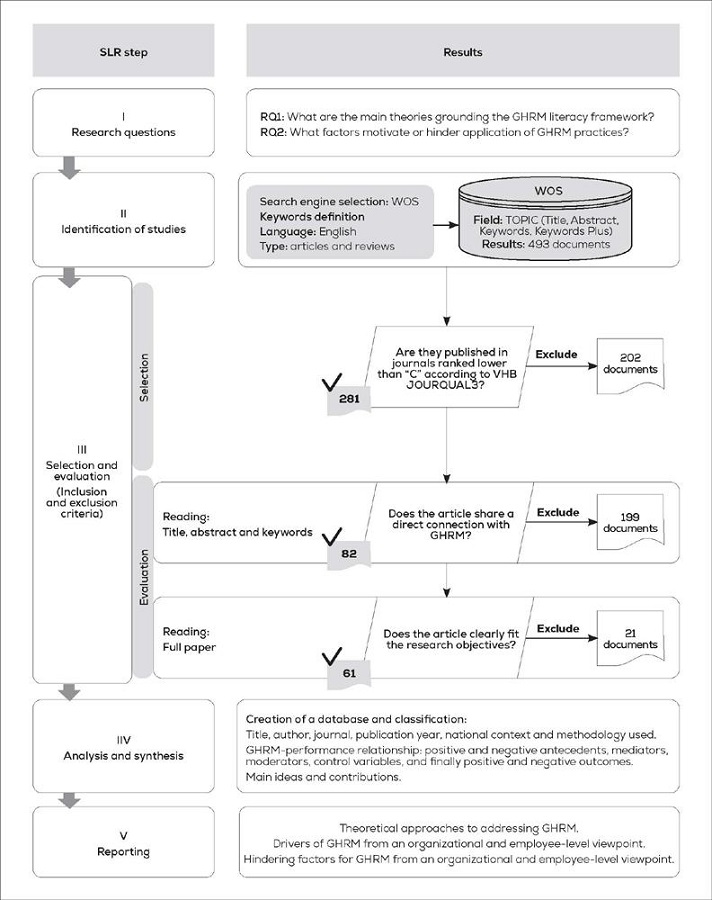
Figure 1
Systematic literature review process, following Langhof and Güldenberg (2020)
Source: Elaborated by the authors.
This study's main objective lies in the intersection between the fields of HRM and sustainability. Like Benevene and Buonomo (2020), we chose the main database of the platform Web of Science (WoS), WoS Core Collections, as this database provides a sample of articles from indexed high-impact journals. We included the keywords “sustainability” and “HRM” in the search string. Literature on Sustainable HRM covers socially responsible HRM and GHRM (Jerónimo et al., 2020), and this inquiry focuses on the search results oriented toward the GHRM perspective. Although GHRM became a scientific research field in 2016 due to the widespread go-green movement (Amrutha & Geetha, 2020), the consensus is that the nature of GHRM is unclear and this lack of clarity creates an ongoing conflict over how this HRM perspective resembles and differs from Sustainable HRM (Ren et al., 2018). Amrutha and Geetha (2020) observe that GHRM researchers often use the terms GHRM and Sustainable HRM interchangeably and have thus far addressed the role of GHRM in sustainability with multiple goals and premises. Overcoming these pitfalls requires an integrative assessment of the progress of this knowledge field.
Our process identified 493 articles published between 2001 and March 23, 2021. We then applied our exclusion criteria. First, to confirm the quality of the papers identified, we followed the prime example of Langhof and Güldenberg (2020). This quality threshold was based on three different journal rankings: VHB JOURQUAL3 (German Academic Association of Business Research), ABS Journal Quality Guide (British Association of Business Schools), and Thomson Reuters/Clarivate's Impact factor (JCR). We ended up removing from the sample research studies published in journals ranked lower than “C” by VHB JOURQUAL3 or the equivalent impact factors in ABS (“2*”) and JCR (“0.7”). Applying this filter reduced the total number of papers to 281. The next step was to carefully scrutinize the title, abstract, and keywords resulting in the exclusion of 82 articles due to their lack of direct connection with GHRM. The main reasons for misalignment were that the paper focused on the CSR-HRM link, ethical issues for sustainability, other HRM specializations (sustainable HRM, flexible HRM, socially responsible HRM, HRM for the common good, strategic HRM, among others), or other functional areas of the company (e.g., the impact of information technologies on sustainability).
At this stage, we analyzed all articles selected and assessed in the preceding step and synthesized them by scanning the full document and coding the information. We built a spreadsheet database that contained the key research topic of each study, its main findings, and other supplementary information. The participation of multiple researchers in this process was key to reducing bias and ensuring the results reliability and accuracy (Denyer & Tranfield, 2009). After verifying their relevance to our study objectives, we analyzed 61 full articles.
Descriptive overview
The final sample (n=61) included 17 journals in which articles about GHRM had been published. The sections to which these journals were assigned included but were not limited to business administration (e.g., Journal of Business Research), sustainability management (e.g. Journal of Business Ethics, Journal of Cleaner Production), organization (e.g., European Management Review, International Journal of Human Resource Management), and logistics, operations research, and production management (e.g., International Journal of Production Economics).
As for the typology of articles analyzed in this systematic literature review, the bibliographic sample was composed of 45 empirical studies (ca. 74%), eleven conceptual papers (ca. 17%), and five papers that used a mixed methodology (ca. 8%).
RESULTS AND DISCUSSION
Theoretical approaches to addressing GHRM
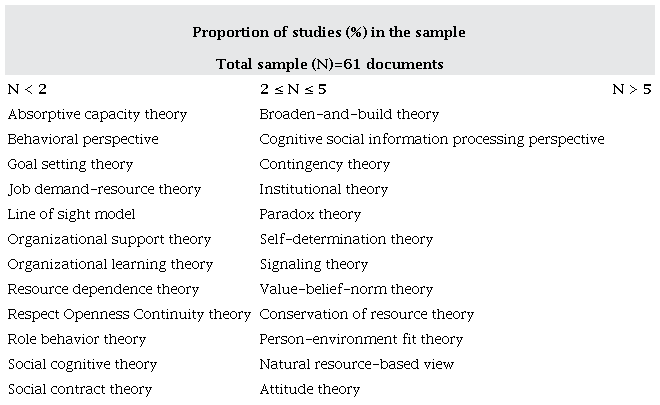
To stimulate new debates on theory building and its consequent use in GHRM research, we use our sample documents to identify the most frequent theoretical lens employed to address
GHRM (see Table 1). The predominant theoretical perspectives drawn from this analysis are ability-opportunity-motivation theory (Appelbaum et al., 2000), social identity theory (Hogg & Abrams, 1988), the resource-based view (Barney, 1991; Wernerfelt, 1984), social exchange theory (Blau, 1964), stakeholder theory (Freeman, 1984), and the theory of planned behavior (Ajzen, 2002).
Source: Elaborated by the authors.
Due to the introductory stage of this knowledge field, Ren et al. (2018) observed that few theoretical perspectives have yet been used to address GHRM. We also noted the lack of indigenous theories for the operationalization of GHRM, which has led to borrowing from other fields, such as psychology, sociology, economics, or management. However, research on this sustainable HRM approach has reached a point where academics and practitioners could benefit from theories pertaining to this discipline. In this sense, the domains of sustainable HRM defined by De Lange and Koppens (2007) – respect, openness, and continuity, forming the ROC model – represent an opportunity and a suitable framework for classifying and (re)positioning HRM initiatives and practices.
Organizational factors that motivate or hinder GHRM implementation
The information presented in this section – on organizational mechanisms linked to the development of GHRM practices – is structured as follows: 1) antecedents (organizational macro-environment, business context, and forms of leadership); 2) a brief description of which practices fall under GHRM; 3) mediating and moderating variables in the GHRM-performance link; and 4) environmental, economic, and social outcomes.
Although several authors in this scientific field have focused on explaining the various components of the organizational macro-environment that affect the adoption of GHRM practices, the results remain disparate. Based on the previous classification by Bombiak and Marciniuk-Kluska (2018), which presents companies' main motives for acting more environmentally and socially responsibly, we detail the external factors that influence the decision to implement GHRM practices. Firstly, we highlight the pressures from the various stakeholders, both inside and outside the company, due to greater environmental awareness and growing interest in companies adopting a more sustainable focus (Peixe et al., 2019). The dimension of culture also affects the outcomes (Haddock-Millar et al., 2016), and we still have no list summarizing the main forces that contribute positively to the development of this sustainable HRM approach. Secondly, the institutional and regulatory framework is also binding. According to Buller and McEvoy (2016), stakeholders expect higher levels of transparency regarding the firm's operations. Environmental regulation is a contextual variable that exerts external pressure on companies, encouraging them to consider the environment when making decisions (Huo et al., 2020). According to Mascarenhas and Barbosa (2019), efforts are being made to achieve convergence of the norms that regulate environmental action through the signing of international treaties and/or conventions to curb environmental degradation and frameworks such as the ISO 14000 series of environmental standards. The potential of ISO 14001 is not restricted to its role as an environmental standard adopted by organizations around the world. It is also an effective tool for improving environmental and social performance (Wang & Tseng, 2019). Thirdly, technological advancements serve as a potential source of innovation within the company, promoting improvements at the production level and providing new opportunities for products or services offered (Bombiak & Marciniuk-Kluska, 2018). For Ogbeibu et al. (2020), technological turbulence drives organizational champions to leverage internal resources to meet changing technological requirements.
Embedded in the business context factors, the integration of circular business models has also been established as a decisive determinant of GHRM system implementation (Yong et al., 2020). Sustainability must be considered a strategic priority and embedded in the organizational culture. To this end, various methods have been identified by which organizations can effectively communicate the significance of and motivation for adopting green behavior in the workplace, both directly and indirectly (Zhang et al., 2019). One such technique is the organizational rationale for sustainability. Defining the organizational vision and mission in line with the company's sustainable orientation can help strengthen employees' perception of the role of sustainability within the company (Jerónimo et al., 2020).
As to forms of leadership, Haddock-Millar et al. (2016) argue that “employees are more willing to undertake environmental initiatives when their supervisors embrace a democratic and open style of communication with regard to environmental ideas” (p. 5). In line with this ideology, research has identified various leadership styles that management teams or supervisors can adopt to contribute significantly to the formation of workers' perceptions about the company's commitment to the environment and thus contribute positively to increased job engagement and performance (Millard, 2011). The first, “responsive leadership” (Mascarenhas & Barbosa, 2019), arises from the need to respond to significant issues of concern to society as a whole. Next, “environmentally-specific servant leadership” (Ari et al., 2020, p. 8) poses a solution to motivate the adoption of green behaviors in the workplace through employees’ (followers’) effective imitation of their leaders’ green orientation. Finally, the application of “green transformational leadership” (Çop et al., 2021, p. 2) is associated with enhancing sustainability-driven organizational changes by enabling the creation of a shared green ideology.
Concerning the bundle of GHRM practices, Dumont et al. (2017) highlight that “a formalized and openly communicated set of green HRM practices and policies overtly demonstrate to employees the organization's commitment to being green and will likely result in the employee acting in accordance with organizational green policies” (p. 616). No consensus exists as to what activities and policies belong to the GHRM system (Ari et al., 2020). However, researchers recognize that these initiatives aim to reinforce the organizational culture by developing job-specific skills and competencies and providing sufficient motivation and opportunities for workers (Buller & McEvoy, 2016). Based on the synthesis of relevant literature, we identify five dimensions into which the various known GHRM practices can be classified: 1) employee life cycle (green recruitment, induction programs, performance management and evaluation, and promotion of green career opportunities); 2) green training and development, 3) green compensation and rewards, 4) green employee involvement practices, and 5) “green work-life balance” (Muster & Schrader, 2011, p. 142). Green employee involvement activities encompass various mechanisms that can be used to generate an environment conducive to green management: a pro-environmental culture (Piwowar-Sulej, 2020), employee empowerment and participation (Buhl et al., 2016), and the formation of green teams (Zibarras & Coan, 2015). The idea of green work-life balance includes “reciprocal interactions between work and non-work-related activities that can facilitate employees' friendly behaviour” (O’Donohue &Torugsa, 2016, p. 3).
We now briefly describe these human resource practices to explain how they can be used. First, to recruit and then select employees who align with the firm’s corporate strategic lines, Mazur and Walczyna (2020) recommend including in the job description the responsibilities, competencies, and other requirements necessary to fulfill the duties associated with the job in an environmentally friendly manner. Ecological training will enable companies to create a solid knowledge base on issues related to environmental management. If used effectively, this knowledge base can promote the proliferation of innovative green behaviors in the organizational environment (Xie & Zhu, 2020). Moreover, introducing green criteria to assess employees’ performance will mobilize human resources to achieve the firm’s environmental goals (Saeed et al., 2019). Based on such performance appraisals, the firm will reward employees for their pro-environmental behaviors to positively reinforce employees’ and top management’s accomplishments in environmental performance. Zibarras and Coan (2015) stress the difficulty of designing green reward and compensation programs suitable for increasing workforce motivation, given people’s differing preferences and interests. These authors also reaffirm that monetary rewards tied to environmental performance are usually reserved for senior managers.
Regarding mediation mechanisms, the operation of GHRM systems is complex, as conflicts of interest arise in the process, requiring effective integration with other organizational functions (i.e., supply chain management). This is also the case of multinational companies, as with all entities that are part of the parent company (Buller & McEvoy, 2016). Moreover, a pro-environmental psychological climate that results from employees’ social interactions will yield deeper insight into which employee behaviors the organization recognizes and compensates (Saeed et al., 2019). In the same vein, managers need to pay more attention to the provision of information and communication of environmental policy (among other issues) that create uncertainty about GHRM processes (Zhang et al., 2019).
Inside organizational moderating variables, we can distinguish between positive and negative moderating effects. In the former group, we include organizations whose top management supports the process of implementing GHRM systems obtaining greater involvement of the company’s human capital and thus motivating green innovation (Huo et al., 2020; Song et al., 2020). Besides, fostering corporate support for employee volunteering during working hours and/or in their free time strengthens individuals’ self-confidence, skills, and abilities and improves their desire for continuous improvement (Al Kerdawy, 2019). We identified the following factors that hinder GHRM implementation and effectiveness. First, “greenwashing” causes damage (Ari et al., 2020, p. 5) due to the mismatch or lack of alignment between the environmental policies that managers disseminate and the actions performed. Second, depending on the company’s structural social capital, Amrutha and Geetha (2020) indicate that a shortage of funds can hinder the implementation of more sustainable production systems. Third, while the company’s ability to adapt to specific markets must be considered, efforts to implement GHRM practices can be frustrated in organizations with a traditional (authoritarian and bureaucratic) organizational structure, a structure that complicates employee participation and cooperation in decisionmaking processes (Buhl et al., 2016).
Both strategic and performance motives can drive the adoption of GHRM systems (Haddock-Millar et al., 2016). Whether classified as green or generally desirable outcomes, all of these practices have a positive impact on organizational performance. Firstly, developing sustainable HR policies and practices will promote eco-innovation (Buhl, 2020) and alleviate barriers to the successful implementation of green supply chain management (GSCM) (Longoni et al., 2018). This idea is consistent with the argument that effective environmental management can only be achieved through collaboration and cooperation between different organizational functions (Longoni et al., 2018). The literature includes several empirical studies that analyze the mediating effect of internal and external GSCM practices, explaining the positive synergies that result from the simultaneous application of GHRM and GSCM processes and the way these synergies translate into improvements in organizational performance (i.e., Zaid et al. [2018]). From an economic perspective, it is important to remark on GHRM capacity to enhance the organization’s prestige and reputation (Tang et al., 2018), attract talented prospective employees (Tulsi & Ji, 2020), and improve the corporate image for customers (Zaid et al., 2018). Similarly, it leads to higher levels of employee satisfaction and, thus, lower turnover intentions (Ren et al., 2018). Additionally, this HRM tool also supports social relations with the local community (Zaid et al., 2018). We can conclude that continuous alignment of sustainability strategy and HRM practices provides a solid basis for maximizing economic, environmental, and social outcomes and is a way for corporations to achieve a sustainable competitive advantage (Buller & McEvoy, 2016).
Figure 2 summarizes all organizational antecedents, consequences, and significant variables involved in the process of implementing GHRM practices.
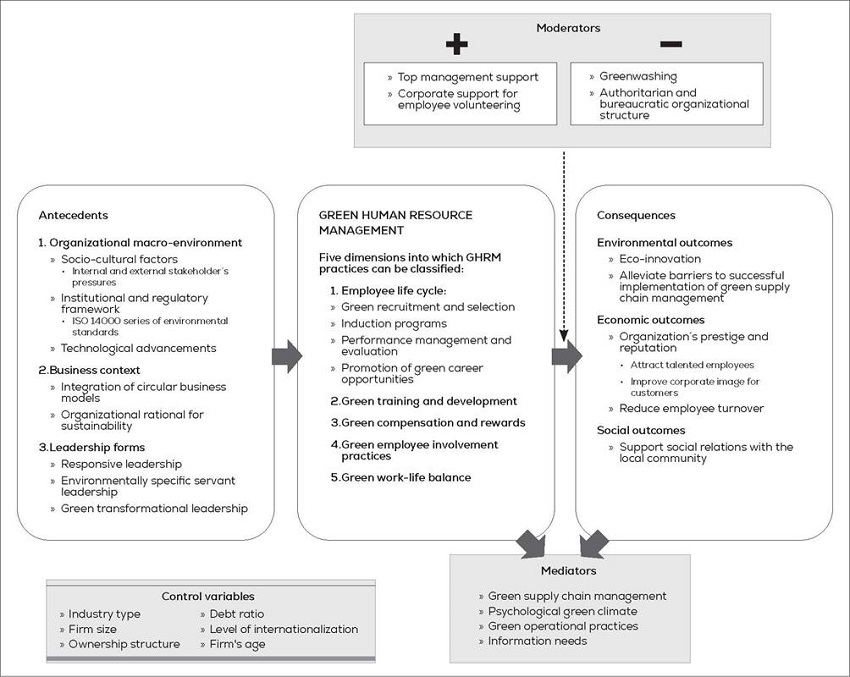
Figure 2
Organizational antecedents, consequences, and significant variables related to GHRM
Source: Elaborated by the authors.
Employee-level factors that motivate or hinder GHRM implementation
The information on individual mechanisms linked to the development of GHRM practices will be structured as follows: 1) antecedents (individual traits, previous green experiences, and certain socio-demographic attributes); 2) mediating and moderating variables in the GHRM-performance link; and 3) both green and non-green employee-level outcomes.
Some binding factors related to the company's green human capital must be considered. For example, Ren et al. (2018) argue that certain individual attributes – such as knowledge of environmental management, greater awareness of the environment, and socio-demographic attributes – have a positive impact on employees’ adoption of green attitudes. The positive feeling of happiness, pride, and satisfaction felt by employees when they contribute to the organization’s environmental performance is similarly classified as employees’ environmental passion (Gilal et al., 2019).
Green human capital is a unique company asset and can act as a competitive source to leverage opportunities for green innovation (Song et al., 2020). Therefore, under the group of employee-level mediating mechanisms, we first find green dynamic capabilities and green team creativity. These two items are interrelated. Ogbeibu et al. (2020) argue that continuous encouragement, resource allocation, positive support, and empowerment provided to employees foster creative attitudes. For instance, service provider resilience is a capability that enables employees to cope with and successfully address ecological challenges (Arasli et al., 2020). Organizational identification, in turn, is an underlying psychological mechanism that stems from the appeal and desirability of maintaining an emotionally fulfilling relationship with the organization (Chaudhary, 2020). Employees with higher organizational identification display a stronger degree of ownership in addressing green issues (Shah et al., 2021). Employees’ emotional acceptance of the change or belief in the benefits inherent in the change project (collective affective commitment to environmental management change) should also be considered. Such employees will exhibit positive behaviors, commitment to the change, intention to support it, and eagerness to participate in its successful implementation (Pinzone et al., 2016).
In terms of moderating factors, the lack of ecological awareness on the part of employees and a lack of environmentally friendly values and attitudes can lead to greater feelings of resistance to change (Amrutha & Geetha, 2020). The phenomenon of employee resistance to change should be monitored by top management, as it may slow the process of environmental change (Nejati et al., 2017).
Finally, the main individual-level changes achieved by organizations that apply GHRM practices will be greater employee green commitment, work engagement, and job satisfaction and encourage the uptake of in-role and discretionary green behaviors (Ari et al., 2020). Among pro-environmental behaviors leading to effective environmental performance in an organization, we find innovative green behaviors (Xie & Zhu, 2020) and a series of discretionary behaviors that contribute to more effective environmental management, termed organizational citizenship behaviors toward the environment (Khan et al., 2021).
Figure 3 summarizes all employee-level antecedents, consequences, and significant variables involved in the process of implementing GHRM practices.
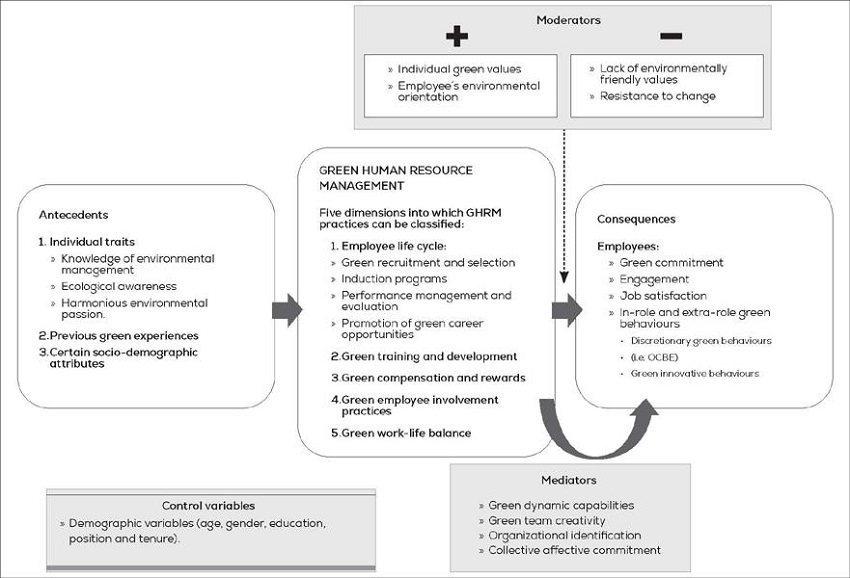
Figure 3
Employee-level antecedents, consequences, and significant variables related to GHRM
Source: Elaborated by the authors.
CONCLUSION
Overall, this literature review sheds new light on ways to analyze GHRM from a holistic sustainability perspective. At the same time, it informs of the influence of both external and internal forces on this HRM approach that relates to green management. Furthermore, by summarizing the factors that hinder the implementation of GHRM systems, we establish a solid basis to identify and correct mechanisms that can frustrate the success of this HRM strategy.
The results obtained in this paper respond to some of the principal lines of research identified in the special issue edited by Jackson et al. (2011). First, and despite the lack of agreement on which specific HRM practices and/or policies support or inhibit change around environmental matters, this paper proposes five main groups of practices inside the GHRM bundle: practices connected to the employee life cycle, green training and development, green compensation and rewards, green employee involvement practices, and green work-life balance. In parallel, some of the most salient findings are: a) there is still no uniformity in the environmental regulations governing companies’ performance; b) both specific individual characteristics and organizational support are decisive in the process of implementing GHRM practices; c) employees’ perception of organizational values directly influences their commitment and behavior; and d) although differences exist among the leadership styles analyzed, all are considered shared leadership styles that promote the participation of followers in decision-making.
Implications
The conceptual model of GHRM proposed in this study and the summary of the main theoretical frameworks can inspire other researchers to extend existing evidence-based literature on GHRM. As designing and implementing GHRM practices requires major investments in organizational resources, our study provides targeted recommendations to managers to help them understand how to create favorable conditions for enhancing sustainability performance. Moreover, communicating the benefits of adopting these practices for both organizations and employees could motivate the spread of this environmental management practice. The theoretical model constructed in this paper also contributes knowledge for management educators who develop students' awareness and managerial potential to tackle environmental issues.
Limitations
Following the steps of the systematic literature review process defined by Langhof and Güldenberg (2020), we conducted a rigorous systematization process to identify the 61 top publications in the final sample. Nevertheless, since the inclusion criteria were restrictive, we cannot be sure that the selection criteria did not exclude relevant and important studies.
Future research directions
Testing the linkages shown will help recognize and tackle some issues identified. In this process, we strongly recommend adopting a longitudinal research design to provide an in-depth study and better explain the relationship between the variables. Secondly, most papers included in this review gathered data from highly environmentally sensitive industries (metallurgical, automotive, and chemical sectors) or service firms that belong to the hospitality, education, and healthcare sectors. Evidence-based information on GHRM in some underexplored service industries (e.g., banking) and studies that use different sizes, ages, and industry sectors would help to improve situating organizational efforts toward greener performance.
Furthermore, GHRM research has focused primarily on the impact that developing these HRM practices has on the organization's environmental performance, while the link between GHRM practices and non-green outcomes has hardly been explored (Ari et al., 2020). We thus recommend as a research opportunity analysis of the effect of applying these green human resource processes through a triple-bottom-line approach.
We have also noted the lack of indigenous theories for the operationalization of GHRM, which has led to borrowing from other fields, such as psychology, sociology, economics, or management. However, research on this sustainable HRM approach has reached a point where academics and practitioners could benefit from theories pertaining to this discipline. In this sense, the domains of sustainable HRM defined by De Lange and Koppens (2007) – respect, openness, and continuity, forming the ROC model - represent an opportunity and a suitable framework for classifying and (re)positioning HRM initiatives and practices.
ACKNOWLEDGMENTS
The authors thank the Strategor Group (URJC) and V Plan de Fomento de la Investigatión (URJC) for partially funding the translation of this article. This research was financed by Ministerio de Ciencia e Innovación (Madrid, Spain), project grant number FPU19/00945. It was also supported by REVTUR research Project (URJC).
REFERENCES
Al Kerdawy, M.M.A. (2019). The role of corporate support for employee volunteering in strengthening the impact of green human resource management practices on corporate social responsibility in the Egyptian firms. European Management Review, 16(4), 1079-1095. https://doi.org/10.1111/emre.12310
Amrutha, V. N., & Geetha, S. N. (2020). A systematic review on green human resource management: Implications for social sustainability. Journal of Cleaner Production, 247, 119131. https://doi.org/10.1016/j.jclepro.2019.119131
Appelbaum, E., Bailey, T., Berg, P., Kalleberg, A. L., & Bailey, T. A. (2000). Manufacturing advantage: Why high-performance work systems pay off. Cornell University Press. https://doi.org/10.2307/259189
Arasli, H., Nergiz, A., Yesiltas, M., & Gunay, T. (2020). Human resource management practices and service provider commitment of green hotel service providers: Mediating role of resilience and work engagement. Sustainability, 12(21), 1-22. https://doi.org/10.3390/sul2219187
Ari, E., Karatepe, O. M., Rezapouraghdam, H., & Avci, T. (2020). A conceptual model for green human resource management: Indicators, differential pathways, and multiple pro-environmental outcomes. Sustainability, 12(17), 7089. https://doi.org/10.3390/sul2177089
Ajzen, I. (2002). Perceived behavioral control, self-efficacy, locus of control, and the theory of planned behavior. Journal of Applied Social Psychology, 32(4), 665-683. https://doi.org/10.1111/j.1559-1816.2002.tb00236.x
Barney, J. (1991). Firm resources and sustained competitive advantage. Journal of Management, 17(1), 99-120. https://doi.org/10.1177/014920639101700108
Benevene, P., & Buonomo, I. (2020). Green human resource management: An evidence-based systematic literature review. Sustainability, 12(15), 5974. https://doi.org/10.3390/sul2155974
Blau, P. (1964). Exchange and power in social life. Wiley.
Bombiak, E., & Marciniuk-Kluska, A. (2018). Green human resource management as a tool for the sustainable development of enterprises: Polish young company experience. Sustainability, 10(6), 1739. https://doi.org/10.3390/sul0061739
Buhl, A., Blazejewski, S., & Dittmer, F. (2016). The more, the merrier: Why and how employee-driven eco-innovation enhances environmental and competitive advantage. Sustainability, 8(9), 946. https://doi.org/10.3390/su8090946
Buller, P. F., & McEvoy, G. M. (2016). A model for implementing a sustainability strategy through HRM practices. Business and Society Review, 121(4), 465-495. https://doi.org/10.1111/basr.12099
Chams, N., & García-Blandón, J. (2019). On the importance of sustainable human resource management for the adoption of sustainable development goals. Resources, Conservation and Recycling, 141, 109-122. https://doi.org/10.1016/j.resconrec.2018.10.006
Chaudhary, R. (2019). Green human resource management in Indian automobile industry. Journal of Global Responsibility, 10(2), 161-175. https://doi.org/10.1108/JGR-12-2018-0084
Chaudhary, R. (2020). Green human resource management and employee green behavior: An empirical analysis. Corporate Social Responsibility and Environmental Management, 27(2), 630-641. https://doi.org/10.1002/csr.1827
Çop, S., Olorunsola, V. O., & Alola, U. V. (2021). Achieving environmental sustainability through green transformational leadership policy: Can green team resilience help? Business Strategy and the Environment, 30(1), 671-682. https://doi.org/10.1002/bse.2646
De Lange, W., & Koppens, J. (2007). De duurzame arbeidsorganisatie. WEKA uitgeverij.
Denyer, D., & Tranfield, D. (2009). Producing a systematic review. In D. A. Buchanan & A. Bryman (Eds.), The Sage handbook of organizational research methods (pp. 671-689). Sage Publications, Ltd.
Dumont, J., Shen, J., & Deng, X. (2017). Effects of green HRM practices on employee workplace green behavior: The role of psychological green climate and employee green values. Human Resource Management, 56(4), 613-627. https://doi.org/10.1002/hrm.21792
Freeman, R. E. (1984). Strategic management: A stakeholder approach. Pitman.
Gilal, F. G., Ashraf, Z., Gilal, N. G., Gilal, R. G., & Channa, N. A. (2019). Promoting environmental performance through green human resource management practices in higher education institutions: A moderated mediation model. Corporate Social Responsibility and Environmental Management, 26(6), 1579-1590. https://doi.org/10.1002/csr.1835
Guerci, M., Longoni, A., & Luzzini, D. (2016). Translating stakeholder pressures into environmental performance: The mediating role of green HRM practices. International Journal of Human Resource Management, 27(2), 262-289. https://doi.org/10.1080/09585192.2015.1065431
Haddock-Millar, J., Sanyal, C., & Müller-Camen, M. (2016). Green human resource management: A comparative qualitative case study of a United States multinational corporation. International Journal of Human Resource Management, 27(2), 192-211. https://doi.org/10.1080/09585192.2015.1052087
Hameed, Z., Khan, I. U., Islam, T., Sheikh, Z., & Naeem, R. M. (2020). Do green HRM practices influence employees’ environmental performance? International Journal of Manpower, 41(7), 1061-1079. https://doi.org/10.1108/IJM-08-2019-0407
Hogg, M. A., & Abrams, D. (1988), Social identifications: A social psychology of intergroup relations and group processes. Routledge.
Huo, W., Li, X., Zheng, M., Liu, Y., & Yan, J. (2020). Commitment to human resource management of the top management team for green creativity. Sustainability, 12(3), 1008. https://doi.org/10.3390/sul2031008
Jackson, S. E., Renwick, D. W. S., Jabbour, C. J. C., & Muller-Camen, M. (2011). State-of-the-art and future directions for green human resource management. German Journal of Research in Human Resource Management, 25(2), 99-116. https://doi.org/10.1177/239700221102500203
Jerónimo, H. M., Lacerda, T. C. de, & Henriques, P. L. (2020). From sustainable HRM to employee performance: A complex and intertwined road. European Management Review, 17(4), 871-884. https://doi.org/10.1111/emre.12402
Kazancoglu, Y., Ekinci, E., Ozen, Y. D. O., & Pala, M. O. (2021). Reducing food waste through lean and sustainable operations: A case study from the poultry industry. RAE-Revista de Administração de Empresas, 61(5), 1-18. https://dx.doi.org/10.1590/S0034-759020210503
Khan, N. U., Irshad, A. ur R., Saufi, R. A., & Ahmed, A. (2021). Antecedents of organizational citizenship behavior towards the environment in manufacturing organizations: Using a structural equation modeling approach. Business Process Management Journal, 27(4), 1054-1087. https://doi.org/10.1108/BPMJ-02-2021-0102
Langhof, J. G., & Güldenberg, S. (2020). Servant leadership: A systematic literature review — toward a model of antecedents and outcomes. German Journal of Human Resource Management, 34(1), 32-68. https://doi.org/10.1177/2397002219869903
Longoni, A., Luzzini, D., & Guerci, M. (2018). Deploying environmental management across functions: The relationship between green human resource management and green supply chain management. Journal of Business Ethics, 151(4), 1081-1095. https://doi.org/10.1007/sl0551-016-3228-l
Mascarenhas, A. O., & Barbosa, A. C. Q. (2019). Sustainable human resource management and social and environmental responsibility: An agenda for debate. RAE-Revista de Administração de Empresas, 59(5), 353-364. https://doi.org/10.1590/S0034-759020190505
Mazur, B., & Walczyna, A. (2020). Bridging sustainable human resource management and corporate sustainability. Sustainability, 12(21), 1-21. https://doi.org/10.3390/sul2218987
Millard, D. (2011). Management learning and the greening of SMEs: Moving beyond problem-solving. German Journal of Human Resource Management, 25(2), 178-195. https://www.jstor.org/stable/23279432
Muster, V., & Schrader, U. (2011). Green work-life balance: A new perspective for green HRM. German Journal of Human Resource Management, 25(2), 140-156. https://www.jstor.org/stable/23279430
Nejati, M., Rabiei, S., & Jabbour, C. J. C. (2017). Envisioning the invisible: Understanding the synergy between green human resource management and green supply chain management in manufacturing firms in Iran in light of the moderating effect of employees' resistance to change. Journal of Cleaner Production, 168, 163-172. https://doi.org/10.1016/j.jclepro.2017.08.213
O'Donohue, W., & Torugsa, N. A. (2016). The moderating effect of ‘Green’ HRM on the association between proactive environmental management and financial performance in small firms. International Journal of Human Resource Management, 27(2), 239-261. https://doi.org/10.1080/09585192.2015.1063078
Ogbeibu, S., Emelifeonwu, J., Senadjki, A., Gaskin, J., & Kaivo-oja, J. (2020). Technological turbulence and greening of team creativity, product innovation, and human resource management: Implications for sustainability. Journal of Cleaner Production, 244, 118703. https://doi.org/10.1016/j.jclepro.2019.118703
Page, M. J., McKenzie, J. E., Bossuyt, P. M., Boutron, I., Hoffmann, T.C., Mulrow, C. D. & Moher, D. (2021). The PRISMA 2020 statement: An updated guideline for reporting systematic reviews. BMJ, 372(71). https://doi.org/10.1136/bmj.n71
Paillé, P., Valéau, P., & Renwick, D. W. (2020). Leveraging green human resource practices to achieve environmental sustainability. Journal of Cleaner Production, 260, 121137. https://doi.org/10.1016/j.jclepro.2020.121137
Peixe, B. C. S., Trierweiller, A. C., Bornia, A. C., Tezza, R., & Campos, L. M. D. S. (2019). Factors related to the maturity of environmental management systems among Brazilian industrial companies. RAE-Revista de Administração de Empresas, 59(1), 29-42. https://doi.org/10.1590/s0034-759020190104
Pinzone, M., Guerci, M., Lettieri, E., & Redman, T. (2016). Progressing in the change journey towards sustainability in healthcare: The role of ‘Green’ HRM. Journal of Cleaner Production, 122, 201-211. https://doi.org/10.1016/j.jclepro.2016.02.031
Piwowar-Sulej, K. (2020). Pro-environmental organizational culture: Its essence and a concept for its operationalization. Sustainability, 12(10), 4197. https://doi.org/10.3390/su12104197
RAE. (2021). Call for papers: Human resource management contribution to sustainability. RAE-Revista de Administração de Empresas.
Ren, S., Tang, G., & Jackson, S. E. (2018). Green human resource management research in emergence: A review and future directions. Asia Pacific Journal of Management, 35(3), 769-803. https://doi.org/10.1007/s10490-017-9532-1
Saeed, B. B., Afsar, B., Hafeez, S., Khan, I., Tahir, M., & Afridi, M. A. (2019). Promoting employee's proenvironmental behavior through green human resource management practices. Corporate Social Responsibility and Environmental Management, 26(2), 424-438. https://doi.org/10.1002/csr.1694
Sathasivam, K., Bakar, R. A., & Hashim, R. C. (2020). Embracing organisational environmental sustainability: Experiences in green human resource management. Business Strategy and Development, 4(2), 123-135. https://doi.org/10.1002/bsd2.133
Shah, S. H. A., Cheema, S., Al-Ghazali, B. M., Ali, M., & Rafiq, N. (2021). Perceived corporate social responsibility and pro-environmental behaviors: The role of organizational identification and coworker pro-environmental advocacy. Corporate Social Responsibility and Environmental Management, 28(1), 366-377. https://doi.org/10.1002/csr.2054
Siyambalapitiya, J., Zhang, X., & Liu, X. (2018). Green human resource management: A proposed model in the context of Sri Lanka's tourism industry. Journal of Cleaner Production, 201, 542-555. https://doi.org/10.1016/j.jclepro.2018.07.305
Song, W., Yu, H., & Xu, H. (2020). Effects of green human resource management and managerial environmental concern on green innovation. European Journal of Innovation Management, 24(3), 951-967. https://doi.org/10.1108/EJIM-ll-2019-0315
Tang, G., Chen, Y., Jiang, Y., Paillé, P., & Jia, J. (2018). Green human resource management practices: Scale development and validity. Asia Pacific Journal of Human Resources, 56(1), 31-55. https://doi.org/10.1111/1744-7941.12147
Tulsi, P., & Ji, Y. (2020). A conceptual approach to green human resource management and corporate environmental responsibility in the hospitality industry. Journal of Asian Finance, Economics and Business, 7(1), 195-203. https://doi.org/10.13106/jafeb.2020.vol7.nol.195
Wang, C. J., & Tseng, K. J. (2019). Effects of selected positive resources on hospitality service quality: The mediating role of work engagement. Sustainability, 11(8), 2320. https://doi.org/10.3390/su11082320
Wernerfelt, B. (1984). A resource-based view of the firm. Strategic Management Journal, 5(2), 171-180. https://www.jstor.org/stable/2486175
Xie, X., & Zhu, Q. (2020). Exploring an innovative pivot: How green training can spur corporate sustainability performance. Business Strategy and the Environment, 29(6), 2432-2449. https://doi.org/10.1002/bse.2512
Yong, J. Y., Yusliza, M. Y., Ramayah, T., Jabbour, C. J. C., Sehnem, S., & Mani, V. (2020). Pathways towards sustainability in manufacturing organizations: Empirical evidence on the role of green human resource management. Business Strategy and the Environment, 29(1), 212-228. https://doi.org/10.1002/bse.2359
Yusliza, M. Y., Norazmi, N. A., Jabbour, C. J. C., Fernando, Y., Fawehinmi, O., & Seles, B. M. R. P. (2019). Top management commitment, corporate social responsibility and green human resource management: A Malaysian study. Benchmarking, 26(6), 2051-2078. https://doi.org/10.1108/BIJ-09-2018-0283
Zaid, A. A., Jaaron, A. A. M., & Bon, A. T. (2018). The impact of green human resource management and green supply chain management practices on sustainable performance: An empirical study. Journal of Cleaner Production, 204, 965-979. https://doi.org/10.1016/j.jclepro.2018.09.062
Zhang, Y., Luo, Y., Zhang, X., & Zhao, J. (2019). How green human resource management can promote green employee behavior in China: A technology acceptance model perspective. Sustainability, 11(19), 5408. https://doi.org/10.3390/su11195408
Zhao, J., Liu, H., & Sun, W. (2020). How proactive environmental strategy facilitates environmental reputation: Roles of green human resource management and discretionary slack. Sustainability, 12(3), 763. https://doi.org/10.3390/sul2030763
Zibarras, L. D., & Coan, P. (2015). HRM practices used to promote pro-environmental behavior: A UK survey. International Journal of Human Resource Management, 26(16), 2121-2142. https://doi.org/10.1080/09585192.2014.972429
Zoogah, D. B. (2011). The dynamics of green HRM behaviors: A cognitive social information processing approach. German Journal of Human Resource Management, 25(2), 117-139. https://doi.org/10.1177/239700221102500204
Author notes
*Corresponding author
Conflict of interest declaration
The authors have no conflicts of interest to declare.