ARTICLES
REQUIREMENTS OF COLLABORATIVE AND TRANSFORMATIONAL LEADERSHIP IN DIGITAL ECOSYSTEMS: TECHNO-ORCHESTRATING LEADERS IN A VUCA WORLD
REQUISITOS DE LIDERANÇA COLABORATIVA E TRANSFORMACIONAL EM ECOSSISTEMAS DIGITAIS: LÍDERES TECNO-ORQUESTRADORES EM UM MUNDO VUCA
REQUISITOS DEL LIDERAZGO COLABORATIVO Y TRANSFORMADOR EN ECOSISTEMAS DIGITALES: LÍDERES ORQUESTADORES TECNOLÓGICOS EN UN ENTORNO VUCA
 Goknur Arzu Akyuz arzu.akyuz@gmail.com
REQUIREMENTS OF COLLABORATIVE AND TRANSFORMATIONAL LEADERSHIP IN DIGITAL ECOSYSTEMS: TECHNO-ORCHESTRATING LEADERS IN A VUCA WORLD
Revista de Administração de Empresas, vol. 63, no. 5, pp. 1-30, 2023
Fundação Getulio Vargas, Escola de Administração de Empresas de S.Paulo
Received: 29 April 2022
Accepted: 20 April 2023
ABSTRACT: In today’s increasingly web-enabled digital world, business environment is being transformed into ecosystems of partners in which digital connectivity, real-time data, information sharing, and visibility are enabled. Partners are becoming increasingly dependent, network collaboration is turning into a key success factor, and managerial, organizational and leadership paradigms are radically changing. This study investigates the requirements of leadership under these collaborative, transformational and technology-intensive conditions. Through a comprehensive and systematic literature review, the study offers main leadership requirements, desired leadership practices, and leader profiles to become successful in this context. Therefore, a conceptual framework is developed. The findings reveal that leadership requirements for digital ecosystems (DES’s) are entirely different from traditional leadership understanding, and orchestration stands out as a key concept. This study is valuable for providing a comprehensive literature review and developing a conceptual framework.
Keywords: Collaboration, digitalization, leadership, requirements, vuca.
RESUMO: No atual mundo digital e cada vez mais conectado em rede, o ambiente de negócios está sendo transformado em ecossistemas de parceiros onde há conectividade digital, dados em tempo real, compartilhamento de informações e visibilidade. Nesse contexto, os parceiros estão cada vez mais dependentes, a colaboração em rede vêm tornando-se um fator de sucesso fundamental, e os paradigmas de gestão, organização e liderança estão mudando radicalmente. Este estudo investiga os requisitos da liderança nessas condições colaborativas, transformacionais e de grande intensidade tecnológica. Por meio de uma revisão sistemática, o estudo apresenta os principais requisitos de liderança, as práticas de liderança desejadas e os perfis de líderes que se tornam bem-sucedidos nesse contexto, desenvolvendo um modelo conceitual. Os resultados revelam que os requisitos de liderança para o ecossistema digital atual são totalmente diferentes do entendimento tradicional de liderança, e a orquestração destaca-se como um conceito-chave. Este estudo é relevante por oferecer uma revisão abrangente da literatura e por desenvolver um modelo conceitual.
Palavras-chave: Colaboração, digitalização, liderança, requisitos, vuca.
RESUMEN: En el mundo digital actual, cada vez más conectado en red, el entorno empresarial se está transformando en ecosistemas de socios en los que se activan la conectividad digital, los datos en tiempo real, el intercambio de información y la visibilidad. En este contexto, los socios son cada vez más dependientes, la colaboración en red se está convirtiendo en un factor clave de éxito, y los paradigmas de gestión, organización y liderazgo están cambiando radicalmente. Este estudio investiga los requisitos del liderazgo en estas condiciones colaborativas, transformacionales y de intensidad tecnológica. A través de una revisión exhaustiva y sistemática de la literatura, el estudio presenta los principales requisitos de liderazgo, las prácticas de liderazgo deseadas y los perfiles de líderes que tienen éxito en este contexto, desarrollando un marco conceptual. Los hallazgos revelan que los requisitos de liderazgo para el ecosistema digital actual son totalmente diferentes de la concepción tradicional del liderazgo, y la orquestación se destaca como un concepto clave. Este estudio es relevante por proporcionar una revisión bibliográfica completa y desarrollar un marco conceptual.
Palabras clave: Colaboración, digitalización, liderazgo, requisitos, vuca.
INTRODUCTION
Today’s business is described by ever-increasing technology-intensive, digitalized and webenabled character working under VUCA (Volatility, Uncertainty, Complexity, and Ambiguity) conditions. VUCA is repeatedly used and well-supported in the literature, where: volatility refers to the nature, speed, character and magnitude of change associated with turbulence; uncertainty highlights the lack of predictability of events and risks; complexity refers to overall systems complications and chaos resulting from interrelationship, interdependency and interaction of elements both within the system and with its environment in technical, economic, organizational, managerial and global dimensions; ambiguity refers to the blurring reality and complexed meanings, resulting in confusion (Horney et al., 2010; Nobre et al., 2010; Rodriguez & Rodriguez, 2015; Singh, 2013; Sinha, 2015). VUCA represents a business environment under constant and radical change in conflicting ways, where agility, innovation, and risk embracement become imperative (EY, 2014; Horney et al., 2010). Organizations must handle VUCA conditions to remain competitive, utilizing ever-changing disruptive information technologies as the key enabler to survive.
Thus, digital transformation (DT) is inevitable for enterprises (Cortellazzo et al., 2019). Enterprises undergo a multi-dimensional transformation in technological, organizational, and managerial dimensions. These drastic changes result in increasingly collaborative, dependent, web-enabled business ecosystems which are well-supported by the new business understanding within IoT, I4.0, and blockchain paradigms (Akyuz & Gursoy, 2018, 2019, 2020; Cloutier et al., 2020; Durugbo, 2016; Fenton et al., 2020; Hahn, 2020; Kotarba, 2018; Rosin et al., 2020; Satalkina & Steiner, 2020; Stanczyk, 2019; Wang et al., 2020; Winkelhaus & Grosse, 2020). It is generally accepted that the modern business environment is viewed as interdependent networks of connected entities to create and capture value (Subramaniam et al., 2019; Williamson & DeMeyer, 2012). Hence, in recent literature, “supply network” has become the dominant terminology, increasingly replacing the term “supply chain” and referring to collaborative, digital ecosystems of partners (suppliers, manufacturers, distributors, retailers, customers, and service providers) jointly creating value (Akyuz & Gursoy, 2019; Fawcett et al., 2011). Digital ecosystems (DES) focus on complex interdependencies, networked relationships, and partnerships enabled by digital technologies (Subramaniam et al., 2019). The DES concept involves extensive use of digital technologies, flexibility, and an ad-hoc character (Valdez-De-Leon, 2019). It is supported by evidence that six of the world’s top seven companies are ecosystem companies (Chung et al., 2020). Therefore, we witness the frequent use of the terms “DES” or “web-based ecosystems” in the literature to represent the network’s digitally connected character (Fenton et al., 2020; Lavikka et al, 2017; Ahsan et al. 2021; Urcioli et al. 2021).
In a global, web-enabled, and multi-partner ecosystem, IT-enabled collaboration among partners (Akyuz & Gursoy, 2019; Fawcett et al., 2011) is key to better innovation, value creation, performance, and risk management (Akyuz & Erkan, 2010; Akyuz & Gursoy, 2014; Chen et al., 2013; Graça & Camarinha-Matos, 2017; Tawaststjerna & Olander, 2021).
Undoubtedly, this is a radical transformation. Technological, managerial, and organizational dimensions must be managed, creating unique challenges for leadership (Deaton , 2018). Compared to past experiences, multi-layered, intermingled, and complex challenges stand out (Mack & Khare, 2016), along with inertia and resistance to transformation. The main management functions of planning, organizing, commanding, coordinating, and controlling are becoming more complicated in unstable conditions (Rimita et al., 2020). Therefore, the new business conditions in the VUCA world require a flexible and transformation-oriented leadership approach.
In the evolution of leadership ontologies, roots are at the Full Range Leadership Theory (FRLT), which was originally introduced in 1978 by Burns, further expanded in 1995 and 1997 by Bass and Avolio (Puni et al., 2018), and encompassing transformational, transactional, and laissez-faire (passive avoidant) leadership (Bass & Avolio, 1997). FRLT has achieved wide application and acceptance in management and leadership literature (Antonakis & House, 2014), and various meta-analyses support its success (Judge & Piccolo, 2004; Lyons & Schneider, 2009). FRLT presents transformational leadership (TFL) as the most effective form of organizational leadership, developing into a cornerstone of modern leadership research (Crede et al., 2019).
TFL has received extensive attention as a dominant approach (Atan & Mahmood, 2019; Dinh et al., 2014; Majeed et al., 2017). TFL is characterized by 4I: idealized influence, inspirational motivation, intellectual stimulation, and individual consideration (Dong et al., 2017; Kroon et al., 2017; Thompson et al., 2021), inspiring pride, respect, and trust among their followers (Puni et al., 2018).
Still, recent critiques (Knippenberg & Sitkin, 2013) highlight FRLT restrictions, failing to cover important leadership behaviors such as strategy formulation (Yukl, 2006). Consequently, FLRT is further extended by adding instrumental leadership (IL) (Allgood et al., 2022; Antonakis & House, 2014; Bass & Avolio, 1997; Chammas & Hernandez, 2019) to fill the gaps of the original model. IL emphasizes the leaders’ ability to monitor and adapt to the external environment, set strategic objectives, achieve goals via analyzing the internal and external environment, use resources efficiently, and provide performance feedback (Chammas & Hernandez, 2019). Relatively few studies exist regarding IL, basically analyzing its effects on performance and comparing it with TFL (Antonakis & House, 2014; Rowold et al., 2017). Hence, the literature does not offer a unified leadership framework (Krauter, 2020).
Consequently, digitally intensive business models demand an overall DT, increasing the importance of transformational perspective while disrupting the existing leadership and organizational models, frameworks, and paradigms. It is widely accepted that leadership ontologies are less useful in increasingly collaborative contexts (Drath et al., 2008). Therefore, new approaches are essential in leadership, management, and organization (Elkington et al., 2017; Gibney et al., 2009; Kannan & Garad, 2020), requiring new skill sets and leadership styles (Nastase & Roja, 2013; Wilson, 2004). Leaders must orchestrate collaborative DES and handle the overall DT under VUCA conditions.
Thus, we focus on the requirements of collaborative and transformational leadership (CTFL) in DES. The study answers the following research questions:
-
What are the main collaborative and transformational requirements of leadership in DES?
-
How can the requirements be clustered to achieve a multi-dimensional framework?
We contribute by providing a comprehensive literature review, revealing the leadership requirements in this context, and providing a conceptual framework. The study is valuable to both researchers and practitioners working in leadership and supply chain management (SCM) in relation to technology, collaboration, organizational transformation, and DES.
The article is structured as follows: first, the methodology is presented, followed by the requirements gathering section. Subsequent sections provide the developed framework, followed by a discussion. Finally, the conclusion and directions for further research are presented together.
METHODOLOGY
This study performs a systematic and comprehensive literature review for gathering and clustering collaborative and transformational leadership (CTFL) requirements in digital ecosystems (DES) to answer the research questions described.
Literature review systematic
The literature review encompassed studies conducted between 2004 and 2020 to ensure recency and reflect the technology-intensive nature of the topic. The primary search was performed on the Web of Science (WoS) database using the keywords “Transformational Leadership” and “Collaborative Leadership.” By applying the date filter of “2004-2020” and refining the search for relevant WoS categories, we obtained a base set of 838 results for transformational leadership and 587 for collaborative leadership. The choice to include the years from 2004 was motivated by significant technological developments during that period, including the rise of web services and service orientation concepts, which underpin the current platform-independent connectivity of enterprise application systems. It also coincided with the global expansion of the internet through Web.2.0 and the emergence of dynamic web-based applications. Additionally, 2004 marked the birth of prominent social media platforms like Facebook. Therefore, we considered these dramatic technological changes crucial and used the time interval 2004-2020.
The studies identified were filtered to find the most relevant ones to IT and supply network topics. During the process, extra valuable resources related to VUCA and IT aspects were included to reflect the research’s multi-dimensional character, such as research reports from various institutions, books/book chapters, and dissertations. In addition, a seminal work published before 2000 was included in the reference set to discuss the theoretical roots, as well as five recent references (from 2021 and 2022).
Resultant distribution according to resource type is provided in summary Table 1:

Source: Elaborated by the authors. Table 1 shows that articles from indexed international journals dominate the resource set.
The results of the review regarding key requirements are synthesized and clustered. The findings show that contemporary leadership characteristics, in addition to essential ones, are required. Thus, the review results are classified into seven main clusters: essential, technology-focused, collaborative, transformational, participative, agility-focused, and innovation-focused. The “requirements gathering” section is structured according to these clusters, and each cluster is discussed under these headers.
Afterward, a generic and conceptual framework for CTFL requirements was developed in compatibility with the clustering mentioned above.
Clustering rationale
The clustering was developed based on the following:
-
inherent logical relevance and relationship of a variety of terminologies and traits identified from the literature,
-
frequently recurring common themes,
-
related analogous uses, and
-
harmony of collaboration, transformation, leadership, DES and VUCA concepts.
In this clustering:
-
Collaboration was proven to be the most essential characteristic of changing business dynamics. Recent supply chain management (SCM) literature highly supports collaboration as the key idea for value creation across the network (Akyuz & Gursoy, 2019; Fawcett et al., 2011; Graça & Camarinha-Matos, 2017; Tawaststjerna & Olander, 2021). Therefore, collaborative characteristics stand out as a separate cluster.
-
Despite the presence and relevance of a multitude of contemporary theoretical views and perspectives regarding leadership (Antonakis & House, 2014; Oberer & Erkollar, 2018; Robbins & Coulter, 2012; University of Cambridge Institute for Sustainability Leadership [UCISL], 2017), our study revealed that transformational leadership (TFL) was the most cited, prominent and appealing theory (Anderson & Sun, 2017; Antonakis & House, 2014; Bambale et al., 2011; Gomes, 2014; Hansbrough & Schyns, 2018; Jones, 2019; Khan, 2016; KPMG, 2017; UCISL, 2017; Vought, 2017). Dinh et al. (2014) also support that TFL is the most frequently utilized leadership approach, based on a recent review of 752 articles published in 10 top academic journals (Majeed et al., 2017). TFL is widely believed to be the most effective leadership style which can perform best (Atan & Mahmood, 2019) under VUCA conditions.
When we compared the basic characteristics of TFL with the other two main FRLT components and its extension, we observed that transactional leadership (TAL) characteristics, representing conventional leadership style, were insufficient to meet the challenges of current IT-based ecosystems under VUCA conditions. In academic literature, the main TAL characteristics – focusing on supervision, maintaining the status quo, being reactive, and focusing too much on structure (Afsar et al., 2017; Ojha et al., 2018) – are incompatible with managing dynamic ecosystems. These TAL characteristics do not fit to participative, agility-focused, and innovation-focused concepts. In fact, they are in contrast with these concepts. Laissez-faire leadership represents a non-directive and passive characteristic, which is far from handling an overall organization-wide transformation. In our IT-based context, we have also observed that the main characteristics of TFL provide better alignment with DES and transformation, better moderating VUCA (Ardi et al., 2020; Matsunaga, 2021) when compared with instrumental leadership (IL), which mainly highlights being practice-oriented and having environment-surveillance capability. We observed that in IT-based context, transformational characteristics were more vital than conventional traits. Therefore, TFL is treated as a separate cluster in line with all the dramatic demands of digital transformation (DT) under VUCA conditions.
“Participative,” “agility-focused,” and “innovation-focused” characteristics appeared as important recurring themes as the key leadership characteristics required to manage the challenging VUCA conditions; hence they are treated under separate headers. Important SCM concepts of flexibility, being customer-centric, and responsiveness, which are referred to in Table 2, are already interdependent with agility. Therefore, the agility cluster covers all these key SCM characteristics.

Source: Elaborated by the authors.
REQUIREMENTS GATHERING
Based on the comprehensive literature review following the methodology described above, this section gathers and discusses requirements for collaborative and transformational leadership (CTFL) in digital ecosystems (DES). Table 2 provides the requirements grouped into seven clusters, along with corresponding leadership traits and supporting references for each header. The requirements for each group are discussed in detail as separate subsections.
Essential requirements
The main leadership requirements were classified under the “essential” header. Findings in this group include characteristics such as having a strategic perspective, foresight/vision, charisma, and power to influence others (Gomes, 2014; Oberer & Erkollar, 2018; UCISL, 2017). Further essential skills such as having a global perspective, being systemic thinkers, seeing the holistic view (UCISL , 2017), thinking beyond enterprise borders, and seeing the top-level interactions, relations and dependencies within a collaborative-ecosystem (Lad, 2017; Vought, 2017; Yücebalkan, 2018), are vital. Environmental alertness and monitoring to obtain practical results are definitely among leadership essentials (Antonakis & House, 2014).
Key issues identified were possessing hybrid skills in strategy, business management, and IT, as well as focusing on business-IT alignment (KPMG, 2017). They should view IT as the greatest enabler of strategic success and work with the business duality to obtain the best IT-business alignment. This requires having an interdisciplinary and multi-disciplinary orientation (UCISL , 2017). Among the vital traits were the characteristics of being analytical and methodical; having the ability to analyze, synthesize, interpret, and evaluate complex issues; applying problem-solving skills in complex settings; having a results-oriented mindset (Cortellazzo et al., 2019; Horney et al., 2010; Vought, 2017); exhibiting ambidextrous behavior; and pursuing exploration and exploitation simultaneously (Luo et al., 2018). Providing path-goal facilitation toward practical results and implementations is undoubtedly among the key characteristics. Openness to discussion, negotiation, and consensus are also essential.
This group of requirements revealed that along with core leadership values such as vision and charisma, leaders in collaborative DES should be systemic, methodical analytical thinkers equipped with hybrid skills, having both IT and business perspectives.
Technology-centered requirements
Under this heading, technology-related requirements stemming from the pressure to adopt dramatic technological changes are presented. In the literature, various phrases are employed to describe this characteristic, such as “technology-knowledge and awareness,” “digital-skills,” “digital-literacy,” and “digital-competences” (EY, 2014; KPMG, 2017; Roubini ThoughtLab, 2017; Wilson, 2004; Yücebalkan, 2018). Therefore, the authors have chosen to use the term “technology-centered” and have provided the other terms in parentheses in Table 2.
This cluster emphasizes that leaders of DES need to have awareness and knowledge of current technologies as well as the associated opportunities and constraints they bring. The speed in technological developments involves a variety of technologies frequently referred to as “disruptive”. Cloud technology, big data analytics, predictive analytics, web-based analytics, cybersecurity, IoT, Industry 4.0 (I-4.0), smartness, mobile application development, computation and coding, enterprise application integration, 3D printing, robotics, automation, autonomous vehicles, blockchain, web collaboration tools, Artificial Intelligence (AI), and augmented reality are recent disruptive topics that significantly impact the businesses (Cortellazzo et al., 2019; Dubey et al., 2020; EY, 2014; KPMG, 2017; Roubini ThoughtLab, 2017; Yücebalkan, 2018).
These technologies are essential in various configurations and combinations to create a visible and transparent ecosystem where partner processes are managed through online and real-time information exchange. Implementing these concepts improves efficiency, information sharing, and integration, enabling unprecedented levels of connectivity, visibility, jointness, and collaboration within DES's (Akyuz & Gursoy, 2018, 2019). Therefore, leaders in a technology-intensive ecosystem must possess knowledge and awareness of the opportunities, barriers, and risks associated with these technologies (EY, 2014; KPMG, 2017).
Web and mobile literacy, social media competence (Cortellazzo et al., 2019; UCISL, 2017), awareness of Fintech concept and its applications and big data analytics emerge as key leadership skills (Roubini ThoughtLab, 2017). Ensuring effective use of social media, guaranteeing web-based connectivity of financial transactions, and keeping the pulse of the customer by using customer relationship management (CRM) data are indispensable skills (EY, 2014; Roubini ThoughtLab, 2017).
Our review shows that leaders in DES should select the most appropriate disruptive technologies and infrastructures and invest in them aggressively (KPMG, 2017). With awareness and knowledge of a broad spectrum of available technologies, they should select and combine them in an effective configuration aligned with strategy and business components, resulting in a unique management information system design. A significant level of awareness is also needed for the ethical issues of security, sharing of sensitive data, and cybersecurity (Roubini ThoughtLab, 2017). The ability to actively use and engage in lifelong learning of these technologies appears as the key aspect characterizing a technologically competent leader using technology for the ecosystem benefit.
Thus, this cluster of requirements highlights the need for leaders of DES to have a broad awareness and knowledge of recent disruptive technologies. They should demonstrate a desire and willingness to learn and update their skills in this context.
Collaborative requirements
Collaboration-related traits are of significant importance in DES leadership (Akyuz & Gursoy, 2019; Cortellazzo et al., 2019; Fawcett et al., 2011; Graça & Camarinha-Matos, 2017; KPMG, 2017; Kramer & Crespy, 2011; Tawaststjerna & Olander, 2021; UCISL, 2017; Lad, 2017). Within this cluster, leaders are expected to adopt a beyond-enterprise, networked perspective and be aware of extended organizational and leadership boundaries (Cortellazzo et al., 2019; Oberer & Erkollar, 2018; Raza , 2016; Yücebalkan, 2018). They should prioritize long-term, network-level values and partnerships over short-term benefits and the well-being of individual enterprises (Akyuz & Gursoy, 2014, 2018, 2019). This collaborative understanding, which entails a different mindset, requires that partners value the long-term benefits and well-being of the network above their individual interests and short-term benefits (Akyuz & Gursoy, 2014; Horney et al., 2010; UCISL, 2017). Leaders should establish a transparent communication and information network based on trust, utilizing IT-based collaboration tools (Raza, 2016; Roubini ThoughtLab, 2017; Vought, 2017). It is crucial to involve multiple partners in decision-making, leading to joint planning, execution, and control across the partners.
Therefore, leaders with a collaborative mindset should actively facilitate the creation of new collaborative ecosystems centered around projects, networks, and transient organizations (UCISL, 2017; Vought, 2017). Within this collaborative paradigm, leaders should facilitate the development of an ecosystem of capabilities, deploying resources according to competence. This requires guidance and leadership beyond the boundaries of individual enterprises, as well as the capability of managing teams across enterprises (Horney et al., 2010; Raza, 2016; UCISL , 2017). Strategic digitalization requires decision-making that prioritizes the well-being of DES over enterprise-centric considerations. Leaders should emphasize collaborative decision-making based on consensus (Akyuz & Gursoy, 2018; Chen et al., 2013). As a result, leaders operating beyond enterprise borders should adopt a mindset that avoids individualistic and opportunistic behavior and makes decisions for the overall well-being of the network.
Leaders who have assimilated this mindset should foster a collaborative culture within their company and cultivate collaboration across partners (Oberer & Erkollar, 2018). They should demonstrate leadership by facilitating the performance of virtual and global teams working in different time zones, facing language barriers, and adapting to organizational and cultural boundaries. They must adopt a flexible and inclusive leadership style that embraces the diversity of views and belief systems while respecting different cultures across cultural, political, and geographical heterogeneities (UCISL , 2017).
Furthermore, they should facilitate building partnerships based on mutual trust, respect, and obligations. This entails creating open communication channels, ensuring symmetrical information sharing, and making consensus-based decisions to form the foundation for trust development. Building mutual trust and respect requires far beyond sharing operational information and processes. These elements evolve with time to the point that collaboration reaches strategic-level decisions and processes (such as collaborative performance and risk management, design, and development) (Akyuz & Gursoy, 2018).
It is evident that awareness of network leadership opportunities and networking skills are essential. Leaders must recognize and seize opportunities while actively engaging in joint solutions and handling conflicts by consensus (Samimi et al., 2020) in a cross-cultural, multi-partner environment. The collaborative management of performance, risks, and uncertainty also becomes crucial. Therefore, the ability of a leader to “orchestrate the ecosystem of partners” emerges as a key concept (Faccin et al., 2020; Fenton et al., 2020).
Consequently, collaborative ecosystem leaders should have a mindset that is eager and willing to engage in collaboration and consensus-based decision-making at operational, tactical and strategic levels for better organizational results (Lazan, 2016; Subramaniam et al., 2019; Valdez-De-Leon, 2019). They should work for the network’s benefit by truly valuing openness, negotiation, consensus, joint decisions, mutual trust, and respect.
Transformational requirements
The ability to manage a comprehensive organizational transformation encompassing various dimensions such as technology, management, and organization is a fundamental requirement in DES (Bambale et al., 2011; Cortellazzo et al., 2019; Jones, 2019; Kane et al., 2015; Ravesteijn & Ongena, 2019; Roubini ThoughtLab, 2017; Zupancic et al., 2016). Therefore, transformational requirements emerge as a distinct group.
In a transformative environment, a high level of willingness/openness and the ability to learn and change are the key traits. Leaders should be open to change to guide people toward the transformation with a digital vision (EY, 2014; Khan, 2016; Yücebalkan, 2018). Being both people-oriented and technical-minded, they should use technology for organizational growth and competitiveness (Kane et al., 2015; KPMG, 2017; Roubini ThoughtLab, 2017). They should rethink business strategy, structure, models, products, IT, enterprise platforms, mindsets, skill sets, and workplaces (EY, 2014; Ravesteijn & Ongena, 2019). Making constant shifts in people, processes, technology, and structure is critical to transforming existing structures via creative processes and multidisciplinary, flexible cross-border teams (Seijts & Gandz, 2018; Yücebalkan, 2018).
Having a broad awareness and knowledge of technology, transformational leaders should adopt a mindset of managing a technology-intensive transformation for the enterprise and the collaborative network. They should create an enterprise-wide transformative digital vision and strategy, extending the transformation to other partners in the ecosystem. The literature strongly supports the importance of alignment between IT and business strategies during digital transformation (DT) (Matt et al., 2015). Critical aspects of a technology-based transformation include evaluating the company’s readiness for change, creating a sound and feasible digital transformation plan, and managing the the implementation process through effective leadership ( Yücebalkan , 2018; Sainger 2018). Leaders should be aware that they are driving a disruptive change to create and foster a digital culture (Sainger, 2018). The combination of digital strategy, culture, and leadership is central to the transformation (Kane et al., 2015). The ability of transformational leadership (TFL) to influence employee attitudes and enhance interteam collaboration is crucial (Chou, 2019; Cleavenger & Munyon, 2013; Mangundjaya & Adiansyah, 2018; Cha et al., 2015). Leaders should act as digital change agents for both their own enterprises and partners in the collaborative ecosystem (Khan, 2016), inspiring, motivating, and stimulating people. Additionally, they should possess the skills for continuous environmental surveillance, managing multidimensional implementation challenges toward successful practical results, and monitoring and evaluating performance for the entire system towards successful practical results (Antonakis & House, 2014).
The ability to simulate and create what-if scenarios under VUCA conditions appears as a key capability. TFL plays a facilitating role in fostering creativity, change, innovation, and entrepreneurship at individual, team, and organizational levels, as supported by the literature (Afsar et al., 2017; Alharbi et al., 2020; Chen et al., 2019; Klaic et al., 2020; Le, 2020; Lei et al., 2020). TFL also enables organizational ambidexterity (Li et al., 2015; Ojha et al., 2018; Subiyanto & Djastut, 2018), and it proves effective in times of uncertainty and crisis for temporary organizations (Pillai & Williams, 2004; Tyssen et al., 2014). TFL is necessary for network sustainability and corporate responsibility, which are crucial for managing the VUCA conditions of the ecosystem (Amin et al., 2019; Khan et al., 2018; Anderson & Sun, 2017; Lawrence, 2013).
Consequently, TFL is still at the heart of leadership in web-based ecosystems (Atan & Mahmood, 2019; Dinh et al., 2014; Majeed et al., 2017). The literature supports that managing disruptive technological change within organizational and managerial contexts is more challenging nowadays. The leader has to select relevant technological components, assess organizational readiness and maturity, manage IT-based implementations, and align technological components with business strategies and processes. Hence, the classical understandings of leadership are insufficient. The meaning of TFL appears to be extended beyond the enterprise, assuming an increasingly technological character in collaborative DES. Undoubtedly, lessons learned from successful/unsuccessful company-wide enterprise resources planning (ERP) implementation projects are also to be extended to cross-partner IT-based projects to meet the implementation challenges involving multiple technological components.
Participative requirements
Participative requirements are founded on the essential principles of being human-oriented, having teamwork orientation, and valuing empowerment and participation, which are well-established in the total quality management philosophy (UCISL , 2017). In a collaborative multi-enterprise context, these ideas appear to be extended and redefined for the entire ecosystem. In this context, valuing within-enterprise and across-enterprise participation is required in this context, and teamwork orientation and shared leadership are extended to the ecosystem. Collaborative leaders should mentor and coach multi-partner, multi-cultural teams (Gomes, 2014; Vought, 2017; Webber & Webber, 2015) and lead cross-border virtual teams in extended context, bringing in additional challenges (Cortellazzo et al., 2019; Lilian, 2014; Mitchell, 2012; Morrison-Smith & Ruiz, 2020; Liebert & Trzeciak, 2019; Yücebalkan, 2018). It is important to design competence networks and cross-partner intelligence by creating tight couplings and linkages among participants, managing team competencies, and allocating tasks according to skills and capabilities (Oberer & Erkollar, 2018; Rao, 2016). For Khan (2016), ensuring relational transparency and trust are the core values in this context. Valuing expertise, culture, and talent development requires a comprehensive understanding of member skills and traits to provide personal development and effective talent management (Kane et al., 2015). The participative requirements entail autonomy to employees, support for individual work, and reliance on self-responsible teams. These measures lead to proactive behavior and innovation as the key leader characteristics (Khan, 2016; UCISL, 2017). Providing freedom for experimenting, testing, making mistakes, learning from faults, and providing inspirational motivation (Khan, 2016; Oberer & Erkollar, 2018) are essential.
Consequently, a participative leader should be the one truly believing in coaching and life-long learning while respecting personal talent development.
Agility-focused requirements
Agility refers to speed, flexibility, responsiveness, and customer centricity, which are the key issues determining the competitiveness and survival of complex supply network ecosystems. Hence, requirements inherently related to these key concepts are classified under “agility-related” requirements. Leadership’s most important and imperative traits are speed, flexibility, and responsiveness in decision-making to obtain results under VUCA conditions (Horney et al., 2010; KPMG, 2017; Roubini ThoughtLab, 2017; UCISL, 2017). Also, leaders should be able to collaboratively manage uncertainty and risk by anticipating change and taking proactive action in a VUCA world (Horney et al., 2010; Slagmulder & Devoldere, 2018). Being customer-centric and service-driven while valuing customer relations and engagement are again mentioned as a “top priority” (Lawrence, 2013; Tanniru, 2018) for seamless, omni-channel customer experience. The leaders should have an agile perspective related to IT architectures and IT-business alignment, considering modularity, speed, scalability, and reliability with tightly-coupled integration of IT architectures (EY, 2014; KPMG, 2017).
Hence, the leaders of IT-based collaborative ecosystems should have an agile perspective, valuing the key principles of speed, flexibility, responsiveness, and customer orientation.
Innovation-focused requirements
With tremendously shortened product and design lifecycles, ever-increasing customer demands, ever-changing technology, and VUCA conditions, our study identified being innovation-focused as a key class of requirements. Leaders should balance growth and risks related to innovation (Deprez et al., 2018; KPMG, 2017; Yücebalkan, 2018). They should understand the vitality of innovation for the survival of the ecosystems and continuously strive to foster a sustained IT-enabled culture of open collaborative innovation by inspiring creativity (Agger et al., 2015; Cortellazzo et al., 2019; EY, 2014; Guinan et al., 2019; Horney et al., 2010; Mainemelis et al., 2015; Raza, 2016; Super, 2020; Tanniru, 2018). Thus, key theme appears as “collaborative innovation,” referring to the generation and fostering of innovation across partners (Horney et al., 2010) in a collaborative context (Cook, 2016; Le et al., 2020). In this direction, an entrepreneurial and intrapreneurial mindset that allows and rewards in-house entrepreneurship and intrapreneurship, appear as essential traits. Leaders focusing on innovation should seek an ecosystem in which innovation, entrepreneurship, and intrapreneurship are really valued and rewarded (Ardi et al., 2020; Arun et al., 2021; Begeç & Arun, 2020; Oberer & Erkollar, 2018; Okun et al., 2020; Roubini ThoughtLab, 2017; UCISL, 2017; Utoyo et al., 2020). In this regard, divergent thinking ability with a mindset of applying new methods and instruments is critical. Innovative leaders should think out of the box (Lawrence, 2013), appreciating and supporting such ideas. Open-mindedness, openness to new ideas and suggestions, and valuing digital talent development and free thinking are critical (Horney et al., 2010).
Consequently, supporting the creation of an ecosystem in which collaborative creativity, innovation, entrepreneurship, and intrapreneurship are valued appears as the key requirement in the new paradigm.
FRAMEWORK DEVELOPMENT
This section develops a generic framework for the requirements of collaborative and transformational leadership (CTFL) in digital ecosystems (DES) based on the literature review developed in the previous sections. Table 2 shows the following seven clusters with the main requirements:
-
Essential
-
Technology-focused
-
Collaborative
-
Transformational
-
Participative
-
Agility-focused
-
Innovation-focused
The framework proposed in Figure 1 is based on these main headers:
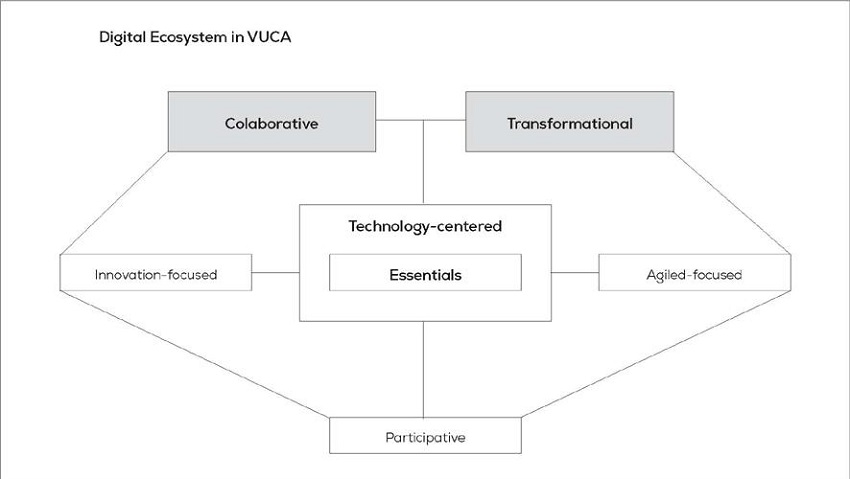
Figure 1
Generic framework for collaborative and transformational leadership requirements in digital ecosystems
Source: Elaborated by the authors.
In this diagram, it is important to highlight the following:
-
All clusters interact with and affect each other,
-
Being centered around essential characteristics and technology-focused provides the foundation for a contemporary and holistic approach to the entire ecosystem. This approach enables collaborative, transformational, agile, innovative, and participative leadership within DES.
This framework is comprehensive and integrative by accounting for all the following leadership requirements from technical, managerial, organizational, and behavioral aspects:
-
essential traits and new requirements arising from current disruptive technological changes,
-
collaboration requirements in complex, web-based, networked ecosystems spanning enterprise boundaries,
-
transformational requirements in this extended ecosystem,
-
participative requirements,
-
agility and innovation requirements in web-enabled ecosystems.
The framework considers the requirements for managing technological, organizational, and managerial transformation needed to align new disruptive technologies, business strategies, models, and processes reengineering efforts toward an overall transformation. The need for aligning these components with appropriate change management is well-established in the management of information systems (MIS) and organizational change management literature. However, these issues must be handled in a more complex, extended, and multi-partner context in a collaborative web-based environment. This demands the embracement of more disruptive and dramatic technological change; development of digital strategy, vision, and a transformation plan; assessment of company readiness for digital transformation; and proper management of the transformation with all dimensions.
Thus, this framework is compatible with and accounts for the core ideas of the literature from leadership, strategic management, organizational design and change, collaborative and complex supply networks, and MIS domains. These core ideas are extended to multi-partner, multi-cultural web-based ecosystems and integrated to meet the increasing collaboration, agility, innovation, transformation, and participation needs of complex, technology-enabled ecosystems in the VUCA world. Due to these characteristics, this framework is unique and contributes to the literature in the above-mentioned domains.
DISCUSSION
This study shows that for managing technology-intensive ecosystems, contemporary leaders should possess core leadership characteristics while meeting new requirements related to being technology-focused, collaborative, transformational, participative, agility-focused, and innovation-focused.
This is a radical paradigm shift in leadership, demanding a collaborative and transformational mindset with the skills to simultaneously handle multiple dimensions of digital transformation (DT) for the entire ecosystem. Being technology-centered to manage the disruptive technologies toward organizational goals and handling the organizational change within a participative mindset is essential. Hence, a transformational approach is vital to handle the technology-intensive transformation and all the organizational and managerial aspects. Also, it is critical to create opportunities for cross-border participation and a collaborative climate for agility and innovation-related results.
Findings show that leaders for technology-intensive collaborative ecosystems should possess a holistic view that can oversee multiple players, dimensions, components, processes, dependencies, and interactions while understanding the VUCA challenges in managing the transformation.
Orchestration also appeared as a critical theme, referring to the ability of a leader to act as a maestro to orchestrate all system components and processes synchronously and collaboratively for the ecosystem. Harmoniously managing well-defined multi-partner processes and interactions for operational, tactical, and strategic dimensions with the alignment of technological, managerial, and organizational aspects appears to be a critical leadership characteristic. Consequently, we believe that “techno-orchestrating leaders” can be an appropriate and overarching term to define CTFL to meet the demands of the VUCA world in today’s I-4.0 and IoT age.
CONCLUSIONS AND FURTHER RESEARCH
This study has shown that identified leadership requirements seem to redefine the skill sets and capabilities needed to manage contemporary, interdependent, technology-intensive, and collaborative business networks. It appears that the classical transactional approach and authoritative leadership understanding cannot result in successful leaders in today’s era. Our findings support that collaborative leaders with a technology-focused mindset and transformational participative spirit with a focus on agility and innovation are required to manage DES under harsh VUCA conditions. Hence, they should be “techno-orchestrating” leaders to meet the challenges of the I-4.0 and IoT era.
Depending on the framework developed, we believe this study is valuable for guiding today’s leaders toward a comprehensive and holistic understanding of all these requirements. With its broad coverage, we hope that the clustering provided in this study can be useful in any further theory development efforts in the leadership domain.
Further studies can examine how well the leadership requirements identified in this study are met in different business contexts. Enterprise-based, sector-based, and network-based studies can be useful for researchers studying this field.
REFERENCES
Afsar, B., Badir, Y., Saeed, B., & Hafeez, S. (2017). Transformational and transactional leadership and employee’s entrepreneurial behavior in knowledge–intensive industries. International Journal of Human Resource Management, 28(2), 307-332. https://doi.org/10.1080/09585192.2016.1244893
Agger, A., Damgaard, B., Krogh, A., & Sørensen, E. (Eds.). (2015). Collaborative governance and public innovation in Northern Europe. Bentham Science Publisher. https://doi.org/10.2174/97816810801301150101
Ahsan, S.R., Yousuf, IS., Khan, Z., Mehrin, Y. & Majumdar, MA. (2021).Digital Supply Chain Management Ecosystem Powered by Blockchain Technology.8 th IEEE Asia-Pacific Conference on Computer Science and Data Engineering (CSDE), https://doi.org/10.1109/CSDE53843.2021.9718436
Akyuz, G. A., & Erkan, T. E. (2010). Supply chain performance measurement: A literature review. International Journal of Production Research, 48(17), 5137-5155. https://doi.org/10.1080/00207540903089536
Akyuz, G. A., & Gursoy, G. (2014). Role of management control and trust formation in supply network collaboration. International Journal of Collaborative Enterprise, 4(3), 137. https://doi.org/10.1504/IJCENT.2014.066320
Akyuz, G. A., & Gursoy, G. (2018). Opportunities and Challenges in supply chain collaboration with blockchain. In IRDITECH 2018 Uluslararası Ar-Ge, İnovasyon ve Teknoloji Yönetimi Kongresi Bildiriler Kitabı (Eds. Gursoy, G., Ensari, M.Ş.). 121–128. https://okan.edu.tr/uploads/pages/bildirikitapcigi/bildiri-kitapcigi-19102018-1.pdf
Akyuz, G. A., & Gursoy, G. (2019). Becoming Smart, innovative, and socially responsible in supply chain collaboration. In Advanced methodologies and technologies in business operations and management, (Ed. Mehdi Khosrow-Pour) (pp. 919-941). IGI Global. https://www.igi-global.com/viewtitlesample.aspx?id=212170&ptid=206307&t=Becoming%20Smart,%20Innovative,%20and%20Socially%20Responsible%20in%20Supply%20Chain%20Collaboration&isxn=9781522573623
Akyuz, G. A., & Gursoy, G. (2020). Transformation of supply chain activities in blockchain environment. In U. Hacioglu (Ed.), Digital business strategies in blockchain ecosystems (pp. 153-175). Springer International Publishing. https://doi.org/10.1007/978-3-030-29739-8_8
Alharbi, I. B., Jamil, R., Mahmood, N. H. N., & Shaharoun, A. M. (2020). Transformational leadership’s impact on organizational innovation: The mediating role of management control system. Global Business Review, Online published first, July 15, 2020, 1-16, 097215092093464. https://doi.org/10.1177/0972150920934640
Allgood, M., Jensen, U. T., & Stritch, J. M. (2022). Work-family conflict and burnout amid COVID-19: Exploring the mitigating effects of instrumental leadership and social belonging. Review of Public Personnel Administration, Online published first, June 15, 2022.0734371X2211013. https://doi.org/10.1177/0734371X221101308
Amin, B., Hakimah, Y., Madjir, S., & Noviantoro, D. (2019). The role of transformation leadership in enhancing corporate sustainability capabilities and sustainable supply chain management. Polish Journal of Management Studies, 20(2), 83-92. https://doi.org/10.17512/pjms.2019.20.2.07
Anderson, H. M., & Sun, Y. T. P. (2017). Reviewing leadership styles: Overlaps and the need for a new ‘full-range’ theory: International Journal of Management Reviews, 19(1), 76-96. https://doi.org/10.1111/ijmr.12082
Antonakis, J., & House, J. R. (2014). Instrumental leadership: Measurement and extension of transformational–transactional leadership theory. The Leadership Quarterly, 25(4), 746-771. https://doi.org/10.1016/j.leaqua.2014.04.005
Ardi, K., Sundring, P. D., Innocentius, B., Sudibjo, N., Aneu, Y., Hezkiel, A. N., & Kezia, A. N. (2020). The relationship between digital transformational leadership styles and knowledge-based empowering interaction for increasing organisational innovativeness. International Journal of Innovation, Creativity&Change, 11(3), 259-277. https://www.ijicc.net/images/vol11iss3/11322_Ardi_2020_E_R.pdf
Arun, K., Begeç, S., & Okun, O. (2021). Intrapreneurial behaviors of organizational members – A conceptual view: How contextual expectations can explain the entrepreneurship roles in organizations? Journal of Research in Marketing and Entrepreneurship, 23(1), 24-40. https://doi.org/10.1108/JRME-09-2019-0074
Atan, J. bin, & Mahmood, N. H. N. (2019). The role of transformational leadership style in enhancing employees’ competency for organization performance. Management Science Letters, 9(13), 2191-2200. https://doi.org/10.5267/j.msl.2019.7.033
Bambale, A. J., Shamsudin, F. M., & Subramaniam, A. C. (2011). Stimulating organizational citizenship behavior research for theory development: Exploration of leadership paradigms. International Journal of Academic Research in Business and Social Sciences, 1(3 Special), 38-59. https://core.ac.uk/download/pdf/42984361.pdf
Bass, B. M., & Avolio, B. J. (1997). Full range leadership development: Manual for the multifactor leadership questionnaire. Mind Garden.
Begeç, S., & Arun, K. (2020). The bottleneck of intrapreneurship: Are social positions and held expectations constraints in organizations’ entrepreneur process? A conceptual view. Journal of Entrepreneurship in Emerging Economies, 13(1), 131-151. https://doi.org/10.1108/JEEE-08-2019-0120
Cha, J., Kim, Y., Lee, J.-Y., & Bachrach, G. D. (2015). Transformational leadership and inter-team collaboration: Exploring the mediating role of teamwork quality and moderating role of team size. Group&Organization Management, 40(6), 715-743. https://doi.org/10.1177/1059601114568244
Chammas, C. B., & Hernandez, J. M. da. C. (2019). Comparing transformational and instrumental leadership: The influence of different leadership styles on individual employee and financial performance in Brazilian startups. Innovation & Management Review, 16(2), 143-160. https://doi.org/10.1108/INMR-08-2018-0064
Chen, J., Sohal, S. A., & Prajogo, I. D. (2013). Supply chain operational risk mitigation: A collaborative approach. International Journal of Production Research, 51(7), 2186-2199. https://doi.org/10.1080/00207543.2012.727490
Chen, J.-X., Sharma, P., Zhan, W., & Liu, L. (2019). Demystifying the impact of CEO transformational leadership on firm performance: Interactive roles of exploratory innovation and environmental uncertainty. Journal of Business Research, 96, 85-96. https://doi.org/10.1016/j.jbusres.2018.10.061
Chou, P. (2019). Transformational leadership and attitude toward enterprise resource planning system: A perspective of organizational change. International Journal of Information Technology Project Management, 10(1), 55-71. https://doi.org/10.4018/IJITPM.2019010104
Chung, V., Dietz, M., Rab, I., & Townsend, Z. (2020). Ecosystem 2.0: Climbing to the next level. McKinsey Quarterly. Retrieved from https://www.mckinsey.com/capabilities/mckinsey-digital/our-insights/ecosystem-2-point-0-climbing-to-the-next-level
Cleavenger, J. D., & Munyon, P. T. (2013). It’s how you frame it: Transformational leadership and the meaning of work. Business Horizons, 56(3), 351-360. https://doi.org/10.1016/j.bushor.2013.01.002
Cloutier, C., Oktaei, P., & Lehoux, N. (2020). Collaborative mechanisms for sustainability-oriented supply chain initiatives: State of the art, role assessment and research opportunities. International Journal of Production Research, 58(19), 5836-5850. https://doi.org/10.1080/00207543.2019.1660821
Cook, P. J. (2016). Leading innovation, creativity and enterprise. Industrial and Commercial Training, 48(6), 294-299. https://doi.org/10.1108/ICT-01-2016-0006
Cortellazzo, L., Bruni, E., & Zampieri, R. (2019). The role of leadership in a digitalized world: A review. Frontiers in Psychology, 10, 1938. https://doi.org/10.3389/fpsyg.2019.01938
Crede, M., Jong, J., & Harms, P. (2019). The generalizability of transformational leadership across cultures: A meta-analysis. Journal of Managerial Psychology, 34(3), 139-155. https://doi.org/10.1108/JMP-11-2018-0506
Deaton, A. V. (2018). Vuca tools for a Vuca world: Developing leaders and teams for sustainable results. DaVinci Resources.
Deprez, J., Leroy, H., & Euwema, M. (2018). Three chronological steps toward encouraging intrapreneurship: Lessons from the Wehkamp case. Business Horizons, 61(1), 135-145. https://doi.org/10.1016/j.bushor.2017.09.013
Dinh, J. E., Lord, R. G., Gardner, W. L., Meuser, J. D., Liden, R. C., & Hu, J. (2014). Leadership theory and research in the new millennium: Current theoretical trends and changing perspectives. The Leadership Quarterly, 25(1), 36-62. https://doi.org/10.1016/j.leaqua.2013.11.005
Dong, Y., Bartol, K. M., Zhang, Z.-X., & Li, C. (2017). Enhancing employee creativity via individual skill development and team knowledge sharing: Influences of dual-focused transformational leadership: Influences of dual-focused TFL on creativity. Journal of Organizational Behavior, 38(3), 439-458. https://doi.org/10.1002/job.2134
Drath, W. H., McCauley, C. D., Palus, C. J., Velsor, E. Van, O’Connor, P. M. G., & McGuire, J. B. (2008). Direction, alignment, commitment: Toward a more integrative ontology of leadership. The Leadership Quarterly, 19(6), 635-653. https://doi.org/10.1016/j.leaqua.2008.09.003
Dubey, R., Gunasekaran, A., Bryde, D. J., Dwivedi, Y. K., & Papadopoulos, T. (2020). Blockchain technology for enhancing swift-trust, collaboration and resilience within a humanitarian supply chain setting. International Journal of Production Research, 58(11), 3381-3398. https://doi.org/10.1080/00207543.2020.1722860
Durugbo, C. (2016). Collaborative networks: A systematic review and multi-level framework. International Journal of Production Research, 54(12), 3749-3776. https://doi.org/10.1080/00207543.2015.1122249
Elkington, R., Steege, M. Van der, Glick-Smith, J., & Breen, J. M. (Eds.). (2017). Visionary leadership in a turbulent world: Thriving in the new VUCA context. Emerald Publishing.
EY. (2014). Sustaining digital leadership! (Research & Analysis N.2; Digital Leadership Study Series). EY’s Global Technology Center and Global Media & Entertainment Center.
Faccin, K., Wegner, D., & Balestrin, A. (2020). How to orchestrate R&D networks? The role of orchestration subprocesses and collaborative practices over time. Creativity and Innovation Management, 29(1), 161-177. https://doi.org/10.1111/caim.12355
Fawcett, S. E., Wallin, C., Allred, C., Fawcett, A. M., & Magnan, G. M. (2011). Information technology as an enabler of supply chain collaboration: A dynamic-capabilities perspective. Journal of Supply Chain Management, 47(1), 38-59. https://doi.org/10.1111/j.1745-493X.2010.03213.x
Fenton, K., Saksena, A., Pawlowski, B. K., & Narsalay, R. (2020). Supply chain ecosystems: Moving from spoke to hub [Research Report]. Accenture. https://www.accenture.com/_acnmedia/PDF-121/Accenture-Supply-Chain-Ecosystems-Moving-From-Spoke-to-Hub.pdf
Gibney, J., Copeland, S., & Murie, A. (2009). Toward a `new’ strategic leadership of place for the knowledge-based economy. Leadership, 5(1), 5-23. https://doi.org/10.1177/1742715008098307
Gomes, A. R. (2014). Transformational leadership: Theory, research, and application to sports. In Mohiyeddini, C. (Ed.), Contemporary topics and trends in the psychology of sports (pp. 53-114). Nova Science Publishers. https://www.researchgate.net/publication/310794991_Transformational_leadership_Theory_research_and_application_to_sports
Graça, P., & Camarinha-Matos, L. M. (2017). Performance indicators for collaborative business ecosystems – Literature review and trends. Technological Forecasting and Social Change, 116, 237-255. https://doi.org/10.1016/j.techfore.2016.10.012
Guinan, P. J., Parise, S., & Langowitz, N. (2019). Creating an innovative digital project team: Levers to enable digital transformation. Business Horizons, 62(6), 717-727. https://doi.org/10.1016/j.bushor.2019.07.005
Hahn, G. J. (2020). Industry 4.0: A supply chain innovation perspective. International Journal of Production Research, 58(5), 1425-1441. https://doi.org/10.1080/00207543.2019.1641642
Hansbrough, T. K., & Schyns, B. (2018). The appeal of transformational leadership. Journal of Leadership Studies, 12(3), 19-32. https://doi.org/10.1002/jls.21571
Horney, N., Pasmore, B., & O’Shea, T. (2010). Leadership agility: A business imperative for a VUCA world. https://luxorgroup.fr/coaching/wp-content/uploads/Leadership-agility-model.pdf
Jones, T. L. (2019). A new transformational leadership: A Meadian framework for a new way forward. Leadership, 15(5), 555-575. https://doi.org/10.1177/1742715018777341
Judge,T. A., & Piccolo, R. F. (2004). Transformational and transactional leadership: A meta-analytic test of their relative validity. Journal of Applied Psychology, 89(5), 755-768. https://doi.org/10.1037/00219010.89.5.755
Kane, G. C., Palmer, D., Phillips, A. N., Kiron, D., & Buckley, N. (2015). Strategy, not technology, drives digital transformation (MIT Sloan Management Review) [Research]. Deloitte University Press. https://www2.deloitte.com/content/dam/Deloitte/fr/Documents/strategy/dup_strategy-not-technology-drives-digital-transformation.pdf
Kannan, K. S. P. N., & Garad, A. (2020). Competencies of quality professionals in the era of industry 4.0: A case study of electronics manufacturer from Malaysia. International Journal of Quality & Reliability Management, 38(3), 839-871. https://doi.org/10.1108/IJQRM-04-2019-0124
Khan, H. U. R., Ali, M., Olya, H. G. T., Zulqarnain, M., & Khan, Z. R. (2018). Transformational leadership, corporate social responsibility, organizational innovation, and organizational performance: Symmetrical and asymmetrical analytical approaches. Corporate Social Responsibility and Environmental Management, 25(6), 1270-1283. https://doi.org/10.1002/csr.1637
Khan, S. (2016). Leadership in the digital age: A study on the effects of digitalisation on top management leadership (Master Thesis 30 HP, Stockholm University). https://su.diva-portal.org/smash/get/diva2:971518/FULLTEXT02.pdf
Klaic, A., Burtscher, M. J., & Jonas, K. (2020). Fostering team innovation and learning by means of team‐centric transformational leadership: The role of teamwork quality. Journal of Occupational & Organizational Psychology, 93(4), 942-966. https://doi.org/10.1111/joop.12316
Knippenberg, D. van, & Sitkin, S. B. (2013). A critical assessment of charismatic-transformational leadership research: Back to the drawing board? Academy of Management Annals, 7(1), 1-60. https://doi.org/10.5465/19416520.2013.759433
Kotarba, M. (2018). Digital transformation of business models. Foundations of Management, 10(1), 123-142. https://doi.org/10.2478/fman-2018-0011
KPMG. (2017). The route to digital business leadership [Survey]. KPMG International Cooperative. https://assets.kpmg/content/dam/kpmg/xx/pdf/2017/09/the-route-to-digital-business-leadership.pdf
Kramer, M. W., & Crespy, D. A. (2011). Communicating collaborative leadership. The Leadership Quarterly, 22(5), 1024-1037. https://doi.org/10.1016/j.leaqua.2011.07.021
Krauter, J. (2020). Explaining leadership: A framework for a layered ontology of leadership. Journal of Critical Realism, 19(5), 500-521. https://doi.org/10.1080/14767430.2020.1827925
Kroon, B., Woerkom, M. van, & Menting, C. (2017). Mindfulness as substitute for transformational leadership. Journal of Managerial Psychology, 32(4), 284-297. https://doi.org/10.1108/JMP-07-2016-0223
Lad, L.J. (2017). Re-thinking collaboration: Crossing boundaries to create a better future. Knowledge Management in the 21st Century: Resilience, creativity and co-creation,761–770. In IFKAD 2017, 12 th International Forum on Knowledge Assets Dynamics. Knowledge Management in the 21 th century: resilience, creativity and co-creation. Proceeding Book (Eds: Spender, JC., Schiuma, G. and Gavrilova, T. 7), June 2017, St. Petersburg Russia, https://publications.hse.ru/en/books/206787669
Lavikka, R., Hirvensalo, A. Smeds, R., & Jaatinen, M. (2017). Transforming a Supply Chain Towards a Digital Business Ecosystem. In Advances in production management systems: the path to intelligent, collaborative and sustainable manufacturing IFIP WG 5.7 International Conference, APMS 2017, Hamburg, Germany, September 3-7, 2017, Proceedings, Part I (Eds. Lodding, H. et al.). Vol. 514, pp. 295-301. IFIP Advances in Information and Communication Technologyhttps://doi.org/10.1007/9783-319-66926-7_34
Lawrence, K. (2013). Developing leaders in a VUCA environment [Executive Development]. Ke-nan-Flagler Business School. https://www.emergingrnleader.com/wp-content/uploads/2013/02/developing-leaders-in-a-vuca-environment.pdf
Lazan, M. (2016). Changing mindset to improve results. Industrial and Commercial Training, 48(5), 231-233. https://doi.org/10.1108/ICT-11-2015-0078
Le, P. B. (2020). How transformational leadership facilitates radical and incremental innovation: The mediating role of individual psychological capital. Asia-Pacific Journal of Business Administration, 12(3/4), 205-222. https://doi.org/10.1108/APJBA-04-2020-0129
Le, P. B., Lei, H., Le, T. T., Gong, J., & Ha, A. T. (2020). Developing a collaborative culture for radical and incremental innovation: The mediating roles of tacit and explicit knowledge sharing. Chinese Management Studies, 14(4), 957-975. https://doi.org/10.1108/CMS-04-2019-0151
Lei, H., Leaungkhamma, L., & Le, P. B. (2020). How transformational leadership facilitates innovation capability: The mediating role of employees’ psychological capital. Leadership & Organization Development Journal, 41(4), 481-499. https://doi.org/10.1108/LODJ-06-2019-0245
Li, C.-R., Lin, C.-J., & Tien, Y.-H. (2015). CEO transformational leadership and top manager ambidexterity: An empirical study in Taiwan SMEs. Leadership & Organization Development Journal, 36(8), 927-954. https://doi.org/10.1108/LODJ-03-2014-0054
Liebert, F., & Trzeciak, M., & (2019). Virtual temporary collaboration networks: A case study of the IT industry. Problemy Zarządzania – Management Issues, 5(85), 56-73. https://doi.org/10.7172/16449584.85.4
Lilian, S. C. (2014). Virtual teams: Opportunities and challenges for e-leaders. Procedia - Social and Behavioral Sciences, 110, 1251-1261. https://doi.org/10.1016/j.sbspro.2013.12.972
Luo, B., Zheng, S., Ji, H., & Liang, L. (2018). Ambidextrous leadership and TMT-member ambidextrous behavior: The role of TMT behavioral integration and TMT risk propensity. The International Journal of Human Resource Management, 29(2), 338-359. https://doi.org/10.1080/09585192.2016.1194871
Lyons, J. B., & Schneider, T. R. (2009). The effects of leadership style on stress outcomes. The Leadership Quarterly, 20(5), 737-748. https://doi.org/10.1016/j.leaqua.2009.06.010
Mack, O., & Khare, A. (2016). Perspectives on a VUCA world. In O. Mack, A. Khare, A. Krämer, & T. Burgartz (Eds.), Managing in a VUCA world (pp. 3-19). Springer International Publishing. https://doi.org/10.1007/978-3-319-16889-0_1
Mainemelis, C., Kark, R., & Epitropaki, O. (2015). Creative leadership: A multi-context conceptualization. Academy of Management Annals, 9(1), 393-482. https://doi.org/10.5465/19416520.2015.1024502
Majeed, N., Ramayah, T., Mustamil, N., Nazri, M., & Jamshed, S. (2017). Transformational leadership and organizational citizenship behavior: Modeling emotional intelligence as mediator. Management & Marketing, 12(4), 571-590. https://doi.org/10.1515/mmcks-2017-0034
Mangundjaya, W. L., & Adiansyah, A. (2018). The impact of trust on transformational leadership and commitment to change. Advanced Science Letters, 24(1), 493-496. https://doi.org/10.1166/asl.2018.12048
Matsunaga, M. (2021). Testing the theory of communication and uncertainty management in the context of digital transformation with transformational leadership as a moderator. International Journal of Business Communication, First published online June 22, 2021. 232948842110239. https://doi.org/10.1177/23294884211023966
Matt, C., Hess, T., & Benlian, A. (2015). Digital transformation strategies. Business & Information Systems Engineering, 57(5), 339-343. https://doi.org/10.1007/s12599-015-0401-5
Mitchell, A. (2012). Interventions for effectively leading in a virtual setting. Business Horizons, 55(5), 431-439. https://doi.org/10.1016/j.bushor.2012.03.007
Morrison-Smith, S., & Ruiz, J. (2020). Challenges and barriers in virtual teams: A literature review. SN Applied Sciences, 2(6), 1096. https://doi.org/10.1007/s42452-020-2801-5
Nastase, M., & Roja, A. (2013, November 7). Leadership in virtual organizations: New management for the new economy. 7th International Management Conference, Bucherest, Romania. http://conferinta.management.ase.ro/archives/2013/pdf/39.pdf
Nobre, F. S., Tobias, A. M., & Walker, D. S. (2010). A new contingency view of the organization: Mananging complexity and uncertainty through cognition. BAR-Brazilian Administration Review, 7(4), 379-396. https://doi.org/10.1590/S1807-76922010000400005
Oberer, B., & Erkollar, A. (2018). Leadership 4.0: Digital leaders in the age of industry 4.0. International Journal of Organizational Leadership, 7(4), 404-412. https://doi.org/10.33844/ijol.2018.60332
Ojha, D., Acharya, C., & Cooper, D. (2018). Transformational leadership and supply chain ambidexterity: Mediating role of supply chain organizational learning and moderating role of uncertainty. International Journal of Production Economics, 197, 215-231. https://doi.org/10.1016/j.ijpe.2018.01.001
Okun, O., Arun, K., & Begec, S. (2020). Intrapreneurship and expectations restrictions. Dimensión Empresarial, 18(2), 140-151. https://doi.org/10.15665/dem.v18i2.2181
Pillai, R., & Williams, E. A. (2004). Transformational leadership, self-efficacy, group cohesiveness, commitment, and performance. Journal of Organizational Change Management, 17(2),144-159. https://doi.org/10.1108/09534810410530584
Puni, A., Mohammed, I., & Asamoah, E. (2018). Transformational leadership and job satisfaction: The moderating effect of contingent reward. Leadership & Organization Development Journal, 39(4), 522-537. https://doi.org/10.1108/LODJ-11-2017-0358
Rao, M. S. (2016). Collaborate to build effective teams to achieve organizational excellence and effectiveness. Industrial and Commercial Training, 48(1), 24-28. https://doi.org/10.1108/ICT-01-2015-0010
Ravesteijn, P., & Ongena, G. (2019). The role of E-leadership in relation to IT capabilities and digital transformation. International Association for the Development of the Information Society.
Raza, B. (2016). Leadership 4.0 [Module: Management Competencies 1(MC1)]. University of Applied Sciences. https://www.academia.edu/25513158/LEADERSHIP_4_0_Module_Management_Competencies_1_MC1_MBA_Aviation_Enrolment_number_1042342
Rimita, K., Hoon, S. N., & Levasseur, R. (2020). Leader readiness in a volatile, uncertain, complex, and ambiguous business environment. Journal of Social Change, 12(1), 10-18. https://doi.org/10.5590/JOSC.2020.12.1.02
Robbins, S. P., & Coulter, M. (2012). Management (11. ed., global ed.). Pearson.
Rodriguez, A., & Rodriguez, Y. (2015). Metaphors for today’s leadership: VUCA world, millennial and “Cloud Leaders.” Journal of Management Development, 34(7), 854-866. https://doi.org/10.1108/JMD-09-2013-0110
Rosin, F., Forget, P., Lamouri, S., & Pellerin, R. (2020). Impacts of industry 4.0 technologies on lean principles. International Journal of Production Research, 58(6), 1644-1661. https://doi.org/10.1080/00207543.2019.1672902
Roubini ThoughtLab. (2017). The path to digital leadership (Wealth and Asset Management 2022) [Econsult Solutions]. Roubini ThoughtLab. https://www.broadridge.com/_assets/pdf/wealth-and-asset-management-2022-the-path-to-digital-leadership.pdf
Rowold, J., Diebig, M., & Heinitz, K. (2017). The effects of transformational and instrumental leadership on followers’ levels of cortisol. German Journal of Human Resource Management: Zeitschrift Für Personalforschung, 31(3), 219-237. https://doi.org/10.1177/2397002216689240
Sainger, G. (2018). Leadership in Digital Age: A study on the role of leader in this Era of Digital Transformation. International Journal on Leadership, 6(1), 1-6. http://www.publishingindia.com/ijl/60/leadership-in-digital-age-a-study-on-the-role-of-leader-in-this-era-of-digital-transformation/684/4784/
Samimi, M., Cortes, A. F., Anderson, M. H., & Herrmann, P. (2020). What is strategic leadership? Developing a framework for future research. The Leadership Quarterly, 33(3), 1-22, 101353. https://doi.org/10.1016/j.leaqua.2019.101353
Satalkina, L., & Steiner, G. (2020). Digital entrepreneurship and its role in innovation systems: A systematic literature review as a basis for future research avenues for sustainable transitions. Sustainability, 12(7), 2764. https://doi.org/10.3390/su12072764
Seijts, G. H., & Gandz, J. (2018). Transformational change and leader character. Business Horizons, 61(2), 239-249. https://doi.org/10.1016/j.bushor.2017.11.005
Singh, H. (2013). Language of law: Ambiguities and interpretation. American International Journal of Research in Humanities, Arts and Social Sciences, 2(2), 122-126. http://iasir.net/AIJRHASSpapers/AIJRHASS13-157.pdf
Sinha, G. (2015). Responding to complexity: Microfinance MIS service providers as complex adaptive systems. Journal of Entrepreneurship and Innovation in Emerging Economies, 1(2), 163-180. https://doi.org/10.1177/2393957515597583
Slagmulder, R., & Devoldere, B. (2018). Transforming under deep uncertainty: A strategic perspective on risk management. Business Horizons, 61(5), 733-743. https://doi.org/10.1016/j.bushor.2018.05.001
Stanczyk, S. (2019). Business ecosystem identity construct. Transformations in Business & Economics, 18(2B(47B)), 674-693. https://search.ebscohost.com/login.aspx?direct=true&profile=ehost&scope=site&authtype=crawler&jrnl=16484460&AN=139939905&h=2uXicDI2NAkXAuyUK4vKAmX28BBuU6l%2BNOZ8blkC534jD9vfD%2BBaEUUzOaAAHOeMs97UjlE9U%2FQCXQHPdar93w%3D%3D&crl=c
Subiyanto, D., & Djastut, I. (2018). Transformational leadership, organizational support, and dynamic ambidexterity capabilities in troubleshooting: Strategic efforts to improve lecturer performance. Quality Management, 19(162), 96-102. https://search.ebscohost.com/login.aspx?direct=true&profile=ehost&scope=site&authtype=crawler&jrnl=15822559&AN=127607692&h=cZhrmTwQLoQH6aERx3hjo1qlXEyZFzFq3Bn6SajJmUFCuzDr0W9yt3QoKpBMnAK%2FKyAHaiysH3sshYe0MAWxQA%3D%3D&crl=c
Subramaniam, M., Iyer, B., & Venkatraman, V. (2019). Competing in digital ecosystems. Business Horizons, 62(1), 83-94. https://doi.org/10.1016/j.bushor.2018.08.013
Super, J. F. (2020). Building innovative teams: Leadership strategies across the various stages of team development. Business Horizons, 63(4), 553-563. https://doi.org/10.1016/j.bushor.2020.04.001
Tanniru, M. R. (2018). Digital leadership. In M. Pomffyova (Ed.), Management of information systems. Chapter 6, pp. pp. 93-109. InTech. https://doi.org/10.5772/intechopen.76045
Tawaststjerna, T., & Olander, H. (2021). Managing digital transformation in digital business ecosystems. International Journal of Innovation Management, 25(10), 2140003. https://doi.org/10.1142/S136391962140003X
Thompson, G., Buch, R., Thompson, P.-M. M., & Glasø, L. (2021). The impact of transformational leadership and interactional justice on follower performance and organizational commitment in a business context. Journal of General Management, 46(4), 274-283. https://doi.org/10.1177/0306307020984579
Tyssen, A. K., Wald, A., & Heidenreich, S. (2014). Leadership in the context of temporary organizations: A study on the effects of transactional and transformational leadership on followers’ commitment in projects. Journal of Leadership & Organizational Studies, 21(4), 376-393. https://doi.org/10.1177/1548051813502086
University of Cambridge Institute for Sustainability Leadership. (2017). Global definitions of leadership and theories of leadership development: Literature Review. University of Cambridge Institute for Sustainability Leadership. https://www.cisl.cam.ac.uk/resources/sustainability-leadership/global-definitions-of-leadership
Urcioli, L., & Hintsa, J. (2021). Can digital ecosystems mitigate risks in sea transport operations? Estimating benefits for supply chain stakeholders. Maritime Economics & Logistics, 23(2), 237-267. https://doi.org/10.1057/s41278-020-00163-6
Utoyo, I., Fontana, A., & Satrya, A. (2020). The role of entrepreneurial leadership and configuring core innovation capabilities to enhance innovation performance in a disruptive environment. International Journal of Innovation Management, 24(6), 2050060. https://doi.org/10.1142/S1363919620500607
Valdez-De-Leon, O. (2019). How to develop a digital ecosystem: A practical framework. Technology Innovation Management Review, 9(8), 43-54. https://doi.org/10.22215/timreview/1260
Vought, W. X. (2017). E-leadership in practice: The components of transformational leadership in virtual business environments (Dissertation, St. John Fisher College). https://fisherpub.sjfc.edu/cgi/viewcontent.cgi?article=1326&context=education_etd
Wang, Y., Chen, C. H., & Zghari-Sales, A. (2020). Designing a blockchain enabled supply chain. International Journal of Production Research, 59(5), 1450-1475. https://doi.org/10.1080/00207543.2020.1824086
Webber, S. S., & Webber, D. S. (2015). Launching and leading intense teams. Business Horizons, 58(4), 449-457. https://doi.org/10.1016/j.bushor.2015.03.009
Williamson, P. J., & DeMeyer, A. (2012). Ecosystem advantage: How to successfully harness the power of partners. California Management Review, 55(1), 24-46. https://doi.org/10.1525/cmr.2012.55.1.24
Wilson, E. J. (2004). Leadership in the Digital Age. In G. Goethals, G. Sorenson, & J. Burns (Eds.), Encyclopedia of leadership. SAGE Publications, Inc. https://doi.org/10.4135/9781412952392.n199
Winkelhaus, S., & Grosse, E. H. (2020). Logistics 4.0: A systematic review towards a new logistics system. International Journal of Production Research, 58(1), 18-43. https://doi.org/10.1080/00207543.2019.1612964
Yücebalkan, B. (2018). Digital leadership in the context of digitalization and digital transformations. In Current academic studies in social science 2018, Eds. Eryılmaz, B., Özlü, K., Keskin, Y.B., Yücetürk, C. (8th ed., Vol. 1, pp. 489-505). Gece Kitaplığı. https://www.academia.edu/38309825/Digital_leadership_in_the_context_of_digitalization_and_digital_transformations
Yukl, G. A. (2006). Leadership in organizations (6th ed). Pearson/Prentice Hall.
Zupancic, T., Verbeke, J., & Achten, H. (2016). Digital leadership. 1, 63-68. ISSN: 9789491207105. eCAADe and Oulu School of Architecture, University of Oulu, https://lirias.kuleuven.be/1685390?limo=0
Author notes
* Corresponding author
Conflict of interest declaration
The authors have no conflicts of interests to declare.