ARTICLES
FIRM STRATEGY AND PRODUCT INNOVATION IN SMEs: THE MEDIATING ROLE OF BUSINESS NETWORKS
Estrategia empresarial e innovación de productos en PyMEs: El rol mediador de las redes de negocios
ESTRATÉGIA EMPRESARIAL E INOVAÇÃO DE PRODUTOS NAS PMES: O PAPEL MEDIADOR DAS REDES EMPRESARIAIS
 Carlos Melendez-Campos carlosmelendezc96@gmail.com
Ronald Mora-Esquivel rmora@itcr.ac.cr
Carlos Melendez-Campos carlosmelendezc96@gmail.com
Ronald Mora-Esquivel rmora@itcr.ac.cr
FIRM STRATEGY AND PRODUCT INNOVATION IN SMEs: THE MEDIATING ROLE OF BUSINESS NETWORKS
Revista de Administração de Empresas, vol. 64, no. 1, e2022-0386, 2024
Fundação Getulio Vargas, Escola de Administração de Empresas de S.Paulo
Received: 29 September 2022
Accepted: 19 September 2023
ABSTRACT: Product innovation is essential for the growth and profitability of SMEs. Existing scientific evidence suggests that firm strategy and participation in business networks could influence this innovation. In turn, participation in networks might influence the configuration and allocation of the organizational resources and capabilities that help shape firm strategy. Hence, this study analyzes business networks as a mediator between firm strategy and product innovation in SMEs. It uses a sample of 205 SMEs from Costa Rica compiled by the Global Competitiveness Project. The proposed mediation is tested using OLS regression equations. The findings show that business networks do indeed play a mediating role in the relationship between firm strategy and product innovation, which has implications for SMEs in terms of the relevance of participating in such networks and also for public policymakers regarding the importance of managing them.
Keywords: Product innovation, SMEs, firm strategy, business networks, competitiveness.
RESUMEN: La innovación de productos es esencial para el crecimiento y rentabilidad de las PyMEs. La evidencia existente sugiere que la estrategia y participación en redes podrían influir en dicha innovación. A su vez, la participación en redes puede influir en la configuración y asignación de recursos y capacidades que ayudan a configurar la estrategia. En consecuencia, este estudio pretende analizar las redes empresariales como variable mediadora entre estrategia e innovación de productos en pymes. El estudio utiliza una muestra de 205 pymes costarricenses, recopilada por el Proyecto de Competitividad Global. La mediación se comprueba mediante un modelo de regresión. Los resultados muestran que las redes desempeñan un papel mediador en la relación entre estrategia e innovación de productos. Los hallazgos tienen implicaciones para las pymes sobre la relevancia de participar en redes que permeen la estrategia y para los responsables de política pública sobre la importancia de gestionar dichas redes.
Palabras clave: Innovación de productos, PyMEs, estrategia empresarial, redes de negocios, competitividad.
RESUMO: A inovação de produtos é essencial para o crescimento e a rentabilidade das pequenas e médias empresas (PMEs). As evidências sugerem que tanto a estratégia empresarial quanto a participação em redes podem influenciar a inovação de produtos, enquanto a participação em redes também pode influenciar a configuração e a alocação de recursos e capacidades que ajudam a moldar a estratégia. O presente estudo visa analisar as redes empresariais como uma variável mediadora entre estratégia e inovação de produtos nas PMEs. O estudo utiliza uma amostra de 205 PMEs costa-riquenhas, coletada pelo Global Competitiveness Project. A mediação é testada usando um modelo de regressão. Os resultados mostram que as redes desempenham um papel mediador na relação entre a estratégia empresarial e a inovação de produtos. As conclusões têm implicações para as PMEs sobre a relevância da participação em redes que permeiam a estratégia e para os formuladores de políticas sobre a importância de gerenciar tais redes.
Palavras-chave: Inovação de produtos, PMEs, estratégia empresarial, redes de negócios, competitividade.
INTRODUCTION
Product innovation has been linked to improvements in long-term growth, financial performance, and competitiveness in SMEs (Berends et al., 2014; Castillo-Vergara & García-Pérez-de-Lema, 2021; López-Fernándes et al., 2018). Existing scientific evidence suggests that firm strategy and participation in business networks could influence innovation in SMEs (Barzi et al., 2015; Belso-Martínez et al., 2020; Fisher & Qualls, 2018; Lechner & Dowling, 2003; Liu & Atuahene-Gima, 2018; Moreno-Moya & Munuera-Aleman, 2016).
For instance, Liu and Atuahene-Gima (2018) found evidence that cost leadership and customer orientation strategies predicted better product innovation performance in an emerging economy with dysfunctional competition (typically involving the breach of intellectual property rights). Belso-Martínez et al. (2020) examined the role of teams and external networks in innovation, finding that knowledge from both sides contributes to innovation and that combining external knowledge with team practices is effective. Similarly, Vasconcelos and Oliveira (2018) found evidence that information and knowledge obtained by SMEs from different networks positively influence their innovation capability.
The Resource-Based View (RBV) postulates that businesses acquire or develop specific resources and capabilities that interact with existing ones to create competencies in their pursuit of competitiveness and, consequently, superior performance (Barney, 1991; Prahalad & Hamel, 1990). A recent article emphasizes the relevance of RBV as an alternative for analyzing new contexts (Helfat et al., 2023). Likewise, our paper proposes that business networks should be viewed as influencers of the configuration and allocation of the organizational resources and capabilities that help shape firm strategy and its relationship with innovation performance.
Specifically, we wish to fill an important knowledge gap by asking the research question: “Do business networks mediate the relationship between firm strategy and product innovation in SMEs?” The study analyzes this issue from the theoretical perspective of the RBV.
The remainder of the paper is structured as follows. The next section presents the theoretical framework, followed by the methodology. Subsequent sections will present the results and discuss the findings. The final sections will provide concluding remarks and discuss implications while highlighting limitations and suggesting potential future research directions.
THEORETICAL FRAMEWORK
Theoretical foundation
This paper adopts the RBV framework as its theoretical foundation. The RBV proposes that by developing and accumulating valuable, unusual, and non-replicable resources, firms can achieve better performance (innovation in our case) and develop a competitive advantage (Barney, 1991;). The RBV posits that a firm’s competitiveness results from amalgamating its diverse and intricate resources and the unique capabilities it can develop from them (Grant, 1991).
From this general line of research, firm strategy can be viewed as a deliberate plan that aligns the organization with the opportunities and threats in its environment. It is composed of the rules that govern what business activities the firm shall engage in, how resources are to be allocated (Ansoff, 1965), what objectives will be pursued (Miller et al., 1996; Wright et al., 1998), and how the firm plans to stand out from its competitors in order to satisfy its customers’ needs efficiently and effectively (Porter, 1996).
Innovation is the successful implementation of creative ideas within an organization (Amabile & Pratt, 2016). New product development is a specific kind of innovation defined as a process in which certain ideas or technologies are materialized and managed and new knowledge is created and incorporated into a product to be introduced to the market (Mu et al., 2009). Finally, networks could be viewed as a form of collective capital that connected firms might benefit from, which may even be essential for the survival of SMEs (Galaso et al., 2019).
Firm strategy and product innovation in SMEs
Successful product innovation requires deploying resources and capabilities, which may be promoted by the firm strategy in several ways. In general, this strategy is either aimed at the exploitation of the organization’s existing capabilities or the exploration of new opportunities. These two approaches have different implications for allocating organizational resources (March, 1991) and their impact on product innovation (Moreno-Moya & Munuera-Aleman, 2016).
Exploitation-oriented firms seek ways to cut costs and offer a cheaper product than their competitors, whereas exploration-oriented firms try to anticipate their customers’ needs and develop improved or completely new products to satisfy them (Porter, 1996; Prahalad & Hamel, 1990). Empirical evidence has shown that strategic decisions affect product innovation differently depending on whether they are focused on cutting costs or anticipating customers’ needs (Liu & Atuahene-Gima, 2018).
Developing capabilities to enable a firm to recognize the threats and opportunities in its environment is a relevant part of firm strategy that may also impact product innovation in SMEs (Moreno-Moya & Munuera-Aleman, 2016). Proactiveness is one such capability, defined as seizing new opportunities even when a firm is not the first to enter the market (Lumpkin & Dess, 1996). A proactive firm strategy might lead to decisions such as reallocating resources and capabilities from products in the maturity or decline stage of their lifecycle to new products (Shan et al., 2016). Risk-taking is another capability present in firm strategy. It may lead to aggressive, proactive efforts to develop new products to satisfy customers’ future and implied needs, as opposed to slow, limited efforts (Morgan et al., 2015).
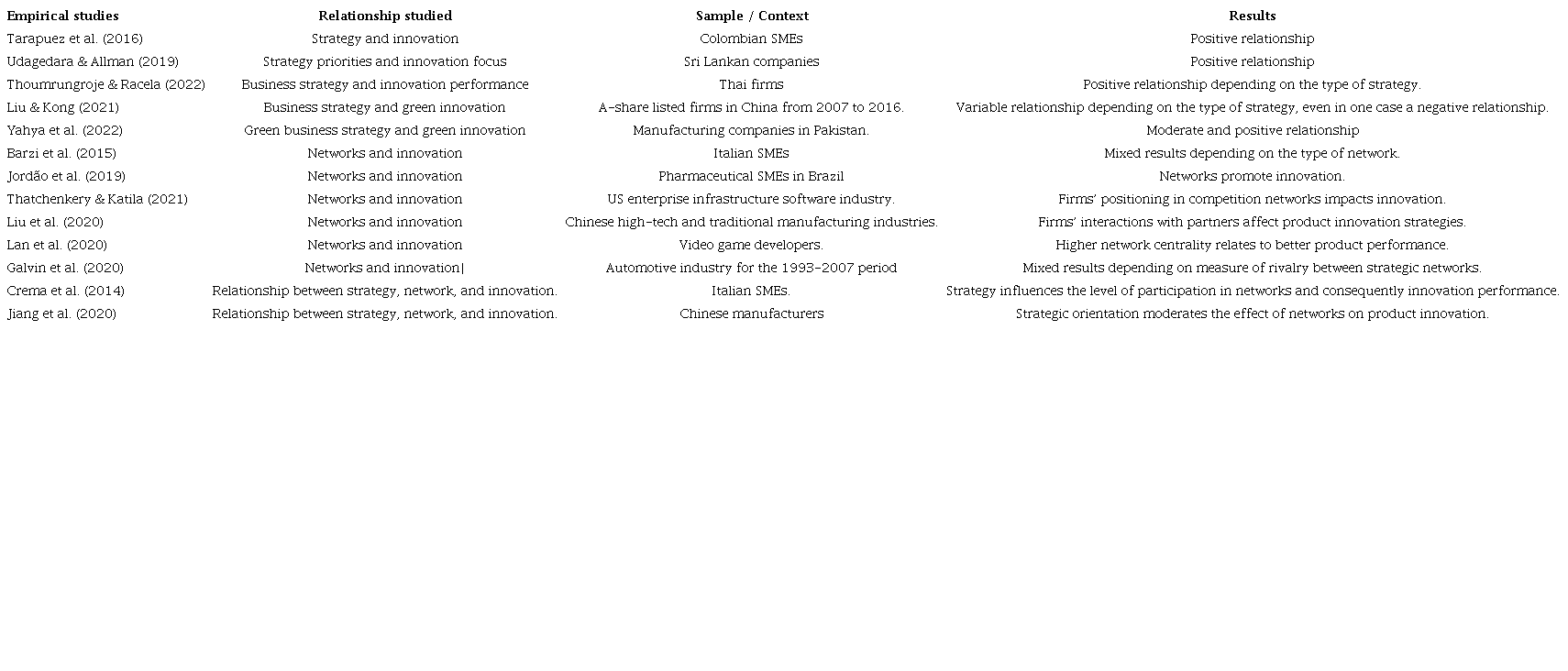
Previous studies have analyzed the relationship between firm strategy and innovation in SMEs. For instance, Tarapuez et al. (2016) found a strong association between enterprises that conduct a comprehensive strategic management process (formulation, implementation, and monitoring) with positive results for innovation (patents and licensing revenue) in a group of SMEs that won the Innova Award presente/d by the Ministry of Commerce, Industry, and Tourism of Colombia in the 2010-2013 period. Udagedara and Allman (2019), based on case studies of software companies in Sri Lanka, revealed that a focus on innovation is aligned with the strategic priorities of firms. Similarly, Thoumrungroje and Racela (2022) found relevant connections between the type of business strategy and innovation performance for 395 Thai firms.
Although not all the recent scientific evidence points in the same direction (Table 1), this paper proposes the following hypothesis:
-
H1: Firm strategy has a positive significant effect on product innovation in SMEs.
The mediating role of networks
Product innovation depends not only on the knowledge and abilities existing within the firm but also on the capability to obtain outside knowledge (Barzi et al., 2015; Molina-Morales & Martínez-Fernández, 2010). Networks could affect product innovation in SMEs in several ways. First, they might help them to access and create new knowledge for use in new or improved products (Lechner & Dowling, 2003; Molina-Morales & Martínez-Fernández, 2010). When networks have strong, close ties with other organizations, SMEs can gain access to a wealth of knowledge. They may also create new knowledge through interactive exchanges with people they trust (Johannisson, 1998), which would be reflected in their product innovation (Lechner & Dowling, 2003). However, evidence also shows that networks built upon weaker but broader relationships could help SMEs access a wider range of information (Granovetter, 1973), which could also be reflected in their product innovation (Lechner & Dowling, 2003).
Networks may also affect product innovation in SMEs through firm interdependency (Lechner & Dowling, 2003). For example, product innovation generally requires SMEs to have an “integrated package” in which other organizations within the network can act as suppliers or allies or offer complementary goods and services. Moreover, firms in the network may assist in the early stages of innovation, such as the design stage, and later on, for instance, in sales or ancillary or complementary services.
In line with this, a firm’s absorptive capacity positively impacts innovation (Fisher & Qualls, 2018). This impact occurs when firms collaborate to create a new product, revealing a certain level of interdependency and mutual benefit from the project. Access to more external knowledge means organizations can get more out of their innovation, given that less uncertainty increases the marketability of the developed products (Ju et al., 2018).
Attitudes, motivation, and an environment prone to innovation are other elements that SMEs may obtain from their networks that might affect product innovation. By engaging in networks where positive values associated with innovation are prevalent (risk-taking, experimentation, acceptance of failure, among others), SMEs could gradually adopt these values and add them to their own practices, positively affecting their product innovation (Chaston & Mangles, 2000).
In general, evidence shows that engaging in networks positively affects firms’ intellectual (human, structural, and relational) capital, which leads to improved performance indicators, such as product innovation. However, there are several nuances to this relationship. For example, Barzi et al. (2015) found mixed results depending on the type of network in their study of Italian firms. Jordão et al. (2019) conducted ten case studies with pharmaceutical SMEs in Brazil, finding that networks promote innovation. Thatchenkery and Katila (2021) examined the US software industry from 1995-2012 and concluded that there is a relationship between a firm’s position in networks and its innovation.
Based on the evidence (Table 1), this paper proposes the following hypothesis:
-
H2: Business networks have a positive significant effect on product innovation in SMEs.
Although networks have become a relevant topic, and studies have analyzed their links to organizational strategy (Henry, 2013) and product innovation (Jordão et al., 2019; Lechner & Dowling, 2003), little research has studied the role they play in the relationship between strategy and product innovation in SMEs and the differences in the performance of such innovation. This study suggests that networks might play a mediating role in this relationship.
On the one hand, participation in business networks could affect the kind of strategy undertaken by SMEs, which could either be focused on exploiting existing capabilities within the organization or on exploring new opportunities (March, 1991) to boost their competitive position in a competitive sector (Porter, 1996), and their place in the value chain (Porter, 1980). This is because participation in networks and the impact it has on SMEs’ intellectual capital (Jordão et al., 2019) could shape or change the kind of decisions that, from an adaptive and emerging approach, are contained in a firm’s strategy (Mintzberg & Waters, 1985).
On the other hand, networks may influence the configuration and allocation of the organizational resources and capabilities that help shape that firm strategy (Jardon & Martos, 2012). For example, providing collaborators with information they could examine individually and collectively is a strategic activity proven to help firms achieve consistent points of view at the team level and form relevant ideas for future actions (Turner & Makhija, 2012).
As mentioned earlier, there is little empirical evidence for the connection between these three factors. Crema et al. (2014) examined the links between strategy, network participation (for open innovation practices), and innovation performance among Italian SMEs. Their findings suggest that firm strategy influences the level of network participation and innovation performance. Jiang et al. (2020) studied how network breadth and depth impacted dynamic capabilities and product innovation and how strategic orientation moderated these effects in a sample of 256 Chinese manufacturers. They concluded that effective strategic orientation moderates the effect of networks on product innovation.
Based on this, we present the following hypothesis:
-
H3: Business networks have a mediating effect on the relationship between firm strategy and product innovation in SMEs.
METHODOLOGY
Research design
This study is grounded in a series of conjectures of interrelations between variables based on the theoretical background presented in the previous section. These are expected to be supported or refuted by utilizing numerical data. Thus, our research is framed within the post-positivism philosophical approach (Creswell, 2014). As our theoretical model involves hypothesis testing, our decisions regarding respondent selection, sampling techniques, data collection, and data analysis need to be aligned with a quantitative study design (Plano & Creswell, 2015). A secondary dataset from a cross-sectional survey by the Global Competitiveness Project (GCP) was utilized. The following subsections describe the methodological features of our quantitative design.
Sample
The study uses a dataset from a secondary source, namely that compiled by the Global Competitiveness Project (GCP), an international project focused on the study of SME competitiveness involving universities from eleven countries (Bosnia and Herzegovina, Brazil, Colombia, Costa Rica, Spain, France, Hungary, Mexico, Pakistan, the Czech Republic, and Romania). Further information on the GCP can be found at www.sme-gcp.org.
Regarding the Costa Rican dataset, the GCP collected data from 231 owners of SMEs in the country. However, the final sample used in this study was reduced to 205 owners after missing values for the variables in our theoretical model were removed. A nonprobability sampling strategy was employed based on the firm selection criteria set by GCP: only firms with at least two full years of operation and more than two employees, including the owner. For firms with less than 20 employees, one of the owners was interviewed (only if they were part of the management team). For firms with 20 employees or more, one of the owners or a senior manager involved in decision-making was interviewed (regardless of whether they held property rights).
The main characteristics of our sample dataset are shown below. SMEs in the Trade and Services sectors account for most of the sample (74.3%). They have a mean of 25.3 employees (SD=40.5). According to the Organisation for Economic Co-operation and Development (OECD, 2021) classification, 48% are micro-enterprises, 37.4 percent are small enterprises, and almost 15 percent are medium-sized enterprises. Almost one third of the firms are located in the country’s capital (San José). The firms in the sample averaged 17.3 years in the market (SD=14.7).
Data collection and variables
The data was compiled from February to May 2019 using a comprehensive questionnaire composed of 112 close-ended questions collected in face-to-face interviews. In Costa Rica, the fieldwork was supervised by a research team from the Costa Rica Institute of Technology, the partner university that leads the GCP in this country. The variables reported by the GCP used in this study are described below.
Based on the Resource-Based View (Barney, 1991; Wernerfelt, 1984), the GCP regards competitiveness as a mutually dependent bundle of ten pillars, namely, human capital, product innovation, domestic market, networks, technology, decision-making, strategy, marketing, internationalization, and online presence, which enable a firm to effectively compete with others and provide customers with valuable goods/services (Lafuente et al., 2019).
The aforementioned authors developed a methodology for measuring business competitiveness with an index encompassing 46 variables linked to the resources and capabilities of the ten competitiveness pillars. Lafuente et al. (2019) provide further details of the methodology for calculating each pillar and the GCP’s competitiveness index. The GCP’s approach has been widely used in research (Alonso & Leiva, 2019; Lukovszki et al., 2020; Lafuente & Vaillant, 2021; Rideg et al., 2023). The following three competitiveness pillars underlie our study: a) product innovation, b) business networks, and c) firm strategy.
Dependent variable
In this study, the product innovation competitiveness pillar is the dependent variable. Five indicators assess the degree of strategic importance that the resource or capability has for a business, where 0 represents no strategic value, 1 represents low strategic value, and up to 4 represents high strategic value. The five indicators are: product innovation, introduction of new or improved products, sales ratio of new products in relation to total sales, continuous innovation, and level of “rarity” of the business product (Lafuente et al., 2019).
The score for each indicator is normalized between 0 and 1 using the maximum score that each indicator obtained from the firms in the sample, a value relative to their “best practices”. Afterward, an average of the normalized value of the five indicators that comprise the pillar is obtained. Thus, the closer the pillar’s value is to 1, the higher the strategic value of product innovation in relation to competitors.
Independent variables
The firm strategy pillar comprises four indicators of resources or capabilities, namely, orientation of the firm strategy (defensive, proactive), growth strategy based on the number of business locations, entrepreneurial attributes of the business founders, and the “rarity” of the firm’s proactive strategy (Lafuente et al., 2019). These indicators are normalized between 0 and 1 and averaged following the method indicated above. Thus, values closer to 1 indicate higher strategic value for firm strategy in relation to competitors.
The business networks pillar is an average of the normalization of the following four resources or capabilities: number of co-operation or collaboration agreements, time spent in the business network in relation to the age of the firm, dependency on external support for business development, and specificity (uniqueness) of the business network (Lafuente et al., 2019). Values closer to 1 represent higher strategic value for business networks related to competitors.
Control variables
In this study, the analytical models control firm size, time in the market, and economic sector. The control variables in the model are firm size, time in the market, and economic sector. Concerning firm size, bigger firms tend to exploit innovation, whereas smaller firms tend to explore it (Acemoglu & Cao, 2015). This variable is measured using the natural logarithm of the number of employees to smooth the data and to avoid the effects of skewed data distribution (Lafuente et al., 2019). Time in the market could, in turn, reflect the firms’ level of involvement in the innovation processes. For example, Acemoglu and Cao (2015) prove that, in general, newer firms tend to develop “more radical and original” innovations than their older counterparts. This variable is measured using the natural logarithm of the number of years in the market to avoid the problem of skewed data distribution (Lafuente et al., 2019). Finally, the analytical models control for economic sector, given that there may be a difference in the style and results of innovation depending on the firms’ sectors (Ferreras-Méndez et al., 2021). This is a dummy variable where 1=Manufacturing and 0=Trade and Services.
Data analysis technique
This study employs the adaptation suggested by Surroca et al. (2010) of Baron and Kenny's (1986) method to test our mediation hypothesis. The former authors follow the latters’ estimation of three regression models but introduce a structural modeling procedure to refine one of the three OLS regression equations of Baron and Kenny’s (1986) method. According to Surroca et al. (2010), testing our cross-sectional mediation method requires the estimation of the two equations established by Baron and Kenny (1986), as follows:
In equation 1), βo is the intercept, β1 is the coefficient estimate computed for firm strategy, and βj are the estimated coefficients for the control variables (firm size, firm age, and sector). The ɛi represents the normally distributed error term; i represents the Nth business. Networks represent a dependent variable in equation 1). β1 must be statistically significant (β1 >0) to contribute to our mediation hypothesis.
In equation 2), β1A represents the coefficient estimate computed for firm strategy and βj for the control variables, βo is the intercept, εi is the error term, PI represents the dependent variable (Product Innovation), and i represents the number of cases. To be conducive to our mediation hypothesis, β1A should be statistically significant (β1A >0).
Before estimating the third equation, Surroca et al. (2010) provide the requirement of computing an instrumental variable for the endogenous variable (firm strategy, in our study). Their econometric approach consists of a two-stage strategy. First, they suggest regressing the endogenous variable on the mediator and control variables (equation 3a). Then, they suggest subtracting the predicted effect of the mediator from the endogenous variable, resulting in the computation of a residual of the endogenous variable (instrumental variable in equation 3b). Following their suggestion, we computed these two equations as follows:
In equation 3a) βo is the constant; β1 represents the estimated coefficient of our mediator, Networks -NTW-; βj is the jth estimated coefficient for each of the three control variables; ɛi represents the normally distributed error term; i represents the Nth business; and CSi functions as a dependent variable. In equation 3b), CSiinstr represents the part of firm strategy that is not explained by networks.
Finally, in the second stage, the third regression model proposed by Baron and Kenny (1986) is computed using the instrumental variable of equation 3b) as the endogenous variable in the model, as follows:
Surroca et al. (2010) mention that their adaptation presents an advantage when dealing with endogeneity or multicollinearity problems between the main endogenous variable and the mediator. According to their adaptation of the method established by Baron and Kenny (1986), if the effect of the instrumental variable vanishes (β1B = 0) when the mediator is introduced (β2B >0), a full mediation hypothesis should be held.
Although the stated method allows researchers to assess the statistical significance of the total effect, it does not provide a test to evaluate the statistical significance of the indirect effect. Thus, we utilize a mimic developed by Crowson (2021) of Hayes’ Process model to be run on Stata to assess a simple mediation model. This procedure is estimated using maximum likelihood based on structural equation modeling. In addition to decomposing the total effect into direct and indirect effects, researchers can use Hayes’ method to assess the statistical significance of the indirect effect by using the percentile bootstrap confidence interval as the inferential test.
Descriptive statistics and regression models were computed using Stata 17.0 software. We follow Acock’s (2016) guidelines to verify the regression models’ assumptions and diagnostic statistics. However, we used robust regression model estimation in the absence of normality distribution of residuals following Acock's (2016) instructions. To assess multicollinearity, we used 10 as the cutoff point for the Variance Inflation Factor (VIF), as suggested by Field (2013).
RESULTS
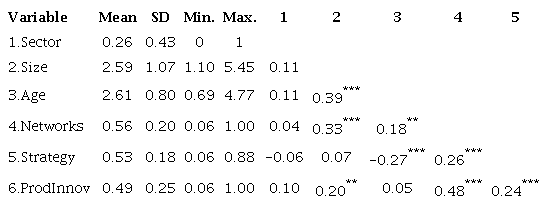
Table 2 shows the descriptive statistics for the variables used in this study. As can be seen, the correlations between the variables of interest are positive. Firm strategy has a low correlation with business networks and innovation, while business networks have a moderately strong (Ratner, 2009) correlation with innovation (0.48, p < 0.001).
* p<0.05,** p<0.01,*** p<0.001
Table 3 shows the results of the regression models following the cross-sectional mediation method proposed by Surroca et al. (2010). F-test values indicate that the models have a good fit and are statistically significant. R2 shows that the suggested model explains 25% of the variation in product innovation performance in the analyzed SMEs. After examining the VIF, no multicollinearity problems were detected in the data, given that the VIF values are under the recommended cutoff point (10) (Vittinghoff et al., 2011).
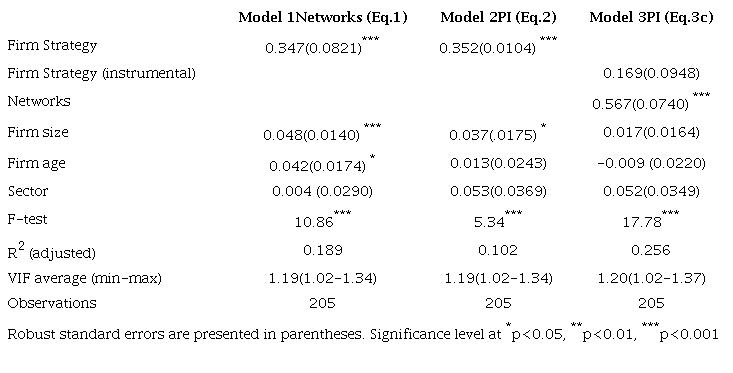
Our first hypothesis suggested that firm strategy has a positive effect on product innovation in SMEs, and this is confirmed by Model 2 in Table 3 (β1A = 0.352, p<0.001). Therefore, we can state that, for each unit of measurement of difference in firm strategy in SMEs, an increase of 0.352 units is estimated for their product innovation.
Our second hypothesis suggested that business networks positively affect product innovation in SMEs. Model 3 in Table 3 confirms this relationship (β1B = 0.567, p<0.001), given that, for each unit of measurement of business networks, an increase of 0.567 units is estimated for product innovation in SMEs.
Our third hypothesis suggested that business networks have a mediating effect on the relationship between firm strategy and product innovation in SMEs. According to the selected method (Surroca et al., 2010), to confirm this hypothesis, the relationship between firm strategy and networks (Table 3, Model 1) and between networks and product innovation (Table 4, Model 3) must be analyzed, and the relationship between the instrumental variable (firm strategy) and product innovation (Table 3, Model 3) must be verified. After doing so, we found that the relationship between firm strategy and networks was confirmed (β1 = 0.347, p<0.001), and also the relationship between networks and product innovation (β1B = 0,567, p<0.001), while we also observed that the effect of the instrumental variable (business networks) vanishes in this model (β1B = 0,169, p>0.05). The aforementioned results support H3, which suggests that business networks play a mediating role in the relationship between firm strategy and product innovation in SMEs.
To conduct a more in-depth analysis, we used a mimic developed by Crowson (2021) to be run on Stata of Hayes’ Process model for a simple mediation model. As shown in Table 4, the bootstrapping confidence interval test for 5000 bootstrapping replications yielded such an interval that the indirect effect coefficient (mediation) does not include zero. This implies that the mediation effect is positive and statistically different from zero. This indicates that, for each unit of measurement of firm strategy in SMEs, an increase of 0.182 units is estimated for their product innovation due to the positive effect firm strategy has on business networks, which, in turn, leads to higher product innovation.
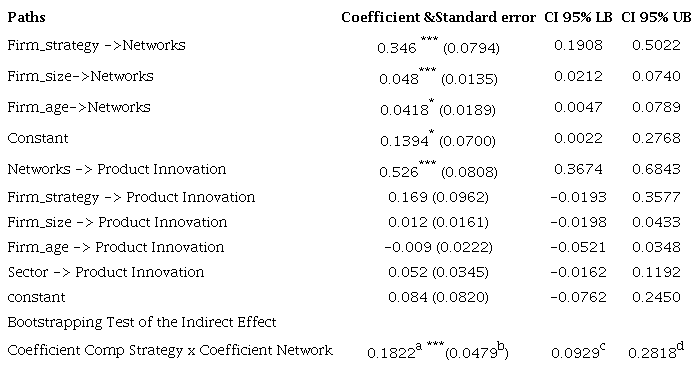
a Coefficient of Percentile Bootstrapping Coefficient Interval testb Bootstrap standard errorc Lower bound percentile bootstrapping confidence intervald Upper bound percentile bootstrapping confidence interval* p<0.05,** p<0.01,*** p<0.001
DISCUSSION
Regarding the link between firm strategy and product innovation proposed by hypothesis one, the results support the claims of most previous empirical evidence (Table 1) that such a strategy is necessary to implement the innovation and develop competitive advantages. With regard to the link between business networks and product innovation posited by hypothesis two, our findings coincide with those published by different authors (Table 1). Networks seem to facilitate access to and the creation of new knowledge, create synergies and interdependencies between firms, strengthen absorptive capacity, and enhance certain values and attitudes in SMEs, reflected in their product innovation.
The evidence of the mediating role that business networks play in the relationship between firm strategy and product innovation in SMEs suggested by hypothesis three is the main contribution of the present study. Our evidence shows that networks may affect the adaptive and emerging decisions that might be encompassed in an SME’s strategy (Mintzberg & Waters, 1985). Moreover, networks may influence the organizational resources and capabilities of that strategy, which, in turn, influences product innovation (Jardon & Martos, 2012).
Our results support the idea that business networks govern the heterogeneity and intensity of the external resources that a firm can access and whose value can be transmitted into the connection between strategy and product innovation (Jiang et al., 2020). SMEs generally have limited internal information sources and financial resources for scanning and monitoring their environments (Crema et al., 2014). The results of our paper may signal how networks can mediate that behavior from the strategic point of view and, consequently, how this can stimulate product innovation in SMEs.
We should bear in mind that product innovation performance in SMEs depends not only on internal resources and capabilities but also on context-specific aspects (Crema et al., 2014). Our findings show how networks (as a bridge between internal and external sources of resources and capabilities) can impact the connection between strategy and product innovation in SMEs.
The literature may provide ideas to help us understand the mediating effect of networks and the disconnection between strategy and product innovation shown in the analytical model proposed for our third hypothesis. On the one hand, innovation tends to be exploratory and unpredictable, whereas strategy focuses on planning and control (Day, 1990). Moreover, strategy encompasses a series of steps (budgets, deadlines, among others) which, more often than not, stifle or even go against innovation (Dobni, 2010). Finally, strategy is analytical and intuitive, which may occasionally force businesses to predict the future based on past experiences, whereas innovation focuses on working toward a desired future (Dobni, 2010). Thus, strategy alone does not necessarily lead to innovation, suggesting that an additional element affects both variables (Ju et al., 2018).
CONCLUSION AND IMPLICATIONS
This study analyzed the mediating role that business networks play in the relationship between firm strategy and product innovation in SMEs.Our results, based on a sample of 205 Costa Rican firms, confirm that mediating role.
Our study also confirms the relationship between strategy, business networks, and product innovation that other studies have found, as shown in the Discussion section. However, it provides evidence of the mediating role that business networks can play in the relationship between strategy and innovative performance.
Our results improve our understanding of the determinants of the relationship between strategy and innovation for SMEs and carry certain implications for practitioners and policymakers.
Therefore, it is valuable for SMEs to consider the strategic relevance of participating in business networks, as these permeate their strategic approach (Porter, 1996), the adaptive-emergent decision pattern that constitutes their strategy (Mintzberg & Waters, 1985), and the configuration of resources and capabilities of this strategy (Jardon & Martos, 2012). For SME managers, it might be worth bearing in mind that the business network structure (i.e., breadth and depth) governs the heterogeneity and intensity of external resources that a firm can access, which may promote dynamic capabilities that generate superior, innovative performance (Teece, 1997).
It may be helpful for policymakers to promote and manage business networks that include SMEs. However, these networks should be appointed to create and transfer knowledge (Jordão et al., 2019) that enriches dynamic capabilities in strategy and product innovation.
Limitations and future research
Our study has some limitations that may inspire future investigations. First, it focused on the mediating role that business networks play in the relationship between strategy and product innovation. However, other organizational variables may play a similar role. Future research could explore some of those variables, such as marketing strategy (Adams et al., 2019), business models (Ferreras-Méndez et al., 2021), and entrepreneurial orientations (Genc et al., 2019).
Second, given the cross-sectional nature of this study, the data for the dependent and independent variables were collected at one given point in time. This implies that the behavior of the variables is maintained within the reasonable time frame required by the independent variables to have a significant effect on the dependent variables. Moreover, the recursive nature of this study does not allow for the assessment of the possible feedback loop between product innovation and business networks. Future qualitative research could explore the variables linked to this possible bidirectional effect between those two variables and the role that firm strategy could play in non-recursive models. Moreover, and in line with the above, it could be useful to conduct longitudinal studies to reveal possible reciprocally influential relationships between the variables.
Finally, the relationships hypothesized in this study were tested using data from a sample of businesses obtained from a single country, so possible cultural bias or other country-specific effects cannot be disregarded. Therefore, future research could undertake a cross-country approach to confirm the hypothesized relationships and other contextual variables.
REFERENCES
Acemoglu, D., & Cao, D. (2015). Innovation by entrants and incumbents. Journal of Economic Theory, 157, 255-294. https://doi.org/10.1016/j.jet.2015.01.001
Acock, A. (2013). Discovering Structural Equation Modeling Using Stata. Stata Press.
Adams, P., Bodas-Freitas, I. M., & Fontana, R. (2019). Strategic orientation, innovation performance and the moderating influence of marketing management. Journal of Business Research, 97, 129-140. https://doi.org/10.1016/j.jbusres.2018.12.071
Alonso, S., & Leiva, J. C. (2019). Competitividad empresarial en Costa Rica: Un enfoque multidimensional. Tec Empresarial, 13(3), 28-41. https://doi.org/10.18845/te.v13i3.4597
Amabile, T. M., & Pratt, M. G. (2016). The dynamic componential model of creativity and innovation in organizations: Making progress, making meaning. Research in Organizational Behavior, 36, 157-183. https://doi.org/10.1016/j.riob.2016.10.001
Ansoff, I. (1965). Corporate strategy. McGraw-Hill.
Barney, J. (1991). Firm resources and sustained competitive advantage. Journal of Management, 17(1), 99-120. https://doi.org/10.1177/014920639101700108
Baron, R. M., & Kenny, D. A. (1986). The moderator-mediator variable distinction in social psychological research: Conceptual, strategic, and statistical considerations. Journal of Personality and Social Psychology, 51(6),1173-1182. https://doi.org/10.1037/0022-3514.51.6.1173
Barzi, F., Cortelezzi, F., Marseguerra, G., & Zoia, M. G. (2015). Cooperative innovation: In quest of effective partners - Evidence from Italian firms. Innovation, 17(3), 281-307. https://doi.org/10.1080/14479338.2015.1036541
Belso-Martínez, J. A., Mas-Verdu, F., & Chinchilla-Mira, L. (2020) How do interorganizational networks and firm group structures matter for innovation in clusters: Different networks, different results. Journal of Small Business Management, 58(1), 73-105. https://doi.org/10.1080/00472778.2019.1659673
Berends, H., Jelinek, M., Reymen, I., & Stultiëns, R. (2014). Product innovation processes in small firms: Combining entrepreneurial effectuation and managerial causation. Journal of Product Innovation Management, 31(3), 616-635. https://doi.org/10.1111/jpim.12117
Castillo-Vergara, M., & García-Pérez-de-Lema, D. (2021). Product innovation and performance in SME’s: The role of the creative process and risk taking. Innovation, 23(4), 470-488. https://doi.org/10.1080/14479338.2020.1811097
Chaston, I., & Mangles, T. (2000). Business networks: assisting knowledge management and competence acquisition within UK manufacturing firms. Journal of Small Business and Enterprise Development, 7(2),160-170. https://doi.org/10.1108/EUM0000000006837
Crema, M., Verbano, C., & Venturini, K. (2014). Linking strategy with open innovation and performance in SMEs. Measuring Business Excellence, 18(2), 14-27. https://doi.org/10.1108/MBE-07-2013-0042
Creswell, J. W. (2014). Research design: Qualitative, quantitative and mixed methods approaches (4th ed.). SAGE Publications, Inc.
Crowson, M. (2021, March 6). Using 'sem' commands to mimic Hayes' Process Model 4 in Stata [Video]. YouTube. https://www.youtube.com/watch?v=4xfxbqlvuTA&ab_channel=MikeCrowson
Day, G., (1990). Market-driven strategy: Processes for creating value. Free Press.
Dobni, C. B. (2010). Achieving synergy between strategy and innovation: The key to value creation. International Journal of Business Science and Applied Management, 5(1),48-58. https://www.business-and-management.org/papers/achieving-synergy-between-strategy-and-innovation-the-key-to-value-creation/50/
Ferreras-Méndez, J. L., Olmos-Peñuela, J., Salas-Vallina, A., & Alegre, J. (2021). Entrepreneurial orientation and new product development performance in SMEs: The mediating role of business model innovation. Technovation, 108, 102325. https://doi.org/10.1016/j.technovation.2021.102325
Field, A. (2013). Discovering Statistics using IBM SPSS Statistics (4th ed). SAGE Publications.
Fisher, G. J., & Qualls, W. J. (2018). A framework of interfirm open innovation: Relationship and knowledge based perspectives. Journal of Business & Industrial Marketing, 33(2), 240-250. https://doi.org/10.1108/JBIM-11-2016-0276
Galaso, P., Rodríguez-Miranda, A., & Picasso, S. (2019). Inter-firm collaborations to make or to buy innovation: Evidence from the rubber and plastics cluster in Uruguay. Management Research, 17(4), 404-425. https://doi.org/10.1108/MRJIAM-12-2018-0893
Galvin, P., Burton, N., Singh, P. J., Sarpong, D., Bach, N., & Teo, S. (2020). Network rivalry, competition and innovation. Technological Forecasting and Social Change, 161, 120253. https://doi.org/10.1016/j.techfore.2020.120253
Genc, E., Dayan, M., & Genc, O. F. (2019). The impact of SME internationalization on innovation: The mediating role of market and entrepreneurial orientation. Industrial Marketing Management, 82, 253-264. https://doi.org/10.1016/j.indmarman.2019.01.008
Grant, R. M. (1991). The resource-based theory of competitive advantage: implications for strategy formulation. California Management Review, 33(3), 114-135. https://doi.org/10.2307/41166664
Granovetter, M. (1973). The strength of weak ties. American Journal of Sociology, 78(6), 1360-1380. https://www.journals.uchicago.edu/doi/10.1086/225469
Helfat, C. E., Kaul, A., Ketchen, D. J., Barney, J. B., Chatain, O., & Singh, H. (2023). Renewing the resource-based view: New contexts, new concepts, and new methods. Strategic Management Journal, 44(6), 1357-1390. https://doi.org/10.1002/smj.3500
Henry, L. (2013). Intellectual capital in a recession: Evidence from UK SMEs. Journal of Intellectual Capital, 14(1), 84-101. https://doi.org/10.1108/14691931311289039
Jardon, C., & Martos, M. (2012). Intellectual capital as competitive advantage in emerging clusters in Latin America. Journal of Intellectual Capital, 13(4), 462-481. https://doi.org/10.1108/14691931211276098
Jiang, W., Mavondo, F., & Zhao, W. (2020). The impact of business networks on dynamic capabilities and product innovation: The moderating role of strategic orientation. Asia Pacific Journal of Management, 37, 1239-1266. https://doi.org/10.1007/s10490-018-9628-2
Johannisson, B. (1998). Personal networks in emerging knowledge-based firms: Spatial and functional patterns. Entrepreneurship & Regional Development, 10(4), 297-312. https://doi.org/10.1080/08985629800000017
Jordão, R. V. D., Novas, J., & Gupta, V. (2019). The role of knowledge-based networks in the intellectual capital and organizational performance of small and medium-sized enterprises. Kybernetes, 49(1), 116-140. https://doi.org/10.1108/K-04-2019-0301
Ju, M., Jin, J. L., & Zhou, K. Z. (2018). How can international ventures utilize marketing capability in emerging markets? its contingent effect on new product development. Journal of International Marketing, 26(4), 1-17. https://doi.org/10.1177/1069031X18809999
Lafuente, E., Leiva, J. C., Moreno-Gómez, J., & Szerb, L. (2019). A non-parametric analysis of competitiveness efficiency: The relevance of firm size and the configuration of competitive pillars. BRQ Business Research Quarterly, 23(3), 203-216. https://doi.org/10.1016/j.brq.2019.02.002
Lafuente, E., & Vaillant, Y. (2021). Pulling from the front or pushing from behind: How competency prioritisation should differ to optimise firm competitiveness. European Business Review, 33(6), 849-868. https://doi.org/10.1108/EBR-11-2020-0288
Lan, Y., Massimino, B. J., Gray, J. V., & Chandrasekaran, A. (2020). The effects of product development network positions on product performance and confidentiality performance. Journal of Operations Management, 66(7-8), 866-894. https://doi.org/10.1002/joom.1105
Lechner, C., & Dowling, M. (2003). Firm networks: External relationships as sources for the growth and competitiveness of entrepreneurial firms. Entrepreneurship & Regional Development, 15(1), 1-26. https://doi.org/10.1080/08985620210159220
Liu, C., & Kong, D. (2021). Business strategy and sustainable development: Evidence from China. Business Strategy and the Environment, 30(1), 657-670. https://doi.org/10.1002/bse.2645
Liu, W., & Atuahene-Gima, K. (2018). Enhancing product innovation performance in a dysfunctional competitive environment: The roles of competitive strategies and market-based assets. Industrial Marketing Management, 73, 7-20. https://doi.org/10.1016/j.indmarman.2018.01.006
Liu, X., Cai, J., & Smart, A. U. (2020). Does the way in which a firm interacts with its network partners influence its formulation of product innovation strategies? International Journal of Technology Management, 83(4), 181-204. https://doi.org/10.1504/IJTM.2020.110119
López-Fernández, J. M., Somohano-Rodríguez, F. M., & Martínez-García, F. J. (2018). Effect of the innovation on the profitability of micro and SMEs in economic contexts of economic recession and growth. Tec Empresarial, 12(1), 7-18. https://doi.org/10.18845/te.v12i1.3567
Lukovszki, L., Rideg, A., & Sipos, N. (2020). Resource-based view of innovation activity in SMEs: An empirical analysis based on the global competitiveness project. Competitiveness Review: An International Business Journal, 31(3), 513-541. https://doi.org/10.1108/CR-01-2020-0018
Lumpkin, G.T., & Dess, GG (1996). Clarifying the entrepreneurial orientation construct and linking it to performance. Academy of Management Review, 21(1), 135-172. https://doi.org/10.5465/amr.1996.9602161568
March, J. G. (1991). Exploration and exploitation in organizational learning. Organization Science, 2(1), 71-87. https://www.jstor.org/stable/2634940
Miller, A., Dess, G. G., & Dess, G. G. (1996). Strategic management (2nd ed.). McGraw-Hill.
Mintzberg, H., & Waters, J. (1985). Of strategies, deliberate and emergent. Strategic Management Journal, 6(3), 257-272. https://doi.org/10.1002/smj.4250060306
Molina-Morales, F. X., & Martínez-Fernández, M. T. (2010). Social networks: Effects of social capital on firm innovation. Journal of Small Business Management, 48(2), 258-279. https://doi-org.ezproxy.itcr.ac.cr/10.1111/j.1540-627X.2010.00294.x
Moreno-Moya, M., & Munuera-Aleman, J.-L. (2016). The differential effect of development speed and launching speed on new product performance: An analysis in SMEs. Journal of Small Business Management, 54(2), 750-770. https://doi.org/10.1111/jsbm.12170
Morgan, T., Anokhin, S., Kretinin, A., & Frishammar, J. (2015). The dark side of the entrepreneurial orientation and market orientation interplay: A new product development perspective. International Small Business Journal, 33(7), 731-751. https://doi.org/10.1177/0266242614521054
Mu, J., Peng, G., & MacLachlan, D. L. (2009). Effect of risk management strategy on NPD performance. Technovation, 29(3), 170-180. https://doi.org/10.1016/j.technovation.2008.07.006
Organisation for Economic Co-operation and Development. (2021). OECD SME and entrepreneurship Outlook 2021. OECD Publishing. https://doi.org/10.1787/97a5bbfe-en
Plano, V. L., & Creswell, J. W. (2015). Understanding research: A consumer’s guide (2nd ed.). Pearson Education, Inc.
Porter, M. E. (1980). Firm strategy. The Free Press.
Porter, M. E. (1996). What is strategy? Harvard Business Review, 74(6), 61-78.
Prahalad, C. K., & Hamel, G. (1990). The core competence of the corporation. Harvard Business Review, 68, 79-91.
Ratner, B. (2009). The correlation coefficient: Its values range between +1/-1, or do they? Journal of Targeting, Measurement and Analysis for Marketing, 17(2), 139-142. https://doi.org/10.1057/jt.2009.5
Rideg, A., Szerb, L., & Varga, A. R. (2023). The role of intellectual capital on innovation: Evidence from Hungarian SMEs. Tec Empresarial, 17(2), 1-19. https://doi.org/10.18845/te.v17i2.6695
Shan, P., Song, M., & Ju, X. (2016). Entrepreneurial orientation and performance: Is innovation speed a missing link? Journal of Business Research, 69(2), 683-690. https://doi.org/10.1016/j.jbusres.2015.08.032.
Surroca, J., Tribó, J. A., & Waddock, S. (2010). Corporate responsibility and financial performance: The role of intangible resources - Intangibles, corporate responsibility, and financial performance. Strategic Management Journal, 31(5), 463-490. https://doi.org/10.1002/smj.820
Tarapuez, E., Guzmán, B. E., & Hernández, R. P. (2016). Estrategia e innovación en las Mipymes colombianas ganadoras del premio Innova 2010-2013. Estudios Gerenciales, 32(139), 170-180. https://doi.org/10.1016/j.estger.2016.01.002
Teece, D. J., Pisano, G., & Shuen, A. (1997). Dynamic capabilities and strategic management. Strategic Management Journal, 18(7), 509-533. https://doi.org/10.1002/(SICI)1097-0266(199708)18:7<509::AID-SMJ882>3.0.CO;2-Z
Thatchenkery, S., & Katila, R. (2021). Seeing what others miss: A competition network lens on product innovation. Organization Science, 32(5), 1346-1370. https://doi.org/10.1287/orsc.2021.1430
Thoumrungroje, A., & Racela, O. C. (2022). Innovation and performance implications of customer-orientation across different business strategy types. Journal of Open Innovation: Technology, Market, and Complexity, 8(4), 178. https://doi.org/10.3390/joitmc8040178
Turner, K. L., & Makhija, M. V. (2012). The role of individuals in the information processing perspective. Strategic Management Journal, 33(6), 661-680. https://doi.org/10.1002/smj.1970
Udagedara, R. S., & Allman, K. (2019). Organizational dynamics and adoption of innovations: A study within the context of software firms in Sri Lanka. Journal of Small Business Management, 57(2), 450-475. https://doi-org.ezproxy.itcr.ac.cr/10.1111/jsbm.12378
Vasconcelos, R. B. B. de, & Oliveira, M. R. G. de. (2018). Determinants of innovation in micro and small enterprises: A management approach. RAE-Revista de Administração de Empresas (Journal of Business Management), 58(4), 349-364. https://doi.org/10.1590/S0034-759020180402
Vittinghoff, E., Glidden, D. V., Shiboski, S. C., & McCulloch, C. E. (2011). Regression methods in biostatistics: Linear, logistic, survival, and repeated measures models (2nd ed.). Springer.
Wernerfelt, B. (1984). A resource-based view of the firm. Strategic Management Journal, 5(2), 171-180. https://doi.org/10.1002/smj.4250050207
Wright, P. L., Kroll, M. J., & Parnell, J. A. (1998). Strategic management: Concepts (4th ed). Prentice Hall.
Yahya, S., Khan, A., Farooq, M., & Irfan, M. (2022). Integrating green business strategies and green competencies to enhance green innovation: Evidence from manufacturing firms of Pakistan. Environmental Science and Pollution Research, 29(26), 39500-39514. https://doi.org/10.1007/s11356-021-18430-1
Notes
Author notes
*Corresponding author
Conflict of interest declaration
The authors have no conflicts of interest to declare.