ARTICLES
A SCIENTOMETRIC ANALYSIS OF INSTITUTIONS IN THE INTERNATIONAL BUSINESS RESEARCH
Un análisis cienciométrico de las instituciones en la investigación de negocios internacionales
UMA ANÁLISE CIENTOMÉTRICA SOBRE INSTITUIÇÕES NA PESQUISA DE NEGÓCIOS INTERNACIONAIS
 Jefferson Marlon Monticelli jmmonticelli@unisinos.br
André Moraes dos Santos amsantos@univali.br
Christian Falaster christianfalaster@gmail.com
Jefferson Marlon Monticelli jmmonticelli@unisinos.br
André Moraes dos Santos amsantos@univali.br
Christian Falaster christianfalaster@gmail.com
A SCIENTOMETRIC ANALYSIS OF INSTITUTIONS IN THE INTERNATIONAL BUSINESS RESEARCH
Revista de Administração de Empresas, vol. 64, no. 1, e2022-0310, 2024
Fundação Getulio Vargas, Escola de Administração de Empresas de S.Paulo
Received: 08 December 2022
Accepted: 16 October 2023
ABSTRACT: This paper explores the co-evolution of international business studies and institutions, employing a scientometric approach and bibliometric review on the application of institutional concepts in international business studies, outlining a research agenda. We compiled a database of 3,520 articles and conducted a scientometric analysis to examine the evolution of the term “institutions” in international business in ABS-ranked journals. Our findings show that (1) over the past two decades, there has been a shift in the use of the term institutions from a political and economic connotation to a sociological perspective to explain how firms adopt strategies, make decisions, and address intra-national problems during the internationalization process; (2) traditional approaches were found to be insufficient in explaining context-dependent events that affect international business; and (3) China has emerged as a critical player in international business studies, which has helped to redirect the focus of institutions from political and economic aspects to the sociological context. Finally, we propose an agenda for future research, highlighting potential pitfalls and remedies.
Keywords: International business, institutions, bibliometrics, scientometrics, VosViewer.
RESUMEN: Este artículo tiene como objetivo explorar la coevolución de los estudios de negocios internacionales y las instituciones, empleando un enfoque cienciométrico y una revisión bibliométrica sobre la aplicación de conceptos institucionales en los estudios de negocios internacionales, delineando una agenda de investigación. Recopilamos una base de datos de 3.520 artículos y realizamos un análisis cienciométrico para examinar la evolución del término "instituciones" en las revistas clasificadas en el ranking ABS en relación con los negocios internacionales. Nuestros hallazgos muestran que: (1) en las últimas dos décadas, ha habido un cambio en el uso del término instituciones de una connotación política y económica a una perspectiva sociológica, que busca explicar cómo las empresas adoptan estrategias, toman decisiones y abordan los problemas intranacionales durante el proceso de internacionalización; (2) se encontró que los enfoques tradicionales eran insuficientes para explicar los eventos dependientes del contexto que afectan los negocios internacionales; y (3) China ha emergido como un actor clave en los estudios de negocios internacionales, lo que ha ayudado a redirigir el enfoque de las instituciones desde los aspectos políticos y económicos al contexto sociológico. Finalmente, proponemos una agenda para futuras investigaciones, destacando posibles dificultades y soluciones.
Palabras clave: Negocios internacionales, instituciones, bibliometría, cienciometría, VosViewer.
RESUMO: Este artigo tem como objetivo explorar a coevolução dos estudos sobre negócios internacionais e instituições, utilizando uma abordagem cientométrica e conduzindo uma revisão bibliométrica da aplicação de conceitos institucionais em estudos de negócios internacionais, de forma a delinear uma agenda de pesquisa. Compilamos um banco de dados de 3.520 artigos e realizamos uma análise cientométrica para examinar a evolução do termo “institutions” (instituições) no contexto dos negócios internacionais em periódicos classificados no ranking ABS. Nossos resultados mostram que: (1) nas últimas duas décadas, houve uma mudança no uso do termo institutions de uma conotação política e econômica para uma perspectiva sociológica, que busca explicar como as empresas adotam estratégias, tomam decisões e abordam problemas intranacionais durante o processo de internacionalização; (2) as abordagens tradicionais foram consideradas insuficientes para explicar eventos dependentes do contexto que afetam os negócios internacionais; e (3) a China emergiu como um ator-chave nos estudos de negócios internacionais, o que ajudou a redirecionar o foco das instituições dos aspectos políticos e econômicos para o contexto sociológico. Por fim, propomos uma agenda de pesquisa para futuros estudos, destacando possíveis armadilhas e soluções.
Palavras-chave: Negócios internacionais, instituições, bibliometria, cientometria, VosViewer.
INTRODUCTION
The significance of institutions within the realm of International Business (IB) literature has become commonplace, with a notable shift from focusing on traditional markets to emerging markets, where institutions wield profound influence (Mudambi & Navarra, 2002). However, this emphasis presents a challenge due to institutions’ diverse definitions and characteristics across various fields from which theories are derived. It is increasingly difficult to draw and make sense from the overarching theoretical framework of institutions as their meanings and internal mechanisms become more complex with the theory’s development.
In economics, institutions are typically seen as mechanisms to enhance market efficiency by reducing transaction costs, as seen in North’s (1990) and Williamson’s (1985b) works. In political science, institutions are seen as tools for power distribution, cooperation, and governance (Helmke & Levitsky, 2012; Ostrom, 1990). From the organizational science perspective, institutions are analyzed regarding legitimacy, adaptation, and routines (Scott, 2008). This multifaceted approach extends further to concepts like institutional logic (Thornton et al., 2015), institutional change (Kingston & Caballero, 2009), institutional complexity (Greenwood et al., 2011), institutional polycentrism (Batjargal et al., 2013), and institutional voids (Doh et al., 2017), all of which contribute to the diverse tapestry of IB research (Rottig, 2016). Together, these approaches enrich the understanding of institutions’ impact on IB (Peng et al., 2023), fostering an evolving and intertwined narrative within the field.
As a result, the evolution of the IB literature concerning institutions has unfolded across more than three decades, evolving alongside broader institutional knowledge. While concepts were initially drawn from other disciplines, IB scholars have developed unique perspectives that inform future research. Aligned with the co-evolutionary perspective by Cantwell, Dunning, and Lundan’s (2010), this paper aims to explore the co-evolution of IB studies and institutions, employing a scientometric approach to retrospectively review the application of institutional concepts in IB studies and outline a research agenda.
This study sheds light on the interconnections between institutions and IB by employing cross-sectional data and scientometric analyses. The study mitigates biases stemming from authors’ preferences or the sources they applied using quantitative criteria to select publications and analyze citations and interconnections. We compiled data from the Web of Science and Scopus databases to create an article list. The scientometric approach and network methodology were then employed to trace the evolution of institutional concepts in IB (Abramo, 2018).
Scientometric techniques have found application in the realm of IB studies previously. Examples include Ferreira, Pinto, and Serra (2014), who conducted a meta-analysis of transaction cost theory in IB; Liesch, Welch, and Buckley (2011), who developed a framework for measuring the pace of evolution in IB studies; López-Duarte, Vidal-Suárez, González-Diáz, and Reis (2016), who explored the significance of culture in IB, and Bhardwaj (2016) who analyzed 1623 indexed papers in IB literature to map research trends.
This paper targets scholars engaged in theory-building, aiming to enhance the understanding of institutional theory’s evolution and application in IB. The study offers a historical overview of institutions’ utilization in IB research, enabling researchers to position their studies within this evolving framework. The research expands the existing body of literature by documenting the co-evolution of IB studies and the institution-based approach (Cantwell et al., 2010). Additionally, a research agenda is proposed to advance the theoretical framework for constructing IB theories, offering a scientometric perspective as a guiding principle for future research.
The findings underline the significance of this theoretical co-evolution. Over two decades following the spotlight on research institutions by Mudambi and Navarra (2002), this paper contributes to that endeavor by analyzing 3,520 articles. This analysis portrays the dynamics of the institutional perspective within IB studies and highlights a recent shift toward a sociological approach to institutions. While institutions were initially harnessed to examine political and economic disparities, the analysis reveals a shift towards emphasizing economic factors, with recent studies embracing a sociological viewpoint. Contemporary research delves into comprehending strategy formulation, decision-making processes, intra-firm dynamics, and IB’s micro-foundations, reflecting this intricate relationship’s evolving nature.
PRELUDING INSTITUTIONS AND INTERNATIONAL BUSINESS INTERPLAY
In the late 1980s, trade between countries with diverse and distant institutional environments intensified. IB studies found a new perspective in the new institutionalism that could help explain the intensification of business complexity, hitherto unsolved by taken-for-granted theoretical assumptions. Historical institutionalism, rational choice intuitionalism, and sociological institutionalism gained traction to explain the role of institutions in determining social and political outcomes (Hall & Taylor, 1996) when the confluence of IB and institutions revealed a valuable way of understanding how IB studies have changed.
In parallel, the ambiguities about the institution’s definition were brought together. While in the economic perspective, raised from the rational choice intuitionalism (Moe, 1984), institutions could be defined as “the rules of the game” (North, 1990, p. 3) that fill gaps resulting from market failures (North, 1971) in the sociological perspective, institutions are “cognitive, normative, and regulative structures and activities that provide stability and meaning to social behavior” (Scott, 1995, p. 33).
Until the 1980s, neoclassical economics heavily influenced IB studies based on equilibria between economic factors, such as prices and outcomes (Mudambi & Navarra, 2002). However, globalization and the emergence of new markets brought the institutional environment into focus. For instance, Peng, Wang, and Jiang (2008, p. 1) raised the question, “What drives firm strategy and performance in IB?” arguing that an institution-based view of IB strategy could combine industry-based and resource-based views to help to explain the internationalization process in emerging markets. Monticelli, Garrido, Curth, Vieira, and Dal-Soto (2018) drew parallels with body dysmorphic disorder, hypothesizing that institutions can also suffer from dysmorphic disorder, creating obstacles to the internationalization process.
Scholars widely recognize that an institutionalist perspective helps analyze organizations. Institutionalism identifies and explains the core values and the social actors participating in the organizational sphere, sharing or disputing resources and power to achieve their goals (Scott, 1995). Institutionalist scholars understand that the environment influences organizations and regulates social legitimacy and institutional processes (Suchman, 1995).
Formal institutions - such as political regulations, court decisions, and economic contracts - converge as legal or governance systems. At the same time, informal institutions - such as behavioral, cultural, ethnic, and ideological norms and conventions - can sustain this convergence, but not necessarily (Khanna et al., 2015). Informal devices intervene to mitigate the uncertainty when there is a lack of or limitation in the formal mechanisms (Peng et al., 2008). An institutional system will be complete only through the interaction between formal and informal institutions (Dunning & Lundan, 2009). Thus, the institutions will operate through their formal or informal structures to perform economic and social transactions that, in turn, will affect any strategic decision adopted by the firm (North, 1990).
National, sub-national, and local spheres all involve constraints at the institutional level (Markusen, 1996) and act as constraints to the actions of managers and organizations. These barriers induce managers to act through similar mechanisms, replicating isomorphic changes. Rather than firms attempting to differentiate themselves from competitors, there is a tendency for homogenization in the field. It is precisely this behavior in contradiction to an expected pattern that guides the studies of institutional theory. This tendency spreads to new entrants, motivated by the environment in which they operate and the forces that govern the social dimension, leading organizations to relentlessly pursue institutional legitimacy (DiMaggio & Powell, 1983).
The implications found in the confluence of IB and institutions are a permanent interest in the literature. For example, revisiting Jackson and Deeg (2008), Aguilera and Grøgaard (2019) examined the role of institutional analysis in IB studies, especially how firms are embedded in institutional configurations of the context, the competitive advantage approach from an institutional lens, and the comprehension of institutional change. They stressed the necessity of looking at institutions alternatively. They first highlighted their particular combinations and explored complementarity and conflicts of available perspectives, avoiding generalizations (Jackson & Deeg, 2008). Secondly, they focused on developing middle-range theories to compare how institutional configurations influence the activities of internationalized firms (Jackson & Deeg, 2019).
METHODOLOGICAL PROCEDURES
Some studies refer to scientometrics as a science about science (Serenko et al., 2009). Scientometrics has its own identity and has been used as a resource for synthesis (Dou, 1994) and to promote interdisciplinarity (Kim & Zhu, 2018) for decades. In general, scientometric studies present meta-analyses of topics and methodologies, identify prominent authors on a topic and more productive countries, report analysis of citations and co-citations, and point out research anomalies.
This paper conducts a bibliometric review to outline future research and examine how, from a scientometric perspective, the relationships between various institutional approaches and IB studies have changed over the last two decades. To visualize the different structures and features of data records (Waltman et al., 2010), we mapped the literature using bibliometric methods, such as graphical networks and clustering techniques (Abramo, 2018), citation analysis, co-citation analysis, bibliographical coupling, co-author analysis, and word co-occurrence analysis were used to handle a large number of records (n=3,520 scientific papers). Applying robust empirical bibliometric methods helps produce objective, evidence-based analyses of the literature (Suominen et al., 2019).
Our primary interest was identifying the most extensive set of articles referring to institutions and IB. As these terms are not exclusive to the IB domain, we avoided including undesired results from other areas. We used the Association of Business Schools’ (ABS) Journal Quality Guide list of journals in the IB and Area Studies subject area (IB&AREA). The ABS list has been used systematically to find the top journals covering IB studies (Skjølsvik et al., 2017; Willmott, 2011) and especially to delimit scientometric studies (Wu et al., 2015). Following the ABS list (Association of Business Schools, 2018), we retrieved 56 journal titles using the IB&AREA descriptor. We assume that the ABS ranking provides comprehensive coverage of IB journals and has good internal and external reliability (Kelly et al., 2009). Although the ABS list’s ranking criteria have been the subject of criticism (Willmott, 2011), it is helpful to accurately determine the set of journals central to a sub-area of management and business studies, in this case, IB and Area Studies. We have illustrated this research process in Figure 1.
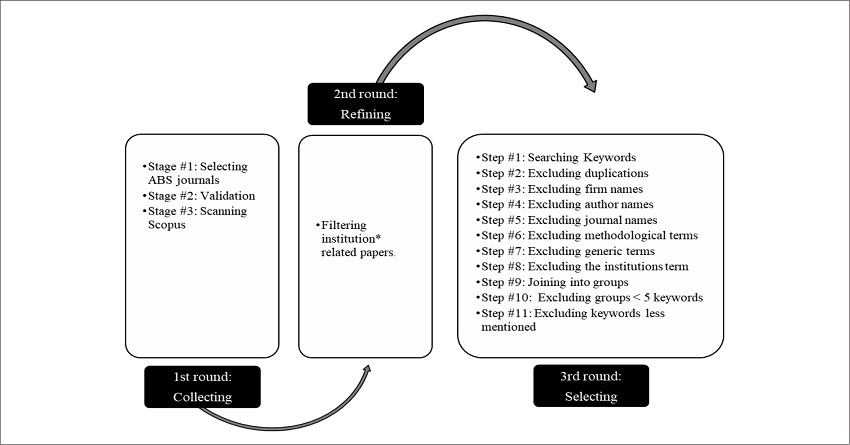
Figure 1
Research Design
Figure 1 depicts how we operationalize our research. We split the process into three rounds: collecting papers, refining them, and clustering the keywords. We split the first round into stages and the third into steps. In the first round, we selected the journals. In the second round, we checked their validity. Finally, we focused on the Scopus database in the third round, in a series of 11 steps. The scientometric analysis per se was based on three primary cluster analyses conducted using VosViewer Software (Waltman et al., 2010).
Round 1: Collecting papers
In the first round, we started from the ABS journal list of IB&AREA journals and searched the Scopus database for these 56 journal titles by ISSN number. This procedure improves internal validity because titles in the Scopus base may differ slightly from the ABS list. Five titles were not included in the Scopus database and removed from the list, leaving 51 valid entries, with 76,435 citations listed on Scopus. We chose to use the Scopus database to improve internal consistency since Scopus is recognized for its high-quality coverage of citations (Falagas et al., 2008). All available years were used regarding the temporal scope until June 2018.
Table 1 lists the 21 most-cited journals, together accounting for 95% of the citations of ABS journals indexed on Scopus, in descending order of percentage of all citations.
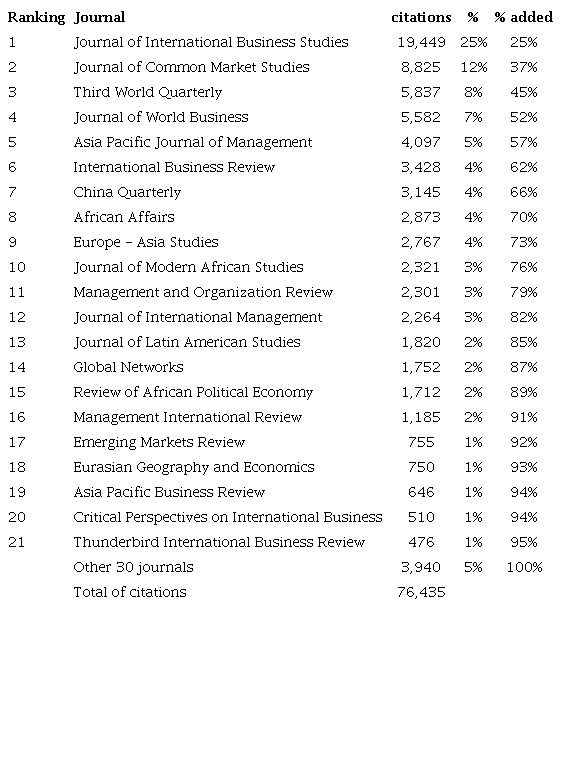
Table 2 lists the 20 most-cited articles we found in the first round of the research process.

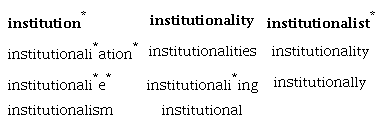
In the second stage of the first round, we tested the internal validity of search terms for identifying the theme of institutions. An effective search term should capture as many relevant articles as possible with a minimum of ‘noise,’ i.e., articles without connection with the topic. A preliminary analysis of the results of searches of Scopus, Web of Science, and Google Scholar identified 21 variant terms related to the root word “institution.” All these terms were valid and related to the focus of this study, as listed in Table 3.
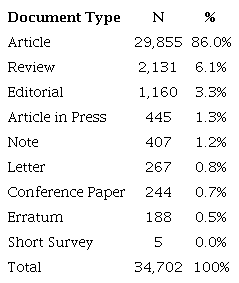
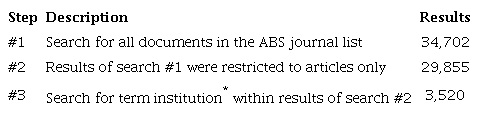
In the third stage of the first round, we ran a search on the Scopus database. To refine the scope of our inquiry, we conducted a targeted search for citations of articles published in the 51 journals selected from the previously defined ABS list, all of which are indexed in the Scopus database. These articles were cited 76,435 times in the entire Scopus database, in 34,702 documents, 86% of which were scientific journal articles. Thus, 29,855 articles indexed on SCOPUS cited papers published in ABS journals in the IB&AREA field. Table 4 lists the results of the first round of searches.
Round 2: Refining the results
In the second round, we refined the results by filtering articles with variants of the root word institution in the title, abstract, or keywords. We ended this search with 3,520 papers, as shown in Table 5.
Round 3: Selecting keywords
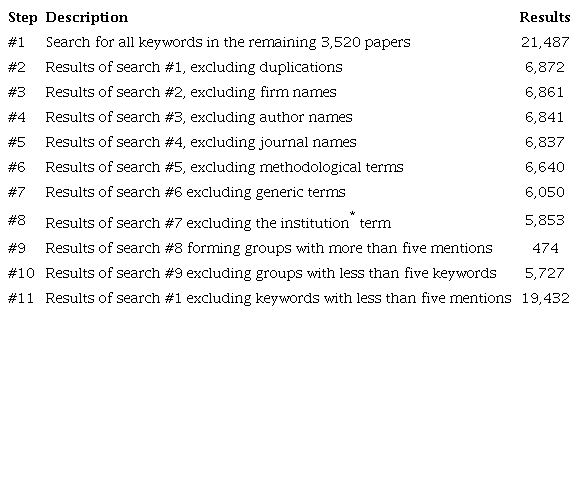
We analyzed the 3,520 articles found in the second round to identify keywords. We split the third round into 11 steps. In the first step, we searched for all keywords in the remaining 3,520 articles selected in the previous round. We found 21,487 occurrences, equating to 6,872 genuine keywords (step #2). We excluded 11 firm names (step #3), 20 author names (step #4), four journal names (step #5), 197 methodological terms (step #6), 590 generic words (step #7), for instance, ‘institutional framework’ (226), ‘conceptual framework’ (21), ‘article’ (8), and ‘research’ (5). Then, we excluded the primary term, ‘institution’ (197) (step #8), leaving 5,853 keywords. We excluded the terms’ institution’ and ‘institutions’ when they appear alone because, although fundamental, these terms are common to all articles. However, we kept them when combined with another term, e.g., ‘political institutions,’ which we allocated to a ‘politics’ keyword group.
We checked the 5,853 words, one by one, to recode words by similarity. We performed this step manually through the interactive and joint analysis and discussion with three scholars familiar with IB and institutional studies to reach a consensual code. The intercoder reliability assessment was dismissed since all three specialists checked each word together. To assure quality criteria, we provide transparent reporting and raw data of the recodification procedures for each one of the words, as recommended by O’Connor and Joffe (2020). For example, the terms violence (50), violent conflict (2), violent democracy (1), and intra-elite violence (1) were allocated to the violence keyword group, which has 54 items. Also, the terms transaction cost economics (14), transaction costs (9), transaction cost (3), transaction cost analysis (3), transaction cost theory (2), transaction costs theory (1), institutional transactions costs (1), and transaction cost variables (1), were all allocated to the TCT group, with 33 items. We also analyzed country names. Countries with four or fewer occurrences were included in their continent group, keeping countries with five or more mentions separate as single-keyword entities. Finally, we excluded groups with less than five occurrences, comprising 474 groups, to be analyzed by the scientometric software (step #9). After grouping, we removed a further 126 keyword groups because, even after grouping, they had less than five occurrences, leaving 5,727 keywords (step #10) in 474 groups. In summary, we focused on 19,432 occurrences of the 5,727 most relevant keywords out of 21,487 occurrences of all 6,872 keywords (about 90% of all occurrences with repetitions excluded), ensuring ample coverage of keywords and thus the reliability of the analysis (step #11). Table 6 depicts this process.
Analysis procedures
We applied a set of bibliometric network techniques to answer the research questions. Bibliometric network analysis analyzes networks of entities extracted from bibliographic metadata like authors, documents, keywords, or journals (Borgatti et al., 2013). We employed the weighted modularity-based clustering technique to identify groups of similar entities (communities) (Eck & Waltman, 2017). This clustering technique, developed by Waltman et al. (2010), is a weighted and parameterized variant of the modularity function proposed by Newman and Girvan (2004). The resolution parameter γ (γ > 0) influences the number and sizes of clusters. This level of control is crucial because it gives more flexibility in identifying relevant communities, especially in exploratory analysis (Palacios-Núñez et al., 2018). Different from traditional weighted modularity clustering (Muff et al., 2005), there is no general optimum value of γ, and it is recommended to test different values for the resolution parameter for a satisfactory level of detail for the research goals (D’Angelo & Magnusson, 2021). We used the visualization of similarities technique (VOS) to construct the network maps. The entities are positioned in a two-dimensional space, where the distance between couples represents their relatedness (Eck & Waltman, 2010). This approach provides an adequate representation of networks than maps constructed using the classical multidimensional scaling technique (Mariani et al., 2021). We use the computerized software package VosViewer that implements both mentioned techniques of clustering and mapping (Eck et al., 2010), suitable to support scientific mapping in the business and management area (Sprong et al., 2021).
RESULTS
The results of the cluster analyses are presented graphically in network maps illustrating relationships between the units of analysis. While the circles represent these units, either authors or keyword groups, the size of each circle represents the number of citations in the case of authors or the number of occurrences in the case of keyword groups. The color of each circle indicates the cluster to which it belongs (except for Figure 5, in which the colors indicate publication dates using a time-citation index, explained below). Clusters were defined by a combination of quantitative analysis and subjective judgment. The position of each circle compared to the other circles indicates their co-occurrence, even when they belong to different clusters, representing comparisons between subjects or theoretical approaches. Connecting lines indicate that authors or keyword groups were cited or mentioned in the same article. When cited or mentioned in the same cluster, the line is the same color as that cluster. When the units of analysis belong to different clusters, the line connecting them transitions gradually from one color to the other, representing a subject change.
Clustering authors and institutional perspectives
Before embarking on any analysis, we highlight how the field authors have cited each other and which publications have contributed to developing the institution-based approach to IB studies-Figure 2 depicts such connections.
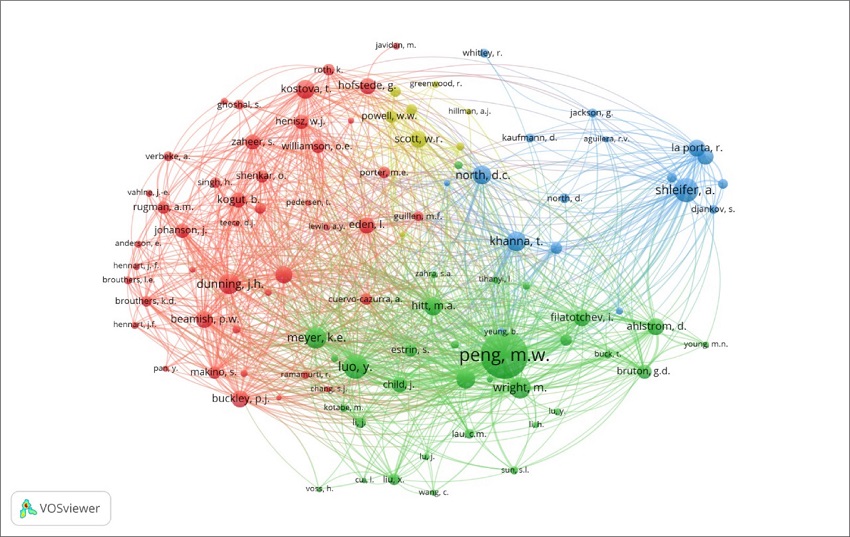
Figure 2
Authors Clustered
Source: Scientometric data analysis.
The green cluster encompasses work offering a set of theoretical foundations to explain the strategy tripod that sustains the IB, considered from a co-evolutionary and integrative perspective (Peng et al., 2008). Peng’s institution-based view of strategy has its roots in earlier works that did not use this specific term, such as Peng and Heath (1996). Peng (2003) also proposed that regulatory, normative, and cognitive pressures exert various degrees of influence depending on the phases of institutional transitions in incumbent firms, entrepreneurial startups, and foreign entrants. Thus, organizations enhance resources and connections in the industry in response to institutional changes, creating and changing institutions (Jackson & Deeg, 2008).
The red cluster is concentrated around Dunning (Dunning & Lundan, 2009), Buckley (Buckley & Ghauri, 2004), Delios (Delios & Beamish, 1999), Williamson (1985b), and Henisz and Swaminathan (2008), among others. Confluently with Transaction Cost Theory (Williamson, 1985a), this cluster has its foundations in the Eclectic Paradigm (Dunning, 1980) explanation of how MNEs expand their business abroad, sustained by their capacity for evaluating the equilibrium between choices about ownership, localization, and internalization. Although Dunning’s original contribution centered on rational-economic aspects has a limited theoretical connection to the concept of institutions, after it was later explored by Cantwell et al. (2010), subsequent literature began to treat institutions as a pivotal element for explaining the context as a landscape in which such decisions are made and in which specific sets of capabilities must be built. One relevant aspect of the red cluster is the proximity between diverse perspectives on IB. A possible explanation is the literature’s tendency to contrast perspectives to establish delimitations and complementarities. For example, the behavioral orientation in IB studies coexists with a rational-economic perspective, and the concept of institutions is critical for holistically understanding the institutional context (Levy et al., 2007).
A third cluster in blue connects to the informal institutions’ concept. It extends from Hofstede (1994), explaining the relationship between culture and business, through Khanna and Palepu (2004) and Kostova (1999) to Porta et al. (2008). This cluster represents an attempt to explain the legality and the effects of corruption on business or even subnational differences to consider when investing abroad (Aguilera et al., 2015) and how civil and common law origins in regulations affect the institutional environment (Djankov et al., 2002). This cluster encompasses a discussion about difficult-to-measure elements that impact business. The blue cluster connects with pure institutional theory (yellow) and institution-based view (green). One possible reason might be that these publications are more directly related to strategic aspects of IB and less integrated with institutionalization per se, which is more pronounced in the red cluster.
Finally, the yellow cluster represents a group of central scholars approaching institutions from a sociological perspective, including Walter W. Powell, Royston Greenwood, and William Richard Scott. This cluster provides data helpful in understanding how economic and sociological perspectives on institutions have had different influences on IB studies and indicates that explanations about political influences are mainly based on economic perspectives rather than political theory since the political approach to institutions is mainly ignored - although exceptions such as Kingston and Caballero (2009), must be acknowledged. For instance, Contractor (1990) points out that foreign firms are more inclined to alliances and partnerships with local firms in environments with restricted regulatory dimensions. Moreover, Agarwal (1994) mentions that something similar occurs in settings with a normative domain that culturally separates foreign and local firms. The yellow cluster represents a hub connecting IB studies with institutional theory. Similar to prior studies, seminal authors in the sociological approach of institutionalism are frequently cited within this cluster, along with the institutional complexity approach, representing a novel avenue for examining institutional ambiguities (Garrido et al., 2021; Greenwood et al., 2010).
One relevant feature of Figure 2 is the network mapping analysis. On the one hand, the positions of each author and the lines traced between them illustrate their connections. Each node’s size represents the total number of connections (centrality degree). For example, Sirmon and Hitt (2007), Cuervo-Cazurra (2018), and Eden (2010) appear to have somehow extrapolated the limits of specific areas, conducting research with a more multidisciplinary approach, employing a wide variety of different keywords, as explored in the next section. On the other hand, the distance between any pair of items reflects their similarity. Thus, the distance from the other clusters to the authors, who are central to the blue cluster, predominantly focused on corruption and rules (Porta et al., 2008), could indicate an exciting avenue for future investigation.
Clustering groups of keywords
We next explored the results of clustering the 474 groups of keywords. Our first intention was to cluster without limiting the number of clusters. However, the multiplicity of combinations limits the possibilities for summarizing the information it illustrates. We, therefore, decided to force clustering into just three clusters. We expected that clustering would clearly indicate whether the institution-based approach to IB studies tends to employ institutional perspectives with origins in the social sciences, economics, or political science or take an alternative path. Figure 3 illustrates the results.
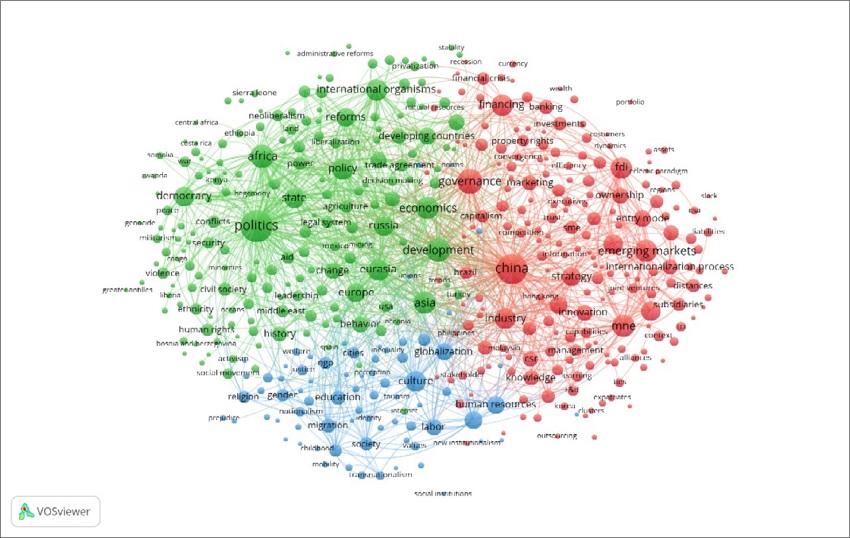
Figure 3
Three-cluster Model of Groups of Keywords
Source: Scientometric data analysis.
The green cluster centers on keywords labeled politics (787 mentions). This group encompasses 123 different keywords. The most frequent of these were political economy (99), political system (66), party politics (57), politics (46), election (42), political power (42), political relations (32), political conflict (31), and political reform (31). The others are all mentioned less than 20 times.
The green cluster is also about geographical issues. We grouped countries with less than five mentions-for example, Africa (494). The keyword group includes countries in Africa with less than five mentions and general issues related to the African continent. The keyword group Asia is also part of the green cluster (359 mentions) and was formed by applying the same logic. It contains the names of Asian countries with less than five mentions and some general issues related to the Asian continent. Europe (176) is also in the green cluster and contains all European countries with less than five mentions.
In summary, work on the institutional context of countries in Africa, Europe, and Asia that account for a relatively small share of IB tends to have more connections with politics, economics, and reform. In contrast with the red cluster, the green cluster illustrates how institutional approaches from political science and economics are used to explain contextual phenomena. From an economic perspective, North (1990) emphasizes that institutions play a crucial role in the economy because they reduce uncertainty and become a reference for individuals. Institutional inefficiencies generate high transaction costs and result in an unfavorable environment for the success of national economies. This institutional framework is more visible in emerging economies because political and economic institutions discourage productive activity. Examples are political instability, government bureaucracy, poor quality regulatory systems, legal system unpredictability, and little control of corruption (Kalasin et al., 2019).
The context of China (605) predominates in the red cluster, and emerging markets (217) are also an important theme. They are both mostly connected to governance (305), financing (268), industry (257), MNE (227), FDI (211), and entry mode (125). As a keyword, China was kept separate from the general discussion about Asia because of its peculiarities. This decision seems justified by clustering results since they were allocated to different clusters. China is a catalyst for discussing financing resources and investment flow in this cluster, mainly based on the Belt and Road Initiative. These connections illustrate the relevance of the economic institutional approach to explain how capital flows worldwide while identifying a communist country as a central player in those capital flows.
Researchers have studied new organizational forms from a sociological perspective, enabling MNEs to deal with legitimacy (Kostova & Zaheer, 1999) and the institutional duality between home and host countries (Kostova & Roth, 2002). Diversification of firms’ international operations from emerging economies reduces their performance because it implies a demand for adaptability to different institutional arrangements, whether regulatory, normative, or cognitive origins (Scott, 1995). In turn, issues related to individuals and culture are not central to this discussion and have greater prominence in the blue cluster.
The blue cluster illustrates the discussion of social aspects, for example, culture (232), human resources (177), education (147), gender (153), migration (152), globalization (145), and religion (111). These keyword groups are closer to the sociological approach to institutions without the predominance of any specific institutional context. The national context is less relevant in this cluster, and relationships dominate the discussion. For example, Meyer and Peng (2005) and Peng (2003) studied institutional change when actors build relationships to maintain and disrupt institutions (Pinho & Prange, 2016). They showed that change could sometimes be rapid and unpredictable, such as when regulatory frameworks are altered. The same perspective on the dynamics of change has also revealed that, in contrast, other changes can be slow and are often subjective, such as when a foreign culture influences the behavior of a population or when local subcultures emerge (Child & Tse, 2001; Meyer & Peng, 2005).
Retrospective heatmap
We used VosViewer’s specific features to obtain a retrospective approach to how themes connect in the institution-based approach to IB studies - the heatmap. We looked at how many times each keyword was cited over a period (years), from first appearance to last appearance. We then examined how often each keyword was used yearly, creating a weighted average. The formula for our time citation index is:
In the formula, X is our time citation index, W is the number of keyword citations for each year (weight), and Y is the year. For example, if a keyword is used once in the first year it is cited, say 2010, we code it as 2010 = 1. If in 2011, the keyword was cited three times, we coded it as 2011 = 3; if 2013 was cited 50 times, we coded it as 2013 = 50. The total number of citations in the example is, therefore, 54. Therefore, the formula measures recent discussion scores for each group of keywords, as presented in Figure 4.
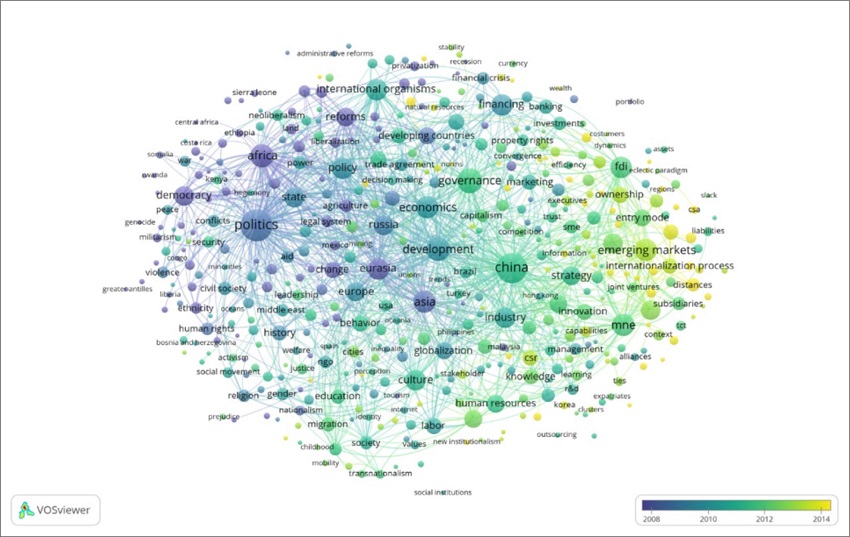
Figure 4
Retrospective Heatmap
Source: Scientometric data analysis.
Figure 4 provides a retrospective representation. Initially represented by purplish and blueish balloons, the dominant focus was on aspects related to political and economic issues, like politics (787), democracy (199), Africa (494), Asia (359), developing countries (121), and reforms (154). The institution-based approach to IB studies was used to explain contexts distant from each other vis-a-vis democratization and economic reforms. As time went by, additional subjects began to emerge in the discussion, represented by the greenish balloons, such as China (605), development (329), economics (273), governance (305), culture (232), financing (268), MNE (227), SME (71), and labor (156). This color group in the heatmap indicates that the intensification of IB raised more detailed questions that needed answering. Mostly involving China and related to the movement of investments, culture shocks, and the challenge of managing the workforce in institutionally distant contexts. To a certain extent, this is a development of the first colored group, now more concerned with intra-firm issues. Next, light green and yellow balloons indicate the state-of-the-art institutional approach to IB studies. Emerging markets (217) are a challenging context, and the discussion revolves around strategy (150), ownership (116), distances (74), subsidiaries (73), and corporate social responsibility (CSR in the figure) (99). One possibility is that there has been a shift toward the sociological approach to institutions, intending to explain more specific phenomena, having evolved from a more all-inclusive consideration of context. In this sense, the heatmap complements the segmentation illustrated in the clustering map shown above (Figure 4), indicating a trend toward using the institution-based approach to IB studies to understand aspects of increasingly micro-level analysis.
DISCUSSION
To respond retrospectively to how institutional concepts have been applied to explain IB phenomena, we discuss these concepts, propose an agenda to deal with the changes in approaching terms together, and offer recommendations to do it carefully.
Our findings show the shift that research on institutions in IB studies has suffered in the last decades. It is visible that researchers started from a macro standpoint, mainly focused on national and supranational levels (Mudambi & Navarra, 2002). The research revealed that the connections between institutions and IB studies started focusing on how political and economic institutions interacted with IB (North, 1990), toward a focus directed at IB that uses an institutional approach as an analysis component (Peng et al., 2009). This movement has significant consequences for IB studies and, perhaps more drastically, for understanding institutions in the field. Researchers may incur a thinner view of institutions by concentrating on the IB questions and only using institutions as a lens of analysis (Jackson & Deeg, 2019). Evidence shows that the focus shift can lead researchers to overlook significant institutional effects that have become more crucial later in the years but were not wholly investigated due to a more applied research emphasis.
Additionally, we call for attention to institutional issues booming worldwide. The last decade has presented an imperative rise in populism, extremism, anti-globalization, arbitrariness, nationalism, and authoritarianism in countries all over the world. This trend is specifically new as it challenges the institutional systems or nations that have been seldom seen since the Second World War. More attention to these movements can be of great interest for a better understanding of the role of institutional stability in IB. In these terms, our findings complement and update Mudambi and Navarra (2002) and Henisz and Swaminathan (2008) by presenting a multi-level analysis of the relationship between institutions and IB. Moreover, these findings complement Aguilera and Grøgaard. (2019), who reinforce the relevance of disentangling institutions in order to understand the complexity and diversity of polycentrically interconnected forces.
In sum, we highlight future research avenues to connect institutions and IB:
-
Understanding how individuals from different institutional contexts influence IB from a micro foundation perspective is necessary.
-
Considering how sub-national institutional environments affect investments. The variations of the sub-national institutional environment within a country can be vast, especially in an emerging economy.
-
Due to China becoming a cornerstone of IB studies, the effect of China Belt and Road initiative institutions on other regions of influence is a particular topic to be studied.
-
Explore the inherent dubious features of institutions and adopt multifaceted theoretical perspectives of institutions like institutional complexity and institutional polycentrism to understand phenomena that affect IB in multiple aspects.
-
Counterintuitively, heterogeneity in institutional environments invites holistic approaches to face problems like climate change and inequality. It can allow us to draw on the strengths of different institutions and cultures to develop more effective solutions.
Finally, this discussion suggests that the interface between IB and institutions is a latent field for research. Our review provides a comprehensive overview of these issues. In these terms, we provide a summary of the research questions that we believe should be addressed:
Influence of formal and informal institutions on IB:
-
How do informal institutions and their interactions with formal institutions affect the internationalization of firms?
-
Are some of these institutions or combinations of institutions in different markets more conducive to IB strategies?
-
How do firms influence formal and informal institutions in different ways? Is it a deliberate or emerging strategy?
Influence of institutions on IB policy:
-
Which constraints and rules are relevant to IB policy?
-
How have supranational institutions influenced IB policy?
-
How can ‘the state model’ be analyzed in an equation that tries to understand firms, institutions, and customers?
-
How have firms responded to changes in the institutions instigated by the government?
-
How can institutional distortions (e.g., institutional dysmorphia, institutional polycentrism) change government policies?
-
What institutional change factors have influenced IB policies?
Influence of institutions on the internationalization models:
-
What drivers and outcomes influence the firm’s internationalization with the institutions’ support?
-
How can natural resources be a constraint or an incentive to a firm’s internationalization with institutional support?
-
Is there a scope for developing new models to explain IB and institutions?
-
How have firms dealt with institutional complexity in IB?
In short, this paper encourages researchers to pay closer attention to IB and institutions at multiple levels. Moreover, it directs scholars’ attention to a broad context for studying institutions, IB policy, and internationalization models.
CONCLUSIONS
In this paper, we aimed to explore the co-evolution of IB studies and institutions, employing a scientometric approach to retrospectively review the application of institutional concepts in IB studies and outline a research agenda. Our contribution unfolds along three distinctive trajectories within the IB literature.
Firstly, we delineate the evolutionary trajectory of theoretical constructs, elucidating the transformation from explicating strategy formulation and decision-making. Our discernment underscores the evolutionary journey of institution-centric investigations within IB, commencing with a political vantage point that eventually transitions to an economic perspective. A discernible shift is underway, with IB scholars embracing a sociological lens to elucidate the interplay of institutions and the intricate tapestry of IB strategies, decisions, and intra-firm challenges.
Secondly, we unveil the inadequacy of conventional paradigms in comprehending contextually nuanced events that exert a confounding influence on the realm of IB, as emphasized by Aguilera and Grøgaard’s work (2019). This recognition underscores the indispensability of examining the crossroads between institutions and IB, emerging as a fertile ground for scholarly exploration. Our study highlights the inadequacy of segregating IB studies into dichotomous rational economic and sociological paradigms, as the burgeoning significance of the institutional milieu necessitates a more holistic perspective to capture the intricate web of polycentric interconnected dynamics.
Thirdly, the landscape of IB scholarship has been transformed by the ascendancy of China, altering the focal point from political and economic considerations to the institutional fabric. This shift is exemplified by China’s pivotal role, disrupting established conventions within the IB studies domain that had persisted until the end of the preceding century.
Admittedly, despite the meticulous methodological rigor characterizing our research, certain limitations warrant acknowledgment. For instance, employing a heatmap to portray temporal keyword concentrations is contingent upon averages, potentially obscuring nuanced patterns wherein a keyword’s relevance could exhibit a U-shaped trajectory, a nuance unaccounted for by our analysis. Moreover, the manual clustering methodology inadvertently introduces a bias that is inherently challenging to mitigate entirely. The decision to employ a trifurcation of keyword clusters might have inadvertently glossed over subtleties that a more extensive cluster framework could have captured.
Notwithstanding these constraints, our findings unequivocally affirm that while the institution-based perspective has propelled a shift in focus within IB studies from political and economic dimensions to introspecting organizational realms and their contextual affiliations, a pressing exigency remains for further deepening our comprehension. Our study carries profound implications for theoretical and methodological pursuits within the institution-based approach to IB studies. We posit that delving into the political science corpus could glean a nuanced understanding of the explicit political ramifications that extend beyond mere partisan politics, encompassing subsidiary power dynamics, innovation, and governmental influence.
Methodologically, our contribution resonates by introducing heatmaps and scientometrics as tools to unravel the evolutionary trajectories of theoretical linkages. Lastly, the converging juncture of institutional perspectives and IB research is resolutely steering toward microscopic investigations. This trend accentuates the pertinence of scrutinizing how institutions interface with the micro-foundations of IB, possibly heralding a promising avenue of exploration. Additionally, nascent themes such as global sustainability, healthcare, and deglobalization proffer a fertile arena to investigate institutions’ imprints on IB dynamics.
Our study underscores the imperative of the Asian context in catalyzing the metamorphosis of IB discourse, redirecting its focal point from the macro institutional context to its ramifications within corporate entities. Conclusively, as a parting recommendation for future scholarship that interfaces institutions and IB, we highlight the necessity of retrospectively acknowledging the predominant perspectives that have shaped our understanding of institutions. This cognizance is essential for fostering insightful dialogue and advancing the frontier of institution-centric IB studies.
REFERENCES
Abramo, G. (2018). Revisiting the scientometric conceptualization of impact and its measurement. Journal of Informetrics, 12(3), 590-597. https://doi.org/10.1016/j.joi.2018.05.001
Agarwal, S. (1994). Socio-Cultural Distance and the Choice of Joint Ventures: A contingency perspective. Journal of International Marketing, 2(2), 63-80. https://doi.org/10.1177/1069031X9400200205
Aguilera, R. V., Flores, R., & Kim, J. U. (2015). Re-examining regional borders and the multinational enterprise. The Multinational Business Review, 23(4), 374-394. https://doi.org/10.1108/MBR-07-2015-0027
Aguilera, R. V., & Grøgaard, B. (2019). The dubious role of institutions in international business: A road forward. Journal of International Business Studies, 50(1), 20-35. https://doi.org/10.1057/s41267-018-0201-5
Association of Business Schools. (2018). Academic Journal Guide. https://facultystaff.richmond.edu/~tmattson/AJG 2018 Journal Guide.pdf
Batjargal, B., Hitt, M. A., Tsui, A. S., Arregle, J.-L., Webb, J. W., & Miller, T. L. (2013). Institutional Polycentrism, Entrepreneurs’ Social Networks, and New Venture Growth. Academy of Management Journal, 56(4), 1024-1049. https://doi.org/10.5465/amj.2010.0095
Bhardwaj, R. K. (2016). Scientometric analysis and dimensions on international business literature. Scientometrics, 106(1), 299-317. https://doi.org/10.1007/s11192-015-1777-1
Borgatti, S. P., Everett, M. G., & Johnson, J. C. (2013). Analyzing Social Networks (2nd ed.). Sage Publications London, Thousand Oaks, CA and New Delhi.
Buckley, P. J., & Ghauri, P. (2004). Globalisation, economic geography and the strategy of multinational enterprises. Journal of International Business Studies, 35(2), 81-98. https://doi.org/10.1057/palgrave.jibs.8400088
Cantwell, J., Dunning, J. H., & Lundan, S. M. (2010). An evolutionary approach to understanding international business activity: The co-evolution of MNEs and the institutional environment. Journal of International Business Studies, 41(4), 567-586. https://doi.org/10.1057/jibs.2009.95
Child, J., & Tse, D. K. (2001). China’s Transition and its Implications for International Business. Journal of International Business Studies, 32(1), 5-21. https://doi.org/10.1057/palgrave.jibs.8490935
Contractor, F. J. (1990). Contractual and cooperative forms of international business: Towards a unified theory of modal choice. MIR: Management International Review, 30(1), 31-54.
Cuervo-Cazurra, A. (2018). The Evolution of Business Groups’ Corporate Social Responsibility. Journal of Business Ethics, 153(4), 997-1016. https://doi.org/10.1007/s10551-018-3912-4
D’Angelo, V., & Magnusson, M. (2021). A Bibliometric Map of Intellectual Communities in Frugal Innovation Literature. IEEE Transactions on Engineering Management, 68(3), 653-666. https://doi.org/10.1109/TEM.2020.2994043
Delios, A., & Beamish, P. W. (1999). Ownership Strategy of Japanese Firms: Transactional, Institutional and Experience Influences. Strategic Management Journal, 20(February), 915-933. https://doi.org/10.1002/(sici)1097-0266(199910)20:10<915::aid-smj51>3.0.co;2-0
DiMaggio, P. J. ., & Powell, W. W. (1983). The Iron Cage Revisited: Institutional Isomorphism and Collective Rationality in Organizational Fields. American Sociological Review, 48(April), 147-160. https://doi.org/10.2307/2095101
Djankov, S., Porta, R. La, Lopez-de-Silane, F., & Shleifer, A. (2002). Courts: the Lex Mundi Project. https://doi.org/10.3386/w8890
Doh, J., Rodrigues, S., Saka-Helmhout, A., & Makhija, M. (2017). International business responses to institutional voids. Journal of International Business Studies, 48(3), 293-307. https://doi.org/10.1057/s41267-017-0074-z
Dou, H. (1994). In which business are we? Scientometrics, 30(2-3), 401-406. https://doi.org/10.1007/BF02018112
Dunning, J. H. (1980). Toward an Eclectic Theory of International Production: Some Empirical Tests. Journal of International Business Studies, 11(1), 9-31. https://doi.org/10.1057/palgrave.jibs.8490593
Dunning, J. H., & Lundan, S. M. (2009). The Internationalization of Corporate R&D: A Review of the Evidence and Some Policy Implications for Home Countries 1. Review of Policy Research, 26(1-2), 13-33. https://doi.org/10.1111/j.1541-1338.2008.00367.x
Eck, N. J. van, & Waltman, L. (2010). Software survey: VOSviewer, a computer program for bibliometric mapping. Scientometrics, 84(2), 523-538. https://doi.org/10.1007/s11192-009-0146-3
Eck, N. J. van, & Waltman, L. (2017). Citation-based clustering of publications using CitNetExplorer and VOSviewer. Scientometrics, 111(2), 1053-1070. https://doi.org/10.1007/s11192-017-2300-7
Eck, N. J. van, Waltman, L., Dekker, R., & van den Berg, J. (2010). A comparison of two techniques for bibliometric mapping: Multidimensional scaling and VOS. Journal of the American Society for Information Science and Technology, 61(12), 2405-2416. https://doi.org/10.1002/asi.21421
Eden, L. (2010). Editorial: Letter from the Editor-in-Chief: Lifting the veil on how institutions matter in IB research. Journal of International Business Studies, 41(2), 175-177. https://doi.org/10.1057/jibs.2009.92
Falagas, M. E., Pitsouni, E. I., Malietzis, G. A., & Pappas, G. (2008). Comparison of PubMed, Scopus, Web of Science, and Google Scholar: strengths and weaknesses. The FASEB Journal, 22(2), 338-342. https://doi.org/10.1096/fj.07-9492LSF
Ferreira, M. P., Pinto, C. F., & Serra, F. R. (2014). The transaction costs theory in international business research: A bibliometric study over three decades. Scientometrics, 98(3), 1899-1922. https://doi.org/10.1007/s11192-013-1172-8
Garrido, I., Vasconcellos, S. L. de, Faccin, K., Monticelli, J. M., & Carpenedo, C. (2021). The moderating role of polycentric institutions in the relationship between effectuation/causation logics and corporate entrepreneur’s decision-making processes. Global Strategy Journal, gsj.1419. https://doi.org/10.1002/gsj.1419
Greenwood, R., Díaz, A. M., Li, S. X., & Lorente, J. C. (2010). The multiplicity of institutional logics and the heterogeneity of organizational responses. Organization Science, 21(2), 521-539. https://doi.org/10.1287/orsc.1090.0453
Greenwood, R., Raynard, M., Kodeih, F., Micelotta, E. R., & Lounsbury, M. (2011). Institutional complexity and organizational responses. Academy of Management Annals, 5(1), 317-371. https://doi.org/10.1080/19416520.2011.590299
Hall, P. A., & Taylor, R. C. R. (1996). Political Science and the Three New Institutionalisms. Political Studies, 44(5), 936-957. https://doi.org/10.1111/j.1467-9248.1996.tb00343.x
Helmke, G., & Levitsky, S. (2012). Informal Institutions and Comparative Politics: A Research Agenda. International Handbook on Informal Governance, 2(4), 85-113. https://doi.org/10.4337/9781781001219.00011
Henisz, W., & Swaminathan, A. (2008). Institutions and international business. Journal of International Business Studies, 39(4), 537-539. https://doi.org/10.1057/palgrave.jibs.8400381
Hofstede, G. (1994). The business of international business is culture. International Business Review, 3(1), 1-14. https://doi.org/10.1016/0969-5931(94)90011-6
Jackson, G., & Deeg, R. (2008). Comparing capitalisms: understanding institutional diversity and its implications for international business. Journal of International Business Studies, 39(4), 540-561. https://doi.org/10.1057/palgrave.jibs.8400375
Jackson, G., & Deeg, R. (2019). Comparing capitalisms and taking institutional context seriously. Journal of International Business Studies, 50(1), 4-19. https://doi.org/10.1057/s41267-018-0206-0
Kalasin, K., Cuervo-Cazurra, A., & Ramamurti, R. (2019). State ownership and international expansion: The S-curve relationship. Global Strategy Journal, February, 1-33. https://doi.org/10.1002/gsj.1339
Kelly, A., Morris, H., & Harvey, C. (2009). Journal rankings and the ABS Journal Quality Guide. Management Decision, 47(9), 1441-1451. https://doi.org/10.1108/00251740910995648
Khanna, T., & Palepu, K. G. (2004). Globalization and convergence in corporate governance: Evidence from Infosys and the Indian software industry. Journal of International Business Studies, 35(6), 484-507. https://doi.org/10.1057/palgrave.jibs.8400103
Khanna, T., Palepu, K. G., & Sinha, J. (2015). Strategies that fi t emerging markets. In International Business Strategy (pp. 629-645). Routledge.
Kim, M. C., & Zhu, Y. (2018). Scientometrics of Scientometrics: Mapping Historical Footprint and Emerging Technologies in Scientometrics. In Scientometrics (pp. 9-27). InTech. https://doi.org/10.5772/intechopen.77951
Kingston, C., & Caballero, G. (2009). Comparing theories of institutional change. Journal of Institutional Economics, 5(2), 151-180. https://doi.org/10.1017/S1744137409001283
Kostova, T. (1999). Transnational Transfer of Strategic Organizational Practices: A Contextual Perspective. The Academy of Management Review, 24(2), 308. https://doi.org/10.2307/259084
Kostova, T., & Roth, K. (2002). Adoption of an organizational practice by subsidiaries of multinational corporations: Institutional and relational effects. Academy of Management Journal, 45(1), 215-233.
Kostova, T., & Zaheer, S. (1999). Organizational legitimacy under conditions of complexity: The case of the multinational enterprise. Academy of Management Review, 24(1), 64-81. https://doi.org/https://www.jstor.org/stable/259037
Levy, O., Beechler, S., Taylor, S., & Boyacigiller, N. A. (2007). What we talk about when we talk about ‘global mindset’: Managerial cognition in multinational corporations. Journal of International Business Studies, 38(2), 231-258. https://doi.org/10.1057/palgrave.jibs.8400265
Liesch, P. W., Welch, L. S., & Buckley, P. J. (2011). Risk and Uncertainty in Internationalisation and International Entrepreneurship Studies. Management International Review, 51(6), 851-873. https://doi.org/10.1007/s11575-011-0107-y
López-Duarte, C., Vidal-Suárez, M. M., González-Díaz, B., & Reis, N. R. (2016). Understanding the Relevance of National Culture in International Business Research: A quantitative analysis. Scientometrics, 108(3), 1553-1590. https://doi.org/10.1007/s11192-016-2044-9
Mariani, M. M., Al-Sultan, K., & Massis, A. De. (2021). Corporate social responsibility in family firms: A systematic literature review. Journal of Small Business Management, 1-55. https://doi.org/10.1080/00472778.2021.1955122
Markusen, A. (1996). Sticky Places in Slippery Space: A Typology of Industrial Districts. Economic Geography, 72(3), 293. https://doi.org/10.2307/144402
Meyer, K. E., & Peng, M. W. (2005). Probing theoretically into Central and Eastern Europe: Transactions, resources, and institutions. Journal of International Business Studies, 36(6), 600-621. https://doi.org/10.1057/palgrave.jibs.8400167
Moe, T. M. (1984). The New Economics of Organization. American Journal of Political Science, 28(4), 739. https://doi.org/10.2307/2110997
Monticelli, J. M., Garrido, I. L., Curth, M., Vieira, L. M., & Dal-Soto, F. (2018). Institutional dysmorphia: When the institutions become ill. In International Journal of Emerging Markets (Vol. 13, Issue 3). https://doi.org/10.1108/IJoEM-03-2016-0057
Mudambi, R., & Navarra, P. (2002). Institutions and internation business: A theoretical overview. International Business Review, 11(6), 635-646. https://doi.org/10.1016/S0969-5931(02)00042-2
Muff, S., Rao, F., & Caflisch, A. (2005). Local modularity measure for network clusterizations. Physical Review E, 72(5), 056107. https://doi.org/10.1103/PhysRevE.72.056107
Newman, M. E. J., & Girvan, M. (2004). Finding and evaluating community structure in networks. Physical Review E, 69(2), 026113. https://doi.org/10.1103/PhysRevE.69.026113
North, D. C. (1971). Institutional Change and Economic Growth. The Journal of Economic History, 31(1), 118-125. http://www.jstor.org/stable/2117023
North, D. C. (1990). Institutions, Institutional Change, and Economic Performance. In Institutions, Institutional Change and Economic Performance. Cambridge University Press. https://doi.org/10.1017/CBO9780511808678
O’Connor, C., & Joffe, H. (2020). Intercoder Reliability in Qualitative Research: Debates and Practical Guidelines. International Journal of Qualitative Methods, 19, 160940691989922. https://doi.org/10.1177/1609406919899220
Ostrom, E. (1990). Governing the commons: The evolution of institutions for collective action. In Governing the Commons. Cambridge University Press. https://doi.org/10.1017/CBO9780511807763
Palacios-Núñez, G., Vélez-Cuartas, G., & Botero, J. D. (2018). Developmental tendencies in the academic field of intellectual property through the identification of invisible colleges. Scientometrics, 115(3), 1561-1574. https://doi.org/10.1007/s11192-018-2648-3
Peng, M. W. (2003). Institutional Transitions and Strategic Choices. The Academy of Management Review, 28(2), 275. https://doi.org/10.2307/30040713
Peng, M. W. ., Sun, S. L., Pinkham, B., & Chen, H. (2009). The Institution-Based View as a Third Leg for a Strategy Tripod. Academy of Management Perspectives, 23(3), 63-81. https://doi.org/10.5465/amp.2009.43479264
Peng, M. W., & Heath, P. S. (1996). The growth of the firm in planned economies in transition: Institutions, organizations, and strategic choice. Academy of Management Review, 21(2), 492-528. https://doi.org/10.5465/amr.1996.9605060220
Peng, M. W., Wang, D. Y. L. L., & Jiang, Y. (2008). An institution-based view of international business strategy: A focus on emerging economies. Journal of International Business Studies, 39(5), 920-936. https://doi.org/10.1057/palgrave.jibs.8400377
Peng, M. W., Wang, J. C., Kathuria, N., Shen, J., & Eleazar, M. J. W. (2023). Toward an institution-based paradigm. Asia Pacific Journal of Management, 40(2), 353-382. https://doi.org/10.1007/s10490-022-09861-6
Pinho, J. C., & Prange, C. (2016). The effect of social networks and dynamic internationalization capabilities on international performance. Journal of World Business, 51(3), 391-403. https://doi.org/10.1016/j.jwb.2015.08.001
Porta, R. La, Lopez-de-Silanes, F., & Shleifer, A. (2008). The Economic Consequences of Legal Origins. Journal of Economic Literature, 46(2), 285-332. https://doi.org/10.1257/jel.46.2.285
Rottig, D. (2016). Institutions and emerging markets: Effects and implications for multinational corporations. International Journal of Emerging Markets, 11(1), 2-17. https://doi.org/10.1108/IJoEM-12-2015-0248
Scott, W. R. (1995). Institutions and organizations. Sage Publications.
Scott, W. R. (2008). Institutions and organizations: Ideas and interests. Sage Publications.
Serenko, A., Bontis, N., & Grant, J. (2009). A scientometric analysis of the Proceedings of the McMaster World Congress on the Management of Intellectual Capital and Innovation for the 1996-2008 period. Journal of Intellectual Capital, 10(1), 8-21. https://doi.org/10.1108/14691930910922860
Sirmon, D. G. D. G., Hitt, M. A. M. A., & Ireland, R. D. (2007). Managing firm resources in dynamic environments to create value: Looking inside the black box. The Academy of Management Review, 32(1), 273-292. https://doi.org/10.5465/amr.2007.23466005
Skjølsvik, T., Pemer, F., & Løwendahl, B. R. (2017). Strategic management of professional service firms: Reviewing ABS journals and identifying key research themes. Journal of Professions and Organization, 4(2), 203-239. https://doi.org/10.1093/jpo/jox005
Sprong, N., Driessen, P. H., Hillebrand, B., & Molner, S. (2021). Market innovation: A literature review and new research directions. Journal of Business Research, 123(438), 450-462. https://doi.org/10.1016/j.jbusres.2020.09.057
Suchman, M. (1995). Managing legitimacy: Strategic and institutional approaches. Academy of Management Review, 20(3), 571-610. http://amr.aom.org/content/20/3/571.short
Suominen, A., Seppänen, M., & Dedehayir, O. (2019). A bibliometric review on innovation systems and ecosystems: A research agenda. European Journal of Innovation Management, 22(2), 335-360. https://doi.org/10.1108/EJIM-12-2017-0188
Thornton, P. H., Ocasio, W., & Lounsbury, M. (2015). The Institutional Logics Perspective. In R. A. Scott & S. M. Kosslyn (Eds.), Emerging trends in the social and behavioral sciences: an interdisciplinary, searchable, and linkable resource (pp. 1-22). Wiley. https://doi.org/10.1002/9781118900772
Waltman, L., Eck, N. J. van, & Noyons, E. C. M. (2010). A unified approach to mapping and clustering of bibliometric networks. Journal of Informetrics, 4(4), 629-635. https://doi.org/10.1016/j.joi.2010.07.002
Williamson, O. E. (1985a). Markets and hierarchies: Analysis and antitrust implications: A study in the economics of internal organization. Free Press. https://doi.org/10.2139/ssrn.1496220
Williamson, O. E. (1985b). The economic institutions of capitalism: Firms, markets, relational contracting. In The Economic Institutions of Capitalism Firms Markets Relational Contracting. Free Press.
Willmott, H. (2011). Journal list fetishism and the perversion of scholarship: Reactivity and the ABS list. Organization, 18(4), 429-442. https://doi.org/10.1177/1350508411403532
Wu, D., Li, M., Zhu, X., Song, H., & Li, J. (2015). Ranking the research productivity of business and management institutions in Asia-Pacific region: empirical research in leading ABS journals. Scientometrics, 105(2), 1253-1272. https://doi.org/10.1007/s11192-015-1752-x
Notes
Author notes
*Corresponding author
Conflict of interest declaration
The authors have no conflicts of interest to declare.