Artículos
Is digit ratio (2D:4D) different between sexual and non-sexual offenders, and non-offending men? Study of a Colombian sample
¿Existen diferencias en la ratio 2D:4D entre delincuentes sexuales y no sexuales, y hombres no delincuentes? Un estudio en una muestra colombiana
Is digit ratio (2D:4D) different between sexual and non-sexual offenders, and non-offending men? Study of a Colombian sample
Interdisciplinaria, vol. 39, núm. 1, pp. 127-141, 2022
Centro Interamericano de Investigaciones Psicológicas y Ciencias Afines

Esta obra está bajo una Licencia Creative Commons Atribución-NoComercial-CompartirIgual 4.0 Internacional.
Recepción: 13 Mayo 2020
Aprobación: 30 Agosto 2021
Abstract: One research line in criminal behavior studies 2D:4D ratio as predictor of aggression and violent behavior has been established, given that there are sexually dimorphic behaviors associated with the influence of testosterone on brain organization. However, results have been mixed. The aim of this study was to explore the differences in the 2D:4D ratio among offending and non-offending Colombian men in four groups (N = 139). A comparative study was conducted with three groups of offenders sentenced in a Colombian penitentiary: (1) sexual offenders against children (n = 34), (2) sexual offenders against adult women (n = 31), and (3) non-sexual violent offenders (n=26); as well as one group (4) men with no criminal record (n = 48). The 2D:4D ratio was measured using the hand scanning technique and three digital measurements were analyzed with the Autometric software: right hand ratio, left hand ratio, and difference between the right and left hand ratios (Dr - Iz). Although, in all groups, right-digit ratio was lower that left-digit ratio (negative Dr–l ratio) and, in non-offending men this difference was not significant, no strong significant differences were found between groups in any measure of 2D:4D ratio used (right hand, left hand or Dr−l). The results support the idea that these associations are too weak to consider them predictors of sexual or non-sexual criminal behavior. The risk factors determining sexual or non-sexual criminal behavior, seems to go beyond intra-uterine effects and involve complex interactions between heritability, epigenetics, and pre-natal and post-natal life events.
Keywords: 2D:4D ratio, Prenatal androgenic influence, Sexual Offenders, Offending Men, Non-offending Men.
Resumen: Una de las líneas de investigación de la conducta criminal estudia la relación 2D:4D como predictor de agresión y comportamiento violento, dada la conexión de este marcador biológico con la influencia de la testosterona en la organización del cerebro y los comportamientos sexualmente dimórficos más prevalentes en hombres. Los resultados han sido mixtos y, en general, se han encontrado tamaños de efecto débiles, aunque significativos, en la relación entre proporción 2D:4D y el comportamiento agresivo, con escasos estudios comparativos y con muestras forenses. El objetivo de este estudio fue explorar las diferencias en la relación 2D:4D entre hombres colombianos (N = 139) con y sin delitos en cuatro grupos. Para ello, se realizó un estudio comparativo con tres grupos de delincuentes condenados en una cárcel de Colombia: (1) agresores sexuales de menores (n = 34); (2) agresores sexuales de mujeres adultas (n = 31); (3) delincuentes violentos no sexuales (n = 26), y uno de (4) hombres sin antecedentes delictivos (n = 48). Se midió la proporción 2D:4D usando la técnica de escaneo de las manos y se analizaron tres medidas digitales con el software Autometric: proporción de la mano derecha, mano izquierda y diferencia entre la proporción de las manos derecha e izquierda (Dr – Iz). Se encontraron diferencias significativas entre la diferencia de la proporción Dr-Iz en todos los grupos, en la que la 2D:4D de la mano derecha fue menor que la de la mano izquierda en todos los grupos. Sólo en los hombres sin antecedentes delictivos esta diferencia no fue significativa. Para evaluar las diferencias grupales en las relaciones 2D:4D, se ajustaron modelos tipo a ANOVA unidireccional con un solo grupo como predictor, seguidos de contrastes de Helmert para comparar las diferencias entre todos los grupos.
Palabras clave: proporción 2D:4D, influencia androgénica prenatal, delincuentes sexuales, delincuentes no sexuales, hombres no delincuentes.
Introduction
This study reports findings on the relationship between the history of sexual and non-sexual violent behavior and the 2D:4D ratio as a proxy marker for prenatal testosterone in four groups of male offenders and non-offenders who participated in a larger study of sexual assault against children.
Prenatal androgens exposure and digit ratio 2D:4D
The organizational-activational hypothesis of Phoenix, Goy, Gerall and Young (1959;Phoenix, 2009) states that prenatal and postnatal exposure to testosterone regulates the masculinization of neural networks in men, while an absence of these effects, leads to the phenotypical development of women. Organizational-activational hypothesis is the basis for the relationship between prenatal testosterone and biomarker: digit ratio 2D:4D.
Androgens not only affect behavior but also stimulate finger bone growth, specifically the second (index) and fourth (annular) digits, which vary in their length according to the level of testosterone exposure during the first trimester of gestation (McIntyre, 2006). The evidence supporting this is relatively consistent (Hönekopp & Watson, 2010), and replicated even in small samples (Vásquez-Amézquita et al., 2018). 2D:4D ratio is lower in men than in women as a consequence of the effect of testosterone and estrogens on the proliferation of chondrocytes that determine the growth of the bones of the fourth finger (Manning & Bundred, 2000). Testosterone promotes growth of the fourth finger and thus tends to produce lower 2D:4D ratios in men, while estrogen has the inverse effect and thus causes higher 2D:4D ratios in women (Zheng & Cohn, 2011).
Since the findings reported by Manning, Scutt, Wilson, and Lewis-Jones (1998), 2D:4D ratio has been used as an indicator for prenatal testosterone exposure (Brown, Finn, & Breedlove, 2002; McIntyre, 2006). Currently, a large body of research has been published about its association with multiple phenotypic expressions (Richards, 2017). Empirical and meta-analytical studies have questioned the validity of 2D:4D ratio as a biomarker of prenatal testosterone exposure (Hampson & Sankar, 2012; Voracek, 2014; Zhang et al., 2013). However, promoters of an association between prenatal exposure to androgens and 2D:4D ratios continue arguing that 2D:4D ratio is a reliable biological marker of prenatal androgenization (Manning & Fink, 2017).
The 2D:4D ratio has proven to be a marker for various sexually dimorphic traits and behaviors. Among them, sexual orientation (van der Meij et al., 2012; Xu & Zheng, 2016), male facial attractiveness (Ferdenzi, Lemaître, Leongómez, & Roberts, 2011), personality traits (Carré et al., 2015), level of empathy (van Honk et al., 2011), and physical disorders, such as coronary atherosclerosis (Ozdogmus et al., 2010) and mental disorders more prevalent in men, like autism or dyslexia (Manning & Bundred, 2000). However, some findings have not been replicated (Vásquez-Amézquita et al., 2018; Wong & Hines, 2016), or were either statistically underpowered, or based on weak or modest effects (Mailhos, Buunk, & del Arca, 2013; for meta-analyses, see Teatero & Netley, 2013; Voracek & Stieger, 2009a).
2D:4D ratio as predictor of sexual and non-sexual violent behavior
The relationship between aggression and prenatal testosterone has been linked through the evolutionary neuro-androgenic theory (ENA) of Ellis and his colleagues (Hoskin & Ellis, 2015). This theory, based on what occurs in other animal species, states that exposure to high levels of prenatal testosterone leads to increased direct aggression, impulsive behavior, and increased risk-taking in adulthood (Ellis, 2017; Hoskin & Ellis, 2015) especially among males (Campbell, 2006). A research line has been developed about 2D:4D ratio as predictor of violent criminal behavior (Pratt, Turanovic, & Cullen, 2016; Turanovic, Pratt, & Piquero, 2017), given that they are considered sexually dimorphic behaviors emerging from levels of physical aggression, more prevalent in men (Bailey & Hurd, 2005;Campbell, 2006) and associated with the influence of testosterone on brain organization. Direct and physical aggression can be an adaptive behavior in men to compete for access to partners and these adaptive responses in men are often under the control of prenatal and postnatal testosterone. Hence the relationship between violent criminal behavior and the indirect marker of prenatal testosterone, the 2D:4D ratio. However, empirical evidence supporting this relationship has been mixed (see Turanovic et al., 2017 for an overview).
Turanovic, Pratt, and Piquero (2017) recently published a meta-analysis of 32 studies and 361 estimates of effect size, in which they found a weak but significant effect size of the relation between 2D:4D ratio and violent criminal behavior. Within this meta-analysis, only two studies recruited samples of criminal offenders (Herschl, Highland, & McChargue, 2012; Romero-Martínez, Lila, Catalá-Miñana, Williams, & Moya-Albiol, 2013), but without comparing them with other groups. Both coincide in reporting an association of low 2D:4D ratios with anger (Herschl, Highland, & McChargue, 2012) and violence (Romero-Martínez et al., 2013). Bailey and Hurd (Bailey & Hurd, 2005), and Hönekopp and Watson (2011) report significant associations between low digit ratio and aggression (defined as ‘‘behavior intended to harm another individual” according to Archer, 2009 cited by Hönekopp & Watson, 2011) in men but not in women, and Benderlioglu and Nelson (2004) found that2D:4D ratio was predictive only of reactive aggression in women, but not in men. Voracek and Stieger (2009a) found no reliable, or replicable associations of digit ratios with implicit or explicit aggression measures.
Evidence about the relationship of this biomarker with sexual aggression is almost absent; only the study by Ellis and Hoskin (2015) reports negative correlations between the 2D:4D ratio and self-reported sexual aggression in university students. There is no empirical research about 2D:4D ratio as a marker of deviant sexual interest toward children. However, child sexual assault and pedophilia occur almost exclusively in men, which could further support the role of male sex steroids during brain maturation (Kruger et al., 2019) and prenatal androgens have been attributed a crucial role in modulating sexual and violent behavior (Jordan, Fromberger, Stolpmann, & Müller, 2011). Understanding the role of prenatal testosterone in predicting criminal sexual behavior has been a challenge with great limitations due to the difficulty of directly measuring prenatal androgens. Furthermore, the relationship between testosterone and sexual assault goes beyond biological factors, and involves cognitive, emotional and contextual factors (Ward & Beech, 2006). Despite these limitations, the literature has found some associations between sexual assault and testosterone (Hoskin, 2017; Jordan et al., 2011; Studer, Aylwin, & Reddon, 2005).
In a recent study with sexual offenders (Kruger et al., 2019), it was found that child sex offenders showed signs of high prenatal exposure to androgens compared to non-offending pedophiles and controls. These findings support theories of testosterone-linked abnormalities in early brain development and criminal behavior including child sexual abuse. Therefore, it could be plausible to use 2D:4D ratio as a marker to test this hypothesis on men with proven violent sexual and non-sexual crimes. It is therefore important to treat them as separate groups and to explore whether there are differences between them in these biomarkers.
The present study
The present study explored, for the first time in a forensic sample of Colombian men, differences in 2D:4D ratio, both in the right and left hands, and in the directional asymmetry (right-left differences) in digit ratio (2D:4D) between four groups of men. Three of convicted offenders: (1) sexual offenders against children; (2) sexual offenders against women; (3) and non-sexual violent offenders, and one of (4) men without criminal records. Since the 2D:4D of the right hand and the directional asymmetry evident in the difference between the 2D:4D ratio of the right and left hand seems to be a stronger marker of prenatal testosterone than the 2D:4D left hand (Benderlioglu & Nelson, 2004), The right and left hands, and the directional asymmetry between both hands (right - left) were measured. This directional asymmetry has been associated with greater developmental instability that could affect the later development of violent criminal behavior (Bailey & Hurd, 2005; Benderlioglu & Nelson, 2004; Coyne, Manning, Ringer, & Bailey, 2007). The predictions were that a low 2D:4D ratio on the right, and greater difference between right and left (greater asymmetric influence of prenatal androgen concentrations on the 2D:4D ratios of the right and left hands), would characterize violent sexual and non-sexual offender groups, compared to men without violent crimes. Since there are no previous studies on possible differences between sexual and non-sexual offenders, or against adults and children, the analyses are exploratory.
Methods
Participants
Of 147 men initially recruited, the final sample consisted of 139 men (mean age ± SD = 42.69 ± 13.82 years old) based on the main inclusion and exclusion criteria. They were from four different groups: (1) sexual offenders against children (SOAC), 34 men convicted for sexual abuse against children under 14 years old (49.06 ± 15.29 years old); (2) sexual offenders against adults (SOAA), 31 men convicted for violent carnal access against adult women (40.97 ± 14.08 years old); (3) non-sexual violent offenders (NSVO) (38.50 ± 10.92 years old), 26 men convicted for violent crimes; and (4) non-offending men (NOM), 48 men without criminal records (41.69 ± 12.91 years old). All groups were similar in age, except for the SOAC group who were significantly older than the NSVO group (p = .02). Participants reported the highest level of education achieved on a scale of 1 to 4 (1 = none, 2 = primary, 3 = secondary, and 4 = technical) See Tables S3 to S6 for descriptive data by group in the supplementary material.
From the initial sample of 147 men, eight were excluded either because of injuries reported or visible on the second or fourth digits, or for inaccuracies in the visualization of scanned images of their hands: four from the SOAC group, two from the SOAA group, one from the NSVO group, and one from the NOM group.
The forensic sample was recruited in a prison in Bogotá, Colombia. Sexual offenders against children were selected according to the crime for which they were convicted and sentenced, specifically abusive carnal access with a minor under fourteen years of age, which involves vaginal, anal or oral penetration with the penis or an object, as defined by the Colombian law (Código Penal, 2004).
Sexual offenders against adults were selected from men convicted of the crime of violent carnal access against a woman over the age of 18, which involves nonconsensual violent vaginal, anal or oral penetration with the penis or other object (Código Penal, 2004).
Non-sexual violent offenders were selected from men convicted of qualified and aggravated robbery (6/26, 23 %), intentional homicide (15/26, 57 %) or attempted murder (5/26, 19 %). These are crimes that involve violence and in which the convicted person possessed a firearm or other dangerous weapon, with which he used to cause serious injury or death to another person (Código Penal, 2004).
Non-offending men were recruited from a group of personnel from security companies, who had been checked for criminal records, and were evaluated through clinical examination by forensic psychologist and psychosomatic symptom evaluation questionnaire SA45, to discard other psychopathological traits and/or psychotic symptoms (See Table S7 for descriptive data by group in the supplementary material).
Measures and procedure
The Institutional Ethics Committee approved the research protocol. All participants provided a written informed consent prior to participating in the study. They were then asked to provide sociodemographic data and subsequently 2D:4D measurements were taken. Participants from the sample were taking part in one separate, larger study.
The scanner used was a Cannon Lide 120 scanner with a 400 dpi resolution (Ryckmans, Millet, & Warlop, 2015) to extract measurement for right hand 2D:4D, left hand 2D:4D and right hand 2D:4D minus left hand 2D:4D (Barel & Tzischinsky, 2017; Hönekopp, Bartholdt, Beier, & Liebert, 2007). Given that differences between the right and left hand, called directional asymmetry, are sexually dimorphic and lower in men than in women (Manning, Churchill, & Peters, 2007), it has been proposed that it could be a marker of prenatal androgenization: in fact, negative correlations between directional asymmetry and aggression have been found in women (Coyne et al., 2007).
The Autometric software was used to measure the proportions of the digits (DeBruine, 2004), that has shown to be more accurate compared to other methods (e. g. Caliper; Kemper & Schwerdtfeger, 2009). Two trained judges made two measurements in each hand, from the tip to the basal crease. Intraclass Correlation Coefficients (Barel & Tzischinsky, 2017; Carré et al., 2015) were calculated to measure the reliability between the two observers for each measure of the 2D: 4D ratio (right hand: ICC3k = .944, F = 17.73, p < .001; left hand: ICC3k = .907, F = 10.769, p < .001[1]; see Table S1 in the Supplementary Material).The value obtained from the averaging the measurements given by the two judges was used for all statistical analyzes (Ryckmans et al., 2015). Three measures of the 2D:4D ratio were calculated: right-hand ratio, 2D:4D (r); left-hand ratio, 2D:4D (l) ; and the difference between right and left-hand ratios, 2D:4D (Dr−l) (Barel & Tzischinsky, 2017). Measurements of right, left, and Dr−l were included, as the proportions of the right hand and the difference between right and left have been supported as better indicators of prenatal testosterone exposure in relation to criminal behavior (Bailey & Hurd, 2005; Coyne et al., 2007). However, nothing is known about the relationship between 2D:4D and criminal sexual behavior. Therefore, it was decided to include in the analyses the three measures, following previous studies (e. g.Barel & Tzischinsky, 2017) with limited background of the problem to be studied.
Results
All data, Supplementary Material and code used to perform the analyses here reported are openly available from the Open Science Framework (OSF) project website of this study (https://osf.io/r2gpt/?view_only=08bda2c26edd47e099de62838b0ea660).
To test group differences in 2D:4D ratios, linear models (one-way ANOVA type) were fitted with only group as predictor, followed by Helmert contrasts comparing differences between (1) sexual offenders (SOAC vs SOAA), (2) sexual and non-sexual offenders (SOAC and SOAA vs NSVO), and (3) offenders and non-offending men (SOAC, SOAA and NSVO vs NOM).
Descriptives of ratio measurements
Distributions of 2D:4D ratio measurements are shown in Figure 1, and main descriptive values are reported in Table S2 (all participants), Tables S3 to S6 (for descriptive data by group). Although age and education differed between groups, these variables were not correlated with any 2D:4D measurement, so were not included in the hypothesis testing model presented below (see Table S8 for correlations for 2D:4D measurements in the Supplementary Material).
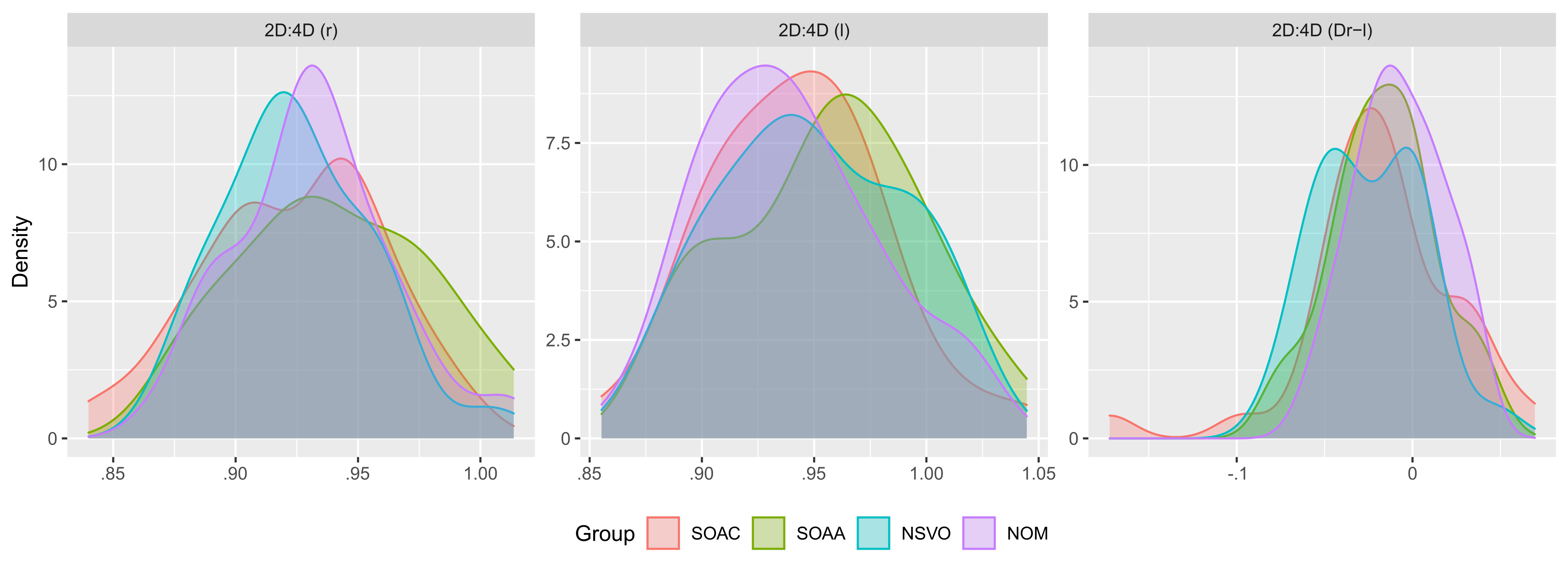
Figure 1.
Distribution of all measured variables by Group.
Note. For detailed descriptive values, see Table S2 (all participants), and Tables S3 to S6 (for descriptives by group) in the Supplementary Material. Group: SOAC: sexual offenders against children; SOAA: sexual offenders against adults; NSVO: non-sexual violent offenders; NOM: non-offending men.
Differences between right- and left-hand 2D:4D
There were significant differences between the right and left hand 2D:4D ratio of the participants (Table 1); in all groups, 2D:4D (r) was significantly lower that 2D:4D (l) (see Tables S3 to S6 in the Supplementary Material).
| Group | df | Estimate | 95% CI | t | p | Cohen's d |
| SOAC | 33 | -.018 | -.003 — -.033 | -2.381 | .023 | .408 |
| SOAA | 30 | -.016 | -.005 — -.027 | -3.01 | .005 | .541 |
| NSVO | 25 | -.024 | -.012 — -.036 | -4.011 | <.001 | .787 |
| NOM | 47 | -.007 | -.000— -.015 | -2.022 | .049 | .292 |
| All Participants | 138 | -.015 | -.010— -.021 | -5.387 | <.0001 | .457 |
2D:4D differences by group
To test group differences in 2D:4D ratios, separate (one-way ANOVA type) linear models were fitted to predict each 2D:4D ratio (r, l, and Dr−l) with group as predictor (for model diagnostics, see Fig. S1, S2 and S3 in the Supplementary Material). These models (Table 2) showed that group only significantly predicted 2D:4D (Dr−l).
| 2D:4D (r) | 2D:4D (l) | 2D:4D (Dr−l) | ||||||||||
| df | F | p | η2 | df | F | p | η2 | df | F | p | η2 | |
| Group | 3 | 1.991 | .119 | .05 | 3 | 1.8 | .151 | .045 | 3 | 3.688 | .014 | .088 |
| Residuals | 91 | . | . | . | 91 | . | . | . | 91 | . | . | . |
Helmert planned contrasts revealed that non-offending men (NOM) had significantly lower 2D:4D (l), and smaller (i. e. closer to zero) difference between right- and left-hand 2D:4D than offenders (for details, see Table S9 in the Supplementary Material); bivariate comparisons (adjusted for multiple tests) showed that the only NSVO and NOM had a direct significant difference (Figure 2).
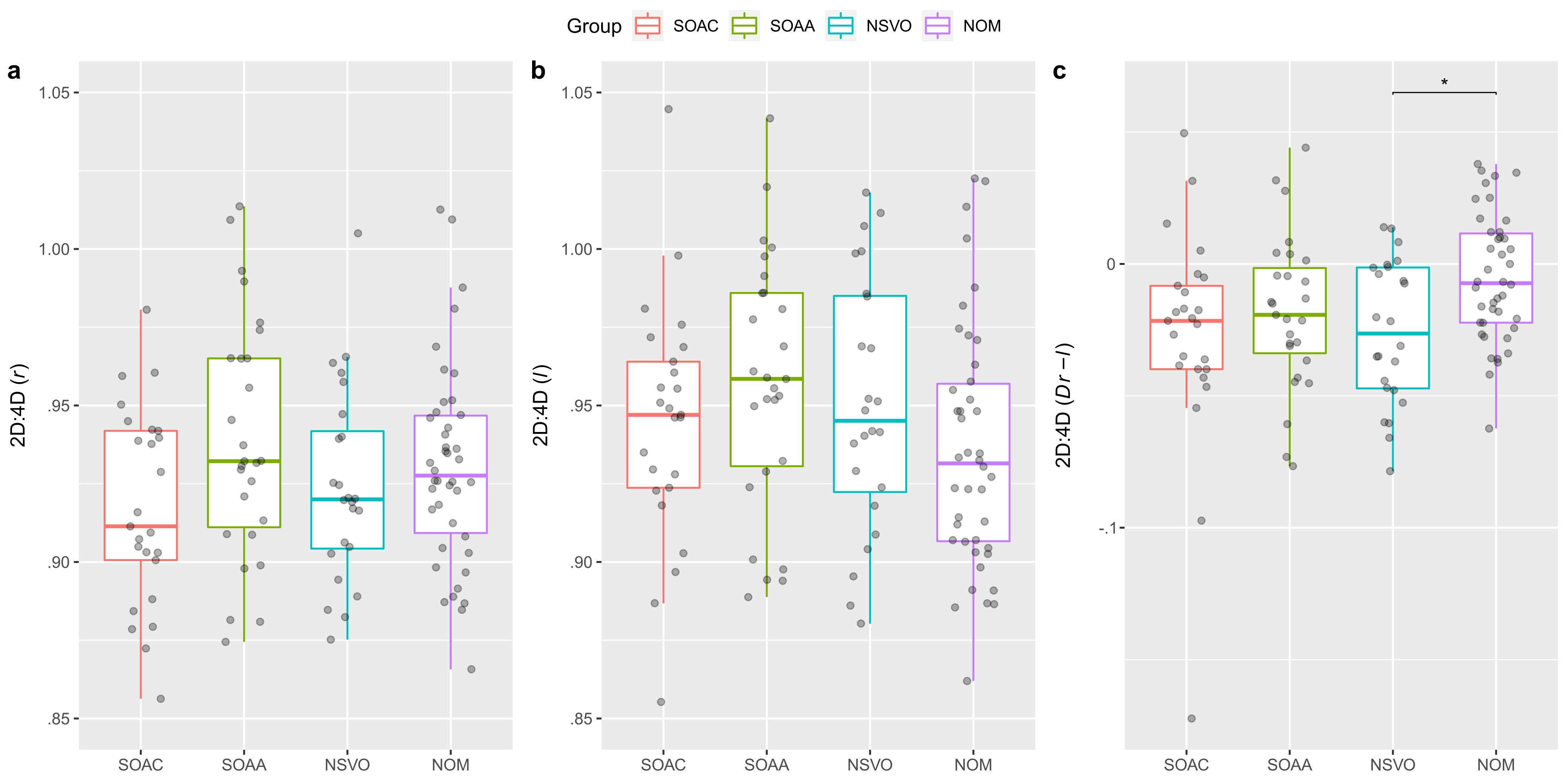
Figure 2.
2D:4D differences by Group
Notes: (a) 2D:4D (r). (b) 2D:4D (l). (c) 2D:4D (Dr−l). Group: SOAC: sexual offenders against children; SOAA: sexual offenders against adults; NSVO: non-sexual violent offenders; NOM = non-offending men. Bivariate comparisons between all groups were performed using t-tests, adjusted for multiple tests. *p < .05.
Discussion
The initial question in this study was whether there were differences in 2D:4D ratios between sexual offenders against children, sexual offenders against adults, non-sexual violent offenders and non-offending men. The main answer is no, because there were not strong or clear significant differences between groups in any measure of 2D:4D ratio used (right hand, left hand, or Dr−l). According to predictions, it was expected to find differences in 2D:4D measurements between offenders and non-offenders. However, there was evidence in favor of a significantly different 2D:4D between all offenders, and men with no criminal history, but only in the difference between the right and left hand. That is, significant differences were found in directional asymmetry with a medium effect size.
These findings suggest that the difference between right and left hand (directional asymmetry) may be a more sensitive indicator of prenatal hormonal exposure in criminal samples (Bailey & Hurd, 2005; Coyne et al., 2007). In this case, especially a higher prenatal testosterone exposure with a more masculinized pattern of 2D:4D ratio in the right hand could differentiate men with criminal records compared to men without records. The differences between non-offending men and offenders could be interpreted as due to a more atypical prenatal androgenization, which would lead to a more negative Dr–l ratio compared to non-offending men, overall having lower right-hand that left-hand 2D:4D (Coyne et al., 2007; Manning et al., 2004; Stoyanov, Marinov, & Pashalieva, 2009).
This was especially evident in sexual offenders against adults and non-sexual violent offenders, but only significantly different between non-sexual violent offenders and non-offending men. A possible explanation for these differences could lie in the basis of the differences between physical assault, sexual assault against adults and sexual assault against children. The latter may be less impulsive, more planned and based on deception and manipulation, rather than on the use of force and coercion, as is the case with sexual assault on adult women and other non-sexual violent crimes (Seto, 2008; Ward & Beech, 2006). This may result in evidence of differences between child sexual offenders, other types of sexual offenders, and non-sexual offenders. However, this is only speculation, since there were no direct differences between groups of offenders, and there is no comparative evidence. Higher prenatal testosterone exposure has been found in recent studies (Kruger et al., 2019) in groups of child sexual offenders compared to non-offending pedophiles and men in the general population.
Overall, findings in forensic and non-forensic samples support, with small effect sizes, that right-hand 2D:4D ratio is lower in criminal compared to non-criminal samples (e. g.Hanoch, Gummerum, & Rolison, 2012). In non-forensic samples, there is evidence of associations between criminal behavior and right-hand 2D:4D (Ellis & Hoskin, 2015; Hoskin, 2017; Hoskin & Ellis, 2015; Romero-Martínez et al., 2013), but these did not measured Dr–l or left-hand 2D:4D ratios. Thus, these findings differ from some previous results but are consistent with others (Anderson, 2012; Voracek & Stieger, 2009b), as no differences were found between groups either in right- or left-hand 2D:4D ratios.
Although these results tentatively suggest that Dr–l ratio could be more dimorphic in criminal groups, especially those who use force or violence towards others, these findings are not concluding. The intra-group variability observed was greater that the variability between groups, and there were no significant differences between non-offending men and sexual offenders against children or adults.
The ability to compare these findings is very limited, as so far there are no comparative studies in forensic and non-forensic samples, or at least measuring criminality, that report data of left-hand or Dr–l 2D:4D digit ratios. All related studies found, authors either explain that they only used right-hand 2D:4D digit ratio, based on evidence pointing to the prenatal androgenization having a stronger effects on the right hand (Anderson, 2012; Ellis & Hoskin, 2015; Hanoch et al., 2012; Hoskin, 2017; Hoskin & Ellis, 2015; Romero-Martínez et al., 2013), or calculate a 2D:4D average from both hands (Herschl et al., 2012), unaware of the importance of Dr–l and left-hand digit ratio.
The multilevel analyses from Pratt, Turanovic, and Cullen (2016) and the meta-analysis from Turanovic et al. (Turanovic et al., 2017) about the relation between 2D:4D digit ratio, aggression, and violent behavior, including studies with violent offenders or criminality (only six studies) and studies with students or general community, found that only 28 % and 11.7 % of studies included left-hand and Dr–l 2D:4D digit ratios, respectively. Yet, researchers of the recent meta-analyses do not call attention to this. It is possible that past publication biases, weak effects and small and mixed samples are deviating attention to the right-hand 2D:4D digit ratio, underestimating the value of the left-hand and, especially, of the Dr–l 2D:4D digit ratio. Only one related study could be identified that measured Dr–l 2D:4D digit ratio and reported that, in women, direct aggression was not linked to 2D:4D digit ratio, but a negative directional asymmetry predicted indirect aggression (Coyne et al., 2007).
Given the small sample size of the groups, and the potential statistical model instability that this could create (e. g.Jaki et al., 2019), replicating this study with adequate sample sizes and across different countries is challenging, but indispensable before 2D:4D ratios are thought to be markers of criminal behavior.
Conclusions
There are recent meta-analyses (Pratt et al., 2016; Turanovic et al., 2017) which confirm that the effect sizes of the relation between digit ratio and measures of aggressive or violent behavior are consistently weak and non-significant. However, it is important to highlight that, because research is still scarce, even meta-analysis based on so few studies with forensic samples, control groups, and including all 2D:4D variables could not be conclusive and results should be interpreted cautiously in any direction.
Although this study was exploratory and had a relatively small sample size, its findings replicate weak associations that have been accepted as positive findings in other studies with larger samples (Bailey & Hurd, 2005; Ellis & Hoskin, 2015). These results support the idea that these associations are too weak to consider them predictors of sexual or non-sexual criminal behavior, and that this marker cannot in any way be used in the prevention or evaluation of sexual or violent criminal behavior because there is no strong and clear difference between offenders and non-offenders.
The risk factors determining sexual or non-sexual criminal behavior seem to go beyond intra-uterine effects and involve complex interactions between heritability, epigenetics, and pre-natal and post-natal life events (Talarovičová, Kršková, & Blažeková, 2009; Voracek & Stieger, 2009b).
Whether 2D:4D ratio is an indirect valid and reliable marker of prenatal androgenization, is beyond dispute with these data; however, if it has more than a simple effect detected by chance on criminal behavior, this should be also further explored in both left-hand and Dr–l 2D:4D digit ratios, to test whether its explanatory power is low or even non-existent.
Also, it is worthwhile to expand this research by considering the classification of sexual and non-sexual crimes, given the multifactorial nature of the conduct that may differ between violent vs. non-violent sexual crimes, as well as exploring in depth the hypothesis of the role of prenatal exposure to testosterone in child sexual offenders compared to adult sexual offenders.
Limitations and future directions
This study was exploratory and measured a relatively small sample due to the difficulties of having access to convicted offenders in Colombia. Furthermore, because of the small number of non-right-handed and non-heterosexual participants, they were excluded from the final statistical models, to reduce the chance of type I errors in interaction involving handedness and/or sexual orientation. Having larger sample sizes in future studies could help in including participants with these characteristics.
Another limitation of this study is that it is not possible to be sure that the convicts in each group belong exclusively to this group, since the study only controlled their classification in each group according to their recorded criminal history. It should be recognized that this is a simple design, with a small sample and difficult to access, especially in countries such as Colombia, where the prison system is not sufficiently integrated into scientific research. It would have been ideal to collect more psychological data to correlate these variables but, as mentioned, this is a study that emerged from a larger experimental study in which the interest was focused on manipulating other variables that could not be associated with 2D:4D due to limitations in sample size and because the interest was to study the isolated effect of 2D:4D by controlling for psychological differences between the groups.
This study has the advantage of overcoming some limitations of predictive studies that do not make comparisons between groups; it included comparisons not only between groups of sexual and non-sexual offenders, but also subtypes of sexual offenders (against children and adults) compared with non-sexual violent offenders and men with no criminal record from the general population. In addition, contrary to other studies (e. g.Ellis & Hoskin, 2015), this one was not based on self-reported offenses, which could be an unreliable measure of criminality (Thornberry & Krohn, 2000).
Data availability
All data used for this article are openly available at the OSF (Anonymous, 2019b). Code to perform all analyses, data manipulation, tables and figures is available in HTML (‘Supplementary_Material.html’), and R Markdown (‘Supplementary Material. Rmd’) formats, so that it can be fully reproduced and explored in depth (Anonymous, 2019a).
References
Anderson, T. (2012). Comparing risk-taking and digit ratio (2D:4D) in offenders and non-offenders. The Plymouth Student Scientist, 5(2), 105–120. https://bcur.org/journals/index.php/TPSS/article/view/344/323
Anonymous. (2019a). Code and Analyses from: 2D:4D in Heterosexual Sexual Offenders, Nonsexual Offenders, and Nonoffending Men. Open Science Framework. https://osf.io/fwcxn/?view_only=08bda2c26edd47e099de62838b0ea660
Anonymous. (2019b). Data from: 2D:4D in Heterosexual Sexual Offenders, Nonsexual Offenders, and Nonoffending Men. Open Science Framework. https://osf.io/v274u/?view_only=08bda2c26edd47e099de62838b0ea660
Bailey, A. A., & Hurd, P. L. (2005). Finger length ratio (2D:4D) correlates with physical aggression in men but not in women. Biological Psychology, 68(3), 215–222. https://doi.org/10.1016/j.biopsycho.2004.05.001
Barel, E., & Tzischinsky, O. (2017). The role of sex hormones and of 2D:4D ratio in individual differences in cognitive abilities. Journal of Cognitive Psychology, 29(4), 497–507. https://doi.org/10.1080/20445911.2017.1279166
Benderlioglu, Z., & Nelson, R. J. (2004). Digit length ratios predict reactive aggression in women, but not in men. Hormones and Behavior, 46(5), 558–564. https://doi.org/10.1016/j.yhbeh.2004.06.004
Brown, W. M., Finn, C. J., & Breedlove, S. M. (2002). Sexual dimorphism in digit-length ratios of laboratory mice. The Anatomical Record, 267(3), 231–234. https://doi.org/10.1002/ar.10108
Campbell, A. (2006). Sex differences in direct aggression: What are the psychological mediators? Aggression and Violent Behavior, 11(3), 237–264. https://doi.org/10.1016/j.avb.2005.09.002
Carré, J. M., Ortiz, T. L., Labine, B., Moreau, B. J. P., Viding, E., Neumann, C. S., & Goldfarb, B. (2015). Digit ratio (2D:4D) and psychopathic traits moderate the effect of exogenous testosterone on socio-cognitive processes in men. Psychoneuroendocrinology, 62, 319–326. https://doi.org/10.1016/j.psyneuen.2015.08.023
Código Penal, Pub. L. No. Art. 212 (2004). Congreso de la República de Colombia. http://perso.unifr.ch/derechopenal/assets/files/legislacion/l_20160208_02.pdf
Coyne, S. M., Manning, J. T., Ringer, L., & Bailey, L. (2007). Directional asymmetry (right–left differences) in digit ratio (2D:4D) predict indirect aggression in women. Personality and Individual Differences, 43(4), 865–872. https://doi.org/10.1016/j.paid.2007.02.010
DeBruine, L. M. (2004). AutoMetric software for measurement of 2D:4D ratios. http:// facelab.org/debruine/Programs/autometric.php.
Ellis, L. (2017). Race/ethnicity and criminal behavior: Neurohormonal influences. Journal of Criminal Justice, 51(March), 34–58. https://doi.org/10.1016/j.jcrimjus.2017.05.013
Ellis, L., & Hoskin, A. W. (2015). Criminality and the 2D:4D ratio: testing the prenatal androgen hypothesis. International Journal of Offender Therapy and Comparative Criminology, 59(3), 295–312. https://doi.org/10.1177/0306624X13503813
Ferdenzi, C., Lemaître, J.-F., Leongómez, J. D., & Roberts, S. C. (2011). Digit ratio (2D:4D) predicts facial, but not voice or body odour, attractiveness in men. Proceedings of the Royal Society B: Biological Sciences, 278(1724), 3551–3557. https://doi.org/10.1098/rspb.2011.0544
Franklin, R. D. (2014). Design and Analysis of Single-Case Research. Psychology Press. https://doi.org/10.4324/9781315806402
Hampson, E., & Sankar, J. S. (2012). Re-examining the Manning hypothesis: androgen receptor polymorphism and the 2D:4D digit ratio. Evolution and Human Behavior, 33(5), 557–561. https://doi.org/10.1016/j.evolhumbehav.2012.02.003
Hanoch, Y., Gummerum, M., & Rolison, J. (2012). Second-to-Fourth Digit Ratio and Impulsivity: A Comparison between Offenders and Nonoffenders. PLoS ONE, 7(10), 2–5. https://doi.org/10.1371/journal.pone.0047140
Herschl, L. C., Highland, K. B., & McChargue, D. E. (2012). Prenatal Exposure to Testosterone Interacts with Lifetime Physical Abuse to Predict Anger Rumination and Cognitive Flexibility among Incarcerated Methamphetamine Users. The American Journal on Addictions, 21(4), 363–369. https://doi.org/10.1111/j.1521-0391.2012.00246.x
Hönekopp, J., Bartholdt, L., Beier, L., & Liebert, A. (2007). Second to fourth digit length ratio (2D:4D) and adult sex hormone levels: New data and a meta-analytic review. Psychoneuroendocrinology, 32(4), 313–321. https://doi.org/10.1016/j.psyneuen.2007.01.007
Hönekopp, J., & Watson, S. (2010). Meta-analysis of digit ratio 2D:4D shows greater sex difference in the right hand. American Journal of Human Biology, 22(5), 619–630. https://doi.org/10.1002/ajhb.21054
Hönekopp, J., & Watson, S. (2011). Meta-analysis of the relationship between digit-ratio 2D:4D and aggression. Personality and Individual Differences, 51(4), 381–386. https://doi.org/10.1016/j.paid.2010.05.003
Hoskin, A. W. (2017). Male sex hormones and criminal behavior: The predictive power of a two-factor model of organizational androgen exposure. Personality and Individual Differences, 108, 86–90. https://doi.org/10.1016/j.paid.2016.11.034
Hoskin, A. W., & Ellis, L. (2015). Fetal Testosterone and Criminality: Test of Evolutionary Neuroandrogenic Theory. Criminology, 53(1), 54–73. https://doi.org/10.1111/1745-9125.12056
Jaki, T., Kim, M., Lamont, A., George, M., Chang, C., Feaster, D., & Van Horn, M. L. (2019). The Effects of Sample Size on the Estimation of Regression Mixture Models. Educational and Psychological Measurement, 79(2), 358–384. https://doi.org/10.1177/0013164418791673
Jordan, K., Fromberger, P., Stolpmann, G., & Müller, J. L. (2011). The role of testosterone in sexuality and paraphilia-a neurobiological approach. Part I: Testosterone and sexuality. Journal of Sexual Medicine, 8(11), 2993–3007. https://doi.org/10.1111/j.1743-6109.2011.02394.x
Kemper, C. J., & Schwerdtfeger, A. (2009). Comparing indirect methods of digit ratio (2D:4D) measurement. American Journal of Human Biology, 21(2), 188–191. https://doi.org/10.1002/ajhb.20843
Kruger, T. H. C., Sinke, C., Kneer, J., Tenbergen, G., Khan, A. Q., Burkert, A., … Frieling, H. (2019). Child sexual offenders show prenatal and epigenetic alterations of the androgen system. Translational Psychiatry, 9(1), 28. https://doi.org/10.1038/s41398-018-0326-0
Mailhos, Á., Buunk, A. P., & del Arca, D. (2013). La relación 2D:4D muestra una leve correlación positiva con la dominancia agresiva, pero no con la dominancia social, en jugadores de fútbol de categorías formativas de un equipo de primera división en Uruguay. Ciencias Psicológicas, 7(2), 143–150. http://www.scielo.edu.uy/pdf/cp/v7n2/v7n2a04.pdf
Manning, J. T., & Bundred, P. E. (2000). The ratio of 2nd to 4th digit length: A new predictor of disease predisposition? Medical Hypotheses, 54(5), 855–857. https://doi.org/10.1054/mehy.1999.1150
Manning, J. T., Churchill, A. J. G., & Peters, M. (2007). The Effects of Sex, Ethnicity, and Sexual Orientation on Self-Measured Digit Ratio (2D:4D). Archives of Sexual Behavior, 36(2), 223–233. https://doi.org/10.1007/s10508-007-9171-6
Manning, J. T., & Fink, B. (2017). Are there any “direct” human studies of digit ratio (2D:4D) and measures of prenatal sex hormones? Early Human Development. https://doi.org/10.1016/j.earlhumdev.2017.09.003
Manning, J. T., Scutt, D., Wilson, J., & Lewis-Jones, D. I. (1998). The ratio of 2nd to 4th digit length: a predictor of sperm numbers and concentrations of testosterone, luteinizing hormone and oestrogen. Human Reproduction (Oxford, England), 13(11), 3000–3004. https://doi.org/10.1093/humrep/13.11.3000
Manning, J. T., Wood, S., Vang, E., Walton, J., Bundred, P. E., van Heyningen, C., & Lewis-Jones, D. I. (2004). Second to fourth digit ratio (2D:4D) and testosterone in men. Asian Journal of Andrology, 6(3), 211–215. http://www.ncbi.nlm.nih.gov/pubmed/15273869
McIntyre, M. H. (2006). The use of digit ratios as markers for perinatal androgen action. Reproductive Biology and Endocrinology : RB&E, 4, 10. https://doi.org/10.1186/1477-7827-4-10
Ozdogmus, O., Çakmak, Y. Ö., Coskun, M., Verimli, U., Cavdar, S., & Uzun, I. (2010). The high 2D:4D finger length ratio effects on atherosclerotic plaque development. Atherosclerosis, 209(1), 195–196. https://doi.org/10.1016/j.atherosclerosis.2009.08.023
Phoenix, C. H. (2009). Organizing action of prenatally administered testosterone propionate on the Tissues mediating mating behavior in the female guinea pig. Hormones and Behavior, 55(5), 566. https://doi.org/10.1016/j.yhbeh.2009.01.004
Phoenix, C. H., Goy, R. W., Gerall, A. A., & Young, W. C. (1959). Organizing action of prenatally administered testosterone propionate on the tissues mediating mating behavior in the female guinea pig. Endocrinology, 65(3), 369–382. https://doi.org/10.1210/endo-65-3-369
Pratt, T. C., Turanovic, Ji. J., & Cullen, F. T. (2016). Revisiting the criminological consequences of exposure to fetal testosterone: a meta-analysis of the 2d:4d digit ratio. Criminology, 54(4), 587–620. https://doi.org/10.1111/1745-9125.12115
Richards, G. (2017). What is the evidence for a link between digit ratio (2D:4D) and direct measures of prenatal sex hormones? Early Human Development, 113(June), 71–72. https://doi.org/10.1016/j.earlhumdev.2017.08.003
Romero-Martínez, Á., Lila, M., Catalá-Miñana, A., Williams, R., & Moya-Albiol, L. (2013). The Contribution of Childhood Parental Rejection and Early Androgen Exposure to Impairments in Socio-Cognitive Skills in Intimate Partner Violence Perpetrators with High Alcohol Consumption. International Journal of Environmental Research and Public Health, 10(8), 3753–3770. https://doi.org/10.3390/ijerph10083753
Ryckmans, J., Millet, K., & Warlop, L. (2015). The influence of facial characteristics on the relation between male 2D:4D and dominance. PLoS ONE, 10(11), 1–9. https://doi.org/10.1371/journal.pone.0143307
Seto, M. C. (2008). Pedophilia and sexual offending against children: Theory, assessment, and intervention. Washington: American Psychological Association. https://doi.org/10.1037/11639-000
Shrout, P. E., & Fleiss, J. L. (1979). Intraclass correlations: Uses in assessing rater reliability. Psychological Bulletin, 86(2), 420–428. https://doi.org/10.1037/0033-2909.86.2.420
Stoyanov, Z., Marinov, M., & Pashalieva, I. (2009). Finger Length Ratio (2D:4D) in Left- and Right-Handed Males. International Journal of Neuroscience, 119(7), 1006–1013. https://doi.org/10.1080/03008200802323883
Studer, L. H., Aylwin, A. S., & Reddon, J. R. (2005). Testosterone, Sexual Offense Recidivism, and Treatment Effect Among Adult Male Sex Offenders. Sexual Abuse: A Journal of Research and Treatment, 17(2), 171–181. https://doi.org/10.1007/s11194-005-4603-0
Talarovičová, A., Kršková, L., & Blažeková, J. (2009). Testosterone enhancement during pregnancy influences the 2D:4D ratio and open field motor activity of rat siblings in adulthood. Hormones and Behavior, 55(1), 235–239. https://doi.org/10.1016/j.yhbeh.2008.10.010
Teatero, M. L., & Netley, C. (2013). A critical review of the research on the extreme male brain theory and digit ratio (2D:4D). Journal of Autism and Developmental Disorders, 43(11), 2664–2676. https://doi.org/10.1007/s10803-013-1819-6
Thornberry, T. P., & Krohn, M. D. (2000). The self-report method for measuring delinquency and crime. Criminal Justice, 4, 33–83. https://www.publicsafety.gc.ca/lbrr/archives/cnmcs-plcng/cn34984-v4-33-83-eng.pdf
Turanovic, J. J., Pratt, T. C., & Piquero, A. R. (2017). Exposure to fetal testosterone, aggression, and violent behavior: A meta-analysis of the 2D:4D digit ratio. Aggression and Violent Behavior, 33, 51–61. https://doi.org/10.1016/j.avb.2017.01.008
van der Meij, L., Almela, M., Hidalgo, V., Villada, C., IJzerman, H., van Lange, P. A. M., & Salvador, A. (2012). Testosterone and Cortisol Release among Spanish Soccer Fans Watching the 2010 World Cup Final. PLoS ONE, 7(4), e34814. https://doi.org/10.1371/journal.pone.0034814
van Honk, J., Schutter, D. J., Bos, P. A., Kruijt, A.-W., Lentjes, E. G., & Baron-Cohen, S. (2011). Testosterone administration impairs cognitive empathy in women depending on second-to-fourth digit ratio. Proceedings of the National Academy of Sciences, 108(8), 3448–3452. https://doi.org/10.1073/pnas.1011891108
Vásquez-Amézquita, M., Leongómez, J. D., Seto, M. C., Bonilla, F. M., Rodríguez-Padilla, A., & Salvador, A. (2018). No relation between digit ratio (2D:4D) and visual attention patterns to sexually preferred and non-preferred stimuli. Personality and Individual Differences, 120, 151–158. https://doi.org/10.1016/j.paid.2017.08.022
Voracek, M. (2014). No effects of androgen receptor gene CAG and GGC repeat polymorphisms on digit ratio (2D: 4D): A comprehensive meta-analysis and critical evaluation of research. Evolution and Human Behavior, 35(5), 430–437. https://doi.org/10.1016/j.evolhumbehav.2014.05.009
Voracek, M., & Stieger, S. (2009a). Replicated nil associations of digit ratio (2D:4D) and absolute finger lengths with implicit and explicit measures of aggression. Psicothema, 21(3), 382–389. http://www.ncbi.nlm.nih.gov/pubmed/19622317
Voracek, M., & Stieger, S. (2009b). Replicated nil associations of digit ratio (2D:4D) and absolute finger lengths with implicit and explicit measures of aggression. Psicothema, 21(3), 382–389.
Ward, T., & Beech, A. (2006). An integrated theory of sexual offending. Aggression and Violent Behavior, 11(1), 44–63. https://doi.org/10.1016/j.avb.2005.05.002
Wong, W. I., & Hines, M. (2016). Interpreting digit ratio (2D:4D)–behavior correlations: 2D:4D sex difference, stability, and behavioral correlates and their replicability in young children. Hormones and Behavior, 78, 86–94. https://doi.org/10.1016/j.yhbeh.2015.10.022
Xu, Y., & Zheng, Y. (2016). The Relationship Between Digit Ratio (2D:4D) and Sexual Orientation in Men from China. Archives of Sexual Behavior, 45(3), 735–741. https://doi.org/10.1007/s10508-015-0535-z
Zhang, C., Dang, J., Pei, L., Guo, M., Zhu, H., Qu, L., … Huo, Z. (2013). Relationship of 2D:4D finger ratio with androgen receptor CAG and GGN repeat polymorphism. American Journal of Human Biology, 25(1), 101–106. https://doi.org/10.1002/ajhb.22347
Zheng, Z., & Cohn, M. J. (2011). Developmental basis of sexually dimorphic digit ratios. Proceedings of the National Academy of Sciences, 108(39), 16289–16294. https://doi.org/10.1073/pnas.1108312108
Notes