Artículos
Organizational support perceived in Mexican workers in the service sector
Apoyo organizacional percibido en trabajadores mexicanos del sector de servicios
Organizational support perceived in Mexican workers in the service sector
Interdisciplinaria, vol. 39, núm. 1, pp. 285-297, 2022
Centro Interamericano de Investigaciones Psicológicas y Ciencias Afines

Esta obra está bajo una Licencia Creative Commons Atribución-NoComercial-CompartirIgual 4.0 Internacional.
Recepción: 02 Julio 2020
Aprobación: 25 Octubre 2021
Abstract: Perceived Organizational Support refers to workers evaluating their workplaces and creating a general perception on whether their contributions are considered worthy by the organization. Employees who consider that the organization values what they contribute and ideas exchanging, also showing concern for their well-being, are people with better job performance, less absenteeism and higher expectations about rewards for their work. Perceived Organizational Support is increasingly recognized as an important factor in worker’s performance and research has shown that it could be related to various sociodemographic and economic variables. The objective of this study was to analyze the relationship between Perceived Organizational Support with sociodemographic variables such as age, gender, educational level, suffering from chronic illness and paternity / maternity; and also economic variables such as years of work, salary, type of economic activity, organization size and hierarchical level in Mexican workers of the service sector. Sample included 294 workers from 27 different organizations, who answered Perceived Organizational Support and sociodemographic and economic characteristics surveys. Results show that only organization size obtained significant differences, being organizations with many employees where more support is perceived compared to small companies or institutions. The rest of the variables did not show significant differences, which represents that Perceived Organizational Support is not related to age, gender, educational level, suffering from chronic illness and paternity / maternity, years of work, salary, economic activity or the hierarchical level. Obtained evidence is discussed and recommendations for future research are proposed.
Keywords: Perceived organizational support, sociodemographic characteristics, economic characteristics, Mexican workers, services sector.
Resumen:
El Apoyo Organizacional Percibido refiere a la percepción general que los trabajadores crean sobre el aprecio a sus contribuciones en la organización en la que se encuentran. Los empleados que consideran que en su trabajo valoran sus aportaciones, sus ideas y su bienestar son personas con un mejor rendimiento laboral, menor ausentismo y mayores expectativas sobre la recompensa de su desempeño. Los estudios han mostrado que podría estar relacionado con diversas variables sociodemográficas y económicas de una población, por lo que el objetivo de esta investigación fue analizar la relación de los diferentes niveles de apoyo organizacional percibido con las variables sociodemográficas –edad, género, nivel educativo, padecer enfermedad crónica y paternidad / maternidad– y con las variables económicas –años de trabajo, salario, tipo de actividad económica, tamaño de la organización y nivel jerárquico– de trabajadores mexicanos del sector de servicios. Estudiar esta variable con este tipo de organizaciones (actividades asociadas a la venta y entrega de servicios) es relevante, puesto que es un área económica importante y que, además, contiene a la mayor fuerza de trabajo en el mundo, y en México estos datos no son la excepción. Esta investigación tiene un diseño transversal, descriptivo y correlacional. El estudio se llevó a cabo con 294 trabajadores de 27 organizaciones de la ciudad de Colima, México. La clasificación de los lugares de trabajo se realizó acorde a las actividades económicas establecidas en el Directorio Estadístico Nacional de Unidades Económicas (DENUE), las cuales quedaron conformadas por ventas, educación, salud, alojamiento temporal, no gubernamentales y organizaciones de gobierno. Los trabajadores respondieron el cuestionario de apoyo organizacional percibido, conformado por dos dimensiones: (1) satisfacción de necesidades socioafectivas; y (2) sensación de reconocimiento. Además, contestaron otro instrumento para medir las características sociodemográficas y económicas elaborado por los autores de este estudio basados en la Encuesta Nacional de Ocupación y Empleo (ENOE). El análisis de datos se llevó a cabo mediante descriptivos y pruebas no paramétricas (Spearman, U de Mann-Whitney y H de Kruskal-Wallis).
Palabras clave: apoyo organizacional percibido, características sociodemográficas, características económicas, trabajadores mexicanos, sector de servicios.
Introduction
Constant personnel rotation is a well-known consequence of worker dissatisfaction and it’s very expensive for organizations (Abualrub & Alghamdi, 2012; Parasuraman, 1982). In México, according to the Instituto Nacional de Estadística, Geografía e Informática (INEGI, 2020), 18 % of worker population who quit their job wanted to continue studying, 17 % had family responsibilities and 16 % wanted to earn more money or overcome themselves. So, if organizations had shown more support to the worker’s needs, maybe they wouldn’t have quit.
Service sector (also known as third sector) is an important economic area that contains the majority of workers in the world (International Labour Organization, 2019), and Mexico is not the exception. Economic activities included in the third sector are associated to organizations that do not process any product, only sell them or give services (INEGI, n.d.); about 63 % of the Mexican workforce (34 646 072 people) belongs to this sector. Out of these 34 million workers, 52 % are catalogued within the middle-low income range, which means they make between one and two minimum wages a day. Moreover, 48 % of them work from 35 to 48 hours a week, while another 28 % have a longer working week. In addition, just over half of this population (52 %) have an educational background that goes up to high school or less. Moreover, it should be noted that only 40 % of this sector has access to health services (INEGI, 2020), which puts workers in a vulnerable state. In conclusion, research about Perceived Organization Support in services sector is undoubtedly relevant.
Perceived Organizational Support
Workers perception about how much the organization values their contributions, exchange of ideas, and cares for their well-being is known as Perceived Organizational Support (POS) (Armeli, Eisenberger, Fasolo, & Lynch, 1998; Eisenberger, Stinglhamber, Vandenberghe, Sucharski, & Rhoades, 2002). Eisenberger, Huntington, Hutchison, & Sowa proposed the Perceived Organizational Support theory in 1986. Their conclusions showed that workers with high support perception levels had better performance.
Reciprocity principle is the basis of Perceived Organizational Support (Gouldner, 1960). It means that, if the people feel valued by the organization where they work, they generate an obligation to return a favorable treatment as the one they received (Eisenberger, Armeli, Rexwinkel, D. Lynch, & Rhoades, 2001). Perceived Organizational Support has been an important variable to understand how to generate more stimulating workplaces for employees.
In their research, Lupano Perugini & Castro Solano (2018) recognize organizational support as a virtue, which mitigates labor stress and influences on satisfaction, commitment, and performance of the workers. Likewise García-González, Torrano, & García-González (2020) about psychosocial risks in university teachers: they mention the importance of the institution supporting their workers through better structuring the workload, the spaces of coexistence, the training plans in professional and personal competences.
Perceived organizational support and the services sector
Research about perceived organizational support in the services sector has been diverse. Li, Zhang, Yan, Wen, & Zhang (2020) with China’s nursing population, they identify the influence of POS on job control, job satisfaction and intention to stay. About the last variable, Aria, Jafari, & Behifar (2019) also found a strong effect of POS but with high school teachers from Iran. Other studies have shown influences on other variables, for example Indrawiani, Anggraeni, & Indrayanto (2018) point out in Civil Service Police Units in Indonesia that POS impacts on organizational citizenship behavior. For their part, Coskuner et al. (2017) identified a negative correlation with mobbing and a positive association with organizational identification.
Other studies in the services sector have found relationships with health status. POS is a mitigator of aversive effects of chronic pain on performance (Byrne & Hochwarter, 2006), which may be related to the culture of care that is formed from support, as determined by Payne, Cluff, Lang, Matson-Koffman, & Morgan-Lopez (2018) with a wide American sample. Pan, Shen, Liu, Yang, & Wang (2015) point out in their research with university professors the influence of the POS on work satisfaction.
In Mexico, there are also some POS studies focused on the services sector. Camacho & Arias (2012), with a teachers sample in Veracruz, indicated a positive correlation with work satisfaction. Ojeda, Talavera, & Berreleza (2016, 2017) have found in a couple of studies a statistically significant relationship between the POS and the organizational commitment in the population of the education and hotel sectors. Salazar-Estrada (2018), with a population mostly of the services sector, points out that POS predicts subjective well-being through stress reduction.
On the other hand, it is possible to identify differences between POS levels and personal conditions in research. For example, Angelucci, Parra, & Peñuela (2017), in a study with supermarket workers in Venezuela, identified that men, older workers, and those with lower academic levels tend to perceive that the company is willing to support them when they have problems. Yu (2011) said that the POS had a positive correlation with the educational level and could also predict professional success (subjective) in knowledge employees.
In addition to this, some studies have identified the relevance of POS in family conditions such as Nasurdin & O’Driscoll (2011), who with university teachers point to the negative correlation with family-work conflicts, and Fitria & Roza (2019), who identified a positive relationship with work life-balance in banking workers.
Job seniority is another variable that influences POS levels as shown by Wnuk (2017) with IT employees. Salary is another aspect that has become involved as a predictor of POS: according to paper by Zin, Othman, & Pangil (2012), money determines the positive effect to support in IT workers too.
Finally, hotel workers from Mexico participated in the research of García, Banda, & Juárez (2020). They did a descriptive analysis about demographic variables and the POS levels. Their results show that the people that perceived lower support are workers from 36 to 40 years old, free union civil status, an educational level high school or less, and job seniority between one to three years.
As can be seen from researches above, POS is crucial in the service sector because it influences many variables in the workplaces. It is important to know the factors that determine organizational support, as well as identify the personal conditions that influence its perception.
Method
Design
This research has a cross-sectional, descriptive and correlation design. Convenience sampling was used in the study.
Sample
The study sample has 294 workers from 27 organizations from Colima, México. Workplaces were distributed in the services sector according to the activities established in Mexican Directorio Estadístico Nacional de Unidades Económicas (DENUE) (INEGI, 2018), which include trade, education, health, temporary accommodation, non-profit and government organizations.
Instruments
Survey of Perceived Organizational Support (SPOS): This survey was created by Eisenberger et al., (1986) in USA, where they established a short version. Later, Marbeti (2001; cited by Ellenberg & Rojas, 2007; Flores & Gómez, 2018) translated to Spanish in Venezuela. This survey was validated in Mexico for this study. It is composed of 15 items in a Likert scale of 1 (strongly disagree) to 7 (strongly agree). The SPOS has two dimensions: (1) satisfaction of socio-affective needs (items: 1, 2, 3, 4, 5, 7, 11, 12, 13 and 15); and (2) sense of recognition (6, 8, 9, 10 and 14). Their Cronbach’s alpha levels were 0.92 and 0.85 respectively.
Sociodemographic and economic characteristics questionnaire: The survey was based in the Mexican Encuesta Nacional de Ocupación y Empleo (ENOE) (INEGI, 2020). Sociodemographic characteristics included six items: age, gender, education level, civil status, paternity or maternity, and state of health. Economic characteristics were composed by five items: economic activities, organization size, hierarchy, job seniority and salary.
Procedure
In this study, 122 services sector organizations were invited to participate, 35 of which agreed but due to administrative changes in some of them only 27 participated. Data collection was carried out in person between March and May 2019. Workers who agreed to participate did so voluntarily, each person gave its informed consent.
Data analysis
To analyze the data the 19th version of Statistical Package for the Social Sciences (SPSS) was used. Firstly, descriptive statistics were applied to describe groups generated for the sociodemographic and economic characteristics. Then, Spearman correlation was applied between scalar variables (age, job seniority and salary) and POS. Mann-Whitney U and Kruskal-Wallis H test were performed to identify differences between groups conformed in POS levels.
Results
Descriptive analysis
Sample age average was 38.63 (ED = 9.93), from 20 to 66 years old range. Regarding years of work, 245 workers filled out the item and the average was 16.5 (ED = 10.17). The salary distribution was made up of workers with an income of $ 1 000 to $ 42 000 Mexican pesos. Average was $10 043.75 (ED = 6.217). The data included 233 people of the sample; the rest did not reply.
Table 1 includes more characteristics that correspond to the sample; it shows how the groups are formed by their contrast between them. Sample distribution in education levels, civil status, economic activities and organization size were omitted in certain groups in subsequent analysis .
| Sociodemographic characteristics | Economics characteristics | ||||
| n | % | n | % | ||
| Gender | Economic activity | ||||
| Male | 163 | 55.4 | Trade | 37 | 12.6 |
| Female | 129 | 43.9 | Education | 116 | 39.5 |
| Education | Health | 48 | 16.3 | ||
| Elementary school | 2 | .7 | Temporary Accommodation | 15 | 5.1 |
| Secondary school | 26 | 8.8 | Non-profit organization | 5 | 1.7 |
| High school | 36 | 12.2 | Government | 73 | 24.8 |
| Technical school | 35 | 11.9 | Size | ||
| Bachelor’s degree | 139 | 47.3 | Small | 199 | 67.7 |
| Postgraduate | 56 | 19 | Medium | 15 | 5.1 |
| Civil status | Large | 80 | 27.2 | ||
| Single | 84 | 28.6 | Hierarchical | ||
| Married | 149 | 50.7 | Supervisor | 53 | 18 |
| Free union | 41 | 13.9 | Subordinate | 239 | 81.3 |
| Divorced | 18 | 6.1 | |||
| Widower | 1 | .3 | |||
| Paternity or maternity | |||||
| Children | 211 | 71.8 | |||
| Not children | 82 | 27.9 | |||
| State of health | |||||
| Sick | 47 | 16 | |||
| Healthy | 245 | 83.3 | |||
Obtained score distribution on SPOS are shown in figure 1. The boxplot shows that satisfaction of socio-affective needs has an asymmetric distribution with a positive bias. Dimension called sense of recognition has a symmetric distribution in their scores with respect to the previous one. Finally, the SPOS in general has a distribution inclined towards the higher scores in the survey.
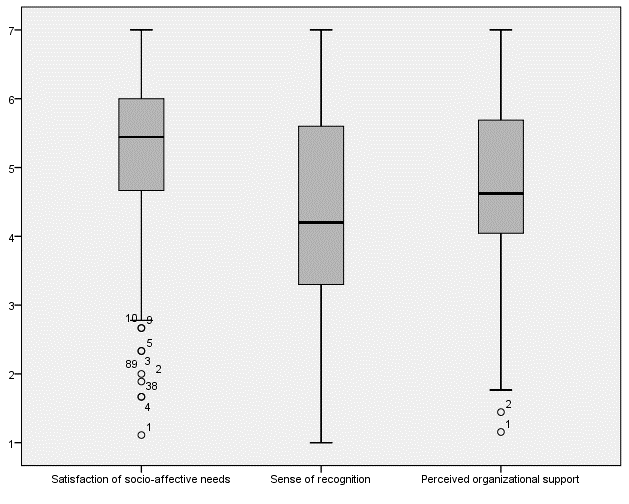
Figure 1.
Scores distributions of POS and their dimensions.
Correlation analysis
Spearman correlation between age, job seniority and salary with the POS and their dimensions did not show significant results. These variables have a null relationship, as the p value was .05 (see table 2).
| Age | Seniority | Salary | |
| Satisfaction of socio-affective needs | .007 | -.051 | -.073 |
| Sense of recognition | -.033 | -.017 | .004 |
| Perceived organizational Support | -.009 | -.024 | -.034 |
Comparative analysis
Comparative analysis between categorical variables are shown in table 3. Results showed that there weren’t significant differences. Gender, education level, civil status, paternity or maternity and health state have a p value higher to .05.
| Satisfaction of socio-affective needs | Sense of recognition | Perceived organizational support | ||||
| Average range | p | Average range | p | Average range | p | |
| Gender | ||||||
| Male | 146.32 | .87 | 148.53 | .72 | 148.01 | .82 |
| Female | 147.85 | 145.08 | 145.74 | |||
| Education | ||||||
| Elementary school | - | .78 | - | .46 | - | .78 |
| Secondary school | 141.20 | 133.06 | 128.96 | |||
| High school | 151.49 | 159.93 | 157.35 | |||
| Technical school | 161.88 | 129.90 | 144.76 | |||
| Bachelor’s Degree | 145.79 | 147.04 | 147.75 | |||
| Postgraduate | 140.25 | 155.65 | 147.96 | |||
| Civil status | ||||||
| Single | 151.01 | .36 | 137.78 | .24 | 143.38 | .22 |
| Married | 148.62 | 155.07 | 153.51 | |||
| Free union | 126.46 | 130.76 | 124.40 | |||
| Divorced | 161.83 | 157.86 | 160 | |||
| Widower | - | - | - | |||
| Paternity or maternity | ||||||
| Children | 147.56 | .98 | 149.06 | .61 | 148.61 | .71 |
| Not children | 147.33 | 143.33 | 144.54 | |||
| State of health | ||||||
| Sick | 134.11 | .25 | 146.73 | .98 | 137.73 | .41 |
| Healthy | 149.46 | 147.05 | 148.77 | |||
Same analysis was done to economic variables (see table 4). These results were not significant between economic activities groups (p > .05) and the hierarchical level (p > .05). But size of organization analysis found differences in sense of recognition dimension (U = 6704; Z = 2.239; p = .02).
| Satisfaction of socio-affective needs | Sense of recognition | Perceived organizational support | ||||
| Average range | p | Average range | p | Average range | p | |
| Economic activity | ||||||
| Trade | 138.70 | .28 | 122.56 | .39 | 125.26 | .33 |
| Education | 143.95 | 143.04 | 144.02 | |||
| Health | 144.36 | 145.96 | 144.39 | |||
| Temporary Accommodation | - | - | - | |||
| Non-profit organization | - | - | - | |||
| Government | 121.98 | 130.11 | 126.52 | |||
| Size | ||||||
| Small | 137.65 | .45 | 133.03 | .02 | 134.82 | .09 |
| Medium | - | - | - | |||
| Large | 145.63 | 156.74 | 152.45 | |||
| Hierarchical | ||||||
| Supervisor | 145.17 | .86 | 149.89 | .78 | 148.71 | .86 |
| Subordinate | 147.41 | 146.35 | 146.61 | |||
Note: The spaces without values refer to the groups not included because the sample size implies risks of making type I or II statistical errors.
Discussion
Perceived organizational support relationships with sociodemographic and economic variables are important to organizational studies. This research contributes with never explored data in a Mexican context.
About distribution scores, this study found a trend toward scale higher points. This means that most workers perceived support for their organizations where they work. These results are like the previous Mexican studies, where the scores pass to the middle point of the scale (Camacho & Arias, 2012; García, Banda, & Juárez, 2020; Salazar-Estrada, 2018).
Organization size was the only variable that had differences in the sense recognition. Larger organizations had better levels than small workplaces, differing with Valencia (2013) and Rhoades & Eisenberger (2002). These findings may reflect that larger organizations have better feedback systems, Hutchison & Garstka (1996) showed in a model that the goal setting and feedback have influence on the POS and it, in turn, is a mediator for commitment. In addition, the social networks have an important role: Hayton, Carnabuci, & Eisenberger (2012) indicate a positive relation with size, density and quality network with the POS in a large manufacturing firm. These aspects may be involved in higher levels of sense of recognition in large companies, so future research may consider making these comparatives analysis between different organization sizes about social networks’ feedback systems and quality, as well as their influence on the POS.
Regarding sociodemographic characteristics, the evidence did not produce significant results. It implied that the age did not have relationship with POS. This result is like other studies (Bjørnstad, Patil, & Raanaas, 2016; Ingusci, Callea, Chirumbolo, & Urbini, 2016; Zhong, Wayne, & Liden, 2016).
The differences in groups of gender, civil status, paternity or maternity and state of health perceived the same support between them. This is different from what was expected in the study, however, there is evidence with similar results like these, for example Robaee et al. (2018) did not identify relation with gender, marital status and education level in a nurses sample. Referent to parents status, Flores & Gómez (2018) and Witt & Carlson (2006) did not find relation with the number of children and POS in their research. Finally, an investigation carried out by Liu, Wen, Xu, & Wang (2014) did not obtain a relationship with health status, but when performing multiple regression analysis with POS, psychological capital, and chronic disease on depressive and anxious symptoms, it indicated that chronic disease has a negative, weak but significant relationship with them.
On another hand, the remaining economic characteristics didn’t have significant associations with POS. The results differ from what was expected in the project, there is similar evidence of other studies done in reference to job seniority (Angelucci et al., 2017;Tejada & Arias, 2004). Regarding salary, some studied coincidence with this one, for example Lynch, Eisenberger, & Armeli (1999): in a sample from United States, they did not find relation between both variables.
The economics activities and hierarchical status did not have significant differences between their groups. Both variables are different to what was theorized at the beginning. The analysis of Valencia (2013) precisely indicates contrarious results to what was obtained in this research. She points out that organizations of health and education has the lowest levels of support. Also, she mentions that the supervisors had better levels than the subordinates.
POS is a variable involved in a broad economic sector; its levels, as results show, may depend on business aspects that determine perception of support. Therefore, it’s important that involved parties consider POS within their strategies for organizational development.
Future research could explore POS effects on programs and interventions within the company. Deeper research about organizational and personal conditions that influence the perception of support should also be done. Finally, it is proposed to explore more about the interactions between demographic and economic characteristics and POS with other variables to get a better understanding about how they interact.
The bias in this paper were related with the sample. The research did not have a representative sample for each organization and the characteristics were not homogenous between their workers. They implied that groups were staying out of the performed analysis. The other principal aspect was that most people were in an education and health sector.
In short, the perceived organization support in workers from Mexican organizations of the services sector was different in relation with the size of the organization, where large workplaces had better results compared to the small ones. The others sociodemographic and economic characteristics did not have relationships or differences with perceived support.
References
Abualrub, R., & Alghamdi, M. (2012). The impact of leadership styles on nurses satisfaction and intention to stay among Saudi nurses. Journal of Nursing Management, 20, 668–678. https://doi.org/10.1111/j.1365-2834.2011.01320.x
Angelucci, L., Parra, K., & Peñuela, R. (2017). Efecto del compromiso organizacional, la satisfacción laboral, el apoyo organizacional y factores sociodemográficos sobre la salud de trabajadores. In G. Blanco & L. Feldman (Eds.), Factores psicosociales laborales y sus efectos: haciendo visible lo invisible. (pp. 133–177). Caracas: Araca Editores.
Aria, A., Jafari, P., & Behifar, M. (2019). Authentic Leadership and Teachers’ Intention to Stay: The Mediating Role of Perceived Organizational Support and Psychological Capital. World Journal of Education, 9(3), 67. https://doi.org/10.5430/wje.v9n3p67
Armeli, S., Eisenberger, R., Fasolo, P., & Lynch, P. (1998). Perceived organizational support and police performance: The moderating influence of socioemotional needs. Journal of Applied Psychology, 83(2), 288–297. https://doi.org/10.1037/0021-9010.83.2.288
Bjørnstad, S., Patil, G., & Raanaas, R. (2016). Nature contact and organizational support during office working hours: benefits relating to stress reduction, subjective health complaints, and sick leave. Work, 53(1), 9–20. https://doi.org/10.3233/WOR-152211
Byrne, Z. S., & Hochwarter, W. A. (2006). I get by with a little help from my friends: The interaction of chronic pain and organizational support on performance. Journal of Occupational Health Psychology, 11(3), 215–227. https://doi.org/10.1037/1076-8998.11.3.215
Camacho, C., & Arias, L. (2012). Satisfacción, Apoyo y Compromiso en Profesores Mexicanos. Revista Interamericana de Psicología Ocupacional, 31(2), 120–127. http://revista.cincel.com.co/index.php/RPO/article/view/131
Coskuner, S., Costur, R., Karapinar, P., Camgoz, S., Ceylan, S., Zorbaz, S. D., … CIFFILIZ, G. (2017). Mobbing, Organizational Identification, and Perceived Support: Evidence From a Higher Education Institution. Eurasian Journal of Educational Research, 18(73), 21–42. https://doi.org/10.14689/ejer.2018.73.2
Eisenberger, R., Armeli, S., Rexwinkel, B., D.Lynch, P., & Rhoades, L. (2001). Reciprocation of POS. Journal of Applied Psychology, 86(1), pp. 42–51. https://doi.org/10.1037//0021-9010.86.1.42
Eisenberger, R., Huntington, R., Hutchison, S., & Sowa, D. (1986). Perceived Organizational Support. Journal of Applied Psychology, 71(3), pp. 500–507. https://doi.org/10.1037/0021-9010.71.3.500
Eisenberger, R., Stinglhamber, F., Vandenberghe, C., Sucharski, I. L., & Rhoades, L. (2002). Perceived supervisor support: Contributions to perceived organizational support and employee retention. Journal of Applied Psychology, 87(3), 565–573. https://doi.org/10.1037/0021-9010.87.3.565
Ellenberg, D., & Rojas, J. (2007). Influencia de la identificación con el trabajo, la percepción de apoyo organizacional, la antigüedad, el sexo, la edad y el nivel de instrucción sobre la ciudadanía organizacional (Tesis de pregado, Universidad Católica Andres Bello). Repositorio institucional UCAB.http://biblioteca2.ucab.edu.ve/anexos/biblioteca/marc/texto/AAQ9997.pdf
Fitria, Y., & Roza, M. (2019). Perceived Organizational Support and Work Life Balance on Employee Turnover Intention. Advances in Economics, Business and Management Research, 65, 503–506. https://doi.org/10.2991/icebef-18.2019.107
Flores, J., & Gómez, I. (2018). Apoyo organizacional percibido y compromiso organizacional en una empresa privada de Lima, Perú. Ajayu, 16(1), 10–30. http://hdl.handle.net/10757/624012
García-González, M., Torrano, F., & García-González, G. (2020). Estudio de los factores de riesgo psicosocial en profesoras de universidades online. Interdisciplinaria Revista de Psicología y Ciencias Afines, 37(1). https://doi.org/10.16888/interd.2020.37.1.18
García, A., Banda, H., & Juárez, S. (2020). Factores Relacionados con la Rotación de Personal en el Sector Hotelero de Chiapas , Mexico. Journal of Tourism and Heritage Research, 3(2), 247–268. https://dialnet.unirioja.es/servlet/articulo?codigo=7764933
Gouldner, A. W. (1960). The Norm of Reciprocity: A Preliminary Statement. American Sociological Review, 25(2), 161. https://doi.org/10.2307/2092623
Hayton, J., Carnabuci, G., & Eisenberger, R. (2012). With a little help from my colleagues: A social embeddedness approach to perceived organizational support. Journal of Organizational Behavior, 33, 235–249. https://doi.org/10.1002/job
Hutchison, S., & Garstka, M. (1996). Sources of Perceived Organizational Support: Goal Setting and Feedback. Journal of Applied Social Psychology, 26(15), 1351–1366. https://doi.org/10.1111/j.1559-1816.1996.tb00075.x
Indrawiani, T. O., Anggraeni, A. I., & Indrayanto, A. (2018). The influence of perceived organizational support ( POS ) and psychological capital on organizational citizenship behavior ( OCB ). Journal of Accounting, Management and Economics, 20(1), 1–4. http://jos.unsoed.ac.id/index.php/jame/article/view/1016
Ingusci, E., Callea, A., Chirumbolo, A., & Urbini, F. (2016). Job crafting and job satisfaction in a sample of Italian teachers: the mediating role of Perceived Organizational Support. Electronic Journal of Applied Statistical Analysis, 9(4), 675–687. https://doi.org/10.1285/i20705948v9n4p675
Instituto Nacional de Estadística, Geografía e Informática (2018). Directorio de empresas y establecimientos. www.beta.inegi.org.mx/temas/directorio/
Instituto Nacional de Estadística Geografía e Informática. (n.d.). Glosario. https://www.inegi.org.mx/app/glosario/default.html?p=ENOE15#letraGloS
Instituto Nacional de Estadística Geografía e Informática. (2020). Encuesta Nacional de Ocupación y Empleo (ENOE), población de 15 años y más de edad. https://www.inegi.org.mx/programas/enoe/15ymas/default.html#Tabulados
International Labour Organization. (2019). World employment and social outlook. https://ilostat.ilo.org/data.
Li, X., Zhang, Y., Yan, D., Wen, F., & Zhang, Y. (2020). Nurses’ intention to stay: The impact of perceived organizational support, job control and job satisfaction. Journal of Advanced Nursing, 76(5), 1141–1150. https://doi.org/10.1111/jan.14305
Liu, L., Wen, F., Xu, X., & Wang, L. (2014). Effective resources for improving mental health among Chinese underground coal miners: Perceived organizational support and psychological capital. Journal of Occupational Health, 57(1), 56–68. https://doi.org/10.1539/joh.14-0082-OA
Lupano Perugini, M. L., & Castro Solano, A. (2018). Influencia de virtudes organizacionales sobre satisfacción, compromiso y performance laboral en organizaciones argentinas. Interdisciplinaria: Revista de Psicología y Ciencias Afines, 35(1). https://doi.org/10.16888/interd.2018.35.1.9
Lynch, P., Eisenberger, R., & Armeli, S. (1999). Perceived Organizational Support: Inferior Versus Superior Performance by Wary Employees. Journal of Applied Psychology, 84(4), 467–483. https://doi.org/10.1037/0021-9010.84.4.467
Nasurdin, A., & O’Driscoll, M. (2011). Work Overload, Parental Demand, Perceived Organizational Support, Family Support, and Work-Family Conflict among New Zealand and Malaysian Academics. New Zealand Journal of Psychology, 40(3), 38–48.
Ojeda, M., Talavera, R., & Berreleza, M. (2016). Análisis de la relación entre compromiso organizacional y percepción de apoyo organizacional en docentes universitarios. Sistemas, Cibernética e Informática, 13(1), 66–71. http://www.iiisci.org/journal/cv$/risci/pdfs/xa510qf15.pdf
Ojeda, M., Talavera, R., & Berreleza, M. (2017). Estudio del Tipo y Grado de Compromiso Organizacional y su Relación con la Percepción de Apoyo Organizacional en la Industria Hotelera en la Ciudad de Tijuana, México. Informática, 14(3), 118–130. http://www.iiisci.org/journal/CV$/risci/pdfs/CA139ZP17.pdf
Pan, B., Shen, X., Liu, L., Yang, Y., & Wang, L. (2015). Factors Associated with Job Satisfaction among University Teachers in Northeastern Region of China: A Cross-Sectional Study. International Journal of Environmental Research and Public Health, 12(10), 12761–12775. https://doi.org/10.3390/ijerph121012761
Parasuraman, S. (1982). Predicting turnover intentions and turnover behavior: A multivariate analysis. Journal of Vocational Behavior, 21(1), 111–121. https://doi.org/10.1016/0001-8791(82)90056-2
Payne, J., Cluff, L., Lang, J., Matson-Koffman, D., & Morgan-Lopez, A. (2018). Elements of a workplace culture of health, perceived organizational support for health, and lifestyle risk. American Journal of Health Promotion, 32(7), 1555–1567. https://doi.org/10.1177/0890117118758235
Rhoades, L., & Eisenberger, R. (2002). Perceived organizational support: A review of the literature. Journal of Applied Psychology, 87(4), 698–714. https://doi.org/10.1037/0021-9010.87.4.698
Robaee, N., Atashzadeh-Shoorideh, F., Ashktorab, T., Baghestani, A., & Barkhordari-Sharifabad, M. (2018). Perceived organizational support and moral distress among nurses. BMC Nursing, 17(1), 1–7. https://doi.org/10.1186/s12912-017-0270-y
Salazar-Estrada, J. G. (2018). La relación entre el apoyo organizacional percibido y la calidad de vida relacionada con el trabajo, con la implementación de un modelo de bienestar en la organización. SIGNOS - Investigación En Sistemas de Gestión, 10(2), 41–53. https://doi.org/10.15332/s2145-1389.2018.0002.02
Tejada, J., & Arias, F. (2004). Administración de la Calidad: prácticas organizacionales percibidas y el compromiso de los trabajadores hacia la organización. Revista Interamericana de Psicología Ocupacional, 23(2), 59–70. https://www.redalyc.org/pdf/395/39520002.pdf
Valencia, M. (2013). Apoyo del jefe. In F. Toro & A. Sanín (Eds.), Gestión del clima organizacional. Intervención basada en evidencias (pp. 93–104). Centro de Investigación en Comportamiento Organizacional, Cincel S.A.S.
Witt, L. A., & Carlson, D. S. (2006). The work-family interface and job performance: Moderating effects of conscientiousness and perceived organizational support. Journal of Occupational Health Psychology, 11(4), 343–357. https://doi.org/10.1037/1076-8998.11.4.343
Wnuk, M. (2017). Organizational conditioning of job satisfaction. A model of job satisfaction. Contemporary Economics, 11(1), 31–44. https://doi.org/10.5709/ce.1897-9254.227
Yu, C. (2011). Chinese Knowledge Employees’ Career Values, Perceived Organizational Support and Career Success. IBusiness, 3(3), 274–282. https://doi.org/10.4236/ib.2011.33036
Zhong, L., Wayne, S., & Liden, R. (2016). Job engagement, perceived organizational support, high‐performance human resource practices, and cultural value orientations: A cross‐level investigation. Journal of Organizational Behavior, 37(6), 823–844. https://doi.org/10.1002/job.2076
Zin, M. L. M., Othman, S. Z., & Pangil, F. (2012). Compensation Practices and Transformational Leadership Influences on Intention to Stay: The Mediating Role of Perceived Organizational Support. Proceedings of Knowledge Management International Conference, 2(July), 462–468.
Notas de autor