Artículos
Human procrastination: effects of response requirements
Procrastinación humana: efectos del requerimiento de respuesta
Human procrastination: effects of response requirements
Interdisciplinaria, vol. 40, no. 3, pp. 19-20, 2023
Centro Interamericano de Investigaciones Psicológicas y Ciencias Afines
Received: 01 September 2021
Accepted: 14 February 2022
Abstract: Two experiments were conducted to evaluate the effects of response requirements on human procrastination. Each study involved 12 undergraduate students who were exposed to a within-subject design in which they had to solve tasks consisting of visual estimation exercises (contrasting the number of green circles and blue circles on a computer screen). In Experiment 1, they were exposed to a task with 100 or 200 exercises, and in Experiment 2 they were exposed to five sub-tasks with 20 or 40 exercises. Simultaneously, participants had immediate access to distractors to instigate procrastination. No systematic effects of the response requirement were found in the first experiment (d = .20) but an increase in total minutes of procrastination was observed in the second experiment with task segmentation. However, idiosyncratic behavioral patterns emerged independent of response requirement, which suggests that procrastination may be accounted for in the context of the experimental analysis of personality.
Keywords: procrastination, response requirement, distractors, university students, behavior patterns.
Resumen: Se llevaron a cabo dos experimentos para evaluar los efectos del requerimiento de respuesta sobre la procrastinación humana. En cada estudio participaron 12 estudiantes de pregrado que fueron expuestos a un diseño intrasujeto en el que tenían que resolver tareas conformadas por ejercicios de estimación visual (contrastando el número de círculos verdes y círculos azules en una pantalla de computadora). En el Experimento 1 se les expuso a una tarea con 100 o 200 ejercicios y en el Experimento 2 se les expuso a cinco subtareas con 20 o 40 ejercicios. Al mismo tiempo, los participantes tuvieron acceso inmediato a distractores para instigar la procrastinación. Los resultados fueron similares en ambos experimentos: no se encontraron efectos sistemáticos del requerimiento de respuesta. También se observó un aumento en el total de minutos de procrastinación en el segundo experimento con las tareas segmentadas. Sin embargo, surgieron patrones de comportamiento idiosincrásicos independientemente del requerimiento de respuesta, lo que sugiere que la procrastinación puede explicarse en el contexto del análisis experimental de la personalidad.
Palabras clave: procrastinación, requerimiento de respuesta, estudiantes universitarios, patrones de comportamiento.
Introduction
Procrastination is defined as the voluntary delay in the initiation or conclusion of mandatory tasks, which have a deadline, in order to engage with distractors (Cid, 2015). Seventy-five percent of the population procrastinate occasionally while 25 % procrastinate chronically in most circumstances and virtually all kinds of activities, including school, work, household chores, and health-related activities (Manchado & Hervías, 2021; Steel, 2007). This phenomenon occurs in both rural and urban contexts, and is more common around the age of 20 and in clerical and research occupations (Ferrari et al., 2005; Hammer & Ferrari, 2002; Harriott & Ferrari, 1996; Kalia & Yadav, 2014; Steel & Ferrari, 2013). Procrastination has been suggested to affect the productivity of industries and universities (Metin et al., 2016; Padilla, 2017), to generate high levels of stress, to weaken the immune system and to trigger cardiovascular diseases in the long term (Sirois, 2015). In addition, procrastinating is linked to psychological discomfort, depressive disorders, and anxiety (Steel, 2007). Therefore, procrastinating is a medical and psychological problem that extends to the community and requires systematic research so its controlling variables may be identified in order to generate efficient behavioral strategies to ameliorate and prevent it.
However, identifying the variables that affect procrastination may be complicated, because it appears to involve affective (preference for working under pressure), cognitive (deciding to procrastinate), and behavioral components (concluding the task by the deadline; Fee & Tangney, 2000). In an attempt to identify one of the variables involved in procrastination, Mazur (1996) conducted a series of experiments with pigeons, using a standard choice paradigm in operant conditioning chambers to determine whether the response requirement was important to the phenomenon. He exposed pigeons to a choice between a greater response requirement later and a smaller response requirement sooner. The results showed preference for a large and delayed response requirement over a small and immediate response requirement. Mazur concluded that delaying a response requirement made them less aversive and therefore more preferred, which leads to procrastination, just as delaying larger rewards decreases their effect on behavior and leads to impulsive choices.
Controlled studies about procrastination with human participants are very few and far between, and most of them used more naturalistic preparations to emulate daily life. Nonetheless, these studies also suggest that task demand may affect procrastination. For example, Froese et al. (1984) designed a setting that consisted of a desk for task completion and some tables with distractors, such as a book of cartoons, various individual puzzles or games, some standard psychological laboratory equipment, and refreshments in a small refrigerator. Procrastination was measured as the time engaged with the distractors before initiating the task. Results showed that children procrastinated more when the task was considered boring or difficult (e. g., a logic problem) and to a lesser extent when the task was considered easy and interesting (e. g., a puzzle). Other studies have shown similar results, since tasks that are physically or intellectually demanding, difficult, aversive, evaluative, and/or stressful increase the likelihood of procrastination (Afzal & Jami, 2018; Blunt & Pychyl, 2000; Ferrari & Tice, 2000; Janssen & Carton, 1999; Mazur, 1996; Musolino, 2007; Solomon & Rothblum, 1984).
However, the findings of human studies are not conclusive, because what makes a task demanding is usually subjective and not clearly or operationally defined. Most of the time, tasks are arbitrarily classified as demanding by the same experimenters (Ferrari & Tice, 2000; Froese et al., 1984). In addition, the required tasks often were similar to the distractors and to other activities from the participants’ pre-experimental history. Sometimes, only a single phase with no control group was conducted, which prevents within and between-group comparisons.
Given the above, Torres et al. (2017) conducted an experiment with humans in which they operationalized task demand as a large response requirement, with the purpose of evaluating its effects on procrastination. In this study, 12 undergraduate students were asked to discern (by visual inspection) whether the number of green dots presented on a computer screen was greater than or less than the number of blue dots. The experimental group was exposed to two conditions with a small response requirement (100 exercises each) and one condition with a large response requirement (200 exercises), while the control group was exposed to three conditions with a small response requirement (100 exercises each). In order to instigate procrastination, distractors (popular culture magazines, games, food, and other computers with internet access and music players) were set up at a different table. Contrary to expectation, more minutes of procrastination were not observed in the condition with a large response requirement. The order of exposure to the different conditions did not have any effect on procrastination, nor a relationship between the amount of procrastination and the accuracy in the task was observed. However, an idiosyncratic pattern of behavior was detected: some participants procrastinated during most conditions while others never did it regardless of the response requirement to which they had been exposed.
The absence of an effect of the response requirement may have been due to the setup of the distractors, which were placed on a separate table and were not immediately available for the participants during task completion. Some studies suggest that the distractors must be available at all times during the task to maximize the immediate gratification provided by the distractor as a response to the discomfort caused by task demands (Adewale Ojo, 2019; Grunschel et al., 2013).
Because the above results were inconclusive, since the large response requirement did not affect the observed level of procrastination, the present experiments aimed to identify whether the large response requirement affects procrastination if the distractors are set up closer to the participants.
Experiment 1
One of the explanations for why procrastination occurs is that individuals prefer immediate gratification over delayed rewards, and this preference may be modulated by the proximity of the distractors (DeWitte & Schouwenburg, 2002; Meier et al., 2016; Reinecke et al., 2018; Schouwenburg & Groenewoud, 2001). For example, students report that immediate distractors such as their social networks on the internet, their hobbies, or access to their favorite music on their computer and smartphones, in conjunction with a lot of time to fulfill their tasks, induce them to procrastinate (Paz et al., 2014). Another study found that distractors physically close to the task setting increased procrastination levels in the task (Porrúa, 2018).
In the experimental setup by Torres et al. (2017), the experimental setting was divided into two separate spaces: one working space (with a desk and a laptop to complete the task) and an entertainment space (with a table with the distractors) two meters away. An overlooked variable of the previous study is that, because the two tables were separate, procrastination could be inhibited since the participants had no immediate distractors and had to stand up and walk to engage with them. Therefore, in this present study, the distractors were placed on the same work laptop as well as over the work desk in such a way that they were immediately available to the participants. With this manipulation, the expectation was to find more procrastination with a higher response requirement in comparison to a lower response requirement task.
Participants
A non-probabilistic convenience sample was used because the main interest of this work was focused on the behavior of individuals over the behavior of groups of individuals. Recruitment was done by direct invitation in five undergraduate Psychology courses from a public Mexican university.
A total of 153 students were invited to participate in the studies and 84 were enlisted, 24 of whom were assigned to these experiments. For the first experiment, twelve undergraduate Psychology students were chosen randomly among the pool of 84 participants. They were between the ages of 18 and 22 (eight women and four men) and were awarded extra credits in one of their courses for participating.
Experimental setting
The study was conducted in a human behavior laboratory isolated from external noise, with natural ventilation, a round table, a square desk, a television, and a fan. On one of the walls there was a one-way mirror connected to an observation room in which the experimenter remained.
Equipment and materials
A desk on which distractors were laid out (popular culture magazines, strategy games, refreshments, the remote control of a TV set located 3 meters away), and a laptop to complete the experimental task (with other distractors such as free access to the internet, video games, and a digital music player).
Experimental design
The experimental design consisted of three conditions of 40 minutes each: two conditions with 100 exercises (task with smaller response requirement) and one condition with 200 exercises (task with larger response requirement). The order of exposure to the larger response requirement was counterbalanced, i. e.: three experimental sub-groups were exposed to the task with 200 exercises in one of each possible position. A control group (also composed of three participants) was exposed to three condition with tasks of 100 exercises each (see Table 1).
| Group | Condition 1 | Condition 2 | Condition 3 |
| Experimental (n = 9) | |||
| Experimental 1 (n = 3) | 200* | 100 | 100 |
| Experimental 2 (n = 3) | 100 | 200* | 100 |
| Experimental 3 (n = 3) | 100 | 100 | 200* |
| Control (n = 3) | 100 | 100 | 100 |
Experimental task
Participants should select, by simple visual inspection, whether there were more or less green circles than blue circles on the computer screen. To indicate their selection, they had two buttons (one with the caption “More”, or “Mayor” in Spanish, and the other one had the caption “Less”, or “Menor” in Spanish), placed at the bottom of the screen (see Figure 1, the interface of the instructions and the task). Participants knew at all times the remaining number of exercises left to complete the task with the help of a counter at the bottom right of the screen. They could also see the remaining time for the completion of each condition as the laptop had a clock. The task was programmed in Visual Basic.Net. The instructions were as follows:
“You will be presented with a screen with blue and green circles. The number of blue circles will remain fixed, while the number of green circles will change every time you respond. At the bottom of the screen, you will find two buttons. Your task will be to press the 'more' button if the number of green circles is larger than the number of blue circles or 'less' button if the opposite is true. Once you have answered, a new exercise of green and blue circles will appear and you will choose again. Look closely, compare the quantities and respond. On the screen you will see a counter that will indicate how many exercises are left.”
“You will have 40 minutes to finish each block of exercises, which will start when the experimenter closes the door when leaving the room. You may start doing exercises whenever you want and take as many pauses as you want to read magazines, drink water, watch TV, use the internet or listen to music on this same computer. You can even go out to the garden that is located in front of the room for fresh air, but keep in mind that the experimenter will return in 40 minutes. Manage your time as you wish. The task will end when you see the phrase 'Task completed' on the screen. The complete task will consist of 3 blocks of 40 minutes each”.
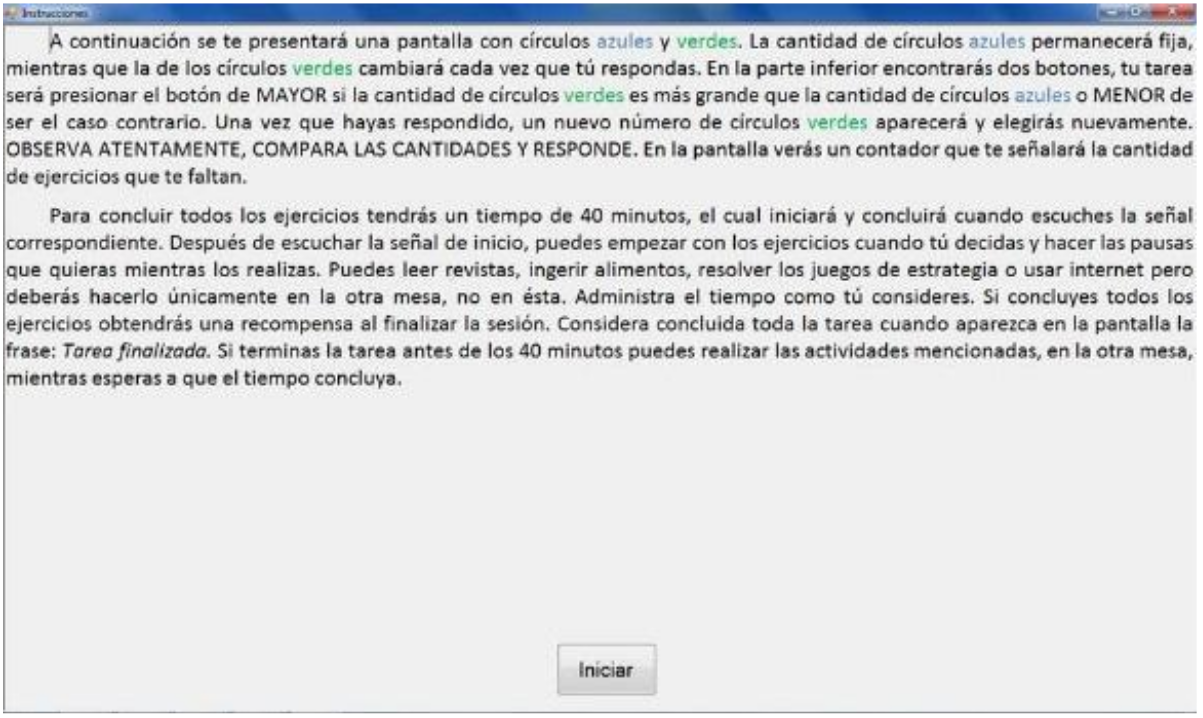
Figure 1a.
Interface of instructions
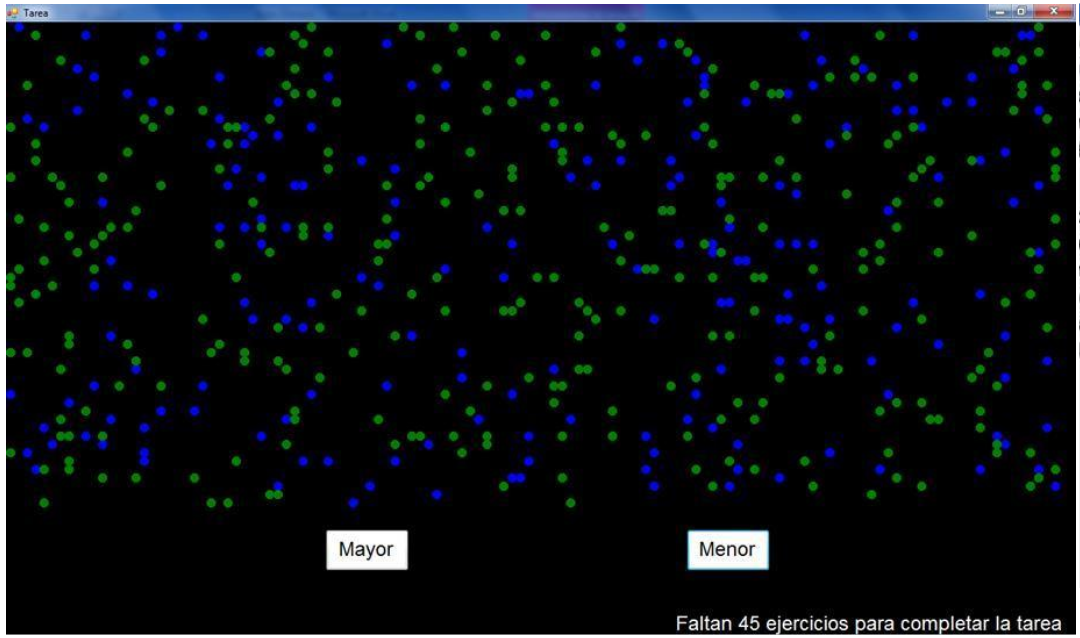
Figure 1b.
Experimental task
Procedure
Participants were exposed to the task individually. After reading and signing the informed consent form, the participant was exposed to a familiarization period (with the task and with the lab) of three minutes, during which they were told that the study was one of the experimenter’s school assignments, and it did not evaluate personality, intelligence or academic skills.
The participant was then prompted to read the instructions and asked orally if he had any questions about it. If that was the case, these were resolved. The subjects could start performing the task whenever they wanted and engage with the distractors freely. Finally, the experimenter left the room and, when he closed the door, the timing of the session began to run.
Results
Responses to the task were recorded with the same software used for the task. Events inside the room were recorded with a Sony Handycam camcorder supported by a tripod located behind the participant. The data was analyzed with Sony Vegas Movie Studio HD Platinum 11 software. To measure of procrastination, the following was recorded: (1) the minutes spent with the distractors before and during the completion of the experimental task (the time spent with the distractors once the task was completed was not considered procrastination); and (2) as a performance measure, the percentage of correct exercises (accuracy) in each of the three conditions.
The results (Table 2) showed that most of the participants procrastinated to some degree (9 out of 12) in most conditions. However, contrary to expectation, more procrastination was not systematically observed during conditions with a large response requirement. A measure of effect size, Cohen’s d was computed based on the minutes of procrastination and the result was not significant (d = .20), which suggests there seems to be no effect of the response requirement on human procrastination (Ferguson, 2009).
However, despite having found no effect of the response requirement, two patterns of behavior were identifiable: a group of participants who procrastinated during two or three conditions and others who never did it (W-3, W-5, and W-4). Most participants achieved an accuracy of 80 % or more regardless of whether they had procrastinated or not (except W-1, who achieved 8.75 % accuracy in the first condition) (see Table 3). A Cohen’s d of -.40 suggests a small effect of the independent variable on the accuracy during the task.
| Condition | ||||||
| Group | Participant | 1 | 2 | 3 | Total | % |
| Experimental 1 | W-3 | 0.00* | 0.00 | 0.00 | 0.00 | 0.00 |
| M-7 | 0.00* | 0.17 | 0.43 | 0.60 | 1.20 | |
| W-11 | 0.00* | 1.52 | 0.96 | 2.48 | 4.96 | |
| Sub-total | 0.00* | 1.69 | 1.39 | 3.08 | 6.16 | |
| Experimental 2 | W-1 | 0.12 | 2.33* | 0.00 | 2.45 | 4.90 |
| W-5 | 0.00 | 0.00* | 0.00 | 0.00 | 0.00 | |
| W-9 | 0.00 | 1.31* | 0.84 | 2.15 | 4.30 | |
| Sub-total | 0.12 | 3.64* | 0.84 | 4.60 | 9.21 | |
| Experimental 3 | M-2 | 9.23 | 14.16 | 3.52* | 26.91 | 53.88 |
| W-6 | 2.46 | 0.00 | 0.34* | 2.80 | 5.60 | |
| M-13 | 0.00 | 1.75 | 2.96* | 4.71 | 9.43 | |
| Sub-total | 11.69 | 15.91 | 6.82* | 34.42 | 68.92 | |
| Control | W-4 | 0.00 | 0.00 | 0.00 | 0.00 | 0.00 |
| M-8 | 1.96 | 2.13 | 0.94 | 5.03 | 10.07 | |
| W-12 | 1.00 | 1.03 | 0.78 | 2.81 | 5.62 | |
| Sub-total | 2.96 | 3.16 | 1.72 | 7.84 | 15.69 | |
| Total | 14.77 | 24.40 | 10.77 | 49.94 | 100.00 |
| Condition | |||||
| Group | Participant | 1 | 2 | 3 | Average |
| Experimental 1 | W-3 | 91.87* | 83.75 | 87.50 | 87.70 |
| M-7 | 94.37* | 86.25 | 88.75 | 89.79 | |
| W-11 | 90.62* | 86.25 | 81.25 | 86.04 | |
| Experimental 2 | W-1 | 08.75 | 95.62* | 96.25 | 66.87 |
| W-5 | 93.75 | 85.62* | 81.25 | 86.87 | |
| W-9 | 90.00 | 96.25* | 97.50 | 94.58 | |
| Experimental 3 | M-2 | 85.00 | 81.25 | 80.62* | 82.29 |
| W-6 | 95.00 | 95.00 | 95.62* | 95.20 | |
| M-13 | 90.00 | 91.25 | 90.62* | 90.62 | |
| Control | W-4 | 90.00 | 86.25 | 86.25 | 87.50 |
| M-8 | 88.75 | 93.75 | 98.75 | 93.75 | |
| W-12 | 96.25 | 96.25 | 96.25 | 96.25 | |
| Average | 84.53 | 89.79 | 90.05 | 88.12 |
Discussion
The goal of the Experiment 1 was to assess the effects of a higher response requirement on procrastination when participants had immediate access to distractors during the task. As in the previous study by Torres et al. (2017), the present Experiment 1 did not reveal systematic effects of the larger response requirement, which is suggestive of two possibilities: (1) operationalizing task difficulty as a large response requirement may be incorrect or (2) task difficulty may not lead to procrastination directly. Regarding the former, task difficulty may involve the realization of several simultaneous operations and, thus, be more related to task complexity than the sheer number of exercises. Regarding the latter possibility, tasks may be classified as difficult only when they evoke stressful emotional states, regardless of their requirement, because they are frustrating, there is no training to perform them or because they have been associated with states of displeasure (Torres, 2018).
Compared to the previous study by Torres, 2018 the distractors were available on the same table and on the same laptop as the experimental task. Their total procrastination then was 64 min 21 s whereas in the present study it was 49 min 56 s Therefore, the data suggests that the proximity of distractors does not have a critical effect on the phenomenon either. One possible explanation for these results might be the effect of social desirability, given that participants were being recorded and might try to give a positive image of themselves to the experimenters. There is evidence that procrastination is susceptible to this phenomenon as individuals become more efficient if they are being observed (Colarossi, 2008).
However, given the within-subject consistencies detected, human procrastination may be an idiosyncratic pattern of behavior and may be studied within the framework of the experimental analysis of personality. Under this framework, the subject matter is behavior consistency through time and situations, such as the one observed in the present experiment (some participants procrastinated in different conditions and in different tasks).
If this were the case, idiosyncratic patterns might be explained by: (1) the history of strengthening or punishment throughout their lives, that is, that deferring the initiation and/or conclusion of tasks was repeatedly reinforced; or (2) the genetics of the individual, which refers to inherent predispositions towards immediate gratification and sensitivity to distractors (Harzem, 1984). However, this assumption (that procrastination is an idiosyncratic pattern of behavior) should be corroborated by further studies.
One of the limitations of this study is how the task was presented, since presenting the exercises in a single block (100 or 200 exercises) might have suggested to the participants that they should perform the task without interruption until its completion. The results, therefore, should be taken with caution and the effect of presenting the task divided into sub-tasks needs to be evaluated.
Experiment 2
Educational counselors often assume that procrastination is reduced when a task is segmented because the objectives (finishing each sub-task) become closer in time (Sims, 2014) and the task, being divided into defined and manageable steps, is made less unpleasant and less stressful (Miranda, 2019). However, splitting tasks into sub-tasks has promoted greater procrastination in laboratory experiments (Bernal, 2018). When participants can estimate the time and effort required to complete each sub-task, they pause more often (if there is plenty of time), which results in an increase in procrastination time.
Based on the lack of clarity regarding the effect of segmentation of the task on the phenomenon of procrastination, a new experiment was designed with the aim of assessing the effect of a larger response requirement on human procrastination when tasks are divided into five sub-tasks with identical response requirements. It was expected to find more procrastination with the larger response requirement with this new setup.
Method
Participants
Twelve undergraduate psychology students between the ages of 18 and 22 (eight women and four men) participated voluntarily. Recruitment was done by direct invitation in classrooms. They were awarded extra credits in one of their courses for participating. The experimental stage, equipment and materials, and design were identical as those described for Experiment 1.
Experimental task
The task was similar to that employed in Experiment 1 with the difference that in each condition the experimental task was divided into five sub-tasks with the same response requirement. In the conditions with a smaller response requirement (100 exercises), the five sub-tasks consisted of 20 exercises each, while in the conditions with a large response requirement (200 exercises) the five sub-tasks consisted of 40 exercises each. The instructions were as follows:
“You will be presented with five blocks of exercises. In each block you will see screens with blue and green circles. The number of blue circles will remain fixed, while the number of green circles will change every time you respond. At the bottom of each screen you will find two buttons and your task will be to press the ‘more’ button if the number of green circles it is greater than the number of blue circles or to press the ‘less’ button if the opposite is true. Once you've responded, a new exercise will appear and you will choose again. Look closely, compare the quantities and respond. On the screen you will see a counter that will show you how many exercises are left.
You will have 40 minutes to finish the five blocks of exercises, which will start when the experimenter closes the door when leaving the room. You may start the exercises whenever you want and make as many breaks as you want to read magazines, drink water, watch TV, use the internet or listen to music on this same computer. You can even go out to the garden that is located in front of the room for fresh air, but keep in mind that the experimenter will return in 40 minutes. Manage time as you wish. The complete task will end when the phrase Task completed appears on each of the 5 screen blocks. The complete task will consist of 3 sessions of 40 minutes each.”
Procedure
Same as Experiment 1. Only the relevant adjustments were made in the instructions indicating the number of exercises that comprised each sub-task.
Results
The results (Table 4) showed that most of the participants procrastinated to some degree (8 out of 12) in most conditions. According to expectation under this new experimental protocol, more procrastination was observed during conditions with a larger response requirement. The effect, however, was only moderate (d = .68).
Nonetheless, different patterns of behavior were again identified: there were those who procrastinated in all three conditions (W-13, W-4, M-14 and W-5), those who did it only occasionally (M-7, W-9, M-11 and W-6) as well as those who never did it (W-8, W-15, M-10 and W-12). In addition, most participants exceeded 80 % accuracy rates regardless of whether they had procrastinated, so there is no clear relationship the two measures (see Table 5), with a virtually null effect (d = -.03).
| Condition | ||||||
| Group | Participant | 1 | 2 | 3 | Total | % |
| Experimental 1 | M-7 | 0.00* | 0.00 | 3.41 | 3.41 | 2.43 |
| W-8 | 0.00* | 0.00 | 0.00 | 0.00 | 0.00 | |
| W-15 | 0.00* | 0.00 | 0.00 | 0.00 | 0.00 | |
| Sub-total | 0.00* | 0.00 | 3.41 | 3.41 | 2.43 | |
| Experimental 2 | W-13 | 3.10 | 13.88* | 13.28 | 30.26 | 21.60 |
| W-4 | 18.43 | 6.48* | 0.18 | 25.09 | 17.90 | |
| W-9 | 5.76 | 0.00* | 0.00 | 5.76 | 4.10 | |
| Sub-total | 27.29 | 20.36* | 13.46 | 61.11 | 43.60 | |
| Experimental 3 | M-14 | 12.58 | 17.16 | 16.65* | 46.39 | 33.10 |
| M-11 | 0.00 | 16.53 | 0.40* | 16.93 | 12.08 | |
| W-5 | 2.36 | 1.20 | 2.16* | 5.72 | 4.08 | |
| Sub-total | 14.94 | 34.89 | 19.21* | 69.04 | 49.26 | |
| Control | W-6 | 0.00 | 0.66 | 5.95 | 6.61 | 4.71 |
| M-10 | 0.00 | 0.00 | 0.00 | 0.00 | 0.00 | |
| W-12 | 0.00 | 0.00 | 0.00 | 0.00 | 0.00 | |
| Sub-total | 0.00 | 0.66 | 5.95 | 6.61 | 4.71 | |
| Total | 42.23 | 55.91 | 42.03 | 140.17 | 100.00 |
| Condition | |||||
| Group | Participant | 1 | 2 | 3 | Average |
| Experimental 1 | M-7 | 91.87* | 88.75 | 88.75 | 89.79 |
| W-8 | 95.62* | 96.25 | 91.25 | 94.37 | |
| W-15 | 23.12* | 92.50 | 87.50 | 67.70 | |
| Experimental 2 | W-4 | 93.75 | 87.50* | 90.00 | 90.41 |
| W-9 | 90.00 | 95.62* | 88.75 | 91.45 | |
| W-13 | 96.25 | 95.62* | 98.75 | 96.87 | |
| Experimental 3 | W-5 | 23.75 | 22.50 | 19.00* | 21.75 |
| M-11 | 22.50 | 81.25 | 90.62* | 64.79 | |
| M-14 | 97.50 | 90.00 | 88.75* | 92.08 | |
| Control | W-6 | 20.00 | 68.75 | 92.50 | 60.41 |
| M-10 | 78.75 | 95.00 | 95.00 | 89.58 | |
| W-12 | 88.75 | 88.75 | 90.00 | 89.16 | |
| Average | 68.48 | 83.54 | 85.07 | 79.03 |
Discussion
Experiment 2 was conducted to evaluate the effect of a larger response requirement on procrastination when tasks are divided into sub-tasks with identical response requirements. In line with the findings of the previous study by Torres et al. (2017) and those of Experiment 1, there were moderate effects of the task with a larger response requirement, which offers additional evidence that the number of exercises to be done may not be related to procrastination.
However, the total time spent procrastinating in this experiment (140 min 10 s) suggest that dividing the task into sub-tasks did have an effect on total time of procrastination when compared to Experiment 1 (49 min 56 s). In contrast to Experiment 1, participants had to close the window of each subtask to start the next one on the laptop, which may have given them opportunities to probe the programmed distractors on the same laptop.
The most relevant and consistent finding in Experiment 2 was that idiosyncratic patterns of behavior were again observed (there were participants who always procrastinated, others who did so only in some conditions, and others who never did). Again, procrastination was not related to task accuracy.
However, it is important to remark two possible limitations of this experiment: (1) since some participants performed visibly low in some of the conditions, the instructions may not have been entirely clear, and (2) as in Experiment 1, participants may not have had higher levels of procrastination due to the phenomenon of social desirability due to the existence of a video camera behind them.
In short, the experiment again revealed that a large response requirement does not systematically bring about procrastination. However, it suggests that segmenting the task into sub-tasks does result in greater total time of procrastination. But the most striking finding was the observed idiosyncratic behavioral patterns, which seem to suggest that procrastination is a stable, individual behavioral style.
General discussion
Two experiments were conducted to evaluate the effect of a larger response requirement on human procrastination. In Experiment 1, the availability of distractors was immediate and, in Experiment 2, the experimental task was presented as five sub-tasks with the same response requirement. The most important findings were: (1) there were no strong effects of the large response requirement; (2) idiosyncratic patterns of behavior developed (those who procrastinated in all three conditions, those who occasionally procrastinated and those who never did); (3) the accuracy in the tasks was independent of procrastination; and (4) the exposure to the task in five sub-tasks appears to result in greater procrastination than exposure in a single block.
One of the strengths of this study is that the preparation emulated situations of daily life in which the individual must complete a task composed of several sub-tasks. For example, writing a thesis (one of the most procrastinated academic tasks) involves carrying out a documentary search, drafting the research problem, developing the theoretical framework, carrying out fieldwork, etc.
Regarding the small and moderate effect of the response requirement, the findings of both experiments go against what was found by other laboratory studies in which a demanding task resulted in more procrastination, and supports what was found by Torres et al. (2017) in a previous study, with the same experimental preparation, in which a larger response requirement also did not have strong effect. In this sense, procrastinated tasks are more likely to be those that have been associated with physiological aversive states (e. g. stress) and are independent of the number of responses needed for their conclusion. Therefore, there may be no inherently procrastinated tasks and this effect is mainly due to social conditioning during the history of individuals. For example, for many people math has been associated with aversive stimuli such as failing grades, punishment, scolding, anxiety, etc., which could increase procrastination in the tasks of this subject matter.
As for individuals who procrastinated during all three conditions in this study, these findings support the claim by Torres et al. (2017), who suggested that procrastination is an idiosyncratic pattern of behavior, that is, a particular behavioral profile consistent over time and over similar situations. If procrastination is indeed an idiosyncratic pattern of behavior, there may be implications for psychometrics. For instance, real-time behavioral tests might be developed to assess whether job candidates exhibit a procrastinating profile, which would increase job efficiency and, more importantly, assist in screening dysfunctional and unhealthy coping styles in organizations (Lopera & Echeverri, 2018).
Regarding task performance, the accuracy in the task was independent of procrastination which contradicts the findings that assume that the phenomenon is related to poor academic and/or work results (Steel, 2007). However, other effects and/or consequences may have happened. For example, Padilla (2018) found that procrastination led to higher levels of psychophysiological stress (measured with salivary cortisol levels), as well as higher levels of perceived stress, anxiety, depression and the development of diseases related to the immune system. This suggests that procrastination may be a dysfunctional style of coping with mandatory tasks, which has a major impact on health and the emotional aspect and therefore be a latent public health problem.
As for the effects of task segmentation, the total time spent procrastinating increased in Experiment 2 and the average accuracy decreased, suggesting that the segmentation of the task may be related to procrastination. This finding contradicts what is intuitively claimed by educational counselors in the sense that segmenting tasks into sub-tasks decrease procrastination. Considering tasks as segments may induce participants to self-indulge at the end of each of the sub-tasks. It may even allow them to estimate the time required to finish each part and complete the task as a whole by managing the available time. Future studies should also assess whether presenting sub-tasks with a different response requirement could promote higher levels of procrastination.
Studies designed to investigate procrastination as an idiosyncratic behavioral pattern might benefit from exposing participants to morphologically different but functionally equivalent tasks relatively distant over time, for example, after three or six months. In this regard, the task of visual estimation of the present work could be used and, after a few months, an adjustment task designed for humans based on the one proposed by Mazur (1996), which consists of presenting two alternatives with different values (in this case different response requirements) and systematically changing their parameters up to a point of equilibrium, which would be taken as a measure of procrastination.
Another possibility is to carry out a more naturalistic study in which participants stay for a considerable amount of time (e. g. 12 hours) in a setting, which would allow to emulate the ordinary conditions in which the phenomenon occurs. For example, keeping participants in a controlled environment with food, distractors and mandatory tasks with different deadlines and response requirements to analyze whether procrastination is an occasional reaction to a task, a generalizable habit to any activity or an idiosyncratic pattern of behavior. In addition, Mazur (1996) was able to observe procrastination by exposing nonhuman animals to tasks with different response requirements. Although his experimental preparation was based on a paradigm of choice, these effects may also be observed in naturalistic preparations. In this way, an assessment could be made whether procrastination is the preference for a large more delayed response requirement over a smaller and immediate response requirement.
References
Adewale Ojo, A. (2019). The impact of procrastination on students’ academic performance in secondary schools. International Journal of Sociology and Anthropology Research, 5(1), 17-22. https://www.eajournals.org/wp-content/uploads/The-Impact-of-Procrastination-on-Students-Academic-Performance-in-Secondary-Schools.pdf
Afzal, S. & Jami, H. (2018). Prevalence of academic procrastination and reasons for academic procrastination in university students. Journal of Behavioural Sciences, 28(1), 51-69. http://pu.edu.pk/images/journal/doap/PDF-FILES/04_v28_1_18.pdf
Bernal, A. (2018). Procrastinación y productividad: un análisis experimental [Tesis de licenciatura]. http://repositorio.usfq.edu.ec/handle/23000/7300
Blunt, A. & Pychyl, T. (2000). Task aversiveness and procrastination: A multi-dimensional approach to task aversiveness across stages of personal projects. Personality and Individual Differences, 28(1), 153-167. https://doi.org/10.1016/S0191-8869(99)00091-4
Cid, S. (2015). Perfeccionismo, autorregulación, autoeficacia y bienestar psicológico en la procrastinación [Tesis de maestría]. https://repositorio.comillas.edu/xmlui/bitstream/handle/11531/1043/TFM000116.pdf?sequence=1
Colarossi, C. (2008). The Application Of Token Reinforcement Procedures In The Modification Of Academic Procrastination: Are The Results What They Seem? [Tesis de Maestría]. http://www.psychology.uct.ac.za/sites/default/files/image_tool/images/117/Claudia.Colarossi.pdf
DeWitte, S. & Schouwenburg, H. (2002). Procrastination, temptations, and incentives: the struggle between the present and the future in procrastinators and the punctual. European Journal of Personality, 16(6), 468-489. https://doi.org/10.1002/per.461
Fee, R. & Tangney, J. (2000). Procrastination: A means of avoiding shame or guilt? Journal of Social Behavior and Personality, 15, 167-184.
Ferguson, C. J. (2009). An effect size primer: A guide for clinicians and researchers. Professional Psychology: Research and Practice, 40(5), 532–538. https://doi.org/10.1037/a0015808
Ferrari, J. R. & Tice, D. M. (2000). Procrastination as a self-handicap for men and women: A task-avoidance strategy in a laboratory setting. Journal of Research in Personality, 34, 73– 83. https://doi.org/10.1006/jrpe.1999.2261
Ferrari, J., O’Callaghan, J., & Newbegin, I. (2005). Prevalence of procrastination in the United States, United Kingdom, and Australia: arousal and avoidance delays among adults. North American Journal of Psychology, 7(1), 1-6. https://www.questia.com/library/journal/1G1-159922620/prevalence-of-procrastination-in-the-united-states
Froese, A., Nisly, S., & May, R. (1984). The effects of task interest and difficulty on procrastination. Transactions of the Kansas Academy of Science, 87(3), 119- 128. https://doi.org/10.2307/3627847
Grunschel, C., Patrzek, J., & Fries, S. (2013). Exploring reasons and consequences of academic procrastination: an interview study. European Journal of Psychology of Education, 28, 841–861. https://doi.org/10.1007/s10212-012-0143-4
Hammer, C. & Ferrari, J. (2002). Differential incidence of procrastination between blue and white-collar workers. Current Psychology, 21(4), 333-338. https://doi.org/10.1007/s12144-002-1022-y
Harriott, J. & Ferrari, J. (1996). Prevalence of procrastination among samples of adults. Psychological Reports, 78, 611-616. https://doi.org/10.2466/pr0.1996.78.2.611
Harzem, P. (1984). Experimental analysis of individual differences and personality. Journal of the Experimental Analysis of Behavior, 42(3), 385-395. https://doi.org/10.1901/jeab.1984.42-385
Janssen, T. & Carton, J. (1999). The effects of locus of control and task difficulty on procrastination. The Journal of Genetic Psychology, 169(4), 436-442. https://doi.org/10.1080/00221329909595557
Kalia, K. & Yadav, M. (2014). Academic procrastination in relation to socio-demographic variables. Scholarly Research Journal for Interdisciplinary Studies, 2(10), 1073-1081. https://www.academia.edu/10406575/Academic_Procrastination_in_relation_to_Socio-demographic_variables
Lopera, I. & Echeverri, J. (2018). Libertad y desarrollo humano en las organizaciones. Interdisciplinaria, 35(2), 395-408. https://doi.org/10.16888/interd.2018.35.2.9
Manchado, M. & Hervías, F. (2021). Procrastinación, ansiedad ante los exámenes y rendimiento académico en estudiantes universitarios. Interdisciplinaria, 38(2), 243-258. https://doi.org/10.16888/interd.2021.38.2.16
Mazur, J. (1996). Procrastination by pigeons: preference for larger, more delayed work requirements. Journal of the Experimental Analysis of Behavior, 65(1), 159- 171. https://doi.org/10.1901/jeab.1996.65-159
Meier, A., Reinecke, L., & Meltzer, C. (2016). “Facebocrastination”? Predictors of using Facebook for procrastination and its effects on students’ well-being. Computers in Human Behavior, 64, 65-76. https://doi.org/10.1016/j.chb.2016.06.011
Metin, U., Taris, T., & Peeters, M. (2016). Measuring procrastination at work and its associated workplace aspects. Personality and Individual Differences, 101, 254 – 263. https://doi.org/10.1016/j.paid.2016.06.006
Miranda, G. (2019). Procrastinación y mindfulness rasgo en adolescentes de un colegio particular de Lima, Metropolitana [Tesis de Maestría]. http://repositorio.upch.edu.pe/bitstream/handle/upch/6560/Procrastinacion_MirandaOgnio_Gabriela.pdf?sequence=1&isAllowed=y
Musolino, E. (2007). The effect of procrastination and stress on low effort and high effort tasks. Journal of Learning and Motivation, 45(1), 224–244. https://ir.lib.uwo.ca/hucjlm/vol45/iss1/13/
Padilla, M. A. (2017). Academic procrastination: the case of Mexican researchers in psychology. American Journal of Education and Learning, 2(2), 103-120. https://doi.org/10.20448/804.2.2.103.120
Padilla, M.A. (2018). Niveles de procrastinación académica, de estrés percibido y de estrés psicofisiológico en investigadores en formación. In Sociedad Mexicana de Análisis de la Conducta (Ed.), Análisis de la conducta en México: investigación y aplicaciones 2018 (pp. 49-62). España: Fondo Editorial Universitario.
Paz, A., Aranda, R., Navarrro, M., Delgado, M., & Sayas, Y. (2014). Representaciones mentales sobre la procrastinación en estudiantes de psicología de la UNMSM. Revista Electrónica de Psicología de Iztacala, 17(3), 1148-1167. http://www.revistas.unam.mx/index.php/repi/article/view/47421
Porrúa, I. (2018). Procrastinación universitaria: influencia y mediación de variables personales y contextuales (Tesis de Maestría). https://repositorio.comillas.edu/xmlui/bitstream/handle/11531/31680/TFM001028.pdf?sequence=1&isAllowed=y
Reinecke, L., Meier, A., Aufenanger, S., Beutel, M., Dreier, M., Quiring, O., Stark, B., Wölfing, K., & Müller, K. (2018). Permanently online and permanently procrastinating? The mediating role of Internet use for the effects of trait procrastination on psychological health and well-being. New Media & Society, 20(3), 862-880. https://doi.org/10.1177/1461444816675437
Schouwenburg, H. & Groenewoud, J. (2001). Study motivation under social temptation; effects of trait procrastination. Personality and Individual Differences, 30(2), 229-240. https://doi.org/10.1016/S0191-8869(00)00034-9
Sims, C. (2014). Self-regulation coaching to alleviate student procrastination: addressing the likeability of studying behaviours. The British Psychological Society, 9(2), 1-29. https://core.ac.uk/download/pdf/74238118.pdf
Sirois, F. (2015). Is procrastination a vulnerability factor for hypertension and cardiovascular disease? Testing an extension of the procrastination-health model. Journal of Behavioral Medicine, 38, 578-589. https://doi.org/10.1007/s10865-015-9629-2
Solomon, L. & Rothblum, E. (1984). Academic procrastination: Frequency and cognitive-behavioral correlates. Journal of Counseling Psychology, 31(4), 503-509. https://doi.org/10.1037/0022-0167.31.4.503
Steel, P. (2007). The nature of procrastination: a meta-analytic and theoretical review of quintessential self-regulatory failure. Psychological Bulletin, 133(1), 65-94. https://doi.org/10.1037/0033-2909.133.1.65
Steel, P. & Ferrari, J. (2013). Sex, education and procrastination: an epidemiological study of procrastinators’ characteristics from a global sample. European Journal of Personality, 27, 51-58. https://doi.org/10.1002/per.1851
Torres, C. (2018). Estudios en laboratorio sobre el fenómeno de la procrastinación. In Fontaines-Ruiz, T., & Barrera, A. D. (Coords.), Inquietudes metodológicas (pp. 37-57). http://repositorio.utmachala.edu.ec/handle/48000/12539
Torres, C., Padilla, M. A., & Valerio, C. (2017). El estudio de la procrastinación humana como un estilo interactivo. Avances en Psicología Latinoamericana, 35(1), 153-163. https://doi.org/10.12804/revistas.urosario.edu.co/apl/a.4330