Abstract: There are antecedents that suggest three hypotheses about the relationship between musical training and executive functions. One hypothesis suggests that a positive relationship exists between both variables, a second one describes that an effect exists on cognitive skills of general control, and the last one suggests a decrease on general control skills if the executive functions are controlled. Some authors have suggested that cognitive process is improved by music, due to the high complexity level that implies learning to play an instrument. Nevertheless, most of these prior studies have been developed through non-experimental research, which implies a methodological limitation to the study of these premises. This study’s goal was to evaluate the potential effect of piano training on executive functions and verbal skills through an experimental pretest-posttest design and it was developed with preschool children that received one hour a week of piano training for 6 months using the Bastien Method, while the control group heard classical music through the same period; as well as the possible mediating role of executive functions in this effect. A statistically significant difference was identified between the means of control and experimental group over the comprehension tasks, working memory and inhibitory control tests. Our results were also consistent with the mediation hypothesis, providing experimental support on how to better understand working memory as a mediator variable between piano learning and arithmetic skills. In conclusion, this study suggests that exposing preschool children to piano training influences executive functions and general order cognitive skills. Finally, there’s evidence of the mediation hypotheses between working memory and general cognitive control, specifically, arithmetic task resolution.
Keywords: piano, lesson-music, training-executive functions, preschool children, mediation hypothesis.
Resumen:
Existen antecedentes que sugieren tres hipótesis sobre la relación entre entrenamiento musical y funciones ejecutivas. Por un lado, la literatura parece señalar que existe una relación positiva entre el entrenamiento musical y las funciones ejecutivas; la segunda hipótesis señala que existe un efecto en las habilidades cognitivas de control general y finalmente, la última hipótesis sugiere que existe un decremento en habilidades de control general si las funciones ejecutivas son controladas estadísticamente. Las funciones ejecutivas son una serie de procesos que facilitan la regulación del pensamiento y la conducta. Algunas propuestas teóricas explican que las funciones ejecutivas están conformadas por grandes subprocesos como cambio, actualización e inhibición. No obstante, algunos estudios sugieren que la estructura para las funciones ejecutivas en la infancia es distinta a la de la edad adulta. Algunos autores han señalado que este tipo de procesos cognitivos se ven beneficiados por la música, debido al alto nivel de complejidad que implica aprender a tocar un instrumento. Aprender a interpretar un instrumento involucra habilidades complejas como leer y ejecutar distintos tonos, ritmos, armonía, así como asociar estos símbolos musicales en patrones de movimiento. No obstante, la mayoría de estos estudios antecedentes se han desarrollado a través de estudios no experimentales, lo cual implica una limitación metodológica en el estudio de estos fenómenos. El objetivo de este estudio fue evaluar el efecto potencial en las funciones ejecutivas del entrenamiento en piano (control inhibitorio y memoria de trabajo) y habilidad verbal, a través de un diseño experimental. Este estudio se desarrolló con niños y niñas en edad preescolar, 27 participantes en la condición control y 31 participantes en la condición experimental. Los participantes del grupo experimental recibieron una hora de clase de piano con el método Bastien por un periodo de 6 meses, mientras que el grupo control escuchó música académica durante una hora a la semana por el mismo periodo de tiempo. Además, se aplicó la batería de pruebas en el pretest y postest para evaluar las variables dependientes. La batería de pruebas incluyó tareas de memoria de trabajo, control inhibitorio y habilidad cognitiva general (verbal y matemática). Entre las tareas que se utilizaron para evaluar memoria de trabajo se encuentra “memoria de juguetes” con seis y ocho estímulos y “dígitos hacia atrás”. Para evaluar control inhibitorio se utilizaron tareas tipo stroop y el paradigma go-nogo. Para evaluar habilidades generales se empleó la tarea WIPSSI. No se hallaron diferencias significativas por sexo entre el grupo control y experimental. Se identificó una diferencia estadísticamente significativa entre el grupo control y el experimental en la tarea de comprensión, en la prueba de memoria de trabajo “memoria de juguetes con ocho estímulos”, en las pruebas tipo stroop para evaluar el control inhibitorio, así como en las tareas de control inhibitorio go-nogo. Los resultados fueron consistentes con la hipótesis de mediación y permiten comprender mejor cómo la memoria de trabajo puede ser una variable mediadora entre el aprendizaje del piano y habilidades aritméticas. En conclusión, este estudio evidencia que la exposición a un entrenamiento en piano en niños y niñas en edad preescolar sí tiene un efecto en las funciones ejecutivas, así como en las habilidades cognitivas de orden general. Finalmente, se presenta una evidencia de la hipótesis de mediación entre la memoria de trabajo y tareas de control cognitivo general, específicamente, y la capacidad de resolución de problemas de aritmética.
Palabras clave: lecciones de piano, entrenamiento en música, funciones ejecutivas, hipótesis de mediación, preescolar.
Artículos
Effects of piano training on executive functions: evidence for the mediation hypothesis in 4- to 5-year-old children
Efectos de lecciones de piano sobre las funciones ejecutivas: evidencia de la hipótesis de mediación en niños y niñas de 4 a 5 años
Centro Interamericano de Investigaciones Psicológicas y Ciencias Afines

Esta obra está bajo una Licencia Creative Commons Atribución-NoComercial-CompartirIgual 4.0 Internacional.
Recepción: 21 Junio 2021
Aprobación: 02 Febrero 2023
Multiple studies have suggested a relation between music and the development of different skills, including language abilities (Chen et al., 2021;Hille & Schupp, 2015) and IQ tests (Barbaroux et al., 2019; Schellenberg & Weiss, 2013) have identified three different kinds of possible links between music and cognition: the association between music abilities and cognition, the effect of listening to music on cognitive tasks, and the improvement of cognitive skills after music training.
Different studies regarding cognitive variables associated with musical aptitude have found a significant correlation with language (Milovanov et al., 2010), arithmetic processing (Foncubierta et al., 2020;Hoch & Tillmann, 2012) and higher order cognitive ability (Swaminathan & Schellenber, 2018).
A second potential relationship between music and cognitive ability would be the enhancement of cognitive performance after or while people listen to music, as described by the controversial so-called Mozart effect, originally reported in connection with visuospatial reasoning (Hetland, 2000). A similar issue has been found in the study of the effects of background music on cognitive performance; for instance, on memory (Richards et al., 2008; Salamé & Baddeley, 1989). Evidence in this area is unclear and, at times, contradictory, yielding different results depending on the population studied. This suggests that personality and musical preferences, type of music, and other conditions of the experimental conditions could affect the results (Cooper, 2020; Schellenberg & Weiss, 2013;Swaminathan & Schellenberg, 2018, Swaminathan et al., 2019).
Finally, Schellenberg, Weiss, and Swaminathan point to a possible effect of music training on cognition (Schellenberg & Weiss, 2013; Swaminathan & Schellenberg, 2018, 2019). Moreno et al. (2011) analyzed the effect of computerized visual art, as well as a music training program on a sample comprising children between the ages of 4 and 6: a significant effect was found for both the verbal intelligence test (WPPSI-III) and on the Go/No-go task for the music training program; but not for the visual art program.
The effect of music training has been shown not only on literacy skills (Slater et al., 2014) and phonological awareness (Degé & Schwarzer, 2011), but in longitudinal studies on different perceptual variables (Fujioka et al., 2006; Strait et al., 2013; Swaminathan & Schellenberg, 2021). In addition, performance was also positively impacted by this type of training when keeping the beat in a finger-tapping task (Slater, et al., 2013; Swaminathan & Schellenberg, 2021).
Regarding the potentially strictly cognitive effects of music training, two different kinds of cognitive variables have been considered: executive functions and higher order cognitive abilities, as measured by IQ tests or academic achievement.
A link between music training and general cognitive abilities (Schellenberg & Weiss, 2013) has been substantiated by several studies involving child (Degé, 2021; Kragness et al., 2021; Norton et al., 2005), and adult populations (Chaddock-Heyman et al., 2021; MacRitchie et al., 2020); for instance, in connection with higher IQ scores (Bilhartz et al., 2000; Schellenberg, 2011; Swaminathanm et al., 2017). Furthermore, studies show that both musicians outperform non-musicians in different executive functions, as well as the impact of musical training on executive functions (Degé, 2021; Degé et al., 2011; Hernández et al., 2021; Moreno et al., 2011; Schellenberg, 2011; Strait et al., 2010; Yurgil et al., 2020).
Executive functions are cognitive processes involved in conscious control. Miyake et al. (2000) and Friedman (2019) claim that three factors underlie executive functions in adult populations: shifting, updating and inhibition. However, some research suggests that structure of these functions differs between children and adults: the existence of a one-factor structure at an early stage has been suggested (Wiebe et al., 2011); that is, when the child turns 10, it splits into 2 specific factors: working memory (WM) updating, and inhibition/shifting (Brydges et al., 2014; Messer et al., 2018). Other research proposes that the same two factors (WM updating and inhibition/shifting) might appear as early as 3 years of age (Miller et al., 2012). Miyake and Friedman (2012) highlight that there is no real evidence of a specific inhibition factor. Thus, the difference in inhibition tasks would be better explained by a general factor of executive functions, while updating tasks would correspond to a combination of this common factor with specific skills. Studies on the development of executive function could therefore point to the existence of an initial general capacity, after which a specific updating capacity would appear.
It is plausible that playing a musical instrument involves high-level skills to facilitate the real-time manipulation of complex information about pitch, harmony, and rhythm encoded in rich notation, as well as requiring the transformation of such information into different movement patterns across the central nervous system. (Soria-Urios et al., 2011; Zhu, 2018). From a neuropsychological perspective, there is some evidence of brain plasticity induced by musical practice (Kausel et al., 2020;Pascuale-Leone, 2003; Schellenberg, 2020).
Apparently, in order to select the correct response and activate the correct motor response, musical training demands access to cognitive functions such as working memory updating and inhibitory control (Bernal-Ruiz et al., 2020; Chen et al., 2020; Degé, 2021, by handling multiple rhythms, interacting with other musicians, and constantly updating the musical notes to be played. Trainor et al. (2009) report a greater induced gamma wave response to musical sounds in musicians compared to non-musicians, claiming that musical training affects oscillatory networks associated with executive functions in the brain, thus concluding that this could improve performance in a wide range of cognitive domains.
Although they come from different research traditions, executive functions and general intelligence have been shown to share a substantial relationship. In a Structural Equation Analysis, Wongupparaj et al. (2015) found that executive functions (Inhibition and Updating), together with short-term memory storage, explain approximately 60 % of the variance of general intelligence, suggesting executive function sub-processes as fundamental pieces of different components of intelligence.
Consistent with this interpretation, some authors have hypothesized that executive functions mediate the effect of music training on general cognitive abilities, claiming that musical training positively affects executive functions (Chen et al., 2021; Hannon & Trainor, 2007; Schellenberg & Peretz, 2008; Schellenberg & Weiss, 2013; Swaminathan & Schellenberg, 2019). These improved functions could in turn explain better results in several cognitive ability tests (Schellenberg & Weiss, 2013), while no direct relationship between music training and general cognitive abilities is apparent.
From a methodological perspective, this hypothesis implies three main predictions: a positive effect of music training on executive functions, a positive effect of musical training on general abilities, and finally, disappearance or decrease of this effect when executive function variables have been statistically controlled. As discussed, there are sufficient elements to support the prediction of said positive effect on general cognitive abilities (Swaminathan & Schellenberg, 2019) which, when found, tends to disappear if executive functions are statistically controlled, as expected in prediction 3. For example, Degé et al. (2011) report that, in a fluid intelligence test, the benefit of music training in a group of children aged 9 to 12 disappeared when five cognitive variables related to executive functions (set shifting, selective attention, planning, inhibition, and fluency from the NEPSY II test) were statistically controlled. Likewise, Franklin et al. (2008) found that the effect of music training on verbal memory in children under 10 disappeared when working memory was controlled.
The relationship between music training and executive functions is supported by some research: for example, a positive effect on auditory working memory tests was found under certain circumstances (Pallesen et al., 2010; Strait et al., 2012; Zhang et al., 2021.). Similarly, other studies report that musicians outperformed non-musicians inhibitory control tasks (Rodríguez-Gómez & Talero-Gutiérrez, 2022; Strait et al., 2010). In a quasi-experimental design with 9- to 12-year-old children, Schellenberg (2011) found a significant effect on a working memory test (Digit Span), but not in verbal fluency, Tower of Hanoi, Wisconsin, Card Sort Test, and Sun-Moon Stroop.
Most of these findings are based on non-experimental designs, resulting in only a small number of randomized experimental studies (Mehr et al., 2013; Swaminathan & Schellenber, 2019). While they have a clear advantage in terms of ecological validity, non-experimental designs also show an important limitation: the effects are measured using previously trained and untrained participants, making the direction of the effects indiscernible. The results could be explained because by musical training, but it could also be the case that subjects with higher abilities were more likely to have prior participation in musical activities. Therefore, an experimental design would be necessary that would allow differentiation between any of the two possible causal directions. Experimental studies evaluating the effect of piano lessons on executive functions have found a positive impact on these cognitive processes in older adults. (Bugos, 2019).
As plausible as this hypothesis is, further experimental studies are required to test it in different contexts and populations, including the analysis of a variety of executive functions and measures of general intelligence. This study has two main purposes: the first one is to assess the potential effect of music training with Bastien's piano method on general cognitive abilities. This study also seeks to test the hypothesis of mediation of music training on executive functions through Bastien's piano instruction method (Bastien, 1990) using an experimental design. Following the evidence of a 2-factor structure during childhood, two executive functions were considered: inhibitory control and working memory updating.
This research was conducted under a pre-test-post-test experimental design, with the inclusion of a control group (Campbell & Stanley, 1973; Shadish et al., 2002). Participants were randomly assigned to control and experimental groups.
To establish the sample size, a prospective power analysis was performed with the "G*power" program. To calculate the sample size in this study, an effect size of .04, 2 independent groups, an expected error of .05 and a statistical power of .80 were used. As a result, it was established that the minimum number of participants should be 60 children. That number was increased to 70 participants considering the possibility of losing participants for external causes. Seventy 4- to 5-year-old participants, all of them Costa Rican and native Spanish speakers, were recruited from two public Kindergartens in Costa Rica. Considering the information gathered via questionnaire, children with neurological or psychiatric disorders, attention deficit, learning difficulties, and visual or hearing impairment, as well as children with previous music instruction, were excluded. The parents of all participants were previously informed about the research goals and other details. Thereafter, they were asked to fill an informed consent agreement. Fifty-eight participants (27 experimental and 31 controls) successfully completed the study. The mean age at the beginning of the study was M = 60.26 months, SD = 3.0. In the second evaluation, 11 months later (including seven months of training, the first application, and the summer break period), the mean age was M = 71.26, SD = 3.056. Participants were randomly assigned into either the experimental group or the control group. Those in the experimental group received one hour of piano training weekly for seven months. Those in the control group did not receive any training but were involved in activities listening to one hour of classical music weekly over the same period (Bach, Beethoven, Verdi, Vivaldi). Participants from the control group listened to this music while playing in kindergarten. Both groups were asked about physical activity (including sports, swimming, dancing, martial arts, and painting): no significant differences in the regularity of these activities were found. Initially, 35 participants were assigned to each group, but from the 58 participants that completed the seven-month study, 27 belong to the experimental group (14 boys and 13 girls) and 31 to the control group (15 boys and 16 girls). Twelve participants did not finish the study due to school transfer.
Participants in both groups were evaluated twice, using a specific task battery pre and post-training. The task battery consisted of a verbal ability test, working-memory updating tests and inhibitory control tests, all of which are described below. The assessment was conducted for three months, and the tasks were divided into four sessions on four different days for each participant. The order of application for the different tests was randomized, applying only one test per participant per day.
After the application of the task battery and for seven months, preschoolers in the experimental group received piano lessons once a week using the Bastien method (described below). They worked individually for half an hour with a piano teacher in the school and half an hour at home with their parents. The parents attended each lesson and had previously received an explanation of the Bastien method. On the other hand, participants from the control group listened to one-hour sessions of classical music[1] per week at home for 7 months. Parents were committed to ensuring that their children would fulfill these tasks at home. In addition to this engagement, the researchers regularly communicated with the parents to provide them with the material their children were to listen to and to ensure that they completed the assignments. After the seven-month training period was over, both groups again took the same battery of tests. This study was approved by the Scientific Ethics Committee (CEC) at the University of Costa Rica, informed consent was signed by parents.
James Bastien’s 1990 piano method was chosen for this study. Bastien´s (1988) book How to teach piano successfully is considered one of the most important publications in piano pedagogy (Thomas-Lee, 2003). Previously, Bastien (1987, 1988, 1990) had presented his own piano method for young beginners, which is currently widely used in the United States and the rest of the world and its present a five-finger position approach.
The Bastien method is a study method that focuses your attention on the position of the fingers and hands and on coordination in its first levels. The essential purpose of the method is the development of vocal, rhythmic, psychomotor, auditory and expressive abilities; so that the musical code becomes a useful and effective instrument of communication. This piano method promotes a comprehensive and formal learning of the instrument, appropriate for the developmental age of the participants (Kneer, 2006).
Instruments within the task battery included general ability and executive function tests (working memory updating and inhibitory control). For general abilities, the three scores used came from the Wechsler Preschool and Primary Scale of Intelligence (WPPSI-R), corresponding to the vocabulary, arithmetic, and comprehension subtests. Working memory updating tests included memory of toys and memory of figures. For inhibitory control, two versions of the Go/No-go and four versions of the Stroop were applied. Each of these tests is described below.
General abilities: Wechsler Preschool and Primary Scale of Intelligence. Three tasks from the WPPSI-R were included in the test battery, which are good measures of general verbal ability according to Otem (2003). The vocabulary task consisted in defining the meaning of a list of words; the arithmetic task, in solving a set of mathematical problems. Finally, the comprehension task involved a series of common-sense questions which required participants to explain different aspects of the world (e.g., explain the reasons why windows in houses are necessary).
Toys Memory Task: The Toys Memory Task is a self-ordered task that evaluates working memory updating (Archibald & Kerns, 1999). It was divided into two sections: Section A is composed of six sheets with pictures of the same six toys on each sheet, although in different positions. The facilitator shows the sheets to the child, who must select a toy on each one under the condition that they do not repeat their selection. For this task, loop was defined as a sequence of toy selections made by participants without making any mistakes, and the score obtained in a trial was the largest loop in a sequence of six toys, six being the largest possible loop and one the shortest. The procedure was repeated three immediately consecutive times (3 trials), obtaining an average score by taking the largest loops in each trial. Section B had the same format, with eight sheets and eight toy pictures on each sheet and a maximum loop of eight toys in each trial. The average of the largest loops per trial was also calculated.
Abstract Images Memory Task: This task is a variation of Toys Memory Task (Archibald & Kerns, 1999), implemented on E-Prime (which is a behavioral experiment software). Abstract images were used instead of the toy figures of the original task. Each trial consisted of six and eight stimulus sheets. For this variation of working memory task, the scores obtained were also the average of the longest loops and the average of the number of errors.
Stroop task: Four different versions of the Stroop task were used: Sun/Moon, Men/Women, Emotional, Animals and Neutral. The Sun/Moon Stroop task (Archibald & Kerns, 1999) consists of two sheets with 20 images on each: ten moons and ten suns. All the images are sorted randomly across both sheets. During the first stage, the participant is asked to name the image (sun or moon) pointed by the applicant within 45 seconds. After a brief explanation of approximately 30 seconds, participants in the second stage are asked to name the opposite image pointed by the applicant: thus, if the applicant points at the “sun” image, the participant has to say “moon” as fast as possible. The test score was determined by the correct responses of the first stage minus the correct responses of the second stage. The result is then divided between the total responses from the first stage. The same procedure with different stimuli is used for the other four versions of the Stroop (Archibald & Kerns, 1999). In the Men-Women Stroop Task, figures of men and women are presented to participants; black dots and dashes for the Neutral Stroop stimuli; and animals’ heads for the Animal Stroop stimuli. Finally, happy or sad male and female faces were used for the Emotional Stroop (Conejo & Garnier, 2011). In contrast to all the other versions, the Animal Stroop used three rather than two different stimuli.
Neutral Go/No-go and Emotional Go/No-go: These tasks were designed and applied with E-Prime software following the protocol developed by Conejo and Gardnier (2011). Each task consisted of two stages. In the first stage, the participant was asked to press a key every time a specific stimulus appeared. In the second stage, the rules were changed, and participants were instructed to ignore the previous order and press the same key when a different stimulus appeared. Each stage of the test had 60 stimuli, presented in the center of the screen for a period of 500ms each. The interstimulus interval (ISI) was pseudorandomized from 1250 to 1750ms (mean per block = 1500ms) to discourage anticipatory responses. For the first stage of the emotional version of Go/No-go, each participant was asked to press a key every time a happy face appeared, whereas in the second stage, they were instructed to ignore this specific stimulus and press the key every time a sad face appeared. Dots and dashes were used for the neutral version of the task. The scores used were the total number of omission mistakes of correct executions during the second stage. Omission mistakes refer to those occasions when the participant was told to press the key but failed to do so. Correct executions are those in which participants had to press the key and did so.
A series of mixed-design ANOVAs including group (Experimental/Control) as a between-subject factor, and session as a within-subject factor, was conducted. A confirmatory factor analysis (CFA) was done for reducing to latent variables the scores of inhibitory control and working memory. With these latent variables, various hierarchical regression models were calculated in order to test the mediation hypothesis. The SSPS 27 software was used for analysis.
After checking the relation between gender, general abilities and executive function variables, no significant differences were found between gender, therefore this variable was not included in the rest of the analyses.
A series of mixed-design 2 (Pre-test/Post-test) x 2 (Experimental/Control group) ANOVAs was used, considering in each case the interaction between both variables (inter and intra subject). The results regarding general abilities measured with the WPPSI are shown in Table 1 as well as their size effects through Cohen´s d. A significant effect in the interaction between pre/post-test and the Experimental/Control group was found for the Comprehension sub-scale. For the rest of the WPPSI sub-scales (Vocabulary and Arithmetic tests) the corresponding effects were only marginally significant. As shown in Table 1 and Figure 1, the interaction was in the expected direction with higher post-test scores in the experimental condition in all three cases.
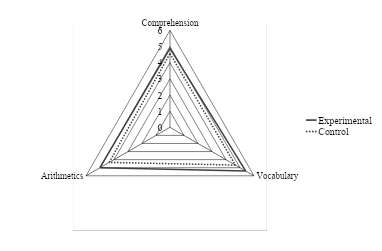
Figure 1.
Comparison between experimental and control condition for WIPPSI tests
Note: For the three subtests from the WIPSSI the graphic draws a clear pattern with higher scores (showed in standard deviation units) for each one of them in the music training condition.
Results of ANOVAs for WIPPSI
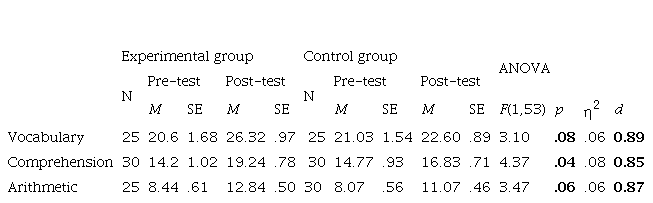
Note: M: mean, SE: standard deviation, F: Fisher, p: p-value, η2: eta square, d: Cohen´s effects size.
Table 2 shows the results of the mixed-design ANOVAs regarding the executive function variables, i.e., the memory tasks and different versions of the Stroop and the Go/No-go tests as well as their size effects through Cohen´s d. The interaction between Pre/Post-test and Experimental/Control Group in memory tests was only marginally significant for the number of errors in the Toys Memory Task with eight stimuli, and, as expected, differences in pre-test between groups were not significant. No significant differences were detected in the rest of the cases (see Table 2). Figure 2 shows a clear pattern with the means number of errors (in standard deviation units) lower for three of the tasks in the experimental condition.
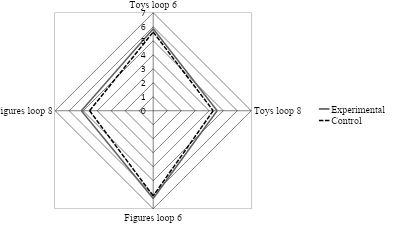
Figure 2.
Comparison between experimental and control condition for working memory tests
For inhibitory control tests, significant effects were found for Neutral, Man/Woman and Emotional versions of the Stroop test with the experimental group post-test outperforming the rest of the conditions (Table 2). As shown in Table 2, there were also significant effects in the number of execution errors for the neutral version of the Go/No-go test; for the omission errors, the effect was only marginally significant. For the emotional version, meanwhile, a significant effect was found in the interaction between Group and Pre/Post-Test omission errors, not so for the execution errors. In Figure 3 it is noticeable that the performance in the Stroop test was systematically better when participant received music training for the four versions of the Stroop. In the case of the Go/No-go tasks, the mean number of errors (in standard deviation units) was lower in three of the measurements (Figure 4).
Results of the ANOVA for the working memory updating tests, Stroop and Go/No-go tests
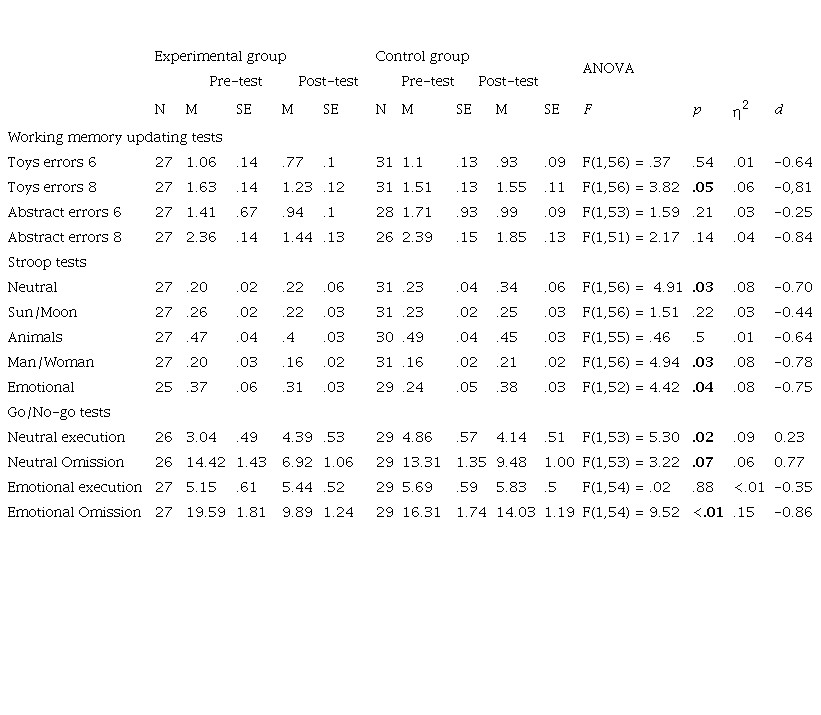
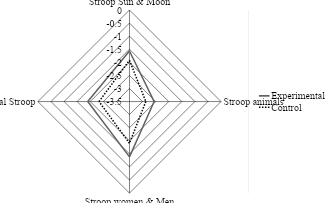
Figure 3.
Comparison between experimental and control condition for Stroop tests
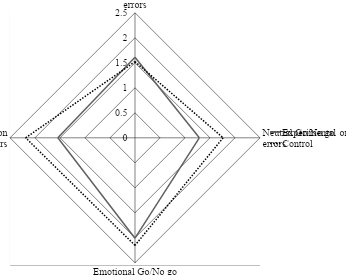
Figure 4.
Comparison between experimental and control condition for Go/No-go tests
So far, evidence has emerged for two predictions of the mediation hypothesis: 1) a positive effect of piano training on general abilities, and 2) a favorable effect of piano training on specific executive function measurements. The final prediction, as stated in the introduction, is that the effect of training on general abilities would be reduced if executive functions are regulated.
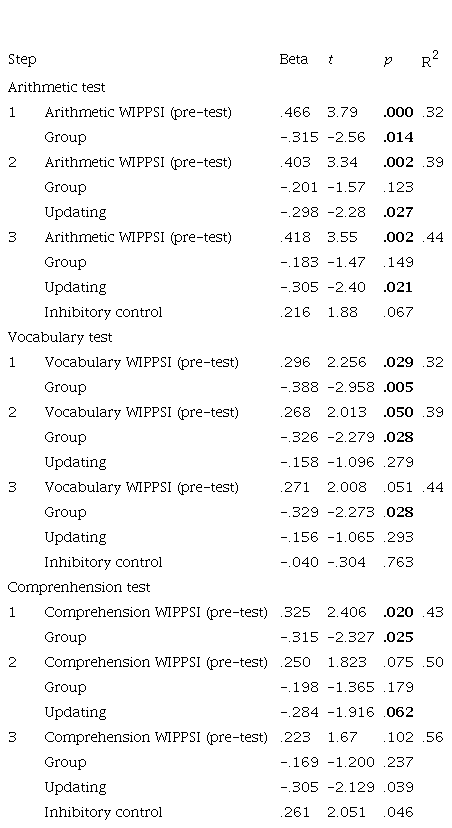
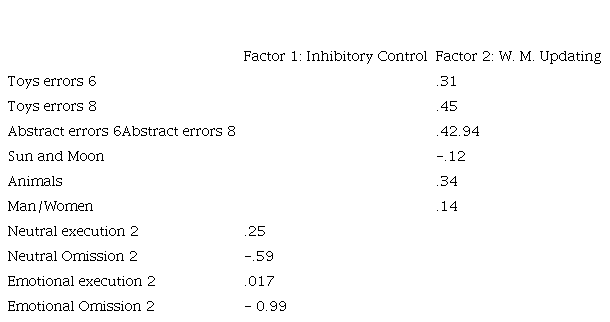
In order to confirm the third prediction, a series of hierarchical regression analysis was conducted, using the three general abilities as dependent variables: vocabulary, arithmetic, and comprehension (Table 3). In the first step of the analyses, only the pre-test value of the corresponding general ability and the group (trained/untrained) were included as independent variables. Subsequently, two executive function latent variables were included as dependents (steps 2 and 3). These latent variables were produced by reducing the original ones by a confirmatory factor analysis (RMSEA = .08, GFI = .84) and correspond to inhibitory control and memory factors (Table 4).
Results of the hierarchical regression model for the arithmetic test, vocabulary test and comprehension test
Factor loadings of the Confirmatory Factor Analysis for executive function measurements
The mediation hypothesis predicts that group, and possibly pre-test, general abilities were significant in the first step of the analyses. This result is consistent with the previously reported results of the ANOVA analyses. Finally, in steps 2 and 3, where executive function latent variables have been controlled, the effect of training should disappear and be non-significant. As predicted, the significant effect of the group on the arithmetic test in step 1 (Table 3) disappears when memory and inhibitory control variables were included in the model.
The fact that the effect of memory was significant in the final model (step 3) suggests that, as expected, assuming the mediation hypothesis, the effect of training on arithmetic general ability is mediated by executive functions, particularly by working memory updating. Additionally, it seems that there is no residual direct effect from music training to arithmetic ability. By contrast, vocabulary general ability as measured by the WIPPSI showed no evidence of executive function mediation. After the inclusion of memory and control inhibitory variables, the effect of group continued being significant as presented in Table 3. Furthermore, neither the memory nor the inhibitory control was significant. Finally, Table 3 shows evidence of executive functions mediation between music training and general comprehension ability. In this case, the direct effect from training disappeared with the introduction of both memory and inhibitory control.
These results confirm the association between musical training and general cognitive abilities (MacRitchie et al., 2020; Schellenberg, 2020; Schellenberg & Peretz, 2008; Schellenberg & Weiss, 2013; Swaminathan & Schellenberg, 2019). Furthermore, the experimental nature of the study gives rise to a causal interpretation. As mentioned in the introduction, both experimental and non-experimental designs have their own advantages and disadvantages, which means that the convergent results from both designs give stronger support to the hypothesis suggesting that musical training increases general cognitive abilities.
Multiple studies using different populations, measurements, and aspects of general cognitive abilities, as well as different kinds of training, are important in order to understand the particularities of these effects. In this study, we show evidence of the effect of music training on general cognitive abilities, as measured by the Weschler Preschool and Primary Scale of Intelligence (WPPSI-R) through the vocabulary, comprehension, and arithmetic subscales.
Previous studies report contradictory results regarding the mediation of executive functions in the relationship between musical training and general cognitive abilities (Bowmer et al., 2018; Bugos et al., 2022; Schellenberg, 2011; Strait et al., 2010). A thorough analysis of the relevant literature reveals that the real challenge is to determine which aspects of executive functions play a role in mediation and, more specifically, to what extent and under what conditions. In this sense, these results can be interpreted as evidence of a particular case of mediation in a population of 4- to 5-year-old children trained in piano with the Bastien Method.
To evaluate the mediation hypothesis, we consider three of its main predictions and contrast them with our data: 1) the positive effect of executive function training; 2) the positive effect of higher order abilities training, and 3) the disappearance or reduction in the effect on general abilities when executive functions were statistically controlled. As for the second prediction, higher-order ability was affected by training in the expected direction: in one component of the WPPSI (Comprehension) the training effect was significant; in the others (Arithmetic and Vocabulary) they were marginally significant. (Table 1).
The first prediction was only partially verified. For Stroop, it was significant in the Neutral, the Man/Woman and the Emotional versions of the task (Table 2). For working memory updating tests, only when children had to maintain 8 rather than 6 stimuli in their memory in the Toys task was the effect significant (Table 2). This suggests that when the task requires less cognitive demand, as in the case of six stimuli tasks, the magnitude of the effect could not be detected with the sample size used in this experimental design. Karbach and Kray (2009) also report a case where an effect associated with training cannot be detected in tasks with a low cognitive demand but becomes significant in a similar task when cognitive demand increases. Furthermore, we found evidence of a positive effect of training on the Go/No-go scores, with significant differences in execution errors for the neutral version as well as in omission errors for the emotional version of the task (Table 2).
According to Johnstone et al. (2005) the effect size in omission errors discovered in the current study for the emotional form of the Go/No-go task reaches the level of a large effect, but the neutral version only approaches the level of a medium effect. A possible interpretation of this pattern would be that the emotional task involves a higher cognitive demand because of the facial expressions (Mancini et al., 2022). An alternative interpretation would be that the character of the music training specifically facilitates the manipulation of emotional stimuli. To evaluate the plausibility of both interpretations, studies including both emotional and no-emotional types of training as well as emotional and non-emotional stimuli should be conducted.
To study the possible role of executive functions mediating the effect of training on general abilities, we decided to extract individual scores for two latent variables related with updating and inhibitory control. Using these scores, we found some support for the third prediction of the mediation hypothesis. Particularly, we found evidence of an indirect effect between training and arithmetic ability, caused by working memory updating (Table 3). Similarly, results suggest mediation of updating as well as of inhibitory control between training and comprehension ability (Table 3). These results agree with evidence from pure correlational studies, such as Degé et al. (2011), using a completely different set of tests
With the aim to understand the different patterns regarding the three general abilities, we analyze the particular traits of the three subtests through the WIPPSI. As for the Arithmetic score, participants had to solve a series of mathematical problems. These results (Table 3) are consistent with literature that reports a relation between mathematical abilities, specifically with respect to arithmetic problems and working memory (Allen et al., 2019; Kroesbergen & van Dijk, 2015). This relation seems to be explained by the important working-memory demand of arithmetic problems, as suggested by the strong correlation between children’s accuracy and the representational set size (maximum number of units required to be held in working memory to solve a given arithmetic problem) (Allen et al., 2019; Giofrè et al., 2018; Klein & Bisanz, 2000).
For the Vocabulary subtest, children had to give definitions for different words. This semantic demand clearly seems to be related to a searching process in long-term memory, rather than working memory as preview evidence has suggested (Artuso & Palladino, 2019; Otem, 2003). Furthermore, Rabbitt et al. (2007) found that different variables highly associated with decline of executive functions in adults (age, loss of brain volume, carotid and basilar artery blood flow, and white matter lesions) had only a very small effect on vocabulary. This finding could be interpreted as lack of effect of executive function on vocabulary, and would be in line with this study results, where no mediation effect from our executive function variables was found.
Finally, the Comprehension subtest requires explanations of a series of situations and activities that involve the management of general principles and social situations for decision-making. In general, subjects must decide between different options, some of them trivially correct. Presumably, children had to inhibit these trivial solutions to achieve higher scores in the subtest. However, relevant evidence seems to be unclear because studies in different populations using the Iowa Gambling Task (IGT) as a measurement for decision-making failed to show a correlation with executive functions (Frischen et al., 2022; Wongupparaj et al., 2015). Conversely, Brand et al. (2006), claim that, in situations under ambiguous conditions like the IGT, the role of executive functions could be negligible, but when it is possible to assess the risks of the decisions, those functions become relevant.
Giofrè et al. (2018) run a confirmatory factor analysis that showed that verbal and working memory can be differentiated and that these factors have a different predictive power in explaining unique portions of variance in reading and mathematics. These results point to the importance of distinguishing between working memory modalities in evaluating the relationship between mathematics or arithmetic skills and verbal abilities.
This study presents relevant information that confirms exposing preschool children to formal piano training, using the Bastien method, influences executive functions and general cognitive skills. By using an experimental design approach, a causal interpretation between piano training and improvements in general cognitive abilities and executive functions can be confirmed.
Specifically, an improvement was found in inhibitory control measured through the Stroop tests, particularly in the neutral, male/female and emotional versions of the task. Positive results were also found in inhibitory control measured through the Go/No-go tests, both in executive errors and in omission errors in the neutral version. Regarding working memory, better results were identified in the experimental condition in the more complex updating tests.
Regarding cognitive skills, differences were found between participants belonging to the experimental group compared to the control group in the three measures used, namely: comprehension, arithmetic and vocabulary.
Finally, the findings of this research partially support the mediation hypothesis for 4- to 5-year-old children. These results provide experimental evidence in favor of this hypothesis specifically for working memory updating as a mediating variable of arithmetic ability measured by WIPPSI. This conclusion follows from the clear advantage in WIPPSI scores in the group of children who receive musical training with the Bastien method and the tendency of this effect to disappear when executive function variables are statistically controlled, except in the case of arithmetic cognitive skills.
It is important that future research delves into the variation in executive function processing results when using tasks with affective versus neutral content.
Furthermore, future studies need to investigate what other training programs may have similar effects on executive functions as those found using piano training. One of the limitations of this study was the sample size. It would be valuable in future research to test the mediation hypothesis with a larger sample size to better understand whether the mediation between executive functions and cognitive skills is limited to arithmetic skills only or whether the results may vary with a larger sample size. These results allow for a better understanding of the development of executive functions at an early age, which contributes to the theoretical understanding of cognitive issues. This study also provides input for decision makers to better understand the impact that learning an instrument has on human and social development.
redalyc-journal-id: 180
Figure 1.
Comparison between experimental and control condition for WIPPSI tests
Results of ANOVAs for WIPPSI
Note: M: mean, SE: standard deviation, F: Fisher, p: p-value, η2: eta square, d: Cohen´s effects size.
Figure 2.
Comparison between experimental and control condition for working memory tests
Results of the ANOVA for the working memory updating tests, Stroop and Go/No-go tests
Figure 3.
Comparison between experimental and control condition for Stroop tests
Figure 4.
Comparison between experimental and control condition for Go/No-go tests
Results of the hierarchical regression model for the arithmetic test, vocabulary test and comprehension test
Factor loadings of the Confirmatory Factor Analysis for executive function measurements
