Scientific note
Propagation of macadamia (Macadamia integrifolia Maiden & Betche) by cuttings
Propagación de macadamia (Macadamia integrifolia Maiden & Betche) por estacas
Propagation of macadamia (Macadamia integrifolia Maiden & Betche) by cuttings
Agronomía Colombiana, vol. 39, no. 1, pp. 129-135, 2021
Universidad Nacional de Colombia, Facultad de Agronomía
Received: 19 August 2020
Accepted: 07 April 2021
ABSTRACT: Macadamia trees require a long period for flowering when propagated by seeds. To anticipate the yield, maintain cultivar characteristics, and increase the homogeneity of nut quality, it is essential to establish orchards with grafted trees. Although semi-hardwood cutting propagation tests have been performed in Brazil, no method has been shown to be appropriate at a large scale due to the difficulties in implementation of techniques or the high cost. Establishing an effective and affordable protocol may provide great improvement to this productive chain since it will meet the demand of nurseries and stimulate the expansion of orchards. The aim of this study was to develop a protocol for macadamia semi-hardwood cutting propagation. Six cultivars (HAES 344, HAES 816, HAES 660, IAC 4-12B, IAC 9-20, and IAC 4-20) were evaluated and selected because of their ample cultivation in Brazil. The propagation material was collected for four months (October and November 2018, and February and March 2019). The semi-hardwood cuttings were also soaked in indole butyric acid (IBA) at three different concentrations (0, 5, or 10 g L-1) and in the commercial product Clonex®. The experiment was arranged in a two-way completely randomized design with four replicates and data were analyzed by R software. The cultivar IAC 4-12B showed the highest index for root development (37.0%). The treatments did not show significant differences between IBA doses and Clonex® for root development (IBA 10 g L-1 - 31.5%, Clonex® - 29.4%, and IBA 5 g L-1 - 27.4%). November was the best cutting season for root development of semi-hardwood cuttings (10.0%).
Key words: Indole butyric acid, rooting, cultural practices.
RESUMEN: Los árboles de macadamia requieren un largo período para empezar la floración cuando se propagan por semillas. Para anticipar el rendimiento, mantener las características del cultivar y aumentar la homogeneidad de la calidad de las nueces, es esencial establecer huertos con árboles injertados. Aunque se han realizado ensayos de propagación de esta planta por estacas semileñosas en Brasil, ningún método ha demostrado ser el apropiado a gran escala debido a las dificultades en la implementación de las técnicas o al alto costo. El establecimiento de un protocolo eficiente y accesible puede proporcionar una gran mejora a esta cadena productiva ya que satisfará la demanda de viveros y estimulará la expansión de los huertos. El objetivo de este estudio fue desarrollar un protocolo para la propagación de macadamia por estacas semileñosas. Seis cultivares (HAES 344, HAES 816, HAES 660, IAC 4-12B, IAC 9-20, e IAC 4-20) fueron evaluados y seleccionados por su amplio cultivo en Brasil. El material de propagación se recolectó durante cuatro meses (octubre y noviembre de 2018 y febrero y marzo de 2019). Las estacas semileñosas se sumergieron en ácido indolbutírico (AIB) en tres concentraciones diferentes (0, 5, o 10 g L-1), y en el producto comercial Clonex®. El experimento se realizó siguiendo un diseño bidireccional con cuatro repeticiones y los datos fueron analizados por el software R. El cultivar IAC 4-12B mostró el índice más alto para el desarrollo de las raíces (37.0%). Los tratamientos no mostraron diferencias significativas entre las dosis de AIB y Clonex® para el desarrollo de las raíces (AIB 10 g L-1 - 31.5%, Clonex® - 29.4%, AIB 5 g L-1 -27.4%). Noviembre fue la mejor temporada de recolección para el enraizamiento de las estacas semileñosas (10.0%).
Palabras clave: Acido indolbutírico, enraizamiento, prácticas culturales.
Introduction
The macadamia (Macadamia integrifolia Maiden & Betche) is a nut tree belonging to the Proteaceae family, native to tropical and subtropical Australian forests (Peace et al., 2005). It was introduced into Brazil in 1931 (Dierberger & Marino Netto, 1985) and in 1940 the Agronomic Institute began the only macadamia breeding program in the country (Sobierajski et al., 2006). Orchards are generally established by using grafted trees to anticipate yield, maintain cultivar characteristics, and increase the homogeneity of nut quality (Melo et al., 2019). The technique usually used for vegetative propagation is grafting (Campo-Dall'Orto et al., 1988). It takes 18 months for the seedling to be ready for planting in the orchard (Russell et al., 2016). In previous studies, the rate of grafting success reached 80% (Campo-Dall'Orto et al., 1983). However, this rate is lower than 50% in commercial nurseries. These factors increase the cost of seedlings and reduce their availability to growers making it difficult to expand the culture in Brazil (Melo et al., 2019).
The macadamia tree produces a nut of great acceptance and high value in the international market (Penoni et al., 2011; Maro et al., 2012). In recent years, there has been an increase in the demand for seedlings of macadamia in Brazil (Perdoná & Soratto 2015; 2016).
The propagation by semi-hardwood cuttings can reduce the time and costs of seedling production (Bell, 1993). Therefore, establishing an effective and affordable protocol of seedling production by semi-hardwood cuttings will provide an advance for macadamia in Brazil, stimulating orchard expansion.
Pereira et al. (1987) studied the rate of rooting in cuttings of five cultivars from two seasons. The authors observed significant differences for cultivars and seasons but no interactions between them. The emission of roots in cuttings of macadamia is the major difficulty for vegetative propagation. Therefore, the use of synthetic growth regulators, such as auxin can be an alternative to overcoming this problem (Garbelini, 2009). Another option is the use of plant growth regulators, e.g., indole butyric acid (IBA) that, when compared to a synthetic auxin, shows lower sensitivity to biological degradation (Fachinello et al., 2005). These plant growth regulators also stimulate root growth (Alvarenga, 1990). However, the ideal IBA concentration for cutting immersion varies among different species and cultivars (Hartmann et al., 2002), and it is still unknown for macadamia. On such a background, the aim of this study was to identify the macadamia cultivars with the best rooting performance of semi-hardwood cuttings and test different IBA concentrations and seasons for seedling production by semi-hardwood cuttings.
Materials and methods
Six macadamia cultivars were propagated by semi-hardwood cuttings. The percentage of survival, callus formation, and rooting were evaluated. The cultivars were selected for their characteristics of yield and nut quality. The cultivars HAES 344, HAES 816, and HAES 660 were developed by the Hawaii Agricultural Experiment Station (HAES) and the Agronomic Institute (IAC) developed the cultivars IAC 4-12B, IAC 9-20, and IAC 4-20.
The semi-hardwood cuttings were collected from 12-year-old trees in Dois Córregos, São Paulo, Brazil, for four months (October and November 2018, and February and March 2019). The materials were cut from the medium treetop with 15-20 cm of length and 3-5 cm of diameter; three leaves were kept for all cuttings, as recommended by Russell et al. (2016). The semi-hardwood cuttings were soaked in IBA (0, 5, or 10 g L-1) (NEON®, Suzano, Brazil) for 15 min, followed by planting in a propagation tube (120 ml) filled with substrate (peat-vermiculite-limestone, Carolina Soil®, Pardinho, Brazil). In addition, the tips of cuttings collected in November, February and March were also soaked in Clonex® (IBA 3 g L-1, for 15 min) (Growth Technology, Taunton, UK). To prevent the cuttings from drying out, they were planted on the same day of collection in a mist-house.
The humidity in the mist-house was maintained using a controller (Fascitec NTI 12 - AC, São Bernardo do Campo, Brazil) for intermittent watering and to avoid accumulation of water on the leaves. The experimental design was a two-way completely randomized design with four replicates and five cuttings by plot/month, of which 20 cuttings were the control treatment (distilled water). Thus, 1,800 cuttings were evaluated.
After 120 d, the semi-hardwood cuttings were removed from the tubes, washed, and evaluated for survival, callus, and root development. The data were transformed by the BoxCox method (Box & Cox, 1964) to meet the normality assumption. The data were analyzed using the R software (R Development Core Team, 2019), and the cluster analyses and threshold were calculated using the R-package 'facto-extra' (Kassambara & Mundt, 2017).
Results and discussion
From the 1,800 semi-hardwood cuttings, 9.8% showed callus, 5.7% developed roots, and 84.5% did not survive. This high mortality caused the data to be unbalanced, which prevented the use of an analysis of variance. The statistical analysis was performed by descriptive and multivariate analysis.
The best season for removing semi-hardwood cuttings for the presence of callus was October 2018 (22.8%), considering all cultivars and doses of IBA and Clonex® (Fig. 1A). However, the best results for root development were observed for those plants collected in November 2018 (10.0%; Fig. IB). The lowest semi-hardwood cutting mortality was observed when the removals occurred in October 2018 (71.9%), while the highest rates occurred in February 2019 (90.2%) and March 2019 (92.3%; Fig. 1C).
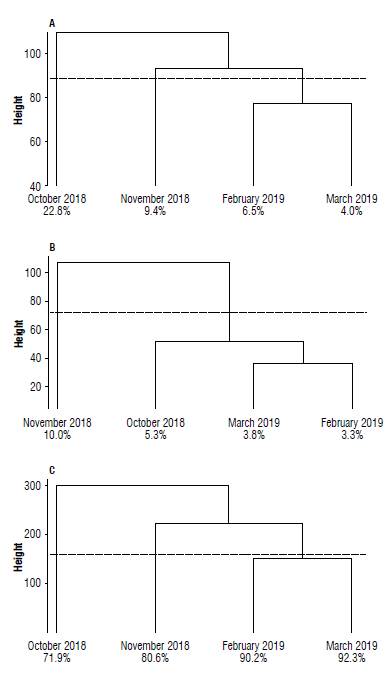
FIGURE 1
Similarity matrix (Euclidean distance) among collection seasons of semi-hardwood cuttings of Macadamia integrifolia, considering all cultivars and doses of IBA and Clonex®. The similarity matrix considered the following parameters: A) presence of callus, B) root development, and C) mortality. The grouping method (cluster analyses) was based on the K-means algorithm (Kassambara & Mundt, 2017).
The control treatment (without IBA application) showed the highest rate for the presence of callus (42.4%), considering all cultivars and collecting seasons (Fig. 2A). However, this treatment showed the lowest rooting rate (11.8%). The other treatments showed no statistical differences for root development with 31.4% for 10 g L-1 IBA, 29.4% for Clonex®, and 27.4% for 5 g L-1 IBA (Fig. 2B). The mortality was statistically lower in semi-hardwood cuttings treated with Clonex® (19.5%) than with the other doses of IBA (Fig. 2C).
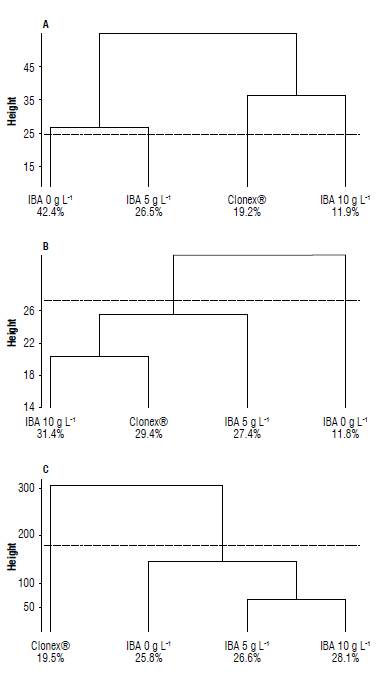
FIGURE 2
Similarity matrix (Euclidean distance) among doses of indole butyric acid (IBA) and Clonex® for semi-hardwood cuttings of Macadamia integrifolia treatment, considering all cultivars and collecting seasons. The similarity matrix considered the following parameters: A) presence of callus, B) root development, and C) mortality. The grouping method (cluster analyses) was based on the K-means algorithm (Kassambara & Mundt, 2017).
The cultivar HAES 660 showed the highest presence of callus (35.6%) considering all seasons of collection and doses of IBA and Clonex® (Fig. 3A). However, only 12.0% of the semi-hardwood cuttings of this cultivar effectively developed roots (Fig. 3B). Regarding root development, the cultivar IAC 4-12B showed the highest rate (37.0%), followed by the second group (formed by TAC 9-20' and TAC 4-20') that showed the second-highest performance (Fig. 3B). The mortality rates by cultivar were similar to each other, but the cultivars HAES 660 (14.8%) and IAC 4-12B (15.6%) showed the lowest values (Fig. 3C).
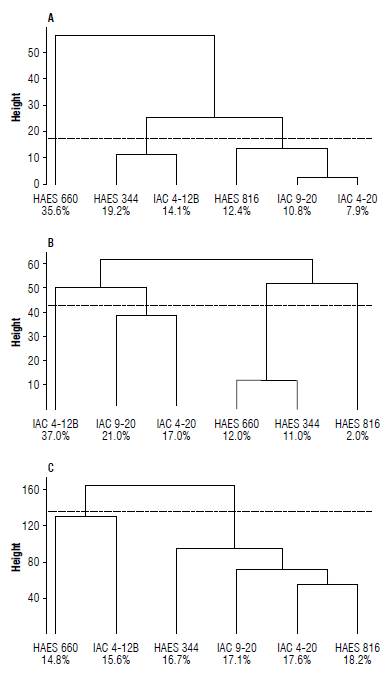
FIGURE 3
Similarity matrix (Euclidean distance) among cultivars of Ma-cadamia integrifolia 'IAC 4-12B', 'IAC 9-20', 'IAC 4-20', 'HAES 344', 'HAES 660' and 'HAES 816', considering all collecting seasons and doses of IBA and Clonex®. The similarity matrix considered the following parameters: A) presence of callus, B) root development, and C) mortality. The grouping method (cluster analyses) was based on the K-means algorithm (Kassambara & Mundt, 2017).
The descriptive analysis regarding the cultivars in all IBA doses and cutting seasons showed 'HAES 660' as the best cultivar regarding the presence of callus (60%), also exhibiting the lowest mortality (40%). These rates were observed for those plants collected in October 2018 and subjected to the control treatment (Tab. 1). The callus is formed by new meristematic cells near the phloem (Hartmann et al, 2002). The presence of calluses in species of hard rooting can precede root emission (Bitencourt et al., 2010). However, the development of callus and roots can be regarded as independent events. For instance, Singh and Ansari (2014) observe high rates for callus development in Dalbergia latifolia (91.5%) and Gmelina arborea (75.0%) in the control treatment, without these calluses evolving into roots (3.1 and 0%, respectively). The authors suggest that the presence of callus in treatments without hormones is a reaction of the plant to restore the injured cutting and not a prerequisite for root induction. These two events may simultaneously occur, because both processes involve cell division and depend on favorable conditions (Preti et al, 2012).
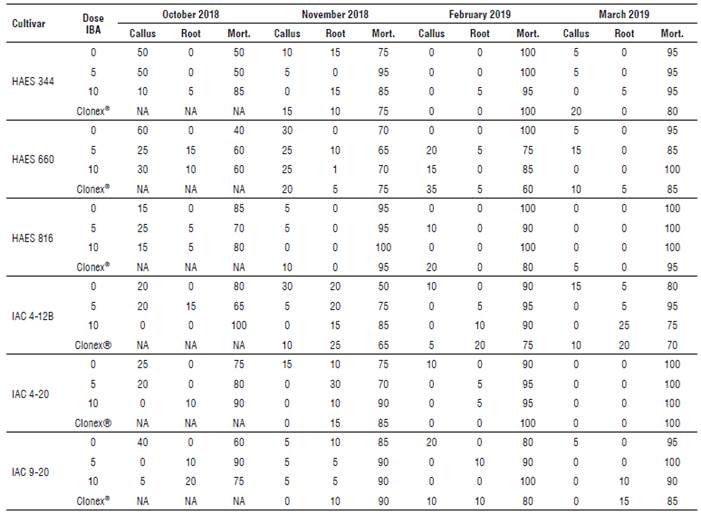
Clonex® - commercial product; NA - not evaluated.
Regarding root development, TAC 4-20' showed the highest rate of rooting (30%) when collected in November 2018 and subjected to treatment with IBA at a dose of 5 g L-1 (Tab. 1). For this variable, all cultivars developed by the Agronomic Institute showed higher results than those found for the Hawaiian cultivars. Cultivar IAC 4-12B was the most stable with 20,20,15 and 25% of rooting in November 2018 (IBA doses 0, 5,10 g L-1, and Clonex®, respectively; Tab. 1). This cultivar also showed high values of rooting in the February collection season (20% - Clonex®) and March 2019 (25% for IBA dose of 10 g L-1 and 20% for Clonex®; Tab. 1). Cultivar IAC 9-20 also showed a high rooting rate (20%) in the October 2018 collection season in semi-hardwood cuttings treated with 10 g L-1 of IBA (Tab. 1). Russell et al. (2016) observe a rooting rate of 44% in M. integrifolia cultivars. Entelmann et al. (2014) obtain rates of 22.9% of rooting when studying the cultivar Aloha 10-14 with an IBA concentration of 3 g L-1.
According to our data, the capability of the cultivars for rootstocks for the presence of callus, rooting, and survival were classified as nine distinct groups by the cluster analyses (Fig. 4). Cluster 3 was formed by TAC 4-20' (IBA at a dose of 5 g L-1), TAC 4-12B' (IBA at a dose of 5 g L-1) and TAC 4-20' (control treatment). These cultivars showed the highest rooting rates and moderate presence of callus. Cluster 7 was formed by the cultivars with lowest mortality rates (TAC 9-20' - control treatment and 'HAES 660' - IBA at doses of 5 and 10 g L-1). The cultivars grouped into cluster 8 ('HAES 344' - control treatment and IBA at a dose of 5 g L-1, and 'HAES 660' - control treatment) showed a high rate of presence of callus; however, these cultivars did not develop roots. These clusters are in agreement with the dendrogram obtained by the similarity matrix (Euclidean distance) (Fig. 5).
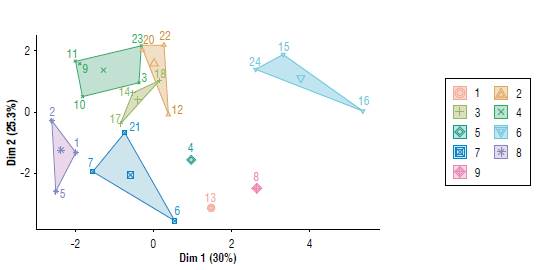
FIGURE 4
Grouping by multivariate features (cultivars, indole butyric acid, and collecting seasons) of semi-hardwood cuttings of Macadamia integrifolia. Cultivars (dose of IBA - g L-1): 1 - HAES 344 (0), 2 - HAES 344 (5), 3 - HAES 344 (10), 4 - HAES 344 (Clonex®), 5 - HAES 660 (0), 6 - HAES 660 (5), 7 - HAES 660 (10), 8 - HAES 660 (Clonex®), 9 - HAES 816 (0), 10 - HAES 816 (5), 11 - HAES 816 (10), 12 - HAES 816 (Clonex®), 13 - IAC 4-12 B (0), 14 - IAC 4-12 B (5), 15 - IAC 4-12 B (10), 16 - IAC 4-12 B (Clonex®), 17 - IAC 4-20 (0), 18 - IAC 4-20 (5), 19 - IAC 4-20 (10), 20 - IAC 4-20 (Clonex®), 21 - IAC 9-20 (0), 22 - IAC 9-20 (5), 23 - IAC 9-20 (10), and 24 - IAC 9-20 (Clonex®). The threshold was obtained by the K-means algorithm (Kassambara & Mundt, 2017).
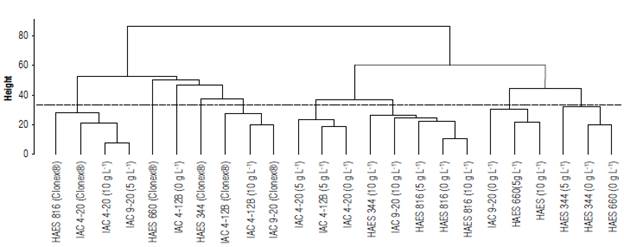
FIGURE 5
Similarity matrix (Euclidean distance) among Macadamia integrifolia cultivars HAES 816, HAES 660, HAES 344, IAC 9-20, IAC 4-20, and IAC 4-12 B subjected to treatment with indole butyric acid (0 g L-1, 5 g L-1 and 10 g L-1) and Clonex® and collected in different seasons. The threshold was obtained by the K-means algorithm (Kassambara & Mundt, 2017).
The high mortality rates observed in this experiment can be related to diseases caused by high environmental moisture, probably due to the identified presence of Cladosporium sp. on the leaves of the semi-hardwood cuttings. High mortality rates (46.2%) were also observed by Russell et al. (2016) evaluating the rooting ability of 32 macadamia cultivars in Australia. These authors found fungi from Nectria spp., seriously affecting M. integrifolia.
Conclusions
Considering all the cultivars evaluated in this study, the macadamia cultivar IAC 4-12B showed the highest rooting. This cultivar, along with HAES 660, showed the lowest mortality rate. Therefore, it can be concluded that IAC 4-12B is an interesting option for macadamia producers.
Although there were no statistical differences between indole butyric acid and Clonex® for root development, this last treatment showed the lowest mortality.
Under the conditions of Brazil, November showed the highest rooting values for semi-hardwood cuttings, and October showed the highest values for the presence of callus and low mortality for semi-hardwood cuttings.
Acknowledgments
The authors would like to thank the National Council for Scientific and Technological Development - CNPq for the fellowships to the first, second, and third authors (CNPq Process 800871/2018-9,134952/2018-9, and 307616/2019-3, respectively).
Literature cited
Alvarenga, A. A. (1990). Substâncias de crescimento e regulação do desenvolvimento vegetal. UFLA.
Bell, H. (1993). The macadamia industry and genetic diversity. Australian Macadamia Society News Bulletin, 20(4), 35-36.
Bitencourt, J., Zuffellato-Ribas, K. C, & Koehler, H. S. (2010). Estaquia de Ginkgo biloba L. utilizando três substratos. Revista Brasileira de Plantas Medicinais, 12(2), 135-140. https://doi.org/10.1590/S1516-05722010000200002
Box, G. E. P., S Cox, D. R. (1964). An analysis of transformations. Journal of the Royal Statistical Society, 26(2), 211-243. https://doi.org/10.1111/j.2517-6161.1964.tb00553.x
Campo-Dall'Orto, F. A., Barbosa, W., S Ojima, M. (1983). Desenvolvimento de macadâmia: cultura às condições brasileiras como nova opção agrícola ao mercado de exportação. Instituto Agronòmico.
Campo-Dall'Orto, F. A., Ojima, M., Barbosa, W., Sabino, J. C., S Rigitano, O. (1988). Enxertia precoce da nogueira-macadâmia. Bragantia, 47(2), 195-211. https://doi.org/10.1590/S0006-87051988000200012
Dierberger, J. E., S Marino Netto, L. (1985). Noz macadâmia - uma nova opção para a fruticultura brasileira. Nobel.
Entelmann, F. A., Scarpare Filho, J. A., Pio, R., Silva, S. R., S Souza, F. B. M. (2014). Emergência de plântulas e enraizamento de estacas e alporques de porta-enxertos de nogueira-macadâmia. Revista Brasileira de Fruticultura, 36(1), 237-242. https://doi.org/10.1590/0100-2945-233/13
Fachinello, J. C., Hoffmann, A., S Nachtigal, J. C. (2005). Propagação de plantas frutíferas. Embrapa.
Garbelini, R. C. B. S. (2009). Reguladores vegetais na emergência e no desenvolvimento de plantas de macadâmia (Macadamia integrifolia Maiden S Betche) [Doctoral dissertation, Universidade Estadual Paulista "Julio de Mesquita Filho"]. Repositório Institucional UNESP. https://repositorio.unesp.br/bitstream/handle/11449/102606/garbelini_rcbs_dr_botib.pdf?sequence=1SisAllowed=y
Hartmann, H. T., Kester, D. E., Davies Jr., F. T., S Geneve, R. L. (2002). Hartmann & Kester's plant propagation - principles and practices. Prentice Hall.
Kassambara, A., S Mundt, F. (2017). Factoextra: extract and visualize the results of multivariate data analyses. http://www.sthda.com/english/rpkgs/factoextra
Maro, L. A. C., Pio, R., Penoni, E. S., Oliveira, M. C., Prates, F. C., Lima, L. C. O., S Cardoso, M. G. (2012). Caracterização química e perfil de ácidos graxos em cultivares de Noguei-ra-macadâmia. Ciência Rural, 42(12), 2166-2171. https://doi.org/10.1590/S0103-84782012005000117
Melo, M. N. V., Silva, V. H. D., S Perdoná, M. J. (2019). Ambientes para produção de mudas de nogueira-macadâmia por estaquia. Revista ANAP Brasil, 12(27), 88-97. https://doi.org/10.17271/19843240122720192242
Peace, C. P., Allan, P., Vithanage, V., Turnbull, C. N., S Carroll, B. J. (2005). Genetic relationships amongst macadamia varieties grown in South Africa as assessed by RAF markers. South African Journal of Plant and Soil, 22(2), 71-75. https://doi.org/10.1080/02571862.2005.10634684
Penoni, E. S., Pio, R., Rodrigues, F. A., Maro, L. A. C., & Costa, F. C. (2011). Análise de frutos e nozes de cultivares de nogueira-macadâmia. Ciência Rural, 41(12), 2080-2083. https://doi.org/10.1590/S0103-84782011001200007
Perdoná, M. J., & Soratto, R. P. (2015). Higher yield and economic benefits are achieved in the macadamia crop by irrigation and intercropping with coffee. Scientia Horticulturae, 185, 59-67. https://doi.org/10.1016/j.scienta.2015.01.007
Perdoná, M. J., & Soratto, R. P. (2016). Arabica coffee-macadamia intercropping: a suitable macadamia cultivar to allow mechanization practices and maximize profitability. Agronomy Journal, 108(6), 2301-2312. https://doi.org/10.2134/agronj2016.01.0024
Pereira, F. M., Banzatto, D. A., Pereira Júnior, A. M., & Martins, F. P. (1987). Enraizamento de estacas enfolhadas de nogueira-macadâmia em câmaras de nebulização. Anais do Congresso Brasileiro de Fruticultura, 9, 543-546.
Preti, E. A., Yamamoto, L. Y., Cardoso, C., Aquino, G. S., Paes, V. S., Assis, A. M., Machado, M. H., Neves, C. S. V. J., & Roberto, S. R. (2012). Estaquia de resedá-nacional (Physocalymma scaberrimum Pohl.) em diferentes substratos e concentrações de AIB. Ciência Florestal, 22(2), 377-383. https://doi.org/10.5902/198050985745
R Development Core Team. (2019). R: a language and environment for statistical computing. R Foundation for Statistical Computing. https://www.r-project.org
Russell, D. M., Neal, J. M., Mayer, R., Bell, D., & Topp, B. L. (2016). Variation of cutting rooting ability in cultivated and wild species of Macadamia. Proceedings of the XXIX International Horticultural Congress on Horticulture: Sustaining Lives, Livelihoods and Landscapes (IHC2014): International Symposium on Nut Crops. Acta Horticulturae, (1109), 197-202. https://doi.org/10.17660/ActaHortic.2016.1109.32
Singh, S., & Ansari, S. A. (2014). Callus formation impedes adventitious rhizogenesis in air layers of broadleaved tree species. Annals of Forest Research, 57(1), 47-54. https://doi.org/10.15287/afr.2014.189
Sobierajski, G. R., Francisco, V. L. F. S., Rocha, P., Ghilardi, A. A., & Maia, M. L. (2006). Noz macadamia: produção, mercado e situação no Estado de São Paulo. Informações Económicas, 36(5), 25-36.
Notes
Author notes
* Corresponding author: sobierajski@iac.sp.gov.br