Articulos de Revision
Désiré Jean Baptiste Gernez: Metastable saturation, crystallization, and triboluminiscence
Désiré Jean Baptiste Gernez: saturación metaestable, cristalización y triboluminiscencia
Désiré Jean Baptiste Gernez: Metastable saturation, crystallization, and triboluminiscence
Revista CENIC. Ciencias Químicas, vol. 49, no. 1, pp. 1-18, 2018
Centro Nacional de Investigaciones Científicas
Received: 03 January 2018
Accepted: 05 March 2018
Abstract: Desiré Gernez was a prolific French physicist and chemist that studied the phenomenon of rotatory power of substances in different states of aggregation. He found that this property was a molecular phenomenon and that the liquid molecules vaporized without a change in structure. He also found that many substances having no optical activity (i.e. amides and certain salts) were able to change the rotatory power of tartaric and malic acids. Gernez studied in detail the physics of the metastable states of supersaturation of salt and gases and the sub-cooling and superheating of liquids. He found more than 30 salts that showed the phenomenon of supersaturation. He proved that addition of microcrystals of the solute, or its isomorphs, were enough to cause the crystallization of a supersaturated solution. Likewise, a supersaturated solution of a racemate could be separated into each enantiomer, depending on the nucleus used to convert it into a saturated one. His experiments showed that bodies that caused the crystallization of a supersaturated solution lost this ability when they were washed with tap water and dried in flask containing sulfuric acid. He found that solids disengaged gases because their surface was always covered with roughness forming a network of capillary conduits into which the gases could penetrate and condense. He also determined the absorption spectra of a variety of substances, among them chlorine, iodine chloride, sulfur, selenium and tellurium and their halides, and alizarin. The spectra of colored vapors were better observed with a spectroscope of several prisms, while colored liquids were better-observed using spectroscope of one prism.
Keywords: Absorption spectra, enantiomers, nucleation, rotatory power, sub-cooling, supersaturation.
Resumen: Desiré Gernez fue un prolífico físico y químico francés que estudió el fenómeno del poder rotatorio de substancias en estados diferentes de agregación. Encontró que esta propiedad era un fenómeno molecular y que los líquidos se vaporizaban sin cambiar su estructura. También encontró que muchas substancias que no tenían actividad óptica (i.e. aminas y ciertas sales) eran capaces de cambiar el poder rotatorio de los ácidos tartárico y málico. Gernez estudió en detalle la física de los estados meta estables de sobresaturación de sales y gases y el sub-enfriamiento y super-calentamiento de líquidos. Halló más de 30 sales que presentaban el fenómeno de sobresaturación y demostró que la adición de microcristales del soluto o de uno de sus isomorfos era suficientes para producir la cristalización de una solución supersaturada. En la misma forma, la solución supersaturada de un racemato podía ser separada en sus enantiómeros, mediante la adición de un núcleo cristalino apropiado. Sus experimentaos probaron que los cuerpos que causaban la cristalización de una solución sobresaturada perdían esta habilidad cuando se los lavaba con agua potable y luego se les secaba en un recipiente conteniendo ácido sulfúrico. Descubrió que los sólidos desprendían gases porque su superficie rugosa formaba un laberinto de conductos capilares, en el cuales los gases podían penetrar y condensarse. También determinó el espectro de absorción de una variedad de substancias, entre ellas, el cloro, el cloruro de yodo, azufre, selenio, telurio y sus haluros, y la alizarina. Para observar el espectro de vapores coloreados era mejor usar un espectroscopio de varios prismas, y para líquidos, el aparato con un prisma.
Palabras clave: Espectro de absorción, isómeros ópticos, enantiómeros, nucleación, poder rotatorio, super-saturación.
Life and career
Désiré Gernez (Figure 1) was born in Valenciennes, Department of the North, on April 24, 1834, son of Jean Baptiste Gernez and Thérèse Lomprez. Few details are available about his family and early education (Anonymous, 1901; Anonymous, 2016ab). Between 1855 and 1858 he studied physics at the École Normale Supérieure, Paris, and after graduation he taught for two years at the Lycée Imperial d'Agen in Lot-et-Garonne. He then returned to Paris and worked for four years in École Normale Supérieure as agrégé-préparateur of physics in Louis Pasteur's (1822-1895) laboratory, while studying for his doctorate. In 1865 he received his degree after successfully defending a thesis about the rotatory power of optically active liquids and their vapors (Gernez, 1864b). After graduation he moved through a series of teaching and research positions: professor of physics at the Lycée de Dijon, Côte- d'Or (1864-1865) adjunct astronomer at the Paris Observatory (1865-1866), professor of physics at the Lycée de Versailles and the Lycée Saint-Louis in Paris (1866-1868), professor of physics at the Lycée Louis-le-Grand, Paris (1868-1881), professor of chemistry at the l'Ecole Centrale des Arts et Manufactures, Paris (1873-1906), maître de conférences de chimie at the l'Ecole Normale Supérieure, Paris (1881-1904), and, finally, head of the chemistry laboratories (higher education) at the l'Ecole Normale Supérieure, Paris (1897- 1904).
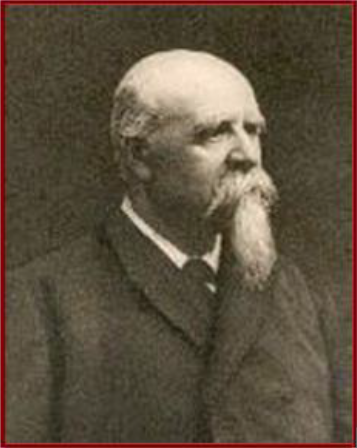
Figure 1
Désiré Gernez (1834-1910).
Among other activities we can mention that in 1873 he was a member of the group of graduates of the École Normale Supérieure that founded the Société Française de Physique. In 1905 he was elected member of the Assembly of the Pasteur Institute and in 1906 he was elected member of the general physics section of the Académie des Sciences, replacing Pierre Curie (1859-1906), after failing in two previous opportunities (1876 and 1897). Gernez was a close friend of Pasteur and participated in many of his research projects on vineyard and silkworm diseases. He took personal care of Pasteur after Pasteur suffered a stroke in 1868. Gernez passed away on October 31, 1910, and was buried in the Saint-Roch (Valenciennes) cemetery (Figure 2). Marie Curie (1867-1934) replaced him at the Académie des Sciences (Anonymous, 1901; Anonymous, 2016ab).
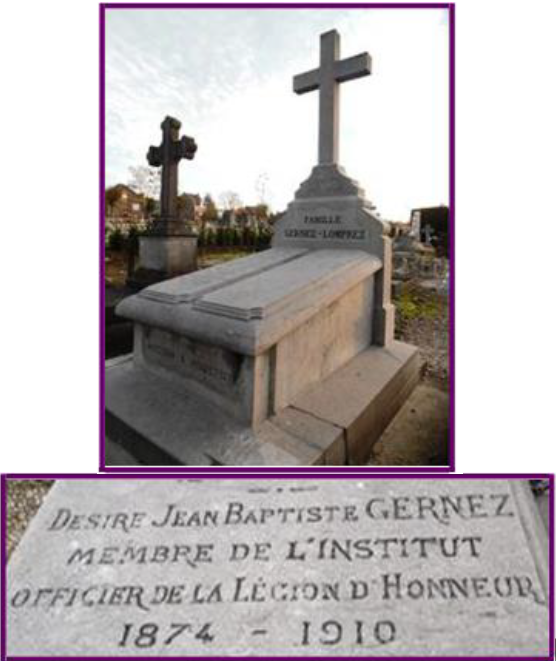
Figure 2
Grave of the Gernez-Lomprez family in the Saint-Roch cemetery, Valenciennes. The inscription for Desiré Gernez mistakenly indicates that he was born in 1874
Scientific work
Gernez was a very prolific writer, he published (alone) about 110 papers in the areas of superheating and supersaturation of liquids and solutions, enantiomers, rotatory power, thermodynamics, etc. A complete list of his papers was published in 1909; at his request this publication carried only a list of his academic positions (Anonymous, 1901). As customary for all candidates to the Académie des Sciences, Gernez published a booklet describing his academic activities and his research and results (Gernez, 1888a). In addition to the subjects discussed below, Gernez studied magnetic rotatory power (Gernez, 1872g); the influence of surface tension on the displacement of a dissolved gas (Gernez, 1873b); capillarity (Gernez, 1873e); the efflorescence of the hydrates of sodium sulfate (Gernez 1874c); boiling and superheating of liquids (Gernez, 1874d, 1875b, 1876c); the influence of vibration on the decomposition of explosive liquids and the boiling of superheated liquids (Gernez, 1878b); the distillation of liquid under the influence of static electricity (Gernez, 1879); the vapors of mercuric iodide (Gernez, 1899ab, 1900); triboluminiscence of metals and racemates (Gernez, 1905, 1908ab); etc.
Rotatory power of active liquids
In 1815 Jean Baptiste Biot (1774-1862) discovered by accident that certain liquids exhibited also the phenomenon of circular polarization, although weakly. He had introduced crystallized plates in different liquids in order to study their penetration by highly oblique rays and noticed that liquids such as essence of turpentine, oil of citron, oil of laurel, and spirit of camphor, were also capable of rotating the axis of polarization. On filling a tube about 15 cm long with turpentine he observed that the complimentary colors had the same property as those produced by a plate of rock crystal, turning the plane of polarization from right to left. He also found that the intensity of the phenomenon increased as the thickness of the liquid was increased; turpentine mixed with an inactive fluid gave a tint proportional to the concentration of turpentine in the mixture; a mixture of oils having opposite deviations, could produce inactive fluids, etc. Biot also found that the vapors of these liquids were also able of deviating the plane of polarized light (Biot, 1805).
Gernez decided to determine if the vapors of these active materials possessed a rotary power of the same magnitude and direction as their mother liquors (Gernez, 1864ab). Preliminary tests done with a tube 15 m long, heated by gas lamps, showed him that the vaporized substance deviated the plane in the same direction as its liquid phase, although with lesser intensity. This result allowed him to reduce the length of the tube to 4 m and arrange it so that the gas was present in near isothermal conditions [a detailed description of the apparatus and experimental technique appears in the thesis of Gernez (Gernez, 1864b)]. Determinations made at several temperatures indicated that the molecular rotary power (a) varied as a parabolic function of the temperature, i.e., a = a- bt - ct2 , where the coefficients were a function of the nature of the substance and the wavelength of the ray. Comparison of the values of a for the same temperature and for the different rays of the spectrum indicated that the essence of citron and of bitter orange diverged much more that the essence of turpentine from the law of the inverse ratio of the square of the wavelength. In addition, for any ray, the ratio of the value of a at two temperatures was the same for all rays considered. In other words, the law of dispersion of the planes of polarization of rays of different colors was valid for all temperatures. Not only that, the results indicated also that the ratio of the rotations in the two states of aggregation (aliq/avapor) was the same for a given ray. Gernez's thesis contains a table providing detailed numerical results for the rotatory power of the liquid and vapor phases of every liquid studied (Gernez, 1864ab).
The next experiences studied the variation of the molecular rotary power with a change in state of aggregation. For this purpose, Gernez filled the tube with saturated vapor at a given pressure and temperature, expelled the vapor with a current of CO2, condensed it, and measured the rotatory power of the liquid at various temperatures. His results showed that at a given temperature the rotating power of the vapors of essence of turpentine and camphor was almost identical with that of their liquid; for the essence of orange and bitter orange the rotatory power of the vapor was slightly smaller than that of the liquid. All the above results proved that the rotatory power of active substances was a molecular phenomenon and that the liquid molecules vaporized without a change of structure (Gernez, 1864ab).
In 1860 Biot reported that boric acid, a substance lacking optical activity, even in very small amount, was able of changing the dispersion law of the polarization plane presented by aqueous solutions of tartaric acid. The intensity of the change varied with the relative concentration of the solutes and the temperature and occurred with both optical isomers of tartaric acid, levo and dextro. At certain relative concentration the presence of boric acid was able to increase four times the rotatory power of an aqueous solution of tartaric acid. Biot attributed the phenomenon to the formation of molecular combinations in proportions varying continuously (Biot, 1860).
Gernez carried on a detailed research on this phenomenon and found that it was not limited to boric acid. In his first publication (Gernez, 1887a) he reported that many substances having no optical activity were able to change the rotatory power of tartaric and malic acids; among them, amides (formamide, acetamide, urea, etc.), acids (arsenic, arsenious, molybdic, and antimonic), and salts (arseniates, molybdates, and alkaline tungstates). For example, addition of sodium molybdate to an aqueous solution of tartaric acid increased its rotatory power 35 times; with a solution of ammonium molybdate it increased 50 times. This publication contained a detailed description of the variation of the rotatory power of a given aqueous solution of dextro tartaric acid, at 17 °C and having a rotatory power of 0° 21', upon addition of increasing amounts of sodium molybdate. This table indicated that a ternary solution containing the same number of equivalents of tartaric and sodium tungstate, corresponding to the formula C5H6O11, NaOMoO3, presented a rotatory power 37.37 times larger than that of tartaric acid alone (Gernez, 1887a).
In a series of additional publications Gernez reported similar information for the influence of ammonium molybdate (Gernez, 1887b), neutral tungstate of sodium and potassium (Gernez, 1888b), and neutral molybdate of magnesium and lithium (Gernez, 1889a) upon tartaric acid; ammonium molybdate (Gernez, 1889b), sodium molybdate (Gernez, 1889c), neutral molybdate of lithium and magnesium (Gernez, 1890a), neutral tungstate of sodium and potassium (Gernez, 1890b), double molybdate of sodium and potassium, and sodium acid molybdate (Gernez, 1890c), and white alkaline phosphomolybdates (Gernez, 1891a); over levo malic acid; acid molybdates of sodium and ammonium over dextro mannitol (Gernez, 1891b); acid molybdates of sodium and ammonium over dextro sorbitol (Gernez,1891c); acid molybdates of sodium and ammonium over dextro perseite; (Gernez, 1892); acid molybdates of sodium and ammonia over rhamnose (Gernez, 1894), etc.
Supersaturation
Gernez studied in detail the causes and uses of the phenomenon of supersaturation in saline solutions (Gernez, 1865abcde, 1866bc, 1867ab, 1872e, 1873af, 1874abcf, 1876c). In his first paper on the subject he gave a short summary of the history of the subject up to 1865 (Gernez, 1865a). In 1815 Johann-Baptist Ziz (1779-1829) reported that the sudden crystallization of aqueous solutions of sodium sulfate was not due to agitation and did not take place when the solutions were kept under a bell glass or without contact with air. Solids contacted with the solution caused instant crystallization when dry and lost this ability when wet or previously boiled. Crystals of the solute were the best agents to induce crystallization (Ziz, 1809). Joseph-Louis Gay-Lussac (1778-1850) was surprised at the inaccuracy of the knowledge about the solubility of salts, in spite of the relative ease of determining its value: the saturated solution was evaporated to dryness and the resulting solid weighed (Gay-Lussac, 1819). Heating the salt with water and followed by cooling to any wanted temperature, or mixing a large excess of salt with water and slowly heating the mixture to the desired temperature could generate a completely saturated saline solution. Carrying the process under agitation and maintaining the mixture for two hours at the final temperature assured perfect saturation.
According to Gay-Lussac, although a saline solution that precipitated the solute without a change in temperature was necessarily supersaturated, supersaturation was not a fixed point because the cause that produced it was the same as that which caused water to stay liquid below its freezing point and also be supersaturated with a gas like CO2. The intensity of this effect seemed to depend on the inertia of the molecules, that is, "a resistance to a change of state or equilibrium, which may be produced by different causes...All the effects may be prevented or destroyed by causes which appear strangers to affinity". Gay-Lussac illustrated this point by the fact that in water containers, water froze always at 00 and boiled at 100 °C. Gay-Lussac measured the solubility of sodium sulfate, anhydrous and crystallized, between 00 and 103.17 °C and observed that it followed an unusual law: In increased rapidly up to a maximum at 33 °C; then is decreased up to 103.17 °C, where it became almost the same as at 30.05 °C. Gay-Lussac's experiments showed that solutions of sodium sulfate, acetate, and selenate presented the phenomenon of supersaturation (Gay-Lussac, 1819).
Henri Löwel carried on a detailed study of the solubility of sodium sulfate in water (Löwel, 1850-1857). Among his many results we can mention the following: (a) Sodium sulfate crystallized by cooling in the presence of air contained 10 molecules of water. Gay-Lussac found that a solution of the same salt prepared in a closed tube, in the presence of air, reached a concentration much higher than when the process was done in the absence of air. Hence, this salt presented two degrees of saturation depending if the cooling was carried in the presence or absence of air; (b) aqueous solutions contained in closed tubes, in contact with platinum wire, pieces of glass, or alone, and exposed to temperatures between 15° to 25 °C during two months, experienced no change, even under agitation. The same amount of crystals was deposited by all the solutions, cooled to 6° to 7 °C. These crystals contained 10 moles of water per mole of sulfate. Separation of the mother liquor, in contact with air, precipitated crystals containing 7 or 8 moles of water; (c) a saturated solution of sodium sulfate, heated to its boiling point and poured into a capsule, in contact with air, became covered with a film of anhydrous salt. Heated to 29° to 32 °C, the film disappeared and the solution precipitated the decahydrate; Löwell also reported that (a) agitation did not cause precipitation of the decahydrate but precipitation occurred upon addition of a particle of sodium sulfate or by simple contact with a glass or metal rod; the rod, heated previously to 40° to 100 °C, lost its precipitation ability; cooling the rods to room temperature returned their crystallization ability; (b) it seemed that bodies that caused crystallization of the decahydrate, attracted the crystalline molecules, while passive bodies repelled them; (c) these phenomena seemed to be caused by a catalytic (dynamic) force, (d) the solubility curve of sodium sulfate in water presented three temperature maxima; (1) between 17° and 18 °C, for the anhydrous salt in the absence of air; (2) between 26° and 27 °C, for the heptahydrate in the absence of air, and (3) between 33° and 34 °C, for the decahydrate. The anhydrous salt and its heptahydrate could only maintain their molecular constitution when in contact with their mother liquors in closed vessels and in the absence of air. This was a metastable state; contacted with air they became opaque and warm and evolved to the decahydrate, the stable state, and (h) other salts, such as magnesium sulfate, sodium carbonate, aluminum-potassium and chromium alum, also exhibited the phenomenon of supersaturation (Löwel, 1850-1857).
Gernez believed that his experiences proved that the crystallization of a supersaturated solution of sodium sulfate was determined by the contact with a particle of anhydrous sodium sulfate or its decahydrate. The following experimental evidence supported this hypothesis: (a) the crystallization was caused by the fall of a solid particle. It was known that supersaturated solutions exposed to laboratory air eventually transformed into a solid mass. Gernez experiments indicated that this phenomenon occurred always when the solution was contained in a flask or balloon where the particles in the air could fall vertically on the surface of the liquid. Larger surfaces produced faster crystallizations, and the phenomenon did not take place when the neck of the vessel was positioned at such an angle that the falling particle did not impinge the liquid surface; (b) the impinging solid particle had to be soluble in water. Gernez experiments showed that bodies that caused the crystallization of a supersaturated solution lost this ability when they were washed with tap water and dried in flask containing sulfuric acid. A supersaturated solution had remained in the same state after bubbling through it 1500 liters of air washed with distilled water. Heating the solid body resulted also in the loss of its crystallization ability; (c) sodium sulfate had to be present in the air. Treating with barium chloride the water used to wash the air resulted in the precipitation of barium sulfate. Gernez studied the possibility that other solid substances were able to induce crystallization; of the 220 substances tried only 39 tested positively. Of these 18 were insoluble in water. These were washed carefully washed with distilled water and dried out of contact with air. When dry they were found to be inactive. These results led Gernez to believe that sodium sulfate was the only substance able to act on its supersaturated solution (Gernez, 1865a).
In a following publication (Gernez, 1865b) Gernez listed 26 additional salts that presented the phenomenon of supersaturation, three of them of organic origin (sodium acetate, citric acid, and the double tartrate of sodium and potassium). He remarked that these solutions presented the following common properties: (a) they crystallized immediately in contact with an infinitesimal particle of the solute; the solidification was highly exothermic; (b) at a certain concentration they could remain unaltered at room temperature, as long as care was taken to avoid their contact with a particle of the solute; (c) a certain number of them precipitated at room temperature, crystals of a less hydrated salt. Most of the deposits were transparent as long as the crystals remained wet by the mother liquor; eventually they would become white and opaque as the mass crystallized completely; (d) the precipitates were hydrates, which heat transformed into their anhydrous form. These hydrates were unable to precipitate their solution (Gernez, 1865b).
Another publication analyzed a solution supersaturated with a gas (Gernez, 1866b). The solution could be prepared by dissolving the pressurized gas in the liquid and the temperature then gradually increased. If the solubility of the gas decreased with an increase in temperature, the solution could remain for some time supersaturated. The same result could be obtained by decreasing the pressure at constant temperature. Pouring the solution in any vessel would result in the appearance of a large number of gas bubbles on the walls of the vessel, which raised and spurted from the surface. This phenomenon had been usually explained as follows: In the bulk of the liquid a molecule of the gas was subjected to an equal pressure in every direction, and hence there was no reason why it should disengage from the liquid. This was not the situation near the walls of the vessel, here the gas molecule was subject to the attraction of the solid and the liquid molecules; depending on the resulting force the gas molecule would disengage or remain in solution. A solid object introduced in the liquid, a rod for example, produced the same effect. Gernez wrote that the results of his experiments seemed to contradict this explanation; (a) a solid substance producing disengagement of bubbles lost this property after some time. Stirring the liquid with the rod showed that the number of bubbles released decreased with time until it ceased to occur; (b) a deeper immersion of the rod showed the appearance of bubbles in the new section being wet; (c) the solid material lost this property upon heating the part to be submerged; (d) solid materials were able to release bubbles only when kept out of contact with air; and (d) air and gases were able to disengage dissolved gases. Gernez introduced an almost capillary tube, sealed at one end and inverted (hence containing air), in an aqueous solution of CO2. The tube had been previously treated to deprive it of the property of disengaging gas. CO2 was seen to disengage on the surface of the liquid touching the air. Similar experiments conducted with other gases, not present in air, showed the same result, indicating that the nature of the gas played no role in this phenomenon. Gernez stated: gases are disengaged by solids because its surface is always covered with roughness forming a sort of network of capillary conduits into which the surrounding gases penetrate and condense in quantities, which frequently are considerable, and the gas bubbles thus imprisoned become the centers to which pass those, which are dissolved (Gernez, 1866b, page 883).
Gernez also found that a layer of gas condensed on the surface of a solid caused a live decomposition of hydrogen peroxide and that the same effect occurred when a current of air was bubbled through the liquid. This result led him to investigate the effect of a gas current on a solution of different compounds such as salts (calcium and barium bicarbonates, alkaline sulfides, sulfites, acetates, and nitrates) and acids (nitric acid and HCl) (Gernez, 1867a). Bubbling an inert gas (i.e. nitrogen, hydrogen, or air) through a solution of calcium, barium, or potassium bicarbonate, resulted in the precipitation of the respective carbonate and release of CO2. Solutions of alkaline sulfide disengaged sulfur dioxide and solutions of nitrates or of nitric acid, disengaged N2O5, at temperatures well below the temperature of their thermal decomposition (Gernez, 1867a).
Gernez found that a supersaturated solution of levo double tartrate of sodium and ammonium did not crystallize when put in contact with a particle of the same dextro salt, and the opposite, a supersaturated solution of dextro double tartrate of sodium and ammonium did not crystallize when put in contact with a particle of the same levo salt. This finding let him to study the behavior of the inactive racemic form of the same tartrate. The supersaturated solution of the latter precipitated only the isomer corresponding to the optical property of the particle added as seed. This allowed an easy separation of the racemate into its two components (Gernez, 1866b).
Gernez found that it was possible to obtain the octahedral and prismatic forms of borax at any low temperature, the first one spontaneously, by cooling of a hot solution, or evaporation of a diluted solution; the second by seeding a supersaturated solution with a crystal of a prismatic crystal, such that of the decahydrate of sodium sulfate, or an isomorphous crystal (Gernez, 1874a).
Sub-cooling
Gernez also studied in detail the phenomenon of sub-cooling where a body could be maintained in a liquid state below its normal solidification point (Gernez, 1866a, 1873f, 1876ab, 1882, 1883a, 1884abcd, 1885abc). In his first paper he reviewed the information available about phosphorus, sulfur, glacial acetic acid, naphthalene, sulfuric acid, anise oil, and phenol (Gernez, 1866a). Phosphorus melted at 44 °C but allowed to cool under a water layer in a tube surrounded by tepid water, it would remain liquid at temperatures substantially lower than its melting point, even under agitation. If the phosphorus was kept at 350 °C in an open tube, it was possible to drop into it any body (including red phosphorus, insoluble in ordinary phosphorus), maintained at the temperature of the surrounding water, without causing solidification; but on touching the liquid with a piece of ordinary phosphorus or rubbing the walls with a glass rod, solidification took place very rapidly with heat release (heat of fusion), which increases the temperature to 44 °C. At first hand, these results suggested that phosphorus, within a certain temperature range, behaved like a supersaturated solution, but this assumption was not totally correct: crystallization of a supersaturated solution occurred only upon contact with a particle of the solute or of an isomorphic body. Crystallization of sub-cooled phosphorus was the result of the internal friction resulting from the contact of two solids, one against the other, on of a solid body against the wall of the tube; solidification began immediately at the rubbing points and from there it propagated to the whole mass (Gernez, 1866a).
The normal melting point of sulfur is 115.2 °C but it can be kept sub-cooled at 100 °C for a long time. Melting the sulfur and dropping it into boiling water easily achieved this metastable state. Crystallization was not induced by contact with a solid at the same temperature but was by contact with a piece of solid sulfur or by rubbing two solids inside the liquid phase. Napthaline and sulfuric acid presented the same phenomena as sulfur, within a more extended temperature range. Glacial acetic acid could be easily maintained sub-cooled between 3° and 16 °C, anise oil between 1° and 14 °C, and phenol between 16° and 35 °C (Gernez, 1866a, 1873f).
Gernez reported also the results of experiments made to determine the duration of the solidification of sub-cooled bodies (Gernez, 1882, 1883a). He remarked that the solidification of a sub-cooled liquid was accompanied by the release of the heat of fusion, which increased the temperature of the liquid layers next to the one solidifying. The rate of solidification depended on the value of the heat of fusion and the specific heat of the substance. Ideal measurement required carrying the experiment on a liquid layer infinitely thin. Carrying the experiment on very thin glass tubes (1.4 to 2.7 mm diameter, and 0.2 mm thickness) provided an excellent approximation to the ideal case: the liquid achieved thermal equilibrium with the surrounding media very rapidly. Solidification of the sub-cooled liquid occurred promptly (in less then 2 seconds) on touching the surface of the liquid with a small amount of the solid substance (phosphorus, for example). Gernez carried similar experiments with sub-cooled octahedral sulfur obtained crystallized from a solution of sulfur in carbon disulfide. These experiments led him to discover that the crystal form of the resulting solid sulfur depended on the crystalline form of the sulfur particle used to induce crystallization, that is, the resulting crystals could be oblique prisms of rhombic base or straight octahedron crystals of square base (Gernez, 1883a). The above results led Gernez to study in detail the transformation of octahedral sulfur into prismatic sulfur and vice-versa (Gernez, 1874b, 1876a, 1884abcd, 1885abcd).
In 1885 the Académie des Science awarded Gernez the prestigious Lacaze prize mostly for all his work on the behavior of metastable systems (Anonymous, 1885). In these systems the different substances were able to experiment important physical changes without the intervention of an external energy source. The awarding committee reported that Gernez had obtained the following results: (1) substances in a supersaturated state solidified rapidly under the action of a localized mechanical action, or by the introduction of an infinitesimal small particle of the solid body about to be formed. This particle played the role of a seed crystal or ferment; (2) superheated liquids evaporated slowly from their free surface but the ebullition became regular when they released a gaseous atmosphere (a simple bubble of appreciable dimensions); (3) supersaturated solutions crystallized upon introduction of a trace of the salt to be formed, or an isomorphic crystal of the same. These solutions were thus comparable with sub-cooled liquids; (4) supersaturated gaseous solutions exhibited the same behavior as superheated liquids; (5) certain solids exhibited similar properties, caused by the instability of their structure. For example, at high temperatures octahedral sulfur transformed into prismatic sulfur when contacted contact with a prismatic seed. At lower temperatures, and under the influence of an octahedral seed, prismatic sulfur turned into octahedral sulfur. All these findings had allowed Gernez to achieve the physical separation of the dextro and levo crystals present in a supersaturated solution of paratartrate, the total transformation of a solution of sodium chlorate into crystals exhibiting dextro or levo rotatory power, etc. Gernez had also showed that the rate of transformation of sulfur crystals depended on the origin of the sulfur and the means employed for obtaining the crystals (Anonymous, 1885).
Absorption spectrum
Gernez determined the absorption spectrum of a variety of substances (Gernez, 1872a,b,c,d). In his first paper he wrote that in 1832 David Brewster (1781-1868) discovered that the passage through a gaseous substance of the rays emitted by a light source having a continuous spectrum, resulted on the absorption of rays of different refrangibility, manifested by dark lines that crisscrossed the spectrum. This phenomenon was clearly observed in the vapors of hyponitric acid, H2N2O2 (Brewster, 1832). In 1870, Augustus Kundt (1839-1894) succeeded in proving that the liquid state of this acid also presented an absorption spectrum having 3 or 5 ill-defined bands, according to the circumstances, and having an average position, which coincided with the rays of the spectrum of the vapor (Kundt, 1870; Gernez, 1872a). Gernez made a detailed study of the absorption spectrum of hyponitric acid in the liquid and vapor states and found that the only visible bands of the liquid coincided with the darkest rays produced by the vapor. Thus, at the place where two very dark rays were present in the spectrum of the vapor, the spectrum of the liquid a presented a light maximum, located in the interval between the above bands. A contrast effect produced the illusion of brilliant rays. The remaining bands were few because at room temperature they appeared only in the region of the spectrum that was not completely absorbed by the intense red coloration of the liquid located after the red and exactly in the green. This observation was easily demonstrated by the fact that at low temperature, the slightly colored liquid let pass the green rays and part of the blues (Gernez, 1872a).
These results led Gernez to carry the experiment with a diluted solution of the acid in order to obtain a liquid that allowed the passage of all the colors of the spectrum, and thus the study of the influence over light. Gernez found that hyponitric acid was soluble in benzene, nitrobenzene, carbon disulfide, and chloroform, as long as the liquids were exempt of water. Every one of these solutions was found to present the same lines as liquid hyponitric acid. This result was not observed in solutions where the coloration was attributed to the presence of hyponitric acid, for example, those obtained by bubbling NO2 through diluted nitric acid. None of them generated absorption bands (Gernez, 1872a).
The absorption spectrum of gaseous hypochlorous acid (HCOCl) was completely different from that of hyponitric acid. Instead of presenting dark lines in all the spectrum range, it showed intense lines only in the blue and violet. Chlorous acid (HClO2) produced similar results; it showed lines only in the blue and violet (Gernez, 1872a).
Gernez wrote that the work of Brewster, William Allen Miller (1817-1870), and William Hallowes Miller (1801-1880) had made known the absorption spectra of the colored vapors of hyponitric acid, bromine, iodine, hypochloric and chlorous acids, and manganese dichloride. These vapors acted strongly on light; a layer a few centimeters thick produced characteristic systems of lines in the continuous spectra of incandescent solids. Increasing the thickness of the sample being examined resulted in the appearance of an increasing number of bands; eventually finer lines began appearing and the primitive bands resolved into groups of very close lines. These bands, or the most conspicuous of the lines are seen to be identical with the ones appearing in the spectra of solutions of these substances (Gernez, 1872b).
These observations led Gernez to study the absorption spectra of chlorine and iodine chloride, ICl (Gernez, 1872b). Highly pure chlorine gas was prepared by passing the dry gas through a glass tube heated to redness. The spectrum was determined at atmospheric pressure in a glass tube 4.7 m long, 6 cm in diameter, closed in both ends, using a beam of the Drummond light (limelight). The emerging light fell on the slit of a spectroscope with two prisms, and gave a spectrum extending into the violet and marked with very distinct lines. Chlorine was examined in a 30 cm thick layer, at 40 °C. The resulting crop of fine lines started from the extreme red to a little beyond the line D; two other rather intense lines appearing in the yellow accompanied them. Gernez remarked that the fact that the spectra of colored vapors appeared as groups of fine lines suggested observing them with a spectroscope of several prisms, while colored liquids were better observed using a spectroscope of one prism (Gernez, 1872b).
The following publication reported the absorption spectra of sulfur, selenious (H₂SeO₃) and hypochlorus acids, HClO (Gernez, 1872c). The spectrum of sulfur was determined in a porcelain tube, 50 cm long, furnished with glass ends and containing some sulfur. The tube was slowly heated and at the boiling point of sulfur the vapors gradually extinct the spectrum, which started from violet and ended at red. At increasing temperatures groups of dark lines began furrowing the violet and blue and extending to the green part of the spectrum. The same arrangement was used to study the absorption spectrum of selenious acid vapors. This spectrum appeared immediately as the substance volatilized. The groups of lines occurred particularly in the violet and blue and were unseen in the less refrangible portions of the spectrum. The spectrum of hypochlorous acid was found to be identical with that of hypochloric and chlorous acids (Gernez, 1872c).
The last paper reported the absorption spectra of the vapors of selenium, selenious chloride and bromide, of tellurium, tellurous chloride and bromide, iodine bromide, and of alizarin (Gernez, 1872d). These vapors are less colored and hence their spectra could be observed only at higher thickness and temperatures: (a) selenium heated to about 700 °C gave a vapor of which a few cm thickness was reddish, and the tint became redder as the thickness increased. A layer 25 cm thick absorbed all the rays of the spectrum as far as the red region near the place occupied by the line c of the solar spectrum. While the temperature was increasing there was a progressive extinction of all the regions of the spectrum, starting from the most refrangible rays, as far as the red, without any trace of dark lines; followed by brightening of the tint of the vapor and reappearance of the different regions of the spectrum furrowed with groups of black bands in the blue and the violet; and (b) the vapors of selenium chloride, Se2Cl2, furrowed the spectrum with lines, which commenced at the boundary between the green and the blue, and extended as far as the extremity of the violet.
Gernez also concluded that (a) the vapors of selenium bromide exercised its absorbent properties in a different region of the spectrum. It produced systems of nearly equidistant lines when observed, like the chloride, in a thickness of 10 cm (b) tellurium vapors, heated in a green glass of 2 or 3 cm diameter, previously filled with dry CO2, at a temperature near that at which the glass began to melt, emitted a golden yellow vapor, which produced a very brilliant absorption spectrum, much more extended towards the red than those of sulfur and selenium and composed of systems of fine lines spreading out from the yellow as far as into the violet, (c) the yellow vapors of tellurium chloride acted very vigorously upon light. A layer 1-cm thick was sufficient for the observation of the absorption spectrum of this substance, which was peculiarly developed in the orange and the green; (d) the violet vapors of tellurium bromide gave an absorption spectrum having its most remarkable lines in the red and the yellow; (e) the color of iodine bromide (IBr) vapor varied with the thickness from copper red to currant red at 80 cm. Its spectrum consisted of very fine lines situated in the red, the yellow, and the orange; and (f) volatile organic matters were found to give also absorption spectra. Thus, dry alizarin, carefully heated, emitted vapors, which produced, in the middle region of the spectrum, systems of sensibly equidistant lines (Gernez, 1872d).
REFERENCES
Anonymous. (1885). Prix Lacaze. Compt. Rendus, 101, 1339-1341. Anonymous. (1901). Gernez Desiré-Jean Baptiste. Bull. Soc. Chim. [4], ., i-viii.
Anonymous. (2016a). France. Archives Nationales. Base Léonore, dossiers nominatifs des personnes nommées ou promues dans l'Ordre de la Légion d'Honneur.
Anonymous. (2016b). Desiré Gernez (1834-1910). Service de Archives de l'Institut Pasteur.
Biot, J. B. (1815). Phénomènes de Polarisation Successive, Observés dans les Fluides Homogènes. Bull. Soc. Philom., 190-192.
Biot, J. B. (1860). Introduction aux Recherches de Mécanique Chimique, dans lesquelles la Lumière Polarisée est Employée Auxiliairement comme Réactif. Ann. Chim. Phys. [3], 59, 206-326.
Brewster, D. (1832). On a New Species of Coloured Fringes, Produced from Reflexion Between the Lenses of Achromatic Compound Object Glasses. Phil. Trans., ., 19-23.
Gay-Lussac, L. J. (1819). Premier Mémoire sur la Dissolubilité des Sels Dans l'Eau. Ann. Chim. Phys.[3], 11, 296-315.
Gernez, D. (1864a). Sur le Pouvoir Rotatoire des Liquides Actifs et leurs Vapeurs. Compt. Rendus, 58, 1108-1111.
Gernez, D. (1864b). Recherches sur le Pouvoir Rotatoire des Liquides Actifs et de leurs Vapeurs. 1e Thèse présente à la Faculté des Sciences de Paris pour obtenir le grade de docteur ès sciences physiques, Avril 1864; Gauthier-Villars, Paris.
Gernez, D. (1865a). Sur la Cristallisation des Dissolutions Salines Sursaturés et sur la Présence Normale du Sulfate de Soude dans l'Air. Compt. Rendus, 60, 833-837.
Gernez, D. (1865b). Nouvelles Études sur les Dissolutions Sursaturés Compt. Rendus, 60, 1027-1030.
Gernez, D. (1865c). Sur les Causes d'Erreur que Présente l'Étude des Dissolutions Sursaturés Compt. Rendus, 61, 71-73.
Gernez, D. (1865d). Addition à des Notes Précédentes sur la Cristallisation des Dissolutions Salines Sursaturés Compt. Rendus, 61, 289-290.
Gernez, D. (1865e). Sur les Solutions Sursaturés Compt. Rendus, 61, 847-850.
Gernez, D. (1866a). Sur les Phénomènes dits de Surfusion. Compt. Rendus, 63, 217-220.
Gernez, D. (1866b). Séparation des Tartrates Gauches et des Tartrates Droits à l'Aides des Solutions Sursaturés. Compt. Rendus, 63, 843.
Gernez, D. (1866c). Sur le Dégagement des Gaz de Leurs Solutions Sursaturés. Compt. Rendus, 63, 883-886.
Gernez, D. (1867a). Influence d'un Courant de Gaz sur la Décomposition des Corps. Compt. Rendus, 64, 606-608.
Gernez, D. (1867b). Sur les Solutions Sursaturés. Bull. Soc. Chim. [2], 8, 152-159.
Gernez, D. (1872a). Sur l'Effet Produit sur le Pouvoir Rotatoire Magnétique par l'Interposition de Tubes Creux à l'Intérieur des Bobines Électro-magnétiques. Bull. Soc. Philom., 9, 170-171.
Gernez, D. (1872b). Sur les Raies d'Absorption Produites dans les Spectre par les Solutions des Acides Hypoazotique, Hypochlorique et Chloreux. Compt. Rendus, 74, 465- 468.
Gernez, D. (1872). Spectres d'Absorption du Chlore et du Chlorure d'Iode. Compt. Rendus, 74, 660-662.
Gernez, D. (1872c). Sur les Spectres d'Absorption des Vapeurs de Soufre, d'Acide Sélénieux et d'Acide Hypochloreux. Compt. Rendus, 74, 803-805.
Gernez, D. (1872c). Sur les Spectres d'Absorption des Vapeurs de Sélénium, de Protochlorure et de Bromure de Sélénium, de Tellure, de Protochlorure et Protobromure de Tellure, de Protobromure d'Iode et d'Alizarine. Compt. Rendus,74, 1190-1192.
Gernez, D. (1872d). Note Relative à l'Action Prétendue des Lames Minces Liquides sur les Solutions Sursaturé. Compt. Rendus, 75, 1705-1708.
Gernez, D. (1873a). Note Relative à l'Action Prétendue des Liquides à Faible Tension Superficielle sur les Gaz Dissous dans les Liquides à Forte Tension Superficielle. Compt Rendus., 76, 89-92.
Gernez, D. (1873b). Nouvelles Observations Relatives à l'Action Prétendue des Lames Minces Liquides sur les Solutions Sursaturé. Compt. Rendus, 76, 566-569.
Gernez, D. (1873c). Expériences de Capillarité. Séances Soc. Fr. Phys., 1, 57-59.
Gernez, D. (1873d). Expériences de Surfusion et de Sursaturation. Séances Soc. Fr. Phys., 1, 88-89.
Gernez, D. (1874a). Sur quelques Particularités Relatives à l'Efflorescence des Deux Hydrates Formés par le Sulfate de Soude. Compt. Rendus, 78, 283-286.
Gernez, D. (1874b). Sur les Conditions de la Formation du Borax Octaédrique. Compt. Rendus, 78, 68-70.
Gernez, D. (1874b). Sur l'Evaporation des Liquides à des Températures Supérieures au Point d'Ebullition, Compt. Rendus, 78, 1848-1852.
Gernez, D. (1874d). Sur la Production, dans le Même Milieu et à la Même Température, des Deux Variétés de Soufre Octaédrique et Prismatique. Compt. Rendus, 79, 219-221.
Gernez, D. (1874e). Observations Relatives à une Note Récent de M. Lecoq de Boisbaudran, sur la Sursaturation. Compt. Rendus, 79, 912-914.
Gernez, D. (1874f). Recherches sur l'Ébullition. Ann. Chim. Phys. [5], 4, 335-401.
Gernez, D. (1876a). Recherches sur l'Evaporation des Liquides Surchauffés. Ann. Chim. Phys. [5], 7, 113-132.
Gernez, D. (1876b). Sur la Détermination de la Température de Solidification des Liquides et en Particulier du Soufre. Compt. Rendus, 82, 1151-1153.
Gernez, D. (1876c). Sur les Circonstances de Production des Deux Variétés Prismatique et Octaédrique du Soufre. Compo. Rendus, 83, 217-220.
Gernez, D. (1878a). Sur l'Efficacité d'un Mouvement Vibratoire pour Provoquer la Décomposition des Liquides Explosifs et l'Ébullition des Liquides Surchauffés. Compt. Rendus, 86, 1549-1552.
Gernez, D. (1878b). Distillation des Liquides sous l'Influence de l'Électricité Statique. Compt. Rendus, 89, 303-305, 348-350.
Gernez, D. (1882). Recherches sur la Durée de la Solidification des Corps Surfondus. Compt. Rendus, 95, 1278-1280.
Gernez, D. (1883). Recherches sur la Durée de la Solidification du Soufre Surfondu. Compt. Rendus, 97, 1298-1301, 1366-1369, 1433-1435.
Gernez, D. (1884a). Sur le Développement des Cristaux Nacrés de Soufre. Compt. Rendus, 98, 144-146.
Gernez, D. (1884b). Sur le Phénomène de la Surchauffe Cristalline du Soufre. Compt. Rendus, 98, 810-812.
Gernez, D. (1884c). Sur la Durée de la Transformation du Soufre Octaédrique Surchauffé en Soufre Prismatique. Compt. Rendus, 98, 915-917.
Gernez, D. (1884d). Recherches sur le Phénomène de la Surchauffe Cristalline du Soufre et la Vitesse de Transformation du Soufre Octaédrique en Prismatique. Ann. Chim. Phys. [6], 10, 266-279.
Gernez, D. (1885a). Sur le Phénomène de la Surfusion Cristalline du Soufre et la Vitesse de Transformation du Soufre Prismatique en Octaédrique. Compt. Rendus, 100, 1343-1345.
Gernez, D. (1885b). Sur la Vitesse de Transformation du Soufre Prismatique en Octaédrique. Compt. Rendus, 100, 1382-1385.
Gernez, D. (1885c). Sur les Cristaux Nacrés de Soufre. Compt. Rendus, 100, 1584-1585.
Gernez, D. (1885d). Sur la Transformation Réciproque des deux Variétés Prismatique et Octaédrique du Soufre. Compt. Rendus, 101, 313-315.
Gernez, D. (1887a). Recherches sur l'Application du Pouvoir Rotatoire à l'Étude de Certains Composés qui se Produisent dans les Solutions d'Acide Tartrique. Compt. Rendus, 104, 783-785.
Gernez, D. (1887b). Recherches sur l'Application du Pouvoir Rotatoire à l'Étude des Composés Formés par l'Action du Molybdate d'Ammoniaque sur les Solutions d'Acide Tartrique. Compt. Rendus, 105, 803-806.
Gernez, D. (1888a). Recherches sur l'Application du Pouvoir Rotatoire à l'Étude des Composés Formés par l'Action du Tungstates Neutres de Soude et de Potasse sur les Solutions d'Acide Tartrique. Compt. Rendus, 106, 1527-1530.
Gernez, D. (1888b). Notice sur les Travaux Scientifiques de M. D. Gernez. Gauthier- Villars, Paris.
Gernez, D. (1889). Recherches sur l'Application de la Mesure du Pouvoir Rotatoire à l'Étude des Composés Formés par l'Action du Molybdate Neutres de Magnésie et de Lithine sur les Solutions d'Acide Tartrique. Compt. Rendus, 108, 942-945.
Gernez D. (1889a). Recherches sur l'Application de la Mesure du Pouvoir Rotatoire à l'Étude des Combinaisons qui Résultent de l'Action de l'Acide Malique sur le Molybdate d'Ammoniaque. Compt. Rendus, 109, 151-154.
Gernez, D. (1889b). Recherches sur l'Application de la Mesure du Pouvoir Rotatoire à l'Étude des Combinaisons qui Résultent de l'Action de l'Acide Malique sur le Molybdate du Soude. Compt. Rendus, 109, 769-771.
Gernez, D. (1890a). Recherches sur l'Application de la Mesure du Pouvoir Rotatoire à la Détermination des Combinaisons qui Résultent de l'Action de l'Acide Malique sur les Molybdates Neutres de Lithine et de Magnésie. Compt. Rendus, 110, 529-532.
Gernez, D. (1890b). Recherches sur l'Application de la Mesure du Pouvoir Rotatoire à la Détermination des Combinaisons qui Résultent de l'Action de l'Acide Malique sur les Tungstates Neutres de Soude et de Potasse. Compt. Rendus, 110, 1365-1368.
Gernez, D. (1890c). Recherches sur l'Application de la Mesure du Pouvoir Rotatoire à la Détermination de Combinaisons Formées par les Solutions Aqueuses d'Acide Malique avec le Molybdate Double de Potasse et de Soude et le Molybdate Acide de Soude. Compt. Rendus, 111, 792-794.
Gernez, D. (1891a). Recherches sur l'Application de la Mesure du Pouvoir Rotatoire à la Détermination de Combinaisons Formées par les Solutions Aqueuses d'Acide Malique avec les Phosphomolybdates Alcalins Blancs. Compt. Rendus, 112, 226-229.
Gernez, D. (1891b). Recherches sur l'Application de la Mesure du Pouvoir Rotatoire à la Détermination de Combinaisons Formées par les Solutions Aqueuses Mannite avec les Molybdates Acides de Soude et d'Ammoniaque. Compt. Rendus, 112, 1360-1363.
Gernez, D. (1891c). Recherches sur l'Application de la Mesure du Pouvoir Rotatoire à la Détermination de Combinaisons Formées par les Solutions Aqueuses de Sorbite avec les Molybdate Acides de Soude et d'Ammoniaque. Compt. Rendus, 113, 1031-1033.
Gernez, D. (1892). Recherches sur l'Application de la Mesure du Pouvoir Rotatoire à la Détermination de Combinaisons Formées par les Solutions Aqueuses de Perséite avec les Molybdate Acides de Soude et d'Ammoniaque. Compt. Rendus, 114, 480-482.
Gernez, D. (1894). Recherches sur l'Application de la Mesure du Pouvoir Rotatoire à la Détermination de Combinaisons Formées par les Solutions Aqueuses de Rhamnose avec les Molybdate Acides de Soude et d'Ammoniaque. Compt. Rendus, 119, 63-65.
Gernez, D. (1899a). Recherches sur les Vapeurs qu'Émettent les Deux Variétés d'Iodure Mercurique. Compt. Rendus, 128, 1516-1519.
Gernez, D. (1899b). Sur la Température des Deux Variétés Quadratique et Orthorhombique de l'Iodure Mercurique. Compt. Rendus, 129, 1234-1236.
Gernez, D. (1900). Recherches sur les Vapeurs qu’mettent les deux Variétés d'Iodure Mercurique et la Température de leurs Transformation Réciproque. Ann Chim Phys. [3], 20, 384-394.
Gernez, D. (1905). Triboluminescence des Composés Métalliques. Compt. Rendus, 140, 1337-1339.
Gernez, D. (1908a). Sur la Triboluminescence des Composés Racémiques. Compt. Rendus, 147, 11-15.
Gernez, D. (1908b). Recherches sur la Triboluminescence. Ann. Chim. Phys. [8], 15, 516- 556.
Kundt, A. (1870). Über das Absorption Spektral der Flüssigen Unter salpetersaure. Ann. Phys. Chem., 141, 157-159.
Lowël, H. (1850). Observations sur la Sursaturation des Dissolutions Salines. Compt. Rendus, 30, 163-167; 1851: 32, 907-909; 1851: 34, 642-643; 1852: 35, 219-221; 1855: 40, 481-485, 1169-1172; 1856: 43,; 709-712; 1855: 44; 313-327; 1857, 49, 32-50.
Ziz, J. B. (1815). Einfluss des Luftdruckes auf Krystallisation der Salze. J. Chem. Phys. Schweigger, 15, 157-171.
Author notes