Artigos
WELFARE INCREASE TOOLS FOR BLIND AND VISUALLY IMPAIRED PEOPLE: INCLUSIVE DESIGN AND TACTILE MODEL
FERRAMENTAS DE INCREMENTO DO BEM-ESTAR DE PESSOAS COM DEFICIÊNCIA VISUAL: ARQUITETURA INCLUSIVA E MAQUETE TÁTIL
WELFARE INCREASE TOOLS FOR BLIND AND VISUALLY IMPAIRED PEOPLE: INCLUSIVE DESIGN AND TACTILE MODEL
Arquitetura Revista, vol. 15, no. 1, pp. 1-14, 2019
Unisinos
Received: 15 May 2018
Accepted: 11 July 2018
Abstract: In this article, the use of tactile models as a means to provide a collaborative medium between blind and visually impaired people and architects is presented to enable the development of the architectural project of an association center for blind and visually impaired people in the city of Passo Fundo, RS, Brazil. Therefore, three tactile models of the association center’s new project were built and used as tools for participatory design with blind and visually impaired people at Associação Passofundense de Cegos (APACE). This paper describes the participation and interaction process between APACE members and designers in the development of the APACE project. All participants were able to understand the dimensions and orientations of spaces and were able to compare the proposed environments with the current venue. This ability allowed broad participation and propositional interaction, increasing self-esteem and the likelihood of increasing these users’ well-being in the projected spaces. The next research steps involve collaborative design of the furniture and interior spaces.
Keywords: Blind and visually impaired people, design process, tactile model, laser cutter.
Resumo: Este artigo apresenta o uso de modelos táteis como uma ferramenta de projeto colaborativo entre as pessoas com deficiência visual e arquitetos, com o objetivo de realizar um projeto arquitetônico do centro de uma associação para pessoas com deficiência visual na cidade de Passo Fundo, RS, Brasil. Para tanto, três modelos táteis do projeto do Núcleo Associativo foram construídos e utilizados como ferramenta de desenho participativo junto às pessoas cegas e deficientes visuais da Associação Passofundense de Cegos (APACE). Este artigo descreve o processo de participação e interação entre os membros da APACE e arquitetos no desenvolvimento do projeto da nova sede da APACE. Todos os participantes puderam compreender as dimensões e a orientação dos espaços, podendo também comparar os ambientes propostos com o local atual. Isso permitiu uma ampla participação e interação propositiva, aumentando a autoestima e as chances de incremento do bem-estar desses usuários nos espaços projetados. Os próximos passos da pesquisa são projetar colaborativamente os mobiliários e os espaços internos.
Palavras chave: Pessoas com deficiência visual, processo de projeto, maquete tátil, cortadora a lêiser.
INTRODUCTION
According to the World Health Organization (WHO, 2017), 253 million people are visually impaired worldwide, 36 million of whom are totally blind and 217 million of whom have low vision.
In the state of Rio Grande do Sul, Brazil, IBGE (2010) shows that, of a total population of 10,693,929 inhabitants, 28,748 have total blindness, 323,137 have low vision, and 1,548,749 have visual difficulty. Specifically, in the municipality of Passo Fundo, where the research was conducted, which has a total of 184,826 inhabitants, 529 are blind, 5,184 have great difficulty seeing, and 25,247 have visual difficulty.
The WHO (2017) also estimates that 90% of the world’s visually impaired people live in subconditions either because they are in extreme poverty and/or do not have their rights guaranteed based on the isonomy principle that determines that every person has free will, independence, and autonomy. This principle is addressed in the Brazilian Law (7,853, dated from 10/24/1989) as support for people with disabilities and their social integration, forcing the inclusion of specific questions regarding this segment of population.
Most people with a type of visual impairment have enormous difficulties surviving daily in terms of performing personally and professionally, participating in community life, generating their own income, and participating in the educational system and labor market. Knowing the impact that this disability has on people and society as well as the physical and financial obstacles they encounter daily, it is the duty of the institutions to assist the blind and visually impaired to eliminate or reduce these obstacles. This assistance is provided by the offering of services that invest in these people by providing training and capacity development to overcome these obstacles.
In addition, the lack of knowledge about people with disabilities is one of the reasons for their exclusion. Thus, the onus lies with visually impaired support institutions to educate society to live with differences, since differences are inherent in every human being.
This context of ignorance permeates the architectural design process that is based nearly exclusively on vision both in the conception and in the representation and communication of the project. This context also appears in the understanding that professionals manifest in their projects by the exploitation of the fullness of the spatial qualities that the environments can have, particularly those not directly related to vision (Heylighen and Herssens, 2014). Vision is the principle used in the design construct and in the use of spaces; there are few considerations of the use of other senses. Designers must have an understanding of the relations between users and the physical environment. At the same time, “designers must have a profound understanding of the connections between the behaviors of users of various attributes and physical environments” (Huang and Yu, 2013, p.743).
According to Huang and Yu (2013, p.743), “blind or visually impaired people use senses other than vision to obtain spatial information and to solve the problem of wayfinding”. These other senses are more than “tactile in that it involves not only cutaneous perception (touch) but also kinesthetic perception (positional awareness, balance, movement)” (Heylighen and Herssens, 2014, p.322). These characteristics comprise a portion of blind and visually impaired people’s expertise and can help designers develop better projects.
One means of integrating the expertise of architects and blind and visually impaired people is by promoting awareness for the development of collaborative, inclusive and participatory design. The methodologies for accomplishing this goal are equally important (Faria and Elali, 2012). More sensibility is needed. The “conditions of the physical environment can have a profound impact on wayfinding performance of the blind or visually impaired people” (Huang and Yu, 2013, p.743). Therefore, understanding what works for enhancing these individuals’ performance is essential. Thus, participatory design can be a strategic means to enhance design performance, particularly the physical environmental conditions.
Collaboration between designers and users should be encouraged. “Participatory design is an attitude about a force for change in the creation and management of environments for people” (Sanoff, 2007, p.213). The most common form of participatory design is used in “urban design, planning, geography as well as to the fields of industrial and information technology”, where the involved actions promote powerful performance, because it “is more insightful and powerful than the sum of individual perspective” (Sanoff, 2007, p.213). Collaborative design can be a means to answer the question proposed by Bianchin and Heylighen (2017): how can designers be fair to users? The authors applied Rawl’s theory of justice in relation to the inclusive design paradox. However, this work presented an experience regarding how a collaborative design can satisfy the needs of blind or visually impaired people. This research is not an in-depth approach regarding inclusive design implications and real semantics; however, it proposes a strategy to achieve inclusive architecture for a specific group of users.
This experience involved architects and engineers who did not have this practice as a routine in their projects and who continue to not design for people with these characteristics. This work presents an experience that includes blind and visual impaired people in the designing of the new APACE Center.
THE EXPERIENCE AND THE APACE PARTNER HISTORY
Societies develop when they find mechanisms (methods and techniques) that include all their individual groups, of which many were previously excluded. When people can move and orientate themselves in the environment with security and autonomy, they can have more security and a sensation of independence. These elements are two essential components for integration in complex societies (Espinosa et al., 1998).
Rehabilitation and habilitation centers play an important role in the inclusion of visually impaired people and the blind. These centers prepare these individuals in autonomous locomotion. Generally, nonprofit associations manage these centers. In Passo Fundo, RS, Brazil, the Associação Passofundense de Cegos (APACE) is a resource in the region for visually impaired and blind people treatment. The center is located in an area with more than 130 cities. Passo Fundo is known as a resource in medicine, culture, and technology.
APACE targets education and rehabilitation; above all, it promotes independence and the guarantee of civil, political and social rights through the services offered to the visually impaired community. Thus, to meet the needs of a large contingent of blind people in Passo Fundo and the surrounding region, it is necessary to create an adequate physical structure with specialized professionals that are capable of addressing all demands arising from the many needs of individuals with visual impairment, since each person has different and very specific situations.
Although APACE is located in a temporary setting with few professionals, the institution, through its activities, offers adequate specialized technical support to individuals; it also addresses the collective needs of visually impaired and blind people who seek its services. Therefore, the center has been a transformation and social inclusion agent, which is reflected in the increase in the number of children with visual impairment admitted to regular schools.
It is necessary to understand the reality of the visually impaired and blind people who use this habilitation and rehabilitation center through projects that are customized to their demands. The activities are effectively inclusive and consider visually impaired and blind people’s expertise regarding the perception of nonvisual spatial qualities that are rarely perceived by designers.
Heylighen and Herssens (2014) noted that the architect’s design process ignores sensations other than those stimulated by vision that the modified space exerts on people, both in the project and in its representation. Project communication occurs through drawings that express a few particular qualities of environmental comfort that are centered in visual experiences, excluding the rest of the human body’s full project experience. However, people’s experience of the built environment is multisensory. As experts in the subject, visually impaired and blind people can clarify how they feel and experience the space. Once this process is understood, projects are more comprehensive, providing more genuine environments with multisensorial characteristics to people; thus, value can be added to the design practice. The understanding of how visually impaired and blind people take advantage of spaces can awaken the architect to the spatial quality perceptions that are not explored or that are insufficiently approached in projects, including nonvisual qualities such as smell, sound, or air quality.
Collaborative design extends beyond space transcription to the visually impaired person, allowing greater interaction with designers and contributing to more assertive project development relative to the real needs of future users.
The first research step presented in this paper began in 2013 with a partnership between a Higher Education Institute (IMED – Faculdade Meridional) and APACE (Mussi et al., 2016). Initially, a survey of APACE members and space characteristics was conducted. A tactile model was built as the product and was tested with APACE members. This test enabled the understanding of whether the material, contrast, and quality characteristics of the tactile model were suitable to represent the existing APACE space and whether APACE members understood this representation. The second part, regarding the 2017 collaborative design of the new APACE center, is the main experience presented in this paper.
METHODOLOGY AND RESULTS
Collaborative design is the main method used. Every methodologic step taken was developed targeting collaborative design. There was interaction between designers and APACE members (blind or visually impaired people) in the first, third and fifth steps and between group 1 designers and group 2 designers in the fourth and fifth steps. The steps are described as follows:
-
First step: focus group;
-
Second step: group 1 and group 2 designers each created a design proposal;
-
Third step: collaborative design — presentation of two design options for evaluation. The representation consisted of:
-
Existing tactile model: APACE Center actual design;
-
Tactile model 1: APACE Center design with one floor (group 1 design);
-
Tactile model 2: APACE Center design with two floors (group 2 design);
-
-
Fourth step: collaborative design — designer groups 1 and 2 jointly created one design with modifications suggested by APACE members in the third step.
-
Fifth step: collaborative design — presentation of one design created in the fourth step with modifications suggested by APACE members in the third step.
In the next subsections, explanations regarding each of these steps will be presented.
First step - focus group
In the first step, a focus group method was used. This method is attitudinal, qualitative, traditional, exploratory, and self-reporting (Martin and Hanington, 2012). Regarding focus group, Martin and Hanington (2012, p.92) state that “the dynamic created by a small group of well-chosen people, when guided by a skilled moderator, can provide deep insight into themes, patterns, and trends”. The skilled moderator was the designers’ advisor, a professor of the Master’s course in architecture and urbanism on inclusive design at the Higher Education Institute (IMED – Faculdade Meridional), with which APACE has partnered. The designers observed and took notes. Five APACE members participated; some were visually impaired, while others were blind. The members were of both genders, of various ages and held functions in APACE; they had knowledge of structural operations and necessary changes to improve the APACE Center. The meeting was held in the morning in May 2017. APACE members debated the intentions for the new APACE Center (Figure 1) for two hours. The themes discussed included the following: environment acoustics, illumination, ventilation, privacy, dimensions, localization, accessibility, and new/existing functions; building materials; coatings; and urban environment accessibility. At the beginning of the meeting, participants introduced themselves to each other; researchers explained the focus group topics and dynamics. The conversation was recorded and later transcribed for evaluation and consideration in the design process conducted in the second step. The guiding questions resulted in information about the current APACE Center structure.
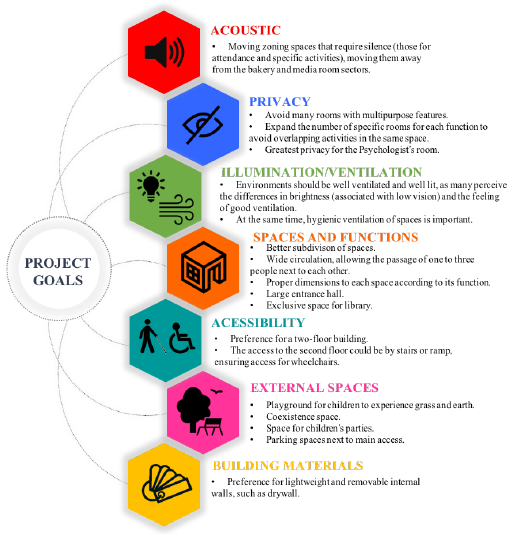
Figure 1
: Feedback of associates in the focus group.
The primary outcome of the main focus group associates’ requirements (Figure 2) and what was considered in the designers’ projects was that the next architectural proposal could have larger rooms. According to associate 02, “The spaces are poorly divided”, which could affect the overall quality of the activities provided. Another outcome was the proposal to increase the corridors’ width, which would provide better user locomotion. Issues were also raised regarding the participants’ experience and new functions. In this case, the participants requested rooms for the autonomy, mobility, and coexistence that would facilitate the inclusion of APACE members in society.
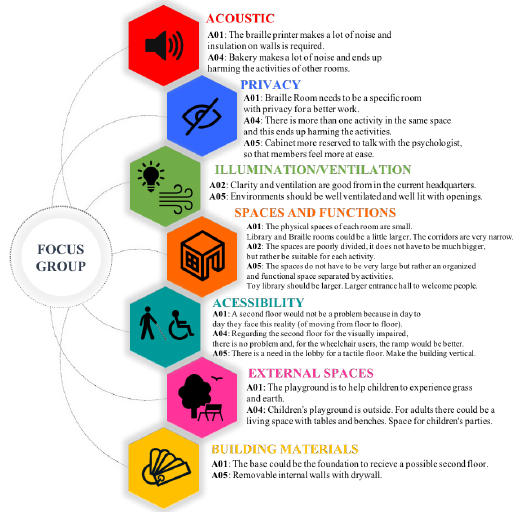
Figure 2
: Summary of the focus group associates’ main requirements for the new APACE Center.
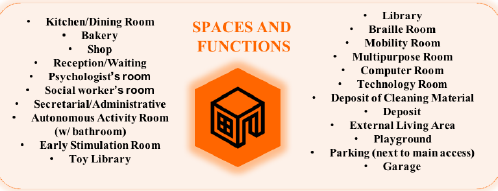
Figure 3
: List of spaces and functions of the new APACE Center
Second step: designer groups 1 and 2 each created a design proposal
In the second step, a proposal for APACE Center was developed by each designer group (design 1 and design 2, as shown in Figure 4). The plot is provided by the Passo Fundo City hall and is 1,032.80 m2.
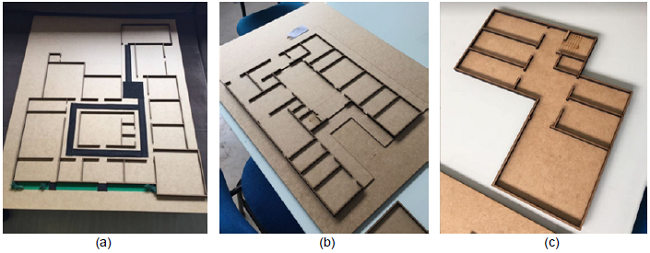
Figure 4
: (a) Proposal 1; (b) Proposal 2 – first floor; (c) Proposal 2 – second floor.
The proposed ground floor project has a projected area of 728.90 m2, where 18 compartments are distributed around central circulation with zenithal lighting. The members sought to include the suggested environments in the first dynamic, which they highlighted as necessary and currently nonexistent, proposing an environment in which each function is developed in APACE. In addition, the members sought to design the environments with larger dimensions relative to the current APACE Center and to sectorize them according to similar activities. Another significant change for the current location was that an entrance to the store was created, which was independent of the reception, with a direct connection to the food preparation and commercialization area.
The second project has an area of 386 m2 and 18 compartments on the ground floor plus 152 m2 and 6 compartments on the second floor (totaling 538 m2). In this proposal, the group sought to concentrate the environments designed for educational activities on the second floor, providing better acoustic conditions to facilitate student and teacher concentration. Among the differences from the first proposal, the distribution of parking spaces in the front, the potential of circling around the entire building and the presence of an internal courtyard are highlighted. Separate entrances to the store and reception were maintained. The second proposal presents the sectorization of environments in the following categories: educational, social, service and other activities.
Subsequent to developing the projects, tactile models were elaborated in the laser cutter using medium density fiberboard (MDF) plates. A 3 mm plate thickness was used for the terrain and floors, and a 6 mm thickness was used for walls. A 1:50 scale was adopted to allow comparison with the current location’s tactile model. In the proposal 1 plan, ethylene vinyl acetat (EVA) elements were added to represent grass and fabric for the podotactile floor in the circulation area. In the second proposal, the first steps of the ladder were represented, as well as a separate tactile model for the second floor. The tactile models of the two proposals are illustrated in Figure 4.
After the tactile models were prepared and completed, the proposals were presented to APACE members (third step) to validate the elaborated projects. The objective was to retrieve the observations and the suggestions regarding the various spatial aspects of each project based on feedback from the focus group.
Third step - collaborative design
The third step occurred in June 2016 and began with designers demonstrating the existing APACE Center tactile model created in 2015 (Mussi et al., 2016) to APACE members to familiarize them with the tactile model configuration. This step was performed to facilitate understanding of the new projects, enabling form remembrance and thus establishing a comparison parameter for the ensuing activities. Then, the two developed projects were presented to the associates based on their suggestions and needs, as explained in the focus group. The two tactile models were then arranged on tables to assess the perception of factors such as distribution, size, and quantity of environments.
First, the new APACE Center project tactile model was presented with only one floor that had internal circulation with zenithal illumination, a podotactile floor, and different textures, as shown in Figure 5. A profound understanding of the project was attained for both those with low vision and total visual impairment, including issues regarding the means by which the circulation was illuminated and the central environment with no external communication; the latter was the autonomous activity room.
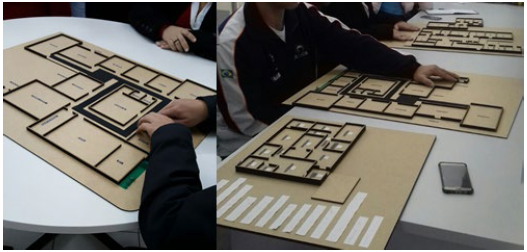
Figure 5
: Two APACE members analyze the tactile model design 1.
The linearity of the access through the entrance hall to the internal corridor was indicated as positive. In addition, it was noted that, although the project’s circulation leads to several environments, “this does not make it a labyrinth”; this may even aid in student directionality training in the internal environments. The central room in the first proposal was intended to host daily living activities. This room has its own bathroom, which pleased the members due to the ability to attend to daily hygiene activities near the central room with no need to exit to other areas.
The participants were satisfied with the compartment distribution, and the independent store and reception entrances were highly praised; however, the size of each environment was questioned. Size information was not included in the tactile models; that should be added in future experiments. In addition, different opinions regarding the size of the environments were presented. The one-story floor plan did not feature a multipurpose room or early stimulation rooms for infants, and both projects no longer included a social welfare room or an exclusive room for psychology activities; these factors were perceived and questioned.
The second project was then presented, as shown in Figure 6. Having car parking and a walkway around the building was highly praised. Previously, purchased goods could only be received by the external exit near the kitchen; however, this element increased exterior access. Furthermore, the participants noted that the autonomous activity room would need a bathroom, as only one had been included in the first-floor design. A certain difficulty in the ladder location was noticed; this is juspngied by the stairs not being fully represented, which is another factor that must be modified in future design experiences. The presence of a second floor was very well understood, as well as its shape (the participants commented that it was nearly in an L-shape), from which they could imagine the building volumetry.
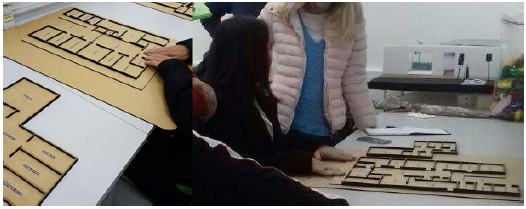
Figure 6
: Presentation of Design 2.
When comparing both projects, participants highlighted that the kitchen and dining areas were together in the first project; however, in the second, they were separated. When asked about preference, the participants reported that the more separate the activities were, the better. In the kitchen, due to the bakery machinery, it would be best to maintain a designated space.
The participants praised the arrangement of the rooms on the upper floor in the second project, noting that by organizing all activities related to education and technology in a separate environment, due to less noise and more tranquility, study and learning activities can be provided.
Certain ideas that were not presented in the focus group appeared in this step due to the presence of a new APACE associate who commented on possibly including a living room where one could play the guitar and even have music classes. However, this room should be far from the other areas, due to the noise issue. In addition, other ideas from the focus group have now been questioned, such as the need for an elderly room, which is included in the second project but is now assumed to be unnecessary.
To incorporate the suggestions and needs that were raised at the focus group stage, the second dynamics were contributed by detailing tactile plans and their presentation for APACE member evaluation. Overall, the results were positive and enabled users to be included in the new headquarters design process, aggregating information from their perspectives of the environment in which they will perform their daily activities.
Highlights of each of the tactile models were determined from the interviewees’ opinions of the two projects. In the first project, the opinions were on the circular corridor and the layouts of environments, while in the second project, the opinions were on car parking, possibilities for walking around external areas and separation of the two floors. Therefore, the idea was to merge the best features of each project to generate a new project better that was suited to the noted preferences. This merging was completed in the fourth step, and a new dynamic for presenting the new project to APACE members was created (fifth step).
Fourth step: collaborative design - designer groups 1 and 2 combined creation
In the fourth step, a third architectural project proposal for the APACE Center was jointly developed by the two designer groups. The solution was to combine the two initial proposals, with the most important environments from both proposals highlighted by APACE members, resulting in a final project (Figure 7).

Figure 7
: Final proposal.
Analyzing the two initial proposals, the relevant items that featured more prominently observed for the group were as follows: wide corridors and natural lighting through a zenithal window, a separate reception and shop, separate doors, access to the street, more rooms, frontal car parking, a patio, a mobility room with a bathroom, outdoor circulation, stairs, and an elevator. Therefore, these items were incorporated into the third proposal.
After the final proposal was developed, the tactile model was elaborated in layers in the laser cutter using MDF plates at the 1:50 scale. In this stage, a base layer was created with markings of the lot, parking, access, and street boundaries. Two layers were created for the walls, one with door openings and others with door and window openings. A better tactile compression emerged, as it allowed the user to sense the direction of the staircase. Furthermore, a separate tactile floor plan was presented for the upper floor with the same settings as the ground floor, as shown in Figure 8.
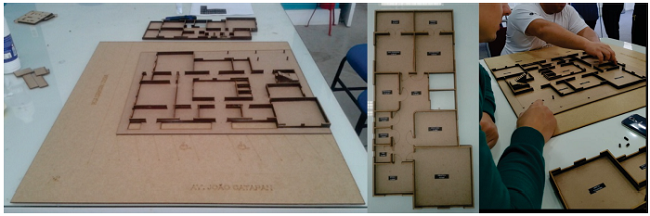
Figure 8
: Final proposal (first and second floor) and an APACE associate exploring the tactile model.
Fifth step - collaborative design: final proposal
The fifth step was a dynamic activity with the APACE members in June 2017: presentation of the final proposal (Figure 8).
The dynamics began with the students again showing the tactile models that refer to the current APACE headquarters, previously elaborated by Mussi et al. (2016), to the members to familiarize them with the tactile plan configuration. Then, the members, who arrived in a group of five, presented the third project, which resulted from studying the two prior projects. The two prior tactile models were then arranged for evaluation on tables for one of the members who could not attend the second dynamic. After the member completed the evaluation, the third proposal was presented to the whole group for a new evaluation.
The group’s familiarity with the environments and the project, as well as a certain satisfaction, was perceived. The group raised questions regarding the use of a social worker’s and a psychologist’s rooms to better position them in the building; however, the rest of the project was highly praised and approved by all.
FINAL CONSIDERATIONS
The tactile models enabled the reproduction of environments and the perception of spaces by the users. By the applied dynamics, the APACE members participated in the whole project process, from reporting their needs to evaluating positive and negative aspects of the projects.
All participants were able to understand the dimensions and orientations of the spaces and were able to compare the proposed environments with the current venue; this was very positive for the experience.
For the designers, the associates’ participation in the steps awakened them to the importance of these users in the design process and to the challenge of promoting changes in the graphic representation of projects for more inclusive architecture. This awareness occurred because the daily reports and demands that needed to be met for blind or visually impaired people were fundamental to this entire process.
The inclusive design experience (Figure 9) involved methods such as focus groups and digital fabrication in a collaborative environment between designers and users. The benefits for the involved parties derived from this experience are highlighted in Figure 9.

Figure 9
: Inclusive design experience: method and benefits for users and designers.
The next steps of this research will focus on adjustments in design and will explore different furniture, coatings, and finishes. Therefore, to test the representation using furniture, a new retrofit project of the existing hall has begun and will be completed with a 3D printer. After this final experience, the APACE Center’s final proposal will be presented.
ACKNOWLEDGMENTS
The authors of this paper want to thank the Postgraduate Program in Architecture and Urbanism (PPGARQ) of the Polytechnic School at Faculdade Meridional (IMED) and Fundação Meridional (IMED – Meridional Foundation) for the financial assistance through scholarships that enabled this research; Associação Passofundense dos Cegos (APACE) for the opportunity; and students at Course Inclusive Design at IMED for the collaboration in the design development. We extend our thanks to the research group Núcleo de Inovação e Tecnologia em Arquitetura e Urbanismo (NITAU-IMED).
REFERENCES
BIANCHIN, M.; HEYLIGHEN, A. 2017. Just design. Design Studies, 54: 1-22. https://doi.org/10.1016/j.destud.2017.10.001
ESPINOSA, M.; UNGAR, S., OCHAÍTA, E; BLADES, M. 1998. Comparing methods for introducing blind and visually impaired people to unifamiliar urban environments. Journal of Environmental Psychology, 18: 277-287. https://doi.org/10.1006/jevp.1998.0097
FARIA, A. T.; ELALI, G. A. 2012. Promovendo a inclusão: uma experiência de participação de pessoa com deficiência visual no desenvolvimento de um projeto arquitetônico. Ação Ergonômica: Revista da Associação Brasileira de Ergonomia, 7(2): 61-75.
HEYLIGHEN, A.; HERSSENS J. 2014. Designerly ways of not knowing: What designers can learn about space from people who are blind. Journal of Urban Design,19(3): 317-332. https://doi.org/10.1080/13574809.2014.890042
HUANG, C., YU, S. 2013. A Study of Environmental Perception Patterns of the Visually Impaired and Environmental Design. Indoor and Built Environment, 22(5): 743-749. https://doi.org/10.1177/1420326X12456317
IBGE - Instituto Brasileiro de Geografia e Estatística. 2010. Censo Demográfico 2010 - Características gerais da população, religião e pessoas com deficiência. Disponível em: http://www.ibge.gov.br/home/presidencia/noticias/noticia_impressao.php?id_noticia=2170Deficientes. Acesso em: 02/04/2017.
MARTIN, B.; HANINGTON, B.M. 2012. Universal methods of design: 100 ways to research complex problems, develop innovative ideas, and design effective solutions. 10 ed., Beverly, Rockport, 207p.
MUSSI, A.Q.; ROMANINI, A.; LANTELME, E.; MARTINS, M.S. 2016. Arquitetura inclusiva: a planta tátil como instrumento de projeto colaborativo com portadores de deficiência visual. In: Congreso de la Sociedad Iberoamericana de Gráfica Digital, 20, Buenos Aires, 2016. Anais... Buenos Aires, SiGraDI, 2016, 3: 387-393. https://doi.org/10.5151/despro-sigradi2016-714
SANOFF, H. 2007. Special issue on participatory design. Design Studies,28(3): 213-215. https://doi.org/10.1016/j.destud.2007.02.001
WHO – World Health Organization. 2017. Blindness and visual impairment. Disponível em: http://www.who.int/news-room/fact-sheets/detail/blindness-and-visual-impairment. Acesso em: 04/04/2018.