Human Development
Scoping Review on Theory of Mind and Bullying: A Critical Update
Revisão de escopo sobre teoria da mente e bullying: uma atualização crítica
Revisión del alcance sobre teoría de la mente y bullying: una actualización crítica
 Beatriz L. Costa
Cleonice A. Bosa
Beatriz L. Costa
Cleonice A. Bosa
Scoping Review on Theory of Mind and Bullying: A Critical Update
Psicologia: Teoria e Prática, vol. 25, no. 1, ePTPHD14258, 2023
Universidade Presbiteriana Mackenzie
Received: 12 January 2021
Accepted: 07 October 2021
Abstract: The present study aimed to conduct a scoping review on researches that investigated the relationship between Theory of Mind (ToM) and school bullying found in seven databases in the areas of health/ psychology (PubMed, PsycInfo, and Lilacs), education (Eric), and interdisciplinary (SciELO, Web of Science, and Scopus). Of the 270 results initially identified, 14 were eligible for review and were analyzed regarding their main results, the measures in ToM used, and variables related to the classification of bullying. It was found that most studies reported a direct (relationships that tend to be statistically significant) and/or indirect (mediated by other variables) relationship between the roles of the students involved and types of bullying and the performance in tasks of ToM. However, a critical discussion regarding the assessment measures in ToM was carried out, pointing to the need for clarification in the type of assessment and updating of tasks.
Keywords: Scoping review, Theory of Mind, school bullying, socio-cognitive development, peer relationship.
Resumo: O presente estudo teve por objetivo realizar uma revisão de escopo sobre pesquisas que investigam a relação entre a Teoria da Mente (ToM) e o bullying escolar em sete bases de dados nas áreas da saúde/psicologia (PubMed, PsycInfo e Lilacs), da educação (Eric) e interdisciplinares (SciELO, Web of Science e Scopus). Dos 270 arquivos identificados inicialmente, 14 foram elegíveis para a revisão e analisados a respeito dos seus principais resultados, das medidas em ToM utilizadas e das variáveis relacionadas à classificação de bullying. Verificou-se que a maioria dos estudos reportou uma relação direta (relações que tendem a ser estatisticamente significativas) e/ou indireta (mediada por outras variáveis) entre papéis dos envolvidos e tipos de bullying e o desempenho em tarefas de ToM. Contudo, uma discussão crítica em relação às medidas de avaliação em ToM foi realizada e apontou a necessidade de esclarecimento no tipo de avaliação e de atualização das tarefas.
Palavras-chave: Revisão de escopo, Teoria da Mente, bullying escolar, desenvolvimento sociocognitivo, relação entre pares.
Resumen: El presente estudio tuvo como objetivo llevar a cabo una revisión del alcance de estudios que investigan la relación entre Teoría de la Mente (ToM) y el bullying en siete bases de datos de las áreas de salud/psicología (PubMed, PsycInfo y Lilacs), educación (Eric) e interdisciplinares (SciELO, Web of Science y Scopus). De los 270 estudios identificados inicialmente, 14 fueron revisados y analizados con respecto a sus principales resultados, a las medidas utilizadas en ToM y a las variables relacionadas con la clasificación del bullying. Se encontró que la mayoría de los estudios reportaron una relación directa (relaciones que tienden a ser estadísticamente significativas) y/o indirecta (mediada por otras variables) entre los roles de los involucrados y los tipos de bullying y el desempeño en las tareas de ToM. Sin embargo, se realizó un d ebate crítico sobre las medidas de evaluación en ToM, señalando la necesidad de aclaración en el tipo de evaluación y actualización de las tareas.
Palabras clave: Revisión del alcance, Teoría de la Mente, bullying escolar, desarrollo sociocognitivo, relación entre pares.
School bullying is a phenomenon investigated worldwide because it is a very common experience among children and adolescents in many countries. According to international estimates, around 83 countries revealed that 30.5% of students between 12 and 17 years old were victims of bullying once or twice in the last month before the study (Biswas et al., 2020). Bullying is characterized by harmful, systematic, and intentional behavior in a context of imbalanced power among those involved (Olweus, 1993; Smith, 2014). Hence, there is a perception that one (or more) student (authors, aggressors, or bullies) has the power and one student is victimized (victim or target). This dynamic leads to a complex process of repeated violence, humiliation, manipulation, etc., with the potential to result in physical and psychological consequences throughout one’s development, such as depressive and anxiety disorders and suicidal behavior (Arseneault, 2017).
In general, school bullying differs from other harmful behavior because of its peculiarities and complexity: 1. it is a group phenomenon in which students play different roles (i.e., leader bully, assistant bully, bully-victim, target, upstander, reinforcer/bystander, and uninvolved), 2. types of aggressions (direct, indirect, or relational), 3. significant psychological and social impact on those involved, and 4. its complex and dynamic nature in social interaction contexts (Salmivalli, 2010; Sutton et al. 1999a).
Some authors note that even though the number of studies focusing on this phenomenon has increased in recent years (Smith et al., 2018), there are still controversies regarding its definition and assessment (Olweus, 2013; Volk et al., 2017). The reason is that, historically, investigations on bullying are conceptually based on empirical data, atheoretical studies, or studies predominantly based on theories of aggression (Volk et al., 2017).
Among the predominant theories, the most frequently used was the model of social information processing by Crick and Dodge (1994), considering that bullying is a subtype of aggression, though with peculiar dynamics and individual, academic, and social impact. According to the model, children with behavioral problems (e.g., aggressive, isolated, etc.) would have a deficit in one or more stages of social information processing (i.e., perception, interpretation, or response), which would lead them to maintain maladaptive behaviors (Crick & Dodge, 1994).
However, Sutton et al. (1999a) conducted a classic theoretical study questioning the use of theoretical models that use social skills/competencies deficits to explain bullying. They consider that these models disregard the possibility of some children in this context, especially the leaders, to have socio-cognitive skills, using these skills to manipulate their victims and become popular among the individuals involved, in a certain way, skills that are adaptive to the individual in terms of social relationships (Smith, 2017; Sutton et al., 1999a, 1999b). Therefore, the authors defend the hypothesis that the inappropriate use of social skills does not necessarily mean a lack of social competence.
Seeking to support their reasoning, Sutton et al. (1999b) administered some tasks intending to understand the mental and emotional states of 193 children aged between 7 and 10, considering their roles in bullying situations. The results revealed that the roles the individuals play significantly influence the scores obtained in social cognition. Bullies performed better in these tasks than anyone else in the sample – assistants, reinforcers, targets, and bystanders. The study above and others that followed this reasoning (Caravita et al., 2010; Gini, 2006; Shakoor et al., 2012) provided the foundation to question models that defended social skills deficits to investigate bullying.
Based on this critique, Sutton et al. (1999a) proposed using the Theory of Mind (ToM) from a new perspective as a field that can contribute to studies investigating bullying. ToM can be defined as a concept, a set of skills, and a field of research. In conceptual terms, it is characterized as the individuals’ ability to ascribe mental states to themselves (e.g., perception, desires, intentions) and others to explain and predict behaviors (Premack & Woodruff, 1978). When addressing the ToM as a set of skills, we consider that it refers to a set of internal and external experiences, which, under the influence of maturation and developmental experiences, enable one to recognize their and others’ intentions, thoughts, desires, and beliefs (Apperly, 2012).
Therefore, ToM is a theoretical model intended to explain the development of interpersonal relationships, more specifically a child’s ability to understand others as mental and intentional beings, different from themselves. Studies addressing bullying and aggression report that in addition to bullies using ToM to manipulate and control targets, which was initially the focus of studies (Sutton et al., 1999a), a child with limited understanding of others’ intentions and emotions may be at risk of becoming a target (Shakoor et al., 2012). Another aspect reported by Shakoor et al. (2012) refers to the importance of ToM for negotiating conflicts and standing up for oneself – a lack of such skills renders individuals more vulnerable.
In a scoping review, Smith (2017) found nine studies analyzing the relationship between ToM and bullying. The studies describe participants, bullying and ToM measures used, and the main results. In general, the results revealed no consensus. Five out of the nine studies reported a positive association between the two variables among bullies, and four out of the seven studies assessing this aspect among the victims identified negative associations between bullying and ToM measures.
Smith (2017) concluded that there is a tendency for a positive association between the roles of leader and upstander with ToM measures (these individuals tend to perform better in socio-cognitive tasks), while an inverse association was found for the victim role, as victims scored lower in ToM assessments (Smith, 2017). Additionally, Smith (2017) presented some factors that contribute to variations among the results, such as: 1. the role an individual plays, especially when the study discriminates between bullies (leaders, assistants, or reinforcers); 2. the type of aggression assessed, whether physical, verbal, relational, direct or indirect, proactive or reactive; 3. age; 4. the participants’ gender; and 5. ToM tasks, though this last item was little explored by the author.
Due to its longitudinal design, one of the most robust studies in the field reports significant results concerning this relationship. Shakoor et al. (2012) investigated the relationship between deficits in traditional ToM tasks during childhood and involvement in bullying during adolescence. The study comprised 2,232 children, parents, and teachers addressed in an extensive study on twins at four points in time: at ages 5, 7, 10, and 12 years. ToM skills were measured at the age of five using four standard first-order false belief tasks (unexpected content and place) and four ToM advanced tasks (to identify desires and beliefs). Measures were also applied to assess cognitive, emotional, and behavioral problems and bullying involvement. The findings indicated that deficits in ToM tasks at the age of five predicted a tendency of individuals to become victims or bullyvictims in preadolescence. This result remained even when the researchers controlled variables such as intelligence quotient (IQ) and family issues (intrafamily violence).
However, the potential relationship between ToM and bullying requires deeper theoretical-methodological consideration. Some researchers present various limitations that need to be considered when investigating the ToM construct in bullying studies, such as the use of a single measure to assess ToM, the selection of tasks for each development stage (Renouf et al., 2010) that favor the use of language, the contextual aspects inherent to the stories selected, and emotional, cognitive, and moral dimensions that may be present in the content of tasks (Sutton, 1999a). Additionally, the studies need to advance in the choices and definitions of ToM tasks that they use because, from a socio-cognitive perspective, a false-belief task does not necessarily measure intention (Beaudoin et al., 2020), precisely one of the skills most frequently related to bullying.
There are many ways to measure ToM skills from a methodological perspective. The most traditional methods are first- and second-order false belief tasks. The objective of these tasks is to verify whether children understand other people’s different mental states while observing an experimental situation. Besides, advanced ToM tasks assess skills in contextualized tasks, such as faux pax (social gaffes), lies, irony, double meaning, among others. The classic ToM tasks were initially developed to assess a specific age; however, numerous tasks with more specific subdomains adapted to different development stages are currently available (Apperly, 2012; Beaudoin et al., 2020).
There is extensive debate in the field of ToM about the wide variability of measures to assess this construct, especially regarding the dimensions or domains these measures propose to investigate (Apperly, 2012; Warnell & Redcay, 2019). The reason is that some theoretical perspectives defend that, in addition to the skills’ different levels of complexity throughout development, the studies addressing this construct report that this ability comprises various dimensions (e.g., perspective-taking, understanding emotions, gaze following). Hence, considering the multiplicity of measures, researchers question whether these tasks, in fact, capture a single construct (Apperly, 2012; Beaudoin et al., 2020).
Apperly (2012) criticizes studies that relate classic false-belief tasks as an age-appropriate measure to investigate competence or social motivation. According to the author’s analysis, studies investigating this construct are divided into three quite distinct approaches: 1. studies in which the interpretation of results is based on the ToM conceptual nature; 2. studies that consider the ToM to comprise a complex set of cognitive processes, such as executive process control, perspective-taking, etc.; and 3. studies that adopt ToM measures as a parameter to assess individual differences in social skills/competencies. Apperly (2012) considers these approaches complementary and fundamental for the field; however, one must be clear about the studies’ objectives and interpretations extracted from the measures adopted.
Therefore, even though Apperly (2012) agrees that ToM is an essential cognitive process for social skills, he argues that these tasks themselves do not capture a continuum of social competencies that varies among individuals, not in the way it is conceived in some studies. He considers that traditional tasks only tell whether a child has or does not have a belief concept, in a given development period, rather than how the child formulates this concept. To investigate individual differences, the author stresses that this type of assessment requires clarity about what the ToM task proposes to measure, the aspect ToM is intended to measure, and why.
To investigate whether there would be a theoretical-methodological coherence justifying the existence of a single or multidimensional ToM, Warnell and Redcay (2019) administered a series of ToM tasks widely used to measure different components adjusted to three different age groups (i.e., preschoolers, school-aged children, and adults). They ranged from the classic first-and second-order false belief tasks to more advanced tasks of understanding mental states and bluff and identification of visual and emotional content. Additionally, cognitive and language assessment measures were used with the child sample. The statistical analysis did not reveal a clear ToM structure between tasks or different development states, even after controlling for potentially confounding variables (e.g., age and verbal ability). Nevertheless, the authors consider that the results are consistent with theoretical propositions arguing that ToM would be an intersection of sets of cognitive and social skills. These suggest a perspective according to which studies investigate the individual base-level components of ToM assessments in detail, as proposed by Apperly (2012).
Based on a recent extensive systematic review, Beaudoin et al. (2020) proposed an inventory of the main ToM measures developed and used with children, characterizing them according to a visual structure named abilities in Theory of Mind Space (ATOMS). This resource enabled a visual mapping that provided a taxonomy of domains and subdomains assessed by the measures that composed the inventory. There were 830 studies and 220 different measures and/ or paradigms. The study generated seven categories of mental states (emotions, desires, intentions, perceptions, knowledge, beliefs, and mentalistic understanding of non-literal communication) and a category named comprehensive measures, which include instruments that assess various mental states and different contexts in a single measure.
Hence, according to recent debates regarding ToM studies (Apperly, 2012; Beaudoin et al., 2020), to understand how the results obtained with ToM tasks are related to bullying, one has to delimit to which ToM, components, and skills studies are referring. Therefore, there is a need to verify how these studies investigate the relationship between the ToM and bullying, how they present the results, and whether the construct has one dimension or multiple domains.
Therefore, this review’s objective is to analyze studies addressing the relationship between bullying and the ToM construct, considering: 1. main findings (general overview); 2. ToM measures (which domains and subdomains are investigated according to the classification proposed by Beaudoin et al., 2020); and 3. bullying-related variables (the participants’ roles and types of aggression).
Method
In this study, the guidelines proposed by Tricco et al. (2018) for scoping reviews were adopted. A scoping review is a method intended to synthesize knowledge whose main characteristic is to answer questions concerning the mapping of evidence regarding a given subject and also explore main concepts, extension, nature, and existing gaps in knowledge (Barbosa & Tricco, 2019; Tricco et al., 2018). Although this review was not registered in specialized databases, we used the Preferred Reporting Items for Systematic Reviews and Meta-Analyses extension for Scoping Reviews (PRISMA-ScR) to systematize its presentation (Tricco et al., 2018).
Inclusion criteria of the material in the review
Table 1 synthesizes inclusion and exclusion criteria established for each step of the selection of papers. Seven high-impact electronic databases in the fields of health and psychology (PubMed, PsycInfo, and Literatura Latino-Americana e do Caribe em Ciências da Saúde [Lilacs]) and education (Education Resources Information Center [Eric]) and interdisciplinary databases (Scientific Electronic Library Online [SciELO], Web of Science, and Scopus) were searched to obtain the largest number of papers addressing the topic. The search terms were organized into three categories: school bullying (bullying, peer aggression, perpetration, and victimization), ToM (Theory of Mind, false belief, and mindreading), and methodological terms (measurement and instrument).

The terms were initially established based on a literature review conducted before the review project and then assessed according to the Medical Subject Headings (MeSH), thesaurus from PubMed. The Boolean operator AND was used in addition to quotes for compound terms and other search guidelines established by each database.
Three researchers (two doctoral students and an undergraduate student from the psychology field) conducted a pilot search in one of the databases to verify how appropriate the terms were. This process revealed that no search results were obtained when the terms concerning methodological aspects (measurement and instrument) intersected with the remaining ones, hence, these terms were removed. Therefore, the search terms used in the databases were those concerning school bullying and the ToM.
Documentary data collection procedure
To register and organize stage 1, the Mendeley® reference management program was used with the aim of systematizing and ensuring that the studies’ general information was thoroughly and uniformly shared among the researchers.
NVivo® was used for the papers suitable for the descriptive analysis (stage 2 – full texts) to record the dates on which the papers were read and selected, analysis of assessment categories, as well as other systematization analysis features that the system has available (e.g., creating spreadsheets according to categories). Complementarily, the selected studies’ references were screened to identify the titles of relevant papers that had not been retrieved in the first search.
Analysis procedures
The descriptive analysis consisted of recording the studies’ general information in addition to when and who performed the analysis (one of the co-authors) to ensure all the authors were in tune with each of the study’s stages. All the full texts of the eligible preselected original files were characterized in terms of theoretical aspects, objectives, hypotheses, design, methodological data, and description of results. The third author mediated disagreements between the authors during the selection and analysis of the papers, as she is the author with more expertise in the field.
The synthesis of the studies included in the review was structured based on four themes of analysis. Therefore, the presentation of the results includes 1. a brief description of the papers included in the sample, 2. a general overview of the main results, 3. an analysis concerning ToM measures, and, finally, 4. a more specific analysis of bullying-related variables.
Results
Figure 1 presents the flowchart of the selection of studies for the qualitative analysis. A total of 268 papers were initially identified in the databases. This first search phase was conducted from August to October 2019. During the screening and eligibility process, new searches were performed every month to identify new studies, using filters set by date or recent, depending on the database. Based on these new searches, another two studies were included, reaching a total of 270 documents retrieved. Of these, 134 papers appeared more than once (due to the terms used) or in more than one database and were disregarded. In the first stage (based on a careful reading of titles and abstracts), other 104 studies were excluded for being unrelated to the review’s objective, such as studies addressing bullying and identity development, social vulnerability, and other socio-cognitive constructs; thus, 32 studies remained for full-text reading.
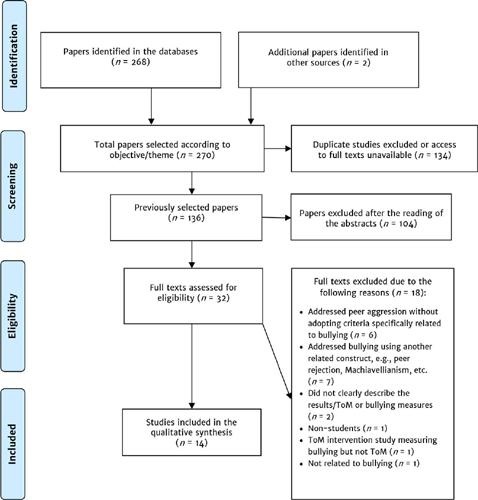
Figure 1
Flowchart of the Studies Selection – Based on PRISMA
Fourteen of these papers met the eligibility criteria. The remaining (n = 18) were excluded because 1. addressed peer aggression without reporting bullying-specific criteria (n = 6); 2. addressed the bullying context adopting other related constructs, e.g., peer rejection, Machiavellianism, etc. (n = 7); 3. did not clearly describe the results and ToM or bullying measures (n = 2); 4. the sample consisted of adult participants (college students; n = 1); 5. were intervention studies using ToM to decrease bullying behavior, though it did not include a pretest/posttest or assessed the relationship between variables (n = 1); and, finally, 6. were unrelated to bullying (n = 1).
Table 2 presents a summary of the 14 studies addressing bullying and ToM. The first study, dated to 1999, was conducted in the United Kingdom, and the last one was published in 2020. The majority of the studies were written by authors and institutions located in Europe. Therefore, most studies are from the United Kingdom (n = 5), followed by the Netherlands (n = 2), Italy (n = 2), and Denmark and Switzerland (n = 1). The remaining are from North American countries (n = 2; USA and Canada), and one is from Australia.
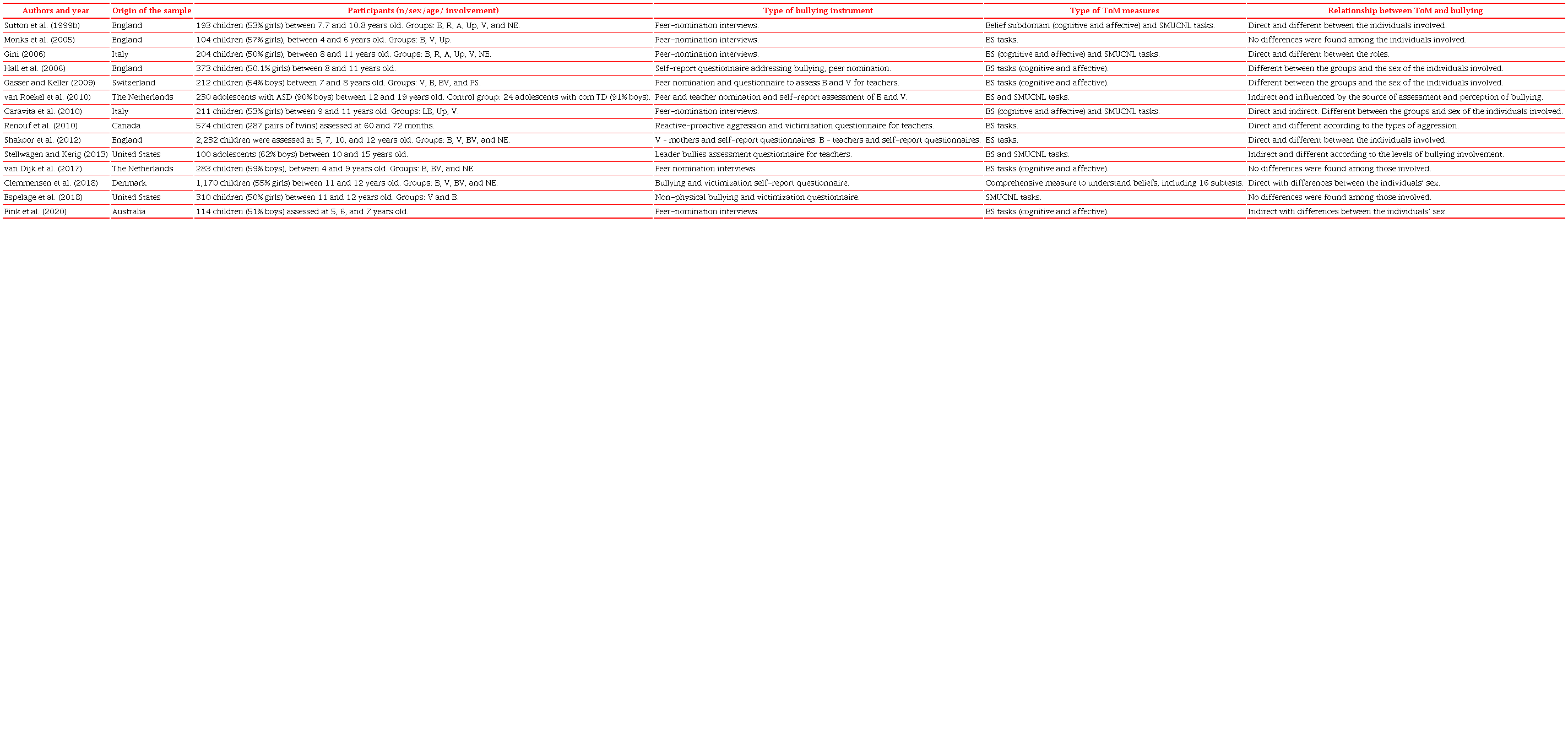
Note. TD: typical development; ASD: autistic spectrum disorder; ToM: Theory of Mind; BS: beliefs subdomain; SMUNLC: subdomain of mentalistic understanding of non-literal communication. Groups of individuals involved: bully (B), leader bullies (LB), reinforcer (R), assistant (A), upstander (Up), victim (V), bully-victim (BV), not involved (NE), prosocial (PS).
The participants were preschoolers and primary, middle, and high school students attending regular schools, except for two studies in which the samples involved adolescents attending a school for individuals with autistic spectrum disorder (ASD) and a school for patients of a psychiatric care center. Ages ranged from 4 to 19 years old, though the studies primarily investigated children aged between 7 and 11, i.e., children attending elementary school. Boys and girls were virtually equally represented.
In terms of instruments, most studies used peer-nomination measures to classify the subtypes of individuals involved and not involved with bullying (n = 8). This technique consists of asking the participants to name their classmates regarding aggressive behavior and victimization, and some instruments included prosocial behavior (Smith, 2014). Based on the students’ nominations, the researchers estimated the means and standard deviations of the individuals most frequently mentioned in the classifications and subclassifications as bullies, victims, or bystanders.
The instrument widely used in this peer-nomination technique is the Participant Role Scale (PRS) (Salmivalli et al., 1996) in its original and brief versions and versions adapted to other languages (n = 5). The remaining instruments were questionnaires completed by teachers (n = 4), parents (n = 1), and students themselves (n = 4).
Regarding ToM measures, the studies, in general, adopted ToM instruments, first and second-order tasks, and advanced tasks. The number of tasks in a single study ranged from 2 to 15 stories with different levels of difficulty levels to understand mental states and emotions (e.g., faux pas/social gaffe, irony, false belief, white lie, etc.). The stories most frequently derived from the instrument Strange Stories, by Happé (1994), which was adopted in six studies, followed by the stories proposed by Sutton et al. (1999b) (n = 3) and Hughes et al. (2000) (n = 3). Among the others, three studies developed or adapted tasks to their own research.
The studies’ design and data analysis included quantitative, cross-sectional designs, whereas three were longitudinal studies (Fink et al., 2020; Renouf et al., 2010; Shakoor et al., 2012). The analyses mainly consisted of correlational and inferential studies intra- and intergroups, using variables related to age, gender, bullying roles, types of aggression, and scores obtained in the ToM tasks (both general scores and scores obtained in subtypes: cognitive and emotional).
Ten studies investigated the relationship between ToM and bullying with other variables of various constructs, such as language and IQ (predominantly used as control measures); attachment and executive functions (Monks et al., 2005); empathy (Espelage et al., 2018); moral (Gasser & Keller, 2009; Gini, 2006); externalizing and antisocial behaviors (Fink et al., 2020; Stellwagen & Kerig, 2013); perception, attributions of intentions, and attitudes (van Dijk et al., 2017; van Roekel et al., 2010); academic performance (Clemmensen et al., 2018); social preference and perception of popularity (Caravita et al., 2010). Specifically, because Shakoor et al. (2012) originated from a more extensive longitudinal study addressing twins, they investigated a series of variables such as cognition, language, emotional problems, behaviors, and family factors.
Main findings (general overview)
Regarding the main results, seven studies identified a direct relationship between ToM and bullying, i.e., a statistically significant relationship was found between ToM and bullying, even after controlling for other variables involved in the phenomenon (Caravita et al., 2010; Gasser & Keller, 2009; Gini, 2006; Hall et al., 2006; Renouf et al., 2010; Shakoor et al., 2012; Sutton et al., 1999b). Only four studies in the sample did not report this relationship (ToM versus bullying) in their analyses, not even an indirect influence with other variables (Clemmensen et al., 2018; Espelage et al., 2018; Monks et al., 2005; van Dijk et al., 2017). However, other four studies found an indirect relationship, i.e., a relationship between ToM and bullying mediated by other constructs (Caravita et al., 2010; Fink et al., 2020; Stellwagen & Kerig, 2013; van Roekel et al., 2010).
Caravita et al. (2010) investigated the relationship between ToM, bullying, social preference, popularity, and empathy among Italian students and identified that social preference and empathy moderated the relationship between ToM and bullying only among the boys. Similar results concerning social preference were also observed by Fink et al. (2020). This longitudinal study assessed these variables among children at the beginning of the schooling process and found that low scores obtained in ToM tasks at time one (T1) predicted involvement with bullying after three years, with this interaction being mediated by low social preference.
Stellwagen and Kerig (2013) addressed a sample of children and adolescents undergoing psychiatric treatment for conduct disorders and identified associations of the performance in ToM tasks with bullying when the participants also presented traits of narcissism, which was found to mediate the (ToM versus bullying) relationship. However, the group investigated obtained means (in the bullying measures) well above the mean cutoff score in the instrument used in the study, which, according to the authors, restricts the generalization of the results to other samples.
Another study presenting interesting results for indirect associations was developed by van Roekel et al. (2010). The authors investigated the relationship between ToM and bullying, verifying the influence of this association from the perspective of students with and without ASD when identifying whether peer interaction situations were bullying-related or not. No significant differences were found regarding perceptions of bullying situations between students with and without ASD. However, the studies showed that the adolescents who obtained high scores in ToM tasks and were classified as bullies more frequently misperceived the videos portraying peer interactions. In these cases, they tended to interpret bullying situations to be unrelated to bullying.
In addition to indirect associations, some common factors were investigated. Age and sex were variables that some studies highlighted as influencing the relationship between ToM and bullying (Caravita et al., 2010; Clemmensen et al., 2018; Gasser & Keller, 2009; Hall et al., 2006; Fink et al., 2020). Regarding age, no indirect influence between ToM and bullying is reported by cross-sectional studies among younger children.
Monks et al. (2005) investigated the relationship between ToM and bullying, executive functions and attachment style among 104 children aged from 4 to 6 years, and no differences were found between bullies, victims, and upstanders regarding ToM tasks. Another study assessing 283 4 to 9-year-old students (6.7 years old on average) found no significant differences between skills assessed by ToM tasks among the groups investigated, including children with no bullying involvement (van Dijk et al., 2017).
Fink et al. (2020) conducted a longitudinal study and monitored elementary school children (first three grades), and no direct association was found between ToM and bullying involvement later, except when the sex of those involved was considered. However, the authors found that girls presented a negative association between their performance in ToM tasks and later peer nomination for bullying situations. Additionally, a positive association was found between ToM and the later involvement of boys with bullying, though not statistically significant. Other effects of gender were also mentioned in the results reported by Gasser and Keller (2009), Caravita et al. (2010), and Clemmensen et al. (2018).
Gasser and Keller (2009) verified that girls classified as bullies scored higher in ToM tasks, while Clemmensen et al. (2018) verified a similar association only among girls classified as victim bullies, a result that differed from all the other groups investigated. As previously mentioned, Caravita et al. (2010) found a tendency of ToM to predict upstanders’ behaviors only among boys who scored higher in empathy and social preference.
Variables related to the Theory of Mind measures
According to the taxonomy proposed by Beaudoin et al. (2020), all the studies included in the sample used measures to assess the belief subdomain, which consists in assessing skills concerning the understanding of false belief, location, identity, first- and second-orders, and belief-based actions/emotions. In addition to the belief subdomain, two other subdomains were identified: understanding measures and mentalistic understanding of non-literal communication (Beaudoin et al., 2020).
Even though seven studies administered belief-based emotion tasks (Caravita et al., 2010; Espelage et al., 2018; Fink et al., 2020; Gasser & Keller, 2009; Gini, 2006; Sutton et al., 1999b; van Dijk et al., 2017), only two studies conducted specific analyses to discriminate between scores obtained in cognitive tasks and emotional tasks (Gini, 2006; Sutton et al., 1999b). Gini (2006) identified that the bully role was positively correlated to both tasks (emotional and cognitive), while in the comparison between the groups, the victims performed significantly worse in cognitive ToM tasks. Sutton et al. (1999b) report similar results with the bully, reinforcer, and assistant roles, which were significantly and positively correlated with cognitive tasks, though only the bully role was positively correlated with belief-based emotion tasks.
Regarding the selection of measures, Clemmensen et al. (2018) were the only ones to adopt a complete comprehensive measure to understand beliefs. In this type of measure, a battery of tasks assesses various skills, such as first- and second-order understanding of false beliefs, white lies, irony, among others, administered in order of complexity, resulting in a single score. The authors of the remaining papers decided to select tasks from different authors to compose ToM assessments for their studies. Another aspect is that not all the tasks used in the studies presented psychometric validity.
The subdomain called mentalistic understanding of non-literal communication consists of measures that assess the individuals’ ability to understand mental states in daily contexts and communication; the intention, desire, or belief are not explicit in the characters’ speech (Beaudoin et al., 2020). Six papers used some of the stories that compose Strange Stories, by Happé (1994), including those that assess irony/sarcasm, lies, jokes, gaffes, etc.
As for how tasks were administered, most studies used individual interviews using playful or visual resources based on objects or printed images. Two studies adopted technological resources, such as tablet computers (van Roekel et al., 2010) and computer interactive visual environments to conduct the study (Hall et al., 2006). Only one study collectively administered a questionnaire to assess ToM (Espelage et al., 2018).
Finally, the last aspect concerns variations between the ToM tasks’ scoring/coding systems. The most frequently used scoring system involves a three-point scale, in which zero indicates wrong answers, one indicates correct understanding/answers (control question), and two indicates the individual completely understood the belief or mental state under study.
Variables related to bullying classifications
One of the analyses most intensively analyzed concerns ToM and the role played by those involved with bullying, from the basic bully and victim classification to the most specific, including seven roles: leader, assistant, victim, bully-victim, upstander, and reinforcer/bystander. In a smaller number (n = 3), other studies also compared the means of those involved and not involved with bullying, such as children with prosocial behavior (Clemmensen et al., 2018; Gasser & Keller, 2009; Hall et al., 2006). In addition to these, two studies investigated types of aggression as a form to assess bullying: physical and non-physical bullying (Espelage et al., 2018) and proactive and reactive aggression (Renouf et al., 2010).
Of the 11 studies assessing the relationship between ToM and the role of those involved, three of them indicated correlations of positive valence between the role of bully and performance in socio-cognitive tasks (Sutton et al., 1999b; Gini, 2006; Gasser & Keller, 2009). In contrast with this trend, Shakoor et al. (2012) observed that obtaining low scores in ToM tasks in early childhood predicted bullying behavior in preadolescence. The remaining studies did not find significant differences in the scores obtained in ToM tasks between the group of bullies and the remaining groups involved in the phenomenon.
Regarding victimization, three studies reported an association of negative tendencies related to ToM. The studies by Gini (2006) and Sutton et al. (1999b) reported that victims performed significantly worse than the general score or even than the other roles (e.g., upstanders). Shakoor et al. (2012) reported similar results and verified that a low score in the ToM tasks at the age of five was associated with becoming a victim in the future, regardless of other variables, such as IQ.
Another aspect the authors noted was that the magnitude of the relationship between low scores in ToM tasks and the role of those involved was much higher among bully-victims (Shakoor et al., 2012). However, it should be noted that when assessing this relationship according to the sex, Clemmensen et al. (2018) verified that female bully-victims scored significantly higher in ToM tasks than any of the groups.
Unlike the other studies, Caravita et al. (2010) did not find a direct or indirect relationship between ToM skills and victimization in their sample, nor did Van Dijk et al. (2017) regarding bully, bully-victim, or bystander roles. These authors intended to assess whether the groups tended to have different or shared psychological processes (including ToM) based on a Bayesian analysis of these two hypotheses in the same sample. Data were congruent with the hypothesis that, at least among elementary school children, these groups more frequently tend to share socio-cognitive processes in bullying behaviors, such as ToM, hostility, proactive and reactive aggression, and positive emotions when victimizing.
The upstander role (bystanders that often defend victims) was also highlighted in the studies’ analysis. Three studies reported that upstanders scored in socio-cognitive skills above the general mean compared to the other groups involved (Caravita et al., 2010; Gini, 2006; Monks et al., 2005).
In the same line, Gasser and Keller (2009) indicated that children from the prosocial and bully groups performed better in ToM tasks when compared to the victim group. However, there is no consensus among the studies regarding this aspect, as the pioneer study by Sutton et al. (1999b) does not report a relationship between the upstander role and performance in ToM tasks. The remaining roles, i.e., assistant, reinforcer, and bystander, were seldom investigated. Only Sutton et al. (1999b) found a positive, though weak, association between ToM and the bully, assistant, and reinforcer roles when investigating the six types of people involved.
Some studies also assessed the relationship between bullying and ToM tasks through types of aggression/bullying. For example, Sutton et al. (1999b) analyzed the types of bullying behavior (indirect, physical, and verbal – as reported by the participants’ teachers) and verified a positive tendency only between verbal bullying and the total score obtained in ToM tasks. However, Espelage et al. (2018) did not find a relationship between ToM and non-physical bullying (e.g., teasing, social exclusion, rumors, and name-calling), whether they were bullies or victims. In turn, Renouf et al. (2010) found a positive relationship between performance in ToM tasks and proactive aggression (to obtain or achieve some other goal), as well as peer victimization.
Finally, another relevant piece of information from Renouf et al. (2010) concerns children experiencing high levels of victimization. In these conditions, performance in ToM tasks was significantly associated with high levels of reactive aggression, which consists of aggressive behavior derived from previous provocations (e.g., retaliation). This information corroborates studies reporting significant negative associations between ToM and bully-victims (Shakoor et al., 2012).
Discussion
This review was intended to verify how studies addressing school bullying investigate the relationship between bullying and ToM, analyzing 14 empirical studies. The results were presented through a general overview of the selected sample, its main findings, and how data collected via ToM measures and the relationship between ToM and bullying were explored, considering classifications and subclassifications.
In general, most of the studies identified a direct and/or indirect relationship between ToM and bullying. These results are added to evidence that questions the predominant perspective in the literature and common sense that portrays bullies as socially incompetent individuals (Crick & Dodge, 1994; Sutton et al., 1999a). In this sense, the findings agree to a certain extent with Sutton et al. (1999a), who defend the hypothesis that the socially inappropriate use of social skills does not necessarily mean a lack of social competence, suggesting that the ToM is a promising tool to assess socio-cognitive competencies among students.
Considering the importance of establishing a theoretically and methodologically appropriate research program to address bullying (Smith, 2014; Volk et al., 2017), developing new studies that go beyond the theoretical limitations focused on general aggression is essential. Currently, the scientific community has made an effort to develop theoretical models based on bullying peculiarities, whether from a psychosocial or evolutionary perspective, among others (Volk et al., 2017). In addition, the socio-cognitive perspective has proposed to look at the relationships underlying this dynamic confluence between the social environment and the cognitive aspects that influence the behavior of those involved with bullying.
However, as observed in the studies included in this review, there is no consensus regarding how the relationship between ToM and bullying takes place. For instance, whether there is a relationship or not, when associations are compared by chance, or even the direction of these associations (positive or negative). Regarding this aspect, the authors themselves argue that reasoning deriving from Sutton et al. (1999a) lists a series of potential explanations for these differences in the results, such as sample size, not specifying the different types of bullies, measures that accurately assess the three bullying criteria, ToM measures that present validity data, among others.
Only four studies do not report significant relationships between ToM and bullying in their analyses, nor a direct influence on other variables (Clemmensen et al., 2018; Espelage et al., 2018; Monks et al., 2005; van Dijk et al., 2017). Nonetheless, another four studies found an indirect correlation. Among the studies that did not find a correlation, three emphasized the sample’s age difference (Fink et al., 2020; Monks et al., 2005; van Dijk et al., 2017). It is worth mentioning that there is evidence that preschoolers have little understanding of the bullying concept and tend to see behaviors more generally, either as aggressive or non-aggressive (Monks & Smith, 2006; Smith et al., 2002).
Regarding the individuals involved with bullying and types of bullying, we observed significant differences concerning roles. Three studies found that victims tend to score low in ToM tasks (Gini, 2006; Shakoor et al., 2012; Sutton et al., 1999b), whereas bullies and upstanders score higher in these measures (Gasser & Keller, 2009; Gini, 2006; Renouf et al., 2010; Sutton et al., 1999b). Bully-victims, who tend to present deficits in various aspects (Salmivalli, 2010; Smith, 2014), present contradictory results. Van Dijk et al. (2017) analyzed this group of students and bullies and reinforced the importance of understanding the groups’ shared traits instead of only focusing on their differences. This alternative perspective enables considering the possibility of investigating shared factors in terms of subdomains of socio-cognitive skills.
Even though few studies adopted a longitudinal approach, some contributions were very relevant to understand the differences reported. The idea that being exposed to aggressive situations or even the style of peer interaction has an important influence on the outcome of bullying involvement (Fink et al., 2020; Renouf et al., 2010; Shakoor et al., 2012) suggests there is a need to investigate the remaining skills or aspects concerning the social context that may be involved in the relationship between ToM and bullying.
One of the initial explanations proposed by Sutton et al. (1999a, 1999b) defends the use of ToM tasks as a promising strategy to assess socio-cognitive skills in studies addressing bullying. The authors argue that these tasks are more neutral in terms of social desirability when compared to the various instruments used to understand social skills and behaviors, such as interviews, self-report questionnaires, etc.
However, in addition to the methodological aspect, the skill itself is a neutral construct. As new evidence emerges in the field, we note that the individual variations in ToM instruments are indirectly influenced by other factors, regardless of the behavior purpose (aggressive or prosocial). Doenyas (2017), in a theoretical study, suggests that it is not about showing good or poor skills in ToM tasks, but, instead, whether there is motivation to use these skills in interactions or not.
Regarding other socio-cognitive processes and ToM measures, it is worth noting the relevance of reflecting on the theoretical-methodological aspects of the studies addressed here. As noted in the introduction, Apperly (2012) emphasizes the importance of clearly understanding the ToM aspects one wants to measure and why. Most studies in the sample used traditional ToM false belief tasks, and few studies proposed a more updated methodology or even analyses more consistent with the bullying context. Another aspect concerns a lack of qualitative studies to assess the tasks more comprehensively, such as the types of errors that occurred. Apperly (2012) noted that more comprehensive studies would allow advancement in how the relationship between ToM and bullying occurs.
According to the studies’ objectives, the most recent studies are based on the premise of ToM as a set of socio-cognitive processes that influence the types of involvement in bullying (Fink et al., 2020; van Dijk et al., 2017). However, other aspects may be relevant in a predictive model, such as emotion recognition, empathy, executive functions, social preference, etc. In these cases, measures that assess, for instance, the intention or other nuances of ToM (Beaudoin et al., 2020) could contribute to mapping socio-cognitive skills involved in bullying behavior. In turn, studies seeking to understand ToM in terms of individual differences would benefit from measures assessing a wide range of ToM skills or contexts of social interactions (Beaudoin et al., 2020).
Finally, it is worth noting that this review presents some limitations. Considering the various studies that used the same ToM measures, the field could benefit from a meta-analysis, despite the restricted number of studies. In addition, even though a broad search was conducted, aspects concerning the search terms, languages selected, and other methodological definitions may also be considered limitations.
Additionally, since the objective of this review was restricted to studies assessing bullying, other relevant studies addressing peer aggression within the school environment and its relationship with ToM were not included in the sample. In this sense, future studies are needed to expand the investigation and include other types of school aggression and socio-cognitive aspects that are not limited to ToM. Furthermore, this study contributes to the discussion regarding the relationships between ToM and bullying, contributing to future investigations in Brazil, considering this is the first study addressing the topic in the country.
References
Apperly, I. A. (2012). What is “theory of mind”? Concepts, cognitive processes and individual differences. Quarterly Journal of Experimental Psychology, 65(5), 825–839. https://doi.org/10.1080/17470218.2012.676055
Arseneault, L. (2017). The long-term impact of bullying victimization on mental health. World Psychiatry, 16(1), 27–28. https://doi.org/10.1002/wps.20399
Barbosa, V. C., Filho, & Tricco, A. C. (2019). Scoping review: A relevant methodological approach for knowledge synthesis in Brazil’s health literature. Revista Brasileira de Atividade Física & Saúde, 24, 1–6. https://doi.org/10.12820/rbafs.24e0082
Beaudoin, C., Leblanc, É., Gagner, C., & Beauchamp, M. H. (2020). Systematic review and inventory of theory of mind measures for young children. Frontiers in Psychology, 10, Article 2905. https://doi.org/10.3389/fpsyg.2019.02905
Biswas, T., Scott, J. G., Munir, K., Thomas, H. J., Huda, M. M., Hasan, M. M., de Vries, T. D., Baxter, J., & Ma-mun, A. A. (2020). Global variation in the prevalence of bullying victimization amongst adolescents: Role of peer and parental supports. eClinical Medicine, 20, 100276. https://doi.org/10.1016/j.eclinm.2020.100276
Caravita, S. C. S., Di Blasio, P., & Salmivalli, C. (2010). Early adolescents’ participation in bullying: Is ToM involved? The Journal of Early Adolescence, 30(1), 138–170. https://doi.org/10.1177/0272431609342983
Clemmensen, L., Jepsen, J. R. M., van Os, J., Blijd-Hoogewys, E. M. A., Rimvall, M. K., Olsen, E. M., Rask, C. U., Bartels-Velthuis, A. A., Skovgaard, A. M., & Jeppesen, P. (2018). Are theory of mind and bullying separately associated with later academic performance among preadolescents? British Journal of Educational Psychology, 90(1), 62–76. https://doi.org/10.1111/bjep.12263
Crick, N. R., & Dodge, K. A. (1994). A review and reformulation of social information-processing mechanisms in children’s social adjustment. Psychological Bulletin, 115(1), 74–101. https://doi.org/10.1037/0033-2909.115.1.74
Doenyas, C. (2017). Self versus other-oriented social motivation, not lack of empathic or moral ability, explains behavioral outcomes in children with high theory of mind abilities. Motivation and Emotion, 41, 683–697. https://doi.org/10.1007/s11031-017-9636-4
Espelage, D. L., Hong, J. S., Kim, D. H., & Nan, L. (2018). Empathy, attitude towards bullying, theory-of-mind, and non-physical forms of bully perpetration and victimization among U.S. middle school students. Child & Youth Care Forum, 47, 45–60. https://doi.org/10.1007/s10566-017-9416-z
Fink, E., de Rosnay, M., Patalay, P., & Hunt, C. (2020). Early pathways to bullying: A prospective longitudinal study examining the influences of theory of mind and social preference on bullying behavior during the first 3 years of school. British Journal of Developmental Psychology, 38(3), 458–477. https://doi.org/10.1111/bjdp.12328
Gasser, L., & Keller, M. (2009). Are the competent the morally good? Perspective taking and moral motivation of children involved in bullying. Social Development, 18(4), 798–816. https://doi.org/10.1111/j.1467-9507.2008.00516.x
Gini, G. (2006). Social cognition and moral cognition in bullying: What’s wrong? Aggressive Behavior, 32(6), 528–539. https://doi.org/10.1002/ab.20153
Hall, L., Woods, S., Aylett, R., & Paiva, A. N. A. (2006). Using theory of mind methods to investigate empathic engagement with synthetic characters. International Journal of Humanoid Robotics, 3(3), 351–370. https://doi.org/10.1142/S0219843606000734
Happé, F. G. E. (1994). An advanced test of theory of mind: Understanding of story characters’ thoughts and feelings by able autistic, mentally handicapped, and normal children and adults. Journal of Autism and Developmental Disorders, 24, 129–154. https://doi.org/10.1007/bf02172093
Hughes, C., Adlam, A., Happé, F., Jackson, J., Taylor, A., & Caspi, A. (2000). Good test-retest reliability for standard and advanced false-belief tasks across a wide range of abilities. Journal of Child Psychology and Psychiatry, 41(4), 483–490. https://doi.org/10.1111/1469-7610.00633
Monks, C. P., & Smith, P. K. (2006). Defnitions of bullying: Age differences in understanding of the term, and the role of experience. British Journal of Developmental Psychology, 24(4), 801–821. https://doi.org/10.1348/026151005X82352
Monks, C. P., Smith, P. K., & Swettenham, J. (2005). Psychological correlates of peer victimization in preschool: Social cognitive skills, executive function and attachment profiles. Aggressive Behavior, 31(6), 571–588. https://doi.org/10.1002/ab.20099
Olweus, D. (1993). Bullying at school: What we know and what we can do. Wiley. https://books.google.com.br/books?id=4qNLY13mkDEC
Olweus, D. (2013). School bullying: Development and some important challenges. Annual Review of Clinical Psychology, 9, 751–780. https://doi.org/10.1146/annurev-clinpsy-050212-185516
Premack, D., & Woodruff, G. (1978). Does the chimpanzee have a theory of mind? Behavioral and Brain Sciences, 1(4), 515–526. https://doi.org/10.1017/S0140525X00076512
Renouf, A., Brendgen, M., Séguin, J. R., Vitaro, F., Boivin, M., Dionne, G., Tremblay, R. E., & Pérusse, D. (2010). Interactive links between theory of mind, peer victimization, and reactive and proactive aggression. Journal of Abnormal Child Psychology, 38, 1109–1123. https://doi.org/10.1007%2Fs10802-010-9432-z
Salmivalli, C. (2010). Bullying and the peer group: A review. Aggression and Violent Behavior, 15(2), 112–120. https://doi.org/10.1016/j.avb.2009.08.007
Salmivalli, C., Lagerspetz, K., Björkqvist, K., Österman, K., & Kaukiainen, A. (1996). Bullying as a group process: Participant roles and their relations to social status within the group. Aggressive Behavior, 22(1), 1–15. https://doi.org/10.1002/(SICI)1098-2337(1996)22:1<1::AID-AB1>3.0.CO;2-T
Shakoor, S., Jaffee, S. R., Bowes, L., Ouellet-Morin, I., Andreou, P., Happé, F., Moffitt, T. E., & Arseneault, L. (2012). A prospective longitudinal study of children’s theory of mind and adolescent involvement in bullying. Journal of Child Psychology and Psychiatry, and Allied Disciplines, 53(3), 254–261 https://doi.org/10.1111/j.1469-7610.2011.02488.x
Smith, P. K. (2014). Understanding school bullying: Its nature & prevention strategies. Sage. https://dx.doi.org/10.4135/9781473906853
Smith, P. K. (2017). Bullying and theory of mind: A review. Current Psychiatry Reviews, 13(2), 90–95. https://doi.org/10.2174/1573400513666170502123214
Smith, P. K., Cowie, H., Olafsson, R., & Liefooghe, A. P. D. (2002). Definitions of bullying: A comparison of terms used and age and sex differences in a 14-country international comparison. Child Development, 73(4), 1119–1133. https://doi.org/10.1111/1467-8624.00461
Smith, P. K., Sundaram, S., Sandhu, D., Blaya, C., Schäfer, M., & Spears, B. A. (2018). Introduction. In P. Smith, S. Sundaram, B. Spears, C. Blaya, M. Schäfer, & D. Sandhu (Eds.), Bullying, cyberbullying and student well-being in schools (pp. 3–25). Cambridge University Press. https://doi.org/10.1017/9781316987384.002
Stellwagen, K. K., & Kerig, P. K. (2013). Ringleader bullying: Association with psychopathic narcissism and theory of mind among child psychiatric inpatients. Child Psychiatry & Human Development, 44, 612–620. https://doi.org/10.1007/s10578-012-0355-5
Sutton, J., Smith, P. K., & Swettenham, J. (1999a). Bullying and “theory of mind”: A critique of the “social skills deficit” view of anti-social behaviour. Social Development, 8(1), 117–127. https://psycnet.apa.org/doi/10.1111/1467-9507.00083
Sutton, J., Smith, P. K., & Swettenham, J. (1999b). Social cognition and bullying: Social inadequacy or skilled manipulation? British Journal of Developmental Psychology, 17(3), 435–450. https://psycnet.apa.org/doi/10.1348/026151099165384
Tricco, A. C., Lillie, E., Zarin, W., O’Brien, K. K., Colquhoun, H., Levac, D., Moher, D., Peters, M. D. J., Horsley, T., Weeks, L., Hempel, S., Akl, E. A., Chang, C., McGowan, J., Stewart, L., Hartling, L., Aldcroft, A., Wilson, M. G., Garritty, C., ... Straus, S. E. (2018). PRISMA Extension for Scoping Reviews (PRISMA-ScR): Checklist and explanation. Annals of Internal Medicine, 169(7), 467–473. https://doi.org/10.7326/m18-0850
van Dijk, A., Poorthuis, A. M. G., & Malti, T. (2017). Psychological processes in young bullies versus bully-victims. Aggressive Behavior, 43(5), 430–439. https://doi.org/10.1002/ab.21701
van Roekel, E., Scholte, R. H. J., & Didden, R. (2010). Bullying among adolescents with autism spectrum disorders: Prevalence and perception. Journal of Autism and Developmental Disorders, 40, 63–73. https://doi.org/10.1007%2Fs10803-009-0832-2
Volk, A. A., Veenstra, R., & Espelage, D. L. (2017). So you want to study bullying? Recommendations to enhance the validity, transparency, and compatibility of bullying research. Aggression and Violent Behavior, 36, 34–43. https://doi.org/10.1016/j.avb.2017.07.003
Warnell, K. R., & Redcay, E. (2019). Minimal coherence among varied theory of mind measures in childhood and adulthood. Cognition, 191, 103997. https://doi.org/10.1016/j.cognition.2019.06.009
Notes
Author notes
Correspondence concerning this article should be addressed to Kátia Carvalho Amaral Faro, Rua Ramiro Barcelos, 2600, Sala 210, Porto Alegre, RS, Brazil. CEP 90035-003. Email: katia.c.psi@gmail.com