Psychological Assessment
PSYCHOMETRIC PROPERTIES OF RISK PERCEPTION SCALE ABOUT COVID-19 AND SOCIAL ISOLATION (RPSCI)
ESCALA DE PERCEPÇÃO DE RISCO SOBRE COVID-19/ISOLAMENTO SOCIAL: PROPRIEDADES PSICOMÉTRICAS
ESCALA DE PERCEPCIÓN DE RIESGO SOBRE COVID-19 Y AISLAMIENTO SOCIAL: PROPIEDADES PSICOMÉTRICAS
 Jonatas Reis Bessa
Roberto Beirão
Vivian Siqueira dos Santos
Jonatas Reis Bessa
Roberto Beirão
Vivian Siqueira dos Santos
PSYCHOMETRIC PROPERTIES OF RISK PERCEPTION SCALE ABOUT COVID-19 AND SOCIAL ISOLATION (RPSCI)
Psicologia: Teoria e Prática, vol. 25, no. 3, ePTPPA15352, 2023
Universidade Presbiteriana Mackenzie
Received: 22 April 2022
Accepted: 10 April 2023
Abstract: Risk perception is a concept related to the decision-making process and allows people to perceive the hazards surrounding the context and choose the best preventive methods to avoid them. The COVID-19 pandemic was a remarkable era in which people had to adopt protective methods, such as social isolation, to reduce the possibility of being contaminated by the virus. This study covers the development, psychometric properties, and norms of a scale to assess Risk Perception regarding COVID-19 and Social Isolation. The analysis suggested good expert agreement regarding the adequacy of the scale content and items and factor analysis suggested two factors, called the emotional and cognitive domains. The composite reliability suggested the internal consistency of the scale and its factors. All the results of this study suggest that this scale presents evidence of construct validity, constituting a reliable instrument. This new instrument may be used to evaluate risk perception related to COVID-19 and Social Isolation.
Keywords: Risk perception, social isolation, exploratory factor analysis, reliability, scale.
Resumo: A percepção de risco é um conceito relacionado ao processo de tomada de decisão e permite que as pessoas percebam os perigos em torno do contexto e escolham os melhores métodos de prevenção para evitá-los. A pandemia do COVID-19 é uma era marcante em que as pessoas devem adotar métodos de proteção, como o isolamento social, para reduzir a possibilidade de serem contaminados pelo vírus. Este estudo fornece o desenvolvimento, as propriedades psicométricas e normas de uma escala para avaliar Percepção de Risco sobre COVID-19 e Isolamento Social. A análise sugeriu boa concordância dos especialistas sobre o ajuste de conteúdo e itens da escala, e a análise fatorial sugeriu dois fatores denominados domínios emocionais e cognitivos. A confiabilidade composta sugeriu a consistência interna da escala e seus fatores. Todos os resultados deste estudo sugerem que esta escala apresenta evidências de validade de construto, sendo um instrumento confiável. Este novo instrumento poderá ser utilizado para avaliar a percepção de risco sobre a COVID-19 e o Isolamento Social.
Palavras-chave: Percepção de risco, isolamento social, análise fatorial exploratória, confiabilidade, escala.
Resumen: La percepción del riesgo es un concepto relacionado con el proceso de toma de decisiones y permite a las personas percibir los peligros en el contexto y elegir los mejores métodos de prevención para evitarlos. La pandemia de COVID-19 es una era notable en la que las personas deben adoptar métodos, como el aislamiento social, para reducir la posibilidad de ser contaminados por el virus. Este estudio proporciona el desarrollo, las propiedades psicométricas y las normas de una escala para evaluar Percepción de Riesgo sobre el COVID-19 y el Aislamiento Social. El análisis sugirió un buen acuerdo de expertos sobre el ajuste del contenido y la escala de ítems y el análisis factorial apuntó dos factores denominados dominios emocional y cognitivo. La confiabilidad compuesta sugirió consistencia interna de la escala y sus factores. Todos los resultados de este estudio proponen que esta escala presenta evidencia de validez de constructo y es un instrumento confiable. Este nuevo instrumento podrá ser utilizado para evaluar la percepción de riesgo sobre el COVID-19 y el aislamiento social.
Palabras clave: Percepción del riesgo, aislamiento social, análisis factorial exploratorio, fiabilidad, escala.
Perception is defined as a process that occurs when a perceptual object or idea is developed in the mind and reflects the properties of the external world (Sternberg & Sternberg, 2017). People use the perception processes to interact with the world and execute activities daily. The perception allows a better comprehension of the characteristics of the contexts experienced and their possible risks. Based on the perception of any risk, individuals can produce efficient methods to prevent this and take care of themselves and their community (Qiao et al., 2020).
The perception of risk or the perceived risk is a cognitive psychology concept used in different areas, such as consumer behavior (Zhan et al., 2020); E-commerce (Bertea, 2010), Tourism (Holland, 2020; Zhan et al., 2020), intention or hesitation in the use of vaccines (Karlsson et al., 2021; Gagneux-Brunon et al., 2021; Thaker, 2021), Sports (Travert et al., 2017) and prevention attitudes regarding different diseases such as COVID-19 and the Flu (Detoc et al., 2020; Fischer et al., 2020; Karlsson et al., 2021; Dryhurst et al., 2020). Furthermore, this construct is seen as a fundamental factor in decision-making (Zhan et al., 2020).
Conceptually, perception of risk may be defined as the subjective evaluation of the probability of an individual experiencing an injury, illness, and/or death (Qiao et al., 2020). It also involves an interpretation of the world and the hazards that someone may be exposed to (Cori et al., 2020). Paek and Hove (2017) suggest that this concept is divided into two factors: the first one is a cognitive factor, which is related to the perceived severity and susceptibility regarding the potential danger; and the second factor is an emotional domain, which is associated with the feelings related to the perceived risk. However, there is also a holistic approach to the model integrating cognitive and emotional domain tradition with the social-cultural paradigm and relevant individual differences (Van der Linden, 2015).
Qiao et al. (2021) suggest that place of residence and socioeconomic status (SES) influence the risk perception process and the responses associated with this. The results of the study by Qiao et al. (2021) suggested that people in situations of socioeconomic vulnerability showed lower levels of attention to risk perception factors than people from a wealthier socioeconomic status.
COVID-19 is an infectious and dangerous disease with negative effects on the well-being and health of society, causing an acute respiratory syndrome epidemic (Qiao et al., 2020; Dryhurst et al., 2020). Intending to reduce fatalities and the potential for contamination from the COVID-19 virus, some recommendations such as the use of face masks, hand washing, use of alcohol gel, and social restrictions or isolation were implemented in many countries (Bedford et al., 2020).
Social isolation can be defined as inadequate social relations, in both quantities, with fewer or less frequent social interactions, or quality, when the individual feels like their social relations do not satisfy their requirements, this being an intrinsic value (Zavaleta et al., 2017). Hwang, et al. (2020) highlighted that an acute sense of social isolation and loneliness can be associated with the pandemic context, potentially causing mental and physical health consequences. In this direction, risk perception factors can provide a high frequency and intensity of protective behaviors, leading to a willingness to be vaccinated (Qiao et al., 2020). Therefore, the mapping of the risk perception levels of people regarding the pandemic and the implications of social isolation can help to understand the collective perception of people and promote effective interventions, aiming to reduce the risk to the population.
A theoretical construct such as risk perception needs a well-described concept to provide efficient possibilities for its evaluation. In the literature, there are some studies and instruments directed toward this assessment. Shen et al. (2021), for example, developed a scale of risk perception for public health emergencies in China following the risk perception theory. The scale was named PHERPS and presented three factors (Severe Risk Perception, Unknown Risk Perception, and Dread Risk Perception) in its model (χ2/df = 1.384; RMSEA = .028; CFI = .995; TLI = .995, total Cronbach’s alpha = .793). Shahin and Hussien (2020) used the Standard questionnaire on the risk perception of an infectious disease outbreak, an instrument with seven domains (Participant’s knowledge, Perception of the seriousness of COVID-19, Perception of Susceptibility to COVID-19, Perception of Efficacy and Self-efficacy in Dealing with COVID-19, Intention to perform preventive measures against COVID-19, Motivating/hindering factors affecting the intention to perform preventive measures, Information needs assessment to investigate the risk perception regarding the COVID-19 outbreak in the general population in the Middle East Survey). Lifshitz et al. (2016) developed an eight-item Risk Perception Scale. Its results suggested a bifactor model (later-life risks and terror risks), which presented a total Cronbach’s alpha = .92 and an explained variance of 75.17%. Zhan et al. (2020) developed a scale related to tourism and risk perception, which presented four factors (Health, Financial, Social, and Performance). The scale presented good reliability, with a Cronbach’s alpha of .95.
Even with all the studies and scales developed about the risk perception theme, the literature presents some limitations for this type of evaluation in Brazil, mainly about risk perception related to COVID-19 and social isolation. For example, Brazilians presented high COVID-19 risk perceptions when they were close to health professionals or living with individuals at a high risk for COVID-19 (Giordani et al., 2021). However, the social economic status of some groups of the Brazilian population influenced the risk perception concerning the virus and their contamination avoidance responses (Qiao et al., 2021). The development, validity, and generation of norms of a risk perception scale in Brazil could contribute to the mapping of this theoretical construct in the Brazilian population and would allow the future association of other variables, promoting new models about the pandemic context.
Based on this argument, the present study aimed to develop a risk perception scale, analyze evidence of its validity, and investigate its norms. The COVID-19 and Social Isolation Risk Perception Scale (EPRCIS – Escala de Percepção de Risco sobre Covid-19/Isolamento Social) was developed, with 20 initial items, by the authors of this paper guided by risk perception theory, using the assumptions of cognitive and emotional domains. The items of the scale present situations related to the perception of the possible risks that COVID-19 and social isolation could present in personal and community life and how the respondents would act based on their perceptions. The hypotheses of this study were: 1) The expert analysis would present a good fit in the interrater agreement analysis; 2) The Exploratory Factor Analysis would retain two factors (Emotional and Cognitive Domains); and 3) The internal consistency of the data would suggest adequate reliability about the scale and its factors.
Method
Type of Study
This was an exploratory psychometric study conducted with respondents from all five regions of Brazil and it was divided into three parts intending to provide evidence of the validity based on content, internal structure and reliability of the scale, as well as norms for the instrument.
Participants
The first stage of this study included seven participants who performed the expert analysis related to the content-based evidence of validity of the scale. All the experts had at least a master’s degree and were specialists in cognitive psychology or neuroscience. The inclusion criteria to participate in this study as an expert were: having more than five years of experience in the field of psychological assessment; having at least a specialization (lato sensu) in the field of cognitive psychology or neuroscience in their education and being a professor at a university. All the experts in this study were from Brazil.
The second stage of the study consisted of procedures associated with checking the validity of evidence based on the internal structure. This step included 758 participants from all five regions of Brazil whose ages varied from 18 to 87 years (Mean = 34.09; SD = 13.04). Regarding gender, 72.82% of this sample reported being female and 61.87% of the participants reported complete university education as their education level (Table 1). The inclusion criteria to participate in this study step were being 18 years of age or more; having an internet connection which allows the execution of the Google Forms platform to respond to the scale online; and reading and accepting the study participation consent form. The exclusion criteria implemented in this study were self-report of any psychiatric or neurological difficulties or injuries that could compromise the understanding and the Google Forms response protocol, the denial of the Google Forms application, and being less than 18 years of age.
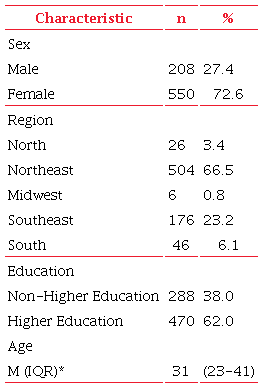
* M = Median; IQR = Interquartile Range
Procedures
For the first part of this study, the Kappa Index and the Content Validity Index were used to analyze the agreement of the experts regarding the face validity and construct that the scale intends to evaluate. Seven experts were invited by e-mail to analyze and respond to a second scale that investigated the instructions, adequacy, and suitability of the contents of the scale. After accepting the invitation, the experts received the COVID-19 risk perception scale and a second scale for its assessment. This first stage of the study took 30 days to be completed.
The second stage of the study was executed after the expert analysis and was composed of five steps: the first was the verification of the factorization of the data collected, using the Kaiser-Meyer-Olkin test and Bartlett’s test (Damasio, 2012); the second was the optimal implementation of parallel analysis to determine the number of factors of the scale (Timmerman & Lorenzo-Seva, 2011); the third procedure was the exploratory factor analysis to determine the model that better fits the scaling proposal (Damasio, 2012); the fourth step was the evaluation of the homogeneity of the scale items through composite reliability (Valentini & Damasio, 2016); and the final step was to provide norms for the scale (Pasquali, 2014).
All the procedures described in this study were executed after the authorization and approval from the Research Ethics Committee of the Federal University of Bahia Psychology Department (CAEE: 33563720.1.0000.5686).
Instruments
The COVID-19 and Social Isolation Risk Perception Scale is an instrument that aims to evaluate the perception of individuals regarding COVID-19 and Social Isolation. The original scale developed contained 20 items with a Likert-type response scale, in which 0 is equivalent to disagree and 4 to agree. The initial aim of the instrument was to evaluate two dimensions of risk perception: the cognitive domain and the emotional domain. The model fit and reliability indexes of the scale are analyzed in this present study.
Data Analysis Procedures and Criteria
The Analyses and the plots of this study were computed using the R program, version 4.0.3 (Team, 2020), and Factor Software, version 11.04.02 for Windows (Ferrando & LorenzoSeva, 2017). The criteria used to evaluate the interrater reliability results of Fleiss’ Kappa Index was k > .60 for the total scale, which suggests substantial agreement among the experts (McHugh, 2012). Furthermore, the IVC criteria used in this study were based on the study by Yusoff (2019), in which an IVC > .83 suggests an acceptable agreement of experts regarding individual items and the total scale. The results of these measures are associated with content-related evidence of validity.
To provide the results related to evidence of validity based on internal structure and reliability, some criteria were implemented. The Kaiser-Mayer-Olkin criteria considered values > .50 as a cut-off, as suggested by Field (2013). The optimal implementation of Parallel Analysis (PA) was calculated to suggest the number of factors that the scale should retain (Timmerman & Lorenzo-Seva, 2011). The EFA analysis and adjusted model criteria used for this study were: polychoric matrices and Robust Diagonally Weighted Least Squares (RDWLS) as the EFA extraction method (Asparouhov & Muthen, 2010); factor loadings > .30; Robust Promin rotation method (Lorenzo-Seva & Ferrando, 2019); Root Mean Square Error of Approximation (RMSEA) < .08; Comparative Fit Index (CFI) and Tucker-Lewis Index (TLI) > .90 (Wang & Wang, 2019); and item discrimination and thresholds parameters evaluated through Reckase’s parameterization (Reckase, 1985). To analyze the reliability, the composite reliability was calculated, considering values above .70 to suggest adequate reliability (Valentini & Damasio, 2016).
To decide the best way to present the norms of this scale, some paths were executed. The first was a Shapiro-Wilk normality test, which suggested Kruskal Wallis non-parametric analysis, and a Mann-Whitney test for independent samples for the two domains evaluated by the scale. The criterion used when any significant result was found was the pairwise comparative analysis method with Bonferroni correction. Accordingly, after that analysis of possible group differences, general and specific normative groups were calculated.
Results
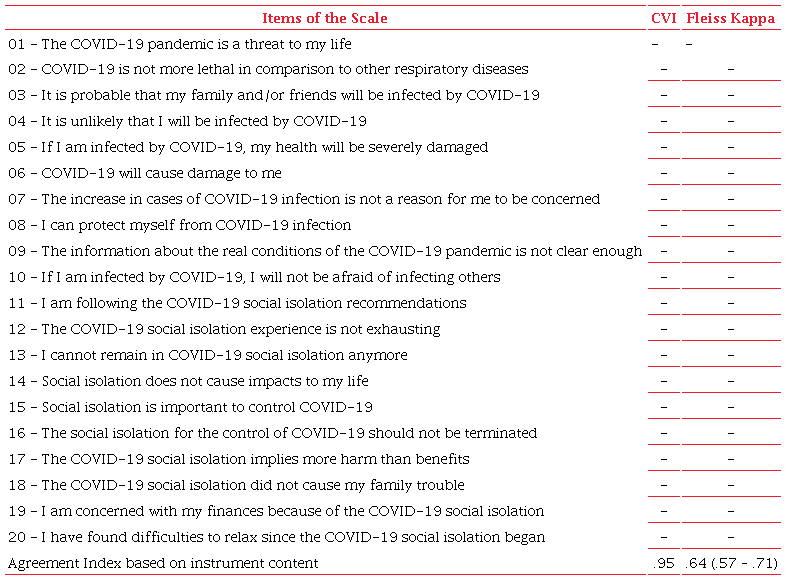
The content-based evidence of validity according to the experts’ analysis was calculated using two different measures. They were chosen to double-check the agreement of the experts who participated in this process. The COVID-19 and Social Isolation Risk Perception Scale was developed with 20 items (Table 2). The experts evaluated the ease of understanding, fit of the content of the scale to the construct desired, item execution, and adequacy of each item for the target public, i.e., the adult population. According to the criteria adopted for this process, both agreement indexes (CVI >0.83; k > 0.60) suggested good adequacy of the construct’s content and understating of the items of the scale (Table 2).
The Kaiser-Meyer-Olkin and Bartlett’s tests were used to check the internal structure analysis, and both supported the possibility of performing exploratory factor analysis - EFA (KMO = .77; χ2 = 3400.1, df = 78, p <.01). To estimate the number of factors for this data, the optimal implementation of parallel analysis was carried out to retain the factors. The results suggested a two-factor model (Table 3). Based on this, the EFA was run using the “Robust Diagonally Weighted Least Squares (RDWLS)” estimation method, and Robust Promin rotation, with the basic analysis of this procedure using polychoric correlation matrices, as the scales use a Likert-type response scale. The Item Response Parameters of item-difficult (thresholds) and discrimination were also calculated in this analysis.
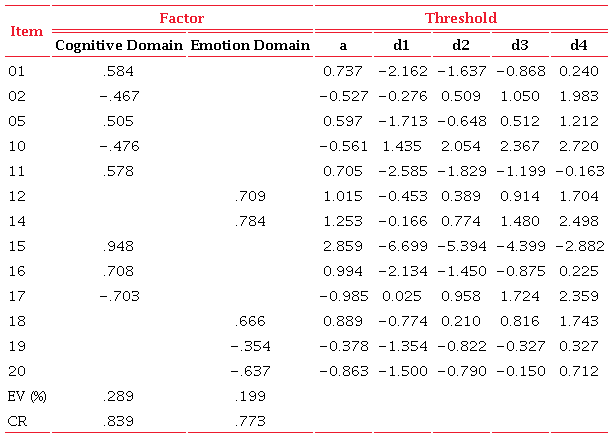
Note: a = item discrimination to its factor (IRT); Threshold (d1, d2, d3, d4) = Category interceptions regarding item difficulty (IRT); EV (%) = Explained Variance of Model; CR = Composite Reliability.
Comparing the 20-item scale which passed through the content validity analysis, the EFA suggested the deletion of 7 items (3, 4, 6, 7, 8, 9, 13), because their factor loadings were below .30. After their removal, the analysis was performed once more following the same steps. The results of the analysis with the remaining items suggested that the total proportion of explained variance of this scale was .4881, i.e., the two factors selected explain a very large part of the data’s variability (Table 3).
The fit indices of the EFA suggested the acceptability of the two-factor model for this scale (χ2 = 3917.843, df = 78, χ2/df = 50.228; RMSEA = .07; CI = .050 – .080; CFI = .937; TLI = .907), according to the criteria adopted in this study. The reliability of the scale suggested an acceptable level of homogeneity (CR > .70) when analyzing the total Composite Reliability (CR = .896) and for each factor (Table 3) (Valentini & Damasio, 2016). Regarding the item Thresholds, no unexpected response pattern was found. This means that, for all the items of the scale, to pass from a smaller response category to a larger category, the respondent will need a higher level of the latent trait.
Additionally, normalization results suggested there were no differences between Region (p > .05), Sex (p > .05) and, in the Cognitive Domain, education levels (p <.05). However, a significant result was found for education levels in the Emotional Domain (p = .001), related specifically to differences in High School and University Education samples (p = .001). Based on these results, General and Education specific norms for scores in both domains were calculated (Table 4). It can be inferred that high scores in the cognitive domain mean a high likelihood to perceive COVID-19 as a real threat to health and social isolation as a protective strategy against the coronavirus. High scores in the emotional domain indicate emotional comfort regarding the adoption of social isolation as a COVID-19 preventive strategy.
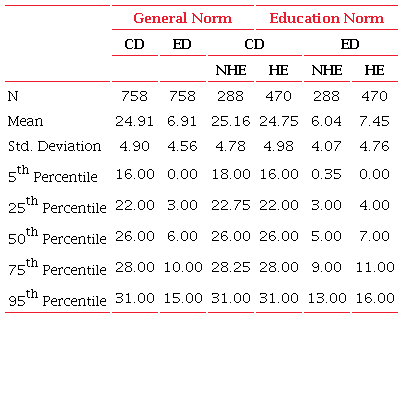
Note: CD = Cognitive Domain; ED = Emotional Domain; NHE = Non-Higher Education; HE= Higher Education;
Discussion
COVID-19 and social isolation risk perception are interpretations of the danger for individuals that are exposed to or worried about being exposed to the coronavirus and harm due to the social isolation strategy. This analysis of hazard probabilities is divided into two main domains, called the Cognitive and Emotional domains. Based on these interpretations, people can adapt and choose the best behaviors and mechanisms to avoid the danger risk and live safely (Qiao et al., 2020; Cori, Bianchim Cadum & Anthonj, 2020; Paek & Hove, 2017). Based on these concepts and the results of this paper, it can be assumed that the COVID-19 Risk Perception Scale (EPRCIS) presented evidence that suggests it fits with the main concept of risk perception in the context of COVID-19 and social isolation. This assumption was based on both the results of the analysis of the experts’ agreement, calculated through the CVI and Kappa Indexes, suggesting that the scale measures what it proposes, and the adequacy of the construct and understanding of all the initial 20 items developed for the scale (McHugh, 2012; Yusoof, 2019). The expert analysis related to the content-based evidence of validity is an initial assessment of whether the content and the construct that the scale proposes to measure are correctly defined (American Educational Research Association [AERA] et al., 2014).
The scale was found to adhere to the two-factor perspective of risk perception, in which some items related to the severity or susceptibility of how dangerous the condition can be to the individuals’ lives (cognitive domain), and some items are associated with feelings about the conditions of risk (emotional domain), with the factorial structure of the scale conforming with the suggestion of the international literature (Qiao et al., 2020; Qiao et al., 2021; Paek & Hove, 2017). The original 20-item scale developed by the authors of this paper was reduced to a 13-item scale. Having investigated the content-based evidence of validity and internal structure, the norms proposed for the population could help professionals to measure the risk perception levels of their patients and make the best decisions for them.
This study has some limitations. The first of them is the lack of participants with non-higher education. Perhaps, the small number of participants in this condition was obtained because the data collection was performed online through Google Forms, limiting the access of people with fewer years of study. Another limitation was the lack of other sources of validity evidence, such as relation to other variables (convergent, discriminant, and criteria validity) because of the testing and response process (AERA et al., 2014). Further studies should provide these other sources of valid evidence to support the fact that the scale measures what it proposes. Furthermore, this scale opens one more possibility to analyze relations between its factors and other variables, such as mental health disorders, which could promote the understanding of possible associations and the generation of new cognitive models (Pacico, Hutz, Schneider & Bandeira, 2015; AERA et al., 2014).
References
American Educational Research Association. American Psychological Association & National Council of Measurement in Education (2014). Standards for educational and psychological testing.
Bedford, J., Enria, D., Giesecke, J., Heymann, D. L., Ihekweazu, C., Kobinger, G., Clifford Lane, H., Memish, Z., Myoung-Don., Sall, A. A., Schuchat, A., & Wieler, L. H. (2020). COVID-19: towards controlling of a pandemic. The lancet, 395(10229), 1015–1018. https://doi.org/10.1016/S0140-6736(20)30673-5
Bertea, P. (2010). Scales for measuring perceived risk in E-Commerce-testing influences on reliability. Management & Marketing-Craiova, (1s), 81–92. https://www.ceeol.com/search/article-detail?id=206969
Cori, L., Bianchi, F., Cadum, E., & Anthonj, C. (2020). Risk perception and COVID-19. International Jornal of Environmental Research and Public Health. https://doi.org/10.3390/ijerph17093114
Damásio, B. F. (2012). Uso da análise fatorial exploratória em psicologia. Avaliação Psicológica: Interamerican Journal of Psychological Assessment, 11(2), 213–228.
Detoc, M., Bruel, S., Frappe, P., Tardy, B., Botelho-Nevers, E., & Gagneux-Brunon, A. (2020). Intention to participate in a COVID-19 vaccine clinical trial and to get vaccinated against COVID-19 in France during the pandemic. Vaccine, 38(45), 7002–7006. https://doi.org/10.1016/j.vaccine.2020.09.041
Dryhurst, S., Schneider, C. R., Kerr, J., Freeman, A. L., Recchia, G., Van Der Bles, A. M., ... & van der Linden, S. (2020). Risk perceptions of COVID-19 around the world. Journal of Risk Research, 23(7-8), 994–1006. https://doi.org/10.1080/13669877.2020.1758193
Ferrando, P. J., & Lorenzo-Seva, U. (2017). Program FACTOR at 10: origins, development and future directions. Psicothema, 29(2), 236–241. https://doi.org/10.7334/psicothema2016.304
Field, A. (2013). Discovering statistics using IBM SPSS statistics. Sage.
Fischer, M., Coogan, A. N., Faltraco, F., & Thome, J. (2020). COVID-19 paranoia in a patient suffering from schizophrenic psychosis–a case report. Psychiatry research, 288, 113001. https://doi.org/10.1016/j. psychres.2020.113001
Gagneux-Brunon, A., Detoc, M., Bruel, S., Tardy, B., Rozaire, O., Frappe, P., & Botelho-Nevers, E. (2021). Intention to get vaccinations against COVID-19 in French healthcare workers during the first pandemic wave: a cross-sectional survey. Journal of Hospital Infection, 108, 168–173. https://doi.org/10.1016/j. jhin.2020.11.020
Giordani, R. C., Giolo, S. R., da Silva, M. G., & Muhl, C. (2021). Percepção de risco do COVID-19: Suscetibilidade e gravidade percebidas pela população brasileira. Journal of Health Psychology, Article first published online: September 6, 2021. https://doi.org/10.1177/13591053211044536
Holland, J. (2020). Risk perceptions of health and safety in cruising. AIMS Geosciences, 6(4), 422–436. https:// doi.org/10.3934/geosci.2020023
Hwang, T., Rabheru, K., Peisah, C., Reichman, W., & Ikeda, M. (2020). Loneliness and social isolation during the COVID-19 pandemic. International Psychogeriatrics, 32(10), 1217–1220. https://doi.org/10.1017/ S1041610220000988
Karlsson, L. C., Soveri, A., Lewandowsky, S., Karlsson, L., Karlsson, H., Nolvi, S., Karukivi, M., Lindfelt, M., & Antfolk, J. (2021). Fearing the disease or the vaccine: The case of COVID-19. Personality and individual differences, 172, 110590. https://doi.org/10.1016/j.paid.2020.110590
Lifshitz, R., Nimrod, G., & Bachner, Y. G. (2016). Measuring Risk Perception in Later Life: The Perceived Risk Scale. Journal of the American Psychiatric Nurses Association, 22(6), 469–474. https://doi. org/10.1177/1078390316659910
Lorenzo-Seva, U., & Ferrando, P. J. (2019). Robust Promin: a method for diagonally weighted factor rotation. Technical report, URV. Tarragona, Spain. https://doi.org/10.24265/liberabit.2019.v25n1.08
McHugh, M. L. (2012). Interrater reliability: the kappa statistic. Biochemia medica, 22(3), 276–282.
Pacico, J. C., Hutz, C. S. Schneider, A. M. A., & Bandeira, D. R. (2015). Validade. Psicometria, 71–95
Paek, H. J., & Hove, T. (2017). Risk perceptions and risk characteristics. In Oxford research encyclopedia of communication. https://doi.org/10.1093/acrefore/9780190228613.013.283
Pasquali, L. (2014). Psicometria: teoria dos testes na psicologia e na educação. Editora Vozes Limitada.
Qiao, S., Li, Z., Liang, C., Li, X., & Rudisill, C. A. (2021). Risk perception of COVID-19 and its socioeconomic correlatesintheUnitedStates:Asocialmediaanalysis.medRxiv.https://doi.org/10.1101/2021.01.27.21250654
Qiao, S., Tam, C. C., & Li, X. (2020). Risk exposures, risk perceptions, negative attitudes toward general vaccination, and COVID-19 vaccine acceptance among college students in South Carolina. medRxiv. https://doi.org/10.1101/2020.11.26.20239483
Reckase, M. D. (1985). The difficulty of test items that measure more than one ability. Applied Psychological Measurement, 9, 401–412. https://doi.org/10.1177/014662168500900409
Shahin, M. A. H., & Hussien, R. M. (2020). Risk perception regarding the COVID-19 outbreak among the general population: a comparative Middle East survey. Middle East Current Psychiatry, 27(1), 1–19 https://doi.org/10.1186/s43045-020-00080-7
Shen, Z., Zhong, Z., Xie, J., Ding, S., Li, S., & Li, C. (2021). Development and psychometric assessment of the public health emergency risk perception scale: Under the outbreak of COVID-19. International journal of nursing sciences, 8(1), 87–94. https://doi.org/10.1016/j.ijnss.2020.12.012
Sternberg, R.; Sternberg, K. (2017). Psicologia Cognitiva. São Paulo. CENGAGE.
Team, R. C. (2020). R: A language and environment for statistical computing.
Thaker, J. (2021). The persistence of vaccine hesitancy: COVID-19 vaccination intention in New Zealand. Journal of Health Communication, 26(2), 104–111. https://doi.org/10.1080/10810730.2021.1899346
Timmerman, M. E., & Lorenzo-Seva, U. (2011). Dimensionality Assessment of Ordered Polytomous Items with Parallel Analysis. Psychological Methods, 16, 209–220. https://doi.org/10.1037/a0023353
Travert, M., Maïano, C., & Griffet, J. (2017). Understanding injuries in sports: self-reported injury and perceived risk of injury among adolescents. European review of applied psychology, 67(6), 291–298. https://doi.org/10.1016/j.erap.2017.10.002
Valentini, F., & Damásio, B., F. (2016). Variância média extraída e confiabilidade composta: indicadores de precisão. Psicologia: teoria e pesquisa, 32(2). https://doi.org/10.1590/0102-3772e322225
Van der Linden, S. (2015). The social-psychological determinants of climate change risk perceptions: Towards a comprehensive model. Journal of Environmental Psychology, 41, 112–124. https://doi.org/10.1016/j. jenvp.2014.11.012
Wang, J., & Wang, X. (2019). Structural equation modeling: Applications using Mplus. John Wiley & Sons.
Yusoff, M. S. B. (2019). ABC of content validation and content validity index calculation. Education in Medicine Journal.11(2):49–54. https://doi.org/10.21315/eimj2019.11.2
Zavaleta, Diego; Samuel, Kim; Mills, China T. (2017). Measures of Social Isolation. Social Indicators Research, 131(1), 367–391. https://doi.org/10.1007/s11205-016-1252-2
Zhan, L., Zeng, X., Morrison, A. M., Liang, H., & Coca-Stefaniak, J. A. (2020). A risk perception scale for travel to a crisis epicentre: Visiting Wuhan after COVID-19. Current Issues in Tourism, 1–18. https://doi.org/10.1080/13683500.2020.1857712
Author notes
* Correspondence concerning this article should be addressed to Neander Abreu, Superintendência de avaliação e desenvolvimento, Federal University of Bahia, Barão de Jeremoabo street, Salvador, State of Bahia, Brazil. CEP 40170155. Email: neandersa@hotmail.com