PERCEPTION OF CHANGE MANAGEMENT IN NIGERIAN UNIVERSITIES
PERCEPTION OF CHANGE MANAGEMENT IN NIGERIAN UNIVERSITIES
Revista de Administração FACES Journal, vol. 15, no. 2, pp. 67-80, 2016
Universidade FUMEC
Received: 05 July 2015
Accepted: 28 March 2016
Abstract: Organizational management are concerned with the effect of both radical and sudden changes can have on individual relationship with the organization and the organization as a whole. In line with this, the study attempt to assess employees’ perception of change management in Nigerian universities by investigating the relationship between change management and employee commitment on one hand, success and failure of change initiatives and employees’ readiness and resistance to change initiatives on the other hand respectively. 180 questionnaires were administered to employees of three universities in south west region of Nigeria. Data obtained was analysed using descriptive statistics while hypotheses were tested using correlation and regression analysis. The result of the findings revealed a strong and direct relationship between change management and employee commitment, success and failure of change programmes has a positive and significant relationship with employee readiness and resistance to change respectively in Nigerian universities. This paper therefore makes useful recommendations to universities and other organisations among which include although, employee might resist change, organization should try their best to properly manage the resistance as it can be beneficial to the employees and the educational organizations at large.
Keywords: Perceptions, Change Management, Change Initiative, Resistance, Employee Commitment.
Resumo: Os gestores estão preocupados com os efeitos das mudanças radicais e repentinas nas empresas, que podem ter relações com cada indivíduo ou com toda a organização. Em consonância, o objetivo deste estudo é avaliar a percepção da gestão da mudança em universidades nigerianas, investigando a relação entre a gestão da mudança e o comprometimento dos funcionários, por um lado, e o sucesso e fracasso das iniciativas dos empregados, além das resistências à mudança, por outro lado. Foram aplicados 180 questionários aos empregados de três universidades na região sudoeste da Nigéria. Os dados obtidos foram analisados por meio de estatística descritiva, enquanto hipóteses foram testadas usando correlação e análise de regressão. Os resultados das conclusões revelaram uma relação forte e direta entre a gestão da mudança e comprometimento dos funcionários. O sucesso e fracasso de programas de mudança tem uma relação positiva e significativa com a prontidão do empregado e resistência à mudança, respectivamente, em universidades nigerianas. Neste trabalho, foram feitas recomendações úteis para universidades e outras organizações entre as quais incluem que a organização deve tentar o seu melhor para gerir adequadamente a resistência, uma vez que pode ser benéfico para os funcionários e as organizações educacionais em geral.
Palavras-chave: Percepções, Gestão da Mudança, Iniciativa da Mudança, Resistência, Comprometimento dos Funcionários.
INTRODUCTION
The changing nature of technology and economy pose great pressures on organizations to change their structural and functional characteristics. In parallel with global developments especially in the last quarter of the last century, changes concerning content and presentation of organizations programs, technologies, structural process and the roles of management and employees come forward. In fact, organizations need to create more effective programmes and procedures in response to organizational needs, generate knowledge, skills, and attitudes and develop organizational strategies in order to ensure development of the individual and sustainability of social life. This is important in getting individuals ready for change by considering the needs from outside or within the organizational system (GÖKÇE, 2005; ROSENBLATT, 2004).
According to Leavitt (1964), internal forces which exists within the organization that encourage organizational change include technology (plant, machinery and tools etc.), primary task (the major field of business), people (human resources constituting the organization) and administrative structures (formalized lines of communication, formation of working procedures, managerial hierarchies, reward systems and disciplinary procedures). Hence, it can be stated that internal forces for change come from both human resources and managerial behaviour or decisions. Also major external forces outside the organizations include law and regulations of the government, society’s standards and values, changing technology, demographic characteristics, administrative processes and needs of organization members (DAWSON, 2003; KREITNER; KINICKI, 2010). These external and internal factors are all related to speed, direction and outcomes of change in organizations (DAWSON, 2003).
University education has undergone tremendous expansion in recent times due to rapid increase in the demand for and enrolment in university education perceived as crucial in sustaining individual growth and relevant to the development of high level manpower in relevant fields for socio-economic, scientific and technological development of any nation.
External pressures posed by the volatile environment surrounding educational organizations necessitate the need for the organization to change overtime. However, educational organizations need to be flexible in order to adapt to various strategies adopted in managing change. Educational change practices actually include different approaches to curriculum, management structures, educational programmes, students and teachers having different backgrounds. In essence, it is necessary to contribute continuous improvement practices with the changing circumstance to achieve organization effectiveness. Indeed, it is essential to maintain stability of schools and give room for effective education (ROSENBLATT, 2004).
Employees together form the building blocks of a successful organization. When individuals can shape their work in such a way that it is perceived as meaningful and enjoyable, they tend to perform better (BAKKER; BAL, 2010; HALBESLEBEN; WHEELER, 2008) and show innovative and charismatic behaviour (HAKANEN; PERHONIEMI; TOPPINEN-TANNER, 2008). This may be especially important during organizational change, when employees need to adapt psychologically and behaviourally to the change, which may influence adaptation of other employees (GREENHALGH et al., 2004).
When an organization is experiencing organizational change, such as: re-structuring, downsizing, or merging, it causes employees the feelings of anxiety, stress, and insecurity, and thus impact on employees’ productivity, satisfaction, and commitment toward the organization (ASHFORD et al., 1989). Employees can develop different attitudes and behaviours as a result of different individual’s life experiences, socio-demographic characteristics, knowledge and skills, attitudes, values, and behavioural pattern. Finally, organizations need willingness and behavioural support from employees in order to build a truly adaptive organization.
Therefore, organizational change is considered as both a challenge and a threat. However, it triggers positive response when considered as challenge and triggers negative response when considered otherwise. Change as a threat has impact on employee’s perception of job insecurity, anxiety and depression, which may in turn influence employee resistance to change program (CONNER, 1993), and in case of challenge, change has impact on motivation, loyalty, job commitment and job satisfaction may automatically speed up the rate of employees acceptance and readiness to change program (REICHERS; WANOUS; AUSTIN, 1997). So organizations need to develop sense of challenge in their employees to get positive response to change and to avoid dissatisfaction and depression among the employees.
As stated by Biljana (2004) “organizations value commitment among their employees because it is assumed that committed employees engage in "extra-role" behaviours, such as creativeness or innovativeness”. Since low job performances, absenteeism and lack of creativity are costly to organizations. Organizational commitment is assumed to be a desirable quality of their employees. Conversely, radical organizational changes have affected employees' commitment, mostly negatively. Meanwhile, it is vital for management to build and manage employees' commitment, especially during and after radical organizational changes since employees' commitment is recognized as a valuable and intangible asset which can produce very tangible results.
In recent times, researchers suggested that both the ability to accept change as well as the tendency to resist change lies within the individuals who are experiencing the change (JUDGE et al., 1999; OREG, 2003). Also Lau and Woodman (1995) revealed that each individual determines through his/her perceptual skills whether change is a threat or a challenge. Therefore change management agents and academic researchers are concerned with issues of managing change process so that employee can actively accept and be involved in the change programs. In view of this, this study attempts to assess employee’s perception of organization change management, relating change management to employee’s readiness to change, resistance to change, its impact on employees ‘commitment and overall employee performance.
Literature Review
Globalization, developments in information and communication technology, economic crises and demographic changes dramatically force human beings to change (RAGSDELL, 2000). Change is quite inevitable due to tremendous unforeseen internal and external environmental pressures. It compares the organization before and after the situation in order to stop one thing and starts new one. It is, in fact, an adaptation to the environment of new ideas or behaviours that can be defined by many ways like transformation of an organization between two points in time (BARNETT; CARROLL, 1995), planned or unplanned transformation in the structure, technology and/or people of an organization (GREENBERG; BARON, 2002). Thus, organization needs to understand the situation created by change in which employees may have positive or negative attitudes and behaviours.
Change management is an organizational process aimed at empowering employees to accept and embrace changes in their current environment. According to the Society for Human Resources Management (SHRM (2007), change management is a structured approach to transitioning individuals, teams, and organizations from a current state to a desired future state, to fulfil or implement a vision and strategy. As a systematic process, it is the formal process for organizational change, including a systematic approach and application of knowledge. Change management means defining and adopting corporate strategies, structures, procedures, and technologies to deal with change stemming from internal and external conditions. Lisa and Brian (1997) contend that it involve a set of activities that helps people transition from their present way of working to the desired way of working (LCMT), and as a competitive tactic, it is the continuous process of aligning an organization with its market place and doing so more responsively and effectively than competitors.
As open system, successful organizations monitor their environment and take appropriate steps to maintain a compatible fit with new external conditions. This adaptability requires continual change because environmental changes do not end. McShane & Vonglinow (2000) identified three prominent forces responsible for change in the external environment. They include computer technology, global and local competition, and demography.
Computer technology seems to be the main reason why organizations are experiencing dramatic and rapid environmental changes. More specifically, the systems of networks that connect computers throughout the planet have rapidly reduced time and dissolve distances. Employees for example use intranets systems to directly access job related information, bypassing supervisors who serve as conduits. Basically, computer technology forces corporate leaders to rethink how their organizations are configured, as well as what competencies and expectations employees must have in these emerging organization (GULLEY, 1998).
Secondly, increasing global and local Competition constitutes powerful forces for organizational change (BETIS; HITT, 1995). Technology has also played a significant role in increasing global and local competition. Global and domestic competition often leads to corporate restructuring; in order to increase competitiveness, organization reduces layers of management, sell entire divisions of employees and reduce payroll through downsizing (MCSHANE et al., 2000). Lastly, demographic forces constitute prominent forces for external change. While firms adjust to global competition, they are also adapting to changes in the workforce. Employees are more educated and consequently expect more involvements and interesting work. These changes have put pressure on organizational leaders to alter practices, develop more compatible structures and reward and discover new ways to lead.
During change, some employees may also have trouble disengaging from the old organization, as they feel a sense of loss with having to “let go” of the old and highly-valued structures, methods and rules (AMIOT et al., 2006; NADLER, 1987). This is especially so if people have been socialized to appreciate the values, norms and organizational history, and if beliefs and values are shared throughout the organization. Inevitably, there are positive aspects of the organizational culture that are lost with any change. The change process may bring about a loss of organizational history through, for example, relocation from an old building or a change in service values. Employees may perceive these changes as a loss to the organization’s status or prestige (AMIOT et al., 2006; ELSBACH; KRAMER, 1996). To date, little research has examined employees’ concerns about retaining positive aspects of an organization’s culture during change. However, all these responses to change are directly related, which in some cases have impact on employees’ commitment and readiness for change.
Interestingly, an organization in today’s competitive world cannot perform at its peak unless its employees are committed to the organizational objectives and work as an effective team members. One of the challenges facing modern organization involves maintaining employee commitment in current business environment. Meyer and Allen (1991) described employee commitment to be of three categories: Affective commitment which refers to employees’ emotional attachment to, identification with and involvement in the organization. Employees with strong affective commitment continue to remain with the organization because they want to. Typically, continuance commitment refers to an awareness of the cost associated with leaving the organization among which include threat of wasting time and effort spent acquiring non transferrable skills, loosing attractive benefits, giving up seniority based privileges or having to uproot family and disrupt personal relationship. Continuance commitments usually develop as a function of lack of alternative opportunities and employees remain because they need to.
Normative commitment reflects a feeling of obligation to continue employment. Employee with high level of this commitment has the feeling that he ought to continue with the organization. Normative commitment occurs when organization provides the employee with rewards in advance or incurs significant costs in providing employment. Employees' commitment constitutes a valuable and intangible asset which can produce very tangible results such as higher productivity and lower employee turnover when managed properly. It is however important for management to build and manage employees' commitment, particularly after radical or sudden organizational changes. Donald, Steven and David (2006) revealed that commitment to change and the organization are not impacted the same way by organizational channel and individual reactions to change are based on a complex calculus reflecting different aspects of the change and its consequence. Furthermore, highest level of commitment developed when there was considerable amount of change going on at the work level. On the other hand, commitment to change tended low when change was generally unfavourable for the work group members irrespective of the extent of change at the work units. Organizational justice literatures point to both change process and outcome as influencing organizational members’ reactions to organizational events. Based on such findings, Donald et al. (2006), concluded that how fairly a change is carried out and how favourably its outcomes are should represent two dimensions that are important in shaping individual sense of commitment to the change itself and to any re -examination of organizational commitment.
Even though change is introduced and implemented for positive reasons such as to adapt to changing environmental conditions and remain competitive, employees often respond negatively toward change and resist change efforts. This negative reaction is mostly because change brings with it increased pressure, stress and uncertainty for employees (ARMENAKIS; BEDEIAN, 1999). Resistance to change is being referred to as employees’ behaviour that seeks to challenge, or disrupt the prevailing assumptions, discourses, and power relations (FOLGER; SKARLICKI 1999). Herscovitch (2003) also gave a work-related definition of resistance to change. According to him, employee action or inaction that is intended to avoid a change and/or interfere with the successful implementation of a change in its current form is a resistance to change.
Oreg’s (2006) is of the view that resistance to change is a “tri-dimensional (negative) attitude towards change, which includes affective, behavioural, and cognitive components”. This definition implies that almost any unfavourable reaction, opposition, or force that prevents or inhibits change, is resistance. Therefore, such resistance needs to be overcome or avoided (MABIN; FORGESON; GREEN, 2001; PIDERIT, 2000). Researchers, however, believe that resistance to change is sometimes beneficial as it precludes some of the more positive aspects and intentions (MUO, 2014). For instance, if resistance is properly managed, it helps to challenge and refine strategic plans and actions (MABIN et al., 2001), and improves the quality of decision making (LINES, 2004). Oreg (2006) also recommends that it can be a productive response to perceived unethical action and it can foster learning among organization participants (MSWELI-MBANGA; POTWANA, 2006). Rosemond and William (2011) suggest that management should encourage employee participation in decision making, build confidence, accept constructive criticism, be transparent and communicate clearly the need for change to employees as these will reduce if not totally eradicate employees negative reaction to change programs.
Meanwhile, a critical responsibility of management to prepare the organization for a change initiative is by creating readiness for the change initiative in the organizational members. According to Hanapachern (1997), readiness refers to the extent to which individuals are mentally, psychologically, or physically ready, prepared, or primed to participate in organization development activities. Thus organizational readiness is framed as the awareness, acceptance, and capability of organizational members to be involved in the implementation of change initiatives in their organizations (DENNIS, 2007). Kotter and Schlesinger (1979) proposed an approach for creating readiness as well as the proper implementation of the change process by offering six methods among which include education and communication, participation and involvement, facilitation and support, and even explicit and implicit coercion.
Armenakis et al. (1999) believed that readiness for change is created in the message communicated to the organization’s members by management. Certainly, introduction of a new change initiative might create uncertainty and concern for the future in the minds of organizational members. The change message is used to address this uncertainties and concerns by answering five questions: Is there any need for the change: does the change being introduced conformed to the required change; are key organizational members supportive of the change; how effectively can organizational members successfully implement the current change; and what are organizational members expectations regarding the change. These questions are answered through five components of the change message (DENNIS, 2007). Meanwhile, readiness for change is reflected in the employee's beliefs, attitudes and intentions regarding the extent to which changes are needed and the organization's ability to successfully complete the intended change. If employees are not ready for organizational change, conflicts between organizational leaders and members may be encountered. For the desired outcome to occur, conflicts have to be resolved so that the employee's beliefs and cognitions align with those of the organization's management (HOLT et al., 2007).
Empirical review
Trust and credibility are the greatest assets a manager can have to lead the workforce through the throes of change, emerging intact and motivated to contribute to the success of the new organization. Ayinde and Akanni (2011) studied employees’ perception of downsizing and their commitment to work in selected federal government establishments in Nigeria. Using stratified random sampling, a total of 604 respondents were selected from the six federal government establishments affected by downsizing. The findings revealed that employee perception of downsizing exercise influenced their commitment to work. Biljiana (2004) in his study on employees commitment in terms of radical changes stressed that organizational changes usually lead to decreased employees commitment, caused by increased job insecurity, decreased morale and trust, and increased stress. He further recommended that organizational commitment should be managed by applying adequate human resource management practices.
Rafferty and Griffin (2006) conducted a study in the large Australian public sector organization on perception of organizational change: a stress and coping perspective. They identified three distinct change characteristics: the frequency, impact and planning of change Lazarus and Folkman’s (1984) cognitive phenomenological model of stress and coping was used to propose ways that these change characteristics influence individuals’ appraisal of the uncertainty associated with change, and, ultimately, job satisfaction and turnover intentions. Based on a repeated cross sectional survey on individuals’ perceptions of change one month prior to employee attitudes in consecutive years, the empirical evidence revealed that while the three change perceptions were moderately to be strongly interrelated, the change perceptions displayed differential relationships with outcomes.
Conclusively, it is highly important to realize that effective management of change is based on clear and precise understanding of human behaviour in the organization. Due to the challenge of change, individuals may react with some emotions like uncertainty, frustration or fear and feel threatened and disoriented. As a result, people often exhibit a defensive and negative attitude and resist to change initiatives. Besides, different impact of change on each organization members and nature of change should be considered and monitored (MULLINS, 2005). Based on the theoretical and empirical review, this study tries to test the following hypotheses:
H0: change management has no significant effect on employee commitment
H0: employee readiness for change is significantly unrelated to successful implementation of change programmes
H0: failure of change programmes has no significant relationship with employee resistance to change initiatives
Methodology
In order to investigate the objectives of this study and answer the hypotheses, the descriptive research method was employed. 210 questionnaires were administered to employees of three universities (70 each) in the south western region. However, only 187 were returned although seven of the returned questionnaires were either incompletely filled or had errors. Thus 180 questionnaires were used for our analysis. The questionnaire has three construct namely: change management, change resistance and readiness to change. Table 1 below shows the demographic profile of the respondents. 60.6% of the respondents were male which implies that the majority of the respondents were male. 57.2% were academic staff while the remaining 42.8% fall in the non-academic staff category. Majority of the respondents are above 35 but below 45yrs of age and constitute 60%, 21.1% are of 25-35 years of age, 12.2% are above 45 but below 55yrs while those above 50yrs constitute the lower percentage of 6.7% of the sample size. M.sc holders constitute the larger part of the population with 47.2% of the total sample size. 12.8% of the respondents are PhD holder, 29.4% are B.sc holders while OND/HND holders constitute 10.6% of the sample size. The respondents’ years of experience between 1-5years constitutes 17.2%, were those of 6-10years was 23.9%, 11-15year was 40.6%, 16-20years constitutes 12.2% and those respondents whose year of experience exceeds 20years was 6.1%.
Results and Discussion
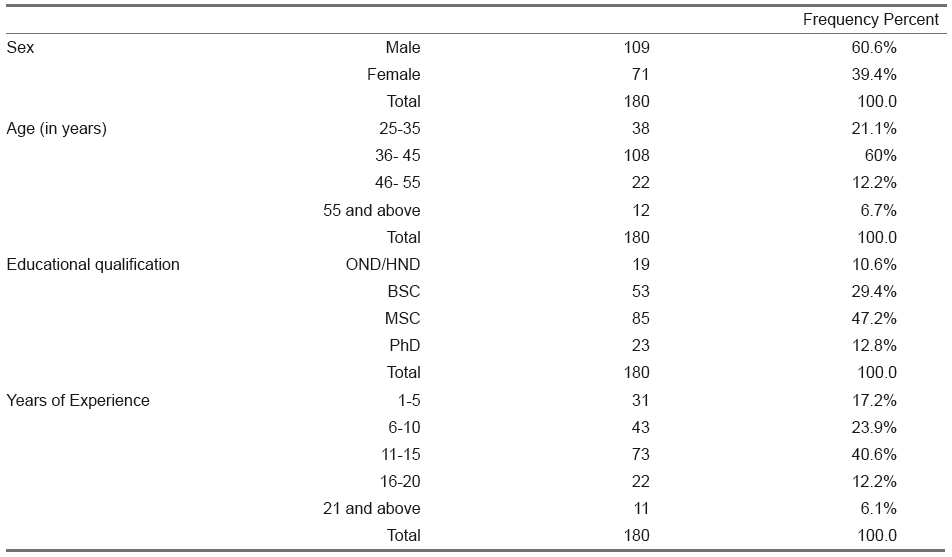
Table 1
Demographic profile of respondents
Field Survey, 2014
Test of Hypotheses
In testing the hypothesis, the statistical tests adopted are correlation coefficient and regression analysis.
HTPOTHESIS 1
From table 2 below, it can be seen that the correlation coefficient of change management and employee commitment r =.092 at significant level of 0.01 (p˂.01) when n = 180 indicates that there is very strong relationship between change management and employee commitment. The table further revealed that p-value is .000 which is less than 0.01. Consequently, we reject the null hypothesis and accept the alternate hypothesis. It is therefore concluded that there exist a strong and direct relationship between change management and employee commitment in Nigerian universities. This is supported by the results of Ayinde and Akanni (2011) which revealed that employee perception of downsizing exercise (a form of change) influenced their commitment to work.
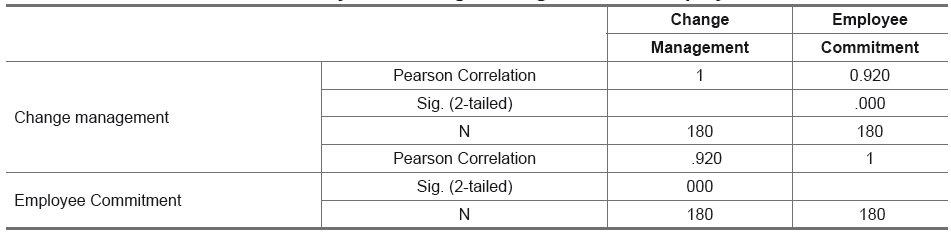
Table 2
Correlation analysis of change management and Employee commitment
**. Correlation is significant at the 0.01 level (2-tailed).
HYPOTHESIS 2
H0: employee readiness for change is significantly unrelated to successful implementation of change programmes H1: employee readiness for change is significantly related to successful implementation of change programmes
Table 3 below illustrates the regression analysis of successfulness of change programmes with employee readiness for change initiatives. The null hypothesis was rejected as r = 0.975 which indicate a significant and positive relationship between successfulness of change programmes and employees readiness for change. As a result, we accept the alternate hypothesis. Furthermore, the coefficient of determination (R2) of model hypothesis 2 is 0.951, which implies that only 95.1% of employee readiness for change explained variation in successfulness of change program. The remaining 4.9% unexplained variation is due to the other variables outside the regression model which are otherwise included in the stochastic error term.
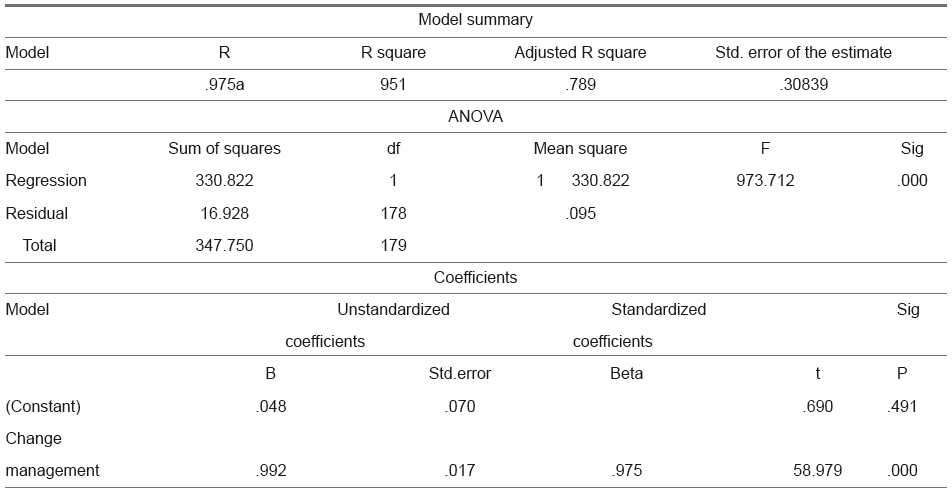
Table 3
Regression analysis of change program successfulness and Employee Readiness for Change
HYPOTHESIS 3
H0: failure of change programmes has no significant relationship with employee resistance to change initiatives H1: failure of change programmes has a significant relationship with employee resistance to change initiatives.
Table 4 below indicates the regression coefficient of failure of change programmes with resistance to change initiatives. We accept the alternate hypothesis consequent to r = 0.978 which indicate a strong and positive relationship between failure of change programmes and resistance of change initiatives. The coefficient of determination denoted by r2 of model hypothesis 3 is 0.957. This means that 95.7% of the failure of change programmes is explained by variance in models of resistance of change initiatives while the remaining 4.3% is unexplained as a result of other variables outside the regression model. This is supported by the results of Donald et al. (2006) which suggests that although compliance with change initiatives may be common but long-term benefits of change only occur when employee actively work and strive to support and participate in the change initiative and also enhance their alignment with the organizational goals and values.
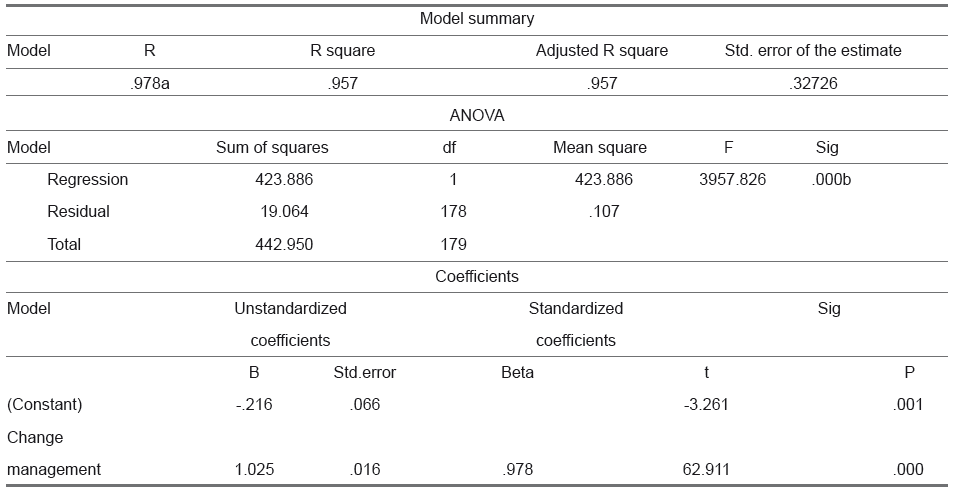
Table 4
Regression analysis of change program failure and Resistances of Change Initiatives
Dependent variable: Resistance of Change
P<0.05
Conclusion and Recommendation
It is highly essential for change agents and organizational management to examine the effect of the introduced change on employee’s commitment towards the organization. Alongside with this, organization should also be familiar with factors responsible for successfulness and failure of change initiatives. The results of this study showed a direct and strong relationship with change management and employees commitment and indicate that successfulness and failure of change initiatives is related to employee readiness to change programmes and resistance to change initiatives respectively in Nigerian universities. Furthermore, when change is formally introduced and implemented accordingly, employees perceive it as a challenge and put in necessary support and effort to achieve success of the change programs and the organization overall objectives at large. If otherwise, employees perceive the introduced change as a threat which enabled employees resist the change and as a result end up in failure of the change initiatives.
Consequently, change agent and organizations should properly manage employees’ resistance to change if any as resistance to change helps to challenge and refine strategic plans and actions (MABIN et al., 2001). It improves the quality of decision making (LINES, 2004). It can also be a productive response to perceived unethical action and it can foster learning among organization participants (MSWELI-MBANGA; POTWANA, 2006). Also introducing change initiatives, organization knowing well those factors responsible for successfulness and failure of change initiatives should properly manage and put into consideration those factors in the act of implementing the change initiatives.
References
2007 CHANGE Management Survey Report. Alexandria, VA: SHRM Research, 2007. Available at: .
ARMENAKIS, A. A.; HARRIS, S. G.; FEILD, H. S. Making change permanent: A model for institutionalizing change interventions. In: PASSMORE, W.; WOODMAN, R. (Ed.). Research in organizational change and development, Greenwich, CT: JAI Press, 1999.
ASHFORD, S. J.; LEE, C.; BOBKO, P. Constant, causes, and consequences of job in security: A theory-based measure and substantive test. Academy of Management Journal, v. 32, n. 4, p. 803-829, 1989.
AYINDE, A. A.; AKANNI A. T. Employees’ Perception of Downsizing and their Commitment to Work In Selected Federal Government Establishments in Nigeria. Journal of Social Science and Public Policy, [S. l.], v. 4, p.18-25, 2011.
BAKKER, A. B.; BAL, P. M. Weekly work engagement and performance: A study among Starting Teachers. Journal of Occupational and Organizational Psychology, [S. l.], v. 83, p. 189-206, 2010.
BALOGUN, J.; HAILY, V. Hope. Exploring Strategic Change, 2nd. ed. London: Prentice, 2004.
BARNETT, W. P.; CARROLL, G. R. Modelling Internal Organizational Change, Annual Review of Sociology, [S. l.], v. 21, n. 1, p. 217, 1995.
BETTIS, R.; HITT, M. The New Competitive Landscape. Strategic Management Journal, [S. l.], v. 16, p. 7-19, 1995.
CHANGE Management Toolkit. Version: 2 Programme, Project and Change Management. London: London Borough of Lambeth for the former Office of the Deputy Prime Minister (ODPM), 2003. Available at: .
CONNER, R. D. Managing at the Speed of Change. New York: Randon House, 1993.
DAWSON, P. Understanding Organizational Change: The Contemporary Experience of People at Work. London: Sage Publications, 2003.
DENIS, R. S. Overcoming Resistance to Change by Managing Readiness to Change. [S. l.]: Troy University. Unpublished, 2007. Available at: .
DONALD, B. F; STEVEN, C.; DAVID, M. H. The Effect of Organizational Change on Employees Commitment: A Multilevel Investigation. Personnel Psychology, [S. l.], v. 59, n. 1, p. 1-29, 2006.
ĐORĐEVIĆ, BILJANA. Employee Commitment in Times of Radical Organizational Changes. Economics and Organization, [S. l.], v. 2, n. 2, p. 111-117, 2004.
FOLGER, R.; SKARLICKI, D. Unfairness and Resistance to Change: Hardship as Mistreatment. Journal of Organizational Change Management, [S. l.], p. 35-50, 1999.
GÖKÇE, F. Behaviour of Turkish Elementary School Principals in the Change Process: An Analysis of the Perceptions of both Teachers and School Principals. Educational Management Administration & Leadership, [S. l.], v. 37, n. 4, p. 198-215, 2009.
GREENHALGH, T. et al. Diffusion of Innovations in Service Organizations: Systematic Review and Recommendations. Milbank Quarterly, [S. l.], v. 82, p. 581-629, 2004.
GURLEY, J. W. A Dell for Every Industry. Fortune, [S. l.], v. 138, n. 7, p. 167-172, 1998.
HAKANEN, J. J.; PERHONIEMI, R.; TOPPINEN-TANNER, S. Positive Gain Spirals at Work: From Job Resources to Work Engagement, Personal Initiative and Work-Unit Innovativeness. Journal of Vocational Behavior, [S. l.], v. 73, p. 78-91, 2008.
HANPACHERN, C. The Extension of the Theory of Margin: A Framework for Assessing Readiness for Change. Unpublished Doctoral Dissertation, Colorado State University, Fort Collins, CO, 1997.
HERSCOVITCH, L. Resistance to Organizational Change: Toward a Multidimensional Conceptualization. Unpublished doctoral dissertation. University of Western Ontario, Ontario, Canada, 2003.
HOLT, D. T. et al. Readiness for Organizational Change the Systematic Development of a Scale. The Journal of Applied Behavioural Science, [S. l.], v. 43, n. 2, p. 232-255, 2007.
JUDGE, T. A.; THORESEN, C. J.; PUCIK, V.; WELBOURNE, T. M. Managerial Coping with Organizational Change: A Dispositional Perspective. Journal of Applied Psychology, [S. l.], v. 84, p. 107-122, 1999.
JULIANNE, R. A Multi-level Examination of Employee Reactions to Organizational Change. [S. l.]: De Paul University, 2010.
KHALID, Arfan; RANA, R. R. Effect of Organizational Change on Employee Job Involvement: Mediating Role of Communication, Emotions and Psychological Contract Information Management and Business Review, [S. l.], v. 3, n. 3, p. 178-184, 2011.
KREITNER, R.; KINICKI, A. Organizational Behavior. 9th. ed. New York: McGraw-Hill Irwin, 2010.
LAU, C.; WOODMAN, R. C. Understanding Organizational Change: A Schematic Perspective. Academy of Management Journal, [S. l.], v. 38, n. 2, p. 537-54, 1995.
LEAVITT, H. J. Applied Organizational Change in Industry: Structural, Technical and Human Approaches. In: COOPER, W. W.; LEAVITT, H. J.; SHELLY, M. W. (Ed.). New perspectives in organization research. New York: Wiley, 1964. p. 55-70.
LINES, R. Influence of Participation in Strategic Change: Resistance, Organizational Commitment and Change Goal Achievement. Journal of Change Management, [S. l], v. 4, n. 3, p. 193-215, 2004.
LISA, M. K.; BRIAN, H. K. Global Trends in Managing Change. Industrial Management, [S. l.], 1997.
MABIN, V.; FORGESON, S.; GREEN, L. Harnessing Resistance: Using the Theory of Constraints to Assist Change Management. Journal of European Industrial Training, [S. l.], v. 25, n. 2-4, p. 168-191, 2001.
MCSHANE, S. L.; VONGLINOW, M. A. Organizational Behaviour. New York: McGraw-Hill Higher Education. 2000.
MSWELI-MBANGA, P; POTWANA, N. Modelling Participation, Resistance to Change, and Organizational Citizenship Behavior: A South African Case. South African Journal of Business Management, [S. l.], v. 37, n. 1, p. 21- 29, 2006.
MULLINS, L. J. Management and Organisational Behaviour. 7th. ed. Harlow, England: Pearson, 2005.
MUO, IK. The other Side of Change Resistance. International Review of Management and Business Research, [S. l.], v. 3, n. 1, 2014.
OREG, S. Personality, Context, and Resistance to Organizational Change. European Journal of Work and Organizational Psychology, [S. l.], v. 15, n. 1, p. 73-101, 2006.
OREG, S. Resistance to Change: Developing an Individual Differences Measure. Journal of Applied Psychology, [S. l.], v. 88, p. 680-693, 2003.
PIDERIT, S. K. Rethinking Resistance and Recognizing Ambivalence: A Multidimensional View of Attitudes toward an Organizational Change. Academy of Management, [S. l.], p. 783-794, 2000.
RAFFERTY, E. A.; GRIFFIN, M. A. Perception of Organizational Change: Stress and Coping Perspective. Journal of Applied Psychology, [S. l.], v. 91, n. 5, p. 1154-1162, 2006.
RAGSDELL, G. Engineering a Paradigm Shift? A Holistic Approach to Organizational Change Management. Journal of Organizational Change Management, [S. l.], v. 13, n. 2, p. 104-120, 2000.
REICHERS, A. E.; WANOUS, P. J.; AUSTIN, J. T. Understanding and Managing Cynicism about Organizational Change. The Academy of Management Executive, [S. l.], v. 11, n. 1, p. 48-59, 1997.
ROSEMOND, B.; ASAMOAH, A. W. Resistance to organizational change: a case study of Oti-Yeboah complex limited. International Business and Management, [S. l.], v. 4, n. 1, p. 135-145, 2012.
ROSENBLATT, Z. Skill Flexibility and School Change: A Multi-National Study. Journal of Educational Change, [S. l.], v. 5, p. 1-30, 2004.
SMOLLAN, R. K.; SAYERS, J. G. Organizational Culture, Change and Emotions: A Qualitative Study. Journal of Change Management, [S. l.], v. 9, n. 4, p. 435-457, 2009.
VISSER, Marjella. Perceptions of Justice in an Organizational Change Situation: The Effect on Resistance to Change and the Mediating Role of Emotion Regulation Strategies. Master Thesis Human Resource Studies, University of Tilburg, Tilburg, 2013.
YILMAZ, Derya; KILIÇOĞLU, Gökhan. Resistance to Change and Ways of Reducing Resistance in Educational Organizations European Journal of Research on Education, [S. l.], v. 1, n. 1, p. 14-21, 2013.