EXPLORING THE CO-CREATION OF VALUE IN THE BRAZILIAN PRIVATE HIGHER EDUCATIONAL SERVICE
EXPLORING THE CO-CREATION OF VALUE IN THE BRAZILIAN PRIVATE HIGHER EDUCATIONAL SERVICE
Revista de Administração FACES Journal, vol. 15, no. 4, pp. 80-99, 2016
Universidade FUMEC
Received: 25 January 2016
Accepted: 05 September 2016
Abstract: Co-creation of value is an imperative practice in the service environment. Understanding education as a service encounter is an innovative approach for the context of higher education. Private Higher Education dominates the Brazilian scenario, with figures above 80% of students, and the Business undergraduate course is the largest in number of students in the country. Based on Self-determination Theory, this study aims to identify at what point the student acts as a co-creator in private education. Through Ethnomethodology, adherence of co-creation to education was identified, in which self-determination acts as a stimulus to generate value.
Keywords: Co-creation, Value Self-Determination, Higher Education, Social Context.
Resumo: Cocriação de valor é uma prática imperativa no ambiente de serviço. O entendimento de educação como um encontro de serviço é uma abordagem inovadora no contexto da educação superior. A educação superior privada no Brasil é a dominante, com mais de 80% dos estudantes, e o curso de Administração o maior em número de estudantes no país. Com base na Teoria da Auto-Determinação, o estudo busca identificar até que ponto os estudantes agem como cocriadores na educação privada. Através de etnometodologia, aderência da cocriação na educação foi identificada, onde a auto-determinação age como estímulo para a geração de valor.
Palavras-chave: Cocriação, Valor Auto-Determinação, Educação Superior, Contexto Social.
INTRODUCTION
A Service Dominant Logic (SDL) uses as centrality a change in focus, from tangible to intangible assets, such as abilities, knowledge and processes (PAYNE et al., 2009). An emerging proposal is to reconcile product and service attributes, which can occupy complementary roles, without excluding any of these categories. This conceptual perspective originated in the article “Evolving to a New Dominant Logic for Marketing” by Vargo and Lusch (2004), of the Journal of Marketing, which was awarded the prize Harold H. Maynard Award for Best Theoretical Contribution in Marketing by the American Marketing Association (AMA), in 2004 (AMA, 2010). Besides the service visibility, the article provided the academia with the opportunity for further discussions.
One of the contributions of SDL is the view that "the consumer is always a co-creator of value" (PAYNE; STORBACKA; FROW, 2008, p.84). For Payne et al. (2009), the service encounter, or locus of co-creation, represents a series of interactions during the relationships between the company and the customer, or in a social/contextual perspective, such as in the relationship between the professor and the student. The value is defined by Prahalad and Ramaswamy (2003) as a result derived of individual experience in specific time and space, for instance, in the classroom.
Taking advantage of customer talents, through more productive experiences, can be the alternative for organizations to promote services with better features compared to competitors (BENDAPUDI; LEONE; 2003). Prahalad and Ramaswamy (2004) point out that the idea of interaction is not new and it is one of the sources of value creation. What is new is the definition of co-creation as the active participation of consumers; generating higher performance and value in service; and a subsequent satisfaction (PRAHALAD; RAMASWAMY, 2004). An example of co-creation and co-production (similar terms) is the educational environment; where students with different expectations are served by teachers and; even in a group or classroom; it is possible to meet different demands. The professor and the university’s interests; besides the community’s; complete the understanding of co-creation as a broader term that includes several stakeholders; and more than the simple interaction or service rendering.
There is a paradox in the view of the student as a consumer of higher education. It is not being defended here the commodification of education; but the importance or resources for private institutions to promote quality. The student as a mere consumer is the starting point that must be transcended. This reality must be changed in the locus of co-creation of value; in the business classroom. Halbesleben and Wheeler (2009) identified significant differences between the models ‘Student as a consumer’ and ‘Student as a Co-Producer’ or co-creator. The perception of being a mere consumer does not provide appropriate conditions for learning and the desired experiences. On the other hand; the Model of Student as a Co-Producer; which is a hybrid consumer model; presents the best learning outcomes and the best social interests; illustrating the importance of co-creating in the academic environment.
The focus of co-creation is always to seek the best composition of value for the stakeholders; at present and in the future; which is a direct result from co-creation or its reflexes. In the educational setting; four stakeholder groups are basically identified. The students who interact directly with the second large group which is the professors’ one and and the University. The external interests are represented by the last group; which is society (companies; associations; families; government). This investigation is limited to the students’ perspective as one of the major co-creation groups; which is both active and resulting; and in the educational investigations it tends to be the element of empirical intervention. The students are the “products and producers of their environments”; responsible for the future (YOUNG; 2005, p. 26).
Prahalad and Ramaswamy (2004) report that the co-creation process originates in the desire for interaction. Students; for example; pursue academic interaction for several reasons (personal growth; culture; the demands of the labor market; the company and the family). In this perspective, Abrantes, Seabra and Lages (2007, p. 960) indicate a gap in the educational sector when they state that besides the “numerous difficulties of measurement; literature does not report a consensus of the main influences of the effectiveness of teaching and the effectiveness of student learning”. That is: it is not clear how co-creation occurs in the classroom. The delivery of the educational system must be related to the students’ interests; without neglecting the interests of the University; the professors and the society. Another gap is observed by Voss; Gruber and Szmigin (2007); because in the context of higher education service; in terms of quality; there is lack of knowledge of the stakeholder expectations; as well as metrics for effective measuring. Pini (2009, p.61) highlights the “lack of studies to investigate the level of consumers’ interest and participation in co-creation”; despite increasing discussions on the topic in the academic contexts. The author points out that there is a need for empirical studies which aim at identifying not only when but also how to engage in co-creation of value. Lush (2007) identifies an alternative in the educational context when he states that Marketing should highlight more than market perspectives; with a greater focus on society; on the contextual value created and on the collaboration among stakeholders.
In co-creative approach, the interests of all stakeholders should be observed (RAMASWAMY; GOUILLART, 2010). In the educational scenario, the focus is on co-creation of knowledge, which refers to “learning to collaborate and learning through collaboration” (ANTONACOPOULOU, 2009, p. 427). Co-creating means developing new and broader perspectives of value together with all the stakeholders (RAMASWAMY, 2009b). Sheth and Sisodia (2006) believe that, many times, Marketing distances itself from reality or focuses only on consumerist principles. That does not mean consumer relations no longer make sense, but it means that this area is not only limited (or should not be) to those aspects. However, analyzing private higher education in the perspective of Marketing does not mean meeting the students’ interests at any price, which can cause a number of problems, such as when marketing issues overlap social issues. Holbrook (2006) highlights that what balance must be established between different interests among those involved in the educational result, considering quality results for students, professors, Universities and other stakeholders. Halbesleben and Wheeler (2009) emphasize that evolution to the co-creating teaching model can solve the utilitarian risk of the model of the client/consumer student, and redirect the teaching focus to aspects guided by social and intellectual aspects. The objective is to prevent the students’ interests and their understanding as “clients” from guiding private higher education to inadequate or insufficient operational purposes (HOLBROOK, 2006).
The concept of co-creation can be understood in Athanasiou (2007, p. 117) about the importance of providing the learner with autonomy, so as to have the meaning of “capacity and the willingness to act independently and in co-creation with others.” The objective of this study is to identify how co-creation is awakened in higher education and what effects are provided by the collaborative classroom. The value, the expected effect of co-creation is delimited in Edvardsson, Tronvoll and Gruber’s proposal (2011), as a socially constructed result, based on configurations and alterations of the social tissue, which is classified as value-in-the-social-context. Co-creation, Ramaswamy and Gouillart (2010) state, is an interactive process that places the experience of human beings at the center point of the service. The student is part of a larger system, consisting of multiple social actors, and the value is a result embedded in a social context (EDVARDSSON; TRONVOLL; GRUBER, 2011).
Having justified the co-creative practice in the educational context, it is important to highlight that as in the traditional market interactions, in higher education it is necessary to “co-create different kinds of contextualized experiences” with the actors (RAMASWAMY, 2009b, p. 29). In this case, the term ‘consumer’ should be changed to ‘student’. Interactions supported by co-creation take place in the specific locus in the generation of value. In the perspective of this study, the ‘place’ of interest is the classroom of Business Undergraduate Course.
The main focus of this research involves the understanding of students’ motivation to co-create value, and the implicators of interaction in perceived performance and quality, in satisfaction, loyalty and retention of the undergraduate students of Business in the private educational service, based on a contextual study developed in South Brazil. The objectives of this study focus on the relationship-building between the Service Dominant Logic and the Self-Determination Theory, as an approach that allows the identification of how co-creation, can be used to provide academic activities of higher value in the construction of interpretative scenarios, to capture the perceptions of co-creation of value in the understanding of students as co-creators/consumers of educational results. And the verification of results obtained with interpretative scenarios for future compositions of more coherent metrics with the relation between co-creation and the classroom environment.
Value Co-creation in the Private Higher Education
According to Troccoli (2009, p. 2), consumers are “more and more involved in a network of social, psychological, environmental, political and technological elements that, interact simultaneously to define their consumption decision”. Co-creation and co-production are mechanisms used to interact with the consumer. There is no substantial difference between the terms, except that not ever co-creation action is co-production, but co-production is always co-creation. The terms co-creation and co-production, in a broad sense, describe the dialogue between supplier and consumer in their interactions (PAYNE et al., 2009). They are alternatives to keep the consumers close to the organization (AUH et al., 2007). As highlighted by Bendapudi and Leone (2003, p. 14), “consumers are being widely encouraged to take more active roles in the production of products and services”.
A requirement of co-creation is the quality of interactive processes, which "allow the individual consumer to co-create unique experiences" (PRAHALAD; RAMASWAMY, 2004, p. 7). The value is feasible through a creative relationship, performed in synergetic initiatives, which involve the business, the consumers and other stakeholders. In the framework by Ramírez (1999), the co-production of value accounts for elements of interdependence, cooperation between company and client, interfaces of the economic activity, combinations and reconfigurations, besides different and contingent senses of value. There is co-creation of value when the higher service is provided in congruence with the determination of customer value (PAYNE; STORBACKA; FROW, 2008, p. 84), which nevertheless represents an action so that clients continue as clients (BERRY, 2002). Despite the fact that the market focus prevails in marketing processes, co-creation applies to several service sectors, including the educational services, which accounts for different understandings and expectations of value.
The connection between co-creation and higher education lies in the educational perspective oriented to teaching and learning, or (multidirectional) learning, opposing the teaching model (unidirectional). It is possible to define the present study regarding the concept of Service Learning. This teaching format is student-centered, requires viable responsiveness and customization through co-creation actions. Athanasiou (2007, p.116) highlights that the collaborative importance within the classroom "constitutes a meaning through which it moves from the traditional teacher-centered approach to a more student-centered approach". This natural movement to emphasize learning is the co-creation in learning, which evolves from the precepts of teaching students to a model of more interaction, and co-creation, or the Being in the Classroom notion (RAMSEY; FITZGIBBONS, 2005).
The motivational idea of co-creation in higher education should approximate the Self-Determination Theory, in which the student, by autonomous motivation, is able to learn and obtain meaningful results (CHIRKOV, 2009; REEVE; HALUSIC, 2009; BORUCHOVITCH, 2008). The breaking point with the traditional market models is identifying the academic co-creation as related to the 'Student Co-Producer' model, rather than generic models of 'consumer' (HALBESLEBEN; WHEELER, 2009). There is a need to create interactive environments, aiming at cooperative learning. The professor must not be a centralizer, but someone who guides the construction of knowledge. In other words, a conductor that provides pathways (COLOSSI; CONSENTINO; QUEIROZ, 2001). For the success of these practices, the student must be convinced of the value obtained, as well as the style of teaching should be more oriented to the support than to the control (YOUNG, 2005). Aiming to make the study proposal more didactical, the following chapter presents a representative conceptual model of co-creation in private higher education, with a brief introduction of its constructs.
Conceptual Model of Educational Service Co-creation
Because of the conceptual difficulties in determining a representative statistical model for the phenomenon, first it is necessary to propose a conceptual model based on the theory. The illustrated framework proposes the relationship among a number of factors that affect the complex compound of Private Higher Education. Despite the different contextual facets, the option in this study is to focus on the central relationship in the educational arena, which is mainly represented by the complex interaction between professors and students.
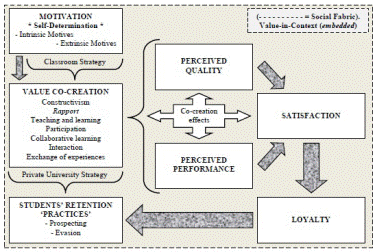
Illustration 1
Educational service co-creation conceptual model
Author.
Motivation and Self-Determination Theory in Private Higher Education
The research developed by Chirkov (2009) addresses the relationship between two concepts, respectively: the autonomous motivation in the academic environment and the Self-Determination Theory. Human nature requires interactions for proper development, where motivation and autonomy in education and the students’ learning are considered (CHIRKOV, 2009). A relevant work of reference for this study, Halusic and Reeve (2009), focuses on the Self-Determination Theory in the perspective of students, which include learning time, their own motivational resources and the professors’ explanation and language in the process.
The base of self-determination consists of the "style of motivation supported by autonomy" (REEVE. HALUSIC, 2009, p. 145). The autonomy refers to the "internal locus of control and to the perception that behaviors are freely chosen" (YOUNG, 2005, p. 28). Mageste and Lopes (2008) highlight the importance of autonomy in relation professor-students as a way to create critical awareness and a questioning training, rich in reflections. The autonomy represents "a socially constructed value and its meaning is negotiated differently in different socio-cultural contexts" (CHIRKOV, 2009, p. 254). The academic motivation for autonomy in learning presents the results of improved performance and well-being. A high level of autonomy "was associated with the most satisfying learning experiences" (CHIRKOV, 2009, p. 255). It may result in better qualification, dynamism, versatility, and encouragement for interactions (co-creation of value), in the classroom contextus.
General academic motivation has an impact on the "intellectual development, as an integral part in the development of an individual’s personality, and was also detected as related to the student’s persistence", so that carries out the necessary activities in the academic setting (TINTO; CULLEN, 1973 p. 56). The Self-Determination Theory should be better understood, (CHIRKOV, 2009; REEVE; HALUSIC, 2009; BORUCHOVITCH, 2008), and, therefore, relating the precepts to co-creation of value represents an important opportunity to better understand of how to create a greater educational value. Teaching methods that support autonomy provide the identification, maturation and development of students’ latent capabilities (not previously developed), which Reeve and Halusic (2009, p. 147) call vitalization of their own resources, an occurrence which is systematized by co-creation of value. One identified advantage is that individuals intrinsically motivated "understand better their efforts and the benefits obtained" all over their lives (LILLY; TIPPINS, 2002, p. 255). Faranda and Clarke III (2004, p.279) showed empirically the impact of professors attitudes on the quality of educational service when they found that "students who are highly motivated by their instructor are more likely to learn and have more positive impressions" about learning.
Co-Creation of Value in Private Higher Education
In a relationship in the classroom, such as the professor and student type (including peers, student-student), there is participation and interaction (interactivity), forming concepts of what is meant by co-creation. Vargo mentions (2008, p. 212) that "the creation of value always requires the involvement" of stakeholders. Co-creating through an exchange relationship (including the idea of constructivism) is a source of generation of educational values that meets the service of private higher education (DONG; EVANS; ZOU, 2008; SILVA, 2003; CHUNG; MCLARNEY, 2000). The student's participation consists of a basic criterion to co-creation, and other researchers emphasize the student in the learning process and their interaction with the professor (GRANITZ; KOENING; HARICH, 2009; ATHANASIOU, 2007; KOTZE; PLESSIS, 2003; FASSINGER, 1995). The exchange of experiences between professors and students is a critical element, and in teaching, it is inherent to the type of service performed. It is important to identify that there is student's responsibility in the co-creation of the results (KHALIFA, 2009). The student conduct and the tension must be managed in the 'to be' and 'must be' relation (OLIVEIRA, 1996).
The classroom in an undergraduate course is understood as an environment of social interaction (SIERRA, 2010). Co-creation in education, especially in higher education, implies the involvement of students in the elaboration and delivery (intellectual absorption) of the processed results (QIAN, 2006). In the classroom, it is possible to co-create through activities like clarifying doubts, discussing personal notes, discussions and questions and through the interaction in the teaching-learning environment. Extracurricular work is also important in educational co-creation (meetings among students, study and research groups, complementary and directed readings, and self-study).
The Social Exchange Theory covers part of the efforts, based on co-creation of value and defines concepts previously fragmented or ideologically biased. The Social Exchange Theory (SET) addresses the interdependent or contingent interaction in relation to the actions the other, of the aspects of reciprocity. Sierra says (2010, p. 108) that "shared responsibility is a critical component in student learning," essential to the occurrence of social exchanges. In the perspective of Cropanzano and Mitchell (2005, p.875) interdependent transactions, or interactive, are those that can promote higher quality relationships, which will "happen before certain circumstances". One of the ideas is that the relationship is improved over time, resulting in trust, loyalty and commitment between the partners. Rules should be established, such as those in the relationship between professor and student. These rules impact the outcome of relationships. An appropriate posture for the exchange relationship needs to focus on collaborative and mutual processes and creation of value (VARGO, 2009).
Sierra (2010) warns of the shared responsibility developed in the co-creation relationship between professor and student. The professor must prepare to enter the classroom, guide discussions and propose challenges to students. Students must be prepared to attend classes and actively participate in discussions focusing on the quality of the tasks. For Kambil, Friesen and Sundaram (1999, p. 43) the "effectiveness of co-creation depends on how much is created in terms of value" for those involved in the interaction.
Interaction is a critical element in creating value (PRAHALAD; RAMASWAMY, 2004). The value is created collaboratively in the settings of interaction and mutual exchanges (VARGO; MAGLIO; AKAKA, 2008). Vargo (2007, p. 56) defines the creation of value as a collaborative co-creating process, involving parties, or as in the definition of the market, the company and its customer. It is understood that this concept goes beyond the dyad proposal mentioned by the author, and better fits the value criterion for stakeholders. This interactivity, says Vargo (2009), illustrates a rooted nature for value creation. Ramaswamy (2009a) remembers that the creation of value is one of the focal elements in business, which extends to the service (and to educational outcomes). The concept of value arises from economics and results from market transactions (PAYNE; HOLT, 2001). Marketing has emerged to meet economic interpretations, precisely focusing on service (VARGO; MORGAN, 2005). Value is now defined as a result of the exchange between the parties, based on a transaction between company and customer. As Pini (2009) argue, consumers should no longer have a perspective of value receiver, and starts to be understood as an active partner in the productive processes. In education, the student participation is essential to generate educational value, or value of real learning. The essence of education is a collaborative process of interactive outcomes.
In the teaching scenario, the generation of value is related to motivation, particularly related to students (DEBNATH; TANDON; POINTER, 2007). The motivational aspect is not limited to students, it is important for the professor and for his relationship with the students, enabling the co-creation (ABRANTES; SEABRA; LAGES, 2007). Value and reciprocity are related, more specifically when it refers to co-creation. Vargo, Maglio and Akaka (2008) state that the most complex exchange is the basis for the value in use. The construction of value goes through the exchange-values and values-in-use and results in value-in-the-social-context.
The starting point of the concept of value in this study is an adaptation of the proposal by Sheth, Newman and Gross (1991), related to the Theory of Choice Behavior in the Market Choice. This theoretical approach understands that consumers are guided by multidimensional consumer values, which "explain why consumers choose to buy or not to buy (or to use or not to use)" a product or a service (SHETH; NEWMAN; GROSS, 1991, p.159). The values involved are the functional value (perceived usefulness and/or utilitarian attributes, such as reliability, durability and price), social value (social association with groups and with social image), emotional value (feelings towards the possibilities and/or alternatives such as comfort or association with a past time in life), epistemic value (related to the awakening of curiosity, novelty or knowledge, as it is the case in new situations, in curiosity and in the desire to learn) and conditional value (related to the set of specific situations of the decisive moment of particularities/peculiarities).
In Costa’s (2008, p. 152) study emerges the following question: "how students perceive value in the course?". In search for answers, the author uses a multidimensional perspective of value, with the five categories mentioned before. The [1] functional value (service attributes, such as usefulness and technical aspects associated with quality and price), the [2] social value (relationships between service actors and their reasons to engage in the activity), the [3] emotional value (of feelings and perceptions, positive or negative, about the service), the [4] epistemic value (arising from the need to generate knowledge and answers to curiosities) and, [5] conditional value (reasons to make a consumption decision), topics which are relevant to the context of the educational service. The same base is used in studies about higher education in Costa (2007), Costa, Soares and Brasileiro (2007), Costa and Oliveira (2008), Costa, Oliveira and Oliveira (2008), Costa and Mota (2008), and, Costa (2009). Some of these papers show the specific characteristics related to the Brazilian higher educational context.
Another conception of value, which does not conflict with the previous one, must be identified. The concept mentioned above is the value-in-use, where the advance of the concept of value is identified. The exchange value is compatible with the Social Exchange Theory (SET). However, in co-creation of value, the emphasis migrates to value in use. For Vargo (2007), the concept of value is used to measure a benefit received, and, in this context, the value in use is related to work (in the broad sense) required to achieve this improvement.
In this study a different view is adopted, where both the exchange value and the value in use besides being relevant are related and can be understood in the evolution of transactional value to value in use, or simply co-exist under specific circumstances. One of these situations of simultaneity is the context of Private Higher Education, where a transactional value, related to the nominal value (price), about the tuition paid by the student, occurs every semester. The nominal value is equivalent to the concept of market price (VARGO, 2007). Meanwhile, the value in use occurs as the undergraduate course progresses and knowledge is acquired and accumulated by the student along the subjects taken. In Vargo’s definition (2007, p. 54) a "work exchange is the fundamental source of real value", that is, the value is derived from the interactive relationship (hard to quantify). Because of the impossibility of measuring the real value, the concepts of exchange value and value in use are adopted. Depending on the complexity of knowledge and the dynamics of markets, value is seen as something that "is not created and delivered, but co-created by consumers and other partners of a value network" (LUSCH, 2007, p. 266).
Despite being approached in an integrative way, the multidimensional values, the exchange value and the value in use, though relevant and related, are not clear alternatives for the representation of the result of complex and interconnected social processes. The conceptual solution, as well, as the explanation that addresses the complexity of social relations, directs to what is called value-in-(social)-context (an evolution of the idea of value-in-use). Value(s) are not simply the result of cause and effect, nor the result of the relationship between variables.
The value comes from a social and collective context, say Edvardsson, Tronvoll and Gruber (2011), in which social structures and the systems of meaning among actors determine and shape value through current interactions, which can also reflect on future perceptions (analyses and reanalyzes of the meaning and of what value represents in each context). The authors complement noting that the perception of value is complex because it is not a specific relationship of the current moment. It reflects a composition that includes the period before, the period of occurrence and the subsequent period of interactions or exchange performed (a mental construction that can be changed by time and experience of each person). It can be said that the relationship in the classroom creates a prior expectation, a perception of the moment and also a subsequent reconsideration of the interaction that occurred. It is also important to highlight that this situation can be perceived differently by an actor over time. For example, a professor who did not demand performance from students at the time of the course can be labeled with judgments such as a nice person, but as time goes by he can be understood as a low quality professional or even incompetent.
Quality in Higher Education
The relationship between professor and students, and the relationship among students in the classroom, for Peltier, Hay, and Drago (2005), can exert a positive impact on the overall perceived quality. The quality perceived by students is a result from value. Relational quality in education is a criterion of satisfaction (VOSS; GRUBER; SZMIGIN, 2007; HOUSTON; BETTENCOURT, 1999). Educational experience is also relevant for perceived quality. The experience criteria integrates aspects like space for suggestions provided by the University, campus space, support services for students (such as a library and laboratories), the relationship of education where there is attention to student learning (NADIRI, 2006). Institutional structure and teaching excellence are crucial for the perception of quality, and an important factor is the professor’s attitude. Qualified faculty impacts the perception of quality (VOSS; GRUBER; SZMIGIN, 2007). This element reinforces the importance of the professor in the teaching-learning relationship. It is the teacher competence to make the link between theory and practice in the content of the subject and his methodological ability is a facilitator to develop the student with learning needs and difficulties (PASWAN; YOUNG, 2002).
Perceived Performance in Education
It is a fact that the increase in customer orientation results in more meaningful marketing programs (IM; WORKMAN Jr., 2004), and only the firms that build a strong and positive relationship with clients will be able to develop sustainable competitive advantage and achieve a higher performance. Sheth and Parvatiyar mention (2002) that relationship actions result from the understanding of consumers needs. Athanasiou (2007) focus on performance in education, about the development of collaborative learning, where the student action is included in the educational process by exercising some autonomy. Collaborative learning is associated with raising learner autonomy, which improves learning.
The concept of Collaborative Learning refers to an "instructional method in the classroom" (ATHANASIOU, 2007, p. 115). An example is the performance of students in study groups, when they seek individual and collective learning. It is a strategy to succeed in activities, which can increase the perception of overall performance of the group. Abrantes, Seabra and Lages (2007) present the concept of Perceived Learning, which agrees with what is described in this study as Perceived Performance to indicate the perceived quality and perceived level of learning by students. Perceived quality, as well as perceived learning is associated with performance. The perceived learning performance is connected with several results from classroom actions, such as self-assessment, knowledge assessment, skills, and can generate a greater desire to learn.
Student Satisfaction
The notion of consumer satisfaction has been expanded, highlighting the increase of points of contact with consumers (WINER, 2001). Bendapudi and Leone (2003, p. 22) found that "the link between quality and satisfaction with the firm is affected by the participation of the consumer". Satisfaction comes from the consumer evaluation of the product or service, having as a parameter expectations and needs (ZEITHAML; BITNER, 2003), and depends on the individual perceptions of value, performance and quality. According to Appleton-Knapp and Krentler (2006), satisfaction is a construct of post-decision that takes place after the co-creation. For these authors, satisfaction is a two-dimensional construct, which highlights the specific meeting (individual unic transaction) and overall satisfaction (accumulated). Grace and O'Cass (2005) understand satisfaction is a result of the expected performance, or value, obtained as service response. Consumers expect the firm service in the resolution of desires and needs, which generates satisfaction (DeSHIELDS Jr.; KARA; KAYNAK, 2005). In this investigation, the direct stakeholders are the students, but they are not the only ones.
Court and Molesworth (2003, p.676) highlight private higher education as a service, in which “pressures for the increase in the number of students, ample opportunities for access and change in the perception of students (they consider themselves clients) generate the imperative need to enhance learning experiences”. The teaching methods to promote the teaching-learning relationship, the management of the University, the enrollment procedures and the general structure of the institution impact on student satisfaction (NAVARRO; IGLESIAS; TORRES, 2005).
Student Loyalty
In private higher education, loyalty can strengthen the relationship of the institution with the students, which is supposed to be an inhibitor of school evasion (LIN TSAI, 2006; HENNING-THURAU; LANGER; HANSEN, 2001). Loyalty, through relationship with students, can promote some kind of competitive advantage for the University.
Hemsley-Brown and Oplatka (2006) point out that an important concept is that of reputation resulting from past actions. At the institutional level, reputation is related to the image, a combination of factors that lead to loyalty.
Retention, Prospection and Evasion
The institution's communication with society and other stakeholders, especially students and companies is important in the maintenance of educational activities, as well as in the actions to prospect for students. The print media and the internet stand out as effective in providing information. In an empirical study, Dettmer, Socorro and Kato (2002, p. 12) identified that the lack of communication with customers is one of the biggest problems in the educational sector. In the same study, results are extended highlighting the importance that the Higher Education Institutions should give to critical points, to the problem of intangibility (difficulty in demonstrating the benefits of education), facilities and equipment, and materials related to corporate communication and public relations.
According to Tinto (2005), skills and motivation impact on retention, which is feasible through innovative education and the encouragement of students, impacted by the figure of the professor. The professor has a direct contact with the student. In this interaction, Tresman (2002) comments, lies the importance of learning experiences for student retention. In prospecting for students, positive word-of-mouth is one of the aspects of publicizing that most affects education (VOSS; GRUBER; SZMIGIN, 2007; QIAN, 2006). This type of action can encourage more students to study at the institution, and at the same time, promotes its brand. According to Soares and Costa (2008), the word-of-mouth also impacts in student retention.
Methodological Procedure: Ethnomethodology
To locate Ethnomethodology within the conception of science, a relevant alternative is the use of the four sociological paradigms stated by Burrell and Morgan (1979). The authors propose four different and related paradigms to examine social theories, namely Interpretive, Functionalist, Radical Humanist and Radical Structuralist. This study is limited to the interpretationist paradigm, with moments of proximity to the Functionalist paradigm.
Garfinkel (2006, p. 12) highlights that Ethnomethodology enables "the explanation of actions as a continuous practical realization of their members". Those involved are able to reflect and provide rational explanations of their environment, which represents the projection of socially established organizations, as well as how the behavior is established in them. With this guiding precept, this research places as the object of study the undergraduate students of Business Administration of a private university in South Brazil. Burrell and Morgan (1979, p.268) emphasize that the reality is specific to particular social contexts. Not so much the results, but the insights obtained from this research make the study represent a first step to understand co-creation of value in service of a complex nature, such as higher education. This step is important to the development of scales to measure business higher education in Brazil.
Mentioned by Vergara and Caldas (2005), Ethnomethodology is located in the interpretive paradigm. Morgan and Smircich’s (1980) work is an example of a comparison between positive and interpretive perspectives in what they conceptualize as paradigms of science. Based on the authors' precepts, the ethnomethodological approach is close to a subjective analysis of social phenomena. The decision to choose students as central informants for the study is based on Paixão (1986, p. 99), who states that "if the world exists as intersubjective reality, it is not an individual construction - communities are larger than individuals". The idea is to transcend the perspective of individual consciences and recognize the social character of constructions of reality.
One of the pillars of ethnomethodology as a scientific procedure lies in the conception that "the social facts are practical constructions" (OLIVEIRA et al., 2010, p. 10). This line of research chooses the immersion in social interactions for the construction of meaning. Carolillo, Cortese and Donato (2008, p.2) understand Ethnomethodology as an "approach for the study of reality, the result of experience", in the adoption of methods that provide meaning and social order recognized by the intervention within groups of interest. The aim is the understanding of the behaviors of everyday life, as is the case with students of Business Administration (CAROLILLO; CORTESE; DONATO, 2008).
In the concept adopted by Kirschbaum and Hoelz (2010, p. 6), Ethnomethodology is a method to obtain qualitative material that show cultural elements mobilized, formation of judgments and the establishment of metaphors and analogies by individuals (based on interpretation). Students, professors and other stakeholders can provide information that enables the understanding of social action from the perspective of individuals. As is the case in interactions, such as the educational one, this methodological application allows the analysis of agents in a creative environment. It is a verification of co-creation of learning. Strength of this research option is the quest for interactive understanding and the collective identity of the interest group, heterogenic in nature and constantly changing their minds.
As a basis for obtaining the necessary reports for analysis, the technique used is linked to the provision of incomplete and complex written situations, which require a decision of the actor of interest in the study. Results are obtained based on the individual settings, through systematic comparisons. These written situations or Vignettes are incomplete, requiring the interpretation of the individual to make sense of the situation (KIRSCHBAUM; HOELZ, 2010). They are educational situations, which especially focus on classroom relationships between students and professors, or everyday situations. These relations can be understood as meaning systems, or sense-making processes (DAFT; WEICK, 2005).
The selected perspective for analysis is the student’s point of view, which is a reference to all the other stakeholders (universities, professors, community and others). DeShields Jr., Kara and Kaynak (2005, p. 129) mentioned that to measure education it is appropriate to use experiences auto-fill technics. Corroborating the idea of vignettes as an instrument for data collection, Oliveira et al. (2010), point out the importance of this type of research (where respondents express opinions and impulses). Ethnomethodology provides the collection and interpretation of material with action and understanding of the subjects.
In the practical research development, twenty Vignettes were applied to collect data in this study, supported by theoretical precepts, which based the creation of the analytical sentences. These situations, based on technique, represent potential conflicts of understanding among students and force the existence of a positioning. To show that the technique was properly employed, there were no cases in which the hypothetical situations would no longer interfere in the comfort zone of the respondents. The technical precepts of Ethnomethodology were applied rigorously. As expected, during the operationalization of the research with students, in many instances respondents were empathetic with the hypothetical situations, and expressed their beliefs.Through the interference in everyday classes, students were asked to manually fill the survey instrument, which consisted of a page of data characterization of students, a page of sentences for analysis and two extra sheets for the provision of answers.
Respondents and Etnomethodological Precepts
An important notion in research is to systematically compare to identify similarities and differences (KNIGHT; PETTIGREW, 2007). Through the use of Vignettes, according to the hypothetical situations of experience in the classroom presented to students, data were collected in two occasions. First, situations were divided into two blocks, Vignettes 1 to 12 and 13 to 20. This separation was done to avoid the omission in some answers because of the extent of the data collection instrument. The main idea here was to collect perceptions rather than structured measurement of the situations that were stablished.
The first stage of data collection results in 54 instruments filled in out of the 60 instruments distributed (including Vignettes 1-12). The application was conducted in the classroom day of classes, for students of the undergraduate course of Business Administration of a private higher institution in the southern part of Brazil. The undergraduate course of Business Administration of this Higher Education Institution has approximately 900 students, distributed in the morning and the evening classes. The intervention was applied directly in the classroom, in which students were instructed to fill the form with general data and were invited to fill the hypothetical situations. In the second stage, the operating procedure was the same for Vignettes 13 to 20. In this second part, the return of forms filled was slightly below the previous phase, with 49 documents. The initial goal of data collection was achieved considering about 50 forms for each stage of data collection.
Conclusions, Research Suggestions and Limitations
Co-creation, unlike rendering a basic service, is a way to reduce the perception of the student as a simple consumer who pays fees. Ask the student for co-creation in the classroom is a way to determine that he should give his work counterpart, rather than simply the financial counterpart (payment of monthly tuition). As one student reported, "the certificate proves that you graduated, but only knowledge will prove you are able to do something" relevant. This clear opinion represents what should be a college degree for all students, but many students still focus only on the certificate (functional/operational value). Most students wish to learn, but an equally significant amount of students just wants to get the certificate. In 'Figure 2', the proposed model is re-evaluated, based on the students’ responses to the interpretive study. The first finding is that students who are intrinsically motivated tend to co-create tasks in the classroom with greater ease than those driven only by external factors like grades and the will to earn more money on their jobs.
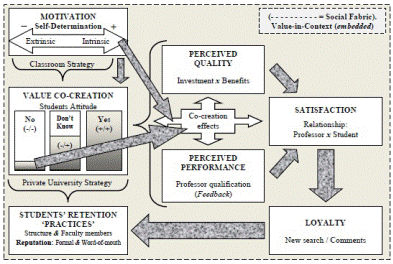
Illustration 2
Educational service co-creation model results
Author.
The results indicate three main groups of students facing the possibility to co-create education or not. There is a group who are unwilling to interact, providing professors with greater difficulty to the co-created development of the classroom, and it also represents the locus where the extrinsic motivation is the students’ propellant aspect (grades, evaluation and certificate may guide de classes, but the results are not the better ones in terms of quality). There is the largest group, the group of those who would like to, but do not know how to co-create, and can be convinced to participate in the co-created class by moderate effort from the professor. Finally, there is a group of students self-motivated to study, who generally have better outcomes in terms of epistemic and functional value, and effectively co-create value.
As a critical point, the focus is observed in the functional dimension of value, in detriment of other faces of the concept. This means that, in some cases, social aspects are listed as having a lower priority than the functional ones. This discussion is similar to the “to have” or “to be” conflict. The prospect of value types originated from co-creative practices represents a possibility for further studies. Another opportunity is to advance to the notion of service proposed by Gummesson (2008), who proposes a broader perspective about the relationships in a network of stakeholders. The educational service can continue to be studied without abandoning the important notion that social reality and its interactions is complex by nature (VERGARA; CALDAS, 2005). Marketing is a subject that deals with complexity, which should be pointed out for studies that can be useful to society as a hole. Equally important, but little explored are the negative situations. The idea that not all co-creation works as expected should also be checked as a research opportunity, for example, in negative service encounters, in education and also in different kinds of social interactions.
REFERENCES
ABRANTES, J. L.; SEABRA, C.; LAGES, L. F. Pedagogical Affect, Student Interest, and Learning Performance. Journal of Business Research, [S. l.], v. 60, p. 960-964, 2007.
ALVES, J. N.; PEREIRA, B. A. D.; BAZZO, P. S. Confiança, Conhecimento e Aprendizagem nos Relacionamentos Interorganizacionais: Diagnóstico e A. dos Avanços sobre o tema. In: ENCONTRO DE ESTUDOS ORGANIZACIONAIS DA ANPAD, 6., 2010, Florianópolis. Anais… Rio de Janeiro: ANPAD, 2010.
AMA - American Marketing Association. 2010. Harold H. Maynard Award Previous Winners. Available in: . Acess on: May 05, 2010.
ANTONACOPOULOU, E. P. Impact and Scholarship: Unlearning and Practising to Co-Create Actionable Knowledge. Management Learning, [S. l.], v. 40, n. 4, p. 421-430, 2009.
APPLETON-KNAPP, S. L.; KRENTLER, K. A. Measuring Student Expectations and their Effects on Satisfaction: The Importance of Managing Student Expectations. Journal of Marketing Education, [S. l.], v. 28, n. 3, p. 254-264, 2006.
ATHANASIOU, A. Developing Learner Autonomy through Collaborative Learning in a Higher Education Context. Journal of Business and Society, [S. l.], v. 20, p. 115-129, 2007.
AUH, S.; BELL, S. J.; McLEOD, C. S.; SHIH, E. (2007). Co-Production and Customer Loyalty in Financial Services. Journal of Retailing, [S. l.], v. 83, n. 3, p. 359-370, 2007.
BENDAPUDI, N.; LEONE, R. P. Psychological Implications of Customer Participation in Co-Production. Journal of Marketing, [S. l.], v. 67, p. 14-28, 2003.
BERRY, L. L. Relationship Marketing of Services: Perspectives from 1983 and 2000. Journal of Relationship Marketing, [S. l.], v. 1, n. 1, p. 59-77.
BORUCHOVITCH, E. Escala de Motivação para Aprender de Universitários (EMA-U): Propriedades Psicométricas. Avaliação Psicológica, [S. l.], v. 7, n. 2, p. 127-134, 2008.
BURRELL, G.; MORGAN, G. Sociological Paradigms and Organisational Analysis. Aldershot, England: Ashgate, 1979.
CAROLILLO, G.; CORTESE, F.; DONATO, D. L’etnometodologia: Profili Teorici Ed Ambiti Applicativi. Dipartimento di Scienze Economico-Aziendali, Giuridiche, Merceologiche e Geografiche: Università degli Studi di Foggia. Quaderno, [S. l.], n. 2, p. 1-28, 2008.
CHIRKOV, V. A Cross-Cultural Analysis of Autonomy in Education: A Self-Determination Theory Perspective. Theory and Research in Education, [S. l.], v. 7, n. 2, p. 253-262, 2009.
CHUNG, E.; McLARNEY, C. The Classroom as a Service Encounter: Suggestions for Value Creation. Journal of Management Education, [S. l.], v. 24, n. 4, p. 484-500, 2000.
COLOSSI, N.; CONSENTINO, A.; QUEIROZ, E. G. Mudanças no Contexto do Ensino Superior no Brasil: Uma Tendência ao Ensino Colaborativo. Revista da FAE, [S. l.], v. 4, n. 1, p. 49-58, 2001.
COSTA, F. J. A influência do valor percebido pelo cliente sobre os comportamentos de reclamação e boca a boca: uma investigação em Cursos de Pós-Graduação Lato Sensu. Tese (Doutorado em Administração) – Escola de Administração de Empresas de São Paulo - FGV-EAESP, São Paulo, 2007.
COSTA, F. J. Formação em Administração na perspectiva do aluno: valor percebido no curso, percepção do prestígio e identificação com a profissão. Revista Ciências Administrativas, v. 14, n. 1, p. 151-163, 2008.
COSTA, F. J. Formação em turismo na perspectiva do estudante: valor percebido no curso, percepção de prestígio e identificação com a profissão. Revista Turismo: Visão e Ação, [S. l.], v. 11, n. 1, p. 3-22, 2009.
COSTA, F. J.; MOTA, K. C. N. Valor Percebido no Curso, Percepção do Prestígio e Identificação com a Profissão: Uma Análise Junto a Estudantes de Turismo. In: Anais do V SEMINÁRIO DA ASSOCIAÇÃO NACIONAL DE PESQUISA E PÓS-GRADUAÇÃO EM TURISMO, 5., 2008, Belo Horizonte. Anais... Belo Horizonte: ANPTUR, 2008.
COSTA, F. J.; OLIVEIRA, L. G. L.; OLIVEIRA, D. M. (2008). Valor Percebido no Curso, Percepção do Prestígio e Identificação com a Profissão: Uma Análise Junto a Estudantes da Área de Negócios. In: ENCONTRO DA ASSOCIAÇÃO NACIONAL DE PÓS-GRADUAÇÃO E PESQUISA EM ADMINISTRAÇÃO, 32., 2008, Rio de Janeiro. Anais... Rio de Janeiro: ANPAD, 2008.
COSTA, F. J.; OLIVEIRA, L. G. L. Valor Percebido no Curso, Percepção do Prestígio e Identificação com a Profissão: Uma Análise Junto a Estudantes de Administração e Contabilidade. Revista de Administração da UFSM, [S. l.], v. 1, n. 3, p. 453-468, 2008.
COSTA, F. J.; SOARES, A. A. C.; BRASILEIRO, A. B. Formação em Administração na perspectiva do aluno: valor percebido no curso, percepção do prestígio e identificação com a profissão. In: ENCONTRO DE ENSINO E PESQUISA EM ADMINISTRAÇÃO E CONTABILIDADE – ENEPQ, 1., 2007, Recife. Anais… Rio de Janeiro: ANPAD, 2007.
COURT, S.; MOLESWORTH, M. Developing Teaching Strategies for Research Methods that are Appropriate to the Learning Styles of Marketing Communication Students. Journal of Marketing Management, [S. l.], v. 19, p. 675-697, 2003.
CROPANZANO, R.; MITCHELL, M. S. Social Exchange Theory: An Interdisciplinary Review. Journal of Management, [S. l.], v. 31, n. 6, p. 874-900, 2005.
DAFT, R. L.; WEICK, K. E. Por um Modelo de Organização Concebido como Sistema Interpretativo. Revista de Administração de Empresas - RAE, [S. l.], v. 45, n. 4, p. 73-86, 2005.
DEBNATH, S. C.; TANDON, S.; POINTER, L. V. Designing Business School Courses to Promote Student Motivation An Application of the Job Characteristics Model. Journal of Management Education, [S. l.], v. 31, n. 6, p. 812-831, 2007.
DeSHIELDS Jr., O. W.; KARA, A.; KAYNAK, E. Determinants of Business Student Satisfaction and Retention in Higher Education: Applying Herzberg’s Two-Factor Theory. International Journal of Education Management, [S. l.], v. 19, n. 2, p. 128-139, 2005.
DETTMER, B.; SOCORRO, C.; KATO, H. T. Marketing de serviços: análise da percepção da qualidade de serviços através da ferramenta servqual em uma instituição de ensino superior de Santa Catarina. Revista de Ciências da Administração, [S. l.], v. 4, n. 8, p. 1-15, 2002.
DONG, B.; EVANS, K. R.; ZOU, S. The Effects of Customer Participation in Co-Created Service Recovery. Journal of the Academy of Marketing Science, [S. l.], v. 36, n. 1, p. 123-137, 2008.
EDVARDSSON, B.; TRONVOLL, B.; GRUBER, T. Expanding Understanding of Service Exchange and Value Co-Creation: A Social Construction Approach. Journal of the Academy of Marketing Science, [S. l.], v. 39, n. 2, p. 327-339, 2011.
FARANDA, W. T.; CLARKE III, I. Student Observations of Outstanding Teaching: Implications for Marketing Educators. Journal of Marketing Education, [S. l.], v. 26, n. 3, p. 271-281, 2004.
FASSINGER, P. A. Understanding Classroom Interaction: Students’ and Professors’ Contributions to Students’ Silence. Journal of Higher Education, [S. l.], v. 66, n. 1, p. 82-96, 1995.
GARFINKEL, H. Estudios en Etnometodología. Barcelona: Anthropos, 2006.
GRACE, D.; O’CASS, A. Service Branding: Consumer Veredicts on Service Brands. Journal of Retailing and Consumer Services, [S. l.], v. 12, p. 125-139, 2005.
GRANITZ, N. A.; KOERNIG, S. K.; HARICH, K. R. Now It’s Personal: Antecedents and Outcomes of Rapport between Business Faculty and their Students. Journal of Marketing Education, [S. l.], v. 31, n. 1, p. 52-65, 2009.
GUMMESSON, E. Extending the Service-Dominant Logic: From Customer Centricity to Balanced Centricity. Journal of the Academy of Marketing Science, [S. l.], v. 36, p. 15-17, 2008.
HALBESLEBEN, J. R. B.; WHEELER, A. R. Student Identification with Business Education Models: Measurement and Relationship to Educational Outcomes. Journal of Management Education, [S. l.], v. 33, n. 2, p. 166-195, 2009.
HEMSLEY-BROWN, J.; OPLATKA, I. Universities in a Competitive Global Marketplace: A Systematic Review of the Literature on Higher Education Marketing. International Journal of Public Sector Management, [S. l.], v. 19, n. 4, p. 316-338, 2006.
HENNIG-THURAU, T.; LANGER, M. F.; HANSEN, U. Modeling and Managing Student Loyalty: An Approach Based on the Concept of Relationship Quality. Journal of Service Research, [S. l.], v. 3, n. 4, p. 331-344, 2001.
HOLBROOK, M. B. Does Marketing Need Reform School? On the Misapplication of Marketing to the Education of Marketers. In: SHETH, J. N.; SISODIA, R. S. (Ed.). Does Marketing Need Reform? Fresh Perspectives on the Future. New York: M. E. Sharpe, 2006. p. 265-269.
HOUSTON, M. B.; BETTENCOURT, L. A. But that’s not Fair! An Exploratory Study of Student Perceptions of Instructor Fairness. Journal of Marketing Education, [S. l.], v. 21, n. 2, p. 84-96, 1999.
IM, S.; WORKMAN JR., J. P. Market Orientation, Creativity, and New Product Performance in High-Technology Firms. Journal of Marketing, [S. l.], v. 68, p. 114-132, 2004.
KAMBIL, A.; FRIESEN, B.; SUNDARAM, A. Co-Creation: A New Source of Value. Outlook, [S. l.], n. 2, p. 38-43, 1999.
KHALIFA, A. S. Student-as-Aspirant: Strategic Implications for Business Education. European Business Review, [S. l.], v. 21, n. 2, p. 172-190, 2009.
KIRSCHBAUM, C.; HOELZ, J. C. Mecanismos Mediadores entre Controle e Confiança. . In: ENCONTRO DE ESTUDOS ORGANIZACIONAIS DA ANPAD, 6., 2010, Florianópolis. Anais… Florianópolis: ANPAD, 2010.
KNIGHT, L.; PETTIGREW, A. Explaining Process and Performance in the Co-Production of Knowledge: A Comparative Analysis of Collaborative Research Projects. In: ORGANIZATION STUDIES THIRD SUMMER WORKSHOP, Crete, Greece, p. 1-38, June 2007.
KOTZÉ, T. G.; PLESSIS, P. F. Students as “Co-Producers” of Education: A Proposed Model of Student Socialization and Participation at Tertiary Institutions. Quality Assurance in Education, [S. l.], v. 11, n. 4, p. 186-201, 2003.
LILLY, B.; TIPPINS, M. J. Enhancing Student Motivation in Marketing Classes: Using Student Management Groups. Journal of Marketing Education, [S. l.], v. 24, n. 3, p. 253-264, 2002.
LIN, C.-P.; TSAI, Y. H. Modeling Educational Quality and Student Loyalty: A Quantitative Approach Based on the Theory of Information Cascades. Quality and Quantity, [S. l.], v. 42, n. 3, p. 397-415, 2006.
LOPES, F. T.; MAGESTE, G. S. Pedagogia Crítica: Repensando o Ensino de Estudos Organizacionais. In: ENCONTRO DE ESTUDOS ORGANIZACIONAIS DA ANPAD, 5., 2008, Belo Horizonte. Anais… Belo Horizonte: ANPAD, 2008.
LUSCH, R. F. Marketing’s Evolving Identity: Defining Our Future. Journal of Public Policy & Marketing, [S. l.], v. 26, n. 2, p. 261-268, 2007.
MORGAN, G.; SMIRCICH, L. The Case for Qualitative Research. Journal of the Academy of Management Review, [S. l.], v. 5, n. 4, p. 491-500, 1980.
NADIRI, H. Strategic Issue in Higher Education Marketing: How University Students’ Perceive Higher Education Services. The Asian Journal Quality, [S. l.], v. 7, n. 2, p. 125-140, 2006.
NAVARRO, M. M.; IGLESIAS, M. P.; TORRES, P. R. A New Management Element for Universities: Satisfaction with the Offered Courses. International Journal of Educational Management, [S. l.], v. 19, n. 6, p. 505-526, 2005.
OLIVEIRA, B. A. O Trabalho Educativo: reflexões sobre paradigmas e problemas do pensamento pedagógico brasileiro. Campinas: Autores Associados, 1996.
OLIVEIRA, S. A.; MONTENEGRO, L. M.; MACHADO-DA-SILVA, C. L.; RESE, N. Etnometodologia: desvelando a alquimia da vivência cotidiana. In: ENCONTRO DE ESTUDOS ORGANIZACIONAIS DA ANPAD, 6., 2010, Florianópolis. Anais... Rio de Janeiro: ANPAD, 2010.
PAIXÃO, A. L. A Etnometodologia e o Estudo do Poder: Notas Preliminares. Anal. & Conj., [S. l.], v. 1, n. 2, p. 93-110, 1986.
PASWAN, A. K.; YOUNG, J. A. Student Evaluation of Instructor: A Nomological Investigation Using Structural Equation Modeling. Journal of Marketing Education, [S. l.], v. 24, n. 3, p. 193-202, 2002.
PAYNE, A. F.; HOLT, S. Diagnosing Customer Value: Integrating the Value Process and Relationship Marketing. British Journal of Management, [S. l.], v. 12, n. 2, p. 159-182, 2001.
PAYNE, A. F.; STORBACKA, K.; FROW, P.; KNOX, S. Co-Creating Brands: Diagnosing and Designing the Relationship Experience. Journal of Business Research, [S. l.], v. 62, n. 3, p. 379-389, 2009.
PAYNE, A. F.; STORBACKA, K.; FROW, P. Managing the Co-Creation of Value. Journal of the Academy of Marketing Science, [S. l.], v. 36, p. 83-96, 2008.
PELTIER, J. W.; HAY, A.; DRAGO, W. The Reflective Learning Continuum: Reflecting on Reflection. Journal of Marketing Education, [S. l.], v. 27, n. 3, p. 250-263, 2005.
PINI, F. M. The Role of Customers in Interactive Co-Creation Practices: The Italian Scenario. Journal of Know Techn Pol, [S. l.], v. 22, p. 61-69, 2009.
PRAHALAD, C. K.; RAMASWAMY, V. Co-Creation Experiences: The Next Practice in Value Creation. Journal of Interactive Marketing, [S. l.], v. 18, n. 3, p. 5-14, 2004.
PRAHALAD, C. K.; RAMASWAMY, V. The New Frontier of Experience Innovation. MIT Sloan Management Review, [S. l.], p. 12-18, 2003.
QIAN, B. Expectation, Service Quality, and Satisfaction in Higher Education: School of Management Strategic Marketing Group. MSc Theses (School of Management: Master of Science). Supervisor: Paul Baines. Cranfield University, [S. l.], p. 1-95, Sept. 2006.
RAMASWAMY, V.; GOUILLART, F. Building the Co-Creative Enterprise. Harvard Business Review, [S. l.], p. 100-109, Oct. 2010.
RAMASWAMY, V. Leading the Transformation to Co-Creation of Value. Strategy & Leadership, [S. l.], v. 37, n. 2, p. 32-37, 2009a.
RAMASWAMY, V. The Rules of Engagement: Are You Ready for the Co-Creation Movement? IESE Insight, [S. l.], v. 2, n. 3, p. 29-35, 2009b.
RAMÍREZ, R. Value Co-Production: Intellectual Origins and Implications for Practice and Research. Strategic Management Journal, [S. l.], v. 20, p. 49-65, 1999.
RAMSEY, V. J.; FITZGIBBONS, D. E. Being in the Classroom. Journal of Management Education, [S. l.], v. 29, n. 2, p. 333-356, 2005.
REEVE, J. M.; HALUSIC, M. How K-12 Teachers can put Self-Determination Theory Principles into Practice. Theory and Research in Education, [S. l.], v. 7, n. 2, p. 145-154, 2009.
SHETH, J. N.; NEWMAN, B. I.; GROSS, B. L. Why We Buy What We Buy: A Theory of Consumption Values. Journal of Business Research, [S. l.], v. 22, p. 159-170, 1991.
SHETH, J. N.; PARVATIYAR, A. Evolving Relationship Marketing into a Discipline. Journal of Relationship Marketing, [S. l.], v. 1, n. 1, p. 3-16, 2002.
SHETH, J. N.; SISODIA, R. S. (Ed.). Does Marketing Need Reform? Fresh Perspectives on the Future. New York: M. E. Sharpe, 2006.
SIERRA, J. J. Shared Responsibility and Student Learning: Ensuring a Favorable Educational Experience. Journal of Marketing Education, [S. l.], v. 32, n. 1, p. 104-111, 2010.
SILVA, M. Educação na Cibercultura: o desafio comunicacional do professor presencial e online. Revista FAEEBA, [S. l.], v. 12, n. 20, p. 261-271, 2003.
SOARES, A. A. C.; COSTA, F. J. A influência do valor percebido e da satisfação do cliente sobre o comportamento de boca a boca: uma análise em academias de ginástica. Revista Brasileira de Gestão de Negócios, [S. l.], v. 10, n. 28, p. 295-312, 2008.
TINTO, V.; CULLEN, J. Dropout in Higher Education: A Review and Theoretical Synthesis of Recent Research. Report of Work: Columbia University, [S. l.], p.100, June 1973.
TINTO, V. Research and Practice of Student Retention: What Next? Journal of College Student Retention, [S. l.], v. 8, n. 1, p. 1-19, 2005.
TRESMAN, S. Towards a Strategy for Improved Student Retention in Programmes of Open, Distance Education: A Case Study from the Open University UK. The International Review of Research in Open and Distance Learning, [S. l.], v. 3, n. 1, 2002.
TROCCOLI, I. R. Co-Criação de Valor e Fidelização dos Clientes: Uma Visão Integrada. Inter Science Place, [S. l.], v. 2, n. 4, p. 1-23, 2009.
VARGO, S. L. Customer Integration and Value Creation: Paradigmatic Traps and Perspectives. Journal of Service Research, [S. l.], v. 11, n. 2, p. 211-215, 2008.
VARGO, S. L.; LUSCH, R. F. Evolving to a New Dominant Logic for Marketing. Journal of Marketing, [S. l.], v. 68, p. 1-17, 2004.
VARGO, S. L.; MAGLIO, P. P.; AKAKA, M. A. On Value and Value Co-Creation: A Service Systems and Service Logic Perspective. European Management Journal, [S. l.], v. 26, p. 145-152, 2008.
VARGO, S. L.; MORGAN, F. W. Services in Society and Academic Thought: An Historical Analysis. Journal of Macromarketing, [S. l.], v. 25, n. 1, p. 42-53, 2005.
VARGO, S. L. On a Theory of Markets and Marketing: From Positively Normative to Normatively Positive. Australasian Marketing Journal, [S. l.], v. 15, n. 1, p. 53-60, 2007.
VARGO, S. L. Toward a Transcending Conceptualization of Relationship: A Service-Dominant Logic Perspective. Journal of Business & Industrial Marketing, [S. l.], v. 24, n. 5/6, p. 373-379, 2009.
VERGARA, S. C.; CALDAS, M. P. Paradigma interpretacionista: a busca da superação do objetivismo funcionalista nos anos 1980 e 1990. RAE: Revista de Administração de Empresas, [S. l.], v. 45, n. 4, p. 66-72, 2005.
VOSS, R.; GRUBER, T.; SZMIGIN, I. Service Quality in Higher Education: The Role of Student Expectations. Journal of Business Research, [S. l.], v. 60, n. 9, p.9 49-959, 2007.
WINER, R. S. A Framework for Customer Relationship Management. California Management Review, [S. l.], v. 43, n. 4, p. 89-105, 2001.
YOUNG, M. R. The Motivational Effects of the Classroom Environment in Facilitating Self- Regulated Learning. Journal of Marketing Education, [S. l.], v. 27, n. 1, p. 25-40, 2005.
ZEITHAML, V. A.; BITNER, M. J. Marketing de serviços: a empresa com foco no cliente. 2. ed. Porto Alegre: Bookman, 2003.