Received: 21 August 2019
Accepted: 30 December 2019
DOI: https://doi.org/10.21714/1984-6975FACES2019V18N4ART7232
Abstract: Science parks have spread throughout the world as mechanisms to promote innovation, technology transfer, knowledge exchange, generation of skilled employment and socioeconomic development. Nevertheless, a current challenge for a venture is the development of more detailed performance management system, representing the major stakeholders, demonstrating results and indicating opportunities for improvement. To contribute to fulfilling this gap, this work proposes a model for performance management of science parks, using the management tool Balanced Scorecard (BSC) as a reference. In drawing up this model, a multiple case study was designed in three Brazilian science parks in operation. The justification for the development of this model is the need for the creation and improvement of a management tool that is a reference for science parks’ managers and stakeholders. Thereby, it is expected that the model helps managers understand the strategic goals and performance indicators common to these ventures. The research contributions by extending known solutions to new problems and the results could be applied in several science parks.
Keywords: Science parks, Critical success factors, Performance management, Balanced scorecard, Strategic map.
Resumo: Os parques tecnológicos se espalharam pelo mundo como mecanismos para promover a inovação, a transferência de tecnologia, a troca de conhecimento, a geração de empregos qualificados e o desenvolvimento socioeconômico. No entanto, um desafio é o desenvolvimento de sistemas de gerenciamento de desempenho mais detalhados, demonstrando resultados e oportunidades de melhoria. Esta pesquisa propõe um modelo de gestão de desempenho de parques tecnológicos, utilizando como referência a ferramenta de gestão Balanced Scorecard. Na elaboração deste modelo, um estudo de caso múltiplo foi elaborado em três parques brasileiros. A justificativa para o desenvolvimento desse modelo é a necessidade de criação e aprimoramento de uma ferramenta de gestão que seja referência para os gestores e os stakeholders. Dessa forma, espera-se que o modelo ajude os envolvidos a entender os objetivos estratégicos e os indicadores de desempenho comuns a esses empreendimentos. Essa pesquisa contribui em estender uma solução conhecida para novos problemas, e os resultados podem ser aplicados em diversos parque tecnológicos.
Palavras-chave: Parques tecnológicos, Fatores críticos de sucesso, Gestão de desempenho, Balanced scorecard, Mapa estratégico.
1 Introduction
In an increasingly knowledge-based economy, science parks have emerged as promising mechanisms to promote sustainable development through innovation. Based on the Triple Helix model of university-industry-government interaction (ETZKOWITZ; LEYDESDORFF, 1999; ETZKOWITZ, 2003), these ventures act as regional economic development catalysts, facilitating the creation and development of new technology-based companies and knowledge transfer between universities and businesses (VILÀ; PAGÈS, 2008).
According to the International Association of Science Parks and Areas of Innovation (IASP, 2016), science parks are a highly specialized type of innovation area, that seek to stimulate and manage the flow of knowledge and technology between universities and companies. By facilitating the communication between companies, entrepreneurs, and technicians, they provide an environment that enhances a culture of innovation, creativity, and quality.
However, issues concerning science parks’ governance, such as the alignment and integration of actors and organizations, and the evaluation of performance and accountability, including the proper identification of improvement opportunities, have been discussed more intensively (BIGLIARDI; DORMIO; NOSELLA; PETRONI, 2006; DABROWSKA, 2011; FERRARA; LAMPERTI; MAVILIA, 2016; MONCK; PETERS, 2009). Notably, there is a dearth of studies that address questions concerning science parks’ governance and a lack of clarity regarding the performance measurement of these organizations (PHAN; SIEGEL; WRIGHT, 2005).
Consequently, proposals have emerged for the development of more detailed performance assessment systems that can be deployed relatively easily and are accepted by the main stakeholders (ANDREEVNA, 2013; DABROWSKA, 2011; FERNANDES, 2014; RODEIRO-PAZOS; CALVO-BABIO, 2012). Although, there is no consensus on what is a successful science park and it is particularly difficult to properly compare these ventures (DABROWSKA, 2011; FERRARA; LAMPERTI; MAVILIA, 2016).
This paper follows a multiple study case design (YIN, 2014) and proposes a model for the performance management of science parks, using the Balanced Scorecard (BSC) reference (KAPLAN; NORTON, 1997; 2000; 2004). Furthermore, a strategic map was prepared, integrating information collected in multiple case study in three Brazilians science parks and a set of theoretical and conceptual performance indicators.
2 Context and Circumstances Under Investigation
2.1 Critical Success Factors of Science Parks
In recent years, several Brazilian cities have expressed interest in installing science parks to develop skills of universities and local companies, stimulating the development of their regions (Associação Nacional de Entidades Promotoras de Empreendimentos Inovadores - ANPROTEC, 2019). However, as these ventures demand high public investment and the available resources are limited, it is essential to establish parameters to assess their feasibility.
In a study conducted by the Association of University Research Parks (AURP, 2013), six critical factors for the success of a park were indicated: good convergence between the scientific basis of the affiliated university and the resident companies; ability to help startups in the commercialization processes; access of the tenant enterprises to capital for investments; priority in providing spaces for graduated companies from the business incubator; priority access to university resources such as facilities, researchers and students; formal presence of a business incubator.
Regarding the success of the resident companies in the park, the availability and ease of resources acquisition are fundamental (TSAMIS, 2009; KHARABSHEH; MAGABLEH; ARABIYAT, 2011) and can occur in two ways: by governments, inducing specific programs or using their purchase power, and by the private sector, through companies, commercial banks and venture capitalists (VEDOVELLO; JUDICE; MACULAN, 2006).
By analyzing the literature, other factors may be considered for the success of a science park, such as governance (BIGLIARDI et al., 2006; CHIOCHETTA, 2010; JÚNIOR; PORTO; PACÍFICO; JÚNIOR, 2015; KHARABSHEH, 2012; KHARABSHEH; MAGABLEH; ARABIYAT, 2011; PHAN; SIEGEL; WRIGHT, 2005); geographic location (LINK; SCOTT, 2003; VEDOVELLO, 1997); infrastructure (GARGIONE; PLONSKI; LOURENÇÃO, 2005; VEDOVELLO; JUDICE; MACULAN, 2006); innovation capacity and entrepreneurial culture in the region (SAUBLENS, 2007; KHARABSHEH, 2012); qualified management team (KHARABSHEH, 2012; KHARABSHEH; MAGABLEH; ARABIYAT, 2011); presence of anchor company (WASIM, 2014); network for learning (HANSSON; HUSTED; VESTERGAARD, 2005).
Besides, several external aspects related to cultural, political, economic and social issues can also be highlighted. This environmental factor (environment) influences the degree of development and the viability of the parks, and its interference can be seen in the definition of priorities, the institutional structure in relation to technology transfer, cooperation and entrepreneurship, the availability of resources to attract companies to the park and the domestic market which supports the growth of small technology-based companies (TSAMIS, 2009).
2.2 Science Parks’ Performance Evaluation
Although science parks are nowadays largely regarded as key elements of the research-based regional development policy (SAUBLENS et al., 2007), evaluating their performance is a complex task (FERRARA; LAMPERTI; MAVILIA, 2016), characterized by the proposition of approaches that cannot be generalized (BIGLIARDI et al., 2006; DABROWSKA, 2011; PHAN; SIEGEL; WRIGHT, 2005; VEDOVELLO; JUDICE; MACULAN, 2006). Even though success stories can be highlighted, there is no agreement on a systematic approach to understand the science parks and identify the nature of their performance (DABROWSKA, 2011; PHAN; SIEGEL; WRIGHT, 2005; RATINHO; HENRIQUES, 2010). Besides, a lack of a clear and shared taxonomy, which distinguishes between science parks and different structures, and the scarcity of available data concerning real ventures make the plain understanding of the phenomena even more difficult (GUY, 1996; FERRARA; LAMPERTI; MAVILIA, 2016).
According to Fernandes (2014), the need to assess the effectiveness of science parks arose due to the expansion of the concept and the creation of new parks. It is about a real demand and can be understood as a consequence of the mechanism maturing as a policy to foster technological entrepreneurship. The performance assessment can contribute to the identification of best practices that enhance these ventures’ competitiveness, and also provide support for the development of the science park model and/or objectives, rectifying any shortcomings (FERRARA; LAMPERTI; MAVILIA, 2016).
Recent studies have used the Balanced Scorecard as a theoretical framework to propose a more consistent approach for managing science parks’ performance (ANDREEVNA, 2013; DABROWSKA, 2011; RODEIRO-PAZOS; CALVO-BABIO, 2012). In these studies, contributions are pointed at the subject, especially in suggesting performance dimensions and indicators for measuring these ventures’ effectiveness. However, greater depth investigations are necessary to explore the Strategic Map and the Balanced Scorecard potential as integrated tools for the strategic management of science parks.
2.3 Balanced Scorecard and Strategic Maps
The Balanced Scorecard promoted and integrated important aspects related to value creation for organizations, such as the human capital, the critical internal processes and the value proposition for customers or the target audience, which would be intrinsically related to the achievement of financial results and the fulfillment of the proposed mission (KAPLAN; NORTON, 1997).
Its name was chosen because the model reflected the balance between short- and long-term objectives, financial and nonfinancial measures, lead and lag indicators and internal and external perspectives of performance. This way, the BSC proposes the integration of objectives, indicators, targets, and initiatives in four interrelated categories of performance: financial, customer, internal processes, and learning and growth (KAPLAN; NORTON, 1997).
The financial perspective is responsible for defining the expected financial performance of the strategy and to provide the main targets for the objectives and measures of all other perspectives of the scorecard. Financial performance measures strategy tangible results, which show whether the organization is heading for success. Two main themes guide this perspective: revenue growth and increased productivity (KAPLAN; NORTON, 2004).
According to BSC subjacent logic, improved financial performance is closely related to the success in meeting customer desires and needs. Thus, it is necessary to carefully establish the organization's value proposition, which will clarify the context for intangible assets and internal processes to create value. The success of the customer's perspective can be measured by results indicators such as satisfaction, customer retention, and growth of success with customers.
While the financial and client perspectives describe the expected results of the strategy implementation (constitute the external sides of performance), the internal processes perspective identifies the critical few processes that must exert the greatest impact on strategy (KAPLAN; NORTON, 2004, p. 32). These are the processes that will create and fulfill the value proposition for customers and indicate improvement trends that will impact on the target audience and financial results.
Based on the BSC, the learning and growth perspective is responsible for defining the most important intangible assets for strategy. The objectives in this perspective identify which jobs (human capital), systems (information capital) and type of climate (organizational capital) are needed to support the internal processes of value creation. These assets must be connected certainly with each other and aligned with the critical internal processes (KAPLAN; NORTON, 2004). Furthermore, "the improvements in the results of learning and growth are trend indicators for the internal processes, customers and financial performance" (KAPLAN; NORTON, 2004, p. 7).
The BSC has been improved and has become complemented by a management tool called "Strategy Map", used to describe the strategy through goals interconnected in cause and effect relationships in the four perspectives (KAPLAN; NORTON, 2004). The strategy map provides further details about each perspective, improving the strategy’s clarity and focus. The internal processes perspective, for example, became to present four strategic groups of activities, and the customer perspective, to present more parameters related to attributes of products and services, relationships and image.
3 Diagnosis of the Problem Situation
3.1 Research strategy
The research diagnosis was based on a multiple case study. This research strategy is justified to understand a complex phenomenon that is not very well understood (MEREDITH; RATURI; AMOAKO-GYAMPAH; KAPLAN, 1989), also that it is indicated to analyze complex subjects (YIN, 2014). Therefore, this study used multiple case study to identified in science parks’ context the factor that contributes most to explain their performance. According to Barratt, Choi, and Li, (2011) is possible to increase the research practical relevance thought manager experience.
3.2 Data collection
To carry out this research, primary and secondary data were collected. Initially, the literature review on science parks, critical success factors, performance evaluation, BSC and strategic maps based on the drafting of the semi-structured questionnaire covering science parks’ planning and strategic performance management. In the next stage, were held ten semi-structured interviews with operational and strategic level managers of three science parks in operation in Brazil: tecnoPARQ (Viçosa, Minas Gerais state), BH-TEC (Belo Horizonte, Minas Gerais state), and Sapiens Parque (Florianópolis, Santa Catarina state).
Information about the interviewee’s profile
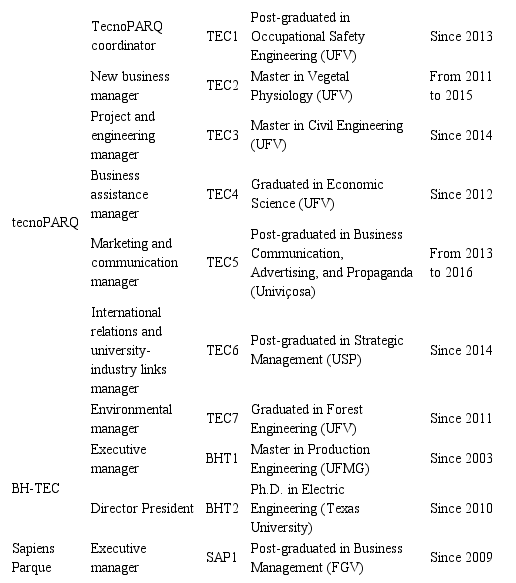
The interviews took place at each science park researched, after a formal contact presenting the study, its objectives and the roadmap of semi-structured questions (Table 1). As well as the interviews, secondary data were collected through direct observation and institutional documents. This triangulation increased the internal validity of the research findings.
3.3 Science parks context
The parks chosen represent ventures in different stages of maturity and regional contexts, allowing a broader spectrum of analysis of management practices, important for the construction of reference models. Taking in account the parks contexts and cities where they are located, respectively, the tecnoPARQ (Science Park of Viçosa) was opened in 2011, is the first science park of Minas Gerais state to come into operation. With a total area of 214 hectares, only 40 hectares are intended for urbanization and occupancy by technology-based companies and centers of research, development, and innovation.
As an important anchor, tecnoPARQ has the Federal University of Viçosa (UFV), a reference in teaching and research in the country, especially in agricultural areas. In 2014, tecnoPARQ had 11 resident companies, that obtained revenue of about US$ 1,5 million (www.centev.ufv.br/tecnoparq/pt-br/ accessed in 07 Jan. 2019). Viçosa is a small town, with about 70.000 inhabitants, a GDP per capita of around US$ 4.891,00 and a Human Development Index (HDI) of 0,775 (Instituto Brasileiro de Geografia e Estatística – IBGE, 2019).
The BH-TEC (Science Park of Belo Horizonte) has opened in 2012, is the second science park in Minas Gerais state to come into operation. Located near the Federal University of Minas Gerais (UFMG), it has approximately 535.000 m2 of total area. Of these, approximately 185.000m2 are for the construction of 12 buildings with a building potential estimated at 235.241m2 (www.http://bhtec.org.br/ accessed in 25 Jan. 2019). The institutional building 1 is operating on full occupancy.
Currently, the park has 25 partner companies, being 18 residents and seven associated but non-residents. In 2014, these companies achieved a turnover of US$ 32,63 million, paid US$ 2,5 million in taxes and employed 120 professionals with a post-graduate degree (www.http://bhtec.org.br/ access in 25 Jan. 2019). Belo Horizonte is the capital of Minas Gerais, and has a population of about 2.375.151 inhabitants, with a GDP per capita of around US$ 10.296,00 and an HDI of 0,810 (IBGE, 2019).
Sapiens Parque (Science Park of Florianópolis) was opened in 2006 as a relative pioneer park in the country. Located in the state capital of Santa Catarina, in the south of Brazil, it has a total area of approximately 430 hectares, with a maximum building potential estimated at 1,3 million square meters. It is housed in an innovative ecosystem, with traditional universities and research institutes, such as the Federal University of Santa Catarina (UFSC) and the Foundation Reference Center for Innovative Technologies (Fundação CERTI).
According to information obtained from this research, today the park has 17 tenant companies, which employ 240 employees. Over the next two years, it is expected that more 35 companies are setting up in the venture. Florianópolis, in turn, is the capital of Santa Catarina state and has 421.240 inhabitants, a GDP per capita of around US$ 10.151,00 and an HDI of 0,847 (IBGE, 2019).
3.4 Strategic planning and performance management of science parks
For the analysis, the content analysis technique was used, more specifically thematic analysis (VAISMORADI; TURUNEN; BONDAS, 2013). In this sense, related information from the interviews was grouped and four thematic categories have been formulated, addressing (i) critical success factors, (ii) service portfolio, (iii) performance indicators, and (iv) positioning, strategy and strategic objectives of the parks. On the following topic, the analysis and discussion of the results are presented. The analysis of the literature and interviews based on the drafting of the Reference Model for Performance Management of Science Parks. This model is anchored in the management tools Strategic Map and Balanced Scorecard and relates objectives and performance indicators for the strategic management of these ventures.
Approached the general outline of the surveyed parks, it is worth remembering that the data collected from semi-structured interviews with its managers were grouped and analyzed in four thematic categories related to the strategic planning and performance management of science parks: (1) critical success factors; (2) services portfolio; (3) results indicators; (4) positioning, strategy and strategic objectives. The data analysis enabled the comparison between theory and practice and showed the managers’ views on the issues addressed. The key aspects of the experience of those involved were also used as inputs for the elaboration of the science parks’ performance management model.
3.4.1 Critical success factors
In contraposition to the high number of success factors mentioned in the literature, the park managers simultaneously highlighted only two aspects as critical to the science parks’ performance: (1) physical space and infrastructure for the establishment of companies; (2) close knowledge source (strong scientific, technological, research, and innovation basis).
Science parks’ critical success factors
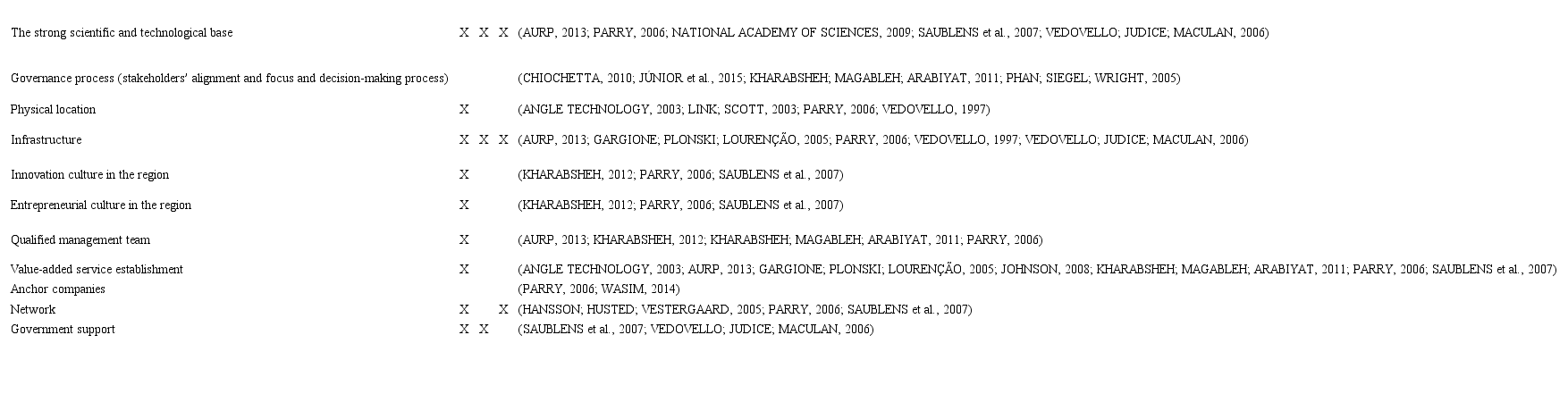
Besides, other relevant aspects mentioned were government support, presence, and demand of business, resources, the connection of companies with universities, cooperation between companies, clustering, qualified management team, with market experience, value-added services for businesses, entrepreneurial culture and decentralized management (Table 2).
3.4.2 Services portfolio
The range of services offered by science parks for tenant companies was evidenced in many ways of support. Among those highlighted are the support for raising institutional funds or investors, supporting the development of projects, events promotion, and legal advice.
High value-added services provided by science parks

Notably, an aspect of the services portfolio was simultaneously emphasized by all the park managers: the networking with universities, other companies, and institutional partners. This observation reinforces the importance of institutional cooperation between university-industry-government for the parks’ success, consolidating the triple-helix concept (Table 3).
3.4.3 Results indicators
In this category of analysis, managers were again highlighting simultaneously only two indicators as the main results of a science park: innovative products and services with commercial success and the evolution of the tenant companies’ revenues. However, other performance indicators were mentioned, such as registration of patents, investments made, internationalization of companies, joint projects between firms and projects in partnership with universities.
Science parks’ results indicators

According to the analysis of the interviews and considering the literature review, it can be said that the main results of a science park are concentrated in two main categories of performance: scientific and technological development and socio-economic development, as shown in Table 4. On the first, it can be seen aspects related to innovations in products and services and the creation of new businesses and technology-based companies through applied research. On the second, there are indicators such as job creation, taxes, and income linked to the development and performance of the business from the park.
3.4.4 Positioning, strategy and strategic objectives
Each park has its vision of future and hopes to see in it more clearly defined its business focus: the tecnoPARQ wants to specialize in all the extensive animal and human biotechnology chain; the BH-TEC aims to focus on the sectors of biotechnology and information technology; and Sapiens Parque seeks to stand out in the clusters of information technology, creative economy, sustainable energy, and life sciences, focusing on the development of drugs.
Regarding the parks’ development strategies, which involve their value propositions for the tenant companies, there is a common concern for promoting competitiveness through the services offered by the parks. In this sense, some interesting views are: "we focus a lot on the maturity of these value-added services that we provide to companies" (TEC1), "we have a great battle in this, to create value for companies" (BHT2), and "we become more competitive by offering a better service" (SAP1).
More specifically, each venture establishes its development strategy. In tecnoPARQ, great emphasis is placed on the maturation of value-added services to enterprises, to overcome the difficulties of the geographical location. In this sense, the park seeks competitiveness through "a qualified team and a present follow-up, giving support to companies and trying to minimize problems that may arise” (TEC1).
BH-TEC seeks to create the brand of a science park that promotes economic development guided by the innovation and development of borderline products. This way, its strategy is "the selection of academic spin-offs, of relevant technology companies, at least to the regional scenario, together with the establishment of technology centers and laboratories that are anchors for the development of other ventures." (BHT1)
By its turn, the Sapiens Parque emphasizes the strengthening of the university-industry cooperation, understanding that applied research and technology transfer is essential for the park success. Emphasizing collaboration between innovation actors (firms and universities), "the main strategy of the park is the creation of clusters for the generation of products, services, networking and connections seeking competitiveness” (SAP1).
Regarding the strategic objectives, common features were also found. All parks highlighted the importance of the physical space settlement, by attracting more technology-based firms, anchor companies, and centers of technology or research. Another obvious difficulty is the need for expansion and improvement of infrastructure since all surveyed parks require more investments and greater agility in the works of urbanization and structuring of physical space.
4 Performance Evaluation Analysis and Balanced Scorecards Model Proposal
As a reference model, the strategic map that integrates the strategic objectives and performance indicators based on the BSC in the context of science parks, proposed here, needs to be adapted by managers to the environment in which it will be applied, taking into consideration the specificities of the park and its boundary conditions. As a planning and management tool, the model can be used by science parks in different stages of development (planning, installation, and operation) and by ventures in operation as a performance evaluation tool. In this sense, the model can contribute to the building of a park strategic system of performance management that promotes alignment and focus of its strategic policies and actions with its mission and goals.
In the proposed theoretical-conceptual model, the original four dimensions of BSC are established in the following way: Learning and growth perspective, Internal process perspective, Tenant companies’ perspective, Technical and scientific perspective, and Sustainable development perspective, as shown in Table 5. The adoption and definition of these perspectives were made considering the science parks’ success factors, the services portfolio (value-added services usually offered to companies), and the most common performance measures and strategic objectives of science parks, according to the literature and the analysis of the cases.
Perspectives’ definition for the science parks’ performance management model

From the definition of perspectives, as shown in Table 5, and considering their relationship with critical success factors (Table 2), high value-added services (Table 3) and results indicators (Table 4), it was proposed the performance management model of science parks in Figure 1. The management model integrates performance perspectives, strategic goals and performance indicators in a strategic map and a BSC for science parks.
The model perspectives are entwined systematically, through cause and effect relationships, and represent internal and external dimensions of performance, considered strategic in the context of science parks. As seen in the literature review, the Strategic Map and the Balanced Scorecard are complementary tools, since the Strategic Map aims to describe the strategy, while the BSC aims to measure the strategy.
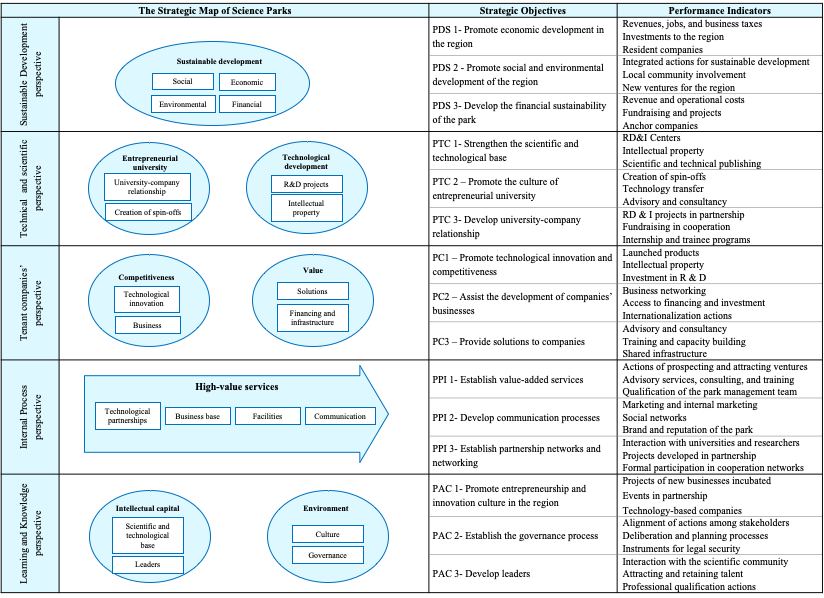
Figure 1
Reference model for performance management of science parks
As shown in the model, the sustainable development perspective goes beyond the traditional measures of financial and innovation performance expected by most ventures. It reflects a dimension of the park value to the stakeholders and society or the fulfillment of the park mission as a local and regional development vector. The sustainable development perspective is responsible for defining the expected performance of the park’s strategy and provides the necessary outcomes for planning major strategic objectives and measures of all other perspectives of the scorecard. In this context, four main axes guide this perspective: social, economic, financial and environmental.
The performance of the sustainable development perspective measures the tangible results of the strategy, which show whether the science park is heading for success. For science parks, the ultimate criteria of success are not the financial performance of the park itself or the creation of sustainable value for resident companies, but the performance in fulfilling its mission. Thus, the success of a science park cannot be measured exclusively by the performance of resident companies. But this is a very important metric for local and regional economic development.
Considering the logic of the BSC proposed for the model, the success of a science park is also related to the performance results of the tenant companies and research and education institutions involved more directly with the science park (techno-scientific perspective). If on one hand, companies, by definition, are the agents of innovation, the excellent scientific and technological basis is responsible, in large part, for providing the knowledge and the necessary resources to the development of research and development projects, the raw material for innovation. The park management, in turn, is responsible for much of the interaction initiatives between the innovation actors and among stakeholders in general. In the model, the performance of the park management is contemplated in the Internal Processes and Learning and Growth perspectives.
The presence of a strong scientific and technological base is seen as a sine qua non condition for the establishment of a science park. But only the geographical proximity does not guarantee a strong relationship between university-company type (LINK; SCOTT, 2003; SIEGEL; WALDMAN; LINK, 2003; VEDOVELLO, 1997). Therefore, the park must establish strategic objectives to strongly influence this performance perspective, considering the context of scientific and technological development and the promotion of the entrepreneurial university. Thus, the technical-scientific perspective has four areas: university-business relationship, creation of spin-offs, research, development and innovation institutions (R, D&I) projects and intellectual property.
From the perspective of this model, the BSC customers dimension is represented by the tenant companies, which are the "real basic cell of the ecosystem, for being the organizations effectively responsible for the introduction of solutions or new products or services in the market successfully” (FIATES, 2014, p. 80). The success of the tenant companies’ perspective is measured by performance indicators unfolded on two main axes: competitiveness and value. It is understood that the competitiveness of resident companies will be achieved through the intensity of technological innovation and business development. The value, or the value proposition, consists of the solutions that businesses receive from the park, which added to the access to financing and quality of infrastructure, can contribute to improving their performance.
Following the BSC logic, the perspectives of sustainable development, scientific and technological development and tenant companies are external dimensions of the park performance, which measure the expected results of the implementation of the venture mission. For its part, the perspective of internal processes shows the work that the park must take to fulfill its mission, considering the processes that will create the value proposition for the tenant companies.
Thus, the internal processes perspective and the learning and growth perspective have been established to ensure the offering of the park's value proposition for tenant companies. The perspective of internal processes is planned considering the need of providing value-added services to tenant companies and therefore considers four strategic themes: technological partnerships, business base, facilities, and communication.
The learning and growth perspective, based on BSC, represents the intangible assets (like competences and skills) that enable the creation and development of a science park and that are, therefore, required to support the internal processes of value creation. The learning and growth perspective have four main areas: scientific and technological base, leadership, culture, and governance. These intangible assets are interconnected and the outcome indicators of the strategic objectives of this perspective should be considered in the planning of the axes of the internal processes’ perspective.
The strategic objectives proposed for the model represent short- and long-term goals, leading to the park the establishment of targets for the proposed indicators, according to the corresponding performance perspective and strategic planning. Setting goals for the indicators associated with different strategic objectives mean defining clearly and reliably, the performance level or the rate of improvement needed. Obviously, for each proposed strategic objective it should be developed a plan of action, addressing operational actions, budgets, and specifications of how to achieve the goals. In turn, the performance indicators refer to measures to assess whether the strategic objective of the proposed perspective is being achieved or not. As a reference model, objectives and indicators can also vary over time according to the maturity of the park.
The proposed performance management model of parks is not limited, therefore, to measure only the performance of the science park. It is, in essence, a path for park managers so that they can establish a strategic management system capable of promoting alignment and focus, considering the different interests of stakeholders and the mission of the park. This path means that the park should make the strategy a continuous process, with the definition of activities and responsibilities for all involved.
5 Conclusion and Practical Contributions
The purpose of this paper is proposing a model for the performance management of science parks, using the Balanced Scorecard reference (KAPLAN; NORTON, 1997; 2000; 2004). Traditionally in the literature, the performance of science parks has been evaluated through the performance of resident companies. However, research on the importance of the science parks for the improvement of tenant companies performance (LÖFSTEN; LINDELÖF, 2002; SIEGEL; WESTHEAD; WRIGHT, 2003A; SIEGEL; WESTHEAD; WRIGHT, 2003b) and the relationships between companies and universities (LINK; SCOTT, 2003; SIEGEL; WALDMAN; LINK, 2003; VEDOVELLO, 1997) had shown inconclusive results (BAKOUROS; MARDAS; VARSAKELIS, 2002; DABROWSKA, 2011; HELMERS, 2011; MONCK; PETERS, 2009; SCHMIDT; BALESTRIN, 2015).
Another difficulty associated with the generalization of the results of science parks’ performance evaluation, considering only the context of resident companies or the university-industry relationship, is associated with the fact that the park has many stakeholders with different institutional missions. The science parks "serve many masters with different interests and expectations" (HANSSON; HUSTED; VESTERGAARD, 2005, p. 1040) and to manage all of these interests is a complex task (JÚNIOR et al., 2015). By observing this evidence, the proposed management model tried to include the contributions and expectations of key stakeholders: park management team, tenant companies, university, and society.
Many parks and their managers are resistant to performance evaluation, in part because they are concerned about the consequences of a bad evaluation by its stakeholders and on the other hand because they consider that the assessment can be a costly and time-consuming process that adds extra demands on their responsibilities and can distract them from their main management objectives (MONCK; PETERS, 2009). However, science parks have been traditionally financed with public funds (DABROWSKA, 2011; SIEGEL; WESTHEAD; WRIGHT, 2003), and, therefore, despite all the difficulties and implications, performance needs to be evaluated, even as a way to check the directions and conduct new public policies.
Thus, as important as the performance evaluation results of science parks, as presented in the literature, is the management of the performance evaluation process as a management tool. Therefore, the model of management and performance evaluation proposed here is not intended to provide a set of unchangeable indicators that tell if the science park is a success or not. Especially because the concept of success or failure is relative, and must be evaluated according to goals and targets set in the context of each venture.
In short, the model aims to establish an organizational reference framework of the strategic management system, enabling four critical management processes (KAPLAN; NORTON, 1997):
(i) Clarification and translation of the vision and strategy;
(ii) Communication and association of objectives and strategic indicators;
(iii) Planning, goal setting, and alignment of strategic initiatives;
(iv) Improvement of feedback and strategic learning.
Thus, the reference model established here is intended to be a management tool that enables managers and park stakeholders to conduct the planning and the actions for the future of the park, in a systemic and integrated manner. In the opinion of the authors, this aspect makes this work unique in the literature. A second aspect differentiating the work is the proposition of performance perspectives, according to the BSC, considering the success factors, the service portfolio, the performance measures and the strategic objectives of science parks, based on literature review and the analysis three representative ventures. Finally, the third aspect of exclusivity is the presentation of the Strategic Map for science parks, integrated with strategic objectives and performance indicators.
Despite the issue’s complexity, the proposed reference model sought to present, in a parsimonious and objective manner, a systemic view of the important aspects for the management of a science park. The model perspectives are connected consistently and represent internal and external performance dimensions, considered strategic in the science parks’ context. It is also important to say that these performance dimensions and indicators are being empirically tested through a survey with resident entrepreneurs of various Brazilian science parks. Thus, it is understood that the results achieved here can be extended and refined considering the application and model validation in different contexts, as well as the in-depth study of the cause and effect relations between the indicators and the dimensions considered in the strategic map for science parks.
References
ANGLE TECHNOLOGY. Evaluation of the past & future economic contribution of the UK Science Park Movement. Cambridge: United Kingdom Science Park Association (UKSPA), 2003.
ANDREEVNA, M. A. The Balanced Scorecard for estimation of science and technology parks. World Applied Sciences Journal, 25(5), 720-727, 2013.
ASSOCIATION OF UNIVERSITY RESEARCH PARKS. Driving regional innovation and growth: the 2012 survey of North America University Research Parks, 2013. Available in: Access in: January 10th of 2018
BARRATT, M.; CHOI, T.Y.; LI, M. Qualitative case studies in operations management: trends, research outcomes, and future research implications, Journal of Operations Management, v. 29 n. 4, 329-342, 2011.
BELLAVISTA, J.; SANZ, L. Science and technology parks: habitats of innovation: introduction to special section. Science and Public Policy, 36(7), 499-510, 2009.
CHIOCHETTA, J. C. Proposta de um modelo de governança para Parques Tecnológicos. Dissertation (Ph.D. of Engineering). Programa de Pós-Graduação em Engenharia de Produção, Universidade Federal do Rio Grande do Sul, Porto Alegre, 2010.
DABROWSKA, J. Measuring the success of science parks: performance monitoring and evaluation. World Conference on Science and Technology Parks, Copenhagen, Denmark, 28, 2011.
ETZKOWITZ, H. Innovation in innovation: The Triple Helix of university-industry-government relations. Social Science Information, v. 42, n. 3, 293-337, 2003.
ETZKOWITZ, H.; LEYDESDORFF, L. The future location of research and technology transfer. Journal of Technology Transfer, 24, 111-123, 1999.
FERNANDES, S. C. R. Avaliação de Parques Tecnológicos: uma proposta de modelo para parques de 3a geração. (Master thesis). Instituto COPPEAD de Administração, Universidade Federal do Rio de Janeiro, Rio de Janeiro, 2014.
FERRARA, M.; LAMPERTI, F.; MAVILIA, R. Looking for best performers: a pilot study towards the evaluation of science parks. Scientometrics, 106, 717-750, 2016.
FIATES, J. E. A. Influência dos Ecossistemas de Empreendedorismo Inovador na Indústria de Venture Capital: Estratégias de apoio às Empresas inovadoras. (Doctoral dissertation). Universidade Federal de Santa Catarina – Programa de Pós-Graduação em Engenharia e Gestão do Conhecimento, Florianópolis, 2014.
GARGIONE, L. A.; PLONSKI, G. A.; LOURENÇÃO, P. T. DE M. Fatores Críticos de Sucesso para Modelagem de Parques Tecnológicos Privados no Brasil. Seminário Latino-Iberoamericano de Gestión Tecnológica. Salvador, Brazil, 9, 2005.
GUY, I. A look at Aston Science Park. Technovation, 16(5), 217-218, 1996.
HANSSON, F.; HUSTED, K.; VESTERGAARD, J. Second-generation science parks: from structural holes jockeys to social capital catalysts of the knowledge society. Technovation, v. 25, 1039-1049, 2005.
INSTITUTO BRASILEIRO DE GEOGRAFIA E ESTATÍSTICA – IBGE. 2019. Available in: Access in: 25 fev. 2019.
JOHNSON, W. H. Roles, resources and benefits of intermediate organizations supporting triple helix collaborative R&D: The case of Precarn. Technovation, 28, 495-505, 2008.
JÚNIOR, A. C. P.; PORTO, G. S.; PACÍFICO, O.; JÚNIOR, A. P. Project stakeholder management: a case study of a Brazilian science park. Journal of Technology Management & Innovation, v. 10, n. 2, 39-49, 2015.
KAPLAN, R.; NORTON, D. A estratégia em ação: balanced scorecard. 18. ed. Rio de Janeiro: Elsevier, 1997.
KAPLAN, R.; NORTON, D. Organização orientada para estratégia: como as empresas que adotam o Balanced Scorecard prosperam no novo ambiente de negócios. 8. ed. Rio de Janeiro: Elsevier, 2000.
KAPLAN, R.; NORTON, D. Mapas estratégicos – Balanced Scorecard: convertendo ativos intangíveis em resultados tangíveis. 9. ed. Rio de Janeiro: Elsevier, 2004.
KHARABSHEH, R. Critical Sucess Factors of Technology Parks in Australia. International Journal of Economics and Finance, v. 4, n. 7, July, 2012.
KHARABSHEH, R.; MAGABLEH, I. K.; ARABIYAT, T. S. Obstacles of Success of Technology Parks: the case of Jordan. International Journal of Economics and Finance, v. 3, n. 6, November, 2011.
LINK, A. N.; SCOTT, J. T. U. S. Science Parks: the diffusion of an innovation and its effects on the academic missions of universities. International Journal of Industrial Organization, v. 21, 1323-1356, 2003.
MONCK, C.; PETERS, K. Science parks as an instrument of regional competitiveness: measuring success and impact. World Conference on Science and Technology Parks, Malaga, Spain, 16, 2009.
NATIONAL ACADEMY OF SCIENCES. Understanding Research, Science and Technology Parks: Global Best Practice: Report of a Symposium. Washington: National Academies Press, 2009.
PARRY, M. The planning, development and operation of science parks (2. ed.). Cambridge: UK Science Park Association, 2006.
PHAN, P. H.; SIEGEL, D. S.; WRIGHT, M. Science parks and incubators: observations, synthesis and future research. Journal of Business Venturing, v. 20, 165-182, 2005.
RATINHO, T.; HENRIQUES, E. The role of science parks and business incubators in converging countries: Evidence from Portugal. Technovation, 30, 278-290, 2010.
RODEIRO-PAZOS, D.; CALVO-BABIO, N. El rol de los parques científico-tecnológicos em el empreendimento universitario: propuesta de um catálogo de indicadores de evaluación. Globalización, Competitividad Y Governabilidad, 6(2), 2012.
SAUBLENS, C. Regional research intensive clusters and science parks. European Comission, 2007. Avalable in: Accessed in: 10th January of 2018
SIEGEL, D. S.; WALDMAN, D.; LINK, A. Assessing the impact of organizational practices on the relative productivity of university technology transfer offices: an exploratory study. Research Policy, v. 32, 27-48, 2003.
TSAMIS, A. Science and Technology Parks in the less favored regions of Europe: an evaluation of their performance and the parameters of success. London: The London School of Economics and Political Science, 2009.
VAISMORADI, M.; TURUNEN, H.; BONDAS, T. Content analysis and thematic analysis: Implications for conducting a qualitative descriptive study. Nursing & health sciences, 15(3), 398-405, 2013.
VEDOVELLO, C. Science parks and university-industry interaction: geographical proximity between the agents as a driving force. Technovation, v. 17, n. 9, 491-502, 1997.
VEDOVELLO, C. A.; JUDICE, V. M. M.; MACULAN, A. D. Revisão crítica às abordagens a parques tecnológicos: alternativas interpretativas às experiências brasileiras recentes. Revista de Administração e Inovação, v. 3, n. 2, 103-118, 2006.
VILÀ, P.; PAGÈS, J. Science and technology parks. Creating new environments favorable to innovation. Paradigmes, (0), 141-149, 2008.
